Archive for the ‘People’s Movements / Struggles’ Category

Written by Mariano Manuel Bartiromo for Osservatorio Italo-Siriano, translated by Mary Rizzo

There was a time when it was normal to feel the fear and worry for those in danger. Welcome to an age when normality is to attack the victims relentlessly, to bind them tightly so that you can hit them and enjoy a perverse pleasure in watching the terror in their eyes. Welcome to the age where selfishness, greed, envy and frustration are now so entrenched that what frightens society is no longer disease or war, but it is love.

vane-greta1 (1)

The “other” who terrorises you for being different from you is branded as crazy and exposed to ridicule and abuse

Dear Vanessa, I have shared this space with you (the blog of the Osservatorio Italo-Siriano) and now I shudder at the thought of writing “about” you.

Your articles, indeed, as you always called them, “stuff I write,” – because you did not want to call yourself a journalist – are here, but none of the journalists – because they instead cling dearly to their title – who have taken advantage of you and Greta so that they could have a scoop in the form of a sideshow and vent their lust for popularity and fame, has taken the trouble to read them.

It would have been enough to read just three lines to understand who you are, your love, your courage, your ideas that have come to become your life, because you have not taken time from your life, because your life is in giving to others. But two girls who leave everything just because they cannot live knowing that in one part of the world there are people dying of hunger and bombs, they simply can’t accept something like that. It is ‘unimaginable in the realm of business and the stock market, of ambition and self-aggrandisement, reality TV and discos.

Those who are not part of the system feel repulsion by the system. Love is not tolerated. We are so used to competing and being suspicious, that when we see selflessness, we simply cannot believe it’s true.

Minister Gentiloni with Greta and Vanessa, on their arrival at Ciampino airport. Photo Percossi © ANSA PHOTOS

Minister Gentiloni with Greta and Vanessa, on their arrival at Ciampino airport. Photo Percossi © ANSA PHOTOS

Italy has become a luminary of the culture of hidden agendas.

“Have the courage to sign a surety to the families of the two idiots to pay the ransom”; “Demented girls. Make them pay!”; “A nice excuse to finance the jihadists”; “Leave them there, those two cretin girls”; “They went to take selfies with the rebels”; “Surely they have some screw loose”, “Samaritans who love the Kalashnikov”; “Leave them there, they went there so they could bring peace and found eternal peace, what the hell have they got to complain about?”; “Leave them where they are, please”; “I wonder whether it is reasonable that all Italians somehow must pay to repatriate these two demented fanatics”; “But enough of these two stupid girls, who are taking us for a ride. Leave them to their fate, that is what they want”; “They are infiltrates to support the terrorists.”

It goes on and on. Comments are scattered here and there all over the web, from the more refined pseudo-political manipulation to the most vulgar outburst from like stadium chants from hoodlums who hide behind nicknames and photo of cartoon characters.

The most squalid Italy, the Italy that from the fullness of their rounded bellies sets up kangaroo courts in the bored refinement  of their “gentlemen’s clubs”, is no  longer able to remember what humanity is: it judges, decides and condemns, then, satisfied, goes back to its alluring pastimes by clicking on another site.

The Syrian uprising began as a spontaneous motion of protest against a dictator, a butcher, a murderer, because the continuous massacres of Assad, sometimes condemned by the too tolerant international community, have made it easy for jihadist infiltration. The “laissez-faire” attitude has stifled the revolution and made Syria a land of chaos that is a perfect stage for terrorism.

You made the cause of an innocent, tortured people, bombed and children herded into mass graves your own. But this terrorises. It makes those who never would have this kind of courage uncomfortable. And they have respect for no one, not even for the families who have been anxiously suffering in worry for months.

No humanitarian corridor has ever been opened, international politics has not offered any mediation between the parties and the violence has continued, in an exponentially increasingly manner, to become the main protagonist in the general indifference.

I CARE

Yes, Vanessa, you’re crazy, a terrorist. Your love is terrifying. Altruism is terror. Sacrifice is terror. Despite not having your courage, we think like you.

We would like to see all dictatorships reversed: the Syrian, the Korean, the Chinese ones, that of Islamic fundamentalism that abuse the Koran and kills, those of African warlords. Even and especially the dictatorship of the market.

And if all this means being lunatics and fanatics, then we are. Insult us as well, because we are all terrorists.

Welcome back home girls!

Original http://blog.you-ng.it/2015/01/16/vanessa-greta-terrore-dellamore/

Written by Ahwazna

The Arab Struggle Movement for the Liberation of Ahwaz organized a mass demonstration entitled “we never forget our Ahwazi oppressed people” in front of the embassy of the Iranian occupying regime in the Danish capital on Saturday 10/01/2015.

The demonstration was held to denounce the policies of occupation of Iran and its ongoing crimes against the Arab people of Ahwaz.

The Ahwazi demonstrators carried their protest through the streets of Copenhagen, chanting anti-regime slogans as they headed toward their final destination, which was a rally that gathered in front of the Iranian embassy.

The Ahwazi crowds packed the streets outside the Iranian embassy in the largest anti-regime protest to date, shouting “Death to the Iranian occupation regime” as well as  chanting slogans such as “Ahwaz will be freed, and Iranian occupiers will be out of it”.

copen demo 2The protesters also carried Arabic and English signs reading “Stop the ethnic cleansing policies against the Ahwazi Arab people”, the world must condemn the land confiscation policies conducted in Ahwaz”.

Many of the Ahwazi Arab protesters who participated in the massive rally came from various European countries. There was significant presence of the Arab community residing in Denmark who took part in the demonstration, showing their solidarity with the Ahwazi Arab people as well as a number of Arab brothers who are supporters of the cause of Ahwaz hailing from European and Arab countries were participants in the rally.

The friends and comrades of the Kurdish, Baluch and Turkmen communities, whose people are under the enslavement and occupation of the Persian state made an unforgettable and effective participation in this demonstration, embodying the spirit of true friendship and collaboration and actual solidarity in the face of the most notorious occupation on earth.

During the demonstration, Ahwazi participants raised the national flag of Ahwaz and carried posters of martyrs and prisoners and banners in Arabic and English condemning the policies of forced displacement and changing demographics which are being carried out by the sinister Persian occupiers. They strongly denounced and condemned the diverting the course of the Karoon River, where the occupying regime is pumping its water away from the Ahwazis and diverting it to central Persian regions.

The organizers of the Arab Struggle Movement for the Liberation of Ahwaz who had called for this demonstration, stated during the Press Conference that despite grave human rights violations perpetrated against Ahwazi people, the plight of this occupied nation remains invisible to the world at large. Therefore, the ultimate aim of the demonstration is to bring it to the attention of the public and to demand that the international organizations place further pressure on the Iranian regime to stop the ethnic cleansing practices, the executions and arbitrary arrests of the Ahwazi Arab people, the detainees being mainly political and human rights activists.

They asserted in recent years that around 35 Ahwazi Arab political prisoners have been executed but these atrocious and senseless crimes have elicited very little reaction from the international community.

For years, Iran has been cracking down on the Ahwazi Arab people by mass arrests, torture and intimidation as well as carrying out the execution of innocent Ahwazi civilians.

The wealth and natural resources, especially natural gas and oil, of Ahwazi lands are being extracted without discernible economic benefit for the Ahwazi Arab people.

This racial oppression has led the Ahwazi people to be one of the most destitute and marginalized people in Middle East, with a very high incarceration and execution rate.

The disfranchisement and ethnic discrimination policies of the Persian state have crippled the majority of the Ahwazi Arab population, as there is an estimated 80 percent of Ahwazi households living below the poverty line, while they are living on the ocean of oil and gas and mineral resources that are being exploited by the Persian occupation state since 1925 and still ongoing.

The censorship of the press and media has been a serious obstacle for Ahwazi activists to voice out the non-stop abuses committed against the Ahwazi people. This serious obstacle has allowed the regime to discriminate strongly and consistently against the Ahwazi Arab people.

copen demo 1The ethnic oppression includes the prohibition of Arabic, leading to the inability of Ahwazi people to study in their native language, the denial of job opportunities, the confiscation of lands and building Persian settlements for Persian settlers.

At the end of the Press Conference, the organizers of the demonstration appealed to human rights organizations and the Arabic and Western media to speak out against the despicable crimes of the Iranian regime in Al-Ahwaz. And finally, to recognize Ahwaz as an occupied Arabic country.

Al-Ahwaz1WRITTEN BY AHWAZNA, Prepared and presented by: Committee for research and studies in The Arab Movement for the Liberation of Al-Ahwaz

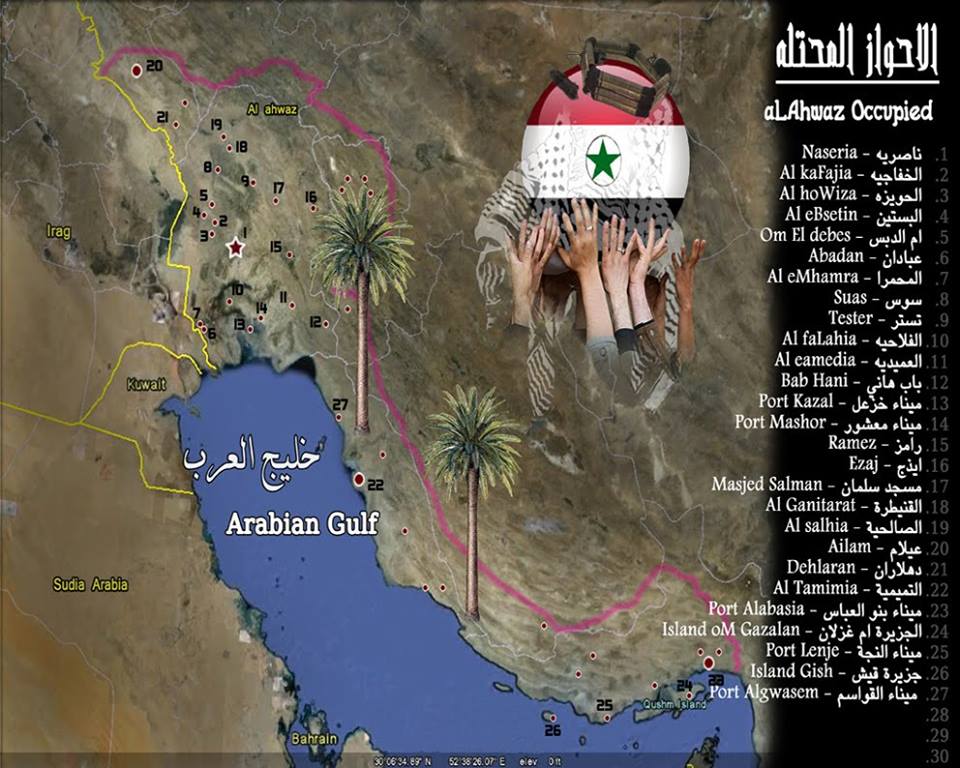
Ahwaz is an occupied Arab country located in the southwestern region of the Republic of Iraq and also in the southwestern region of Persia. It is bounded on the north by the Kurdistan Mountains the eastern border of the Lorestan Mountains which are known as the mountains of Zagros. These mountains in the north and the east create a natural border that separates the Ahwaz Arab lands from Persia. To the south, Ahwaz lies along the northern coast of the Arabian Gulf.

In terms of climate, the areas of occupied Ahwaz are quite similar to the plains of Mesopotamia as well as being entirely different in all respects with the climate of Persia.

Arnold Wilson, the British civil commissioner in Baghdad in 1918-1920, also asserted when he visited Ahwaz or Arabistan, “Ahwaz (Arabistan) is quite different from Iran. Ahwaz is surrounded by mountain chains forming a wall completely surrounding Al-Ahwaz and constituting a geographic division. The interval between Ahwaz and Persia and the difference between Ahwaz and Persia resembles the differences between Germany and Spain. In addition, this difference is not only confined to the geographical landmarks of Ahwaz, but includes culture, language, customs and traditions, history and population, fertility of the land and agricultural crops”.

The actual total area of this occupied Arab land is 375 thousand square kilometers, but the subsequent Iranian occupying governments have proceeded to usurp vast areas of this Arab land and have annexed adjacent Ahwaz areas to the Persian regions, all for the reason of legitimizing the diminishment of the area of Ahwaz. This organized plundering, shrinking the area through a land-grab and pernicious policies had been sought since 1936 up to the present day where Persian governments, under the pretext of conducting modern administrative regulations have truncated the following parts of Ahwazi lands:

  • Cutting off 11 thousand square kilometers of southern lands of Ahwaz and annexing it to Fars Province.
  • Cutting off 10 thousand square kilometers of eastern lands of Ahwaz and annexing it to Esfahan Province.
  • Cutting off 4400 square kilometers of northern lands of Ahwaz and annexing it to Lorestan Province.
  • Other regions such as Elam, Bushehr, and Bandar Abbas also have been cut from Ahwaz and exposed to Persianization policies by displacing its indigenous Ahwazi Arab inhabitants and settling Persians there. In Bushehr and Bandar Abbas large numbers of Ahwazi Arab inhabitants have been forced into Arabian Gulf countries after experiencing oppression, poverty, the appropriation of their property and possessions, particularly through forcible confiscation of their lands.

Consequently, the map of Al-Ahwaz has dramatically been shrunk from its original size to 159,600 thousand square kilometers according to current Iranian statistics.

Despite the lack of accurate statistics on the precise amount of the Ahwaz population, the number of residents of this occupied Arabic country is estimated to be eight million people. According to the most recent census issued by the Persian government in 1962, the population of this country that remained after the annexation of large regions from it was approximately 3.5 million Arabs. In addition to the 100,000, settlers who came from the Persian cities to this country after Reza Shah Pahlavi invaded Ahwaz.

According to other statistics recognized by the Persian occupation which was carried out after administrative divisions led into truncation, large parts of this usurped Arabic country the Ahwaz or Khuzestan area, as Persian rule calls it, is 64,236 square kilometers and the census of Arab people is 374,6772 residents.  So, if we retrieve the population of the separated areas and add it to the aforesaid number, then the number of Arab inhabitants of Ahwaz will reach nearly eight million people.

Since 1925 and right after the fall of its last Arab ruler through the military occupation of Reza Shah, Ahwaz has been the target of racist policies of successive governments of Persian regimes.

The most vile, dangerous and destructive policy inflicted on Ahwaz is the plague of Persianization that is changing the demographic composition of Ahwaz with the goal of eliminating the Arabic identity and destroying all its major pillars of nation building.

ahwazThis policy in the long-term has drawn a vicious vision for the Persian occupation that is the requisite of dragging the Ahwazi Arab nation to a stage in which calling it a nation will no longer be possible. They have spared no effort to make this vision a reality on the ground. The practices and policies undertaken by Persian occupation can be divided into two eras.

The overt racist philosophy of Farsism began in the form of the pan-Iranist party during the Reza Shah Regime. But our intended concept is the inherent popularized idea of Farsism that has penetrated deeply into the mind and the characters of the Persian people, even those who are seemingly combating racism.  However, they are more Catholic than the Pope when it comes to anti-Arab sentiment or fighting against Arabs.

The contemptuous attitude toward other non-Persian, people particularly toward the Ahwazi nation, constitutes the backbone of Farsism as an ideology. In fact, the policy of racial discrimination is being applied at the beginning of the founding of the state – the nation.

The Ahwazi Arab people have been the first victims of this policy. Because the radicalism of Farsism, which seeks to maintain and stabilize its illegal roots in the land that was occupied it by force, has committed mass murder and genocide of Ahwazi Arab people in different ways. Before the occupation, Ahwaz had a homogeneous Arab population with various clans and tribes.  After the conquest of Ahwaz and consequent overthrow of Arabic rule, Reza Shah by applying the recommendations of Farsism theorists such as Foroughi, Mirza Malcom, Akhound Zadeh and Taghi Zadeh, practiced the policy of forced migration and displacement of populations against the Arab people. In his first criminal acts, we can refer to the mass exile of Arab sheikhs outside Ahwaz.

Then, he ordered the banishment of a large number of Ahwazi Arab tribes to the Khorassan region, forcing them to walk barefoot long distances day and night without water and food, having to cross grueling mountain routes as so many women, children and elderly people were killed due to extreme fatigue, thirst and starvation.

For years, Reza Shah had widely practiced the policy of reverse migration of Ahwazi people to the central Persian regions and in contrast promoted the settlement of Persian people in Ahwazi regions.

AHWAZ MAPThe nomadic Lur and Bakhtiyari tribes, as their original homelands is beyond Zagros Mountains and because of their proximity to the northern regions of Ahwaz, had frequently travelled  with their herds to Ahwazi areas to find pasture lands to feed their flocks of sheep and goats. This situation helped Reza Shah to resettle them quickly in Ahwazi areas especially in Qenitra (Dezful) and Susa (Shush).  The Bakhtiyari tribes were only living in mountain regions and foothills of the Zagros in Izeh and Masjed Soleyman and in winter and summer they were commuting between their original homeland and the Ahwazi areas (Izeh and Masjed Soleyman. This meant that they left Ahwaz in the summer and returned to Ahwazi areas in the winter. These areas had the greatest potential for changing the demographic composition of Ahwaz. However, the industrialization of the cities of Abadan and Ahwaz had created the basis for the massive migration into the cities.

The Pahlavi regime repeatedly sent groups of Persian laborers into cities and through the granting of privileges, established a Persian middle class in the heart of Ahwazi cities, thereby enabling and reinforcing its occupation policies. Since 1925 the systematic migration of Persians has been carried out through the settlement of the “Lor and Bakhtiyari” tribes in Izeh, Masjed Solyman and Qenitra (Dezful), agricultural projects in Toster to Muhammarah, and industrial and oil projects in Ahwaz and Abadan.

Once Persian immigrants started to descend on Ahwazi cities, it did not take long for the total political domination of the Persian state over Ahwaz. Further development of the Abadan oil refinery in 1938 led it to become one of the largest refineries in the Middle East, providing thousands of job opportunities and paving the way for the arrival of many immigrants.

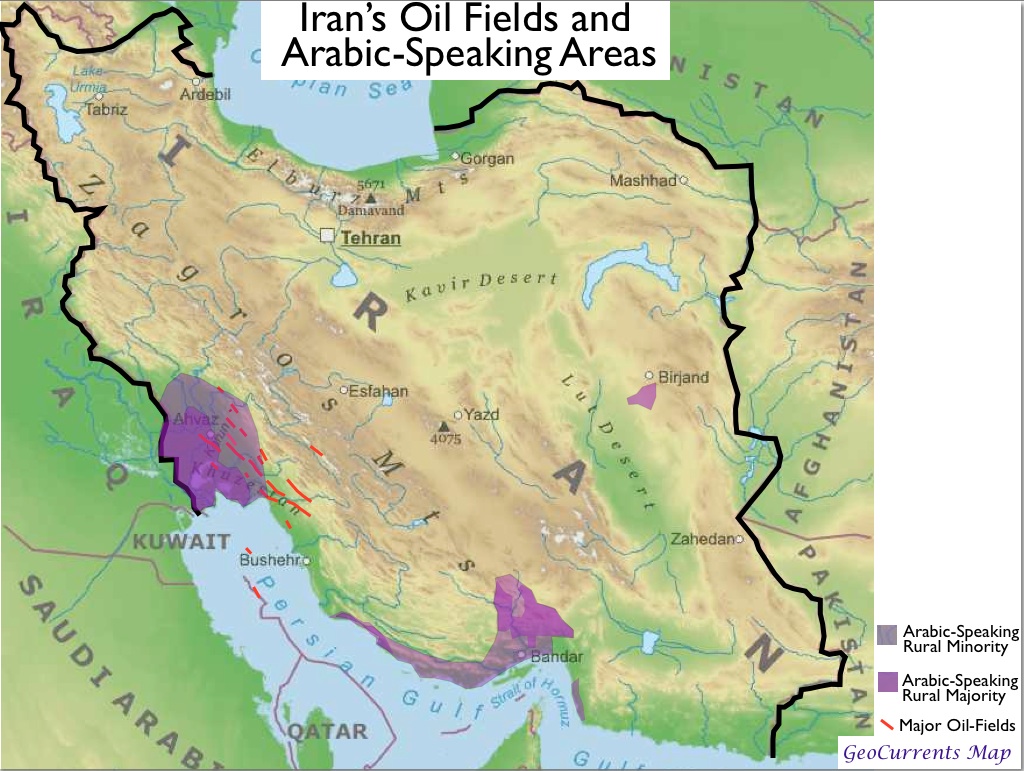
Iran_Oil_Arab_Population_MapApproximately 25 years after Reza Khan entered the region, the population of Abadan increased to 227,000, more than ten times that of 1956. The arrival of Persian settlers was to such an extent that there was not sufficient housing to lodge them. It followed that the English-Iranian Oil Company had to construct exclusive residential buildings for their workers and employees, and these buildings are known as “Bangleha”. According to government statistics, 62 percent of these immigrants are from the Isfahan and Yazd provinces, 24 percent are from the Fars province and 8 percent from the Kermanshah province.

These government settlement programs resulted in an influx of large numbers of Persian settlers to the cities of Abadan and Mahshor. The occupation authorities ever since have sought to build new industrial hubs in other major cities in an effort to further spread the scale and scope of Persian settlement of the cities of Al-Ahwaz.

Through the establishment of governmental centers, industrial factories in and around the Ahwaz capital, in addition to promoting and strengthening the military’s role in establishing large military bases, improving roads and routes leading to Ahwaz city, they created another new industrial hub in the region that brought tens of thousands of Persian immigrants to the city.

The consequence of this policy led to the population of Ahwaz city in 1977 to reach half a million people, surpassing Abadan and other cities.

The outbreak of the Iran revolution in 1979 and after the Iran-Iraq war, the migration of Iranians to Ahwazi regions had relented for a while. But after those ethnic statistics were excluded from the official statistics of Iran, it was the beginning of a lack of transparency in statistics related to immigrants coming to Ahwaz.

As every year, the hideous assimilation phenomenon (Persianizing land and human settlement) plagues Ahwaz, mainly the northern and the eastern bordering regions. This monstrous occupying Persian state aims at devouring the entirety of Arabic characteristics of Ahwaz.

Changing the demographic structure in favor of non-Arab immigrants, changing the Arabic names to Farsi ones, the ban on teaching the Arabic language and breaking up Ahwazi territories by annexing parts of Ahwaz and inserting them into Persian regions adjacent to Ahwaz are all part of the agenda, seeking the corroboration of the occupation authorities in targeting all the pillars of the national Arabic identity of the Ahwazi people.

In addition to forced migration and deporting Arab people to Persian regions and reverse migration of non-Arab people into Ahwaz, the Persian state has adopted other evil methods against the Ahwazi people.

The confiscation and plundering of agricultural lands by Persian feudal owners followed new approval of agrarian reforms.  Under the new and unfair law, the non-indigenous feudal entities had seized the chance to illegally become the owners of the lands that had previously been usurped from Arab farmers. In this regard, the death of Majid Khan, the great feudal owner, had been a perfect opportunity for the Persian central government to take control of 25,000 hectares of the lands that were virtually usurped.  Later, the occupation government has established the “Karoon Sugar Cane Development project” on these confiscated lands in the Toster (Shushtar) region.  As a matter of fact, the agrarian reforms made by the government were not so different  when compared to the feudal ones with respect to giving the possession of lands by its main Arab owners and once again it was a lose–lose situation for Ahwazi Arab farmers. Although some feudal lands were granted to Arab farmers, the majority of lands that were under the possession of feudal ownership, once again were confiscated by the central government and  Arab farmers were deprived of their lands forever. Additionally, those nomadic Lor tribes that forcibly settled on Ahwazi lands according to the agrarian reform Law become the owners of lands that formerly had belonged to the Arab people.

In Mahshor, Temimiyeh (Hendijan), Khalafeyeh, Ramez and Omideyeh the Pahlavi government claimed that the lands belonged to a Persian person named “Hosseinqoli Nezam Alsalteneh Ma’âfi” and after his death the government declared the confiscation of all these lands.

The Pahlavi government’s argument that apparently based is on speculation and lacks any credible evidence was announced as follows:

It seems that before the ownership of lands by Hosseinqoli Nezam Alsalteneh Ma’âfi, these lands were under the authority of Sheikh Khazaal (the ruler of Ahwaz) but when Sheikh Khazaal married Batul Ma’âfi, the daughter of Hosseinqoli, he endowed the lands to Hosseinqoli Ma’âfi.  After the fall of Sheikh Khazaal and occupation of Ahwaz, Hosseinqoli Ma’âfi gave half of these lands to the government endowment organization and kept the rest in his ownership until the end of the Pahlavi regime. Later the Islamic Republic seized the part of lands owned by him. Now the Ahwazi Arab people, the original inhabitants of these lands, remained tenants residing on the lands that mainly belong to them and every time the landlord (government) wishes it can expel them from these lands.

Most statistics and evidence show that the government has put more focus on changing the demographic structure of Al-Ahwaz. Because they know well that a divided and heterogeneous nation is no longer able to stand against colonialism for this reason, the government has ever since been targeting the Ahwazi Arab nation from the inside.

It is a silent killer policy aimed at exterminating the entire Ahwaz population, and it has been pursued in the form of changing the demographic structure of Ahwaz.  This inhuman act is conducted without adequate news reflection or attention. In silence, its annihilating consequences are disintegrating the Ahwazi nation from the inside.

In addition to the above methods, the government has deployed modern methods for changing the demographic structure, such as constructing Persian settlements to make a rapid and widespread change in the fabric of the population in favor of Persian settlers.  New Yazd and New Isfahan settlements built in Khafajah city are only examples of these grave crimes that not only have not stopped under the current Islamic Republic regime, but have continued with greater frequency and intensity.

Of course, these are just a few cases of the Pahlavi regime’s crimes in the demographic structure of the Arab nation of Al-Ahwaz. In the second part of this article, we will shed more light on the current policies of changing the population structure of Al-Ahwaz under the Islamic Republic regime.


WRITTEN BY MASSIMO RUSSO, translated by Mary Rizzo
What do the tears of Shirin Ebadi and Tawakkul Karman at the summit for the Peace of Rome tell us: if we don’t like the present, it is only up to us to change it

Shirin Ebadi and Tawakkul Karman on stage at the summit of Nobel Laureates The embrace between Shirin Ebadi and Tawakkul Karman on stage at the summit of the Nobel prize winners (Photo: Wired)

Shirin Ebadi and Tawakkul Karman on stage at the summit of Nobel Laureates
The embrace between Shirin Ebadi and Tawakkul Karman on stage at the summit of the Nobel prize winners (Photo: Wired)

“I ask forgiveness on behalf of the Iranian people for what the government of my country has done first in Syria, supporting a dictator – Bashar al-Assad – who kills his own citizens, and now to the Yemen of my sister Tawakkul, because it is helping the counter-revolution to stifle change. ”

Sometimes international meetings on peace are resolved in formal occasions to repeat formulas that are a  little ‘age-worn’. At the 14th World Summit of the Nobel Peace prize, which is being held these days in Rome, things were different. The abstract concept of peace and diplomacy became transformed into a hug, and into the tears of two women, the Nobel laureates Shirin Ebadi and Tawakkul Karman, divided by nationality and religion, united by belonging to the species of those who did not give up.

And if you wonder what this has to do with Wired, the answer is: because both these women are innovative. No, they are more than that, they are hackers.

Shirin Ebadi, Iranian, won the Nobel in 2003 for her fight for human rights. Magistrate, she was relieved of her duties and lives actually in exile in London. Tawakkul was the first Arab woman to receive the Nobel in 2011 for her peaceful campaign for equality, freedom and against corruption, which led to the overthrow of the regime in Yemen. A few moments before receiving the embrace of Shirin, Tawakkul had cried out passionately, asking the international community to condemn Iran for its intervention in support of the dictators of Syria and Yemen and against the Arab Spring, in order to establish itself as a regional power and obtain more favourable terms in the negotiations on nuclear disarmament.

Tawakkul in her speech emphasises a concept dear to all disruptive innovators: do not ask permission.

“No one will give you your rights if you are not willing to take them for yourselves, to take to the front lines and fight for them. And the only ones able to declare your defeat are yourselves. If you lose hope, you are already finished, everything depends on you. ”

Ebadi adds: “Democracy is alive, and it must be looked over every day, even when you’ve achieved it.”

Then there’s the idea of hacking. Because only the creative tampering of reality, even when all logic is contrary, it can lead to change in seemingly hopeless situations. All revolutionaries, rebels who are really changing the world, start by listening to themselves, to their own convictions. So they act, and change their own roads, their own community, their own country. Without any excuses.

What does this embrace between two extraordinary women in a sleepy Roman Saturday morning have to say to us? Again, the answer is a lot. To all of us. The first words that Shirin Ebadi addressed to Federica Mogherini, EU High Representative for Foreign Policy, and Italians were: “Do not accept the money of dictators. Many have brought their wealth to Italian banks. “But the real point is that people like these, with their vital example, speak to our attitude of detached cynicism, western pessimism of bored depression. The fate, the future is in our hands. From the crisis to corruption, to work, which is not created by decree. Nobody will change our destiny in our place. And the hunt for the culprit, to those who have it taken away, is simple. Just get up and look straight the first mirror.

original: http://www.wired.it/attualita/politica/2014/12/13/labbraccio-nobel-senso-dellinnovazione-nostra-pigrizia/

WRITTEN BY MARY RIZZO

What precisely is the USA doing regarding Syria? Has it changed its policy over the course of the years since the start of the protests in Syria in 2011? Are the events at the confines of Europe enough to bring a return of multilateralism in response to global crises or even a change in command? To answer the first two questions, it’s a good idea to understand what the USA has had as its goal regarding Syria. It would be too elementary to state simply that they are “looking after their own interests” and defining those interests only in two traditional compartments: control of energy and resources and management of Israel. The first compartment demands no explanation, the second is heavily tied in with maintaining the regional “instability” (not stability, as one might think) because as long as there is an illegal occupation that the USA traditionally supports economically and diplomatically, creating tensions internationally and allowing the USA and its allies to determine a military presence and accept that there is nuclear proliferation in the area, despite having themselves signed the NPT, they can continue to influence events and policies, thus making the control of energy and resources more successful.

everyone in power gets what they want.

everyone in power gets what they want.

However, it is not really either of those two issues that may be the driving interest of the USA regarding Syria. The USA, like any other country, naturally has to have an interest in order for them to do any kind of action, and refraining from an action while stating that actions could be taken is also an action. The USA has been very vocal regarding Syria and they have done specific actions since the start of the uprising, most of them, however, detrimental to Syrian people. The interest they have is to re-establish authority and influence with smaller countries within the new global situation where the relationship between the West and the East has changed. Oddly enough, this is the same problem that Russia has, left as it is without the clearly established balance of power and satellite states, and it seems that the arena for this to play out is Syria.

For a very long time some have attempted to deny that the Syrian people had ever risen up themselves. “Conspiracy buffs” as well as reactionary thinkers of every colour of the political spectrum, believed that it was not possible that civilians could continue to protest against their government even after the government reacted brutally to repress the protests, promising only more blood and destruction. Nor could these “thought leaders” or “vanguards of anti-imperialism” believe that there could be defections from the Syrian Army, where they formed a defensive army that later had the stated goal of overthrowing the government if the government would not step down. The government, naturally, had no intentions whatsoever to step down, and used the smokescreen of “sovereignty” in order to pursue its policy of using brutality to repress the protests and stay in power.

There are conditions both in international law and in what is established by customary international law where sovereignty is considered to be a lesser “right” than the right of protection of human life. In 1999, even without a UN mandate, customary international law permitted international intervention in Kosovo and it went under the journalistic name of “humanitarian war”, surprisingly, having as some of its supporters persons considered within the vanguard of humanitarianism such as Vaclav Havel who stated:

“I believe that during intervention of NATO in Kosovo there is an element nobody can question: the air attacks, the bombs, are not caused by a material interest. Their character is exclusively humanitarian: What is at stake here are the principles, human rights which are accorded priority that surpasses even state sovereignty. This makes attacking the Yugoslav Federation legitimate, even without the United Nations mandate.”

Right on the heels of the moral and practical questions regarding the appropriateness and feasibility of “humanitarian intervention”, scorned by some humanitarians and endorsed by others, comes the other pressing issue concerning intervention, no less bitterly disputed by humanitarians, that of “regime change”. The Syrian people, when they took to the streets to protest, as is now understood by even the staunchest defender of Assad, were not demanding a regime change. They were making explicit demands for reforms and against corruption and what was widely regarded as a governmental policy where privileges, opportunities and development were handed out or withheld along sectarian lines. Those closest to the regime had less trouble advancing and the average citizen was excluded from progress or actually discriminated against on a daily basis according to his or her religious or ethnic belonging. It didn’t take long for the demand for reforms to turn into a demand for Assad to give up his power, because no longer was it considered as legitimate. Not only for the not-insignificant matter that he basically inherited the power, for the leadership of Syria, following the coup of Bashar al-Assad’s father, was simply autocratic rule of a family dynasty with the Ba’ath party providing a way for non-family members to obtain some power.

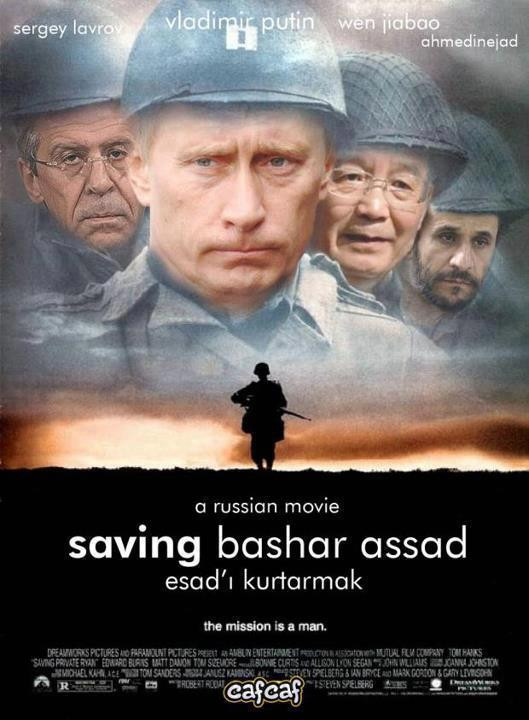
SAVING ASSADThe uprising had all the aspects of a revolution, including mass defections of the regular army into a people’s army with the goal of overthrowing the government in power. The problem, however, is: once the government goes, something else is going to have to come after it, and neither the US administration nor the apologists in the west who go under the code name of “anti-imperialists” were willing to see some kind of self-determination of the people, since they had not been either groomed for democracy nor were the ideologically prepared to set up a state that would cater to the agendas of the anti-imperialists.

Can a people who are demanding the end of an illegitimate government (and the government did not gain in legitimacy simply by staging sham elections) have conditions put on them externally as well as the internal violence used by them so that they cease and desist? Is any assistance given so that they obtain their goal deemed as intervention? We’ve seen how the anti-imperialists aren’t against foreign intervention, since they strongly support that of Russia, Iran and Hezbollah in favour of the upholding of the regime, but they simply do not want US intervention, because they have “interests and an agenda”. Seeming to wish to appease this faction, though not wanting to close off future options, The US Administration used a non-interventionist approach, hoping that Assad would simply leave, or that there could be a political solution, because he had to know, he was a very, very bad man and the USA was going to verbally condemn him for as long as it took! The records are full of scores of condemnations from the Commander in Chief, the Secretary of State, the Spokesman for the White House and the UN representative. Obama has gone on record with a powerful statement of condemnation in February 2012, following the Homs Massacre:

“I strongly condemn the Syrian government’s unspeakable assault against the people of Homs, and I offer my deepest sympathy to those who have lost loved ones.  Assad must halt his campaign of killing and crimes against his own people now.  He must step aside and allow a democratic transition to proceed immediately. Thirty years after his father massacred tens of thousands of innocent Syrian men, women, and children in Hama, Bashar al-Assad has demonstrated a similar disdain for human life and dignity. Yesterday, the Syrian government murdered hundreds of Syrian citizens, including women and children, in Homs through shelling and other indiscriminate violence, and Syrian forces continue to prevent hundreds of injured civilians from seeking medical help.”

Secretary of State Hillary Clinton still thought there was a diplomatic solution to get Assad to step down, or simply “goes”, as she had said at the heels of the Hama Massacre in June 2012.

 “We’re disgusted by what we see happening. The regime-sponsored violence that we witnessed again in Hama yesterday is simply unconscionable,” she said. “Assad has doubled down on his brutality and duplicity, and Syria will not, cannot be peaceful, stable or democratic until Assad goes.”

Then a year and a half later, when the more crude massacres were being replaced by a seemingly endless, and still ongoing, campaign of barrel bombing on civilian areas outside of regime control, the White House continued to condemn the regime. Press secretary Jay Carney said:

“The United States condemns the ongoing air assault by Syrian government forces on civilians, including the indiscriminate use of SCUD missiles and barrel bombs in and around Aleppo over the last week.” Yet, he still believed that in spite of the policy of repeated air raids using SCUD missiles against civilians, he called on all parties in the Syrian conflict to “reach a comprehensive and durable political solution to end the crisis in Syria.”

Yeah, that usually works.

To not seem like they were just good at words but short on deeds, the US also supplied some forms of military aid and training. To a very select few, almost never providing them with what they asked for according to their needs, and absolutely not anything that might involve direct intervention or even the request for a No Fly Zone, a demilitarised zone in the sky that perhaps could not be properly enforced, but at least points in the right direction at the ending of aerial attacks. This aid had the characteristic of being just enough assistance to keep some pressure on Assad, but not enough assistance to remove him. Apparently, the US strategy is to wait for Assad to “step aside”, “go” or even be one of the parties to “reach a solution”. The way things are going the only Assad solution looks a lot like the final solution.

Is there still any doubt that the longer this regime stays in place, the worse things will be?

RED LINECould that truly abhorrent policy of “the worse things are, the better they are” be the endgame in the plans of the US? Is their current intervention – one that leaves Assad unharmed, allows his army to concentrate on fighting the “rebels” while others fight it out in the areas where the risks of loss of crucial air power are greater, allowing Assad to be constantly armed by Russia – a deliberate policy? The morphing into a War on Terrorism has become the excuse to intervene selectively while allowing the regime to remain in power. Despite the focus of the US solely on ISIS, it is clear that the only way to save whatever remains of Syria and stop the suffering of the Syrian people is to remove the regime by any means possible in the shortest time possible. To leave the regime in place is to allow a murderous dictator to continue his policy of mass destruction of the assets of the nation and genocide of the population. Therefore, the US solution is not a solution and it can’t be accepted. Stopping a dictator of this sort is one of the reasons that international law is granted legitimacy to intervene, taking precedence over any reasons of sovereignty, which have been violated at any rate by the Russian and Iranian contributions since the very beginning of the war.

There is and has been more than enough evidence, directly presented to the USA administration as well as available to the international community and even to private citizens to verify for themselves and that prove without the slightest doubt that the regime has engaged in actions within its own territory that are in violation of human rights. There is clear evidence that the regime is the perpetrator of massacres, including those deemed even more serious than massacres with conventional weapons because they involved use of weapons of mass destruction (chemical weapons). The western apologists repeated the regime line at first, denying that the regime even had any such things and that the massacres of civilians in opposition areas was work of the opposition itself so that they could frame Assad with crimes he did not commit, but Bashar al-Assad himself threw them all for a loop, finally making an “executive decision” to save his skin. He debunked many of these feckless supporters by agreeing to “surrender the chemical stockpiles” to an international body so that they could be destroyed as part of the reassuring deal that the US would refrain from military intervention as a result of the regime turning over its enormous stock of WMDs, including of course, the very Sarin gas that the Assad supporters claimed did not exist.

Where the USA was willing to appease and be appeased, assured that if they intervened, it would never be enough to change the game, or upset their “rival” Russia, and surely not have the aim of regime change, the European Council, in its Foreign Affairs meeting press release stated:

“Non-inclusive policies in Iraq, and instability in Syria caused by the Assad regime’s brutal war against its own people, massive human rights violations and systematic obstruction against democratic reforms, have allowed ISIL /Da’esh to flourish. As a consequence of its policies and actions, the Assad regime cannot be a partner in the fight against ISIL /Da’esh.”

And further:

“The EU is seriously concerned about the humanitarian and security situation in Syria and Iraq and condemns unreservedly the attacks, atrocities, killings and abuses of human rights perpetrated by ISIL / Da’esh and other terrorist groups in both countries as well as by the Assad regime in Syria. The EU is determined to contribute to the international endeavour to defeat those terrorist groups. A Syrian led political transition and inclusive political governance in Iraq are crucial to sustainable peace and stability in the region.”

The question comes naturally, has the USA unequivocally condemned the Assad regime in such clear terms, even attributing to his regime “allowing ISIL/Da’esh to flourish”? The answer is, “No”.

The US is aware that the EU collectively does not possess its own army to enforce the military policies that might derive from Foreign Affairs directives. It does not have the unified military might to actually “contribute” to defeating terrorist groups, though, differently from the “Coalition intervention”, the EU has officially rejected having Assad as a partner in defeating them. In fact, it implicates that the transition to follow the war will be Syrian in Syria and Iraqi in Iraq. It envisions victory in the “war on terror”, but it also rejects what is so far the Russian paradigm of support of the regime and the US one of tolerance of it. The US however, isn’t that concerned about what the EU will or will not do or want, because while they prefer multilateralism, if their allies don’t have the same plans, the US will carry on without any problems in unilateralism.

Tensions are increasing in the Eastern European countries that see the return of Russian expansionism.

Tensions are increasing in the Eastern European countries that see the return of Russian expansionism.

Now that Russia has also returned to its tendencies of expansionism, States under its influence and economically tied to it are undergoing dramatic events so as to get closer to Europe. This increased tension in the area, the blurred line between West and East, is going to contribute to just how far Russia is willing to go for broke with its own interests. Is Russia powerful enough and interested enough to face down both the US and the EU in a power battle that is playing out in Syria and the Ukraine? The veto power in the Security Council only goes so far, at the end of the day, wars are fought on the battlefield. The US is willing to flex its muscles, but not upset the balance too much. The EU would be in a unique position of bringing the war to a quicker end if they are serious and not just using the “condemning” in the traditional way, but they would need to enlist individual armies in the effort, something that is highly unlikely. The vast military spending each nation has, while paling in comparison to other countries, still has provided most of Europe with the most advanced systems on the market. Many of the air forces in Europe are equipped not only with a substantial amount of extremely costly F35s of dubious quality, but also with scores of Dassault Rafale, Eurofighter Typhoons and other advanced fighter planes. These aircraft must have been placed into the budgets of these nations not only to decorate the hangars and give pilots something to practice on. It would be feasible for several air forces alone to enforce a No Fly Zone if there is political will to do so. There already is more than enough legal justification for such action. So not acting militarily, even taking into account the difficulty of such a thing, seems to be a matter of choice. All of that will turn what was a revolution indeed into a proxy war, at the expense of the Syrian people. There are better choices to be made, and they have to be made before it is too late. If the US is unwilling to do what is necessary to stop a genocide, Europe should take the lead in international affairs. Not only will it help save Syria and its people, but it will establish multilateralism, which itself is a requirement for self-determination in post war transitional periods.

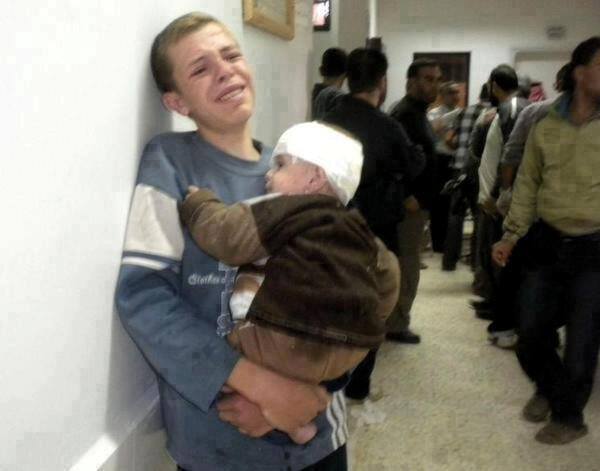
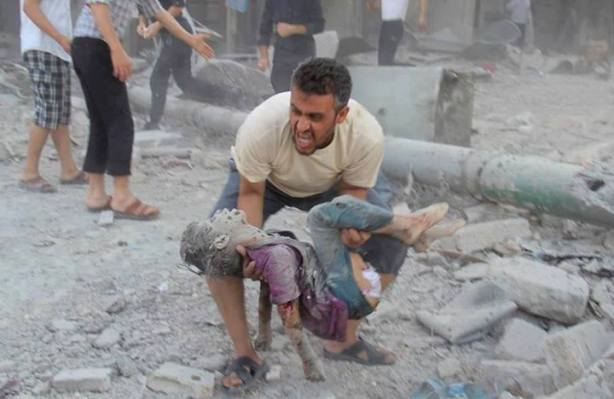
Most of us recognise this picture as being from Aleppo. Aftermath of one of the market bombings by the Syrian regime against a civilian population. It circulates also as Gaza, where those who are then corrected, instead of saying, "this is terrible and  a crime against humanity" say instead, "Well, it REPRESENTS the suffering of the Gazans". The point is lost and truth is not served.

Most of us recognise this picture as being from Aleppo. Aftermath of one of the market bombings by the Syrian regime against a civilian population. It circulates also as Gaza, where those who are then corrected, instead of saying, “this is terrible and a crime against humanity” say instead, “Well, it REPRESENTS the suffering of the Gazans”. The point is lost and truth is not served.

WRITTEN BY MARY RIZZO
The question invariably arises when one loses faith in the narratives of the news media: If the mainstream media sets forth aspects of an issue in order to put forth a particular agenda of the dominant or powerful sector of society, and even the so-called alternative media presents its own narrative to push ahead its own ideologies or values and effect the situation with its own “solutions”, where is one to turn to if one seeks to know the truth?

The answer is simple and complicated at the same time. One has to find the truth oneself. The truth is indeed “out there”. The problem though is that it is an enormously cumbersome and time-consuming task to get to it, so difficult and depressing, in fact, that too many give up on it and fall back on whatever the media narrative is, even when we know and have the proof that it is full of lies, full of holes or full of propaganda. The truth can be found not in the various narratives of the news media, but in the vast and bottomless well of the body of evidence. To get to the truth, one has to do one’s own digging, sorting, one has to do one’s own thinking. One can only get to the truth on one’s own and only with great determination and persistency.

It is absolutely frustrating to look at the news on TV or read it in the paper and see things that not only “don’t look right” but “don’t feel right”. We claim (well, most of us who are interested in civil justice and world peace) that we are supporters of human rights. But do we realise that often what we feel as a violation of our own rights on our own soil we shrug off as just “the way they do things” when it is on a vast scale in another country. Mass arbitrary arrests, bombing of civilian areas, torture, policies of terror and starvation to subjugate a population are wrong in our own lands as they are wrong in other lands. However, for a very long time, the extent of these policies has been kept hidden from us, that is, our media only reported on institutionalised (policy-based) violations of human rights when at some level our own interests were involved or there has been what is perceived as a connection between “us” and “them”.  Somehow, the bigger the atrocity is, the more distant we feel from it and the easier it is to keep us away from this reality. We accept as well the media narrative, which sometimes is just the echo of the regime or dominant narrative because the truth, the reality is far, far worse than what even our wildest ideas of it could be.

Orphans in Ras al-Ain, survivors of a Syrian regime aerial raid; the winter clothes alone should tell observers to look beneath the "insta-pundit labelling" of the sufferers as Gazans.

Orphans in Ras al-Ain, survivors of a Syrian regime aerial raid; the winter clothes alone should tell observers to look beneath the “insta-pundit labelling” of the sufferers as Gazans.

There is a reason  why reality is not presented fully to us and why so many populations have been presented as “other”. The people are depicted as deserving of the oppression because they are primitive, not ready for rights and still needed to be controlled by a powerful figure that would take care of their interests, though at times he might be a little rough, he’s probably some kind of oriental despot that we have to learn to live with out of some perverted idea of “relativism”.

We extend our disgust in various ways towards the population and their ignorance. If they voted, they never did it “right”. If they didn’t vote, that was because they didn’t view democracy as a value and therefore if internal movements towards democracy arose, they would be depicted as being driven from reactionary forces abroad who would then throw the rulers out of power and establish their own protectorate. In essence, the individuals and the geographical/ethnic/linguistic/religious groups they belonged to did not have their own agency to affect their own change, and if they are not “willing” to help themselves, it’s very easy to promote the idea that they are impermeable to change or that it has to be imposed from outside if there is going to be any. Otherwise, they get what they deserve.
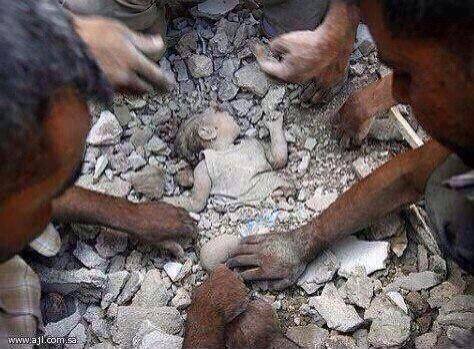
One of the innocent victims of the bombing of Azaz. The Assad regime kills them an the world lets them dig the dead infants out with their bare hands.  This picture has also circulated with great success as having happened in Gaza.

One of the innocent victims of the bombing of Azaz. The Assad regime kills them an the world lets them dig the dead infants out with their bare hands. This picture has also circulated with great success as having happened in Gaza.

Only those who  have forgotten (or who haven’t realised) that personal freedom is a right for every human on the planet and that there is a series of rights that belong to every human being in order to truly be considered as being a free individual, regardless of the geopolitical situation in which he or she was born or currently is living will be interested in finding the truth and rejecting the “story”, “spin” or “narrative” that any news providers is giving. News providers don’t appear out of nothing, they obtain their information and disseminate their information according to their own interests. If they support a particular ideology, they will have a bias towards only giving information that supports the tenets of their ideology. If they claim to be media providers that are free of ideological bias and hidden agendas, however, they are going to have to have an ethical code of some sort, they are going to have to follow some kind of criteria for the selection of the material they present.

This is the reason that the only way towards knowing and obtaining the truth is to sort through the body of evidence. We can’t pretend to know everything about everything or even something about everything, but if we are interested in international affairs, if we are interested in civil and human rights, we can’t afford the luxury of laziness. We can’t accept everything that is handed to us as “news” and what IS handed to us under that guise has to be scrutinised very carefully. We have been presented with a multitude of “instant pundits” and experts under various titles who assure us that they have a very consistent response to all the issues they speak about and yet, the only thing they are consistently doing is neglecting the bulk of material that comprises the body of evidence. Their arrangement and analysis of information is sometimes even based on no evidence at all, but mere speculation and repetition of what anyone could recognise as propaganda if they actually look at their sources of information or the repetition of specific images over the course of time.

A body of evidence, on the other hand is not sorted, is not usually accompanied by “analysis” of experts and it has a scientific criteria that we can apply, it has a rationale that we can use to judge and verify its strength. First of all, we have to have access to information that is as close as possible to those affected by events. We unfortunately know that witnesses to events, particularly in the worst and most inhuman situations, are too busy trying to survive or escape than they are in trying to inform the outside world about what is happening to them. Outsiders who make it in often themselves become victims of the same situation, so the number of outsiders must be dramatically reduced in order to prevent complications. But, in situations such as war in Syria, the body of evidence is overwhelming in its immensity. There are literally millions of photographs and videos available to anyone at any time. There are millions of witnesses who are able to tell what is happening instead of just posing for a photograph in their miserable setting of an overcrowded and disease-infested refugee camp. There is actually SO MUCH information that we are numbed by the overwhelming quantity of it… but mostly, it is surprising to find that despite the fact that the consistency and veracity of it (given strength by its size, range, content, precision, directness) is overwhelmingly constant: and almost always pointing in the same direction and the news media still seems to ignore it in favour of its own bias which is that of ignoring the voice and evidence of the oppressed in favour of a different narrative with its own appeal and history.

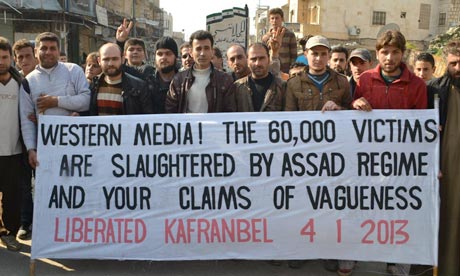
One of the hundreds of banners by the Kafranbel Media Centre... direct, to the point, and with no need for interpretation.

One of the hundreds of banners by the Kafranbel Media Centre… direct, to the point, and with no need for interpretation.

Since the onset of the uprising, protesters were determined to document the events in every way possible and to disseminate what they gathered outside of Syria. They did not own media providers, they were not part of an information “system”, they simply were providing evidence, most of it videos documenting the events and photographs of places during a protest or march or immediately following a sniper attack, a bombing, and later, a massacre. What has developed in Syria is a multitude of independent media aggregators, the Sham News Network, the Aleppo Media Centre, the phenomenon of the Young Lens photographers, the Kafranbel Media Centre and hundreds of others in every province and town, no matter how small. They collect, subtitle, disseminate and identify the evidence of the hundreds of thousands of witnesses to the war in Syria. They open YouTube channels, Facebook pages and blogs where anyone and everyone, INCLUDING mainstream and alternative media providers can tap into their evidence, and luckily, some outside news aggregators have picked up on their evidence and helped spread it far and wide. The problem is, the media providers that have a long history and prestige or are financed by advertising or political interest groups don’t tell a “sexy” story if it’s just about the (now four-year-long) struggle for survival of a besieged and oppressed people who have the misfortune of neither being of interest to the “imperialists” or the “anti-imperialists”, which are by the way, simply code words to express two variations of reactionary ideological thinking, where individuals don’t have rights, collective rights are also selective and all people can be fit into the prism of the narrative or spin of their administrations, regimes or leaders.

There is no shortage of evidence, the evidence provided meets all the criteria to be accepted as valid, even if it contradicts the story of the mass media, which often just serves as an amplifier of those who have the most power, preserving their interests. There is a clear causal chain that is evident to anyone who decides to access the body of evidence. The causal chain’s importance is heightened by the sheer magnitude of the evidence available. Literally, there are thousands of photographs and videos available that document the enormous quantity of atrocities committed against the people. It is not difficult to corroborate the evidence of the perpetrators of a massacre, and while the “pundits” will take the word of one “anonymous insider” whose words seem to mimic the regime narrative regarding who is responsible for the nerve gas attacks against the populations of the “free” towns that were resisting Assad and often victim to the regime’s violent attacks with more “orthodox” means, they refuse to study the evidence of experts who state that the only possible perpetrator is the regime and produce convincing argument that stands up to scrutiny, likewise corroborated by third party investigators who see more than the films, but have access to the sites or can scientifically test the tissue of survivors.

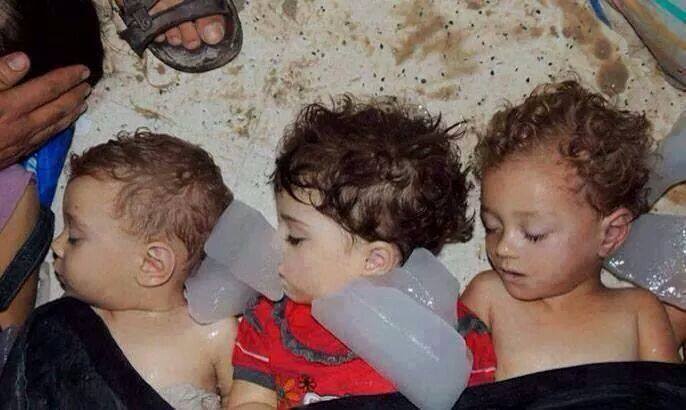
Infant victims suffocated in their sleep by Sarin in Al Ghouta (at the Arbeen field hospital). The fate of these innocent vicitms was "too horrifying" to be shown, but that all changed when they were recycled as victims of Israel and not of Assad and our indifference.

Infant victims suffocated in their sleep by Sarin in Al Ghouta (at the Arbeen field hospital). The fate of these innocent vicitms was “too horrifying” to be shown, but that all changed when they were recycled as victims of Israel and not of Assad and our indifference.

Yet, how could anyone in their right mind continue to even question or doubt such an obvious massacre as that of Ghouta? How could the proof of the culpability of the regime be in doubt for even one minute when their sponsors and patrons in the UN Security Council vetoed decisions made in Human Rights Commission following a detailed war crimes report to support the effort to bring the matter to the International Criminal Court which would judge the body of evidence in a legal seat and then exercise Justice, which then the world powers would have a leg to stand on when they took positions for or against Assad? By closing their eyes to the evidence, despite how great, consistent, direct, precise and applicable (i.e., bearing all the qualities that give what is known as “strength” to a body of evidence) they are able to hide the truth, but not to stop it being true.

Not only the massacre of approximately 1500 men, women and children by suffocation from exposure to nerve gas, but hidden or distorted are the numerous and well-documented “white weapons massacres” by knives and bayonets that are the signature of the Shabbiha thugs who operate for Assad, terrorising villages and leaving hundreds murdered despite their age, condition or innocence. The massacres of Houla, Banyas, Deir Ezzor and countless others have left in their wake hundreds and hundreds of photographs, videos and eyewitness testimony. If one looks at most of the news media though, you are going to find very little reference made to these events and they are simply not providing information on them, often with the ill-disguised goal of exclusion of the videos or pictures due to “the excessive cruelty of the images”, where they fall into the vacuum of oblivion, where our consciences can’t be reached and therefore our outrage can’t be aroused.

Instead they promote “massacres that weren’t” or at least that have no consistent body of evidence such as the “Adra Massacre” or the “Kessab massacre”. The “Hatla Massacre”, depicted as a sectarian attack against Shi’a Muslims by the agencies of the regime, bears a great deal of evidence that it was an armed conflict between anti-regime and pro-regime fighters with civilians caught in the crossfire and not a premeditated massacre to terrorise the population, though as a result, for a time the civilian population fled, as is the case in the entirety of Syria given the amount of urban warfare involved.

What are the images that people remember from the news? They see a “rebel” (not even a member of the Free Syrian Army) eating a heart, they see a “Christian” crucified by Islamists, and to them, the vision of these two images, out of context and factually incorrect (at least in the case of the crucifixion, the victims were Free Syrian Army soldiers, who by their identification are Sunni Muslims) become “the icons” and the real atrocities that matter. The tens of thousands of photographs of the torture of starved prisoners in regime jails was just a blip on the radar. The atrocities committed against Syrians who are tortured to death for crimes they did not commit are too vast to even contemplate. So, see the pictures, then forget them, that is how it works. It is much easier to bear one image and give it any meaning you want or you have been told. It’s not worth it to differentiate between types of atrocities and their intensity of occurrence.

a composite photo of some of the thousands of Syrian infants slaughtered in every way possible, one of them even wrapped in a Syrian Independence Flag... they finally got some interest when they ceased to be victims of Assad.

a composite photo of some of the thousands of Syrian infants slaughtered in every way possible, one of them even wrapped in a Syrian Independence Flag… they finally got some interest when they ceased to be victims of Assad.

But the opposition to Assad, the suffering population has its own iconic images. Millions of them, some of them so familiar to those who have been seeking truth and evidence from Syria for these four years that it comes as a painful shock to see them “recycled” as being Palestinian victims of Israel’s brutal attacks in Gaza. To see the photos cropped to cut out watermarks, Syrian flags or anything that identifies the identity of the victim and the circumstances of his or her death has been a genuine shock and additional accumulation of suffering when one considers that these photos and videos have been shared for years, in the vain effort to inform the world of the situation and the extent of this crime against humanity that is the genocide of the Syrian people, first by Assad’s regime and its infiltrate forces and since the past two years also by the rogue “Islamist” forces that are conducting their proxy wars for the domination of either Iran or Saudi Arabia in the name of their stated objective of the creation of a Caliphate in the Levant.

ISIS, as well as Hezbollah, makes the claim that their enemy is the West, but they are only good at slaughtering and oppressing other Arabs, including Muslims or those who have come to witness and share the information of the besieged and oppressed people, including journalists and human rights workers and volunteers. To the distracted observer, the war is a sectarian war that is now in the face-off stages of secularism vs obscurantism and there is no interest in investigating the facts, but to act “better late than never” against the enemy that is perceived as dangerous to the West, forgetting in essence the actions and objectives of the tyrant whose policies were at the genesis of the entire uprising and who has only consolidated his power in farcical elections that would never be accepted by anyone if they were to happen in their own countries under such condition and lack of democracy or legitimacy. His “election” has given him the perceived license to kill as much and as brutally as possible, and it is a license that he has taken full advantage of.

A roof in Aleppo, again, not surprisinging attracting interest only when it is mislabelled as being the destroyed home of a Gazan.

A roof in Aleppo, again, not surprisinging attracting interest only when it is mislabelled as being the destroyed home of a Gazan.

It is indeed frustrating to realise that the body of evidence proving the total destruction of Syria, its people and its infrastructure, including those who are living in the Palestinian refugee camps who have been subjected to siege, torture, arrest and death no less than their brothers and sisters in Gaza and in the rest of Syria, has been ignored for years, only to be carted out and presented as a different war, a different enemy, a different sponsor. Sometimes the Syrian independence flags that are used by every faction against Assad with the exception of the “black flag Jihadis” are not even cropped out or the subtitles changed. It is with a sickening Orientalism that these victims are passed off as someone more worthy of support, and at least for them, some support has been forthcoming. It is as if Arabs are interchangeable and a defiant Aleppo survivor who painted his ultimate resistance on the ruins of his bombed out roof has become a Gazan. The situation is not identical, though similar, but only one defiant resistant soul is honoured at the expense of another, whose suffering again is buried under rubble and debris. Nothing to see here, move along!

Another iconic image of Syrian grief and suffering,  mislabelled and blamed on anyone but Assad!

Another iconic image of Syrian grief and suffering, mislabelled and blamed on anyone but Assad!

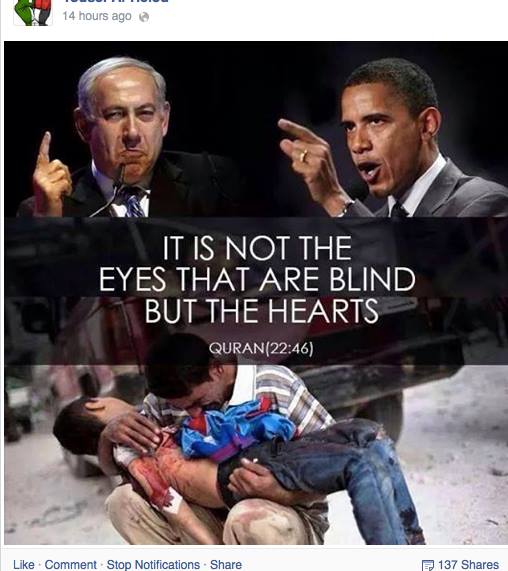
There are shameless people who spread pictures and videos that depict persons in a state of shock after their loved ones are carried off dead in blankets among the buildings that were made to explode and collapse on top of them after air raids in civilian areas. The viewer should use a bit of healthy scepticism to realise that in July winter coats are not worn in Gaza and this event is someplace else, the victims are someone else. The perpetrator of such heinous crimes is not Netanyahu but instead it is Assad.

All of this evidence, the weight of which presents a picture that again and again shows the reality of the situation, the true story of what is happening, stripped from agendas and narratives, all of it is there for us to view. It is a deliberate choice we can make to ignore it and take the easy way out of accepting the stories told by the media that are deliberately hiding or altering this information in such a way so that the struggle to know the truth is stifled, and it is out of our hands to effect change in a positive way to those who are suffering (those whose side we have to be on, no matter what other considerations might influence us such as proximity or religious/ethnic affiliation).

If those who survived a massacre decided to document it, and took all the risks linked to that, they did this so that the truth would not be hidden. They did it in the hopes that those who had the power, influence or ability could help and protect them. They did it not because they want to shock us or draw us into a world that has nothing to do with us, but because this is our world already, it is only a short flight away from many of us or even has touched our shores with its outpouring of survivors of unspeakable atrocities. If we refuse to be lazy, we can look for the truth and we can find it. We are no longer bound to being complicit in genocides and then claiming in the same breath, “we didn’t know” and “never again”. It will be never again ONLY if we make it so NOW. Our task is to be an amplifier of the voices of the people, not a substitute or interpreter of them.  We have the enormous possibility of affecting change simply by not keeping information buried or tearing it out of context. If we choose to, we can save lives and make a better world. It’s up to us. Can we be up to the task? Isn’t it a noble goal to seek the truth and serve the truth?
The Syrians know the Media isn't divided into Mainstream or Alternative. Until evidence is all that matters, they will hold the high moral ground.

The Syrians know the Media isn’t divided into Mainstream or Alternative. Until evidence is all that matters, they will hold the high moral ground.

1397298_611763265539907_779226832_oWRITTEN BY ASMAE DACHAN, translated by Mary Rizzo

The news from Syria and Iraq on the persecution of the Christian and Yazidi minorities on behalf of ISIS is shaking world public opinion.

Is not acceptable, either moral nor civilly or religiously, that a person or a group of people are threatened and suffer violence because of their ethnicity and/or religious belonging and any act which is contrary to the universal principle of equality between human beings must be condemned without reservation.

Respect for the sacredness of human life is the basis of every civil society and must be the premise on which to base any reasoning and every action.

Today, dialogue, brotherhood, solidarity, human solidarity are seriously threatened. There is a danger of seeing burned, together with houses, places of worship, monuments and books, even centuries of coexistence, respect, and dialogue.

Syria and Iraq are, in fact, the cradle of the monotheistic religions and civilisation and have always been an example of tolerance, brotherhood, and opening up to the other, with all the difficulties that have been part of such a thing over time. And it is precisely from this point that we need to start: the dramatic events of these days should not obscure the fact that the serene and fraternal coexistence between Christians and Muslims in these two countries has lasted for centuries, since, that is, when these two great civilisations were born and developed.  It is a historical error to give the credit of the constructive and peaceful coexistence to the regimes that govern these two countries. Quite the opposite: their policies have resulted in the growing bitterness of relations between the different communities that make up the respective civil societies, creating a climate of tension that is the outpost of sectarianism.

The situation in Iraq and in Syria in recent years has become dramatic: the war waged against Iraq in 2003 and never finished (the one that was sold to the world as war to export democracy) and the repression of the regime of Damascus against what should be his own people, which began in 2011 after forty years of domination of the Assad dynasty, have caused hundreds of thousands of deaths. They are two different situations, but the consequences on the population and on social equilibria are sadly all too similar.

In fact, the war, the bombings and the rapes, kidnappings, torture, violence is the humus in which they are born and from which grow evil sprouts of terrorism.

There are many who are taking advantage of the situation of general chaos to conduct parallel wars and satisfy their own interests and the interests of those who are pulling their strings. The case of Daesh/ISIS, the infamous Islamic State of Syria and Levant, is proof of that.

Hordes of barbarian mercenaries have been infiltrated into two countries, armed and trained by foreign powers and in fact supported and given free rein by the governments of both countries and, taking advantage of the situation of total anarchy, have themselves become a power.

For more than a year the Syrians have been loudly proclaiming that ISIS is not against Assad, but fights, rapes and kills its opponents and especially blasphemes and slanders Islam saying that it operates in the name of that faith. No one has listened to the Syrians, indeed, part of politics and the press has continued to label ISIS as anti-Assad rebels, it is absolutely false because In Syria ISIS moves and operates only where government troops have withdrawn and opens fire, persecutes and massacres civilians and opponents of the regime.

Today ISIS is a military power that frightens and in the face of the escalation of its violence, which has brought to Iraq its nearing to areas where there are oil reserves, it seems that the world is waking up.  Nobody has moved a finger for the Syrian civilians (more than 80 percent Muslims), killed by these barbarians, and they even deny the massacres that have taken place, but today that the cries against the persecution of minorities are made, in Syria as in Iraq, the alarm is being sounded.

Therefore the message gets out that if to die is the Muslim majority it doesn’t matter, but woe to those who harm others. In doing so it is only playing the game of ISIS that wants to create tension and foment sectarian hatred. In this context, the regimes sing victory, posing as guardians of minorities and the already unacceptable death of innocent people is even hijacked.

It is necessary, therefore, to stop and shed some light on the matter:

1- In Syria the main causes of death is the bombing by air raids by the Syrian regime, affecting in vicious and indiscriminate manner the entire population, destroying and killing regardless of faith and ethnicity; today there have been over 200 thousand victims in 41 months, of which more than 18 thousand are children under 16 years of age. In Syria Christians, Muslims, secular people, atheists, Kurds and Armenians have been dying for over 3 years. It is a genocide that is affecting the entire population.

2- In Iraq even the UN has stopped counting the dead, but now most sources say that there are about a million; Christians are between 5 and 8% of the population, have experienced the sufferings and the atrocities that all of the other social components are undergoing. With the advance of ISIS their situation has even worsened and the threats, the started, the house to house persecutions that totally resembles Nazi style persecution. The persecution of the Yazidi is being given a religious significance, but in reality ISIS is concerned with occupying their lands and putting their hands on the oil fields.

3- ISIS does not represent the feelings, values, principles of Islam, quite the opposite: ISIS must be defined as what it is, a group (even if it defines itself as a nation) of terrorist mercenaries whose work is contrary to Islamic faith. ISIS is killing Muslims in Syria and Iraq and killing with them the other ethnic and religious components. ISIS abuses, mortifies and blasphemes the name of God. The only deity to which ISIS responds to is money. ISIS does not represent Syrians, does not represent the Iraqi people, does not represent Islam.

4- ISIS is comprised of foreign mercenaries that have nothing to do with the cause of the Syrian people who have opposed themselves to almost half a century of tyranny, nor is it with the cause of the Iraqi people who now fight for their survival after years of genocide. ISIS is a creature of international secret services that finds support in different monarchies and were formed for the purpose of “wreaking havoc”, to conduct wars by proxy.

To learn more read these articles (in Italian): http://www.sirialibano.com/tag/isis http://www.pagina99.it/news/mondo/6681/Che-succede-in-Iraq.html http://popoffquotidiano.it/2014/08/11/hillary-clinton-lisil-e-roba-nostra-ma-ci-e-sfuggito-di-mano/ http://megachip.globalist.it/Detail_News_Display?ID=107832&typeb=0

5 – The strategy of false information is harvesting many victims: photos purporting to be what they are not (to follow will be one of my article on the false story of the decapitation of Christian children) are causing reactions even from the top, among the powerful of the world. It would only take a minimum of attention and professionalism to check the origin and the matrix of a photo and a news item, but the media war is one that the regimes and terrorists are fighting – no holds barred – and careless reporting, or even complicit reporting becomes an amplifier.

For those who have faith, for those who believe, for anyone who has a conscience and a minimum of intellectual honesty it seems even superfluous to have to reiterate that there is no war in the name of God, that nothing and no one can justify the persecution, the threat, the offence and the killing of an innocent. Let us not fall into the trap of sectarian hatred, we will never cease to dialogue with each other, let us not allow the sowers of conflict outweigh the bridge builders.

It takes much determination and bravery, especially now, but it is precisely in the face of these difficulties that the world of believers of different religions and the civil society as a whole, secular, atheist, must join hands and feel that the real strength is in dialogue and the commitment to peace. It is not naïve optimism, indeed, it is much more challenging to reiterate the reasons for dialogue and bring ourselves toward the other than to erect walls and close ourselves in the hell of hatred.

If you want to imagine a manifesto of Syrians, Iraqis, of Muslims that at this moment are associated incorrectly and unfairly to terrorism we must repeat indefinitely: “No, not in our name”. Christians are our brothers, the human beings of every religion and ethnicity are our brothers and sisters.

As author of this blog, as Syrian, as Muslim I repeat too and I am proposing the campaign:

“Not_in_our_name”, to say no to persecution, false news, the sowers of hatred.

ORIGINAL http://diariodisiria.wordpress.com/2014/08/12/not_in_our_name-le-guerre-e-il-terrorismo-stanno-uccidendo-il-dialogo/

Greta Ramelli and Vanessa Marzullo, two human rights activists and aid volunteers for Syria.

Greta Ramelli and Vanessa Marzullo, two human rights activists and aid volunteers for Syria.

Missing from Aleppo, no news of the two young women since 1 August

Hours of anxiety for the fate of two young Italian aid workers abducted in Syria in Aleppo, where they had been since 28 July to carry out humanitarian projects. The Foreign Ministry, which has activated the Crisis Unit, confirmed “the impossibility of contact of the two Italian citizens,” but the strictest secrecy on the matter is being maintained.

The abducted women are Vanessa Marzullo from Brembate (Bergamo) and Greta Ramelli from Gavirate (Varese), respectively 21 and 20 years of age, the founders of the Progetto Horryaty – solidarity initiative for Syria, which is primarily concerned with activities in the sectors of health and water.

According to the website of the Jordanian newspaper Assabeel, responsible for the abduction of the two Italian aid workers would be an armed group which in the past has kidnapped several activists and journalists. It cites as a source a local activist who reports to some newspapers, according to which, the girls were taken in the town of El Ismo, west of Aleppo, in the house of the “head of the Revolutionary Council” local, where they were housed. With them, the source continues, there was also an Italian journalist, Daniele Raineri of Il Foglio, who managed to escape and alerted other to what happened. “The two Italians – Assabeel states – were seen for the last time Friday, 1 August.”

The site does not give the name of the group behind the kidnapping, nor specify whether it is a criminal organisation or a politically motivated one. But he adds that in the past several of its members were killed in military actions.

On Greta’s the Facebook page, for whom this is the third trip to Syria and who already behind her has several experiences in humanitarian missions in Africa, the last update to was on 31 July: a picture of Aleppo devastated by bombing and a boy with a Kalashnikov and a camouflage jacket that looks at the rubble in front of him. On Vanessa’s, the last post was on 16 July. “Red, red like that crib, and in the crib the battered little body of the girl of Aleppo whose legs were pulverised by an explosion. Red like the bloodstains now encrusted on the walls and the floor, in the corner of the room where you have been tortured until you want to die, until you die in an unspeakably horrible way …., “wrote the volunteer who is studying “Linguistic and Cultural Mediation” at the University of Milan and who speaks Arabic.

Immediately from the disappearance of two young women, the Foreign Ministry had activated the crisis unit, intelligence and “all the information and research channels for the necessary verifications.” The families have been informed and are kept constantly informed of developments. “If you want to stay close to Vanessa and Greta, just tell the world what’s going on in Syria and why it is in this situation.” This is how a close relative of Greta Ramelli responded to reporters about the kidnapped woman when questioned by journalists at the family home in Gavirate.

Since the first of August it has been working to bring them home, as was done successfully in the past in similar events. “I hadn’t heard from Vanessa and Greta for a few days,” said Roberto Andervill third manager of Progetto Horryaty, who in March had gone with them to survey rural areas of Idlib. There, the aid workers wrote on Facebook, they “had tried to establish an initial relationship with the local population, in order to understand the true needs and visit the places involved in the project.” “During this mission – it says – we were always accompanied and escorted by local staff, with a high degree of safety.” This time, the two aid workers had entered Syria through Atma, one of the largest refugee camps near the border with Turkey.

With Vanessa and Greta it brings to the number of Italians kidnapped and currently missing in Syria to three: from July of last year there has been no news of Father Paolo Dall’Oglio, 59, Roman Jesuit who had worked in the country for thirty years. Throughout the world there are three other Italians kidnapped: Giovanni Lo Porto, 38, missing volunteer in Pakistan for two years; Gianluca Salviato, 48, clerk, who was kidnapped in Libya in March; Marco Vallisa, technician kidnapped a month ago in Libya.

Original La Stampa http://www.lastampa.it/2014/08/06/esteri/siria-sparite-due-volontarie-italiane-THhNZTD0WFWMTLSxBjAZTN/pagina.html translated by Mary Rizzo. ALL RIGHTS RESERVED TO LA STAMPA.


Two Italian women abducted in Syria, for six days no information of their whereabouts is known, perhaps in the hands of common criminals

Two Italian volunteers, Vanessa Marzullo and Greta Ramelli, were abducted by armed men, probably common criminals in Syria, near Aleppo.

The two women, founders of Progetto Horryaty (charitable initiative for Syria), had entered 28 from Atma, a village on the border between Turkey and Syria. A few kilometres away is the namesake refugee camp, one of the largest in the country. Here over 28,000 people have found refuge.

The area of ​​Atma is a sea port managed jointly by several militant groups, such as those of the Jabhat al Nusra and the FSA, but also frequented by ISIS cells and criminal gangs. It is not clear what the two women came to do in Syria, if to enter with a cargo of medicines or food staples to be delivered or if only for an exploratory mission. The abduction is said to have taken place in Aleppo, in the Al Abzemo area, around four o’clock in the morning between 31 July and 1 August, according to reports from local sources.

An abduction that was carried out by dozens of armed men (at least thirty militants) that surrounded the house the Italians were staying at, taking hostage also two Syrians of the battalion Noureddin al-Zengi who were with them with the task of protecting them. The Syrians were then subsequently released a dozen miles from the house. The two women had with them about four thousand Euro in cash. The kidnappers also took away laptops and mobile phones of the women.

The information activities. The Foreign Ministry, confirmed the impossibility of contacting Greta and Vanessa, meanwhile, has launched information activities on site in order to reconstruct the sequence of events. The last message in chat by one of the women carries the date of 31 July at 3:31 pm. Then, nothing. Also according to some well-informed sources, the two were last seen together with members of Jaish al-Mujahideen, an acronym that contains a dozen Islamist groups (allies of the Free Syrian Army and anti-Isis).

“The women were in a house. With them were three men to protect them,” says a Syrian who knows them and who previously had accompanied the first two voyages. “I do not know with whom they entered from Atma and what they were doing in Aleppo. They told me that they had several thousand Euros with them.”

The hypotheses. At the moment no one knows where they are, and above all who is with Greta and Vanessa. The hypothesis of common criminals is the most likely one, even if nothing happens by chance in Syria. Organising an abduction with the use of four vehicles and thirty people is not a trivial matter and takes a planning stage, people and vehicles.

Whoever organised the kidnapping knew they would arrive in the country, when and where they would go and how many men would be in their escort. And in a country where people have been killing and seeing others kill for over three years, where people are left with nothing and where violence is the daily companion of everyone, abducting two Western young women is a business that can mean the exchange of millions of dollars.

The other trips. It was not the first time that the two volunteers have been in Syria. In March 2014, their first trip, according to what is said by other activists, then a second at a distance of a few weeks to set up small projects and send medicines and basic necessities. A journey, the second, seems to have been done with a casualness that leaves many speechless.

Syria is not the ‘country of evil’ as the journalist Domenico Quirico labelled it, himself abducted in Syria in 2013 and held hostage for five months, but it is not a country where two young women can go on their own, relying on chance. Father Paul dall’Oglio, who knows Syria like the back of his hand, is an unfortunate witness. For over a year, no one knows anything of his whereabouts.

ORIGINAL il Messaggero 
http://www.ilmessaggero.it/PRIMOPIANO/ESTERI/rapite_siria_due_ragazze_italiane_criminali_comuni/notizie/836524.shtml translated by Mary Rizzo

Thursday, August 7, 2014 – 08:13 Last updated: 14:08

© ALL RIGHTS RESERVED (to il Messaggero)

Against war and imperialism. Now and forever Resistance.

WRIT Against war and imperialism. Now and forever Resistance.

WRITTEN BY FOUAD ROUEIHA, translated by Mary Rizzo

I keep on seeing photos and videos that come out of Syria passed off as if proof of the atrocities committed by the Israelis in Palestine… but with everything the Zionists are doing, is there really any need to turn to these falsifications to make the point?

Moreover, I see these images on the pages of people who for over three years have not given a damn about what is happening in Syria, that is, in the instances when some of them were not rooting for the criminal Assad and his disgusting allies.

When faced with the same images (with the sole difference being the caption, which indicates Palestinians as the victims and Israelis as the perpetrators) there is today those who “shout” their protest and indignation on the social networks while seeing them in action for the past 3 years, they never did anything for Syria but repeat that the situation was “too complex for me to take sides on” or that “Assad’s surely no saint, but at least he is secular” (as if Hamas, which today will get their support because they deem it the legitimate resistance, was a secular movement).

The latest example? The video in the link below in which Assad soldiers are torturing a misfortunate soul while continuing to repeat to him in Arabic, with a clear inflection common to Alawite speech, “So you want freedom?” … a phrase that is sadly known among Syrian activists:
https://www.facebook.com/magarimuori/posts/837975529547680

But there is an abundance of examples, in recent days I have seen the famous (for us Syrians) video of the Syrian refugee boy who was beaten by a Lebanese boy upon incitement of his  family, also this was passed off as “”Israeli boy who beats a Palestinian boy in the West Bank”… when I mentioned it to the random “know-it-all” (who from his profile boasts Iraqi origins and is always posting the Qu’ran in transliteration and translation) he answered, “In fact, the dialect seems Lebanese, but I can assure you that in Israel much worse things happen”… So, someone who doesn’t know that in Israel Hebrew is spoken and not Arabic, and then claiming to recognise the Arabic dialects when in actuality the distinction between the dialect of northern Palestine and southern Lebanon is so slight that it would not be able to be detected unless by a highly trained ear.

If the solidarity between ourselves and the Palestinian people wasn’t written in our history, our soul and our culture, these disgusting propagandists that once again humiliate our dead by taking advantage of the documentation of their suffering for their own purposes would have been enough to break our connections.

But luckily, they won’t be able to do that. The pro-Palestinian movement however, which for decades I felt part of, appears to me to be more of a shadow, a tradition. The support for Palestine is an indispensable trendy position of the “leftist” groups, including those who are nostalgic for Stalinism, and instead of being a true desire of solidarity and support FOR the Palestinians, it is a movement AGAINST Israel and the United States (and make no mistake, their policies make me sick as well) in an aprioristic manner and not limited to healthy anti-zionism or anti-capitalism.

Speaking with Palestinians who live in Palestine and not connected to political movements (and therefore, excluded from the élite of Ramallah or Gaza) the reciprocity of solidarity between us Syrians and them is more than evident, in addition to the historical reasons that unite us there is also the deep reciprocal understanding of our suffering. But Palestinians abroad that talk are especially those who are close to the dominant groups, those who don’t accept the criticisms of the Oslo Accords or the Palestinian National Authority, or classic case, those people who support Assad and yet never talk about the Palestinians persecuted by him in Syria or in the siege of Yarmouk.

palestina_liberaIn particular, the “pro-Palestinians” who stand by Assad are in general the same ones who chant “Free Palestine, Red Palestine” in the protests, leaving out the fact that for Palestine to be truly free it has to be the Palestinians alone who decide if it should be red or yellow or purple or anything else… otherwise we will act just like the governments that we have criticised when they isolated the Palestinian government the day after Hamas won them in what were considered fair elections, in those days we said: “We aren’t fond of Hamas, but democracy means also letting those we don’t like govern when they win.”

These characters talk of international interests, regional equilibrium, energy market, areas of influence, national sovereignty… but never once have be heard them talk about popular sovereignty, will of the people, of the reasons that brought the Arab masses to fearlessly stand before bullets.

They assume that the people who have filled the streets and squares in protest don’t have their own will, their own personal reasons or agency, but that instead they follow the designs or interests that manoeuvre every event like demiurges, with the amazing capacity to control to the smallest detail complex dynamics in which the number of variables is incalculable and among them, the illogical way that humans sometimes act, which social sciences only are able to forecast according to probability, getting their forecast wrong most of the time.

There is a subtle (but not even too much) racism in the incredulity of those who don’t think that the Arab populations desire freedom and dignity, desires that evidently can only be born from mature societies like the western ones, countries that have obtained democracy in spite of the fact that 3 days before the hanging of the corpse of Mussolini in Piazzale Loreto they were hailing the dictator or who had democratically elected Hitler. Those who say that Arab societies are primordial and tribal, used to a perpetual state of conflict and fatalist to the point of not giving value to the lives of individuals. Societies permeated by superstition and an invasive religion, populations that need a strong leader to prevent them from self-destructing, winding themselves into a spiral of barbarity that is comprised of throat-cutters, decapitation, stoning, flagellation and infibulation.

That the dictatorships (illuminated? Benevolent?) are the best instrument for preparing a society for a democratic evolution is just one of their pet concepts…

There is not much difference in this from the racism of those who insist that the populations of the Middle East are angelic: the Arabs are fearless revolutionaries, incorruptible, willing to become martyrs at all costs to defend their cause and their land. The Arab culture is that of hospitality, tolerance and friendship, not yet exposed to the defects of capitalism and materialism.

Ladies and gentlemen, it might seem strange to you, but the Arabs are simply persons, who suffer for their dead and cry for their children when they know they are going to be tortured. Among the Arabs are people who take advantage of the gaps in power caused by the revolution so that they can create their own little empires or for their own personal gain. There are noble heroes and scum of the Earth, fine thinkers and hopeless bigots. Just like some criminals managed to sneak themselves in with the resistance fighters against Fascism, there are some who let themselves go to personal vendettas, looting and taking advantage of the situation, in the exact same way that there is “among us”. Just like there are those who sacrificed their own lives, those who divide their pitiful crumbs of bread with their brothers in arms, but also with their enemies, there are shining examples among the revolutionaries but there are also among the supporters of the Ba’ath regime decent persons who take no part in the crimes of Assad, while all the same preferring his regime to uncertain alternatives that risk to become the caliphate of Baghdadi… a black and white world does not exist, let’s leave the die-hard fan where he belongs, in the stadium.

Do we want to do activism? Let’s do it for human rights, for self-determination of peoples, let’s do it listening to the people and not who claims to represent them. Let’s do it asking ourselves questions without thinking that we have simple, final or complete answers, leaving everyone the benefit of the doubt. Let’s do it with humility and without paternalism or idolatry of those we support.

Every day, hundreds of Syrian Asylum seekers pass through Milan's Central station, but they consider it only a stop on the way to freedom.

Every day, hundreds of Syrian Asylum seekers who have endured months of travel and risked their lives to arrive in Italy pass through Milan’s Central station, but they consider it only a stop on the way to freedom.

The experts say: “This is a new phenomenon, new Syrian arrivals are highly-educated people”

WRITTEN BY NICCOLÒ ZANCAN, translated by Mary Rizzo

MILAN – The ticket to Vienna costs € 430 plus agency expenses, three adults and two kids. Going to buy them is a grandfather called Shady Zyadan, rolling out from his pants pocket a wad as thick as a finger. And while walking towards the ticket window, he touches his mouth because of the pain or perhaps because he feels shame: “In Libya, they ripped out all my gold teeth. They did the same to my wife, those dogs. It was terrible.

Continuous torture. We were held captive for twenty days in a house. There were more than 300 of us. On May 7, they came with a machine gun. They pointed it at me: “You board now or we’ll kill you here.'”

It is not easy to embark, for the Zyadan family. It is not easy to do even move ten meters if truth must be told. Because the two grandchildren are paraplegics of 14 and 16 years of age. They’ve never walked from birth, they do not speak and they stare with eyes that seem to be lost. Sometimes they just seem angry. Others, however, they make sharp sounds with their mouths, which sound a bit like laughter. They were visited at the centre of Via Aldini run by ARCA. They ate pasta with tomato sauce, drank a Sprite. And now, with their mother, are waiting on the grand staircase of the Central Station. In the last Italian stop along the voyage of Syrian refugees fleeing the war.

“We left Homs eight months ago – explains Mr. Zyadan – in Syria we have nothing, we have no one left. In my opinion, soon Bashar Al-Assad will be seeking political asylum … “. He smiles while dialing a phone number on a brand new smartphone. They want to go to Vienna because they have an uncle there. He was the person who sent them the money. And now they have to get moving, the train leaves at 9:30 pm. Here’s the scene: two operators of civil protection of the Municipality of Milan, Alessandro and Mauro, hoist the boys on their shoulders. The grandparents thank them while putting their hand to their hearts, at the same time, the mother holds a green duffel bag in one hand and a bag with some cans in the other. They are going to carry out the mission they had set from the beginning of the journey: do not stop in Italy, do not identify themselves here. Continue the voyage to the North.

It is the same for everyone. On the monumental staircase, awaiting other trains there are: four families with small children, two pregnant young women with their partners, a doctor, a craftsman, a merchant, a professor. A man with $ 2,000 to be changed urgently. “It’s an entirely new migration,” says Valentina Polizzi of Save the Children. “Something we’ve never seen.” She, along with the mediators Majdi Karbai and Sara Sayed, spends her days and nights here, to lend comfort. “Coming are people that know English, educated, upper-middle social classes. The very first thing they ask is where they can wash themselves. They are all quite well-informed. They are always grateful, respectful. I have never seen the slightest episode of violence. ”

These are true stories that become legendary. Nine thousand dollars belonging to a refugee lost at sea during disembarking in August. The magnificent gold jewelry brought to the pawnbroker for cash by another. The Syrian family who paid € 2000 euro to go to Germany, but was abandoned on a motorway at Como. Those who never got out of Milan:  “The man driving said there was a flat tire, made us get out and then took off like a bat out of hell.” Those who have been recklessly put on a train to Switzerland. “Even in Egypt now we are treated badly – said a refugee – prices for us Syrians have quadrupled.” They land in Italy and end up in the network of other traffickers. You see them here, at the Central Station. Vultures, waiting. Those who promise a sure accompaniment. The ones that give you a false document. Those who will buy you a ticket to Ventimiglia (border crossing, translator’s note) and ask you to pay them a € 50 commission.

Meanwhile, almost every day, more Syrian refugees continue to arrive. “These families have strength and trust in the future that is completely unknown to us,” says Valentina Polizzi. There is Khalid, with his leg broken at the ankle, “My boat collided against another boat, just off the port of Alexandria. I prayed. The sea was calm, it has been good.” Yesterday they put the pins in his leg. And then there is Hamal, a 5 year old girl that no one can get out of their hearts. The mediator Majdi Karbai tells me: “I overheard her speaking with her father. Hamal said: “Now that we are in Italy, if I don’t get to eat, I’ll report you. I’m not saying we need to eat every single day, but at least every other day.” They too lived in Homs. They went to buy bread and all of a sudden an explosive barrel rained down on them from the sky. Hamal watched as her house was destroyed. Her mother was buried in the rubble. They travelled for seven months. And now, she is laughing, eating a cheese sandwich, sitting on the floor in the train station of Milan. This night she too will leave. She got this far, who in the world can stop Hamal now?

ORIGINAL: http://www.lastampa.it/2014/05/22/italia/cronache/nella-stazione-di-milano-profughi-della-classe-media-in-attesa-dellultimo-treno-wpojmxl73Gz6Boewim23GK/pagina.html?wtrk=cpc.social.Facebook&utm_source=Twitter&utm_medium=&utm_campaign=

A Jafra volonteer looks at piles of debris during a cleaning campaign

A Jafra volonteer looks at piles of debris during a cleaning campaign

WRITTEN BY Claudia Avolio

In Yarmouk people are busy cleaning the streets of trash and rubble, Starting from the constant work of the Jafra Foundation in the camp, a dialogue evolves between the protagonists: the trash and a camp scraper.

In Arabic, one of the words describing garbage is zubala and it comes from a verb – zabbala – that means to manure, to fertilise. Cleaning the streets of Yarmouk of garbage and rubble activated in my mind an image of what this Arabic root brings with it: zibl, the manure itself. As if those streets received from the gesture of being unburdened a new substance. Something will allow them to grow better in this return to how they were before, even under this siege. And this happens, for me, in the embrace that the scrapers (which made me think of The Crying of the Excavator by Pier Paolo Pasolini, written in 1956) make in their efforts to attend to garbage and rubble to take them away.

That poem by the Italian poet Pier Paolo Pasolini entitled “The crying of the excavator” (1956) in the incipit of which these verses seem to give no way out: “Only to love, only to know / counts – not having loved, / not having known. It’s anguishing / to live a consummated  / love. The soul stops growing”. This image for me comes now in contact with an opposing, regenerative force, which lies in the way Jafra Foundation constantly renews its efforts in the streets of Yarmouk so that “the soul that stops growing” as mentioned in the poem starts to grow again once it is free from the garbage.

To the youth of Jafra and to the new metaphorical fertiliser its efforts are giving to the streets of Yarmouk goes this short dialogue that hopes to be just a soft countermelody to their amazing work and love for the camp.

volunteers removing rubble and garbage from the devastated camp

volunteers removing rubble and garbage from the devastated camp

“Jafra Foundation has been working in the cleaning of Yarmouk Camp since the municipality stopped functioning at the beginning of 2013. Since that time, the Jafra cleaning team works to clean Yarmouk Camp from the garbage and the rubble that was accumulating in the camp to protect the civilians from all kinds of sickness that they were vulnerable to because of the accumulating garbage in the streets.

Jafra will continue working in Yarmouk Camp to help the people there, as we belong to all the vulnerable people in all the streets.

WHENEVER DEATH SURROUNDS US

WE CHOOSE TO CELEBRATE LIFE

Jafra shall continue to the end.”

(from the video of Jafra Foundation https://www.youtube.com/watch?v=m8Vpy2M3jBo )

“You can dig up anything, time: hopes

passions. But not these pure

forms of life…”

(from “The cry of the excavator” (1956) – by the Italian poet Pier Paolo Pasolini)

the scraper: We must leave now.

the garbage: I am ready.

the scraper: You will not forget.

the garbage: Never. Their gestures have made a cast of this concrete

the scraper: Even after the concrete collapsed.

the garbage: It knows all the names of those who hit it.

the scraper: And the faces of who will take care of its children. Of the walls that will be built.

the garbage: I met the streets. I heard it all. All of it.

the scraper: I must take you away. For their sake.

the garbage: Because you are the soul transforming weight into space. Your arm that raises me is the last accusation. I am your raised hand, asking for permission to speak. For those who lost this right.

the scraper: Taking you away from here is my freedom finding again its way home.

the garbage: From the corners of these sidewalks I desired to be a tree and I couldn’t. With heavy branches made of black bags I stretched to the sky, with the wind. Looking for a passage, saying: “I am here”.

the scraper: Now that you leave, life will try to come closer to the soil.

the garbage: That same life is asking to be heard. And hasn’t got any fear.

the scraper: Only those who chase life must be scared of it.

the garbage: Because life is still here. You give birth to it pushing me faraway.

the scraper: While you are leaving, a trace remains that feeds the seeds. Paths grow up after your departure.

the garbage: Wings of light dust. The fine dust becomes light again and doesn’t make people sick anymore.

the scraper: With the breath of the streets came back to the surface after a long time holding its breath.

the garbage: I was calling you and saw you appear with your youth.

the scraper: Through their efforts, through the contagion of ideas, I realized I wouldn’t stay still. That every street was waiting for me and my youth to be there.

the garbage: They breed these streets with you. In the struggle of the arms that defeat carelessness.

the scraper: The sun will come and sit here, in the place you used to occupy.

the garbage: While you’re taking me away, the space starts to offer an opportunity.

the scraper: In this embrace of ours the street regenerates.

the garbage: The street walked by your youth, the street they will not abandon.

the scraper: Whatever happens, they’ll take care of it.

Click on “Like” on its Facebook page and support Jafra Foundation https://www.facebook.com/Jafra.Foundation?fref=ts

20.000 - 30.000 civils sont toujours pris au piège à l'intérieur du camp.   #SaveYarmoukCamp  Les souffrances continuent sans répit dans le camp de réfugiés de Yarmouk.

20.000 – 30.000 civils sont toujours pris au piège à l’intérieur du camp.
#SaveYarmoukCamp
Les souffrances continuent sans répit dans le camp de réfugiés de Yarmouk.

Wesam est un jeune palestinien qui milite au sein de “JAFRA”, une organisation communautaire qui aide la population de Yarmouk, en Syrie. Il a très gentillement accepté de répondre à nos questions, pour le public italien, mais pas seulement celui destiné à la Péninsule, puisqu’aussi bien Wesam aurait pu s’exprimer en anglais si son interviewer n’avait pas été arabophone. Cet entretien est la traduction anglaise de la version italienne tirée de l’arabe d’origine. (Interview & traduction italienne de Fouad Rouieha, traduction anglaise de Mary Rizzo, traduction française de Eric Lamy). 

Commençons par décrire Yarmouk.

Le camp de réfugiés de Yarmouk est situé au sud de Damas. Il s’étend sur plus de sept kilomètres carrés, juste à côté des districts du centre, tel celui de Midan Zahir. Pour faire court, le camp fait partie du tissu urbain de Damas. Avant le début de la révolte, il comptait 700.000 âmes, dont 220.000 palestiniens d’origine, le reste étant des syriens. Le camp de Yarmouk fut établi en 1957 : la majorité des palestiniens qui y vivent sont des fils de réfugiés de 48, principalement originaires du nord de la Palestine auxquels s’ajoutèrent ceux qui vinrent de Jordanie en 67 et 70. Avant la révolution en Syrie, Yarmouk était une zone économique florissante, considérée comme la capitale de la diaspora palestinienne. Il s’y tenait un marché considérable, le commerce y prospérait. Une véritable ferveur pour les questions sociales et politiques y prévalait, sans oublier ce dynamisme culturel qui faisait de Yarmouk le centre culturel de Damas, le lieu où il se passait quelque chose, où des festivals étaient organisés. Un grand nombre d’artistes célèbres sont originaires de Yarmouk. Pareil à d’autres quartiers, mais plus particulièrement animé, les rues étaient peuplées de boutiques et de restaurants que fréquentaient tous les damascènes. Le weekend, ou pendant les congés, les rues étaient si populeuses qu’on avait du mal à y circuler ; c’était un quartier très peuplé mais également réputé pour la sécurité qu’il offrait.

Vous parlez de l’existence d’un activisme politique, mais être militant, en Syrie, était complètement tabou à cause de la surveillance policière et de la répression toujours possible. Était-ce différent pour les palestiniens ?

J’ai mentionné l’activisme politique en rapport avec la Cause Palestinienne, qui n’avait pas de lien avec la situation syrienne. Yarmouk était une des bases pour les factions palestiniennes : le Front Populaire, le Hamas, le Front Populaire-Commandement Général, le Jihad Islamique, le Fatah… l’activité politique autorisée impliquait le camp de Yarmouk et la Palestine, mais rien qui pût se rapporter directement à la Syrie. Les syriens vivant à l’extérieur du camp assistaient à nos discussions, mais tant qu’il n’était question que de Palestine, tant que la politique syrienne n’était pas évoquée, il n’y avait aucun problème.

Une rue de Yarmouk.

Une rue de Yarmouk.

Parlez-nous de la cohabitation entre syriens et palestiniens-syriens. Peut-on parler d’intégration réussie ou, au contraire, a-t-on assisté à la création d’une sorte de ghetto ?

Entre nous, personne ne faisait de différence. À Yarmouk, nous avons vécu ensemble pendant 50 à 60 ans. Les mariages mixtes sont monnaie courante et nous sommes tous mélangés. Il faut dire que parfois une même famille est partagée entre les deux nations (la Palestine du Nord et la Syrie méridionale n’étant pas séparées à l’époque qui a précédé l’exil palestinien ; des familles et des clans étaient établis de chaque côté de la frontière. Il n’y a pas de différence entre syriens, palestiniens, libanais et jordaniens car des relations d’amitié et de parenté ont toujours existé.

On dit qu’au début de la révolution les palestiniens-syriens du camp ont tenté de se démarquer du conflit.

Non, nous n’avons pas tenté de nous en affranchir : il y a eu un débat considérable pour déterminer si le camp devait s’investir dans la confrontation. Une partie d’entre nous pensait que les militants de Yarmouk qui voulaient se joindre à la révolution devaient s’engager en dehors du camp, sans l’impliquer. Nous savions que si Yarmouk était visé par des représailles, elles seraient extrêmement violentes : c’est malheureusement ce qui est arrivé. Ensuite, l’idée à circulé selon laquelle Yarmouk pourrait être un lieu de repli sûr pour les syriens déplacés, pour les blessés, afin de leur permettre d’accéder aux soins médicaux et au ravitaillement. Au cours des deux premières années, Yarmouk à rempli ce rôle. Quand les affrontements ont éclaté dans les zones de Al Hajar Aswad ou de Tadamon, Yarmouk était un centre de distribution de produits médicaux et d’entraide. Nous accueillions les réfugiés. Avant eux, nous avions déjà recueilli les réfugiés de Homs : il y avait là tant de familles ! Pour eux, nous avons ouverts des refuges, profitant des écoles de l’UNRWA (agence de Nations Unies pour les Réfugiés Palestiniens, n.d.l.t.) et de celles de l’état. C’était des refuges protégés pour ces gens où ils furent accueillis, nourris et logés. Lorsque le Commandement Général à incité certains d’entre nous à prendre les armes contre l’Armée Syrienne Libre, Yarmouk a été directement impliqué dans les combats : l’ASL est entrée dans le camp et il devint, comme les autres districts de Damas, la cible du régime syrien.

On nous a rapporté des abus commis par l’ASL…

Ceux qui sont entrés dans Yarmouk n’étaient pas tous de même obédience : il y avait là des tas de gens différents et, parmi eux, des criminels de droit commun déguisés en révolutionnaires, comme cette “Brigade des Fils du Golan” qui était, en fait, un gang de kidnappeurs et de voyous. Ils ont incendié des maisons et en ont pillé d’autres. Cela a duré 6 mois, puis l’ASL, constituée de palestiniens et de syriens, les à délogés du camp.

 Concernant la révolution syrienne, qu’elle est la position des factions palestiniennes à l’intérieur du camp ?

Elle est contradictoire : d’un côté, les partisans du FPLP-GC, du Fatah Al Intifada qui combattaient aux côtés des loyalistes. Les proches du Hamas ainsi que des groupes indépendants se battaient contre le régime. La division qui existe dans la population syrienne est la même qui affecte la société syro-palestinienne.

une victime de la famine.

Une victime de la famine.

Pouvez-vous chiffrer la population vivant à l’intérieur du camp ?

Nos données diffèrent de celles de l’UNRWA : nous sommes sur une base de 25 à 30.000 personnes, dont 5000 syriens, le reste des résidents étant palestiniens. Ceux qui sont restés n’ont nulle part où aller et il n’y a plus de place dans les refuges. Pauvres d’entre les pauvres, ces palestiniens et ces syriens n’ont pas d’argent pour louer une maison et ils n’ont pu trouver de place dans les dispensaires du camp. Certains d’entre eux ont pu, un temps, s’installer dans les différents jardins publics de Damas, mais ils en sont revenus. Il y a aussi ceux qui n’ont pu fuir de peur que leur fils soit enrôlé de force dans l’armée. Il y a là des gens qui n’ont pas de papiers, pas de carte d’identité et ne peuvent donc pas sortir du camp. Soyons un peu logiques : il y a 30.000 civils à Yarmouk. S’ils avaient vraiment été des combattants, Damas serait tombée en 2 jours ! Parmi les hommes en armes à l’intérieur du camp, on compte environ 1000 palestiniens et 500 syriens : voilà tous les combattants du camp. Ces palestiniens sont natifs de Yarmouk. Ils ont formé des comités de dėfense, pas seulement contre le régime mais pour des raisons de sécurité interne : les institutions ont volė en éclat, l’anarchie est partout. Il fallait protéger les résidents des voleurs, des kidnappeurs. Ces comités de défense remplissent, en fait, une fonction de police. Il leur arrive même de régler des problèmes familiaux.

Aujourd’hui, comment décririez-vous la situation humanitaire ?

Yarmouk vit sous siège partiel depuis décembre 2012. Cela signifie que les civils peuvent entrer et sortir avec ce qu’ils peuvent transporter. Bien sûr, les camions chargés de nourriture sont interdits. Depuis le début du siège, nous n’avons réussi qu’à faire entrer 4 camions, ce qui a entraîné l’arrestation de quelques volontaires et la mort de Khaled Bakrawi. En juin 2013, le siège à été complètement fermé : plus personne ne put entrer ou sortir, plus de nourriture, plus de produits médicaux, plus aucun bien de consommation ne furent autorisés à pénétrer à l’intérieur du camp. Au bout de 4 mois sont apparus des cas extrêmes de malnutrition et les gens ont commencé à mourir. À ce jour, nous avons répertorié 154 cas de décès dûs à la faim, sans parler des cas où la faim n’est qu’un facteur du de la mort. La nourriture continue de manquer ; il y a bien eu des tentatives diplomatiques ces deux derniers mois qui n’ont abouti qu’à la livraison de 12000 paniers-repas qui ne permettent chacun que d’assurer la subsistance d’une famille de 4 personnes pendant 10 jours. Quiconque en a reçu un n’a plus rien aujourd’hui. Plus tard, 5000 paniers contenant de la confiture, des dattes et un peu de pain furent distribués. Cette dernière livraison fut assurée par l’UNRWA, tandis que nous avons réussi à en distribuer entre 4 à 5000.

Des volontaires de JAFRA distribuent des sacs de nourriture.

Des volontaires de JAFRA distribuent des sacs de nourriture.

La situation médicale et sanitaire : il n’y avait qu’un seul hôpital en activité à Yarmouk, l’Hôpital de Palestine, qui a été fermé par suite du manque de carburant (“mazot”, une sorte de fioul utilisé pour les groupes électrogènes et les stérilisateurs, ndlt). Comme l’électricité a été coupée dans le camp il y a treize mois, l’hôpital ne peut plus compter que sur les générateurs. Il n’y a plus de produits médicaux dans le camp et le seul médecin présent à Yarmouk a été tué il y a 6 mois, comme il sortait de l’hôpital, au cours d’un bombardement. Le personnel médical ne se compose plus que d’infirmières ; leur travail est guidé par l’expérience, mais ils ne sont ni médecins, ni spécialistes. Le mois dernier, nous avons pu exfiltrer 400 cas graves hors du camp. Au cours de l’évacuation, certains ont pourtant été arrêtés par les forces de sécurité du régime. À ce jour, nous avons des cas de malades qui réclament leur évacuation, mais il est absolument impossible aux civils de quitter le camp.

Parlez-nous de la vie quotidienne d’un résident de Yarmouk. J’imagine qu’il est peu probable qu’il puisse y travailler ?

Il n’y a plus de travail à l’intérieur du camp. Les routes sont fermées : pas de déplacement, pas de commerce possible. Le problème majeur est le prix élevé de la nourriture, car la contrebande de denrées est apparue. Il y a un mois et demi, un kilo de riz coûtait environ 12.000 livres syriennes (LS), l’équivalent d’à peu près 70$. Le tarif a baissé légèrement le mois dernier, mais il faut se dire qu’il coûtait 1$ voici trois ans, qu’il coûte 1$ dans les zones qui entourent le camp, soit soixante-dix fois moins ! Un litre de fioul pour groupe électrogène revient à environ 600/700 LS et coûte seulement 100 LS dans Damas. De toutes façons, il n’en reste presque plus à l’intérieur du camp. Certaines ONG – dont notre Fondation JAFRA – ont mis en place des projets agricoles d’auto-suffisance à l’intérieur du camp. Cela n’a pas trop bien marché l’hiver dernier à causes du temps, mais cela va beaucoup mieux. Il y a ceux qui ramassent de l’herbe dans les prés, et nous avons recensé 5 morts dûs aux snipers du régime qui surveillent ces prés. Les autres se contentent d’exister à l’intérieur de Yarmouk, fouillent les maisons abandonnées à la recherche de nourriture, une poignée de riz ou de farine, quelques épices, n’importe quoi qui puisse se manger. Voilà comment vivent ces gens…

Au cours des mois écoulés, lors de tentatives d’introduire des convois d’aide humanitaire, des attaques ont eu lieu : le régime en a rejeté la responsabilité sur les rebelles.

Il ne s’agissait pas d’attaques directes, bien qu’il y ait eu des tirs dont nous n’avons pas pu établir l’origine. Les deux parties s’accusent mutuellement. La milice accuse le Commandement Général, et celui-ci dénonce les islamistes armés. En réalité, des tirs de la milice ont empêché la distribution mais, franchement, je ne pense pas que l’intention était délibérée. Ils souffrent du siège comme les autres et sont logés à la même enseigne. Je crois plutôt qu’au cours d’un engagement avec les forces loyalistes les convois ont été pris entre deux feux.

 Pour finir, avez-vous un message à faire passer à la société italienne ?

Il y a à peu près 30.000 personnes dans le camp de Yarmouk, dont 1200 enfants. Beaucoup sont nés pendant le siège. J’y étais il y a trois mois : ces enfants ne savent plus le goût de la nourriture. L’un d’entre eux rêve de déguster une simple pomme de terre, de manger quelque chose de bon, quelque chose de sucré. Des personnes âgées ont besoin de remèdes pour leur tension artérielle, leurs problèmes cardiaques, leur diabète, tous les traitements simples et basiques dont le manque total cause leur décès. Les blessés sont contraints à l’amputation par faute de simple traitement. Pas de médicament, pas de médecin ! Nous avons besoin de vaccins pour nos enfants. Les problèmes sont immenses : ils n’ont plus la moindre idée de ce qu’est une vie normale et n’imaginent même plus comment est-ce en dehors du camp. Quelle faute ont donc commis ces enfants et ces civils pour souffrir autant ? Ce qui se passe à Yarmouk est contraire à tout principe d’humanité, contraire à toute notion de patrie, contraire à toute idée de panarabisme, toutes choses pour lesquelles le régime syrien se targue d’être en première ligne !

English: http://radiofreesyria1.wordpress.com/2014/05/06/extreme-suffering-in-yarmouk-camp-interview-with-wesam-sabaaneh/

WRITTEN BY NICOLE MAGNOONA GERVITZ

Hafez al-Assad (second from left) is briefed by one of his officers in a reserve trench. Next to Hafez al-Assad is Defense Minister Mustafa Tlas, and next to Tlas is Rifaat al-Assad, 1973.

Hafez al-Assad (second from left) is briefed by one of his officers in a reserve trench.
Next to Hafez al-Assad is Defense Minister Mustafa Tlas, and next to Tlas is Rifaat al-Assad, 1973.

Black September 1970: Hafez al Assad made the decision to send tanks into Jordan to support the Palestinians against Hashemite King Hussein. The PLO won popular support amongst the Arab masses after the regimes were thoroughly discredited in the 1967 humiliation at the hands of Israel. King Hussein ordered his Jordanian military to attack the PLO forces in Jordan because of their declared policy to overthrow him. Assad refused to send any major Syrian military support because he feared another war with Israel would erupt. He refused to provide air cover to the Syrian tanks and they were forced to withdraw following the bombardment by the Jordanians. This left the Palestinians isolated, abandoned, and several thousand of them were massacred by Hussein’s Jordanian military. Only a few weeks after Black September is when Hafez al Assad led his military coup in Damascus.

1973: Syria attempted to regain control of the Golan Heights and it was another failure. Hafez al Assad found himself becoming the security guard for Israel’s northern border. Colonel Rafik Halawi, the Druze commander of the infantry brigade that was destroyed by the Israelis in the Golan, was executed under the orders of Hafez before the war even came to an official close. The Syrian regime claimed he was killed in battle with Israel and anyone who was caught saying anything otherwise was threatened with torture and imprisonment.

Palestinian soldiers in Lebanon, 1976

Palestinian soldiers in Lebanon, 1976

1976: Hafez al Assad supported the Lebanese Christian fascist Phalangists against the Lebanese Communist-PLO alliance that had formed in opposition to both Phalangist and Ba’athist tyranny. The Syrian military’s invasion of Lebanon in 1976 was approved by the US. However, the Lebanese Communist-PLO alliance wiped the floor with the Syrian occupation forces in June of that year. Two months later Hafez al Assad made an example out of such resistance. The Phalangists, backed by Hafez al Assad, committed a massacre of Palestinian people at the Tal al Zaatar refugee camp. With the blessing of the Arab League the Syrian government decided to ally itself with Israel to prevent the defeat of the Phalangists. They besieged the Palestinian camps of both Karantina and Tel al Zaatar with Syrian weaponry and 2,000 Palestinian people were slaughtered. An open letter from the Palestinian resistance within the camps was released that summer;

“Syrian weapons are being used – most unfortunately – against our camp, while the rulers of Damascus continue to repeat that they are here in Lebanon in order to defend our camp. This is a murderous lie, a lie which pains us more than anyone else… But we wish to inform you that we will fight in defense of this camp with our bare hands if all our ammunition is spent and all our weapons are gone, and that we will tighten our belts so that hunger will not kill us. For we have taken a decision not to surrender and we shall not surrender…”

Palestinian refugees fleeing Tel al Zataar refugee camp. Merit goes also to Hafez Al-Assad

Palestinian refugees fleeing Tel al Zataar refugee camp. Merit goes also to Hafez Al-Assad


Photographs of a few of the tens of thousands of Syrians massacred in Hama in 1982.

Photographs of a few of the tens of thousands of Syrians massacred in Hama in 1982.

1980’s: As part of its vicious crackdown against leftist dissidents during the 1980’s Hafez al Assad’s regime arrested hundreds of activists from both the Party for Communist Action and the Syrian Communist Party in an attempt to smother the last remaining voices of dissent after it had crushed the Muslim Brotherhood. It was the Syrian Communists who worked with a group of Palestinian dissidents called the Palestinian Popular Committee in the Yarmouk refugee camp in the Damascus governate. The Palestinian Popular Committee was founded in 1983 but was forced to dissolve two years later as a result of Hafez al Assad’s campaign of arrests. 200 members of the Party for Communist Action were arrested by the Syrian security forces in 1986.

The PLO began to splinter in 1983. Colonel Saed Abu Musa was Arafat’s rival and he led a rebellion amongst al Fatah in the Bekaa Valley. Abu Musa had been a professional soldier in the Jordanian army before joining the PLO. The Syrian regime supported him and assisted in supplying him with weapons. Abu Musa and his followers ran Arafat’s men out of Tripoli that summer. When a reporter from Newsweek asked Yasir Arafat for a comment regarding this mutiny he responded with, “Don’t ask me about the puppets and the horses of Troy… Assad wants my pen. He wants the Palestinian decision, and I won’t give it to him.” Most of the Palestinian refugees chose Arafat over a Syrian puppet, but as a result of Hafez’s meddling Arafat’s men were forced out of Tripoli and the Palestinian resistance was disempowered.

In the “War of the Camps” between 1985 and 1988 Hafez al Assad recruited the Shia Lebanese Amal Movement. It was in armed conflict with Hezbollah at the time and it opened fire on the Palestinians and Hezbollah simultaneously.

Lebanon: Tripoli is a Sunni majority city with an Alawite minority that is given financial support by Syrian government. Syrian Alawites are placed in the Lebanese Parliament entirely due to pressure from Damascus. Lebanon’s naturalization laws are also completely subverted. Palestinian refugees who have lived in the impoverished refugee camps since the Nakba of 1948 and its sequel in 1967 cannot attain Lebanese citizenship whatsoever, but Syrian Alawites can at any time.

a scene from within the Tadmur prison, where many political dissidents were tortured to death.

a scene from within the Tadmur prison, where many political dissidents were tortured to death.

2000: While Bashar al Assad was praising the second intifada hundreds of Palestinians were languishing in his jails. Attieyeh Dhiab Attieyeh, a Palestinian in his early 30’s, died in Tadmur prison in early 2000 due to medical neglect. He was already very ill when he was transferred in Tadmur in 1996. Attieyeh was a member of Fatah, the faction led by Yasser Arafat, and had been arrested in 1989 in south Lebanon before being sent to Syria.

2008: There is a similarity between the Hama massacre of 1982 and Cast Lead. In both massacres the minarets of the mosques were destroyed by the invading occupation forces. They claimed that the minarets were being used by Islamist snipers. There’s no evidence of that in either situation, but there is evidence of the distaste for orthodox Islam expressed by both sets of perpetrators.

May 2011: A few Palestinians from the Yarmouk camp managed to break the siege on Deraa and deliver some desperately needed medical supplies.

Sending Palestinians directly into the line of fire.

Sending Palestinians directly into the line of fire.

Nakba Day 2011: Hundreds of Palestinians from the refugee camps in and around Damascus were bused to the demilitarized zone that separates Syria from the Golan Heights. The safety of the Palestinian civilians was not prioritized. The fence was breached and Israeli occupation forces opened fire and a dozen Palestinian people were killed. There was a repeat of this bloodshed in June on Naksa Day; the anniversary of the outbreak of the June War in 1967. Another dozen Palestinians were shot and killed. This was unprecedented because never before had the Syrian government bused hundreds of Palestinian people to the Golan on either anniversary. Why 2011? To deflect attention from the ongoing slaughter in the streets. One of the main intelligence branches in Syria deals only with Palestine-related issues. It’s impossible for the Syrian government to not have known that a breach of the fence in the Golan would’ve cost Palestinian lives.

images (6)Fall 2011: Ghiyath Matar, a young man with Palestinian origins living in the Daraya suburbs of Damascus, pioneered the tactic of handing out roses and water to the Alawite security forces sent to shoot demonstrators. By early September of 2011 he was dead. His mangled corpse was delivered to his family four days after his arrest. Several US envoys attended his funeral. The spokespeople for the Assad regime said an armed gang was responsible for Ghiyath’s torture and death, and that is half true because, after all, there was an armed gang running the government.

As a result of Bashar al Assad’s genocidal campaign of government repression Yarmouk became a home for one million internally displaced Syrian refugees by the end of 2011. When the Free Syrian Army gained ground in the southern suburbs of Damascus the Syrian military began to shell the camp while, at the same time, arming the pro-regime PFLP-GC. Mortars were fired at the camp by Assad’s forces before the FSA ever stepped foot in it.

victims of the mosque massacre in central Yarmouk, from Syrian Air Force bomb raids

victims of the mosque massacre in central Yarmouk, from Syrian Air Force bomb raids

Summer 2012: Alawite para-militaries who lived in Nisreen street, close to Yarmouk, opened fire on a massive anti-government demonstration. They killed ten Palestinians, including a little boy.

Fall 2012: The FSA set up a supply line through Yarmouk, and massive collective punishment at the hands of the regime ensued. Syrian government forces and Alawite militias encircled Yarmouk and by October of 2012 the entrances to the camp were only open two or three days a week. The civilians bore the brunt of the violence; starvation, disease, and random shelling.

December 2012: Syrian regime warplanes bombed a mosque in Yarmouk that was housing internally displaced Syrian refugees. Dozens were killed. The excuse for such an atrocity was that the FSA had hidden some weapons in the basement of the mosque. 

2013: Khaled Bakrawi, a young Palestinian-Syrian community organizer and founding member of the Jafra Foundation for Relief and Youth Development, was arrested by Alawite state security forces in January of 2013 for his leading role in carrying out humanitarian and aid work in Yarmouk. By September the Palestinians of Yarmouk learned that Khaled was killed under torture in a detention center in Damascus.

Khaled Bakrawi  and Hassan Hassan, two Palestinians active in community services both tortured to death in Assad regime prisons.

Khaled Bakrawi and Hassan Hassan, two Palestinians active in community services both tortured to death in Assad regime prisons.

Khaled Bakrawi took part in the June march into the Golan. He witnessed the leader of the PFLP, Ahmad Jibril, lead the people into the Israeli-occupied cease-fire zone. Knowing what was going to happen he tried to dissuade his fellow Palestinians from following Ahmad Jibril’s orders, but to no avail. Khaled was forced to watch Alawite state security forces relax and drink tea while Israeli occupation soldiers rained bullets down on his neighbors. Khaled took two bullets in his leg. The young man who was labeled a hero for taking a few Zionist bullets would later fade away into obscurity following his murder at the hands of Bashar al Assad’s security forces.

Palestinians in Yarmouk are also sometimes murdered by other Palestinians. The Russian BM-21 Grad Rocket was used to attack Yarmouk in July of 2013. Two grad missiles were fired onto the Hamdan bakery on July 24th, killing fifteen civilians. It was reported by both Reuters and the Yarmouk Camp Coordination Committee that this attack was carried out by the PFLP. Fifteen Palestinians in Yarmouk died of starvation between September and December of 2013. The number of Palestinian refugees killed since 2011 in Syria has reached 1,597, in addition to 651 others lost or imprisoned, and 74 tortured to death in regime detention centers by the fall of 2013.

The Assad regime’s annihilation of the country is good for Israel: – An Arab despot who crushes his own people always has a special place in the Zionist heart. Israel has always relied on corrupt Arab despots like Bashar al Assad to put down the masses for them,- An anti-Iranian sentiment is being sown in the Arab world as a result of its colonization of Syria. – Hezbollah is too busy murdering Syrians to cause Israel much trouble. – Israel no longer faces any pressure to give up the Golan Heights.


You can take your neutrality and hang yourself with it. 

If you are interested in the sources, feel free to message me and I will send you 583736648728255485947476 books, articles, videos, photos, more books, human rights reports, and advocacy organizations.

SEE: http://www.scribd.com/doc/220568814/Understanding-a-Revolutionary-Syria-Rebellions-Uprisings-and-the-Persistence-of-Tyranny


a letter written by the detained Syrians in Egypt

a letter written by the detained Syrians in Egypt

Stopped in the middle of the sea by the Egyptian Coast Guard, aboard a boat that was sinking shortly after the start of its journey to Europe. Locked within the premises of a police station in Alexandria, where the police prevent the arrival of relief supplies of Caritas

WRITTEN by STEFANO PASTA, translated by Mary Rizzo

MILAN- Through WhatsApp, we interviewed Syrian refugees held since 14 April in Al Rashid police station in Alexandria, Egypt. Having failed to reach Europe with a barge, they were handed over to the Egyptian authorities, but now risk transfer to the prison of Al Burj , or – even worse – repatriation to Syria.

What is your situation like today?

Disastrous hygienic conditions are dangerous due to a broken sewer. We are 144 persons living in two rooms measuring only a few meters, one room for women and one for men. We sleep on the ground and we cannot wash. We try to keep calm, but when it happened a few days ago there were moments of tension between us, the police prevented the visits for that day and suspended the coffee and the food brought from outside by Caritas Alexandria. The boys and men are still able to resist in some way, but the women and children are really at the limit; there are two women with heart problems who finished their medicine and they need to get out immediately.

What is the situation of children?

There are 44 children under the age of 12, while the total number of children is 63. There are a few who are trying to play with water bottles and they are the only ones who can get distracted for a moment. At night, however, they find it difficult to sleep. As of yesterday, almost all of them have developed a sort of skin disease that no one can identify. Two children of one and two and a half years, alone with his mother because his father was killed in Syria, were suffering particularly yesterday , they were taken to the hospital five times because they suffer from asthma and staying in this place of detention is equivalent to sleeping in a garbage dump. We are also concerned about another 4 year old girl, suffering from cardiac difficulties, who had begun to complain about the chest pain already in the midst of the sea.

Why did you flee from Syria?

Many of us have fled to avoid conscription in the army of Assad, others are activists against the regime who are risking their lives. Then there are families who have fled their homes because they could not survive in some cities, people are dying of hunger because of the siege of the regular army (regime army), which does not allow the entry of food. There is no bread and milk for the children, while the rice when one can find it, costs almost twenty dollars a kilo. Life like that is simply impossible, that’s why we escaped.

Have you talked with a lawyer or with international authorities?

No, none of us was able to speak with a lawyer or has received a sheet with the written reasons for why we are being detained. We met a lawyer named Ahmad, who initially presented himself as belonging to UNHCR, but then he began to terrorise us by threatening to have us repatriated and he revealed that he works for Egyptian National Security.  This is our greatest fear, because it would be tantamount to a death sentence; also return to Lebanon would be very dangerous, since it has already happened that Hezbollah has handed over some refuges to Assad. After a week from the meeting with Ahmad, presented to us is a UN official, at least this is what he is telling us, along with an interpreter, in which we explained how we ended up in the police station.

How did it happen?

What happened before our arrest was a nightmare. We were ready to face the Mediterranean to reach Europe and we had entrusted ourselves to smugglers, who treated us badly, screaming profanities and threatening to beat us with bars, even children. With small boats, we were taken in groups on a larger boat, where we were parked at sea for seven days waiting for it to fill up to 250 people. When we were ready to leave, the same smugglers noticed that the boat was about to sink. It was the worst time since we left Syria: we could die and nobody would know. Then, after a fight broke out between the smugglers on the boat and the organisers were on the ground, we were able to convince them to bring us back; we passed the Coast Guard, but no one saw us. Once on the beach, we ourselves went to the Egyptian authorities, asking for help, but since that day, April 14, we were all arrested, including children.

Have you heard of other refugees detained in Egypt?

Of course, we have detailed information because they are members of our own families. The wife of a man who is here at Al Rashid is held in another place, then we know where the traveling companions arrested with us are. In the police station in Al Montazah there are 22 people, 55 in Chabrakhit and an unknown number – but with so many children – in Miami.

What are you asking for?

We call for the respect of Article 33 of the Geneva Convention, which prohibits any member country the repatriation (refoulement ) of persons to countries where their lives or freedom would be threatened . We ask UNHCR and the European embassies (we initiated contact with the Austrian one) to be able to apply for asylum. We ask the Europeans: would you like your children to have the Mediterranean as their graves? Open a humanitarian corridor, let us save our lives legally.

thank you to Nawal 

victims of the mosque massacre in central Yarmouk, from Syrian Air Force bomb raids

victims of the mosque massacre in central Yarmouk, from Syrian Air Force bomb raids

By Mahmoud Sarhan, translated by Jimmy Phoenix

The memory of Palestinians of the Yarmouk refugee camp – south of Damascus – carries two harsh memories of two catastrophes: the first was the catastrophe of being kicked out of their land in 1948, while the second dates to 16-12-2012, which marks the Syrian opposition barging in the camp and the MIG strike which was executed by the Syrian Air Force over Falluja school and Abdul Kadir Alhusaini Mosque in the middle of the camp. And both were being used as refugee centers for those who fled from other locations, and these MIG strikes killed 170 refugees and caused many casualties as well. Afterwards, many rumors went around talking about a 24-hour warning given to the camp citizens before the regime forces would break in. As a result, thousands of citizens who were horrified by the massacre that just took place packed their bags and headed out of the camp in a scene more like the new Palestinian diaspora which was described as being worse than the first one. And many activists consider the MIG strike of the 17th December 2012 as the actual date of the catastrophe. According to Mohammed Almaqdesi – the official speaker of the Palestinian camps news association – that after the MIG strike, many Facebook pages affiliated to “Jibril” (PFLP – General Command) spread a rumor that the Syrian army commanded the people of Yarmouk camp to evacuate the camp, which is what actually was done, fearing the occurrence of another massacre just like the Mosque and School massacre.

yarmouk 2At that time, Yarmouk camp sheltered thousands of Syrian families who evacuated to it from neighboring provinces, even some came from the cities of Aleppo and Homs. Which caused schools, mosques and houses to overflow with Syrian emigrants, which seemed for a while to be a safer place from the burning hell across the country. Yet, that didn’t suit the Syrian regime, who used genocide and group punishment against civilians after exiling them from their houses and forcing them to leave, seeking refuge from the inferno scorched by the regime’s military as soon as they suspected the presence of the FSA in it. However, Yarmouk camp succeeded for 9 months to stay unbiased despite the repeating attempts to drag it to the war, which was obvious through shelling it with mortars repeatedly and accusing the opposition for bombarding the camp. One of those barrages caused the “Alja’oona” massacre in 2-8-2012, which resulted a death toll of more than 20 martyrs and tens of casualties. Though, the main attempt to drag the camp into the conflict was from the “Jibril group” (or the PFLP – General Command) and its withdrawal from the agreement of the PLO factions, forming armed popular committees supported by the regime, which eventually caused those committees to overpass their duties within the camp and engage in armed clashes with the FSA in the Alhajar AlAswad and Tadamun areas. And not just that, but some groups even overpassed Jibril to receive orders directly from the Syrian Republican Guard (aka Presidential Guard), who eventually made the regime succeed in taking control of the green zone and eliminating the sanctuary the camp represented. This eventually forced the FSA to enter the camp in order to get oust the regime forces.

According to Almaqdesi: the FSA intended upon liberating only Alhajar Alaswad and the neighborhoods interlocking with Yelda Area. But Baian Miz’il broke into the entire camp along with his forces, ignoring the plan. Here, a new name rises up “Baian Miz’il”, one of the leaders of the south region FSA, who were found to be a regime agent, and has been the cause of letting the regime regain control of some of the that area’s neighborhoods. Thus, the regime bears the responsibility of dragging the camp into that bloody conflict so that he could make a few victories. Considering the military side, the regime tightened its grasp totally on all the neighborhoods of the southern region, using only one check point consisting of a few hundred soldiers and mercenaries. Which somehow reduces the burden of spreading soldiers around the camp and costing the regime many forces that would be better deployed to other sensitive regions as it sees fitting. Add to that, the regime also cut the supply lines to the camp and the safe haven that the camp represented as well as the popular revolution’s surrogate, which is represented by thousands of Syrian refugees who fled to the camp. All that is considered to be a part of the regime’s means of punishing revolting areas and its residents wherever they are.

While from the political point of view, the regime used the “kicking the Palestinians out of the camp” strategy to support the alleged propaganda of the “universal conspiracy” against the regime, and using it to press on all Palestinian, Arab, and international bodies as well to come to its aid. The regime succeeded in involving Yarmouk Camp through “Jibril’s faction” and one of his goons, therefore, succeeded – using few a soldiers only, to impose a suffocating siege on all the areas out of his control in the southern area of Damascus for a period of one year, which allows him to stall in executing any initiative presented by the PLO or anyone else. And according to “Mamdouh” – a politician activist, the regime sees no interest in making truces, and any initiative or ceasefire is nothing but a trick which he uses in the context of a psychological warfare which he imposes upon the besieged to ruin their spirit, waiting for things to change and for the facts on the ground to get to his side. And until now, all the initiatives presented by the PLO have failed, while those presented by NGO’s in Yarmouk seem to be suspended between PLO officials’ statements, and Jibril’s people’s belief that it is bound to fail, and none of the distress calls made to help the besieged from an incoming humanitarian crisis caused by letting them stay for 6 months without food or medicine are listened to. Also, the camp’s residents’ attempts to neutralize the camp’s status and force Jibril and the regime to execute the recent initiative, which has brought about the death of four citizens in the “coffins” march, during their march to the regime forces’ check point outside the camp, returning to face the monopoly of the dealers inside. Even the kids went in the “empty vessels” march demanding the siege to be lifted. In the camp’s catastrophe anniversary, the citizens celebrated it by demanding the siege to be broken and neutralized from the entire situation and stop killing them by bombs, bullets and hunger. Yet, we haven’t received any reaction from the besiegers, and after a whole year, all the popular and formal attempts represented by the PLO failed and did not bring about any change regarding the camp’s situation, and the regime succeeded in eliminating the refugees’ green zone and cutting the supply lines by using just a paper to negotiate with. And that comfortable situation enforced the regime to bargain with all sides, considering that the Syrian regime is the puppet master from now on, and it becomes the only one to benefit from Yarmouk’s catastrophe. And according to what Mamdouh said, I guess there one significant difference between who besieges the Gazans and who does the same in Yarmouk, where Palestinians are being besieged by either the occupation or the “defiance” regime.

http://alhayat.com/Details/587914

Syrian Refugees who survived a dangerous sea crossing face a new odyssey once in Europe - inhumane bureaucracy.

Syrian Refugees who survived a dangerous sea crossing face a new odyssey once in Europe – inhumane bureaucracy.

1)      A refugee in Syria is a person who has left Syria. An Internally Displaced person suffers most of the same (and at times greater) risk to their lives, but they are not covered under the 1951 and 1967 protocols as “refugees”. http://www.unhcr.org/3b66c2aa10.html . The convention identifies not only STATUS but also RIGHTS of refugees, including their right to seek refuge and restrictions against them being held against their will inside a country where they fear their lives are endangered.

2)      A refugee does not go through the same “immigration process” that is standard for a person who does not seek this status. This means that the refugee does not avail of protection by his own country (in this case Syria) and thus cannot seek the necessary documents from the Syrian government that are part of the “facilitation of travel” that are required under ordinary immigration protocols. They thus cannot apply for visas for work or study in the nations they seek refuge in, since this would require them to recognise Syria as able to protect them. Therefore, without an entrance visa, it is simply not possible to book a safe flight from Syria to European or North American countries, nor are there airlifts that facilitate the process in any way by the ONLY international organisation that has the obligation to oversee conventions regarding refugees (and see that they are implemented) the United Nations High Commissioner for Refugees. States that have signed the convention must adhere to the laws and if possible, assume the burden of granting asylum.

3)      Why do all countries simply not grant asylum? Because the complying states are obligated to accord “favourable treatment”, that at the very least is “not less than that accorded to aliens generally in the same circumstances”. This is why in nations such as Italy, where the amount of favourable treatment accorded to aliens who are NOT refugees is minimal and at times repressive (including detainment in “identification camps” for unspecified amounts of time and the aliens are not automatically accorded that their families may join them after they have met specific requirements) Syrian refugees are seeking to request asylum in countries northern European countries that have consolidated programmes for aliens and refugees that guarantee more rights such as housing, work and integration into the local fabric. It stands to be mentioned however, that these countries are not on the Mediterranean and a Syrian can arrive there only upon having first crossed the border of a state that has that geographic continuity, by land or by sea. Given the impossibility of arriving directly to Sweden, Germany, Austria or the UK, given the impossibility of obtaining documents for facilitation of travel, the Syrian refugees have been forced to remain in refugee camps abroad (Jordan, Turkey) or in ad hoc and non-recognised refugee camps in places such as Lebanon. They have mostly sought private housing in Egypt, and a great number have continued towards Libya, where they have been under the belief that they would be able to safely arrive at the gates of Europe by sea and then would obtain asylum status in Sweden.

4)      Article 6 of the charter is consistently violated in many countries of arrival of the asylum seekers.  It is an article that grants them the right to freely move within the territory of their arrival. They find themselves in what can only be described as prison confinement, as they are under the jurisdiction of the national law, which in my country (Italy) is very restrictive of immigration, while at the same time being one of the European countries with the greatest number of arrivals of migrants and asylum seeks who have not legally obtained visas (granted under very strict economic conditions, often with the obligation of declaring economic independence and exhibiting proof of self-sustainment or “sponsorship” by a legal resident or citizen). This situation has made it impossible for them to move freely within Italy for the reason of arriving at a northern border and seeking asylum in a country that accords more favourable treatment.

5)      The member states of the EU have signed something known as the Dublin II Regulation. It sets out the laws regarding granting of asylum. It was created to “prevent” that asylum seekers sought the best deals for themselves, putting excessive burdens on the states with more costly programmes, and this to maintain internal stability in these individual states. However, it has set as the regulation that the Responsible Member State is the state in which the asylum seeker first arrived, which is not Norway, Sweden or Germany, but Italy, Greece or Bulgaria. Since the Shengen Area has tightened its checks (and the minimum checks include checking for falsification and counterfeiting of travel documents and denial of entry upon that circumstance) many Syrian refugees, who had never obtained an authentic passport, and not having been issued a document in the arrival state as many had refused it (which would have required them to remain in holding camps), countries are “sending them back to Italy” under the Dublin II Regulation, and following considerable cost to the Syrians, they find themselves stateless, unprotected and impoverished in a foreign country. Their options are very slim. Many make several attempts to arrive to nations where they believe they will find better circumstances, and quite a few are left at the hands of unscrupulous persons who promise them passage, driving them to German-speaking areas of Italy and abandoning them, after having taken all their money and possessions.

6)      In consideration of what happens upon arrival in Italy, as if it were not bad enough, getting here is an odyssey and risk. Average “passages” with traffickers have been quoted at rates that never are less than $2000 and in some cases, we have heard of passages costing $8000 per person. The second package included “passport and application for asylum in Sweden”. Many have died at sea. No one has had it go the way their hopes and dreams have been. Several persons that have been interviewed have said they wished to continue over and over until they succeeded, others said they would try to go back to the middle east where at least they understood the language and would attempt to rely on the charity of strangers.

7)      We appeal for the regulations to be modified in light of the circumstances, but our appeals seem to fall upon deaf ears. We appeal for our countries to facilitate the asylum seekers and to provide humane living conditions for them so that they do not fall into the traps of those criminals who exploit them. In the meantime, we have to simply realistically inform those fleeing Syria of the situation here. We activists want to welcome them with open arms, with dignity and with generosity until they are able to return home. But, we are also very small voices in the matter, and our efforts in changing the laws so far have not been successful. The humanitarian emergency involves our countries and our human duty is to protect refugees. It is currently a task we are failing at, while the humanity of the volunteers almost always is exemplary.

This is a transcript of a presentation given by Palestinian anarchist Budour Hassan on 17 November 2013 at a Teach in on Syria in New York organized by the MENA Solidarity Newtork US . There is a link to the video of the presentation below.

*******

In April of 2011 a famous megastar Egyptian blogger told Syrian revolutionaries that they needed to raise Palestinian flags during the demonstrations on Friday just to prove that they support the Palestinian resistance and to deny the narrative by the regime that the regime supports the Palestinian cause.

Now I asked myself then, do Syrians have to do that? Do Syrians have to raise the Palestinian flag just to prove that they support Palestine? Do Syrians have to show their nationalist credentials so the world supports their cause? And the answer was clear to me then: No, Syrians do not have to do that. Now a Syrian friend told me at the start of the uprising that we avoided raising Palestinian flags and talking about Palestine not because we don’t support the Palestinian cause, but because this cause was exploited by the regime to a degree that turned it into just a political tool, and we love Palestine so much that we don’t agree to turn the cause into a political tool, and this is why we avoided using it. And I think that Syrians do not have to do this, Syrians do not have to wave a Palestinian flag to prove that they support us. Because Palestine is not a flag. Definitely Palestine is much more than that.

Palestine is the refugees in Yarmouk camp who supported the revolution from the first day, who aided displaced Syrians and who participated in protests, documented the uprising, and helped as much as they could. The revolution is also the Palestinian refugees in al Raml refugee camp in Latakia who took a hard beating by the regime and had to deal with a heavy crackdown starting from July 2011. And the revolution lives not in the palaces of the regime, nor in the speeches of a resistance leader who thinks that just because he leads a resistance movement this gives him the right to speak in the name of Palestinians, and to kill innocent people in Syria not just in the name of resistance but also in the name of Palestine. So this is why I think that Syrians do not have to prove anything to anyone.

Secondly, even though if we suppose that the Syrian regime does in fact support the Palestinian resistance, does it mean that this allows the Syrian regime to control Syria, to prevent people from expressing their opinions, to kill and torture hundreds of thousands of Syrians just because they dare say no to more than 40 years of oppression, to more than 40 years of injustice? Of course not. Even if Bashar al Assad was the only person capable of liberating Palestine I would not support him, and I’m sure that many Palestinians would not do so either. Because our liberation cannot be established on the enslavement of another people, particularly when this enslavement is an enslavement of our sisters and brothers in Syria.

And in fact the truth is that the Syrian regime has never truly supported Palestine; for the Syrian regime, Palestine has always been a fig leaf and always been a political tool. And it started from the 1970s when the Syrian regime helped other militias in Lebanon to crack down on the refugees in Tel al-Zaatar. The siege and massacre in Tel al-Zaatar cannot be forgotten. And the massacres that the regime helped the Amal party in Lebanon commit in the 1980s also against refugees in Lebanon and against the PLO cannot be forgotten either. And the siege the regime is imposing in Yarmouk refugee camp, preventing people from getting medical aid or baby milk, preventing people from going in and out of the refugee camp, cannot be tolerated and cannot be just ignored, as many are doing unfortunately just because they think that this regime is for resistance, and that this regime is for the human rights of Palestinians.

Now the thing is that me as a Palestinian, I don’t need to say this for many people just to convince them about the justice of the Syrian cause. Because in my opinion it is very clear that this revolution was a revolution for freedom and dignity. But unfortunately for many of us here in Palestine, because there is a polarization among Palestinians, as is the case in many other Arab countries, about the Syrian regime, we had to say it over and over again and to try to convince our comrades — or our former comrades – that they need to stop supporting the Syrian regime, that all we hear about the Syrian regime’s support of resistance is nothing but propaganda.

Now unfortunately it didn’t really help. People mostly stick to their opinions regarding the regime. If we want to talk about what the reaction of Palestinians toward the Syrian revolution is, it varies. Unfortunately the left, mostly the mainstream left, supports the Assad regime. And here lies the irony, because one of the most supportive parties of the regime is called the Israeli Communist Party, and it supports the regime because, it says, “Well, this regime is against imperialism.” But at the same time these people had absolutely no problem in participating in protests alongside Zionists in Tel Aviv, liberal Zionists for instance. So how can you say that you support the Syrian regime because it is against imperialism and on the other hand participate in protests with Zionists?

And also there are others who say that we supported the Syrian Revolution when it was nonviolent, but then after it got violent we couldn’t support it anymore, and it was hijacked. So yes, the Syrian Revolution was indeed hijacked, and we know that there are many Salafis, many jihadists and many other groups, and many pro-America and pro-imperialist groups that tried to hijack the Syrian Revolution. But that does not by any means tarnish the Syrian Revolution, and it also doesn’t mean that just because a revolutionary movement was hijacked that we should stand on the sidelines and stop supporting it.

Of course there are still so many revolutionaries working on the ground, many of them are nonviolent, and there are even many nonsectarian armed brigades that we cannot ignore. If the revolution was hijacked we don’t just go and start blaming the people for it being hijacked. We actually do everything to side with the people in order to get the revolution back on the right track. And this is what many leftists couldn’t understand.

Now on the other side of the spectrum you have the right wingers and the Islamists who support the Syrian Revolution but not truly because they believe in the right of freedom and dignity, but because they think that it is a Sunni uprising against an Alawite regime. Now this is why it was for me very hard to participate in protests organized by Islamists in support of the Revolution, because for me, although of course there are religious movements inside the Revolution, it still a Revolution for freedom, equality, social justice and dignity. And this is why I cannot agree with the line of the Islamists here in Palestine who support the Revolution just because they see it as Sunni versus Alawite.

Now there is a small section among the Palestinian left that supports the Syrian Revolution that doesn’t lecture Syrians about what they have to do, and how they failed. And we managed to organize a few protests, in Haifa for instance, in Jeruslaem, and in other places in Palestine. Although they were small protests I think it meant a lot for us to show the Syrian people that yes there are people in Palestine who stand with you, and there are people who don’t buy into the regime propaganda.

I mean it says a lot that in Syria right now there is an intelligence branch, one of the most notorious intelligence branches in Syria, it’s called “Palestine.” That means that there are people being tortured, including Palestinans, by the way, that are being tortured in the name of Palestine, in the name of our country, in the name of our cause, because we believe it is a cause for freedom.

Now to those Palestinians and to those people who believe that the Syrian regime is truly supportive of Palestine, and who do not support the Revolution, who stand on the side and say “no, we don’t want to support the Revolution, or who remain neutral: I say you have a Palestine and I have my own.

Your Palestine is an intelligence branch in Damascus that kills and tortures people, while my Palestine is Khaled Bakrawi, the martyr from the Yarmouk refugee camp, who was arrested and tortured to death. Your Palestine is a speech by Bashar al-Assad, while my Palestine is the chants of Syrian freedom fighters in Hama. Your Palestine is just empty rhetoric, while my Palestine is people in Bustan al-Qasr raising the picture of Samer Assawi, the hunger-striking prisoner.

My Palestine is people from the north to the south chanting in solidarity with Gaza during the recent war on Gaza last year and saying “Oh Gaza, we are with you ‘til death.” They did it when they were bombarded by the Assad regime and they were shelled. My Palestine is that of the Syrian Revolutionary Youth in Damascus who raised a pamphlet in solidarity with the Palestinians in the Nakab and said “Prawer shall not pass!”

So Syrian revolutionaries, even when they face the most terrible cases of torture, of persecution, and of crackdown, they still remember their sisters and brothers in Palestine, they still chant in solidarity with them and do not forget about the prisoners.

So I think it is very important to remember that, and to remember the hundreds of thousands of Syrians and Palestinian prisoners who still languish in regime jails, for example Ali Shihabi, the communist Palestinian who has been detained in Syrian regime jails for almost a year, and Maher al-Jajeh also, another youth activist from Yarmouk refugee camp, who has been detained by the Syrian regime for more than a year and no one knows what is going on with his case now.

Also we will not forget the martyr Anas Amara, who was murdered simply because he was trying to get aid into Yarmouk refugee camp and trying to break the siege. And my Palestine is that also of Jihad Asad Muhammad, the Syrian journalist who even prior to the Syrian Revolution was always writing in solidarity with Palestine, and who like many others did not believe that this Palestine is Bashar al-Assad’s Palestine, but this is a cause that interests all Arabs.

So I just ask one last thing: I ask people who think that Bashar al-Assad supports Palestine or still believe his propaganda, just go over history a little bit, read more about what he and his father did to Palestine and to the Palestinian camps. And even if you are not convinced, don’t let this fact, don’t let political gains affect your support of the Syrian revolution. Because it is obviously not about geopolitics. We do not know whether if the revolution wins in Syria how will that affect the Palestinian cause. It might indeed damage us, I do not know. But I do not care on the other hand. Because my support of the Syrian Revolution is unconditional.

And I do believe that even though it is getting more and more complicated, and despite all the terrible groups that are trying to hijack the Syrian Revolution, especially the Islamic State of Syria and Iraq, which we obviously oppose like so many Syrians, the same Syrians who started protest against the regime and are also protesting against the Islamic State, so I have faith in these people. I have faith in a woman like Souad Nofal, I have faith in those who are so resilient and steadfast in Damascus and in Daraa, birthplace of the Revolution, and in Aleppo and in Salamieh, the fantastic city that has been protesting since the first days of the uprising.

So I have faith in these people, that even though things are getting more and more complicated, that they can manage to keep the uprising going, and even if this means bad things for my cause I really do not care. What I care about is the freedom and dignity of my Syrian sisters and brothers, and to reject that my name or my country or my cause be used or coopted by the Syrian regime to kill and persecute my sisters and brothers in Syria.

agnes (1) (StWC) invited Mother Superior Agnès Mariam de la Croix to speak at its November 30 International Anti-War Conference. Fellow guests included MPs Diane Abbott and Jeremy Corbyn and journalists Owen Jones and Jeremy Scahill.

Responding to a firestorm of protest, Jones and Scahill vowed to boycott the event if the Syrian-based nun spoke alongside them. Eventually she decided to “withdraw” from the conference and StWC issued a statement without explanation. Nor did it divulge why anyone would object to a Syrian cleric’s participation in an ostensibly pro-peace event.

Here are some reasons why we consider Mother Agnès-Mariam’s inclusion in an anti-war event to be a “red line” for opponents of conflict. Despite contrary claims, she is a partisan to—rather than a neutral observer of—the war in Syria.

Mother Agnès claimed that the Syrian opposition faked films of Bashar al-Assad’s 21 August 2013 sarin-gas attack on Ghouta in the suburbs of Damascus. In her 50-page dossier on the horrible events of that fateful morning, she wrote that the dead, gassed children documented in those videos “seem mostly sleeping” and “under anaesthesia.”

According to Father Paolo Dall’Oglio, a Jesuit priest exiled by the Assad regime for speaking out against its suppression of peaceful protests and currently a prisoner of al-Qa’ida’s Syrian affiliate, ISIS, Mother Agnes “has been consistent in assuming and spreading the lies of the regime, and promoting it through the power of her religious persona. She knows how to cover up the brutality of the regime”.

Moreover, Syrian Christians for Peace have denounced Mother Agnès for claiming there had never been a single peaceful demonstration in Syria. The also accused her of failing to disburse any of the money she raised in the name of their beleaguered community. They have asked “that she be excommunicated and prevented from speaking in the name of the Order of Carmelites.”

Having a massacre denier and apologist for war criminals like Mother Agnès speak alongside respected journalists such as Jeremy Scahill and Owen Jones is not only an insult to them and their principles. It is also, more insidiously, a means of exploiting their credibility and moral authority to bolster hers, both of which are non-existent.  No journalist should be sharing a platform with Agnès when she stands accused of being complicit in the death of French journalist Gilles Jacquier by his widow and a colleague who accompanied him into Homs during the trip arranged by Mother Agnès in January 2012.

Given that her UK speaking tour is still scheduled to last from the 21st to 30th November we, the undersigned, feel compelled to express our profound and principled objections to those who give a platform to a woman condemned by Syrian pro-peace Christians for greasing the skids of the regime’s war machine.

Signatories:

  1. Prof. Gilbert Achcar, SOAS
  2. Assaad al-Achi, Local Coordination Committees in Syria
  3. Rime Allaf, Syrian writer
  4. Omar al-Assil, Syrian Non-Violence Movement
  5. Hussam Ayloush, Chairman, Syrian American Council
  6. Noor Barotchi, Bradford Syria Solidarity
  7. Mark Boothroyd, International Socialist Network
  8. Kat Burdon-Manley, International Socialist Network
  9. Clara Connolly, Human Rights lawyer
  10. Paul Conroy, photojournalist
  11. Donnacha DeLong, National Union of Journalists
  12. Hannah Elsisi, Egyptian Revolutionary Socialist
    Raed Fares, Head of Kafranabel Media Centre
  13. Naomi Foyle, writer and co-ordinator of British Writers in Support of Palestine
  14. Razan Ghazzawi, Syrian blogger and activist
  15. Christine Gilmore,  Leeds Friends of Syria
  16. Golan Haji, poet and translator
  17. Marcus Halaby, staff writer, Workers Power
  18. Sam Charles Hamad, activist
  19. Nebal Istanbouly, Office Manager of the National Coalition for Syrian Revolutionary and Opposition Forces (SOC) in the UK
  20. Tehmina Kazi, human rights activist
  21. Ghalia Kabbani, Syrian journalist and writer
  22. Khaled Khalifa, Syrian writer
  23. Malik Little, blogger
  24. Amer Scott Masri, Scotland4Syria
  25. Margaret McAdam, Unite Casa Branch NW567 (pc)
  26. Yassir Munif, sociologist and activist
  27. Tom Mycock, Unite shop steward (pc)
  28. Maryam Namazie, Spokesperson, Council of Ex-Muslims of Britain and Fitnah – Movement for Women’s Liberation
  29. Tim Nelson, Unison Shop Steward (pc)
  30. Louis Proyect, Counterpunch contributor
  31. Martin Ralph, VP Liverpool TUC (pc)
  32. Ruth Riegler, co-founder of Radio Free Syria, Syrian International Media Alliance
  33. Mary Rizzo, activist, translator and blogger
  34. Christopher Roche and Dima Albadra, Bath Solidarity
  35. Walid Saffour, Representative of the National Coalition for Syrian Revolutionary and Opposition Forces (SOC) in the UK
  36. Gita Sahgal, Centre for Secular Space
  37. David St Vincent, contributing writer and editor, National Geographic Books
  38. Reem Salahi, civil rights lawyer
  39. Salim Salamah, Palestinian blogger
  40. Yassin al-Haj Saleh, Syrian writer
  41. Richard Seymour, author
  42. Bina Shah, author and contributor to the International New York Times
  43. Leila Shrooms, founding member of Tahrir-ICN
  44. Luke Staunton, International Socialist Network
  45. KD Tait, National Secretary, Workers Power
  46. Peter Tatchell, human rights campaigner
  47. Paris Thompson, International Socialist Network
  48. Hassan Walid, Anas el-Khani and Abdulwahab Sayyed Omar, British Solidarity for Syria
  49. Robin Yassin-Kassab, author and co-editor of Critical Muslim
  50. Qusai Zakariya, activist from Moadamiyeh, Syria
  51. Nisreen al-Zaraee and Wisam al-Hamoui. Freedom Days
  52. Tasneem al-Zeer, activist
  53. Razan Zeitouneh, human rights lawyer

    originally published on: http://pulsemedia.org/2013/11/20/open-letter-to-the-stop-the-war-coalition/

1460303_10151719963817016_1488318310_nWRITTEN BY MOHJA KAHF

We are going through hell and our friends inside Syria are being torn limb from limb. You come in after three years of it and tell us what our uprising is and isn’t and what it should be and shouldn’t. We all started out together in it, hopeful, finding each other, Syrians, talking to each other again after years of monstrous silence twisted by so many layers of fear, generations of fear handed down by the trauma of families with absent members in prison. Young people began hearing their own voices for the first time, shouting “freedom.” “It was the first time I ever heard my own voice,” young women, young men, street protesters, have told me over and over. Working-class urban neighborhoods and farming- and middle-class rural villagers across the country came out for clearly stated goals of human rights and democratic freedoms and no more being ruled by police state, and it had nothing to do with Islamists but that was before you bothered to notice. Some 920 different locales were protesting nonviolently on a weekly basis by summer 2011, with at least 4 million of Syria’s 23 million people having protested at the height of 2011. Even this first reality, you won’t acknowledge.

Stunning arrogant brutality is how this police state met this uprising. Insane brutality and duplicity. House-to-house raids, tank and machine gun fire, ground troops, snipers, home burnings, the capture and torture of children, the siege of Daraa—all this before the uprising began to arm. The pressure for self-defense was intense. Come live in it for a day. I don’t think you’ve ever been stopped cold by the tears and the anguish in the individual self-defense argument from a real Syrian human being demanding, “if a regime militia is raiding my home, about to kill my children, how dare you tell me not to lift arms to try to save them.” I am stopped cold by it, every day. 

My only answer is: “look, I’m really sorry, but look at the facts; after the revolution lifted arms, your children are dead and so is the whole neighborhood. Arms are not working; self-defense is not defending; it is making you a more legible target for the lethal regime. It defended that home for two hours or two weeks, but in the end the entire neighborhood was flattened by the regime, because the regime is hugely more armed. Nor will outside military intervention save you. You can only win if you band together in slow, organized, nonviolent resistance.”

I say this and I staunchly advocate nonviolence over the din of shelling, but my voice breaks saying it to someone whose children are cowering tonight because the home is shaking because the town is being shelled and his parents are already dead. Some far-sighted Syrians got that having the (secular) FSA only drew heavier regime fire. Most Syrians did not get it—gasp, they live in a pro-violence culture like most of the world—and felt the only answer to the inequity in arms only means all their problems would be solved by heavier arms for the (secular) FSA which they see as defending them. I know they’re only harming themselves in believing this romance of armed liberation, but I know it from their pain, and I can only tell them with my voice shaking because I am at a privileged distance from them, and because I haven’t been able to help them in any other way stronger than they see the (secular) FSA helping them, and then the armed Islamists—who did not come in until 2012, able to wedge in because of the regime devastation wreaked on nonviolent uprising Syrians whose screams went unheard by you, able to ride in on the false promise of armed liberation and humanitarian aid not provided by others.

And you hear their cry for arms, and you brand them intransigent militants, and demand why they won’t go to Geneva. I demand that too, but I do it from inside a Syrian anguish, at far higher damage to myself than it costs you. You then turn around and cast aspersions on me and Syrians with similar stands, not even allowing us our embattled path, because of our “associations;” we wake up damned if we do advocate nonviolence, and damned if we don’t.

Our “associations?” We are Syrians. We all started out together. Hopeful. Three years ago, we did not know how things would unfold. We began working together and creating histories and relationships. And now that different paths have been trod in this revolution, you come in and tell us we are not allowed to be associates, to be related to other Syrian people in this revolution who’ve taken other paths? There are people on the pro-FSA side who I think have done no end of damage to this revolution, but for whom I’d give my life as much as for people in civilian resistance. Yeah, those are my associations.

You breeze in and say, in effect, “how dare these Syrians fall for the romance of armed liberation. They offend my anti-imperialist stance as a progressive American. Every leftist revolution has fallen for that romance and every other revolution too, but how despicable and primitive of these Syrians to fall for it.” You demand we apologize for “associating” with each other. You demand we devote our energies to proving we are nonviolent and meet your standards, like a man demanding a feminist prove she is not a man-hater and has never associated with militant separatist feminists. This, while we get derision from fellow Syrians every day for insisting that this brutal regime can be stopped by nonviolence, hisses from starving freezing impoverished people facing its gun barrels in their faces every day, before whose trauma we tremble. Insulated from realities on Syrian ground, you point to one of us and say, in effect, “How dare any of you Syrian activists abroad be tempted, even for a moment, to see an iota of use in bombing assad’s military airports that are bombing your people?” In the din of this shriek of pain that we hear unceasingly, to the edge of our insanity, from Syrians in Syria, how dare we as Syrian peace activists abroad ever register the temptation to sympathize with the primal desire that someone, anyone just come and bomb the fuck out of this monster killing people we know daily. How dare I have a friend like that.

Instead of offering one bit of solidarity, you come in to tell us who we are and who we should be and are suspicious of us if we are not packaged into discrete separate compartments for you. We’re not up to your standards. We are Syrians and yes, we associate with each other, nonviolent proponents and Coalition and FSA-proponents and hard-drinking Syrian atheists and Muslim Brotherhood and gay Syrians and Nusra sympathizers, all fighting the regime together in our different ways; and some of us even have nephews in assad’s army just as much as nephews in assad’s prisons and in the FSA, and regime loyalist aunts, and military officer dads about whom we are terrified they could be killed and horrified they could be torturing someone. Yes, simultaneously. Because that is what it is to be Syrian today. Yes we are all cousins, all in-laws, all related, all family, and we all will have to live with each other for years to come in this Syria boat that is a life and a home and a country for Syrians even if it is an equation on a piece of paper for you, and we in this Revolution hate and love each other and fight with each other all while struggling against a brutal regime for a future Syria that has some ounce of justice, some human dignity and freedom in it, and for us there is green and good in Syrians worth struggling for still, and who on earth are you to drain one drop of our precious few remaining energies.

Syria: Getting out of the abyss that Assad has created, before it is too late

Father Paolo Dall'Oglio

Father Paolo Dall’Oglio

Interview with Father Paolo Dall’Oglio by Antonella Vicini, 9 January 2013 from Reset – Dialogues on Civilizations (translated by Mary Rizzo)

A discourse that in fact reaffirms the status quo and sixty thousand deaths that since 15 March 2011 (to January 2013, tr. note) have plunged Syria into a bloodbath: Bashar al-Assad and the Organisation of the United Nations have indicated the salient points of the current situation in the country. The former, speaking from the House of Culture in Damascus in front of his supporters, proposed a three-stage plan that substantially eliminates the revolutionary forces, labelled as “Western puppets” and the latter, in recent days, has published a series of disturbing numbers. From July to now, in correspondence with the increase of the military offensive, the dead are calculated at about 5 thousand per month, mostly civilians (approximately 76 percent). But this is only partial data: right from the title of the report the word is in fact of Preliminary Statistical Analysis of Documentation of Killings in Syria. “This figure is far higher than we expected. And it’s really shocking,” said the High Commissioner for Human Rights Navi Pillay. Also higher than the 45 thousand victims counted so far by groups linked to the opposition.

Torture, attacks on protected sites, the use of banned weapons and in general the human rights violations are delineating – as can be read also in the last report dated 2012 of the Independent International Commission of Investigation on Syria led by Paulo Sergio Pinheiro – a conflict with an increasingly sectarian character that is now extended also to those minorities initially “inclined to be neutral and non-hostile” and that reveal the presence of foreign fighters “with their own agenda.” A conflict that brought “immeasurable destruction and human suffering to the civilian population” and that cannot foresee “any military victory.”

“The only way to achieve an immediate cessation of violence is a negotiated political solution that responds to the legitimate aspirations of the Syrian people.” Thus was the conclusion of the updating of the Syrian situation relative to September and December, 2012, probably simplifying the complexity of the current situation on the ground.
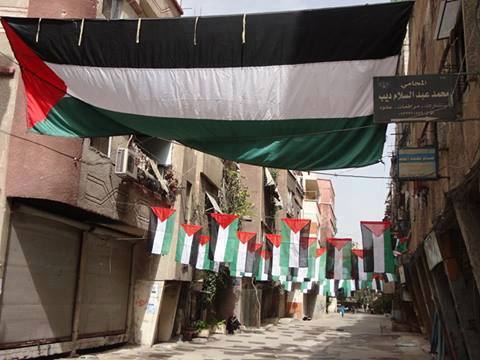
The person who knows the Syrian context, in its areas of light and shadow, is no doubt someone like Father Paolo Dall’Oglio, who has lived in the country for over thirty years. Founder of the monastic community of Deir Mar Musa, in the desert north of Damascus, Father Paolo has always been engaged in interfaith dialogue with the Islamic world and until last June, before being forced to leave by the regime, has spoken about the tragedy that he has witnessed daily in first person accounts.

The new UN report has just been released where a denouncement is made of 60 thousand deaths since the beginning of the conflict.

I cannot make an assessment of the number of deaths on a technical basis because it’s not my task to do that, and I note that often revolutionary movements tend to drive up the numbers for propaganda purposes. But the UN, bringing together different reasonably credible sources has arrived at an even greater number (15 thousand more compared to the 45 thousand already reported, ed. note). This does not surprise me, but I am afraid that once the dust has settled, when you can make a more accurate count, the numbers will be even higher. You cannot perpetrate months and months of aerial bombardments on civilian populations imagining to get balances of victims that look like surgical operations, which are also more than questionable on moral grounds. In Syria there is no action to hit the Resistance leaders but to kill the Syrians, en masse. The moral code of the Assad regime is one is with Assad or there will be destruction of the country.

How do you explain the substantial absence and delay of the international community on Syria?

Once defined by the regime, and by its friends, the “Islamist threat” in Syria, the international community has self-legitimised its maintaining a position of stalling and waiting: there will be no democracy in Syria, then there is no reason to take steps to activate for democracy of the Syrians. We are faced with a paradox, this position of wait-and-see has created the conditions for the expansion of radical Islamism.

The revolution, as a whole, has condemned the first actions of these groups as conspiracy actions conducted by the Syrian state. I never succumbed to this temptation, but remote-controlled manipulation is nothing new in the Syrian panorama, and there have been regime manipulations of extremist cells. Without simplifying, I say that the activity of Islamic extremism was part of the regime’s postulate since the very beginning, where they claimed the revolution was terrorism paid for by foreigners, then when this area branched, complex and effective, it has been able to take the initiative and the head of the revolution in military terms, these groups have provoked in the international community a self-justification to refrain from action. There was an incredible miscalculation and these same groups have exploded in the hands of the regime.

In the report of the UN Commission of Inquiry on Syria, it is said that, given the situation on the ground, a military solution to the conflict is now impossible, and that it is instead desirable to begin negotiations. But at this moment a negotiated solution seems impractical.

The regime wants negotiations to the extent that it needs more time to continue the systematic destruction of Syria and thus enter into the third phase and try to take the country back in its own hands. I was expecting that the regime in Damascus would work to divide the country on the line of the Orontes, once acknowledged the fact of not being able to maintain control over everything. Faced with a general revolution the only thing possible would be a Syrian Kosovo, hedging their bets on Alawite solidarity and other minorities living in that area, such as, in fact, the Christians; this is a solution accepted by Iran (Shiite, ed. note) as a lesser evil. This has not happened so far and in revolutionary circles it is said that it cannot happen because the rebels have so deeply penetrated even in that area that the regime would no longer be able to have such a division.

Why had it not chosen the way of secession as long as it was possible?

I can give you two reasons. One is psychological. Bashar al-Assad has always said I am a man of Damascus and not of the Alawite mountains. His cultural and mental space is all of Syria. In this sense, paradoxically, Assad would be a “non-sectarian”. He uses his sect for his power, but a power that if it is not of the whole of Syria, it does not interest him. We see this as a disconnect between his own idea of ​​himself and reality.

The other hypothesis assumes that the regime is a complex matter, divided between Ba’ath ideology, which is obviously not for secession, and the logic of the Alawite family. These two souls have been separated in time but not enough to contemplate the geographical dislocation of the country.

You have spoken of the need to begin to govern at least the liberated zones.

I have written in Arabic just two days ago, on Facebook, asking the head of the coalition to immediately set up in the liberated territories the sole government of transition. It is an operation that should be done immediately because it would eliminate the impression that the Syrian revolution is now entirely in the hands of Muslim extremists who are subversive and clandestine and they can begin to restore the country to the Syrians. On the ground there are practical problems such as lack of water, electricity, labour, wages.

Do you believe it is still too early to talk about the future of the minorities?

It is not early, in fact you have to talk about it now, but it is very difficult to see the future because of the omission of international relief. There is hope that the revolution as a whole may have a capacity of self-discipline that allows them to form that unity of the country in the reconciliation desired by everyone in the democratic revolution in Syria. Only some extremist military groups seem to threaten the destiny of minorities, even if they have never attacked Christians as such.

In recent days, however, there was a complaint by Mother Agnes Mariam (Carmelite and superior of the Deir Mar Yocoub monastery of Qara, known to be very critical of the rebels, ed. note) in this regard.

Mother Agnes knows how to dose the words and she is only, I repeat and I emphasise, the (able) clerical expression of the deceitful manipulation action of the Syrian regime. Mother Agnes is a self-proclaimed leader of a movement that does not exist on the ground, Musalaha (Reconciliation, ed note), and it is a real problem because for her interpretation of the facts is always selective and one-sided: that the revolution is terrorism!

How do you see a possible Syria after Assad and after nearly two years of war?

I believe that the profound nature of democratic Syria will be a laboratory of civil evolution and policy making of the Islamist Arab area of great interest. Syria has a cultural dignity of Islam that is different from that of the Gulf.

This is my vow, my hope and also the space of my commitment. At the end of January I will participate in the commission of the Syrian revolution that deals with preventing the massacres in the moment of victory and I hope, in February, to be able to re-enter the country. Syria cannot win the revolution leaving a hundred thousand Alawites deaths in its wake. We must find a way, even ideological and theological, to say that there will be no revenge against the Alawites and that all criminals will be judged with fairness.

See http://www.resetdoc.org

Nun on Irish visit accused of peddling ‘regime lies’ about crisis in Syria

17/08/12

MARY FITZGERALD, Foreign Affairs Correspondent (The Irish Times)

AN ITALIAN Jesuit expelled from Syria in June due to his outspoken criticism of government violence has accused a controversial nun who visited Ireland last week of peddling “regime lies” about the crisis there.

Fr Paolo Dall’Oglio, who lived in Syria for 30 years and has been heavily involved in interfaith work in the country, described Mother Agnes Mariam as “an instrument” of President Bashar al-Assad’s regime. “She has been consistent in assuming and spreading the lies of the regime, and promoting it through the power of her religious persona,” he told The Irish Times yesterday. “She knows how to cover up the brutality of the regime.”

During her four-day visit to Ireland last week, Mother Agnes Mariam, who is superior at the Melkite Greek Catholic monastery in Syria, gave media interviews in which she claimed Christians in Syria were facing “extinction” and that rebels battling Assad were predominantly foreigners linked with al-Qaeda.

Fr Dall’Oglio, who has spent time with opposition activists in several restive parts of Syria, said these claims were “ridiculous” and constituted regime propaganda.

“I have been there, I know the people, including the youth, who are working for the revolution, and I know that what she is saying is insane. It corresponds with the regime version of the facts,” he said.

Mother Agnes Mariam, who visited Dublin and Belfast, had separate meetings with representatives of the Irish Bishops Conference justice and peace committee, Sinn Féin TD Seán Crowe, Nobel peace laureate Mairead Corrigan Maguire, and an official from the Department of Foreign Affairs.

One of her interlocutors here was taken aback when the nun claimed during their meeting that the Houla massacre, in which more than 100 civilians, more than half of them children, were killed, was an elaborate hoax concocted by rebels. This week a UN commission of inquiry concluded that Syrian government forces and the pro-Assad militia known as shabiha were responsible for the massacre.

In March, Mother Agnes Mariam was accused of running a “misinformation campaign” by a US-based Syrian opposition group called Syrian Christians for Democracy.

It said she maintains “close ties” to the Assad family and alleged she had fed selected visiting journalists “distorted facts and fake testimonies for the sole purpose of tarnishing the opposition’s image”.

The group referred to the role of a number of Christians in the Syrian uprising.

“Mother Agnes and those helping her are harming the Syrian people by disseminating negative pro-Assad propaganda and tearing at Syria’s social and religious fabrics,” it said. “The Christians in Syria, as well as the rest of the population, are in need of undivided support, backing, and funding. They do not need divisive rumours and the propagation of inaccurate information.”

Mother Agnes Mariam’s trip to Ireland was organised by Alan Lonergan, who acts as churches liaison officer with Sadaka, an Irish pro-Palestinian advocacy group, though he arranged the visit in a personal capacity.

“The impression people have of what is happening in Syria is very black and white,” he said. “We need to examine more of the grey area.”

Filed Under: Assad’s Regimedistorted factsItalian JesuitMother Agnes MariamPropaganda,Syria

http://syrianfreedom.org/nun-on-irish-visit-accused-of-peddling-regime-lies-about-crisis-in-syria

http://www.irishtimes.com/premium/loginpage?destination=http://www.irishtimes.com/news/nun-on-irish-visit-accused-of-peddling-regime-lies-about-crisis-in-syria-1.538877

thanks to Treasa