Archive for the ‘Grassroots Activism’ Category

Protesters for Libyan freedom in London

It seems like years ago, but only a few months have gone by. The anti-imperialist world raised their virtual glasses in a united toast to the people’s revolutions. When I say this phrase, it seems I need to define every term, so bear with me. I will try to not take any concepts for granted.

The anti-imperialist world as I have come to know it is generally comprised of generally well-to-do intellectual-type folks who engage more time in discourse and social networking than they actually do in developing strategies or training individuals for a radical change in society where local (indigenous) people are their own leaders and determine for their exclusive benefit the policies and economic organisation of their own territory. They however are generally very passionate about the need to seek justice against tyrants and they believe that the people themselves want the same thing, so they do what they can (far from the places themselves) ninety-nine times out of one hundred by raising awareness through their articles, videos, comments, social network activities and fundraisers for more public events to raise awareness (and this cycle continues until it exhausts itself into the next fashionable group of unfortunate others).

With all that awareness-raising, you would be sure that by now, this formidable band of selfless virtual warriors would have convinced all of the world that there is no way on earth that the will of the people should be trampled on and that sooner rather than later, each people will achieve its own autonomy and self-reliance. These people who have concretely moved towards self-liberation might even be so inclined as to bite the hands that looks like it feeds them, if this has to happen for them to truly be free, but an anti-imperialist should never look at his or her own interests as a member of the empire who enjoys the privileges of that status, and should even tolerate great levels of aggression against the empire he calls home.

That said, when first Tunisia, then Egypt, began staging independent demos to demand change in their government systems, inspired by their sheer numbers, they seemed to be fully successful. There was bloodshed among civilians, but it ended, and this was a revolution that was almost like a dream, almost too easy and certainly so full of promise and hope. It even adopted the name that will remain with it for all time, “Arab Spring”, the long-awaited renewal of Arabhood connected to the idea of development of a new society that was going to put people before anything else. That it gained support at a global level probably was intrinsic to its success.

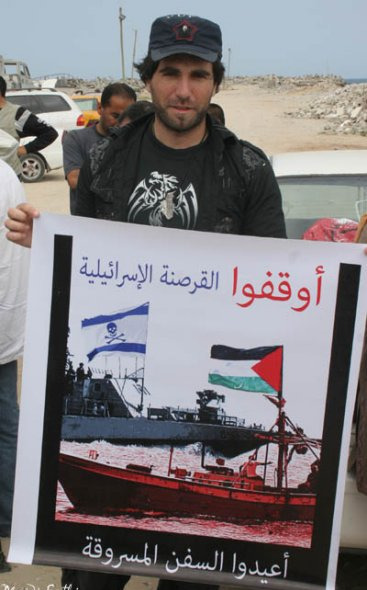
Protesters in Gaza

How did that happen? Well, we all know it was through mass communications, some of it entirely spontaneous between those directly involved, and some of it presented to a wider community to enlist their sympathies and support. It was the fact that the world was watching that perhaps hastened the demise of Ben Ali and Mubarak, and it could also be the fact that a barrier of fear had been broken. Make no mistake, I have been  documenting Egyptian uprisings for at least 3 years, and there are others who like me were not under the impression that Egyptians were passively accepting a lack of political expression and a worsening social crisis. Several of us had commented that it was necessary to break through the impression that Egyptians were incapable of rebellion and to show that there was the emergence of a protest movement that was non-confessional, and was tying together the idea of the rebirth of Arabhood as well as an Egyptian national identity that was as vibrant as the Egyptian people. We could have been some of the few who were not surprised by the revolution, but what did surprise us was the enablement that  this gave to nearby peoples.

Living in the European country closest to Libya and with a colonial past which as recently as 1972 has seen mass expulsions of Libyans of Italian descent, whatever happens in Libya is going to be felt directly. In the past years, hundreds of boats full of refugees have headed toward our shores,  and as has been documented thoroughly, the Libyan regime had utilised the African migrants as a playing card to obtain many things from Italy. The Africans who were brought to Libyan Migrant Detention Centres were actually imprisoned there, and the thought of dying at sea on unsafe and overcrowded ships was a risk almost all of them were desirous to take after months of torment from the military and police branches of the Libyan government. There were truckloads of them driven to the confines of the desert and left there to die, documented by Italian film crews, who were concerned about lives in the face of the “Bilateral Agreements” so that Gaddafi could keep a foothold in Italy’s economy and obtain “aid” worth billions of Euros for infrastructure (some of it I can personally testify was for bunkers), weaponry and telecommunications in exchange for a policy of limiting African immigration from Libyan shores.

Gaddafi’s racism thought it found another foothold in the sensitivities of the Italian government, and his words were carefully used to obtain what he  wanted, a combination of greed and rank racism that I witnessed few anti-imperialists getting upset about.  It deserves being read word by word:

“Europe runs the risk of turning black from illegal immigration, it could turn into Africa. We need support from the European Union to stop this army trying to get across from Libya, which is their entry point. At the moment there is a dangerous level of immigration from Africa into Europe and we don’t know what will happen. What will be the reaction of the white Christian Europeans to this mass of hungry, uneducated Africans? We don’t know if Europe will remain an advanced and cohesive continent or if it will be destroyed by this barbarian invasion. We have to imagine that this could happen but before it does we need to work together.”
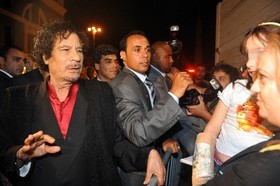
Gaddafi's recent "Rome By Night" outing

Gaddafi would come to Italy, honoured by Silvio Berlusconi and the best that the Italian government had to offer by way of hospitality, in order to seal more deals and to re-establish that these two neighbours had the same interests at heart: especially a thirst for petroleum and a provider who would make sure there would be preferential treatment under certain conditions, including keeping Europe white. Berlusconi was also an honoured guest in Libya, promising billions of Euros for schools, retirement homes, infrastructure and other things. It is curious that those continually claiming Libya was fulfilling all of its people’s needs on its own seem to not question why they would need so very much Italian money to do what they claim has already been done. During these visits, our news shows were almost suffering an embarrassment at how to represent it. The feelings run deep, and we had known of the abuses that were going on in Libya. Many of us know Libyans, some of them in exile, “You mean  you can’t go back? What do you mean you can’t go back?” Others who come on scholarships and seem to never want to talk about politics either. I would joke with two friends (one in each category) and call it the Libyan black hole. However, both would easily admit that Libya could be much more than it is, if only it could have the chance for that.

So, I watched the revolutions with other anti-imperialists, and the Libyan revolution had quite a few of us excited at the first moments because  Libya is not a Middle Eastern country and it also has ambiguous and collaborative relations with the empire, and with my nation in particular. I  was naively convinced that true anti-imperialists would welcome the will of the people as sovereign and that the information constantly withheld from us regarding many human rights violations would cause one of those powerful moments of decision: supporting an action that really was going to mean conflict and risk for my own nation. As February 17th approached, (with its planned march in Benghazi of the family members of the 1,200 political prisoners of Abu Salim who had been executed by Gaddafi ) I noticed that a few would start to say it was not a real revolution because a) it was against a leader who claimed to be anti-imperialist, b) it was a tribal conflict that we should not take part in, as it would lead to division of Libya (as if they actually knew or cared!), c)the protesters had some problems that did not make them revolutionary, with the sub-groups of 1) they are seeking the restoration of the monarchy, 2) they are religious fanatics that will turn back the clock on progressive revolutions and make Libya a theocratic state. I asked them if they had the right to determine when a revolution was valid and when it was not, and I was surprised to hear that they were putting conditions on the support of a people, and didn’t they notice the people were demanding their freedom?

I started to check into all my favourite anti-imperialist sites, most of the relevant articles indicated to me by friends on Facebook, and lo and behold, most of these were articles by Westerners. If I had kept count, and I should have, I would have the evidence in front of me that out of 100 articles perhaps 3 were actually penned by Libyans. I got to wondering what was happening when I had been reading and hearing the reports from Benghazi by Mohamed Nabbous, killed by Gaddafi’s squadrons and in the many comments surrounding these interventions, and noticed the enormous gulf in what the Pundits were saying, and what Libyans were saying. It was as if there were two worlds colliding. All of these people claimed to love freedom and to want to do anything necessary to obtain it, but there was that nasty issue of Gaddafi actually threatening to exterminate those who tried. At this point, one would think that this would be enough for one to firmly side with the Libyan people and wonder what the pundits were going on about.

And, at this time, many things entered the scene, such as NATO, which all of us detest, and transitional governments and Libyan officials abandoning their leader and an upsurge in refugees flooding into Tunisia and war and death in the land that only a few weeks before was the next domino with a tyrant’s face that had to be knocked down.

We read of infiltrations of Al Qaeda, (this was what Gaddafi claimed the Thuwar (“rebels” to those who hate them and “freedom fighters” to those who love them), of deals with Empire, of CIA infiltrates and anything else that you can imagine by way of establishing that those who were commemorating the massacre of their loved ones and who were massacred while doing so were SO BAD and if we supported them, we were dupes. I guess it would take a very self-assured person to still want to see the Thuwar and indeed the people opposing Gaddafi in a decent light.

Already involved in a few discussion groups regarding the events in the region, I was invited by friends to join a few private mostly-Libyan discussion groups. I wanted to observe the discourse, and since my sympathies and antipathies were known to me, but not backed up by enough concrete information, I took it as my “personal fact finding mission” to learn as much as I could about the situation from Libyans. Indeed, the discussions in these groups are lively, and shockingly, almost everyone in the groups (which are by no means small either) has a martyr for the cause and has family living in conditions of siege. It is quite a shocker to log in and see someone receiving condolences for his father, his uncle, her brother, a daily litany of suffering and loss… And even more shocking was the coming into contact with a world I should have been more aware of, that of the acceptance of the will and wisdom of God.

Yes, religion plays a big part in many of these struggles, and while this is not a religious war, (and all Libyans practice the same religion for the most part), the element of faith and perseverance that these people surely learned from over four decades of negation of their political freedom is omnipresent. I would also peek into Pro-Gaddafi boards and oddly, there was a sort of violence and lack of humanity that were not even hidden very well. It became almost apparent to me that there was a lot more to this situation than meets the eye.

I got into discussions with American Communists (self-proclaimed, naturally) and leftists in general and when they started to stress that they didn’t like the religious symbolism that they were seeing (as if their taste was going to matter) I had to ask them why they thought they knew better than the Libyans what was best for Libyans. I was told that the Libyans would put the monarchy in. I stated that the TNC issued a statement and it was supported by those I was discussing things with, that there were to be elections and there was going to be an establishment of democracy. These AC + Leftists told me that the Libyans were dupes for the empire and religious fanatics and that if they were not working for a world revolution but for a repressive and authoritative patriarchal set-up, and thus, as AC + Leftists, the Libyans would not be worthy of obtaining their support. I thought that was some cheek. So what I decided to do was to serve as a filter, I invited Libyans to use my board to engage with these anti-imperialists, and many willingly did so. They presented the Libyan point of view, they were kind, patient and tried to explain what the situation was so that it could be understood.

I admit I was shocked at the violent verbal reactions they got. I admit it was the classic Western Pundit thing of orientalism and ignoring the voice of the common man if that common man was not “politically advanced”. It was the thing I see time and again in Palestine activism: the great Western hero (usually white, male, often Christian or Jewish) determines that he or she knows what is best and becomes the spokesman and mouthpiece for Palestinians. It is denial of Palestinian agency, but it is so common and so normal that we tend to not notice it as the alarming trend it is.
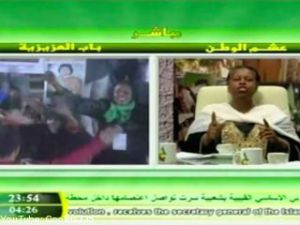
McKinney not looking too objective there.

Working for the Man

So, when Cynthia McKinney stepped onto the scene, it is as if the secret prayers of the Gaddafi supporters who also are against the Libyan people’s revolution (they want to deny it’s what it is, but they are unable to turn off our memory cells that far back) had been answered. Black, female, present in the past in brave gestures for Palestine, outspoken against the robbery of the Democratic vote in the Bush elections, pacifist and they can plug their noses on the fact that she actually might represent empire by being involved in the presidential elections as a candidate and as a Roman Catholic. She does fine to complain against NATO abuses and even their involvement, but to become the mouthpiece of Gaddafi went above and beyond the call of duty, even going so far as to follow the game plan he provided while establishing the proper narrative to put forth. She did this as well on Libyan State TV, yes, the same state TV that has been accused by Libyans as sending out calls for ethnic cleansing of the Amazigh people (a linguistic minority in Libya) and those living in cities where protesting became resistance and then revolution.

And it seems, once again, we have thousands of eyewitnesses who the anti- imperialists, Leftists, American Communists refuse to listen to or when they are given the opportunity censor them or hurl insults their way, but when an American “eyewitness” (who has been shown where the Gaddafi cronies have taken her and nowhere else) speaks, she is the one who must be listened to, because she will not change anything, because she has no loved ones there, so whatever happens is politics, because she will have her hardcore followers and for all the ones she loses, she will pick up more, sensing where the anti-imperialist (banter) winds blow, feeding the fundraising machine for awareness-raising in an endless cycle. Those who actually are Libyans are treated to the usual “shut up” that is reserved for “counter-revolutionaries”. All from the comfort of these Western Anti-Imperialist homes far away from where the blood is being shed.

So what is my final remark to anti-imperialists, that group which I had felt I had proudly belonged to for decades? Quit lecturing with such an attitude of cultural colonialism and start listening to those who are actually the directly interested party. Answer them at least once when they ask  what alternative you would have offered when it was clear that their people were being violently crushed. Realise they are not interested in anything but their own freedom, and that includes freedom from you and your ideology and platitudes that contain nothing concrete for them to use towards obtainment of their freedom. If the anti-imperialists can’t understand that, then Khalas, because shutting up is golden.

Funeral in Gaza City

Gaza, deux mois après l’assassinat, deux mois avec Vittorio Arrigoni

DE Michele Giorgio (à Gaza city pour ” il manifesto” 15/juin/2011)
traduit par Mariam S. (Mimi Loves Gaza)

“L’espace de jeux des enfants sera par là,  on rénové la salle de bain et la cuisine sera là”…

Saber Zanin se déplaçait rapidement d’une pièce à l’autre dans le local de l’association “Forsan Al Ghad ” pour les jeunes de Beit Hanoun.

Juste quelque temps auparavant il avait guidé une manifestation de presque trente volontaires occidentaux d’ISM (International Solidarity Movement) aux marges de la “Buffer Zone” (zone tampon),  la zone agricole la plus fertile de toute la bande de Gaza.

Ce sont ces secteurs dont Israël bloque l’accès aux palestiniens, pour des “raisons de sécurité”, même à ceux qui y possèdent des terrains.

C’est une mesure qui s’accompagne de tirs d’armes automatiques contre quiconque ose violer l’interdiction qui a affamé des centaines de familles qui vivent grâce à l’agriculture familiale.

“Vittorio a lutté avec nous, nous avons fait plusieurs marches ensemble le long de la “Buffer Zone”, c’était un frère pour moi, Saber réfléchit  en
nous montrant sur son ordinateur portable, des photos de Vittorio faites il y a à peine quelques mois.

Aujourd’hui  sera inauguré un camp d’été  appelé “Stay Human, Restiamo Umani”, à la mémoire de l’activiste italien kidnappé et tué il y a deux mois. Nous allons accueillir 60 enfants et adolescents entre six et seize ans, explique Saber. ” Et en plus de jouer et s’amuser ils vont apprendre à mieux connaître l’engagement politique et l’histoire humaine de Vittorio. Et aussi ils vont apprendre des notions de droits humains qui les prépareront à suivre les pas de notre frère décédé.”

Une dizaine d’ONG italiennes qui travaillent à Gaza sponsorisent le camp d’été,  Saber a la possibilité de voir son rêve devenir réalité, “Vittorio a toujours protégé les enfants de Gaza,  il serait heureux que cette initiative lui soit dédiée.”

Deux mois sans Vik, au contraire deux mois avec Vik continuellement, parce que à Gaza les amis et les camarades ne l’ont jamais oublié. Ses mots sont comme des pierres, son image fait partie de la mémoire collective. Daniela Riva, une volontaire du GVC  (groupe de volontaires chrétiens) de Bologne a passé les quelques dernières années a Gaza, travaillant sur des projets de développement.

Vittorio était un de ses amis proches, “quand je m’écroulais face à ceux qui en comprenaient pas mon engagement pour Gaza”, raconte Daniela, “Vik me disait que je devais répondre, qu’être engagé pour la justice et la liberté voulait dire être en vie, est ce qu’il y a autre chose qui mérite qu’on vive ou meure pour elle ? Qu’y a-t- il au monde de plus précieux ?… Quand, il y a quelques mois, un fermier que j’ai  vu seulement pendant quelques minutes a été tué par les balles israéliennes, Vittorio m’a dit de tout faire pour ne pas pleurer aux funérailles et de tenir ma tête haute,  on en pleure pas les martyrs, je l’ai fait. J’ai essayé de faire la même chose à ses funérailles aussi mais les larmes sont tombées en dépit de mes efforts.

Des souvenirs, d’intenses moments d’émotion, pour un jeune homme qui a perdu la vie à seulement 36 ans, un jeune homme qui a envoyé, via internet, quotidiennement et  durant des années avec honnêteté et constance,  des informations sur le siège israélien de Gaza. Sans omettre l’aspect économique et social, des informations qui ont été encore une fois confirmées hier.

Un rapport  de l’UNRWA précise que dans la seconde moitié de 2010, le taux de chômage dans la bande de Gaza était de 45.2%, l’un des plus élevés au monde. D’un  autre côté le niveau des salaires ne cesse de baisser. “Ceci est un signal d’alarme.” A déclaré Chris Gunness, le porte parole de l’UNRWA, “il est difficile de comprendre la logique d’une telle politique planifiée (par Israël note de l’auteur) afin d’appauvrir délibérément et qui a condamné des centaines de milliers de personnes à une vie de misère abjecte. Si le but du siège est d’affaiblir le Hamas”, continue –t-il “ces chiffres montrent qu’ils ont échoué, en même temps ils ont eu un grand succès dans la punition de quiconque puisse être considéré comme parmi les plus pauvres  des pauvres du moyen orient.

Les parents de Vittorio, sa sœur, ses amis, tous ceux qui l’ont connu personnellement ou qui ont fait sa connaissance à travers internet,  ceux qui l’ont écouté attentivement durant son tour d’Italie, ils sont tous impatients de connaître la vérité sur son assassinat. Ce moment pourrait être proche, des sources autorisées du ministère de la justice et des services de sécurité du gouvernement de Hamas, qui ont préféré rester anonymes, ont dit au manifesto que la court martiale allait rendre publique un communiqué officiel à la fin du mois de juin dans le cour des investigations et qu’au moins deux personnes, impliquées dans l’enlèvement et l’assassinat de Vittorio, allaient être jugées. L’une d’elles est Mahmoud al Salfit, le seul survivant des trois membres de la cellule Salafite autoproclamée (qui ont quitté le groupe Tawhid wal Jihad) responsable de l’enlèvement.

Les deux autres, le jordanien Abdel Rahman Breizat et Bilal Omari ont été tués dans l’assaut donné a Nuseriat mené par les forces spéciales du Hamas, quelques jours après le meurtre de l’activiste italien.

Des sources du ministère de justice ont expliqué que l’enquête, close à la mi-mai a été rouverte après l’échec de deux tentatives d’enlèvement de jeunes citoyens américains, un coopérant (résident de longue date dans la bande) et un activiste de ISM (le dernier près “de la Galerie”, le café que Vittorio fréquentait avec divers activistes locaux et internationaux).

Le cerveau derrière l’enlèvement est le jordanien Abdel Rahman Breizat, qui a préparé le plan un mois et demi auparavant, à l’aide de plusieurs habitants de la bande de Gaza dont certains proches  de Vittorio, la plupart d’entre eux ignoraient ses intentions.

Au début, ont ajouté les sources, le plan n’incluait pas le meurtre de l’activiste italien cependant lorsque les ravisseurs ont comprit qu’ils allaient être découverts dans l’espace de quelques heures, ils ont décidé de s’enfuir et d’effacer leurs traces. C’est Breizat qui a tué Vittorio parce qu’il était convaincu qu’en laissant l’homme kidnappé en vie ils seraient très vite découverts (Vik connaissait au moins deux de ses ravisseurs, en particulier Bilal Omari qui fréquentait la même salle de sport que lui).

Pour la confirmation de ces informations il ne reste qu’à attendre le début du procès. A ce moment là on pourra consulter les actes d’accusation et nous connaîtront finalement les déclarations faites par les accusés durant les interrogatoires.

En attendant, le mystère règne sur la disparition de huit objets ayant appartenus à Vittorio en particulier son ordinateur portable, disparus après l’enlèvement. Hamas avait déclaré les avoir récupérés et déposés dans les locaux de la centrale de police, maintenant ils nient cela.

en anglais: https://wewritewhatwelike.com/2011/06/15/hamas-the-report-with-the-truth-on-vik%e2%80%99s-homicide-at-the-end-of-june/


Funeral in Gaza City

GAZA, TWO MONTHS AFTER THE ASSASSINATION: Two months with Vittorio Arrigoni

By Michele Giorgio
in Gaza City (from il manifesto, 15 June 2011) www.ilmanifesto.it
translated from Italian by Mary Rizzo

“Children will be playing in these spaces, we have renovated the bathroom and the kitchen will be here,” Saber Zanin moves quickly from one  room to another in the “Forsan al Ghad for Youth Association” of Beit Hanoun.

Just a short time before, he led a demonstration of about thirty Western volunteers from the International Solidarity Movement (ISM) at the margins of the “buffer zone”, the most fertile agricultural lands of Gaza.

It is in those areas where “for security reasons” the Israeli army does not allow Palestinians to gain access, not even those who own property there. It is a measure that is accompanied by the fire of automatic weapons against whoever dares to violate that prohibition that has brought starvation  to hundreds of families who live by means of family farming. “Vittorio struggled with us. We have had so many marches along the buffer zone together, he was a brother to me,” Saber muses, showing us some photos of Vittorio that had been taken in recent months on his laptop. Today in memory of the Italian activist that was kidnapped and killed two months ago in Gaza, the summer camp “Stay Human, Restiamo Umani” will have its inauguration. “We will welcome 60 children and teens between 6 and 16 years of age,” Saber explains, “and in addition to them being able to play and have fun, they will also learn about the political and human story of Vittorio. Not only that, they will learn principles of humanitarian rights, preparing them to follow in the footsteps of our fallen brother.” Sponsoring the summer camp are a dozen or so Italian NGOs that work in the Gaza Strip. Saber has the possibility of making a dream come true. “Vittorio protected Palestinian children, he would be happy that this initiative is being dedicated to him.”

Two months without Vik. On the contrary, two months always with Vik because in Gaza, friends and comrades haven’t forgotten him. His words  are like stones, his image is part of the collective memory. Daniela Riva, a volunteer in the GVC of Bologna spent the last several years in the Strip,  working on development projects. Vittorio was a close friend of hers. “When I used to break down in front of whoever could not understand my involvement with Gaza,” Daniela says, “Vik would repeat to me that I had to answer that being involved in a struggle for justice and freedom means being alive, is there anything worth living or dying for that has more value than that?… when months ago (the shootings from Israeli soldiers) a farmer was killed, one who I’d only met with a few minutes prior, Vittorio told me to try hard to cry no tears at that funeral, but to keep my head held high. One does not cry for martyrs. I did it. I tried to do the same at his funeral too, but the tears fell despite my efforts…”

Memories, intense moments of emotion for a young man whose life was taken at only 36 years of age, who with honesty and constancy, through  the Internet, had for years sent out daily information on Gaza under the Israeli siege.  Not omitting the economic or social aspects of the situation. News that yesterday had once more been confirmed. An UNRWA report records that in the second half of 2010 the unemployment rate of Gaza is at 45.2%, one of the world’s highest. On the other hand, the level of salaries keeps sinking. “This is an alarming trend,” the spokesman of the UNRWA Chris Gunness says. “It is difficult to understand the logic of a policy that was carefully planned (by Israel, author’s note) to deliberately impoverish and that has condemned hundreds of thousands of persons to a life of abject misery. If the purpose of the policy of the closure of Gaza  was to weaken Hamas,” he continues, “these numbers show that they have failed, while at the same time there has been massive success in punishing whoever can be counted among the poorest of the poor in the Middle East.”

Vittorio’s parents, his sister, his friends, everyone who knew him personally or who had met him through Internet, those who had listened  intently while he spoke in tours throughout Italy, all of them are impatiently waiting to know the truth about his assassination. That moment could be near. Authoritative sources of the Ministry of Justice and of the Security Services of the Hamas government – who have asked to remain anonymous – have told il manifesto that the Military Court will issue an official communiqué at the end of June on the course of the investigations and it will bring to trial at least two persons involved in various levels in the kidnapping and assassination of Vittorio. One of these is Mahmoud al Salfiti, the only survivor of the three members of the self-proclaimed Salafite cell (who had left the Tawhid wal Jihad group) responsible for the kidnapping. The other two, the Jordanian Abdel Rahman Breizat and Bilal Omari were killed in the armed clash at Nuseriat with a special forces team of Hamas several days after the having killed the Italian activist.

Sources of the Ministry of Justice have explained that the investigations that had closed in mid-May had been reopened following another two failed kidnap attempts of two young American citizens: a cooperation worker (long-time resident in the Strip) and an activist of the ISM (the latter near the “Gallery”, the coffeehouse that Vittorio frequented along with various local and international activists). The mind behind the kidnapping was the Jordanian Breizat, who had prepared the plan about a month and a half earlier, using the help of various inhabitants of Gaza who were close to Vittorio, most of them unaware of his intentions. At the start, the sources add, the plan didn’t include the killing of the Italian. However, when the kidnappers were aware that they would have been discovered in a matter of hours, they decided to make a run for it and cover their tracks. It was Breizat who had killed Vittorio, because he was convinced that by leaving the kidnapped man alive they would have been discovered immediately (Vik personally knew at least two of the kidnappers, in particular Bilal Omari, who went to the same gym he frequented in Gaza City).

For the confirmation of this information, there is nothing to do but await the start of the trial. In that moment the acts can be consulted and we can finally know the declarations made during the interrogations of the accused parties. In the meantime, mystery reigns over the eight objects  belonging to Vittorio that disappeared after the kidnapping, in particular, his laptop. The Hamas authorities have referred in an earlier moment that they had been recovered and were being held at the central command of the Police. Now, they deny this.


(Italian subtitles by Diego Traversa, French by Mirielle Rumeau)
To reply to the Gaza youth Manifesto, and with no additional words to the ones spoken with true heart on this video, we give you, The Manifesto. A simple, true, self-explanatory, expression of what we’re sick of.

As these days mark the 63rd memory of the Nakba, our people all around the world, revolt, and object to the injustice and hatred we are met with on a day to day basis, just because we’re Palestinians and just because we exist.

I urge your humanity and your conscience, to spread on this video, so the 15th of May 1948, wouldn’t ever be forgot, and so Palestinians would once more have their freedom and rights back; especially the right of return.

Salamat,
Two anonymous from Palestine.

كرد على بيان شباب غزة، وبدون أي كلمات إضافية للكلمات الصادقة من القلب التي قيلت في هذا الفيديو، نقدم نحن لكم “البيان” والذي هو تعبيرنا البسيط والصريح والغاني عن الشرح، الذي يعبر عن كل الأشياء “اللي احنا زهقنا منها”.

في هذه الأيام التي تمثل الذكرى الثالثة والستين للنكبة، شعبنا في مختلف أنحاء العالم ينتفض ويحتج على الظلم والكراهية التي نعامل بها على أساس يومي، فقط “علشان احنا فلسطينية”.

أنا أحث إنسانيتكم وضمائركم لتنشروا بياننا، لكي يبقى 15-5-1948 يوما لا ينسى في تاريخ الشعوب، ولكي يستعيد الفلسطينيون حريتهم وحقوقهم، وخاصة حقهم في العودة.

سلامات،
عشوائيان من فلسطين.

63 ans de Nakba

Par Deux anonymes de Gaza

Pour répondre au Manifeste de la Jeunesse de Gaza, et sans ajouter un mot à ceux qui sont dits du fond du cœur sur cette vidéo, nous vous donnons Le Manifeste. L’expression simple, qui se passe d’explications, de tout ce dont nous avons marre. En ces jours qui marquent le 63ème souvenir de la Nakba, notre peuple, dans le monde entier, se révolte et proteste contre l’injustice et la haine que nous rencontrons chaque jour, simplement parce que nous sommes Palestiniens et simplement parce que nous existons. (cliquer pour la suite du post et la traduction des sous-titres)
Nous en appelons à votre humanité et à votre conscience pour diffuser cette vidéo, pour que le 15 mai 1948 ne soit jamais oublié, et pour que les Palestiniens recouvrent leur liberté et leurs droits, en particulier le droit au retour.

Salamat,
Deux anonymes de Palestine

http://www.ism-france.org/temoignages/63-ans-de-Nakba-article-15565

63 ans de Nakba

J’en ai marre du mur
J’en ai marre des checkpoints entre les villes palestiniennes
J’en ai marre des colons israéliens illégaux et de leurs colonies
J’en ai marre que ma carte d’identité soit en hébreu
J’en ai marre que des gens ne connaissent rien de notre histoire mais qu’ils sachent tout de l’histoire juive
J’en ai marre que des gens ignorent le droit palestinien au retour et accepte le droit au retour des juifs
J’en ai marre de l’Accord d’Oslo que personne ici n’a d’abord voulu
J’en ai marre de l’Autorité palestinienne sans aucune autorité
J’en ai marre de voir mon père être humilié aux checkpoints par des gens de mon âge et plus jeunes
J’en ai marre que mes amis internationaux soient obligés de mentir quand ils viennent me voir, qu’ils soient interrogés, fouillés à corps et quelquefois expulsés
J’en ai marre que des gens ne comprennent pas ce qu’est “l’occupation”
J’en ai marre d’avoir tout le temps peur
J’en ai marre du syndrome de stress post-traumatique, un état normal ici en Palestine
J’en ai marre du Droit humanitaire international qui ne s’applique pas à l’État d’Israël
J’en ai marre de voir que combattre pour les droits humains de base des Palestiniens, ou critiquer la politique israélienne, est si souvent traité d'”antisémitisme”
J’en ai marre que tout le monde oublie que je suis une Sémite
J’en ai marre d’entendre les Israéliens se plaindre de discrimination quand l’État d’Israël a été fondé sur un principe de pureté ethnique
J’en ai marre de vivre à une époque où la discrimination raciale est devenue acceptable
J’en ai marre d’être constamment traité comme un suspect
J’en ai marre de la manière dont les médias nous décrivent, nous et notre situation
J’en ai marre que le monde entier se préoccupe de Gilad Shalit alors qu’il y a plus de 7000 Palestiniens dans les prisons israéliennes
J’en ai marre d’essayer de me défendre, moi-même, mes amis ou mes compatriotes et de me faire traiter de terroriste
J’en ai marre de voir, où je j’aille, le mur, une colonie ou une soldat israélien

J’en ai marre de 63 ans d’occupation israélienne

Traduction : MR pour ISM

we must work to get all instigators to this atrocious crime prosecuted legally and their evil doings blocked

(segue l’ italiano) Today I finally was able to talk to people at the Italian foreign office. Journalists who are card carrying ones get directed to an office, the rest of us have to fill out a form. this is the phone number: +39 06 36911 if you are a journalist. (They also have ability to receieve calls in English). If you are an ordinary citizen, you talk to someone at THIS number +39 06 36911, where a kind man listens to you and then tells you he is unable to do anything but ask you to use 3000 characters to fill out a written declaration. You may do it in Italian or English. I have written this (the English translation will follow) and I kindly ask all of you to please 1) call them to let them know this is an emergency, 2) fill out the form and ask all your contacts to fill it out as well, 3) pressure at least the Italian Foreign Ministry to do their duty to investigate an instigator to an Italian citizen’s assassination. 4) do the same with any other country you think can help, USA in particular, since this is where the site is. 

this is the URL for the complaint: 

http://www.esteri.it/MAE/IT/Ministero/Servizi/Sportello_Info/DomandeFrequenti/FAQRichiestaInfo.htm

http://www.esteri.it/MAE/EN/Ministero/Servizi/Sportello_Info/DomandeFrequenti/FAQRichiestaInfo.htm?LANG=EN 

Vorrei segnalare il sito www.stoptheism.com che celebra la morte di Arrigoni ed in più, il suo autore ha istigato alla morte già in data 2009, http://www.scribd.com/doc/53046178/Israeli-HIT-LIST-Includes-Vittorio-Utopia-Arrigoni. (con foto della istigazione compreso). Chiedo che Lee Kaplan viene indagato come istigatore della morte ed il suo site chiuso immediatamente. http://www.megachip.info/modules.php?name=Sections&op=printpage&artid=8532 (in italiano). 

in English what I wrote, feel free to use it or modify it as you wish: 

I would like to indicate the site www.stoptheism.com that celebrates the death of Arrigoni and in addition, its author has instigated to the death already on the date of 2009, http://www.scribd.com/doc/53046178/Israeli-HIT-LIST-Includes-Vittorio-Utopia-Arrigoni. (with photos of the instigation included). I ask that Lee Kaplan is investigated as an instigator to the assassination and that his site is immediately closed. http://www.megachip.info/modules.php?name=Sections&op=printpage&artid=8532 (in Italian).

ITALIANO

Oggi, finalmente ho potuto parlare con la Farnesina. Giornalisti che hanno le qualifiche professionali sono diretti ad un ufficio, noi altri dobbiamo riempire un modulo. Ecco il numero: 06 36911 se giornalista (possono anche ricevere in inglese). Se solo un privato cittadino, puoi parlare con qualcuno a questo numero: 06 36911, dove un signore gentile ti ascolta e dopo averti detto che non potrebbe fare nulla, ti istruisce di riempire il modulo di segnalazione, con 3000 caratteri a disposizione. (in italiano o inglese). Ho scritto il seguente e chiedo gentilmente a tutti di 1) telefonare per farli capire che è un’emergenza, 2) riempire il modulo e chiedere a tutti i contatti la stessa cosa, 3) mettere pressione almeno sulla Farnesina per fare il loro dovere nell’indagine nell’assassinio di un cittadino italiano, 4) fare lo stesso con ogni paese che crediate potrebbe fare qualcosa, in particolare gli USA dove è registrato il sito.

Vorrei segnalare il sito www.stoptheism.com che celebra la morte di Arrigoni ed in più, il suo autore ha istigato alla morte già in data 2009, http://www.scribd.com/doc/53046178/Israeli-HIT-LIST-Includes-Vittorio-Utopia-Arrigoni. (con foto della istigazione compreso). Chiedo che Lee Kaplan viene indagato come istigatore della morte ed il suo site chiuso immediatamente. http://www.megachip.info/modules.php?name=Sections&op=printpage&artid=8532 (in italiano). 

in inglese, usatelo o modificatelo come ritenete sia giusto: 

I would like to indicate the site www.stoptheism.com that celebrates the death of Arrigoni and in addition, its author has instigated to the death already on the date of 2009, http://www.scribd.com/doc/53046178/Israeli-HIT-LIST-Includes-Vittorio-Utopia-Arrigoni. (with photos of the instigation included). I ask that Lee Kaplan is investigated as an instigator to the assassination and that his site is immediately closed. http://www.megachip.info/modules.php?name=Sections&op=printpage&artid=8532 (in Italian).

UPDATE: THE JOB IS NOT OVER! THE SITE WITH THE SPECIFIC INCITEMENT HAS BEEN CLOSED (WHICH WE HAVE ON ARCHIVES) BUT A SITE WITH A DIFFERENT URL IS STILL THREATENING! DON’T STOP WRITING LETTERS OF COMPLAINT TO HAVE HIM SENTENCED! https://wewritewhatwelike.com/2011/04/18/re-arrigoni-execution-write-to-italian-foreign-office-to-close-kaplan-site-scrivete-alla-farnesina/ TAKE ACTION!!

By Luca Galassi, translated by Mary Rizzo

Lee KaplanLee Kaplan, its author, is being investigated by Interpol

The site of the Jewish fundamentalist Lee Kaplan has been closed. “Stop the ISM”, a site financed by the well-known American David Horowitz, urged on for people to provide information so that the pacifist Vittorio Arrigono could be localised and then eliminated by the Israeli military. For now, awaiting that the Interpol investigations run their course, the ferocity of the words of Kaplan have brought about a rightful elimination as the price to pay. We raised the question in this article (in English here with the archived copy of the original threat to Vittorio and the other activists), highlighting the very serious echo that the words of Kaplan would have had and reconstructing the links of the self-styled “journalist and political analyst” with the Jewish Lobby of the extreme Right.
The Italian embassy at Tel Aviv and the Italian Foreign Ministry, contacted repeatedly by us on the matter have evidently alerted the competent authorities to address this case that regarded our fellow Italian citizen. And, for once, our denouncement was not ignored. 

http://it.peacereporter.net/articolo/13782/Chiuso+il+sito+che+incitava+a+uccidere+il+pacifista+Arrigoni

Tradotto in italiano da Daniela Filippin (Questo omaggio a Vittorio di Jeff Halper è così bello, che non potevo sopportare che non venisse tradotto in italiano):

Dopo aver perso un altro amico e compagno meno di due settimane fa, Juliano Mer-Khamis, mi tocca piangere e ricordare il mio compagno di viaggio di nave Free Gaza, Vittorio (Vik) Arrigoni, brutalmente assassinato ieri notte da estremisti religiosi a Gaza. In realtà; Vik ricordava fisicamente Juliano, per la personalità esuberante e la sua insistenza nell’”esserci” quando gli oppressi avevano bisogno di lui.

Vik era davvero una persona che non potevi non notare. Era così pieno di energia, un misto di gioia, goliardia e impazienza entro i confini di barche e prigioni come Gaza, che all’improvviso ti avrebbe sollevato in aria, o si sarebbe messo a fare la lotta con te – era un ragazzo grosso, forte, bello, vivace e sorridente anche nelle situazioni più pericolose e oppressive, come a dirti: Yaala! A noi e ai pescatori palestinesi, queste navi israeliane che ci sparano, non possono prevalere sulla solidarietà, indignazione e la giustizia della nostra causa! (Vik fu ferito in uno di questi scontri). Ti arrivava da dietro dicendoti: L’occupazione cadrà esattamente così! (lottando con te fino a gettarti a terra, ridendo e giocando con te mentre lo faceva).

Vik, che come me ha ricevuto la cittadinanza palestinese e un passaporto quando abbiamo rotto l’assedio di Gaza salpando nel porto di Gaza nell’agosto 2008, era un esempio supremo di portatore di pace. Nonostante avesse una famiglia in Italia, si è dedicato ai palestinesi col cuore intero, come era solito fare. Sulla sua pagina facebook ha scritto: “Vive a Gaza”. Era conosciuto soprattutto perché accompagnava i pescatori che cercavano di fare il loro lavoro, nonostante gli spari quasi quotidiane della marina israeliana, che li confina alle acque già pescate fino all’esaurimento e sporche di fogna delle cose di Gaza. Almeno diciotto pescatori sono stati uccisi nell’ultimo decennio e circa 200 feriti, molte barche sono state distrutte e molto equipaggiamento danneggiato. Ma era intimamente coinvolto ovunque ci fosse bisogno di lui a Gaza, fra i contadini come fra i bambini traumatizzati, in tempi difficili – il suo libro, Gaza Stay Human, documenta le due esperienze fra la gente durante l’offensiva israeliana di tre settimane nel 2008-09 – e anche essendo semplicemente a contatto con la gente nelle caffetterie e nelle loro case.

Quando è stato appreso che era stato rapito sono spontaneamente sorti centinaia di appelli non solo dalla comunità pacifista internazionale, ma soprattutto dalla popolazione palestinese affranta di Gaza. Un memoriale sarà tenuto oggi a Gaza City e altre parti dei territori occupati.

Vik lavorava nella West Bank come a Gaza, ed è stato imprigionato tre volte prima di essere stato espulso da Israele. Ma il suo lavoro di pace non era solo sotto forma di attivismo. Vik era un maestro della comunicazione – fisica, verbale, scritta (il suo blog, Guerrilla Radio, era uno dei più seguiti in Italia), mischiando con naturalezza esperienze personali, reportage e analisi.

Vik era quello che chiamiamo un “testimone”, qualcuno che fisicamente si mette dalla parte degli oppressi e condivide con loro trionfi, tragedie, sofferenze e speranze. Eppure era uno che attraverso l’azione sperava di influenzare dei veri cambiamenti. Lui, come Juliano, Rachel e molti altri che si sono sacrificati per la pace e la giustizia in Palestina e in tutto il mondo, lasciano un grande vuoto nei nostri cuori, le nostre vite e nella lotta.

Mi mancherai, ragazzo mio. Ma ogni volta che mi sento stanco o scoraggiato, ti sentirò sollevarmi su in alto e sopra la tua testa e, col tuo enorme sorriso e la tua risata, minacciare di gettarmi fuori bordo se solo esito a coinvolgermi in una lotta. Tu eri e sei la forza terrena della lotta contro l’ingiustizia. Ci solleverai sempre su e ci ispirerai. Come i pescatori palestinesi che amavi tanto, noi e tutti gli altri che lottano per le fondamenta della vita in tutto il mondo ci impegneremo per realizzare la tua visione.

Ciao, amico.

Posted: April 15, 2011 by Politirature

I have created a Candlelight Vigil event on Facebook  for Vittorio Arrigoni who got killed yesterday by a group of extremists who wanted to settle accounts with Hamas. Vittorio’s murder is a great loss, humanity lost a lot, Gaza & Palestine lost a lot and of course us, pro-Palestine activists lost a lot.

Day: Next Tuesday, April 19th, 2011

Location: In front of the Italian embassy. Shara Abdel Rahman Fahmi, 15 Garden City, Cairo, Egypt.

Time: from 7:30 to 8:30 pm CLT

Why did I create this event ?

-Because Vittorio is one of us ! he was a friend of many of us.

-Because Vittorio is a brave independent man who dedicated his life for truth, Palestine and peace.

-Because Vittorio risked everything to expose Zionism and share the truth.

-Because we have to tell the world that those who killed Vittorio are NOT Muslims.

-Because it’s the least we can do for such a great pure soul.

PLEASE attend the event and share the link everywhere  (Facebook, Twitter, Blogs) even if you’re not in Egypt.

http://www.facebook.com/event.php?eid=142924945778327&notif_t=event_wall#wall_posts

And I really hope that all of you create similar events in your cities and countries


Écrit par Pasquale Navarra pour Forum Palestina (traduit en français par Wassyla-Heyett). 

Les causes et la dynamique de l’enlèvement et l’assassinat de Vittorio Arrigoni, activiste et correspondant du Mouvement international de solidarité avec la Palestine dans la bande de Gaza, sont pour le moment en cours de reconstitution. Certaines informations et  évaluations peuvent néanmoins être données, même maintenant.

Vittorio était sur le point de retourner en Italie pour collaborer avec la mission de la flottille de la liberté qui avait décidé de briser en mai le blocus contre les Palestiniens de Gaza, que Vittorio avait systématiquement dénoncé en fournissant une documentation depuis des années.

Vittorio a été découvert déjà mort quand la police palestinienne, aidé par la population locale, a été en mesure de trouver l’endroit où il avait été retenu en otage. L’ultimatum 30 heures n’a été rien de plus qu’un prétexte. Les ravisseurs étaient très jeunes, y compris au moins l’un d’entre eux qui était un citoyen jordanien (et non palestinien). 

Le groupe qui a enlevé et tué Vittorio appartient à cette pléiade de groupes islamistes salafistes, très différents de l’actuel Islam politique que le mouvement Hamas, qui gouverne la bande de Gaza, a comme référence. Ces groupes sont beaucoup plus actifs contre les autres courants islamiques corrompus et les régimes arabes – accusés d’apostasie – qu’ils ne sont opposés à l’occupation israélienne de la Palestine ou de la présence des États-Unis au Moyen-Orient. 

Certains de ces groupes appartiennent au réseau de l’Islam politique qui a comme référence l’Arabie saoudite, est financé et armé par elle. Certains de ces groupes ont déjà provoqué des affrontements et des problèmes très graves dans les camps de réfugiés palestiniens au Liban. 

En ces semaines où les alliances au Moyen-Orient sont brusquement bousculées par les révoltes des peuples et les tensions qui sont présentes dans toute la région, la monarchie saoudienne a établi une alliance avec Israël pour marquer l’ennemi commun représenté par l’Iran et son influence dans la région du Golfe et du Moyen-Orient. Cette alliance a été renforcée par un récent sommet à Moscou auquel participaient à la fois Netanyahu et les dirigeants des services services saoudiens. 

Ces dernières semaines, les autorités israéliennes ont lancé une campagne d’intimidation contre les militants et les campagnes internationales de solidarité avec la Palestine, en particulier contre la flottille de la liberté qui appareillera en mai pour se diriger vers la bande de Gaza, et contre le mouvement de boycott, de désinvestissement et de sanctions contre Israël. Les autorités israéliennes ont demandé aux gouvernements des pays qui ont des navires en partance de leurs côtes ou dans lesquels les campagnes BDS sont importantes, d’intervenir contre les activistes. Le Premier ministre italien Silvio Berlusconi a déjà accepté la demande du gouvernement israélien. Les services secrets israéliens ont été activés pour utiliser tous les moyens nécessaires afin de maintenir les militants internationaux loin de Gaza et de Palestine.

Nous n’avons pas tous les éléments de preuve, mais nous considérons que l’enlèvement et l’assassinat de Vittorio correspond peut-être au sale boulot effectué par les groupes islamistes liés au réseau d’Arabie Saoudite aujourd’hui alliée avec Israël. Le message aux militants internationaux est fort, claire et déconcertant: “Tenez vous loin de Gaza, tenez vous loin de  Palestine”, “Aucune internationalisation de la question palestinienne ne sera tolérée par les autorités de Tel-Aviv et ses alliés”. 

Nous tenons à adresser un message fort et clair à tous ceux qui en Israël ou dans le monde arabe, en Europe ou aux États-Unis entendent ​​resserrer l’étau de l’isolement et de la liquidation autour du droit à l’autodétermination des Palestiniens. Nous le devons à cette population qui se bat pour sa liberté depuis plus de soixante ans et maintenant nous le devons aussi à Vittorio. 

Forum Palestina 

Carlos Latuff's homage to Vittorio Arrigoni

Written by Pasquale Navarra for Forum Palestina (translated by Mary Rizzo)

The causes and the dynamics of the kidnapping and assassination of Vittorio Arrigoni, activist and correspondent of the International Solidarity Movement with Palestine in Gaza, are at the moment being reconstructed. Some information and evaluations can nevertheless be given even now.

Vittorio was about to return to Italy so that he could collaborate with the Freedom Flotilla mission which in May was planning on breaking the siege against the Palestinians of Gaza, a siege that Vittorio had systematically denounced and for years had been documenting.

Vittorio was found already dead when the Palestinian police, helped by the local population, was able to find the place where he had been held hostage. The 30 hour ultimatum was nothing more than a pretext. The kidnappers were very young, including at least one who was a Jordanian citizen (and not Palestinian).

The group that had kidnapped and killed Vittorio belongs to that galaxy of Salafi Islamic groups, very different from the current of Political Islam that the Hamas movement, which governs the Gaza Strip, has as its point of reference. These groups are much more active against the other corrupt Islamic currents and the Arab regimes – accused of apostasy – than they are against the Israeli occupation of Palestine or the USA presence in the Middle East.

Some of these groups belong to the network of Political Islam that has as its reference, is financed and armed by Saudi Arabia. Some of these groups have already provoked clashes and very serious problems in the Palestinian refugee camps of Lebanon.

In these weeks in which the alliances of the Middle East are brusquely shuffled around by the people’s revolts and the tensions that are present in the entire region, the Saudi monarchy has established an alliance with Israel to mark the common enemy represented by Iran and its influence in the Gulf region and the Middle East. This alliance has been strengthened by a recent summit in Moscow in which present were both Netanyahu and the Saudi secret services leaders.

In these weeks the Israel authorities have initiated an intimidation campaign against the activists and the international solidarity campaigns with Palestine, in particular against the Freedom Flotilla which will leave in May, headed towards Gaza and the boycott, divestment and sanctions campaign against Israel. The Israeli authorities have asked the governments of the countries which will have ships leaving from their shores or in which the BDS campaigns are strong to intervene against the activists. The Italian Prime Minister Berlusconi has already accepted the request from the Israeli government. The Israeli secret services have been activated to use any means necessary to keep the international activists far from Gaza and from Palestine.

We do not have all the evidence, but we consider that the kidnapping and assassination of Vittorio possibly fits into the dirty work carried out by the Islamic groups tied to the Saudi Arabian network that today is allied with Israel. The message to the international activists is loud, clear and disconcerting: “Stay far away from Gaza, stay far away from Palestine”, “No internationalisation on the Palestinian question will be tolerated by the authorities of Tel Aviv and its allies”.

We would like to send a loud and clear message to all those who in Israel or in the Arab world, in Europe or the United States intend upon tightening the noose of isolation and liquidation around the right of self-determination of the Palestinians. We owe it to this population that has been fighting for its freedom for over sixty years and now we also owe it to Vittorio.

Il Forum Palestina

Goodbye, Vik

Written by Luca Galassi for PeaceReporter. Translated by Mary Rizzo

Vittorio Arrigoni was strangled by his kidnappers during a blitz by the armed faction of Hamas in the flat where he was held hostage in Gaza City.

Vittorio Arrigoni is dead. His body was found during the night at approximately 1:50 in a flat in the Gaza Strip, in the Qaram quarter, in the outskirts of Gaza City. The news was first disseminated by the Hamas sources and then confirmed to PeaceReporter by an activist of the International Solidarity Movement. Hamas, the Islamic movement that controls the territory of the Strip was unable to mediate to bring about his liberation. Or perhaps they did not even try. According to what has been reported by the movement’s spokesman, following indications of one of the members of the ultra-radical group (as in original Italian) interrogated in the early afternoon, the security forces surrounded the area in which Vittorio was being held captive, giving way to a blitz that turned into an armed clash, the result of which was the injuring of some Salafi militants, two of them arrested, while the others are still being sought.

It is unclear how and when Vittorio was assassinated, even if the Hamas spokesman, Yiab Hussein, declared in a press conference held shortly after 3 AM that Arrigoni had been killed approximately three hours prior to the blitz, without however explaining how it was possible to establish the details of the death with such exactness. An ISM volunteer arrived at the place he was found and recognised the body at 3:10. “He had his hands tied behind his back, he was lying on a mattress.” The woman told PeaceReporter that Hamas security organs also told her and the other members of the ISM who went to the flat where Vittorio is said to have been killed that he had died several hours before their arrival. The pacifist has been strangled, even if, from the account given to PeaceReporter by the volunteer, there were various kinds of injuries behind his neck. “He still had the blindfolding over his eyes, and he lost blood from behind his head. There were marks from handcuffs around his wrists.”

The evening before the kidnapping, Arrigoni went to the gym. Then he had made a call to book a table at the restaurant where he often had dinner. He said he would be there around 22:00. At 22:30, not seeing him arrive, the restaurant rang him. But Vittorio did not answer. No one was worried, because often he would turn off his mobile phone. After dinner he was expected to meet with a friend and the next morning would have gone to Rafah to visit with some Palestinian families together with his colleagues of the ISM, who had also tried to contact him after the gym, but in vain. Vittorio was kidnapped as soon as he left the gym.

His body was transferred during the night to Shifa Hospital of Gaza, where a post-mortem examination was carried out and his death certificate was drafted. The Italian pacifist was kidnapped yesterday by a Salafi Islamic group that, in a film on YouTube, threatened to kill him if within 30 hours, starting from 11:00 local time, the Hamas government did not liberate some Salafi detainees. Vittorio was killed without even half the time that the kidnappers stated as the limit having passed, much earlier than the moment they announced in their ultimatum. He was killed without even an indication that a negotiation was started for his release. Unfortunately, there are many questions which are not easy to find answers to. With his death, the world loses one of the most fervent supporters of the Palestinian cause. A war journalist. And a friend. Goodbye, Vik.

http://it.peacereporter.net/articolo/27991/Lo+hanno+ucciso.+Addio,+Vik

Don Quixote and Sancho PanzaHero or madman? Four hundred years ago Don Quixote, Cervantes’s cavalier clod, set out from La Mancha on a decrepit horse, Sancho Panza by his side, to win the heart of Dulcinea. Quixote was a dreamer with good intentions and his legend has endured, but for all the wrong reasons. We remember him for his misadventures, albeit chivalrous, but at the end of the day Quixote saved no one and made no difference except perhaps in the hearts of those he encountered. In truth, his righteous intentions and noble acts often led to grave consequences.

In a strange sort of way, it feels like we’re seeing these misadventures played out before our eyes, and as in Cervantes’s brilliant parody, with equally tragic results.

The quixotic endeavour known as the Freedom Flotilla is about to embark on its second act at the end of May 2011. The first flotilla, which reached its dramatic end on 31 May 2010, saw a tiny fleet of boats carrying peace activists – and according to Israel, a group of Turkish militants – face off against one of the most powerful armed forces in the world. Well, at least no one can accuse them of battling windmills but one must question the sanity and cynicism of organizers who deliberately sought acclaim through known adversity. Perhaps like Quixote, they truly believed they were “born to be an example of misfortune, and a target at which the arrows of adversary are aimed.”

So they got their headlines, but at such a cost. The incident, planned as a publicity-raising exercise more than anything else, set off a series of protests and diplomatic wrist-slaps around the world. Europeans very much want to see a negotiated end to Israel’s occupation of the West Bank. But significantly, the flotilla disaster has failed to hurt Israel’s international standing. Indeed, within a few weeks of the raid, Israel’s proponents were lining up to affirm their support. “Israel’s basic right to self-defense should not be questioned,” wrote one group that included Jose Maria Aznar, a former prime minister of Spain, David Trimble, a former first minister of Northern Ireland, Alejandro Toledo, a former president of Peru, and Marcello Pera, a former president of the Italian Senate.

Since the demise of Israel’s relations with Turkey (which, admittedly, began before the flotilla incident), Israel’s Mediterranean neighbours have been practically tripping over themselves to improve ties to Israel. Last November Italy’s air force conducted a joint training exercise with the IAF. In February, Israeli President Shimon Peres visited Spain where he met with Spanish PM Jose Luis Zapatero and the King of Spain, Juan Carlos I who hosted Peres at a royal reception. Last week, Cyprus President Dimitris Christofias arrived in Israel for the first visit by a Cypriot head of state in over 10 years. While in Jerusalem Christofias, Cyprus’ first Communist president, became the first European leader to publicly denounce the flotilla project. “Terror activities in Gaza are unacceptable,” stated Christofias, “and therefore we have prevented the flotillas from leaving.” http://www.israelnationalnews.com/News/News.aspx/142898

No state is benefiting from Israel’s estrangement from Turkey more than Greece. Israel’s ties to Greece have been strengthening on an almost daily basis. It should be remembered that Greece initially withdrew from joint military exercises with Israel in protest at the raid. But within a few months, Greece was hosting senior members of the IDF, including navy head Eli Marom (who ordered the Mavi Marmara attack), and Israel’s PM and his wife.
http://multimedia.jta.org/images/multimedia/bibius_0/F100817GPO05_m.jpg

“We see the (European) market expanding to the Mediterranean and certainly we would like to integrate Israel into this European market,” said Prime Minister George Papandreou. “I think this is vital for Israel’s economy but also for its strategic security. “Last month, Greek’s PM promised visiting Jewish American leaders that Athens would help Israel forge even CLOSER ties with the European Union, particularly through gaining access to European markets. Not a word about Israel’s treatment of the Palestinians or even the detention of 30 Greek activists on board Mavi Marmara. A non-issue!

Other European states have been equally nonchalant toward the tiny protest movement. Just a few weeks before the raid, on 10 May 2010, Israel had been invited by the Organisation for Economic Co-operation and Development (OECD) countries to become a member. One might have expected the deadly assault to affect the discussions. One would be wrong. The formal agreement was signed in Paris on 28 June 2010.

The love-fest has continued throughout the EU. Last month, the Dutch parliament passed a pro-Israel bill affirming Israel’s existence as a Jewish, democratic state and urging the EU not to recognize a unilaterally declared Palestinian state. The bill declared that the unilateral declaration of a Palestinian state would not bring closer a lasting peace, and therefore the Dutch government will advance a European (EU) policy that rejects the unilateral declaration of a Palestinian state and means a European call to the Palestinian leaders to resume direct negotiations with Israel. In other words, a complete dismissal of Palestinian rejection of Jewish self-determination and agreement with Israel’s position that it has been the PA and its refusal to negotiate that is the stumbling block, not Israeli actions. It’s also impossible not to notice tightening relations between Israel and Poland which includes several recent military deals. In Jerusalem last month for the first ever Polish-Israeli governmental forum, Polish Prime Minister Donald Tusk declared, “You have a real friend in Europe and it is important that both countries will strengthen each other’s image.” (And again, not a mention of Israel’s treatment of Gaza’s population.) http://electronicintifada.net/v2/article11858.shtml

If that doesn’t seem significant consider this: in July 2011, Poland will assume the rotating presidency of the EU.

There’s more. Last month, a computer scientist at Jerusalem’s Hebrew University was appointed by the European Commission to its Scientific Council, the governing body of the European Research Council (ERC). A few days later, Israel was selected to host the 2011/13 Union of European Football Associations (UEFA) European Under-21 final tournament. Yes, international organizations are still planning events in Israel, business is up (4.1% in 2010) and tourists are flocking to the country in droves.

Other than some public admonishment from known critics of Israel, such as Catherine Ashton, the British government has all but forgotten last year’s raid. Prime Minister David Cameron, who last year condemned the attack, has now reversed his position saying that Israel was “within its rights to search vessels bringing cargo into Gaza.” And last week, George Galloway’s Viva Palestina announced that it can no longer fund-raise in behalf of any future flotilla as a result of suspected ties to Hamas. Although no links have been proven, Viva Palestina obviously believes the investigation is ongoing. Was this inquiry ordered from above? The timing is certainly suspicious.

The incident definitely didn’t affect Israel’s relationship with the US. In August 2010, the two countries signed a formal co-operation pact between NASA and the Israel Space Agency (ISA). The US has continued to shield Israel from legal action and has endorsed Israel’s Turkel Report, an examination of the details of the raid, as a “credible and impartial and transparent investigation.”

The issue at hand is not the cause, which is worthwhile and laudable, but the methods and motivation of some so-called peace-activists who, like Quixote, are “spurred on by the conviction that the world [needs their] immediate presence.”

If, then, the Freedom Flotilla’s hope was to embarrass Israel into lifting its blockade of the Gaza strip, it was a dismal failure. A second flotilla planned for May 2011, will also likely end in disaster, the boats stopped by force, activists detained and possibly killed. The movement will succeed at getting more headlines for a cause that’s barely been out of the news for 40 years. Will international condemnation follow? Probably. Will it make a difference? It hasn’t yet.

That’s not to say the plan is meaningless: it empowers and validates human rights activists trying to make a difference; more importantly, the global movement gives hope to Gaza’s entrapped population. That sort of gesture shouldn’t be dismissed. But there is a troubling flip-side that must be addressed, and that is the powerful influence of a small group of narcissistic, self-righteous Don Quixotes (and I put Turkey’s PM Erdogan, who is seeing re-election just weeks after the scheduled flotilla, in this group) who may be championing a failed strategy at the expense of putting the time and effort into developing realistic strategies for real peace. Before another flotilla sails, I think it’s time this prospect is considered.


Gaza – PNN – Crowds packed Gaza City’s streets today, chanting “The people want an end to division.” The demonstrators are demanding both Palestinian governments in Gaza and the West Bank end the four year old division and restore national unity.

Although Hamas security forces in Gaza didn’t attempt to break up the protests for most of the day, after night fell they surrounded demonstrators and used force to disperse them, beating some with batons, as many as five were reported injured.

Mahmoud Srour is a university student. He left class today demanding national unity.

“Yes for the unity of the Palestinian people in order to encounter an aggressive occupation that grabs our lands day by day, while each of the dividing parties are just taking care to their own political interests and ignore Palestine’s”

As part of the call for unity, some Palestinians have been on hunger strike and many demonstrators say say they are committed to continue demonstrating until they see results. Rewan Abu Shahla is one of the March 15 organizers in Gaza.

“We are staying here, whatever happens, we are staying because what we are calling for is noble and higher than anything. We are calling for unity for the sake of Palestine and we are raising this flag, the Palestinian flag, so we will never give this up”.

Despite mediation from Arab countries including Egypt, Qatar, Saudi Arabia and Yemen, both Fatah and Hamas have been unable to agree on a path toward reconciliation.

Rami Al Meghari from Gaza contributed to this article. http://english.pnn.ps/index.php?option=com_content&task=view&id=9713

STATEMENT from Falasteenlana

The mass protests planned by Palestinian youth groups for March 15th are gaining momentum and extended media coverage. We, the youth groups organizing and mobilizing for this movement, find it necessary to clarify the following points:

– These protests are being organized under the banner of national unity and reconciliation. However, we emphasize that resolving the predicament of Palestinian disunity must be based on principles and values agreed upon by the Palestinian people regardless of their political affiliation. The first of these principles is the illegitimacy of imprisoning people based on their political beliefs. Consequently, we demand the release of all political prisoners held by the government in Gaza and the Palestinian Authority in the West Bank.

Our demands for change go beyond ending Palestinian disunity and partial tweaks to the status quo. We insist on full democratic representation for Palestinians all over the world. Consequently our movement stipulates:

– Democratic Palestinian National Council (PNC) elections based on a one-person one-vote electoral system that guarantees equal representation for all Palestinians around the world (Gaza Strip, West Bank, 48 territories, refugee camps, and in the Diaspora). This necessitates a complete overhaul of the PNC’s structures and the establishment of new electoral procedures.

Attempts to Co-opt March 15th Mass protests
Palestinian political parties, Hamas’ government in Gaza, Fayyad’s government in the West Bank, and a plethora of nongovernmental organizations are seeking to co-opt this movement to serve their narrow interests. Moreover, they are attempting to legitimize themselves by falsely stating that they are the main organizers behind this event. We open-heartedly welcome the participation of party members and NGO employees, who are an essential and inseparable part of our societal fabric. We do not welcome attempts by their leaders to redirect our efforts.

– We affirm that the March 15th movement is by the people for the people, and is independent of any political party or institutional backing. It is being organized by non-partisan youth groups who dream of a better future for their people.

We invite all Palestinians, and particularly Palestinian youth, to come down to the street on March 15th. We will only carry Palestinian flags, and chant and sing for freedom, unity, and justice. March 15th shall be the day we stand in unity to demand democratic representation for all Palestinians as an affirmative step in our struggle for Freedom from Israeli Apartheid.

May Palestine one day be Free, like the Spirit of her Children


بيان توضيحي عن فعالية الخامس عشر (15) من آذار

بعد أن كثر الحديث في الآونة الأخيرة عن تاريخ الخامس عشر من آذار نوضح نحن المجموعات الشبابية المشاركة في تنظيم وإعداد فعالية الخامس عشر من آذار بعض النقاط:

في حين أن العنوان الأساسي للفعالية يتحدث عن إنهاء الإنقسام، ننوه إلى أن إنهاء الإنقسام يجب أن يستند إلى شروط يحددها الشعب الفلسطيني ونؤكد على ضرورة الإفراج الفوري عن كل المعتقلين السياسيين لدى السلطتين كخطوة اولى. إلا أننا نحن الشباب نطالب بحل جذري لا جزئي للوضع الراهن، يبدأ بمطالبة واضحة بإجراء انتخابات مجلس وطني جديد لمنظمة التحرير الفلسطينية تستند إلى آليات انتخاب جديدة تضمن مشاركة كافة أجزاء الشعب الفلسطيني حول العالم (الضفة الغربية وقطاع غزة، فلسطينيو الداخل، اللاجئين، وفلسطينيو الشتات). تأتي المطالبة بجسم ممثل للشعب الفلسطيني في كافة أماكن تواجده، للتعبير عن طموحات الشعب الفلسطيني، وخاصة أهمية الخروج من المرحلة الإنهزامية الحالية إلى حركة تحرر وطنية توظف كافة السبل لمقاومة الكيان الصهيوني حتى الوصول إلى الحقوق الفلسطينية غير القابلة للتصرف وعلى رأسها حق الشعب الفلسطيني في تقرير المصير، وانهاء الإحتلال والإستعمار، والتمييز
العنصري ضد شعبنا في الداخل الفلسطيني، وحق العودة للديار كما تنص عليه قرارات الشرعية الدولية.

نحذر من محاولات بعض الجهات لتجيير فعاليات الخامس عشر من آذار لمصلحة أهدافها السياسية الفئوية، وخاصة بعض المؤسسات الشبابية و الأحزاب السياسية والحكومات التي تحاول احتواء نشاط الشباب و”شرعنة” نفسها من خلال محاولة اظهار النشاط وكأنه من تنظيمها. نأكد على أن تحرك الخامس عشر من آذار تحرك شعبي غير تابع لأي فصيل أو مؤسسة، وهو ملك الشباب والشابات المتظاهرين.

أخيرا،

ندعو جميع فئات الشعب الفلسطيني وخاصة الشباب إلى النزول للشارع يوم الخامس عشر من آذار لرفع العلم الفلسطيني فقط، دون شعارات أو أعلام أو ألوان حزبية للتأكيد على رفض تجيير الفعالية لأهداف أو مطالب حزبية أوغيرها. هذا يومنا للمطالبة وبوضوح بانتخابات مجلس وطني فلسطيني جديد كبداية ترتيب صفناالداخلي وإعادة بناء مشروعنا الوطني الهادف لمقاومة الأضطهاد الإسرائيلي بكافة أشكاله.

عاشت فلسطين حرة كأبنائها


Saeed Amireh, unlike me, does not live in freedom. Saeed, 18, lives in Palestine, in a village named Ni’lin. His home is under Occupation by Israel. I have chosen to write my third piece on Palestine about Saeed and his family. Their treatment by the Israeli army has been shockingly brutal.

The erection of the illegal apartheid wall has stolen one third of Ni’lin’s land. In 2004 the Israel Supreme court and the international court of justice sided with the villagers of Ni’lin and ruled the wall illegal. However, this did not deter the Israeli government and in 2008 the construction of the wall continued again. It is a disgrace that this wall steals much of Ni’lin’s land. Saeed and his family are an inspiration.

They continually protest against the annexation wall. Saeed’s father is Ibrahim Amireh, one of the leaders of “The Ni’lin Popular Committee against the Wall.’ The Popular Committee non-violently resists the construction. On the 12th January 2010, Ibrahim was arrested by the Israeli army and sentenced to 11 months and 15 days in prison and fined 9,000 shekels ($2,330) with a prohibition from joining future protests. His family were given two months to pay the fine but they had no means to pay it. Two other members of the Popular Committee, Hassan Mousa and Zaydoon Srour, each received the same sentence. Ibrahim’s treatment during his arrest and incarceration was inhumane.

Photo: Saeed Arpatheid
wallcredit to Saeed Amireh.

I sit and watch the news and listen to the radio and hear the commentators speak of the conflict in the Middle East. This is not a conflict; it is an occupation, pure and simple. It saddens me that so many seem to close their eyes to the horror of the situation. In highlighting Saeed’s story and that of his family I am sharing only one of many such accounts that tell of Israel’s brutal military and their unfair and unjust treatment of Palestinians.

Writing about Palestine evokes many emotions no matter how detached one tries to be. The previous articles I wrote in this series on life in the West Bank gave a feel for what life is like in Palestine as an activist, fighting for a cause while often feeling nobody is hearing you. I followed this with an opposite view point of a Jewish settler living in the west bank and what it feels like to live with the constant threat of terrorism. But who really is the terrorist? Can a home that has been built on occupied territory really be named a settlement when it has no right to be there? I would argue as Saeed does, that these are colonies, not settlements. Is the media portrayal of the Palestinian terrorist just another propagation of the Israeli government? Palestinians live under a constant state of occupation. Their dignity has been stolen as well as their land. They fight every day for freedom. Is Israel not terrorising the Palestinians, who now no longer have a country? Without a country they do not have an army, so how can this be defined a conflict?

During my interviews and correspondence with many people living in Palestine and the occupied areas, I found it very difficult not to sympathise with the Palestinians. At all times I found them to be very obliging, sincere and not at all bitter, although their sadness and feelings of loss is evident in their every word. It has become quite apparent to me that the media coverage of the Israel-Palestine situation is unbalanced. The American activist Alison Weir who is neither Jewish or a Muslim uncovered this for herself and continually addresses the balance on her web page ‘If Americans knew’ . Since September 29th 2000, 124 Israeli children have been killed by Palestinians and 1,452 Palestinian children have been killed by Israelis. I think it is reasonable to state that this is by far an occupation and not a conflict. This article focuses on the village Ni’lin and of an occupation but most of all an inspiring family.

Ni’lin, in the words of Saeed

Ni’lin, a village located to the west of Ramallah City in the West Bank, and just a few kilometres east of the Green line has been particularly affected by the construction of the Separation Barrier, the expansion of illegal settlements, the construction of a settler-only road and a tunnel that will inherently run through the village. In the near future, the village will be closed off from all sides, controlling the movement of Ni’lin’s citizens through one tunnel. We are suffering in the village since 1948. Once we had 57,000 dunam (A unit of land measurement) of fertile land. Israel has left us 7,000 dunam, they have stolen 50,000 dunam in order to build settlements and road number 446, which is an apartheid road since it can be used only by settlers, we are prohibited to enter it. Five illegal settlements have been built on our land; they surround our village from all sides. Additionally, Israel started building the separation wall on our remaining olive orchards in May 2008, annexing additional dunams of our land. With the support of surrounding villages, as well as international and Israeli peace activists, we have been protesting against the confiscation of the land and the construction of the apartheid wall. The army regularly invades our village and beats and arrests men and children, often in the middle of the night. We have been on curfew for four consecutive days. The authorities continue to deny us access to our land as well as working permits. There is no doubt that Israel wants us to disappear and annex all that remains. How are we to survive these measures?”

Ni’lin, (Photo of Saeeds mother at one of the first all women protests and where she was shot)
credit Activestills.

Demonstrations

In May 2008 nonviolent demonstrations began taking place in an effort to block the construction of the wall. By July the Israeli army had imposed a total curfew on Ni’lin. Did they have the right? After three days, villagers from the surrounding areas join the residents of Ni’lin in a demonstration to break the curfew. The Israeli military shoot two demonstrators who survive. A month later, on July 29, 2008, Ahmed Mousa, is shot and killed during a nonviolent demonstration. Ahmed was ten years old. Was he really a serious threat to Israel’s security? Yousef Amira (17) is shot and killed during a nonviolent demonstration two days later. In December Saeed is arrested during a night raid. Later, that same month Arafat Rateb Khawaje (22) and Mohammed Khawaje (20) are shot and killed during a demonstration. By 2009 Israel had established checkpoints around Ni’lin in an effort to prevent Israeli and international activists from participating in the non-violent demonstrations. Of course it must be remembered that Israel does not own this land but are occupying it illegally, one cannot say this enough. Saeed’s was in his final year at school when he was arrested. It was December 2008. Saeed was not released until the following April. Since then he has not studied. Israel tried to destroy his future but they cannot destroy his spirit. He was top in his grades but since his release he has worked tirelessly for the cause of Palestine. He cannot now afford to go to university.

The Amireh family

On the 12th January 2010, Ibrahim Amireh was arrested by the Israeli army and sentenced to 11 months and 15 days in prison. During his time in Prison there were 15 court hearings. The offences he was charged with were: Being present in a declared military zone: The “military zone” is actually his olive groves, which Israel declared a military zone, once they began building the wall. Organizing illegal and violent demonstrations: Ibrahim has always been a strong opponent to violence and has discouraged others from reacting violently whenever they have been attacked by the Israeli military. Saeed decided to fight for his father’s release and set up a web page. Using borrowed computers he began to raise awareness, as well as funds, to get his father and other members of ‘The Popular Committee against the Wall,’ out of prison. Saeed has seen things that an 18-year-old should never have to see.

Perseverance, strength, and determination

“Sometimes the Israeli soldiers just come to harass, mock and threaten us. Other times they come with dogs, unleash them inside the house, rummage through the house and cause a great deal of damage.

Due to the repeated abuse we have endured, both of my five-year-old twin brothers are terrified and suffer from nightmares. My 12- year-old sister Sammer, has been shot in her hand with live ammunition simply for participating in the protests. My 10-year-old sister Rajaa, was hit in her leg by a sound bomb when she tried to prevent snipers from climbing on our rooftop to shoot at other villagers.

Since the building of the apartheid wall on our lands, which started on the 27th May 2008, Israel has prevented us from reaching our lands. A few months ago Israel issued 50 permits for the first time for people to go on the other side of the wall to harvest the olive trees. More than 2000 people who are in need of permits in order to harvest their land were denied access to their land. My family and I are among those 2000 people.

When the people went to harvest their olive trees on the other side of the wall they had to wait for the soldiers for two hours until they came and opened the gate and the farmers were allowed in. It is an insult to our lives because before the wall was built we easily reached our land any time we wanted to.

Since the Israeli occupation constructed this wall we need to apply for permits which are very difficult to get. Those few who did get them received them only for a limited time of five days. After the farmers reached their lands, which are full of weeds and waste, they were surprised to see that the settlers and the soldiers had put Israeli flags on the olive trees and also burned many others.” –  Saeed Amireh

Saeed worked hard to try and get his father released by appealing through his web page, and facebook account, using limited internet access. Mostly he would use internet cafes. I have corresponded a great deal with him and was in awe of his dedicated perseverance.

His continuing determination eventually did get his father released. Early in December Ibrahim was freed after his plight was highlighted in newspapers and on websites. Many people emailed kind words of support and staged fundraising events. The Facebook page now has more than 1,134 members, many who contributed to help release Ibrahim Amirah.

I spoke to Ibrahim and his wife following his release.

Tell us about the day you were arrested?

Ibrahim: “It was the 12th January 2010, around 1.30 in the morning. We heard loud knocking on the door. I woke up and went to answer it. I was surprised to see 10 Israeli soldier’s pointing their M16 guns at me and shouting, ‘Are you Ibrahim Amerih?” I told them yes, and then one of them started screaming in my face and telling me to go out of the house. I told him I needed to get my shoes and my jacket but they didn’t allow me to.

Violently, they took me out of the house where it was very cold. They then raided the house and started to destroy the furniture and scream at my sons, trying to make them scared. I looked around me and saw that more than fifty soldiers were surrounding my house. Why so many I thought? They handcuffed and blindfolded me and took me to the military jeep. Once at the gate of the military Jail I met with my friends Hassan Mousa and Zaydoon Srour.

We waited from 1.00 am to 7.00am. It was very cold and I was without any shoes or warm clothes. I was freezing at that time and I also sick in my heart. Just after 7.00 am they took us to be interrogated. I stayed there until 11 pm in the evening without water or food or being allowed to use the bathroom. It was very hard for me.

For more than three hours they interrogated me and then started to threaten me to force me to admit things that I hadn’t done. I refused to say things, which were not true. I know that we are under occupation, and the real face of this occupation is so bad and unjust.

They treat us as if we are animals and they look at us like we are less than the animals. In these closed places where there is no media you see their reality. They do horrible things but when in front of the media they show themselves as a democratic people. The reality is that they are very brutal criminals.

I fight the occupation with values and ethics and with all the peaceful ways I know. I fight to get justice and have it in our lives. I fight for the justice and freedom of my people and to be independent and to get back our stolen land.”

Photo: Saeed with his parents, credit to Saeed Amireh

What was it like when you were released?

“I cannot describe my happiness. I was so happy. You cannot imagine how it feels to be away from your wife, children and responsibilities and not know how they are or how they are coping while you are not with them.

I was worried about my family so when I was released I was so pleased to be back in my home and land and with my people, who welcomed me back with a very big party.

Freedom is a very nice and beautiful thing. I wish to taste the flavour of freedom and peace for Palestine one day.”

Do you think there can ever be peace?

“Yes, and I am confident about that. We hope to have the right to live on our land in freedom and peace like all other people in the world.

Our peaceful and non-violent struggle we hope will prove to the whole world that we are a peaceful people. If we can show the whole world our true cause then they will know the truth about Palestine.

If we have international support we can break the borders and make a very big popular peace army to put pressure on America to stop Israel from committing such crimes against us and end the Occupation. We can then talk about peace.”

Living with a husband in Jail

For Bassma Amireh, life was very hard after her husband’s arrest. It was difficult to cope without him and even visiting him was quite arduous. Bassma would rise at four in the morning to visit her husband, as she knew there would be long waits at checkpoints before she would arrive at Negev Jail. The trip would take her many hours and when she finally arrived she could only spend forty-five minutes with him. Most of her time was spent travelling, waiting for buses, waiting at checkpoints and then waiting at the jail. It would be 11 at night before she returned home, exhausted and hungry. I asked how she had coped.

“It is really so hard to describe how we all were while my husband was in the jail and how we coped. I realized that this was a big thing imposed on us and we must accept it and continue our life and face all its difficulties. Even so, it is very hard because our situation is bad and our house was raided more than twenty-five times.

We became closer as a family and stronger in order to face all the difficulties. I became the only responsible parent to my children because now I have to cover the place of the father too. My oldest son Sadat who is twenty-one started looking for work and my other son Saeed did also. There are eight in the family so we needed to survive.  Every member of the family started taking responsibility for something. We were a united family. But before I visited him we were so worried as we didn’t know what had happened to him because they took him in a very brutal way.  After two months we were allowed to see him, just my two little twins Mahmood and Mostafa aged five and me and even then only for forty-five minutes.

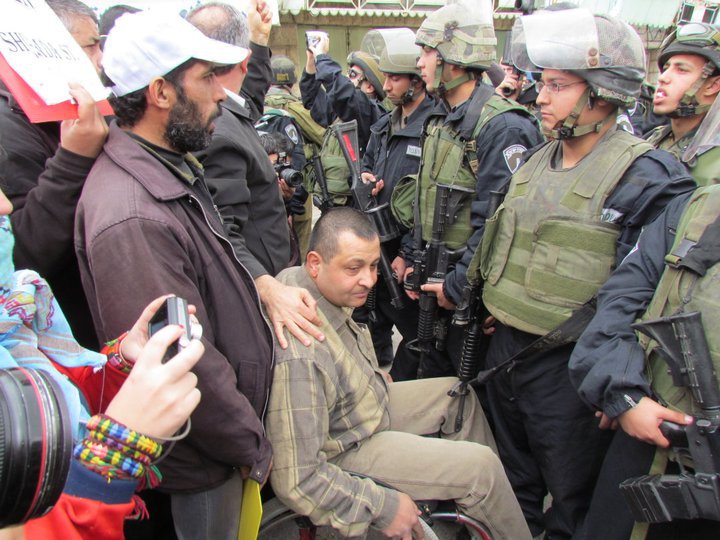
It was a so hard, those days that I don’t want to remember it anymore.”

You must be very proud of your son Saeed and all he has done to raise awareness?

“Yes I am. Always he fights and never accepts that we lose. Saeed will not be broken and he has much dignity. One day, we were very disappointed and started to lose hope because the fine that was set to free my husband was so high.

Saeed came to me and told me that there is a friend ((an international friend)) who wants to help us with our situation and continue our struggle. I didn’t believe him in the beginning but later I saw everything that they did to raise money. I am so proud of my son and also grateful to all the people that helped raise the money for us.

I realized that we are not alone anymore and that the whole world is starting to know about what really goes on here now.

I don’t know how Saeed organised all this or how it all started but I saw Saeed was always busy, day and night. I know he worked so hard to achieve this great success. This is my son, as I know him and his spirit cannot be broken.”

Can you tell us a little about your everyday life and what it is like living under an occupied territory?

“It is a hard life and an unbearable life, but we have to deal with it and try to be normal. Here there is no security and most of the time I am so worried about my children because of the occupation forces. It is frightening when they come and go to the village often in the day.

At night there are the night raids. Our house was raided more than 25 times and when they don’t come to the house they annoy the whole village by throwing sound bombs and tear gas and live bullets at our homes. We need to feel more secure and also to feel we have some rights.

I joined the protest against the building of the annexation wall and I got shot several times. There is no way else than to accept to live under this situation, but we still do have hope for a better future full of peace and love and security and freedom one day. My daily life is-full of stress, we try to smile but it’s so hard when we have pain in our hearts hurting us. But we will never go down and we will be free one day.

It seems the Israeli army have total unchecked freedom to threaten, detain, imprison, torture and arrest Palestinians often without any charge. They openly practice violation of human rights.

These acts are carried out in the name of Jews everywhere. As a Jew this makes me responsible. I cannot condone their acts.”

* Palestinian, loss of land:
http://lawrenceofcyberia.blogs.com/photos/maps/landloss.html
* To read more about Ni’lin and to show your support, please go to
http://www.nilin-village.org/

AUTHOR: Lynda Renham-Cook
URL: http://www.lyndarenham.org.uk
E-MAIL: lynda@renham.co.uk

http://www.nl-aid.org/continent/middle-east/palestine-the-theft-of-ni’lin/

During Demonstrations Demanding the Opening of Shuhada Street and Commemorating the Ibrihimi Mosque Massacre, a Number of Participants are Injured or Arrested
Hebron–Dozens of were injured Friday 2/25 when Israeli forces threw sound bombs and assaulted demonstrators at a large peaceful protest commemorating the Ibrihimi Mosque massacre, calling for the opening of Shuhada Street, and criticizing the American veto of the Palestinian call for UN Security Council condemnation of and a halt to settlement activity.

The protest was organized by Youth Against Settlements. Thousands of Palestinians and dozens of Israeli and foreign activists along with a number of Palestinian leaders (among them the Governor of Hebron Governorate Kamel Hamid, member of the Fatah Central Leadership Committee Jamal Mahsin, Head of the Palestinian initiative Mustafa Barghouthi,) participated in the demonstration after Friday prayers. The demonstration proceeded from the area of Sheikh Ali Al-Baka Mosque in the city toward the direction of Shuhada Street in the center of Hebron.

Occupation forces tried to prevent the demonstrators from reaching the eastern entrance to Shuhada Street, near the old municipality, by creating a large human chain of individuals from Special Forces. However, a large number of demonstrators managed to cross into Shuhada Street, where a number of demonstrators sat on the ground and in front of the tires of military jeeps. Soldiers attacked them, began to hit them with their hands and with the butts of their guns, pulled them away, and arrested a number of them, according to Youth Against Settlements Coordinator Issa Amro
.
The protesters split up to try to enter Shuhada Street through alleyways and smaller streets. They confronted occupation forces who used excessive force against them.

Occupation forces fired gas and sound bombs and rubber bullets at demonstrators, leading to injuries. About 20 demonstrators were taken to Hebron Governmental Hospital.

According to Amro, the demonstrators chanted slogans and carried signs in Arabic, English, and Hebrew demanding from the occupying authorities the opening of Shuhada Street, which has been closed for many years. Demonstrators’ slogans praised the popular revolutions in Egypt, Tunisia, and Libya, and criticized the American veto of the UN Security Council condemnation of settlement activities.

Hebron Governor Kamel Hamid spoke to those in attendance, confirming the Arab nature of the city of Hebron and the opposition to the policy of settlement and discrimination practiced by the occupation in the city. He called for supporting and strengthening popular resistance to the occupation. He condemned the US veto in the Security Council. Jamal Mahsin spoke also, praising the steadfastness of the residents of Hebron, and emphasizing the necessity of national unity and the end of internal divisions.

The Israeli occupation forces closed Shuhada Street to Palestinian vehicles in 1994, after the Ibrihimi Mosque massacre, then forbade Palestinian residents to walk there in 2000, in order to provide security for the 600 Israeli settlers occupying the center of Hebron.

More than 500 stores were closed by military order in the center of Hebron, and more than a thousand store owners were forced to close their shops due to checkpoints and closures. At the same time, illegal settlers enjoy freedom of movement in the closed streets and are protected by occupation forces.

The activities of the occupation and its settlers in the city of Hebron have turned the lives of 200,000 Palestinians in Hebron into a living hell and expelled thousands from their homes.

Unity between Palestinians is more urgent than any other need

 please sign the petion Ahewar
We have yet to be free as a people but have diverged from the path to liberty. This social contract is the basis of a new popular movement towards our liberation.

The Palestinian people and their struggle are now confronted by a disastrous situation. We are divided. Our priorities are confused, and our agenda for liberation is unclear. We have consequently fallen short of achieving our freedom. We lack justice and have yet to practice our inalienable right of self-determination.

Today, we derive our strength and legitimacy from our urge to end the suffering and aspirations of the Palestinian people in Jerusalem, the West Bank, Gaza Strip, Galilee, in the compulsory diaspora in Syria, Lebanon, Jordan, and around the world. We stand infused with the energy emanating from the Arab people’s glorious revolutions in Tunisia and Egypt, and the revolutions in Arab countries from the Atlantic Ocean to the Arabian Gulf. We say, in the name of our innocent martyrs, the wounded, prisoners, refugees, men, women and children, youth and elderly that our compass now points in one direction, and it points towards freedom. To get there we must and shall achieve the following:

Freedom, Justice, and Self-determination

The Palestinian people shall begin to build a realistic vision for their future based on a new Palestinian Social Contract. Our social contract shall be based on the inalienable rights to liberty, justice, self-determination, and the pursuit of happiness. This contract shall ensure freedom, human dignity and justice. Equality, clarity, transparency, democracy and full societal participation in the struggle shall be the guiding principles for this contract. The Palestinian citizens’ cause, concerns and aspirations cannot be reduced, in anyway, to one third of the Palestinians who are in the West Bank and the Gaza Strip. Therefore, the required Social Contract represents all the Palestinians. It addresses their rights within a formula that observes what is common among all Palestinians and recognizes the differences among the diverse components of our society.

This statement balances between the daily concerns of the Palestinian people and their aspirations. It also suggests realistic alternatives to the current status quo that results in a state of division, weakness, economic crises and the marginalization of the majority of the Palestinian people. We pose three necessary changes to the status quo that express our vision for the Palestinian people.

First: The Establishment of a New Palestinian Social Contract

The Social Contract is based on the need to establish unity amongst the Palestinian people (in Palestine within its historical borders and in the diaspora). We all have the same aspirations: Freedom, justice, return, the unhindered pursuit of happiness, and the dream that we will practice our right to self-determination. To achieve these aspirations all sectors of the Palestinian people, civil society, different political factions, the youth and trade unions are invited to:

– Rebuild the PLO as the sole representative of the Palestinian people and maintain its independence. This requires re-structuring its institutions and ensuring that it is away from the Israeli occupation control.
– Reformulate the Palestinian National Charter in accordance with the new Social Contract, in a manner that ensures the supremacy of freedom, justice and equality that light the path for our movement towards liberation, democracy and self-determination.
– Re-building of the PLO requires, first and foremost, election of a Palestinian National Council (PNC) representing all Palestinians (inside and outside the homeland). Preparations for the elections shall ensure full democracy.
– Pursuant to the PNC elections, the PLO Executive Committee shall be formed in a manner representing political forces, independent personalities and representative institutions with a special focus on ending the factional quota tradition.
– Full separation between the PLO institutions, tasks and persons and the institutions of the administrative bodies responsible for maintaining the day to day life of Palestinian people in the occupied Palestinian territories (OPT).
– End the existing status quo and begin building mechanisms that ensure the broadest democratic representation of the Palestinian people.
– Ensure that the newly formulated PLO is the sole responsible party for the political track of the Palestinian cause before the Palestinian people. Consequently, the Palestinian Authority, as an institution or personalities, does not politically represent the Palestinian people and does not identify mechanisms of our struggle and resistance.
– Struggle against the occupation and its injustices using all internationally legitimate and ethical means. Any strategies for the struggle shall be decided upon through national consensus (achieved within the PLO) and strategically formulated according to the challenges the Palestinian cause is facing to ensure that the most practical tactics are being used.
– Ensure that our inalienable rights are non-negotiable.

Second: The Struggle Against the Occupation and its Apartheid policies

Main principle: The Palestinian people shall struggle against the Israeli occupation using all morally legitimate means of resistance until they are free and establish a just society with full equality.

– The Palestinian people, through the PLO, shall identify the strategies of the struggle.
– We shall increase the momentum of nonviolent popular resistance, using the media, international law, strikes, boycotts, divestment and sanctions and shall seek international support for our struggle.
– We shall support the steadfastness our people on their land, especially in Jerusalem, areas threatened with eviction such as the Jordan Valley and areas in the Negev desert, and near the Apartheid barrier.
– We shall form popular committees to confront occupation’s measures and create daily realities to protect innocent people, their private properties and land.
– We shall launch international campaigns to combat the occupation and its racist separation. We shall use international law to assist us in ascertaining our rights and coordination with international organizations that support values such as human rights, freedom, and equality.
– We shall struggle against the Israel’s racist measures against our people inside the Green Line, support them and provide political and legal protection for their demands and struggle.

Third: Administration of the daily living affairs of the Palestinian people in the OPT

Main principle: The Palestinian administration in the Occupied Palestinian Territories is the civil entity mandated by the PLO to manage the Palestinian affairs. Hence, it does not have the authority to represent all Palestinians. It is not a political entity or authority.
– The PLO forms a representative council for the Palestinians in the OPT responsible for management of their life affairs.
– The representative council is the realistic alternative of the Palestinian Legislative Council and the Presidential institution in the OPT.
– An administrator shall be elected from the representative council. He/She shall nominate the heads of the differnet administrative directorates, which shall work according to a platform set up and approved by the representative council to ensure the fulfillment of the people’s day-to-day demands in the OPT.
– The representative council shall be constituted of experts and not politicians whose tasks are confined in taking care of administrative and legislative demands pertinent to people’s day-to-day lives. This will reduce factional competition and enhance the role of the elected representative council.

Formation of security apparatuses and their tasks, and the resistance arms
– All security apparatuses will be integrated within one police service that maintains public safety and the rule of law in the OPT.
– The police apparatus shall be fully separated from and independent of the political factions.
– Weapons shall be used for legal reasons only such as maintaining the people’s safety and defending them from mortal harm.
– Political factions do not have the right to individually select their resistance strategies.
– The police apparatus will be restructured based on new laws that shall govern its duties.

Combating corruption
– Full transparency shall be restored. Corrupt institutes and individuals shall be tried and the stolen funds returned to their rightful owners and the Palestinian people.

Requirements of national and societal reconciliation
– Banning any political platform from inciting to violence.
– The youth and academic experts shall formulate a document to end Palestinian disunity in a manner that is beneficial for the Palestinian cause.
– The youth shall use wide ranging activities to pressure all conflicting sides to come together
– Any delay in ending the division after this document is presented shall be borne by the present leaderships.
– A court shall be formed from independent persons guaranteed by the PLO to decide on all the division implications at the individual and collective levels. The court’s decisions are binding to all.

Let all people who love their people and their country now say, as we say here:
– WE SHALL STRUGGLE FOR FREEDOM, SIDE BY SIDE, THROUGHOUT OUR LIVES, UNTIL WE HAVE WON OUR LIBERTY.

please sign the petition on Ahewar

Houria Bouteldja from "Indigenes de la Republique"

 from Kasama Project A Maoist sister in Spain, LG, sent us the following posting. She wrote as an introduction:

This very controversial  essay is by Houria Bouteldja, the spokesperson for the political party organized by people of color in France called Les Indigenes de la Republique. This group is composed by people born and raised in France whose families come from the French ex-colonies. The majority of the members are French from African, Caribbean and Arab origin.

The essay caused a lot of interesting debates because it is a critique to Western Feminism from a Third World Feminist perspective. The essay was also translated to many languages by the Decolonial Translation group.

The term “indigenous” in the French context is used very differently from the Americas. In the Americas, the indigenous are aboriginal or native people. In France, indigenous means “colonial subjects of the French empire.” Indigenous was the term used by the French empire during colonial times to refer to colonial populations everywhere (Viet Nam, Algeria, Tunisia, Martinique, Guadaloupe, Senegal, etc.).

This French party, composed primarily by people of color but open to everybody, appropriated the term “indigenous” from French colonial history to basically say that even though they are French (born and raised in France), due to racism, capitalism and imperialism, they are still treated inside France as “indigenous of the Republic,” that is, as colonial subjects.

It is a way of saying, we are still living in colonial times even though we live in France. Thus, their openly stated goal is to decolonize France. They do a Decolonial march every year in Paris on May 8th. This is the day of the liberation of France in 1944 from the Nazi occupation and the day of the Seti massacre in Algeria. What happened was that while the French went to the streets to celebrate, the Algerians in Seti (a small city of Algeria) also went to the streets to celebrate and to call for Algerian independence. The response of the French colonial army was to kill everybody in the Seti demonstration. So, the indigenous of the Republique do this Decolonial march every year to remind that France is in need of radical decolonization. I was once in one of these marches and it is surreal. You could see thousands of French people-of-color in a demonstration through the streets of Paris with huge Photos of Aime Cesaire, Frantz Fanon, Amircal Cabral, Angela Davis, Malcolm X, Kwame Nkhruma, Nelson Mandela, Nasrallah, Nasser, etc.

Anyway, here is the essay, which was delivered as a speech to the 4th International Congress of Islamic Feminism that took place in Madrid, in October 2010. It appeared in English on Decolonial Translation:


Les Indigenes de la Republique


White women and the privilege of solidarity

by Houria Bouteldja

I would, first of all, like to thank the Junta Islamica Catalana for having organized this colloquium, which is a real breath of fresh air in a Europe that is shriveling up in upon itself, wrought up in xenophobic debates and increasingly rejecting difference/alterity.

I hope that such an initiative will be able to take place in France. Before getting into the subject at hand, I would like to introduce myself, as I believe that speech should always be located.

I live in France, I am the daughter of Algerian immigrants. My father was a working class man and my mother was a housewife. I am not speaking as a sociologist, a researcher or a theologian. In other words, I am no expert.

I am an activist and I am speaking as a result of my experience as a political activist and, I might add, my own personal sensibility. I am insisting on these details because I would like to be as honest as possible in my reasoning. Truth be told, until today, I hadn’t really thought about the question of Islamic feminism. So why am I taking part in this colloquium? When I was invited, I made it quite clear that I lacked the authority to speak about Islamic feminism and that I would rather deal with the idea of decolonial feminism and the ways in which, I believe, it should be related to the more general question of Islamic feminism.

That is why I thought I would lay out a few questions that could prove useful for our collective questioning.

  • Is feminism universal?
  • What is the relationship between white/Western feminisms and Third World feminisms among which we find Islamic feminisms?
  • Is feminism compatible with Islam?
  • If it is, then how can it be legitimized and what would its priorities be?

First Question: Is feminism universal?

For me, it is the question of all questions when adopting a decolonial approach and when attempting to decolonize feminism. This question is essential, not because of the answer but rather because it makes us, we who live in the West, take the necessary precautions when we are confronted with ‘Other’ societies.

Let’s take, for example, so-called Western societies that witnessed the emergence of feminist movements and have been influenced by them. The women who fought against patriarchy in favor of an equal dignity between men and women gained rights and improved women’s circumstances, which I, myself, benefit from.

Let’s compare their situation, that is to say our situation, with that of so-called “primitive” societies in Amazonia for instance. There are still societies here and there that have been spared by Western influence. I should add here that I don’t consider any society to be primitive. I think there are differing spaces/times on our planet, different temporalities, that no civilization is in advance or behind on any other, that I don’t locate myself on a scale of progress and that I don’t consider progress an end in itself nor a political goal.

In other words, I don’t necessarily consider progress to be progressive but sometimes, even often, it is regressive. And, I think that the decolonial question can also be applied to our perception of time. Getting back to the subject at hand, if we take as our criteria the simple notion of well-being, who in this room can state that the women from those societies (who know nothing of the concept of feminism as we conceive of it) are less well-off than European women who not only took part in the struggles but also made available, to their societies, these invaluable social gains?

I, myself, find it quite impossible to answer this question and would consider quite fortunate whoever could. But yet again, the answer is of no importance. The question itself is, for it humbles us, and curbs our imperialist tendencies as well as our interfering reflexes. It prevents us from considering our own norms as universal and trying to make other’s realities fit into our own. In short, it makes us locate ourselves with regards to our own particularities.

Between Western & Third World feminisms

Having laid out that question clearly, I now feel more at ease to tackle the second question dealing with the relationship between Western feminisms and Third World feminisms. Obviously it’s very complicated but one of its dimensions is the domination of the global south by the global north. A decolonial approach should question this relationship and attempt to subvert it. An example:

In 2007, women from the Movement of the Indigenous of the Republic took part in the annual 8th of March demonstration in support of women’s struggles. At that time, the American campaign against Iran had begun. We decided to march behind a banner that’s message was “No feminism without anti-imperialism”. We were all wearing Palestinian kaffiyehs and handing out flyers in support of three resistant Iraqi women taken prisoner by the Americans. When we arrived, the organizers of the official procession started chanting slogans in support of Iranian women. We found these slogans extremely shocking given the ideological offensive against Iran at that time. Why the Iranians, the Algerians and not the Palestinians and the Iraqis? Why such selective choices? To thwart these slogans, we decided to express our solidarity not with Third World women but rather with Western women. And so we chanted:

Solidarity with Swedish women!

Solidarity with Italian women!

Solidarity with German women!

Solidarity with English women!

Solidarity with French women!

Solidarity with American women!

Which meant:

Why should you, white women, have the privilege of solidarity? You are also battered, raped, you are also subject to men’s violence, you are also underpaid, despised, your bodies are also instrumentalized…

I can tell you that they looked at us as if we were from outer space. What we were saying seemed surreal, inconceivable. It was like the 4th dimension.  It wasn’t so much the fact that we reminded them of their situation as Western women that shocked them. It was more the fact that African and Arabo-Muslim women had dared symbolically subvert a relationship of domination and had established themselves as patrons. In other words, with this skillful rhetorical turn, we showed them that they de facto had a superior status to our own. We found their looks of disbelief quite entertaining.

Another example: After a solidarity trip to Palestine, a friend was telling me how the French women had asked the Palestinian women if they used birth control. According to my friend, the Palestinian women couldn’t understand such a question given how important the demographic issue is in Palestine. They were coming from a completely different perspective. For many Palestinian women, having children is an act of resistance against the ethnic cleansing policies of the Israeli state.

There you have two examples that illustrate our situation as racialized women, that help understand what is at stake and envisage a way to fight colonialist and Eurocentric feminism.

Following on from that question, is Islam compatible with feminism?

This question is purely provocative on my behalf. I can’t stand it. I am asking this question to imitate some French journalist who believes they are asking a really pertinent question. As for me, I refuse to answer out of principle.

On the one hand, because it comes from a position of arrogance. The representative of civilization X is demanding that the representative of civilization Y prove something. Y is, therefore, put in dock and must provide proof of her/his “modern-ness”, justify her/him-self to please X.

On the other hand, because the answer is not simple when one knows that the Islamic world is not monolithic. The debate could go on forever and that is exactly what happens when you make the mistake of trying to answer.

Myself, I cut to the chase by asking X the following question:Is the French Republic compatible with feminism?

I can guarantee you one thing: ideological victory is in the answer to this question. In France, 1 woman dies every 3 days as a result of domestic violence. The number rapes per year is estimated around 48 000. Women are underpaid. Women’s pensions are considerably less substantial than those of men. Political, economic and symbolic power remains mostly in the hands of men. True, since the 60’s and 70’s, men share more in household duties: statistically, 3 min more than 30 years ago!! So I ask my question again: are the French Republic and feminism compatible? We would be tempted to say no!

Actually, the answer is neither yes nor no. French women liberated French women and it’s thanks to them that the Republic is less macho than it was. The same goes for Arabo-Muslim, African and Asian countries. No more, no less. With, however, one extra challenge: consolidating within women’s struggles the decolonial dimension, that is to say the critique of modernity and eurocentrism.

How to legitimize Islamic feminism?

For me, it legitimizes itself. It doesn’t have to pass a feminist exam. The simple fact that Muslim women have taken it up to demand their rights and their dignity is enough for it to be fully recognized. I know, as result of my intimate knowledge of women from the Maghreb and in the diaspora, that “the-submissive-woman” does not exist. She was invented. I know women that are dominated. Submissive ones are rarer!

I would like to conclude with what, in my opinion, should be priorities for decolonial feminism.

You have all heard about Amina Wadud and her involvement in the development of Islamic feminism. She became well known the day she lead the prayer, a role usually reserved for men. Out of context, I would say that it could be thought of as a revolutionary act. However, in an international context that saw the Iranian Revolution and 9/11 (as well as growing Islamophobia, demands that Islam update and modernize itself), a much more ambiguous message was brought to light. Was it answering strong demands, an urgency, the fundamental expectations of women from the Umma? Or were these expectations of the white world? Allow me to dwell on the latter hypothesis. Not that there aren’t any women who find it an injustice that only men be allowed to lead the prayer but because women’s priorities and urgent needs are elsewhere.

What do Afghan, Iraqi and Palestinian women want? Peace, the end of the war and the occupation, the rebuilding of their national infrastructures, legal frameworks that guarantee their rights and protect them, access to sufficient food and water, the ability to feed and educate their children under good conditions. What do Muslim women in Europe and more generally those who are immigrants and who, for the most part, live in lower income neighborhoods want? A job, housing, rights that protect them not only from state violence but also men’s violence. They demand respect for their religion, their culture. Why are all of these demands silenced and why does the issue of leading the prayer make its way across the globe when Judaism and Christianity have never really made apparent their own intransigent defense of the equality of sexes? To finish up with this example, I believe that Amina Wadud’s act was, in fact, quite the opposite of what it claimed to be. In reality and independently of the theologian’s own wishes, this act, in my opinion, was counter-productive. It will only be able to adopt a feminist dimension once Islam is equally treated with respect and once the demands to lead the prayer come from Muslim women themselves. It is time to see Muslim men and women how they really are and not how we would like them to be.

I conclude here and hope to have shown the ways in which a true decolonial feminism could benefit women, all women when they, themselves, deem it to be their path to emancipation.

Houria Bouteldja, Madrid, 22 October 2010.

Translated by Amy Fechtmann