Archive for the ‘Human Rights’ Category

AHW 1WRITTEN BY Rahim Hamid

Al-Ahwaz region of Iran is currently witnessing a wave of mass protests and demonstrations demanding freedom and an end to the Iranian regime’s multifaceted oppression of the Ahwazi people, which has been continuous since Iran first occupied the region by the use of military force.

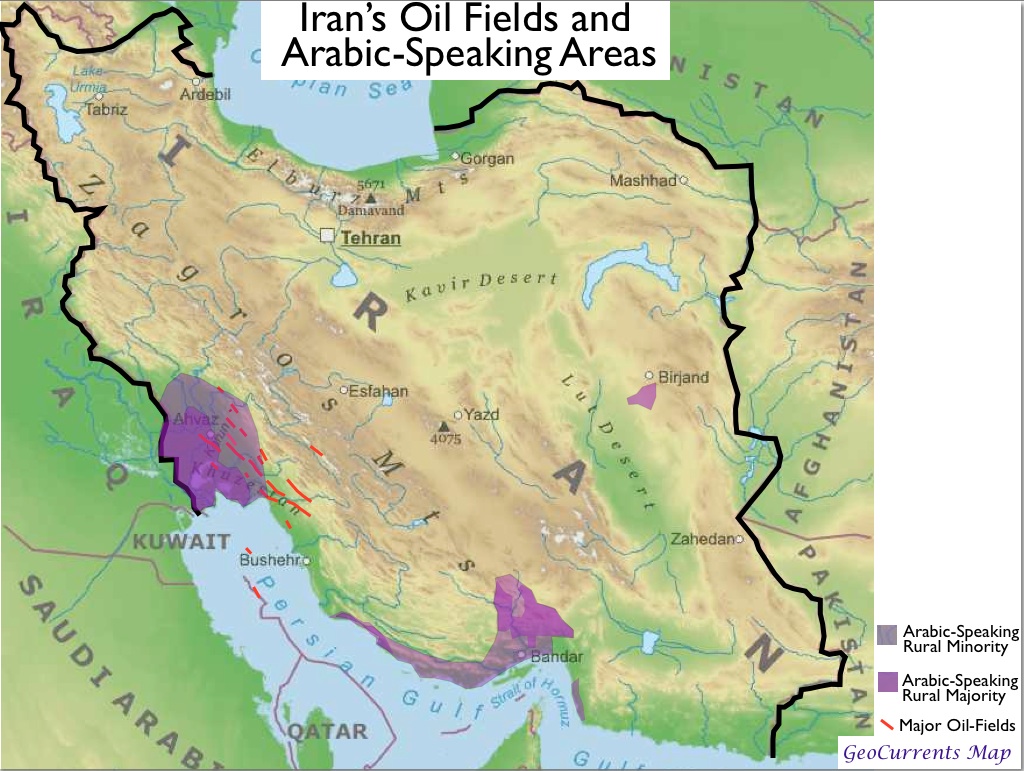
Ahwazi Arabs are among the most brutally oppressed peoples in the Middle East. The population of the region in the south and southwest of Iran totals around 10 million, with the people united by race, culture and language. The Ahwazi Arab dialect strongly resembles the dialect in neighboring Iraq. The majority of Ahwazis are Shia and Sunni Muslim, although there are other sects and creeds, including Christian and Mandaean.

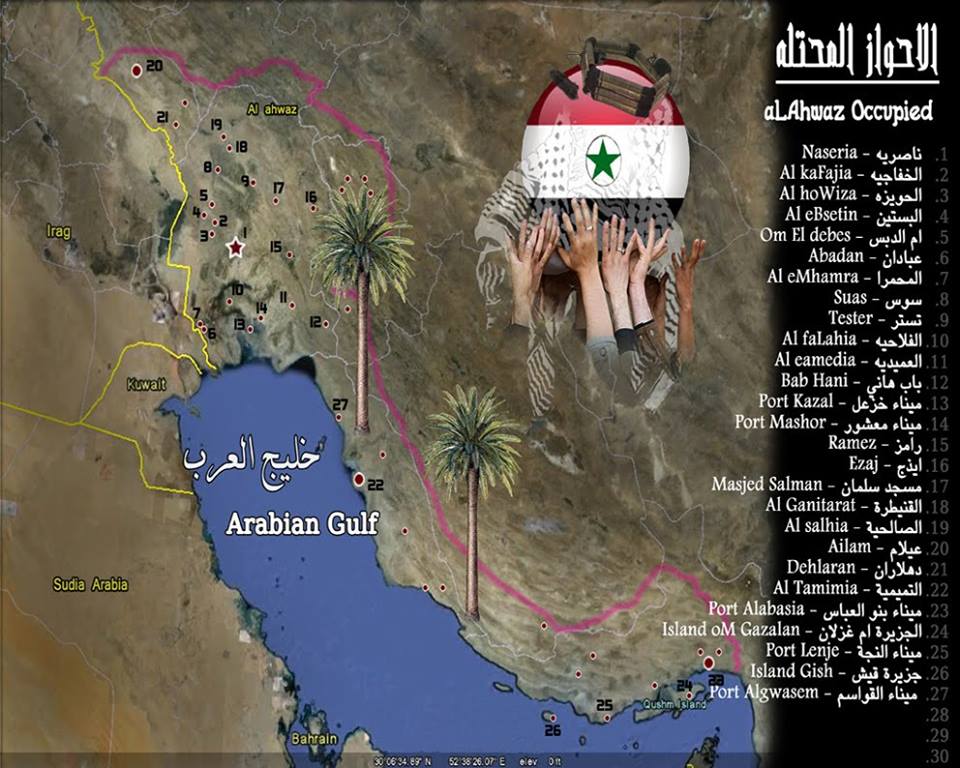
Ahwaz is a Persian-occupied Arab country located in the north and the east of the Arabian Gulf to the east of Shat Al-Arab waterway which has been occupied by Iran for more than eight decades and renamed ‘Khuzestan.’

The entire territory of Ahwaz, covering 324,000 square kilometers, is bounded to the west by Iraq, to the south-west by the Arabian Gulf and Arabian Peninsula and to the north, east and south-east by the Zagros Mountains, the natural boundary between Ahwaz and Iran.  With an Arab population of ten million, Ahwaz is among the most resource-rich territories occupied by Iran, holding more than 80 percent of the country’s oil and gas resources.

The region has three major rivers, the Karoon, Jarrahi and Karkheh, which play a vital role in the lives of its people, with most Ahwazis long economically dependent on the three waterways for their income from both fishing and agriculture, with the waters used to irrigate the rich arable land.

Historically the Semitic Elami tribes, the first known peoples of the Arabian Peninsula and Iraq, settled on Ahwaz’s riverbanks and valleys, establishing a great civilization, particularly the ancient city of Susa, now known as Shush.

Since the initial annexation of Ahwaz by Iran, then known as Persia, 90 years ago, the humanitarian situation of the Ahwazi Arab people has steadily worsened, with the level of murderous repression by the current regime rising daily, extending to the level of systemic ethnic cleansing as policy, forcible eviction of the Ahwazi indigenous people, and the construction of exclusive apartheid-style settlements for non- Ahwazi, non-Arab settlers; these settlers are offered multiple economic and social incentives to move there and given guarantees of a promising future, while the Ahwazi Arab indigenous peoples are further marginalised, alienated and denied the most basic rights in every field.

Historically the catastrophic suffering of the Ahwazi people first began after Reza Khan, the then-ruler of Persia, now called Iran, and invaded the Emirate of Al-Ahwaz in 1925, overthrowing the last independent Arab ruler of the region, Sheikh Khazaal Alkaabi, who was subsequently imprisoned in Tehran for 10 years before being murdered in 1936 by strangulation on the orders of Reza Khan.

The current theocratic Iranian regime has imposed authoritarian rule on Al-Ahwaz region by the harshest measures, in a bid to isolate the Ahwazi Arab people from their origins and their historical association with the Arab nations, simultaneously imposing an absolute media blackout on any reporting of the suffering of Ahwazis.

As is widely known, the Iranian regime provides no official statistics on the number of Ahwazi Arabs in Iran, but studies conducted by Ahwazi activists confirm that the current total Ahwazi population stands at between 8 and 10 million. American historian William Theodore Strunk in his work about Ahwaz: The Reign of Sheikh Khazal ibn Jabir and the Suppression of the Principality of Arabistan: A Study in British Imperialism in Southwestern Iran, 1897-1925, Unpublished PhD thesis, Indiana University August 1977, wrote that during the discovery of oil 1908 in Al-Ahwaz region, Ahwazi Arabs made up roughly 98 percent of the regional population.

AHW 2This majority has now shrunk to 70 percent, due to the regime’s policy of systemic and deliberate Persian immigration and colonisation of the region in order to alter its demographic composition.

The primary reason for Iran’s occupation of Al-Ahwaz is the region’s major oil and gas resources. The region also has extensive and fertile agricultural plains irrigated by the Karoon River.

Ahwaz is a tropical region located in the south and south-west of what is currently known as Iran, with the region being a major producer of crops, including dates, cucumbers, carrots, potatoes, tomatoes, watermelons and other fruits and vegetables, as well as wheat, sugar and corn and many other cereal crops.

Despite all this natural abundance and its status as the center of Iran’s oil and gas industry housing massive industrial complexes, Al-Ahwaz is also the home of Iran’s poorest people, with 99% of Ahwazi Arabs living in extreme poverty and endemic deprivation. This destitution among the region’s indigenous people has its origins in the profoundly racist mentality of the Iranian occupiers, in whose eyes the Ahwazi people’s Arab identity poses a dangerous threat to the country’s national security.

A destitute Ahwazi Arab couple, their home demolished by Iranian occupying forces, collect plastic from rubbish to sell simply in order to survive 

A destitute Ahwazi Arab couple, their home demolished by Iranian occupying forces, collect plastic from rubbish to sell simply in order to survive

Iranian colonial projects in Al-Ahwaz  

The Iranian regime occupiers to this day seek to increase the proportion of non-Arab settlers in Ahwaz, even changing the original Arabic names of cities, towns, rivers and other geographical features to Farsi names in an attempt to deny the region’s Arab identity.

This systemic eradication of the Arab character and identity of the Ahwaz region and its peoples extend into every area of life, showing a thoroughly planned strategy to bury and erase the Arab culture and identity of Ahwazis once and for all via the illegitimate and forcible imposition of the Persian occupiers’ culture on the Arab peoples.

There is all too plentiful evidence of this policy which has led to the current bitter daily reality of the Ahwazi peoples.  One of the earliest demonstrations of this policy was during the era of Reza Khan’s rule of then-Persia when the speaking of Arabic and wearing of Arab clothing in public were outlawed, with transgressors facing horrendous punishments.

Thereafter and to this day, Iran enforced an all-Farsi education curriculum in Al Ahwaz, with the teaching of the Arabic language forbidden and all studies in Arabic made illegal.  This led to rampant illiteracy among the Ahwazi people, adding to the problems of widespread unemployment, with Ahwazis denied access to job opportunities on the pretext of their lack of educational qualifications. Through these openly grotesquely racist policies, the Ahwazi people were very deliberately weakened, losing any possibility of economic and social stability. These apartheid policies of successive Iranian regimes mean that Ahwazi people are still forbidden from giving their children Arab names or from wearing Arab dress, with the ultimate goal of eradicating all Arab identity and subsuming the Ahwazi people into simply another part of the Persian nationalist whole.

Karoon Rivers which dried up due to transferring of its water to central regions of Iran

Karoon River which dried up due to transferring of its water to central regions of Iran

Ahwazi peoples suffer from systemic exclusion in every area of life and at all levels, with the regime continuing a policy of ethnic cleansing, arbitrarily seizing homes, land and property and ‘giving’ these to settlers from neighbouring Persian territories in order to change the demographic balance of the region; under the Iranian legal system, the Ahwazi peoples are denied any legal recourse to object to such grotesque injustices.

The key leadership positions in the region are dominated by Persians, with all such positions being off-limit to Arabs. There is no real representation of Ahwazi peoples at any political level in the region due to the ‘security’ concerns of the occupying Persian authorities in all affairs concerning the Ahwazi people.

Despite the region providing approximately 80 percent of Iran’s oil and gas resources, Ahwazis, the rightful owners of this wealth, are denied any share in the massive profits generated by their mineral or other resources.

The only part of the oil and gas production which is passed on to the Ahwazi people is the related air and water pollution and a related increase in dangerous diseases as a result of the toxic waste and toxic gases emitted by the oil and petrochemical facilities whose emissions are largely unmonitored, discharging massive amounts of harmful industrial substances into the surrounding environment.

Recent acid rainfall and dust storms in the region resulting from this large-scale industrial pollution have seen more than 50,000 Ahwazi people admitted to hospitals and medical clinics for treatment for related conditions, providing terrible and plentiful evidence of the environmental pollution in the region.
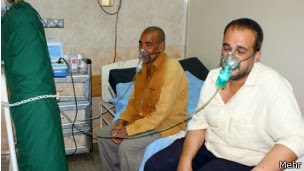
Ahwazi citizens who were admitted to hospitals due to difficulty in breathing after dust storms

Ahwazi citizens who were admitted to hospitals due to difficulty in breathing after dust storms

Successive Iranian governments have allocated far less than one percent of the monies from the region’s oil and gas revenues and related petrochemical projects to the   development of Al Ahwaz; indeed the Iranian parliament recently rejected – for a fourth time – a proposal presented by the regional vice-consul to allocate 1.5 percent of the region’s oil revenues for the reconstruction of towns and cities in the region devastated in the 1980-88 Iran-Iraq war, which ended 27 years ago.

Following Reza Khan’s 1925 military invasion of Al Ahwaz in 1925 and the ousting of Sheikh Khazaal, Ahwazi independence and sovereignty were formally denied when Al Ahwaz was annexed to become part of the newly established nation of Iran in 1934.

Since then, several Ahwazi Arab uprisings have taken place and been brutally quashed, with both military and civil movements reiterating their determination to continue their resistance and struggle for justice and freedom from Iranian occupation and to restore Ahwaz to its previous sovereign status.

Each uprising has met with murderous brutality at the hands of the Iranian authorities, with massive numbers of Ahwazis being banished and forcibly transferred to Persian regions.

Ahwazis have now received harsh treatment at the hands of Iranian authorities for generations. In the wake of the first popular uprising following the initial annexation of Ahwaz, Persia’s then-rulers banished large numbers of the people, forcibly resettling them in  Persian regions as part of an ethnic cleansing policy, as well as changing the name of the region to Khuzestan and conferring Farsi names on cities, towns,  villages and even geographic features like rivers, as well as banning the wearing of Arab clothing and criminalizing the speaking of Arabic, all in an effort to deny and effectively eradicate the region’s Arab identity and history.

These policies continue to the present day, with Ahwazi people’s land and property forcibly confiscated to be redistributed to Persian settlers in an attempt to ‘Persianise’ the Ahwaz region.  In the late 1940s, the Persian rulers introduced a policy of settling people of Persia’s nomadic ‘Lur’ tribes in areas with Arab majorities, particularly around the oil-rich cities in the Ahwaz region, while Arab residents were forcibly transferred elsewhere.

This systemic ethnic cleansing policy has accelerated in recent years, with the apparent objective of eradicating the Arab identity and culture of Ahwaz. Any popular political movement or uprising led by Ahwazi dissidents, such as the last major one in 2005, protesting against this institutionalized injustice and oppression is brutally quashed by regime authorities, with massive violence against demonstrators and mass arrests and executions of hundreds of the most prominent dissidents.

Ahwazi demonstration

Ahwazi demonstration

After every uprising, hundreds of bodies of Ahwazi dissidents arrested tortured and killed by Iranian security forces are recovered from the Karoon River where they are dumped.  The detained prisoners are routinely held incommunicado for months, during which they are subjected to horrific torture and interrogation, with ‘confessions’ extracted under duress.

Ahwazi people have repeatedly sought to utilize every peaceful political means to attain even the most basic human rights, which are supposedly guaranteed under the current Iranian regime’s constitution, particularly in Articles 15 and 19, which stress the right to education in the native language of all ethnic groups within Iran, including Arabs, Turks, Kurds and Baluchis. This legislation is effectively superficial window dressing, however, since the regime refuses to implement these articles,  with the result that more than half of Iran’s population who are ethnically non-Persian  are denied the right to be educated in their mother tongue; this in turn means that, with an educational curriculum taught solely in Farsi,  schools in the already marginalised non-Persian areas see high rates of non-attendance, with pupils dropping out at an early stage, leaving these populations further disadvantaged by widespread illiteracy and low education levels.  Added to this, the criminalization of Arab culture, including proscriptions on Arabic language in both speech and education, along with the widely resented imposition of Farsi as the official language leaves students largely unskilled in both languages and suffering from a dual identity crisis.

Historical context

To understand the contemporary crisis in Ahwaz, it’s necessary to know some historical background.  Oil was first discovered in Ahwaz, as elsewhere in the Middle East, in 1908, piquing the colonial greed of both the Persian state and the Western powers, with the then-British Empire seeking to expand its regional power and control in tandem with other European powers.

With the outbreak of World War I in 1914, Ahwaz also assumed a strategic importance for the nations involved due to its strategic location.

In 1925, the Pahlavi dynasty came to power in Persia, ousting the previous ruler of Persia, Ahmad Shah Qajar.  Reza Pahlavi identified the geopolitical significance and resource wealth of Ahwaz as potential major assets, with the new rulers wasting no time in invading and annexing Ahwaz, deposing Sheikh Khazaal, in 1925.  In 1936, the year of Khazaal’s execution, Ahwaz was given a new, Farsi name, ‘Khuzestan’, while Persia was renamed ‘Iran’ – ‘Land of the Aryans.’

As Persia’s new name suggested, the Pahlavi dynasty was founded on a strongly nationalistic ideology, with all of Tehran’s territories depicted as homogenous parts of a mono-ethnic, monocultural Persian whole. This resulted inevitably in deeply racist antagonistic policies towards the Arab peoples of Ahwaz as to other non-Persian peoples in territories under Iran’s control from the 1920s which continue to the present day, with all non-Persians essentially robbed of their culture and identity. This denial and eradication of non-Persian identity extended into every area of life, from language, dress, education to all aspects of culture. Following the 1979 Islamic revolution, these brutal proscriptions extended to religion, with non-Shiites (and Shiite dissidents) being persecuted and non-Shiite religious ceremonies and worship heavily punished by imprisonment, torture and often execution.

A History of Dissent: Ahwazi resistance continues in the second Pahlavi era under Mohammad Reza Shah (1941–1979) and since the ‘Islamic Revolution’.

The grievances of the minorities under Iranian rule (who combined comprise the majority)  grew throughout the second Pahlavi monarchy (1941-1979) since Mohammad Reza Pahlavi adopted his father’s deeply chauvinist policy to ethnically restructure the country completely based on Persian ethnicity and identity. Mohammad Reza Pahlavi introduced even more extensive policies intended to subjugate, marginalize and eliminate the five largest minorities under Iranian rule: Ahwazi Arabs, Turkish Azaris, Kurds, Baluchis and Turkmen peoples.

In response to these brutal policies, Ahwazi Arabs and other oppressed groups launched both peaceful and armed uprisings to defy this policy of systemic subjugation and ethnic cleansing.  In 1958, the ‘Arabistan Liberation Front’ was established with the objective of liberating the homeland from Iranian occupation, operating primarily in the cities of Abadan, Mohammareh and Ahwaz.

Two decades after this, in the initial period following the 1979 Islamic Revolution, Ahwazi Arabs felt inspired and hopeful of positive change as a result of the overthrow of the brutal monarchy.  In light of this new spirit of optimism, a delegation of 33 leading Ahwazi figures representing all classes and points on the political spectrum was dispatched to Tehran in late April that year, under the aegis of the then-Ahwazi spiritual leader Grand Ayatollah Sheikh Mohammad Taher Al Shobair Khaghani, for talks with the new provisional government, then chaired by Mehdi Bazargan.  The delegates took with them a memorandum containing 12 demands for very basic reforms, as agreed by the vast majority of prominent Ahwazi political and social leaders, with the people pinning their hopes on the new rulers in Tehran to help Ahwazis attain their legitimate rights and achieve long-denied freedom.

Among the demands laid out in the memorandum were:

  1. Legal recognition of Ahwazi Arab nationality, to be acknowledged and protected under the new Iranian constitution.
  2. The formation of a local committee to administer the affairs of the Ahwazi region as an autonomous, broadly independent territory.
  3. Recognition of Arabic as the official language in Ahwaz, to be taught at school and further education level and the foundation of schools and universities for this purpose, with Arab students to be granted the opportunity of overseas scholarships.
  4. A guarantee of freedom of expression, freedom of assembly and the freedom to establish Arabic newspapers and broadcast media, and an end to the draconian censorship policies of the Shah’s regime.
  5. Abolition of discriminatory policies towards Ahwazis in civil service recruitment.
  6. The allocation of sufficient funds from the oil and gas revenues from Ahwazi lands to help in development of the Ahwazi region.
  7. The restoration and recognition of the Ahwazi people’s right to their Arab identity, i.e. through reintroducing the Arabic names of towns, cities, villages and geographic features rather than the Farsi names conferred under the Shahs’ rule.
  8. Revisions and reforms to the previous regime’s agricultural legislation in order to allow land to be redistributed in a fair and equitable way among Ahwazi farmers, with their ownership rights to be taken into consideration.

During their week of talks in the capital, the delegates met with the then-Prime Minister and other ministers of the new government, as well as with the clerical regime’s religious leaders, including Ayatollah Khomeini.  In these talks, they were assured of the new leadership’s full commitment to overturning the policies of the previous regime, renouncing violence and preserving the unity and integrity of the country.  The delegates, on their part, reassured the officials that the Ahwazi people fully accepted that all state affairs concerning foreign policy, military issues, the monetary system, international treaties and economic plans should be exclusively the concern of the central state.

The Ahwazi delegates had hoped that even if all the demands laid out in the 12-point memorandum were not met, the new leadership would at least grant the Ahwazi people their basic rights and put an end to the Shahs’ decades-long policies of systemic brutal injustice and oppressive rule.   During their meetings, however, the delegates came to realise that the new rulers were little different to the previous despotic regime in their racist attitudes and discriminatory policies towards Iran’s non-Persian population.

Following their return from Tehran, the delegates issued an official statement declaring that the new Iranian leadership had trivialized and undermined the concerns of the Ahwazi people. This led to widespread public anger among Ahwazis, who had been hopeful of real change following the revolution, with many taking to the streets for demonstrations against the continuing racism of the Iranian state to voice their disappointment and disillusionment. The protesters pointed out that the leaders of the Islamic Revolution had come to power with slogans promising a new openness and tolerance and making promises to fulfill the Ahwazi people’s long-denied demands for basic rights, all of which had turned out to be false. Instead, said the protesters, the new regime had shown the same contempt as the previous one, baring its teeth in response to their demands for freedom and rights.

In response to these protests and to the Ahwazi Arabs’ demands, officials of the new clerical regime immediately launched a propaganda and disinformation campaign, now widely known as a standard regime tactic, falsely alleging that the Ahwazi peoples’ protests were part of a regional and global conspiracy to separate Ahwaz from Iran, and asserting that any concessions to the Ahwazi people’s demands would undoubtedly threaten Iran’s territorial integrity, warning ominously that any such protests should be ‘neutralised’ at any cost.

The meaning of this ‘neutralisation’ became horribly clear on May 29th 1979,  only a few months after the revolution brought Ayatollah Khomeini to power, with the new clerical regime’s military, supported by affiliated voluntary extremist sectarian militias launching a murderous offensive on Ahwazi Arab dissidents, killing many hundreds, with thousands more imprisoned and forcibly ‘disappeared’ or forcibly displaced.  The day subsequently became known amongst Ahwazis as ‘Black Wednesday.’

Images of the brutal crackdown on Ahwazis who were massacred savagely in Mohammareh

Images of the brutal crackdown on Ahwazis who were massacred savagely in Mohammareh

The ‘Black Wednesday massacre was carried out in direct response to a Fatwa (religious decree) issued by Ayatollah Khomeini, who directly ordered Ahmad Madani, the then-military governor of Ahwaz to organize the massacre of all the members of political and cultural organizations of the Ahwazi Arab people in Mohammareh city.  To carry out this crime against humanity, Madani deployed the regime’s air and naval forces, who were supported by masked volunteer militias, who coordinated a massive military operation besieging and attacking all the headquarters of Ahwazi political and cultural organisations in the cities of Ahwaz, Abadan, and Mohammareh cities.

Ahmad Madani subsequently became a hero to the Persian people for his leadership of this slaughter, being appointed Commander of the Iranian Navy as a reward for his leading role. He was subsequently quoted as stating, “The Ahwazi are inciting riots so I will drink their blood if they continue insisting on their illegal demands.”

Ahmad Madani and his speech on the necessity of quelling Ahwazi demonstrations

Ahmad Madani and his speech on the necessity of quelling Ahwazi demonstrations

The staff and anyone else in the buildings, including those who attempted to flee the regime’s forces, were either arrested or shot dead if they attempted to flee.  When news spread of the regime’s massively brutal offensives, hundreds of enraged residents of the three cities rushed to the scenes of the atrocities in a desperate effort to save the activists.  Despite being unarmed, these people in turn were machine-gunned in massive numbers by the masked militias and otherwise executed in cold blood, with survivors who didn’t manage to escape being arrested, imprisoned and/or forcibly exiled.

Mohammed Sadeq Givi Khalkhali, one of the main regime officials under Madani responsible for organizing this slaughter, was subsequently appointed as  Chief Justice of the regime’s revolutionary courts in the region, where he ordered the execution of countless other innocent Ahwazi Arabs, often following ‘military trials’ which lasted no longer than a few minutes.

Unfortunately, like so many of the clerical regime’s brutal crimes against Ahwazis and others, ‘Black Wednesday’ has remained uninvestigated and unmentioned by international human rights organisations to date, despite being deeply etched on the memories of the survivors and of all Ahwazi peoples, for whom it is impossible to forget or to forgive until the perpetrators are brought to justice. Despite the regime being accorded absolute impunity by the international community to act with barbaric savagery and to sweep such crimes against humanity under the carpet, the day will live in infamy among all Ahwazis, even those who weren’t born at the time.

One desperate reaction in the aftermath of ‘Black Wednesday’ was the 1980 Iranian Embassy siege in London by an Ahwazi Arab pro-autonomy group who demanded the release of 91 of their comrades held in Iranian jails. Given the relentless decades-long murderous repression of Ahwazis by successive regimes and their refusal to grant even the most basic human rights to the Ahwazi peoples,   some Ahwazis see no hope of regaining their rights under such monstrously unjust leadership, with the Pahlavis’ monarchy and the Islamic Republic’s theocracy being effectively two largely indistinguishable faces of the same genocidal and deeply racist coin for Ahwazis and other minorities in Iran.

Whilst it has gone down in Ahwazi history as one of the most infamous of the Khomeinist regime’s crimes,  ‘Black Wednesday’ was not isolated incident, with similar murderous brutality meted out routinely, indeed systemically as regime policy, to Ahwazi peoples and other minorities by regime forces and militias in that period and ever since.

Like their predecessors, Ahwazi dissidents and intellectuals continue to face the threat of imprisonment, torture and execution simply for campaigning or writing in support of freedom, self-determination and human rights.

The three founders of the ALF, Mohiuddin Al-Nasser, Dohrab Al-Nasseri and Isa Nasseri, were executed in 1964 at the hands of the Organization of Intelligence and National Security, better known by its Farsi acronym, SAVAK, which led the regime’s rule of terror between 1957 and 1979. This, along with the tragic bloody massacre in  Mohammareh city in 1979, and the brutal crackdown on another popular uprising in 2005, are just a few of the stark indications of the dangers faced by Ahwazi dissidents and intellectuals, who live under the constant threat of prison, torture, exile and/or execution.

In the face of this relentless persecution, the Ahwazi people have continued their long struggle for freedom, self-determination and their long-denied legitimate rights; despite the lack of regional and international support for their cause, the people have maintained their determination to continue until they attain their objectives.

Indeed, it could be argued that the many obstacles and the lack of external support or recognition of Ahwazis’ struggle have resulted in strengthened resolve among the Ahwazi people, recognizing that only they can achieve their liberation and succeed in the struggle for freedom, social emancipation and self-determination.

These efforts have led to the establishment of a number of political organisations and groups which have introduced political and social programs that enjoy widespread popular support. Ahwazi groups have also built strong links with liberation movements representing other non-Persian minorities in Iran oppressed by successive Iranian regimes during the same period, including Kurds, Turks, Baluchis and Turkmen.

After its initial revolutionary fervor, the clerical regime’s profoundly reactionary nature, along with its double standards and hypocrisy, became clearer as time went on. For one example, despite having lived and studied in France, the home of liberté, égalité, fraternité, during his exile, Bani Sadr, a prominent figure among the leaders of the Islamic Revolution, returned to Iran only to become one of the most vehemently racist Persian nationalists in the new regime.  Sadr enthusiastically supported the brutal persecution of the Ahwazi people under the new leadership, with his greed for power quickly overcoming any revolutionary ideals he had previously espoused. In an interview with a Paris-based Iranian news agency concerning the popular uprising by Ahwazis in support of freedom and self-determination, Sadr said, “  will not grant autonomy to any territory because it simply means the disintegration of the country”.

Another official, who had met with the Ahwazi delegates during the 1979 talks and promised that their demands would be submitted to the consultative committee then drafting the new constitution, reneged on his promises, telling the official news agency, “Granting autonomy is without doubt considered separation which threatens national unity.”

Meanwhile, Ayatollah Khalkhali, prioritized his loyalty to the new regime, vehemently opposing any autonomy and stating, “We will cover the Shaat al-Arab with the blood of those pro-autonomy Ahwazi Arabs.”

In extracts from his posthumously published memoirs, reported in the Iranian Hamshahri newspaper in December 2001, the ayatollah appeared to have been proud of his criminal practices against Iran’s Arab Ahwazi and Kurdish peoples, writing, “I have killed a lot of Ahwazi Arabs, Kurdish and remnants of the monarchy, but I don’t regret it, and my conscience is not tormenting me.”

Regime oppression continues

The clerical regime’s racist attitudes to Ahwazi Arabs and other minorities remain as deeply entrenched today as they were in 1979, having become institutionalized and systemic as under the Shahs’ rule.  Ahwazis continue to be subjected to ethnic cleansing and the withholding of all rights, with imprisonment, torture and execution standard policy for even the most minor offence or for no reason other than to maintain fear,  and ensure continued subjugation and break the will of the people. As a result of this policy, the percentage of Ahwazi Arab prisoners in the regime’s prisons is, unsurprisingly higher than that of any other group. Regular calls by the EU and international human rights organisations for the introduction of fair and transparent trials for Ahwazi prisoners, who are routinely denied access to a lawyer as standard practice, have been disregarded.

Despite the clerical regime’s oft-repeated claims to stand for Palestinian freedom, anti-Arab racism is endemic and encouraged by the regime, with Arabs being commonly referred to by derogatory terms such as ‘lizard-eaters’ and ‘camel’s milk-drinkers’ and depicted as uncivilized  barbarians and barefoot nomadic peoples.

Denied rights and employment, destitution amongst Ahwazis is widespread, with disproportionate numbers living in the most abject poverty amid unimaginable conditions. With the Tehran regime deliberately withholding funding, infrastructure development is non-existent, with thousands in the regional capital, Ahwaz, living in areas with open sewers, no sanitation, rampant diseases due to pollution, no access to running water, electricity or gas, despite the fact that the region is, as mentioned above, the centre and backbone of Iran’s massive oil wealth, containing over 80 percent of its oil and gas resources. Ahwazi peoples are essentially treated as fifth-class subjects in their own lands, while Persian settlers introduced by Tehran to change the demographic balance live in great affluence in pleasant Persian-only settlements as part of the regime’s policy of tempting more Persians to move to these areas.   Those Ahwazis who are able to find employment have access only to the most menial, low-paid jobs, with all desirable jobs reserved for Persians.

Although most Ahwazis are Shiite, those who are Sunni face even greater discrimination due to the clerical regime’s persecution of non-Shiites.

Almost a century of systemic racist subjugation as policy has led to the Ahwazi people being one of the most marginalized and oppressed peoples in the Middle East and the world,  with one of the highest rates of incarceration and execution globally.

The disfranchisement and ethnic discrimination policies of the Persian state towards Ahwazi Arabs have crippled the majority of the Ahwazi population, with an estimated 80 percent of Ahwazi households living below the poverty line, even while their lands sit on virtually limitless oil, gas and mineral resources that have been exploited to benefit Iranian occupiers since before the state of Iran even came into existence.

The absolute censorship of the press and media has been a serious obstacle for Ahwazi activists attempting to raise awareness of the systemic racism and abuses perpetrated against the Ahwazi people, allowing the regime to continue these inhuman and supposedly internationally outlawed policies.

Iranian hard-liners consider Ahwazis a threat to the integrity of their theocratic state and to the oil and gas wealth which is one of its primary income sources, and have done their utmost to disseminate negative perceptions of Ahwazi peoples, labelling activists as apostates and terrorists and thus enabling the judicial system to issue grotesquely unjust prison sentences against them. The EU parliament and a number of international human rights organisations have issued a large number of extensive, well-documented reports listing some of the abuses and violations commonly inflicted on Ahwazi peoples and other non-Persian minorities in Iran. These decades-long abuses comprise part of a longstanding policy, which predates the clerical regime but have been enthusiastically adopted by it, with the ultimate objective of eradicating, subjugating and subsuming the non-Persian population in every way.

For far too long, successive Iranian regimes have denied the true diversity of the ethnic mosaic which makes up Iran, which is in reality the most ethnically diverse   country in the Middle East.  The flagrant and systemic violations and abuses against non-Persian minorities show that the current regime, like the monarchy that precedes it, is in reality founded on a savagely fascistic, repressive and racist mono-ethnic, monocultural ideology, regardless of its veneer of theocratic piety.

In summary

At present, we see strong and continues popular movement in Al-Ahwaz, once comes out in a football stadium to express the power held by the people against the Iranian military, again it shows up at the funeral of   “Younes Asakereh” the martyr which his funeral turned into a huge anti-regime protest in “Mohammareh” city.

As people in one united voice chanted revolutionary slogans calling for popular uprising in Ahwaz against the racial discrimination, the national oppression, the marginalization, the rampant poverty, unemployment, and attempts to obliterate the Arab identity of the region at the hands of the occupying   Tehran government’s policies in Al-Ahwaz.

As matter of fact, organizing such Ahwazi populace movement at wide scale which engulfed the most parts of Al-Ahwaz aims to the following:

–    Applying pressure on the Iranian regime, through the general popular rejection of the brutal Iranian policy in Ahwaz and in all countries that Iran presents.

–    Working with non-Persian peoples against mullahs’ authority to expose its violations against the peoples exists in geopolitics Iran.

In fact, this Ahwazi movement has become an example to the rest of peoples in geopolitical Iran, the people of (Turk, Kurds, and Baluchs) was directly affected by this movement on many occasions and in conjunction with Ahwazi people have staged protest rejecting the repressive measures of Iranian regime conducting against non-Persian national groups and even Persian community. Many senior intelligence officials has visited Ahwaz to calm the situation which came up in a very critical time for Iran while it’s looking for internal cohesion to continue its sabotage in the Arab world, This senior-level of security officials visits reflects the strong movement of Ahwaz and it’s reflection to what is going on in the Arab Nation which is fed up with Iranian hegemony.

Without doubt, all these events in the region are in the national security interests of the Arab countries, the inner uprising of the non-Persian peoples are fruitful to those peoples firstly, and secondly they are in the same row against Iranian expansion in the Arab world.

For Ahwazi Arab people, the matter is not being forgotten like before, we now see the Arab media generally interested in Ahwaz’s cause specially the Saudi media, as well as the liberation groups started to have armed wings, the “Arab struggle for the liberation of Ahwaz” movement on the top of it which succeeded in directing painful blows to Iran in both revolutionary field inside occupied Ahwaz homeland or its political activities in all over the world.

This is the truth in spite of Iranian media ignoring Ahwaz’s movement which is living real uprising despite more than eighty years of Ahwaz’s occupation, where Iran exercised all forms of racism to root out the Arabic identity and it didn’t even succeed to contain all Ahwaz’s Shiites, which most of them are resisting the Persian occupation, on the other side the Sunni elimination didn’t succeed and the number of Shiites who converted to be Sunni exceeded all the expectations.

It is noteworthy that ever since the April 15th uprising in Ahwaz in 2005 commemorating the anniversary of the original 1925 Iranian occupation of Ahwaz (which was subsequently renamed Khuzestan in 1936), Iranian security and intelligence services have launched brutal crackdowns and mass arrests of activists and civilians in the weeks preceding the anniversary in an attempt to intimidate the people and prevent further demonstrations.

It is imperative that Arab and Western human rights organisations take up the too-long ignored cause of Al Ahwaz on the basis of basic humanitarian principles, recognizing that the occupied and horrendously brutalized peoples are being deprived of their most basic rights as fellow human beings.

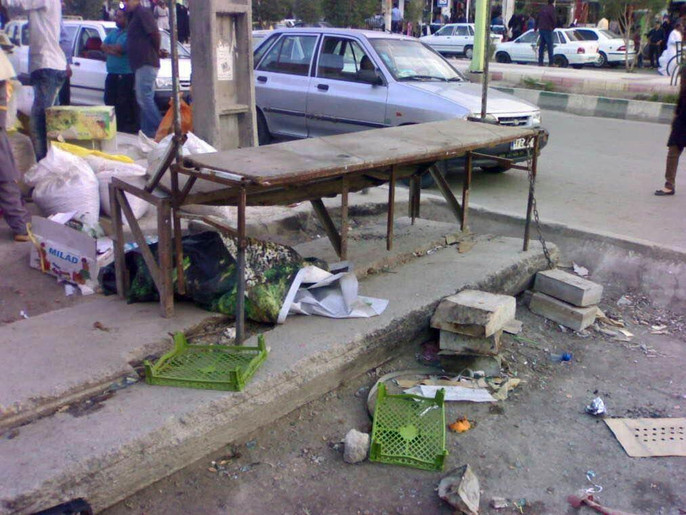
ahwaz 15-3 1An Ahwazi Arab street vendor by the name of Younes Asakere from Mohammareh city has set himself on fire in protest against the  action of the Occupying municipal officials who confiscated his small grocer’s  stall.

This incident occurred when the municipal officials embarked on an arbitrary raid against the street vendors in Mohammareh city in a usual attempt to extort money from the poor street vendors who have no other way to make a living but by vending in the streets as a result of extreme poverty and high unemployment.

The occupying municipal officials, by confiscating the stalls, carts and wheelbarrows of street vendors under the pretext of not having a vendor’s permit have enraged the local Arab vendors, resulting in their  clashes with the municipal officials.

According to his brother, Younes is 32 years old, married with two children and lives in Mohammareh city.  He is fruit seller and has small grocer’s store which is the only source of income of his family; he lives in rental house and recently his lease contract ended, with the landlord demanding him to evacuate the house.  As Younes is the only provider of his family, his small grocer’s stall means everything for him and his family.

On Saturday, 14 March 2015, Younes, on his way to his workplace, faced the confiscation of his grocer’s stall by the municipal officials and the security police forces.

ahwaz 15 3 2The unbearable circumstanced of witnessing these forces destroy his stall in front of his eyes, drove him to go in front of the municipal building and in protest of the confiscation of his stall, to set himself alight by pouring a gallon of inflammable liquid over his body.

The local people, with the help of firefighters and emergency medical technicians transferred him to a local hospital in Mohammareh city and then due to his critical condition he was admitted to Taleghani hospital in Ahwaz city.  He is now hospitalized in the intensive care unit as more than 70% of his body is severely burnt.

The Persian occupying authorities are always targeting, humiliating and looting Ahwazi Arab vendors who are living in extreme poverty. The majority of Ahwazi people are denied employment and any governmental job opportunities as they have no option but to sell in temporary stalls the perishable goods without a permit.

Additional information for those readers who are not familiar with the plight of the Ahwazis:

Ahwaz is occupied Arab land with a population of more than 8 million, located in the Southwest and South of so-called Iran’s map.

The name of Al-Ahwaz was changed to Khuzestan, Bushehr and Hormozgan in 1935 after the invasion of the Emirate of Al-Ahwaz in 1925 and toppling the last Arabic rule of Amir Khazaal Al-Kaabi in Mohammareh city.

The Iranian regimes of Pahlavi and the Islamic Republic deployed different tools to suppress the Ahwazi Arab people.

The lack of actual mainstream media coverage on Al-Ahwaz issue has allowed the Iranian occupation authorities to commit serious crimes against the Ahwazis who are struggling for freedom and liberation of their homeland under the unlawful Iranian domination lasting over eight decades.

The  Ahwaz region is the wealthiest land with multiple resources including oil, gas, steel and water, although the Ahwazi Arab people are one of the most destitute and impoverished people in Middle East.

The bitter fact is that Al-Ahwaz region was annexed by Iran forcibly against the will of its people in 1925 as the region had previously been independent. The region is the primary source of revenue for Iran’s oil and gas. It is the second vital and strategic region after Tehran for Iran and directly related to the national security of the occupying clerical regime.  Al-Ahwaz holds 70% of Iran’s oil resources and 30% of its water, flowing from more than five rivers such as Karoon, Dez, and Karkheh, with vast agricultural and fertile lands.

By Ahwanza website

moMona Oudeh, an Ahwazi activist based in London, said in an interview with Al-Sharq Newspaper that she has always carried the burden of the Ahwazi cause like every other Ahwazi Arab woman who rejects and repudiates the Persian occupation of Al-Ahwaz that has forced her to leave her homeland.

Mona, who devotes all of her time to the Ahwazi cause, has spoken about some of the atrocities perpetrated by the Persian occupation against her Arab compatriots, and in particular, against women, affirming the fact that due to decades of Iranian occupation, Ahwazi Arab women have been subjected to human rights violations such as being deprived of their inalienable right to education in Arabic, their native language.

Al-Sharq: How do Ahwazi women consider the Persian occupation of their homeland Ahwaz?

MO: First I would like to express my gratitude to the venerable Al-Sharq newspaper for allowing me this opportunity to talk about Al-Ahwaz case.

Also, let me take this opportunity to extend my appreciation to the Saudi people, brothers, and all observers, and to all those interested in news and developments in the matter of Al-Ahwaz.  To answer your question, Ahwazi women, as an integral part of their society, believe that the occupation has to be overthrown, even militarily, if necessary, and the area returned to Ahwazi Arab rule.

The occupation is entirely illegal, and there is no doubt that sooner or later it is bound to disappear. The occupation is the root cause of my people’s suffering, and Ahwazi women endure additional repression and exclusion, such as losing their right to live in dignity in their homeland.

In fact, since the start of Iranian occupation and domination of Al-Ahwaz, the ultra-national Persian institutions have systematically implemented policies of racial discrimination against the entire Ahwazi population, and in particular, of Ahwazi women, who have been excluded from all rights and privileges including educational opportunities, employment, intellectual, literary and artistic participation, as well as the denial of exercising their indigenous cultural activities.

Mona continued, saying that crimes of the occupation are incalculable, but the worst crime committed against the majority of Ahwazi women is through the policy of ethnic cleansing practiced in the cruelest manner, by preventing women of childbearing age to bring about demographic change in the areas of Al-Ahwaz.

The occupation authorities are forcing Ahwazi women to give birth through “Caesarean” procedure rather than natural birthing, and in many cases the authorities urge the doctors to carry out sterilization on birthing women without their knowledge or prior approval, through the process of tying the fallopian tubes.  This results in Ahwazi women no longer being able to have more than one child, and thus, it reduces population growth among the Arabs.

She pointed out the suffering of the Ahwazi women as a consequence of the apartheid policies of Iranian occupation.  Women are subjected to arbitrary arrest, imprisonment, physical harassment, psychological and physical torture as well as the death penalty like all Ahwazi activists.  The Arab and international stance regarding our plight is still weak, and our cause must be activated and placed on the table of international forums.

Al-Sharq: What else do the Ahwazi women suffer because of the occupation?  

MO:  If we want to describe and analyze the nature of oppression and suffering of Ahwazi women under the grip of Iranian Occupation, then it would require us to write books about it.

This is because of a racist, anti-Arab mentality and ideology of the Iranian occupation against Arab people generally, and particularly against Ahwazis.   As a matter of fact, the intensity of the regime’s racial oppression and segregation falls primarily on the Ahwazis in comparison to other ethnic and indigenous peoples in Iran, which is reflected in all aspects of their social, economic, and political lives and many other areas.

In this case, because the Iranian occupation harbors hatred towards Arabs, the Ahwazi women suffer and endure the most vicious types of harassment, arrest, imprisonment, physical and psychological torture because of three major factors, the first one is their female gender and, the second is their Arab ethnicity and the third is because they are Ahwazi women freedom fighters.

Ahwazi women, as Ahwazi men, face the death penalty because of their struggle against the Iranian occupation, and while sometimes the Ahwazi woman activist has undergone such heavy and cruel punishment, the most prominent Ahwazi woman imprisoned in an Iranian jail is Ms. Faheme Esmaili Badawi. She is an elementary school teacher and political activist who was arrested in 2005 and is currently serving 15 year’s imprisonment in exile from her homeland.

In December 2006, the Iranian occupation regime executed her husband Ali Matouri Zadeh, the Ahwazi activist and founding member of the moderate Hizbal-Wifaq (Reconciliation Party).

The suffering of Faheme Esmaili Badawi cannot be easily summarized through her arrest and the injustice of her husband’s execution, during imprisonment she was forced to give birth to her daughter Salma without receiving adequate medical assistance and in the most unsanitary conditions.  Her daughter Salma is now seven years old, and she lives without her mother and her father, who was unjustly hanged by the regime.

faheme

Al-Sharq: What is your view of the stance of Arabs and Muslims toward your issue?

MO:  Honestly, the position of the Arab and Islamic countries toward the issue of Ahwaz is very weak and timid.  It cannot in anyway be considered a significant stance, neither can it be called advocacy or support for it. So far, however, hopeful and positive indicators have recently occurred in one or two of the Arab Gulf countries.  However, we can say that there is no Arab state with a clear and explicit stand in support for the Ahwazi issue. In reality, the promises made regarding supporting Ahwazi people were only words spoken, no actions have been taken.  There are Arab countries allied with Iran, and these countries, especially the Syrian regime, have handed over political Ahwazi activists to Iran to be sentenced to death and executed.

As for the European position, through the work of human rights and civic organizations, it has resulted in the right of assembly and demonstration for Ahwazi communities in European countries. European governments have met with Ahwazi organizations in order to learn about and understand their cause.

Al-Sharq: What is the stance of the United Nations and international organizations toward the plight of the Ahwazi people?

MO:  All that the United Nations and human rights organizations have done is to condemn and denounce the crimes committed by the Iranian occupation authorities in Al-Ahwaz, despite the fact that the Iranian crimes against Ahwazis have reached the level of ethnic cleansing and genocide.  The international community has to do its duty to prosecute those responsible for these heinous crimes.

The secret letter leaked from the office of “Abtahi” during the tenure of the President Mohammad Khatami clearly indicated a policy of ethnic cleansing, a policy that is still ongoing and expanding.  The letter stipulates orders and certain conditions for conducting systematic ethnic cleansing of Ahwazis within 10 years, such as the banishment of influential and educated Ahwazis such as teachers, university professors and governmental employers to remote Persian areas. This is facilitated through different enticements, particularly by making them promises of providing better living conditions, promotions and increased salaries and then replacing them with Persian settlers who implement the orders of the occupation government in Al-Ahwaz.

Al-Sharq: How do you see the future of the Al-Ahwaz cause and Middle East?

MO:  I think that all Ahwazi activists believe that the demise of the occupation and the establishment of the state of Ahwaz is a fact that will come into being and what separates us from our goal is just a matter of time and the need to improve Ahwazi capabilities and facilities that will ensure the development of tools for the Ahwazi struggle to defeat the Persian occupation.  Ahwazis fully believe in the future of their cause and work on this basis.

We know the rule says that the revolutionary struggle for liberation from the clutches of colonialism and oppression requires manpower, in fact, we have the manpower that is willing to sacrifice in order to regain the legitimate rights of Al-Ahwaz.

But, we also need foreign support and backing at all levels for our struggle against the Iranian occupation. We need the international human rights and law agencies to decry the human rights abuses practiced against Ahwazi Arab people.

Additionally as Al-Ahwaz has been occupied military and the enemy only understands force,  there has to be a regional strategy to supply us with arms and training, as well as the implementation and full force of international law, to recognize us as an occupied and oppressed people.  It is the responsibility of the global media and regional media to expose our suffering to the world.

Lack of attention to our just cause is only in the interest of the Iranian occupation to perpetuate its illegal existence and crimes and expansionist aspirations which know no boundaries not only in Al-Ahwaz but all the neighboring Arab countries, as today it is more evident than any other time, when we see Iran’s occupation of Syria, Iraq, Yemen destroying our people’s revolutions through their mercenaries.  The only tool that can foil the regime’s devastating colonial advancement in the region is by supporting Ahwazis and other non-Persian ethnic groups such as Turks, Kurds and Baluchs in Iran.

In my point of view, this is the only way we can trample the regime, because as long as the regime exists and there is the absence of a comprehensive national Arabic project to deal with Iran, nowhere in the Middle East will there be peace and stability. Thus, the absence of the Ahwazi cause in the international and regional arena only serves the regime, as the Iranian regime’s major strength has originated from its domination of Al-Ahwaz’s sea oil and gas, albeit, the Ahwazi indigenous people have gained nothing from their vast resources, which have become a curse against them solely.

We ask the international community to support our cause in accordance with the norms and the international conventions because we are a suffering and oppressed people undergoing countless policies of racial discrimination.

The Iranian regime is attempting to melt us down in the crucible of Persian culture, eliminating our Arabic origins. As earlier mentioned, the regime has exercised such brutal racial discrimination policies that have amounted to ethnic cleansing through forcible displacement, reverse migration, and settlement construction for installing Persian settlers in Al-Ahwaz in order to impose a new demographic reality on us and the future of Al-Ahwaz.

The brutal oppression of the indigenous Ahwazi Arab people encompasses political, economic, social and cultural measures  has been going on for years, and the sheer injustice imposed on my Arab people has gone unreported for decades, never getting the attention that it deserves.  Our cause has been sanctioned due to regional plots related to bilateral economic and political interests.

The most unfair tool that is still used against our plight is the Media Blackout made of the spilled blood of my people who have dared to speak out against the Iranian occupation. Is their blood so cheap, without global condemnation?

The truth is that Ahwazis are sieged and restricted and unable to convey their voices out because the internal media is controlled by the regime and even the outside Persian opponent the media are bribed and supportive of the regime’s crimes against us and deliberately hide our news and events taking place on the ground, as such biased media stigmatizes Ahwazi Arab fighters by describing them as foreign stooges  scheming with Britain and Saudi Arabia who want to break up the country and bring corruption, terrorism and Wahhabism.

Likewise, the occupying judicial system presses the same charges against the Ahwazi prisoners and simply executes them.  This is because the racism and the anti-Arab sentiment has taken deep root into the minds of the entire Farsi-speaking community.  Furthermore, Arab and Western media also have not really put a spotlight on our issue because of the aforesaid reasons, turning our issue into a regional and global orphan.

The outcry of Ahwazi prisoners remains unheard behind bars, so our most basic and smallest demand is to receive help and solidarity from Media outlets to break the Iranian occupation blackout, to make known the reality of the Ahwazis and other ethnic groups, where our most basic conditions are so low in the framework of Iran’s petrified ideology.

We need the world to hear our voice and stand by our side against the Persianization policies and genocide campaign that look like a fatal cancer metastasizing to the whole Ahwazi Arab society as an attempt to erase the Arabic identity of Ahwazis.  For instance, as I mentioned earlier, this vicious occupation policy, through denying our native Arabic language, has caused the Ahwazi people to be stammering and uneducated in our own tongue, not able to speak Arabic or write in it.

My people have had enough of torture, prison, execution, poverty and illiteracy. We have had enough of the grief of mothers whose loved ones are executed or imprisoned for years. Let’s stop here because I am speechless. I have run out of words. I cannot depict the gravity of the nameless crimes exercised by the Iranian occupying authorities in Al-Ahwaz. I just look forward to seeing a better future for my Ahwazi oppressed people as they are free of any chains of oppression and living in safety and dignity.


Main Source: Al-Sharq newspaper  

Translated by Rahim Hamid


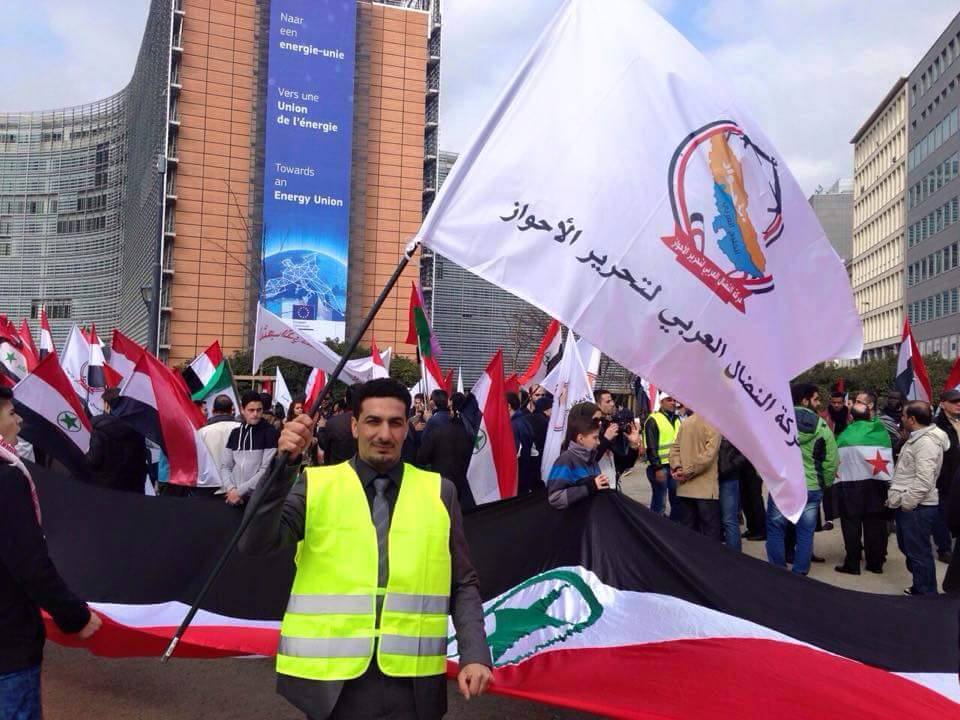
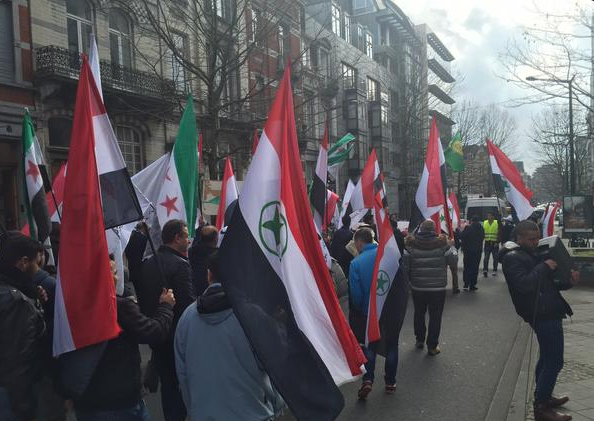
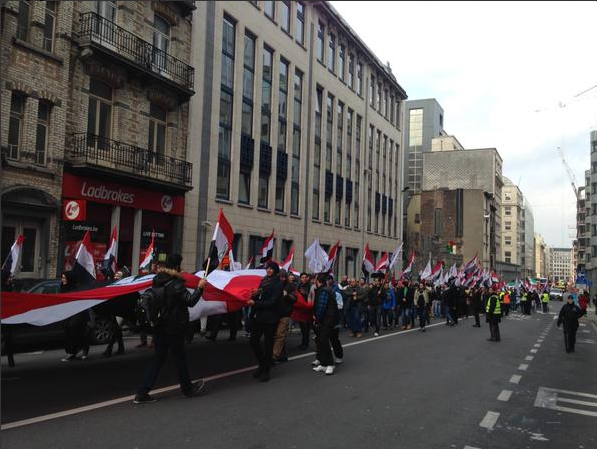
Ahwazi and Syrian freedom flags march together to demand the EU address their human rights.

Ahwazi and Syrian freedom flags march together to demand the EU address their human rights.

written by Ahwazna website

The Arab Struggle Movement for the Ahwazi mass demonstration in front of the European Parliament in BrusselsLiberation of Al-Ahwaz has organized a mass demonstration, under the title “We will never forget our Ahwazi people” in front of the European Parliament in Brussels, the Belgian Capital.

The Demonstration took place on Friday 6th of March to condemn the policies of Iranian occupation and the ongoing anti-human atrocities against the Arab people of Ahwaz.

The Ahwazi community organized this massive demonstration as a message of solidarity with the enormous sacrifices of the Ahwazi Arab people in the path of preserving the Arab identity and liberation of the Al-Ahwaz land from Iranian domination which has brought nothing but destruction and murder to its indigenous Arab people. Also, it acts upon the belief in the feasibility of using all legal means in combating the unlawful Iranian occupation and its non-humanitarian practices in Al-Ahwaz.

This demonstration was a part of series of demonstrations and activities undertaken by the Arab Struggle for the Liberation of Ahwaz as a bid to expose the obnoxious occupation policies of the Iranian regime. In addition, to make heard the oppressed voice of Ahwazi Arabs who are under extreme oppression from the occupation by Iran, the likes of which is not known to the world at large, despite the objective brutality of this occupation.

Hundreds of Ahwazis and Syrian took part in the mass demonstration, as there was a significant presence of Arab communities including Iraqis, Lebanon, Yemenis and Palestinians who came from various European countries as well as distinguished media figures and human rights advocates who came from Arab Gulf states and other countries for the purpose of supporting the Ahwazi cause.

Non-Persian communities such as Turks from South Azerbaijan and Kurds from East Kurdistan and Baluchis attended this demonstration to denounce the Iranian regime over its  atrocious policies that are murdering their people in cold blood and in particular, against the ongoing machine of execution that is being used at an alarming rate against their activists.

brx 5Ahwazi women along with other non-Persian women including Kurds and Turks who came from different countries took part in this demonstration to protest against the violated women’s rights, for their fundamental rights to education in their mother language and for the right to freedom of expression, against sex discrimination and inequality that the totalitarian Iranian regime has been committing against them for decades.

During the demonstration, participants raised the national flag of Ahwaz and the flags of the struggle movement and images of Ahwazi martyrs and prisoners and numerous banners in Arabic and English denouncing the continued policies of forced displacement and changing the demographic structure of Ahwazi Arab areas through construction of exclusive vast settlements for bringing Persian settlers. There were also banners whose theme was the dryness of Ahwazi rivers and marshlands via construction of excessive dams.

Many outspoken political figures emphasized the necessity of supporting the Ahwazi Arab cause in their long struggle against Iranian occupation and ongoing Iran oppression and to denounce the abuse of human rights of Arab people in occupied Ahwaz territory. Moreover, they stress the necessity of implementing an effective political and media strategy to highlight the Ahwazi Arab issue not only amid the Arab world but also on the international level.

brx 4As the Arabic region is on the verge of  mass domestic unrest and instability, important speeches were addressed to the  audience regarding Arab national security and the increasing threat of Iranian influence and its terrorism-driven campaign in Arab countries – Iraq, Syria, Lebanon, Yemen and Bahrain and the necessity of Arab countries to build strong alliances to tackle the aggressive Iranian foreign policy which is extending serious repercussions outwards, as its expansionist ambitions to achieve more influence politically and economically in the Arab world countries, mainly Arab Gulf states, become more evident each day.

The partial list of names of veteran political and journalism figures who were present at the demonstration are Dr. Walid Tabtabai, the Former Kuwaiti MP, Mohammad Al-Emadi and Nasser Al-Fezalle the MPs in Bahrain’s parliament, Rashid al-Fayed, the veteran politician and representative of the Lebanese Future Movement, Anwar Malek, an Algerian human rights advocate, Behjet Al-kurdi, the Iraqi political activist, Ayed Al-Shemeri, the prominent Saudi journalist,  Delegation from PJAK party, Delegation from Baluchistan and  Democratic Party of South Azerbaijan.

The participants spoke about ways to support the struggle of the Arab people of Ahwaz in order to lift the injustice, oppression and racial discrimination which has been practiced against them and also viable solutions to reclaim their freedom and exercise the right to self-determination of Ahwazi Arab people who have sought to end Iranian occupation of their homeland for years.

The demonstration has witnessed notable coverage by Arabic and foreign newspapers as well as TV news channels such as Al-Arabiya, Orient, Alrafidain, Wesal and Lebanon Future Channel.

The Arab Struggle Movement, in a letter submitted to the European Union, called for urgent intervention to immediately stop the Iranian regime’s arbitrary arrests and executions of Ahwazis.

The Movement also appealed to the European Union and its institutions to visit Al-Ahwaz to uncover and document the Iran regime’s occupation practices that have polluted and destroyed the environment, leading to the large-scale spread of dangerous diseases in all parts of Al-Ahwaz.

The delegation of the Arab Struggle Movement met with a number of European Union officials in Brussels after the demonstration.

The delegation stressed the need for the European Union intervention and implementation of safeguards as provided for in international treaties and conventions to protect oppressed peoples under military occupation, in particular, the Arab people of Ahwaz.

The Arab Struggle Movement also expressed its hopes that the EU’s relations with the occupying Iranian regime would not be at the expense of the right of peoples under Iranian occupation, and to be supportive of the demands of the peoples struggling for their freedom and the formation of their Independent States.

The final statement which came out with five recommendations was stated by Musa Mehdi Fakher, the Ahwazi political activist. The some of the notable recommendations are as follow:

– Stop ongoing violent persecution ranging from execution, torture and detainment of Ahwazi Arab people.

– Unconditional release of all Ahwazi political and cultural prisoners.

– Granting the prisoners their legal rights of having access to lawyers and having an open, transparent and non-biased trial respecting human rights standards.

– Stop changing the main courses of Karoon, Jarahi, Karkheh Rivers, and stop damaging the environment in Ahwaz.

– Stop the forced displacement and construction settlement policies that are conducted in line with ethnic cleansing policies against Ahwazi Arab people.

– Support the protesters who are protesting against the Iranian occupying authorities in destroying the environment in Ahwaz.

– Demand for sending specialist envoys to Al-Ahwaz by the United Nations to stand up against the repeated cases of abuse suffered by the people of Ahwaz, where some of them reached the level of extermination and ethnic cleansing crimes, and demand the punishment of those individuals who must be held accountable for these offences.

– Refusal to make the Ahwazi, Kurdish, Baluchi and Turkish Azeri people issues and the violations of human rights of the occupying clerical regime as issues of compromise during  the ongoing negotiations between the West and the occupying Mullah regime over its nuclear program. As it is not permissible to compromise on the fundamental rights of these peoples supported by international law under any circumstances.

To conclude, we demand the free world, specifically the EU, to assume its full humanitarian responsibilities and to stand by the side of Ahwazi people and other non-Persian peoples in their legitimate struggle for their freedom and to maintain their dignity.

It is worth mentioning that this demonstration is the third of its kind this year, as the Arab Struggle Movement for the Liberation of Ahwaz has already organized a mass demonstration, entitled “We will never forget our Ahwazi oppressed people” in front of the Embassy of the State of Iranian occupation in the Danish capital, Copenhagen on 10 January 2015. Followed by another massive demonstration in front of the UN headquarters in the Austrian capital Vienna on 20 February 2015, to support the Ahwazi people rising up at home against the Iranian occupation policies.

brx 3brx 2

11007578_1417896418510798_1765605101_nWRITTEN BY Ahwazna website

Throughout human history, authoritarian regimes have exercised numerous policies to influence and pressure peoples whose homelands are under the grip of domination and occupation. Occupation policies include construction of settlements and relocation of settlers to change demographics to favor their colonial aspirations.  This is one of many ways used gradually to control the indigenous population living under colonial occupation.

History is full of examples illustrating the process of colonialism and occupation, but none more clearly than the example of the brutal Israeli colonization and occupation of Palestine. Through the establishment of extensive illegal settlements and introduction of hundreds of thousands of Zionist settlers the occupation has usurped the historical homeland of the Palestinian people.

Since the outset of Iran’s military occupation of Emirate of Al-Ahwaz, the occupying central governments have one after another, exposed the Ahwazi people to heinous crimes of violence, brutality, and everyday indignities.  Through the colonial acquisition of lands throughout Al-Ahwaz, the goal was to cleanse the area of the indigenous Ahwazis.

The looting and plundering of Ahwazi lands were carried out through forcible displacement of Ahwazi citizens and the appropriation of their land by force of arms as well as using money to entice the most impoverished Ahwazis to sell their land.  The facade of legitimacy and legality masked the occupier’s dishonest practices, and the plundered Ahwazi lands were handed over to Persian settlers.

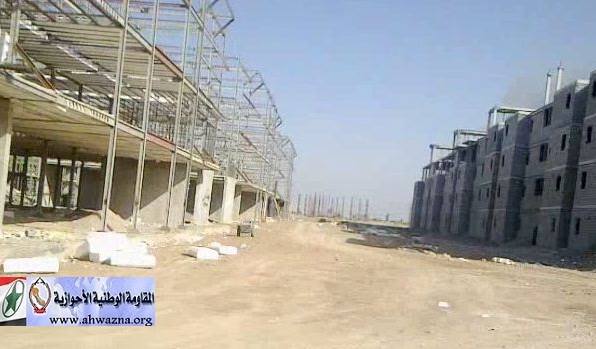
After years of confiscating and appropriating vast amounts of territory, the Iranian colonizers and segregationist governments have built hundreds settlements, bringing in tens of thousands of Persian settlers into areas where the number of settlers was scarce or where there were fears of changing demographics in Persian settlers ‘favor, which would harm the future of the   Al- Ahwaz in the case of right to self-determination.

The Ahwaz Arab people continue to resist the settlers by whatever means available to them, but the resistance has not been exhaustive.  For the most part, it only involved those who suffered at the hands of the settlers.   There is substantial documented evidence recorded by the Ahwazi human rights activists, showing the involvement of many Persian settlers in committing the most barbaric and inhuman crimes against the Ahwazi Arab citizens.

It is important to remind that the majority of settlers are also equipped with weapons and unlimited support by the Persian occupation authorities. Unfortunately there is a level of complacency of in segments of the Ahwazi people, partly due to ignorance, or fear of government repressive responses and, in some cases, a lack of interest in what is happening. However, these problems and areas of what may be perceived as weakness have never deterred Ahwazi citizens to resist the occupiers.

The building of settlements for housing non-Arab settlers did not suffice the Persian occupation authorities this means that in addition to the importation of Persian settlers to Al-Ahwaz, Persian occupying forces have extended their underhanded criminal activities by building thousands of housing units in Arab areas and populating them with Persian settlers which serves the purposes of Persian occupation in several ways.

They have brazenly gone too far in conducting their crimes over which enhancing their occupation malicious projects through the construction of thousands of housing units in the hearts of  Arab areas and bringing settlers  recruiting them  for a number of things.
Firstly: The Persian settlers act as the eyes and ears of the occupation forces and provide the Persian occupation with anti-activists agents placed among the Arab population, who are able to immediately inform Persian intelligence and security forces of any intended anti-occupation activities. This provides Persian forces with preemptive capabilities to subdue and eliminate any resistance in the fastest manner possible.

Secondly: The Persian settler’s physical proximity to Arab Ahwazis, aims to destroy Arab culture by excluding it from everyday activities and through corrupting and replacing Arab culture with the Persian state-supported culture.

In work, education, intermarriage, every aspect of socio-economic activities imposed on the Arab Ahwazi culture puts it in a weak, threatened position.  It is generally excluded and frowned down upon while Persian is endorsed and supported by the state.  Conflicts arising from forcing Persian culture upon Ahwazi Arabs continues to have adverse and detrimental affects upon all aspects of Ahwazi life.

Thirdly: Persian settlements aim to monopolize trade in Persian settler hands through buying up all shops and outlets.  This has resulted in grave economic changes which will be very difficult to reverse in the future.  Through Persian news agencies and Persian government official communiques inform of proposed new settlements and housing units being completed and delivered to Persian settlers.  In addition, one hears of the large numbers of companies, government agencies, banks and cooperatives supportive of Persian settlement activities.

It is clear that Persian occupation and settlement of Ahwaz, coupled with the criminal destruction of Arab society and culture in Ahwaz, is high on the agenda of the Iranian state and is ongoing with strong impetus.

Many researchers and observers hold that resisting Persian settlement activities should be among the foremost of priorities for the indigenous Ahwazi population.  Unless the Ahwazis resist Persian colonial settlement at this time, it will be impossible to reverse the dangerous and ongoing demographic changes in the area.

Therefore, taking all of the above  into consideration, all Ahwazi citizens, without exception,  are obliged to engage in resisting all forms of Persian settlement undertaken by Persian authorities without differentiation between any particular form of settlement, or Persian Military personnel, agriculturalists or pastoralists, or government employees settled in Arab Ahwaz.  All are collaborators in the crime of occupation and theft of Ahwazi Arab land, indigenous resources and job opportunities.

The resistance against occupation and settlers needs no debate, neither is it subject to debate; rather it is a national duty dictated by religion law and conscience.

Among the most important manners to resist settlement and settlers are:

  1. Boycotting settlers socially and severing all contact with them.
  2. Economically boycotting settlers and their businesses.
  3. Military confrontations with settlers.

At this decisive stage it has become imperative for all members of the National Ahwazi Resistance to join ranks in order to deliver the most powerful blow possible to Persian occupation, which includes Persian settlers, who have ever since their arrival, acted and conspired against the Arab Ahwazi people.

Any wavering at this stage in resisting Persian settlers will end all future hopes for the Arab citizens of Al-Ahwaz.  History shows that attempts towards the establishment of peaceful co-existence and good neighborly conduct have proven fruitless in deterring Persian settlers from aiding and collaborating with the Persian occupation of Ahwaz, the theft of our land and national resources, and the destruction of the culture of Arab Ahwaz.

pes 3WRITTEN BY Mary Rizzo.
We have all already heard of the phenomenon of PEP (Progressive Except on Palestine), in which those who consider themselves progressives (liberals in the USA) or leftists are pretty liberal on every single issue except the Israeli-Palestinian conflict. But, their syndrome has been pointed out and diagnosed fully. A lot of them justify this position by saying that supporting the government of Israel is a liberal position. Their problems are not our problem… they need help that we surely can’t provide.

However, there is another phenomenon far more worrisome because it involves those who are Progressive ALSO for Palestine, and that is the case of PES (Progressive Except on Syria). Those who are afflicted by this malady feel safety in numbers, because they are in fact the majority of non-Palestinian supporters of Palestine. They will actually USE the argument of Palestine as justification of their support of Assad, even though his regime has a terrible record regarding Palestinians, (as did that of his father).  They will argue that support of Assad is a progressive (liberal) leftist value. Whether it’s called “selective humanitarianism” “double standards” or “hypocrisy”, it is a dangerous and insidious disease and should be cured. Here is a little test to discover if perhaps YOU are afflicted with this mental illness.

pes 2Do you perhaps suffer from PES without being aware of it? Fear no more! We’re happy to provide you a self-diagnosis test with simple YES / NO replies so that you can discover your own hypocritical stance, and hopefully, be on the path to the cure.

  1. Did you protest or complain about the unfairness of the USA elections for any reason but believe that Assad won a landslide victory in free and fair elections?
  2. Do you think that Assad is fighting terrorism?
  3. Do you think that the Palestinian cause is being defended by Assad?
  4. Do you believe that the war in Syria is all about foreign aggressiondue to their national and pan-Arab stances” and is not a people’s uprising? In fact, you think the whole Arab Spring has got to be “exposed” as an imperialist, western plot.
  5. Do you think that the Intifada in Palestine is legitimate and that the uprising in Syria is manufactured (while of course saying so having been paid guest to Assad’s presidential palace)?
  6. Do you think that the Palestinian cause is being defended by Hezbollah even when they target and kill Palestinian refugees and ignore the growing tensions between Palestinian refugees in Lebanon and Hezbollah?
  7. Do you condemn religiously-inspired militias such as ISIS and Al Nusra when they commit murder and use violence against civilians but have not condemned Hezbollah when it commits murder and uses violence against civilians?
  8. Do you think that it was a good idea for the Popular Front for the Liberation of Palestine – General Command (PFLP-GC) to shoot on the Palestinians who mourned those killed on Naksa Day 2011?
  9. Have you called Gaza “the world’s largest open-air prison” but don’t agree with the UNHCR claim that Syria’s war “is more brutal and destructive than the wars in Afghanistan and Iraq, and has turned into the worst humanitarian disaster since the end of the cold war.”?
  10. Have you endorsed or thought a No Fly Zone was a good idea for Gaza but reject it as Imperialist meddling or a bid to save Al Qaeda if it’s done in Syria?
  11. Do you condemn the Palestinians tortured to death in Israeli prisons (since 1967, a total of 72 Palestinians have been tortured to death) but have not condemned the 200 Palestinians tortured to death in Syrian prisons since 2011? You naturally probably don’t know about the at least 11.000 Syrians who were tortured to death inside these prisons.
  12. Do the at least 10,000 bodies of prisoners in Syrian regime prisons that were ordered to be catalogued by the regime mean nothing to you since you don’t have details on what the reasons for their deaths could be?
  13. Do you call for release of political prisoners from Israeli jails but do not call for the release of the tens of thousands of political prisoners in Syrian jails?
  14. Have you actually asked for money to bring Gazan children to make a protest for the NFZ but think that asking for a NFZ in Syria is a bid to help Al Qaeda?
  15. Do you think Al Qaeda and ISIS are Mossad / CIA inventions?
  16. Do you protest against the death penalty in the USA: Executions in 2014, 35, but don’t do the same for Iran: executions in 2014, Between 721 and 801 at least.
  17. Do you think it is wrong for the US to provide Israel with armaments because it engages in war crimes but at the same time, think it is justified for Russia to provide the Syrian regime with armaments and military experts because “it’s war against NATO”?
  18. Do you condemn Israel’s “extra judicial killing” but claim that Assad must do everything he needs to maintain power because blocking his actions in any way, even by condemning them “… could end up ousting Assad. It would mean replacing him with pro-Western stooge governance. It would eliminate another Israeli rival. It would isolate Iran. It would be disastrous for ordinary Syrians.”
  19. Have you ever praised Assad’s government because it is secular, or “fighting the enemy of the West”: because after all, you only see the alternatives being Assad or the “Islamic Fundamentalists”?
  20. Did you support Haniyeh and Meshaal until they started waving the Syrian revolution flag?
  21. Do you erroneously refer to the Syrian revolution flag as the “French Mandate Flag” ignoring that even the Assad regime celebrated it as the Independence flag each “Evacuation (Independence) Day on 17 April to celebrate the resistance against the French colonialists?
  22. Do you know the names of at least one Palestinian dissident/political writer but don’t know any Syrian ones?
  23. Do you call the opposition to Assad “Western-backed rebels” either from a Pro-Israel or Pro-Iran standpoint?
  24. Did you protest for Palestinian detainees and even know their names but not do the same for Palestinian detainees in Syrian’s prisons?
  25. Do you know the name of at least one minor arrested or killed by Israel but don’t know the name of at least one minor arrested or killed by the Assad regime?
  26. You have protested against the racist and discriminatory Apartheid Wall and checkpoints in Israel/Palestine but you have nothing much to say about Syrian military checkpoints and sniper-lined checkpoints?
  27. Did you get angry when a US newspaper used a photo of Iraqi deaths, claiming they were Syrian, but when Palestinian supporters use Syrian ones, it’s “illustrating the suffering in Gaza”?
  28. You have protested against Israeli use of phosphorus bombs but you have nothing much to say about the unconventional weapons use by Assad against both opposition fighters and civilians such as barrel bombs and chemical weapons?
  29. Are you critical of the US for intervening in affairs of other countries but think it’s normal for Iran and Russia to be sending troops into Syria to help the regime?
  30. You would never consider Palestine compromising with Israel but you believe that the opposition must compromise with the regime in Syria.
  31. Do you condemn the Saudi monarchy and refer to them as Wahhabis, Salafis, etc., but refuse to recognise that Iran is a theocracy?
  32. Do you think that Assad is simply doing everything he can to protect the minorities in his country?
  33. Do you call the Israeli occupation of Palestine ethnic cleansing but do not speak out against the regime-driven massacres in Syria that are ethnically based?
  34. Do you refer to the Assad regime, Hezbollah and Iran as the “Axis of Resistance” even when they don’t react to Israeli attacks on them?
  35. Do you think the following two statements are both true?
    a. Dissent in the United States is patriotic.
    b. Protesting in Syria is an assault on the State and needs to be quelled.
  36. Do you think the following two statements are true?
    a. Pepper spraying protesters in the USA is a violation of human rights.
    b. The Syrian regime has to use whatever force it deems necessary against protesters, because they protesters have violent intentions.
  37. Do you think that Israel must be brought to the ICC for crimes against humanity but think that the Syrian regime should not?
  38. Do you condemn the USA vetoes on the UN Security Council in favour of Israel but praise the Russian and Chinese ones in favour of Assad both to stop sanctions and to prohibit ICC investigation including three Chinese vetoes on Syria alone out of eight total vetoes in their history?
  39. Do you think the following statements are both true?
    a.Calling a U.S. citizen anti-American or un-American for being critical of the US government is ridiculous, knee-jerk, unintelligent and actually incorrect.
    b.People who are critical of Assad are closet or overt imperialists and want US control over the region.
  40. You do not believe that Russia is an imperialist state while you are certain that Syria is an anti-imperialist state defending itself against imperialist onslaught.
  41. Do you think that Erdogan is seeking to dominate politics in the region in an attempt to restore what was once the Ottoman Empire or even think the US is trying to establish an Islamic State but support Iranian domination and the Shi’a Crescent?
  42. Have you signed petitions against companies such as Soda Stream and Coca-cola but not against weapons provider, the Russian monopoly Rosoboronexport or even the western companies providing the Syrian and Iranian regimes with surveillance equipment that they use against dissidents and opposition?
  43. Do you call innocent victims killed by American drones or victims of war crimes but consider the Syrians and Palestinians killed by Syrian bombs and chemical weapons collateral damage?
  44. Do you reject the USA/UK “War on Terror” but believe that Assad has a right to use whatever means possible to kill whoever he considers as a terrorist in Syria and that Syria is a sovereign nation fighting Al Qaeda?
  45. Have you mentioned the Blockade on Gaza in conversations and know it is illegal and a crime against humanity but don’t feel the same about the Blockade on Yarmouk?
  46. Do you respond to criticism of Assad by pointing out USA human rights violations?
  47. You know the name of USA civilians killed by cops or vigilantes, but you don’t know the name of a single Syrian victim of torture in the Assad prisons.
  48. You have protested for the closure of Gitmo, but you don’t raise your voice or even one eyebrow over the Syrian Torture Archipelago in which “The systematic patterns of ill-treatment and torture [in the 27 detention facilities run by Syrian Intelligence] that Human Rights Watch documented clearly point to a state policy of torture and ill-treatment and therefore constitute a crime against humanity.” Moreover, you don’t want to notice that Syria’s government has been cooperating with the CIA extensively in renditions and the torture programme.
  49. You think that Israel should not have nuclear capacity but that Iran should have nuclear capacity. Extra points if you support Non-Proliferation. Super extra points if you participated in any No Nukes events in the West or signed any such petitions, super extra and mega extra points if you are against nuclear power.
  50. You believe that the Palestinian struggle is about human rights but the Syrian protests were sectarian and religious-oriented, driven by people who wanted to overthrow and overtake power illegitimately if not in fact manufactured by the West?
  51. Do you believe it’s normal for the Syrian constitution to be amended every time that it serves the Assad family but the US Constitution is sacred and especially no amendments should be made to limit gun possession whether you detest the US government or think it should basically call all the shots around the world?
  52. Do you think that Jews protesting the Israel government are noble people who are fighting for human rights and justice while any Syrian protesting the Assad regime are in cahoots with the Israeli government.
  53. Do you believe that, “We must not in any way call for the removal of President Assad unless he commits acts of terror against us. Assad’s government has committed no such act, thus rendering it criminal for foreign governments to undermine the Syrian regime. You either stand for national sovereignty, or against it. The choice is yours.” While at the same time have supported efforts from the liberals or conservatives to have Obama impeached?
  54. Do you believe that foreign countries helping the Palestinians militarily to win against Israel is legitimate but helping Syrians win against Assad is meddling and think that “any further intervention in Syria would be for U.S. interests, like weakening an ally of Iran, and would encourage Assad’s allies to step up their armament shipments. The carnage would continue, and perhaps increase.”?
  55. Do you reject claims that the involvement of Iran and Russia in favour of Assad is meddling?
  56. Do you think that the entire Syrian war is for the purpose of the US weakening Syria so that it can pursue its own interests in the region but ignore the fact that Russia has enormous interests in Syria that are far more evident?
  57. Have you ever found yourself denying Assad had chemical weapons but also applauding the Syrian regime’s decision to hand them over to Russia as a strong gesture towards peace?

pes 1

How many questions did you answer YES to?

Between 1 and 5? You are headed towards selective humanitarianism, or even are afflicted with Western Privilege Syndrome!

Between 6 and 10? You are dangerously using double standards and believe that human rights aren’t something universal, but allow your ideological or dogmatic prejudices to influence your ethical judgement!

Over 10? You are a dyed in the wool Hypocrite! Maybe you should avoid “current events” altogether, you have no understanding of what human rights and justice mean, you should wash your mouth out before you ever speak about human rights for Palestinians or anyone.

dried wetland  Written by Rahim Hamid 

Thousands of Ahwazi people have gathered once again on 14th, 15th and 16th of February in front of Ahwaz Governorate office in Ahwaz’s capital demanding swift actions to cope with the dust storm that is currently crippling the lives of the Ahwazi people.

Ahwazi protesters, donning face masks, angrily shouted critical slogans against the lack of appropriate actions than those expected to be taken by local authorities to alleviate the suffering of the Ahwazi people as a result of the persistence of the dust storms.

The Iranian occupation security forces, by taking tight precautionary measures, scattered and arrested key protesters in yesterday’s demonstration.

The occupying security forces, in efforts to quell the public anger of Ahwazi Arab protesters, have tactically and brutally beaten up and handcuffed a group of Arab protesters who played important roles in organizing the peaceful protest.

The aggressive operations of police security forces in dealing with the protest resulted in the arrest of dozens of key activists and organizers who were kicked and punched savagely and taken to an unknown place by the occupying forces. The security forces the put up massive barricades to prevent protesters from advancing to other locations.

The mass arrests were carried out immediately, just thirty minutes from the start of the protest while protesters raised banners and began chanting slogans condemning the criminal policies of the occupation government. The occupying authorities, to clamp down on the protests, deployed significant anti-riot squad forces to battle the Ahwazi Arab activists who called people to take part in this protest through social Media.

Since early February, the Ahwazi people’s lives have been gravely disrupted due to the lingering intensive dust storms causing breathing disorders. Asthmatic attacks have become very problematic and prevalent among the people.

The protesters, by holding up numerous placards, placed the entire responsibility of the environmental disaster in Al-Ahwaz on the occupying Iranian central government’s policies in constructing excessive dams on Ahwazi Rivers diverting the course of the water of the rivers to the central plateau of Iran.

According to reports and studies led by Ahwazi medical research centers, Al-Ahwaz has become one of the most dangerous regions in terms of air and water pollution. As the annual review of the medical centers indicates, annually more than 22,000 Ahwazi citizens were admitted to hospitals and clinics due to diseases linked to inhaling polluted air or drinking contaminated water.

Through the protest which included adults and children, people  expressed their outrage  at the negligence and the aggressive policies of occupying Persian authorities as they raised banners that read “we have right to breathe clean air”, “you have stolen Oil, Gas, and water and left the dust for us”.

The World Health Organization since 2011 has repeatedly rated Al-Ahwaz as the world’s most polluted region. Not surprisingly, cancer and respiratory illnesses are on the rise among desperate poor Ahwazi Arab people. Annually, nearly 2000 people in the Al-Ahwaz area are diagnosed with cancer. A number is likely to increase by 90% by 2020, according to cancer research in Ahwazi medical centers. The WHO says Ahwaz has the highest measured level of airborne particles small enough to cause serious health problems for humans.

Despite the severe degradation of Ahwaz’s climate, the Iranian government has done nothing to effectively counter the spreading desertification that is encroaching on the most Ahwazi fertile agricultural lands, transforming them into arid and barren lands as a consequence of lack of water where the water of Ahwazi Rivers due to the diversion into Persian regions.

Several of participants in the rally expressed their resentment of what they described as shameful disregard and deliberate neglect by the Occupation state of Iran toward the lives of Ahwazi citizens as the occupying authorities only visit Ahwaz without providing any tangible solutions to combat the environmental and health disasters that are ravaging the lives of millions of Ahwazi citizens.

Ahwazi officials continuously stated that the level of dust particles in the Ahwazi atmosphere has seen no signs of improvement and exceeds the acceptable level by 66 times.

The Ahwazi protesters placed the responsibility for the devastating consequences of air pollution that pummel embattled Ahwazi citizens on the Iranian occupying government and blamed the Occupation’s pernicious policies at all levels in Al-Ahwaz.

The protesters, by chanting fiery slogans have slammed the government authorities for being irresponsible, indifferent as nothing can justify the inactions of the authorities. The protesters reiterated to continue their protest until the authorities take the necessary and essential procedures to tackle this adverse problem is crippling the lives of Ahwazis as the dense dust storm has reduced the visibility to less than 150 meters during the day.

The protests continued and escalated in recent days as residents gathered several times in front of the governorate in the Ahwaz capital as an expression of objection and discontentment regarding their neglected fundamental rights.

The residents have shown their anger and intolerance of the continued racial oppression and the systematic discrimination that has been practiced against them for decades at the hands of occupying officials and demanded comprehensive and rapid solutions to address the catastrophe of the dust storms have been sweeping through the entire Ahwazi cities for two weeks.

No report has been released on the number of Ahwazis who were admitted to hospitals or clinics after being affected by the dust storm. However, many reports with pictures by Ahwazi activists have been circulated via social Medias showing the massive numbers of Ahwazi Arab people who have been hospitalized in the medical centers in several Ahwazis cities due to the dust storm.

It is crucial to mention that the United Nations Environmental program (UNEP) said the dust storm in Al-Ahwaz is mainly originating from the dried wetland of Hur-Al-Azim in the west of Ahwaz. UNEP has already warned Iran about the catastrophic consequences of the dryness of the Hur-Al-Azim wetland.  

wetland 2During the Iran-Iraq war (1980-1988) a large part of Al-Azim wetland was destroyed and the remaining part of it was devastated completely with prospecting and drilling of the Azadegan oilfield project, as well as the construction of the Karkheh Dam, which brought about the desertification of the wetland which was regarded as the only economic source of the local Ahwazi people, forcing the majority of them to migrate to surrounding cities.

The area of Al-Azim in Al-Ahwaz measures about 3,500 square kilometers but it has been totally dried out by the Iranian oil companies.

In recent years, dust storms have jeopardized the Ahwazi people’s health as the level of dust particles ultimately had reached 2,335 micrograms per cubic meter in the February of 2015.  The dust storm phenomenon in Al-Ahwaz led to numerous respiratory problems, asthmatic attacks, and even surge in various cancerous and chronic diseases.

The plundering policies of Iranian occupiers led to the dryness Al-Azim and Howeyzeh wetlands, the most extensive wetlands in Middle East.  The destruction of the wetlands has driven massive population of inhabitants to abandon their lands and migrate to cities. All of these factors combined have caused the majority of them to face homelessness and destitution as they are living in ghettos under the worst economic pressures.

Additional information
Ahwaz is occupied Arab land that is located in the South- West and South of Iran. The name of Al-Ahwaz has changed to Khuzestan, Bushehr and Hormozgan in 1935 after invading the Emirate of Al-Ahwaz in 1925. The Iranian regimes of Pahlavi and Islamic republic deployed different ways to suppress Ahwazi voices.


10961890_1407719049528535_223506516_n (1)

WRITTEN BY RAHIM HAMID

The revolution of 1979 in Iran was visualized like a remedy in the minds and hearts of Ahwazi Arab people who were yearning for freedom and justice after having been oppressed by tyrannous and fascist policies of the Pahlavi regime.

The Ahwazi people, like other ethnic groups, pinned their hopes on the revolution because it was the only recourse for the freedom from racial oppression.

More than every other people in Iran, Ahwazi people were victims of anti-Arab policies of the Pan Persian Pahlavi regime. For this reason, they inspired to join the revolution so as to achieve their national rights and abolish the racial injustice and racism that had been practiced against them for years. However, in the early months of the revolution, all the hopes of ethnic groups including Ahwazi Arab people despaired after the revolution’s objectives turned out to be merely delusive slogans.

The Islamic Republic regime, to reach their illegitimate goals and continue to dominate over non-Persian ethnic people resorted to the worst type of racist tools.

The Mullah regime with much more aggressive policies in comparison with the previous Pahlavi system, has continued to carry out the ethnic cleansing policies through changing the demographic composition of Al-Ahwaz.   In this period, the policy of changing the population structure of Al-Ahwaz in various forms has been widely implemented.

Some of the methods that are used in line with ethnic cleansing of the Ahwazi Arab people are outlined as follows:

Exile:

Exile is one of the tools that the Islamic Republic regime, like its predecessor the Pahlavi regime, has used it against Ahwazis. This punitive measure is employed especially for those effective Arab intellectuals and influential political figures who have been campaigning to gain some of the social, political, cultural, and economic rights for the Ahwazi people.

10966681_1407719212861852_796136942_nThe regime, by applying exile, is seeking different goals such as disconnection of Ahwazi intellectuals with their society as a step for depriving the society of benefits of the intellectual’s insights. Besides the displacement of intellectuals, the regime is attempting to submerge the intellectuals and their families in the host community (Persian community) in order to prevent the continuation of their influence on the next generations.

As a matter of fact, in the early days of the revolution, the institutionalized policies, of banishing Ahwazi people to Persian regions, was carried out with greater frequency and intensity.

However, later with the outbreak of the Iran-Iraq war the exile and displacement of Ahwazis practically took on new and broader forms as this time there was no longer need for Iranian courts’ decisions to carry out the banishment of Ahwazis.

This is because of constant fears of rockets and mortar shells of the war that forced many of Arab people out of Al-Ahwaz. As it is estimated that around 1.5 million Ahwazi civilians have been relocated in provinces of Fars, Isfahan, Khorasan, Tehran and many other places.

War:     

Khomeini said war was a blessing for us. These ominous words today apparently reveal the destructive and the murderous theories that had been set against the Ahwazi people during the war.

The Iranian occupying theorists viewed the war as the best opportunity to implement their horrid goals and make them facts on the ground.

The Ahwazi liberationist movement was a serious obstacle for the Iranian totalitarian regime. Therefore, the large-scale turmoil of the war was an unrepeatable time for the government to liquidate most of the Ahwaz’s political class once and for all so that they could never become a challenge to the regime that see the demands of Ahwazis  incompatible with its centralized  ideology.

Finally, the Iranian death squads operated massive extrajudicial killings of any Ahwazi who was suspected of having cultural or political activism by accusing them of being a fifth column, or engaged in espionage or sabotage activism for Iraqi forces.

By the end of the eight-year Iran-Iraq war, many Ahwazi political forces  called for the establishment of political and cultural institutions, but the governments of the time  did not respond to any of the demands. At that phase, the Ahwazi Arab movement suffered the greatest human losses due to repression by the Islamic Republic regime, as hundreds of Ahwazi cultural, civil and political activists were executed, based on unfounded accusations like treason charges.

Additionally, the cataclysm of the prolonged war operated as a potent weapon in favor of the Iranian regime to displace Ahwazi Arab inhabitants and as the conflict reached its fiercest peak the war-stricken cities such as Abadan, Mohammareh, Albseytin and rural areas in borderline which exposed to extensive havoc and damage were almost deserted and its Arab population moved to the central regions of the Iranian plateau thereafter they were scattered among different cities. As a consequence, the large active part and one of the most efficient pillars of Ahwaz society, particularly in Mohammareh city, has been practically excluded from influencing the movement of the Ahwazi Arab nation.

After the war, the successive governments had undertaken similar policies against the Ahwazi people. They refrained from allocating part of the economic budget to the reconstruction of the devastated infrastructure of the war-ravaged regions, especially in the cities of Abadan and Mohammareh. In this way they were able to foreclose any possibility regarding the return of the Ahwazi people in exile to their homeland. Thus, the Iranian occupying state had pioneered in contemporary history of the Middle East in one of the largest changes of demographic composition, that of uprooting the Ahwazi Arab people.

10966804_1407719286195178_544516746_nAs always, the regime, with overt relocation programs, sought to use the condition of the war-torn areas from where its Arab people had largely evacuated during the conflict as an excuse to prevent and discourage the return of thousands of its original inhabitants.

The regime did not reconstruct these areas, particularly those bordering villages and instead have declared them as prohibited military zones and have cordoned the areas off with barbed wire and patrols leaving it empty to this day.

In fact, the Arab people belonging to these rural areas after fleeing their villages were relocated in shanty town and marginalized areas around Ahwaz city and other urban areas outside Al-Ahwaz.

They waited long years to return to their villages, but their hopes have steadily weakened and became a mirage contrary to what they had previously assumed; that they could come back to their homes soon after the end of the war.

The Arab people have lost not only their villages, but also their agricultural lands. They retain countless mines and unexploded rockets. The Iranian governments did not attempt to restore and de-mine the agricultural lands from the remains of the legacy of the war and in exchange used it as a preventive measure with which to deprive the Arab villagers from cultivating their lands.

Such measures have caused the Arab villagers prefer to live under the harshest conditions in the margins of the metropolis of Ahwaz and to not return to their ruins.

Thank you, from Nour, an artist in Syria.

Thank you, from Nour, an artist in Syria.

Dearest daughters, dear Vanessa and Greta,

Welcome home. We are very happy to know you are safe within the loving embrace of your families.  In these five months we have never stopped praying for you.

I want to just write a few lines to thank you for your sacrifice and your commitment, thank you for having made the cause of the long-suffering Syrian people your own and for having taken so fully to heart the suffering of the children, women, youth and the elderly who are dying in Syria. You are a noble example of what volunteering is, the pride and joy of Italy, where every day thousands of persons are dedicated to helping those in need. The Syrian people thank both of you and all the Italians who have never stopped sending their aid and who have welcomed and comforted refugees in transit on Italian soil.

You have been mothers to the little orphans and sisters to the many Syrian women who are paying with their lives without any reason for it. You have waved the flag of Free Syria, honouring the sacrifice of the 270 thousand Syrian victims who have died in the name of dignity and freedom.

As a father, I am so proud of your altruism and your generosity: so young, and yet at the same time, so sensitive to the pain of the millions of helpless civilians who have been undergoing a genocide for almost four years. My dear daughters, five months spent so far away from your loved ones, five difficult months of pain and suffering: you have paid so dearly for your altruistic instinct for which the entire Syrian population, 21 million persons, are indebted to you.

Please don’t apologise, on the contrary: the world of free men and women is on your side and is with you, and is very sorry for all that has happened to you and what you have had to undergo.

Welcome back, and may you receive the blessings that the Lord will grant you for your generosity and sensitivity.

Dr. Dachan Mohamed Nour

Syrian National Council

la comune 2From La Comune, a “Humanist Socialist” organisation in Italy that has always been side by side with us in the struggle for Syrian Freedom.  WRITTEN BY RENATO SCAROLA, Translated by Mary Rizzo

We are happy that Greta and Vanessa are alive and free. We are disgusted by the comments and by the articles that are vulgar and chauvinist, cynical and with evident instrumental manipulation of the truth that has followed their liberation Greta and Vanessa are being attacked as women and as persons who are in solidarity with a population caught between the vice grip of the Assad dictatorship and the Neo-Nazis of ISIS. The former Fascist Gasparri has distinguished himself in this flood of cynical sexist vulgarity.  Moreover, manipulating the truth, it has been insinuated that Greta and Vanessa have had ambiguous contacts with sectors connected to al Qaeda, that is, by those who had kept them imprisoned as hostages for months. From what the young women have declared and from what we know, their commitment and aid is devoted to the Syrian population and is against both the dictatorship of Assad as well as that of al Qaeda and the Neo-Nazis of ISIS. Analogously, put under accusation is also Yasser, an exponent of the Syrian Arab Community in Italy (and friend of Greta and Vanessa) of Bologna and of the Committee of Solidarity with the Syrian Karama population, a person who has signed the appeal that La Comune has promoted for a day of national action in solidarity with the Kurdish, Iraqi and Syrian populations against the Neo-Nazis of ISIS.

We denounce these cynical and ignoble attacks and we express our solidarity to Greta, Vanessa and Yasser, which for us cannot be renounced as a necessary part of the support alongside the Kurdish, Syrian and Iraqi populations in the people’s resistance to the Neo-Nazis of ISIS and dictators like Al Assad.
Original: http://www.lacomuneonline.it/index.php?option=com_content&view=article&id=973%3Agreta-e-vanessa-solidarieta&lang=it

greta-ramelli-vanessa-marzullo-1WRITTEN BY ASMAE SIRIA DACHAN, translated by Mary Rizzo

The emotion was immense when, Friday, 16 January, 2015, the Italian news agency Ansa finally released the title:”Palazzo Chigi (Office of the Prime Minister, translator’s note) confirmed, Greta and Vanessa are free.” It’s over, thank God; the nightmare that has lasted five months is over. An interminable time in which, respecting a news blackout and considering the need of discretion, I preferred not to write anything, entrusting my feelings and my thoughts to prayer.

The day the news was released of their kidnapping I was at home, having returned just a few days before from a poignant trip to Syria; Ramadan had just begun. Hearing the names of Vanessa Marzullo and Greta Ramelli on the TV and that word, “abducted” was terrible. The beginning of a nightmare for all who love and know them. But now they are back home, in the close and reassuring embrace of their families.

On the news many times was broadcast a video in which Vanessa and I are together: an interview in Bologna in November 2012, on the occasion of the Global March for the Children of Syria’, an initiative of solidarity and denouncement in which many had taken part, from every part of Italy. Syrians, Italians, volunteers, students, journalists, families, charities: a colourful procession bring to Italy the voice of Syrian civilians. Vanessa was one of the organisers of the march, whose local slogan was ‘Follow Your Heart’ and I made the interviews with the participants, while Paolo Crobu oversaw shooting and editing. Initiative ignored by the mainstream media, with interviews that were only broadcast on the YouTube channel; the aim was to raise awareness about what was and is still happening in Syria, where from 2011 to today there are at least 270 thousand deaths, including more than 20 thousand children.

Many had written and phoned to tell me that they had seen the video on TV. It had been there on the net almost unnoticed and, in the light of the abduction, was instead disseminated. I’ve seen it countless times.

Vanessa speaks quietly but with determination, she speaks of the Syrian drama, the dream of freedom for a people with whom she, a young student of Lombardy, has been in contact with and to whom she is attached. Only twenty years old, at his age many of her peers are busy only with their studies and organising their amusement, but she hasn’t thought only of this. Ever since I met her, I’ve noted that she was writing every night of Syria, denouncing kidnappings, rapes, abuses suffered by civilians. She translates the stories and dramatic testimony that is disclosed in the network by young Syrian activists. ‘Clandestine Communicators’, ‘opponents’, ‘rebels’, ie, people who have found the courage to challenge the censorship imposed by the Assad regime, giving voice to the genocide of which the world seems not to have taken notice. Because the dictatorship leads to this: to move like ghosts, to become ‘outlaws’ for disobeying the impositions of the tyrant. In Syria one shuts up and obeys the rules, or else you are finished, and this the world, at least the countries that in the past have suffered such violence, know, or at least should know.

In Syria able to move freely is the regime and their supporters; anyone who is opposed to it is illegal. Anyone who has picked up the flag with the three stars, the historic Syrian flag hoisted after the end of French colonialism in 1946 (and not the red, white and black with the two stars imposed by the regime) is branded for life. Anyone who has taken part in marches, demonstrations, initiatives, is branded. Not only in Syria. Even among Syrians abroad. Everyone knows that having declared themself to be against the regime, the regime that after fifty years of power and four years of bloodshed still holds Syria in its fist, means to have finally signed their forced exile from the homeland. The Syrians who have fled in boats of death, which in the absence of an international humanitarian corridor, are entrusted to human traffickers, they know they will not be able to return home. The same for those who are in the condition of refugees. This is something Vanessa and Greta knew and they did not look the other way. They participated, along with many other young people and volunteer associations in operations of hosting the Syrians in transit at the station in Milan to reach northern Europe.

They have taken Syria to heart. They have embraced the pain of a humanity forgotten. With selflessness and courage. Exposing themselves personally. Risking, without any fear. You can criticise their imprudence, but demonise them, no.

Now they are paying for their courage. On the web the media lynching is nothing short of disgraceful. I have never seen so much fury even against mob bosses or serial rapists. Certain political areas exploit their dramatic story for their campaign. We are witnessing a sexist drift, a blind hatred and theatre of hypocrisy that dance embraced tightly to ignorance. Because most of the people, even in good faith, ignore what is happening in Syria and how we have come to this state of total chaos.

Greta and Vanessa are becoming the scapegoat for many crisis situations. Paying for being young, for being women, for having taken the side of a people struggling against a tyrant, for putting the lives of others before their own. Turning them into what they are not is ignoble.

Has the sacrifice of these two young girls perhaps rekindled the spotlight on the Syrian drama? Is anyone wondering what is going on over there? Today it seems that the problem in Syria is only Isis, circulating many distorted concepts, the truth is systematically raped and the dramatic situation is ignored. The Syrian situation is the most serious humanitarian emergency in the new century. Please read the reports of the Syrian Network for Human Rights, UNICEF, the UN and humanitarian organisations that are monitoring the situation. It is reflected by the numbers of this massacre: 270 thousand deaths, including 20 thousand children, 9 million IDPs, over 3.7 million refugees, 1 million wounded and more than 250 thousand missing. Taking Syria to heart means not being indifferent to all this.

As a Syrian I feel strong embarrassment towards Greta and Vanessa for what they have suffered in Syria. I am equally embarrassed for all the hatred that is flowing against them. Both situations are ignoble.

A dutiful thanks goes to those who worked towards bringing them home safe and sound.

Greta and Vanessa are courage and recklessness, selflessness and sacrifice. We have waited anxiously. Today they are here. Welcome Back Home.


Original: https://diariodisiria.wordpress.com/2015/01/20/greta-e-vanessa-il-coraggio-contro-lindifferenza/

van a casa greta a casa

Written by Mary Rizzo

Hundreds of articles, thousands of comments and dozens of conjectures have emerged since the liberation of Greta Ramelli and Vanessa Marzullo from their imprisonment in Syria. Reading them, I am continually shocked by the content, mostly because the relationship of the content of these articles with reality is close to nil. And, of course, since those of us who know these women have acted responsibly, following the instructions of our government to keep press silence for their sake, it has given space to the vultures and monsters of orientalist, conspiracy, reactionary yellow journalism, who see in them all the ingredients for their “articles”: beautiful young maidens who are victims of the evils they embraced. Articles are coming out basing their research on the trash articles full of falsehood and insane conjecture, because during those endless 5 and a half months, the trash writers had free reign and their inventions, which will naturally be held up to scrutiny now that it is possible to respond to them, and certainly lawsuits will arise from the defamation they contain.

Five and a half months where those who know, and those who know better, were discouraged from expressing in public our solidarity, prohibited from making marches, creating petitions, even from something so simple as making a supportive page in Facebook. Asking activists to go against their instincts of protesting, getting into the streets and involving the general public in awareness raising activities is asking a lot of them, especially if the thing they are being asked to do is to keep silence regarding persons they know and love very much. But this was done, some of us suspending our feelings of disappointment in how our government works, and simply trusting them and obeying them. Our government pulled through and fulfilled their obligation to bring back our co-citizens who were victims of criminals in a foreign country. We are so grateful to them for their efforts and thrilled at their success.

There are other Italians who are not so happy about it though. One of them, for instance, is a former minister, Luca Zaia who says, (taking the words of some unknown “Tweeter” account statement as legitimate against the word of his own government that states that no ransom was paid and international laws were adhered to) “there has to be a norm for whoever gets themselves in trouble, they have to find their own way to get out of the mess.” He suggests that the goods of the families of Greta and Vanessa should be confiscated for life, to repay the Italian State, in fact.  All of that is pretty rich coming from someone who, when he was minister of Agriculture brought upon the Italian State fines amounting to 2.4 billion Euros for not adhering to EU limits of milk production, “The smooth operators and cheaters in the milk quotas have cost us Italians 4.5 billion Euros. In 2009 then Minister of the Northern League Zaia bailed out the “tax evaders” and denied the Revenue Agency Collection the right to get back the amounts paid by the State on their behalf.”

Then there are those who say they were involved with Jihadis and militias of every kind. Others who say they ought to have stayed in Italy and taken care of our many poor and needy. Still others say they had no preparation to go where they went to do what they claimed they were there to do. Neither of the first two groups have the faintest idea of who Greta and Vanessa are. They don’t know that they have been involved in the humanitarian aspect of what is a war zone. They have absolutely a point of view, given their interest and knowledge of the situation, and it is impossible to remain “neutral in the face of oppression” or pretend that there is not a war going on and know how it started and what areas are suffering the most. They don’t know that they also have volunteered and been trained in Italy and other countries, and that they were not “sent” by anyone. It seems peculiar to these people that young adult women can have a grasp on a very complex situation. Just because those condemning them don’t have a grasp, they assume it should be the same for Vanessa and Greta. The third group of critics has a slight advantage in that while they are wrong about them being totally unprepared, they are right that this kind of volunteer work in a war zone has absolutely no rules and anything can happen, even to the most prepared person, so this is all the more true of two individuals representing a humanitarian group they were the founders of, without a history of safety regulations and a staff to organise every particular up to the smallest detail.

Those who doubt their sincerity, however, or why they should be so involved in Syria, evidently have not had the same exposure to the information that the women have had. Ones who are informed of the situation of the Syrian population, who have learned about the suffering and the slaughter of innocent people, particularly children, simply can’t just shut it off. It becomes a sort of obsession, a constant suffering. There are simply people in the world, empathic and humanitarian people, and Vanessa and Greta are two of them, who when they see the suffering of others, enter into a state of profound com-passion. They feel it fully, they share in the pain and it becomes so deeply felt that they feel that their duty is to help, they cannot NOT help. They believe in the power of love and the human duty to not look away but to do like others have done before them throughout the history of the world, where the people we are given as examples for life go to the den of the leper and embrace him, to make him feel that he is not alone in the world and to try to heal his wounds. They knew that their aid might be a drop in the bucket, but the power of sharing the suffering, taking part and witnessing, that is something that they felt compelled to do, and all the friendly advice of those who love them could not change the path that they set before them, to BE THERE for others. If there are those who doubt this sentiment can exist, I say, they are surrounded by grey people, and when they find themselves alone and in pain, they may not have someone there to stand by them, that kind of thing is not contemplated in their world. But this is the world of Greta and Vanessa, the world of compassion and sharing in the burden.

It is disgusting to read the various comments by people who only criticise them or even smear or defame them. But it is good to realise that they come from a world that is alien to mine and to that of Greta and Vanessa, who are thankfully enjoying the support of many, despite the louder voices of the vile and vulgar ones. In schools across Italy (if I take for an example my own child’s high school) the “hour of religion” – yes, Italian public schools have this, and given that the students prefer to stay together during the day, even those who are not Catholic participate and they are basically classes where ethics and current events are discussed – all of the students applauded the girls, said they were proud of them, admired them, thought they were the best representative of humane ideals, but simply that they were wrong to have underestimated how dangerous it was and to have caused their families the worry. In Italy, unlike America, young people often live at home even after they reach 18, and independence is not complete, though the right to make important decisions is recognised, it is still considered necessary to obtain parental approval for some things, and in this case, the students of my child’s class thought that this was the only thing they did wrong. It seems that 17 year olds have a better understanding than 50 year olds sometimes…..

But there is one subject that remains to be discussed, and that is how it happened. All we know is that despite the media circus, the “jihadi” theory is ridiculous and so is the one that they were working for the FSA. The dynamics are going to come out in time, and rather than the weak little Pollyannas that some may have thought they are, the two Italian women are proving to be stronger than lions. They not only had to undergo the horrors of their imprisonment, but they are fully collaborating with the magistrates who are investigating the kidnapping. They, in the first place, who believe in justice and dignity, are not going to withhold any information that leads to the arrest of those who are responsible for their abduction and detainment against their will. It is possible that those who are responsible don’t live in a war zone, so justice may indeed be served.

It is said that in their auditions before the investigators, who have opened the case to investigate and ultimately prosecute those responsible, they were aware of the reason they were abducted the moment they were taken away, because they asked, “Why??” and the response was, “For money”.

Yes, this is where those of us who not only love and admire Vanessa and Greta now have to take a stand. We, like them, believe in justice, human rights and most of us also support the revolution against Assad. We are quite willing to condemn any and every group and individual who not only has violated the rights of humanitarians but who have betrayed the very cause of opposition to Assad if they engage in actions that are against human rights and harm innocent people. If it is true that, as they admit, they were in a place considered as safe, only for it to instead have been a trap artfully set up by those who acted like friends only to betray them, then this is not going to be buried under the rug because it is shameful. Instead, we trust more than ever our authorities to investigate, find the evidence that will prove that they have been set up by guys who boast of their importance inside Syria with the oppostion and their excellent and safe connections, and there is going to be no rest if it turns out that these are individuals who are hiding behind the Syrian revolution flag or acting like they are for the overthrow of Assad or even if they are (as they may claim) greatly respected by the revolutionaries and even influential in Syria. If their tactics are the same, treating innocent people like merchandise, a cheap form of human trafficking, it is all the more shameful because it has brainwashed itself that it’s for “the cause”. It’s not for any cause that Vanessa and Greta and the rest of us stand for. If it is a person or persons involved in the opposition militia, my personal wish for them is that they simply keep on as they are doing, because even if they achieve martyrdom, they are not going to ever achieve Janna (paradise) because they have committed a crime so heinous that there is no way to atone. They will learn what imprisonment is, eternally.

If they have even the thought that the lives of these women have X value and they tricked them or led to them being tricked, then they are no different than what we are against, and they, hopefully soon exposed, should be made to pay their debt with justice until their last day on earth. They are not going to find any “friends” who cover for them or pat them on the back or who justify what they have done. Whoever it is, may they feel that the circle is closing in on them, and the sooner the Syrian people are rid of such traitors, the better. It is also unfortunate that thanks to situations like this, other humanitarian efforts are thwarted, relief to the suffering Syrian population is going to be denied and the end of the Assad regime is going to be set farther ahead. Yes. Thanks to the betrayal of such kinds of persons against all that is good and right, who abuse trust and good faith and the purity of decent people. They betray all of Syria by their actions.

Lastly, we thank Greta and Vanessa from the heart for proving to us that there is indeed humanity, for being the beautiful people they are. We wish for them only the joy, happiness, serenity they deserve so much and we are thrilled that they are reunited with their families who strongly supported them and went through their own suffering, but who are not punitive, because there is nothing to punish heroes for, because it is a blessing to be in the midst of heroes, humanitarians and persons who know the meaning of the phrase, “stay human”. No matter what choices Vanessa and Greta make in life, we stand by them, we trust them and we love them, and hope we are going to be worthy of them.

Written by Ahwazna

The Arab Struggle Movement for the Liberation of Ahwaz organized a mass demonstration entitled “we never forget our Ahwazi oppressed people” in front of the embassy of the Iranian occupying regime in the Danish capital on Saturday 10/01/2015.

The demonstration was held to denounce the policies of occupation of Iran and its ongoing crimes against the Arab people of Ahwaz.

The Ahwazi demonstrators carried their protest through the streets of Copenhagen, chanting anti-regime slogans as they headed toward their final destination, which was a rally that gathered in front of the Iranian embassy.

The Ahwazi crowds packed the streets outside the Iranian embassy in the largest anti-regime protest to date, shouting “Death to the Iranian occupation regime” as well as  chanting slogans such as “Ahwaz will be freed, and Iranian occupiers will be out of it”.

copen demo 2The protesters also carried Arabic and English signs reading “Stop the ethnic cleansing policies against the Ahwazi Arab people”, the world must condemn the land confiscation policies conducted in Ahwaz”.

Many of the Ahwazi Arab protesters who participated in the massive rally came from various European countries. There was significant presence of the Arab community residing in Denmark who took part in the demonstration, showing their solidarity with the Ahwazi Arab people as well as a number of Arab brothers who are supporters of the cause of Ahwaz hailing from European and Arab countries were participants in the rally.

The friends and comrades of the Kurdish, Baluch and Turkmen communities, whose people are under the enslavement and occupation of the Persian state made an unforgettable and effective participation in this demonstration, embodying the spirit of true friendship and collaboration and actual solidarity in the face of the most notorious occupation on earth.

During the demonstration, Ahwazi participants raised the national flag of Ahwaz and carried posters of martyrs and prisoners and banners in Arabic and English condemning the policies of forced displacement and changing demographics which are being carried out by the sinister Persian occupiers. They strongly denounced and condemned the diverting the course of the Karoon River, where the occupying regime is pumping its water away from the Ahwazis and diverting it to central Persian regions.

The organizers of the Arab Struggle Movement for the Liberation of Ahwaz who had called for this demonstration, stated during the Press Conference that despite grave human rights violations perpetrated against Ahwazi people, the plight of this occupied nation remains invisible to the world at large. Therefore, the ultimate aim of the demonstration is to bring it to the attention of the public and to demand that the international organizations place further pressure on the Iranian regime to stop the ethnic cleansing practices, the executions and arbitrary arrests of the Ahwazi Arab people, the detainees being mainly political and human rights activists.

They asserted in recent years that around 35 Ahwazi Arab political prisoners have been executed but these atrocious and senseless crimes have elicited very little reaction from the international community.

For years, Iran has been cracking down on the Ahwazi Arab people by mass arrests, torture and intimidation as well as carrying out the execution of innocent Ahwazi civilians.

The wealth and natural resources, especially natural gas and oil, of Ahwazi lands are being extracted without discernible economic benefit for the Ahwazi Arab people.

This racial oppression has led the Ahwazi people to be one of the most destitute and marginalized people in Middle East, with a very high incarceration and execution rate.

The disfranchisement and ethnic discrimination policies of the Persian state have crippled the majority of the Ahwazi Arab population, as there is an estimated 80 percent of Ahwazi households living below the poverty line, while they are living on the ocean of oil and gas and mineral resources that are being exploited by the Persian occupation state since 1925 and still ongoing.

The censorship of the press and media has been a serious obstacle for Ahwazi activists to voice out the non-stop abuses committed against the Ahwazi people. This serious obstacle has allowed the regime to discriminate strongly and consistently against the Ahwazi Arab people.

copen demo 1The ethnic oppression includes the prohibition of Arabic, leading to the inability of Ahwazi people to study in their native language, the denial of job opportunities, the confiscation of lands and building Persian settlements for Persian settlers.

At the end of the Press Conference, the organizers of the demonstration appealed to human rights organizations and the Arabic and Western media to speak out against the despicable crimes of the Iranian regime in Al-Ahwaz. And finally, to recognize Ahwaz as an occupied Arabic country.

no more mosquesWRITTEN BY SHADY HAMADI, translated by Mary Rizzo

I am a Muslim and I condemn the massacre at the headquarters of Charlie Hebdo and I condemn Islamic fanaticism. But for some, and in a particular way I am thinking of certain politicians who carry out electoral campaigns inciting hatred towards immigrants and Islam, the condemnations by the religious leaders of the Islamic world are not going to be enough. Even if every single Muslim in the world speaks out to condemn what happened, this, unfortunately, will still not be enough because all that is being done is pointing the finger at a sole culprit, against the Islamic religion.

Even now, they will tell you that Islam, that is, more than two billion people, has declared war on you, on your values and on your Western belonging.

A certain kind of politics will seek consensus exploiting the massacre of Paris. Our politicians will tell you that “we are already at war against Islam and that we have to defend ourselves,” and the only real defence against the Islamic tide, is to vote for precisely those parties that have made xenophobia their raison d’etre. They will launch campaigns against the construction of places of worship for Muslims, declaring that “the mosques are the breeding ground for new terrorists” and, in so doing, they deny a right … just like those fanatics who they claim they want to fight.

tumblr_n7kzh7oJLR1skw9p7o6_1280You can choose. You can believe those who say that a war with Islam is inevitable. According to them, this religion embodies the violence and brutality that is then transmitted from one believer to another, through the study of the doctrine and prayer. For them, there aren’t good Muslims but there are only terrorists. They paint them all with the same brush, providing the right motivation that serves the terrorists to proselytize among the multitude of the desperate.

Another possibility, more sensible and correct, is to try to reason and understand that for the actions of two terrorists, two billion people and a religion cannot be responsible. We must understand that fanaticism in the Islamic world has many reasons, most of them related to social and historical causes, that affect societies today.

A century where colonialism and dictatorships, foraged from the West, have produced enormous damage to the Arabic social fabric. School systems built around an education formed on totalitarian regimes that have produced widespread ignorance; the lack of economic opportunities; the syndrome of Arabic nihilism, well described by the late Samir Kassir; the total lack of hope for the future and the tragedies that came about as of September 11 were some of the reasons that have produced contemporary religious radicalism. The first victim of this fanaticism is Islam itself. Sunni Muslims are the most persecuted by fundamentalists, as evidenced by the massacres in Syria: a whole population victim of the totalitarianism of Assad and the ISIS barbarians. And it is always Islam, the perception we have of this religion, to suffer the most damage because of the acts of those insane minds.

Today, in fact, Islam has become synonymous with terrorism in the West, so as to be deprived of any spiritual significance. It is marred by those who continue to associate it, without knowing anything about it in the least, as an enemy to fight. Clichés, simplifications and stereotypes about Islam are the collateral damage of a lack of knowledge that is far too widespread.

Now more than ever, we need constructive encounters, ones that are the sign of Mediterranean conviviality and an inter-religious discourse. Only with mutual recognition can we continue in our common history, managing to build a society for all of us. The fight for freedom is the struggle of each one of us, regardless of our faith.

If we abandon ourselves to the entrepreneurs of fear and ignorance, all will be lost.

Original: http://www.ilfattoquotidiano.it/2015/01/08/charlie-hebdo-prima-vittima-fanatismo-lislam/1322511/

safe_image

Al-Ahwaz1WRITTEN BY AHWAZNA, Prepared and presented by: Committee for research and studies in The Arab Movement for the Liberation of Al-Ahwaz

Ahwaz is an occupied Arab country located in the southwestern region of the Republic of Iraq and also in the southwestern region of Persia. It is bounded on the north by the Kurdistan Mountains the eastern border of the Lorestan Mountains which are known as the mountains of Zagros. These mountains in the north and the east create a natural border that separates the Ahwaz Arab lands from Persia. To the south, Ahwaz lies along the northern coast of the Arabian Gulf.

In terms of climate, the areas of occupied Ahwaz are quite similar to the plains of Mesopotamia as well as being entirely different in all respects with the climate of Persia.

Arnold Wilson, the British civil commissioner in Baghdad in 1918-1920, also asserted when he visited Ahwaz or Arabistan, “Ahwaz (Arabistan) is quite different from Iran. Ahwaz is surrounded by mountain chains forming a wall completely surrounding Al-Ahwaz and constituting a geographic division. The interval between Ahwaz and Persia and the difference between Ahwaz and Persia resembles the differences between Germany and Spain. In addition, this difference is not only confined to the geographical landmarks of Ahwaz, but includes culture, language, customs and traditions, history and population, fertility of the land and agricultural crops”.

The actual total area of this occupied Arab land is 375 thousand square kilometers, but the subsequent Iranian occupying governments have proceeded to usurp vast areas of this Arab land and have annexed adjacent Ahwaz areas to the Persian regions, all for the reason of legitimizing the diminishment of the area of Ahwaz. This organized plundering, shrinking the area through a land-grab and pernicious policies had been sought since 1936 up to the present day where Persian governments, under the pretext of conducting modern administrative regulations have truncated the following parts of Ahwazi lands:

  • Cutting off 11 thousand square kilometers of southern lands of Ahwaz and annexing it to Fars Province.
  • Cutting off 10 thousand square kilometers of eastern lands of Ahwaz and annexing it to Esfahan Province.
  • Cutting off 4400 square kilometers of northern lands of Ahwaz and annexing it to Lorestan Province.
  • Other regions such as Elam, Bushehr, and Bandar Abbas also have been cut from Ahwaz and exposed to Persianization policies by displacing its indigenous Ahwazi Arab inhabitants and settling Persians there. In Bushehr and Bandar Abbas large numbers of Ahwazi Arab inhabitants have been forced into Arabian Gulf countries after experiencing oppression, poverty, the appropriation of their property and possessions, particularly through forcible confiscation of their lands.

Consequently, the map of Al-Ahwaz has dramatically been shrunk from its original size to 159,600 thousand square kilometers according to current Iranian statistics.

Despite the lack of accurate statistics on the precise amount of the Ahwaz population, the number of residents of this occupied Arabic country is estimated to be eight million people. According to the most recent census issued by the Persian government in 1962, the population of this country that remained after the annexation of large regions from it was approximately 3.5 million Arabs. In addition to the 100,000, settlers who came from the Persian cities to this country after Reza Shah Pahlavi invaded Ahwaz.

According to other statistics recognized by the Persian occupation which was carried out after administrative divisions led into truncation, large parts of this usurped Arabic country the Ahwaz or Khuzestan area, as Persian rule calls it, is 64,236 square kilometers and the census of Arab people is 374,6772 residents.  So, if we retrieve the population of the separated areas and add it to the aforesaid number, then the number of Arab inhabitants of Ahwaz will reach nearly eight million people.

Since 1925 and right after the fall of its last Arab ruler through the military occupation of Reza Shah, Ahwaz has been the target of racist policies of successive governments of Persian regimes.

The most vile, dangerous and destructive policy inflicted on Ahwaz is the plague of Persianization that is changing the demographic composition of Ahwaz with the goal of eliminating the Arabic identity and destroying all its major pillars of nation building.

ahwazThis policy in the long-term has drawn a vicious vision for the Persian occupation that is the requisite of dragging the Ahwazi Arab nation to a stage in which calling it a nation will no longer be possible. They have spared no effort to make this vision a reality on the ground. The practices and policies undertaken by Persian occupation can be divided into two eras.

The overt racist philosophy of Farsism began in the form of the pan-Iranist party during the Reza Shah Regime. But our intended concept is the inherent popularized idea of Farsism that has penetrated deeply into the mind and the characters of the Persian people, even those who are seemingly combating racism.  However, they are more Catholic than the Pope when it comes to anti-Arab sentiment or fighting against Arabs.

The contemptuous attitude toward other non-Persian, people particularly toward the Ahwazi nation, constitutes the backbone of Farsism as an ideology. In fact, the policy of racial discrimination is being applied at the beginning of the founding of the state – the nation.

The Ahwazi Arab people have been the first victims of this policy. Because the radicalism of Farsism, which seeks to maintain and stabilize its illegal roots in the land that was occupied it by force, has committed mass murder and genocide of Ahwazi Arab people in different ways. Before the occupation, Ahwaz had a homogeneous Arab population with various clans and tribes.  After the conquest of Ahwaz and consequent overthrow of Arabic rule, Reza Shah by applying the recommendations of Farsism theorists such as Foroughi, Mirza Malcom, Akhound Zadeh and Taghi Zadeh, practiced the policy of forced migration and displacement of populations against the Arab people. In his first criminal acts, we can refer to the mass exile of Arab sheikhs outside Ahwaz.

Then, he ordered the banishment of a large number of Ahwazi Arab tribes to the Khorassan region, forcing them to walk barefoot long distances day and night without water and food, having to cross grueling mountain routes as so many women, children and elderly people were killed due to extreme fatigue, thirst and starvation.

For years, Reza Shah had widely practiced the policy of reverse migration of Ahwazi people to the central Persian regions and in contrast promoted the settlement of Persian people in Ahwazi regions.

AHWAZ MAPThe nomadic Lur and Bakhtiyari tribes, as their original homelands is beyond Zagros Mountains and because of their proximity to the northern regions of Ahwaz, had frequently travelled  with their herds to Ahwazi areas to find pasture lands to feed their flocks of sheep and goats. This situation helped Reza Shah to resettle them quickly in Ahwazi areas especially in Qenitra (Dezful) and Susa (Shush).  The Bakhtiyari tribes were only living in mountain regions and foothills of the Zagros in Izeh and Masjed Soleyman and in winter and summer they were commuting between their original homeland and the Ahwazi areas (Izeh and Masjed Soleyman. This meant that they left Ahwaz in the summer and returned to Ahwazi areas in the winter. These areas had the greatest potential for changing the demographic composition of Ahwaz. However, the industrialization of the cities of Abadan and Ahwaz had created the basis for the massive migration into the cities.

The Pahlavi regime repeatedly sent groups of Persian laborers into cities and through the granting of privileges, established a Persian middle class in the heart of Ahwazi cities, thereby enabling and reinforcing its occupation policies. Since 1925 the systematic migration of Persians has been carried out through the settlement of the “Lor and Bakhtiyari” tribes in Izeh, Masjed Solyman and Qenitra (Dezful), agricultural projects in Toster to Muhammarah, and industrial and oil projects in Ahwaz and Abadan.

Once Persian immigrants started to descend on Ahwazi cities, it did not take long for the total political domination of the Persian state over Ahwaz. Further development of the Abadan oil refinery in 1938 led it to become one of the largest refineries in the Middle East, providing thousands of job opportunities and paving the way for the arrival of many immigrants.

Iran_Oil_Arab_Population_MapApproximately 25 years after Reza Khan entered the region, the population of Abadan increased to 227,000, more than ten times that of 1956. The arrival of Persian settlers was to such an extent that there was not sufficient housing to lodge them. It followed that the English-Iranian Oil Company had to construct exclusive residential buildings for their workers and employees, and these buildings are known as “Bangleha”. According to government statistics, 62 percent of these immigrants are from the Isfahan and Yazd provinces, 24 percent are from the Fars province and 8 percent from the Kermanshah province.

These government settlement programs resulted in an influx of large numbers of Persian settlers to the cities of Abadan and Mahshor. The occupation authorities ever since have sought to build new industrial hubs in other major cities in an effort to further spread the scale and scope of Persian settlement of the cities of Al-Ahwaz.

Through the establishment of governmental centers, industrial factories in and around the Ahwaz capital, in addition to promoting and strengthening the military’s role in establishing large military bases, improving roads and routes leading to Ahwaz city, they created another new industrial hub in the region that brought tens of thousands of Persian immigrants to the city.

The consequence of this policy led to the population of Ahwaz city in 1977 to reach half a million people, surpassing Abadan and other cities.

The outbreak of the Iran revolution in 1979 and after the Iran-Iraq war, the migration of Iranians to Ahwazi regions had relented for a while. But after those ethnic statistics were excluded from the official statistics of Iran, it was the beginning of a lack of transparency in statistics related to immigrants coming to Ahwaz.

As every year, the hideous assimilation phenomenon (Persianizing land and human settlement) plagues Ahwaz, mainly the northern and the eastern bordering regions. This monstrous occupying Persian state aims at devouring the entirety of Arabic characteristics of Ahwaz.

Changing the demographic structure in favor of non-Arab immigrants, changing the Arabic names to Farsi ones, the ban on teaching the Arabic language and breaking up Ahwazi territories by annexing parts of Ahwaz and inserting them into Persian regions adjacent to Ahwaz are all part of the agenda, seeking the corroboration of the occupation authorities in targeting all the pillars of the national Arabic identity of the Ahwazi people.

In addition to forced migration and deporting Arab people to Persian regions and reverse migration of non-Arab people into Ahwaz, the Persian state has adopted other evil methods against the Ahwazi people.

The confiscation and plundering of agricultural lands by Persian feudal owners followed new approval of agrarian reforms.  Under the new and unfair law, the non-indigenous feudal entities had seized the chance to illegally become the owners of the lands that had previously been usurped from Arab farmers. In this regard, the death of Majid Khan, the great feudal owner, had been a perfect opportunity for the Persian central government to take control of 25,000 hectares of the lands that were virtually usurped.  Later, the occupation government has established the “Karoon Sugar Cane Development project” on these confiscated lands in the Toster (Shushtar) region.  As a matter of fact, the agrarian reforms made by the government were not so different  when compared to the feudal ones with respect to giving the possession of lands by its main Arab owners and once again it was a lose–lose situation for Ahwazi Arab farmers. Although some feudal lands were granted to Arab farmers, the majority of lands that were under the possession of feudal ownership, once again were confiscated by the central government and  Arab farmers were deprived of their lands forever. Additionally, those nomadic Lor tribes that forcibly settled on Ahwazi lands according to the agrarian reform Law become the owners of lands that formerly had belonged to the Arab people.

In Mahshor, Temimiyeh (Hendijan), Khalafeyeh, Ramez and Omideyeh the Pahlavi government claimed that the lands belonged to a Persian person named “Hosseinqoli Nezam Alsalteneh Ma’âfi” and after his death the government declared the confiscation of all these lands.

The Pahlavi government’s argument that apparently based is on speculation and lacks any credible evidence was announced as follows:

It seems that before the ownership of lands by Hosseinqoli Nezam Alsalteneh Ma’âfi, these lands were under the authority of Sheikh Khazaal (the ruler of Ahwaz) but when Sheikh Khazaal married Batul Ma’âfi, the daughter of Hosseinqoli, he endowed the lands to Hosseinqoli Ma’âfi.  After the fall of Sheikh Khazaal and occupation of Ahwaz, Hosseinqoli Ma’âfi gave half of these lands to the government endowment organization and kept the rest in his ownership until the end of the Pahlavi regime. Later the Islamic Republic seized the part of lands owned by him. Now the Ahwazi Arab people, the original inhabitants of these lands, remained tenants residing on the lands that mainly belong to them and every time the landlord (government) wishes it can expel them from these lands.

Most statistics and evidence show that the government has put more focus on changing the demographic structure of Al-Ahwaz. Because they know well that a divided and heterogeneous nation is no longer able to stand against colonialism for this reason, the government has ever since been targeting the Ahwazi Arab nation from the inside.

It is a silent killer policy aimed at exterminating the entire Ahwaz population, and it has been pursued in the form of changing the demographic structure of Ahwaz.  This inhuman act is conducted without adequate news reflection or attention. In silence, its annihilating consequences are disintegrating the Ahwazi nation from the inside.

In addition to the above methods, the government has deployed modern methods for changing the demographic structure, such as constructing Persian settlements to make a rapid and widespread change in the fabric of the population in favor of Persian settlers.  New Yazd and New Isfahan settlements built in Khafajah city are only examples of these grave crimes that not only have not stopped under the current Islamic Republic regime, but have continued with greater frequency and intensity.

Of course, these are just a few cases of the Pahlavi regime’s crimes in the demographic structure of the Arab nation of Al-Ahwaz. In the second part of this article, we will shed more light on the current policies of changing the population structure of Al-Ahwaz under the Islamic Republic regime.


GAZA MS 1WRITTEN BY FIDA SHURRAB, PHOTOGRAPHS BY MOHAMMED HASSAN SHURRAB

Wars are always classified within historical eras with a start and end dates. However, do wars really have an end? Do wars end when bombings and strikes stop? Palestinians in the Gaza Strip, have witnessed three wars within six years, each war ended leaving a mass of destruction at all levels, and none of them has really ended. When the people in the Gaza Strip speak of the memories they have of the wars, all of a sudden, memories turn to be very alive scenes, as if the wars have taken a place in their hearts and souls.

Do we, in Gaza, overcome the trauma? Psychologists have to expand their theories in the post traumatic disorder interventions when it comes to the Palestinians in the Gaza Strip. Living and surviving three wars is not an easy life story. Damages have occurred in our life system. In what way in the whole world can people get used to the sounds of bombs, because people in Gaza did? This needs to be brought to the attention of the whole world, the people in Gaza Strip lost their lives during the past three wars, they are alive but without souls, their humanity has been easily raped by the silence of the international world watching genocide taking place.

GAZA MS 2We gained nothing from wars! An old woman once said, as a survivor of three wars: “In the 2008 war, I lost my eyes, and in the 2014 war, I lost my home. Loss is all I’ve gained”. In wars, we harvest loss and pain. A child, 4 years old, keeps repeating: “Every time I go to sleep, I hear loud explosions, and I cover my face with a blanket to hide from the rockets. I am afraid of sleeping”. The war visits the people every night in their dreams. People, during the war, run under heavy shelling looking for a safe place, leaving their houses, people were displaced in the schools and the streets. Many of them lost their children when they were running. A young man, from Al Shejeaya, was holding his son in his hands while running looking for a shelter, when shrapnel hit his child, cutting him into pieces. This man has nothing to speak about except the moment of his biggest loss, he says: “Why live?! I lost my pregnant wife, and I could not protect my child, he died in my hands. All of my life was snatched away in a matter of seconds”.

We need to live without remembering the scenes of the massacres, we want to stop expecting wars at every second, is that a too much for a human being?

Having a tour of the massively destroyed neighborhoods in the Gaza Strip is not easy. The rubbles of thousands of houses are not only a pile of stones, those rubbles are huge amounts of stories, memories, dreams and hopes which all have been brutally scattered.

Meeting a mother who has lost a child in the war is like meeting a mountain dipped with anguish. All she can talk about is her child whom she lost, she does not speak of his/her death but rather of his/her life, hobbies, things they hated and things they loved, as if she denies the fact that she lost him/her forever; and telling her the truth is like committing a crime. Forgetting is impossible, but death has become a habit. Losing the souls of the beloved ones can take the lives of the survivors with them in the graves, this leads us to the fact that we are also buried in life.

GAZA MS3The war has done a hellish job in the Gaza Strip, the war did not end, people are still suffering its severe consequences, the only different thing is that the explosions have stopped; otherwise, the stories of pain and loss continue to be our antagonists in the Gaza Strip.

We Shall Not Forgive nor Forget!!!!

According to the UN reports:

  • 2,127 Palestinian citizens were killed during the 51 days of war. The number of deaths included 544 children and 302 women.
  • The number of wounded is 10,744, including 3,258 children and 2,089 women. About 3,000 wounded are expected to have lifelong disabilities.
  • About the Israeli attacks, the Israeli occupation carried out 60,664 attacks, including 8,210 airstrikes, 36,718 tank and artillery shells and 15,736 naval strikes.
  • The number of houses targeted by the occupation is 16,002, including 2,358 completely destroyed and 13,644 partially destroyed.

WRITTEN BY MASSIMO RUSSO, translated by Mary Rizzo
What do the tears of Shirin Ebadi and Tawakkul Karman at the summit for the Peace of Rome tell us: if we don’t like the present, it is only up to us to change it

Shirin Ebadi and Tawakkul Karman on stage at the summit of Nobel Laureates The embrace between Shirin Ebadi and Tawakkul Karman on stage at the summit of the Nobel prize winners (Photo: Wired)

Shirin Ebadi and Tawakkul Karman on stage at the summit of Nobel Laureates
The embrace between Shirin Ebadi and Tawakkul Karman on stage at the summit of the Nobel prize winners (Photo: Wired)

“I ask forgiveness on behalf of the Iranian people for what the government of my country has done first in Syria, supporting a dictator – Bashar al-Assad – who kills his own citizens, and now to the Yemen of my sister Tawakkul, because it is helping the counter-revolution to stifle change. ”

Sometimes international meetings on peace are resolved in formal occasions to repeat formulas that are a  little ‘age-worn’. At the 14th World Summit of the Nobel Peace prize, which is being held these days in Rome, things were different. The abstract concept of peace and diplomacy became transformed into a hug, and into the tears of two women, the Nobel laureates Shirin Ebadi and Tawakkul Karman, divided by nationality and religion, united by belonging to the species of those who did not give up.

And if you wonder what this has to do with Wired, the answer is: because both these women are innovative. No, they are more than that, they are hackers.

Shirin Ebadi, Iranian, won the Nobel in 2003 for her fight for human rights. Magistrate, she was relieved of her duties and lives actually in exile in London. Tawakkul was the first Arab woman to receive the Nobel in 2011 for her peaceful campaign for equality, freedom and against corruption, which led to the overthrow of the regime in Yemen. A few moments before receiving the embrace of Shirin, Tawakkul had cried out passionately, asking the international community to condemn Iran for its intervention in support of the dictators of Syria and Yemen and against the Arab Spring, in order to establish itself as a regional power and obtain more favourable terms in the negotiations on nuclear disarmament.

Tawakkul in her speech emphasises a concept dear to all disruptive innovators: do not ask permission.

“No one will give you your rights if you are not willing to take them for yourselves, to take to the front lines and fight for them. And the only ones able to declare your defeat are yourselves. If you lose hope, you are already finished, everything depends on you. ”

Ebadi adds: “Democracy is alive, and it must be looked over every day, even when you’ve achieved it.”

Then there’s the idea of hacking. Because only the creative tampering of reality, even when all logic is contrary, it can lead to change in seemingly hopeless situations. All revolutionaries, rebels who are really changing the world, start by listening to themselves, to their own convictions. So they act, and change their own roads, their own community, their own country. Without any excuses.

What does this embrace between two extraordinary women in a sleepy Roman Saturday morning have to say to us? Again, the answer is a lot. To all of us. The first words that Shirin Ebadi addressed to Federica Mogherini, EU High Representative for Foreign Policy, and Italians were: “Do not accept the money of dictators. Many have brought their wealth to Italian banks. “But the real point is that people like these, with their vital example, speak to our attitude of detached cynicism, western pessimism of bored depression. The fate, the future is in our hands. From the crisis to corruption, to work, which is not created by decree. Nobody will change our destiny in our place. And the hunt for the culprit, to those who have it taken away, is simple. Just get up and look straight the first mirror.

original: http://www.wired.it/attualita/politica/2014/12/13/labbraccio-nobel-senso-dellinnovazione-nostra-pigrizia/

Most of us recognise this picture as being from Aleppo. Aftermath of one of the market bombings by the Syrian regime against a civilian population. It circulates also as Gaza, where those who are then corrected, instead of saying, "this is terrible and  a crime against humanity" say instead, "Well, it REPRESENTS the suffering of the Gazans". The point is lost and truth is not served.

Most of us recognise this picture as being from Aleppo. Aftermath of one of the market bombings by the Syrian regime against a civilian population. It circulates also as Gaza, where those who are then corrected, instead of saying, “this is terrible and a crime against humanity” say instead, “Well, it REPRESENTS the suffering of the Gazans”. The point is lost and truth is not served.

WRITTEN BY MARY RIZZO
The question invariably arises when one loses faith in the narratives of the news media: If the mainstream media sets forth aspects of an issue in order to put forth a particular agenda of the dominant or powerful sector of society, and even the so-called alternative media presents its own narrative to push ahead its own ideologies or values and effect the situation with its own “solutions”, where is one to turn to if one seeks to know the truth?

The answer is simple and complicated at the same time. One has to find the truth oneself. The truth is indeed “out there”. The problem though is that it is an enormously cumbersome and time-consuming task to get to it, so difficult and depressing, in fact, that too many give up on it and fall back on whatever the media narrative is, even when we know and have the proof that it is full of lies, full of holes or full of propaganda. The truth can be found not in the various narratives of the news media, but in the vast and bottomless well of the body of evidence. To get to the truth, one has to do one’s own digging, sorting, one has to do one’s own thinking. One can only get to the truth on one’s own and only with great determination and persistency.

It is absolutely frustrating to look at the news on TV or read it in the paper and see things that not only “don’t look right” but “don’t feel right”. We claim (well, most of us who are interested in civil justice and world peace) that we are supporters of human rights. But do we realise that often what we feel as a violation of our own rights on our own soil we shrug off as just “the way they do things” when it is on a vast scale in another country. Mass arbitrary arrests, bombing of civilian areas, torture, policies of terror and starvation to subjugate a population are wrong in our own lands as they are wrong in other lands. However, for a very long time, the extent of these policies has been kept hidden from us, that is, our media only reported on institutionalised (policy-based) violations of human rights when at some level our own interests were involved or there has been what is perceived as a connection between “us” and “them”.  Somehow, the bigger the atrocity is, the more distant we feel from it and the easier it is to keep us away from this reality. We accept as well the media narrative, which sometimes is just the echo of the regime or dominant narrative because the truth, the reality is far, far worse than what even our wildest ideas of it could be.

Orphans in Ras al-Ain, survivors of a Syrian regime aerial raid; the winter clothes alone should tell observers to look beneath the "insta-pundit labelling" of the sufferers as Gazans.

Orphans in Ras al-Ain, survivors of a Syrian regime aerial raid; the winter clothes alone should tell observers to look beneath the “insta-pundit labelling” of the sufferers as Gazans.

There is a reason  why reality is not presented fully to us and why so many populations have been presented as “other”. The people are depicted as deserving of the oppression because they are primitive, not ready for rights and still needed to be controlled by a powerful figure that would take care of their interests, though at times he might be a little rough, he’s probably some kind of oriental despot that we have to learn to live with out of some perverted idea of “relativism”.

We extend our disgust in various ways towards the population and their ignorance. If they voted, they never did it “right”. If they didn’t vote, that was because they didn’t view democracy as a value and therefore if internal movements towards democracy arose, they would be depicted as being driven from reactionary forces abroad who would then throw the rulers out of power and establish their own protectorate. In essence, the individuals and the geographical/ethnic/linguistic/religious groups they belonged to did not have their own agency to affect their own change, and if they are not “willing” to help themselves, it’s very easy to promote the idea that they are impermeable to change or that it has to be imposed from outside if there is going to be any. Otherwise, they get what they deserve.

One of the innocent victims of the bombing of Azaz. The Assad regime kills them an the world lets them dig the dead infants out with their bare hands.  This picture has also circulated with great success as having happened in Gaza.

One of the innocent victims of the bombing of Azaz. The Assad regime kills them an the world lets them dig the dead infants out with their bare hands. This picture has also circulated with great success as having happened in Gaza.

Only those who  have forgotten (or who haven’t realised) that personal freedom is a right for every human on the planet and that there is a series of rights that belong to every human being in order to truly be considered as being a free individual, regardless of the geopolitical situation in which he or she was born or currently is living will be interested in finding the truth and rejecting the “story”, “spin” or “narrative” that any news providers is giving. News providers don’t appear out of nothing, they obtain their information and disseminate their information according to their own interests. If they support a particular ideology, they will have a bias towards only giving information that supports the tenets of their ideology. If they claim to be media providers that are free of ideological bias and hidden agendas, however, they are going to have to have an ethical code of some sort, they are going to have to follow some kind of criteria for the selection of the material they present.

This is the reason that the only way towards knowing and obtaining the truth is to sort through the body of evidence. We can’t pretend to know everything about everything or even something about everything, but if we are interested in international affairs, if we are interested in civil and human rights, we can’t afford the luxury of laziness. We can’t accept everything that is handed to us as “news” and what IS handed to us under that guise has to be scrutinised very carefully. We have been presented with a multitude of “instant pundits” and experts under various titles who assure us that they have a very consistent response to all the issues they speak about and yet, the only thing they are consistently doing is neglecting the bulk of material that comprises the body of evidence. Their arrangement and analysis of information is sometimes even based on no evidence at all, but mere speculation and repetition of what anyone could recognise as propaganda if they actually look at their sources of information or the repetition of specific images over the course of time.

A body of evidence, on the other hand is not sorted, is not usually accompanied by “analysis” of experts and it has a scientific criteria that we can apply, it has a rationale that we can use to judge and verify its strength. First of all, we have to have access to information that is as close as possible to those affected by events. We unfortunately know that witnesses to events, particularly in the worst and most inhuman situations, are too busy trying to survive or escape than they are in trying to inform the outside world about what is happening to them. Outsiders who make it in often themselves become victims of the same situation, so the number of outsiders must be dramatically reduced in order to prevent complications. But, in situations such as war in Syria, the body of evidence is overwhelming in its immensity. There are literally millions of photographs and videos available to anyone at any time. There are millions of witnesses who are able to tell what is happening instead of just posing for a photograph in their miserable setting of an overcrowded and disease-infested refugee camp. There is actually SO MUCH information that we are numbed by the overwhelming quantity of it… but mostly, it is surprising to find that despite the fact that the consistency and veracity of it (given strength by its size, range, content, precision, directness) is overwhelmingly constant: and almost always pointing in the same direction and the news media still seems to ignore it in favour of its own bias which is that of ignoring the voice and evidence of the oppressed in favour of a different narrative with its own appeal and history.

One of the hundreds of banners by the Kafranbel Media Centre... direct, to the point, and with no need for interpretation.

One of the hundreds of banners by the Kafranbel Media Centre… direct, to the point, and with no need for interpretation.

Since the onset of the uprising, protesters were determined to document the events in every way possible and to disseminate what they gathered outside of Syria. They did not own media providers, they were not part of an information “system”, they simply were providing evidence, most of it videos documenting the events and photographs of places during a protest or march or immediately following a sniper attack, a bombing, and later, a massacre. What has developed in Syria is a multitude of independent media aggregators, the Sham News Network, the Aleppo Media Centre, the phenomenon of the Young Lens photographers, the Kafranbel Media Centre and hundreds of others in every province and town, no matter how small. They collect, subtitle, disseminate and identify the evidence of the hundreds of thousands of witnesses to the war in Syria. They open YouTube channels, Facebook pages and blogs where anyone and everyone, INCLUDING mainstream and alternative media providers can tap into their evidence, and luckily, some outside news aggregators have picked up on their evidence and helped spread it far and wide. The problem is, the media providers that have a long history and prestige or are financed by advertising or political interest groups don’t tell a “sexy” story if it’s just about the (now four-year-long) struggle for survival of a besieged and oppressed people who have the misfortune of neither being of interest to the “imperialists” or the “anti-imperialists”, which are by the way, simply code words to express two variations of reactionary ideological thinking, where individuals don’t have rights, collective rights are also selective and all people can be fit into the prism of the narrative or spin of their administrations, regimes or leaders.

There is no shortage of evidence, the evidence provided meets all the criteria to be accepted as valid, even if it contradicts the story of the mass media, which often just serves as an amplifier of those who have the most power, preserving their interests. There is a clear causal chain that is evident to anyone who decides to access the body of evidence. The causal chain’s importance is heightened by the sheer magnitude of the evidence available. Literally, there are thousands of photographs and videos available that document the enormous quantity of atrocities committed against the people. It is not difficult to corroborate the evidence of the perpetrators of a massacre, and while the “pundits” will take the word of one “anonymous insider” whose words seem to mimic the regime narrative regarding who is responsible for the nerve gas attacks against the populations of the “free” towns that were resisting Assad and often victim to the regime’s violent attacks with more “orthodox” means, they refuse to study the evidence of experts who state that the only possible perpetrator is the regime and produce convincing argument that stands up to scrutiny, likewise corroborated by third party investigators who see more than the films, but have access to the sites or can scientifically test the tissue of survivors.

Infant victims suffocated in their sleep by Sarin in Al Ghouta (at the Arbeen field hospital). The fate of these innocent vicitms was "too horrifying" to be shown, but that all changed when they were recycled as victims of Israel and not of Assad and our indifference.

Infant victims suffocated in their sleep by Sarin in Al Ghouta (at the Arbeen field hospital). The fate of these innocent vicitms was “too horrifying” to be shown, but that all changed when they were recycled as victims of Israel and not of Assad and our indifference.

Yet, how could anyone in their right mind continue to even question or doubt such an obvious massacre as that of Ghouta? How could the proof of the culpability of the regime be in doubt for even one minute when their sponsors and patrons in the UN Security Council vetoed decisions made in Human Rights Commission following a detailed war crimes report to support the effort to bring the matter to the International Criminal Court which would judge the body of evidence in a legal seat and then exercise Justice, which then the world powers would have a leg to stand on when they took positions for or against Assad? By closing their eyes to the evidence, despite how great, consistent, direct, precise and applicable (i.e., bearing all the qualities that give what is known as “strength” to a body of evidence) they are able to hide the truth, but not to stop it being true.

Not only the massacre of approximately 1500 men, women and children by suffocation from exposure to nerve gas, but hidden or distorted are the numerous and well-documented “white weapons massacres” by knives and bayonets that are the signature of the Shabbiha thugs who operate for Assad, terrorising villages and leaving hundreds murdered despite their age, condition or innocence. The massacres of Houla, Banyas, Deir Ezzor and countless others have left in their wake hundreds and hundreds of photographs, videos and eyewitness testimony. If one looks at most of the news media though, you are going to find very little reference made to these events and they are simply not providing information on them, often with the ill-disguised goal of exclusion of the videos or pictures due to “the excessive cruelty of the images”, where they fall into the vacuum of oblivion, where our consciences can’t be reached and therefore our outrage can’t be aroused.

Instead they promote “massacres that weren’t” or at least that have no consistent body of evidence such as the “Adra Massacre” or the “Kessab massacre”. The “Hatla Massacre”, depicted as a sectarian attack against Shi’a Muslims by the agencies of the regime, bears a great deal of evidence that it was an armed conflict between anti-regime and pro-regime fighters with civilians caught in the crossfire and not a premeditated massacre to terrorise the population, though as a result, for a time the civilian population fled, as is the case in the entirety of Syria given the amount of urban warfare involved.

What are the images that people remember from the news? They see a “rebel” (not even a member of the Free Syrian Army) eating a heart, they see a “Christian” crucified by Islamists, and to them, the vision of these two images, out of context and factually incorrect (at least in the case of the crucifixion, the victims were Free Syrian Army soldiers, who by their identification are Sunni Muslims) become “the icons” and the real atrocities that matter. The tens of thousands of photographs of the torture of starved prisoners in regime jails was just a blip on the radar. The atrocities committed against Syrians who are tortured to death for crimes they did not commit are too vast to even contemplate. So, see the pictures, then forget them, that is how it works. It is much easier to bear one image and give it any meaning you want or you have been told. It’s not worth it to differentiate between types of atrocities and their intensity of occurrence.

a composite photo of some of the thousands of Syrian infants slaughtered in every way possible, one of them even wrapped in a Syrian Independence Flag... they finally got some interest when they ceased to be victims of Assad.

a composite photo of some of the thousands of Syrian infants slaughtered in every way possible, one of them even wrapped in a Syrian Independence Flag… they finally got some interest when they ceased to be victims of Assad.

But the opposition to Assad, the suffering population has its own iconic images. Millions of them, some of them so familiar to those who have been seeking truth and evidence from Syria for these four years that it comes as a painful shock to see them “recycled” as being Palestinian victims of Israel’s brutal attacks in Gaza. To see the photos cropped to cut out watermarks, Syrian flags or anything that identifies the identity of the victim and the circumstances of his or her death has been a genuine shock and additional accumulation of suffering when one considers that these photos and videos have been shared for years, in the vain effort to inform the world of the situation and the extent of this crime against humanity that is the genocide of the Syrian people, first by Assad’s regime and its infiltrate forces and since the past two years also by the rogue “Islamist” forces that are conducting their proxy wars for the domination of either Iran or Saudi Arabia in the name of their stated objective of the creation of a Caliphate in the Levant.

ISIS, as well as Hezbollah, makes the claim that their enemy is the West, but they are only good at slaughtering and oppressing other Arabs, including Muslims or those who have come to witness and share the information of the besieged and oppressed people, including journalists and human rights workers and volunteers. To the distracted observer, the war is a sectarian war that is now in the face-off stages of secularism vs obscurantism and there is no interest in investigating the facts, but to act “better late than never” against the enemy that is perceived as dangerous to the West, forgetting in essence the actions and objectives of the tyrant whose policies were at the genesis of the entire uprising and who has only consolidated his power in farcical elections that would never be accepted by anyone if they were to happen in their own countries under such condition and lack of democracy or legitimacy. His “election” has given him the perceived license to kill as much and as brutally as possible, and it is a license that he has taken full advantage of.

A roof in Aleppo, again, not surprisinging attracting interest only when it is mislabelled as being the destroyed home of a Gazan.

A roof in Aleppo, again, not surprisinging attracting interest only when it is mislabelled as being the destroyed home of a Gazan.

It is indeed frustrating to realise that the body of evidence proving the total destruction of Syria, its people and its infrastructure, including those who are living in the Palestinian refugee camps who have been subjected to siege, torture, arrest and death no less than their brothers and sisters in Gaza and in the rest of Syria, has been ignored for years, only to be carted out and presented as a different war, a different enemy, a different sponsor. Sometimes the Syrian independence flags that are used by every faction against Assad with the exception of the “black flag Jihadis” are not even cropped out or the subtitles changed. It is with a sickening Orientalism that these victims are passed off as someone more worthy of support, and at least for them, some support has been forthcoming. It is as if Arabs are interchangeable and a defiant Aleppo survivor who painted his ultimate resistance on the ruins of his bombed out roof has become a Gazan. The situation is not identical, though similar, but only one defiant resistant soul is honoured at the expense of another, whose suffering again is buried under rubble and debris. Nothing to see here, move along!

Another iconic image of Syrian grief and suffering,  mislabelled and blamed on anyone but Assad!

Another iconic image of Syrian grief and suffering, mislabelled and blamed on anyone but Assad!

There are shameless people who spread pictures and videos that depict persons in a state of shock after their loved ones are carried off dead in blankets among the buildings that were made to explode and collapse on top of them after air raids in civilian areas. The viewer should use a bit of healthy scepticism to realise that in July winter coats are not worn in Gaza and this event is someplace else, the victims are someone else. The perpetrator of such heinous crimes is not Netanyahu but instead it is Assad.

All of this evidence, the weight of which presents a picture that again and again shows the reality of the situation, the true story of what is happening, stripped from agendas and narratives, all of it is there for us to view. It is a deliberate choice we can make to ignore it and take the easy way out of accepting the stories told by the media that are deliberately hiding or altering this information in such a way so that the struggle to know the truth is stifled, and it is out of our hands to effect change in a positive way to those who are suffering (those whose side we have to be on, no matter what other considerations might influence us such as proximity or religious/ethnic affiliation).

If those who survived a massacre decided to document it, and took all the risks linked to that, they did this so that the truth would not be hidden. They did it in the hopes that those who had the power, influence or ability could help and protect them. They did it not because they want to shock us or draw us into a world that has nothing to do with us, but because this is our world already, it is only a short flight away from many of us or even has touched our shores with its outpouring of survivors of unspeakable atrocities. If we refuse to be lazy, we can look for the truth and we can find it. We are no longer bound to being complicit in genocides and then claiming in the same breath, “we didn’t know” and “never again”. It will be never again ONLY if we make it so NOW. Our task is to be an amplifier of the voices of the people, not a substitute or interpreter of them.  We have the enormous possibility of affecting change simply by not keeping information buried or tearing it out of context. If we choose to, we can save lives and make a better world. It’s up to us. Can we be up to the task? Isn’t it a noble goal to seek the truth and serve the truth?

The Syrians know the Media isn't divided into Mainstream or Alternative. Until evidence is all that matters, they will hold the high moral ground.

The Syrians know the Media isn’t divided into Mainstream or Alternative. Until evidence is all that matters, they will hold the high moral ground.

1397298_611763265539907_779226832_oWRITTEN BY ASMAE DACHAN, translated by Mary Rizzo

The news from Syria and Iraq on the persecution of the Christian and Yazidi minorities on behalf of ISIS is shaking world public opinion.

Is not acceptable, either moral nor civilly or religiously, that a person or a group of people are threatened and suffer violence because of their ethnicity and/or religious belonging and any act which is contrary to the universal principle of equality between human beings must be condemned without reservation.

Respect for the sacredness of human life is the basis of every civil society and must be the premise on which to base any reasoning and every action.

Today, dialogue, brotherhood, solidarity, human solidarity are seriously threatened. There is a danger of seeing burned, together with houses, places of worship, monuments and books, even centuries of coexistence, respect, and dialogue.

Syria and Iraq are, in fact, the cradle of the monotheistic religions and civilisation and have always been an example of tolerance, brotherhood, and opening up to the other, with all the difficulties that have been part of such a thing over time. And it is precisely from this point that we need to start: the dramatic events of these days should not obscure the fact that the serene and fraternal coexistence between Christians and Muslims in these two countries has lasted for centuries, since, that is, when these two great civilisations were born and developed.  It is a historical error to give the credit of the constructive and peaceful coexistence to the regimes that govern these two countries. Quite the opposite: their policies have resulted in the growing bitterness of relations between the different communities that make up the respective civil societies, creating a climate of tension that is the outpost of sectarianism.

The situation in Iraq and in Syria in recent years has become dramatic: the war waged against Iraq in 2003 and never finished (the one that was sold to the world as war to export democracy) and the repression of the regime of Damascus against what should be his own people, which began in 2011 after forty years of domination of the Assad dynasty, have caused hundreds of thousands of deaths. They are two different situations, but the consequences on the population and on social equilibria are sadly all too similar.

In fact, the war, the bombings and the rapes, kidnappings, torture, violence is the humus in which they are born and from which grow evil sprouts of terrorism.

There are many who are taking advantage of the situation of general chaos to conduct parallel wars and satisfy their own interests and the interests of those who are pulling their strings. The case of Daesh/ISIS, the infamous Islamic State of Syria and Levant, is proof of that.
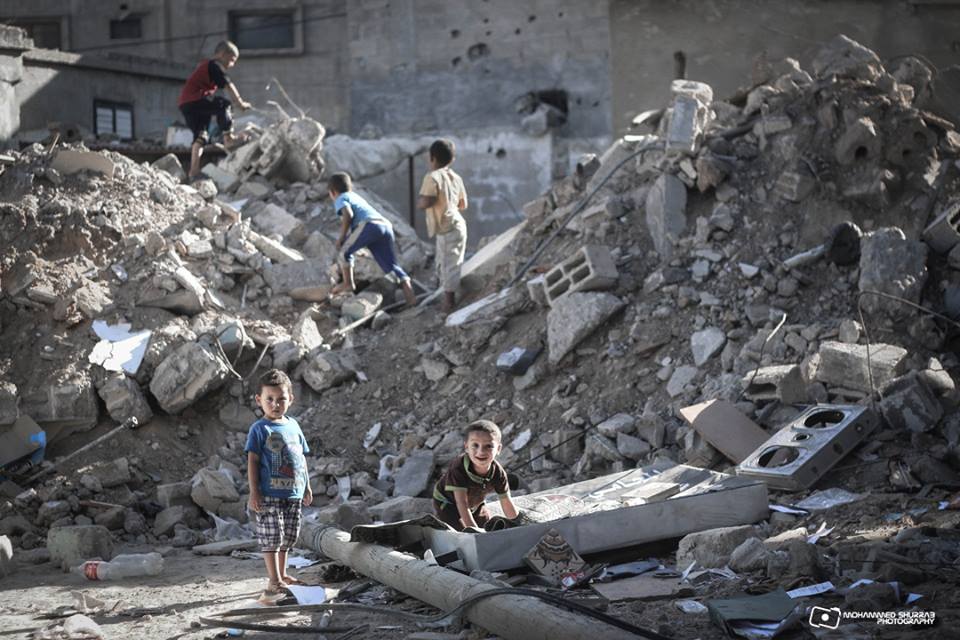
Hordes of barbarian mercenaries have been infiltrated into two countries, armed and trained by foreign powers and in fact supported and given free rein by the governments of both countries and, taking advantage of the situation of total anarchy, have themselves become a power.

For more than a year the Syrians have been loudly proclaiming that ISIS is not against Assad, but fights, rapes and kills its opponents and especially blasphemes and slanders Islam saying that it operates in the name of that faith. No one has listened to the Syrians, indeed, part of politics and the press has continued to label ISIS as anti-Assad rebels, it is absolutely false because In Syria ISIS moves and operates only where government troops have withdrawn and opens fire, persecutes and massacres civilians and opponents of the regime.

Today ISIS is a military power that frightens and in the face of the escalation of its violence, which has brought to Iraq its nearing to areas where there are oil reserves, it seems that the world is waking up.  Nobody has moved a finger for the Syrian civilians (more than 80 percent Muslims), killed by these barbarians, and they even deny the massacres that have taken place, but today that the cries against the persecution of minorities are made, in Syria as in Iraq, the alarm is being sounded.

Therefore the message gets out that if to die is the Muslim majority it doesn’t matter, but woe to those who harm others. In doing so it is only playing the game of ISIS that wants to create tension and foment sectarian hatred. In this context, the regimes sing victory, posing as guardians of minorities and the already unacceptable death of innocent people is even hijacked.
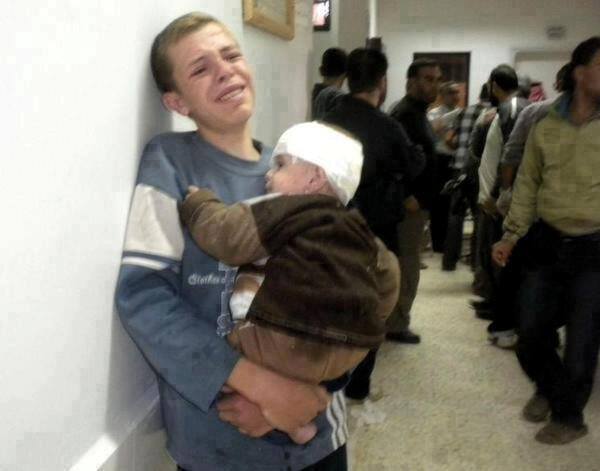
It is necessary, therefore, to stop and shed some light on the matter:

1- In Syria the main causes of death is the bombing by air raids by the Syrian regime, affecting in vicious and indiscriminate manner the entire population, destroying and killing regardless of faith and ethnicity; today there have been over 200 thousand victims in 41 months, of which more than 18 thousand are children under 16 years of age. In Syria Christians, Muslims, secular people, atheists, Kurds and Armenians have been dying for over 3 years. It is a genocide that is affecting the entire population.

2- In Iraq even the UN has stopped counting the dead, but now most sources say that there are about a million; Christians are between 5 and 8% of the population, have experienced the sufferings and the atrocities that all of the other social components are undergoing. With the advance of ISIS their situation has even worsened and the threats, the started, the house to house persecutions that totally resembles Nazi style persecution. The persecution of the Yazidi is being given a religious significance, but in reality ISIS is concerned with occupying their lands and putting their hands on the oil fields.

3- ISIS does not represent the feelings, values, principles of Islam, quite the opposite: ISIS must be defined as what it is, a group (even if it defines itself as a nation) of terrorist mercenaries whose work is contrary to Islamic faith. ISIS is killing Muslims in Syria and Iraq and killing with them the other ethnic and religious components. ISIS abuses, mortifies and blasphemes the name of God. The only deity to which ISIS responds to is money. ISIS does not represent Syrians, does not represent the Iraqi people, does not represent Islam.

4- ISIS is comprised of foreign mercenaries that have nothing to do with the cause of the Syrian people who have opposed themselves to almost half a century of tyranny, nor is it with the cause of the Iraqi people who now fight for their survival after years of genocide. ISIS is a creature of international secret services that finds support in different monarchies and were formed for the purpose of “wreaking havoc”, to conduct wars by proxy.

To learn more read these articles (in Italian): http://www.sirialibano.com/tag/isis http://www.pagina99.it/news/mondo/6681/Che-succede-in-Iraq.html http://popoffquotidiano.it/2014/08/11/hillary-clinton-lisil-e-roba-nostra-ma-ci-e-sfuggito-di-mano/ http://megachip.globalist.it/Detail_News_Display?ID=107832&typeb=0

5 – The strategy of false information is harvesting many victims: photos purporting to be what they are not (to follow will be one of my article on the false story of the decapitation of Christian children) are causing reactions even from the top, among the powerful of the world. It would only take a minimum of attention and professionalism to check the origin and the matrix of a photo and a news item, but the media war is one that the regimes and terrorists are fighting – no holds barred – and careless reporting, or even complicit reporting becomes an amplifier.

For those who have faith, for those who believe, for anyone who has a conscience and a minimum of intellectual honesty it seems even superfluous to have to reiterate that there is no war in the name of God, that nothing and no one can justify the persecution, the threat, the offence and the killing of an innocent. Let us not fall into the trap of sectarian hatred, we will never cease to dialogue with each other, let us not allow the sowers of conflict outweigh the bridge builders.

It takes much determination and bravery, especially now, but it is precisely in the face of these difficulties that the world of believers of different religions and the civil society as a whole, secular, atheist, must join hands and feel that the real strength is in dialogue and the commitment to peace. It is not naïve optimism, indeed, it is much more challenging to reiterate the reasons for dialogue and bring ourselves toward the other than to erect walls and close ourselves in the hell of hatred.

If you want to imagine a manifesto of Syrians, Iraqis, of Muslims that at this moment are associated incorrectly and unfairly to terrorism we must repeat indefinitely: “No, not in our name”. Christians are our brothers, the human beings of every religion and ethnicity are our brothers and sisters.

As author of this blog, as Syrian, as Muslim I repeat too and I am proposing the campaign:

“Not_in_our_name”, to say no to persecution, false news, the sowers of hatred.

ORIGINAL http://diariodisiria.wordpress.com/2014/08/12/not_in_our_name-le-guerre-e-il-terrorismo-stanno-uccidendo-il-dialogo/

Greta Ramelli and Vanessa Marzullo, two human rights activists and aid volunteers for Syria.

Greta Ramelli and Vanessa Marzullo, two human rights activists and aid volunteers for Syria.

My dear daughters Greta and Vanessa,

in these days of silence we are living in a state of anxiety, worry and pain. Your good hearts, your profound humanity and sensitivity prompted you to not turn your backs, but instead to take to heart the cause of the Syrian people, as if it were your people, your family. You have taken the time to work to bring awareness to the situation and bring relief to the needy, thinking especially about the children. 200,000 dead, 50,000 died under torture, 500,000 prisoners in the prisons of the regime, 150,000 missing without a trace 3 and a half million refugees, 9 million internally displaces, 3 million homes destroyed, 1 million wounded, over 650,000 mutilated: behind these numbers, there are people, human beings, an entire population that is undergoing a genocide.

The proportions of this drama have left parts of the world indifferent, but not the two of you, who with your own small hands have been active and involved. I join in the prayers of your parents, friends, and everyone who knows you and who anxiously awaits your return. I join all of those who, like you, in these three years have wanted to be involved in concretely helping Syria. Selfless and generous men and women who work every day in silence to relieve the pain and suffering of so many innocent civilians. People who have not given up any of their own humanity, as instead have done those who revel in making judgements, comments, malicious criticisms certainly not worthy to be mentioned. People who behave like hyenas and jackals.

The situation in Syria is dramatic: the regime, which for over forty years has been repressing the entire nation continues its offensive on the cities using the air force and the army, sparing no bombs, including chemical ones. There are at least 26 groups of foreign mercenaries, with various acronyms and names, who are fighting against the people and the Syrian resistance. These terrorists, paid, armed, sent abroad, invade the liberated areas and carry out executions, kidnappings, crimes against the defenceless population and against the partisans who try to defend Syria and its people.

These same terrorists use religious names and clothes to disguise their wickedness and they are accredited by those same parties who favoured their onset and their operations, while the faithful know that such actions and such people are only an insult and blasphemy against religion and are useful to the purposes of disinformation and sectarianism, which is desired by the regime in Syria as in Iraq. Even the most unsophisticated people know that the caliphate is something else, but today we are faced with armed men in disguise who are committing unspeakable crimes against innocent people of every ethnicity, faith, social class, which in addition to enduring shelling, sieges and lack of medical care, food and education are also threatened by the wicked, persecutory and inhumane acts carried out by these barbarian invaders.

The acts of these criminals are a threat to the people of Syria and Iraq, but not only to them, because they are undermining the coexistence between religions and ethnicities that has lasted for centuries. It should be stressed that the reality of brotherhood, dialogue, respect, coexistence between religions has been in the hearts of the Syrians for centuries, from the very birth of these faiths, which have developed into the great monotheistic religions. It was not certainly the merit of the regime to create conditions of coexistence, conditions that today, however, are threatened by the arrival of these criminal occupants.

Our thoughts turn to Father Paolo Dall’Oglio, symbol of this coexistence and fraternal dialogue and it runs towards you, Greta and Vanessa, who have not been frightened by diversity, but have made it a richness. In the name of your example, in the name of the commitment of millions of Syrians, men and women of different ethnicities and faiths, we continue to believe in dialogue and support for the most vulnerable. Do not let the screaming of the sowers of discord prevail over the words of love and good sense that unites those who work in solidarity and peaceful confrontation. Dear Greta and Vanessa, dear Father Paolo Dall’Oglio, dear Syrians, we join our prayers for your immediate and unconditional release and your return in peace and serenity to your families.

Your uncle, Dr. Mohamed Nour Dachan