Archive for the ‘People’s Movements / Struggles’ Category

Blasting. Shouts. Screams. Sirens. 

Someone told me to run, I should.

I try to keep my eyes open; I would, if I could.

Wait,

Nobody told me it would feel this good.

I look at the sky and breathe in one last time,

That’s it; I think it has reached my time.

I close my eyes and as I let go, I smile,

I haven’t felt this happy in a very long while.

Don’t get carried away with me,

Going, Going, I’m gone away…

To my mother, father, son, daughter and anyone that has cried;

It would be an insult to say I have died,

Instead be blissful and speak my name in pride,

Or release those tears of joy you are trying to hide,

For I am waiting for you on the better side.

Sorry about the call you received at 4 o’clock in the morning,

I don’t want you upset and I don’t want you mourning.

I am sorry to anyone I have left behind,

I hope one day peace and tranquillity you will find.

Don’t worry about me I am wide awake,

For I have lost my earthly life for the almighty’s sake.

If you have lost me or any family member,

Stay with the thought that we will meet again in Jannah.

They say what doesn’t kill you only makes you stronger,

So try and hold on a little while longer.

With you I will always remain, in your heart and your soul;

As you try to find freedom and accomplish this goal.

Be strong, and remain standing tall,

Don’t give up hope or lose patience as you fight for evil’s downfall,

Everything helps no matter how small,

Each one of us can build freedom like each brick builds a wall.

Pray, Pray, Pray and Pray.

Try not to lose patience and carry on day after day,

As you fight for freedom in every way.

My death wasn’t my end, it’s not over,

The sadness of my loss you will Inshallah get over,

Remember that paradise is what I fly over,

The Dunya’s hurt that I suffered I don’t think over,

Agony and Pain I will never again fret over,

Just carry on praying for the day that this is all over.

freedom fighters in BenghaziThe author of the article I post below, Robert Grenier, rightly asked: “Where are the Arabs?” but in our opinion, we Arab Nationalists, also believe that he had also rightly volunteered to reply to his own question which is in his own words:

“…the primary motivating principles of the rebels have been clear: A desire for personal liberty, dignity and collective social empowerment.” 

Once an Egyptian Arab intellectual lady, Huda Hanum Shaarawi, replied after the 1948 Palestinian Arab Nakbah to the question: “How is it possible that seven Arab states and their armies were defeated by one state “Israel”? Her reply was simple and clear: “Because they were seven states with seven armies and seven ‘leaderships’ each quarrelling with the rest, while the enemy was one with one leadership, one army for one state.”, which the author has described below:

Robert Grenier was the CIA’s chief of station in Islamabad, Pakistan, from 1999 to 2002. He was also the director of the CIA’s counter-terrorism centre.” As a high CIA officer he should have known why did the British  Mr. Sykes and the French M. Picot come together to plan to divide the east Mediterranean Arab territories even before the defeat and  expulsion of the Ottoman Turks from it. They met and agreed to conclude on what is known as “The Sykes Picot Agreement”, that is, to  apply the principle of “divide and rule”, of course to create small weak Arab states that cannot defend themselves in the face of the colonialist powers and their colonialist ambitions, who were at the time in the first place Great Britain and France.

And lately why the old Zionist fox Shimon Peres to be joined at a later time by Condoleezza Rice, U.S Secretary of State under George W. Bush, further try to divide the present Arab states into a smaller states based on religious and ethnic minorities, which Zionists and other colonialist powers shall try to create between them feuds and enmities so as to resort to these colonialist powers for protection against their other Arab brothers… then Zionists and other colonialists shall be able to control them all, but fortunately enough what is known as the New Middle East colonialist conspiracy did not see the light, and with the domino theory of Arab revolutions presently taking place shall never be realized, and hopefully an Arab unity shall instead be realized to counteract these Zionist and western colonialist conspiracies.

Now the aim of young Arab revolutionaries is to get rid of these rulers who want to keep their control on what they consider as their subjects in collaboration with their colonialist protectors, but the young Arab citizens who want to be no more subjects of their corrupt ruers, but real citizens and be able to decide their own fate are struggling to overthrow all these rotten, corrupt and isolationist rulers. That is why those particular rulers shall not volunteer to come to give assistance to Libyan Arabs or any revolutionary Arabs citizens revolting against their rotten rulers… because as we said and saw that by the domino theory, revolutions shall pass from one Arab state to another. They, Arab rulers, want to keep their chairs under the seat of their pants and keep on riding on the backs of what they consider their obedient subjects. The young revolutionaries want their freedom and liberty from their internal and external rulers.

In a big and rich Arab state, an official and a member of the ruling family commented on the simple and rightful demands of their young citizens whom they consider “subjects” who gathered peacefully. As is the case with all Arab rulers, the official said after denying that there were gatherings and demands: “The cooperation of citizens with security men to confront those who call for anarchy was a good proof and spontaneous response against those calling for evil in a peaceful country.” He added that, “driving people to overstep matters to what doesn’t achieve demands or reform, calls for dialogue,and that is exactly what those in command in the state call for”!!!!

Another highly posted official said: “Some of those calling for evil gathered in front of the ministry of internal affairs,” he claimed that, “they want to make of the state a place of chaos, they are organizing purposeless demonstrations that have no high aims, but they proved that they don’t know the people of their state”!!!

From Libya, correspondent Ogharit Dandaash wrote the story of the engineer Almahdi Zeo:

“Before February 14th there was not a single exceptional matter or incident that makes it to informational mass media, nor was there a political stance, be it pro or con, regarding the regime that was in the activities of this Benghazi engineer who was in his forties. Engineer Almahdi Zeo was living a quiet life in Benghazi, his financial status was as described by those who knew him well as “better than good (kwaiseh)”. Zeo was the head of a family, and the father of two daughters studying at university, who never heard or noticed him fidgeting when Gaddafi and his men ruling from their stronghold of terror in Benghazi were mentioned.

On February 15th 2011 the young people of Benghazi didn’t expect the official birth for the February 17th revolution, to mount the winds of change that blew from their neighborhood. They demonstrated and were confronted from the Benghazi battalion of terror with fire in front of the court house… many of the revolutionary fell down martyrs…

While the young revolutionaries were marching in the funeral of their martyred comrades, Zeo was passing an ordinary day during his monotonous life. He passed in front of the headquarters of the battalion on his way to practice his ordinary daily routine work, it was inevitable that some incident should happen to attract his attention. Young people returning from the funeral of their beloved comrades, were, without notice, confronted with live fire, the source of which was from the battalion of Al-Fadel Omar, the headquarters of the soldiers of the regime, where any activists with political opposition to the regime, or with any ideas that contradict those of the Gaddafi Green holy Book. Zeo stopped to see the young people confronting the heavily armed soldiers with their naked chests, He returned home to tell his two daughters about 18 years olds fighting without help.

The following morning he returned to practice his ordinary work, believing that the zeal of the young couldn’t but be aborted with the regime’s brutality, but just in front of the same battalion tens of young people returned for another sit down with other supporters… Zeo realized after a long life of submission and looking aside shall not end with the feeling at ease required by other human beings, those youngsters realized, before it was too late, that there is a difference between living as ordinary human beings and a life full with a humanitarian meaning.

That night he hugged his beloved ones like he had never done before, he talked to them about small heroic incidents that history books didn’t mention, and about which no poems were written, but they leave their effect in people’s souls that had submitted to accepting life at ease, and as an ordinary matter… and left his house.

The place is the headquarters of the Benghazi battalion, date before the new Libyan history, attendants, the young persons seated on the ground, the occasion: drawing a new road map for the revolution.

The engineer said: “Success depends on the element of surprise: Clearly, we need to act quickly.

One of youth there understood: the moment the road opens, we attack.

Another youth pointed out to another group of young people, the brothers coming here are from Baida, they came to help us.

The engineer said, “I am going ahead”.

The engineer mounts his car that was loaded with gas containers for home use, and drives towards the wall of the two storey building housing the battalion’s headquarters, which is impossible to enter to or to break into. He steps on the accelerator to maximum speed, hits the wall, the car explodes, the wall crumbles creating an opening, the youngsters rush into the headquarters.

The element of surprise dispersed the soldiers who ran away, the revolutionaries took control and they obtained their first quantity of arms, they took control of the helm of the battle and thus the battle turned in their favor. After some confrontations, the Abu Al-Fadel Omar battalion fell and its leader fled to Tripoli along with Assaadi Al-Gaddafi (One of Muamar Gaddafi’s sons) who took refuge at the battalion’s headquarters after the outbreak of revolution. Then the weapons and ammunitions stores are now in the service of the revolution born on February 17th.

The fall of the battalion contributed to the liberation of Benghazi, and the revolutionaries gave credit in that to Engineer Almahdi Zeo for the morale and military help he gave to them, and encouraging many officers and soldiers to defect from Gaddafi’s forces and join the revolutionaries, and opening the door wide open for victories, which made the east of Libya fall from the hands of Gaddafi into the hands of the revolution within four days.

Martyr Al-Mahdi Zeo did not live to reap the fruits of the trees he planted, but those Libyan young men and women who had never heard of Engineer Zeo know now that the engineer of the realized revolution shall be the name who they shall tell to their children and grandchildren when their hair shall turn grey about a revolution executed by dreamers who didn’t wait enjoy its fruits.

So we should not expect from these decaying, rotten and dictatorial regimes to step in to help other revolutions against their equally decaying, rotten and dictatorial Arab regimes… they are equally bad and should be overthrown by young Arab revolutionaries.

“Where are the Arabs?” The other Arabs, are the young revolutionary Arabs, who are each cleaning the dirt the old Arab dictatorial and rotten Arab regimes left over by colonialism behind. Good things are coming with Arab liberty and unity. 

So we cannot but agree with Robert Grenier saying: A new day is dawning in the Arab world. The revolutions underway have only just begun, and there is much to be sorted out in the countries where the democratic wave has taken hold. The response of other regional regimes, under less acute and immediate pressure, but still grappling with the challenge of socio-political changes now set perhaps inexorably in motion, remains very much to be seen. For all that its common outlook is rapidly evolving, the Arab world has a long way to go in coming to a firm consensus about what forms of rule will meet its minimum standards of acceptability.”

 ORIGINAL PIECE

Opinion
‘Where are the Arabs?’ By: Robert Grenier 

If Arab states are serious about ending Gaddafi’s menace to his people, they must take the lead in helping the rebels.

Robert Grenier Last Modified: 13 Mar 2011 08:35 GMT
If Arab states do not act now, when the last Libyan rebel lies bleeding in the desert, his final words
may well be: ‘Where are the Arabs?’

It was August of 1982. For seven weeks, Beirut had been sealed off, under attack by Israel from land, sea and air. Water and electricity supplies were cut. The Israelis had secured the airport and much of the southern suburbs. The Syrians had been defeated, their air force wiped from the Lebanese skies. Chairman Arafat and the PLO were seemingly at the mercy of their enemies, utterly dependent upon the international community to arrange an evacuation of their fighters which would bring an end to the carnage. Isolated and alone, all the leader of the Palestinian movement could do was look into the cameras and plead: “Where are the Arabs?”

In January of 1991, a nominally extensive international coalition of armed forces, led by the US but including many of the Arab countries, stood poised in northern Saudi Arabia to drive Saddam Hussein from Kuwait. It might have seemed that much of the Arab world was unified, and had engaged the United States and the international community in their cause to liberate a brutally occupied Arab country.

But in many of the Arab capitals, and to a seeming majority in the Arab street, the armies massed in the Saudi desert were anything but a sign of Arab strength and unity. For in point of fact, the Arab countries had had comparatively little to do with organizing this un-authorized, largely Western coalition. Many Arab nationalists from across the region asserted strenuously that the Arabs should not rely upon the Americans to sort out their difficulties, arguing in favor of an “Arab solution” to the crisis. In fact, however, this was mere posturing: An Arab solution to the crisis would have amounted to meek acquiescence in Saddam Hussein’s intra-Arab aggression. Those Arab countries most threatened by Saddam were not about to entrust their fate to regional Arab councils. They did not wish one day to be left, alone, to make the entreaty: “Where are the Arabs?”

Today, in the deserts along the coast of Libya, patriots are fighting to liberate themselves and their country from over 40 years of brutal, arbitrary misrule. Although tribal and other social divisions are no doubt playing a role in determining the fault lines of the civil war progressively settling over Libya, the primary motivating principles of the rebels have been clear: A desire for personal liberty, dignity and collective social empowerment. In this they have been transparently inspired by the courage of their brothers and sisters in Tunisia, in Egypt, and in many other parts of the Arab world. But as they attempt to withstand the onslaught of Muammar Gaddafi’s better-armed loyalists, and as those rebels most hard-pressed repeatedly plead for at least limited outside assistance, well they might ask: “Where are the Arabs?”

Passivity and diffidence

A new day is dawning in the Arab world. The revolutions underway have only just begun, and there is much to be sorted out in the countries where the democratic wave has taken hold. The response of other regional regimes, under less acute and immediate pressure, but still grappling with the challenge of socio-political changes now set perhaps inexorably in motion, remains very much to be seen. For all that its common outlook is rapidly evolving, the Arab world has a long way to go in coming to a firm consensus about what forms of rule will meet its minimum standards of acceptability.

Nonetheless, the latest indications of Arab intent in the context of Libya are positive, if as yet insufficient. A clear message has been sent by both the GCC and the Arab League that Gaddafi’s brutality toward his people is not acceptable, and has effectively delegitimised his government. The Arab nations have taken a clear stand in favour of a UN Security Council-imposed no-fly zone, and for urgent outreach to the National Transitional Council in Benghazi.

So far, perhaps, so good. Still, troubling signs of traditional passivity and diffidence remain. The Arabs are deferring action to the international community without suggestions as to how that action should be implemented, and with no firm commitment for their own direct involvement. The Arab League ministers aver that a no-fly zone should only be for the purpose of protecting Libyan civilians, and should end as quickly as possible. They continue to express concern over foreign intervention, while requesting precisely that. Their ambivalence is palpable.

At the same time, evidence is mounting that the international fixation on a no-fly zone may be a distraction from more urgently-needed action, and may in fact be counter-productive. First of all, it is not at all clear how great a threat is posed by Gaddafi’s air strikes, per se. While the military situation remains confused, it seems more likely that Gaddafi’s armour and artillery pose the more lethal danger to both rebel and civilian targets.

Moreover, imposition of a no-fly zone would be no simple task. Security Council agreement is far from assured: The Council is divided, and the Chinese, in particular, will do what they can to avoid approving international interference in internal Libyan affairs, out of fear of the negative precedent it might set for themselves. While others might well participate, the US, clearly, would have to take the lead. (As far we Arabs are concerned, we have no trust with the United States and other western powers, their policies are equally colonialist, and we suffered enough on their hands and their rogue adopted and nursed our Zionist entity- A.S.K.)

Following its doctrine, the US would need to attack Libyan air defences first; the potential for significant collateral damage is considerable. The Americans would also require a helicopter-borne “combat search and rescue (CSAR)” capability to be in place for downed pilots before they would willingly act. And there are not nearly enough aircraft in theatre, yet, for an effective no-fly effort. Finally, it may simply be too much to suppose that the Americans, already engaged militarily in two Muslim countries, should now intervene in a third, when the risk to their already weak regional standing from those who may advocate international action now, but will no doubt quickly criticise any missteps, is so great.

Taking the lead
If the Arab League is serious about ending Gaddafi’s menace to his people, they should focus on providing the National Transitional Council with the means to defeat him and his loyalist forces. The US, the EU and NATO have all made clear that they will only act with a clear legal mandate and with regional support. Therefore, it is up to the Arab nations to take the initiative.

It is very likely that the softness in the Arab League stance is a reflection of the divisions between those members on either side of the “democratic revolutionary” divide. Hobbled by the need for consensus, the League as a whole has gone about as far as it is capable; it is unlikely to take the tough decisions and hard actions necessary to counter Gaddafi’s resurgence. Those whose commitment to support of the rebellion is notably strong – Egypt and the GCC countries in particular – must be prepared to take the lead from here.

First, they should move quickly to recognise the Council in Benghazi as the legitimate government of Libya, and immediately request modification of the current UN arms embargo to exclude its forces. Meanwhile, a rapid assessment of the rebels’ military requirements is needed; these would likely include ammunition, anti-armour weapons, and perhaps rockets or artillery. It is clearly within the capabilities of at least some of the Arab countries to provide these rapidly by air, most likely with logistical assistance from the US or NATO. In this context, it would become far easier, and more palatable, for the US and NATO to provide overhead intelligence, perhaps off-shore jamming of Libyan military communications, and other forms of assistance to the transitional government.

We can begin to imagine that such an Arab-led initiative on behalf of the Libyans could help to build a new, cooperative relationship with America and the West – one which flows from Arab empowerment and collective resolve, and not, as in the past, from Arab weakness.

The time has come, in short, for the Arab regimes to demonstrate regionally and internationally the will and courage to act demonstrated by many of their own citizens domestically. Otherwise, they run the risk, in what is supposed to be a transforming Middle East, that when the last Libyan rebel lies bleeding in the desert, the boot of a pro-Gaddafi thug upon his neck, his last gasp will be: “Where are the Arabs?”

Robert Grenier was the CIA’s chief of station in Islamabad, Pakistan, from 1999 to 2002. He was also the director of the CIA’s counter-terrorism centre.

The views expressed in this article are the author’s own and do not necessarily reflect Al Jazeera’s editorial policy.Source:

Al Jazeera

The arms of the Resistance, it has been suggested, should be abandoned as a matter of principle.  ‘From now on’, explains Caretaker Prime Minister Saad Hariri, ‘the possession of weapons, decision of war and peace, and defending the country should only be under the state’s control’.  Political principles, it would seem, can be slippery.  ‘From now on’?  Perhaps this disclaimer is meant to ease the turnabout from the Hariri-Ministerial Cabinet Statement issued just over a year ago:

‘Based on the Cabinet’s responsibility to preserve Leba­non’s sovereignty, its independence, unity and the safety of its land, the government underscores Lebanon’s right through its people, army and resistance to liberate or regain authority of Shebaa Farms, Kfarshouba hills and the occupied part of Ghajar village and defend the country against any aggression’.

For the sake of argument, however, let us set aside the dictates of political expediency.  Let us look at the reality of what this stance entails. 

The crux of the grievance being voiced these days is that the Lebanese Army should have exclusive domain over national defence.  The grievance asserts that the Islamic Resistance of Hezbollah has usurped this privilege for its own advancement.  The puzzling bit of this accusation, however, is that it is being raised not by the Army—but by various politicians.

In contrast to the opinions of the 14th of March personalities, the Lebanese Army has for over twenty-five years maintained an efficient working relationship with the Resistance.  The developments in Lebanon over the past six years have left this harmony stronger than ever.  Building on the firm, longstanding commitment exhibited by Generals Michel Aoun and Emile Lahoud, the Lebanese Army remains a proud partner of the Resistance. 

When Lebanese Army General Michel Sleiman took on the role of President in 2008, he carried with him the experience to judge the elements required for an adequate national defence.  He stated that the success of the Resistance in defeating the occupier was ‘achieved by virtue of the support granted by the Lebanese people, the State, and the Lebanese Army’.  Such success notwithstanding, he continued,

‘the enemy’s persistence in threatening to violate our sovereignty imposes upon us to elaborate a defensive strategy that will safeguard the country concomitantly with a calm dialogue to benefit from the capacities of the Resistance in order to better serve this strategy.  Accordingly, we will manage to avoid depreciating the achievements of the Resistance in internal conflicts and subsequently we will safeguard its values and national position’.

President Sleiman reiterated his conviction just weeks ago in response to Israeli Defence Minister Ehud Barak’s warning that Israeli military may invade Lebanon yet again.  Barak ‘knows full well’, said Sleiman, ‘ that entering Lebanon is no longer a walk in the park.  The defence minister’s threat to send his forces into Lebanon again shows premeditated intentions of aggression.  The Lebanese people, army and resistance are ready to respond to any such aggression.’

President Sleiman’s confidence in the existing defence framework is shared by the head of the Lebanese Army, General Jean Kahwagi.  Addressing his troops last year, he advised them to ‘cling to the will of steadfastness and confrontation and to benefit from all the Lebanese capabilities residing in the capacities of the Army, the people and the Resistance as well as from the presence of the United Nations Interim Force in Lebanon and its support’. 

Whereas the stance currently adopted by the 14th of March campaigners clearly resents the ability of the Resistance, General Kahwagi  openly describes all contributions toward the national defence as honourable:

‘Let us look with veneration and respect at the souls of our pious martyrs, whether soldiers, citizens or resistance fighters, who fell while defending their country. . . and drew with their innocent blood the path of dignity and liberation for a country that we can be proud of in front of the whole world since we are its true and loyal protectors’.

As the Israeli media grins at the banners being  waved in Beirut that read ‘We want only the arms of the Lebanese army’, again it becomes imperative to look at the reality of what this stance entails.  

The Lebanese Army remains committed to a cooperative national defence, to a formula of the Army, the people and the Resistance.  Just days ago, General Kahwagi reiterated:

‘The Lebanese Army abides by this formula since it is part of the decisions and guidance of the political authority represented by the Cabinet and it is totally convinced by this formula since experience has proved its primary role in liberating the greater part of south Lebanon and western Bekaa from Israeli enemy occupation in addition to its role in defeating this enemy in the war of July 2006 and in safeguarding Lebanon in these days’.

A system of mutual support has evolved.  To disallow the arms of the Resistance would be to arbitrarily disregard the consistent evaluation of the Army’s top leaders.  This is nonsensical.  Such a suggestion would leave Lebanon vulnerable; of this there is no doubt.  The only conclusion, then, is that such a suggestion is either gross negligence or wilfull acceptance of Lebanon’s being engulfed.   We have to wonder whether the current swirl of rhetoric over who gets to be commander-of-the-day has more to do with protection or politics.  If both the acting Army General and the President, a former Army General, embrace the contributions of the Resistance, then the state of Lebanon is already well in control of its defence. 

 By Brenda Heard For www.english.moqawama.org

Originally posted at http://www.english.moqawama.org/essaydetails.php?eid=13640&cid=269 

Cameron likes private Israeli security orgs

‘With me you have a prime minister whose belief in Israel is indestructible’, David Cameron assured over a thousand supporters of a private security organisation that polices the English Jewish communities.  While his commitment has long been common knowledge, his word choice underscores the need for concern.

When we say we ‘believe in’ something, we are making a personal value judgement.  Whether we ‘believe in’ God, or we ‘believe in’ drinking five litres of water a day, the phrase means that we think the concept is valid.  The British Prime Minister’s word choice points to a political phenomenon: Israel has never been a traditional state as much as it has been an ethos.  From the beginning, the Israeli project has been an ideology imposed at the expense of those whose only fault was to have been caught unawares on a coveted land. 

Indeed the whole of Cameron’s speech, which can be read here http://www.thejc.com/news/uk-news/46044/david-camerons-speech-cst, exudes a passion for a conceptual people under siege.  Cameron thus describes his belief in the Israeli project as ‘indestructible’—defensively and defiantly ‘indestructible’. 

The need for concern lies with his personal adulation dictating the terms of his political management.  Certainly, to guarantee equal rights for English people of all religious faiths is admirable.  But throughout his speech Cameron equates ‘Jewish’ with ‘Israeli’—as if all London Jews were pro-Israeli (they are not) and as if all Israelis were Jewish (they are not).   Such a stance discredits both demographics.  Likewise, his promise that he ‘will always be an advocate for the State of Israel’ denies the possibility of a conflict of interest with his sworn duty as Prime Minister to be faithful and bear true allegiance to Her Majesty Queen Elizabeth: to be an advocate for the United Kingdom.

Equally as worrisome, though, is the Prime Minister’s characterisation of the recent upheavals in the Arab world.  Cameron notes that ‘this instability may seem a cause for concern for Israel’, but he then shrewdly reassures his audience.  This is a ‘precious moment of opportunity’, he says.  ‘We want to see Israel driving the process, which means seizing the initiative.  Doing so is absolutely vital’.

Vital to whom?  Is it vital to the Libyan people against whom Muammar and Saif al-Islam Gaddafi are using mercenary weapons outsourced from similar Israeli ‘security firms’?  No, not vital, but lethal to those seeking redress.

Cameron devotes a significant portion of his speech to discussing the Arab uprisings as an ‘opportunity’ for Israel and its Western patrons to remake the region to better suit themselves.  This myopic exploitation typifies the pattern of defining all matters and all peoples of the Greater Middle East in terms of the Western-Israeli Alliance. 

A spirit of entitlement and superiority has for many long and bloody years pervaded Western foreign policies.  Many of those who have been suffocated by such attitudes have at last realised that they deserve to decide for themselves their own business.

A state is a dynamic entity.  No state comprises people of identical values.  Its success lies in achieving a balance in the cultural expression of those values.   But this balance cannot be imposed.  It can be determined only by the people themselves. 

The Arab peoples have had enough of the condescending advisories from those who have their strategic eye on Aladdin’s cave.  The Arab peoples do not need the dubious money-maker George Soros to sort out on the BBC the Arabs’ handling of their own natural resources.  Nor do they need David Cameron’s vision of ‘stability and security for all.’  Because his vision is simply not for all.  He said it himself: he will always be an advocate for the State of Israel. 

The seemingly contagious quests for Arab autonomy throughout the region have been propelled by people who want and need and demand a voice.  Their own voice.  The uprisings are neither pro-Westernism, nor anti-Westernism.  Rather, the uprisings are about self-respect.  The uprisings are resistance to imposed ideologies.  Let us be clear: the region is not for sale.

www.english.moqawama.org

Originally posted at http://english.moqawama.org/essaydetails.php?eid=13593&cid=269  

Photo from http://thecst.org.uk/blog/?p=2359   

"peace" talks

When allowed to turn freely, the metaphoric Palestinian compass points in one direction — that of Palestinian struggle. But most of the time, someone is interfering with this compass, rigging it to other directions, as in the case of the continually failing peace process.

Now, with much of the Arab world up in arms against its autocratic rulers, the Palestinian compass is given another nudge, also in the wrong direction. The Palestinian public is seething, and yet Palestine Liberation Organisation (PLO) officials are telling us that the only way forward is through more negotiations. The “peace process,” we’re told, is the only thing worth saving from the current sea of Arab discontent.

It’s all topsy-turvy in the land of discontent. A Day of Dignity has been called to presumably restore unity in Palestinian ranks. Most likely it will lead to further disunity. Allow me to elaborate.

The Day of Dignity, held on 11 February, was not meant to end occupation but to terminate Gaza’s spirit of civil defiance. “Say no to division and occupation and yes to national unity,” is the slogan another group of organisers chose for planned protests on 15 March. On that day, the PLO plans to call for new presidential, legislative, and local elections in the hope of regaining enough credibility to pursue its favourite goal, that of negotiating for peace. The organisers tell us that they want a Palestinian state by next September. How many times have we heard this before?

WAFA, the PLO-run news agency, is trying to give the impression that this is the only path available to the nation. We’re either going to negotiate for peace, or we’ll protest and then negotiate for peace. If there is a point to this argument, I don’t see it.

Does anyone remember why the current split in Palestinian ranks happened? It all started when PLO officials, the endemic believers in peace, refused to honour the outcome of democratic elections held in 2006. So much of current dilemma is due to the simple inability of the PLO to reconcile peace with democracy.

So far, we’ve had a peace process that wasn’t so much about ending the conflict as it was about managing it.

The kind of negotiations we’ve been having, as Rashid Khalidi, the prominent Columbia University professor said, were never about self-determination or about ending the occupation, but about allowing Israel to impose its point of view, with US blessing every step of the way. This has been the case since the Madrid Conference of 1991. The only practical use of the peace process was to allow Israel time to build more settlements, with US approval. A US veto only a few days ago, on 18 February, should put to rest any lingering doubts in this regard.

But American officials are still conducting “quiet” talks with both sides, as Dennis Ross told the 2011 J Street Conference. Abbas thinks this is the only way forward, but some Israelis are not so sure.

Uri Avnery, long-time peace activist and founder of the peace movement Gush Shalom (the Peace Bloc), says that the Palestinians have other options. “What would happen if hundreds of thousands of Palestinians started walking to the Separation Wall and pulled it down? What would happen if a quarter of a million Palestinian refugees in Lebanon gather on our northern borders? What would happen if protesters gathered in numbers at Al-Manara Square in Ramallah and Al-Baladiya Square in Nablus to challenge the occupation?” he asked.

The Israeli peace activist is not saying that this may happen today or tomorrow. But, judging by the way things are going, it cannot be ruled out. This is perhaps why Obama’s chief Middle East advisor Dennis Ross admitted that the current situation was “untenable”.

And yet PLO negotiators are helping the Israelis prolong the situation, by giving the false impression that something will happen when everyone else knows that things are going to stay the same. The PLO seems to be holding out for the day when the US, or the EU, put their foot down and broker a fair peace. It’s not going to happen.

Meanwhile, the PLO continues to suppress the only two forces capable of turning things around: national resistance and a citizen-led Intifada. The PLO is blocking any chance of forward movement while giving everyone the impression that it is doing something for the people. All it is doing is to help the Israelis perpetuate a basically untenable situation.

On 2 March, the newspaper Haaretz reported that Prime Minister Binyamin Netanyahu was working on a plan for establishing a Palestinian state with temporary borders as part of interim peace arrangements. We’ve heard it all before.

The Netanyahu plan is nothing new. It is a reproduction of earlier plans, all aiming to give the Palestinians a reduced version of the West Bank. Former defence minister, Shaul Mofaz, who is now chairman of the Knesset Foreign Affairs and Defence Committee, came up with a similar idea that would have given the Palestinians back about half of the West Bank.

An earlier version of the Netanyahu strategy was tried by Labour when Ehud Barak was prime minister. Barak, unable to complete a promised three-phase withdrawal from the West Bank, dragged PLO negotiators to a summit in Camp David in 2000 and then made sure that the summit would lead to nothing.

Kadima tried the same thing when Ariel Sharon was prime minister. Arafat snubbed him and was subjected to a cruel siege that ended in his death. Were Abbas to snub Netanyahu, he may face a similar fate. But Abbas doesn’t seem too eager to take a stand.

Arafat stood firm, even when he ran out of options. He told his people the truth. He told them that he cannot give up their rights, froze the PLO’s participation in the talks, and told the Palestinians that they would have to live and die for their rights. “Millions of martyrs will go to Jerusalem,” were his famous last words.

You cannot have a national unity government without having credibility. The most Abbas and Prime Minister Fayyad have so far proposed is a government of technocrats. How can technocrats resolve an issue that is so political at heart? Reconciliation is a political quest, and the concessions it requires are not “technocratic” in nature.

The PLO cannot partner with Hamas before reconciliation is achieved, Fatah Central Committee member Jamal Moheisen told Gulf News on 28 February. This makes a lot of sense, but reconciliation comes at a price. And so far I don’t believe that the PLO is willing to pay that price. The way I see it, the PLO cares more for peace talks than it does for national unity.

You cannot have negotiations without resistance, just as you cannot have democracy without fighting for it. We’ve always known that, and we have the Intifada to prove it. We cannot be united until we’re willing to struggle against occupation together. And we cannot be democratic until we’ve learned how to share. So far, the PLO is neither sharing nor struggling, and its quest for peace is therefore doomed.

The writer is a veteran Arab journalist based in Birzeit in the West Bank of the Israeli-occupied Palestinian Territories. This article was translated from Arabic and published by Al-Ahram Weekly on 10-16 March 2011.

http://english.pnn.ps/index.php?option=com_content&task=view&id=9701&Itemid=58


Gaza – PNN – Crowds packed Gaza City’s streets today, chanting “The people want an end to division.” The demonstrators are demanding both Palestinian governments in Gaza and the West Bank end the four year old division and restore national unity.

Although Hamas security forces in Gaza didn’t attempt to break up the protests for most of the day, after night fell they surrounded demonstrators and used force to disperse them, beating some with batons, as many as five were reported injured.

Mahmoud Srour is a university student. He left class today demanding national unity.

“Yes for the unity of the Palestinian people in order to encounter an aggressive occupation that grabs our lands day by day, while each of the dividing parties are just taking care to their own political interests and ignore Palestine’s”

As part of the call for unity, some Palestinians have been on hunger strike and many demonstrators say say they are committed to continue demonstrating until they see results. Rewan Abu Shahla is one of the March 15 organizers in Gaza.

“We are staying here, whatever happens, we are staying because what we are calling for is noble and higher than anything. We are calling for unity for the sake of Palestine and we are raising this flag, the Palestinian flag, so we will never give this up”.

Despite mediation from Arab countries including Egypt, Qatar, Saudi Arabia and Yemen, both Fatah and Hamas have been unable to agree on a path toward reconciliation.

Rami Al Meghari from Gaza contributed to this article. http://english.pnn.ps/index.php?option=com_content&task=view&id=9713

UNITE!

Posted: 03/14/2011 by editormary in Palestine, People's Movements / Struggles
Tags: , , ,

Unite! by Carlos Latuff

STATEMENT from Falasteenlana

The mass protests planned by Palestinian youth groups for March 15th are gaining momentum and extended media coverage. We, the youth groups organizing and mobilizing for this movement, find it necessary to clarify the following points:

– These protests are being organized under the banner of national unity and reconciliation. However, we emphasize that resolving the predicament of Palestinian disunity must be based on principles and values agreed upon by the Palestinian people regardless of their political affiliation. The first of these principles is the illegitimacy of imprisoning people based on their political beliefs. Consequently, we demand the release of all political prisoners held by the government in Gaza and the Palestinian Authority in the West Bank.

Our demands for change go beyond ending Palestinian disunity and partial tweaks to the status quo. We insist on full democratic representation for Palestinians all over the world. Consequently our movement stipulates:

– Democratic Palestinian National Council (PNC) elections based on a one-person one-vote electoral system that guarantees equal representation for all Palestinians around the world (Gaza Strip, West Bank, 48 territories, refugee camps, and in the Diaspora). This necessitates a complete overhaul of the PNC’s structures and the establishment of new electoral procedures.

Attempts to Co-opt March 15th Mass protests
Palestinian political parties, Hamas’ government in Gaza, Fayyad’s government in the West Bank, and a plethora of nongovernmental organizations are seeking to co-opt this movement to serve their narrow interests. Moreover, they are attempting to legitimize themselves by falsely stating that they are the main organizers behind this event. We open-heartedly welcome the participation of party members and NGO employees, who are an essential and inseparable part of our societal fabric. We do not welcome attempts by their leaders to redirect our efforts.

– We affirm that the March 15th movement is by the people for the people, and is independent of any political party or institutional backing. It is being organized by non-partisan youth groups who dream of a better future for their people.

We invite all Palestinians, and particularly Palestinian youth, to come down to the street on March 15th. We will only carry Palestinian flags, and chant and sing for freedom, unity, and justice. March 15th shall be the day we stand in unity to demand democratic representation for all Palestinians as an affirmative step in our struggle for Freedom from Israeli Apartheid.

May Palestine one day be Free, like the Spirit of her Children


بيان توضيحي عن فعالية الخامس عشر (15) من آذار

بعد أن كثر الحديث في الآونة الأخيرة عن تاريخ الخامس عشر من آذار نوضح نحن المجموعات الشبابية المشاركة في تنظيم وإعداد فعالية الخامس عشر من آذار بعض النقاط:

في حين أن العنوان الأساسي للفعالية يتحدث عن إنهاء الإنقسام، ننوه إلى أن إنهاء الإنقسام يجب أن يستند إلى شروط يحددها الشعب الفلسطيني ونؤكد على ضرورة الإفراج الفوري عن كل المعتقلين السياسيين لدى السلطتين كخطوة اولى. إلا أننا نحن الشباب نطالب بحل جذري لا جزئي للوضع الراهن، يبدأ بمطالبة واضحة بإجراء انتخابات مجلس وطني جديد لمنظمة التحرير الفلسطينية تستند إلى آليات انتخاب جديدة تضمن مشاركة كافة أجزاء الشعب الفلسطيني حول العالم (الضفة الغربية وقطاع غزة، فلسطينيو الداخل، اللاجئين، وفلسطينيو الشتات). تأتي المطالبة بجسم ممثل للشعب الفلسطيني في كافة أماكن تواجده، للتعبير عن طموحات الشعب الفلسطيني، وخاصة أهمية الخروج من المرحلة الإنهزامية الحالية إلى حركة تحرر وطنية توظف كافة السبل لمقاومة الكيان الصهيوني حتى الوصول إلى الحقوق الفلسطينية غير القابلة للتصرف وعلى رأسها حق الشعب الفلسطيني في تقرير المصير، وانهاء الإحتلال والإستعمار، والتمييز
العنصري ضد شعبنا في الداخل الفلسطيني، وحق العودة للديار كما تنص عليه قرارات الشرعية الدولية.

نحذر من محاولات بعض الجهات لتجيير فعاليات الخامس عشر من آذار لمصلحة أهدافها السياسية الفئوية، وخاصة بعض المؤسسات الشبابية و الأحزاب السياسية والحكومات التي تحاول احتواء نشاط الشباب و”شرعنة” نفسها من خلال محاولة اظهار النشاط وكأنه من تنظيمها. نأكد على أن تحرك الخامس عشر من آذار تحرك شعبي غير تابع لأي فصيل أو مؤسسة، وهو ملك الشباب والشابات المتظاهرين.

أخيرا،

ندعو جميع فئات الشعب الفلسطيني وخاصة الشباب إلى النزول للشارع يوم الخامس عشر من آذار لرفع العلم الفلسطيني فقط، دون شعارات أو أعلام أو ألوان حزبية للتأكيد على رفض تجيير الفعالية لأهداف أو مطالب حزبية أوغيرها. هذا يومنا للمطالبة وبوضوح بانتخابات مجلس وطني فلسطيني جديد كبداية ترتيب صفناالداخلي وإعادة بناء مشروعنا الوطني الهادف لمقاومة الأضطهاد الإسرائيلي بكافة أشكاله.

عاشت فلسطين حرة كأبنائها


Saeed Amireh, unlike me, does not live in freedom. Saeed, 18, lives in Palestine, in a village named Ni’lin. His home is under Occupation by Israel. I have chosen to write my third piece on Palestine about Saeed and his family. Their treatment by the Israeli army has been shockingly brutal.

The erection of the illegal apartheid wall has stolen one third of Ni’lin’s land. In 2004 the Israel Supreme court and the international court of justice sided with the villagers of Ni’lin and ruled the wall illegal. However, this did not deter the Israeli government and in 2008 the construction of the wall continued again. It is a disgrace that this wall steals much of Ni’lin’s land. Saeed and his family are an inspiration.

They continually protest against the annexation wall. Saeed’s father is Ibrahim Amireh, one of the leaders of “The Ni’lin Popular Committee against the Wall.’ The Popular Committee non-violently resists the construction. On the 12th January 2010, Ibrahim was arrested by the Israeli army and sentenced to 11 months and 15 days in prison and fined 9,000 shekels ($2,330) with a prohibition from joining future protests. His family were given two months to pay the fine but they had no means to pay it. Two other members of the Popular Committee, Hassan Mousa and Zaydoon Srour, each received the same sentence. Ibrahim’s treatment during his arrest and incarceration was inhumane.

Photo: Saeed Arpatheid
wallcredit to Saeed Amireh.

I sit and watch the news and listen to the radio and hear the commentators speak of the conflict in the Middle East. This is not a conflict; it is an occupation, pure and simple. It saddens me that so many seem to close their eyes to the horror of the situation. In highlighting Saeed’s story and that of his family I am sharing only one of many such accounts that tell of Israel’s brutal military and their unfair and unjust treatment of Palestinians.

Writing about Palestine evokes many emotions no matter how detached one tries to be. The previous articles I wrote in this series on life in the West Bank gave a feel for what life is like in Palestine as an activist, fighting for a cause while often feeling nobody is hearing you. I followed this with an opposite view point of a Jewish settler living in the west bank and what it feels like to live with the constant threat of terrorism. But who really is the terrorist? Can a home that has been built on occupied territory really be named a settlement when it has no right to be there? I would argue as Saeed does, that these are colonies, not settlements. Is the media portrayal of the Palestinian terrorist just another propagation of the Israeli government? Palestinians live under a constant state of occupation. Their dignity has been stolen as well as their land. They fight every day for freedom. Is Israel not terrorising the Palestinians, who now no longer have a country? Without a country they do not have an army, so how can this be defined a conflict?

During my interviews and correspondence with many people living in Palestine and the occupied areas, I found it very difficult not to sympathise with the Palestinians. At all times I found them to be very obliging, sincere and not at all bitter, although their sadness and feelings of loss is evident in their every word. It has become quite apparent to me that the media coverage of the Israel-Palestine situation is unbalanced. The American activist Alison Weir who is neither Jewish or a Muslim uncovered this for herself and continually addresses the balance on her web page ‘If Americans knew’ . Since September 29th 2000, 124 Israeli children have been killed by Palestinians and 1,452 Palestinian children have been killed by Israelis. I think it is reasonable to state that this is by far an occupation and not a conflict. This article focuses on the village Ni’lin and of an occupation but most of all an inspiring family.

Ni’lin, in the words of Saeed

Ni’lin, a village located to the west of Ramallah City in the West Bank, and just a few kilometres east of the Green line has been particularly affected by the construction of the Separation Barrier, the expansion of illegal settlements, the construction of a settler-only road and a tunnel that will inherently run through the village. In the near future, the village will be closed off from all sides, controlling the movement of Ni’lin’s citizens through one tunnel. We are suffering in the village since 1948. Once we had 57,000 dunam (A unit of land measurement) of fertile land. Israel has left us 7,000 dunam, they have stolen 50,000 dunam in order to build settlements and road number 446, which is an apartheid road since it can be used only by settlers, we are prohibited to enter it. Five illegal settlements have been built on our land; they surround our village from all sides. Additionally, Israel started building the separation wall on our remaining olive orchards in May 2008, annexing additional dunams of our land. With the support of surrounding villages, as well as international and Israeli peace activists, we have been protesting against the confiscation of the land and the construction of the apartheid wall. The army regularly invades our village and beats and arrests men and children, often in the middle of the night. We have been on curfew for four consecutive days. The authorities continue to deny us access to our land as well as working permits. There is no doubt that Israel wants us to disappear and annex all that remains. How are we to survive these measures?”

Ni’lin, (Photo of Saeeds mother at one of the first all women protests and where she was shot)
credit Activestills.

Demonstrations

In May 2008 nonviolent demonstrations began taking place in an effort to block the construction of the wall. By July the Israeli army had imposed a total curfew on Ni’lin. Did they have the right? After three days, villagers from the surrounding areas join the residents of Ni’lin in a demonstration to break the curfew. The Israeli military shoot two demonstrators who survive. A month later, on July 29, 2008, Ahmed Mousa, is shot and killed during a nonviolent demonstration. Ahmed was ten years old. Was he really a serious threat to Israel’s security? Yousef Amira (17) is shot and killed during a nonviolent demonstration two days later. In December Saeed is arrested during a night raid. Later, that same month Arafat Rateb Khawaje (22) and Mohammed Khawaje (20) are shot and killed during a demonstration. By 2009 Israel had established checkpoints around Ni’lin in an effort to prevent Israeli and international activists from participating in the non-violent demonstrations. Of course it must be remembered that Israel does not own this land but are occupying it illegally, one cannot say this enough. Saeed’s was in his final year at school when he was arrested. It was December 2008. Saeed was not released until the following April. Since then he has not studied. Israel tried to destroy his future but they cannot destroy his spirit. He was top in his grades but since his release he has worked tirelessly for the cause of Palestine. He cannot now afford to go to university.

The Amireh family

On the 12th January 2010, Ibrahim Amireh was arrested by the Israeli army and sentenced to 11 months and 15 days in prison. During his time in Prison there were 15 court hearings. The offences he was charged with were: Being present in a declared military zone: The “military zone” is actually his olive groves, which Israel declared a military zone, once they began building the wall. Organizing illegal and violent demonstrations: Ibrahim has always been a strong opponent to violence and has discouraged others from reacting violently whenever they have been attacked by the Israeli military. Saeed decided to fight for his father’s release and set up a web page. Using borrowed computers he began to raise awareness, as well as funds, to get his father and other members of ‘The Popular Committee against the Wall,’ out of prison. Saeed has seen things that an 18-year-old should never have to see.

Perseverance, strength, and determination

“Sometimes the Israeli soldiers just come to harass, mock and threaten us. Other times they come with dogs, unleash them inside the house, rummage through the house and cause a great deal of damage.

Due to the repeated abuse we have endured, both of my five-year-old twin brothers are terrified and suffer from nightmares. My 12- year-old sister Sammer, has been shot in her hand with live ammunition simply for participating in the protests. My 10-year-old sister Rajaa, was hit in her leg by a sound bomb when she tried to prevent snipers from climbing on our rooftop to shoot at other villagers.

Since the building of the apartheid wall on our lands, which started on the 27th May 2008, Israel has prevented us from reaching our lands. A few months ago Israel issued 50 permits for the first time for people to go on the other side of the wall to harvest the olive trees. More than 2000 people who are in need of permits in order to harvest their land were denied access to their land. My family and I are among those 2000 people.

When the people went to harvest their olive trees on the other side of the wall they had to wait for the soldiers for two hours until they came and opened the gate and the farmers were allowed in. It is an insult to our lives because before the wall was built we easily reached our land any time we wanted to.

Since the Israeli occupation constructed this wall we need to apply for permits which are very difficult to get. Those few who did get them received them only for a limited time of five days. After the farmers reached their lands, which are full of weeds and waste, they were surprised to see that the settlers and the soldiers had put Israeli flags on the olive trees and also burned many others.” –  Saeed Amireh

Saeed worked hard to try and get his father released by appealing through his web page, and facebook account, using limited internet access. Mostly he would use internet cafes. I have corresponded a great deal with him and was in awe of his dedicated perseverance.

His continuing determination eventually did get his father released. Early in December Ibrahim was freed after his plight was highlighted in newspapers and on websites. Many people emailed kind words of support and staged fundraising events. The Facebook page now has more than 1,134 members, many who contributed to help release Ibrahim Amirah.

I spoke to Ibrahim and his wife following his release.

Tell us about the day you were arrested?

Ibrahim: “It was the 12th January 2010, around 1.30 in the morning. We heard loud knocking on the door. I woke up and went to answer it. I was surprised to see 10 Israeli soldier’s pointing their M16 guns at me and shouting, ‘Are you Ibrahim Amerih?” I told them yes, and then one of them started screaming in my face and telling me to go out of the house. I told him I needed to get my shoes and my jacket but they didn’t allow me to.

Violently, they took me out of the house where it was very cold. They then raided the house and started to destroy the furniture and scream at my sons, trying to make them scared. I looked around me and saw that more than fifty soldiers were surrounding my house. Why so many I thought? They handcuffed and blindfolded me and took me to the military jeep. Once at the gate of the military Jail I met with my friends Hassan Mousa and Zaydoon Srour.

We waited from 1.00 am to 7.00am. It was very cold and I was without any shoes or warm clothes. I was freezing at that time and I also sick in my heart. Just after 7.00 am they took us to be interrogated. I stayed there until 11 pm in the evening without water or food or being allowed to use the bathroom. It was very hard for me.

For more than three hours they interrogated me and then started to threaten me to force me to admit things that I hadn’t done. I refused to say things, which were not true. I know that we are under occupation, and the real face of this occupation is so bad and unjust.

They treat us as if we are animals and they look at us like we are less than the animals. In these closed places where there is no media you see their reality. They do horrible things but when in front of the media they show themselves as a democratic people. The reality is that they are very brutal criminals.

I fight the occupation with values and ethics and with all the peaceful ways I know. I fight to get justice and have it in our lives. I fight for the justice and freedom of my people and to be independent and to get back our stolen land.”

Photo: Saeed with his parents, credit to Saeed Amireh

What was it like when you were released?

“I cannot describe my happiness. I was so happy. You cannot imagine how it feels to be away from your wife, children and responsibilities and not know how they are or how they are coping while you are not with them.

I was worried about my family so when I was released I was so pleased to be back in my home and land and with my people, who welcomed me back with a very big party.

Freedom is a very nice and beautiful thing. I wish to taste the flavour of freedom and peace for Palestine one day.”

Do you think there can ever be peace?

“Yes, and I am confident about that. We hope to have the right to live on our land in freedom and peace like all other people in the world.

Our peaceful and non-violent struggle we hope will prove to the whole world that we are a peaceful people. If we can show the whole world our true cause then they will know the truth about Palestine.

If we have international support we can break the borders and make a very big popular peace army to put pressure on America to stop Israel from committing such crimes against us and end the Occupation. We can then talk about peace.”

Living with a husband in Jail

For Bassma Amireh, life was very hard after her husband’s arrest. It was difficult to cope without him and even visiting him was quite arduous. Bassma would rise at four in the morning to visit her husband, as she knew there would be long waits at checkpoints before she would arrive at Negev Jail. The trip would take her many hours and when she finally arrived she could only spend forty-five minutes with him. Most of her time was spent travelling, waiting for buses, waiting at checkpoints and then waiting at the jail. It would be 11 at night before she returned home, exhausted and hungry. I asked how she had coped.

“It is really so hard to describe how we all were while my husband was in the jail and how we coped. I realized that this was a big thing imposed on us and we must accept it and continue our life and face all its difficulties. Even so, it is very hard because our situation is bad and our house was raided more than twenty-five times.

We became closer as a family and stronger in order to face all the difficulties. I became the only responsible parent to my children because now I have to cover the place of the father too. My oldest son Sadat who is twenty-one started looking for work and my other son Saeed did also. There are eight in the family so we needed to survive.  Every member of the family started taking responsibility for something. We were a united family. But before I visited him we were so worried as we didn’t know what had happened to him because they took him in a very brutal way.  After two months we were allowed to see him, just my two little twins Mahmood and Mostafa aged five and me and even then only for forty-five minutes.

It was a so hard, those days that I don’t want to remember it anymore.”

You must be very proud of your son Saeed and all he has done to raise awareness?

“Yes I am. Always he fights and never accepts that we lose. Saeed will not be broken and he has much dignity. One day, we were very disappointed and started to lose hope because the fine that was set to free my husband was so high.

Saeed came to me and told me that there is a friend ((an international friend)) who wants to help us with our situation and continue our struggle. I didn’t believe him in the beginning but later I saw everything that they did to raise money. I am so proud of my son and also grateful to all the people that helped raise the money for us.

I realized that we are not alone anymore and that the whole world is starting to know about what really goes on here now.

I don’t know how Saeed organised all this or how it all started but I saw Saeed was always busy, day and night. I know he worked so hard to achieve this great success. This is my son, as I know him and his spirit cannot be broken.”

Can you tell us a little about your everyday life and what it is like living under an occupied territory?

“It is a hard life and an unbearable life, but we have to deal with it and try to be normal. Here there is no security and most of the time I am so worried about my children because of the occupation forces. It is frightening when they come and go to the village often in the day.

At night there are the night raids. Our house was raided more than 25 times and when they don’t come to the house they annoy the whole village by throwing sound bombs and tear gas and live bullets at our homes. We need to feel more secure and also to feel we have some rights.

I joined the protest against the building of the annexation wall and I got shot several times. There is no way else than to accept to live under this situation, but we still do have hope for a better future full of peace and love and security and freedom one day. My daily life is-full of stress, we try to smile but it’s so hard when we have pain in our hearts hurting us. But we will never go down and we will be free one day.

It seems the Israeli army have total unchecked freedom to threaten, detain, imprison, torture and arrest Palestinians often without any charge. They openly practice violation of human rights.

These acts are carried out in the name of Jews everywhere. As a Jew this makes me responsible. I cannot condone their acts.”

* Palestinian, loss of land:
http://lawrenceofcyberia.blogs.com/photos/maps/landloss.html
* To read more about Ni’lin and to show your support, please go to
http://www.nilin-village.org/

AUTHOR: Lynda Renham-Cook
URL: http://www.lyndarenham.org.uk
E-MAIL: lynda@renham.co.uk

http://www.nl-aid.org/continent/middle-east/palestine-the-theft-of-ni’lin/

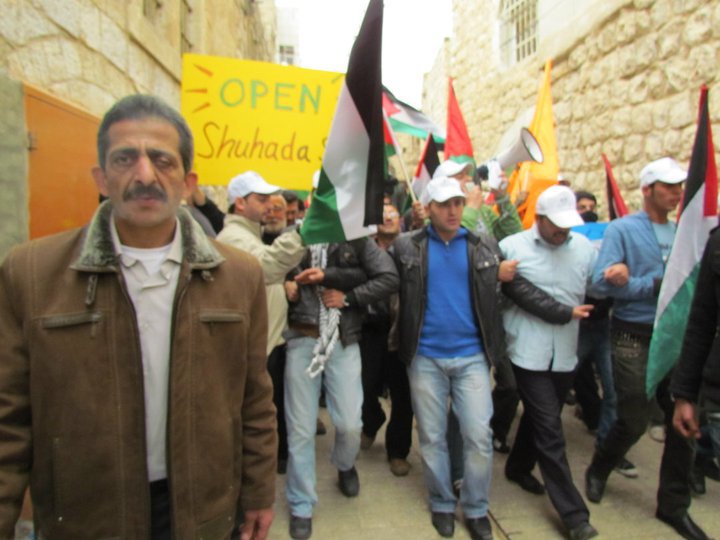
During Demonstrations Demanding the Opening of Shuhada Street and Commemorating the Ibrihimi Mosque Massacre, a Number of Participants are Injured or Arrested
Hebron–Dozens of were injured Friday 2/25 when Israeli forces threw sound bombs and assaulted demonstrators at a large peaceful protest commemorating the Ibrihimi Mosque massacre, calling for the opening of Shuhada Street, and criticizing the American veto of the Palestinian call for UN Security Council condemnation of and a halt to settlement activity.

The protest was organized by Youth Against Settlements. Thousands of Palestinians and dozens of Israeli and foreign activists along with a number of Palestinian leaders (among them the Governor of Hebron Governorate Kamel Hamid, member of the Fatah Central Leadership Committee Jamal Mahsin, Head of the Palestinian initiative Mustafa Barghouthi,) participated in the demonstration after Friday prayers. The demonstration proceeded from the area of Sheikh Ali Al-Baka Mosque in the city toward the direction of Shuhada Street in the center of Hebron.

Occupation forces tried to prevent the demonstrators from reaching the eastern entrance to Shuhada Street, near the old municipality, by creating a large human chain of individuals from Special Forces. However, a large number of demonstrators managed to cross into Shuhada Street, where a number of demonstrators sat on the ground and in front of the tires of military jeeps. Soldiers attacked them, began to hit them with their hands and with the butts of their guns, pulled them away, and arrested a number of them, according to Youth Against Settlements Coordinator Issa Amro
.
The protesters split up to try to enter Shuhada Street through alleyways and smaller streets. They confronted occupation forces who used excessive force against them.

Occupation forces fired gas and sound bombs and rubber bullets at demonstrators, leading to injuries. About 20 demonstrators were taken to Hebron Governmental Hospital.

According to Amro, the demonstrators chanted slogans and carried signs in Arabic, English, and Hebrew demanding from the occupying authorities the opening of Shuhada Street, which has been closed for many years. Demonstrators’ slogans praised the popular revolutions in Egypt, Tunisia, and Libya, and criticized the American veto of the UN Security Council condemnation of settlement activities.

Hebron Governor Kamel Hamid spoke to those in attendance, confirming the Arab nature of the city of Hebron and the opposition to the policy of settlement and discrimination practiced by the occupation in the city. He called for supporting and strengthening popular resistance to the occupation. He condemned the US veto in the Security Council. Jamal Mahsin spoke also, praising the steadfastness of the residents of Hebron, and emphasizing the necessity of national unity and the end of internal divisions.

The Israeli occupation forces closed Shuhada Street to Palestinian vehicles in 1994, after the Ibrihimi Mosque massacre, then forbade Palestinian residents to walk there in 2000, in order to provide security for the 600 Israeli settlers occupying the center of Hebron.

More than 500 stores were closed by military order in the center of Hebron, and more than a thousand store owners were forced to close their shops due to checkpoints and closures. At the same time, illegal settlers enjoy freedom of movement in the closed streets and are protected by occupation forces.

The activities of the occupation and its settlers in the city of Hebron have turned the lives of 200,000 Palestinians in Hebron into a living hell and expelled thousands from their homes.

Unity between Palestinians is more urgent than any other need

 please sign the petion Ahewar
We have yet to be free as a people but have diverged from the path to liberty. This social contract is the basis of a new popular movement towards our liberation.

The Palestinian people and their struggle are now confronted by a disastrous situation. We are divided. Our priorities are confused, and our agenda for liberation is unclear. We have consequently fallen short of achieving our freedom. We lack justice and have yet to practice our inalienable right of self-determination.

Today, we derive our strength and legitimacy from our urge to end the suffering and aspirations of the Palestinian people in Jerusalem, the West Bank, Gaza Strip, Galilee, in the compulsory diaspora in Syria, Lebanon, Jordan, and around the world. We stand infused with the energy emanating from the Arab people’s glorious revolutions in Tunisia and Egypt, and the revolutions in Arab countries from the Atlantic Ocean to the Arabian Gulf. We say, in the name of our innocent martyrs, the wounded, prisoners, refugees, men, women and children, youth and elderly that our compass now points in one direction, and it points towards freedom. To get there we must and shall achieve the following:

Freedom, Justice, and Self-determination

The Palestinian people shall begin to build a realistic vision for their future based on a new Palestinian Social Contract. Our social contract shall be based on the inalienable rights to liberty, justice, self-determination, and the pursuit of happiness. This contract shall ensure freedom, human dignity and justice. Equality, clarity, transparency, democracy and full societal participation in the struggle shall be the guiding principles for this contract. The Palestinian citizens’ cause, concerns and aspirations cannot be reduced, in anyway, to one third of the Palestinians who are in the West Bank and the Gaza Strip. Therefore, the required Social Contract represents all the Palestinians. It addresses their rights within a formula that observes what is common among all Palestinians and recognizes the differences among the diverse components of our society.

This statement balances between the daily concerns of the Palestinian people and their aspirations. It also suggests realistic alternatives to the current status quo that results in a state of division, weakness, economic crises and the marginalization of the majority of the Palestinian people. We pose three necessary changes to the status quo that express our vision for the Palestinian people.

First: The Establishment of a New Palestinian Social Contract

The Social Contract is based on the need to establish unity amongst the Palestinian people (in Palestine within its historical borders and in the diaspora). We all have the same aspirations: Freedom, justice, return, the unhindered pursuit of happiness, and the dream that we will practice our right to self-determination. To achieve these aspirations all sectors of the Palestinian people, civil society, different political factions, the youth and trade unions are invited to:

– Rebuild the PLO as the sole representative of the Palestinian people and maintain its independence. This requires re-structuring its institutions and ensuring that it is away from the Israeli occupation control.
– Reformulate the Palestinian National Charter in accordance with the new Social Contract, in a manner that ensures the supremacy of freedom, justice and equality that light the path for our movement towards liberation, democracy and self-determination.
– Re-building of the PLO requires, first and foremost, election of a Palestinian National Council (PNC) representing all Palestinians (inside and outside the homeland). Preparations for the elections shall ensure full democracy.
– Pursuant to the PNC elections, the PLO Executive Committee shall be formed in a manner representing political forces, independent personalities and representative institutions with a special focus on ending the factional quota tradition.
– Full separation between the PLO institutions, tasks and persons and the institutions of the administrative bodies responsible for maintaining the day to day life of Palestinian people in the occupied Palestinian territories (OPT).
– End the existing status quo and begin building mechanisms that ensure the broadest democratic representation of the Palestinian people.
– Ensure that the newly formulated PLO is the sole responsible party for the political track of the Palestinian cause before the Palestinian people. Consequently, the Palestinian Authority, as an institution or personalities, does not politically represent the Palestinian people and does not identify mechanisms of our struggle and resistance.
– Struggle against the occupation and its injustices using all internationally legitimate and ethical means. Any strategies for the struggle shall be decided upon through national consensus (achieved within the PLO) and strategically formulated according to the challenges the Palestinian cause is facing to ensure that the most practical tactics are being used.
– Ensure that our inalienable rights are non-negotiable.

Second: The Struggle Against the Occupation and its Apartheid policies

Main principle: The Palestinian people shall struggle against the Israeli occupation using all morally legitimate means of resistance until they are free and establish a just society with full equality.

– The Palestinian people, through the PLO, shall identify the strategies of the struggle.
– We shall increase the momentum of nonviolent popular resistance, using the media, international law, strikes, boycotts, divestment and sanctions and shall seek international support for our struggle.
– We shall support the steadfastness our people on their land, especially in Jerusalem, areas threatened with eviction such as the Jordan Valley and areas in the Negev desert, and near the Apartheid barrier.
– We shall form popular committees to confront occupation’s measures and create daily realities to protect innocent people, their private properties and land.
– We shall launch international campaigns to combat the occupation and its racist separation. We shall use international law to assist us in ascertaining our rights and coordination with international organizations that support values such as human rights, freedom, and equality.
– We shall struggle against the Israel’s racist measures against our people inside the Green Line, support them and provide political and legal protection for their demands and struggle.

Third: Administration of the daily living affairs of the Palestinian people in the OPT

Main principle: The Palestinian administration in the Occupied Palestinian Territories is the civil entity mandated by the PLO to manage the Palestinian affairs. Hence, it does not have the authority to represent all Palestinians. It is not a political entity or authority.
– The PLO forms a representative council for the Palestinians in the OPT responsible for management of their life affairs.
– The representative council is the realistic alternative of the Palestinian Legislative Council and the Presidential institution in the OPT.
– An administrator shall be elected from the representative council. He/She shall nominate the heads of the differnet administrative directorates, which shall work according to a platform set up and approved by the representative council to ensure the fulfillment of the people’s day-to-day demands in the OPT.
– The representative council shall be constituted of experts and not politicians whose tasks are confined in taking care of administrative and legislative demands pertinent to people’s day-to-day lives. This will reduce factional competition and enhance the role of the elected representative council.

Formation of security apparatuses and their tasks, and the resistance arms
– All security apparatuses will be integrated within one police service that maintains public safety and the rule of law in the OPT.
– The police apparatus shall be fully separated from and independent of the political factions.
– Weapons shall be used for legal reasons only such as maintaining the people’s safety and defending them from mortal harm.
– Political factions do not have the right to individually select their resistance strategies.
– The police apparatus will be restructured based on new laws that shall govern its duties.

Combating corruption
– Full transparency shall be restored. Corrupt institutes and individuals shall be tried and the stolen funds returned to their rightful owners and the Palestinian people.

Requirements of national and societal reconciliation
– Banning any political platform from inciting to violence.
– The youth and academic experts shall formulate a document to end Palestinian disunity in a manner that is beneficial for the Palestinian cause.
– The youth shall use wide ranging activities to pressure all conflicting sides to come together
– Any delay in ending the division after this document is presented shall be borne by the present leaderships.
– A court shall be formed from independent persons guaranteed by the PLO to decide on all the division implications at the individual and collective levels. The court’s decisions are binding to all.

Let all people who love their people and their country now say, as we say here:
– WE SHALL STRUGGLE FOR FREEDOM, SIDE BY SIDE, THROUGHOUT OUR LIVES, UNTIL WE HAVE WON OUR LIBERTY.

please sign the petition on Ahewar

Houria Bouteldja from "Indigenes de la Republique"

 from Kasama Project A Maoist sister in Spain, LG, sent us the following posting. She wrote as an introduction:

This very controversial  essay is by Houria Bouteldja, the spokesperson for the political party organized by people of color in France called Les Indigenes de la Republique. This group is composed by people born and raised in France whose families come from the French ex-colonies. The majority of the members are French from African, Caribbean and Arab origin.

The essay caused a lot of interesting debates because it is a critique to Western Feminism from a Third World Feminist perspective. The essay was also translated to many languages by the Decolonial Translation group.

The term “indigenous” in the French context is used very differently from the Americas. In the Americas, the indigenous are aboriginal or native people. In France, indigenous means “colonial subjects of the French empire.” Indigenous was the term used by the French empire during colonial times to refer to colonial populations everywhere (Viet Nam, Algeria, Tunisia, Martinique, Guadaloupe, Senegal, etc.).

This French party, composed primarily by people of color but open to everybody, appropriated the term “indigenous” from French colonial history to basically say that even though they are French (born and raised in France), due to racism, capitalism and imperialism, they are still treated inside France as “indigenous of the Republic,” that is, as colonial subjects.

It is a way of saying, we are still living in colonial times even though we live in France. Thus, their openly stated goal is to decolonize France. They do a Decolonial march every year in Paris on May 8th. This is the day of the liberation of France in 1944 from the Nazi occupation and the day of the Seti massacre in Algeria. What happened was that while the French went to the streets to celebrate, the Algerians in Seti (a small city of Algeria) also went to the streets to celebrate and to call for Algerian independence. The response of the French colonial army was to kill everybody in the Seti demonstration. So, the indigenous of the Republique do this Decolonial march every year to remind that France is in need of radical decolonization. I was once in one of these marches and it is surreal. You could see thousands of French people-of-color in a demonstration through the streets of Paris with huge Photos of Aime Cesaire, Frantz Fanon, Amircal Cabral, Angela Davis, Malcolm X, Kwame Nkhruma, Nelson Mandela, Nasrallah, Nasser, etc.

Anyway, here is the essay, which was delivered as a speech to the 4th International Congress of Islamic Feminism that took place in Madrid, in October 2010. It appeared in English on Decolonial Translation:


Les Indigenes de la Republique


White women and the privilege of solidarity

by Houria Bouteldja

I would, first of all, like to thank the Junta Islamica Catalana for having organized this colloquium, which is a real breath of fresh air in a Europe that is shriveling up in upon itself, wrought up in xenophobic debates and increasingly rejecting difference/alterity.

I hope that such an initiative will be able to take place in France. Before getting into the subject at hand, I would like to introduce myself, as I believe that speech should always be located.

I live in France, I am the daughter of Algerian immigrants. My father was a working class man and my mother was a housewife. I am not speaking as a sociologist, a researcher or a theologian. In other words, I am no expert.

I am an activist and I am speaking as a result of my experience as a political activist and, I might add, my own personal sensibility. I am insisting on these details because I would like to be as honest as possible in my reasoning. Truth be told, until today, I hadn’t really thought about the question of Islamic feminism. So why am I taking part in this colloquium? When I was invited, I made it quite clear that I lacked the authority to speak about Islamic feminism and that I would rather deal with the idea of decolonial feminism and the ways in which, I believe, it should be related to the more general question of Islamic feminism.

That is why I thought I would lay out a few questions that could prove useful for our collective questioning.

  • Is feminism universal?
  • What is the relationship between white/Western feminisms and Third World feminisms among which we find Islamic feminisms?
  • Is feminism compatible with Islam?
  • If it is, then how can it be legitimized and what would its priorities be?

First Question: Is feminism universal?

For me, it is the question of all questions when adopting a decolonial approach and when attempting to decolonize feminism. This question is essential, not because of the answer but rather because it makes us, we who live in the West, take the necessary precautions when we are confronted with ‘Other’ societies.

Let’s take, for example, so-called Western societies that witnessed the emergence of feminist movements and have been influenced by them. The women who fought against patriarchy in favor of an equal dignity between men and women gained rights and improved women’s circumstances, which I, myself, benefit from.

Let’s compare their situation, that is to say our situation, with that of so-called “primitive” societies in Amazonia for instance. There are still societies here and there that have been spared by Western influence. I should add here that I don’t consider any society to be primitive. I think there are differing spaces/times on our planet, different temporalities, that no civilization is in advance or behind on any other, that I don’t locate myself on a scale of progress and that I don’t consider progress an end in itself nor a political goal.

In other words, I don’t necessarily consider progress to be progressive but sometimes, even often, it is regressive. And, I think that the decolonial question can also be applied to our perception of time. Getting back to the subject at hand, if we take as our criteria the simple notion of well-being, who in this room can state that the women from those societies (who know nothing of the concept of feminism as we conceive of it) are less well-off than European women who not only took part in the struggles but also made available, to their societies, these invaluable social gains?

I, myself, find it quite impossible to answer this question and would consider quite fortunate whoever could. But yet again, the answer is of no importance. The question itself is, for it humbles us, and curbs our imperialist tendencies as well as our interfering reflexes. It prevents us from considering our own norms as universal and trying to make other’s realities fit into our own. In short, it makes us locate ourselves with regards to our own particularities.

Between Western & Third World feminisms

Having laid out that question clearly, I now feel more at ease to tackle the second question dealing with the relationship between Western feminisms and Third World feminisms. Obviously it’s very complicated but one of its dimensions is the domination of the global south by the global north. A decolonial approach should question this relationship and attempt to subvert it. An example:

In 2007, women from the Movement of the Indigenous of the Republic took part in the annual 8th of March demonstration in support of women’s struggles. At that time, the American campaign against Iran had begun. We decided to march behind a banner that’s message was “No feminism without anti-imperialism”. We were all wearing Palestinian kaffiyehs and handing out flyers in support of three resistant Iraqi women taken prisoner by the Americans. When we arrived, the organizers of the official procession started chanting slogans in support of Iranian women. We found these slogans extremely shocking given the ideological offensive against Iran at that time. Why the Iranians, the Algerians and not the Palestinians and the Iraqis? Why such selective choices? To thwart these slogans, we decided to express our solidarity not with Third World women but rather with Western women. And so we chanted:

Solidarity with Swedish women!

Solidarity with Italian women!

Solidarity with German women!

Solidarity with English women!

Solidarity with French women!

Solidarity with American women!

Which meant:

Why should you, white women, have the privilege of solidarity? You are also battered, raped, you are also subject to men’s violence, you are also underpaid, despised, your bodies are also instrumentalized…

I can tell you that they looked at us as if we were from outer space. What we were saying seemed surreal, inconceivable. It was like the 4th dimension.  It wasn’t so much the fact that we reminded them of their situation as Western women that shocked them. It was more the fact that African and Arabo-Muslim women had dared symbolically subvert a relationship of domination and had established themselves as patrons. In other words, with this skillful rhetorical turn, we showed them that they de facto had a superior status to our own. We found their looks of disbelief quite entertaining.

Another example: After a solidarity trip to Palestine, a friend was telling me how the French women had asked the Palestinian women if they used birth control. According to my friend, the Palestinian women couldn’t understand such a question given how important the demographic issue is in Palestine. They were coming from a completely different perspective. For many Palestinian women, having children is an act of resistance against the ethnic cleansing policies of the Israeli state.

There you have two examples that illustrate our situation as racialized women, that help understand what is at stake and envisage a way to fight colonialist and Eurocentric feminism.

Following on from that question, is Islam compatible with feminism?

This question is purely provocative on my behalf. I can’t stand it. I am asking this question to imitate some French journalist who believes they are asking a really pertinent question. As for me, I refuse to answer out of principle.

On the one hand, because it comes from a position of arrogance. The representative of civilization X is demanding that the representative of civilization Y prove something. Y is, therefore, put in dock and must provide proof of her/his “modern-ness”, justify her/him-self to please X.

On the other hand, because the answer is not simple when one knows that the Islamic world is not monolithic. The debate could go on forever and that is exactly what happens when you make the mistake of trying to answer.

Myself, I cut to the chase by asking X the following question:Is the French Republic compatible with feminism?

I can guarantee you one thing: ideological victory is in the answer to this question. In France, 1 woman dies every 3 days as a result of domestic violence. The number rapes per year is estimated around 48 000. Women are underpaid. Women’s pensions are considerably less substantial than those of men. Political, economic and symbolic power remains mostly in the hands of men. True, since the 60’s and 70’s, men share more in household duties: statistically, 3 min more than 30 years ago!! So I ask my question again: are the French Republic and feminism compatible? We would be tempted to say no!

Actually, the answer is neither yes nor no. French women liberated French women and it’s thanks to them that the Republic is less macho than it was. The same goes for Arabo-Muslim, African and Asian countries. No more, no less. With, however, one extra challenge: consolidating within women’s struggles the decolonial dimension, that is to say the critique of modernity and eurocentrism.

How to legitimize Islamic feminism?

For me, it legitimizes itself. It doesn’t have to pass a feminist exam. The simple fact that Muslim women have taken it up to demand their rights and their dignity is enough for it to be fully recognized. I know, as result of my intimate knowledge of women from the Maghreb and in the diaspora, that “the-submissive-woman” does not exist. She was invented. I know women that are dominated. Submissive ones are rarer!

I would like to conclude with what, in my opinion, should be priorities for decolonial feminism.

You have all heard about Amina Wadud and her involvement in the development of Islamic feminism. She became well known the day she lead the prayer, a role usually reserved for men. Out of context, I would say that it could be thought of as a revolutionary act. However, in an international context that saw the Iranian Revolution and 9/11 (as well as growing Islamophobia, demands that Islam update and modernize itself), a much more ambiguous message was brought to light. Was it answering strong demands, an urgency, the fundamental expectations of women from the Umma? Or were these expectations of the white world? Allow me to dwell on the latter hypothesis. Not that there aren’t any women who find it an injustice that only men be allowed to lead the prayer but because women’s priorities and urgent needs are elsewhere.

What do Afghan, Iraqi and Palestinian women want? Peace, the end of the war and the occupation, the rebuilding of their national infrastructures, legal frameworks that guarantee their rights and protect them, access to sufficient food and water, the ability to feed and educate their children under good conditions. What do Muslim women in Europe and more generally those who are immigrants and who, for the most part, live in lower income neighborhoods want? A job, housing, rights that protect them not only from state violence but also men’s violence. They demand respect for their religion, their culture. Why are all of these demands silenced and why does the issue of leading the prayer make its way across the globe when Judaism and Christianity have never really made apparent their own intransigent defense of the equality of sexes? To finish up with this example, I believe that Amina Wadud’s act was, in fact, quite the opposite of what it claimed to be. In reality and independently of the theologian’s own wishes, this act, in my opinion, was counter-productive. It will only be able to adopt a feminist dimension once Islam is equally treated with respect and once the demands to lead the prayer come from Muslim women themselves. It is time to see Muslim men and women how they really are and not how we would like them to be.

I conclude here and hope to have shown the ways in which a true decolonial feminism could benefit women, all women when they, themselves, deem it to be their path to emancipation.

Houria Bouteldja, Madrid, 22 October 2010.

Translated by Amy Fechtmann

(thank you Hussain)

Gheddafi and Chavez

If one, like myself, is raised with the love of “the worker” and “the people” which exceeds any love of a party, an ideology or even a nation, it is difficult to really fit in with any established left. While the left claims that it seeks power of the people, too many times its public statements make it clear that the people to protect are instead the people already in power, despite what they might actually have to do in order to maintain that power.

In the past, I have been critical of the massive investments Fidel Castro allowed to be made by Rafi Eitan and have been told that expressing how wrong the policy of “anything at all to uphold the Cuban revolution is good, even if it means trampling on Palestinians” was. I was accused of siding with dissident Cubans. It seems that there is a belief that this leader is beyond criticism.

Again, when I have criticised Ahmadinejad (who is not a leftist leader, but currently a leader some of the anti-imperialists who do not accept pan-Arabism look to as being “the voice of truth”) for the lack of what I consider political savvy in some of his speeches and how easily they are used to deflect attention to Israel as victim and away from Palestine as real victim, I have been accused of being a Zionist… and to my eyes, the automatism of Ahmadinejad=the real anti-Zionist seems like rote dogmatism without true reflection of what precisely Iran’s role in the region’s in/stability might be. Iran deserves to be free of all instrumentalisation and to have a truly autonomous and independent domestic and foreign policy, no matter if Ahmadinejad is the leader or not, but those in the West who insist upon singing the praises of Ahmadinejad as a symbol and condemning those who don’t are using simpleton logic and do nothing that is different from those who use him as the banner for what is evil.

Today my inbox has gotten another jolt. It seems that the “Hugo Chavez International Foundation for Peace, Friendship and Solidarity” is supporting Muammar Gheddafi and accusing the uprising in Libya as being the work of foreign services. Like classic dogmatic leftist propaganda, their press release attempts to equate the person of Gheddafi with the nation of Libya. Like all pieces of dogmatic propaganda, it contains some elements of truth, such as lamenting the lack of media attention for the crimes against humanity committed against the Palestinian people as well as the tendency of the forces of power in the West to attempt to hijack any popular movement and take control of it. As well, its statements about Gheddafi’s son being a benefactor in an NGO are also true, as his foundation donated 180 vehicles to the Viva Palestina mission as well as having assumed the exaggerated costs of the doomed and ill-planned Road to Hope Convoy, which did not factor in the amount of money to actually bring the goods to Gaza by boat, as is (unfortunately in these horrible times we live in) the only means possible. However aside from some facts and truth in the press statement, the core truth is that once again, the “left” sides by the power of a leader who states himself to be anti-imperialist, (despite evidence to the contrary) and instead tyrannically controls the business and wealth in a sort of State Capitalism where only a few gain and where democracy is seen as counter to the interests of the State. 

It is sufficient to read the press statement to see that the great blindspot blocking many who speak in the name of the “left” is a lack of awareness of the unstoppable force and legitimacy of the Arab masses. People in the MENA lands are divided into nations, religions, political orientation so that they can be used for a huge variety of dogmatic reasons. This is done even by their friends and supporters who neglect a very basic reality – unity across every artificial divide. There are those who blame/praise the recent uprisings on Islam, but that is again untrue. Though these are nations with a vast Muslim population, the uprisings are not religious rallies and are indeed joined by Muslim groups, but not lead by them, just as they are joined by internationalist groups, but are not lead by them. It is simply the power of human beings who live in the “Middle East” and North Africa who are demanding their political and human rights. It is their identification as a united front which brings them en masse to the largest squares in their countries, allows them to face bravely the very real threat of bodily harm and even death. 

It is the Arab human being who is being buried on the beaches of Tripoli, the cemeteries of Soussa, Manama and Cairo. It is the Arab human being who is arrested in Palestine for sharing his or her solidarity with other humans fighting for their rights. There is no limit of age, sex, religion, political credo or even social class. There is one uniting factor, the factor of Arabhood, Arab Consciousness that is drawing these people to demand to have a say in their own future and to construct their own country, and protect it for all the nationals abroad who are in exile or diaspora, ousting corrupt and tyrannical leaders who have at times used patriotism of the nation to inspire “brand loyalty” to the leader. 

Yet, these same feelings of patriotism, the beloved flags of all the independent nations, are being waved in a mass statement of unity. Arab people are supporting other Arab people across the globe, seeking to empower the individual national struggles in the name of Arabhood and humanity as a whole. The Algerian, the Moroccan, the Jordanian, the Tunisian, the Iraqi, the Egyptian and all the other national identities are not abandoned, but are instead joined together in solidarity as a sole people rising up against any outside forces or internal pressure that seeks to strip them of their power and determination to be the protagonists of their own stories. 

Just as it is wrong and improper to impose sanctions against a people to bring down a leader, as is attempted from the West and the imperialist powers (US and EU sanctions against Iran, Iraq, Gaza, to name only some), it is also wrong to have attempted to call for an economic boycott of Egypt to bring down Mubarak. To boycott an Arab nation at this time, as is expected soon from the USA towards Libya, never brings down the leader, it only weakens the masses and makes them further victimised by the oppressive powers, their own and those from outside. Boycotts are to change policy, not to bring down leaders, and they do nothing but increase suffering to the population which does not possess any kind of powers or economic clout. 

So the left, rather than support Gheddafi, should condemn the proposed boycott of Libya while at the same time accept the power of the people and abandon the dogmatism of the charismatic “revolutionary leader” when it is evident that his leadership is in place only by means of oppression. I would expect that true revolutionaries and leftists will ignore the appeal of the Chavez Foundation and will take their place alongside the Arab people in their struggle for freedom. 

(thank you Ali Baghdadi for bringing this missive to my attention).   

HUGO CHAVEZ INTERNATIONAL FOUNDATION FOR PEACE, FRIENDSHIP AND SOLIDARITY

HCI-FPFS

“To love one’s neighbor is also to love one’s enemy. Although in reality that qualifier-‘enemy’ does not exist in my vocabulary. I recognize that I only have adversaries and I have acquired the capacity to love them because in this way we do away with violence, wrath, vengeance, hatred and substitute them with justice and forgiveness.” 
Dr. Oscar Elias Biscet Gonzalez (1999)

Press Statement                                                                       23 February, 2011.

Bamako, Republic of Mali                    Tel: 00223-6413027.

This is the second statement to the Press issued by the Hugo Chavez International Foundation for Peace, Friendship and Solidarity (HCI-FPFS), in the light of the situation in Libya. It is no more a secret to state in this Press Release that foreign powers, opposed to peace, unity and progress of Africa are in action again, leading a wicked campaign of treachery, deception and terrorism against Libyan leader, Muammar Al-Qathafi and the people of Libya. This time, the enemies of Africa are hiding behind the corrupt foreign media in their criminal attempts to attack and destroy Libya.

The international conspiracy to destroy Muammar Al-Qathafi through a carefully-calculated media frenzy constitutes the burden of each of our position statement on current events in Libya, especially the wide, vicious, hypocritical gap between the US and Western powers’ “democratic” avowal and the state terrorism associated with the activities of these so-called civilized nations towards the people of Africa, Middle East, the Caribbean and Latin America. In the first place, the Hugo Chavez International Foundation for Peace,
Friendship and Solidarity (HCI-FPFS) wonders how British Foreign Secretary William Hague can feel so comfortable in the company of anti-Libyan organized crime groups that seek the devastation and destruction of Libya. For instance, it was the British Foreign Secretary-turned-coat anti-Libyan, anti-Qathafi, anti-Africa, anti-Arab, anti-Hugo Chavez, anti-Venezuelan whom led the malicious lie to the world that Libyan leader Muammar Al-Qathafi had ran away and sought refuge in Venezuela. The malicious lie was doctored at a time British Prime Minister David Cameron was on an unannounced visit to Egypt, ostensibly to urge the military junta in Cairo to respect the so-called timetable for holding elections.

The other lies, deceptions and ill-thought-out propaganda associated with the ongoing anti-Libyan campaign in the corrupt media include the following misguided allegations, that:

LIBYAN WAR PLANES BOMBED CIVILIANS.

It is innuendos and reckless dissipation for any foreign government, organization or the corrupt media to suggest that the competent authorities in Tripoli used Libya’s fighter jet planes against Libyan civilians. It has never happened and there is no evidence to convince any sane person to believe that the Government of Muammar Al-Qathafi ever used fighter planes against the Libyan people, since the dawn of the era of the Great September 1st Al-Fateh Revolution in 1969. As a matter of fact, there are all evidences available to conclude that the Government of Muammar Al-Qathafi does not need importing foreign mercenaries to protect Libyan life and property against the terrorist activities of organized crime groups and the corrupt media.

It is now clear that the “corrupt international media” disproportionately covers human rights violations in Libya beyond an attempted distraction from the actual situation on the North African nation. For example when Israeli army massacred Palestinian men, women and children in the occupied Arab lands and territories, there is little media coverage compared to the coverage generated over the drown attacks directed by the White House in Washington against tribes men, women and children in Afghanistan. The extrajudicial execution of Egyptian opposition leaders by US/Israeli trained agents of former government of the disgraced dictator Hosni Mubarrak was not covered by the “corporate media” despite it being a heinous crime against humanity. We assert that, the assumption that Libyan fighter planes deployed by the Libyan Government against civilians is without basis. This is further evidence that the corporate media’s claims about happenings in Libya are without substance.

SAIF AL-ISLAM QATHAFI THREATENED THE LIBYAN PEOPLE.

The corporate media got it wrong from the beginning when it made and repeated the claim that Saif Al-Islam Qathafi, the President of the Gadafi Foundation threatened the Libyan people. When weighing the claims of the corporate media against the President of the Gadafi Foundation, one should look at Saif Al-Islam’s background. This is a man who leads a respectable Non-Governmental Organisation (NGO), the Gadafi Foundation that has been instrumental in enforcing the principles of the Green Charter International (GCI), for peace, human rights, rule of law, democracy, freedom and human dignity in Libya and world over.

Saif Al-Islam’s statement on attempts by criminals to rob the Libyan people of their peace, freedom and dignity was crystal clear and made to urge the Libyan people to resist any foreign attempts to destroy their country. The accusations against Sail Al-Islam are false and reveal that the corporate media is ever willing to blatantly lie in order to attempt to damage the reputation and illuminating personality of Sail Al-Islam.

Thus far we have seen how a simple, clear-cut national security case became a wider, more serious problem through unwillingness on the part of the enemies of Libya to respect the sovereignty and independence of the North African nation. Instead they (the enemies of Libya) deliberately buried facts and began a campaign of gossip, tale bearing and slander against Sail Al-Islam. We have also learned how the US and Western imperialists encouraged the corporate media’s anti-Libya terrorism by listening to their unfounded and baseless allegations and treating them as true.

NO FLY ZONE RHETORIC.

A number of heretics, racists and anti-Libyans have gone mad and resorted to advocate for a “no fly zone” be imposed on Libya. The objective, it is now clear-to create a corridor for aggression and violation of Libya’s sovereignty and integrity. Those who advocate for this subversive action plan are themselves collaborators of organized crime groups intending to destroy Libya.

On whether Muammar Al-Qathafi is in control of Libya, we would leave it to the sane international community to read the writings on the wall. There is no gain saying the fact Muammar Qathafai is well, kicking and performing his duties as Leader and Guide of the Revolution, and remains the legitimate leader of the Libyan masses. The Libyan Government is fully in control of its country’s internal situation, and as repeatedly said by Muammar Qathafi, the Libyan Government would not sit idle and allow any body pursue vested personal agendas, or derail the country from path of economic prosperity and sustained development.

The competent authorities in Tripoli have undertaken full duties and responsibilities through decisive action in the face of a well planned international covert agenda, and managed to restore security and protect human life and property in Libya. The US and Western governments hate-filled attacks on Colonel Muammar Qathafi are mere “propaganda” aimed at diverting growing international concern over the deteriorating humanitarian situation in Iraq, occupied Palestine, Afghanistan and Pakistan.

Anger and frustration at the collapse of the anti-Arab, pro-zionist regime in Egypt is completely understandable and shared by us, in the Hugo Chavez International Foundation for Peace, Friendship and Solidarity (HCI-FPFS), yet that anger must not be directed at destroying.

Concluding we call upon the civilized international community to exert pressure on the military junta in Cairo not to allow any part of Egypt be use as staging posts for the destabilization of Libya.

Signed:………………………….

Alimamy Bakarr Sankoh

President of the Hugo Chavez International Foundation for Peace, Friendship and Solidarity (HCI-FPFS),

For, and on behalf of the Hugo Chavez International Foundation for Peace, Friendship and Solidarity (HCI-FPFS).

On 25 February 2011 activists and organizations from around the world will join together in solidarity with the Palestinian residents of Hebron/ al Khaleel, through local protests that demand for the opening of Shuhada Street to Palestinians and an End to the Occupation! For more info or to organize a protest in your city please contact openshuhadastreet@gmail.com

Want to get involved? Click here for more information

Open Shuhada Street Pamphlet 2011

Open Shuhada Street – 25 Feb 2011 – Global Day of Action from Joseph Dana on Vimeo.

Shuhada Street used to be the principal street for Palestinians residents, businesses and a very active market place in the Palestinian city of Hebron/ al Khaleel. Today, because Shuhada Street runs through the Jewish settlement of Hebron, the street is closed to Palestinian movement and looks like a virtual ghost street which only Israelis and tourists are allowed to access. Hate graffiti has been sprayed across the closed Palestinian shops and Palestinians living on the street have to enter and exit their houses through their back doors or, even sometimes by climbing over neighbor’s roofs.

International Supporter Being Arrested During a Recent Protest in Hebron. Photo: Activestills.org

In 1994, following the massacre of 29 Muslims at prayer by America-Israeli settler Dr Baruch Goldstein, shops on Shuhada Street were closed and vehicular traffic prohibited on the street. Despite a court case and an admission by the Israeli government that it is illegal, the street is still closed to Palestinians 16 years later. We are focusing on Shuhada Street as a symbol of the settlement issue, the policy of separation in Hebron/al Khaleel and the entire West Bank, the lack of freedom of movement, and the occupation at large. Check back to this page for more updates regarding how you can get involved. For more background information and FAQ’s click here.


Στο όνομα του Αραβικού Παλαιστινιακού λαού, του αίματος των μαρτύρων, των χηρών και των υστερημένων, των ορφανών και των χιλιάδων φυλακισμένων στις Ισραηλινές φυλακές και όλων των απόδημων Παλαιστινίων, καλούμε όλες τις Παλαιστινιακές παρατάξεις να ενωθούν υπό το λάβαρο της Παλαιστίνης, προκειμένου να μεταρρυθμιστεί το πολιτικό σύστημα στην Παλαιστίνη στη βάση των συμφερόντων και των φιλοδοξιών (οραμάτων) των Παλαιστινίων στην πατρίδα και τη διασπορά.

Η σοβαρότητα της Ισραηλινής αποικιακής εισβολής στην παρούσα φάση, η αρπαγή των εδαφών της ιερής μας Ιερουσαλήμ και η βίαιη πολιορκία εναντίον του λαού της Γάζας, απαιτεί από όλους μας να αντισταθούμε σε αυτή την βάναυση κατοχή.

Έχουμε ακούσει πως ο Παλαιστινιακός λαός ζητά νομοθετικές και προεδρικές εκλογές προκειμένου να λήξει το καθεστώς διάσπασης. Ναι, όλοι θέλουμε να βάλουμε ένα τέλος στη διάσπαση, αλλά θέλουμε επίσης την πλήρη αναδόμηση και μεταρρύθμιση της Οργάνωσης για την Απελευθέρωση της Παλαιστίνης (PLO), ώστε να περιλαμβάνει όλες τις αποχρώσεις του παλαιστινιακού πολιτικού φάσματος, της Hamas συμπεριλαμβανομένης, προκειμένου να παλέψουμε πάλι για την απελευθέρωση της Παλαιστίνης όπως προορίστηκε αρχικά.

Εμείς, οι Παλαιστίνιοι στην πατρίδα και στο εξωτερικό, πάντα ακούγαμε ότι οι ειρηνικές ενέργειες θα επετύγχαναν τη νίκη και θα αποκαθιστούσαν τα εδάφη μας αλλά 20 χρόνια διαπραγματεύσεων δεν έχουν επιτύχει ούτε τις ελάχιστες απαιτήσεις. Οι συνάνθρωποι μας παραμένουν υπό τη βάναυση και καταπιεστική κατοχή που υφαρπάζει τα εδάφη μας, παραβιάζει τους ιερούς τόπους και σκοτώνει τα παιδιά μας, και όλα αυτά ενώ η οικουμένη, που απαιτεί δημοκρατία και σεβασμό των ανθρωπίνων δικαιωμάτων, απλά παρατηρεί και ακούει! Ενώ παράλληλα, η αντίσταση χρονοτριβεί, αφήνοντας περισσότερο από ενάμιση εκατομμύριο Παλαιστίνιους υπό τον ισραηλινό αποκλεισμό που τους πνίγει σε τέτοιο βαθμό που παραπέμπει ακόμα και ασθενείς στο εξωτερικό προκειμένου να τους παραχθεί θεραπεία, την ίδια στιγμή που αυτό είναι πρακτικά αδύνατο να γίνει, ακόμα και για τους ίδιους τους ηγέτες της αντίστασης και των οικογενειών τους, πόσο μάλλον για τον υπόλοιπο Παλεστινιακό λαό.

Πρέπει να συμφωνήσουμε πως είναι απαραίτητο όλοι μας να ενωθούμε για τους απανταχού Παλαιστίνιους, που ακόμη ονειρεύονται την επιστροφή έξι εκατομμύριων Παλαιστίνιων προσφύγων στις κατοικίες τους που καταπατήθηκαν κατά την κατοχή, μια κατοχή που αντιλαμβάνεται μόνο τη γλώσσα της βίας!

Ας γίνουμε δυνατοί, ας είναι η ενότητα η δύναμή μας, και ας συμφωνήσουμε ομόφωνα σε μια ενοποιημένη ηγεσία που θα μας οδηγήσει στην ελευθερία με υπερηφάνεια και αξιοπρέπεια!

Από αυτή τη θέση, καλούμε τις κυβερνήσεις της Δυτικής Όχθης και της Γάζας να ανταποκριθούν στα νόμιμα αιτήματα των ανθρώπων:
1. Την απελευθέρωση όλων των πολιτικών κρατουμένων από τις φυλακές της Παλαιστινιακής Αρχής και της Hamas.
2. Το τέλος της μεταξύ τους δημόσιας αντιπαράθεσης.
3. Την παραίτηση των κυβερνήσεων του Haniyeh και του Fayyad και τον σχηματισμό μίας κυβέρνησης εθνικής ενότητας που θα συμφωνηθεί από όλες τις παλαιστινιακές παρατάξεις και θα είναι αντιπροσωπευτική του Παλαιστινιακού λαού.
4. Την αναδιάρθρωση της Οργάνωσης για την Απελευθέρωση της Παλαιστίνης, που θα περιέχει όλες τις παλαιστινιακές παρατάξεις και την επιστροφή της στον αρχικό στόχο: την Ελευθερία της Παλαιστίνης
5. Την ανακοίνωση περί αναστολής όλων των διαπραγματεύσεων μέχρι την πλήρη συμφωνία ενός πολιτικού προγράμματος από τις διάφορες παλαιστινιακές παρατάξεις
6. Το τέλος κάθε μορφής συντονισμού σε θέματα ασφάλειας με το σιωνιστή εχθρό
7. Την οργάνωση προεδρικών και κοινοβουλευτικών εκλογών ταυτόχρονα, σε χρόνο που θα συμφωνηθεί από όλες τις παρατάξεις

Οι εκδηλώσεις θα ξεκινήσουν την Τρίτη, 15 Μαρτίου 2011, στις 11:30 π.μ. και θα συνεχιστούν μέχρι την επίτευξη όλων των στόχων.
Θα μαζευτούμε στις ακόλουθες τοποθεσίες (αλλαγές είναι πιθανόν να υπάρξουν):
Γάζα: Πλατεία Αγνώστου Στρατιώτη (Gaza: the Unknown Soldier Square)
Ραμάλλα: Πλατεία Manara (Ramallah: Manara Square)
Τουλκάρμ: Κυκλική Πλατεία Gamal Abdel Nasser (Tulkarm: Roundabout Gamal Abdel Nasser)
Τζενίν: στο συγκρότημα των χώρων στάθμευσης κοντά στον παλαιό κινηματογράφο Jenin (Jenin: complex of garages near the old Cinema Jenin)
Χεβρώνα: μπροστά στο κυβερνείο (Hebron: in front of the governor’s office)
Βηθλεέμ: Εκκλησία της πλατείας Nativity (Bethlehem: Church of the Nativity Square)
Nablus: Πλατεία Μαρτύρων (Nablus: Martyrs Square)
Ιορδανία και Λίβανος: η τοποθεσία δεν έχει οριστεί ακόμα
Στον υπόλοιπο κόσμο: μπροστά από τις Παλαιστινιακές πρεσβείες, σε συνεννόηση με τις παλαιστινιακές κοινότητες στο εξωτερικό. ΘΑ ΑΚΟΛΟΥΘΗΣΕΙ ΑΝΑΚΟΙΝΩΣΗ !!!

Παρακαλούμε επισκεφτείτε μας στην σελίδα:
http://www.facebook.com/Palestinians.United?sk=info

15 marzo, Azione internazionale per l’unità del Popolo Palestinese.
Un solo popolo contro il Sionismo.

In nome del popolo arabo palestinese, per il rispetto del sangue dei martiri, delle vedove, degli orfani e dei loro lutti, per le migliaia di prigionieri nelle carceri israeliane e per tutta la nostra gente della diaspora palestinese, chiediamo a tutte le fazioni di unirsi sotto la bandiera della Palestina per potere riformare e basare il sistema politico in Palestina sugli interessi ed aspirazioni del popolo palestinese, in patria e in esilio.

La gravità dell’attuale fase di incursioni da parte dei coloni israeliani, dell’appropriazione della terra nella nostra Sacra Gerusalemme e della violenza dell’assedio contro il popolo palestinese di Gaza obbliga tutti noi ad unirci saldamente contro quest’occupazione brutale.

Noi abbiamo sentito il popolo palestinese chiedere le elezioni legislative e presidenziali per porre fine alla divisione. Sì, tutti noi vogliamo la fine della divisione, ma vogliamo anche una totale ricostruzione dell’ Organizzazione per la Liberazione della Palestina, che comprenda tutti i colori dello spettro politico palestinese, incluso Hamas, e di riformarla con lo scopo di lottare di nuovo per la liberazione della Palestina, così come era stato inteso dalla sua fondazione.

Noi, il popolo palestinese, in patria ed in esilio, abbiamo sempre sentito che le azioni pacifiche sarebbero bastate per ottenere la vittoria e ci avrebbero restituito la nostra terra, ma 20 anni di negoziati non ci hanno fatto ottenere la benché minima richiesta. La nostra gente vive sotto una brutale ed oppressiva occupazione che saccheggia la nostra terra, viola i nostri luoghi sacri, uccide i nostri figli. Fa tutto questo mentre il mondo dichiara che la democrazia è assicurata e i diritti umani vengono rispettati! D’altro canto la resistenza è in stallo, mentre più di un milione e mezzo di palestinesi restano sotto l’assedio israeliano che strangola fino al punto che i nostri malati, compresi i figli dei leader della resistenza, possono essere curati solo altrove.

Dobbiamo essere d’accordo: è necessario che noi ci uniamo per tutti i palestinesi qui e per i sei milioni di rifugiati palestinesi in ogni parte del mondo che ancora sognano il loro ritorno alle loro case sottratte dall’Occupazione, che comprende soltanto il linguaggio della forza! Dobbiamo essere forti, dobbiamo fare sì che l’unità sia la nostra forza e che siamo unanimemente concordi su una dirigenza che ci potrebbe guidare fino alla libertà, con orgoglio e dignità!

Con questo appello chiediamo a tutti coloro che governano in Cisgiordania e Gaza di rispondere alle richieste legittime del popolo:
1 – il rilascio di tutti i detenuti politici nelle prigioni dell’ Autorità Palestinese e di Hamas
2 – la fine di ogni tipo di campagna stampa contro le altre fazioni
3 – le dimissioni dei governi di Haniyeh e Fayyad per poter ricostruire un governo di unità nazionale che riscuota l’approvazione di ogni fazione palestinese e che avrebbe il compito di rappresentare il popolo palestinese
4 – la ristrutturazione dell’Organizzazione per la Liberazione della Palestinna che includa tutte le fazioni palestinesi e che ritorni al suo scopo originario: la liberazione della Palestina
5 – l’annuncio del congelamento dei negoziati finchè non ci sarà totale compatabilità tra le vari fazioni su un programma politico
6 – la fine di ogni forma di coordinamento con il nemico sionista sulla questione della sicurezza
7 – l’organizzazione di elezioni presidenziali e parlamentari simultanee nei tempi scelti da tutte le fazioni

Gli eventi avranno inizio il martedì, 15/03/2011 alle 11:30 e andranno avanti finchè non saranno accolte tutte le nostre richieste. Ci raduneremo nei seguenti posti (salvo modifiche):
Gaza: Piazza del Milite Ignoto
Ramallah: Piazza Manara
Tulkarm: Piazzale Gamal Abdel Nasser
Jenin: complesso dei garagi vicino al vecchio Cinema Jenin
Hebron: davanti all’ufficio del Governatore (Al Khalil)
Bethlehem: Piazza della Natività
Nablus: Piazza dei Martiri
Giordania e Libano: da definire
Nel mondo: davanti alle sedi diplomatici palestinesi, in coordinamento con le comunità palestinesi in esilio.

http://www.facebook.com/Palestinians.United?sk=info

Gaza Youth Breaks Out

Translated into Greek by Christina Baseos, translated into Italian by Mary Rizzo

A classic postion for a dictator's speech... from the window of the symbolic building

I have just finished listening to Colonel Qaddafi
I did not get wiser, nor did my opinion change.

40 years is enough even if the ruler is Mother Tereza
or Nelson Mandela…………

One thing I must agree with Qaddafi:
If and when Qadafi shall leave Libya,
it will no more be ruled by “a Libyan”
.
Raja Chemayel

Raja, I am surprised.  How did you get the strength to listen to Gheddafi’s speech all the way to the end?  I tried but couldn’t do it.  I got too sick.  I did even vomit. 

I met the man several times.  I prayed behind him on the sand outside his tent.  I visited his home and sat with his ordinary and humble wife and lovely daughter, Aashea.  I was impressed.  I loved what I saw.  Aaesha told me that she will soon be studying law to defend the oppressed.  I must say that my home is better than theirs.  I am not rich.  I saw no servants.  It was Aaesha and her mom who brought lemonade, pistachio nuts and baclawa.  The living room was tiny and had simple furniture.  Only the home of President Omar al-Bashir of the Sudan impressed me more.  It was even tinier and simpler.  The couch I sat on was an old iron bed.

Nasser was a dictator, but we loved him.  He was our champion. As a matter of fact, we almost “worshipped” him.  He built Egypt.  The Arab people realized that we are one nation.  Despite our defeats, we felt proud. He was one of the pillars of the non-aligned nations’ movement.  He continued to live in his house that he owned as an officer.  The home had only one bathroom.  Nasser was surprised when his children complained and told him that they knew some families who had two bathrooms.  The Nasser family members had to stand in line to wash, bathe and do the other thing; you know what I mean.  After he was poisoned, he left behind less than 100 dollars for his family.

Gheddafi was a dictator too.  But we tolerated him.  He financed several liberation movements around the world.  He didn’t succumb to Zionism.  He didn’t open an Israeli embassy at this bad time when the majority of Arab leaders are caving in.  We also thought that he didn’t deposit billions of dollars in foreign banks.  Of course, it is too early to find the truth.

I personally dropped Gheddafi from my “book” when he paid over two and a half billion dollars to the Lockerbie Pan American crash victims.  Libya has nothing to do with this horrendous crime.  It was a false flag.  It was a CIA operation.  The White Prime Minister of South Africa was warned in advance to not take that plane. Gheddafi also paid for the attack on a night club in Berlin.  Two American soldiers died.  This crime was carried out by the German Red Brigade that worked for the CIA.

My “respect” for Gheddafi ended when he capitulated to Bush the son on nukes and sent all material and equipment to Washington.  The guy even demanded that Iran should do the same to avoid destruction by America.

hand in hand

I was delivering a speech titled “Africa’s Brain Drain” in Tripoli, Libya when the Tunisian President fled to Saudi Arabia.  Almost 500 people from Europe, North and South America, Australia and New Zealand attended a conference on African Immigration to Europe.  I was shocked to discover that the organizers were not interested in the papers we delivered.  They packed us as cattle and drove us to listen to Gheddafi and his puppets.  The great “revolutionary leader” delivered another speech telling the Tunisians that they should have kept Ben Ali for life as a president.  I couldn’t believe my ears.  He repeated the same nonsense later when the Egyptian youth revolution erupted.  He wanted Mubarak to stay.

The only thing that I loved about my trip to Tripoli is the fact that I met some good people.  Abdel Hakim Jamal Abdel an-Nasser was one.  Fortunately, he didn’t speak.  I felt that he was disgusted.  We embraced.  I saw Nasser in him.  But I also wept.  I am “weak”.

I do apologize to the Arab people of Libya.  I thought that they would never rise up.  I thought that they are not prepared to face the enormous firepower of Gheddafi’s army. Fortunately, I was wrong. To my greatest surprise, they did.  The price was too high.  My Libyan brothers and sisters continue to pay.

Today, Gheddafi accused the Libyan youth who demand his ouster of being on drugs.  Now I am convinced that the man himself is hallucinating.  He should check what his Ukrainian “nurse” is giving him.  He should leave now.  He must not forget to take his sons.  Libyans want to be free.  The Gheddafi “kingdom” must come to an end.

Ali Baghdadi

These are the beloved people of Egypt!