Archive for the ‘War’ Category

WRITTEN BY NICOLE MAGNOONA GERVITZ

Hafez al-Assad (second from left) is briefed by one of his officers in a reserve trench. Next to Hafez al-Assad is Defense Minister Mustafa Tlas, and next to Tlas is Rifaat al-Assad, 1973.

Hafez al-Assad (second from left) is briefed by one of his officers in a reserve trench.
Next to Hafez al-Assad is Defense Minister Mustafa Tlas, and next to Tlas is Rifaat al-Assad, 1973.

Black September 1970: Hafez al Assad made the decision to send tanks into Jordan to support the Palestinians against Hashemite King Hussein. The PLO won popular support amongst the Arab masses after the regimes were thoroughly discredited in the 1967 humiliation at the hands of Israel. King Hussein ordered his Jordanian military to attack the PLO forces in Jordan because of their declared policy to overthrow him. Assad refused to send any major Syrian military support because he feared another war with Israel would erupt. He refused to provide air cover to the Syrian tanks and they were forced to withdraw following the bombardment by the Jordanians. This left the Palestinians isolated, abandoned, and several thousand of them were massacred by Hussein’s Jordanian military. Only a few weeks after Black September is when Hafez al Assad led his military coup in Damascus.

1973: Syria attempted to regain control of the Golan Heights and it was another failure. Hafez al Assad found himself becoming the security guard for Israel’s northern border. Colonel Rafik Halawi, the Druze commander of the infantry brigade that was destroyed by the Israelis in the Golan, was executed under the orders of Hafez before the war even came to an official close. The Syrian regime claimed he was killed in battle with Israel and anyone who was caught saying anything otherwise was threatened with torture and imprisonment.
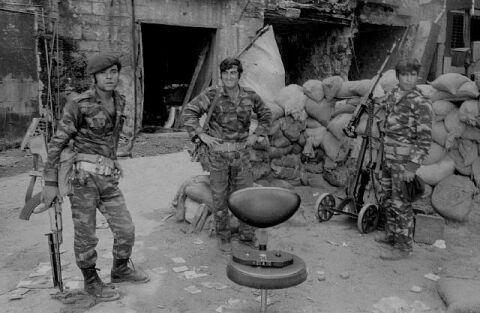
Palestinian soldiers in Lebanon, 1976

Palestinian soldiers in Lebanon, 1976

1976: Hafez al Assad supported the Lebanese Christian fascist Phalangists against the Lebanese Communist-PLO alliance that had formed in opposition to both Phalangist and Ba’athist tyranny. The Syrian military’s invasion of Lebanon in 1976 was approved by the US. However, the Lebanese Communist-PLO alliance wiped the floor with the Syrian occupation forces in June of that year. Two months later Hafez al Assad made an example out of such resistance. The Phalangists, backed by Hafez al Assad, committed a massacre of Palestinian people at the Tal al Zaatar refugee camp. With the blessing of the Arab League the Syrian government decided to ally itself with Israel to prevent the defeat of the Phalangists. They besieged the Palestinian camps of both Karantina and Tel al Zaatar with Syrian weaponry and 2,000 Palestinian people were slaughtered. An open letter from the Palestinian resistance within the camps was released that summer;

“Syrian weapons are being used – most unfortunately – against our camp, while the rulers of Damascus continue to repeat that they are here in Lebanon in order to defend our camp. This is a murderous lie, a lie which pains us more than anyone else… But we wish to inform you that we will fight in defense of this camp with our bare hands if all our ammunition is spent and all our weapons are gone, and that we will tighten our belts so that hunger will not kill us. For we have taken a decision not to surrender and we shall not surrender…”

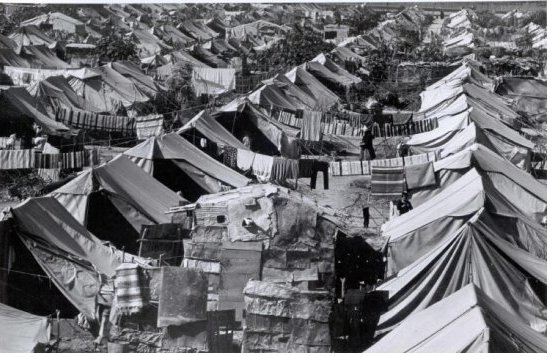
Palestinian refugees fleeing Tel al Zataar refugee camp. Merit goes also to Hafez Al-Assad

Palestinian refugees fleeing Tel al Zataar refugee camp. Merit goes also to Hafez Al-Assad


Photographs of a few of the tens of thousands of Syrians massacred in Hama in 1982.

Photographs of a few of the tens of thousands of Syrians massacred in Hama in 1982.

1980’s: As part of its vicious crackdown against leftist dissidents during the 1980’s Hafez al Assad’s regime arrested hundreds of activists from both the Party for Communist Action and the Syrian Communist Party in an attempt to smother the last remaining voices of dissent after it had crushed the Muslim Brotherhood. It was the Syrian Communists who worked with a group of Palestinian dissidents called the Palestinian Popular Committee in the Yarmouk refugee camp in the Damascus governate. The Palestinian Popular Committee was founded in 1983 but was forced to dissolve two years later as a result of Hafez al Assad’s campaign of arrests. 200 members of the Party for Communist Action were arrested by the Syrian security forces in 1986.

The PLO began to splinter in 1983. Colonel Saed Abu Musa was Arafat’s rival and he led a rebellion amongst al Fatah in the Bekaa Valley. Abu Musa had been a professional soldier in the Jordanian army before joining the PLO. The Syrian regime supported him and assisted in supplying him with weapons. Abu Musa and his followers ran Arafat’s men out of Tripoli that summer. When a reporter from Newsweek asked Yasir Arafat for a comment regarding this mutiny he responded with, “Don’t ask me about the puppets and the horses of Troy… Assad wants my pen. He wants the Palestinian decision, and I won’t give it to him.” Most of the Palestinian refugees chose Arafat over a Syrian puppet, but as a result of Hafez’s meddling Arafat’s men were forced out of Tripoli and the Palestinian resistance was disempowered.

In the “War of the Camps” between 1985 and 1988 Hafez al Assad recruited the Shia Lebanese Amal Movement. It was in armed conflict with Hezbollah at the time and it opened fire on the Palestinians and Hezbollah simultaneously.

Lebanon: Tripoli is a Sunni majority city with an Alawite minority that is given financial support by Syrian government. Syrian Alawites are placed in the Lebanese Parliament entirely due to pressure from Damascus. Lebanon’s naturalization laws are also completely subverted. Palestinian refugees who have lived in the impoverished refugee camps since the Nakba of 1948 and its sequel in 1967 cannot attain Lebanese citizenship whatsoever, but Syrian Alawites can at any time.

a scene from within the Tadmur prison, where many political dissidents were tortured to death.

a scene from within the Tadmur prison, where many political dissidents were tortured to death.

2000: While Bashar al Assad was praising the second intifada hundreds of Palestinians were languishing in his jails. Attieyeh Dhiab Attieyeh, a Palestinian in his early 30’s, died in Tadmur prison in early 2000 due to medical neglect. He was already very ill when he was transferred in Tadmur in 1996. Attieyeh was a member of Fatah, the faction led by Yasser Arafat, and had been arrested in 1989 in south Lebanon before being sent to Syria.

2008: There is a similarity between the Hama massacre of 1982 and Cast Lead. In both massacres the minarets of the mosques were destroyed by the invading occupation forces. They claimed that the minarets were being used by Islamist snipers. There’s no evidence of that in either situation, but there is evidence of the distaste for orthodox Islam expressed by both sets of perpetrators.

May 2011: A few Palestinians from the Yarmouk camp managed to break the siege on Deraa and deliver some desperately needed medical supplies.
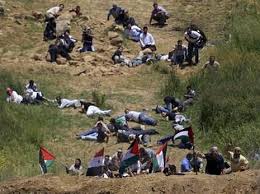
Sending Palestinians directly into the line of fire.

Sending Palestinians directly into the line of fire.

Nakba Day 2011: Hundreds of Palestinians from the refugee camps in and around Damascus were bused to the demilitarized zone that separates Syria from the Golan Heights. The safety of the Palestinian civilians was not prioritized. The fence was breached and Israeli occupation forces opened fire and a dozen Palestinian people were killed. There was a repeat of this bloodshed in June on Naksa Day; the anniversary of the outbreak of the June War in 1967. Another dozen Palestinians were shot and killed. This was unprecedented because never before had the Syrian government bused hundreds of Palestinian people to the Golan on either anniversary. Why 2011? To deflect attention from the ongoing slaughter in the streets. One of the main intelligence branches in Syria deals only with Palestine-related issues. It’s impossible for the Syrian government to not have known that a breach of the fence in the Golan would’ve cost Palestinian lives.

images (6)Fall 2011: Ghiyath Matar, a young man with Palestinian origins living in the Daraya suburbs of Damascus, pioneered the tactic of handing out roses and water to the Alawite security forces sent to shoot demonstrators. By early September of 2011 he was dead. His mangled corpse was delivered to his family four days after his arrest. Several US envoys attended his funeral. The spokespeople for the Assad regime said an armed gang was responsible for Ghiyath’s torture and death, and that is half true because, after all, there was an armed gang running the government.

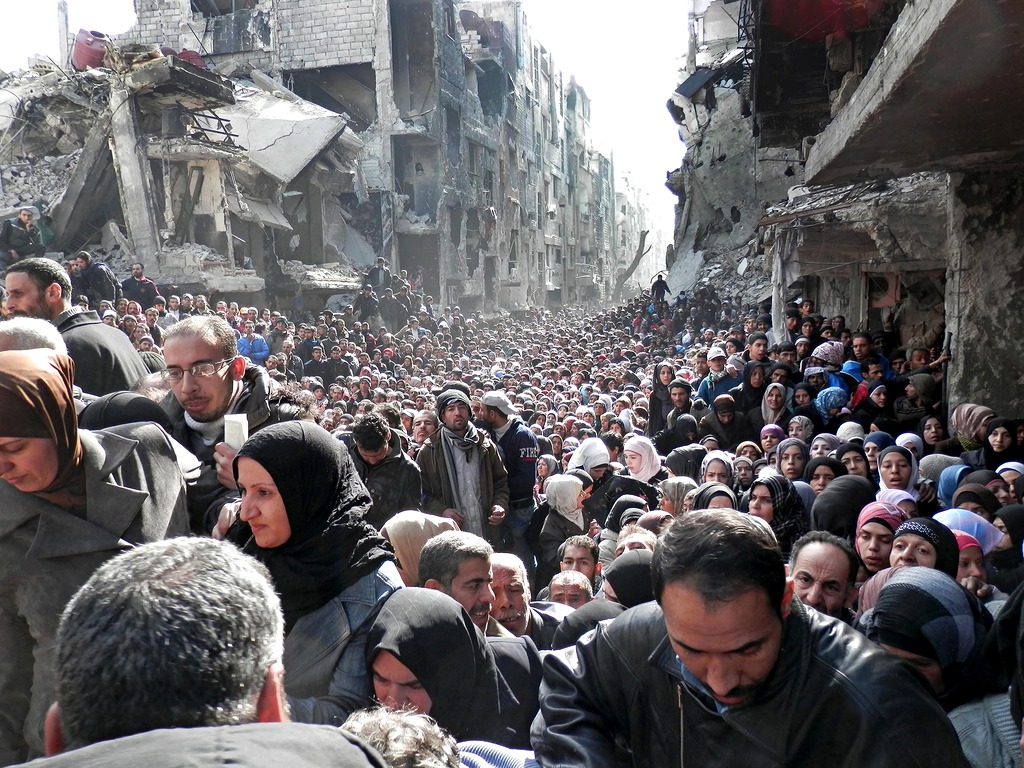
As a result of Bashar al Assad’s genocidal campaign of government repression Yarmouk became a home for one million internally displaced Syrian refugees by the end of 2011. When the Free Syrian Army gained ground in the southern suburbs of Damascus the Syrian military began to shell the camp while, at the same time, arming the pro-regime PFLP-GC. Mortars were fired at the camp by Assad’s forces before the FSA ever stepped foot in it.

victims of the mosque massacre in central Yarmouk, from Syrian Air Force bomb raids

victims of the mosque massacre in central Yarmouk, from Syrian Air Force bomb raids

Summer 2012: Alawite para-militaries who lived in Nisreen street, close to Yarmouk, opened fire on a massive anti-government demonstration. They killed ten Palestinians, including a little boy.

Fall 2012: The FSA set up a supply line through Yarmouk, and massive collective punishment at the hands of the regime ensued. Syrian government forces and Alawite militias encircled Yarmouk and by October of 2012 the entrances to the camp were only open two or three days a week. The civilians bore the brunt of the violence; starvation, disease, and random shelling.

December 2012: Syrian regime warplanes bombed a mosque in Yarmouk that was housing internally displaced Syrian refugees. Dozens were killed. The excuse for such an atrocity was that the FSA had hidden some weapons in the basement of the mosque. 

2013: Khaled Bakrawi, a young Palestinian-Syrian community organizer and founding member of the Jafra Foundation for Relief and Youth Development, was arrested by Alawite state security forces in January of 2013 for his leading role in carrying out humanitarian and aid work in Yarmouk. By September the Palestinians of Yarmouk learned that Khaled was killed under torture in a detention center in Damascus.

Khaled Bakrawi  and Hassan Hassan, two Palestinians active in community services both tortured to death in Assad regime prisons.

Khaled Bakrawi and Hassan Hassan, two Palestinians active in community services both tortured to death in Assad regime prisons.

Khaled Bakrawi took part in the June march into the Golan. He witnessed the leader of the PFLP, Ahmad Jibril, lead the people into the Israeli-occupied cease-fire zone. Knowing what was going to happen he tried to dissuade his fellow Palestinians from following Ahmad Jibril’s orders, but to no avail. Khaled was forced to watch Alawite state security forces relax and drink tea while Israeli occupation soldiers rained bullets down on his neighbors. Khaled took two bullets in his leg. The young man who was labeled a hero for taking a few Zionist bullets would later fade away into obscurity following his murder at the hands of Bashar al Assad’s security forces.

Palestinians in Yarmouk are also sometimes murdered by other Palestinians. The Russian BM-21 Grad Rocket was used to attack Yarmouk in July of 2013. Two grad missiles were fired onto the Hamdan bakery on July 24th, killing fifteen civilians. It was reported by both Reuters and the Yarmouk Camp Coordination Committee that this attack was carried out by the PFLP. Fifteen Palestinians in Yarmouk died of starvation between September and December of 2013. The number of Palestinian refugees killed since 2011 in Syria has reached 1,597, in addition to 651 others lost or imprisoned, and 74 tortured to death in regime detention centers by the fall of 2013.

The Assad regime’s annihilation of the country is good for Israel: – An Arab despot who crushes his own people always has a special place in the Zionist heart. Israel has always relied on corrupt Arab despots like Bashar al Assad to put down the masses for them,- An anti-Iranian sentiment is being sown in the Arab world as a result of its colonization of Syria. – Hezbollah is too busy murdering Syrians to cause Israel much trouble. – Israel no longer faces any pressure to give up the Golan Heights.


You can take your neutrality and hang yourself with it. 

If you are interested in the sources, feel free to message me and I will send you 583736648728255485947476 books, articles, videos, photos, more books, human rights reports, and advocacy organizations.

SEE: http://www.scribd.com/doc/220568814/Understanding-a-Revolutionary-Syria-Rebellions-Uprisings-and-the-Persistence-of-Tyranny
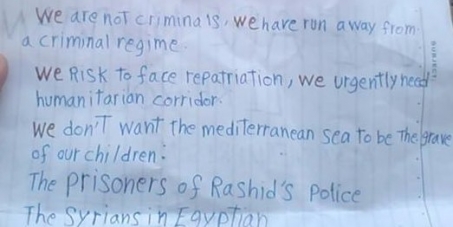


a letter written by the detained Syrians in Egypt

a letter written by the detained Syrians in Egypt

Stopped in the middle of the sea by the Egyptian Coast Guard, aboard a boat that was sinking shortly after the start of its journey to Europe. Locked within the premises of a police station in Alexandria, where the police prevent the arrival of relief supplies of Caritas

WRITTEN by STEFANO PASTA, translated by Mary Rizzo

MILAN- Through WhatsApp, we interviewed Syrian refugees held since 14 April in Al Rashid police station in Alexandria, Egypt. Having failed to reach Europe with a barge, they were handed over to the Egyptian authorities, but now risk transfer to the prison of Al Burj , or – even worse – repatriation to Syria.

What is your situation like today?

Disastrous hygienic conditions are dangerous due to a broken sewer. We are 144 persons living in two rooms measuring only a few meters, one room for women and one for men. We sleep on the ground and we cannot wash. We try to keep calm, but when it happened a few days ago there were moments of tension between us, the police prevented the visits for that day and suspended the coffee and the food brought from outside by Caritas Alexandria. The boys and men are still able to resist in some way, but the women and children are really at the limit; there are two women with heart problems who finished their medicine and they need to get out immediately.

What is the situation of children?

There are 44 children under the age of 12, while the total number of children is 63. There are a few who are trying to play with water bottles and they are the only ones who can get distracted for a moment. At night, however, they find it difficult to sleep. As of yesterday, almost all of them have developed a sort of skin disease that no one can identify. Two children of one and two and a half years, alone with his mother because his father was killed in Syria, were suffering particularly yesterday , they were taken to the hospital five times because they suffer from asthma and staying in this place of detention is equivalent to sleeping in a garbage dump. We are also concerned about another 4 year old girl, suffering from cardiac difficulties, who had begun to complain about the chest pain already in the midst of the sea.

Why did you flee from Syria?

Many of us have fled to avoid conscription in the army of Assad, others are activists against the regime who are risking their lives. Then there are families who have fled their homes because they could not survive in some cities, people are dying of hunger because of the siege of the regular army (regime army), which does not allow the entry of food. There is no bread and milk for the children, while the rice when one can find it, costs almost twenty dollars a kilo. Life like that is simply impossible, that’s why we escaped.

Have you talked with a lawyer or with international authorities?

No, none of us was able to speak with a lawyer or has received a sheet with the written reasons for why we are being detained. We met a lawyer named Ahmad, who initially presented himself as belonging to UNHCR, but then he began to terrorise us by threatening to have us repatriated and he revealed that he works for Egyptian National Security.  This is our greatest fear, because it would be tantamount to a death sentence; also return to Lebanon would be very dangerous, since it has already happened that Hezbollah has handed over some refuges to Assad. After a week from the meeting with Ahmad, presented to us is a UN official, at least this is what he is telling us, along with an interpreter, in which we explained how we ended up in the police station.

How did it happen?

What happened before our arrest was a nightmare. We were ready to face the Mediterranean to reach Europe and we had entrusted ourselves to smugglers, who treated us badly, screaming profanities and threatening to beat us with bars, even children. With small boats, we were taken in groups on a larger boat, where we were parked at sea for seven days waiting for it to fill up to 250 people. When we were ready to leave, the same smugglers noticed that the boat was about to sink. It was the worst time since we left Syria: we could die and nobody would know. Then, after a fight broke out between the smugglers on the boat and the organisers were on the ground, we were able to convince them to bring us back; we passed the Coast Guard, but no one saw us. Once on the beach, we ourselves went to the Egyptian authorities, asking for help, but since that day, April 14, we were all arrested, including children.

Have you heard of other refugees detained in Egypt?

Of course, we have detailed information because they are members of our own families. The wife of a man who is here at Al Rashid is held in another place, then we know where the traveling companions arrested with us are. In the police station in Al Montazah there are 22 people, 55 in Chabrakhit and an unknown number – but with so many children – in Miami.

What are you asking for?

We call for the respect of Article 33 of the Geneva Convention, which prohibits any member country the repatriation (refoulement ) of persons to countries where their lives or freedom would be threatened . We ask UNHCR and the European embassies (we initiated contact with the Austrian one) to be able to apply for asylum. We ask the Europeans: would you like your children to have the Mediterranean as their graves? Open a humanitarian corridor, let us save our lives legally.

thank you to Nawal 

siriani2--620x420WRITTEN BY ALESSANDRA COPPOLA, translated by Mary Rizzo

Which European country sustains the greatest number of refugees?

No, it’s not Italy. Despite the news of the refugee landings and the tragedies of Lampedusa, the proclamations of politics and the sacrifices of the local communities, women, men and children who cross our borders are for the most part directed elsewhere. The Syrians, in particular: they land here, in the southern part of Sicily or even along the Calabrian coast, they reach a train station, then they continue their travels towards the north. The answer to the original question, then, is another, miles and miles away: Sweden. Faithful to a long and established tradition of hospitality, Stockholm offers families fleeing the war the possibility of a permanent residence permit. In expectation of that document, there is a guarantee of a roof, meals, assistance, and the prospect of language training and placement programs, although in one of the villages scattered in the snowy landscape of Scandinavia. This was explained to me by a woman traveling with her two daughters in their twenties, passing through Milan: “I ​​would stay in Italy, but here the maximum that you can give us is a piece of paper: that’s not enough to give you a roof over your head and you can’t eat with it. In Sweden, they give us a home and a support to start over again.”

The civilised choice of Stockholm is proving, however, untenable even for an advanced welfare like Sweden’s. And the Scandinavian government, as yesterday stated in the Wall Street Journal, that it no longer is hiding its annoyance regarding the Mediterranean countries that complain about the mass arrival of migrants (receiving millions in EU aid), but at the same time (ignoring the regulations) push refugees to the Northern European countries, shifting the problem elsewhere. The criticism is directed towards Athens, but especially towards Rome.

“There was much talk of economic difficulties – protests the Swedish Immigration Minister Tobias Billström – but Italy still remains one of the 20 richest countries in the world.”

Without a comprehensive law on asylum and with a reception system founded on emergencies and improvisation. The European regulations definitely deserve to be revised, but Sweden (9.5 million inhabitants) now compares the numbers and asks Brussels to intervene: in 2013 (UNHCR data) has received 50,000 applications for asylum against 25 thousand of Italy (60 million inhabitants). Regarding those applications from Syrians, the disparity is embarrassing: 677 here, 14,362 in Sweden, with the forecast of other 23 thousand in 2014.

Tamim-Al-Barghoutipar Tamim Barghouti, traduit par Eric Lamy

À trois reprises, les médias furent trompés : “la gravitė de la famine était exagérée”, “les témoins oculaires mentaient” et “les victimes de la faim n’avaient faim que de célėbrité”. Dans ces trois cas précis, les forces assiégeantes mangèrent et burent devant les caméras des reporteurs, juste à côté du camp, pour mieux humilier et insulter ceux qui y vivaient.

Le camp de réfugiés de Yarmouk (à Damas) est assiégé depuis des mois, soumis à des bombardements terrestres ou aériens. De nombreux réfugiés sont morts de faim, n’ayant d’autre ressource que de se nourrir de feuilles ou de cactées ; le manque d’eau potable à également entraîné des affections intestinales et des maladies de peau.

Des nouveaux-nés ont péri de même, ainsi que leurs mères, des personnes âgées, des malades et des blessés, à cause du manque de médicaments. Toute personne qui essaie de quitter le camp est abattue, et le camp à été bombardé à de nombreuses reprises.

Même quand le régime syrien a permis l’entrée de l’aide dans le camp (grâce à la pression des médias étrangers), il a aussitôt refermé le siège quand l’attention des médias s’est relâchée.

Les tentatives des soutiens du régime syrien pour nier leur responsabilité vis-à-vis de Yarmouk sont pathétiques : le camp jouxte Damas. L’armée syrienne est seule responsable, légalement et moralement et aussi sur le plan régional, puisqu’elle contrôle entièrement la ville.

Quoique les supporteurs du régime prétendent qu’ils ont le droit pour eux, leurs actions immondes seraient moins ignobles s’ils ne prétendaient pas les accomplir au nom d’une cause prétendue.

Pour ce qui est d’affamer les Palestiniens, le régime syrien en a une longue expérience, peut-être même la plus accomplie que tout autre pays arabe. Trois des quatre pays qui entourent la Palestine ont été impliqués dans la mort de Palestiniens. Septembre, Sabra & Shatila et le blocus de Gaza… Pour autant, un seul pays sur les quatre fit couler le sang Palestinien à trois reprises : Tel Zaatar, la Guerre des Camps de réfugiés, et le camp de Yarmouk aujourd’hui.

À trois reprises, la scène se répète : le régime syrien utilise des milices alliées et leur donne l’ordre d’encercler le camp. Concernant le camp de Tel Al-Zaatar (1976), Damas a utilisé les milices chrétiennes maronites (et notamment les Phalangistes de la plus importante milice chrétienne), sans oublier les “forces Kataeb”, les “gardiens du Cèdre” et le “mouvement Marada”.

Au cours de la Guerre de Camps (1985/1988), le régime syrien à recruté la milice shiite Amal qui était, à l’époque, en conflit armé avec le Hezbollah pour le contrôle de Beyrouth et du Sud-Liban. Le Parti de Dieu ne prit pas part à la Guerre des Camps, mais Amal ouvrit le feu sur les Palestiniens et, simultanément, attaqua le Hezbollah.

Comme aujourd’hui, le régime syrien s’appuie directement sur son armée ainsi que sur des milices Palestiniennes inféodées, comme le Front Populaire pour la Libération de la Palestine – Commandement Général (FPLP – CG) et le groupe Fatah al Intifada.

Dans ces trois différents camps de réfugiés, l’eau et l’électricité furent d’abord coupés : les gens furent privés d’approvisionnement jusqu’à manquer de tout, jusqu’à mourir de faim. Dans ces trois cas, la faim à poussé les gens à manger des feuilles et à réclamer des fatwas pour être autorisés à manger des chats, des chiens et des cadavres d’animaux. Les femmes qui s’aventuraient jusqu’aux puits et autres pompes de forage à l’extérieur du camp étaient abattues par les snipers positionnés autour du camp.

Hussein Ayyad et Maysa Khatib, habitants de Tel Al-Zaatar, ont raconté que les corps des femmes tuées par les snipers tombaient dans les puits ; les gens étaient obligés de puiser l’eau dans laquelle restaient les corps des martyres. Impossible de les en retirer car les snipers continuaient de leur tirer dessus.

Dans ces trois exemples précités, les médias furent mystifiés : l’importance de la famine était exagérée, les témoins oculaires mentaient, et les victimes de la faim n’avaient faim que de célébrité. De la même manière, les forces assiégeantes mangeaient et buvaient devant les caméras, près du camp, afin d’humilier et d’insulter plus encore les habitants du camp.

Une des chaînes de télévision libanaise qui soutient le régime syrien à diffusé un reportage sur le Camp de Yarmouk montrant les soldats loyalistes en train de manger avec un des reporters de la chaîne, niant que les habitants du camp soient affamés et imitant les scènes où du lait maternisé était gâché pendant les sièges de Sabra & Shatila et de Burj El-Barajneh (dans les années 80). Le premier, imposé par le Liban et soutenu par Israël, dura trois mois, de juin à septembre 1982. Le second, mis en place par le Liban et soutenu par la Syrie, à duré 4 ans, de 1985 à 1988.

À chaque occasion, le régime syrien s’est justifié en arguant que les Palestiniens entretenaient des opinions radicales, qu’ils étaient des résistants invétérés. Mais Damas ne s’en prit jamais à Israël, même quand l’état hébreu à bombardé Damas. À chaque fois, l’humiliation des Palestiniens relayée par les médias était un élément essentiel de la guerre livrée contre eux. Non content de démoraliser les gens dans les camps et tous ceux qui les défendaient pendant le siège, il fallait aussi salir l’image de la Palestine, des symboles politiques et culturels Palestiniens. Il fallait aussi semer la confusion dans l’opinion publique syrienne et libanaise, dans leur réaction à de telles actions et, enfin, les convaincre de ne rien tenter pour s’opposer au siège des camps de réfugiés.

Refugee camp in Damascus, SyriaLe 9 janvier 2014, le porte parole de l’UNRWA, Christopher Gunness à déclaré que “la profonde souffrance des civils de Yarmouk s’aggrave. Les rapports confirment que la malnutrition est extrêmement répandue, de même que l’absence de soins médicaux, surtout pour ceux qui ont été blessés à cause du conflit, ainsi que les femmes prêtes à accoucher, avec des conséquences fatales pour certaines d’entre elles.”

Le journal britannique The Guardian relate que le même porte-parole de l’UNRWA déclaré, le 9 février 2014 (un mois après sa première déclaration) que le Dr Ibrahim Mohammed, qui travaille au sein de l’UNRWA, à sauvé un bébé de 14 mois appelé Khaled, souffrant de grave malnutrition. Depuis 2 mois, ce bébé ne vivait presqu’exclusivement d’eau. Noor, sa maman de 29 ans, avoua qu’elle n’avait, pour toute nourriture, que des décoctions d’épices. Quand il n’y en eut plus, ils se mirent à manger de l’herbe, mais celle-ci vint aussi à manquer.

Dans un message attesté du Réseau Euro-Méditerranéen pour les Droits de l’Homme (REMDH), une organisation basée à Genève qui collabore avec l’UNRWA pour apporter de la nourriture au camp, le REMDH rapporte qu’une jeune fille de 15 ans, prénommée Heba et son bébé de 5 mois, à raconté au personnel des Nations Unies qui distribuaient la nourriture qu’ils n’avaient pas mangé depuis trois jours, et qu’elle n’avait pas pu donner le sein à son bébé. Quand les infirmiers donnèrent de l’eau au bébé, il se mit à gonfler, n’ayant rien avalé depuis plusieurs jours. Les infirmiers en furent si inquiets qu’un médecin de la Croix Rouge Internationale dut le prendre en charge.

Ces exemples de famine furent accompagnés, dans le passé, par le massacre de quiconque tentait de quitter le camp. Dans le cas de celui de Tel Al-Zaatar, par exemple, après avoir affamé le camp pendant des mois, les Phalangistes, soutenus par le régime syrien [de Hafez al Assad, père de Bashar] annoncèrent qu’ils allaient autoriser les Palestiniens à quitter le camp afin d’être acheminés dans des refuges de la Croix Rouge. Quand les Palestiniens commencèrent à quitter le camp, les miliciens les massacrèrent, comme le raconte Maysa Al Khatib, une des survivantes de la tuerie, dont le témoignage fut, avec celui de Hussain Ayyad, publié dans l’appendice Palestinien du journal libanais Al-Safir du 12 août 2013 et du 15 septembre 2012.

“Tous les hommes de plus de dix ans qui tentaient de quitter le camp, comme de nombreuses jeunes filles, jeunes femmes et femmes âgées furent massacrées. Un des assassins s’approcha d’une jeune femme qui portait son nouveau-né de deux jours. Il empoigna son bébé et le projeta au loin. Celui-ci retomba dans des arbres mais la mère ne put localiser l’endroit où son bébé avait atterri.”

Une jeune femme blessée aux jambes se traînait parmi la foule. Un des meurtriers dit à un autre : “emmène-la donc sous le figuier, pour lui donner un peu de bonheur !” La femme répondit que la mort était mille fois préférable. Il la tua d’un coup de feu en disant : “crève donc !”

“Ghazi, mon cousin, portait ma grand-mère sur ses épaules, pensant que le fait de la porter lui éviterait la mort. Mais ils la tuèrent avant de l’assassiner. Une vieille femme glissa et tomba dans un fossé : comme elle tentait de s’en extraire, un des assassins lui dit : “où vas-tu ? Reste donc là où tu es ! ” Et il lui tira plusieurs balles dans la tête.

Abu Yaseen Freijah, un infirmier de l’UNRWA, vêtu de sa tenue blanche, soutenait sa femme, qui avait reçu une balle à l’épaule. Les meurtriers s’emparèrent d’elle et lièrent ses jambes à deux voitures, qui l’ont écartelée.

Mon cousin Ali, âgé de 17 ans, doux et inoffensif, fut attaché à l’arrière d’une voiture qui démarra en trombe. Abu Akram, un marchand de tissu bien connu, essaya de dissuader les assassins de s’en prendre à son fils en leur offrant tout l’argent qu’il possédait. Ils tuèrent son fils sous ses yeux avant de l’abattre, et de prendre tout son argent.

À ce jour, les coupables du massacre de Tel Al- Zaatar et de la famine organisée imposée pendant la Guerre de Camps n’ont pas été punis. Certains d’entre eux sont même devenus ministres ou responsables de conseils représentatifs, au Liban ou en Syrie. Ces tragédies se répètent dans le Camp de réfugiés de Yarmouk. Bien que le début de la tragédie à Yarmouk soit semblable à celle de Tel Al-Zaatar, nous devons agir pour que tous ces gens-là ne finissent pas de la même manière !

Tamim Al Barghouti est un poète palestinien et un scientifique engagé en politique. Il vient d’une famille lettrée. Son père est le poète palestinien Mourid Barghouti et sa mère, romancière érudite, est Radwa Ashour, d’origine égyptienne. Cet article fut publié en arabe dans le journal Shorouk, le 25 février 2014.


victims of the mosque massacre in central Yarmouk, from Syrian Air Force bomb raids

victims of the mosque massacre in central Yarmouk, from Syrian Air Force bomb raids

By Mahmoud Sarhan, translated by Jimmy Phoenix

The memory of Palestinians of the Yarmouk refugee camp – south of Damascus – carries two harsh memories of two catastrophes: the first was the catastrophe of being kicked out of their land in 1948, while the second dates to 16-12-2012, which marks the Syrian opposition barging in the camp and the MIG strike which was executed by the Syrian Air Force over Falluja school and Abdul Kadir Alhusaini Mosque in the middle of the camp. And both were being used as refugee centers for those who fled from other locations, and these MIG strikes killed 170 refugees and caused many casualties as well. Afterwards, many rumors went around talking about a 24-hour warning given to the camp citizens before the regime forces would break in. As a result, thousands of citizens who were horrified by the massacre that just took place packed their bags and headed out of the camp in a scene more like the new Palestinian diaspora which was described as being worse than the first one. And many activists consider the MIG strike of the 17th December 2012 as the actual date of the catastrophe. According to Mohammed Almaqdesi – the official speaker of the Palestinian camps news association – that after the MIG strike, many Facebook pages affiliated to “Jibril” (PFLP – General Command) spread a rumor that the Syrian army commanded the people of Yarmouk camp to evacuate the camp, which is what actually was done, fearing the occurrence of another massacre just like the Mosque and School massacre.

yarmouk 2At that time, Yarmouk camp sheltered thousands of Syrian families who evacuated to it from neighboring provinces, even some came from the cities of Aleppo and Homs. Which caused schools, mosques and houses to overflow with Syrian emigrants, which seemed for a while to be a safer place from the burning hell across the country. Yet, that didn’t suit the Syrian regime, who used genocide and group punishment against civilians after exiling them from their houses and forcing them to leave, seeking refuge from the inferno scorched by the regime’s military as soon as they suspected the presence of the FSA in it. However, Yarmouk camp succeeded for 9 months to stay unbiased despite the repeating attempts to drag it to the war, which was obvious through shelling it with mortars repeatedly and accusing the opposition for bombarding the camp. One of those barrages caused the “Alja’oona” massacre in 2-8-2012, which resulted a death toll of more than 20 martyrs and tens of casualties. Though, the main attempt to drag the camp into the conflict was from the “Jibril group” (or the PFLP – General Command) and its withdrawal from the agreement of the PLO factions, forming armed popular committees supported by the regime, which eventually caused those committees to overpass their duties within the camp and engage in armed clashes with the FSA in the Alhajar AlAswad and Tadamun areas. And not just that, but some groups even overpassed Jibril to receive orders directly from the Syrian Republican Guard (aka Presidential Guard), who eventually made the regime succeed in taking control of the green zone and eliminating the sanctuary the camp represented. This eventually forced the FSA to enter the camp in order to get oust the regime forces.

According to Almaqdesi: the FSA intended upon liberating only Alhajar Alaswad and the neighborhoods interlocking with Yelda Area. But Baian Miz’il broke into the entire camp along with his forces, ignoring the plan. Here, a new name rises up “Baian Miz’il”, one of the leaders of the south region FSA, who were found to be a regime agent, and has been the cause of letting the regime regain control of some of the that area’s neighborhoods. Thus, the regime bears the responsibility of dragging the camp into that bloody conflict so that he could make a few victories. Considering the military side, the regime tightened its grasp totally on all the neighborhoods of the southern region, using only one check point consisting of a few hundred soldiers and mercenaries. Which somehow reduces the burden of spreading soldiers around the camp and costing the regime many forces that would be better deployed to other sensitive regions as it sees fitting. Add to that, the regime also cut the supply lines to the camp and the safe haven that the camp represented as well as the popular revolution’s surrogate, which is represented by thousands of Syrian refugees who fled to the camp. All that is considered to be a part of the regime’s means of punishing revolting areas and its residents wherever they are.

While from the political point of view, the regime used the “kicking the Palestinians out of the camp” strategy to support the alleged propaganda of the “universal conspiracy” against the regime, and using it to press on all Palestinian, Arab, and international bodies as well to come to its aid. The regime succeeded in involving Yarmouk Camp through “Jibril’s faction” and one of his goons, therefore, succeeded – using few a soldiers only, to impose a suffocating siege on all the areas out of his control in the southern area of Damascus for a period of one year, which allows him to stall in executing any initiative presented by the PLO or anyone else. And according to “Mamdouh” – a politician activist, the regime sees no interest in making truces, and any initiative or ceasefire is nothing but a trick which he uses in the context of a psychological warfare which he imposes upon the besieged to ruin their spirit, waiting for things to change and for the facts on the ground to get to his side. And until now, all the initiatives presented by the PLO have failed, while those presented by NGO’s in Yarmouk seem to be suspended between PLO officials’ statements, and Jibril’s people’s belief that it is bound to fail, and none of the distress calls made to help the besieged from an incoming humanitarian crisis caused by letting them stay for 6 months without food or medicine are listened to. Also, the camp’s residents’ attempts to neutralize the camp’s status and force Jibril and the regime to execute the recent initiative, which has brought about the death of four citizens in the “coffins” march, during their march to the regime forces’ check point outside the camp, returning to face the monopoly of the dealers inside. Even the kids went in the “empty vessels” march demanding the siege to be lifted. In the camp’s catastrophe anniversary, the citizens celebrated it by demanding the siege to be broken and neutralized from the entire situation and stop killing them by bombs, bullets and hunger. Yet, we haven’t received any reaction from the besiegers, and after a whole year, all the popular and formal attempts represented by the PLO failed and did not bring about any change regarding the camp’s situation, and the regime succeeded in eliminating the refugees’ green zone and cutting the supply lines by using just a paper to negotiate with. And that comfortable situation enforced the regime to bargain with all sides, considering that the Syrian regime is the puppet master from now on, and it becomes the only one to benefit from Yarmouk’s catastrophe. And according to what Mamdouh said, I guess there one significant difference between who besieges the Gazans and who does the same in Yarmouk, where Palestinians are being besieged by either the occupation or the “defiance” regime.

http://alhayat.com/Details/587914

Syrian Refugees who survived a dangerous sea crossing face a new odyssey once in Europe - inhumane bureaucracy.

Syrian Refugees who survived a dangerous sea crossing face a new odyssey once in Europe – inhumane bureaucracy.

1)      A refugee in Syria is a person who has left Syria. An Internally Displaced person suffers most of the same (and at times greater) risk to their lives, but they are not covered under the 1951 and 1967 protocols as “refugees”. http://www.unhcr.org/3b66c2aa10.html . The convention identifies not only STATUS but also RIGHTS of refugees, including their right to seek refuge and restrictions against them being held against their will inside a country where they fear their lives are endangered.

2)      A refugee does not go through the same “immigration process” that is standard for a person who does not seek this status. This means that the refugee does not avail of protection by his own country (in this case Syria) and thus cannot seek the necessary documents from the Syrian government that are part of the “facilitation of travel” that are required under ordinary immigration protocols. They thus cannot apply for visas for work or study in the nations they seek refuge in, since this would require them to recognise Syria as able to protect them. Therefore, without an entrance visa, it is simply not possible to book a safe flight from Syria to European or North American countries, nor are there airlifts that facilitate the process in any way by the ONLY international organisation that has the obligation to oversee conventions regarding refugees (and see that they are implemented) the United Nations High Commissioner for Refugees. States that have signed the convention must adhere to the laws and if possible, assume the burden of granting asylum.

3)      Why do all countries simply not grant asylum? Because the complying states are obligated to accord “favourable treatment”, that at the very least is “not less than that accorded to aliens generally in the same circumstances”. This is why in nations such as Italy, where the amount of favourable treatment accorded to aliens who are NOT refugees is minimal and at times repressive (including detainment in “identification camps” for unspecified amounts of time and the aliens are not automatically accorded that their families may join them after they have met specific requirements) Syrian refugees are seeking to request asylum in countries northern European countries that have consolidated programmes for aliens and refugees that guarantee more rights such as housing, work and integration into the local fabric. It stands to be mentioned however, that these countries are not on the Mediterranean and a Syrian can arrive there only upon having first crossed the border of a state that has that geographic continuity, by land or by sea. Given the impossibility of arriving directly to Sweden, Germany, Austria or the UK, given the impossibility of obtaining documents for facilitation of travel, the Syrian refugees have been forced to remain in refugee camps abroad (Jordan, Turkey) or in ad hoc and non-recognised refugee camps in places such as Lebanon. They have mostly sought private housing in Egypt, and a great number have continued towards Libya, where they have been under the belief that they would be able to safely arrive at the gates of Europe by sea and then would obtain asylum status in Sweden.

4)      Article 6 of the charter is consistently violated in many countries of arrival of the asylum seekers.  It is an article that grants them the right to freely move within the territory of their arrival. They find themselves in what can only be described as prison confinement, as they are under the jurisdiction of the national law, which in my country (Italy) is very restrictive of immigration, while at the same time being one of the European countries with the greatest number of arrivals of migrants and asylum seeks who have not legally obtained visas (granted under very strict economic conditions, often with the obligation of declaring economic independence and exhibiting proof of self-sustainment or “sponsorship” by a legal resident or citizen). This situation has made it impossible for them to move freely within Italy for the reason of arriving at a northern border and seeking asylum in a country that accords more favourable treatment.

5)      The member states of the EU have signed something known as the Dublin II Regulation. It sets out the laws regarding granting of asylum. It was created to “prevent” that asylum seekers sought the best deals for themselves, putting excessive burdens on the states with more costly programmes, and this to maintain internal stability in these individual states. However, it has set as the regulation that the Responsible Member State is the state in which the asylum seeker first arrived, which is not Norway, Sweden or Germany, but Italy, Greece or Bulgaria. Since the Shengen Area has tightened its checks (and the minimum checks include checking for falsification and counterfeiting of travel documents and denial of entry upon that circumstance) many Syrian refugees, who had never obtained an authentic passport, and not having been issued a document in the arrival state as many had refused it (which would have required them to remain in holding camps), countries are “sending them back to Italy” under the Dublin II Regulation, and following considerable cost to the Syrians, they find themselves stateless, unprotected and impoverished in a foreign country. Their options are very slim. Many make several attempts to arrive to nations where they believe they will find better circumstances, and quite a few are left at the hands of unscrupulous persons who promise them passage, driving them to German-speaking areas of Italy and abandoning them, after having taken all their money and possessions.

6)      In consideration of what happens upon arrival in Italy, as if it were not bad enough, getting here is an odyssey and risk. Average “passages” with traffickers have been quoted at rates that never are less than $2000 and in some cases, we have heard of passages costing $8000 per person. The second package included “passport and application for asylum in Sweden”. Many have died at sea. No one has had it go the way their hopes and dreams have been. Several persons that have been interviewed have said they wished to continue over and over until they succeeded, others said they would try to go back to the middle east where at least they understood the language and would attempt to rely on the charity of strangers.

7)      We appeal for the regulations to be modified in light of the circumstances, but our appeals seem to fall upon deaf ears. We appeal for our countries to facilitate the asylum seekers and to provide humane living conditions for them so that they do not fall into the traps of those criminals who exploit them. In the meantime, we have to simply realistically inform those fleeing Syria of the situation here. We activists want to welcome them with open arms, with dignity and with generosity until they are able to return home. But, we are also very small voices in the matter, and our efforts in changing the laws so far have not been successful. The humanitarian emergency involves our countries and our human duty is to protect refugees. It is currently a task we are failing at, while the humanity of the volunteers almost always is exemplary.

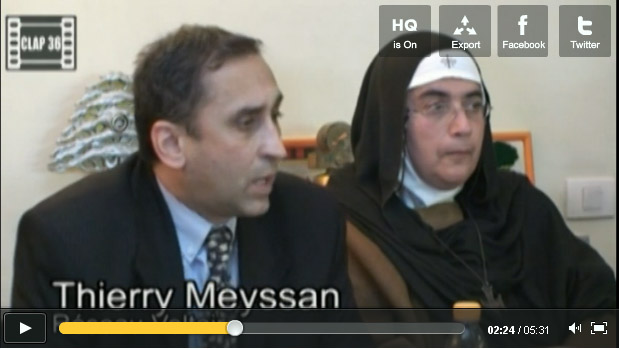
Meyssan and Friend.....

Meyssan and Friend…..

From ISLAMETRO by LORENZO DECLICH translated by Mary Rizzo 

Thierry Meyssan carefully chooses the place in which he lives.
At the time of the war in Libya he was in Tripoli, in the palaces of Moammar Gaddafi.
After the war he moved to Damascus, where he has been living for two years.
But, as we read on Megachip, he has known Syria for ten years.

And Sunday, 3 November 2013, having a sudden illumination, he comes to say that “Syria has changed.”
It had not changed ten years ago, after the pale “Damascus Spring” was crushed by the young son of Hafez al-Assad, Bashar, to the sound of arrests. It has not changed since March 2011, when the people, overcoming fear, began to take to the streets knowing that they would be shot at. It changed today, but the reason for it being today, who knows what that could be.

Maybe because at the presidential palace they say that it’s time to bring closure to the circle of propaganda, now that the event of the chemical weapons has paid off and the world has come to the common conclusion that “a war has been avoided”. Perhaps because there is the need of a dusting off of the image, the idea must be reinforced that after all, “everything’s going in the right direction”.

As the intro of the piece tells us:

The media coverage of the war in Syria extends only to military, humanitarian and diplomatic actions. But all of that leaves aside the profound transformation of the country.

And if this comes from someone who lives in Damascus, presumably in the city’s centre, which is one of the few areas of Syria Bashar has not bombed, you can be sure that it is true.
One hundred and twenty thousand deaths, including eight million displaced persons and refugees do not register for Meyssan as a “transformation.”

Speaking of “humanitarian actions”, therefore, we do not register the profound change of a country. Speaking of bombardment of the population by the army serving Bashar, that proves to be indiscriminate when they affect areas beyond government control but targeted when they hit schools and hospitals in those same areas, we “leave aside” the deepest Syria, the one which has changed.

Speaking of the indolence, inaction and hypocrisy of diplomacy over Syria, we are denouncing that this situation is left to rot in indifference.

And if we want to talk about media coverage, we do not understand why the “mainstream” – and with it Thierry Meyssan – systematically has been ignoring  the voices for three years – some faint and inaccurate – of Syrian activism at home, those voices that Bashar as well as since several months, the qaidists of the Islamic State of Iraq and the Levant, have been silencing to the sound of arrests, assassinations, torture.

And if we want to go and see “the media outlets” that host the reflections of Thierry Meissan we find that these, after all, are not as “poor”.

As they write on Megachip:

This “weekly news on foreign policy” appears simultaneously in the Arabic version of the newspaper “Al- Watan” (Syria), in the German version of the “Neue Reinische Zeitung” in the Russian language on the “Komsomolskaya Pravda”, in English on “Information Clearing House” in French on “Réseau Voltaire”.

One wonders what journalist – or one who is alleged to be – has the luck of being simultaneously translated into five languages. One has to wonder who engages in such a zealous manner to spread the thought of the embedded for Bashar.

***

Here you are.

Now one supposes that a deconstruction of Meyssan’s article will follow, but I’m already tired.
The propaganda of Bashar has won again, he works right alongside it.
But I will make one last effort, trying to direct you on how to read – unless you find yourself overcome with the urge to vomit, which would mean that you are already aware and it’s simply no use to continue – this gem of deception, creation of false trails and propaganda.

The article uses categories of thought that are considered to be those of the “left discourse”.

It speaks to those persons who, as is highlighted in the titles to the paragraphs, are concerned about things like freedom.

Hence the division into themes:
The war according to the armed opposition
Freedom of expression
Freedom of thought
Political freedom
Reactions of class

Thierry, in them, holds the bar solidly on one thing alone: to not accredit in any way the only Syrian opposition that would show how ridiculous his reasoning is.
This opposition is represented by the Syrian Local Coordination Committees, which are the backbone of the revolution against Bashar, and the galaxy of nonviolent activism (which I have mentioned before).
These two entities are the only ones to be able to speak with authority and ownership of the topics with which Meyssan headlines his paragraphs.
So it is obvious that he attempts to delete them.

As well as, since March 2011, trying to make Bashar, firing on the crowd.

And just as with initiatives that lure the unsuspecting, awkwardly composed of small groups of mindless “pacifists” in various parts of the world, including the effort afloat for some time by the nun of Bashar, Agnes Marie de la Croix.

The only way that Meyssan can achieve the goal, from the rhetorical point of view, is to seize control of the words and concepts of the real opposition, in order to build a parallel reality on them in which the opposition no longer exists and the “good people” are the friends of Bashar identified as an ideal “people” of the “poor” who seek ” freedom” and “democracy” and fights against “obscurantism”.

Let’s see how it goes.

Meyssan says more or less, “everyone is talking about civil war when in fact there has been an external aggression.”
The truth, however, is that he speaks of “civil war” when we should be speaking of the destruction of a country and a people by a mafia clan, acting like a dog that refuses to give up the bone (remember the writing on the wall? “Only Assad, or we will burn the country”).

Then he tells us that Bashar has emanated laws on freedom of expression so that today – given that “Syria has changed” – everyone is talking about politics. But he does not tell us that there are tens of thousands of political prisoners in jail. That there are mass graves near these prisons. That there are secret torture centres scattered across the country.*

Then he tells us that today, given that Syria has changed, there are those who fight for “freedom of thought”, for religious freedom, etc. taking up arms and fighting against the obscurantist terrorists, formed and trained by the West, who are in the opposition.

But among these people who are fighting he does not include those who truly have been part of the struggle, revolting against Bashar, often paying with their lives, and now becoming a victim of those extremists – which among other things do not identify with the revolution of March 2011, they have another agenda – one that Bashar has done everything to foment.

These people who are the true part of the struggle for freedom are activists and representatives of those Local Coordination Committees mentioned above.

Persons whom Meyssan simply wants to wipe from the face of the earth.

What a guy!

An easy-going guy who then tells us that there are so many parties that we cannot even count them. That people used to watch al-Jazeera and now they watch government channels or channels of the Shi’a network. That the snipers who fired on the crowd they were terrorists, they were not the army of Bashar. That the internal Syrian intelligence services, the Mukhabarat, if the first part good and part bad  have now become absolutely good and fight with us, with all of us east to west north to south, for freedom.

Other pleasant lies follow, up to the “Class reactions”, which comprises the final gem.

Meyssan, without ever obviously mentioning the mafia that is in power, is able to say that the rich have all left and what remains are the people, a people that combats against the evil of the West, incarnated by the terrorists. A people who will win against all odds. The amount of lies can be summed up entirely in this penultimate sentence:

This war has bloodied Syria, of which half of the cities and infrastructure have been destroyed to satisfy the appetites and fantasies of the Western and Gulf powers.

While the tragic truth is that the brutal dictator Bashar al-Assad has destroyed Syria and massacred the Syrian people for the sole purpose of not leaving his power and privilege. And that there is no solution to the conflict if he and his gang of criminals do not go away and die far from Syria.

——

* I can already imagine the pro-Assad that says, “if they are secret how do you know that they exists?” My answer is “fuck you, you idiot.”

——

P.S. My congratulations go to Megachip but especially friends of the network of “Globalist “, with which I have worked in the past. This stuff, dear readers, is quite creepy and there is no policy of clicking “like” that can justify the publication, not even via syndication. Make an analysis for yourselves, find the answers. Or let the world go on as it is, between a bit of light porno that passes for network TV and a Meyssan, at the core, there really is no difference between them.

http://islametro.altervista.org/la-voce-damasco/

This is a transcript of a presentation given by Palestinian anarchist Budour Hassan on 17 November 2013 at a Teach in on Syria in New York organized by the MENA Solidarity Newtork US . There is a link to the video of the presentation below.

*******

In April of 2011 a famous megastar Egyptian blogger told Syrian revolutionaries that they needed to raise Palestinian flags during the demonstrations on Friday just to prove that they support the Palestinian resistance and to deny the narrative by the regime that the regime supports the Palestinian cause.

Now I asked myself then, do Syrians have to do that? Do Syrians have to raise the Palestinian flag just to prove that they support Palestine? Do Syrians have to show their nationalist credentials so the world supports their cause? And the answer was clear to me then: No, Syrians do not have to do that. Now a Syrian friend told me at the start of the uprising that we avoided raising Palestinian flags and talking about Palestine not because we don’t support the Palestinian cause, but because this cause was exploited by the regime to a degree that turned it into just a political tool, and we love Palestine so much that we don’t agree to turn the cause into a political tool, and this is why we avoided using it. And I think that Syrians do not have to do this, Syrians do not have to wave a Palestinian flag to prove that they support us. Because Palestine is not a flag. Definitely Palestine is much more than that.

Palestine is the refugees in Yarmouk camp who supported the revolution from the first day, who aided displaced Syrians and who participated in protests, documented the uprising, and helped as much as they could. The revolution is also the Palestinian refugees in al Raml refugee camp in Latakia who took a hard beating by the regime and had to deal with a heavy crackdown starting from July 2011. And the revolution lives not in the palaces of the regime, nor in the speeches of a resistance leader who thinks that just because he leads a resistance movement this gives him the right to speak in the name of Palestinians, and to kill innocent people in Syria not just in the name of resistance but also in the name of Palestine. So this is why I think that Syrians do not have to prove anything to anyone.

Secondly, even though if we suppose that the Syrian regime does in fact support the Palestinian resistance, does it mean that this allows the Syrian regime to control Syria, to prevent people from expressing their opinions, to kill and torture hundreds of thousands of Syrians just because they dare say no to more than 40 years of oppression, to more than 40 years of injustice? Of course not. Even if Bashar al Assad was the only person capable of liberating Palestine I would not support him, and I’m sure that many Palestinians would not do so either. Because our liberation cannot be established on the enslavement of another people, particularly when this enslavement is an enslavement of our sisters and brothers in Syria.

And in fact the truth is that the Syrian regime has never truly supported Palestine; for the Syrian regime, Palestine has always been a fig leaf and always been a political tool. And it started from the 1970s when the Syrian regime helped other militias in Lebanon to crack down on the refugees in Tel al-Zaatar. The siege and massacre in Tel al-Zaatar cannot be forgotten. And the massacres that the regime helped the Amal party in Lebanon commit in the 1980s also against refugees in Lebanon and against the PLO cannot be forgotten either. And the siege the regime is imposing in Yarmouk refugee camp, preventing people from getting medical aid or baby milk, preventing people from going in and out of the refugee camp, cannot be tolerated and cannot be just ignored, as many are doing unfortunately just because they think that this regime is for resistance, and that this regime is for the human rights of Palestinians.

Now the thing is that me as a Palestinian, I don’t need to say this for many people just to convince them about the justice of the Syrian cause. Because in my opinion it is very clear that this revolution was a revolution for freedom and dignity. But unfortunately for many of us here in Palestine, because there is a polarization among Palestinians, as is the case in many other Arab countries, about the Syrian regime, we had to say it over and over again and to try to convince our comrades — or our former comrades – that they need to stop supporting the Syrian regime, that all we hear about the Syrian regime’s support of resistance is nothing but propaganda.

Now unfortunately it didn’t really help. People mostly stick to their opinions regarding the regime. If we want to talk about what the reaction of Palestinians toward the Syrian revolution is, it varies. Unfortunately the left, mostly the mainstream left, supports the Assad regime. And here lies the irony, because one of the most supportive parties of the regime is called the Israeli Communist Party, and it supports the regime because, it says, “Well, this regime is against imperialism.” But at the same time these people had absolutely no problem in participating in protests alongside Zionists in Tel Aviv, liberal Zionists for instance. So how can you say that you support the Syrian regime because it is against imperialism and on the other hand participate in protests with Zionists?

And also there are others who say that we supported the Syrian Revolution when it was nonviolent, but then after it got violent we couldn’t support it anymore, and it was hijacked. So yes, the Syrian Revolution was indeed hijacked, and we know that there are many Salafis, many jihadists and many other groups, and many pro-America and pro-imperialist groups that tried to hijack the Syrian Revolution. But that does not by any means tarnish the Syrian Revolution, and it also doesn’t mean that just because a revolutionary movement was hijacked that we should stand on the sidelines and stop supporting it.

Of course there are still so many revolutionaries working on the ground, many of them are nonviolent, and there are even many nonsectarian armed brigades that we cannot ignore. If the revolution was hijacked we don’t just go and start blaming the people for it being hijacked. We actually do everything to side with the people in order to get the revolution back on the right track. And this is what many leftists couldn’t understand.

Now on the other side of the spectrum you have the right wingers and the Islamists who support the Syrian Revolution but not truly because they believe in the right of freedom and dignity, but because they think that it is a Sunni uprising against an Alawite regime. Now this is why it was for me very hard to participate in protests organized by Islamists in support of the Revolution, because for me, although of course there are religious movements inside the Revolution, it still a Revolution for freedom, equality, social justice and dignity. And this is why I cannot agree with the line of the Islamists here in Palestine who support the Revolution just because they see it as Sunni versus Alawite.

Now there is a small section among the Palestinian left that supports the Syrian Revolution that doesn’t lecture Syrians about what they have to do, and how they failed. And we managed to organize a few protests, in Haifa for instance, in Jeruslaem, and in other places in Palestine. Although they were small protests I think it meant a lot for us to show the Syrian people that yes there are people in Palestine who stand with you, and there are people who don’t buy into the regime propaganda.

I mean it says a lot that in Syria right now there is an intelligence branch, one of the most notorious intelligence branches in Syria, it’s called “Palestine.” That means that there are people being tortured, including Palestinans, by the way, that are being tortured in the name of Palestine, in the name of our country, in the name of our cause, because we believe it is a cause for freedom.

Now to those Palestinians and to those people who believe that the Syrian regime is truly supportive of Palestine, and who do not support the Revolution, who stand on the side and say “no, we don’t want to support the Revolution, or who remain neutral: I say you have a Palestine and I have my own.

Your Palestine is an intelligence branch in Damascus that kills and tortures people, while my Palestine is Khaled Bakrawi, the martyr from the Yarmouk refugee camp, who was arrested and tortured to death. Your Palestine is a speech by Bashar al-Assad, while my Palestine is the chants of Syrian freedom fighters in Hama. Your Palestine is just empty rhetoric, while my Palestine is people in Bustan al-Qasr raising the picture of Samer Assawi, the hunger-striking prisoner.

My Palestine is people from the north to the south chanting in solidarity with Gaza during the recent war on Gaza last year and saying “Oh Gaza, we are with you ‘til death.” They did it when they were bombarded by the Assad regime and they were shelled. My Palestine is that of the Syrian Revolutionary Youth in Damascus who raised a pamphlet in solidarity with the Palestinians in the Nakab and said “Prawer shall not pass!”

So Syrian revolutionaries, even when they face the most terrible cases of torture, of persecution, and of crackdown, they still remember their sisters and brothers in Palestine, they still chant in solidarity with them and do not forget about the prisoners.

So I think it is very important to remember that, and to remember the hundreds of thousands of Syrians and Palestinian prisoners who still languish in regime jails, for example Ali Shihabi, the communist Palestinian who has been detained in Syrian regime jails for almost a year, and Maher al-Jajeh also, another youth activist from Yarmouk refugee camp, who has been detained by the Syrian regime for more than a year and no one knows what is going on with his case now.

Also we will not forget the martyr Anas Amara, who was murdered simply because he was trying to get aid into Yarmouk refugee camp and trying to break the siege. And my Palestine is that also of Jihad Asad Muhammad, the Syrian journalist who even prior to the Syrian Revolution was always writing in solidarity with Palestine, and who like many others did not believe that this Palestine is Bashar al-Assad’s Palestine, but this is a cause that interests all Arabs.

So I just ask one last thing: I ask people who think that Bashar al-Assad supports Palestine or still believe his propaganda, just go over history a little bit, read more about what he and his father did to Palestine and to the Palestinian camps. And even if you are not convinced, don’t let this fact, don’t let political gains affect your support of the Syrian revolution. Because it is obviously not about geopolitics. We do not know whether if the revolution wins in Syria how will that affect the Palestinian cause. It might indeed damage us, I do not know. But I do not care on the other hand. Because my support of the Syrian Revolution is unconditional.

And I do believe that even though it is getting more and more complicated, and despite all the terrible groups that are trying to hijack the Syrian Revolution, especially the Islamic State of Syria and Iraq, which we obviously oppose like so many Syrians, the same Syrians who started protest against the regime and are also protesting against the Islamic State, so I have faith in these people. I have faith in a woman like Souad Nofal, I have faith in those who are so resilient and steadfast in Damascus and in Daraa, birthplace of the Revolution, and in Aleppo and in Salamieh, the fantastic city that has been protesting since the first days of the uprising.

So I have faith in these people, that even though things are getting more and more complicated, that they can manage to keep the uprising going, and even if this means bad things for my cause I really do not care. What I care about is the freedom and dignity of my Syrian sisters and brothers, and to reject that my name or my country or my cause be used or coopted by the Syrian regime to kill and persecute my sisters and brothers in Syria.

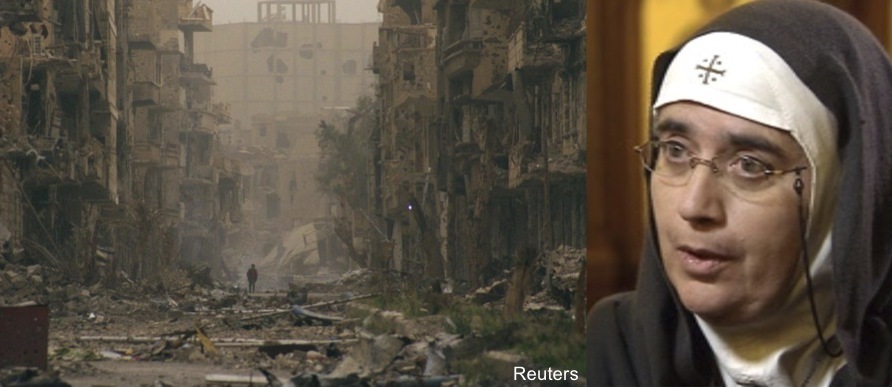
agnes (1) (StWC) invited Mother Superior Agnès Mariam de la Croix to speak at its November 30 International Anti-War Conference. Fellow guests included MPs Diane Abbott and Jeremy Corbyn and journalists Owen Jones and Jeremy Scahill.

Responding to a firestorm of protest, Jones and Scahill vowed to boycott the event if the Syrian-based nun spoke alongside them. Eventually she decided to “withdraw” from the conference and StWC issued a statement without explanation. Nor did it divulge why anyone would object to a Syrian cleric’s participation in an ostensibly pro-peace event.

Here are some reasons why we consider Mother Agnès-Mariam’s inclusion in an anti-war event to be a “red line” for opponents of conflict. Despite contrary claims, she is a partisan to—rather than a neutral observer of—the war in Syria.

Mother Agnès claimed that the Syrian opposition faked films of Bashar al-Assad’s 21 August 2013 sarin-gas attack on Ghouta in the suburbs of Damascus. In her 50-page dossier on the horrible events of that fateful morning, she wrote that the dead, gassed children documented in those videos “seem mostly sleeping” and “under anaesthesia.”

According to Father Paolo Dall’Oglio, a Jesuit priest exiled by the Assad regime for speaking out against its suppression of peaceful protests and currently a prisoner of al-Qa’ida’s Syrian affiliate, ISIS, Mother Agnes “has been consistent in assuming and spreading the lies of the regime, and promoting it through the power of her religious persona. She knows how to cover up the brutality of the regime”.

Moreover, Syrian Christians for Peace have denounced Mother Agnès for claiming there had never been a single peaceful demonstration in Syria. The also accused her of failing to disburse any of the money she raised in the name of their beleaguered community. They have asked “that she be excommunicated and prevented from speaking in the name of the Order of Carmelites.”

Having a massacre denier and apologist for war criminals like Mother Agnès speak alongside respected journalists such as Jeremy Scahill and Owen Jones is not only an insult to them and their principles. It is also, more insidiously, a means of exploiting their credibility and moral authority to bolster hers, both of which are non-existent.  No journalist should be sharing a platform with Agnès when she stands accused of being complicit in the death of French journalist Gilles Jacquier by his widow and a colleague who accompanied him into Homs during the trip arranged by Mother Agnès in January 2012.

Given that her UK speaking tour is still scheduled to last from the 21st to 30th November we, the undersigned, feel compelled to express our profound and principled objections to those who give a platform to a woman condemned by Syrian pro-peace Christians for greasing the skids of the regime’s war machine.

Signatories:

  1. Prof. Gilbert Achcar, SOAS
  2. Assaad al-Achi, Local Coordination Committees in Syria
  3. Rime Allaf, Syrian writer
  4. Omar al-Assil, Syrian Non-Violence Movement
  5. Hussam Ayloush, Chairman, Syrian American Council
  6. Noor Barotchi, Bradford Syria Solidarity
  7. Mark Boothroyd, International Socialist Network
  8. Kat Burdon-Manley, International Socialist Network
  9. Clara Connolly, Human Rights lawyer
  10. Paul Conroy, photojournalist
  11. Donnacha DeLong, National Union of Journalists
  12. Hannah Elsisi, Egyptian Revolutionary Socialist
    Raed Fares, Head of Kafranabel Media Centre
  13. Naomi Foyle, writer and co-ordinator of British Writers in Support of Palestine
  14. Razan Ghazzawi, Syrian blogger and activist
  15. Christine Gilmore,  Leeds Friends of Syria
  16. Golan Haji, poet and translator
  17. Marcus Halaby, staff writer, Workers Power
  18. Sam Charles Hamad, activist
  19. Nebal Istanbouly, Office Manager of the National Coalition for Syrian Revolutionary and Opposition Forces (SOC) in the UK
  20. Tehmina Kazi, human rights activist
  21. Ghalia Kabbani, Syrian journalist and writer
  22. Khaled Khalifa, Syrian writer
  23. Malik Little, blogger
  24. Amer Scott Masri, Scotland4Syria
  25. Margaret McAdam, Unite Casa Branch NW567 (pc)
  26. Yassir Munif, sociologist and activist
  27. Tom Mycock, Unite shop steward (pc)
  28. Maryam Namazie, Spokesperson, Council of Ex-Muslims of Britain and Fitnah – Movement for Women’s Liberation
  29. Tim Nelson, Unison Shop Steward (pc)
  30. Louis Proyect, Counterpunch contributor
  31. Martin Ralph, VP Liverpool TUC (pc)
  32. Ruth Riegler, co-founder of Radio Free Syria, Syrian International Media Alliance
  33. Mary Rizzo, activist, translator and blogger
  34. Christopher Roche and Dima Albadra, Bath Solidarity
  35. Walid Saffour, Representative of the National Coalition for Syrian Revolutionary and Opposition Forces (SOC) in the UK
  36. Gita Sahgal, Centre for Secular Space
  37. David St Vincent, contributing writer and editor, National Geographic Books
  38. Reem Salahi, civil rights lawyer
  39. Salim Salamah, Palestinian blogger
  40. Yassin al-Haj Saleh, Syrian writer
  41. Richard Seymour, author
  42. Bina Shah, author and contributor to the International New York Times
  43. Leila Shrooms, founding member of Tahrir-ICN
  44. Luke Staunton, International Socialist Network
  45. KD Tait, National Secretary, Workers Power
  46. Peter Tatchell, human rights campaigner
  47. Paris Thompson, International Socialist Network
  48. Hassan Walid, Anas el-Khani and Abdulwahab Sayyed Omar, British Solidarity for Syria
  49. Robin Yassin-Kassab, author and co-editor of Critical Muslim
  50. Qusai Zakariya, activist from Moadamiyeh, Syria
  51. Nisreen al-Zaraee and Wisam al-Hamoui. Freedom Days
  52. Tasneem al-Zeer, activist
  53. Razan Zeitouneh, human rights lawyer

    originally published on: http://pulsemedia.org/2013/11/20/open-letter-to-the-stop-the-war-coalition/

1460303_10151719963817016_1488318310_nWRITTEN BY MOHJA KAHF

We are going through hell and our friends inside Syria are being torn limb from limb. You come in after three years of it and tell us what our uprising is and isn’t and what it should be and shouldn’t. We all started out together in it, hopeful, finding each other, Syrians, talking to each other again after years of monstrous silence twisted by so many layers of fear, generations of fear handed down by the trauma of families with absent members in prison. Young people began hearing their own voices for the first time, shouting “freedom.” “It was the first time I ever heard my own voice,” young women, young men, street protesters, have told me over and over. Working-class urban neighborhoods and farming- and middle-class rural villagers across the country came out for clearly stated goals of human rights and democratic freedoms and no more being ruled by police state, and it had nothing to do with Islamists but that was before you bothered to notice. Some 920 different locales were protesting nonviolently on a weekly basis by summer 2011, with at least 4 million of Syria’s 23 million people having protested at the height of 2011. Even this first reality, you won’t acknowledge.

Stunning arrogant brutality is how this police state met this uprising. Insane brutality and duplicity. House-to-house raids, tank and machine gun fire, ground troops, snipers, home burnings, the capture and torture of children, the siege of Daraa—all this before the uprising began to arm. The pressure for self-defense was intense. Come live in it for a day. I don’t think you’ve ever been stopped cold by the tears and the anguish in the individual self-defense argument from a real Syrian human being demanding, “if a regime militia is raiding my home, about to kill my children, how dare you tell me not to lift arms to try to save them.” I am stopped cold by it, every day. 

My only answer is: “look, I’m really sorry, but look at the facts; after the revolution lifted arms, your children are dead and so is the whole neighborhood. Arms are not working; self-defense is not defending; it is making you a more legible target for the lethal regime. It defended that home for two hours or two weeks, but in the end the entire neighborhood was flattened by the regime, because the regime is hugely more armed. Nor will outside military intervention save you. You can only win if you band together in slow, organized, nonviolent resistance.”

I say this and I staunchly advocate nonviolence over the din of shelling, but my voice breaks saying it to someone whose children are cowering tonight because the home is shaking because the town is being shelled and his parents are already dead. Some far-sighted Syrians got that having the (secular) FSA only drew heavier regime fire. Most Syrians did not get it—gasp, they live in a pro-violence culture like most of the world—and felt the only answer to the inequity in arms only means all their problems would be solved by heavier arms for the (secular) FSA which they see as defending them. I know they’re only harming themselves in believing this romance of armed liberation, but I know it from their pain, and I can only tell them with my voice shaking because I am at a privileged distance from them, and because I haven’t been able to help them in any other way stronger than they see the (secular) FSA helping them, and then the armed Islamists—who did not come in until 2012, able to wedge in because of the regime devastation wreaked on nonviolent uprising Syrians whose screams went unheard by you, able to ride in on the false promise of armed liberation and humanitarian aid not provided by others.

And you hear their cry for arms, and you brand them intransigent militants, and demand why they won’t go to Geneva. I demand that too, but I do it from inside a Syrian anguish, at far higher damage to myself than it costs you. You then turn around and cast aspersions on me and Syrians with similar stands, not even allowing us our embattled path, because of our “associations;” we wake up damned if we do advocate nonviolence, and damned if we don’t.

Our “associations?” We are Syrians. We all started out together. Hopeful. Three years ago, we did not know how things would unfold. We began working together and creating histories and relationships. And now that different paths have been trod in this revolution, you come in and tell us we are not allowed to be associates, to be related to other Syrian people in this revolution who’ve taken other paths? There are people on the pro-FSA side who I think have done no end of damage to this revolution, but for whom I’d give my life as much as for people in civilian resistance. Yeah, those are my associations.

You breeze in and say, in effect, “how dare these Syrians fall for the romance of armed liberation. They offend my anti-imperialist stance as a progressive American. Every leftist revolution has fallen for that romance and every other revolution too, but how despicable and primitive of these Syrians to fall for it.” You demand we apologize for “associating” with each other. You demand we devote our energies to proving we are nonviolent and meet your standards, like a man demanding a feminist prove she is not a man-hater and has never associated with militant separatist feminists. This, while we get derision from fellow Syrians every day for insisting that this brutal regime can be stopped by nonviolence, hisses from starving freezing impoverished people facing its gun barrels in their faces every day, before whose trauma we tremble. Insulated from realities on Syrian ground, you point to one of us and say, in effect, “How dare any of you Syrian activists abroad be tempted, even for a moment, to see an iota of use in bombing assad’s military airports that are bombing your people?” In the din of this shriek of pain that we hear unceasingly, to the edge of our insanity, from Syrians in Syria, how dare we as Syrian peace activists abroad ever register the temptation to sympathize with the primal desire that someone, anyone just come and bomb the fuck out of this monster killing people we know daily. How dare I have a friend like that.

Instead of offering one bit of solidarity, you come in to tell us who we are and who we should be and are suspicious of us if we are not packaged into discrete separate compartments for you. We’re not up to your standards. We are Syrians and yes, we associate with each other, nonviolent proponents and Coalition and FSA-proponents and hard-drinking Syrian atheists and Muslim Brotherhood and gay Syrians and Nusra sympathizers, all fighting the regime together in our different ways; and some of us even have nephews in assad’s army just as much as nephews in assad’s prisons and in the FSA, and regime loyalist aunts, and military officer dads about whom we are terrified they could be killed and horrified they could be torturing someone. Yes, simultaneously. Because that is what it is to be Syrian today. Yes we are all cousins, all in-laws, all related, all family, and we all will have to live with each other for years to come in this Syria boat that is a life and a home and a country for Syrians even if it is an equation on a piece of paper for you, and we in this Revolution hate and love each other and fight with each other all while struggling against a brutal regime for a future Syria that has some ounce of justice, some human dignity and freedom in it, and for us there is green and good in Syrians worth struggling for still, and who on earth are you to drain one drop of our precious few remaining energies.

suora    This is a letter that can be sent to every venue that is hosting Mother Agnes-Mariam De La Croix as a speaker. It can be personalized and altered as required. As activists and responsible human beings, we cannot stand by while an apologist for genocide is given a platform in spaces that claim to promote peace, justice, and human rights:

Dear Sir/Madam,

In reference to the visit of Mother Agnes-Mariam De La Croix, the Superior of the Monastery of Deir Mar Yacoub, (and any other persons participating at DATE/ADDRESS), we would like to draw your attention to the following:
Large scale massacres against civilian populations have been committed by government military forces and pro-regime militias in Syria. Those invited to speak about this immense tragedy should be examined carefully as to their position in support of the forces behind the massacres. It is unethical to give a platform to persons who support these massacres or facilitate them by spreading information that has been proven again and again to be misleading, false, and in many cases pure propaganda of the regime perpetrating the crimes. It would be completely unconscionable for a religious or spiritual organization to put their facilities at the disposal of such persons.

We fully respect the principle of debate and freedom of expression, but in this case the person you have invited expresses blind support for a dictator who has massacred and is still massacring his own population, including over 11,000 children. The only reason for this violence is the regime’s intention to crush any and all people who stand up for their human rights and who they deem to be a threat to their tyrannical rule. The regime has killed countless numbers of people for trying to exercise their right to free expression. It is clearly evident that the uprising in Syria started peacefully, and was not militarized. Nor was it based on religious intolerance or sectarianism. It began with non-violent protests demanding reforms and basic freedoms that they had been denied for far too long. These protests were met with extreme violence and repression, and in order to justify that, a machine of propaganda was put in place, disseminating lies, passing off hoaxes as fact, and claiming that minorities in Syria were under threat of harm from religious extremists. The speaker you have invited is one of the key players in this propaganda machine, many of her claims have been debunked by experts and witnesses, while the voices of those murdered by the regime have been silenced once and for all.

The peaceful nature of the protests that your guest attempts to depict as a violent insurgency against Syria’s minorities has been recognised by the European Union, the United States and the United Nations. The crimes against humanity committed by Assad have also been recognised by these entities, as well as by Amnesty International and Human Rights Watch. People in Syria only took up arms against the regime when the killing had reached such a scale that they were forced to defend themselves and their families militarily.

We are astonished that you have made your venue available to supporters of a murderous dictatorship. What is happening in Syria is in the public domain and cannot be ignored. Support for this project may amount to complicity in crimes against humanity. This is not just a legal issue but also a moral one.

It is extremely ironic that the photo used by the organisation promoting the event depicts damage in Syria caused by airstrikes. It is common knowledge that ONLY the regime possesses air power and the capacity to bomb cities and residential areas in this way. The use of the image in this way is further evidence of the bad faith of the organisers of this event. 

We request that you cancel this event immediately and we would like to suggest that you organise a new event that will present what is happening in Syria in a truthful and objective way. We thank you for your solidarity with the people of Syria.

sirin

WRITTEN BY Sirin Bekdash, translated by Mary Rizzo

Refugees #1

“How old are you? You look very young.”

She smiles at me in a way that it seems she has not gotten love for years, “24, 4 of these are my children. My husband has gone to a better world.”

Her eyes are green, they are not deep, but they sparkle. They say that suffering becomes light in the eyes of those who have tried it, I’ve just seen proof of that.

Refugees #2

“Take off your hood so I can fit you with this sweatshirt.”

“But my hair is a mess.”

“Well what does it matter now, it’s not important.”

“Then how should I expect to get married? I’m at the right age for it… I have to look good, I could put on my best clothes, but they fell into the sea already 3 times and the suitcase is soaking wet. I’ve been rescued each time, but the gel gets lost…”

“Don’t worry, girls like tussled hair. Tell me, is there anything else you need?”

“Yes, how many years separate us in age?”

But his was that innocent kind of questioning that is the sweetest thing that exists in the world.

Refugees #3

I learned in a week of life more than I have 3 years. You don’t learn about history by reading what’s in the newspapers, but in the eyes of the people, they have the power of incinerating paper.

Refugees #4

I stroked her fragile legs, I forced a hug, I placed a sweater over her shoulders.

I gave her a chocolate but she did not close her fist and it fell to the ground.

I asked her to choose a toy but with a chilling stare, her mouth dirty or maybe even wounded, in short, crusted, she looked beyond.

“Are you hungry little one?” She did not answer.

“Are you cold?” She did not answer.

“Are you afraid?” She lowered her gaze.

Can I die of fright in her place?

Please God

Refugees #5

This sounds terribly selfish I know, but I need those refugees more than they need me. I depend on them much more than they depend on me.

Refugees #6

There are those who wonder how you fall asleep without love, tonight I ask myself only how fall asleep in a station.

Refugees #7

Certain phrases on the walls touch my soul.

“No human being is illegal”

Refugees #8

An elderly woman with a scarred face. I do not know why, I just know that I look at you and I think that the more valuable a vase is, the more noticeable its scars will be.

Refugees #9

Slender, a back broken from 120 days of travel, 2 children in tow.

It makes me think of bamboo plants, incredibly thin trunks that are able to be tall and resilient, it leaves an impression on me.

Refugees #10

A “shukran” uttered by you has the power of reconciling myself with the world.

Refugees #11

They arrived at their destination, refugees do not put limits on Divine Providence.

Refugees #12

My mother has never had to scold me or spank me, she would tell me something was not to be done and I did not do it.

But these myopic laws…no, you cannot respect them. Mine is not an invitation to disorder but a call to demand those rights that even we one day might need.

Refugees # 13

“I’ve been travelling for two months, may daughter and I. The two of us alone.”

I prayed so that my mother would not die, she is not sick , she’s fine alhamdulillah. Then I cried silently for such a sad prayer.

Refugees #14

“What’s your name habibty?”

“Salam”

Nomen Omen, what the ancients said in Latin; your name is an omen, your destiny.

Refugees #15

I’ll reveal a work that combines mysticism and action: helping others.

Refugees #16

Probably the pages of history books will not give testimony to all the blood that Arabs have offered for free. But no matter, liber scriptus proferetur, in quo totum continetur. “A written book will be brought forth, in which everything shall be contained.”

Refugees  #17

“It’s all because of that Tunisian Bouazizi! Is it not true that it’s only his fault that all this has happened? I just wanted to live in safety and before there was safety.”

I was clamping my hands over my ears until they began to hurt. It’s a lie, an atrocious lie. But with what courage can I say that to those who have lost everything in war?

Refugees  #18

It took only a little to give me euphoria and just as little to make me sad, a goodbye. When you talk of fingerprints I seem to see you running with ankle weights. When you talk of Sweden you seem like a sunflower that stands proud and tries to get close to the sun.

Some of the hundreds of civilian victims of the Sarin Nerve Gas massacre in Ghouta. Gassed in their beds by the Syrian regime.

Some of the hundreds of civilian victims of the Sarin Nerve Gas massacre in Ghouta. Gassed in their beds by the Syrian regime.

WRITTEN BY Amr Salahi
A green light to Assad

Ever since the Syrian regime gassed its own citizens in the Damascus suburbs in a chemical attack on August 21, the issue has rarely been out of the Western news media. However, the debate has been very simplistic. Any observer would be forgiven for thinking that the only crime committed in Syria was this chemical attack, and that the Syrian people had not been subjected to a genocidal war at the hands of a ruthless sectarian dictatorship for two and a half years.

Of course, the original cause of the conflict has been largely forgotten. Outside Syria, not many people remember the peaceful protests calling for freedom and democracy that began the Syrian revolution in March 2011, and how those protests were met by the Assad regime, with unarmed protesters being slaughtered in the streets and children who wrote slogans on walls or took part in the protests tortured, on many occasions to death, in the regime’s jails. It was only after many long months of killing and oppression that defecting soldiers from the regime’s army formed the Free Syrian Army, to defend peaceful protesters as well as ordinary citizens from government attacks.

An observer of the debate would also be forgiven for thinking that the countries of the world are divided on Syria. The received wisdom on the Syrian conflict is that the United States, its allies in NATO and the Gulf States are offering support to the rebels while Russia, China, Iran and the Lebanese Hezbollah are supporting the regime. Bashar Al-Assad’s regime likes to paint itself as part of an “axis of resistance” against US and Israeli imperialism which includes Iran and Hezbollah and is supported by Russia; this is why it has gained support from the anti-imperialist left in Western countries. A closer look at the support the regime is receiving vis-a-vis the “support” the rebels are receiving from their supposed allies shows that there is in fact little difference between the major powers on the Syrian issue. Russian ships carrying weapons, including aircraft, dock regularly in Latakia and Tartus, ensuring that the regime remains armed to the teeth and able to fight on despite the military setbacks inflicted on it by the rebels. Iran has not only sent weapons to the regime but also troops and advisers. It is believed widely in Syria that these advisers are the real rulers of the country. Hezbollah was instrumental in the regime’s ruthless bombardment and capture of Qusair, and its fighters now line up alongside the regime in Deraa and Aleppo.

On the other hand, the United States and the European countries have given rhetorical support to the Syrian opposition while making sure that the Free Syrian Army remains unable to defeat the government’s forces by imposing a strict arms embargo. For example, last year the Free Syrian Army managed to acquire anti-aircraft weapons but the United States and NATO refused to allow them to be transported to Syria and they remained in storage in Turkey. In June this year, following a regime chemical attack on the town of Saraqeb, the Obama administration announced that it would arm the Syrian rebels. To-date they have not received a single bullet from the United States or from any of its European allies. The FSA’s main source of weapons remains those captured from the regime or those sold to it by corrupt regime officers. It is thought that Gulf countries have supplied weapons but not on a scale that would tip the balance of the conflict. The main factor ensuring that the conflict and genocide continue, and the Assad regime stays in power, is the continuing embargo on weapons to the Free Syrian Army, which lacks the heavy weapons needed to defeat the state’s armed forces.

In order to understand the position of the United States and its European allies, it is helpful to look at the statements of Israeli officials. While the main pro-Israel lobby group in the United States, AIPAC, publicly declared its support for strikes against the Syrian regime following the most recent chemical weapons attack, it is much more evident that Israel would in fact prefer Bashar Al-Assad to remain in power. The Wall Street Journal reported recently that Israeli Prime Minister Benjamin Netanyahu urged US Secretary of State Kerry to reach a deal with Russia that would avoid a military strike on Syria, expressing fears that a US strike would strengthen the Syrian opposition and allow it to gain control of Assad’s chemical weapons. Netanyahu’s office later issued a denial that any such exchange took place.

In November 2011, relatively early in the Syrian revolution when there was no serious talk of an Islamic extremist presence in Syria, Amos Gilad, a senior Israeli defence ministry official, said that Assad’s removal from power would be “devastating for Israel”; the Zionist state, he added, would then face an “Islamic Empire” encompassing Syria, Jordan and Egypt run by the Muslim Brotherhood and committed to its destruction. In May 2013, shortly after an Israeli strike on Damascus, Ephraim Halevy, a former director of Israel’s Mossad spy agency, went much further in an article in the American journal Foreign Affairs. Calling Assad “Israel’s Man in Damascus” he spelt out the reason why: for the past 40 years Assad has kept Israel’s “border” with Syria quiet and guaranteed its security. What Halevy means is that Assad has allowed Israel to occupy the Golan Heights, undisturbed by any resistance. Another Israeli intelligence official summed up the Israeli position towards the conflict in Syria thus: “Our ‘best-case scenario’ is that they continue to busy themselves fighting each other and don’t turn their attention to us.”

Israel’s attitude to the Syrian conflict allows us to consider the developments that have taken place since the chemical attack in a new light. After President Obama announced that the US would strike Syria, anti-war activists and left-wing “anti-imperialists” were up in arms, as were right-wing pro-Israel Republicans in the United States. There was much comment that the rebels fighting against Assad were sectarian extremists with links to Al-Qaeda, who posed a threat to Syria’s minorities, especially its Christian community, and that they were just as brutal as Assad. Conspiracy theories without any evidence which blamed the rebels for the sarin attack received mainstream coverage and were used to argue that the US and its allies were being dragged into an Iraq-style war.

Sadly for the conspiracy theorists, the evidence that the Syrian regime carried out the attack is incontrovertible. The United Nations report on the attack published on Tuesday, which does not assign blame, nevertheless concludes that it was launched from Mount Qassioun, a major government military base outside Damascus from which attacks against the Damascus suburbs are launched regularly. The report also concluded that the attack was launched using M14 rockets, which only the regime possesses, and that the sarin used was of a quality that could only be produced on an industrial scale using the resources of a government. The Assad regime’s own reaction to the attack points to its responsibility, and to its sectarian character. First, it denied that any such attack took place; then it conceded that the attack happened but blamed the rebels; then a few days later the world was treated to the bizarre spectacle of Syrian government spokeswoman Buthaina Shaaban appearing on Sky News to claim that the child victims of the attack were in fact brought to the Ghouta area from Latakia province (an Alawite-majority area 300 miles away) by “terrorists” and then killed. The government did not declare any period of mourning for the 1,429 victims of the attack and, in fact, its supporters were seen celebrating and handing out sweets on the streets of Damascus in its immediate aftermath.

The anti-war activists and their new-found allies the Assad supporters and right-wing Republicans need not have worried. Despite a great deal of emotional language from John Kerry about the use of chemical weapons and the 426 children who died as a result, Obama’s strike threat dwindled away to nothing. From being a “limited” attack to punish Assad, but not tip the balance in favour of the rebels, it became an “unbelievably small” one, as Kerry called it on his visit to London, to a non-existent one, when Kerry and Russian Foreign Minister Lavrov agreed to a deal which would allow Assad to keep his conventional weapons and continue using them to kill his own people, but oblige him to give up his chemical weapons. It is doubtful whether the deal will be backed by a binding Security Council resolution, and it is estimated that it will take until the middle of 2014 to destroy the chemical weapons. This is probably the first time in history that a criminal is to be punished simply by taking away one of his weapons.

The deal struck between Kerry and Lavrov makes almost everyone a winner. The United States can continue posing as a supporter of the Syrian people; Israel is satisfied that “their man in Damascus” is still in place; Russia can continue arming Assad and today appears to have stood up to the United States, when in reality there is little difference between the positions of these two nations on the Syrian issue; and Iran can continue to participate actively in Assad’s sectarian war while pretending that it is standing up to the United States and Israel. The anti-war campaigners are in ignorant bliss because they believe that they have stopped a war on Syria, not knowing or caring that Syrians are still enduring the most horrific war since the genocide in Rwanda. The only losers are the Syrian people.

For two and a half years, they have been pleading with the world to stop Assad’s war against them but to no avail. The chemical attack is only the latest chapter in this genocide. Constant efforts have been made in both the mainstream and alternative media to belittle the suffering in Syria, discredit the casualty figures and assign blame to the opposition for the regime’s crimes but what is happening is genocide by any standard. United Nations figures reveal that 110,000 people have been killed since the Syrian revolution broke out in March 2011. Seven million people have been displaced and the death rate is approximately 5,000 people per month. Only the regime has the capacity to kill and displace people on this scale and it has now received a green light to continue killing its own citizens, as long as it doesn’t use chemical weapons.

The suffering and the genocide of the Syrian people will be detailed in the part 2 of this article.

http://www.middleeastmonitor.com/articles/middle-east/7448-syria-genocide-by-international-consensus-

Written by NOT George Sabra. [Submitted this to any number of publications, none picked it up. Maybe I shouldn’t have gone after Rania Masri…]

The anti-war movement in the West got what it wanted: the war in Syria grinds on without the involvement of the only force capable of ending the bloody stalemate, the U.S. military.

The anti-war movement in the West accomplished what it set out to do: American F-16s remained grounded while the Assad regime’s MiGs returned to the skies to bomb hospitals for the first time since Bashar al-Assad crossed President Obama’s “red line” on August 21.

The anti-war movement in the West succeeded: the big guns aboard America’s battleships parked off the Syrian coast remained silent as the regime’s big guns opened fire once more on defenseless civilian neighborhoods.

The anti-war movement in the West won a great victory: while the war-making regime in Damascus enjoys the unlimited and unconditional financial, military, and diplomatic support of Iran and Russia, the popular uprising still stands alone as the red-headed stepchild of the Arab Spring, without a steady source for the heavy weapons it needs to survive.

These are the bloody real-world consequences of this so-called anti-war movement’s triumph in the West.

This movement that arose on the basis of Sarah Palin-style concern for Syrian lives – “so we’re bombing Syria because Syria is bombing Syria?” – is nowhere to be found now that the regime’s savage campaign to end their lives has resumed in earnest. This movement that was so worried about the fate of innocent Syrians in the face of American bombs has not uttered a single word, not called a single Congressman, nor organized a single demonstration to demand the Obama administration send Syrians gas masks, something the administration has steadfastly refused to do despite its talk about basic human decency and the sanctity of children’s lives. Thus, the administration and its anti-war critics are united as one in treating Syrian lives as fodder for their political agendas, as a rhetorical device in finely-worded speeches about high-minded principles and universal ethics.

Leading figures of this movement like Rania Masri (who should know better because of her workaround Israel-Palestine) continually draw a false equivalence between the infrequent atrocities committed by a poorly armed, untrained, undisciplined, disorganized rag-tag opposition desperate to save themselves and their families from an oppressive dictatorial regime that uses sarin, tanks, jets, scud missiles, and artillery against them daily. Imagine blaming “both sides” for the carnage of the 1943 Warsaw ghetto uprising and you get an idea of how monstrous this is.

What is worse than this “anti-war” movement’s highly selective faux outrage over the plight of the Syrian people are the bald-faced lies it continually spreads to substantiate its position.

In the run up to the 2003 Iraq war, the anti-war movement fought the Bush administration’s lies with pure, unadulterated truth. Former U.N. weapons inspector Scott Ritter declared that Saddam Hussein’s weapons of mass destruction had been destroyed by the U.N. in the 1990s and pointed out that Iraq was a basket case militarily thanks to a decade of crippling U.N. sanctions. For his trouble, Ritter was shut out of the halls of power as lawmakers in Washington, D.C. authorized President Bush to disarm a disarmed Iraq by invading and forcibly occupying it.

In the run up to the 2013 Syria war that wasn’t, the anti-war movement fought the Obama administration’s truths with pure, unadulterated lies. Antiwar.com founder Justin Raimando saidthe Assad regime’s sarin gas attack in Ghouta on August 21 was a “hoax” and referred to it sarcastically as a massacre – in quotation marks. Retired CIA officer Ray McGovern and his Veteran Intelligence Professionals for Sanity (VIPS) claimed that the Ghouta gassacre was a false-flag attack staged by the opposition in a bogus, unsourced Curveball-style “report” that VIPS plagiarized from Global Research, a conspiracy theory website founded by a man withdirect ties to the Assad dynasty.

“Bush lied, people died” is what the anti-war movement said when the Downing Street memo revealed that the Bush administration fixed the facts and the intelligence around their policy of regime change in Iraq. This time, the movement lied, Syrians died as anti-war activists went into overdrive to spin the facts and intelligence coming out of Syria in 2013 to fit the Iraq template of 2003. U.S. politician Dennis Kucinich even recapitulated in his own way Donald Rumsfeld’s infamous handshake with the Butcher of Baghdad as he was gassing Kurds and Iranians by having friendly sit down with Bashar al-Assad in the middle of his killing fields.

The movement to stop U.S. military action failed in 2003 and succeeded in 2013. In both cases, the result was needless bloodshed and brutality borne by people far from our shores.

pilgerWRITTEN BY SAM CHARLES HAMAD    For people like Pilger, Arabs have absolutely no agency – they either have to be the passive masses living under an ‘anti-western’ strongman like Assad, wherein their very real suffering is even reduced by Pilger and his ilk to a ‘western conspiracy’ (or it’s just ignored), or they are these seemingly mindless ‘proxies’ being manipulated by all and sundry. 

In the recent piece by John Pilger  he writes:  “Syria is the current project. Outflanked by Russia and public opinion, Obama has now embraced the “path of diplomacy”. Has he? As Russian and US negotiators arrived in Geneva on 12 September, the US increased its support for the Al-Qaeda affiliated militias with weapons sent clandestinely through Turkey, Eastern Europe and the Gulf. The Godfather has no intention of deserting his proxies in Syria. Al Qaeda was all but created by the CIA’s Operation Cyclone that armed the mujahedin in Soviet-occupied Afghanistan. Since then, jihadists have been used to divide and Arab societies and in eliminating the threat of pan-Arab nationalism to western “interests” and Israel’s lawless colonial expansion. This is Kissinger-style “realism”.”

Let me just make something very clear: John Pilger is basically saying here that the Syrian rebels are ‘jihadists’ being used to destroy the regime of Bashar al-Assad because it somehow represents a threat to ‘western interests’. It’s not just that Pilger’s understanding of the conflict is so utterly stupid and bereft of any logic or historical fact, but it is also is in its content a very definite form of apologia for the regime’s crimes. Unlike most of the other witting and unwitting apologists for Bashar al-Assad on the left, Pilger doesn’t even bother paying lip service to Assad’s crimes (or the wider crimes of the Assad dynasty), but instead ‘treats’ us to the now familiar narrative of the conflict, wherein Assad is cast as the righteous protagonist, who was presumably just keeping on keeping on, when these vicious antagonists, the jihadist Al-Qaeda proxies, appeared from nowhere and started causing all kinds of fitna. Basically, it’s all a US plot and Assad’s ‘war on terrorism’ is very real and very righteous (unlike the west’s ‘war on terrorism’, every aspect of which Pilger was, as you might expect, dead against).

For people like Pilger, Arabs have absolutely no agency – they either have to be the passive masses living under an ‘anti-western’ strongman like Assad, wherein their very real suffering is even reduced by Pilger and his ilk to a ‘western conspiracy’ (or it’s just ignored), or they are these seemingly mindless ‘proxies’ being manipulated by all and sundry. The only time that somebody such as Pilger would ever comment on, let alone turn up with a camera to document, the suffering or resistance of the Arab peoples is if they are ‘victims’ of what he perceives to be the West, or, in other words, if they are Palestinians living under and resisting the Israeli occupation or Iraqis being ravaged by US sanctions or fighting against the imperialist occupation forces. However, if you are a Syrian who has been living under the cruel tyranny of the Assad dynasty, Pilger will not merely ignore your suffering or apologise for it, but if you resist such tyranny, he will actively essentialise you as being an ‘Al-Qaeda affiliated terrorist’ or a mere proxy for the West. His entire worldview is in essence the mirror image of the worldview of the defenders of US power and hegemony, who, for example, care only about the very few Israeli victims of rockets fired on Sderot from Gaza, while they actively deny the suffering of the Palestinian victims of Israeli state terror – or, as Pilger implies with Syria, they actually justify the death and destruction inflicted upon Gaza by Israel as being necessary in a ‘war on terror’.

To various different degrees (some more subtle than others), events in Syria have allowed this kind of facile ‘anti-imperialism’ to come to the fore among significant sections and individuals of the left, and you’ll notice that there has been – over the past two-and-a-half years – a gradual coalescence of not just the type of language used by some on the ‘anti-imperialist left’ and that of the pro-imperialists, but the actual substance of the arguments are basically the same, albeit with different ‘sides’ corresponding to the similar content and form of the arguments. This is not a type of leftism that I could ever accept or be a part of.

Sryrian Children. Worth more than all the "pundits" put together. They should be seen AND heard.

Sryrian Children. Worth more than all the “pundits” put together. They should be seen AND heard.

Written by Mary Rizzo
For well over two and a half years, there has been a war in Syria. Some will call it a Civil War, and yet… these same people who call it a civil war (despite having been repeatedly corrected by fighters on the ground that it is an Intifada, an uprising and a revolution) are now finally taking to the  streets to chant, “No War – Hands off Syria” as if it is currently waiting for a war to start and are simply being targeted by the West for imperial expansionism. A variant on the theme, they shout, “Stop the War” and again, they don’t mean to in any way address the bombing that has destroyed most of Syria, they mean the air strikes that a very few Western leaders are threatening to do to a very limited amount of targets inside Syria. Why on earth would the Western leaders do something like this when for two and a half years they have not done anything more severe than “deplore” the use of barrel bombs and carpet bombing of residential areas? Because they had to in some way establish a point of no return and it randomly fell on the use of Chemical Weapons.

It is beyond all reasonable doubt that the Syrian regime (which had admitted they possessed these weapons and have the only means to have implemented their use on a massive scale this August, exposing 15,000 people, including the elderly, women and children, to lethal nerve gas while in their beds) used Sarin Gas against its own people. Many more details about its acquisition will come out in the future, but at the current moment, over 1,500 have succumbed to it immediately (including hundreds of infants and children) and thousands more who have been exposed have had to deal with its very dangerous effects. So, I would think that any human being would be against the use of this weapon, considering it to be an atrocity that should not be ignored or even in the slightest way defended.

But what has instead happened? After the international news agencies, refusing to support the revolution also due to the fear that the western public has of any change of regime in the Arab world and an allergy to revolutions in general, finally displayed a fragment of the visual evidence of people suffocating to their deaths, their bodies writhing in pain or struck by uncontrollable spasms, the solidarity world started to move. But how did it happen that instead of condemning the atrocity, they are rallying around the Syrian regime and demanding the contradictory “no war” and “stop the war”. It seems that the western solidarity industry (yes, that part where people make a living as “activists”) again has been working overtime to keep its overwhelmingly white, male, western and older pundits on their pedestals. From these pedestals, they lament of the terrible hypocrisy of the very West (where most of them thrive and are “alternative media stars”. (Hint: the Syrian people sure have very little use for them, if they even know who they are).

The Western activists who have not opened their mouths in support of the popular revolution that they have pretended to have supported for the Palestinians but when push comes to shove, even over 1,600 Palestinians murdered by the Assad regime and tens of thousands sent into further exile, have been silent and uncaring, are disgusted by the hypocrisy of their own leaders. This is the argument they use: The West didn’t come in and in any way strike those who were using chemical weapons against the Palestinians, so the West is comprised of freedom hating hypocrites.  And this position begs the question: does this mean that if the US and the West had acted in this way for Palestine, it would not have been intervention, but something else instead? And if it is something else, what would they classify it as? Could it be exactly what the Syrians who are besieged in many parts of Syria and subject to ethnic cleansing and massacres have been begging for?  This seemingly contradictory stance (intervention for Palestine is considered as “good”, intervention for Syria is considered as “evil”) is at the core of what I will call “the Waffle Syndrome”. Waffling on a position and changing it according to a specific point of view fuelled not by a revolutionary vision of liberation and freedom, but by an ideological position of “anti-west” activism and money to be made in a cause that has long ago entered into the discourse thanks to the hard work of many activists (in primis Palestinians and Arabs, with the support of some Westerners who run the gamut from pan-arabists to anarchists, Marxists and anti-imperialists).

If the sudden interest in the death of Syrians (which of course, if you follow the discourse of these pundits, will only start when NATO bombs the living daylights out of Syria, so the “humanitarian” thing to do is to wash “our dirty hands that have always been evil” of it and stay out now… in stark contrast with the calls to support the Intifada and Arabs that were part of the discourse until the Arab Spring actually happened!) is going to do anything for Arab-Western relations, it is going to heighten the distrust not only of the West, which never does what it says it will, or which uses the pain of other people as a means to get involved in international disputes, but it is going to bring the level of hatred for western ACTIVISTS who are showing now, like never before, that they have not got a grasp on even the very basic and core ideals of revolution or struggles to liberate oneself from an oppressor.

sarinWhen push comes to shove, when the most widely condemned atrocities are added to atrocities that started from shooting peaceful protesters and arbitrary arrest and torture of civilian political opposition and even of children, leading up to the absolute destruction of most of Syria where the majority live (leaving the minority who sustain the bombing of their own country by their own leader unscathed because it maintains their privilege- similar to the theory of “if you want an omelette, you have to break a few eggs” of imperialist memory) it is clear that the bulk of the activists stand by the perpetrator of the crimes and against the common people, the refugees and the unarmed. They are following the hasbara (Israeli propaganda that knows it is propaganda and a narrative) tricks used against the Palestinians, accusing them of using their homes and people as human shields for terrorists. It is a new version of hasbara, but applied to the Syrian people: claiming to be with the Syrian people but selectively ignoring any crimes against them except for the few that the Syrian regime and propaganda machine want them to be scandalised by, specifically if they are backed by flags with Islamic or Islamist slogans. The problem is not that Assad is bombing the Syrian country into oblivion and driving one quarter of its population into refugee status. The problem is that there are evil foreign agents who will impose their will on Syria. They are imperialists and Islamists, and in a three-card-shuffle, these two diametrically opposed entities are scratching one another’s back, as if they have the same goal and interests. As far as the Wafflers are concerned, they are the same, and they use the same reactionary rhetoric that the hasbarists use against the Palestinian struggle for liberation.

But what is worse than the lack of interest of the “activists” and their support of the regime “because the alternative is worse FOR THE SYRIANS”, if you follow their rhetoric? It is the hypocrisy they have regarding the very issue of intervention and the role of the international community.

They have not seemed to have ever taken the streets or set the internet on fire with their calls against intervention in Syria before. They seem to ignore that for years there has been foreign intervention in Syria, that Russian weapons and experts, troops from Iran and Hezbollah, have been waging the war already, fuelling it and at times even bringing their own soldiers home in flag draped boxes. Are they unaware that Russian intervention has also used the tool to advance their personal agenda and interests, the tool that every single one of us for years had believed was the “original sin”: the UN Veto of a resolution condemning an act of war or imposing a restriction on intervention. It seems that the arms embargo against the revolutionary Free Syrian Army has been in force while there has been no such restriction in arming the regime. If it is a civil war, it is indeed alimented with great gusto by the Russians by means of the unethical tool of their power to impose their will by means of a veto.  It is this waffling and hypocrisy that will deepen the gulf of “misunderstanding” between the people of the Arab world and the “caring” West, which is represented by impotent leaders or reactionary, counter-revolutionary activists who are expert navel-gazers.

PLEASE don't tell the Syrians things will get bad once they start getting bombed. They might think you are insane.

PLEASE don’t tell the Syrians things will get bad once they start getting bombed. They might think you are insane.

Because, when it comes down to it, the counter-revolutionaries are going to scream bloody murder when a protester in Berkeley gets pepper spray in her eyes by the cops and at the same time defend the ruler in a regime where rule of law and democracy has never been in force, there is some heavy-duty orientalism/superior thinking going on. Evidently, a single protester in the USA is worth more, or the belief that Americans deserve full rule of law and justice but Syrians just must persevere because they have to resist “Western Imperialism” is rife. And why is this idea so common? Because (as usual) the Western activists have a great deal of trouble accepting that maybe they don’t know better than “the other” what’s better for them. They impose their fears on them, their ideology is naturally “revolutionary” but it does nothing in the slightest to back the revolution, and in fact, uses the terminology that the reactionary right/hasbarists have been using against the Palestinians for decades. They say that they would really support the Syrians, but they “know” that the Islamists are worse than Assad. How do they know this? Because they watch Press TV (run by an Islamic Theocratic state that incidentally finances Assad’s regime because it is holding back the majority rule in Syria, which would likely be democratic or in the lack of that, Sunni dominated) and they read who I have been referring to for years as the “fat white male western pundits”.

For years, I have managed and run various sites for Arab freedom causes, and for years, I have placed at the top of those sites articles and commentary written by Arabs. I believe that if you are able to serve a cause, the first task is to listen, then if you can, amplify the voice of the oppressed. But, while the names I published and translated on my site were overwhelmingly Arab, the names getting the big circulation on the web and doing the well-paid speaking tours were non-Arab, many times they were actually Israelis (ostensibly speaking “for” the Palestinians), almost all the time they were male, the educated élite of punditry and most of them were at least a generation older than those who were marching in the streets for their own rights. It was a rare thing to see the actual protagonists saying, “this is what I think, this is what I want, this is what I want from you”.

All of that has changed so much recently. There is a vast range of articles written by Syrians about their situation, by Palestinians about their situation as “double refugees” and by Arabs around the world who want to express solidarity with those of their language/culture and often religious affiliation. More than that, any week of the year, you can see the posters from the marches INSIDE Syria. Yes. After two and a half years, they are still marching in their streets and expressing what they want. They are not props set up by anyone, they are not the pawns of someone else’s interests, they are THOSE WE ARE SUPPOSED TO LISTEN TO AND EXPRESS SOLIDARITY WITH. What are they saying? Are they begging for the world to ignore them and let them sort it out on their own? No. In fact they are saying what they have been saying since the beginning, “if you don’t help us, we will be killed”.

Can the message get any clearer?

Can the message get any clearer?

Are you prepared to understand what kind of help they have been begging for from the start? They have been first of all asking for protection from the bombs. That means that those who are in the streets in the West have ignored for two and a half years that an entire population has been bombed night and day and that hundreds of thousands of them have lost everything they had. How could the “No War” people have missed this? Oh, that’s right, they have been listening only to the well-paid, popular, fat, white, western guys who get money from Press TV or Al Manar to tell them what is happening in Syria. They don’t actually have to LISTEN to Syrians or watch their videos that they load with constancy despite the difficulties, because they WANT us to know and to do something. They have been asking for the lifting of the arms embargo against the Free Syrian Army, which they recognise as their liberation force. The first commander of the FSA said (two years ago) that if the FSA were armed adequately, they would finish the revolution in a matter of weeks with no direct foreign intervention. He also said that if this did not happen, there would be other forces around who would not wait to form militias and enter into Syria, without the same revolutionary goals, and definitely not with an interest in a Syria for all of its people, even those who currently support Assad.

I suppose the most ironic part of the waffling hypocritical “activism” world that woke up now to “stop a war” that they aren’t even sure exists or not, and if it does, what kind of war it is, is that they claim to be anti-Zionist, but when for the first time a true threat to the Zionist state has been uttered by the regime and some of its supporters (Iran and Hezbollah) as the Syrian regime Army Generals warned “in case of attacks on Syria, ‘Israel will burn’ and that if Syria weakens, ‘certain irresponsible groups’ will be formed that would endanger Israel,” they don’t seem to understand the actual regional dynamics – or else they really don’t want anything to threaten Israel, whose own “security” has always trumped Arab rights and Arab lives.

Now, here is the core of the hypocrisy. Evidently, a Syria that accepts the provocations of Israel without responding, that accepts for decades the occupation of Syrian soil and helps to actually displace once again more Palestinians and to engage in a “scorched earth” policy with regard to what is supposed to be a threat to Israel (Syria itself), is considered as “resistant”. It is considered as an idea that is beyond the pale to bring Israel into any kind of conflict, and if there is such a thing, it can only be considered “irresponsible”. Israel has got to be left alone, not even a slap on the wrist, the Syrian regime is the one that sees to their protection, they are their border guardian not only throughout the decades, but more than ever now that Syria might actually lose Assad as its leader.

The expansion of the conflict is not what anyone wants, and in fact, Assad has seen to it to be the exact party not only to maintain the Israeli status quo, but to also keep any kind of anti-west or anti-pluralism elements at arm’s reach. If nothing else, this statement alone shows the fundamental flaw of the reasoning of at least a portion of the “solidarity activists against the war”. Now, not only will they be used to enhance the totalitarian, Arab-hating and Islamophobic forces in the area, but they will be given the legitimacy that they don’t get from their own people. Once again, Imperialism Wins! The Westerners know BETTER! And there is an important lesson to be learned, and repeated by any kind of “oriental despot”: massacre your own people in their sleep and the “solidarity” champions will make a hero of you.


Quello che stiamo vivendo è una rivoluzione, per favore ci dovete capire

Quello che stiamo vivendo è una rivoluzione, per favore ci dovete capire

Scritto da Salwa Amor, tradotto da Mary Rizzo

Giornalista britannico – siriana Salwa Amor dice che il movimento Fermare la guerra – Stop the War ha perso il rispetto dei siriani, non sostenendo la loro rivoluzione.

Dal momento che la rivoluzione in Siria è iniziata due anni e mezzo fa ed è stato salutato da un regime oppressivo con una forza senza precedenti, il mondo sembra essere stato in silenzio sui crimini in corso che si sono verificati. A parte un paio di discussioni qua e là su i canali all-news, sembra a quelli all’interno della Siria che il mondo non si preoccupa di ciò che sta avvenendo nella loro terra e se il loro governo sta commettendo crimini contro l’umanità o no.

Prima della minaccia della guerra in Iraq gli arabi hanno ritenuto che l’Occidente (il popolo non i loro governi ) finalmente cominciavano a capire la loro lotta contro l’oppressione, l’occupazione e la dittatura. La Marcia del Milione che si è svolta per le strade di Londra è stato un punto di riferimento per le persone in Iraq e l’intero mondo arabo, era la prima volta che sono stati in grado di vedere una solidarietà visiva verso le loro continue lotte.

Fast forward al 2011 e un 26enne che lavorava come venditore ambulante in Tunisia si mise, insieme con l’intera regione araba, a fuoco in quella che sarebbe diventata la primavera araba. Egitto ha seguito l’esempio e il movimento contro la guerra hanno applaudite mentre erano testimoni ad un altro paese arabo che rovesciava il proprio dittatore tiranno.

Ispirato da Bouazizi, quello stesso gennaio un uomo in Siria anche desse fuoco a se stesso , sperando che le fiamme che hanno bruciato il suo corpo sarebbe l’ispirazione ai suoi concittadini a ribellarsi contro il loro dittatore. Il nome di quell’uomo era Hasan Ali Akleh. La sua storia non è così conosciuto, in realtà è stato appena documentato. Forse perché il Paese da cui è venuto non fa notizia, ma è stata la scintilla che ha illuminato i cuori di almeno alcuni siriani, siccome le proteste iniziarono lentamente a prendere vita in Al Raqa quello stesso mes , anche se hanno ricevuto poca o nessuna attenzione dei media.

Cospirazione occidentale?

Come le proteste avevano cominciato ad essere più frequenti, Assad ha orgogliosamente proclamato che egli è stato vittima di un complotto imperialista dell’occidente sostenuta da Israele e che avrebbe combattuto, succedesse qualunque cosa. E combattere il ciò che ha fatto, ma a differenza dei leader di Tunisia o d’Egitto, Assad ha usato i suoi armi più micidiali, principalmente realizzati in Russia che gli è stata fornita gratuitamente. Siriani feriti negli ospedali  vi racconterebbe delle bombe TNT che avrebbe letteralmente messo centinaia di buchi nei corpi delle vittime, lasciandoli ad implorare la misericordia della morte.

Eppure il movimento contro la guerra e la sinistra guardavano in silenzio mentre la furia assassina ha continuato per due anni e mezzo, con la paura che l’Occidente avrebbe usato questo per i propri interessi e di invadere un altro paese, in nome della libertà. Da un punto di vista politico che avevano ragione – l’Occidente “diffondere la democrazia e la libertà”, solamente dove i suoi interessi sono forti. Dal punto di vista umano, invece, la sinistra sì è sbagliato di grosso questa volta.

Come persone di coscienza, coloro che lottano per la pace e movimenti per la giustizia hanno una maggiore responsabilità nei confronti di quelli sotto l’oppressione, e temo che il movimento di sinistra e contro la guerra è caduto negli occhi dei siriani in tutto il mondo. E quando dico siriani, non mi riferisco agli alawiti, il 7% che hanno subito il lavaggio del cervello a lealtà verso Assad, perché ci sono alcuni di loro che si sono uniti alle proteste contro la guerra che chiedevano “nessun intervento in Siria”. Hanno il diritto di dire la loro come chiunqu , ma loro non rappressentano la maggioranza dei sirianni, come molti nella sinistra hanno suggerito.

Rivoluzione siriana

Se la sinistra c’era dalla parte dei siriani ordinari in tutto e dichiarato il loro sostegno per la loro rivoluzione come hanno fatto con la Tunisia e l’Egitto non sentirebbe come uno schiaffo in faccia alla rivoluzione, quando oggi si levano in piedi fuori dal parlamento chiedendo nessun intervento in Siria. Non è sufficiente in questa fase alla fine del gioco per chiamare semplicemente per nessun intervento. Ci deve essere il supporto per i rivoluzionari che hanno rischiato la loro vita per 30 mesi nella loro richiesta della libertà.

Se i socialisti/comunisti e sinistrorsi non supportano gli oppressi e gridare per la libertà, allora c’è qualcosa di molto sbagliato. Il movimento ha il diritto di chiedere al loro governo di non intervenire in guerre all’estero, ma per lo meno si dovrebbe tenere cartelli che raccontano siriani che hanno perso le loro case, le famiglie e la dignità che “noi, il popolo della Gran Bretagna siamo con voi”. Holding cartelli che dire “Nessun intervento e non toccare la Siria ” sembra ai siriani che siete dalla parte di Russia e la Russia è ed stava intervenendo fin dall’inizio (con le sue navi da guerra a Tartous dopo la 5° mese della rivolta e la maggior parte delle armi che hanno siriani uccisi erano un regalo di Assad da Putin).

Se la posizione dei movimenti  è “no all’intervenzione”, allora deve includere la Russia e l’Iran altrimenti è davvero unilaterale. Forse la sinistra è indulgente verso i crimini della Russia, perché non sono impegnati in nome dell’imperialismo occidentale, o forse la Russia e anche lo sfondo socialista della famiglia Assad e legami a marxismo e comunismo hanno accecato la sinistra che non riesce a vedere le loro colpe.

In qualche modo quelli che sono contro l’imperialismo occidentale sono diventati cieco da un occhio, vedono chiaramente i crimini dell’Occidente, ma la vista della loro altro occhio è bloccato da una credenza o una speranza che il mondo sarebbe un posto migliore se solo il capitalismo sarebbe rimosso insieme con i suoi ideali imperialistici.

Purtroppo, la storia ci insegna che il male esiste in molte forme e maniere, che non è definita in base al colore, religione o razza, ma risiede in tutti coloro che sono in vita, così come l’altruismo e la bontà. L’Occidente non può prendere la colpa per la Siria, non perché non è degno di biasimo per gran parte della sconvolgimenti in Medio Oriente, ma perché ci sono altri mali del mondo.

Scoraggiante

E ‘veramente scoraggiante vedere un movimento che è stato costruito per sostenere gli oppressi che è così poco solidale della rivoluzione siriana. E’ come se essi hanno completamente trascurato la rivolta. Quasi come non è mai successo, o che tutta la crisi può essere descritto come una cospirazione imperialista occidentale.

Non erano i siriani oppressi e umiliati per 40 anni? Non era la polizia segreta in Siria responsabile per avere istillato paura intollerabile nei cuori dei giovani e meno giovani o la causa di migliaia di morti sotto tortura? Per ridurre la rivoluzione siriana ad un complotto imperialista occidentale è che implica che tutto il male del mondo deriva da Ovest. Assad non era da Ovest, la sua polizia segreta che hanno torturato i bambini fino alla morte erano siriani, nati e cresciuti in Siria, lontano dall’occhio vigile del West.

Questo Sabato fermare la guerra terrà un’altra protesta contro l’intervento occidentale. Come si può discutere con la loro logica, l’Occidente infatti impone le sue idee sul mondo intero. Eppure, la prossima protesta e le sue parole d’ordine incarnano l’essenza della supremazia bianca della mente; imporre le loro credenze e le richieste sulla rivoluzione del popolo siriano. Nessun intervento , Giù le mani dalla Siria non sono slogan che sono venute dalla Siria, nemmeno lontanamente, quindi, si deve presumere che essi sono gli slogan che vengono imposte al popolo siriano.

Perché se si curava di leggere e tradurre solamente alcuni dei cartelli che quelli nelle città assediate all’interno della Siria dimostrano con orgoglio alle luci dei media  di tutto il mondo avrebbero scoperto presto che il più famoso e diffuso di tutti è SOS ! I Siriani stanno implorando aiuto, non possono prendere i bombardamenti, la fame, la mancanza di acqua e di diffusione della malattia, i corpi sotto le macerie o dei bambini che sono sepolti vivi in loro. Quindi, chi sono alla sinistra in Gran Bretagna a dichiarare giù le mani dalla Siria quando invece sono i siriani a chiedere aiuto?

Fermare la guerra è una organizzazione di base il cui lavoro è prezioso in Gran Bretagna e all’estero e la rivoluzione siriana non è diverso, è la lotta di un popolo che la sinistra ha spinto sotto il tappeto per paura dell’imperialismo occidentale. L’ironia è che i siriani stanno combattendo per la stessa cosa per cui battono i Stop the War, ma la tragedia è che la sinistra non metterà la sua paranoia del West in attesa per un tempo sufficiente per sentire le grida che esce delle macerie dalle loro controparti rivoluzionarie siriane.

5PIllarz originale http://www.5pillarz.com/2013/08/29/stop-the-war-must-support-the-syrian-revolution/

No "more" bombs...the ones from Russia and Iran dropped by Assad's army can keep coming though... there are terrorists, you know.

No “more” bombs…the ones from Russia and Iran dropped by Assad’s army can keep coming though… there are terrorists, you know.

RE: Stop the War in Syria

Hello Antiwar Activist,

How are you? It’s been 2 and half years. I’ve missed you. I hope all is well. Thank you for writing back. Yes you’re right, we have to stop this war!

I am glad you are here now. We can use your help. You are against war, right? So you must really care about the Syrian people and want to help save them from the tragedies they have endured for far too long. Let me catch you up to speed so you can join the effort to help end this war.

The media is telling us that the West is about to attack Syria. You seem concerned. Just a heads up, Israel attacked Syria a month ago. The West attacked Mali last year, Libya the year before that, and continues to use drones worldwide every day. I didn’t hear from you then so you probably just didn’t get the memo. The war isn’t just about to start. It’s actually been going on for 2 and half years. 100,000 people are dead. 1 out of every three people is displaced. 1 out of every 3 people needs humanitarian assistance. The medical system has collapsed. And third of the country is in rubble because conventional weapons are being used indiscriminately every day.

So, the West is about to attack. We don’t want foreign military intervention right? Oh but Iranian and Lebanese forces have been there for some time now fighting with The Government’s army, and along with Russia have been arming them with sophisticated weapons. I guess that doesn’t count as foreign because those are not western countries. Israel attacked Syria a few times too but they are not Western so let’s forget about that too.

What’s important now is to stop the West. They’re always looking to start wars. They are the bad guy. So that means Syria must be the good guy. Oh you don’t know much about them. Let me fill you in. There is a dictatorship there. It’s been about 40 years. It comes with all the stuff you expect from good guys, no freedom of expression, no democracy, gross human rights violations, political prisoners, and complete theft of the economy. In fact one guy owns 60% of the entire Syrian economy! Hmm, let me see what else. Oh yeah they were responsible for the killing of an entire city of Hama killing over 20,000 people in 1982 and are a designated a state sponsor of terrorism since 1979. And in case you forgot they attacked, kidnapped, tortured, and killed peaceful protesters for the first 6 months of the conflict while people asked for their basic rights and freedoms. Most recently chemical attacks were used against people while they slept killing over a thousand men, women, and children. In case you were wondering, Syria has the largest stockpile of chemical weapons in the world.

But they are not the bad guys, right? It’s more important to stop the West because they cause collateral damage. Never mind the existing collateral damage caused by The Government that has reduced a third of the country to rubble and killed tens of thousands in the process. No need to protest against the daily indiscriminate missile strikes being used by Syria’s military because the 3 days of missile strikes by the West will be much worse for the people of Syria.

I mean who does the West think its fooling? After their claims about Iraq, who can believe them? There is no proof that a war exists in Syria and that The Government is responsible for anything. Maybe we should check with someone else who we can really trust. Let’s see what AMNESTY INTERNATIONAL, HUMAN RIGHTS WATCH, UN-OCHA, INTERNATIONAL COMMITTEE OF THE RED CROSS, AND REPORTERS WITHOUT BORDERS have to say. What? You’re kidding me? There actually IS a war going on and The Government IS responsible for the vast majority of crimes against humanity. You mean they have been using tanks, airplanes, helicopters and snipers indiscriminately against the population? You know, I don’t think I have heard you mention this war. Maybe you believe that war is only bad when other countries get involved, and that it is not a war when the government attacks its own people?

Let us be clear. When you say stop the war, you don’t just mean that West should not attack? You also mean that The Government should stop indiscriminately attacking its own population? I don’t think those countless reliable sources are wrong when they have repeatedly documented that a war has been going on, that The Government is largely responsible, and that this is not acceptable? You are against war, right? Or maybe it’s okay if the war is just inside the country itself? I mean the government’s crimes against humanity are needed because their enemy is foreign jihads who eat human hearts. That’s the real bad guy. Oh didn’t you know? The foreign jihadis have always been there. They have been there for 40 years so that’s why it was okay to have a dictatorship that trampled people’s freedom for decades. They were there during the peaceful protests, that’s why The Government had to attack and kill peaceful protestors for 6 months. And they are everywhere now. No Syrian has ever picked up a gun to defend himself after seeing his wife raped, his children slaughtered, and his home razed. The 100 000 people killed and 6 million people displaced are all foreign jihadis.

Don’t you know that dictatorship, oppression, waging war, and committing crimes against humanity does not cause a local population to resist? This is all just one big conspiracy by the West. Syrians don’t have a problem from 40 years of oppression. The scenes of millions of people across the entire country protesting peacefully for the human rights were all faked. And if they weren’t, well they must have been orchestrated by the West. I mean any human rights activist can tell you how easy it is to mobilize nationwide protests in the millions for 6 months. Even in the face of torture and death, they continued to protest because the West wanted them to. It had nothing to do with any internal desire for their own basic rights. We all know how easy it is to brainwash millions of people to go in the street and protest day after day when you’re facing possible death.

I mean in the end, it’s the people you care about right? That’s why you don’t want the West to attack. Protesting against a limited Western attack will help the people much more protesting against a war that has destroyed the country for 2 and half years, calling for more help in the largest humanitarian operation in the history of the UN, or demanding our governments do something, anything REAL to stop the bloodshed. Protesting against a limited Western attack will help the people by stopping the war all together. That’s what you really care about after all, the people. It has nothing to do with protesting yet another American foreign attack. You are there to protest because you truly care about the people.

Hmmm but where have you been. I haven’t seen you protesting and lobbying your government to increase humanitarian aid to the people of Syria. You do know it’s the largest humanitarian disaster of the century? That there are over 7 million people who need humanitarian assistance? I haven’t seen you asking for more pressure on the Syrian government to stop attacking civilians indiscriminately. You do know not a single UN Security Council on Syria has been passed?

Well you are here now. Nice to have you. I hope I can count on you to help the people of Syria. We need all the help we can get. We need to stop this war. We need to help the people. Let us stand together in solidarity and call for an end to the war in Syria. Let us stand together and demand protection and aid for the people of Syria. That’s why we are here right. It’s not just about stopping a small scale limited Western military intervention. It’s about ENDING THE WAR! It’s about helping the people of Syria. We are activists for a reason, right? Stopping wars is not our end goal, it’s just a means to saving our fellow man from oppression.

I have been here for some time now. I am exhausted. It’s nice to have you next to me. This war will likely not end anytime soon. I hope you will stay for the long haul.

Thank you,
A Human rights Activist

A tiny Syrian boy who has known mostly war and suffering in his short life, wants to pay humanitarian volunteers who have brought food to his family.

A tiny Syrian boy who has known mostly war and suffering in his short life, wants to pay humanitarian volunteers who have brought food to his family.

July 9, 2013 – Kafar Naha, Syria WRITTEN BY Asmae Siria Dachan, translated by Mary Rizzo

The moment of the distribution of food parcels in a context of war is always a moment of relief for everyone. Aid that arrives in areas that are continuously bombed and under siege, becomes vital for the civilian population. The families are ready to receive the donations, without ever giving up their own dignity and self-respect. No one has chosen to become displaced, no one has chosen to undergo a genocide. They are all victims and to rescue and assist them is an imperative for all of humanity.

For children it is a time of celebration: they get to see the vans with people who move from house to house and stop to make deliveries. Those young people, with their serene faces and their smiles, inspire confidence. They are the volunteers of two Italian-Syrian humanitarian associations Onsur, Global Campaign to Support the Syrian people and Ossmei, Syrian Organisation for emergency medical services in Italy. Among them is Abdullah Dachan, a student: he delivers a box to a man who is there with his son; the shy little one peeking from behind a wall. He was blonde, like angels in paintings, he must have been no more than three or four.

The tiny boy stretches out his hand that is clutching a coin and says, “Please ammo – (in Arabic-uncle) take this money.”

The volunteer stops in disbelief: how much dignity, how much fairness, how much innocent spontaneity in that little man, who would want to pay for what he has received. Abdullah asks the boy’s father if he can pick him up: he then hugs him, gives him a kiss, holding back the tears … tears of emotion and anger – why, why do these children have to suffer all this – he asks himself. “It is I who have to thank you, little friend. You gave me something beautiful, your smile and your courage,” are the words he would like to say to him.

In addition to the residents who are driven to exhaustion by the bombings, there are thousands of displaced people in that area. They have all lost their homes, their jobs, their freedom. Among them there are a few survivors of the massacre of Banyas. Civilians fleeing the horrors of a genocide that does not give signs of abating, while the world remains unmoved.

From the stories of the sixth mission in Syria Onsur-Ossmei

Original: http://diariodisiria.wordpress.com/2013/07/11/zio-ti-prego-prendi-questa-monetina/

refugee camp of the Palestinian Nakba, 1948

refugee camp of the Palestinian Nakba, 1948

Commemoration Day of the Nakba is approaching. It is an important date that we must never ignore. All who know me are aware that my major interest for the past 3 decades has been to raise awareness of the Palestinian struggle and for those people to obtain their rights and justice, and for this reason, I have operated sites and written, translated, edited and shared articles on the issue, hoping to always allow the voices of the oppressed to have a venue to be heard. This Nakba day feels different from the others, though. For the first time, I feel that I am on the opposite side of the fence of many with whom I’ve campaigned for decades. I’m not talking about the Palestinians, who, by and large share the same views I do on the events of the Middle East, but I’m talking about the activism community in the West, the Left and those who consider themselves anti-imperialists.

What is the problem? The problem is that the focus in not at all about the plight of refugees and humans who are subjected to the greatest loss of all, especially in the moments of war or invasion, it is only about repeating a mantra that Israel and the West are the only enemies and anyone who is “VERBAL” about that, (it’s not required to actually DO anything to liberate occupied lands or to bring refugees back home!) has got to be backed and helped out no matter what any other policy is, particularly those internal policies that involve ethnic cleansing, oppression of part of the population, violence, arrest of any opposition, no matter if they are political or just average people on the street, extra-judicial killings and a vast list of crimes against humanity.

We have seen those who have fought for the rights of the Palestinians completely back the policy of genocide and ethnic cleansing carried out by Assad. All of this not based on his deeds, which include the active participation in the massacres and exile of Palestinians in Syria and prior to that in Lebanon.

refugee camp for Syrians in Turkey, 2013. Photo by Rana Sammani

refugee camp for internally displaced Syrians, 2013. Photo by Rana Sammani

We are seeing them deny the Nakba of the Syrian people because they are more convinced by fiery speeches than by a true liberation position that vows to protect the lives of Palestinians and at the same time mows them down along with the Syrians, because they dared to not take an active role in support of the regime or if they openly support the opposition. That is enough for the Palestinian camps inside Syria to be subjected to sieges worse than those in Gaza, carpet bombing, checkpoints, massacres and starvation, along with the destruction of their homes and exile, refugees once more, but this time with the denial of the proper documents by Syria so that they can register as refugees where they escaped to, a perverse strategy the Syrian regime uses to prevent them from obtaining their rights. The same fate of collective punishment of the Syrians. This alone should alarm ANY human rights activist, and even more so, those who campaign for Palestinian rights.

Shall we compare the numbers of the victims of these two crimes of displacement and forced exile?

During the 1948 Palestine War, an estimated 700,000 Palestinians were expelled or fled, and hundreds of Palestinian villages were depopulated and destroyed. (sources agree on this, from Benny Morris to Walid Khalidi)

Palestinian refugees in 1948

These refugees and their descendants number several million people today, divided between Jordan (2 million), Lebanon (427,057), Syria (477,700), the West Bank (788,108) and the Gaza Strip (1.1 million), with at least another quarter of a million internally displaced Palestinians in Israel. The displacement, dispossession and dispersal of the Palestinian people is known to them as an-Nakba, meaning “catastrophe” or “disaster”.

Syria (since the start of the uprising in 2011)

In August 2012, the United Nations High Commissioner for Refugees (UNHCR) reported that the number of registered Syrian refugees had reached over 200,000, exceeding the UNHCR estimate of 185,000 for the entire year. Also according to the United Nations, 6 million people inside Syria needed help and about 4 million Syrians were internally displaced because of the Syrian civil war.

By the early months of 2013 the UNCHR announced that the number of refugees had topped 1 million, and by March 2013 had risen to 1,204,707 people. A spokeswoman for UNHCR, Sybilla Wilkes, also reported that the rate of flight from Syria was increasing. “In March an average of 10,000 people crossing per day. In February it was 8,000. In January it was 5,000. The numbers keep going up and up.” It has been estimated that by the summer, the number of refugees will be 4.25 MILLION, only some of them registered with the agency because they have found refuge with families living abroad or are internally displaced, which does not record them at all.

700,000 is a lot of people displaced. It is a crime against humanity.

4.25 million is an astronomical number that barely is able to be imagined. The crimes against these people are also crimes against humanity.

If supporters of Human Rights for Palestinians ignore the displacement of Arabs, it is because they are in bad faith, ill-informed, or they do not have human rights as their core agenda. They hate the West (which most of them live in quite comfortably) much much more than they love the people who are subjected to oppression, and seek that they are not denied safety and rights. Justice and dignity are not what they care about, it is something else, and the sacrifice of the Syrian people and the Palestinians inside Syria has exposed all of this.

But, to be completely fair, it is not the concern of the Syrians themselves what the activists out here think. Many of them tell me they do not care about what the activists think and they no longer are interested in their support. They have shown their suffering to the world, they do not need the approval of anyone out of Syria. Even the hypocrisy does not faze them. They basically ignore what those people think, as it has no bearing on their lives. A just cause is a just cause, and the causes of Palestinian and Syrian people are just causes, and they do not get diminished by the neglect or double standards of activists. It is the luxury of activists like me, out here, safe and comfortable, to despise the hypocrisy and hope that this vile thing would change over time, as more and more people regain their reason and reject the empty rhetoric that for decades fooled a lot of us, and still does fool some. The Syrians have the conviction that victory will come to the righteous, that God will not allow them to lose, and that it is only a matter of time, but justice will come. This is why they are so much better than I will ever be, they do not waste energy on the useless emotions, they know the battle is where they live, fought on their soil, and they strive towards their goal.