Archive for the ‘Culture and Heritage’ Category

(From the Palestine Telegraph) To be a Palestinian in this world today is a truly unique experience. You are made to and in fact, begin to feel that you are “different” from everyone else the minute that you start to understand and comprehend what your birthright means for you. By the simple fact of being born on and living on that small piece of real estate between the Jordan River and the Mediterranean Sea , your life takes you on a path that others cannot fully comprehend.

Simple arrival in this world is looked at with suspicion and no small amount of concern. You are not just another baby: you are a statistic to be counted and watched by those who worry not about your welfare or your future, but about the fact that another Palestinian has been added to the ‘demographic equation’. Those that watch the demographics with concern would be happier if you were never born at all, and if in you had to come into “their world”, it would better elsewhere. Your arrival adds to their worry that they would lose the majority. A majority based on the “exclusivity” of a “chosen” race and religion, even though you can trace your ancestors to that piece of land for thousands of years, in the eyes of the demographers, you are not welcome there.

From the very first day that you could understand your surroundings, you begin to comprehend the burden of being a Palestinian. While other children in the world learn and play in an atmosphere of relative safety and bliss, you cannot. Your life is regulated by the ever present occupiers: settlers and their soldiers. While other kids retain the innocence that goes with childhood, yours is shattered and traumatized by the sights and sounds of the endless war of attrition surrounding you. Things that would make adults cringe with horror in other parts of the world are a part of your everyday life and in fact, become “routine”. You become as hard as your surroundings. The games of childhood are no longer innocent and lose meaning or interest to you. The games that you play reflect the desperation of your Palestinian reality. While others plan and look forward to a future, you are concerned only with surviving the present.

Your father, once the pillar of your life, the man who made you feel safe and secure, can no longer find work to support your family. He is stripped of his clothes and his honor, right there, in full view of the world: you begin to see that he cannot be the guarantor of your well being. Your heart aches to see him in such light. In your youthful anger, you want him to lash out and defy, resuming his proper place in your eyes. Yet the reality is that he cannot, and you begin to understand that it is not out of fear for his own safety, but from his fear for the well being of yourself and siblings. You begin to understand the great burden that he must shoulder in silence, suffering alone.

Your mother, the symbol of all that is good and pure in this world, is reduced to begging and pleading just to be able to move from one area to the next. You watch in horror and rage as a young Israeli soldier yells profanities and makes derogatory remarks to her. Yet she holds her ground and with the patience that only a Palestinian mother can have, she perseveres. She has been pushed to the forefront of trying to provide for and keep her family going. She undergoes the greatest humiliations at the checkpoints in order to spare your father worse treatment. She steps between you and danger, following her motherly instincts, shielding you from certain harm. You wonder what she thinks about during those sleepless nights, but you will never know, for she bears this burden in total silence.

You go to school, when allowed, and get good grades, yet you know deep down in your heart that no matter how much education you have, the best that you can hope for is a low paying menial job, even at that, a scarcity. You see the young men gather everyday on the same streets, in a ritual of boredom and futility. They either have finished their schooling or just quit out of frustration and hopelessness. Their numbers seem to grow daily, as their prospects for a hopeful future diminish. This, you begin to understand is the byproduct of the many decades of occupation, colonialism, and brazen policies to keep your people down, desperate, and broken. You begin to feel your loneliness in this world, to understand that the rest of the world doesn’t know of your plight or simply doesn’t care. You watch television images of your tormentors, living but a few kilometers away, enjoying the very life that they deny you. Your life, home, land, and history continue to be stolen, destroyed, and expropriated by others in an endless campaign to erase “Palestinian” from the land whose very soil, is mixed with the blood, sweat, and tears of your ancestors, and no amount effort will ever “cleanse” the land of the traces of its rightful owners!

While the world at large, including those that count themselves as your “brothers” in the Arab world, make yet another proclamation, statement, and preach about freedom and justice, they collude with your tormentors to imprison, starve, and oppress you in everyway possible: setting aside the very Conventions, laws, and acts of human decency that they espouse, as if those things are meant to apply to everyone, BUT those that happen to born Palestinian!

Food, a basic human need for survival, is now a “luxury” according to your oppressors, and should you happen to make too much noise about your situation, then the “dogs of war” are unleashed to kill and destroy at will, with no actual regard for your life and those around, be they young or old, as total and barbaric destruction is once again the answer to your cries for freedom, justice, and dignity, for “being Palestinian” in their eyes and the eyes that grant them unconditional support, makes you a “child of a lesser God”, thus negating your basic human rights…

You watch with envy and anger as others enjoy the freedoms forbidden to you. While others travel around the world and claim that indeed the world is a “smaller place”, you scoff at them because you cannot even travel a few kilometers to visit family, loved ones, in your own homeland. Your world grows “smaller” and more claustrophobic each day, filled only with suffocating blockades, check points, closures, and curfews.

Even though sometimes you find yourself living in another part of the world, whether close or far away from the land that is YOUR birthright, in “comfortable” and not so very comfortable surroundings, you continue to yearn for your homeland, and realize that something will always be missing in your life, that you cannot ever be “whole” or “complete” and that as Palestinians, we are different from others in that while others live in a “homeland”, our homeland will forever live in us…

“You are not very different from the canary that you keep in the cage, indeed, he might be better off than you. You take him out and set him free and watch with envy and admiration as he soars high in the sky. Free at last, A free bird in Palestine. You envy that bird and wish that you were one also…”

 Mike Odetalla


http://www.hanini.org/Beingpalestinian.html

source:
http://www.paltelegraph.com/index.php?option=com_content&view=article&id=293:to-be-a-palestinian&catid=60:palestinian-refugees&Itemid=184

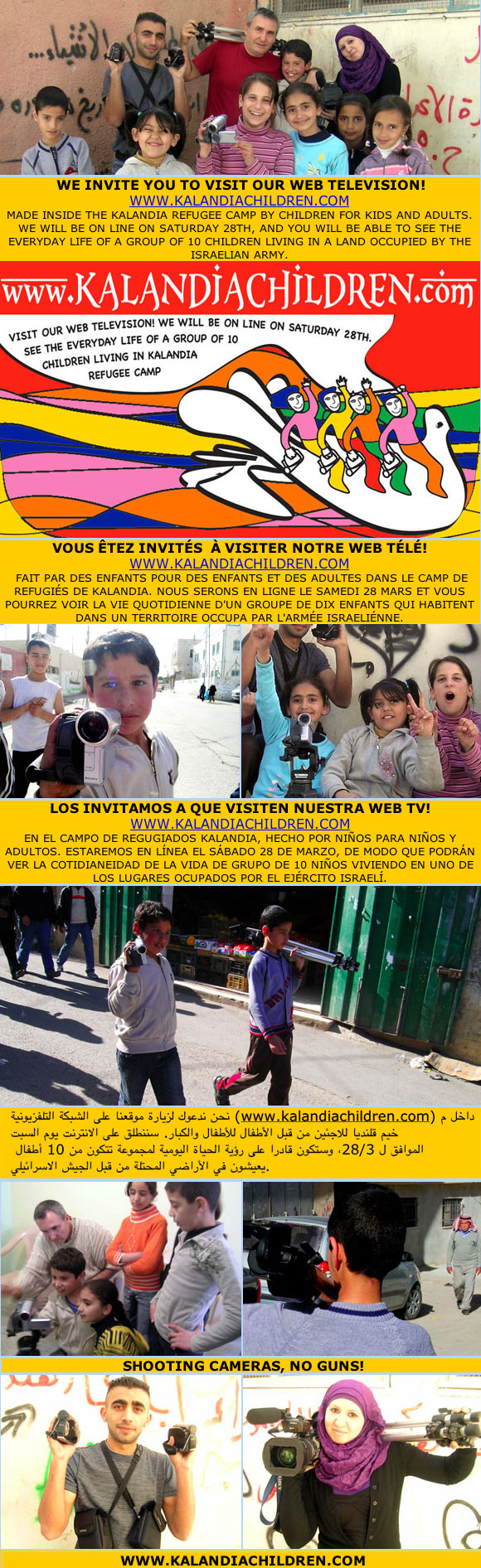
My friends at the Italian-Palestinian youth group “Wael Zuaiter” shared this incredible new creative initiative that was partly organised by the Italian NGO “Vento di Terra” (http://www.ventoditerra.org/). It’s the first Web TV program from the refugee camp of Qalandia and these kids ready to share pieces of their daily experiences with us. Armed with one camera (and they need more, so anyone who can help, please do!) we’ll get a child’s view of things, which is just as important a view as an adult’s if not more important! It just went on line two days ago, a few bugs need to be worked out before it is up and running to full capacity but it looks promising!

http://nuke.kalandiachildren.com/PressKit/tabid/487/Default.aspx


http://nuke.kalandiachildren.com/

What will happen next? Will Palestinian kids be duped into playing music to Israeli pilots who exterminated Gaza children with White Phosphorus?

By Khalid Amayreh in Occupied East Jerusalem

29 March, 2009


It is really hard to write on this subject without getting angry. We all know the extent to which Israel can be evil and satanic. After all, we Palestinians have been on the receiving end of Israeli savagery for decades.  


In fact, being thoroughly tormented and killed by the children, grandchildren and great grandchildren of the holocaust has always been and continues to be “the” Palestinians’ way of life.


However, for some Palestinians to allow themselves to be duped to sing and play music to their oppressors and child-killers is simply beyond the pale of human dignity.


It is at least as insulting and humiliating as some Jews were forced or duped to play music to SS, Gestapo and Wehrmacht soldiers during the Second World War. In both cases, the act was meant to humiliate the victims and rob them of the last visages of human dignity. 


And now, Jews in Israel are doing the same thing to Palestinians, Nazism’s vicarious victims.


Last week, a few innocent kids from the Jenin refugee camp were surreptiously taken to Tel Aviv to “cheer up and take part in peace-promoting activities.”


However, once there the kids were unceremoniously driven to a reception where they were made to play music and sing to “holocaust survivors,” some of them are former members of the Hagana and Irgun terrorist gangs who had taken part in the ethnic cleansing of Palestine and expulsion of Palestinians form their homeland.


God knows how much Palestinian blood did these so-called “holocaust survivors” shed in 1948 and subsequent years. Certainly, Deir Yasin, Tantura, Dawaymeh, and the numerous other massacres were not committed by UFOs. They were committed in cold blood by these very people our children are now cheering up.


Shame on us a thousand times!


Some of the kids were instructed to utter words that should never be uttered by the victims of Zionism. One of the participants reportedly dedicated a special song to Gilad Shalit, an Israeli soldier taken prisoner by Palestinian fighters in Gaza nearly three years ago. No mention, not even an allusion, was made of the estimated 10,000 Palestinian political and resistance prisoners languishing in Israeli dungeons and concentration camps. 


But the kids apparently felt they had to say anything they were asked to say in order to show gratitude for the Jewish “peace contractor” who got them out of the ghetto, otherwise known as Jenin refugee camp, even for a six-our outing in Tel Aviv.


I am not against showing genuine sympathy with the victims of the holocaust. However, a sympathy that is manipulated to justify, rationalize or even extenuate the crime against humanity that is Israel is worse than a crime if only because it serves to promote and perpetuate oppression.


As human beings, we Palestinians do sympathize with all victims of Nazism, Stalinism and imperialism, the wept, the over-wept, and especially the unwept who constitute the vast majority of victims.


Having said that, however, I strongly believe that no honest person under the sun has the slightest right to demand that we pay the price for what the Nazis did or may have done to European Jews nearly 70 years ago.


We didn’t send Jews to the ovens. The Germans did. We didn’t starve Jews to death as Jews are doing to us today in the Gaza Strip.


We didn’t incinerate Jews in Gas chambers as Jews have recently incinerated Palestinian children with White Phosphorus.


Hence, of all people in this world, Palestinians must never be made to feel guilty for what the Nazis and other Europeans did to Jews. I say so because a feeling of guilt, even a modicum of guilt, on our part, would be construed or misconstrued as a  vindication of Zionism, the Nazism of our time.


There are additional reasons that make the latest insensitive manipulation of Palestinian suffering especially ugly and dishonorable.


First, nearly all the young musicians who were taken to Tel Aviv came from the Jenin Refugee camp. For those who have forgotten, this is the very same refugee camp that Israeli tanks pulverized in 2002. According to eyewitnesses, Israeli tanks and bulldozers destroyed homes right on top of innocent civilians, including the physically handicapped, while dozens of innocent civilians were systematically massacred, very much like Jews were at Ghetto Warsaw. The massacre at the camp was so hideous that Israel refused to allow UN officials to access the camp to inspect what happened.


Well, again the Nazi analogy is inescapable. Just imagine surviving Jewish children from Treblinka or Bergen Belsen made to sing to SS soldiers!!


Second, the disgraceful concert in Tel Aviv comes on the heel of Israel’s genocidal assault in Gaza where Israeli warplanes showered the children, women and men of coastal enclave with White Phosphorus and other missiles and bombs of death while Israeli Jews were gleefully celebrating the “victory on Hamas” and Israeli rabbis preoccupied with classifying gentiles into “children of light” and “children of darkness.”


In Gaza, the Zionist Jews exposed their shame to all the people of the world by acting like primitive barbarians and murderous savages.


Hence, the utter shamefulness of sending Palestinian children to Tel Aviv to help Israel’s hasbara efforts whitewash Israel’s pornographic barbarianism in Gaza.


Finally, it is obvious that the PA bears much of the blame for this disgraceful event. The PA should never allow so called “cultural exchanges” and “cultural normalization” with the murderers of our children, the very state whose leaders and military commanders view us as “scum, vermin and animals” that ought to be exterminated.


Unfortunately, the PA itself encourages some demoralized Palestinians to endear themselves to Israel, even in the cheapest of manners.


The often cordial meetings and exchanging of kisses between Mahmoud Abbas and Ehud Olmert, the butcher of Gaza, leave one and only impression, not only on the children of the refugee camp in Jenin, but also on TV viewers around the world.


Perhaps the Israel artillery and war planes were showering Gaza with candy, not White Phosphorus!!!


This is probably the main message the organizers of the Jenin-Tel Aviv tour wanted to communicate to these miserable kids who are obviously having a hard time recognizing their fathers’ killers.

Commemorating 60+ Years of the Systematic Murder of Palestinian Land. The first part of a three part series for Land Day

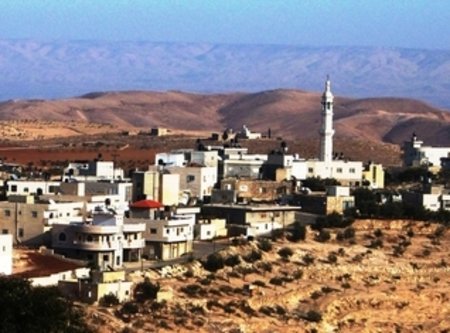
As I stood on the roof and watched Jerusalem stretch in front of me, with the sun reflecting on the golden Dome, I felt angry and felt how unfair the world is. I was born in Jerusalem, went to school there and practically grew up there knowing almost every corner, every street and every alley in it. I have more memories in Jerusalem than any other place in the world, all cherished ones. But now, I am not allowed into the city anymore because I am Palestinian. As I stood there, with tears in my eyes, I envied every Palestinian with an American or European passport, because they can come and visit Jerusalem. I envied every foreigner who can visit the city whenever they choose. I even envied the birds singing on the cypresses before me, because they could fly over Jerusalem and fill their eyes with its beauty and their lungs with its air. In my childhood, Jerusalem was the only major Palestinian city I knew well and loved. In the eyes and mind of a child, to me Ramallah was a cold city, Bethlehem was the “village” nearby, Nablus and Hebron were the places “to visit my uncles in Israeli prisons” and Jericho was too hot. Only Jerusalem was perfect: with its bustling Old City, the old bus station, Salah Al-Deen Street, Al Musrarah, the walk to the Notre Dame, the walk down Wadi Al-Joz and up to Al-Tur and the walk up to Ras El Amoud. I walked on the roof and saw the mountains on the Jordanian side, clearly visible during mild weather. Late afternoons, coming back home from school, one would witness a breathtaking sight going down the steep street in Sawahreh: a marvellous mixture of simple houses, some with old traditional domed roofs, barley fields or olive groves spreading against a curtain of mountains. Between the mountains and the last of the houses a strip of blue was visible. We always thought it to be the Dead Sea. Well, I personally still like to think of it as the Dead Sea. It was a combination of colours that rarely showed itself, but when it did, it was truly breathtaking.


To the south I could see Mount Herod in the distance. I have watched this artificial mountain since my childhood and always wondered at its shape. It always looked far away to be reached, but at the same time so close, an integral part of the view surrounding my home. I used to think about the impossibility of climbing that mountain, because it had steep sides, one would keep slipping and would never reach the top. I did “climb” that mountain years later, during the work on a TV documentary on Bethlehem. During the 2002 IOF invasion of the West Bank, my parents told me that Israeli fighter jets used to pass over Sawahreh on their way to Bethlehem. After a few minutes, the sound of explosions would rock the sky, as the IOF bombarded Bethlehem and the surrounding towns, villages and refugee camps. Since hearing this, every time I see Mount Herod I can’t help thinking of Israeli jets on their way to destroying yet another part of Palestine and kill innocent unarmed civilians. In Sawahreh, Israeli jets roaring in the sky were always a common thing. Some of Sawahreh’s vast lands had been confiscated for so-called “security reasons” and were used as a training area for the IOF. We would often hear sounds of explosions and the house would shake, or hear Israeli jets coming and going. One time, my sister, my brother and I thought that they were preparing for war, and since we had no army of our own, had no jets or tanks or bombs to protect ourselves, we held a meeting to decide on the best way to protect the family. The only solution we could think of was to build an underground shelter. I don’t know where we got the idea of a shelter from, since Palestinians have no shelters, but most probably from one of those WWII films the Israeli TV kept showing. We did start digging, using our hands and small pointy stones, but realized after a while what a lengthy and hard process that was, and instead decided that in case a war does break out we would use the water well as a shelter, i.e., after removing all the water.


One would think what a beautiful view, Jerusalem on one side, Bethlehem on the other with mountains and an imaginary sea in the background. Unfortunately, this scenery is interrupted by the Jewish illegal settlements Maale Adumim and Kidar, spreading themselves on Palestinian hills. Many Palestinian villages and town are surrounded by illegal Jewish settlements. Some are surrounded by settlements from one, two or three sides. Others are surrounded by illegal settlements and the Apartheid Wall. Sawahreh is surrounded by the illegal settlements of Maale Adumim from the northeast and Kidar from the east and by the Apartheid Wall from the west. Kidar settlement is the closest to us. Before the first intifada, Kidar settlers used to come and walk through our main street, among Palestinian houses. So sure they were of themselves, acting as if the land belonged to them. I remember once we were playing in the land, when a group of settlers walked up the street. We stopped playing and just watched them. I didn’t understand settlers and settlements much at the time, but I remember knowing that these people had no right to walk on our streets. We used to spend our holidays in Dheisheh refugee camp, where the IOF would shoot to kill little children, and then we would come back to Sawahreh, where settlers were walking our street. Those close to Kidar used to sell home-made white cheese and yoghurt to the settlers, who thought us too quiet and peaceful, so they called us “Kiryat Shalom” or the village of peace. It was something I always felt ashamed of, knowing that the settlers thought us too peaceful to bother with, while their army and their fellow fanatic settlers were attacking Dheisheh and killing people there. If the illegal settlers of Kidar were so very interested in peace with us, why did they steal our lands to expand their settlement, knowing that our livelihood depended on these lands? You can’t have peace with your occupier, because the only peace they will offer you is a masquerade, not a real and just peace. In Palestine, power cuts are a regular thing, and whenever we had no electricity and had to study using candle light, which often hurt our eyes, I used to look through the window and watch Sawahreh, Abu Dees and Ezariyyeh drown in complete darkness, while Kidar and Maale Adumim would be lighted like a Christmas tree. Even as a child this made me think of how unfair the situation was and that these settlers and these settlements don’t belong here.


I remember as a child how “far away” Maale Adumim seemed. But as I grew up, so did the illegal settlement. The danger of this expansion never really registered in my mind until one night I dreamt that I opened the window of my bedroom to find myself looking into the courtyard of a Jewish house. The settlement had eaten the land all the way from where it stood till our house, and our house and the land surrounding it was next. I woke up sweating and my heart beating fast. So real was the threat, I realized at the time, that I knew it was not a mere nightmare. The next day I went at the back of the house to the spot where one could get a direct view of Maale Adumim and tried to calculate how much time we had before my nightmare became reality. I thought we still had time to act, but I was mistaken. Since the 1990’s the settlements have been expanding and are eating more Palestinian land at an unprecedented pace. In this area there are several illegal Jewish settlements such as Maale Adumim, Alon, Almon, Kidar, Kefar Adumim and Mishor Adumim, with a combined population of some 40,000 settlers. The largest, Maale Adumim was established in 1975 on confiscated Palestinian land and lies 14 km to the east of Jerusalem. It has a population of 35,000 illegal Jewish settlers and a jurisdictional area of 50 km². Road networks have been also established to connect Maale Adumim and neighboring settlements with Jerusalem and with the Jordan Valley. Palestinian land would be confiscated, declared a “closed military zone” and later used for illegal settlement expansions.


On the day of my arrival to Palestine for a short visit, I watched in shock as I passed Maale Adumim at how huge it has become. Within the space of two years, since my last visit, it had doubled in size, to say the least. Standing there on the mountain top, with a wall surrounding parts of it, it reminded me of a fortress from the middle ages. Although I am a fan of fortresses, this one brought only anger and disgust. The lands opposite it, which I distinctly remember were planted with olive trees, had become bare land, the trees uprooted and the land destroyed to make way for more illegal settler houses and roads. At the entrance to Maale Adumim stood a single olive tree, as huge as life and older than any illegal settler on this land. It was clear that this tree had been uprooted from some Palestinian field, maybe even from our confiscated land, and replanted here. Macabre, I thought and could only shake my head at the sad view of that lonely olive tree. Olive trees are like Palestinians, they grow in groups, surrounded by family and friends. That tree stood there alone, a reminder to every Palestinian that this is what the so-called peace process had done to us, and that if this process is allowed to go on, every single Palestinian will end up like that tree, alone and uprooted.


The plan to expand Maale Adumim, known as the “E-1” Plan, which was initiated by Rabin in 1994 and approved in 1999, led to the confiscation of yet more Palestinian land. This Plan is an important part of the “Greater Jerusalem” scheme, which includes Maale Adumim, Beitar, H´Givat Ze’ev, Gush Etzion, the Ariel bloc, the Hashmonain bloc and the Jordan Rift, and aims at annexing large areas of the West Bank to Jerusalem. This plan expands the jurisdictional boundaries of Maale Adumim and its satellite settlements to the Israeli Jerusalem municipal boundaries, linking Jerusalem with surrounding settlement blocs and linking the Maale Adumim bloc with with other settlement blocs such as Pisgat Ze’ev, Pisgat Omer, Neve Ya’acov and the French Hill. Also, a wall is being built around Maale Adumim and its satellite settlements, which will completely encircle East Jerusalem and 61 km² of Palestinian land. The “E-1” Plan aims to completely cut off Jerusalem from the rest of the Palestinian Territories, disconnecting the geographic contiguity of Palestinian Territories by dividing the West Bank into two parts, thus ensuring that no viable Palestinian state would ever come to existence. Last year, roads were paved and a bridge, main junctions, public squares, police stations, checkpoints and side walls were built in the “E-1” area. This area will cover some 13,000 dunums confiscated from Palestinian villages around Jerusalem and is to house an additional 15,000 illegal settlers. Two Israeli-only roads will connect settler roads southeast of Bethlehem with roads to the northeast, including connecting Maale Adumim and other Jerusalem settlements with the Ramot Ashkol settlement. For the construction of these roads, tens of houses in Sawahreh, Abu Dees and Al Tour are to be demolished. To prevent Palestinians from entering Jerusalem or using Road Nr. 1 that passes through the E-1 and Road Nr. 60 that passes through East Jerusalem, an “alternative” road is being constructed for Palestinian use and is to connect the Southern West Bank with its Northern part. For the construction of this road, the IOF issued a military order in 2007 confiscating 1,128 dunums of Palestinian land from villages between Jerusalem and Maale Adumim, i.e. Sawahreh, Abu Dees, Nebi Musa and Al Khan Al Ahmar.


Blocking the southern entrance of Sawahreh is the “Container” checkpoint, which is now being expanded to become a permanent border-like crossing. Passing the checkpoint, one would not imagine what beautiful landscape lies behind the Israeli stone blocks and control tower. Locally, we call it “Barriyeh”, the wilderness or the prairies. Green meadows decorated with red poppies wherever one looks. My favourite spot there is a low area, surrounded by hills and naturally-formed stone structures. Here, running was not possible because of the tall vegetation that covered the place. We would imagine ourselves swimming and race each other or play hide and seek. Then, when we would feel hungry, we would have something to eat under the olive trees. Relics of family history decorate caves in that area and cherished memories of childhood lie behind the checkpoint, making them off-limit to us. The last time I went there was just before leaving for Germany and I had not set foot again. Our lands there, including the olive fields, which were a source of income for my family, were confiscated in 2003. Today, only those few who originally had their houses behind the checkpoint are allowed in, but no one knows how long before their houses will be demolished for some reason or other so as to close the area completely.


The “Container” checkpoint is a passage between the north and the south of the West Bank. It is one of more than 630 Israeli checkpoints and road barriers all over the West Bank, aiming to restrict Palestinian movement on Palestinian land. Travelling to the south, one would have to take the “Wadi Al-Nar” road. Wadi Al-Nar, the Valley of Fire, is most probably called so because of its steepness and the danger of driving there. It was a dirt road connecting Sawahreh with Ubediyyeh, rarely used except maybe by villagers travelling on donkeys. With the signing of the so-called peace process, Jerusalem was closed to most Palestinians and this road was used instead as a link left between the south and the north. If one is stuck behind a truck on that road, the meaning of “Valley of Fire” becomes clear, for when driving up the road, one has the continuous feeling that the truck will turn over any minute and everything behind that truck would be squeezed underneath it. As children we would follow the shepherds with their herds whenever we could. We would eat figs, search for snake nests in caves and play at the old ottoman stone circles. Every time we were there on the hills, we would go exploring a bit further. It was mostly steep hills, where we learned to slide slowly down a hill, using our left foot as a break. Here, there were no illegal settlements and no IOF soldiers, or at least they were not visible. When it was time to go home, instead of taking the direct way, we would go all around the hills, passing the “sacred river” to the old Sawahreh houses and further back home. The “sacred river” as we called it, was a small “river” running through the Wadi Al-Nar. Greenery was along both sides of this river, giving it a genuine river look, like those we used to see in cartoons. The vegetables growing around the riverbanks were double the size of the ordinary vegetables we would buy from the supermarket. Later, and to our great disappoint, we found out that the reason for the extraordinary growth of these vegetables was the waste water. This “sacred river” was actually the flow of waste water from Maale Adumim and other settlements in the area. Not only was their waste water contaminating our lands, their solid waste was being dumped and burned on our lands as well. Several studies have shown that illegal Settlements comprise a major environmental threat. Waste water and industrial waste from settlements is dumped on Palestinian lands, contaminating the soil and the water supply. Palestinian plans to treat waste water are usually rejected by Israel, and in one incident Israel insisted that a treatment facility for Tulkarem be built on the other side of the Green line, for no other reason than to use the treated water for its own interest.


During my last visit to Palestine, I wanted to see these hills again and enjoy the beauty of a Palestine that was free of illegal settlements and IOF checkpoints. It was late afternoon and as I looked around me I saw Mount Herod in the distance, with Palestinian villages decorating the hills all the way from there to Jerusalem. And opposite them, Palestinian hills extended all the way to meet the Jordanian mountains in the horizon. There was no Apartheid Wall, no IOF checkpoints and no settlements. Although I knew they were there, breaking the natural bond between Jerusalem and the rest of the West Bank, they were not visible from where I stood. I saw the old stone houses with the traditional domed roof, a herd of sheep with a shepherd who was playing the flute, the sunset adding a magical touch to the whole landscape, and there, at that moment I felt what it would feel to live in a truly free Palestine. I started taking photos and wondering how long before the Israelis would wipe out this landscape and all traces of Palestinian existence here. I went home, thinking that the Palestine I grew up in is not the Palestine of today. The Palestine of today is the rest of the so-called peace process with its illegal settlements, the Apartheid Wall, the IOF checkpoints and “Herrenstraßen” that are eating Palestine from inside, like a cancer, destroying the land piece by piece. I remembered that lonely olive tree in front of Maale Adumim and hoped that those still disillusioned by the “peace process” would wake up and act before it was too late.


Sources:

http://www.arij.org

http://www.peacenow.org

http://www.poica.org

http://www.btselem.org

http://www.imemc.org


In its increasingly rabid efforts to consolidate control of traditionally Arab-East Jerusalem, Israel this week moved to suppress Palestinian cultural activities associated with the city being declared the capital of Arab culture for 2009.

On 19 March heavily armed paramilitary police violently dispersed a meeting at the Ambassador Hotel in East Jerusalem, confiscating posters, leaflets, placards and computers.

Israeli police also raided schools, social clubs and community centres to foil activities celebrating Arab culture in the occupied city which Israel considers its “united and undivided capital”.

Several organisers, including East Jerusalem lawmaker Hatem Abdel-Qader, were arrested on charges of disturbing peace.

Israeli security forces cordoned off East Jerusalem by deploying soldiers at all entrances to the city. They turned back visitors, including several delegations from Arabian Gulf states, including Kuwait and the United Arab Emirates.

Frustrated by the draconian Israeli measures the Palestinian Authority, the main organiser of the festivities, decided to transfer the main event to Bethlehem, a few kilometres south of Jerusalem. Hundreds of PA officials, foreign dignitaries, religious leaders and diplomats arrived on 21 March to listen to a speech by PA President Mahmoud Abbas.

Abbas reasserted his commitment to establishing a viable Palestinian state, with Jerusalem as its capital, on all Palestinian land Israel occupied in 1967.

“We will continue to reject the Israeli policy of Judaising Al-Quds Al-Sharif [Jerusalem]. And we will not hold peace talks with any Israeli government that rejects the two-state solution,” said Abbas, alluding to Israeli designate-Prime Minister Benyamin Netanyahu.

The Palestinian leader, who recited a few verses of the Quran pertaining to the status of Jerusalem in Islam, pointed out that Jerusalem was the key to peace in the region and the world, saying that peace will not prevail unless and until the Israeli occupation ends completely.

Addressing the Arab-Muslim world, Abbas said: “I urge our Arab and Muslim brothers to come to the rescue of Jerusalem, protect Jerusalem from the act of rape to which the city is being subjected… Jerusalem is being Judaised by force, its Arab identity is being obliterated, its history is being falsified, its people are being oppressed and tormented. Its homes are being demolished. Jerusalem is the beginning and the end, it is the ultimate address of peace. Jerusalem is the capital of Palestine.”

Addressing Israel, Abbas said: “Peace can’t be made through the building and expansion of settlements, brute force and military insolence. What happened in Gaza recently reflects the Israeli mindset, and with such a mindset, it is clear there can be no peace.”

Abbas’s desperate but defiant words epitomised the situation across the occupied Palestinian territories but especially in Jerusalem, where Israel is planning to destroy hundreds of Palestinian homes.

The planned destruction of the Silwan neighbourhood in the heart of the city has been described by PA officials as “demographic decapitation”.

“They are indulging in ethnic cleansing in broad daylight. They are chasing Palestinians out of their homes. They are trying to decapitate Arab existence in East Jerusalem, step by step, home by home, neighbourhood by neighbourhood, while they continue to lie about their desire for peace,” said Rafiq Al-Husseini, a senior aide to Abbas.

Asked by Al-Ahram Weekly what the PA was going to do to prevent Israel from carrying out the wholesale destruction of the Silwan neighbourhood [the goal is to build a park and recreational facilities for Jewish settlers in the surrounding areas], Al-Husseini said the PA would try to mobilise the international community to stop Israeli crimes.

During her recent visit to the occupied territories US Secretary of State Hillary Clinton described the planned demolitions as “unhelpful” and “incompatible with Israeli commitments under the roadmap”.

Israeli officials were unimpressed by Clinton’s warnings. Jerusalem’s Jewish mayor, Nir Barkat, described her words as “a lot of air”, claiming she had been misled by the Palestinians.

Barkat, an extreme right-winger, vowed to destroy Arab homes en masse, saying that “what we do in our capital is none of America’s business”.

Israeli efforts to obliterate the Arab-Islamic-Christian identity of Jerusalem began immediately after 1967. Four days after seizing the city Israeli army bulldozers razed the Maghariba and Sharaf neighbourhoods. The Palestinian inhabitants of the two neighbourhoods were expelled at gunpoint. Two mosques, two religious schools or Zawiyas and 135 houses were destroyed.

Several months later Israel seized the Harat Al-Maghariba for “public use” and built a large plaza in front of the Buraq — the Wailing or Western — Wall. The heart of Al-Maghariba and the adjacent, smaller Harat Al-Sharaf were both Islamic Waqf (religious endowment) properties dating back to the time of Salaheddin Al-Ayoubi (Saladin).

According to Palestinian sources Israel has demolished as many as 700 homes in the old town alone, forcing many inhabitants to seek shelter outside the boundaries of the city, e.g. in the West Bank.

Since 1967 Israel has confiscated 34 per cent of East Jerusalem for “public benefit” and designated 44 per cent of the occupied Arab town as “green space”. Nine per cent of the city was confiscated for the purpose of building settlements, leaving only 13 per cent of the original, built up Arab area, for the Palestinians.

In addition Israel has adopted a number of aggressive measures aimed at forcing the town’s Arab inhabitants to leave. These include imposing excessive taxes on real estate, including homes, withholding vital municipal services from Jerusalem’s Arabs in order to force them to relocate and denying residency rights to as many as 20,000 Arabs living in the city.

The Israeli authorities have continued to deny Arabs building licences, exacerbating a housing crisis in the Old Town and surrounding Arab neighbourhoods.

The systematic destruction by Israeli municipal authority of “illegally-built” homes pushed thousands of Jerusalemites to the brink of despair.

Adnan Al-Husseini, the nominal Palestinian governor of Jerusalem, described Israeli measures in Jerusalem as a “full fledged demographic war”.

“The Israeli goal is very clear. It is to force as many Palestinians as possible to leave the city and sell their property to Jewish interests.”

Al-Husseini said Israel was following a variety of tactics to achieve its strategy, including psychological and economic pressure, heavy taxation, physical coercion and harassment and financial incentives to force Arabs to sell their properties. Jerusalemite Arabs were clinging to their city, he said, despite Israeli efforts to curtail Arab demographic growth.

The Palestinian population of Jerusalem has grown extensively since the beginning of the occupation in 1967. Today, the total population of Jerusalem (East and West) is estimated at 720,000, including 475,000 Jews (66 per cent) and 245,000 Arabs (34 per cent).

As many as 260,000 of the Jewish population of the city (54.7 per cent) are living in 34 colonies established in and around East Jerusalem since 1967.

Maali Adomim, Pisgat Zeev, Har Homa and Gush Itzion are among the largest of these settlements.

Israeli demographic experts predict the Palestinian population will make up 40 per cent of the town’s total population by the 2020. It is to forestall this possibility that Israel has been making frantic efforts to confiscate more Arab land in order to build Jewish settler units.

According Israeli sources tenders for building more than 25,000 settler units have been issued since the Annapolis conference in 2007.

Earlier this month the Israeli group Peace Now revealed that the Israeli government was planning to build more than 73,000 units in the occupied West Bank, most of them in existing settlements surrounding East Jerusalem.

The group, which monitors settlement expansion in the West Bank, said the new plans would lead to the doubling of the Israeli settler population and scuttle any prospects for the creation of a viable and contiguous Palestinian state.

Among the most dangerous and explosive aspects of Israel’s efforts to Judaise East Jerusalem is the ongoing excavation and digging beneath the Al-Aqsa Mosque, Islam’s third holiest shrine.

According to Waqf officials, digging beneath the Al-Aqsa Mosque is seriously undermining the foundations of Islamic shrine and the nearby Dome of the Rock.

Sheikh Mohamed Hussein, head of the Supreme Muslim Council in Jerusalem, warned that it was only a matter of time before a “major disaster” occurred as a result of Israeli diggings in the vicinity of the Haram Al-Sharif (Al-Aqsa Mosque) esplanade. He accused the Israeli authorities of constructing subterranean tunnels beneath Islamic holy places without any consideration for the safety of Islamic shrines. “I can say without the slightest exaggeration that the Al-Aqsa Mosque is facing the danger of collapse as a result of these excavations.”

Islamic Palestinian leader Raed Salah was even more dramatic in voicing his concerns. “The Al-Aqsa Mosque is facing urgent danger. A medium earthquake could cause the collapse of the mosque.”

Salah was arrested by Israeli police on Monday, 23 March, charged with “disturbing the peace” and “inciting against Israel”.

In recent years the Israeli security authorities have allowed extremist Jews to enter the Haram esplanade and perform Jewish prayers and other rituals.

In 1967 the Israeli army chief rabbi, General Shlomo Goren, tried to convince a commander of the conquering forces, Uzi Narkis, to blow up the mosque “once and for all”.

The story was told by Narkis shortly before his death in 1997 and quoted by Avi Shlaim, an Israeli historian, in The Iron Wall: Israel and the Arab World.

“There was an atmosphere of spiritual elation. Paratroopers were milling around in a daze. Narkis was standing for a moment on his own, deep in thought, when Goren went up to him and said ‘Uzi, this is the time to put a hundred kilograms of explosives in the Mosque of Omar and that’s it, we’ll get rid of it once and for all.’ Narkis said ‘Rabbi, stop it.” Goren then said to him, ‘Uzi, you’ll enter the history books by virtue of this deed.’ Narkis replied, ‘I have already recorded my name in the pages of the history of Jerusalem.’ Goren walked away without saying another word.”

Two weeks later the Israeli occupation army seized the key to one of the gates of Al-Aqsa Mosque (the Moroccan Gate).

Numerous efforts by Jewish extremists to destroy the Islamic shrine have been reported over the years.

When the women came and told her to leave what she was doing and come and sit in front of the house with them, my grandmother knew what was to come. They sat outside and didn’t talk much. My uncle had been shot in the chest by the IOF that afternoon, and was at that moment being operated. He was in a critical condition, the doctors had told the men who had brought him to the hospital. Some were sent back home to prepare the family for the news and to prepare the refugee camp to welcome the hero, in case the worst happened. Although hope dies last, it was a necessity to prepare everything for a quick funeral and a quick burial. The Israeli army had been known to take bodies of Palestinian martyrs and steal their organs without the Palestinian family’s consent. The organs would then be given to Israelis who needed them. So a Palestinian killed by the IOF, mostly for no reason at all or for defending his country, would be labelled as terrorist by Israel and the biased media, while his organs would be used to save Israeli lives. In other countries, stealing the organs of dead people is considered a crime, but as usual, it doesn’t apply to Israel.


My grandmother sat quiet the whole time, no tears and no words. It was her youngest son, they said. His elder brothers had one time after another been imprisoned for everything that Israel considered “terror”, that she decided at least to spare the youngest the inside of an Israeli prison. Every day she would tell him to go to school and come back directly. “don’t go here or there”. I heard my mother say one time “she thought this way she was keeping him safe from the Israelis; everyday coming back from school after classes were over, and keeping him at her side most of the time.” Till one day, the boys came and told my grandmother that her son had been arrested. ”Arrested for what?” “he was throwing stones.” He hadn’t even bothered to go to school that day.” One of my other uncles said laughingly when the story was brought up once: but we had prepared him for this. And everyone laughed. I laughed too, because I have been though this process as well. Actually, to us kids, it was just another game. One of those bizarre refugee camp games, like the “UNRWA restaurant” game, where we would play little refugee kids standing in line and waiting for our daily portion of a slice of bread and small slice of tomato with salt, and being shouted at by the “UNRWA employee”. The other game, which was to prepare us for future imprisonment by the IOF was the “confession game”. Each one of us would be “tortured” to strengthen our resistance and prevent us from confessing anything in case we are interrogated by the IOF. There was really no “torture” in this game, because there was no real beating. We would be shouted at in a funny way, and the one among us to act the “IOF soldier” would be mimicking Israeli soldiers trying to be brave, but who are in fact afraid of us, little children. We would laugh while being “tortured”, for it was mostly fun for us. Although the game would not really prepare anyone for the barbaric Israeli interrogation and torture, in some way, the game was educational. It gave us the feeling that we are stronger than the IOF and that despite all their weapons, they feared us. So, we would just play being beaten by the IOF, and the one playing the IOF soldier would ask us continuously to confess and we would refuse. He would slash us, though not harshly, on the soles, and demand we confess. We would refuse, laughingly, because for us it was a game, a game that would prove useful one day.


That day, no funeral took place, for my uncle had made it. He had a strong will to live. But every time I think of that moment, I think about my grandmother. The 60 year old woman, who used to divide her week according to visiting days in Israeli prisons. Before one of them was released, another would be arrested, so that they rarely gathered at a dinner table. We were all used to it, not seeing all my uncles at the same time. I rarely heard my grandmother complain, but it was clear to everyone how much she loved her family and how sad she was that they weren’t all around her. She didn’t have to tell her children to go and demonstrate. It was a natural reaction to what these children themselves saw and went through, and it was the love of the land planted in their heart by my grandmother. She would often talk about Jrash, the village from which she and her family and all the residents were ethnically cleansed by the Zionist terror organizations. They were forced to move from one place to another, until they finally reached what is now Dheisheh refugee camp. There she tried to reconstruct her original home by planting some trees in the small piece of land near the UNRWA rooms they were to live in.


The life of my grandmother is typical of the lives of many Palestinian mothers. She was born in a small picturesque village in Palestine, where she grew up, got married and started a family. She would take care of her home, and help the family with the fields. She would care for her small garden and the apple trees which she loved most and would make marmalade for the winter. When the Zionist terror organizations started implementing their plan of ethnically cleansing the Palestinian population, Palestinian villages were attacked one after the other, and horrific massacres took place. The residents of Jrash were finally forced to leave, but not before they fought heroically. My grandparents often talked about these days. During my last visit to Palestine a couple of months ago, I listened to my grandfather as he talked about the fight with the Zionist groups. With sharp memory, he mentioned such details, that for a few seconds I could feel myself there, with them, 60 years ago.


A number of times my grandmother was beaten by the IOF soldiers, some of whom were younger than her own sons and who didn’t care that she was an elderly woman. When IOF soldiers would attempt to arrest someone in the refugee camp, she would hurry with the other women and try and stop them. When Zionist settlers would attack the refugee camp, she would carry the tree stem she hides behind the couch and go protect the camp alongside the men and women. And in the early mornings of the day, when everyone is still fast asleep, after finishing the morning prayer I would hear her asking God to protect her family, her relatives, her neighbours, the refugee camp, the Palestinians and the whole world. I heard her day after day asking forgiveness for the whole world.


In Palestine mothers are sacred. Every one of us has several mothers: the mother that gave birth to us, the olive tree, the land and the mother of all: Palestine. And a Palestinian mother isn’t just a mother to the children she gives birth to, she is mother to all Palestinians. When a Palestinian is being arrested by the IOF, women of all ages will be surrounding the soldiers within seconds, trying to free the prisoner. And for that, sometimes they pay a heavy price, like the 60 year old Mariam Ayyad from Abu Dees. On the night of 20th of September 2008, IOF soldiers broke into her house. After arguing with her, the old woman was repeatedly hit and thrown on the ground by the soldiers until she died in front of her children and grandchildren. During curfews, it is mostly women who would move carefully from one house corner to another and from one street to the other and distribute wheat and milk. When young masked men wanted to go from one place to another, they would be assisted by these mothers, who would check that the roads were clear of IOF soldiers. And when one of their millions of children gets killed by the IOF, they all gather and mourn as one single mother, that it becomes difficult to figure out which one of these mothers is the martyr’s mother. They are the protectors, the helpers and the witnesses of Israeli brutality, for many of them not only carry the pain of losing their children, they carry the scars of more than 60 years of Zionist terror and destruction.


During the Nakba of 1948, Zionist terrorists massacred Palestinians indiscriminately. Even women and children, who are protected during wars under all human laws, were killed in a brutal way. Accounts of the Deir Yassin massacre mention that among the 254 Palestinians victims were 25 pregnant women who were bayoneted in the abdomen while still alive. Another 52 children were maimed in front of their mothers before having their heads cut off by the Zionist terrorists. After the village of Beit Darras had been surrounded by Zionist terror groups and further Zionist mobilization was on the way to occupy the village, the Zionist terror groups called on the Palestinian residents to leave the village safely from the south side. The villagers decided that it was safer for the women and children to leave, since it was the village the Zionists wanted. Upon leaving the village, all the women and children were massacred by the Zionist terrorists. Kafr Qasim, Qibya and many other massacres carry the same pattern of killing unarmed mothers and their children. Other mothers lost their children, and many their lives, after being forced out of their homes to wander the hills of Palestine in search of a safe spot.


The suffering and pain of Palestinian mothers continues till today. Palestinian mothers, including the elderly and the sick among them, are often humiliated at checkpoints in front of their children, and pregnant women are delayed, causing many to give birth at these checkpoint. Women are not only delayed at checkpoints, they are often prevented from reaching hospitals, causing miscarriages and even the death of some of women and infants. Many unnamed children are stillborn at Israeli checkpoints after unnecessary delays or after their mothers were forced to deliver on the dirt road or inside cars at the checkpoint. A report of the Palestinian Ministry of Health published in October 2006 states that since the beginning of the second Intifada in September 2000 some 68 pregnant women gave birth at Israeli checkpoints, leading to 34 miscarriages and the death of four women. In 2002, in two consecutive days two pregnant women on their way to hospital were shot and injured by the IOF soldiers at a checkpoint in the Nablus area. One of the women lost her husband who was shot on the neck and the chest. Others are forced to give birth at home, despite fear of complications because they fear they will be stopped at checkpoints and won’t make it in time to the hospital. In Azzun Atma near Qalqilya pregnant women are even forced to take up residence outside the village until they deliver out of fear that they might not be able to get the necessary medical treatment. The village, encircled by the apartheid wall, is separated by a gate from the rest of the West Bank. This gate is not manned at night, making the village a prison to its residents. According to a B’Tselem report, alone during 2006 some 20 out of 30 pregnant women from Azzun Atma were forced to relocate outside of the village because of their pregnancy.


IOF soldiers don’t hesitate in arresting Palestinian mothers to be used as hostages to pressure wanted Palestinians to give themselves up. In its report “Behind the Bars: Palestinian Women in Israeli Prisons” published in June 2008, Addammeer, Mandela Institute and the Palestinian Counselling Centre state that “As of May 2008, over 9.080 Palestinian political prisoners remain in Israeli prisons, detention facilities and camps; of those 73 Palestinian women (including 2 girls aged 16 and 17 of a total of 327 minors, and 24 mothers with a total number of 68 children.” Many of the prisoners are held without any charges, and are subjected to torture, humiliation and intimidation. There were four cases of women giving birth inside Israeli prisons under difficult conditions. These women had their hands and feet shackled to their beds. They remain so until they enter the delivery room and are chained again after they deliver.


Palestinian mothers are not only to suffer the loss of their children, husbands and other family members, they themselves are also targeted by the IOF. According to Miftah 7141 Palestinians had been killed by the IOF during the period from 28th September 2000 till 28th February 2009, 1138 of whom were children and 581 were women. A recent report of the Palestine Centre for Human Rights on Israel’s war on Gaza confirms that “Over the course of the 22 day Israeli assault on the Gaza Strip, a total of 1,434 Palestinians were killed. Of these, 235 were combatants. The vast majority of the dead, however, were civilians and non-combatants: protected persons according to the principles of IHL. PCHR investigations confirm that, in total, 960 civilians lost their lives, including 288 children and 121 women. 239 police officers were also killed; the majority (235) in air strikes carried out on the first day of the attacks. The Ministry of Health has also confirmed that a total of 5,303 Palestinians were injured in the assault, including 1,606 children and 828 women.” Every single child killed had a mother. Human rights organization talked in their reports about mothers being killed together with their children, others witnessing the killing of their children and not able to prevent it, while others died in front of their children. Some of these mothers lost not only one child, but several. Of the many war crimes committed by Israel in Gaza, one horrific story tells the fate of a Palestinian mother of 10. While sitting with her children, the IOF soldiers entered her house and demanded she choose five of her children to “give as a gift to Israel”. After the woman screamed in horror, the IOF soldiers told her they would choose themselves and then killed five of her children in front of her.


Palestinian mothers have been actively participating in resisting the occupation. They are the first to organize sit-ins in front of international organizations and hold marches demanding the release of their children from Israeli prisons or protesting the brutality of the Israeli military occupation. They visit their sons in hospitals and in jails, despite the long wait and the humiliation they endure on the hands of the Israelis jailers. Also, many of these mothers are the supporters of their families. When the father or son is arrested or killed by the IOF, it is the mothers who take on the burden of providing for their families. Those among them who have a piece of land would plant it with vegetables and herbs, to be later sold to neighbours or at the local market. Others use their embroidery skills to stitch Palestinian tradition dresses “thob”, scarves, shawls and pillow covers. They hold their families together, particularly in difficult times.


Biased media, serving only Zionist propaganda, ignores the suffering of Palestinian  mothers under Israeli occupation and instead often portrays them as heartless women, who send these children to the streets and encourage them to throw stones so be killed and then celebrate their death. Palestinian parents encourage their children to study and get a good education and build a better future for themselves. Some parents even lock their children inside the house to prevent them from participating in demonstration or any other kind of activity against the IOF because they know the brutality of the IOF and out of fear they might be killed by Israeli soldiers or settlers. Parents work hard to spare their children the suffering they themselves endured under the Israeli occupation. But as long as the Zionists occupy Palestine, Palestinian suffering will continue, and generation after generation will seek to get themselves rid of this brutal occupation, no matter how hard the parents try to keep their children away from it. Living in Palestine, and being confronted with Zionist terror every day, one is not in need of parents or teachers to form an idea about this Zionist state and decide to demonstrate for a better future. That is why many join demonstrations or get politically active without telling their parents. In many cases it is when the children get arrested or are killed that the parents first know of their children’s involvement in resisting the occupation. Palestinian mothers who lose their children often appear composed on TV and in the news, and if asked, most of them talk about their martyred children in pride and calm and without shedding a tear. It is behind the camera that they show their sorrow and anger at the loss of their beloved ones. Palestinians know that these mothers want to send a message to Israel: despite the suffering and the pain, you won’t break us, ever. Few journalists bother to visit these mothers days after their children have been killed. Many of them visit the grave of their killed child daily, and others keep their room as it was when they still lived there. Few reporters bother asking these mothers what memoires they have kept of their children. If they did, they would be shown clothes, hair brushes, notebooks and pictures, all soaked in tears. These mothers would have freely sacrificed their lives to save their children from death on the hands of the IOF and give them a future empty of Zionist occupation.


Mothers are sacred in Palestine because they are the personification of Palestine: the homeland and the mother of all Palestinians. It is the love of this land that is handed over from one generation to the next. Whenever in Dheisheh, we often sat with grandmother as children, listening to her talking about Palestine, the Nakba, the Naksa and the life in a refugee camp. She would talk about her mother and her grandmother, about her brothers and sisters, about my grandfather, and about her children. She was strong and was always there for her family, even at times when she herself was very weak. She was the safe island everyone seeks and the cave that sheltered us from the storm. Even long after her death, I still often think of her and ask for her guidance. She passed down her strength, steadfastness and kindness to her children. My mother continued the tradition of connecting us to the Palestinian landscape. As children, she and my father used to sit with us and tell us stories about Palestine, the history that one would not find in book, the history of the real people who lived on this land and appreciated it. For me, the personal experiences of my grandmother and mother are priceless. I am thankful to my grandmother and my mother for introducing me to a Palestine that was unknown to me, to parts of our history that others work hard to delete, to a heritage that is mine forever. Through our mothers Palestine is celebrated every single day.


In his poem “My Mother”, late Palestinian poet Mahmoud Darwish said:

I must be worth my life

At the hour of my death

Worth the tears of my mother


Sources:

www.pchrgaza.org/h

www.miftah.org

www.imemc.org

http://mecaforpeace.blogspot.com/2009/01/in-gaza.html

2008 marked the 60th anniversary of the establishment of the state of Israel and the simultaneous destruction of Palestinian civil and political society. The two events are as intimately connected as two sides of a coin, yet each side offers a distinct narrative that remains at odds with the accounts of the other. Feelings of belonging and claims of ownership irrevocably separate, yet permanently connect Arabs and Jews in their struggle for a land that is called Palestine by one group and Israel by the other.  Each of the two cultures wants to hold on to every inch of land claimed by its opponent. The Palestinians strongly feel that they belong to the land, while the Israelis insist that the land belongs to them.

The narrative of displacement and experiences in exile of the modern Palestinians remains relatively unfamiliar to most Westerners and especially to the majority of Americans. By contrast, Israel’s narrative of rebuilding a homeland for the Jews has been deeply imbedded in the Western psyche and continues to dominate the political discourse regarding the Palestinian / Israeli conflict. The documentary films we create at SittingCrow Productions explore the personal narratives and artistic expressions of Palestinians. 

Some of the films that we have completed, as well as others that are currently in progress, present the memories of a small group of men and women selected from an aging and rapidly dying generation of Palestinians who directly experienced the catastrophic ethnic cleansing of their homeland in 1948. They are referred to as the generation of the Nakba (the Arabic term for the Great Catastrophe that began in 1948) and are the men and women who directly experienced the destruction of Palestinian civil and political society as well as the ethnic cleansing of 85% of the Palestinian population from the land that became Israel in 1948. The survivors of that generation are now in their 60’s, 70’s, 80’s and 90’s. Many still live in refugee camps in the West Bank, the Gaza Strip and neighboring Arab countries, while those who were not expelled in 1948, or managed to return to their homeland, live in Israel as Arab citizens of the Jewish State. Their stories have seldom been recorded, and their experiences and memories of life before, during and since 1948 are rapidly disappearing as that generation ages and dies.

Other films that we are producing at SittingCrow look at Palestinian men and women who use art, poetry and dance as a way to rejuvenate the traditions of a shattered culture and to revive a history that has long been suppressed and denied. Their art bridges the shattered past of Palestinian society with the tragic present of life under occupation and reaches for a desired future of peaceful existence. 

During periods of extended political conflict, art can often be the best way for a society under the stress of cultural annihilation to sustain itself, critique its attackers and project its historical identity to the world. This is very much the case in Palestine today, where art is seen and used as a tool of cultural survival. Driven by a desire to persevere as a historical culture in the face of an extended military occupation, the visual, literary and performing arts are flourishing in complex ways in Palestine. 

The recent and current projects at SittingCrow Productions are a continuation of the focus on displacement, exile and identity construction that have been at the core of my artwork over the past two and a half decades. During the past two years, those topics have been developed and presented in the form of documentary films. Prior to that, these issues were explored and continue to be presented in the form of paintings and drawings. My name is John Halaka, I am a Visual Artist and the founder, creative director and producer of the work that comes out of SittingCrow Productions. I am also a Professor of Visual Arts at the University of San Diego. As an activist artist, my creative work serves as a vehicle for meditation on personal, cultural and political concerns. I present personal narratives in my films and create allegorical images in my paintings in order to raise questions, for myself as well as for the viewer, about some of the pressing issues of our time. Our goal at SittingCrow is to present the viewer with complex and seldom heard narratives that compel her/him to reflect on their relationship to the cultural, political, historical and emotional issues presented.

Our films are designed and intended to be screened at community forums, universities, schools and religious centers, where they can provoke discussion and reflection regarding the Palestinian/Israeli conflict. If you would like to screen one of our films and invite me lead a discussion regarding the past, present and future of the Palestinian/Israeli conflict as well as our relationship to that conflict, you can e-mail me at sittingcrowproductions@gmail.com or call me at 619.260.4107. I welcome your comments and feedback regarding the films and this website. Please feel free to email me with your comments and questions.

Our projects at SittingCrow Productions have been funded through small grants and community contributions. We greatly welcome and need financial support from the community. If you would lilke to contribute to one of our current productions please contact me at sittingcrowproductions@gmail.com or call me at 619.260.4107.

For additional information about my painting and drawing projects please visit my other web site at www.johnhalaka.com.

Thank you for your interest and your support.

John Halaka
SittingCrow Productions


Filmed account of how Palestinians attempt to harvest their olives in the face of every sort of vexation and obstacle. Very telling in this video by Amos Zuckerman are the comments that were broadcast on Israeli TV from settlers and soldiers. See it on PTT TV https://wewritewhatwelike.com/wp-content/uploads/2009/03/destroyed-trees-thumb1.jpgptt-tv/

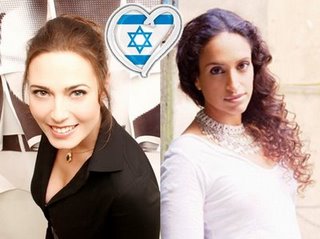
The Palestinian Campaign for the Academic and Cultural Boycott of Israel has this to say about Mira Awad, the Palestinian-Israeli artist performing with Noa at the Eurovision Song Contest:

PACBI — Ramallah, Occupied Palestine, March 8, 2009

Palestinian artists and intellectuals in the occupied West Bank and Gaza Strip are disappointed by the news of your intention to represent Israel in the Eurovision Song Contest. The Palestinian Campaign for the Academic and Cultural Boycott of Israel (PACBI) is writing to urge you not to participate on behalf of Israel in this contest.

To represent Israel in the Eurovision Song Contest will serve to polish the international image of an aggressive occupying state that has long been engaged in ethnic cleansing and crimes against humanity. It will communicate to the rest of the world that Israel’s war crimes and violations of international law are acceptable to us as Palestinians! May we remind you of some of the actions of the state you will be representing: the ethnic cleansing of more than 750,000 Palestinians in 1948; the subjugation of 3.6 million Palestinians to a system of occupation and apartheid in the West Bank and Gaza Strip since 1967; the long history of extra-judicial killing of Palestinian leaders and activists; the imprisonment of tens of thousands of Palestinians since 1948; the building of the apartheid wall; the recent vicious attack on occupied Gaza and the murder of more than 1,440 people (of whom at least 400 were children).

Your performance in this contest will be telling Palestinians that their suffering – the product of colonialism and racism – doesn‘t matter. You will be giving a slap in the face to each and every Palestinian singer, musician, artist, filmmaker, writer, poet, as well as regular Palestinians, who have to struggle to overcome Israel’s deliberate efforts to silence their voice.

You may feel that it is important for you to represent Israel to demonstrate the full spectrum of Israeli society, which includes Palestinians living in Israel. This is utterly misguided. Until Palestinians living within Israel have full rights and do not suffer systemic discrimination and violation of their human and political rights, Israel has no right to portray itself as a healthy, multicultural society. And until it ends its occupation of Palestinian lands and complies with international law, it should be boycotted by all artists. You must realise that if you participate in such a high-profile event you will be seen not only as an individual singer, but as the representative of other Palestinian artists as well as Palestinians at large. Can you not see that by representing both occupier and occupied you will shatter the Palestinian message to the rest of the world?

It is also particularly appalling to us that you plan to perform alongside the singer Achinoam Nini, who has issued a letter blaming Israel’s brutal attack on the Gaza Strip on Hamas. She wrote: “I can only wish for you that Israel will do the job we all know needs to be done, and finally RID YOU of this cancer, this virus, this monster called fanaticism, today, called Hamas.” These words demonstrate that Nini expresses the colonial attitude of the occupier; she blames the victims for trying to defend themselves and she thinks she knows what is better for the victims than they do themselves – even if this means killing 1,440 and injuring more than 5,300 people.

The small Israeli minority who truly understands the colonial nature of Israel and its actions could not remain silent. Udi Aloni, Israeli film director replied to her: “You use your loving words in the service of your conquering people and call upon the Palestinians to surrender in a tender voice. You bestow upon Israel the role of liberator. Upon Israel – that for over 60 years has been occupying and humiliating them.”

Your singing partner has justified the indiscriminate killing of Palestinians, actions which led the UN agencies and human rights organizations to call for war crimes investigations. What is worse, now you will be a partner in this justification, in front of the entire world. Whether you like it or not, your performance will be used to help Israel whitewash its atrocities in the Gaza Strip.

As you may know, virtually all Palestinian filmmakers, artists and cultural figures have called on their colleagues worldwide to boycott Israeli cultural and arts institutions due to their complicity in perpetuating Israel‘s occupation and other forms of oppression against the Palestinian people. In response, in the past months, throughout the world, groups of artists, singers, film-makers, students and academics, have consolidated their efforts to show solidarity with the occupied Palestinians, to condemn Israel‘s war crimes and its apartheid regime, and to call for effective political action such as boycotts, divestment drives, and sanctions (BDS).
We call upon you, as a Palestinian, to at least emulate the actions of artists, including Bono, Snoop Dogg, Bjork and Jean-Luc Godard, who have taken action to ensure they are not perceived to support Israel’s actions until it fulfils its obligations under international law and fully recognizes Palestinian rights.

Palestinian artists have also written to you urging you not to participate in this event. They note: ‘Israel‘s image as a ‘democratic‘, ‘enlightened‘ and ‘peace loving‘ state is what allows the international community to support it. Your participation in the Eurovision is participation in the Israeli propaganda machine. Every brick in the wall of this phony image allows the Israeli army to throw 10 more tons of explosives and more phosphorus bombs. We are sure that you also see these images and cry…. Please Mira, for the children of Gaza and for the future of every child in this land – Arabs and Jews – don‘t be an accomplice to the killing machine.”

We add our voice to theirs and are hopeful that you will decide not to take part in this contest. We trust you are able to understand that your contribution will be used to endorse and justify the actions of the colonial Israeli government and army in the Gaza Strip. We hope that a decision based on principles will override professional advancement and career considerations.

Yours truly,

PACBI
http://www.pacbi.org/etemplate.php?id=966
info@boycottisrael.ps
www.pacbi.org


Posted on 08-03-2009

Thanks to Artists Against Apartheid http://www.artistsagainstapartheid.org/?p=53

The surge in the “Pro-Palestinian” activities in the United States after the Zionist massacre in the Gaza Strip is at least suspicious if not alarming. I am not saying this because I do not want the support for our people to be the norm in this country, but because I see who is riding this wave, and understand that those elements and what they represent are still dangerous and their agenda will not die unless we reach liberation and return.

The fundamentals of the Palestinian struggle are clear and not complicated:
– Palestine is not that section that was occupied in 1967, or Gaza or Jericho. Palestine is from the River to the Sea and from the Lebanese border to Egypt.
– Palestine is Arab, it’s the heart of the Arab World, and thus are the Palestinian people.
– The Palestinian struggle is not about religion. We have nothing against the Jewish faith or the Jews.
– No just and acceptable solution to our cause will have in it anything less than a complete liberation of Palestine and the return of the Palestinian people to their homes and villages and towns that they or their parents or grandparents were forced to leave in the early part of the last century.

Any activity that will not consider these fundamentals, safeguard them and uphold them will not help our cause. People who are putting on activities that take away any of these fundamentals are not helping our cause. We cannot and we do not have the legal or ethical right to trade any of the Palestinian rights, so the “American people” can stand with us or even understand our cause. Anyone or group that attempts to do this should and will be discredit and exposed, and all of us should be vigilant and calling them on it when they do this.

Many, who were for years, trying to work against our rights, and were defeated in every step they took, even though they had the financing and support from the establishment, are resurfacing again after the massacre. Many were given the opportunity to go to Gaza and actually get into the Strip, when thousands of doctors and many other needed professionals were not allowed in. They were allowed in the Strip so they can get some sort of new blood desperately needed so they can continue their work against the rights of the Palestinian people. They are now out and about putting on teachings and resurfacing old “Foundations”, and trying again, to make murky the picture, after it became clear (after the massacre) that the divide between the resistance and the collaborators is wide open, and the same between the supporters of the struggle and those who claim to support, but work on making sure that Palestine is only the West Bank and Gaza or what’s left of it, and the Palestinian people are those who live under the Zionist occupation, and the majority of our people, the Refugees, have to fend for themselves and just accept their fate.

Others, who claim they are anti-Zionist Jews, are also getting very active. They are putting on activities, in most cases while completely ignoring the Palestinian movement here, so they can get to shape our struggle and narrative. These are the same that we had to fight for years so we can put Palestine in the center stage of the so-called anti-War and Peace and Justice movement. We defeated them and put Palestine up there and now they’re coming back to with new hope that they can go back to their old politics.

We do not view people according to their religious affiliations, and our struggle is not a religious one. They keep calling themselves Jews, and for some reason that they feel they have to put this out and that we have to accommodate it. If they feel, just because they are Jews, that they are part of the struggle, as if they are “Israelis”, then holding a teaching is not good enough. If they are true anti-Zionists and feel they are on the side of the struggle because of their religion then they should go to Palestine and join the Palestinian resistance and take up arms against the Zionist invaders.

I have known Rhoda Shapiro for many years, and just a few days ago I learned that she is of the Jewish faith. When I met this comrade, she was in the forefront of the movement defending Palestinians and their struggle for liberation and return, never once she proclaimed her Jewish(ness), like I never proclaimed my Christianity and others their Islam. Last week, Rhoda had a stroke while in a public forum in Canada doing what she spent her live doing, defending and supporting Palestinians and attacking the Zionist invaders for all they have done to the Palestinians from before 1948 until now.

This is what a true anti-War, Peace and Justice Community member should do whether they are Arabs or not, Jews or not.

SEE ALSO https://wewritewhatwelike.com/wp-content/uploads/2009/03/map-feat1.jpg2009/03/07/a-commitment-for-activists-palestinians-are-the-priority/

Palestinian women photojournalists: from taking photos of holy places to documenting burned babies


The first woman photojournalist in the Arab world was the Palestinian Karimeh Abbud (1896-1955)  


Palestinian women started taking photographs of families and holy places, ceremonies and weddings, but ended up taking pictures of bodies of killed young children, shelled schools ruined homes, and lots of blood


Research by exiled Palestinian journalist Iqbal Tamimi


Introduction 

The difficult circumstances in Palestine facing journalists in the occupied West Bank and Gaza forced many media establishments to choose employing local journalists who know the nature of the area, besides minimizing the amount of risks reporters and photojournalists face when covering clashes between Israelis and Palestinians in the Gaza.


This Essay will focus on Palestinian women photojournalists working within the Palestinian territories; thus excluding hundreds of Palestinian women journalists who are working all over the world after their families became refugees, or forced to exile.  


Early photography in Palestine

Photojournalism started after photography was introduced to Palestine in the late-nineteenth century by the British who undertook the first archaeological excavations in the Holy Land and tried to document their findings and the areas they investigated by pictures as Rachel Hallote reported (2007 pp 26-41). The British were followed by the Germans, and eventually by the Americans. Photography was introduced by people who came searching for evidence about biblical subjects and connections. Some elder Palestinians claimed that these excavations were part of a planned agenda to pave the way for the Jews to occupy Palestine well ahead the Nazi’s aggression on the European Jews. Americans were deeply involved in the archaeological photography in Palestine, but the British Palestine Exploration Fund dominated the photography activities in Palestine since the 1860s.

Photojournalism in Palestine is considered a male dominated profession as is the case in almost all Middle Eastern countries, but Palestine has always been the first country within the Arab world to offer women the opportunity to be in the lead to break old social moulds when it comes to pioneering work and education for women. As an example the first Arab woman to hold an academic title as a professor and to establish an institute in a western country was the Palestinian Kulthum Odeh (1892 -1965) as Tamimi (2008) reported.

During the same period another woman from the same city of Nazerath named Karimeh Abbud (1896-1955) was the first Palestinian woman to become a professional photographer. Karimeh lived and worked in Palestine in the first half of the twentieth century, research shows that she might have been the first female professional photographer not just in Palestine but in the entire East. Karima had her education in Nazareth, and at the Schmidt Girls School in Jerusalem, and the American University of Beirut in Lebanon.


Ahmed Mrowat (2007 p 72-78) reported that Abbud started photography in 1913 in Bethlehem after receiving a camera from her father as a gift for her 17th birthday. Her first photos were of family, friends and the landscape in Bethlehem. Her first signed picture available at present is dated October 1919. She started by setting up a home studio, earning money by taking photos of women, children, weddings and other ceremonies. She also took numerous photos of public spaces in Haifa, Nazareth, Bethlehem and Tiberias. When local Nazareth photographer Fadil Saba moved to Haifa 1930, Karimeh’s studio work was in high demand. The work she produced in that period was stamped in Arabic and English with the words: “Karimeh Abbud – Lady Photographer. She took photos of areas that have religious significance like Kafr Kanna in the Galilee associated with the Cana village where Jesus biblical stories claimed he turned water into wine. This village flourished in the 16th century, as it lay on the trade route between Egypt and Syria. Karimeh also took pictures of Mary’s Well near Nazareth or “The spring of the Virgin Mary“) which is reputed to be located at the site where the Angel Gabriel appeared to Mary and announced that she would bear a son. The well was positioned over an underground spring that served for centuries as a local watering hole for the Arab villagers.

In the mid-1930s, she began offering hand-painted copies of studio photographs. In a 1941 letter to her cousins, she expresses her desire to prepare a publicly printed album for her photographic work. According to Mrowat (2007) Karimeh ultimately returned to Nazareth, where she died in 1955. Original copies of her extensive portfolio have been collected together by Ahmed Mrowat, Director of the Nazareth Archives Project. In 2006, Boki Boazz, an Israeli antiquities collector, discovered over 400 original prints of Abbud’s in a home in the Qatamon quarter of Jerusalem that had been abandoned by its owners in 1948. Mrowat has expanded his collection by purchasing the photos from Boazz, many of which are signed by the artist.


While Palestinian male photojournalists started few years earlier than Karimeh as Nassar reported (2006 pp. 139-155) it was Yessayi Garabedian the leader of the Armenian Patriarchate in Jerusalem who started the first photographic workshop in Palestine. One of Garabedian’s pupils was the famous Garabed Krikorian as Ankori (2006 p36) reported that he established his photographic studio in the Old City of Jerusalem and worked in it from 1885 until 1948. Krikorian was entrusted to prepare the famous Sultan Abdul Hamid Albums on Palestine and later became the official photographer of Kaiser Wilhelm II during his visit to Palestine in 1899. Krikorian worked in his workshop for over forty years. His son Johannes travelled to Cologne in Germany to further his photographic training and came back after years of study and training to become the preeminent studio photographer in Jerusalem.


Another of Garabed’s students was Khalil Raad who opened his studio in 1890, across the street from the Krikorian studio, leading to intense competition between the two pioneering photographers. Peace was found when Raad’s niece, Najla Raad was betrothed to Johannes Krikorian and she became known as the peace bride. But unfortunately the historic photographic studio was tragically destroyed in 1948 by the Jews during their attacks on the city. 


Palestinian women photojournalists now 

I requested some information from The Palestinian Central Bureau of Statistics in the Palestinian Authorities for (2008) regarding the percentage of female Palestinian photojournalists registered officially, the Palestinian authorities statistics built its findings on ownership documents of photography studios showing that there are 201 Palestinian female photographers in the West Bank of a total of 984 photographers, 783 are males. This statistic was obtained from officially registered studios excluding the number of photographers in Gaza where it is difficult to obtain statistics by the Palestinian Authorities, besides there is a number of journalists who are not registered officially. A female photojournalist in Gaza Eman Mohammed explained to me the amount of social difficulty she faced for stepping in a male’s territory, she also expressed her determination to overcome obstacles as she said “going to take photos at invasions, airstrikes, violent demonstrations, and hot zones seemed like the only way to prove to everyone that I can handle this job, but I could never go there without getting verbally offended or harassed”.


Eman mentioned violent demonstrations, invasions, and airstrikes for her subjects unlike the subjects documented by Karimeh, because she had no other choices for such subjects are part of everyday life in Palestine. Should she had another choice maybe she would choose to take photos of fashion shows or festivals, art galleries or anything that is not related to death and destruction, but this is her city and this was the hard reality she had to face.


During the Visa pour l’image international photojournalism festival in Perpignan, France, from August 29 to September 11, 2005 Jack Crager (2005 p10, 15) reported that the exhibitions featured reflected individual photographers’ efforts to highlight major trends, during the exhibition all three participating Palestinian photographers’ images were of funerals in the Gaza Strip. Burgess (1994 p20-22) also reported that during the 1994 World Press Photo annual awards in Amsterdam, the top award went to Larry Towell’s image of Palestinian boys playing with guns for the camera. Palestinian photojournalists do not only witness and document attacks, they become sometimes part of such bigger picture. Smyth (2005 p12-14) wrote a feature article about three Palestinian photojournalists and brothers based in the Gaza strip who are employed by Reuters. Smyth reported that their work regularly takes them to scenes of chaos and destruction in which they are sometimes, inevitably, involved and face the possibilities of injury, she wrote of Jadallah one of the three Palestinian brothers photographers being injured four times through his work, and she reported on the more tragically still, funerals they have to cover that is often involve friends and relatives. Smyth argues that their intimate knowledge of Gaza that allowed the brothers to take photographs different to those of Western photographers based in the area. Sure if you are part of a place you would see things differently because you are not only doing your job, you are affected by what you are trying to capture from another angle, you are not totally independent of your emotions. 


Eman like almost all other Palestinian photojournalists could not get official training so she was trained as an individual by several photojournalists, and she had to convince her community that photography was only ‘just a hobby, not a lifetime career’ to escape more scrutiny. She had worked for different agencies for free just to have her pictures published.


Unlike Eman, Enas Mraih another Palestinian female photojournalist she was lucky to work with Alhadath newspaper published in Palestinian territories occupied 1948 called now ‘Israel’. She was invited to Denmark to participate in a workshop with 28 other journalists from 6 countries: Egypt, Jordan, Yemen, Occupied Palestinian territories of 1967, Besides Israel and the country host. Enas was even chosen to be on the cover of ‘Crossing Borders’ a magazine published in Denmark and circulated in the Arab world. Enas was accompanied by another two Palestinian women photojournalists; they were Kholoud Masalhah, and Qamar Thaher. Enas was more fortunate than other female Palestinian photojournalists in being able to participate few times in conferences to discuss the Palestinian Israeli conflict, and the struggle of Palestinians fighting for the right to be treated equally like Jewish citizens living in the same state holding the same Citizenship, but still suffer racial discrimination by the Israeli government for being Israeli Arabs.


Laila Abu Odeh is another female photojournalist working in Rafah who was a victim of aggression by Israeli forces; she was shot in her thigh by the Israeli soldiers while filming the destruction caused by the Israeli shelling of The Rafah Camp near Salah Eddin Gate on the 20th of April 2001.


Palestinian women started taking pictures of families and holy places, ceremonies and weddings because this was part of every day life, but ended up taking pictures of bodies of killed young children, shelled schools and homes, and lots of blood including their own for the same reason. Having been living in an area where everything is disputed including the rights of journalists, there are no institutions those women can request assistance from for training or protection. They are women armed with cameras chasing the truth no matter what the consequences are. Some of them end up in jail like Isra’a el-Amarna the photojournalist from Dheisheh refugee camp who has been detained by the Israeli occupation authorities. Isra’a was working in photography to support her poor family when the Israeli occupation authorities arrested her on accusation of membership to Qassam Brigades, and that she had the intention to carry out a martyrdom operation. A camera is as powerful as a gun but those who use cameras are not the coward ones.


Bibliography

Katz, Lee M. (2000) Life, limb, & a deadline to meet Editor & Publisher 11/20/2000, Vol. 133 Issue 47, p14 


Hallote, R. (2007) Photography The American Contribution To Early Biblical Archaeology 1870-1920. Near Eastern Archaeology 70 no1 pp 26-41

Tamimi, I.  (2008)  The Palestinian Kulthum Odeh (1892 -1965) the first woman to hold the professor title in the Arab world, London Progressive Journal. Issue 41 October 2008

Mrowat. A (2007) Karimeh Abbud: Early Woman Photographer (1896-1955) Jerusalem Quarterly (Institute of Jerusalem Studies) Issue 31: p. 72-78


Mrowat, A (2007) Photography As Ethnographic History. Depiction of Israeli-Palestinian Conflict since 1948, The Institute of Jerusalem Studies.  


Nassar, I. (2006) Familial Snapshots: Representing Palestine in the Work of the First Local Photographers History & Memory – Volume 18, Number 2, Fall/Winter 2006, pp. 139-155 Indiana University Press.

Ankori. G. (2006) Palestinian Art Reaction Books, London P36

Mohammed, E. (2008) Proud with no pride of the “me” I choose to be Voices from the Frontline. Available online at: http://www.peacexpeace.org/content/en/yourstory/write?memoir=148&showhidden=hb8fea1a312984aae10183bef02bd1f26 accessed 20/1/2009

Crager, J. (2005) See it now American Photo v. 16 no. 5 (September/October 2005) p. 10, 12


Burgess, N. (1994) Going Dutch British Journal of Photography v. 141 (June 8 1994) p. 20-2


Smyth, D. (2005) Funeral days British Journal of Photography v. 152 (September 7 2005) p. 12-14


WRITTEN BY Michelle J. Kinnucan

An Israeli apartheid dance troupe started its North America tour in Houston on Wednesday, January 28, 2009. Between then and March 1, 2009 it will go to fourteen more American and Canadian cities. That troupe, the Batsheva Dance Company, is currently scheduled to perform in Purchase, NY on January 30-31 and then it’s on to (in order): Princeton, NJ; Philadelphia, PA; Pittsburgh, PA; Chicago, IL; Columbus, OH; Ottawa, ON; Ann Arbor, MI; Minneapolis, MN; Vancouver, BC; Santa Barbara, CA; San Diego, CA; Los Angeles, CA; and New York, NY.

As I wrote in The Electronic Intifada last November, the Batsheva Dance Company has been a recipient of Israeli public financing since the 1990s. According to a report in The Independent of London, the dance company has no Arab performers and is “proud to be considered Israel’s leading ambassador.” As I also wrote, “Ohad Naharin, the dance company’s current Director, served in the Israeli army. In a 2005 interview with a Canadian newspaper, Naharin stated that ‘I continue to do my work, while 20 km from me people are participating in war crimes … the ability to detach oneself from the situation — that is what allows one to go on.’ Needless to say, the victims of Israeli ‘war crimes’ cannot avail themselves of the luxury of detachment.” It is particularly egregious that the Batsheva Dance Company is scheduled to perform in Vancouver, British Columbia as part of the 2009 Cultural Olympiad in the run up to the 2010 Olympic Games. Since when is polishing the image of a violent, racist state part of the Olympic spirit?

As Omar Barghouti, a Jerusalem-based freelance choreographer, cultural analyst, and founding member of the Palestinian Campaign for the Academic and Cultural Boycott of Israel (www.PACBI.org) said last month in The Dance Insider: No Israeli dance company “has ever taken a position calling for an end to the occupation, not to mention recognizing UN-sanctioned rights of the refugees or ending racial discrimination against the state’s ‘non-Jewish’ citizens … none of [the dance companies] has ever challenged reserve service in the occupation army, despite the fact that punishment for doing so is minimal in Israel (unlike Germany in the ’30s, say). … Those same dancers are part-time occupation soldiers, manning roadblocks, protecting colonies, evacuating homes and demolishing them, killing children and letting pregnant women die at checkpoints by preventing ambulances [from passing through], letting young bleeding youth bleed to death without medical aid, etcetera. What a bunch of liberal dancers! And what do their institutions do? Nothing.”

I urge American and Canadian Palestinian solidarity activists to use letters, petitions, leaflets, demonstrations, signs, and other nonviolent means to encourage cultural organizations and their patrons to boycott the Batsheva Dance Company and to raise awareness of Israel’s crimes and the BDS campaign to liberate the Palestinian people. Local campaigns are already well underway in Ann Arbor, Pittsburgh, Chicago, and other cities, plus the newly formed U.S. Campaign for the Academic & Cultural Boycott of Israel is spreading the word, too. As Desmond Tutu used to say during the struggle against South African apartheid–which also employed BDS, including cultural boycotts–it’s time join the winning side, the side of justice. Today, that side is the side of the Palestinian people.

For more details on the dance company’s performance schedule please go here or check the web site of their North American booking agent, H-Art Management, at www.h-artmanagement.com/calendar.html.

Michelle J. Kinnucan is a member of Middle East Task Force of Ann Arbor. Click here to contact her. Her writing has previously appeared in CommonDreams.org, Critical Moment, Palestine Chronicle, Arab American News, and elsewhere. Her 2004 investigative report on the Global Intelligence Working Group was featured in Censored 2005: The Top 25 Censored Stories (Seven Stories Pr., 2004) and she contributed a chapter to Finding the Force of the Star Wars Franchise (Peter Lang, 2006).

To support Peoples’ Anti-Imperialistic Resistance and the building of Alternatives to Globalisation 

On the initiative of several research centres, associations and socio-political movements, The Beirut International Forum was held on 16, 17 and 18 January 2009, attended by Arab and international delegations and authorities from five continents (66 countries).


This Forum, in which South America, Asia and Near East were massively represented, embodied the spirit of the Tricontinental centre.


Two major topics characterised the Forum. On one hand, the heroic resistance by the Palestinian people of Gaza and their ability to confront an intense violence and unprecedented barbarity. On the other, capitalism’s global crisis, which is not only financial but also on economic, social, cultural and moral fronts, thus posing a threat to the survival of humanity itself.
Principles and rights

The Forum declares that:

– All Peoples have the right to resist. This right must be inalienable, supported by the entire international community and recognised as such within international law;

– The resistance’s fight against colonialism can’t be detached from the struggle carried out by world revolutionaries and free individuals when facing global capitalism, imperialism, militarisation and destruction of social achievements. These have been the product of the working classes’ tenacious struggles for two hundred years;

– Peoples have the right to sovereignty over their own natural resources. Rights to nourishment, health and education prevail over all commercial stakes;

– Every culture has to be able to help build humanity’s common good with respect for nature, the supremacy of human needs and a democratic management of societies;

– The right to democratic participation must be exerted not only on a political level but also on an economic one and it applies to men and women alike;

– The right to cultural differentiation and freedom of worship without any cultural or racial stigmatisation.


Campaigns and resolutions
Concerning Gaza:

The Forum’s attendees declare their support of the Palestinian people’s resistance of Gaza. They condemn the terrorism, crimes, violations of the rule of law and disregard for human value, which Israel has inflicted on these populations.

Moreover, they call for:
1-     Applying severe sanctions against Israel, such as: calling off relations and covenants and forbidding any sale of weapons to this country;
2-     Legal proceedings against states and companies selling weapons to Israel;
3-     Urging the EU to put an end to all economic, political and cultural relations with Israel and to cancel all the covenants and agreements linking it with this country;
4-     Holding an international conference in order to judge war crimes and crimes against humanity inflicted upon Gaza’ s population, as well as economic and environmental crimes, and to bring to court the persons accountable for these actions, as well as for those committed in Lebanon in 2006;
5-     Restoring UN Resolution 3379 which classifies Zionism as racism, and ousting Israel from the UN;
6-     Launching an international campaign for rebuilding Gaza, lifting the blockade and having political prisoners released

Concerning the anti-imperialistic and anti-colonialist struggle
1-     The Forum participants expressed their support for both the Palestinian and Lebanese resistances against Israeli occupation, as well as to the Iraqis’ fight against American occupation. In addition, they back the Iraqi people’s endeavours to preserve their territorial unity.
2-     The participants declare their support for self-determination for the Afghan people and to their struggle against the American and Atlantic occupation.
3-     The participants salute Venezuelan President Hugo Chavez and Bolivian President Evo Morales for their support to the peoples’ resistance. They express total endorsement of their fight against US’s interference in South America.
4-     They call for lifting the embargo on Cuba and the release of Cuban prisoners detained in US’ prisons.
5-     They demand the establishment of an international league of Parliamentary members in order to uphold the peoples’ right to resistance and self-determination, in order to restore accords relevant to the defence of civilian populations.
6-     They urge the creation of an international media network that may expose the mendacious propaganda concerning Israel’s character and crimes.
7-     Carrying on the moral imperative to judge war crimes, namely bringing to court the people responsible for the war crimes committed in Lebanon in 2006.
8-     Launching a campaign to enforce the consultative advice by the International Court of Justice concerning the wall’s ethnic segregation in Palestine.
9-     Setting up an international network with the aim of coordination between local delegations during crises and wars.
10-          Refusing threats and provocations by the US against Iran with regard to its right to develop its nuclear program for civil purposes within the context of international laws. Refusing, likewise, the threats of war by the US towards Syria and Sudan.
11-          Opposing American attempts to make international and humanitarian laws ineffective under the pretext of the war on terror.

The participants suggest the following as alternatives to the market’s blackmail:
1-     Excluding agriculture and feeding-related sectors from the international negotiations contemplating the privitisation of markets (GATT, OMC…)
2-     Turning down accords and international policies that allow corporations to control living organisms thus jeopardizing biodiversity.
3-     Setting up a Mediterranean Common Market based on fair trade between customers and producers, from the north and the south of the basin as well as within each country. All this is to be performed within a process for building an area linking Mediterranean basin with Mesopotamia (leaving out Israel until the colonial question in Palestine is settled), in opposition to Sarkozy’s neo-liberal project.
4-     Fighting the excessive exploitation carried out by industrial fishing in favour of artisan fishery.
5-     Preserving the common asset of humanity and the fundamental resources for living. Developing organic agriculture and using renewable energy sources.


The Center for Studies and Documentation in Beirut, International Campaign against American and Zionist Occupation (the Cairo Conference), the National Gathering to Support the Choice of Resistance (Lebanon), The International Anti-Imperialist and Peoples’ Solidarity Forum (the Calcutta- India Conference), Stop The War Campaign (London), L’union de la jeunesse démocratique (Liban), Réseau des organisations de la jeunesse Palestinienne, The Party of Dignity (Egypt), The Popular Campaign to Break the Siege on Gaza, KIFAYA (le mouvement egyptien pour le changement), Union of Democratic Youth (Lebanon), Egyptian Women Issues Association, Palestinian Youth Organizations Network (Palestine), Fédération des Syndicats marocains, AMCI (The Mediterranean Agency for International Cooperation (Morocco), Arab Youth Council- and the wWalk to the aArab pParliament (Morocco), Data and Strategic Studies Center (Syria), El Badil Regroupement Anti Globalisation (Syria), Campaign Genoa 2001 Greece, l’altra Lambardia-Sulatesta, Anti- Imperialist Camp (Grèce),  Socialist Thinking Forum (Jordan), Organisation des socialistes révolutionnaires (Egypt), To be continued…

TRANSLATED BY DIEGO TRAVERSA AND REVISED BY SAJA RAOOF, MEMBERS OF TLAXCALA. www.tlaxcala.es