Archive for the ‘Human Rights’ Category

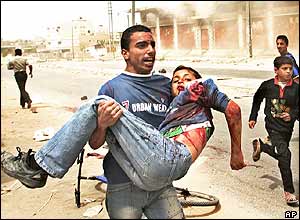
a father mourns his slaughtered son in Homs

WRITTEN By Soubhi Dachan, translated by Mary Rizzo

In a world in which communication has become a duty, the silence that reigns over the Syrian tragedy is even more shameful.

Only yesterday, Tuesday 21/02/2012 in the city of Homs there were 400 rounds of shells launched upon the defenceless city for the 18th consecutive day.

In this slaughter which is being consumed before our very eyes, no one is spared, not even journalists, killed under the cannon mortar.

In a country in which all foreign press is prohibited and in which every foreign observer is now forbidden entry, it is natural to ask some questions to those who still today sustain that there is no truth to the news that reaches us from Syria:

– Why are outside journalists now allowed to report from Syria?

– Why are the International Red Cross and the Red Crescent forbidden from operating in Syria?

– Why are all the Syrian cities under siege?

– Why are non-government agencies not allowed entry into cities such as Hama or Baba Amr and other Syrian cities?

The protesters have reported widespread use of chemical weapons against civilians, carpet-bombing, bombing of hospitals and mosques, shortages or absence of food, water and medicine, lack of gas and electricity. For over a month, there has not even been oxygen for the sick who need it.

Four hundred victims in only a few days. Among them women, children, the elderly.

What is going to have to happen so that this genocide will stop? What other excuses do people need to fabricate in order to maintain their shameful silence? And thus, to remain accomplices of this state terrorism adopted by the criminal dictatorship of the Syrian regime?

 ITALIANO

In un mondo in cui la comunicazione è diventata dovere è quanto più vergognoso il silenzio che si cela sulla tragedia Siriana.
Solo ieri martedì 21.02.2012 nella città di Homs sono stati lanciate 400 cannonate sulla città inerme per il 18° giorno consecutivo
In questa mattanza che si sta consumando nessuno è risparmiato, nemmeno i giornalisti, uccisi sotto i colpi di mortaio.
In un paese in cui …ogni stampa estera è vietata e in cui ogni osservatore estero è bandito, viene naturale chiedere a coloro che ancora oggi sostengono la non veridicità delle notizie che giungono dalla Siria:

– Come mai non sono ammessi altri giornalisti?
– Come mai non è permesso alla croce rossa internazionale o alla mezza luna rossa operare in loco?
– Come mai le città di tutta la siria sotto assedio?
– Come mai non si permette alle organizzazioni non governative di entrare nelle città come HOMOS e BABA AMR e nelle altre città Siriane?

I rivoltosi denunciano l’uso di armi chimiche, bombardamenti a tappeto, bombardamento di ospedali e moschee, la mancanza di viveri, acqua e medicinali, gas e corrente. Nemmeo l’ossigeno per i malati è presente oramai da più di un mese.

Quattrocento morti in meno di pochi giorni, donne, bambini e anziani.
Cosa bisogna aspettare ancora per fermare questo genocidio? Quali altre scuse bisogna fabbricare per rimanere ancora in questo vergognoso silenzio, e dunque, complice di questo terrorismo di stato adottato dalla dittatura criminale del regime Siriano?

Dr. Mohamed Nour Dachan

Interview with Doctor Mohamed Nour Dachan, Italian delegate of the Syrian Coalition of Support to the Syrian Revolution

 by Giovanni Sarubbi, translated by Mary Rizzo

Doctor Mohamed Nour Dachan is the Italian delegate of the Syrian Coalition of Support to the Syrian Revolution. Born in Aleppo, Syria 65 years ago, he has been living in Italy for 45 years. Doctor of Medicine and Surgery, he has various specialisations and works as a family doctor. Currently he is the President Emeritus of the Union of Islamic Communities of Italy (UCOII) of which he is among the founders, and of which he was the acting President until two years ago. Recently he participated in the meeting of the Syrian National Council with the Italian Foreign Affairs Minister Giulio Maria Terzi di Sant’Agata. The Syrian National Council has promoted a national protest in Rome to be held on the date of 19 February, which has as its slogan “Let us stop the massacre of the innocents”. He has accepted to answer our questions regarding the Syrian situation, and for this, we are grateful. In his words, one can feel the suffering of who, still very young, was forced to leave his own country, bringing him to firmly oppose the Assad government. But, and this should be stressed, it is also an appeal to not leave anything untried for a peaceful solution, without arms or war, to the Syrian crisis. It is a hypothesis on which he works intensively. Following is the text of the interview.

Giovanni Sarubbi (GS): Doctor Dachan, you have been living for many years in Italy, and you have become a member of the Syrian National Council. Can you kindly explain to us the reasons for your choice and describe what forces comprise such Council?

Dr. Mohamed Nour Dachan (MND): To become a member of the SNC is not a novelty for me, seeing that for many years I have chosen freedom and democracy and that during these years I have fought against dictatorships and injustice and for this reason, I could not hesitate to give my contribution to my country of origin.

The SNC joins together very many components of the Syrian opposition, an opposition that has a wide variety of elements, given that there has been over 40 years of dictatorship which has slowly but surely allowed the birth of one opposition group after the other. The advantage of the SNC is that it has the largest opposition groups taking part in it: religious, secular and liberal ones.

GS: What do you propose to do, what is your programme and by the means of what initiatives and instruments do you plan on realising your goals?

MND: The programme is to support the peaceful revolution of the Syrian people, to work and raise awareness to all the world’s countries so that they help us to obtain the fall of the Syrian regime.

GS: What relationship do you have with the Free Syrian Army?

MND: There has to be some clarification regarding the name: it is called Free Syrian Army, which means that they are soldiers, officers and non-commissioned officers who have chosen to refuse shooting at unarmed civilians and it is not an offensive army that is at war, but it has exclusively the task of defending the protests.

It is constituted of a bilateral commission which has started its collaboration between the SNC and the Free Army.

GS: The Syrian National Council has been recognised at an international level by some countries such as France and the USA. What relationships have you got with these countries? Don’t you believe that this support could harm your cause and the liberation of your people from oppression?

MND: The SNC has not yet been recognised by any country, but there have been meetings with several countries, both Arab-Islamic and not. For the time being, the only country that has expelled the Syrian Ambassador has been Tunisia, and Libya is preparing to give the SNC official local offices, in addition to other countries such as Turkey where the SNC has its actual headquarters.

GS: You have recently had a meeting with the Foreign Affairs Minister of the Italian government. What have you asked of the Italian government and what response did you receive?

MND: We have already had a meeting with the previous government’s Foreign Affairs Minister Frattini, and successively with Minister Terzi: our first requests have been to obtain support for the Syrian revolution with all possible means and to remove the support and collaboration they have with the Syrian regime. The relationship has begun very well and we hope that the collaboration is continuous and fruitful.

GS: In your communiqué you have written that: “Today everyone is pointing their finger against Russia and China, but in reality, behind their positions are hidden other diplomatic entities who are complicit in this slaughter.” Who are you referring to? From your point of view, who are the forces in play in Syria and what are the objectives they have set for themselves?”

MND: We don’t have any particular nation in mind, but in the time that has passed, eleven months with massacres each and every day – (and this is only my personal point of view) much more could have been done and perhaps much more can be done, if the positions of China and Russia had been different.

The forces in play by the regime are the army and the forces of the security services. Certainly, the Assad family and those dependent upon it have a sole objective: to continue to rule.

GS: In point 28 of the Report of the International Observers in Syria it is written: “The Mission had made note that various parties reported that there had been explosions of violence in many areas. When the observers had gone to these areas, they found that this information was unfounded.” Just as in all wars, the first victim is the truth and correct information. What can you say, from your point of observation, on what is truly going on in Syria? Do you have direct sources of information on all the things that are taking place?

MND: The mission of the Observers in Syria was dead before it had a chance to be born. There were three objectives to that mission:

1. Withdrawal of all the military vehicles from the streets, an objective that was neither applied nor taken into consideration,

2. The liberation of all the prisoners of thought who have been arrested from the beginning of the revolution to this very date: of the 150,000 person arrested, the government has liberated only a few hundred, only to arrest others from other places,

3. The number of observers was supposed to be 5,000, and instead those who had actually arrived were only 150, some of whom could not even be able to observe a high school graduation test in any high school at all!

The Syrian government, with its excuse of protecting them, first sent in the police forces and then they themselves made these very observers be accompanied by the security forces, in this way, they ensured that the people were terrified and they did not speak with anyone.

Of course, we have direct sources, and we are able to communicate with them now in every way that is possible, including those that are widespread communication instruments: Facebook, emails, cell phones and so forth.

GS: What is your point of view on the various proposals of solution to the Syrian crisis that have been set forth by different international organisations?

MND: We are favourable to any proposal at all which is peaceful but protects civilians, and most importantly, immediately stops this barbarity.

GS: There are about ninety associations, unions and parties, among them FIOM-CGIL, which have taken the position against any hypothesis of a new war in Syria, similar to what has recently been fought in Libya. From your point of view, is a pacific solution possible for the Syrian crisis, without wars or the intervention of foreign powers in your country?

MND: I thank you for this question and allow me to express an appeal, because some forces and some friends with which we have already shared in some activities and sit ins, when faced with the massacres of the Syrian people, are not evaluating the human question, but the political question, as if we were in the Cold War. The revolution started with the actions of children, and still today, each day its characteristic feature is the peaceful protesting in the street and squares. To allow a dictator to keep on assassinating his own people or to join in a war as the one in Libya? Between the two things there are actually many solutions, and for this I invite all the free and democratic men and women to take the side of the people: one simply cannot say, “we are against the war” in words, and then support the government that is using its own army against defenceless people. We ask our brothers and sisters who are against the war to join us with other solutions, but with a sole objective: to immediately put an end to the massacres.

Thus ends the interview. Obviously, whoever is against the war in Syria does not support any regime or any assassin, whoever it is committing these acts, but believes that one must to all that is necessary to find peaceful solutions to the crisis.

By Giovanni Sarubbi – Director of the site www.ildialogo.org (Italian)

Original in Italian: http://www.ildialogo.org/cEv.php?f=http://www.ildialogo.org/noguerra/NotizieCommenti_1328690852.htm

Shady Hamadi and other Italian Syrians protest against the Assad Regime

WRITTEN BY Monica Ricci Sargentini, translated by Mary Rizzo

In the days in which the city of Homs is under massive shelling by the Assad Regime and there has been a call for the evacuation of Americans from Syria, the writer and activist Shady Hamadi, born in Milan in 1988 from an Italian mother and Syrian father, writes an appeal to the Italian and International Community so that they forcefully condemn the massacre of unarmed people that is happening in his country of origin. His appeal seems to me to be a cry of anguish which we should not ignore. Shady Hamadi (photo) is a son of a leader of the Arab Nationalist Party in the region of Homs who underwent the torture of electrical cattle prods in the regime’s cells and at the end of the 1960s, was able to flee to Italy. A student of Political Sciences, Shady has already exposed himself on many occasions. He has given interviews on TV and web networks (“We can break the wall of fear”), and he is among the members of a Facebook community “Comunità siriana in Italia”. He is in contact with opposition figures in Paris and last year his book Voci di anime was published. It is a spiritual voyage in the search of one’s identity that is divided between two cultures. In the letter that we publish below, he invites us to “not remain in silence” and to set upon the task of “raising awareness” to inform others of the reality of the situation.

“My request of you all,” says Hamadi, “is that of putting a black ribbon around your bags, cases, backpacks, coats, wherever you can. This simple act will allow us, the Syrians who pass by you in public places, to recognise those who have chosen to not abandon the Syrian people, because they believe in the values of freedom and respect for human life.”

A simple act that, for the Syrians, means “solidarity”.

Here is the full letter:  

“I hope that my words will be a shout that comes from the whole of Syria and a kind request to all of you.

For eleven months, the land that has been the cradle of civilisation, is experiencing one of the darkest moments of its history that spans the millennia. Syria is bleeding. There is not a single city that has been able to spare itself from burying the young and old, women and children.

This revolution – different from others by the means and macabre repression it is using – is costing the city of Homs the highest price in human lives.

Hart Safsafi, Bab Sba, Bab Amr, are only some of the neighbourhoods of this audacious city, which have continued to pay a constant price in human lives. In these streets, my family has its origins and its memories, while today, those who live there, are facing a daily challenge against death.

Only in the last week more than 500 persons have lost their lives, due to the constant shelling that is striking their homes. This massacre of human beings must no longer be tolerated by the whole of humanity. There are no excuses, nor can there be any excuses for these actions carried out by the militia of the Syrian regime, with the goal of bending the city of Homs, given its strenuous and indomitable resistance. The people of Syria – Alawites, Sunnis, Shi’as, Christians, the entire enormous puzzle of ethnic and religious groups – has chosen to no longer accept the silence, striving for the breath of freedom that is common to human nature.

The task entrusted to the Syrians abroad and to any person at all, disregarding any differences in faith, nationality, ethnicity, is that of witnessing and being aware of what is happening in Syria.  No one should be silent or observe with indifference the continuation of this drama.

I invite all of you to begin a campaign to raise awareness, with the aim of informing others of what is going on in this nation that is suffering. Talk with your neighbours, your friends, write, protest and learn – from the Syrian tragedy – to love your neighbour, to not forget about his needs.

My request of you all is that of putting a black ribbon around your bags, cases, backpacks, coats, wherever you can. This simple act will allow us, the Syrians who pass by you in public places, to recognise those who have chosen to not abandon the Syrian people, because they believe in the values of freedom and respect for human life.”
Shady Hamadi

Original: http://lepersoneeladignita.corriere.it/2012/02/07/lappello-dello-scrittore-hamadi-un-fiocco-nero-per-salvare-la-siria/

EN FRANCAIS – Traduit par Wassyla Hayat

* Fr. L’écrivain et militant Shady Hamadi, né à Milan en 19…88 d’une mère italienne et d’un père syrien, lance un appel à la communauté italienne et internationale afin que soit énergiquement condamné  le massacre de gens désarmés dans son pays d’origine. Il est le fils d’un chef de file du parti nationaliste arabe de la région de Homs qui a subi la torture des aiguillons électriques pour bovins dans les cellules du régime et à la fin des années 1960, et a réussi à s’enfuir en Italie. Etudiant en Sciences Politiques, Shady a déjà pris position à de nombreuses reprises.

Voici son appel. “J’espère que mes paroles seront un cri qui s’élèvera de la Syrie toute entière et une demande à vous tous. Depuis onze mois, la terre qui a été le berceau de la civilisation, connaît l’un des moments les plus sombres de son histoire qui s’étend sur des millénaires. La Syrie saigne. Pas une seule ville n’a été exempte d’enterrements de jeunes et d’anciens, de femmes et d’enfants. Cette révolution – différente des autres par les moyens et la macabre répression macabre mis en œuvre – coûte à la ville de Homs le prix le plus élevé en vies humaines.

Hart Safsafi, Bab Sba, Bab Amr, ce ne sont que quelques-uns des quartiers de cette ville audacieuse, qui ont continué à payer un prix constant en vies humaines. Dans ces rues, ma famille a ses origines et ses souvenirs, alors qu’aujourd’hui ceux qui y vivent, sont confrontés à un défi quotidien contre la mort.

La semaine dernière seulement plus de 500 personnes ont perdu la vie, en raison du bombardement constant qui  s’abat sur leurs maisons. Ce massacre d’êtres humains ne doit plus être toléré par l’ensemble de l’humanité. Il n’y a pas d’excuses, il ne peut y avoir aucune excuse pour ces actions menées par la milice du régime syrien, dans le but de faire plier la ville de Homs en raison de son énergique et indomptable résistance. Le peuple de Syrie -, sunnites, alaouites chiites,  chrétiens, l’ensemble de l’immense puzzle de groupes ethniques et religieux – a choisi de ne plus accepter le silence, en luttant pour la liberté, aspiration commune à la nature humaine.

La tâche qui incombe aux Syriens vivant à l’étranger et à tous, sans tenir compte des différences de  foi, nationalité, ethnicité, est d’être témoin et conscient de ce qui se passe en Syrie. Personne ne doit se taire ou observer avec indifférence la poursuite de ce drame.

Je vous invite tous à commencer une campagne de sensibilisation, dans le but d’informer de ce qui se passe dans ce pays meurtri. Parlez à vos voisins, vos amis, écrivez, manifestez,  et apprenez – de la tragédie syrienne – à aimer votre voisin, à ne pas oublier ses besoins. Ce que je vous demande, c’est de mettre un ruban noir à vos sacs, mallettes, sacs à dos, manteaux, partout où vous le pouvez. Cet acte simple nous permettra, nous Syriens qui passons parmi vous dans les lieux publics, de reconnaître ceux qui ont choisi de ne pas abandonner le peuple syrien, parce qu’ils croient dans les valeurs de liberté et de respect de la vie humaine.”

Vous pouvez bien sûr rejoindre la page (en anglais pour le moment) “Un ruban noir pour la Syrie, éveiller les consciences” ( le lien figure en haut) et, si vous êtes anglophone, lire l’article https://wewritewhatwelike.com/2012/02/07/an-appeal-by-the-writer-hamadi-a-black-ribbon-for-syria/

grazie Mobin Safi    نحن مواطنون وناشطون سياسيون ومثقفون من منبت علوي وخصوصا من حمص وريف الساحل، ندين بقوة

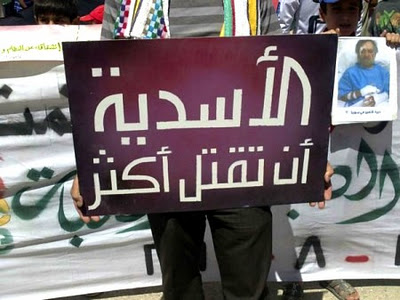
The Assad System: To Kill More

جرائم بشار الأسد وندين بالخصوص القصف الذي تعرضت له مدينتنا الباسلة مدينة حمص الذي راح ضحيته اكثر من ثلاثمئة وخمسون شهيداً، بينهم شبان وأطفال ونساء، كلهم أ…برياء وكلهم سوريون وكلهم مظلومون وندين كل أنواع القتل والإجتياح التي يمارسها …النظام في ريف دمشق وحماه وإدلب وكل مكان من سورية، نحن ومن منطلق حرصنا على وطننا السوري المعذّب ندعو بشدة أهلنا السوريين من كل الطوائف والإثنيات للبقاء صفاً واحداً لتفويت الفتنة التي يحاول النظام الأسدي المجرم زرعها لجرالبلاد إلى حرب أهلية لا يعرف أحد كيف أوأين تنتهي، نحن السوريون العلويون في كل مكان من سورية ننبّه أخواننا إلى أن الجيش الأسدي يستخدم أحياء العلويين في حمص ليمارس إعتداءه على بقية الأحياء محاولاً بهذه الوسيلة إثارة الإقتتال الطائفي، لذلك فنحن نحمّل افراد النظام ا…لأسدي وكل المتعاملين معه من اشخاص وقوى واحزاب في الداخل والخارج مسؤولية ما يجري في البلاد ونحملهم بالأخص مسؤولية أيقاد الفتنة الطائفية التي قد تؤدي إلى تقسيم سورية، كما ندعو كل العسكريين الشرفاء من ضباط وصف ضباط ورجال أمن الإنشقاق عن آلة نظام العصابة القاتلة، هذه الآلة المدمّرة لبنيان الوطن السوري الحبيب، كما ندعوهم الوقوف في وجه هذا النظام اللاوطني في محاولته لزرع الفتنة الطائفية والمناطقية والقومية ومحاولة تقسيم سورية كي يبقى على أشلائها، كما إننا ندين الموقف الروسي اللامسؤول ونحمّل النظام الروسي القاتل مسؤولية كل طفل وامرأة ورجل يقتل برصاصه وأسلحته ونعلن ما يلي : 1- وقوفنا العلني واللا مشروط إلى جانب الثوار في سوريا 2- وقوفنا العلني واللا مشروط ضد العصابات الحاكمة لسوريا وضد من يساندها أو يدعمها مهما اختلفت التسميات والحجج 3- وقوفنا العلني واللا مشروط ضد الذين يراهنون على قتل الشعب فهؤلاء هم أعداء سوريا المستقبل مهما اختلفت انتماءاتهم عاشت سورية حرة واحدة مستقلة من الموقعين: د. تماضر عبدالله د.توفيق دنيا -د.رامي حسين- رشا عمران- نزار حمود كفاح علي ديب- المحامي عُباب رياض خليل- عادل محفوظ -الفنانة لويز عبدالكريم -الفنانة ريم علي- يامن حسين- عبدالكريم علي- فايق المير فراس سعد- عُلا رمضان- ماهر إبراهيم- مرح وسّوف- نينار حسن -علي بدرية- علي عبود- ربا حسن- غياث الجندي- راغدة حسين- ميلاد أمين علي نزير -علي سهير- أسمر خلدون الإبراهيم- محمود سلمان محمود عبدالله أسماء- عمار سوزان- سلوم تميم- أحمد أحمد- م أحمد شعبان وسّوف -سليمان علي- حسام وقّاف- حبيب محمد- نضال سعيد ماهر اسماعيل جميلة بركات- نضال س سلامه -ربى حداد- عادل سعود- عبير محمد نهلة -عباس ماهر اسبر- نور الهدى -عودة علي -سعد بيسان الفقيه- صبا خضور هشام- شوكت احمد -اياد الكردي- سميرة قابقلي عبير سليمان -سلاف صبح -همام حداد- وسيم حسن- علي سعد -علي علي- نوار قاسم

Our Children in Syria
WRITTEN BY Asmae Dachan, translated by Mary Rizzo

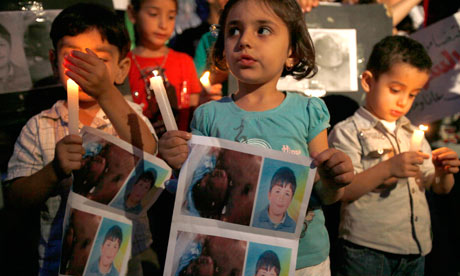
Syrian children carry the photo of Hamza Al Khatib, before and after his torture and death

Every parent would like to buy their own children toys so that they can play, books so that they can get an education, clothes and shoes to wear, food and drink for their nourishment. They would like to smile while they get out of bed during the night to check on their children as they sleep in their room, tucking them in well under their covers; wake them up in the morning, help them get ready, bring them to school, kiss them goodbye and then embrace them again when they return from work, sit beside them on the sofa, listen to them tell about their day, watch their eyes light up when they are excited, look through their notebooks with them to see what they are learning, hugging them tightly, watch a film with them…

These are scenes from daily life: you may be asking yourself why I have used a conditional mode for this text. Because in Syria, for 11 months, none of these things exist any longer. In Syria, it has been exactly the love of freedom of a group of children from the city of Dar’à who wrote on a wall of their school “The people want the fall of the regime” to cause the repression and wicked violence of the bloody regime, which has been in power for over 40 years. In Syria, for 11 months, unarmed civilians are suffering unspeakable violence, they are under the guns of snipers and their homes shelled by armoured tanks. To this day, there are over 7,000 dead, among them, 400 children! Children who have been torn away from life, from the love of their families, their relatives, their friends. Children who have been deprived of the right to play, dream, grow.

More than 400 flowers cut by the criminal hands of the dictator Assad and his militia. More than 400 little voices who filled the lives and homes of their mothers and fathers, the classes of their schools, the streets of their towns, the gardens and playgrounds and now have been silenced forever. More than 400 innocent victims full of love and curious to discover life, who today sleep eternally. More than 400 tiny souls who will always remain in the hearts and the memories of those who loved them, including the other children with whom they shared the days in school or the afternoons of play. 400 times “goodbye” to these pure angels.

Their stories burn in our souls as if we are being branded. Our children in Syria know what it means to be tortured, they know what it means to die on account of an infection, from a bullet that penetrates their bodies, from a grenade launched against the homes they live in. Our children in Syria have learned what it means to spend days without eating and drinking, they know what it means to die from the cold, since the regime with determination cut the electricity and the gas, and they prohibited the inhabited centres in the zones of the protests from being supplied with these basic necessities. In Syria our children know what it means to see their own mother or father die before their eyes, they know what it means to look fear in the eyes…

Today in Syria parents are forced to buy shrouds for their children, and when it is not possible, they give them the final farewell wrapping them in their own blankets.

What kind of humanity can accept all of this?

In Syria our children die twice: The first time at the hands of the regime, the second time on account of the world’s indifference!

Do not be accomplices in this slaughter of innocents!
The Martyrdom of Syrian Children WITH VIDEO

WRITTEN BY SHADY HAMADI, translated by Mary Rizzo

victims of a massacre, women and children included

The week that has just ended has been the bloodiest since the start of the Syrian uprising. At least 66 killed yesterday alone, as reported by activists in Syria. The regime of Damascus has started a violent offensive against the Free Syrian Army (FSA) and the protesters: the deaths come from each one of these groups. The Syrian Foreign Minister Mohammed Ibrahim al Chaar has declared, by means of the official SANA news agency that, “the regime is determined to re-establish order and security and to clean the territory of its criminals.”

In the suburbs of Saqba and Zabadani, which are now under the control of the FSA, there are equally heavy attacks from the regime underway, which aim at regaining control, not only of these two zones, but of the entire band of suburbs surrounding the capital. The Arab League, due to the escalation of the violence, has ended their observers mission. Nabil al Arabi, secretary of the Arab League, has flown to New York in order to United Nations’ support for a plan of peaceful transition of power.

What is now in Syria becoming a true war of liberation encloses one tragedy in another: it is that of the Syrian children who have become involuntary protagonists in a revolution that is robbing their innocence from them. More than 400 children have died from violence since the beginning of the protests.

Hamza al-Khatib, born in October 1997 in Jiza, in the Daraa province, was arrested on 29 April in a checkpoint, while he was going to Daraa with other persons to bring aid to the citizens under siege by the Syrian regular militia. The body of the child was brought to his family completely mutilated, his penis was cut off, and bearing many other signs of torture, he had gunshot wounds on his limbs and chest.

Tamer Mohammad al-Sharey, 15 years old, he was arrested together with Hamza al-Khatib and like him, he died under torture; his teeth were pulled out of his mouth while he was alive, they gouged out his eyes and shot him in the legs, stomach and face. Signs of cigarette burns were found on every part of his body.

And several days ago was the terrible massacre of children in the village of Hasal al Wuard. Eleven components of the Bahado family were executed by the regime’s “security forces” and among the victims, five children. How long will mankind be attracted to evil, How long will be keep accepting that all of this happens?

Original http://www.ilfattoquotidiano.it/2012/01/30/martirio-bambini-siriani/187597/

100 Syrian civilian vicitims in 2 days of attacks against them

WRITTEN BY MARY RIZZO

“You may as well be born an animal rather than a Syrian. You would have been given more protection.”

I have been wondering to myself and at times aloud, “What the hell has happened to the empathy and humanity of the activism movement? When did they start deciding whose blood was expendable? Where did their compassion, empathy and sense of justice go?”

There are a few qualities that an activist should have as a mandatory part of their baggage.  Not all of them are required to have a solution to the problems that are afflicting the victims or the weak in the causes that they are advocating. Nor are they even required to dedicate a lot of time or money to the cause. One can be an activist nowadays locally or even if they are disabled and unable to leave their homes, as they can express their views, share information and engage in solidarity by means of internet. The qualities however that should be part of every activists’ tool kit include empathy, a bit of courage and a strong desire for “good” to overpower and defeat “bad”.  And, that this vital and obligatory baggage has become so selective, has got to be the most fatal blow to the activism universe. It makes it reek of hypocrisy and plays directly into the hands of the oppressors.

Empathy is a social and emotional response to the conditions that other sentient beings are in. Since we all can agree that pain and suffering (including being a victim of abuse, starvation, deprivation) are negative things, it is not difficult to feel bad, “as if” what is happening could be happening to us or to the people or animals we love. If we are able to unplug the empathy because we have an ideology that we buy into, accompanied by a kind of strange peer pressure, something has gone wrong very seriously. If we are selective in such a subject as human pain and our acceptance of it, we need a major time out to rethink what we are doing in activism. We should remember that empathy can be a tool towards change, we should put it to use and understand that suffering people (and to some extent animals) are aware of our involvement or our detachment, and they tap into the capacity of (especially) activists, to make the feelings of empathy manifest and bring about an end to the suffering, which is the primary and immediate goal.

By understanding, witnessing and realising the extreme suffering that some are subject to, an activist has the ability to concretely help to change the condition of pain and suffering through the recognition of the condition followed by acts that aim at intervening in favour of the victims. On the other hand, their indifference can empower the abuser and oppressor, who believes that there is justification for his violence.

There has been no lack of evidence for many many months coming from Syria that the situation in Syria is a humanitarian crisis of an extremely severe nature. To cite some statistics, much of them from international organs that are considered to be highly authoritative such as the UN, Human Rights Watch, Amnesty International and others, in eleven months since the first protests against the regime in power took to the streets, there have been a confirmed 6000 civilians killed, by snipers, shelling, bombs and beatings, though other sources claim that the actual number is much higher, since discovery of mass graves and bodies of “disappeared” protesters is a constant occurrence. 70,000 persons have been arrested, most of them charged with nothing or charged with crimes that would not stand up in any normal court of law, including thought crimes and crimes of intention. There have been constant and documented abuses and torture, with corpses bearing the signs of brutality one can hardly imagine. The scenes are so horrible and devastating, in years and years of activism for human rights and especially Palestinian rights, I have never witnessed this level of depravity, this level of gore.

Last week, the town of Idlib had a most gruesome event: a group of people were victims of the explosion of a nail bomb, sending tiny projectiles into the flesh, damaging internal organs and causing internal bleeding until painful death comes. They were brought to the civil hospital for holding before their funerals, but 60 other bodies were discovered in the refrigerator cells, all of them bearing signs of gruesome torture. The hospital was occupied by the regime’s militia who also prohibited any wounded from receiving treatment. Hospitals were now simply for serving the regime’s fight to stay in power at all costs. What came to mind to an activist I know who had seen the still shots of the bodies face down in pools of their own blood was scenes of Sabra and Shatilla. But these are Syrians, and for some strange reason, most activists for Palestine are ignoring this. Are they wearing blinders or are they unable to empathise with the Syrians?

That there are over 20,000 refugees who have sought refuge in Turkey in a tent facility is another number that should cause any activists to tremble. We know the fate of refugees, the way they often never come back and mostly, the dire living conditions they are faced with. An activist should be concerned about this problem. How many Syrians have fled to Lebanon or even farther? No one knows the numbers because often these people continue to be threatened and hunted even in exile.

Why do the activists fail to understand the severity of the situation? Why do they denounce the protesters in the same exact terms used by the regime with mountains of evidence against it being a humane government? Why have they tweeted, blogged, shouted for weeks about pepper spray in the eyes of American demonstrators, yet the mortal assaults on civilians (including 300 children who have had a violent death at the hands of the regime, many of them subjected to arrest and death at the hands of their torturers) are all but ignored? Are Syrians children of a lesser God? Are they less worthy of protection and concern? Is it possible that American university students who later in the day can go to their dorms and realise their lives are not in danger get more sympathy and empathy from activists than innocent Arab children who have lost their lives under the cruelty of a repressive militia?

Some will say, “Why do you say that it’s worse if someone is killing their own people?” as a kind of excuse to then talk about a different geographical place, a different situation. Others will say that the Assad regime is the last bastion against imperialism, which is the sole argument they seem to be able to muster. They are certain there is an imperialist plot behind all of this, something they were reluctant to say with the same protests in Tunisia, Egypt and to some extent, to the Palestinian Intifadas. Many of these people who are proclaiming it can’t be a sincere popular revolt or revolution live in affluent societies in Europe and North America, where they have the right to say what they want to without being arrested and yet, have never taken part in a revolution or revolt. Others will say that there should be no outside intervention, but they root for Russia, Lebanon and Iran continuing to arm the regime and give it economic solvency for as long as possible. Others will say that the Free Syria Army is an imperialist militia (???!!!) and that it is fomenting war and is not a true resistance militia. Yet others are claiming that both sides are to blame, putting them on equal footing, something they would never dare do if this were Palestine. How can an armed power that controls government, the economy, can turn off water, electricity and gas at a whim, arbitrarily arrest people in the thousands, close down hospitals and invade cities with tanks, bombarding people as they are within their own homes and placing snipers on the roof should they dare seek to escape be equated with the civilians?

A Syrian friend of mine said to me a few months ago, “If only we were animals, then I think that more people would feel for us and care.” After a few weeks, he noticed even the total abandonment of the Activists for Palestine, who are touting the Assad line without a practical reason to do so unless they are inhumane or blind. He said, “We should just tell everyone we are Palestinian, perhaps they will then be upset about how we are dying”. I would take it further: several years ago Vittorio Arrigoni wrote a piece that was very poignant. I ask especially the activists for Palestine to read it and reflect upon it.

“Take some kittens, tiny little cats and put them in a box” said the surgeon at Gaza’s main hospital called Al Shifa, while the nurse placed a couple of big boxes on the floor right in front of us, covered in splashes of blood. “Seal up the box, then with all your might jump on top of it until you hear the little bones crunching, and the last suffocated “meow”. I’m astounded and I stare at the boxes. The doctor goes on “Now try to imagine what would happen straight after the broadcast of a scene like that, the justifiably indignant reaction of the world-wide public, the denunciations of the organisations protecting animals…” The doctor goes on with his account and I can’t take my eyes off those boxes placed by my feet. “Israel has enclosed hundreds of civilians in a school as though in a box, dozens of children, and then it squeezed it with all its might using its bombs. And what were the reactions of the world? Almost nothing. You may as well be born an animal rather than Palestinian. We would have been given more protection.” At this point the doctor leans towards the box and takes the lid off in front of my eyes. Inside there are mutilated limbs, arms, legs, from the knee down or whole femurs, amputated from the people injured inside the Al Fakhura United Nations school in Jabalia. Up until now there are more than 50 victims. I pretended I had an urgent telephone call, I told Jamal I had to go, but actually I ran for the toilet, I bent over and threw up.

http://groups.yahoo.com/group/NewWorldOrderWhistleBlowers3/message/32547

Right now those victims are Syrians. At this moment, the average of 40 victims each day, at times close to 100, belongs to Syria.  “You may as well be born an animal rather than a Syrian. You would have been given more protection.”

WRITTEN BY SHADY HAMADI, translated by Mary Rizzo

Fadwa Soliman

Since the start of the Syrian revolution, approximately eleven months ago, women have played a role that is equal to that of men. Young Syrian women have been leading the protest, they are at the head of human rights organisations and they are leading protagonists in the political opposition. But who are these women?

Fadwa Soliman was one of Syria’s most famous actresses. When the revolution began, she decided to actively participate. Her parents, upon discovering their daughter’s choice, disowned her, because they were dedicated supporters of the president Assad as well as belonging to the same religious group as the Assad family, the Alawite sect. Being a public figure whose face was known to all, Fadwa, wanted by the police, decided to cut her long black hair so as to render herself less recognisable. Her activity, in this moment, is concentrated especially in leading protests and sending video messages by means of You Tube. She has been living in hiding for months, and every day she is forced to change where she is living so as to avoid capture.

Razan Zaithouni, born in 1977, she manages a network of local coordination committees for human rights in Syria. She is wanted because she is accused by the Syrian regime of being a foreign spy. Razan Zaithouni was awarded the Sakharov Prize in October and also in 2011 won the Anna Politkovskaya Award. Her husband is currently detained in the Syrian prisons.

Bassma Kodmani, spokesperson of the Syrian National Council – the principle opposition group to the regime – in 1968 left Syria with his parents who abandoned their country due to political problems, transferring themselves to Paris. Prior to the start of the revolution, she had published various books in France and has managed, for the Ford Foundation, the programme of government and cooperation in the Middle East. She is the most influential Syrian woman on a political level at this moment, and she is the second in command of the Syrian National Council.

Suhair Atassi, human rights activits, member of the Atassi family, which has a lengthy political history behind it, manages the Jamal Atassi Forum. In this moment the form is only online because it was outlawed by the government. She was arrested at the start of the protests and released several months later. Her identity card has been taken by the security forces so as to prevent her from escaping. She lives under the constant threat of being arrested again.

The list of the women who are changing Syria is long. Christian, Muslim, Alawite women, as well as women from all the other religions are participating, collaborating actively in this spring that is late in blooming. I believe that the saying “behind every great man there is a great woman” isn’t sufficient for the Syrian situation, because men and women are walking side by side, hand in hand.

PLEASE WATCH THIS IMPORTANT VIDEO MESSAGE

Original: http://www.ilfattoquotidiano.it/2012/01/23/donne-della-primavera-siriana/185771/

Global day of rage

21 January 2012 Global Day of Rage in Solidarity with the Syrian People

Why?

  • Because the Syrian people have been undergoing the atrocities of the dictatorship of the Assad dynasty for more than 40 years. First, the father Hafez, then his son Bashar, with the complicity of the entire family and the mercenaries of the Ba’ath party.
  • Because the Syrian people, for 11 months, have taken to the streets to demand the end of this regime, to demand the respect of their human rights, invoking freedom and democracy and for this reason, and no other, are killed by an inhumane repression.
  • Because in Syria innocents are dying, children are killed in cold blood, as well as adolescents, women and men of every age, unarmed and defenceless civilians. The centres of their towns and villages are bombarded and shelled and their places of worship are broken into. Universities are raided in order to arrest and kill those who oppose the regime.
  • Because in Syria there is a strike to demand the protection and safeguarding of human dignity, paid for in blood.
  • Because in Syria thousands of people are imprisoned for thought crimes: even children!!
  • Because in Syria women are abducted and raped, including minors, in order to dissuade people from the desire to demand their freedom.
  • Because in Syria funeral processions are shot upon and the bodies of the martyrs are subject to every kind of vilification.
  • Because in Syria the regime controls information, instruction, economy and every aspect of the people’s lives.
  • Because there are entire cities in Syria that are subject to constant shelling by armoured tanks of the regime, with snipers positioned on the roofs and in the streets who are there to kill passers-by and protesters.
  • Because the world is standing by and only watching, from the UN to the Arab League, no one has moved a finger decisively and effectively to make this massacre cease!!
  • Because 6,700 martyrs, many of them children, thousands of wounded and mutilated people, prisoners and desaparicidos ask that this massacre ENDS and that justice be done!!

These are only some of the reasons for which, the 21st of January 2012, the World Day of Rage in Solidarity with the Syrian People has been declared. We can no longer stand by in silence! Silence and indifference are accomplices in this massacre! We make an appeal to the consciences of everyone, citizens, administrations, workers, political and religious leaders, academics and students, for mobilisation towards the respect of human rights in Syria.

SYRIA ASKS FOR FREEDOM: LET US SUPPORT HER!!

Giornata Mondiale della Collera per la Siria

21 gennaio 2012 Giornata Mondiale della collera in Solidarietà con il Popolo Siriano
Sabato, 21 gennaio 2012 sarà celebrata dalle donne e dagli uomini liberi di tutto il mondo la Giornata Mondiale della collera in Solidarietà con il Popolo… Siriano.
Perché?

• Perché il popolo siriano subisce le atrocità della dittatura della dinastia Assad da oltre 40 anni. Prima il padre, Hafez, poi il figlio, Bashar, con la complicità di tutta la famiglia e dei mercenari del partito Ba’ath.

• Perché il popolo siriano da 11 mesi è sceso in piazza per chiedere la fine di questo regime, per domandare il rispetto dei diritti umani, invocando libertà e democrazia e per questo viene colpito a morte da una repressione disumana.

• Perché in Siria muoiono innocenti, vengono uccisi a sangue freddo bambini, adolescenti, donne e uomini di ogni età, civili inermi e disarmati. Si bombardano i centri abitati e si fa irruzione dei luoghi di culto e nelle università per arrestare e uccidere chi si oppone al regime.

• Perché in Siria chi sciopera per chiedere la tutela e la salvaguardia della propria dignità paga con il sangue.

• Perché in Siria migliaia di persone si trovano in carcere per reati d’opinione: anche bambini!

• Perché in Siria vengono sequestrate e stuprate le donne, comprese le minorenni, per dissuadere il popolo dalla volontà di chiedere libertà.

• Perché in Siria sparano sui cortei funebri e vilipendiano i corpi dei martiri.

• Perché in Siria il regime controlla l’informazione, l’istruzione, l’economia e tutti gli aspetti della vita del popolo.

• Perché ci sono intere città in Siria che vengono bombardare dai carro armati del regime, con i cecchini appostati sui tetti e nelle strade per uccidere i passanti e i dimostranti.

• Perché il mondo sta a guardare, dall’ONU alla Lega Araba, nessuno si è mosso con decisione ed efficacia per dire stop al massacro!

• Perché 6700 martiri, tra cui molti bambini, migliaia di feriti e mutilati, di prigionieri e di desaparecidos chiedono che venga fermato il massacro e sia fatta giustizia!!!

Queste sono alcune della cause per cui il 21 gennaio 2012 è stata proclamata la Giornata Mondiale della collera in solidarietà con il Popolo Siriano! Non possiamo più sopportare in silenzio! Il silenzio e l’indifferenza sono complici di questo massacro! Ci appelliamo alle coscienze di tutti, cittadini, amministrazioni, lavoratori, esponenti politici e religiosi, accademici e studenti, per una mobilitazione generale per il rispetto dei diritti umani in Siria.

LA SIRIA CHIEDE LIBERTA’: SOSTENIAMOLA!

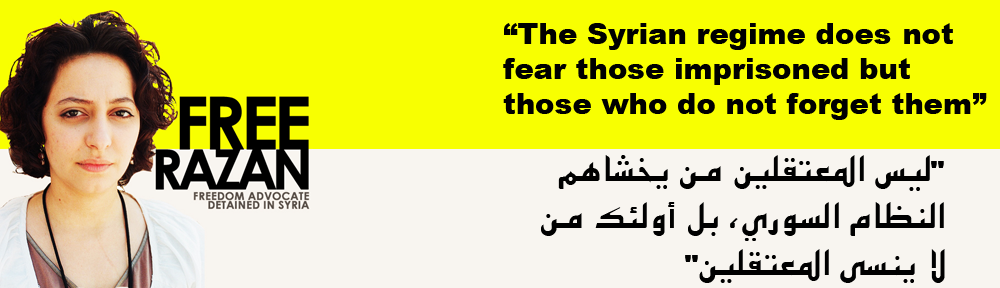
After years of watching human rights abuses, censorship and detention of civilians in Syria for no other reason than them writing or even commenting on Syria in a negative way, the latest arrest hits me very personally. Razan Ghazzawi is a personal friend, and as others have said much better than I ever could, a heroic individual, and I will add, a true Syrian.

Like many others, I “virtually met” Razan in her role as a blogger. I admired her attention to all kinds of issues, especially Palestine and the fate of the Palestinian refugees in Lebanon, but also her dedication to other issues such as animal rights and women’s rights. I admired her bravery to personally campaign for each and every man or woman detained for expressing their views, and there are probably 20 or so campaigns she sent to me, which I circulated in my own network. I asked her to join the anti-imperialist translations collective I founded, Tlaxcala, and she was enthusiastic, though, never had much time to for it, which was understandable, given her intense writing and research activities as well as her very extensive on-the-ground activities. Our friendship grew, as well as my awareness that she was an outstanding communicator, so I invited her to be one of the speakers at a convention I was organising (not about blogging, but about the concept of living under occupation and attempts to make an Italian public become familiar with the idea of Palestinian right of return and the refugee situation). Unfortunately, she was unable to make it.

It was due to Razan’s older blogs, Decentering Damascus, especially (which contains some of the best writing I’ve ever encountered), but also Free Occupied Syrian Golan and Damascus Spring, which introduced me to the Damascus Spring movement and the repression they underwent, which prior to then, I had not been remotely aware of. She had an archive of Asmi Bishara writing in a blog as well. She gave me permission to use many of her photos on posts for my blog and site and quite often, I would republish her articles on them as well. Later, I got to know her even better, as her posts became more personal, though always strong and focused, on the blog everyone knows well, Razaniyyat. In an interview for Maktoob, when asked who my favourite writers were, it was easy to come up with a list, and topping the list was Razan. Her writing is simply intense, and it could only be because of her very powerful sense of justice, her keen perception and her amazing humanity and compassion for people and animals.

But I wonder if the “authorities” who stole her liberty and are detaining her realise that they do not have an enemy at all. This is the huge mistake that the regime makes, by pointing the finger at various outside entities or a perversion of the idea of patriotic spirit in their repression of dissent and in their will to quelch all who are perceived as their enemy. They fail to realise in the desperate clinging to power, that they are killing off those who love Syria. So, after reading once again the blog of hers that meant the most to me, tears running down my face worrying about her well-being, I invite you to read just one passage and to ask yourselves: is Syria’s regime so afraid of Syrians who THINK about Syria and question it and seek to belong to it as much as their hearts want them to?

“With a country and our belonging to it, the process becomes rather complex. Each Syrian loves her Syria, and each fights or not, to maintain the Syria she sees or wants to see growing. I think most of our belonging to Syria is either fictionist if not imagined. For some, Syria lies in Syrian food, for others it lies in old cafes in Old Damascus. Some belongings to Syria lie in the longing for her. I think some belongings are “touristy” when it comes to Syria’s traditional atmosphere.

Syrian becomes its “ornamentation”.

I believe racism, sexism, sectarianism, human rights’ abuse, are unconsciously celebrated in the Syrian daily life. Just like the Syrians are now the prime reason for everything wrong happens in Lebanon, the Iraqi refugees are the prime reason of everything wrong happens in Syria, if one caught AIDS, it’s an Iraqi girl, if one cannot find a job, it’s the Iraqis’ fault, if a family are sleeping in the streets, it’s the Iraqis fault. Syrians now, and away from the regime’s tyranny, are constructing the “Syrianism” within this binary opposition “Syrians/Iraqis”, as a continuous process that started with the “Syrians/Lebanon”. Syrians are formulating a belonging to Syrian in opposition to the “new comers” of Syria.

I am not here trying to unfold the current Syrianism in order to come up with another, I don’t like fixed entities, I like chaos, I trust chaotic identities. My Arabism is like no other Arabist, neither is my Syrianism. To be a Syrian is not a question to be answered or to look for, it shouldn’t be there or obvious, it should be a repeatedly questioned question.”

Also, in 2007, her article about the censoring of Facebook is definitely worth a read.

Now, all I can add after this is: please participate in all the campaigns to free Razan. A petition: http://www.avaaz.org/en/free_razan/  a Facebook page with many useful campaigns: https://www.facebook.com/freerazan and a site with many useful links: http://freerazan.pen.io/

Please write, call, share information, use the #FreeRazan hashtag on Twitter and don’t stop until Razan is safe at home with her family, friends and loved ones. ALL Syrian detainees MUST be freed immediately.

The lifeless body of 14 year old Mohmmed Abdul Salam Al Mlaessa

The 14 year old shot dead by a soldier in front of his classmates

He was a model student, just like the rest of his classmates. Mohammed was a student at one of the institutes for gifted youth in Eastern Syria, near the Iraqi border. The other morning, together with his classmates, Mohammed was taken from his classroom: brought to the street, he was forced to join in a pro-regime march in the city of Deir ez Zor, a hotbed of dissent. Mohammed dared to give voice to those who like him did not want to go and protest against the decision of the Arab League to suspend Syria for the brutality of Assad’s repression of dissenters. He dared to ask to simply go home. The response was a bullet in his chest, in front of his classmates as they witnessed in
shock.

The teen had fallen to the ground, but Assad’s military security forces continued to shoot: first they kicked him and clubbed him with sticks and then they ended by firing one more shot into his side. “Make sure he is dead,” was the order given by the commander of the Military Security Forces, in the account given of the incident before the Syrian Observatory for Human Rights, an NGO with a London base that has access to a large number of voluntary informers who life in Syria.

Mohammed Abdul Salam Al Mlaessa was only 14 years old. How he was beaten and brought to such pitiful condition at the end of this brutal execution can be seen in the videos on You Tube (it is not possible to verify the authenticity, Western journalists are forbidden to report by the regime): a bullet hole in the left side, his face plummeted and in a pool of blood. An “exemplary” lesson for the other youth present.

That Damascus is afraid of students was something that was clear from the start:  at the beginning of the protests, last March, repression against a group of youth that had made anti-Assad graffiti on the walls of their school. “From primary school to high school, the youth of Syria are in the front line in the protests,” Mousab Azzawi, from the Syrian Observatory for Human Rights states. “No regime can resist when students protest and for this reason, they fear them, they kill them, they take them as hostages. And they make their families hear their voice over the phone as they are torturing them.”

The funeral of Mohammed was attended by at least 45 thousand people, according to estimates. “To disperse the crowd, agents used electrical sticks that provoked temporary paralysis,” Azzawi states. At the ceremony there was an evening sit-in with 8 thousand youths in what has been renamed “Liberty Square”. The gathering was dispersed by firing from the security forces: here there were two of the day’s thirty victims, the majority of which in the city of Homs, the capital of the protesters, where the deserters have taken refuge. But also in the streets of Hama, Deraa, Idleb, people continue to be killed. The activists report that yesterday forty protesters had been killed by soldiers near the Jordan border.

The repression has not stopped, despite the agreement made by Damascus on 2 November to follow the Arab League’s peace plan which calls for the end of the violence and the withdrawal of the tanks from the cities. And after the assaults on the Embassies of the Arab countries that had announced the suspension of Syria from the pan-Arab organisation, the regime has used the iron fist to fill the squares with pro-Assad marches and demonstrations. The case of Mohammed is not an isolated one. Similar incidents have been reported in other parts of the country. Azzawi states: “This same Sunday at Hama, the security forces shot against a group of students who had refused to participate in a loyalist march: five of them never again opened their eyes.”

Alessandra Muglia for Corriere della Sera (translated by Mary Rizzo)

http://www.corriere.it/esteri/11_novembre_15/20111115NAZ19_22_97cf31c6-0f59-11e1-a19b-d568c0d63dd6.shtmlv


 STATEMENT FROM THE SYRIAN OBSERVATORY FOR HUMAN RIGHTS, Sunday, 13 November 2011 19:41
On November the
13th , 2011, 09.15 local time in Dir Zour, the elements of military security took out the students of the pioneer students school in the city by force to the street and compelled them to participate in a march organized by Syrian security forces to condemn the decisions of Arab League concerning the  suspending of Syrian membership in the League.When first-graders of high school refused to participate in the march, and asked to be allowed to go back homes, security forces arrested the student Mohamed Abdul Salam Al-Mlaessa (14 years) who spoke on behalf of his classmates who do not want to participate in the march supporting Syrian Regime, and shot him directly in his chest just under the right wishbone in front of his friends. Then, they started beating him with batons while he bleeds in front of all students crowded for few minutes. When they were not sure about his Death, several minutes after the first shot in his chest, and the awful beating he was subjected to, the commander of the present elements of military security recommended the elements to shoot him again to ensure that he dies (this is literally what the commander said), and this is exactly what happened through the second shot in the flank of the child Mohamed Abdul Salam Al-Mlaessa, which led to his death.Syrian Observatory for Human Rights calls on all Arab and International organizations concerned with protecting civilians and child rights, to urgently intervene to protect civilians in Syria and refer all those responsible for committing such crimes against civilians in Syria to International Criminal Court to consider what might be a typical example of the crimes against humanity that are taking place daily in Syria.To see the documenting videos, you can click on the links below:

www.youtube.com/watch?v=68_uLBMKs0o

www.youtube.com/watch?v=5-QdqGQ5Auc

www.youtube.com/watch?v=zT6nrDpSrVQ

Syrian Observatory for Human Rights

London, November
13th , 2011

Protesters for Libyan freedom in London

It seems like years ago, but only a few months have gone by. The anti-imperialist world raised their virtual glasses in a united toast to the people’s revolutions. When I say this phrase, it seems I need to define every term, so bear with me. I will try to not take any concepts for granted.

The anti-imperialist world as I have come to know it is generally comprised of generally well-to-do intellectual-type folks who engage more time in discourse and social networking than they actually do in developing strategies or training individuals for a radical change in society where local (indigenous) people are their own leaders and determine for their exclusive benefit the policies and economic organisation of their own territory. They however are generally very passionate about the need to seek justice against tyrants and they believe that the people themselves want the same thing, so they do what they can (far from the places themselves) ninety-nine times out of one hundred by raising awareness through their articles, videos, comments, social network activities and fundraisers for more public events to raise awareness (and this cycle continues until it exhausts itself into the next fashionable group of unfortunate others).

With all that awareness-raising, you would be sure that by now, this formidable band of selfless virtual warriors would have convinced all of the world that there is no way on earth that the will of the people should be trampled on and that sooner rather than later, each people will achieve its own autonomy and self-reliance. These people who have concretely moved towards self-liberation might even be so inclined as to bite the hands that looks like it feeds them, if this has to happen for them to truly be free, but an anti-imperialist should never look at his or her own interests as a member of the empire who enjoys the privileges of that status, and should even tolerate great levels of aggression against the empire he calls home.

That said, when first Tunisia, then Egypt, began staging independent demos to demand change in their government systems, inspired by their sheer numbers, they seemed to be fully successful. There was bloodshed among civilians, but it ended, and this was a revolution that was almost like a dream, almost too easy and certainly so full of promise and hope. It even adopted the name that will remain with it for all time, “Arab Spring”, the long-awaited renewal of Arabhood connected to the idea of development of a new society that was going to put people before anything else. That it gained support at a global level probably was intrinsic to its success.

Protesters in Gaza

How did that happen? Well, we all know it was through mass communications, some of it entirely spontaneous between those directly involved, and some of it presented to a wider community to enlist their sympathies and support. It was the fact that the world was watching that perhaps hastened the demise of Ben Ali and Mubarak, and it could also be the fact that a barrier of fear had been broken. Make no mistake, I have been  documenting Egyptian uprisings for at least 3 years, and there are others who like me were not under the impression that Egyptians were passively accepting a lack of political expression and a worsening social crisis. Several of us had commented that it was necessary to break through the impression that Egyptians were incapable of rebellion and to show that there was the emergence of a protest movement that was non-confessional, and was tying together the idea of the rebirth of Arabhood as well as an Egyptian national identity that was as vibrant as the Egyptian people. We could have been some of the few who were not surprised by the revolution, but what did surprise us was the enablement that  this gave to nearby peoples.

Living in the European country closest to Libya and with a colonial past which as recently as 1972 has seen mass expulsions of Libyans of Italian descent, whatever happens in Libya is going to be felt directly. In the past years, hundreds of boats full of refugees have headed toward our shores,  and as has been documented thoroughly, the Libyan regime had utilised the African migrants as a playing card to obtain many things from Italy. The Africans who were brought to Libyan Migrant Detention Centres were actually imprisoned there, and the thought of dying at sea on unsafe and overcrowded ships was a risk almost all of them were desirous to take after months of torment from the military and police branches of the Libyan government. There were truckloads of them driven to the confines of the desert and left there to die, documented by Italian film crews, who were concerned about lives in the face of the “Bilateral Agreements” so that Gaddafi could keep a foothold in Italy’s economy and obtain “aid” worth billions of Euros for infrastructure (some of it I can personally testify was for bunkers), weaponry and telecommunications in exchange for a policy of limiting African immigration from Libyan shores.

Gaddafi’s racism thought it found another foothold in the sensitivities of the Italian government, and his words were carefully used to obtain what he  wanted, a combination of greed and rank racism that I witnessed few anti-imperialists getting upset about.  It deserves being read word by word:

“Europe runs the risk of turning black from illegal immigration, it could turn into Africa. We need support from the European Union to stop this army trying to get across from Libya, which is their entry point. At the moment there is a dangerous level of immigration from Africa into Europe and we don’t know what will happen. What will be the reaction of the white Christian Europeans to this mass of hungry, uneducated Africans? We don’t know if Europe will remain an advanced and cohesive continent or if it will be destroyed by this barbarian invasion. We have to imagine that this could happen but before it does we need to work together.”

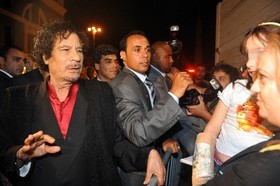
Gaddafi's recent "Rome By Night" outing

Gaddafi would come to Italy, honoured by Silvio Berlusconi and the best that the Italian government had to offer by way of hospitality, in order to seal more deals and to re-establish that these two neighbours had the same interests at heart: especially a thirst for petroleum and a provider who would make sure there would be preferential treatment under certain conditions, including keeping Europe white. Berlusconi was also an honoured guest in Libya, promising billions of Euros for schools, retirement homes, infrastructure and other things. It is curious that those continually claiming Libya was fulfilling all of its people’s needs on its own seem to not question why they would need so very much Italian money to do what they claim has already been done. During these visits, our news shows were almost suffering an embarrassment at how to represent it. The feelings run deep, and we had known of the abuses that were going on in Libya. Many of us know Libyans, some of them in exile, “You mean  you can’t go back? What do you mean you can’t go back?” Others who come on scholarships and seem to never want to talk about politics either. I would joke with two friends (one in each category) and call it the Libyan black hole. However, both would easily admit that Libya could be much more than it is, if only it could have the chance for that.

So, I watched the revolutions with other anti-imperialists, and the Libyan revolution had quite a few of us excited at the first moments because  Libya is not a Middle Eastern country and it also has ambiguous and collaborative relations with the empire, and with my nation in particular. I  was naively convinced that true anti-imperialists would welcome the will of the people as sovereign and that the information constantly withheld from us regarding many human rights violations would cause one of those powerful moments of decision: supporting an action that really was going to mean conflict and risk for my own nation. As February 17th approached, (with its planned march in Benghazi of the family members of the 1,200 political prisoners of Abu Salim who had been executed by Gaddafi ) I noticed that a few would start to say it was not a real revolution because a) it was against a leader who claimed to be anti-imperialist, b) it was a tribal conflict that we should not take part in, as it would lead to division of Libya (as if they actually knew or cared!), c)the protesters had some problems that did not make them revolutionary, with the sub-groups of 1) they are seeking the restoration of the monarchy, 2) they are religious fanatics that will turn back the clock on progressive revolutions and make Libya a theocratic state. I asked them if they had the right to determine when a revolution was valid and when it was not, and I was surprised to hear that they were putting conditions on the support of a people, and didn’t they notice the people were demanding their freedom?

I started to check into all my favourite anti-imperialist sites, most of the relevant articles indicated to me by friends on Facebook, and lo and behold, most of these were articles by Westerners. If I had kept count, and I should have, I would have the evidence in front of me that out of 100 articles perhaps 3 were actually penned by Libyans. I got to wondering what was happening when I had been reading and hearing the reports from Benghazi by Mohamed Nabbous, killed by Gaddafi’s squadrons and in the many comments surrounding these interventions, and noticed the enormous gulf in what the Pundits were saying, and what Libyans were saying. It was as if there were two worlds colliding. All of these people claimed to love freedom and to want to do anything necessary to obtain it, but there was that nasty issue of Gaddafi actually threatening to exterminate those who tried. At this point, one would think that this would be enough for one to firmly side with the Libyan people and wonder what the pundits were going on about.

And, at this time, many things entered the scene, such as NATO, which all of us detest, and transitional governments and Libyan officials abandoning their leader and an upsurge in refugees flooding into Tunisia and war and death in the land that only a few weeks before was the next domino with a tyrant’s face that had to be knocked down.

We read of infiltrations of Al Qaeda, (this was what Gaddafi claimed the Thuwar (“rebels” to those who hate them and “freedom fighters” to those who love them), of deals with Empire, of CIA infiltrates and anything else that you can imagine by way of establishing that those who were commemorating the massacre of their loved ones and who were massacred while doing so were SO BAD and if we supported them, we were dupes. I guess it would take a very self-assured person to still want to see the Thuwar and indeed the people opposing Gaddafi in a decent light.

Already involved in a few discussion groups regarding the events in the region, I was invited by friends to join a few private mostly-Libyan discussion groups. I wanted to observe the discourse, and since my sympathies and antipathies were known to me, but not backed up by enough concrete information, I took it as my “personal fact finding mission” to learn as much as I could about the situation from Libyans. Indeed, the discussions in these groups are lively, and shockingly, almost everyone in the groups (which are by no means small either) has a martyr for the cause and has family living in conditions of siege. It is quite a shocker to log in and see someone receiving condolences for his father, his uncle, her brother, a daily litany of suffering and loss… And even more shocking was the coming into contact with a world I should have been more aware of, that of the acceptance of the will and wisdom of God.

Yes, religion plays a big part in many of these struggles, and while this is not a religious war, (and all Libyans practice the same religion for the most part), the element of faith and perseverance that these people surely learned from over four decades of negation of their political freedom is omnipresent. I would also peek into Pro-Gaddafi boards and oddly, there was a sort of violence and lack of humanity that were not even hidden very well. It became almost apparent to me that there was a lot more to this situation than meets the eye.

I got into discussions with American Communists (self-proclaimed, naturally) and leftists in general and when they started to stress that they didn’t like the religious symbolism that they were seeing (as if their taste was going to matter) I had to ask them why they thought they knew better than the Libyans what was best for Libyans. I was told that the Libyans would put the monarchy in. I stated that the TNC issued a statement and it was supported by those I was discussing things with, that there were to be elections and there was going to be an establishment of democracy. These AC + Leftists told me that the Libyans were dupes for the empire and religious fanatics and that if they were not working for a world revolution but for a repressive and authoritative patriarchal set-up, and thus, as AC + Leftists, the Libyans would not be worthy of obtaining their support. I thought that was some cheek. So what I decided to do was to serve as a filter, I invited Libyans to use my board to engage with these anti-imperialists, and many willingly did so. They presented the Libyan point of view, they were kind, patient and tried to explain what the situation was so that it could be understood.

I admit I was shocked at the violent verbal reactions they got. I admit it was the classic Western Pundit thing of orientalism and ignoring the voice of the common man if that common man was not “politically advanced”. It was the thing I see time and again in Palestine activism: the great Western hero (usually white, male, often Christian or Jewish) determines that he or she knows what is best and becomes the spokesman and mouthpiece for Palestinians. It is denial of Palestinian agency, but it is so common and so normal that we tend to not notice it as the alarming trend it is.

McKinney not looking too objective there.

Working for the Man

So, when Cynthia McKinney stepped onto the scene, it is as if the secret prayers of the Gaddafi supporters who also are against the Libyan people’s revolution (they want to deny it’s what it is, but they are unable to turn off our memory cells that far back) had been answered. Black, female, present in the past in brave gestures for Palestine, outspoken against the robbery of the Democratic vote in the Bush elections, pacifist and they can plug their noses on the fact that she actually might represent empire by being involved in the presidential elections as a candidate and as a Roman Catholic. She does fine to complain against NATO abuses and even their involvement, but to become the mouthpiece of Gaddafi went above and beyond the call of duty, even going so far as to follow the game plan he provided while establishing the proper narrative to put forth. She did this as well on Libyan State TV, yes, the same state TV that has been accused by Libyans as sending out calls for ethnic cleansing of the Amazigh people (a linguistic minority in Libya) and those living in cities where protesting became resistance and then revolution.

And it seems, once again, we have thousands of eyewitnesses who the anti- imperialists, Leftists, American Communists refuse to listen to or when they are given the opportunity censor them or hurl insults their way, but when an American “eyewitness” (who has been shown where the Gaddafi cronies have taken her and nowhere else) speaks, she is the one who must be listened to, because she will not change anything, because she has no loved ones there, so whatever happens is politics, because she will have her hardcore followers and for all the ones she loses, she will pick up more, sensing where the anti-imperialist (banter) winds blow, feeding the fundraising machine for awareness-raising in an endless cycle. Those who actually are Libyans are treated to the usual “shut up” that is reserved for “counter-revolutionaries”. All from the comfort of these Western Anti-Imperialist homes far away from where the blood is being shed.

So what is my final remark to anti-imperialists, that group which I had felt I had proudly belonged to for decades? Quit lecturing with such an attitude of cultural colonialism and start listening to those who are actually the directly interested party. Answer them at least once when they ask  what alternative you would have offered when it was clear that their people were being violently crushed. Realise they are not interested in anything but their own freedom, and that includes freedom from you and your ideology and platitudes that contain nothing concrete for them to use towards obtainment of their freedom. If the anti-imperialists can’t understand that, then Khalas, because shutting up is golden.

Houria Bouteldja from "Indigenes de la Republique"

 from Kasama Project A Maoist sister in Spain, LG, sent us the following posting. She wrote as an introduction:

This very controversial  essay is by Houria Bouteldja, the spokesperson for the political party organized by people of color in France called Les Indigenes de la Republique. This group is composed by people born and raised in France whose families come from the French ex-colonies. The majority of the members are French from African, Caribbean and Arab origin.

The essay caused a lot of interesting debates because it is a critique to Western Feminism from a Third World Feminist perspective. The essay was also translated to many languages by the Decolonial Translation group.

The term “indigenous” in the French context is used very differently from the Americas. In the Americas, the indigenous are aboriginal or native people. In France, indigenous means “colonial subjects of the French empire.” Indigenous was the term used by the French empire during colonial times to refer to colonial populations everywhere (Viet Nam, Algeria, Tunisia, Martinique, Guadaloupe, Senegal, etc.).

This French party, composed primarily by people of color but open to everybody, appropriated the term “indigenous” from French colonial history to basically say that even though they are French (born and raised in France), due to racism, capitalism and imperialism, they are still treated inside France as “indigenous of the Republic,” that is, as colonial subjects.

It is a way of saying, we are still living in colonial times even though we live in France. Thus, their openly stated goal is to decolonize France. They do a Decolonial march every year in Paris on May 8th. This is the day of the liberation of France in 1944 from the Nazi occupation and the day of the Seti massacre in Algeria. What happened was that while the French went to the streets to celebrate, the Algerians in Seti (a small city of Algeria) also went to the streets to celebrate and to call for Algerian independence. The response of the French colonial army was to kill everybody in the Seti demonstration. So, the indigenous of the Republique do this Decolonial march every year to remind that France is in need of radical decolonization. I was once in one of these marches and it is surreal. You could see thousands of French people-of-color in a demonstration through the streets of Paris with huge Photos of Aime Cesaire, Frantz Fanon, Amircal Cabral, Angela Davis, Malcolm X, Kwame Nkhruma, Nelson Mandela, Nasrallah, Nasser, etc.

Anyway, here is the essay, which was delivered as a speech to the 4th International Congress of Islamic Feminism that took place in Madrid, in October 2010. It appeared in English on Decolonial Translation:


Les Indigenes de la Republique


White women and the privilege of solidarity

by Houria Bouteldja

I would, first of all, like to thank the Junta Islamica Catalana for having organized this colloquium, which is a real breath of fresh air in a Europe that is shriveling up in upon itself, wrought up in xenophobic debates and increasingly rejecting difference/alterity.

I hope that such an initiative will be able to take place in France. Before getting into the subject at hand, I would like to introduce myself, as I believe that speech should always be located.

I live in France, I am the daughter of Algerian immigrants. My father was a working class man and my mother was a housewife. I am not speaking as a sociologist, a researcher or a theologian. In other words, I am no expert.

I am an activist and I am speaking as a result of my experience as a political activist and, I might add, my own personal sensibility. I am insisting on these details because I would like to be as honest as possible in my reasoning. Truth be told, until today, I hadn’t really thought about the question of Islamic feminism. So why am I taking part in this colloquium? When I was invited, I made it quite clear that I lacked the authority to speak about Islamic feminism and that I would rather deal with the idea of decolonial feminism and the ways in which, I believe, it should be related to the more general question of Islamic feminism.

That is why I thought I would lay out a few questions that could prove useful for our collective questioning.

  • Is feminism universal?
  • What is the relationship between white/Western feminisms and Third World feminisms among which we find Islamic feminisms?
  • Is feminism compatible with Islam?
  • If it is, then how can it be legitimized and what would its priorities be?

First Question: Is feminism universal?

For me, it is the question of all questions when adopting a decolonial approach and when attempting to decolonize feminism. This question is essential, not because of the answer but rather because it makes us, we who live in the West, take the necessary precautions when we are confronted with ‘Other’ societies.

Let’s take, for example, so-called Western societies that witnessed the emergence of feminist movements and have been influenced by them. The women who fought against patriarchy in favor of an equal dignity between men and women gained rights and improved women’s circumstances, which I, myself, benefit from.

Let’s compare their situation, that is to say our situation, with that of so-called “primitive” societies in Amazonia for instance. There are still societies here and there that have been spared by Western influence. I should add here that I don’t consider any society to be primitive. I think there are differing spaces/times on our planet, different temporalities, that no civilization is in advance or behind on any other, that I don’t locate myself on a scale of progress and that I don’t consider progress an end in itself nor a political goal.

In other words, I don’t necessarily consider progress to be progressive but sometimes, even often, it is regressive. And, I think that the decolonial question can also be applied to our perception of time. Getting back to the subject at hand, if we take as our criteria the simple notion of well-being, who in this room can state that the women from those societies (who know nothing of the concept of feminism as we conceive of it) are less well-off than European women who not only took part in the struggles but also made available, to their societies, these invaluable social gains?

I, myself, find it quite impossible to answer this question and would consider quite fortunate whoever could. But yet again, the answer is of no importance. The question itself is, for it humbles us, and curbs our imperialist tendencies as well as our interfering reflexes. It prevents us from considering our own norms as universal and trying to make other’s realities fit into our own. In short, it makes us locate ourselves with regards to our own particularities.

Between Western & Third World feminisms

Having laid out that question clearly, I now feel more at ease to tackle the second question dealing with the relationship between Western feminisms and Third World feminisms. Obviously it’s very complicated but one of its dimensions is the domination of the global south by the global north. A decolonial approach should question this relationship and attempt to subvert it. An example:

In 2007, women from the Movement of the Indigenous of the Republic took part in the annual 8th of March demonstration in support of women’s struggles. At that time, the American campaign against Iran had begun. We decided to march behind a banner that’s message was “No feminism without anti-imperialism”. We were all wearing Palestinian kaffiyehs and handing out flyers in support of three resistant Iraqi women taken prisoner by the Americans. When we arrived, the organizers of the official procession started chanting slogans in support of Iranian women. We found these slogans extremely shocking given the ideological offensive against Iran at that time. Why the Iranians, the Algerians and not the Palestinians and the Iraqis? Why such selective choices? To thwart these slogans, we decided to express our solidarity not with Third World women but rather with Western women. And so we chanted:

Solidarity with Swedish women!

Solidarity with Italian women!

Solidarity with German women!

Solidarity with English women!

Solidarity with French women!

Solidarity with American women!

Which meant:

Why should you, white women, have the privilege of solidarity? You are also battered, raped, you are also subject to men’s violence, you are also underpaid, despised, your bodies are also instrumentalized…

I can tell you that they looked at us as if we were from outer space. What we were saying seemed surreal, inconceivable. It was like the 4th dimension.  It wasn’t so much the fact that we reminded them of their situation as Western women that shocked them. It was more the fact that African and Arabo-Muslim women had dared symbolically subvert a relationship of domination and had established themselves as patrons. In other words, with this skillful rhetorical turn, we showed them that they de facto had a superior status to our own. We found their looks of disbelief quite entertaining.

Another example: After a solidarity trip to Palestine, a friend was telling me how the French women had asked the Palestinian women if they used birth control. According to my friend, the Palestinian women couldn’t understand such a question given how important the demographic issue is in Palestine. They were coming from a completely different perspective. For many Palestinian women, having children is an act of resistance against the ethnic cleansing policies of the Israeli state.

There you have two examples that illustrate our situation as racialized women, that help understand what is at stake and envisage a way to fight colonialist and Eurocentric feminism.

Following on from that question, is Islam compatible with feminism?

This question is purely provocative on my behalf. I can’t stand it. I am asking this question to imitate some French journalist who believes they are asking a really pertinent question. As for me, I refuse to answer out of principle.

On the one hand, because it comes from a position of arrogance. The representative of civilization X is demanding that the representative of civilization Y prove something. Y is, therefore, put in dock and must provide proof of her/his “modern-ness”, justify her/him-self to please X.

On the other hand, because the answer is not simple when one knows that the Islamic world is not monolithic. The debate could go on forever and that is exactly what happens when you make the mistake of trying to answer.

Myself, I cut to the chase by asking X the following question:Is the French Republic compatible with feminism?

I can guarantee you one thing: ideological victory is in the answer to this question. In France, 1 woman dies every 3 days as a result of domestic violence. The number rapes per year is estimated around 48 000. Women are underpaid. Women’s pensions are considerably less substantial than those of men. Political, economic and symbolic power remains mostly in the hands of men. True, since the 60’s and 70’s, men share more in household duties: statistically, 3 min more than 30 years ago!! So I ask my question again: are the French Republic and feminism compatible? We would be tempted to say no!

Actually, the answer is neither yes nor no. French women liberated French women and it’s thanks to them that the Republic is less macho than it was. The same goes for Arabo-Muslim, African and Asian countries. No more, no less. With, however, one extra challenge: consolidating within women’s struggles the decolonial dimension, that is to say the critique of modernity and eurocentrism.

How to legitimize Islamic feminism?

For me, it legitimizes itself. It doesn’t have to pass a feminist exam. The simple fact that Muslim women have taken it up to demand their rights and their dignity is enough for it to be fully recognized. I know, as result of my intimate knowledge of women from the Maghreb and in the diaspora, that “the-submissive-woman” does not exist. She was invented. I know women that are dominated. Submissive ones are rarer!

I would like to conclude with what, in my opinion, should be priorities for decolonial feminism.

You have all heard about Amina Wadud and her involvement in the development of Islamic feminism. She became well known the day she lead the prayer, a role usually reserved for men. Out of context, I would say that it could be thought of as a revolutionary act. However, in an international context that saw the Iranian Revolution and 9/11 (as well as growing Islamophobia, demands that Islam update and modernize itself), a much more ambiguous message was brought to light. Was it answering strong demands, an urgency, the fundamental expectations of women from the Umma? Or were these expectations of the white world? Allow me to dwell on the latter hypothesis. Not that there aren’t any women who find it an injustice that only men be allowed to lead the prayer but because women’s priorities and urgent needs are elsewhere.

What do Afghan, Iraqi and Palestinian women want? Peace, the end of the war and the occupation, the rebuilding of their national infrastructures, legal frameworks that guarantee their rights and protect them, access to sufficient food and water, the ability to feed and educate their children under good conditions. What do Muslim women in Europe and more generally those who are immigrants and who, for the most part, live in lower income neighborhoods want? A job, housing, rights that protect them not only from state violence but also men’s violence. They demand respect for their religion, their culture. Why are all of these demands silenced and why does the issue of leading the prayer make its way across the globe when Judaism and Christianity have never really made apparent their own intransigent defense of the equality of sexes? To finish up with this example, I believe that Amina Wadud’s act was, in fact, quite the opposite of what it claimed to be. In reality and independently of the theologian’s own wishes, this act, in my opinion, was counter-productive. It will only be able to adopt a feminist dimension once Islam is equally treated with respect and once the demands to lead the prayer come from Muslim women themselves. It is time to see Muslim men and women how they really are and not how we would like them to be.

I conclude here and hope to have shown the ways in which a true decolonial feminism could benefit women, all women when they, themselves, deem it to be their path to emancipation.

Houria Bouteldja, Madrid, 22 October 2010.

Translated by Amy Fechtmann

Things that do not require a tribunal in Lebanon (picture by Amelia Opainska)

Al Jazeera reported yesterday that judges and lawyers at the Special Tribunal for Lebanon (STL), ostensibly established to prosecute the perpetrators of the 2005 assassination of former Lebanese prime minister Rafik Hariri, “have begun discussions on how to define the crime of ‘terrorism’ as listed in a draft indictment”.

Opposition to the politicization of the STL, which appears to be concerned with prosecuting certain groups and not others, led to the collapse of the Lebanese government in January.

According to the Al Jazeera website:

International lawyers have wrangled for years without arriving at a single definition for the crime of terrorism, but prosecutors and defence lawyers at the tribunal agreed on Monday to apply the definition as stated in Lebanese law, which the tribunal already uses.

‘There is no reason to go further and create an overarching, worldwide, universal definition,’ Iain Morley, a lawyer for the prosecution, said.

But he sought to refine the definition they will use at future trials, arguing that it was unnecessary to prove a political motive for a terrorist act.

He proposed his own definition of terrorism as an act by which ‘a substantial section of the public reasonably and significantly fears more than momentarily from the present onward indiscriminate personal harm’”.

I’d be willing to bet that a more substantial section of the Lebanese public feared impending indiscriminate personal harm during and after the July 2006 Israeli war on Lebanon—waged in part via rush shipments of American weapons to Israel and resulting in the elimination of over 1200 people, mostly civilians, in the country—than after the elimination of Hariri and 22 others.

As for assassination-related fear, there was presumably some of this in 1985 when CIA-trained operatives attempted to dispense with Shiite cleric Muhammad Hussein Fadlallah in Beirut. Fadlallah survived; approximately 80 civilians, including a number of women and children, did not. It is meanwhile unclear why the Hariri assassination should be considered any more fear-inducing than the decades of Lebanese political assassinations that have not prompted special tribunals.

Dr. Omar Nashabe, editor of the justice section at Lebanon’s Al-Akhbar newspaper, gave an excellent speech in London last month on the subject of the STL in which he pointed out that current Israeli Defense Minister Ehud Barak has boasted of his participation in assassinations in Lebanon in 1973. One more reason not to issue an “overarching, worldwide, universal definition” of the word terrorism.

http://pulsemedia.org/2011/02/08/on-indiscriminate-personal-harm-in-lebanon/

The Beit Ayn settlement outpost near Hebron

WRITTEN BY Khalid Amayreh in al-Khalil

8 April, 2009


Religious Jewish terrorists on Thursday attacked a small Arab village north of al Khalil (Hebron), shooting randomly on civilians and vandalizing homes and businesses.

Eyewitnesses said as many as a hundred settler terrorists descended on the small village of Safa, 10 kilometers north west of al-Khalil, with the purpose of carrying out a pogrom against local inhabitants.


The terrorists were escorted by several Israeli army soldiers who reportedly made no effort to stop the terrorists who were shouting “death to the Arabs.”


The Palestinians, fearing for their lives, hurled stones at the rampaging  settlers to prevent them from setting fire to Palestinian property, prompting Israeli soldiers to open fire at the Palestinians.


At least 28 people were reportedly wounded with live ammunition, including a boy who was shot in the chest.


Medical sources said Thaer Nasser Adi, 17, was in serious but stable condition at the Ahli hospital in al–Khalil.


The mayor of the nearby town of Beit Ummar, Nasri Sabarna, described the settler rampage as “an unprovoked criminal act against innocent and peaceable people.”


Sabarna said the settlers wanted to terrorize the Palestinian villagers in order to take over their land and property.


He accused the right-wing Israeli government of giving Jewish terrorists a green light to attack Palestinians and vandalize their property.


“The present government is a government of settlers, by the settlers, for the settlers. I believe there is a full coordination between the settlers and the army.”


Muhammed, a local villager, called the settlers “savages and Nazis.”


“These people go to their religious Talmudic schools in the morning, and in the afternoon they come here to attack us, terrorize our women and children  and sabotage our property. What kind of religion are they following?”


Muhammed called on the international community to provide protection against “these barbarians who want to kill us and expel us from our land.”


He lashed out at the Israeli army for its “connivance and collusion” with the settlers, saying that the army and the settlers were “two sides of the same coin.”


Al-Khalil Governor Hussein al Araj, who arrived at the village soon after the disturbances, accused the Israeli army of failing to protect Palestinians from the settlers.


“I believe the settlers wouldn’t dare attack the village without at least a tacit approval from the Israeli army.”


Al-Araj held the Israeli army fully responsible for this “pogrom,” saying that Palestinians in the occupied territories needed international protection.


He added that settler attacks and terror would continue as long as “these criminal squatters remain here.”


The small settlement outpost, known as Beit Ayn, is home to extremist settlers who are indoctrinated in Jewish supremacy.


A few years ago, some of the settlers from Beit Ayn were caught implanting a large explosive charge at a Palestinian school near Jerusalem.


The explosion would have killed and injured dozens of Palestinian children.


Last week, a settler was killed, ostensibly in retaliation for the murder  of Palestinians by settler terrorists.


Normally, the Israeli justice system deals extremely lightly with settlers who murder Palestinians.


During the al-Qsa intifada,  the Israeli army and paramilitary Jewish terrorists killed thousands of Palestinians, the vast majority of whom innocent civilians, to suppress Palestinian aspirations for freedom from decades of the Nazi-like Israeli military occupation.


According to an Israeli human rights organization, only a handful of cases of murder were investigated.

What will happen next? Will Palestinian kids be duped into playing music to Israeli pilots who exterminated Gaza children with White Phosphorus?

By Khalid Amayreh in Occupied East Jerusalem

29 March, 2009


It is really hard to write on this subject without getting angry. We all know the extent to which Israel can be evil and satanic. After all, we Palestinians have been on the receiving end of Israeli savagery for decades.  


In fact, being thoroughly tormented and killed by the children, grandchildren and great grandchildren of the holocaust has always been and continues to be “the” Palestinians’ way of life.


However, for some Palestinians to allow themselves to be duped to sing and play music to their oppressors and child-killers is simply beyond the pale of human dignity.


It is at least as insulting and humiliating as some Jews were forced or duped to play music to SS, Gestapo and Wehrmacht soldiers during the Second World War. In both cases, the act was meant to humiliate the victims and rob them of the last visages of human dignity. 


And now, Jews in Israel are doing the same thing to Palestinians, Nazism’s vicarious victims.


Last week, a few innocent kids from the Jenin refugee camp were surreptiously taken to Tel Aviv to “cheer up and take part in peace-promoting activities.”


However, once there the kids were unceremoniously driven to a reception where they were made to play music and sing to “holocaust survivors,” some of them are former members of the Hagana and Irgun terrorist gangs who had taken part in the ethnic cleansing of Palestine and expulsion of Palestinians form their homeland.


God knows how much Palestinian blood did these so-called “holocaust survivors” shed in 1948 and subsequent years. Certainly, Deir Yasin, Tantura, Dawaymeh, and the numerous other massacres were not committed by UFOs. They were committed in cold blood by these very people our children are now cheering up.


Shame on us a thousand times!


Some of the kids were instructed to utter words that should never be uttered by the victims of Zionism. One of the participants reportedly dedicated a special song to Gilad Shalit, an Israeli soldier taken prisoner by Palestinian fighters in Gaza nearly three years ago. No mention, not even an allusion, was made of the estimated 10,000 Palestinian political and resistance prisoners languishing in Israeli dungeons and concentration camps. 


But the kids apparently felt they had to say anything they were asked to say in order to show gratitude for the Jewish “peace contractor” who got them out of the ghetto, otherwise known as Jenin refugee camp, even for a six-our outing in Tel Aviv.


I am not against showing genuine sympathy with the victims of the holocaust. However, a sympathy that is manipulated to justify, rationalize or even extenuate the crime against humanity that is Israel is worse than a crime if only because it serves to promote and perpetuate oppression.


As human beings, we Palestinians do sympathize with all victims of Nazism, Stalinism and imperialism, the wept, the over-wept, and especially the unwept who constitute the vast majority of victims.


Having said that, however, I strongly believe that no honest person under the sun has the slightest right to demand that we pay the price for what the Nazis did or may have done to European Jews nearly 70 years ago.


We didn’t send Jews to the ovens. The Germans did. We didn’t starve Jews to death as Jews are doing to us today in the Gaza Strip.


We didn’t incinerate Jews in Gas chambers as Jews have recently incinerated Palestinian children with White Phosphorus.


Hence, of all people in this world, Palestinians must never be made to feel guilty for what the Nazis and other Europeans did to Jews. I say so because a feeling of guilt, even a modicum of guilt, on our part, would be construed or misconstrued as a  vindication of Zionism, the Nazism of our time.


There are additional reasons that make the latest insensitive manipulation of Palestinian suffering especially ugly and dishonorable.


First, nearly all the young musicians who were taken to Tel Aviv came from the Jenin Refugee camp. For those who have forgotten, this is the very same refugee camp that Israeli tanks pulverized in 2002. According to eyewitnesses, Israeli tanks and bulldozers destroyed homes right on top of innocent civilians, including the physically handicapped, while dozens of innocent civilians were systematically massacred, very much like Jews were at Ghetto Warsaw. The massacre at the camp was so hideous that Israel refused to allow UN officials to access the camp to inspect what happened.


Well, again the Nazi analogy is inescapable. Just imagine surviving Jewish children from Treblinka or Bergen Belsen made to sing to SS soldiers!!


Second, the disgraceful concert in Tel Aviv comes on the heel of Israel’s genocidal assault in Gaza where Israeli warplanes showered the children, women and men of coastal enclave with White Phosphorus and other missiles and bombs of death while Israeli Jews were gleefully celebrating the “victory on Hamas” and Israeli rabbis preoccupied with classifying gentiles into “children of light” and “children of darkness.”


In Gaza, the Zionist Jews exposed their shame to all the people of the world by acting like primitive barbarians and murderous savages.


Hence, the utter shamefulness of sending Palestinian children to Tel Aviv to help Israel’s hasbara efforts whitewash Israel’s pornographic barbarianism in Gaza.


Finally, it is obvious that the PA bears much of the blame for this disgraceful event. The PA should never allow so called “cultural exchanges” and “cultural normalization” with the murderers of our children, the very state whose leaders and military commanders view us as “scum, vermin and animals” that ought to be exterminated.


Unfortunately, the PA itself encourages some demoralized Palestinians to endear themselves to Israel, even in the cheapest of manners.


The often cordial meetings and exchanging of kisses between Mahmoud Abbas and Ehud Olmert, the butcher of Gaza, leave one and only impression, not only on the children of the refugee camp in Jenin, but also on TV viewers around the world.


Perhaps the Israel artillery and war planes were showering Gaza with candy, not White Phosphorus!!!


This is probably the main message the organizers of the Jenin-Tel Aviv tour wanted to communicate to these miserable kids who are obviously having a hard time recognizing their fathers’ killers.

Many countries are set to participate in the Conference against Racism, scheduled to be held in Geneva, April 20-25. But the highly touted international meet is already marred with disagreement after Israel, the United States and other countries decided not to participate. Although the abstention of four or more countries is immaterial to the proceedings, the US decision in particular was meant to render the conference ‘controversial’, at best.


The US government’s provoking stance is not new, but a repetition of another fiasco which took place in Durban, South Africa in 2001.


Israeli and US representatives stormed out in protest of the “anti-Israeli” and the “anti-Semitic” sentiments that supposedly pervaded the World Conference against Racism (WCAR), held in Durban in 2001. The decision was an ominous sign, for the Bush Administration was yet to be tested on foreign policy in any definite terms, as the conference concluded on September 8, three days before the 911 terrorist attacks.


The US justified its denunciation of the international forum, then on the very same, unsubstantiated grounds cited by Israel, that the forum was transformed to a stage for anti-Israeli and anti-Semitic rhetoric.


But was “the World Conference against Racism, Racial Discrimination, Xenophobia and related intolerance” indeed transformed into a stage for racism and bigotry, as Israel’s friends, lead amongst them the Bush Administration, charged?


What indeed took place at the conference was democracy in its best manifestations, where no country could defy international consensus with the use of a veto power, or could flex its economic muscles to bend the will of the international community. The result was, of course, disturbing from the view point of those who refuse to treat all United Nations member states with equity and impartiality. An African demand for a separate apology from every country that benefited from slavery, to every African nation that suffered from slavery was considered excessive, and eventually discounted.


But the main “controversial” issue that led to the US representative’s departure from the conference was the criticism by many countries of Israel’s racism against the Palestinians. A majority of countries called for reinstituting UN General Assembly resolution 3379 which in 1975 equated Zionism with racism.


The conference, then, was not meant to only address the issue of Palestine and Israel. However, the strong American resistance to any criticism of the racially motivated practices of the Israeli state – the extreme violence, the land theft, the Wall, the settlements, the protracted military occupation, etc – pushed the issue to center stage.


The Palestinian struggle is not meant to overshadow the struggles of oppressed nations around the world, but it rather compliments the calls for rights, freedom and liberation that continue to echo around the globe. However, the fact that the illegal and violent mass oppression of Palestinians, as practiced openly by the Israeli state continue unabated – and is rather defended and justified by the United States and other European powers – highlights the historical legacy championed by former colonial powers throughout the so-called third world for so many years.


There are hardly many international forums that are held and governed by principals of equality and fairness amongst nations. The World Conference against Racism is one of very few, indeed. It was not a surprise, therefore, to witness the international solidarity with the Palestinian and world-wide repulsion of the racist and Apartheid policies carried out daily by Israel.


But the mere censure of Israel’s unfair, undemocratic and racist policies – let alone taking any action to bring them to a halt – is mechanically considered anti-Semitic from an Israeli standpoint and US administrations.


The US conditioned its participation of the April conference in Geneva (Durban II) by removing any specific censure of Israel, and ensuring that Israel is not ‘singled out’ for criticism. Although US sensibilities constantly expect, but demand the singling out of any country, leader or group it deems rouge, war criminal, or terrorist, Israel is treated based on different standards. “A bad document became worse, and the US decided not to participate in the conference”, Israeli daily, Haaretz, reported in reference to the draft documents being finalized before the conference.


The original “bad” document apparently dubs Israel “an occupying state that carries out racist policies”, a description which is consistent with international law, UN resolutions and the views of leading world human rights defenders – Archbishop Desmond Tutu,  John Dugard, the former UN Special Rapporteur for the Palestinian Territories, Richard Falk,the current UN’s envoy, among many others.


The ‘bad document’ might have ‘became worse’ with new references to the Gaza bloodbath, which killed and wounded nearly 7,000 Palestinians in 22-days.


From an American – and unfortunately, Canadian and Italian, so far – viewpoint, such inhumane practices don’t warrant a pause or mere words of condemnation. The same, of course, doesn’t apply to Sudan, Zimbabwe, Iran, Cuba and other ‘unfriendly’ nations. The US decision must be particularity disheartening to African nations who saw in the advent of Barack Obama some vindication. The US first black president, however, saw it fit to boycott a conference that intended to discuss the issue of slavery and repatriation, to once again prove that race alone is hardly sufficient in explaining US internal and external policies.


A day after rebuffing the conference, US Secretary of State, Hilary Clinton arrived on her first visit to the Middle East, where she admonished Iran, Hamas and Hizbollah – for largely posing threats to Israel – and praised the Jewish state and its ‘moderate’ allies.


She remarked in a joint statement with Israeli president Shimon Peres, on March 3: “It is important that the United States always underscore our unshakeable, durable, fundamental relationship and support for the State of Israel. I will be going from here to Yad VaShem to pay respects to the lost souls, to remember those who the Holocaust took, to lay a wreath, and to say a prayer.” 


Needless to say, Mrs. Clinton refused to visit Gaza, where 1.5 million people are trapped in one large concentration camp, denied access to food, medicine, political and human rights. 


– Ramzy Baroud (www.ramzybaroud.net) is an author and editor of www.PalestineChronicle.com. His work has been published in many newspapers, journals and anthologies around the world. His latest book is, The Second Palestinian Intifada: A Chronicle of a People’s Struggle (Pluto Press, London). 


SEE ALSO: Cynthia McKinney’s article on Black Agenda Report on Obama and Durban II and https://wewritewhatwelike.com/wp-content/uploads/2009/03/durban-2-feat1.jpgptt-tv/ for a short video on Middle Eastern Stereotypes

On 2 February 2009, The Lancet Medical Journal’s Global Health Network online published Dr Swee Ang and Dr Ghassan Abu Sitta’s `The Wounds of Gaza’, first published here at PULSE. It introduced the article by stating:

Two Surgeons from the UK, Dr Ghassan Abu Sittah and Dr Swee Ang, managed to get into Gaza during the Israeli invasion. Here they describe their experiences, share their views, and conclude that the people of Gaza are extremely vulnerable and defenseless in the event of another attack.

On 2 March 09 the Journal removed the article (though The Lancet Student still has it), stating: “We have taken down the blog post The Wounds of Gaza because of factual inaccuracies.”

No specific faults or amendments to the alleged inaccuracies are suggested. The reader comments, overwhelmingly in support, remain posted. A letter penned by four israelis (surprise, surprise!) that objects to the article was published on February 18. Our friend Dr Swee responds to this development and elaborates on the figures.

Dr Swee Ang on reporting from Palestine and Lebanon

Many of us are afraid to put numbers down because the pro-Israel Lobby will inundate us with emails and complaints. This has gone to the extent that only figures sanctioned by the Israelis are credible. Everything else is viewed as suspect!

Over the last twenty-six and a half years, I have taken many blows over this kind of issue. The only question I ask myself when writing is – when is the version according to the victims going to be articulated? The people of Gaza knew that 5,000 were killed in the Khan Younis massacre in 1956; 100,000 gone missing in 1967 of which 35,000 were murdered – just because they cannot go to the Sinai and take pictures, or dig up the mass graves, does not mean we refuse to let them state their case.

I looked at Northern Gaza – how often have I driven down Sala -Uddin Road in 1988 and 1989. I remember every turn and corner- I know the citrus orchards, the farms and the homes. Often I would stop my ambulance to give a ride to the farm workers and they in return would give me freshly picked lemons and oranges. I now see it completely laid waste by Israeli explosives like the nuclear holocaust of Hiroshima, and yet we were called liars when we put forward the figure of one and a half million tons of explosives. We have seen apartment blocks not only reduced to rubble but incinerated – how many kilotons of explosives are responsible for this kind of damage?

The Lancet Global Health Network withdrawing `The Wounds of Gaza’ is not a problem at all. The wonder is how it even got to be published in the first instance.

My book From Beirut to Jerusalem, when first published in 1989, was reprinted hard back and then paperback within 2 months, as it was sold out on publication, and again sold out as soon as reprinted. Then Tom Friedman came out with a book with exactly the same title half a year later and by the same publisher. My book was withdrawn from the shelves. It went out of print for many years.

But the truth has to come out. Most times at great inconvenience to some of us as we well know.

I just want you to know that I am not afraid to believe the Palestinians. It is a scandal that the extent of the Khan Younis massacre had not come to light for all these years. It is a scandal that what happened in the Six Day War was not published. The intimidation to silence witnesses has to stop. We cannot allow the case to be stated only by the perpetrators of the killings.

Like the Palestinians in Gaza – I am also not afraid. My witness of Gaza counts. So does your witness. We should not be afraid of saying what the Palestinians told us. They are the ones whose families were killed, who bear the wounds of violence, who are dispossessed and persecuted. Their voices must be heard.

Dr. Swee Ang on the explosives used in Gaza

The actual tonnage of the explosives dropped on Gaza can only be accurately known to the IDF themselves. So other figures can only be estimates. However some of us have many years of experience looking at bombed out countries.

Over the 22 days, Gaza was intensely bombed from land, air and sea. The bombs dropped from the air are large, and most of them are more than a ton on average. In the south the bombs used to destroy the tunnels and structures around them are large heavy bombs.

Of the 21,000 buildings destroyed, 4000 of them are completely demolished. Some believe that these are by small nuclear fission bombs. However there is no proof and it is impossible to tell, though the effect of all structures, especially concrete, being incinerated, would suggest that the size of these bombs are of the order of kilotons­whether they are conventional explosives or otherwise. If you were to look at the effect of the atom bomb on Hiroshima (about 15 – 20 kilotons), you would see the incineration of concrete similar to that of that seen in these 4,000 buildings. These 4,000 buildings would have been destroyed by 4,000 kilotons of explosives. The other 17,000 destroyed buildings are the result of bombs of single figure tonnage judging from the kind of destruction. Apart from bombs being dropped on buildings reducing them to rubble, bombs were also dropped on fields, orchards, farms and roads.

We do not know enough of the explosive values of DIME to comment and hence have not speculated on it. They have been used in Gaza. But from what is commonly known about them, they are very heavy bombs, more so than conventional.

As to the person who queried the “million and a half tons of explosives dropped in 22 days” as such an amount would have obliterated Gaza [a question put forward to http://www.womenforpalestine.org, a site which carried Dr Ang’s article]­ we can safely answer him that the whole of Northern Gaza has indeed been obliterated – he or she is most welcome to see for themselves! The whole stretch of Northern Gaza has been converted to a complete wasteland. In the South again vast stretches of agricultural areas have also been demolished.

The figure of one and a half million tons of explosives in our view is a conservative estimate. Those who are sceptical about it need to see it for themselves.

Dr Swee Ang on the figure of 35,000 political prisoners being executed during the 1967 Six Day war

The number 35,000 was from the International Co-operation Department (ICD) of Gaza. Within the first 2 hours of the attack on Egypt, 11,000 Egyptian soldiers were killed. But we are not talking about them, as they would be those killed in action.

After the first 2 hours till the end of the 6-Day War, about 100,000 Egyptian and Palestinian combatants were missing and never found. These included many young men in Gaza who had joined the Egyptians and the early PLA (of Nasser) to fight the Israelis. There are at least 2 mass graves in El-Arish on the edge of the Sinai desert, and the Israelis themselves had admitted to killing those captured, but had not admitted to killing so many. The Gaza information had stated 35,000 executed, but we had not asked them the whereabouts of the remaining 65,000. Many of the missing still have surviving relatives living in Gaza. The names of those executed could be traced from the ICD in Gaza. 1967 is a long time ago, and I do not see what advantage it is to the ICD in Gaza to make up these figures.

As many of you will be aware, a similar situation occurred with the Sabra and Shatilla massacre, where Palestinian sources believed that 3,000 were killed and IDF only admitted to over 300. Bayan Al-Hout had compiled at least one and a half thousand names to date, and the list is still increasing. We still do not know the whereabouts of the men murdered in the Stadium, now that some soldiers of the Phalange have admitted to executing people there. The bodies buried in Martyr’s Square were from within the camp itself, and not those abducted to the Stadium.

ORIGINAL ARTICLE, NOW REMOVED from Lancet, but always on PTT
https://wewritewhatwelike.com/wp-content/uploads/2009/03/swee-ang-thumb1.jpg2009/02/04/the-wounds-of-gaza/

from http://pulsemedia.org/2009/03/04/lancet-withdraws-gaza-article/ email: meca@mecaforpeace.org web: http://www.mecaforpeace.org

FOR A TALK AND PRESENTATION SEE ALSO URL: http://www.inminds.com/from-beirut-to-jerusalem.html

I saw this a few days ago, and only now had time to post it up. I have read a lot about the film, we even published an article Gilad Atzmon had written regarding it, but this review is so good, it should be read by everyone. That Waltz With Bashir is propaganda (slick, financed by Israel, used for didactic purposes with a million dollar investment in a Viewer’s Guide) was no secret… When the Director was brought here to promote it, during the heat of the Gaza War, he had not a word to say about that war. It was shocking coming from someone who claimed to be making a statement. BUT this is the state of Israel Peaceniks… they don’t really mean it, but they want you to think they do! Thanks Mr Levy for this exceptional review!

Gideon Levy / ‘Antiwar’ film Waltz with Bashir is nothing but charade
By Gideon Levy, Haaretz Correspondent 

Everyone now has his fingers crossed for Ari Folman and all the creative artists behind “Waltz with Bashir” to win the Oscar on Sunday. A first Israeli Oscar? Why not? 

However, it must also be noted that the film is infuriating, disturbing, outrageous and deceptive. It deserves an Oscar for the illustrations and animation – but a badge of shame for its message. It was not by accident that when he won the Golden Globe, Folman didn’t even mention the war in Gaza, which was raging as he accepted the prestigious award. The images coming out of Gaza that day looked remarkably like those in Folman’s film. But he was silent. So before we sing Folman’s praises, which will of course be praise for us all, we would do well to remember that this is not an antiwar film, nor even a critical work about Israel as militarist and occupier. It is an act of fraud and deceit, intended to allow us to pat ourselves on the back, to tell us and the world how lovely we are. 

Hollywood will be enraptured, Europe will cheer and the Israeli Foreign Ministry will send the movie and its makers around the world to show off the country’s good side. But the truth is that it is propaganda. Stylish, sophisticated, gifted and tasteful – but propaganda. A new ambassador of culture will now join Amos Oz and A.B. Yehoshua, and he too will be considered fabulously enlightened – so different from the bloodthirsty soldiers at the checkpoints, the pilots who bomb residential neighborhoods, the artillerymen who shell women and children, and the combat engineers who rip up streets. Here, instead, is the opposite picture. Animated, too. Of enlightened, beautiful Israel, anguished and self-righteous, dancing a waltz, with and without Bashir. Why do we need propagandists, officers, commentators and spokespersons who will convey “information”? We have this waltz. 

The waltz rests on two ideological foundations. One is the “we shot and we cried” syndrome: Oh, how we wept, yet our hands did not spill this blood. Add to this a pinch of Holocaust memories, without which there is no proper Israeli self-preoccupation. And a dash of victimization – another absolutely essential ingredient in public discourse here – and voila! You have the deceptive portrait of Israel 2008, in words and pictures. 

Folman took part in the Lebanon war of 1982, and two dozen years later remembered to make a movie about it. He is tormented. He goes back to his comrades-in-arms, gulps down shots of whiskey at a bar with one, smokes joints in Holland with another, wakes his therapist pal at first light and goes for another session to his shrink – all to free himself at long last from the nightmare that haunts him. And the nightmare is always ours, ours alone. 

It is very convenient to make a film about the first, and now remote, Lebanon war: We already sent one of those, “Beaufort,” to the Oscar competition. And it’s even more convenient to focus specifically on Sabra and Chatila, the Beirut refugee camps. 

Even way back, after the huge protest against the massacre perpetrated in those camps, there was always the declaration that, despite everything – including the green light given to our lackey, the Phalange, to execute the slaughter, and the fact that it all took place in Israeli-occupied territory – the cruel and brutal hands that shed blood are not our hands. Let us lift our voices in protest against all the savage Bashir-types we have known. And yes, a little against ourselves, too, for shutting our eyes, perhaps even showing encouragement. But no: That blood, that’s not us. It’s them, not us. 

We have not yet made a movie about the other blood, which we have spilled and continue to allow to flow, from Jenin to Rafah – certainly not a movie that will get to the Oscars. And not by chance. 

In “Waltz with Bashir” the soldiers of the world’s most moral army sing out something like: “Lebanon, good morning. May you know no more grief. Let your dreams come true, your nightmares evaporate, your whole life be a blessing.” 

Nice, right? What other army has a song like this, and in the middle of a war, yet? Afterward they go on to sing that Lebanon is the “love of my life, the short life.” And then the tank, from inside of which this lofty and enlightened singing emanates, crushes a car for starters, turning it into a smashed tin can, then pounds a residential building, threatening to topple it. That’s how we are. Singing and wrecking. Where else will you find sensitive soldiers like these? It would really be preferable for them to shout with hoarse voices: Death to the Arabs! 

I saw the “Waltz” twice. The first time was in a movie theater, and I was bowled over by the artistry. What style, what talent. The illustrations are perfect, the voices are authentic, the music adds so much. Even Ron Ben Yishai’s half-missing finger is accurate. No detail is missed, no nuance blurred. All the heroes are heroes, superbly stylish, like Folman himself: articulate, trendy, up-to-date, left-wingers – so sensitive and intelligent. 

Then I watched it again, at home, a few weeks later. This time I listened to the dialogue and grasped the message that emerges from behind the talent. I became more outraged from one minute to the next. This is an extraordinarily infuriating film precisely because it is done with so much talent. Art has been recruited here for an operation of deceit. The war has been painted with soft, caressing colors – as in comic books, you know. Even the blood is amazingly aesthetic, and suffering is not really suffering when it is drawn in lines. The soundtrack plays in the background, behind the drinks and the joints and the bars. The war’s fomenters were mobilized for active service of self-astonishment and self-torment. 

Boaz is devastated at having shot 26 stray dogs, and he remembers each of them. Now he is looking for “a therapist, a shrink, shiatsu, something.” Poor Boaz. And poor Folman, too: He is devilishly unable to remember what happened during the massacre. “Movies are also psychotherapy” – that’s the bit of free advice he gets. Sabra and Chatila? “To tell you the truth? It’s not in my system.” All in such up-to-the-minute Hebrew you could cry. After the actual encounter with Boaz in 2006, 24 years later, the “flash” arrives, the great flash that engendered the great movie. 

One fellow comes to the war on the Love Boat, another flees it by swimming away. One sprinkles patchouli on himself, another eats a Spam omelet. The filmmaker-hero of “Waltz” remembers that summer with great sadness: It was exactly then that Yaeli dumped him. Between one thing and the other, they killed and destroyed indiscriminately. The commander watches porn videos in a Beirut villa, and even Ben Yishai has a place in Ba’abda, where one evening he downs half a glass of whiskey and phones Arik Sharon at the ranch and tells him about the massacre. And no one asks who these looted and plundered apartments belong to, damn it, or where their owners are and what our forces are doing in them in the first place. That is not part of the nightmare. 

What’s left is hallucination, a sea of fears, the hero confesses on the way to his therapist, who is quick to calm him and explains that the hero’s interest in the massacre at the camps derives from a different massacre: from the camps from which his parents came. Bingo! How could we have missed it? It’s not us at all, it’s the Nazis, may their name and memory be obliterated. It’s because of them that we are the way we are. “You have been cast in the role of the Nazi against your will,” a different therapist says reassuringly, as though evoking Golda Meir’s remark that we will never forgive the Arabs for making us what we are. What we are? The therapist says that we shone the lights, but “did not perpetrate the massacre.” What a relief. Our clean hands are not part of the dirty work, no way. 

And besides that, it wasn’t us at all: How pleasant to see the cruelty of the other. The amputated limbs that the Phalange, may their name be obliterated, stuff into the formaldehyde bottles; the executions they perpetrate; the symbols they slash into the bodies of their victims. Look at them and look at us: We never do things like that. 

When Ben Yishai enters the Beirut camps, he recalls scenes of the Warsaw ghetto. Suddenly he sees through the rubble a small hand and a curly-haired head, just like that of his daughter. “Stop the shooting, everybody go home,” the commander, Amos, calls out through a megaphone in English. The massacre comes to an abrupt end. Cut. 

Then, suddenly, the illustrations give way to the real shots of the horror of the women keening amid the ruins and the bodies. For the first time in the movie, we not only see real footage, but also the real victims. Not the ones who need a shrink and a drink to get over their experience, but those who remain bereaved for all time, homeless, limbless and crippled. No drink and no shrink can help them. And that is the first (and last) moment of truth and pain in “Waltz with Bashir.”

WRITTEN By PAUL SCHEMM
The rules were simple: Don’t touch the blindfold. The handcuffs stay on. Speak only when spoken to — and then only in a low voice.

Newly released German-Egyptian activist Philip Rizk said Thursday that he was interrogated by Egypt’s State Security for four days, accused of being everything from an Israeli spy to a gunrunner for the militant group Hamas.

Rizk was arrested by security officers last Friday after participating in a small march outside Cairo calling for an end to the blockade of the Gaza Strip — a closure imposed by Egypt and Israel after Hamas gunmen seized control of the Palestinian territory in June 2007.

Rizk was held in solitary confinement for four days while friends, family and German diplomats inquired about his whereabouts and the reasons for his detention. Then he was abruptly dropped off at his apartment before dawn Wednesday.

His detention reflects Egypt’s increasing sensitivity over any criticism of its policies on Gaza and Hamas. Hundreds of members of the opposition Muslim Brotherhood have been jailed, along with a half dozen young vocal bloggers like Rizk who put their criticism online.

Egypt has made no official comment on Rizk’s detention, and he was never charged.

Rizk called himself lucky because he was held only a few days and wasn’t hurt, ascribing that to his dual nationality and a spirited campaign for his release conducted by friends. Human rights groups allege that torture, including sexual abuse, is commonplace for Egypt’s approximately 18,000 political prisoners.

“What happened for a period of four days is that I did nothing much more than answer questions while being interrogated, or sleeping, or trying to sleep,” the 27-year-old Rizk told reporters gathered on his balcony in a leafy suburb Thursday, his birthday.

“I was blindfolded the entire time, was wearing handcuffs the entire time except for a few occasions,” usually during questioning, he said. He added that he was allowed only one shower.

Rizk said two men questioned him repeatedly about his life, his friends and acquaintances, and his activities. When his answers displeased them, they would replace the handcuffs and make him stand, he said.

“Everything in your head, we want to take it out,” he quoted one interrogator as telling him.

Rather than physical abuse, “it was more the threats of what could happen to me if I were not to say the truth,” Rizk said.

“I heard sounds of things going on around me,” including screams, he said. “I don’t know if they were recordings or they were actually taking place — people being tortured.”

Rizk said his questioners accused him of spying for Israel and then of dealing weapons to Israel’s staunch enemy, Hamas.

Until his detention, Rizk operated a blog highlighting the plight of Palestinians called Tabula Gaza and was a graduate student in Middle East studies at the American University in Cairo.

He said that while he was in custody security officers went to his apartment and took his computers, cameras, portable hard drives and the research notes for his master’s thesis. They also broke into e-mail accounts and read all his mail, he said.

“They’ve taken my blog down which I’ve worked on since 2006. They have more control over parts of my life than I do. This is a horrible feeling. It took some time to sink in,” Rizk said.

http://wire.antiwar.com/2009/02/12/freed-blogger-describes-interrogation-in-egypt/


Two Surgeons from the UK, Dr Ghassan Abu Sittah and Dr Swee Ang, managed to get into Gaza during the Israeli invasion. Here they describe their experiences, share their views, and conclude that the people of Gaza are extremely vulnerable and defenseless in the event of another attack.

The wounds of Gaza are deep and multi-layered. Are we talking about the Khan Younis massacre of 5,000  in 1956 or the execution  of 35,000 prisoners of war by Israel in 1967? Yet more wounds of the First Intifada, when civil disobedience by an occupied people against the occupiers resulted in massive wounded and hundreds dead?  We also cannot discount the 5,420 wounded in southern Gaza alone since 2000. Hence what we are referring to below are only that of the invasion as of 27 December 2008,
Over the period of 27 December 2008 to the ceasefire of 18 Jan 2009, it was estimated that a million and a half tons of explosives were dropped on Gaza Strip. Gaza is 25 miles by 5 miles and home to 1.5 million people. This makes it the most crowded area in the whole world. Prior to this Gaza has been completely blockaded and starved for 50 days.  In fact since the Palestinian election Gaza has been under total or partial blockade for several years.

On the first day of the invasion, 250 persons were killed.  Every single police station in Gaza was bombed killing large numbers of police officers. Having wiped out the police force attention was turned to non government targets.  Gaza was bombed from the air by F16 and Apache helicopters,  shelled from the sea by Israeli gunboats and from the land by tank artillery. Many schools were reduced to rubble,  including the American School of Gaza, 40 mosques, hospitals, UN buildings, and of course 21,000 homes, 4,000 of which were demolished completely. It is estimated that 100,000 people are now homeless.

Israeli weapons
The weapons used apart from conventional bombs and high explosives also include unconventional weapons of which at least 4 categories could be identified.

Phosphorus Shells and bombs
The bombs dropped were described by eye witnesses as exploding at high altitude scattering a large canopy of phosphorus bomblets which cover a large area.

During the land invasion, eyewitnesses describe the tanks shelling into homes first with a conventional shell. Once the walls are destroyed, a second shell – a phosphorus shell is then shot into the homes.  Used in this manner the phosphorus explodes and burns the families and the homes. Many charred bodies were found among burning phosphorus particles.
One area of concern is the phosphorus  seems to be in a special stabilizing agent. This  results in the phosphorus being more stable and not completely burning out.  Residues still cover the fields, playground and compounds. They ignite when picked up by curious kids, or produce fumes when farmers return to water their fields. One returning farming family on watering their field met with clouds of fumes producing epistaxis.  Thus the phosphorus residues probably treated with a stabilizer also act as anti-personnel  weapons against children and make the return to normal life difficult without certain hazards.

Surgeons from hospitals are also reporting cases where after primary laparotomy for relatively small wounds with minimal contamination find on second look laparotomy  increasing areas of tissue necrosis at about 3 days.  Patients then become gravely ill and by about 10 days those patients needing a third relook encounter massive liver necrosis. This may or may not be accompanied by generalized bleeding , kidney failure and heart failure and death. Although acidosis, liver necrosis and sudden cardiac arrest due to hypocalcemia are known to be a complication of white phosphorus it is not possible to attribute these complications as being due to phosphorus alone.

There is real urgency to analyze and identify the real nature of this modified phosphorus as to its long term effect on the people of Gaza. There is also urgency in collecting and disposing of the phosphorus residues littering the entire Gaza Strip. As they give off toxic fumes when coming into contact with water, once the rain falls the whole area would be polluted with acid phosphorus fumes. Children should be warned not to handle and play with these phosphorus residues.

Heavy Bombs
The use of DIME (dense inert material explosives) were evident, though it is unsure whether depleted uranium were used in the south.  In the civilian areas, surviving patients were found to have limbs truncated by DIME, since the stumps apart from being characteristically cut off in guillotine fashion also fail to bleed. Bomb casing and shrapnel are  extremely heavy.

Fuel Air Explosives
Bunker busters and implosion bombs have been used . There are buildings especially the 8 storey  Science and Technology Building of the Islamic University of Gaza which had been reduced to a pile of rubble no higher than 5-6 feet.

Silent Bombs
People in Gaza described a silent bomb which is extremely destructive.  The bomb arrives as a silent projectile at most with a whistling sound and creates a large area where all objects and living things are vaporized with minimal trace.  We are unable to fit this into conventional weapons but the possibility of new particle weapons being tested should be suspected.

Executions
Survivors describe Israeli tanks arriving in front of homes asking residents to come out. Children, old people and women would come forward and as they were lined up they were just fired on and killed. Families have lost tens of their members through such executions. The deliberate targeting of unarmed children and women is well documented by human right groups in the Gaza Strip over the past month.

Targeting of ambulances
Thirteen ambulances had been fired upon killing drivers and first aid personnel in the process of rescue and evacuation of the wounded.

Cluster bombs
The first patients wounded by cluster were brought into Abu Yusef Najjar Hospital.  Since more than 50% of the tunnels have been destroyed, Gaza has lost part of her lifeline. These tunnels contrary to popular belief are not for weapons, though small light weapons could have been smuggled through them.  However they are the main stay of food and fuel for Gaza. 

Palestinians are beginning to tunnel again. However it became clear that cluster bombs were dropped on to the Rafah border and the first was accidentally set of by tunneling.  Five burns patients were brought in after setting off a booby trap kind of device.

Death toll
As of 25 January 2009, the death toll was estimated at 1,350 with the numbers increasing daily. This is due to the severely wounded continuing to die in hospitals. 60% of those killed were children.

Severe injuries
The severely injured numbered 5,450, with 40% being children. These are mainly large burns and polytrauma patients.  Single limb fractures and walking wounded are not included in these figures.

Through our conversations with doctors and nurses the word holocaust and catastrophe were repeatedly used. The medical staff all bear the psychological trauma of the past month living though the situation and dealing with mass casualties which swamped their casualties and operating rooms. Many patients died in the Accident and Emergency Department while awaiting treatment. In a district hospital, the orthopaedic surgeon carried out 13 external fixations in less than a day.

It is estimated that of the severely injured, 1,600 will suffer permanently disabilities. These include amputations, spinal cord injuries, head injuries, large burns with crippling contractures.

Special factors
The death and injury toll is especially high in this recent assault due to several factors:

No escape:  As Gaza is sealed by Israeli troops, no one can escape the bombardment and the land invasion. There is simply no escape. Even within the Gaza Strip itself, movement from north to south is impossible as Israeli tanks had cut the northern half of Gaza from the south. Compare this with the situation in Lebanon 1982 and 2006, when it was possible for people to escape from an area of heavy bombardment to an area of relative calm – there was no such is option for Gaza.

Gaza is very densely populated.  It is eerie to see that the bombs used by Israel have been precision bombs. They have a hundred percent hit rate on buildings which are crowded with people. Examples are the central market, police stations. Schools, the UN compounds used as a safety shelter from bombardment, mosques (40 of them destroyed), and the homes of families who thought they were safe as there were no combatants in them and high rise flats where a single implosion bomb would destroy multiple families.  This pattern of consistent targeting of civilians makes one suspect that the military targets are but collateral damage, while civilians are the primary targets.

The quantity and quality of the ammunition being used as described above.
Gaza’s lack of defense against the modern weapons of Israel. She has no tanks, no planes, no anti-aircraft missiles against the invading army.  We experienced that first hand in a minor clash of Israeli tank shells versus Palestinian AK47 return fire.  The forces were simply unmatched.

Absence of well constructed bomb shelters for civilians. Unfortunately these will also be no match for bunker busters possessed by the Israeli Army.

Conclusion
Taking the above points into consideration, the next assault on Gaza would be just as disastrous. The people of Gaza are extremely vulnerable and defenseless in the event of another attack. If the International Community is serious about preventing such a large scale of deaths and injuries in the future, it will have to develop a some sort of defense force for Gaza. Otherwise, many more vulnerable  civilans will continue to die.

Dr Ghassan Abu Sittah and Dr Swee Ang
(Franklin, thanks for sending!!)