Archive for the ‘Middle East’ Category

Influx-of-Syrian-Refugees-into-Jordan

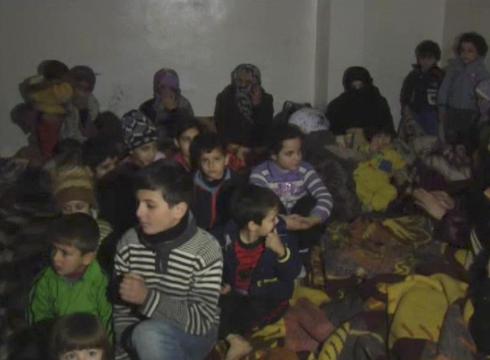
Over 432,000 Syrians have sought refuge in Jordan. they often tell the same tales of horror.

We are posting the observations made by a person who has been assisting Iraqi refugees inside Jordan for the past six years. Since late last year, the organisation has also begun assisting Syrian refugees.

I had a long discussion today with a Syrian refugee family (extended). I asked many questions – about what they had experienced, witnessed, and wanted for their country. Some of the more interesting points are that they say that there are entire brigades of Alawites who are fighting with the FSA and that, as in Iraq, sectarianism does not exist at all to the degree the media is painting it as being. That this is propaganda being put out by Assad’s gov to negate the genuine revolution.

They told me of witnessing, themselves, a woman shot in the head by snipers as she prayed by government snipers, other women who were killed the same way while doing nothing other than walking down the street…about a man – a vegetable dealer – stopped at a military check point and asked what he was up to. He replied “As you can see, I am going to sell vegetables” and he was told to go ahead and then, when his back was turned, he was shot dead by them. Another witnessed an Imam driving to the mosque to speak at Friday prayers. His car stopped at the same checkpoint, he was told to step out of the car and was immediately shot and killed. The soldiers then filled his car trunk with weapons, photographed this and then claimed they had killed a “terrorist”.

These people told me that areas under FSA control have organized to provide medical care and financial support to the injured and help for the destitute. They told me that they are an educated intelligent people and fully capable of creating a government that will respect of the people – all of the people of Syria.

I asked about the claims that there are hordes of foreign fighters supposedly aligned with the FSA, who are carrying out brutalities. They said these claims are grossly exaggerated and that foreigners fighting against the government are a very, very small percentage of those fighting…that this is a revolution and it is the Syrian people who are fighting it.

I asked what, if any, help they wanted from the outside. They told me that the ONLY thing they ask is for a no-fly order to stop the missile attacks by the airforce. They said they do not want weapons, that what they have are enough and are being increased by confiscation from defeated Syrian troops. They said that if a no fly zone was created they could bring down the government within 10 days.

In our work with refugees here, every Syrian family I have interviewed have consistently told me these same things – and I believe them. Not because I had an opinion and they are validating it; I did not. I came in skeptical of both versions of the “truth” about this conflict. And, as we must scrutinize every case to make sure they are truly in need, over the years I have developed a pretty astute “bullshit meter” – these people are utterly sincere. across the board. I am now absolutely convinced that there is a genuine people’s revolution and on a massive scale. That this sincere and determined quest for freedom is a collective act of bravery beyond comprehension and that their determination and courage against the terrible odds they face is one to be not only applauded but to be supported.

There has been a very sophisticated – and largely successful – effort to deny the truth of this situation and this effort has and continues to result in mass murder of innocent civilians and the ancient and irreplaceable infrastructure of this nation. What is appalling is that it appears to me that it is pure laziness on the part of a large part of the international activist community that has bought into the propaganda that resulted in this ongoing unspeakable destruction and the support of Assad that has allowed it. We have become “conspiracy theorists” first, over champions for justice – we support a dictator whose crimes against his people should appall us and call us for action – and all only because we are so eager to see the dirty hands of the USA and NATO (and I do agree that they are filthy) “behind every bush”. We allow a genocide by Assad only to satisfy our own smug opinion of how astute we are in sussing out “another” USA-led imperialist adventure.

What a damned shame – and I hope that we who have erred so badly and with such disastrous consequences will someday (and soon) feel this shame to the degree it belongs to us and learn from it that our oh-so-smug egos are as dangerous on an international scale as they are in our personal lives – and that we are just as vulnerable to accepting propaganda as are those we ridicule, as long as the propaganda supports, in part, our own agendas and world views (whether those are accurate to a large degree or not).

Luckily, from what I have seen, the Syrian people do not need us to succeed. They aren’t motivated by wanting our approval but by a genuine compulsion for freedom from oppression and that ‘justice’ we all claim to be working for. Their determination will result in their success in overthrowing this brutal tyrant and, hopefully, end this reign of terror and mass murder.

Does this mean I support the USA/NATO and that I am ignorant of their malicious and deadly meddling? No. I am well aware that these entities certainly do provide support for whoever they feel will ultimately benefit their agendas. If they feel that removal of Assad is to their benefit, they will support his removal – by whoever they feel will be successful – whether they have the best interest of the people or not. Certainly there are factions inside this revolution who, if taking power after Assad falls, will only continue or even perhaps “improve on” Assad’s techniques and, if the USA/NATO feels that any of these entities will best serve their purposes, then they will be supported in their quest to take power. Let us hope that those, like these people I talked with today, those who support a free and cohesive new Syria will succeed and that they will not sell out due to any US/NATO influence. (à la Iraq). But, in the meantime, let’s recognize and support a people’s fight for freedom and that they are so determined for it that they are willing to face death for it.

089

WRITTEN BY ASMAE DACHAN, translated by Mary Rizzo
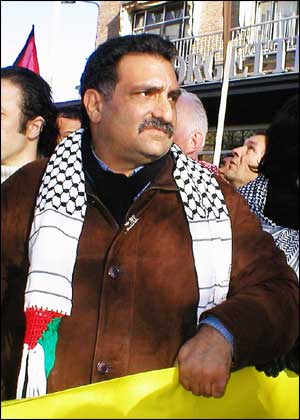
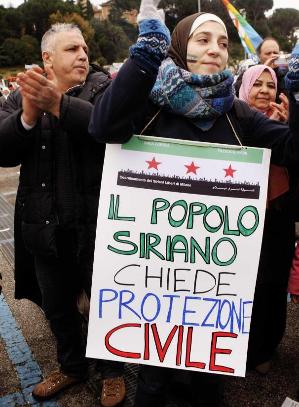
Hundreds of Syrians and supporters of the Syrian cause took to the streets of Rome on 13 April to say “We’ve had enough of the massacre perpetrated by the Assad regime in front of the indifference of the world”. They came in coaches, trains and cars; the young and the old, women, children, entire families who live in various cities of Italy, who in Syria have families and loved ones living in the cities under siege.

Answering the appeal of the organisers were coaches full of people from Verona to Naples: it was a presence that was important for the reasons of the march more so than for the numbers of people. The vision for those in Piazza dell’Esquilino where the march started, was an impressive one: a Syrian flag measuring 60 metres opened the march, followed by an orderly and proud stream of people who, despite the fatigue and stress of over two years of protests and activism to fight the repression their loved ones are subject to, has never betrayed its pacific nature or its ideals.

The threats and the intimidating acts coming from the supporters of the Syrian dictator in Italy that had preceded this march did not dissuade anyone. The cherrybomb that they exploded in a parallel street to the square where the marchers gathered served no purpose. It was just a loud bang that had caused the law enforcement officers to intervene immediately, but it did not shake those present, in deep empathy with their people who every day must deal with showers of real bombs.

Nor did the presence of the militants of the extreme right movement of Casa Pound, above street level and armed with stones and regime flags serve any purpose. In fact, they folded up their flags and broke up their own gathering when the officers neared them for identification. In their presence, the protesters chanted an impassioned “Assassins, assassins, keep your hands off of our children”. The march wound its way through the central streets of the capital, where hundreds of tourists and Romans applauded and were united to show their human solidarity.

Breaking the wall of silence that engulfs Syria, indeed, is one of the priorities of activism outside Syria, and the reason for which this latest protest by the Syrian community in Italy had been called. Among the participating associations were: CNS Italia, Onsur, Ossmei, Associazione 3 febbraio, Assopace SessaAurunca and others.

http://diariodisiria.wordpress.com/2013/04/15/i-siriani-ditalia-in-piazza-per-dire-stop-al-massacro-del-loro-popolo/

asm 1asm 3asm 4
asm 2

Recently, a new site has started which is a platform for video debates on various controversial issues. The owner of the site finds persons on Facebook who are active in discussing the matter, and sets up an hour-long debate which then will be uploaded to You Tube so that others can watch it after it is over. One of the topics is Syria. Originally, the title of the room where those debates take place was “Civil War In Syria” and the photo that accompanies it is of Assad and some of his high-ranking officers. Today, the photo still is there, but the title reads “Revolution in Syria”. I suppose this must be a compromise for each of the factions.

I had been invited to debate by the owner of the site, and participated in my first discussion. Then I was invited to participate in another one, but during it, after 45 minutes, the opponent declared he was having some internet problems, was not satisfied with the audio and he did not want what we recorded uploaded but wanted a new debate the next week. We both agreed and it was rescheduled.

We had the debate, which you can watch here, to make all the judgments for yourselves on how it unfolded.

A few days later, Ghassan continued the private message between the site owner and me, addressing me alone and asking for a “re-match”. I wrote that I do not schedule the debates, so he would have to talk to the owner about it. A LONG discussion ensued, and within this conversation, you will see EXACTLY how the Pro-Assad faction twists facts even when it is in front of their eyes, all in a day’s work!

However, I could have kept all of their twisting to myself, sparing them the embarassment, but I was encouraged to disclose by this Facebook post and discussion (CLICK on the picture to enlarge it):

intibah 1

intibah 2

Therefore, for your entertainment and information, see for yourselves the mechanisms of the Pro Assad side, how facts and truth, even with evidence in front of their eyes, get distorted and twisted.

  • Conversation started 17 February
  • Ghassan Kadi

    Hi Guys. Can we reschedule this for same time next week?

  • 21 February
  • Max Ringelheim

    Hey Ghassan and Mary are we still all good for a Vonvo discussion this Sunday at 4PM EST which is 10PM for you Mary and 9PM for you Ghassan….??

  • Mary Hassan Ali Rizzo

    that would be 11 PM for Lebanon, no?

  • Mary Hassan Ali Rizzo

    or 9 in Rome and 10 in Lebanon, correct?

  • Max Ringelheim

    4PM EST is 10PM in Rome and Idk if Ghassan is speaking from Lebanon not entirely sure….for you the time is 10pm Sunday night

  • Max Ringelheim

    great so lets see if Ghassan can confirm also and we will be all set….

  • Ghassan Kadi

    Hi all. As I keep saying Max, this time slot suits me just fine. Sunday 4PM EST (US). Will there be other speakers othr than Mary and me?

  • Max Ringelheim

    possibly working on that now.

  • 22 February
  • Max Ringelheim

    Reem Alhariri Connor will be participating in the discussion as well

  • 22 February
  • 25 February
  • Ghassan Kadi

    Max what I would really like is to have a one on one with Mary. After all, Reem had little to say apart from deviating the discussion further.

    Mary, you raised many groundless points and unsubstantiated matters into the discussion, needeless to say that when you realized that you were losing the debate, you have committed a number of grave errors, which again reveal your total lack of knowledge of the history of the area. One good example was your mention to Tal Al-Zaatar massacre, blaming it on Assad, though it happened 3 months before Syrian forces entered Lebanon. If you want to know the truth behind those issues, let’s debate them one on one.

    I may not be available next Sunday, but I should be fine for the one after.

  • 25 February
  • Mary Hassan Ali Rizzo

    odd, i Never for one second thought I was losing the debate!

  • 25 February
  • Ghassan Kadi

    I am not here to attack your ego Mary and/or give it the tap on the shoulder. The question is that though you have little to say, the setting of the first failed discussion we had and the time allocations we had in the 2nd discussion, you accused me of not answering your questions. I want to answer your questions, though I normally do not get into details. This is your call Max.

  • 26 February
  • Mary Hassan Ali Rizzo

    Ghassan, i don’t think you GET IT! it is not about you or me, no matter how many times you wish to deflect the discourse into a “personal direction”, without EVER revealing where you actually come from, what you do, who you are. For god’s sake, you do not show your face or give your real name, and yet you spend time to provide your assessments of your opponents as if from atop some pulpit!

    it is about you going continually off the topic and rather than debate the current issues that might actually interest people, you want to provide your version of a history lesson with the “Defiant Narrative”. It is clear that this is the sole argument that you have, and in all sincerity, it has been adequately responded to by Reem and myself.

  • Ghassan Kadi

    Mary, on one hand you accuse me of taking a “personal direction” and then you put my identity/location etc… as important issues. I wonder if you see the contradiction.

    The reason I “hide” myself is to avert danger. I have just received the news that a cousin of mine got killed in the Homs region for similar reasons, and I do not intend to take this path, at least not deliberately.

    As I said to you in the interview Mary, I know that you are well-intentioned, by very highly misled, and your work is causing harm to my country and I am prepared to do all that is in my power to change the minds of people like yourself because it is the combined efforts of the pro rebelion who want to bring in NATO no flight zone (and we know what this meant in Lybia). We just want the world to get its hands off Syria, and you would be doing the same if the whole world was conspiring to drag Italy into oblivion.

    If you are prepared to take the “challenge”, then you are welcome, and if you don’t, it would be entirely your decision to be seen as running and hiding. This is not about inflaming your ego and persuading you into a debate, but I just feel that somehow we perhaps “need” to end this debate, albeit in agreeing to disagree, and not by leaving certain issues un-discussed.

  • Mary Hassan Ali Rizzo

    you have some issues, dear Ghassan, and one of them is your insistence on interpreting the intentions/sentiments of your adversaries simply by projecting your own ideas. When someone “loses” a debate or any sort of challenge, they traditionally are in the position of asking for a rematch. This is clear around the entire world, and while you are convinced that I was fretting because of losing, despite my expressing to you that I did not feel for one moment that either Reem or I were “losing”, quite the opposite in fact! You lost your temper and demanded double time, went emotionally over the edge when “interrupted”, yet insisted that you yourself could continue to interrupt. I do not consider you a debate partner that respects those you are in the conversation with, and find that you have a tendency to gatekeep that inhibits free discourse, which is why I am obligated to point it out to you and to anyone listening.

  • Ghassan Kadi

    I am not asking for a re-match. I am challenging you to finish what we have started. There is a great difference. If you are so confident that you have won the debate, should be looking forward to “smash” me some more, so what are you so worried about ?

  • Mary Hassan Ali Rizzo

    i am worried about nothing. You seem to fancy yourself as some sort of guru, this I find frankly kind of comical, and the way you dismissed the ONLY syrian on the discussion is evidence enough that you do not LISTEN, but you simply pummel your own narrative. You have asked for a rematch, and I don’t see any ground rules to make certain you keep civil and do not break out shouting or to keep the argument on the topic rather than veering off into tangents.

  • Ghassan Kadi

    Your psychoanalysis of me Mary does not intimidate me. You are simply worried to continue and you are too scared to go one on one. Plain and simple. And BTW, I am Syrian too. As Lebanese, I am a Syrian whether colonialists define me this way or not.

  • Mary Hassan Ali Rizzo

    I am not psychoanalysing you, nor am I intimidating you. You seem to have great difficulty reading or listening to what others write or state without projecting something on top of that, as well as “describing” their mental state or their emotions. This is something that you could work on if you wish to continue to debate others as an equal!

  • Ghassan Kadi

    Mary please let us cut this out. It is psychoanalysis of some sorts. Let us not split hairs please. The bottom line is what matters. Do you want to finish this discussion on one-on-one basis? Yes or no.

  • Mary Hassan Ali Rizzo

    Given that you have dragged Max into this, NOT without reason – on the contrary, in an effort to exert some pressure on me and given that Max has said no word at all (rightfully, he is just the “organiser/moderator”), throwing the ball in my court isn’t working, as I’m not a kid and I don’t see things as personal challenges, where I have to be proven the ‘winner’ of anything. Whether we agree on what is happening in Syria or not, the fact that remains and we both agree on is that people are being killed (regardless whose side they’re on) and when the factor ‘human life’ enters, I don’t play games by accepting or declining challenges. My points of view are clear, whoever likes them, fine, whoever doesn’t like them, that’s again fine.
    I feel confident about myself and I feel confident that I’m on the right side of history and I’d be more than happy to express my views, whenever I’m invited to do so, either on a public forum like vonvo or in other venues.
    If the organisers/moderators of Vonvo wish to arrange for a discussion about Syria and if THEY want to invite me, I’d be more than glad to participate. My participation is NOT subject to who the other participants are, but rather the topic. I have been invited by Vonvo twice and accepted the invitation, however it is not me who has asked for these debates to take place. It was the other way around. Vonvo decides, they organise them, they are the ones who reached me and I accepted.
    Therefore, kindly refrain yourself from writing around on FB that you are challenging me for another debate and I’m playing “tough” because you know very well that this is not the case and remember my Dear Ghassan, that I never speak without proof and I remind you of the famous quote “verba volant, scripta manent”.
    For the last time, please stop sending me PMs asking me for another debate. It is not up to me. I have proven that I have no problem whatsoever to participate with anyone in discussions, therefore my actions speak louder than words. If Vonvo decides to have another debate and if they want me to be one of the speakers, I’m more than happy to hear from THEM and if I’m available on the scheduled date/time, then I’ll accept their invitation.
    I however will expose attempts at gatekeeping, will be less tolerant of rudeness and sudden attempts to modify the rules by any of the participants, and any “opponent” should bear in mind that rules do not get created during an encounter, such as double time allotments and the permission of one party to interrupt but the other parties must wait five minutes and at times more, when the discussion has taken different tangents.

  • Ghassan Kadi

    Mary, from previous experienced with you it was always you who used the offensive language against me on FB and not the othe way around. And whe we had a discussion on FB, you decided to end it, not me

    Yes, it is up to Vonvo York agree to organize the meeting, but it is up to you to accept it decline. And if you remember correctly, this whole debate was my idea in the first place any way

    And speaking of changing rules Mary, take this up with Max because he agrees that when 2 are against 1, then the 1 should have enough time and opportunity to respond to both

    It is clear that you are avoiding a one on one debate. I don’t blame you.

  • 26 February
  • Mary Hassan Ali Rizzo

    Ghassan, it’s not necessary to continue to persevere with analysis of my motivations and mental state, as you are entirely off the track, and no matter what I would say, you would persist in your own expression of patently erroneous statements!
    Ghassan, I have debated persons for YEARS and chaired panels where there were actually adversaries who were much more “threatening” than you are. I have also debated in other venues and even on vonvo before, so I don’t understand why you insist you are extending some kind of rematch to me, who you erroneously persist in considering as “me avoiding you”. You are not the issue. I debate about Syria, you are totally irrelevant to any participation of mine in a debate about Syria, though you seem to be keen on it with great persistence. Should I feel “honoured”?
    I also do not realise that you are the one who is creating the schedule / programming for vonvo. I had been invited by Max weeks ago, and when he had asked me if i wanted to debate Syria, I accepted. You asked me if i wanted to debate you, and i said, if memory serves, why not. I have no particular issue with you, I “ended” interaction with you when i felt spammed and when you began to attack me, which is something everyone does when they no longer seek interaction with someone on FB, they unfriend them! As I also remember, a close friend of yours was insulting me for “being a Jew”, and your wife spammed my inbox unsolicited. If anything, i have been tolerating your attitude – which clearly showed your limits not only in discourse, but in tolerating that anyone has the opportunity to speak, including the insertion of ad hominem speech, interrupting both Reem and me repeatedly but screaming and telling us to shut up when we asked for you to repeat something or when we in real time said something was untrue when you were stating something entirely invented. As for changing the rules during the debate, I think this demand you made during the debate to have double time to either of your adversaries reveals your own weaknesses while alotting you a privileged position in the debate. Insistence upon obtaining the last word, double intervention, avoidance of the points raised by your adversaries, refusal to take a question from the moderator and derailing of the discourse into tangents that also included discussion of the parties involved does not quite strike me as civil conduct!

    I imagine that in all future debates, Max will have to consider that rules do not get amended while a debate is in course, and since it was clear that there was the panel composition, this should not have happened during the debate. Your being satisfied with your privilege and demanding it be respected outside of the original “pact” resulted in you raising your voice in continuation and demanding others to be cut short.

    So, I honestly do not get your point in responding when it is made clear that your request for a rematch does not depend upon you or me. There are many persons who I am certain are anxious to debate about the topic, and unless the ground rules are fair and you are kept to maintain civil composure, you must have the humility at least to recognise that it is not your decision or my decision to make, so you can even keep your attitude problems under cover and at least appear a bit more of a gentleman!

  • 26 February
  • Ghassan Kadi

    You are simply, though vet elaborately, trying to avoid finishing the discussion because you well know that if you did, your lack of knoewledge will be exposed and you will lose your popularity among your followers who were littering the chat room with silly comments and personal attacks. That’s fine Mary. I won’t twist your arms. You have distanced many friends recently simply because you have no arguments to make. I just would wish that you would stop meddling into my country. You are causing harm and you are not at all helping anything or any one except the friends of Israel. Speaking of whom, you did not respond to my comments regarding FSA fighters getting treated in Israeli hospitals. These are the questions you are trying to avoid confronting. But this is fine Mary. I will not defame you in FB as you. You have already made some recent complaints to FB. I do have the right however to say that you are refusing to finish the debate.

  • Max Ringelheim

    Guys I will try reading through this fully and respond to this a little later. Been a busy busy day today.

  • Ghassan Kadi

    While you are at it Max, please make it clear who has broken the debate protocol and who interrupted who. I interrupted Mary once only and said “I need to interrupt”. She interrupted me on a number of counts. Further, her supporters mobbed the chat room. I believe that the same rules of civil conduct that apply to the debate room should apply to the chat room.

    Mary has accused me (above) of the exact things that she and her groupies have done, but bullies often play victims. There is nothing new in this tactic.

    Honestly, this needs to be tidied up. I know that Vonvo is not CNN, but there are certain basic rules that need to be implemented. Least of which is that the number of people in the debate room should be raised to 5 so you can have yourselv plus 2 from each side.

  • 27 February
  • Mary Hassan Ali Rizzo

    At Ghassan:
    It seems that either your English isn’t good enough or you have reading comprehesion problems, because I can’t explain otherwise what it is that you don’t understand when I say “don’t contact me with regards to another vonvo debate, it’s not up to me, it’s up to them”.

    Anyhow, it looks like you just want to have the last word, regardless if what you say is true or not. So, listen to me and this time try to understand what I’m saying because enough is enough.

    You can claim as much as you like that I’m avoiding/declining/rejecting your proposal/suggestion/challenge for another debate. If you wish, you can also claim that the earth is square and not round. You can also claim that Elvis is still alive. Whatever it is you claim, I advise you to not forget that the evidence proving the contrary is here and I will put it out if you decide to continue acting like a 5 year old in kindergarten. So, here’s the deal. I’ll repeat it for the last time – take it or leave it. It’s up to you.

    As I have made it crystal in this PM that I have no problem whatsoever to engage in another vonvo debate with you (or anyone else for that matter), try your best to understand and realise that I’m not the person in charge for organising these debates. Max is. So, quit barking up the wrong tree. If you don’t know the meaning of that idiom, you can also take it literally!

    With regards to your allegation that I’m going around on FB defaming you or whatever, I refer you to last night’s thread that your wife started in your group, in which she claims that I have reported her on FB about some comment in some thread, which I have no idea whatsoever about. However, what I’m certain though is that this thread contains enough comments that are pure lies, let alone the various derogatory and insulting terms used, like for example the Spanish ‘puta’, i.e whore.

    Who is libeling whom on FB is clear. It’s obvious that you have turned this to a personal issue and that Syria is the last thing you actually want to discuss. Moreover, you have dragged Max & Vonvo into a vendetta (note: a vendetta that takes place only in your mind and imagination) by asking him the most absurd stuff and requesting him to act as a mediator, as if this is his job. And when he declined to do so, simply because he’s only the Vonvo moderator and not your Mother or Father where you can go to and complain that some child stole your chocolate bar, asking him to do things that are none of his business, like taking actions against anyone who writes anything on FB. That is not his business, nor his job and for all I know, he couldn’t care less if a bunch of people on FB wish to engage in petty cat-fights. The guy only wants (and rightfully so) to acquire more speakers & listeners for a project he started, namely Vonvo. It’s not his job to take sides or tell people what to write and what not on FB and when he made that clear to you guys last night, your first reaction was to immediately dismiss Vonvo, start calling for people to leave Vonvo and start accusing them of a bunch of things. Thumbs up! Score!
    For the love of God people, grow up!

    Listen Ghasan, and if you don’t understand what I’m going to say then reread it as many times as you need until you get it. I don’t care how Max will deal with your actions and your group’s posts & comments on FB dissing Vonvo. That is his job to do and he will deal with it accordingly if he wishes and if he thinks it’s necessary, in an effort to protect Vonvo from libel.

    But when it comes to me, rest assured that the next time you will write to me with false allegations and lies or you, together with your friends, write again anywhere that I’m declining your proposal or call me a whore again, I will put out in the public this PM, as well as any other threads which clearly prove that what you claim is false. End of story.

    At Max:
    I’m sorry that you have been involved in this silliness but unfortunately this is the ugly side of activism. I trust your judgement and I trust that you will deal accordingly with whatever defamatory comments have been put and will be put up on FB in the future about Vonvo, simply because you chose not to be part of an argument that doesn’t involve you. As I said yesterday Max, if you wish to organise another debate on Vonvo and invite me as a speaker and given that I’m available, please feel free to contact me. You know where to find me. I apologise for you being put in the middle but I can’t control other people’s actions nor can I prevent anyone from copying you in PMs that don’t concern you. It’s clear though, that you being included in such an exchange of messages was not my decision nor was it ever my wish, as I can realise that you are just a moderator of a public forum. I’ve been trying for 2 days now to make Ghassan understand that, it seems that he’s not capable of understanding it though. I hope that you will soon be left out of the drama that some people instigate and that you won’t have to deal with a defamatory campaign against Vonvo.

  • 27 February
  • Max Ringelheim

    Hey guys so I hear both of your points and respect each of you. I also thoroughly enjoy and appreciate the time that you have devoted to the Vonvo website.

    Ultimately I think you both believe in Vonvo and its mission of fostering discussion and debates around crucial trending current events. Our platform is unfortunately not perfect but enhancements to our Version 2 Vonvo website should be coming in the following weeks.

    In the end when you break this down, very simply in my eyes this just seems like a matter where two people having differing opinions and are struggling to find common ground and agreement. This is MORE than fine! Vonvo cant guarantee people will agree with one another but the point is providing a platform where one can be heard. I have practically no control over what people can do off of the Vonvo website which I think you would both find understandable.

    How would you suggest we resolve this issue? Would you like to have another debate? Would you rather not speak to one another again? Totally up to you

  • 27 February
  • Ghassan Kadi

    Max. Mary follows the strategies and tactis of Israel. Attack, lie, frame others, and then play victim. Her very rude remarks above are very obvious and she is trying to make herself look nice towards you just for the sake of trying to me make me look bad. I do not wish to debate her any more. I would rather debate someone else who is decent and has something of substance to say.

  • Max Ringelheim

    no problem Ghassan thank u for your suggestion and that is more than fine. ALL GOOD. Have a good weekend and just to confirm u said u are not available correct?

    this weekend that is??

  • Tuesday
  • Ghassan Kadi

    Yes. This weekend shoud be fine.

Seen by everyone

WHEN YOU AREWRITTEN BY RUTH RIEGLER

What is it that the world doesn’t ‘get’ with Syria that leads to the continuing reluctance to unequivocally condemn and speak out against Bashar Al Assad’s regime among so many otherwise intelligent people?

The Assad regime is using warplanes, helicopter warships, tanks, Scud missiles, cluster bombs, phosphorous bombs, TNT-filled barrel bombs, rocket launchers and assorted other weapons against civilians. Over 70,000 Syrian people have been officially documented killed to date, more than 5,000 of those are children. The real death toll may be twice that and it is rising by the day. Hundreds of thousands are imprisoned, ”missing,” maimed, crippled, over four million in the country need urgent humanitarian aid, over 2.6 million are displaced, over 700,000 are refugees…the horror statistics go on and on…and the world collectively shrugs, sighs and turns away.

I realise that people have the right to say this isn’t happening. They also have the right to say that the sun doesn’t rise in the east, although repeating the latter patent falsehood at least doesn’t make them tacitly complicit in genocide, as repeating the former one does.

Of course, people have the right to believe what the Assad regime and its supporters tells them – that it is a heroic and embattled state fighting heinous and possibly fanged radical Islamists and jihadists intent on its destruction, who are part of a foreign plot by the CIA to overthrow The Only True Anti-Imperialist State In The Region.

People also have the right to believe what Israel and its supporters tell them – that it is a heroic and embattled state fighting heinous and possibly fanged radical Islamists and jihadists intent on its destruction, who are part of a foreign plot by Iran to overthrow The Only True Democracy In The Region.

Both arguments, for the Assad regime and for the zionist state, have exactly the same amount of legitimacy and merit and stand up equally well to even the briefest scrutiny or analysis, which is to say none and not at all.

People have the right to say that they wish to remain neutral on Syria. In the end, however, as Desmond Tutu wisely noted, ‘If you are neutral in situations of injustice, you have chosen the side of the oppressor.’ ”Neutrality” – or simply indifference – from the outside world is what all abusive spouses, all dictators, all totalitarian regimes, all brutal and oppressive states rely on in order to continue with their brutality and oppression. Neutrality in such monstrously unjust situations is not an admirable and objective stance, but a tacit nod and wink to evil.

People have the right to suggest that maybe dictators are better for some – if they themselves are prepared to give up their own freedoms and live under dictatorship since of course they wouldn’t be hypocritical enough to wish for others what they don’t wish for themselves (perish the thought…).

People also have the right to say that Western democracy is a sham, and I would agree wholeheartedly that it could certainly be massively improved. But oddly I don’t notice the Western totalitarianism groupies actually rushing to renounce their citizenship of horrid sham democracies in favour of emigration to glorious people’s republics, or indeed campaigning for fewer rights in order to feel less oppressed by the horrors of democracy.

People have the right to say that Western leaders and governments are monstrously hypocritical, amoral and indifferent to human life, paying only lip service to the ideals of freedom and human rights while actually opposing them whenever expedient for their interests. And I would agree wholeheartedly without reservations. I’d also suggest that this is one more reason why we should not exhibit the same monstrous hypocrisy, amorality and indifference to human life – because if we pick and choose which people’s freedom and human rights to support or oppose we are no different, no less hypocritical, amoral and indifferent to human life, and certainly no better than those governments we condemn.

In the end, people have the right to say, do (or not do) and believe whatever they want, about Syria or any other issue. But that right comes with the attendant acceptance of responsibility for the results of their words, action or inaction and beliefs. The results of neutrality of indifference towards Assad’s war on Syria are tacit support for and complicity with it. The neutral and indifferent people around the world are not flying Assad’s warplanes, dropping the cluster bombs and phosphorous bombs, carrying out the rapes, torture, massacres, but their silence gives their consent for the regime to continue doing so, tipping Assad a silent nod and wink to ‘Carry On Killing.’

the "enemy" bombs... but you of course, don't react, do you?

the “enemy” bombs… but you of course, don’t react, do you?

WRITTEN BY LORENZO TROMBETTA, translated by Mary Rizzo

No open warfare is about to break out in the Middle East. And no balance status quo in place for decades is about to get off kilter. The Syrian regime has no intention of responding militarily to the alleged air raid carried out by Israeli fighter jets just two steps away from Damascus against a target, the nature of which is still uncertain. The Israeli action is only indirectly linked to the dynamics of the ongoing internal conflict in Syria and is not intended to be followed by any other actions in the short term.

In the night between Tuesday 29 and Wednesday 30 January, an “unprecedented explosion” was heard by the inhabitants of Jamraya and Hamma, located halfway between Damascus and the Lebanese border. The sources speak of a blast that was “much more powerful than those heard in the past” and a fire broke out inside the Science and Research Centre, protected on three sides by land controlled by the armed forces.

Israeli press sources indicated in that same area the target of the raid. But diplomats and intelligence (anonymous) affirm that what had been struck was a convoy of missiles destined for Hezbollah in Lebanon, the allies of Damascus who effectively control large portions of territory across the border.

In a statement, the Syrian government has admitted the Israeli bombing, saying it targeted a research centre and in the attack and two employees died. At this point, there is insufficient information available and provided by unidentified sources, the reconstructions are biased and contradictory.

What is certain is that for days the Israeli air force had stepped up patrols over the skies of Lebanon. A fact confirmed by the Ministry of Defence in Beirut and the UN force deployed in southern Lebanon.

The rise of the Israeli security measures was a result of the claims made by the authorities of the Jewish State about the danger of the chemical weapons in the possession of the Syrian regime possibly falling into the hands of its allies, Hezbollah. For Israel, they are the real enemy at the gates.

The Syria of the Assads for decades has not constituted a real threat to Israel’s security. Indeed, as has been repeatedly stated in a direct and an indirect way by Israeli politicians, the permanence in power of President Bashar al Assad is a guarantee and not a danger to the Jewish state. Which has never hidden the fact that it prefers its best enemy to the unknown.

Signals that no war is about to break out in the region also come from the two main allies of Damascus: Hezbollah verbally condemned the raid yet,  in spite of having ample means to do so, it did nothing to prevent the Israeli fighter jets from bombing a target just miles away from the Syrian capital.

Israeli planes went in – confirmed the defense ministry in Beirut – by Naqura, on the sea, and in a north-easternly direction, have gone through almost all of the Beqaa valley passing right over the inner defense lines, deposits and training camps of the Shiite militia. If Hezbollah really wanted to protect its ally – and unleash a new war with Israel – it could use at least one of the twenty thousand missiles said to be in possession of the pro-Iranian movement.

And if Israel wanted to support the Syrian anti-regime rebels – which is the argument of the supporters of Assad, raising hue and cry of a foreign conspiracy led by the Zionists – they not merely would bomb a sole objective, and almost two years after the start of the uprising, but they would have long ago started a campaign on several fronts to accelerate the fall of Assad

Iran, for its part, had in recent days said that “any attack on Syria will be considered an attack on Iran.” But from the declaration of condemnation in the latest hours from Tehran – by the Undersecretary for Foreign Affairs and Minister of Defense – it is clear that the Islamic Republic will not act militarily in the rescue of its historic Arab ally.

The Syrian government – through the ambassador in Beirut, not the president Assad says that it reserves the right to respond to the vile aggression, but it will do it by way of surprise. As if the surprise effect was an exception in this type of action and not the norm.

The difficult position of the Syrian regime is put in these hours is further laid bare by the finding – reported not only by expert analysts but by the simplest of men in the street in Syria – that no Syrian military aircraft rose in the air to protect the country from an Israeli raid.

And that the Damascys avatiation  will not be used against the “enemy” but will continue to be used against field hospitals where injured are crowded beyond belief, bakeries before which stretch lines of women and children, and mosques which are the refuges of displaced families. (Limesonline, January 31, 2013).

http://www.sirialibano.com/short-news/siria-israele-business-as-usual.html

azmi-bsharaHow the Road to Hell was Paved (without any good intentions this time):

In the beginning, the regime refused to lead a reform process, which the protestors, and a group of people including myself had begged it to do. Instead, the regime began a forceful repression of the uprising. 

Only after it was too late does the regime finally declare that it will accede to reform—and by then, nobody believed them. Of course, the regime wanted to lead the reform single-handed, pushing the opposition aside. The forceful repression of the uprising, which by then had blossomed into a revolution, continued. 

The regime begged for dialogue, and asks the unarmed opposition to take part. Nobody accepts however, and the regime wages war on its people who are now in the throes of an armed revolution. 

The regime demands negotiations without any preconditions, yet nobody is willing to accept anything less than the regime’s departure as a condition to come to the table. So the regime adopts a scorched earth policy, bombing its own towns and cities and displacing its own people: even as they stood in queues outside of bakeries, the Syrian people were bombed by their regime. Even if left without a people and state to rule over, and even if only the ruins of towns and cities remain, this regime of destruction is committed to remaining in power. 

The Syrian people have lost count of the dead. All they have left to see is the light at the end of the tunnel.

Sheik Moaz Al Khatib, capo della nuova costituzione Coalizione nazionale siriano per l’opposizione e le forze rivoluzionarie

11 novembre 2012, Qatar

Il popolo siriano è il prodotto di 10.000 anni di civiltà. Il grande popolo della Siria si trova ad affrontare ogni giorno, una guerra di sterminio programmato e distruzione selvaggia. Si può tranquillamente dire che non c’è un cittadino che non è stato danneggiato da questo regime. Molti partiti hanno esercitato molto sforzo per tirare questo regime fuori dalla sua primitività, la sua ferocia e la sua stupidità, ma sono stati messi fuori dalla sua testardaggine e la sua arroganza.

Il regime ha distrutto tutti gli aspetti della vita normale e ha trasformato la Siria in una rovina;  ha adoperato per 50 anni per negare la volontà del popolo e di giocare sulle sue contraddizioni che li utilizzano per lacerare la nostra gente. Dopo una lunga lotta, numerosi gruppi patriottici sono ora uniti come una sola per fermare il massacro a cui il nostro popolo è stato sottoposto ogni giorno, mentre il resto del mondo ascolta passivamente e guarda.

Il nostro compito primario è quello di fornire assistenza umanitaria d’emergenza per il nostro popolo e di fermare il torrente di sangue che scorre giorno e notte, come ci uniamo i nostri ranghi per rimuovere questo regime tirannico con tutti i suoi simboli e costruire una società giusta fondata sulla giustizia e la dignità che è un dono da Dio ad ogni essere umano. Vorrei avvisarvi di determinate questioni, anche se leggermente spostato rispetto delle norme del protocollo diplomatico. Il primo problema è che la nostra rivoluzione è una rivoluzione pacifica che dal suo inizio alla sua fine ed è il solo regime che ha la responsabilità morale e legale, perché è il regime che ha costretto la nostra gente a ricorrere alla resistenza armata per difendersi, la loro famiglie, la loro cose e la loro religione.

In decine di città, fiori erano portanti durante le manifestazioni di migliaia di giovani uomini e donne. Portavano fiori e acqua fredda per dare ai membri delle forze di sicurezza per chiedere il loro diritto, semplicemente di esprimersi. Questo mostruoso regime ha risposto con arresti, carcere e la tortura e poi ha proceduto a distruggere la struttura fisica, sociale ed economica del paese, dopo aver distrutto il suo tessuto intellettuale e morale negli ultimi cinquant’anni.

Salutiamo la lotta di questo grande popolo, uomini, donne e bambini e salutiamo il loro leggendario coraggio di fronte all’oppressione e distruzione come ci troviamo con rispetto in memoria delle anime dei nostri martiri. Salutiamo anche con fedeltà tutti i combattenti dell’Esercito Siriano Libero che difendono la rivoluzione di fronte alla tirannia.

Il regime ha distrutto il nostro popolo, il nostro paese e il nostro esercito che onoriamo e proviamo il dolore alla vista di ogni bara di un soldato morto. Questo è l’esercito costruito dal lavoro duro del popolo, dal loro sudore e lacrime, per difendere il nostro paese, e lo abbiamo visto essere trasformato dal regime come una forza contro il popolo. Le richieste della gente erano molto semplici, fratelli, tutto ciò che il nostro popolo vuole è per ogni individuo di essere in grado di andare a dormire senza paura. Questa è stata la domanda del nostro popolo, fratelli, e il regime non ha risposto a questa domanda semplice, e oggi non ci sono decisioni accettabili, se non quella della partenza del regime e il completo smantellamento della sua struttura mostruosa.

La seconda questione ha a che fare con l’islamizzazione della rivoluzione e ciò che si dice, giorno e notte, per la ferocia del popolo siriano e dei suoi ribelli. O fratelli, e mi prendo la piena responsabilità di quello che dico, ogni combattente è alla ricerca di libertà, ma alcuni sono spinti agli estremi della ferocia delle forze del regime. Gli sforzi sono in corso per consigli giuridici che regolano il comportamento dei combattenti ribelli, anche quando si tratta di rapporti con i nemici. Questa rivoluzione usa “Takbir” (il canto di Allah è grande), in tutti i suoi angoli, non esclude nessuno dei nostri fratelli di tutte le fedi sono i nostri partner. Molti dei nostri fratelli cristiani sono uniti a noi come abbiamo iniziato a dimostrare dall’interno moschee e cantato “Allahu Akbar”, di fronte al tiranno. L’Islam che ci portiamo dietro è un islam che costruisce le civiltà e onora gli esseri umani, è un Islam che abbraccia il cristianesimo nella più sacra delle terre, un Islam che unisce la gente e non li divide, un islam che ritiene che la forza è nella diversità non nel isolamento. E nella scia dei primi martiri in Douma, è stato reso molto chiaro che noi chiediamo la libertà per ogni sunnita e alawita, ogni cristiano e Durzi, ogni Ismaili e Syriani. Sentiamo il dolore di ognuno di loro, dalle ingiustizie perpetrate contro il nostro arabismo alle ingiustizie perpetrate contro il grande popolo curdo e per le ingiustizie trattati ad ogni segmento della nostra società. Che cosa è presente nel nostro paese non è solo convivenza ma vero compassione e l’amore per il prossimo.

Il nostro lavoro si concluderà, e lo dico in particolare ai nostri confratelli all’interno della Siria, non appena si svolgono libere elezioni. Ogni questione giuridica e costituzionale è sospesa fino ad allora in modo che il popolo deciderà sul loro sistema giuridico e la loro costituzione con elezioni libere dopo la caduta del regime e in un clima di totale libertà e uguaglianza.

In terzo luogo, la rivoluzione le distanze dall’idea di vendetta contro chiunque e ci saranno comitati giudiziari di tenere chiunque responsabile, che commette crimini contro cittadini innocenti. Supplico anche, sapendo che molti degli ufficiali dell’esercito siriano e soldati sono persone oneste soppressi dal ferro e fuoco come noi tutti erano, mi appello a loro di prepararsi a disertare da questo corpo corrotto e di aiutarci a costruire la Siria del futuro. La maggior parte ha sofferto e le minoranze hanno sofferto e il regime ci ha trasformato uno contro l’altro, è il momento di unirsi in amore per affrontare la lunga notte.

In quarto luogo, noi come individui e comunità, non ha giurato e non giurerà mai fedeltà a qualsiasi lato o causa che è dannoso per il nostro popolo, la nostra unità e la nostra terra e il sangue è la firma del nostro impegno. Ci impegniamo davanti alla nostra gente per proteggere i loro interessi, la loro terra, la loro religione, la loro morale, la loro libertà e dello stato di diritto. La Siria del futuro sarà per tutti i suoi figli e e sue figlie. Mi impegno personalmente davanti ai miei fratelli, per essere al servizio del mio popolo, per unirli e che ogni decisione presa nel suo interesse di riconquistare la loro dignità.

In quinto luogo, chiediamo alla comunità internazionale, i suoi governi a onorare promesse di aiuto per la nostra gente. Il nostro popolo, o fratelli, non è un popolo primitivo o marginali, siamo i creatori di una grande civiltà e quando i diritti del nostro popolo vengono restituiti le risorgeremo di nuovo e creare una grande civiltà, dopo la caduta del regime. Chiediamo ogni le forme di aiuto umanitario, sostegno politico ed economico. A nome di tutti i nostri fratelli assenti in Siria, porgo i miei ringraziamenti al governo del Qatar e del suo popolo, l’Arabia Saudita e gli Emirati Arabi Uniti. Ringrazio i nostri partner di civiltà e di storia, i nostri fratelli turchi e dei nostri fratelli in Libia, Giordania ed Egitto. Spero che si possa lavorare insieme per alleviare le sofferenze del popolo siriano. Vorrei anche ringraziare tutti i nostri fratelli che hanno lavorato instancabilmente per molte notti di mettere insieme questa coalizione. Vorrei anche ringraziare il Consiglio Nazionale Siriano per aver collaborato con noi come fratelli, perché alla fine siamo fratelli.

Infine, vorrei salutare il nostro grande popolo, con riverenza e baciare la mano di ogni madre e padre. Voglio anche salutare la fermezza dei nostri giovani uomini e donne. Voglio salutare in particolare le donne siriane, esemplare della più grande donna su questa terra, che ha fatto gli esseri umani che conquistarono ferro e sangue. Vorrei anche affrontare i nostri figli, loro hanno il mio amore incondizionato e dire loro che ci verseremo il nostro sangue in modo che possano andare a letto felice, con un sorriso sulle labbra e con l’amore e la pace nei loro sogni. Voglio dire a tutti i siriani che se si trova bene in quello che faccio poi mi tengono, e altrimenti che mi chiedono di lasciare, io vi amo tutti e chiedo a dio per il successo, la lode appartiene ad Allah, Signore dei mondi.

http://levantdream.blogspot.co.uk/2012/11/translation-of-sheik-moaz-kahtibs-speech.html

(Traduzione dall’arabo: Rabi Tawil, traduzione dall’inglese Mary Rizzo)

It is said that Assad sold the GPS coordinates to France for a promise.
Assad aurait vendu les coordonnées GPS de Kadhafi en échange d’une contrepartie.

Il y a de fortes probabilités pour que la capture de Kadhafi soit l’œuvre des services secrets français. Le Colonel aurait été “vendu” à l’Ouest par Al Assad.

De notre correspondant au Corriere della Sera, Lorenzo Cremonesi, traduit par Eric Lamy

TRIPOLI.    Ce ne serait donc pas un membre des Brigades Révolutionnaires mais un “agent étranger” qui a tiré le coup de feu mortel ayant atteint Muammar Kadhafi à la tête le 20 octobre de l’année dernière, dans les faubourgs de Syrte. Ce n’est pas la première fois que la version officielle communément admise concernant la fin du colonel est remise en cause en Lybie. Mais aujourd’hui, c’est Mahmoud Jibril en personne qui s’exprime : Jibril est l’ancien premier ministre du Gouvernement de Transition, et actuellement en concurrence pour diriger les affaires lybiennes après les législatives du 7 juillet. Il pointe à nouveau l’hypothèse d’un plan conçu par
des services secrets étrangers. “C’est un agent étranger infiltré au sein des Brigades Révolutionnaires qui a tué Kadhafi” a-t-il précisé il y a deux jours, au cours d’un interview avec la chaîne de télévision cairote Dream TV, où il participait à un débat sur le printemps arabe.

La French Connection
S’il y a bien un secret de Polichinelle dont on parle abondamment dans les milieux diplomatiques de la capitale lybienne, c’est bien que l’assassin de Kadhafi n’était pas seulement un étranger : il était français. Et voici pourquoi. Depuis le début du soutien de l’OTAN à la révolution lybienne, fortement encouragée par le gouvernement de Nicolas Sarkozy, Kadhafi avait ouvertement menacé de révéler la teneur de sa relation avec le président français, et d’évoquer les millions de dollars versés au candidat Sarkozy pendant la campagne électorale de 2007. Selon des sources diplomatiques européennes, Sarkozy aurait eu toutes les raisons de réduire Kadhafi au silence
le plus rapidement possible. Ce point de vue est confirmé par les informations recueillies par le “Corriere della Sera” il y a trois jours, à Benghazi. Rami El Obeidi, ancien chargé de mission auprès des agences de renseignements étrangers pour le compte du Conseil National de Transition (la première entité politique de la Lybie révolutionnaire) jusqu’au milieu de l’année 2011, nous a révélé qu’il connaissait les procédures qui ont permis à l ‘OTAN d’identifier l’endroit où se cachait le colonel Kadhafi , après la libération de Tripoli par les forces révolutionnaires, entre le 20 et le 23 août 2011. “On croyait, à cette époque, que Kadhafi s’était réfugié dans le désert avec une poignée de partisans, vers la frontière méridionale du pays, avec l’intention d’organiser la résistance” déclare El Obeidi. Ces informations étaient sans cesse relayées par les révolutionnaires eux-mêmes, qui avaient lancé des attaques jusqu’au secteur de Bani Walid et des oasis du sud.

En réalité, Kadhafi avait trouvé refuge au sein de Syrte, qui lui était restée fidèle. El Obeidi précise que “le raïs a utilisé son téléphone Irridium pour joindre ses fidèles réfugiés en Syrie et protégés par Assad”. Parmi ces loyalistes se trouvait le fidèle Yusuf Shakir, chargé de la propagande à la TV
lybienne, qui vit actuellement incognito à Prague. C’est, en fait, le président syrien qui aurait donné le numéro de téléphone de Kadhafi aux services secrets français ; en échange, Assad obtiendrait l’assurance que Paris limiterait sa pression sur régime syrien responsable de réprimer son peuple révolté. Dès lors, la localisation du téléphone Irridium du dictateur grâce au système de GPS était un jeu d’enfant pour les spécialistes de l’Alliance Atlantique… Si la chose était confirmée, on peut raisonnablement affirmer que ce fut le faux pas qui conduisit Kadhafi à sa perte quelques semaines plus tard.

It is said that Assad sold the GPS coordinates to France for a promise.

The credit for the capture of Gaddafi would have been the Intelligence Services of France. The Colonel “sold” to the West by Assad

From our reporter LORENZO CREMONESI / Corriere della Sera

TRIPOLI – It is said to have been a “foreign agent” and not the Libyan Revolutionary Brigades, to fire the gunshot wound to the head that would have killed Muammar Gaddafi on October 20 last year on the outskirts of Sirte. This is not the first time the official and more widespread version concerning the end of the Colonel is doubted in Libya. But now it is Mahmoud Jibril himself, former Prime Minister of the transitional government and currently vying for the leadership of the country after the parliamentary elections of July 7, to again mention the version of the plot devised by a foreign intelligence service. “It was a foreign agent who had mixed with the revolutionary brigades to kill Gaddafi,” he said two days ago during an interview with the Egyptian network “Dream TV” in Cairo, where he is to participate in a debate on the Arab Spring.

THE FRENCH CONNECTION – Among the Western diplomatic circles in the Libyan capital, the most widespread unofficial comment is that, if indeed there was the hand of an assassin in the service of foreign intelligence, he “almost certainly was French.” The reasoning is known. Since the beginning of NATO’s support to the revolution, strongly backed by the government of Nicolas Sarkozy, Gaddafi openly threatened to reveal details of his relationship with the former president of France, including the millions of dollars he paid to finance his candidacy and the 2007 election campaign. “Sarkozy had every reason to try to silence the Colonel and as quickly as possible,” European diplomatic sources in Tripoli told us yesterday.

REVELATIONS – This view is reinforced by the revelations collected by the “Corriere della Sera” three days ago, in Benghazi. Here Rami El Obeidi, former responsible for relations with foreign intelligence agencies on behalf of the National Transitional Council (the former self-governing body of Libyan revolutionaries) up to mid-2011, told us his knowledge on procedures that allowed the NATO to identify the place where the Colonel had hidden after the liberation of Tripoli at the hands of the revolutionaries between 20 and 23 August 2011. “At the time it was believed that Gaddafi had fled to the desert and to the southern border of Libya along with a handful of followers with the intention of reorganising the resistance,” says El Obeidi. The news was repeated continuously by the revolutionaries themselves, who had stepped up their attacks on the region south of Bani Walid and towards the southern oases. In reality, Gaddafi had found refuge in the loyalist city of Sirte. El Obeidi adds: “Here the Rais tried to communicate via his Iridium satellite with a number of loyalists who fled to Syria under the protection of Bashar Assad. Among them was his heir for television propaganda, Yusuf Shakir (today he is safe and sound incognito in Prague). And it was in fact the Syrian president to pass the satellite number belonging to Gaddafi to French intelligence. In return, Assad would get a promise from Paris that they would limit international pressure on Syria to stop the repression against the people in revolt.” Locating the Iridium of the dictator with GPS would then be child’s play for the NATO experts. If it is confirmed, that was the first step that led to the tragic end of Gaddafi several weeks later.

September 29, 2012 | Translated by Mary Rizzo Original: http://www.corriere.it/esteri/12_settembre_29/gheddafi-morte-servizi-segreti-francesi-libia_155ed6f2-0a07-11e2-a442-48fbd27c0e44.shtml

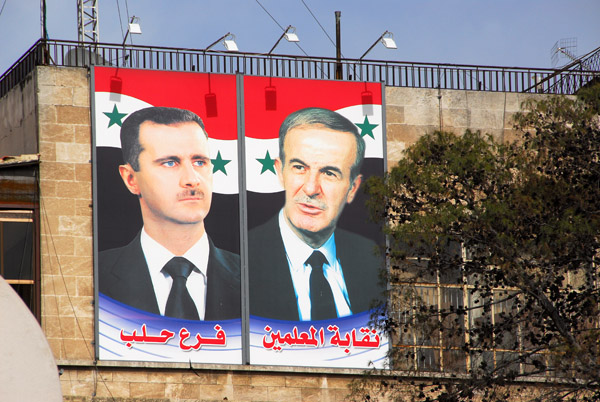
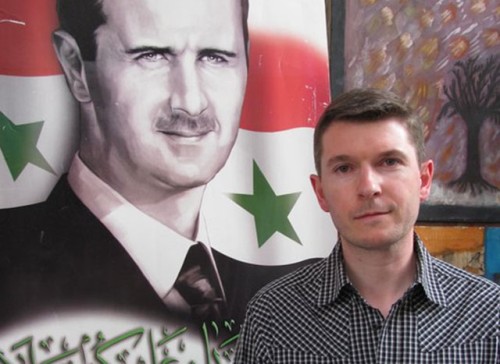
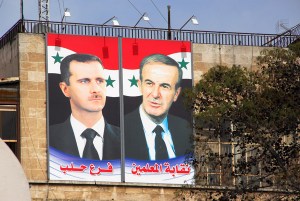
Affiches géantes, pour rappeler au peuple qui commande.

Ruth Riegler a interrogé un activiste syrien afin de mieux comprendre sa vie dans la Syrie révolutionnaire. Il apparaît sous un pseudonyme. Traduit par Eric Lamy.

R. R. : Comment décririez-vous la vie en Syrie avant la révolution, et comment définiriez-vous les causes premières de celle-ci ?

S. L. : Mon nom est Syrien Libre. Je veux que le monde sache pourquoi nous faisons la révolution contre Bashar Al Assad et son régime. Chacun sait aujourd’hui que c’est une révolution majeure, mais personne ne sait, en fait, quelles en sont les raisons profondes. Je vais vous le dire. Je veux que le monde sache comment nous vivions avant la révolution, qu’il en sache les vraies raisons. Nous vivions dans un monde où nous n’avions qu’à obéir comme des esclaves, quelque soit l’ordre du maître. Nous n’avions qu’à obéir et nous exécuter. En cas de désobéissance, nous étions punis ou exécutés.

Nous vivions dans un état de haute sécurité, ce qui signifie que nous étions gouvernés par un président unique avec ses militaires, ses services secrets, ses officiers, sa police militaire, sa police, ses indicateurs et ses shabihas [gangs armés]. Pour faire quoique ce soit, il vous fallait d’abord obtenir une autorisation et vérifier que la loi vous permettait d’agir ou non ; ce qui signifie que vous n’aviez aucun droit d’agir de vous-même et que vous auriez à affronter des obstacles si vous persistiez. Seuls les tenants du pouvoir pouvaient vivre librement et en dehors des lois. Ils pouvaient agir en toute liberté sans rien demander à personne, tout en contrôlant chaque quartier, y compris le système politique, le secteur industriel du pétrole et du gaz, l’économie du pays, les banques, le commerce, l’armée, l’agriculture et l ‘éducation. Dans les faits, ils se considéraient comme des dieux.
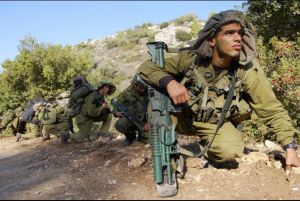
C’est Hafez (et ensuite Bashar) qui ont permis à Israël d’occuper militairement les Hauteurs du Golan.

Nous avons vécu sous ce régime qui prétend être anti-sioniste, mais c’est, en fait, un autre mensonge : il n’a jamais tiré un coup de feu contre Israël et il a maintenu la paix dans les Hauteurs du Golan, interdisant à tout syrien d’attaquer l’État Juif ou de réclamer ce territoire annexé. Tout homme qui l’aurait osé eût été jeté en prison, puni et probablement exécuté. Nous vivions comme des esclaves, sans aucun droit. Nous n’avions pas celui de choisir un candidat au poste de président ou d’organiser des élections libres, de créer des partis politiques ou de choisir des députés, d’élire un parlement. Seuls Assad et ses services secrets pouvaient choisir des députés, et leurs choix allaient invariablement vers les plus corrompus, les plus dénués de moralité ou de conscience. Si vous vous opposiez à la moindre de leurs actions, vous étiez jetés en prison. Ils faisaient de vous ce qu’ils voulaient parce que vous n’étiez rien. Les gens avaient peur de s’opposer, d’être en désaccord avec le régime ou avec quelqu’un qui fût proche des services secrets : les Syriens ont appris à courber l’échine et à se taire. Si vous osiez maudire Bashar, les hommes du régime venaient vous saisir où que vous soyiez pour vous embarquer à l’antenne locale des services secrets. Personne ne savait où vous étiez passé, personne n’osait s’en informer ou même prononcer votre nom. Si jamais vous vouliez créer un mouvement politique, ils agissaient de même : en Syrie, il n’y avait qu’un seul parti, et tous les syriens étaient obligés d’y adhérer. Au cas où vous aviez l’intention d’échapper au service militaire obligatoire, vous étiez jeté en prison pour au moins trois mois, puis forcé de servir quand même.. S’il vous arrivait de mourir pendant votre incarcération dans les geôles des services secrets, personne n’aurait cherché à savoir comment et pourquoi. Personne, évidemment, n’aurait pu être tenu responsable de votre mort car la constitution syrienne garantit au président, à ses services secrets, ses militaires et ses collaborateurs une immunité totale. Les syriens étaient traités comme des insectes qu’on écrase sous une botte. Leur vie importait peu.

On ne peut représenter l’oppression, mais on peut la ressentir.

Le système permettait au président, son armée et ses services secrets d’arrêter, de torturer et de tuer n’importe qui, de disposer de nous et personne, en dehors du pays, ne savait ce qui s’y passait. La corruption, le népotisme et les faveurs étaient la règle à tous les niveaux de l’état, et les gens ont appris à survivre et à ne s’occuper que de soi, sans poser de question, sans s’occuper des autres. Seuls Assad et les proches du régime pouvaient agir à leur guise. La Syrie était une grande ferme et les syriens en étaient le bétail.

Il faut que je vous parle de l’économie du pays. En dépit de la découverte de réserves de pétrole et de gaz dans le Nord-Est de la Syrie ainsi que d’énormes gisements en Mer Méditerranée, nous nous sommes toujours étonnés de ce que ces matières premières étaient si chères pour nous, et pourquoi devions-nous les importer d’Iran, d’Iraq et d’Égypte. Nous avons découvert que c’est parce que Bashar et sa famille volaient le gaz et le pétrole syriens pour le vendre au rabais à la Russie et à l’Europe. Ils se mettaient l’argent dans la poche, pendant que les Syriens n’ont d’autre choix que d’acheter leur carburant et leur gaz à un prix élevé dans les centres de distribution de l’état, quand on avait la chance d’en trouver un. Le gouvernement a constamment gonflé le prix du pétrole et du gaz. Conséquemment, les prix des autres denrées, pain, riz, sucre, habillement, appareils électroniques, maisons, tout, enfin, à augmenté et continué d’augmenter sans jamais diminuer. Quand on pense aux réserves de notre pays en énergies fossiles, cette situation est tout à fait grotesque.

L’économie syrienne toute entière est une farce : lorsque le gouvernement recevait une aide d’autres pays, toute question de notre part relative à la destination de ces fonds restait sans réponse. Quand nous voulûmes nous pencher sur le développement du système éducatif de notre pays, de la santé, de l’agriculture, du secteur industriel ou du réseau électrique national, le gouvernement nous répondit que cette idée entraînerait une hausse des impôts ainsi qu’un surcroît de l’aide internationale parce que la Syrie n’avait pas les moyens de telles réformes.

Les agences de services secrets et les espions : le contrôle de la vie du peuple est total. Telle est l’existence sous le règne d’Assad.

Si un Syrien, désireux de vivre dignement voulait créer une entreprise, manufacture ou import de produits finis telles des voitures, de l’habillement ou de l’équipement électrique, le régime ne l’autorisait qu’à la condition qu’il obtienne une part des bénéfices, un pot-de-vin régulier, en plus des taxes habituelles. Si vous acceptiez cela, on vous accordait votre licence. Si vous refusiez, votre demande était rejetée, et les obstacles à votre projet commençaient à se dresser devant lui. Toute personne désirant ouvrir un commerce de quelque nature que ce soit (échoppe de rue vendant de l’épicerie, stand de bouquiniste, supérette ou cybercafé) devait en premier lieu obtenir l’aval des services secrets avant de faire sa demande auprès des services d’état concernés, à qui il devait verser un pot-de-vin. Si, par exemple, vous vouliez ouvrir un cybercafé, il vous fallait obtenir l’aval des services secrets. Ensuite, après vous être rendu au siège du ministère de la communication (et acquitté un backchich pour les fonctionnaires afin que votre demande soit prise en compte) il vous fallait vous rendre au bureau du gouvernement local puis à l’organisme financier d’état et naviguer au sein de cet écheveau bureaucratique pendant des mois avant d’arriver à un résultat. Même si vous vouliez vous marier et organiser la fête de la noce, vous deviez d’abord en obtenir la permission de l’état. Pardonnez-moi d’être un peu cru, mais c’est une boutade syrienne que de dire que “si tu veux coucher avec ta femme, il te faut l’autorisation écrite du gouvernement”.

En Syrie, tout homme d’un âge donné doit se soumettre à la conscription obligatoire. Beaucoup de mes compatriotes, dès qu’ils ont 18 ans, s’envolent pour l’étranger afin d’y travailler ou faire des études. Grâce au pot-de-vin, on peut échapper à la conscription. Mais si vous n’aviez pas les moyens de prendre l’avion, de travailler ou de suivre des études à l’étranger (et pas de moyen d’échapper à la conscription), il vous restait la possibilité d’être le domestique d’un officier, ou bien chauffeur, ou garde. Si vous pouviez verser un tant par semaine à un gradé, vous pouviez être dispensé de servir et être autorisé à trouver un travail au lieu de rester au chômage. Si vous aviez les moyens d’un gros backchich (un poste TV à un gradé, le paiement de ses factures de téléphone, l’entretien de sa voiture ou tout autre service) vous pouviez éviter le service militaire pendant deux ans. Après ce délai, il vous fallait recommencer votre vie à zéro.

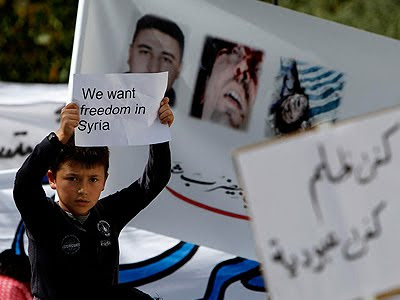
Les syriens veulent la liberté !

Voilà le genre de choses qui nous ont conduit à nous dresser contre le régime d’Assad. Nous voulons la liberté. Nous voulons décider de nos vies. Nous voulons organiser et affermir notre pays de nos mains. Nous voulons construire, produire nos biens de consommation nous-mêmes. Nous voulons produire de nos propres mains. Nous voulons améliorer le système éducatif, le système de santé, l’agriculture et tous les autres secteurs d’activités qu’Assad à laissé en friche. Nous voulons innover. Nous voulons être les premiers Arabes à produire des voitures, des trains. Oui, comme tous les autres peuples du monde, nous réclamons la dignité. Pour toutes ces raisons, nous continuerons de nous battre et nous ne reculerons pas. Nous vivrons dans la dignité, ou bien nous mourrons en martyr. Nous réclamons la liberté.

R. R. : Pour donner au lecteur une idée de ce que vous et vos compatriotes vivez
aujourd’hui, pouvez-vous décrire une journée habituelle en Syrie ?

S. L. : Imaginez-vous un beau matin ensoleillé… Vous vous levez, faites votre toilette, prenez votre café, en souriant à l’idée de tout ce que vous allez faire aujourd’hui, en dépit des obstacles que le gouvernement met en travers de votre chemin. Ça, c’était avant la révolution. À présent, dormir la nuit, se lever tôt le matin, c’est terminé. Tout à changé depuis le début de notre chère révolution, le 15 mai 2011 à Deraa. Bien… Voilà ce qui a changé dans mon programme et dans ma vie en général. D’abord, je ne dors plus que très tard ou très peu, sans cesse réveillé par les bombardements, les obus, les coups de feu et les manifestations, matin ou soir. Mes habitudes ont changé également.

J’avais l’habitude de fréquenter une école de langues près de chez moi pour étudier l’anglais afin d’être traducteur. Cela me permettait, en outre, de rencontrer un ami et de dénicher une meilleure place pour obtenir une maîtrise de traducteur. J’avais trouvé une place à Preston (GB), mais je n’ai pu malheureusement répondre à cette offre d’emploi car je n’ai pas de passeport, et les cours au centre linguistique américain (cycle TOEFL) ont été suspendus. Bien que j’aie contacté le Conseil Britannique pour tenter de les persuader de dispenser un cours  (cycles TOEFL ou ILTES) au Royaume-Uni, je ne pense pas pouvoir commencer ma maîtrise cette année. Je pense que l’occasion en est perdue. Mais ce n’est pas le seul problème que j’ai rencontré : après avoir cherché du travail quelques temps, j’en avais trouvé, l’an dernier, dans une société privée de communications. C’est tombé à l’eau, également, depuis que la situation, ici, n’a cessé d’empirer.

En plus, le fait de ne pas avoir fait mon service militaire signifie que je ne peux ni travailler, ni voyager pour passer ma maîtrise. Cela m’a vraiment déprimé : pas de travail, plus d’espoir de maîtrise, je perdais l’envie de vivre. Puis le régime s’est mis à tuer notre peuple. D’abord à Deraa, où les troupes d’Assad utilisèrent des balles réelles contre des manifestants désarmés, puis vinrent les chars à l’intérieur des villes. Nous autres, jeunes de Syrie, nous n’avons pas du tout aimé cela et nous avons commencé à manifester. Alors le régime à commencé à utiliser des nervis en civil et des casseurs, des brutes comme les shabihas pour nous terroriser.

Depuis lors, le régime d’Assad n’a rien épargné contre nous. Avant la révolution, je faisais trois repas par jour. Aujourd’hui, un seul. Avant la révolution, je dormais huit heures par nuit. Aujourd’hui, je me contente de cinq heures de sommeil, mais je veille bien souvent jusqu’à l’aube. Je me suis débrouillé pour aider au mieux les compatriotes qui en avaient le plus besoin, en les cachant ou en aidant quiconque avait besoin de traduire des infos ou des vidéos envoyées par d’autres activistes. Je reçois des tas d’infos : je les traduis, je les partage au mieux, je discute avec mes amis et nous échangeons nos points de vue sur ce qu’il convient de faire. Notre principal sujet de conversation tourne autour de l’idée que chaque nation au sein de la Communauté Internationale soutient le régime de Bashar parce qu’elle ne veut pas perdre le toutou docile qui protège Israël et maintient la sécurité dans la région.

À présent, le régime à dressé des checkpoints dans toutes les villes et villages, sur tous les axes principaux, et il a fermé toutes les rues qui conduisent au palais présidentiel, à Damas. Il a placé également des snipers un peu partout, surtout dans les zones contrôlées par les rebelles. Si vous voulez faire des courses ou bien vous rendre à la salle de gym, voir des amis ou aller n’importe où, les troupes du régime vous arrêteront aux checkpoints et vérifieront votre identité sur une longue liste de noms : si vous êtes recherché, convaincu d’être un activiste ou que vous n’ayez pas fait votre service militaire, ils vous arrêtent ou bien vous tuent sur place. Il nous faut passer ces checkpoints tous les jours. Récemment, je me rendais chez des amis pour travailler à notre cause. J’ai été arrêté pendant une demi-heure. Je commençais à me faire du soucis. Un soldat m’a appelé. Je me suis approché pour demander ce qui n’allait pas. Il m’a regardé puis a dit : “Voilà  tes papiers. Tu nous fais perdre notre temps avec des recherches inutiles. File.” Après cette aventure, j’ai décidé qu’à chaque fois que je sortirais, j’emprunterais des chemins de traverse pour éviter les checkpoints. Une autre fois, récemment, je me suis rendu à Barzeh pour voir les parents de Salim, un ami abattu par un sniper. Je voulais leur présenter mes condoléances. Au même moment, de violents affrontements avaient lieu dans le secteur, entre des troupes loyalistes et l’Armée Syrienne de Libération. Comme je me rendais à l’appartement des parents de Salim, un sniper à tiré et m’a manqué de peu. J’ai seulement réalisé ce qui arrivait quand un inconnu m’a tiré dans l’entrée de l’immeuble en disant : “Tu es cinglé ? Tu as donc envié de mourir ?”

Ce porc de Bashar à donné ordre aux snipers de se positionner un peu partout et de descendre qui ils veulent. J’ai beaucoup d’amis qui ont été tués par des snipers. D’autres ont survécu à leurs tirs. Anwar, un ami qui n’avait peur de rien et qui était de toutes les manifs, à pris une balle dans la tête. Après un séjour de six mois en soins intensifs et une balle qui lui a traversé le crâne, Allah n’a pas voulu qu’il meure. Certes, il a survécu, mais il est a demi-paralysé et il peut à peine se servir de sa jambe et son bras droits. J’ai d’autres amis qui ont purement et simplement disparu depuis leur arrestation par les forces du régime. Personne ne sait où ils sont et s’ils sont en vie. L’un d’entre eux, Bilal, un ami proche, avait l’habitude de ne pas manquer une seule manif pour encourager la chute du régime… Tous les jours, j’entends parler d’amis kidnappés contre rançon, d’autres sont enlevés dans la rue ou à un checkpoint. Certains d’entre eux peuvent appeler leurs parents pour demander de l’argent. Tant que la rançon n’est pas versée, les ravisseurs ne donnent aucune nouvelle aux parents.

Il est impossible de décrire notre enfer. Plus d’ordre, plus aucune stabilité, et la Communauté Internationale qui regarde faire et se tait. Des tas de jeunes gens s’envolent à l’étranger pour survivre. Les autres rejoignent les rangs de l’ASL dans laquelle on retrouve de nombreux éléments qui ont déserté l’armée régulière où ils étaient obligés de servir. Voila ma vie en Syrie aujourd’hui. J’ai décidé de rallier l’ASL. Honnêtement, j’ai souvent envié de fuir le plus vite possible. J’ai songé à m’enfuir à l’étranger mais, comme je vous l’ai dit, je n’ai pas de passeport. Bien que j’aie demandé de l’aide à des tas d’amis et de connaissances, il est quasi impossible de sortir de Syrie sans passeport.

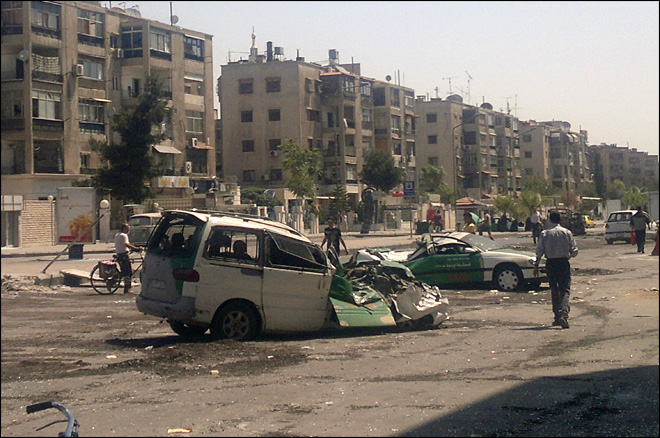
Conséquences du passage des tanks qui ont pénétré dans le camp palestinien de Yarmouk, près de Damas.

R. R. : Que répondez-vous à ceux qui continuent à prétendre qu’Assad est une figure emblématique de l’anti-sionisme ?

S. L. : Tout le monde sait que Hafez Al Assad (que Dieu le maudisse, lui et son fils !) a vendu les Hauteurs du Golan à Israël et qu’il est responsable de la mort de nombreux Palestiniens au Liban et en Syrie, et ce pour garantir la sécurité d’Israël au Liban. À présent, son fils Bashar fait la même chose mais d’une manière différente. Il a attaqué de nombreuses zones où vivent les Palestiniens établis en Syrie, surtout au camp de Yarmouk, près de Damas, et je l’ai vu de mes propres yeux. De même, il est tout à fait faux de croire que Bashar soutient le Hezbollah libanais dans sa lutte contre Israël. C’est pur mensonge. Chacun sait qu’Assad à donné le feu vert au Hezbollah pour assassiner le leader sunnite Rafiq Al Hariri au Liban. De même, le soutien syrien pour redorer le blason de Nasrallah [chef du Hezbollah libanais] afin qu’il puisse se poser en héros de guerre ; la guerre de 2007 contre Israël était pourtant un autre mensonge, un stratagème pour permettre l’expansion du Hezbollah au Liban, et donner aux chiites l’occasion d’accroître leur mainmise sur ce pays, en permettant à l’Iran de renforcer son contrôle sur la région. C’est le projet de Téhéran au Moyen-Orient : constituer un croissant chiite qui s’étendrait de l’Iran à l’Iraq en réunissant la Syrie, le Liban, l’Égypte, l’Arabie Saoudite et le Yémen. Bashar Al Assad souligne sans cesse qu’il lutte contre Israël, qu’il mène la résistance contre l’État Hébreu. Je répondrai ceci : en ce cas, pourquoi emprisonnez-vous, pourquoi torturez-vous, pourquoi tuez-vous tous mes amis ainsi que des dizaines de milliers de Syriens ? Pourquoi tuez-vous mes frères Palestiniens et Iraquiens ? Pourquoi n’avez-vous rien fait quand les avions israéliens ont violé l’espace aérien de notre pays ? N’essayez pas de mentir au peuple syrien : nous vous connaissons mieux que personne. Nous savons tous que votre boulot, c’est de nous liquider et de protéger Israël. Que Dieu vous maudisse, fils de l’adultère !

Homs, au pire de la violence.

R. R. : Comment ça se passe pour vous qui devez vivre dans une vraie zone de guerre ?

S. L. :  Il nous est très difficile de subvenir à nos besoins dans les circonstances actuelles ; on vit avec prudence, on n’achète et on ne consomme que l’essentiel. En ce qui me concerne, c’est plus dur parce que je suis sans emploi. C’est mon père qui m’aide financièrement. Je vis chez mes parents et je les aide. Aujourd’hui, en Syrie, les branches d’une même famille sont regroupées sous un même toit, ce qui fait qu’on trouve parfois de trois à dix familles vivant dans la même maison. La situation est dramatique : entre 65 et 75% de la Syrie est détruite. On se débrouille pour acheter, pour stocker la nourriture qu’on peut trouver, mais il y a des secteurs où il n’y à plus rien. À Homs, il n’y a plus ni nourriture, ni quoique ce soit pour se protéger du froid. Dans deux mois, l’hiver sera là, et nous voudrions que cela finisse le plus tôt possible. La plupart des villes syriennes n’ont plus rien : Assad à brûlé les récoltes et détruit les habitations. J’ai de quoi manger la plupart du temps mais d’autres non, et ça, ça m’inquiète. On leur envoie de l’aide mais le régime encercle ces zones, bien que l’ASL fasse de son mieux pour distribuer aide et médicaments.

Personne n’a idée de la tragédie que nous vivons, mais nous avons bon moral car nous savons tous qu’Allah est à nos côtés. Nous tuerons Bashar, inch’Allah. Nous allons continuer à nous soutenir mutuellement avec nourriture, soins médicaux et tout ce qui sera nécessaire pour remporter la
victoire. J’insiste sur le fait que que l’armée de notre pays, c’est l’Armée Libre de Syrie, l’ALS, et nous en sommes très fiers. Nous sommes tous syriens et nous resterons unis : c’est ce que nous chantions pendant les manifestations “uni, uni, uni, le Peuple Syrien est uni!”

Même après de nombreux mois, le monde se contente toujours de regarder le génocide.

R. R. : Que ressentez-vous devant l’apathie de presque toute la Communauté Internationale à l’égard de la révolution syrienne, et est-ce que votre opinion à son égard a-t-elle évolué ? Si oui, dans quelle mesure ?

S. L. : Pour quelles raisons le monde entier a-t-il béni les révolutions en Tunisie, en Égypte, en Lybie et au Yémen, pourquoi les a-t-il soutenus alors que personne ne nous a aidé, personne pour soutenir notre révolution, personne pour dire le bien-fondé de notre cause ? Pourquoi la Russie, l’Iran, la Chine et l’Iraq ont-ils été autorisés à aider Bashar et son régime en fournissant armes, argent, carburant, gaz et démarches politiques ? Pourquoi les gouvernements occidentaux n’ont-ils pas essayé de nous aider en créant une zone d’exclusion aérienne, en nous fournissant les armes nécessaires et en établissant des zones protégées pour les civils ?Peut-être que ces mêmes gouvernements sont incapables de répondre à toutes ces questions.

Nous, les syriens, nous savons pourquoi : ils veulent nous imposer une solution unilatérale, et cela, nous ne l’accepterons jamais. Je vais vous dire ce que l’on nous propose comme solution. Ils veulent que nous acceptions leurs conditions en permettant à Bashar de rester au pouvoir, nous octroyer une liberté cosmétique et procéder à des changements superficiels en réunissant un gouvernement d’unité nationale. Les gouvernements occidentaux ne veulent pas entendre parler de gens droits et nobles, d’honorables patriotes, ils ne veulent pas entendre parler de l’ALS, non. Ils veulent tuer tous ces gens-là pour mieux nous imposer leurs vues. Il y a aussi cette clause très importante : ils veulent qu’Israël soit assuré d’une paix sans nuage et que nul ne s’en approche. Pour toutes ces raisons – et l’Histoire le prouve à l’envi – Bashar est le mieux placé pour réussir. C’est pourquoi les gouvernements occidentaux laissent l’Iran, la Russie et lal’Iraq le soutenir en lui envoyant davantage d’armes et de troupes, puisqu’il n’y a plus de syriens (qui ne veulent plus de lui) à cause des défections  en masse qui dépeuplent l’armée régulière. L’Occident laisse ces pays envoyer des fonds et des soldats du Hezbollah, de l’Armée du Mahdi [milice chiite irakienne] et de la Force Al Qds [pasdarans iraniens, opérations extérieures]. L’excuse de l’Occident est que l’issue du conflit est complexe. Elle est très simple, au contraire : nous voulons la liberté. Donnez-nous des armes lourdes pour détruire les avions de chasse, des tanks, des lance-rocket et nous gagnerons. L’Occident sait que Bashar est affaibli, c’est pourquoi il prétend que s’il nous donnait des armes, l’ASL serait incapable d’en contrôler la distribution et donc Al-Qaeda en profiterait.

Mais les syriens savent bien qu’Al-Qaeda n’est pas en Syrie, ni dans aucun pays arabe. Les gouvernements occidentaux ont brandi cette nouvelle excuse : l’opposition syrienne n’est pas unie. Celle qui a défait les régimes en place dans les autres pays n’était pas plus unie. Les gouvernements occidentaux n’ont rien fait non plus pour les réfugiés syriens en Turquie, en Jordanie, au Liban et en Iraq ; ils n’ont envoyé qu’une aide insuffisante, sans leur permettre de pouvoir travailler. Ils ne les ont même pas enregistrés comme réfugiés aux Nations Unies, les laissant dans des zones désolées d’Iraq et de Jordanie, parce que l’Occident veut que les syriens, même réfugiés, obéissent à leurs directives en se soumettant à Bashar Al Assad, en retournant vivre sous sa férule. Si nous refusons cela, notre punition sera la privation de nourriture, d’eau et de denrées de première nécessité. Il ne faudra, bien sûr, pas compter sur son aide pour se débarrasser de Bashar. Personne ne nous aidera. Nous n’avons que nous pour nous aider, et Dieu, et c’est précisément ce à quoi nous sommes réduits aujourd’hui.
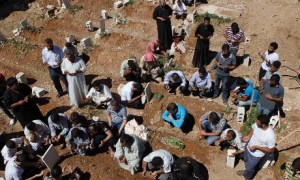
Combattants de l’ASL tombés au champ d’honneur.

R. R. : Comment voyez-vous la situation évoluer à court et moyen terme, et êtes-vous confiant dans le retour de la paix après la chute d’Assad ?

S. L. : La situation sera sanglante et bloquée si nous ne nous efforçons pas ardemment de résoudre le problème. Si l’on peut agir vite pour nous libérer, cela nous permettra d’épargner le plus de vies possibles et de sauver ce qui peut l’être de notre peuple, des propriétés, de l’infrastructure du pays, de son économie… Si on leslaisse faire ce qu’ils veulent (Bashar et les puissances occidentales) nous perdrons davantage de nos compatriotes et le carnage va empirer. Si cela devait arriver, le bain de sang se poursuivrait (ce serait un génocide) avec des milliers de morts supplémentaires, le pays pillé et mis à sac par son armée, les bâtiments et son infrastructure détruits, l’économie dévastée, des milliers de gens choisissant l’exil, les meilleurs cerveaux de Syrie, ceux qui sont essentiels pour reconstruire le pays, fuiraient une nation tout simplement abandonnée au chaos. Nous autres syriens nous ne le voulons pas. Nous ne pouvons accepter ça. C’est pourquoi nous travaillons très dur à organiser et harmoniser notre agenda pour tuer Bashar et mettre rapidement un terme à cette épouvantable situation. Nous autres syriens sommes optimistes parce qu’Allah nous accompagne et que nous sommes unis. C’est pourquoi nous pensons que la paix reviendra bientôt. Si Bashar reste au pouvoir, il n’y aura nulle paix. Juste plus de discours et de sang versé, et nous vivrons à jamais dans les ténèbres comme des esclaves. Nous ne pouvons l’accepter. C’est pourquoi nous  préférons  vivre dignement ou mourir en martyr. C’est l’option que nous avons retenue : la mort plutôt que d’être encore humiliés.

R. R. : Que pensez-vous de certaines allégations relevées dans de nombreux médias qui parlent de “guerre civile confessionnelle” ?

S. L. : Il n’y a pas de “guerre civile confessionnelle”. C’est de la propagande, distillée par le
régime et d’autres pays. Ils prétendent que si le régime tombe, une guerre civile va éclater et le massacre sera général et qu’au contraire, si Bashar reste, la société syrienne demeurera unie. C’est un mensonge éhonté ! Ce que l’Occident et Bashar projettent de faire, c’est de redessiner la carte de la Syrie en régions autonomes comme en Iraq, avec les Kurdes qui y auraient un état indépendant dans le Nord-Est, les Druzes dans le Sud et les Alaouites le long de la côte syrienne, tandis que les Sunnites obtiendraient le reste. Voilà leur projet, et Bashar se démène tant et plus pour réaliser son rêve d’un état Alaouite-Chiite. Ils oublient seulement que depuis le début de notre révolution, notre mot d’ordre a été “Uni, uni, uni : le Peuple Syrien est Uni !”

Le régime essaie d’attiser le sectarisme prétendu de la révolution ; le peuple pense différemment [la Syrie pour tous !].

Ce pays est à tous. Quelle que soit votre religion, secte ou groupe particulier, vous êtes syrien et vous appartenez à la Syrie. Les syriens de toute obédience refusent le projet de diviser notre nation et tous en appellent à l’unité. J’ai rencontré des Alaouites, des Chiites, des Chrétiens, des Druzes et des Sunnites au cours de notre révolution et tous ont rejeté ce plan pour nous diviser. Nous en appelons à l’unité : un peuple, un pays. En dépit des tentatives du pouvoir pour armer différentes sectes et les retourner les unes contre les autres. Pour nous diviser. Même si Bashar fait de son mieux pour semer la division parmi nous, nous ne permettrons pas d’être manipulés, de nous entretuer : nous sommes frères et sœurs.

Pour finir, je voudrais ajouter ceci : avant notre révolution, on vivait ensemble en parfaite harmonie. J’ai vécu, moi, dans un immeuble où mes voisins étaient chiites, juifs et chrétiens. Mes amis sont de religions différentes : on s’apprécie et on cohabite sans problème.

R. R. : Pensez-vous que cette expérience vous a changé ? Si oui, dans quelle mesure ?

S. L. :  Oui, j’ai changé. J’ai une plus grande conscience de la conspiration générale pour faire échouer notre révolution. J’ai également découvert que le monde ne se préoccupe que de ses intérêts et il se moque bien de tout le reste, sauf de lui-même. J’ai également fini de croire à la rhétorique des représentants de l’ONU ou des organisations non-gouvernementales, que ce soit les Droits de l’Homme, l’UNICEF, l’UNICO [universités & collèges en GB], la CPI [cour pénale internationale], l’IJP [institut de justice pénale] ou autre. Le monde n’a pas été capable de mettre au point le moindre programme pour aider les syriens en Syrie ou les réfugiés dans les pays voisins, ni même d’organiser une rencontre de donateurs. Même les conférences des “Amis de la
Syrie” n’a débouché sur rien. Tout ce que savent faire ces gens-là, c’est de nous regarder et laisser Bashar nous tuer avec le soutien russe et iranien.

Pour autant, la révolution m’a donné une forme d’espoir. Voulez-vous savoir ? Elle m’a appris que lorsque vous affrontez des difficultés et des obstacles dans votre vie, personne (excepté sans doute une poignée d’amis véritables ainsi que votre famille) ne se soucie de vous pour vous apporter de l’aide. Il faut tout faire soi-même et s’entraider de toutes les manières. La révolution m’a rendu très conscient de cela. Elle m’a rendu fier de mon peuple et de mon pays. Elle m’a appris ce dont nous avons besoin pour en finir avec cette situation. Nous sommes des gens pacifiques et nous ne manquons pas de ressources. On peut se reconstruire, nous et notre pays, développer nos talents et en acquérir d’autres. Je me sens plus responsable qu’avant : je veux me développer, parfaire mes capacités, acquérir de nouvelles connaissances et les partager avec mon peuple. Je veux enseigner aux générations futures que nous avons combattu et sacrifié nos vies pour gagner notre liberté, et que nous ne devons jamais plus accepter quiconque qui se prendrait pour un dieu avec un droit divin sur son peuple. Non, il nous faut désormais élire des chefs désintéressés, seulement préoccupés de la nation et du peuple syriens, et non de leur enrichissement personnel.

Je veux souligner le fait que la révolution est dans nos mains. Je pense que le monde à besoin de changement. Il doit comprendre que les peuples qui vivent sur cette terre sont égaux et qu’ils ont droit à la liberté. J’ai aussi découvert que ceux qui se posent en tant que “Leaders Arabes” ne sont que des traîtres à la solde des puissances étrangères. Au mieux, ils se moquent totalement des arabes.

R. R. : Combien de temps pensez-vous que la révolution puisse continuer, et que prévoyez-vous qu’il advienne quand elle sera achevée ?

S. L. : Lorsque nous avons commencé la révolution, nous savions qu’il n’y aurait pas de retour en arrière et nous n’avons pas changé d’avis ; après tout ce que nous avons enduré, consenti tous ces sacrifices, nous serions perdus de seulement imaginer revenir au statu quo ante. C’est notre mot de la fin : tout ce que Bashar nous a fait (et continue de nous faire, sans répit), il l’a fait avec de plus en plus d’aide d’Israël, de la Russie, de l’Iran et de la Chine. Nous avons prouvé au monde entier (qui s’obstine dans ses dénégations) que des troupes iraniennes, des hommes du Hezbollah et des soldats russes ont été capturés dans chaque ville de Syrie. Chacun de ces hommes était porteur de documents qui attestent cette évidence. Nous avons également obtenu des documents officiels en provenance du pouvoir qui prouvent que Bashar a fait venir de plus en plus d’hommes en provenance d’Iran (gardiens de la révolution), du Liban, d’Iraq, de Russie et d’autres pays qui fournissent aussi bien des armes que des troupes. Malgré cela, le régime d’Assad est en train de perdre la bataille. Ses alliés et les puissances occidentales veulent qu’il demeure, et ils le couvrent de toutes les manières possibles. Malheureusement pour lui, nous le battrons lui et ses alliés, et nous le tuerons, inch’Allah !
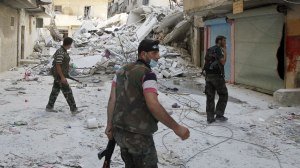
Vous me demandez combien de temps la révolution va-t-elle encore durer : jusqu’à ce que nous tuions Bachar et que nous chassions les russes, les iraniens et le Hezbollah hors de Syrie. Personne, dans notre pays, n’accepterait de s’arrêter aujourd’hui car dans chaque maison de chaque village, ville ou grande cité de Syrie on compte au moins un martyr, un prisonnier, une victime d’enlèvement par les forces du régime, à moins que ce soit un membre de la famille qui ait été contraint à l’exil. Savez-vous qu’Assad a anéanti de nombreuses familles ?

Savez-vous qu’il a détruit la plupart des villes du pays et qu’il a emprisonné plus de 250 000 personnes ? Savez-vous qu’il punit collectivement chaque syrien dans chaque secteur qui s’oppose à lui (c’est à dire presque toute la Syrie) ? Savez-vous que ses forces détiennent et retiennent des stocks de produits pharmaceutiques, qu’elles empoisonnent les réserves d’eau et de nourriture, bombardant les boulangeries pour affamer la population ? Assad fait aussi bombarder les hôpitaux, vise le personnel médical dans l’espoir que le peuple syrien sera obligé de lui obéir. Voici la réponse que nous lui adressons : “vas en enfer !”

Le monde voit tout cela et ne fait rien. Il s’excuse en disant : “c’est bien difficile. C’est compiqué”. C’est très simple, au contraire. Les syriens veulent être libérés de la dictature et la Communauté Internationale pourrait nous aider si elle le voulait. Les syriens savent tout cela. Nous allons continuer à nous soutenir les uns les autres, soutenir et combattre pour l’ALS. Quoique fasse Assad, nous ne calerons pas. Chaque homme, chaque femme, chaque enfant va combattre jusqu’à son dernier souffle. Pas question d’accepter ce que l’ Occident à décidé pour nous. Nous ne céderons pas. Nous n’accepterons pas ce que l’on veut nous imposer. Nous l’avons commencée et nous allons la finir, cette révolution. Par-dessus tout, et nous l’avons déclaré à nos débuts, Allah est avec nous, Allah et personne d’autre que Lui. Nous n’avons que Lui.

Vous voulez savoir “ce que nous ferons” après la révolution. Pour l’instant, on travaille dans la clandestinité afin que tout soit prêt, et il y a une parfaite collaboration entre nous. Nos plans sont arrêtés, mais nous ne pouvons nous dévoiler de peur que l’ennemi ne découvre ce que nous préparons. Tout ce que je peux dire, c’est que nous assurons la coordination entre l’Armée de Libération, les conseils militaires, l’opposition et les différents partis pour nous assurer que la normalité et la loi seront restaurées à la chute d’Assad, afin que le peuple syrien puisse retourner à une vie normale. Nous créerons un jour la transition qui restera en place jusqu’à ce qu’une nouvelle constitution soit adoptée et qu’un nouveau président avec un gouvernement et un parlement soient établis.

R. R. : Quels sont vos projets pour la période post-révolutionnaire, et est-ce que ce que vous avez vécu pendant la révolution les a-t-ils modifiés, et en quoi ?

S. L. : Aujourd’hui, je voudrais acquérir d’avantage d’expérience et m’impliquer activement en politique. Je veux jouer un rôle actif dans la reconstruction et le développement de mon pays et aussi participer à l’aide médicale de mes compatriotes. J’aimerais m’impliquer dans l’aide humanitaire et l’aide sociale car, comme vous le savez, un grand nombre d’adultes et d’enfants ont dû subir des amputations suite aux bombardements du régime. Ces personnes ont besoin de prothèses, tandis que d’autres ont besoin d’être opérés sans tarder. Tout cela va coûter des sommes considérables, aussi avons-nous besoin d’argent et de l’aide d’hôpitaux étrangers.

Je voudrais aussi m’investir dans l’éducation. Comme vous le savez, je suis traducteur et j’aimerais aider à enseigner aux enfants et aux jeunes gens dans les écoles, les collèges et autres établissements scolaires. Le régime a tué un grand nombre de professeurs dans toutes les disciplines, c’est pourquoi nous souffrons d’une grande pénurie dans ce domaine, et il va falloir vraiment mettre les bouchées doubles pour pallier toutes ces vacances. Il nous faudra aussi surveiller les fondations d’un projet éducatif afin de mettre en place un programme d’études accéléré. De cette façon, nous éviterons les difficultés pour des enfants qui ont manqué deux années d’études à cause des bombardements du régime et le chaos qui s’en suivit.

Nous voulons procéder à l’arrestation de tous ceux qui auront été impliqués dans des meurtres, dans la pratique de la torture, des viols et des pillages. Ces personnes seront em prisonnées et jugées. Ceux qui auront commis le pire seront exécutés. Nous ne permettrons à personne d’échapper au châtiment, quelle que soit sa religion. Nous avons tous été confrontés à la persécution, à la terreur et à l’intimidation, et beaucoup trop d’entre nous ont été torturés et/ou assassinés. C’est pourquoi nous voulons justice et dignité pour tous. De manière égale.

Pour conclure, je vous dirai que je veux participer activement au processus politique afin d’aider et représenter mon pays et mon peuple. J’ai toujours l’ambition d’obtenir ma maîtrise de traducteur et d’interprète, même si le régime m’a privé de cette chance en gâchant deux années de ma vie à cause d’une guerre brutale déchaînée contre les syriens eux-mêmes. C’est ce que ce pouvoir nous a imposé, mais nous rejetons ce régime.

https://wewritewhatwelike.com/2012/09/22/interview-with-a-free-syrian/ (original)
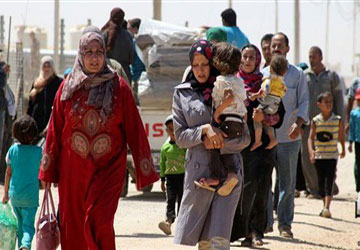
Le facce in gigantografia che vedano tutto, anche dopo la morte

Ruth Riegler ha intervistato un attivista in Siria per comprendere la vita che si conduce nella Siria rivoluzionaria. Egli usa uno pseudonomo. Traduzione a cura di Shadi Inomad

RR: Come descriveresti la vita prima della rivoluzione? E quali credi siano state le origini della rivoluzione?

FS: Il mio nome è Libero Siriano (Free Syrian). Voglio dire al mondo perché abbiamo fatto la rivoluzione contro Bashar Al Assad e il suo regime. Tutti nel mondo sanno che si tratta di una grandiosa rivoluzione, ma in realtà nessuno sa quale sia la vera ragione dietro di essa. Te lo dirò io. Voglio che il mondo intero sappia come si viveva prima della rivoluzione e quali sono le ragioni di questa. Vivevamo in un mondo in cui abbiamo dovuto dar retta e obbedire come schiavi – qualunque cosa dicesse il padrone, dovevi obbedire e farlo, e se gli disubbidivi ti puniva o ti uccideva.

Abbiamo vissuto in uno stato di sicurezza, il che significa che siamo stati governati da un presidente e dai suoi militari, dall’intelligence, dagli ufficiali dell’esercito, dalla polizia regolare e quella militare, dagli informatori e dagli shabbiha (bande armate, sono delle milizie paramilitari a base settaria, ossia composta da alawiti, che vengono pagate profumatamente e agiscono a sostegno di Assad, ndr). Quando volevi far qualcosa, dovevi prima ottenere il loro permesso e vedere se le loro regole ti permettevano di farlo o no, il che significava che non avevi il diritto di fare nessuna cosa in modo indipendente e avresti dovuto affrontare degli ostacoli se avessi tentato. Solo il personale del regime poteva vivere liberamente e senza essere governati da delle leggi; potevano fare ciò che volevano senza chiedere, comandando ogni settore, tra cui il sistema politico, il petrolio e il gas, l’economia, le banche, il commercio, i militari, l’agricoltura e l’istruzione. In effetti, si consideravano degli dei.

I siriani erano proibiti dal toccare la loro terra: l’esercito israeliano, addirittura faceva esercitazioni.

Abbiamo vissuto sotto questo regime, che rivendica di essere anti-sionista, ma in realtà questa è solo un’altra menzogna perché per 47 anni non ha mai sparato un solo proiettile contro Israele e ha mantenuto la calma nelle alture occupate del Golan, vietando a qualsiasi siriano di sparare anche un solo colpo contro Israele o di rivendicare questa terra rubata. Chiunque lo avesse fatto sarebbe stato gettato in prigione, punito ed eventualmente ucciso.

Abbiamo vissuto come schiavi, senza alcun diritto. Ci sono stati vietati la scelta di un candidato alla presidenza, lo svolgimento di elezioni libere, la costituzione di partiti politici o la selezione di nostri rappresentanti per il parlamento. Solo ad Assad e alla sua rete di intelligence era concesso scegliere i parlamentari e scelsero le persone più corrotte, senza morale o coscienza, permettendo loro di fare i propri interessi. Se ti fossi opposto a qualunque cosa facessero, saresti stati messo in prigione e ti avrebbero fatto ogni cosa avessero voluto, perché tu non sei nulla per loro.

La gente aveva paura di opporsi o dissentire con il regime o chiunque fosse vicino ai servizi segreti: i siriani impararono a tenere la testa bassa e non dire nulla. Anche se solo avessi maledetto Bashar, sarebbero venuti a prenderti ovunque tu fossi e ti avrebbero portato alla sezione locale dei servizi segreti, senza che nessuno sapesse dove tu fossi o osasse chiedere di te o anche solo nominare il tuo nome. Se volevi dare vita a un movimento politico sarebbe successo lo stesso, perché in Siria abbiamo avuto un solo partito e tutti i siriani erano costretti a farne parte. Se tu avessi evitato il servizio militare obbligatorio e non volessi servire, ti avrebbero imprigionato per tre o più mesi per poi in ogni caso costringerti a fare il servizio militare. Se si fosse morti in custodia dei servizi segreti, nessuno avrebbe chiesto come e perché eri morto e nessuno sarebbe stato ritenuto responsabile per la tua morte, perché la Costituzione conferisce l’immunità completa al presidente, ai suoi servizi di intelligence e i suoi alleati militari. Il popolo siriano è trattato come gli insetti che sono schiacciati sotto i piedi, senza attenzione per i nostri morti.

L’oppressione non si può fotografare, ma la si può sentire ovunque.

Il sistema permetteva al presidente, alle sue forze armate e ai servizi segreti, di arrestare, torturare o uccidere chiunque, di fare quello che volevano di noi, senza che nessuno nel mondo esterno sapesse cosa stava succedendo. La corruzione, il nepotismo e il favoritismo sono la norma in tutte le istituzioni statali e la gente ha imparato a esistere solo e a badare solo ai propri interessi, non chiedendo o aiutando nessuno se non sè stessi, dove solo Assad ei suoi fedelissimi del regime avevano il permesso di fare ciò che volevano; la Siria è la sua fattoria e i siriani sono gli animali.

Vorrei anche fare un accenno sull’economia siriana. Nonostante la scoperta di riserve di petrolio e di gas nel nord-est del paese e di enormi riserve di petrolio e di gas offshore, ci chiedevamo perché questi prodotti fossero così costosi per noi e perché invece compravamo gas e petrolio dall’Iran, Iraq ed Egitto. Abbiamo scoperto che questo accadeva perché Bashar e la sua famiglia rubavano il gas e il petrolio della Siria per venderlo sottocosto alla Russia e ai paesi europei, mantenendo i profitti per sè stessi, mentre noi siriani non avevamo altra scelta che comprare gas e petrolio dalle aziende statali a prezzi elevati – sempre che riuscissimo a trovarne per tutti. Il governo aumentò artificiosamente in modo costante il prezzo del petrolio e del gas e di conseguenza i prezzi di ogni altro bene – pane, riso, zucchero, vestiti, prodotti elettronici, case, tutto – aumentò e continuò a crescere senza mai diminuire. Data la grande ricchezza di petrolio e gas del nostro Paese, questa è la situazione più assurda.

La nostra economia è una farsa. Anche se il governo ha ottenuto aiuti provenienti da altri paesi, qualunque nostra domanda riguardo dove sarebbero finiti tali fondi è rimasta senza risposta. Quando volevamo sviluppare la didattica del paese, la sanità, l’agricoltura, alcuni settori industriali o la sua rete elettrica, il governo disse che avrebbe avuto bisogno di imporre più tasse per farlo, che avrebbe avuto bisogno dell’aiuto di altre nazioni, perché la Siria non aveva le risorse.

Ogni aspetto della vita dei siriani era controllato, l’intelligenza spiava sempre. Ecco la vita sotto degli Assad.

Se un siriano, cercando di vivere una vita dignitosa, avesse voluto avviare una attività produttiva per vendere i nostri propri prodotti, o di importare merci da rivendere, come automobili, vestiti o apparecchiature elettriche, il regime non ce lo avrebbe permesso, a meno che ne avesse una percentuale degli utili e fossero pagate tangenti regolari [oltre le consuete tasse]. Se eri d’accordo, ti avrebbero concesso una licenza di esercizio, ma se ti fossi rifiutato, ti avrebbero respinto la richiesta e creato ostacoli.

Chiunque avesse voluto aprire qualsiasi tipo di negozio, sia un piccolo negozio che venda generi alimentari, o una libreria, un supermercato, un internet café o qualsiasi altra cosa, avrebbe dovuto anzitutto ottenere il permesso da parte dei servizi segreti, prima di richiedere una licenza agli organi statali competenti, e pagare tangenti ai funzionari. Per esempio, se avessi voluto aprire un internet café, avrei dovuto in primis ottnere il permesso dei servizi segreti, quindi andare al ministero della comunicazione e pagare una tangente ai funzionari perché alla domanda fosse dato il suo corso, prima di andare all’ufficio locale del governatorato, poi all’ente dell’istituzione finanziaria, e proseguire con questo groviglio burocratico per mesi prima di non arrivare comunque a ottenere niente. Anche se volevi sposarti e organizzare una festa di nozze, per farlo dovevi prima ottenere il permesso ufficiale dello stato; mi dispiace usare un linguaggio grezzo, ma è una storiella ricorrente tra siriani che anche se tu volessi fare l’amore con tua moglie era prima necessario ottenere il permesso scritto del governo.

Abbiamo anche avuto il servizio militare obbligatorio per ogni uomo di una certa età. Molti fuggono all’estero per lavorare o studiare quando raggiungono i 18 anni, o pagano tangenti per evitare il servizio militare (dai 1000 dollari americani in su, cioè lo stipendio medio annuale di un siriano, ndr). Se non potevi permetterti di viaggiare e lavorare o studiare all’estero e non avessi altro modo per sfuggire alla coscrizione, avresti potuto lavorare per loro come un servo, un autista o una guardia. Se eri in grado di pagare una tangente settimanale agli ufficiali superiori, avresti potuto esser esentato dal servizio e avresti potuto ottenere il permesso di andare a cercare un posto di lavoro o piuttosto rimanere disoccupato. Se avessi potuto permetterti di pagare una tangente maggiore come l’acquisto di un televisore per un alto ufficiale, o di pagare le loro bollette telefoniche, o riparare la sua macchina o facendo un qualsiasi altro servizio utile, avresti potuto essere in grado di evitare il servizio militare per i prossimi due anni, ma dopo ciò avresti dovuti iniziare la tua vita ancora una volta da zero.

I siriani vogliano la libertà

Queste sono alcune delle cose che ci hanno spinto a insorgere contro il regime di Assad. Vogliamo la libertà. Vogliamo scegliere noi stessi la nostra vita. Vogliamo organizzare e rafforzare il nostro paese con le nostre mani. Vogliamo costruire e produrre le nostre merci nei nostri stabilimenti. Vogliamo migliorare l’istruzione della Siria, la salute, l’agricoltura e tutti gli altri settori, che Assad ha ignorato, vogliamo essere innovatori, per costruire le prime automobili e primi treni arabi. Sì, siamo persone come chiunque altro al mondo che vuole dignità. Per tutte queste ragioni noi continueremo a combattere e non torneremo indietro; vivremo la nostra vita con dignità o moriremo come martiri. Vogliamo la libertà.

RR: Puoi brevemente descrivere una giornata tipo in modo da dare ai lettori un’idea di ciò che tu e altri siriani dovete avere a che fare?

FS: Immaginati di svegliarti in una bella mattina di sole, di lavarti il viso e poi bere il tuo caffè, sorridendo al pensiero di quel che otterrai oggi, anche se devi superare degli ostacoli introdotti da parte del governo sul tuo percorso. Quella era la vita prima della rivoluzione.

Ora riusciamo a dormire in orari normali e ci svegliamo presto, sempre che riusciamo a dormire. Tutto ciò che riguarda le nostre vite è cambiato da quando è iniziata la nostra benedetta rivoluzione, il 15 Marzo 2011 a Daraa. Ad ogni modo, lascia che ti dica cosa è cambiato nel mio programma quotidiano e nella vita in generale. Anzitutto, ho comiciato a dormire tardi oppure a mala pena non dormire affatto, svegliandomi sempre per udire esplosioni di bombe, colpi di cannone, spari oppure manifestazioni, giorno e notte. Pure le mie abitudini sono cambiate. Frequentavo un istituto locale di lingua inglese per esercitarmi nella capacità di traduzione e per sviluppare le mie competenze dopo la laurea, così come mi incontravo con un amico per lavorare in modo da trovare il miglior posto per ottenere un master in traduzione. Trovai un posto in un corso a Preston, nel Regno Unito, ma sfortunatamente non sono stato in grado di accettare l’offerta poiché non in possesso di un passaporto e poiché erano stati sospeti i corsi TOEFL al Centro Linguistico Americo nella mia città. Nonostante io abbia anche contattato il British Council per cercare di convincerli ad offrire un corso TOEFL o ILTES nel Regno Unito, non penso che quest’anno riuscirò a iniziare il mio Master e comunque ho perso la mia occasione. Questo non è stato l’unico problema che ho dovuto affrontare da quando, dopo aver cercato per un certo tempo un lavoro, me ne era stato promesso uno l’anno scorso in una società privata di comunicazioni. Tuttavia anche questo è saltato dato che la situazione qui era diventata sempre peggiore. Il fatto che non avessi svolto il servizio militare significava che non potevo lavorare o viaggiare, perché non fare il servizio militare ti preclude la possibilità di fare entrambe le cose, un altro ostacolo per lasciare il paese per fare il mio Master. Questo mi ha fatto sentire senza speranza, senza lavoro e senza la speranza di un Master stavo perdendo il desiderio per la vita e tutto il resto. In seguito il regime cominciò ad uccidere la nostra gente, in un primo momento a Daraa, dove le truppe di Assad usavano proiettili veri contro manifestanti disarmati, e in seguito con carri armati dentro le città. A noi giovani siriani ciò non piacque e cominciammo a manifestare contro questo atteggiamento. Successivamente il regime cominciò ad utilizzare delinquenti e picchiatori in borghese, noti come “shabbiha”, per terrorizzarci, e da allora ha usato di tutto contro di noi.

Prima della rivoluzione ero solito avere tre pasti al giorno, ora ne ho uno solo. Prima dormivo otto ore, ora avrei potuto al massimo dormirne cinque e spesso restavo sveglio fino al mattino. Ho lavorato per far quel che potevo per aiutare i siriani che avevano bisogno di assistenza, nascondendoli e aiutando chiunque avesse bisogno di tradurre notizie o video inviati da altri attivisti. Ricevo un sacco di notizie, le traduco e le condivido ovunque posso, parlando con amici e scambiando opinioni su cosa dovremmo fare. Gran parte delle nostre conversazioni ruotano attorno a come ogni altra nazione del mondo stia sostenendo Bashar affinché rimanga al potere perché non vogliono perdere il loro maialino domestico che protegge Israele e ne preserva la sicurezza nella regione.

Il regime ora ha collocato posti di blocco sulle strade principali in ogni paesino ed in ogni città, e ha chiuso tutte le strade che portano al suo palazzo a Damasco, così come ha posizionato cecchini ovunque, specialmente nelle zone dei ribelli. Se vuoi andare a fare shopping o in palestra, vedere gli amici o andare da qualsiasi parte, le truppe del regime ti feramo ai checkpoints e verificano che il tuo nome non sia inserito nella lunga lista dei soggetti ricercati, di quelli che identificati come attivisti o di quelli che hanno evitato il servizio militare. Se il tuo nome è nella lista, ti arrestano o semplicemente ti sparano sul posto. Ogni giorno dobbiamo passare attraverso questi posti di blocco. Un giorno, di recente, sono andato a trovare degli amici per aiutarli nel lavoro connesso alla rivoluzione. Fui fermato per una mezz’ora ad un checkpoint e cominciai a preoccuparmi. Quando un soldato del regime chiamò il mio nome, andai da lui e gli chiesi quale fosse il problema: mi guardò e mi disse “Prendi la tua carta d’identità e vattene, stai sprecando il nostro tempo alla ricerca del nulla”. Dopo questo avvenimento, decisi che ovunque sarei andato, avrei utilizzato una scorciatoria per evitare i posti di blocco. Recentemente, in un’altra occasione, andai a Barzeh a visitare i genitori di un amico di nome Salim che era stato colpito a morte da un cecchino, per portar loro le mie condoglianze. In quel momento in quella zona vi erano degli scontri feroci tra le truppe del regime e l’ESL. Mentre ero in direzione dell’isolato dove si trovava l’appartamento della famiglia di Salim, un cecchino mi sparò ma mi manco per poco. Realizzai tutto ciò solo quando uno sconosciuto mi tirò verso l’entrata e mi disse “Sei matto? Vuoi morire così in malo modo?”.

La vita sotto i cecchini

Bashar il maiale ha ordinato di piazzare cecchini ovunque e ha dato loro istruzioni di sparare a chiunque essi vogliano. Molti dei miei amici sono stati uccisi dai cecchini, mentre altri sono stati nel mirino ma sono sopravvissuti. Un mio amico di nome Anwar ch era senza paura e partecipava ad ogni manifestazione anti-regime, fu colpito alla testa. Nonostante sia rimasto nel reparti di terapia intensiva per sei mesi, Allah ha evidentemente voluto che continuasse a vivere, con il proiettile che era passato attraverso il cranio. Nonostante sia sopravvissuto, tuttavia ora è parzialmente paralizzato e ha una mobilità molto limitata del suo braccio e della gamba destre. Altri amici sono tra coloro che sono scomparsi dopo esser stati arrestati dalle forze del regime; nessuno sa dove siano o se siano ancora ancora in vita. Uno di loro, un mio caro amico che si chiama Bilal, era sempre solito venire ad ogni manifestazione per sostenere la caduta del regime. Quotidianamente sento di amici che vengono rapiti per ottenere un riscatto, mentre alcuni amici vengono rapiti per strada oppure ai posti di blocco. Alcuni chiamano i loro genitori per chiedere soldi da versare ai rapitori; a meno che il riscatto non sia pagato non gli viene detto dove si trovi il loro bambino.

E’ impossibile descrivere l’interno che stiamo vivendo, senza alcun ordine o stabilità, mentre il mondo sta a guardare e non fa nulla. Molti giovani per sopravvivere fuggono all’estero: altri si uniscono all’ESL, molti dei quali dopo aver defezionato dalle forze del regime che sono sono costretti a servire. Al momento questa è la mia vita in Siria. Ho pensato di entrare nell’ESL. A dire il vero, spesso vorrei fuggire il più velocemente possibile. Già avevo pensato di fuggire e di andare all’estero, ma come ho detto non ho un passaporto e, nonostante abbia chiesto a molti amici e conoscenti di aiutarmi ad uscire, è molto difficile farlo senza passaporto.

Alla fine voglio dire che odio Bashar Al Assad e suo padre da quando sono venuti a governare la Siria. Conosciamo tutta la storia della sua famiglia e quel che hanno fatto. Sappiamo della loro distruzione assassina e sappiamo che Hafez Al Assad ebbe supporto e copertura dei suoi crimi a Hama, Aleppo e Deir El Zour (all’inizio degli anni ’80, ndr) da parte di USA, Russia, Iran e Israele e che questi stessi paesi stanno facendo lo stesso per suo figlio Bashar.

Dopo l’ennesima invasione del campo rifugiati vicino Damasco. Carri armati che hanno devastato anche le macchine.

RR: Come rispondi a quelli che continuano ad insistere sul fatto che Assad è un’icona anti-sionista?

FS: Tutti sappiamo che Hafez Al Assad (che Allah possa maledire lui e suo figlio) ha venduto le alture del Golan ad Israele e che fu responsabile dell’uccisione di molti palestinesi in Libano e Siria per preservare la sicurezza di Israele in Libano. Ora suo figlio Bashar sta facendo la stessa cosa in maniera differente. Ha attaccato molte aree palestinesi presenti in Siria, in particolare a Damasco il campo profughi di Yarmouk, che ho visto con i miei occhi. Se credi che egli sostenga Hezbollah per combattere e sconfiggere Israele, questa è una menzogna. Tutti sappiamo che (Bashar, ndr) ha dato a Hezbollah il via libera di uccidere il leader sunnita Rafiq Al Hariri in Libano, oltre ad esser d’accordo con Nasrallah per migliorare l’immagine di Nasrallah stesso e farlo sembrare un eroe di guerra, ma la guerra del 2007 contro Israele fu un’altra menzogna, semplicemente uno stratagemma per consentire l’espansione di Hezbollah in Libano e far sì che gli sciiti avessero un maggior potere nel paese per permettere all’Iran di avere lì il controllo e realizzare il piano di Teheran per un Medio Oriente sciita, dall’Iran all’Iraq, Siria, Libano, Egitto, Arabia Saudita e Yemen. Bashar Al Assad insiste sempre sul fatto che si oppone a Israele, che egli conduce la resistenza contro Israele stesso. Al che io rispondo: allora perché improgioni, torturi e uccidi i miei amici e decine di migliaia di altre persone in Siria? Perché ammazzi i miei fratelli palestinesi e iracheni? Perché non hai fatto nulla quando gli aerei militari israeliani violarono lo spazio aereo siriano? Non cercare di mentire al popolo siriano, noi ti conosciamo meglio di chiunque altro, lo sappiamo che il tuo lavoro è quello di uccidere noi e proteggere Israele; che Dio ti maledica, figlio di un adulterio.

Homs, molte famiglie cercano il reparo durante un bombardamento

RR: Come fai fronte allo stress per vivere in quella che è a tutti gli effetti una zona di guerra?

FS: E’ molto difficile per noi garantire i nostri bisogni in queste circostanze; viviamo con prudenza e mangiamo e compriamo solo lo stretto necessario. Per me, diventa più difficile sapendo che sono senza lavoro e che mio padre mi sta tuttora aiutando finanziariamente. Vivo con i miei genitori e li aiuto; nella situazione attuale, in Siria la maggior parte delle famiglie allargate è ammassata in una sola casa, con qualcosa come dalle tre alle dieci famiglie separate in ogni casa. La situazione è molto brutta, la maggior parte della Siria, tra il 65 e il 75%, è distrutta. Cerchiamo di acquistare e immagazzinare tutto il cibo che si può, ma alcune zone sono senza niente. In aree come quella di Homs non riescono a trovare alcun cibo e niente con cui proteggersi e mantenersi al caldo. L’inverno presto arriverà, fra due mesi, e vogliamo porre fine a ciò il più presto possibile. La maggior parte delle città siriana non hanno più nulla, Assad ha bruciato la maggior parte delle colture e ha distrutto le case. Io posso mangiare quasi tutti i giorni, ma altri non possono e sono preoccupato per loro. Gli inviamo aiuti ma il regime sta assediando quelle aree, nonostante l’ESL faccia del suo meglio e lavora duramente per fornire aiuti e medicine.

Nessuno ha una minima idea della tragedia che stiamo vivendo, ma i nostri spiriti rimangono forti e tutti noi sappiamo che vinceremo perché Allah è con noi e uccideremo Bashar, inshallah. Continueremo a sostenerci l’un l’altro con cibo, medicine o qualsiasi cosa necessaria per vincere. Voglio sottolineare che il vero esercito del nostro paese è l’Esercito Siriano Libero, l’ESL, e siamo molto orgogliosi di loro. Siamo tutti parte del popolo siriano e saremo tutti uniti: come gridiamo alle nostre manifestazioni, “Uno, uno, uno – il popolo siriano è uno”.

Dov’è il mondo?

RR: Come ti senti circa l’apatia di gran parte del mondo nei confronti della rivoluzione siriana e hai cambiato opinione riguardo la “comunità internazionale”? Se sì, come?

FS: Perché il mondo intero ha benedetto le rivoluzioni in Tunisia, Egitto, Libia e Yemen e le ha sostenute, mentre nessuno ha aiutato o supportato la nostra rivoluzione inSiria o ha cercato di raccontare la verità sulla giustezza della nostra causa? Perché è stato permesso a Russia, Iran, Cina e Iraq di continuare ad aiutare Bashar e il suo regime con armi, denaro, petrolio, benzina e iniziative politiche? Perché le potenze occidentali non hanno cercato di aiutarci creando una no-fly zone, fornendoci le armi necessarie o garantire zone al sicuro per i civili?

Tutte queste domande possono sembrare senza risposta, ma noi siriani sappiamo perché: le potenze occidentali vogliono imporci la loro soluzione con le loro maniere, e questo è ciò che non accetteremo mai. Ma ti dirò quali sono le opzioni o le soluzioni che ci offrono. Vogliono farci accettare le loro condizioni, consentendo a Bashar di rimanere al potere, accordandoci una libertà apparente e dei cambiamenti di facciata creando un governo di unità nazionale. Non vogliono gente nobile o veri ed autentici patrioti così come non vogliono l’ESL; vogliono ucciderli tutti e imporci a loro volontà. Quel che più conta è che vogliono che Israele sia lasciata in pace senza che nessuno possa persino portare qualsiasi pericolo, e come la storia dimostra, Bashar è il miglior candidato per questo. Per questo motivo (le potenze occidentali, ndr) lasciano che Iran, Russia e Iraq lo sostengano inviandogli più armi e truppe per aiutarlo dopo che non avrà più siriani che compiono defezioni di massa in quanto i siriani non lo vogliono. Esse permettono a questi paesi di inviargli soldi e truppe da parte di Hezbollah, dell’Esercito del Mahdy (formazione paramilitare irachena creata nel giugno 2003 dal leader sciita iracheno Moqtada Al-Sadr, ndr) e della Quds Force (letteralmente “Brigata Gerusalemme”, l’unità delle Guardie Rivoluzionarie responsabile dell’esportazione dell’ideologia khomeinista fuori dall’Iran, è guidata dal generale Qasem Suleimani, ndr). Il loro pretesto per consentire ciò è che la questione è difficile e complessa, ma in realtà è molto semplice: vogliamo la libertà. Dateci le armi pesanti necessarie a distruggere i suoi aerei da guerra, carri armati e lanciarazzi e possiamo vincere. Essi sanno che Bashar è estremamente povero così usano anche la scusa che se ci dessero le armi, l’ESL non sarebbe in grado di controllarne l’accesso e Al Qaeda acquisirebbe potere. Ma i siriani sono tutti ben consapevoli che non esiste Al Qaeda nè in Siria nè in nessun paese arabo, e così le potenze occidentali tirarono fuori un’altra scusa: che la nostra opposizione non è unita. Ma in realtà neanchè le opposizioni che rovesciarono regimi in altre nazioni erano unite.

Le potenze occidentali non hanno fatto nulla neanche per i rifugiati siriani in Turchia, Giordania, Libano e Iraq; non hanno inviato loro alcun aiuto reale e non hanno permesso loro di fare nessun lavoro. Non li hanno nemmeno registrati presso le Nazioni Unite (come rifugiati, ndr), li hanno semplicemente lassciati nei campi situati in zone morte in Iraq e Giordania, perché vogliono che i siriani obbediscano ai loro ordini, accettando Bashar Al Asssad e ritornando a vivere sotto il suo regime e se rifiuteranno, verranno puniti lasciandoli senza cibo, acqua o i servizi essenziali. Non ci aiuteranno a ucciderlo, nessuno ci aiuterà. Abbiamo solo noi stessi e facciamo affidanmento solo a Dio, e questo è quel già stiamo facendo ora.

Momento durante un funerale per gli FSA

RR: Come vedi svilupparsi la situazione in Siria nel breve e nel lungo termine, e ti senti ottimista che si possa avere la pace dopo la caduta di Assad?

FS: La situazione si svilupperà in maniera lenta e sanguinosa se non lavoreremo sodo per risolverla. Se siamo in grado di muoverci velocemente per liberar noi stessi sarà il miligior modo per non perdere altri siriani e per salvare ciò che ancora possiamo del nostro popolo, delle nostre proprietà, infrastrutture, economia e tutto il resto. Se lo lasciamo fare ciò che lui, i suoi alleati e le potenze occidentali vogliono, perderemo altre persone e ci sarà un ulteriore spargimento di sangue. Se ciò accade, il bagno di sangue continuerà, sarà un genocidio, con altre migliaia di morti, il paese sarà saccheggiato e depredato dalle sue forze, gli edifici e le infrastrutture saranno distrutti, l’economia devastata, altre migliaia di persone che vivranno in esilio e una fuga di cervelli delle persone migliori che sono essenziali per ricostruire il paese, che sarà lasciato nel caos. Noi siriani non vogliamo nè accettiamo questo, e così lavoriamo sodo tra di noi per unire le nostre forze per ucciderlo e porre al più presto fine a questa terribile situazione. Noi popolo siriano siamo ottimisti perché Allah è con noi e siamo tutti uniti, e crediamo che prestò ci sarà la pace. Se restasse non ci sarebbe nessuna pace, solo più caos e spargimenti di sangue e vivremo nelle tenebre per sempre come schiavi. Ci rifiutiamo di accetare questo per cui preferiamo vivere con dignità oppure morire come martiri. Questa è la nostre opzione preferite, la morte piuttosto che l’umiliazione.

RR: Come vedi la pretesa ripetuta da molti mezzi di informazione che si tratti di una “guerra civile settaria”?

FS: Non vi è una guerra civile settaria: questa è soltanto propaganda usata e promossa dal regime e in altri paesi. Essi sostengono che se il regime crolla ci sarà la guerra civile e la gente che si ammazza a vicenda, ma se rimane manterrà integra la società siriana. Questa è una menzogna sfacciata; quello a cui il regime e loro (le potenze straniere, ndr) stanno lavorando è dividere la Siria in regioni autonome come in Iraq, ai Curdi uno stato nel nord-est, ai drusi uno nel sud e agli alawiti uno sulla costa siriana, mentre ai sunniti rimarrebbe il resto. Questo è il loro piano e Bashar sta lavorando duramente per realizzare la sua ambizione di uno stato alawita-sciita. Si dimenticano però che fin dall’inizio della rivoluzione il nostro moto è stato “Uno, uno, uno – il popolo siriano è uno”.

Il regime spinge sul settarismo mentre il popolo siriano la pensa diversamente

Questa nazione è per tutti: qualunque sia la tua religione, setta o gruppo tu sei siriano e appartieni alla Siria. Tutte le sette del popolo siriano rifiutano questo piano di dividere la nazione e si sono appellate all’unità. Durante la rivoluzione ho incontrato e parlato con siriani alawiti, sciiti, cristiani, drusi e sunniti e tutti hanno respinto questi piani per dividerci. Tutti invochiamo l’unità – un popolo una nazione, anche se il regime ha tentato più volte di armare sette diverse e dirigerle l’una contro l’altra, per creare divisioni tra di noi. Per quanto (il regime, ndr) si sforzi, non permetteremo di essere manovrati in questo modo, e di combattere e uccidere l’un l’altro – siamo tutti fratelli e sorelle.

Infine, voglio dire una cosa in più: prima che la nostra rivoluzione cominciasse, abbiamo tutti vissuto in pace e armonia. Io vivevo personalmente in un condominio con vicini sciiti, ebrei e cristiani. I miei amici appartengono a tutte le sette, ci amiamo vicendevolmente e viviamo assieme.

RR: Pensi che questa esperienza ti ha cambiato come persona? Se sì, in che modo?

FS: Sì, mi ha cambiato e ha accresciuto la mia consapevolezza riguardo il complotto globale volto a garantire il fallimento della nostra rivoluzione. Ho anche scoperto che l’intero mondo guarda solo ai propri interessi e non si preoccupa nient’altro che di sè stesso. Non credo più nella retorica delle Nazioni Unite e delle organizzazioni non governative, che si tratti di Human Rights Watch, UNICEF, UNICO, della Corte penale internazionale, del CJI o di qualsiasi altra cosa. Il mondo intero non è riuscito ad ideare un programma per aiutare i siriani in Siria o i rifiugiati nei paesi limitrofi o addirittura tenere una riunione di donatori. Anche la conferenza “Amici della Siria” non ha ottenuto nulla; stanno solo a guardarci e a lasciarci uccidere con il sostegno russo e iraniano.

La rivoluzione mi ha comunque dato una speranza in un modo: vuoi sapere come? Mi ha insegnato che quando si incontrano problemi o ostacoli nella vita, nessun altro se non solo una manciata di veri amici si preoccuperanno o aiuteranno te e le tua famiglia, devi fare da solo e aiutare gli altri nella stessa situazione in qualunque maniera. Mi ha reso più consapevole e orgoglioso del mio popolo e del mio paese e di cosa dobbiamo fare per porre fine a ciò. Siamo gente pacifica e abbiamo delle risorse. Possiamo ricostruire noi stessi e il nostro paese, sviluppare le nostre competenze già esistenti e imparare nuove abilità. Ora sono più responsabile di quello che ero: voglio costruire me stesso, sviluppare le mie competenze, acquisire maggiori conoscenze e condividerle con la mia gente. Voglio tramandare alle generazioni future che abbiamo combattuto e sacrificato le nostre vite per ottenere la libertà e che non dovremo mai più accettare chiunque si credi un dio e ritenga di avere il diritto divino di governarci per sempre, ma dovremo eleggere solo leader altruisti che hanno a cuore il popolo siriano e la nazione piuttosto che l’auto-arricchimento.

Voglio sottolineare che la rivoluzione è nelle nostre mani. Credo che il mondo abbia bisogno di cambiare e realizzare che tutte le persone del pianeta sono uguali e gli deve essere concesso di ottenere la libertà. Ho anche scoperto che quelli che si definiscono “leader arabi” e governano paesi arabi sono in realtà infidi mandatari di poteri esterni o sempcliemente non si preoccupano affatto degli arabi.

RR: In cuor tuo, per quanto tempo ancora pensi che la rivoluzione possa continuare e cosa pensi che sia probabile che accada nel periodo successivo alla rivoluzione?

FS: Quando iniziammo questa rivoluzione, sapevamo che non saremmo mai tornati indietro e siamo ancora consci di questo: dopo tutto quello che abbiamo passato e sacrificato, saremmo condannati se soltanto considerassimo di ritornare a come stavano le cose; questa è la nostra risposta definitiva. Tutto ciò che Bashar ha commesso contro di noi e continua a farlo senza pause, lo ha fatto con il crescente supporto di Israele, Russia, Iran e China; abbiamo dimostrato al mondo che continua a negare il loro coinvolgimento, che truppe iraniane, russe e di Hezbollah sono state catturate in ogni città siriana, con ognuno di essi in possesso di documenti comprovanti ciò. Inoltre, abbiamo ottenuto dei documenti ufficiali del regime che dimostrano che Bashar ha importato sempre più soldati sciiti da Iran, Libano e Iraq, compresi dei membrei della Guardia Rivoluzionaria iraniana, con la Russia e altre nazioni che gli inviano armi così come delle truppe. Nonostante tutto questo, tuttavia, il suo regime sta perdendo la battaglia, ma i suoi alleati e le potenze occidentali vogliono che rimanga e continuare a coprirlo in qualsiasi modo possibile. Sfortunatamente per loro, noi sconfiggeremo lui e loro e lo uccideremo presto, inshallah.

Soldati del Esercito Libero Siriano entrano in una zona di Aleppo quasi raso al suolo dall’esercito del regime.

Quindi, se mi chiedete quanto tempo ancora continuerà la rivoluzione, io dico che la continueremo fino a quando non lo avremo ucciso e cacciato Russia, Iran e Hezbollah dal nostro paese. Nessuno in Siria accetterà di farla finita ora perché ogni famiglia in ogni villaggio, paesino o città siriane ha almeno un martire, un detenuto, una vittima di un rapimento da parte delle forze del regime o un membro della famiglia spinto verso l’esilio.

Lo sai che ha annientato molte famiglie intere? Lo sai che ha distrutto la maggior parte delle città e ha arrestato più di 250 mila persone? Lo sai che ora sta punendo collettivamente ogni persona in qualsiasi area che si è opposta a lui (la maggior parte della Siria) e che le sue forze stanno avvelenando le forniture di acqua e di prodotti alimentari, anche prendendo di mira i forni per fare in modo che la gente muoia di fame? Lo sai che le sue forze stanno negando le medicine e le cure mediche, bombardando ospedali e prendendo di mira il personale medico nella speranza che questo costringerà il popolo siriano ad obbedirgli? Noi gli diciamo, vai all’inferno!

Tutto il mondo lo vede e non fa nulla, scusandosi dicendo “E’ difficile e complicato” ma in realtà è molto semplice – i siriani vogliono liberarsi dalla dittatura – e potrebbero aiutare se solo lo volessero. I siriani sanno tutto questo. Continueremo e ci sosterremo a vicenda nonché sosterremo e combatteremo per l’ESL. Qualunque cosa Bashar faccia, noi non ci fermeremo; ogni uomo, ogni donna e ogni bambino si batterà fino all’ultimo respiro. Non acceteremo quel che il mondo vuole per noi, non indietreggieremo di un passo nè accetteremo quel che ci vogliono imporre. Abbiamo cominciato questo e noi lo porteremo a conclusione. E soprattutto, lo abbiamo detto fin dall’inizio, Allah è con noi e Allah e nessun al di fuori di Allah è co noi. Non abbiamo nessuno se non Allah.

Mi stai chiedendo “cosa farai dopo la rivoluzione?” Stiamo lavorando sotto copertura, per preparare tutto e cooperare tra di noi. Abbiamo progetti in atto ma il problema è che non possiamo rivelarli per timore che le persone sbagliate scoprano ciò che stiamo progettando. Tutto quello che posso dire è che stiamo coordinandoci tra l’ESL, i consigli militari, l’opposizione e i vari partiti per garantire che la normalità e lo stato di diritto siano ripristinati una volta caduto il regime, in modo che il popolo siriano possa ritornare a condurre una vita normale. Creeremo un governo di transizione che rimarrà in vigore fino a quando una nuova costituzione sarà stata creato e saranno decisi un nuovo presidente, un nuovo governo e un nuovo parlamento.

RR: Quali sono i tuoi progetti per il periodo post rivoluzionario? Le tue esperienze di vita attraverso la rivoluzione li hanno cambiati? Se sì, come?

FS: A dire il vero, mi piacerebbe far esperienza ed essere attivamente coinvolto in questioni politiche. Voglio avere un ruolo attivo nella ricostruzione e nello sviluppo del mio paese, e aiutare a fornire ciò che è necessario come il cibo e le medicine. Mi piacerebbe essere coinvolto negli aiuti e nell’assistenza umanitaria perché, come sai, ora abbiamo molti adulti e bambini amputati che hanno perso gli arti in attacchi del regime per cui hanno bisogno di arti artificiali, così come ci sono persone che necessitano di interventi chirurgici urgenti. Tutto ciò verra a costare miliardi per cui abbiamo bisogno di raccogliere fondi o di ricevere aiuto da ospedali all’estero.

Mi piacerebbe essere coinvolto nel sistema educativo. Come sai, sono uno traduttore e mi piacerebbe aiutare a insegnare ai bambini e ai giovani in scuole, università e altre istituzioni educative. Il regime ha ucciso docenti in molti settori per cui abbiamo una carenza enorme a riguardo e dobbiamo lavorare sodo per riempire questi posti vacanti e sovrintendere all’attuazione di un piano di vera educazione per introdurre un programma di apprendimento accelerato al fine di evitare problemi futuri per quei ragazzi che hanno già perso due anni di insegnamento a causa dei bombardamenti del regime e il caos ha significato che non avrebbero potuto continuare la loro educazione.

Noi vogliamo catturare tutti i soggetti coinvolti in uccisioni, torture, stupri e sacchegghi, per giudicarli, imprigionarli e giustiziare i peggiori colpevoli. Non permetteremo a nessuno di sfuggire alla pena a causa della propria setta. Siamo stati tutti esposti senza discriminazione alla persecuzione, terrore e intimidazione, e troppi sono stati torturati e/o uccisi per cui vogliamo giustizia e dignità allo stesso modo per tutti.

Infine, voglio partecipare attivamente al processo politico per aiutare e rappresentare il mio paese a la mia gente. Ho ancora l’ambizione di ottenere un Master in Traduzione e Interpretariato, anche se il regime mi ha privato di questa opportunità fino ad oggi e ha sprecato due anni della mia vita in una guerra brutale contro il popolo siriano. Questo è ciò che ci è stato imposto ma tuttora rifiutiamo il regime.

Originale in inglese https://wewritewhatwelike.com/2012/09/22/interview-with-a-free-syrian/

By Wissam Al Jazairy

There are two ways of experiencing a social upheaval of epic proportions: directly or indirectly. Naturally, if one is directly affected by restrictions, uprisings, detention, revolution, attacks, blockades, shortages of utilities, medicine and food, migration and so forth, they are going to be connected to the event in a visceral way and this of course helps to define the nature of the event as being positive or negative.  There is a DIRECT relationship between what is happening and an improvement or a worsening in their lives. It is a relationship that is dependent upon reality and the “timeline” of their narrative is going to be “before” the event and “after” it. There is little abstraction going on, as, for example, you simply know that “before” you lived in your home and “after”, you were marching towards a refugee camp because not only your home, but your entire town no longer exists, and you know who did that to you as well!  No one has to inform you that this is a bad situation. No ideology could ever be more meaningful to you than the fact that your life has been totally changed (for the worse) from what it was before.

It’s obvious that those who live outside areas of upheaval are not going to have these experiences in order to judge the events, and judging them is what we tend to do naturally if we are “activists”. We tend to see them in a bigger picture and part of a greater struggle. Therefore, as indirectly involved, we have a few choices at our disposal. We can view events (and people) in a prism that comforts us or at least fits into what we think we already know (our ideology or beliefs), we can take the road of empathy and identify with the persons directly involved, we can remain indifferent, uninvolved and choose to ignore any information until it DOES directly involve us, if it ever would have that destiny. We can even attempt to tightrope walk in a combination of all of them, depending upon our mood, our social interactions, our interests.

Then there are degrees of indirect involvement. It often relates to the concept of “identity politics”: where a person relates to an event according to a perceived degree of identification with those directly involved in any event. Taking the Syrian uprising into consideration in this paper, it is clear that all Syrians around the world have a connection to Syria and have its interests at heart. I doubt that there is even one Syrian who washes his or her hands of the entire situation, even if they may find themselves on diametrically opposed sides. However, one important matter must be acknowledged: that there are indeed persons who are directly affected and whose lives have been shattered, and that the facts supporting the amount of destruction, the number of deaths and refugees and even the dynamics of the various massacres can in no way be denied. It is beyond ridiculous to imagine that we can turn back the clock to a time when we were not connected in real time, when news of massacres only reached a small public in whispered tones, knowing that the details were too horrible to even be believed. Any town in the world that has some sort of access to communication is fully able to see documents such as photographs and films of the real events happening in Syria at this very minute. They can judge if there are protests, battles, massacres by what they see.

Dealing with cognitive dissonance

There is actually a tricky part of this whole thing though: if we AREN’T directly involved, whatever decision we make will turn out to be an ethical choice. Unless we are completely alienated and detached from the suffering of others, not to mention living in a vacuum, the suffering going on in Syria smacks us in the face day after day and hour after hour. If the sight of torture, destruction and death makes us feel bad, chances are we are normal and we will experience some level of cognitive dissonance. We know that things we are witnessing (or being shown) are “bad” or even “unacceptable” or “evil”, depending on our linguistic habits, but since we are not in the habit of outspokenly endorsing evident ethnic cleansing and carpet bombing of Arab cities and villages, we may find ourselves taking refuge in the cosy world of “punditry” and “analysis”, where the idea and intention (real or imagined) bears more weight than isolated events (even if they are repeated thousands and hundreds of thousands of times). It is clear that punditry is the easiest road for the self-identifying human rights activist, because we all have a body of literature that slips all events into a meta-narrative (in the case of punditry that calls itself “anti-imperialist”, but is actually the sum equivalent of counter-revolutionary thought, where the leader is preferred and supported over the rebelling masses for perceived value he has in an ideological framework) and we can selectively analyse specific events in order to prove our points and especially settle our painful cognitive dissonance.

It’s a bit of a disaster though, because it assumes that the indirect experience, nay, the ANALYSIS is actually more relevant than the direct experience. It puts us in the even MORE uncomfortable position of being the “great white hope”, the one who “knows better than “the other” what’s Best for the Other”, though we attempt to not let that fact bother us, as we are cognisant that most of us are unwilling and unable to leave the comfort of the West and its trappings such as banks, iPads and all the pluggable things we adore more than humans. We have the opportunity of justifying what we normally would not be able to justify by means of adopting a “more important” ideological stance, and we assume others will be able to understand that we are not any kind of privileged person, but instead we benefit of our years of activism and awareness and just plain “intelligence”, seeing things ordinary folk can’t see!

A few anti-interventionists in London are selective about what intervention they reject

In addition to our ability to be physically far from war, we are even lucky enough to have the assistance of critical distance, the only thing that allows analysis and lets us paint over the grey areas (we can decide even which meta-narrative we can focus on, tailoring our interventions to our public. If the consumers of punditry are Westerners like us, (as 90% of them are) we can assume they do not want to be involved in interventionist wars (Western intervention, that is) and they will respond to a group of code words, they will take on and utilise in discourse new ones such as “sectarian” without requiring mental strain of figuring out if this is truly the case in point. We can vary the theme a bit by going for the generic pacifism/no war framework if the complexities of historical events in mass movements in the Arab world is beyond our grasp. And there is a beauty to all of this: we can still consider ourselves as superior ethical beings, because we are not ignoring (and we would never admit we are facilitating something negative!) the situation, but instead we can remain great humanitarian activists who are looking out for the best interests in those populations who do not have the dialectical positions we have. We resolve our painful cognitive dissonance and at the same time give ourselves hefty pats on the backs for being so very clever and anti-imperialist.

I believe I am like most of the others reading this: not directly involved, but not able to avoid the empathic response of shock and disgust at the violence, yet also deeply entrenched in my “activist identity” that seeks to analyse what is seen within a larger framework. This means that I am a consumer of punditry, and for better or worse, the vast majority of it is done by those who might move onto the next “hot spot”, and that means that whatever the outcome, it’s not going to affect them personally, because it’s someone else’s lives, someone else’s country. So, the logical assumption is that if you are not personally involved, your stakes in the situation are completely different than those who are involved, and your “personal” stakes may not at all be lofty ideals such as “saving the Arab people from the evil empire”, since the evidence that imperial interests are the driving force in the uprising of the Syrian people is nil. The personal stakes may quite simply be learning to live with yourself after seeing what is objectively “unacceptable” violence committed by the regime with very little excuse for this except that they CAN.

How is that done? Simple! Claim that the justification of the violence is a greater cause or that “both sides” commit unacceptable deeds. The fact that you will always find a bit of evidence to justify that thesis comes in handy, and it avoids the need to actually ANALYSE, but to stick selected evidence into a pre-conceived analysis. You can use even contradict yourself, no one is keeping score! If in January there was NO such thing as Al Qaeda, in August they can be the driving force of the “rebels”.  If you spent years stressing the absolute right of the Palestinians to select for themselves parties that are overtly Islamic, no one will spend too much effort to point out the hypocrisy of determining that Assad “needs” to stay in power to guarantee a Secular Syria. No one will point out the vaguely Islamophobic comments that you might make as you lump all the freedom fighters into the “Salafist” bag. And do not worry that people are going to argue that the concept of a wider “homeland” has always been a part of uprisings in the Arab world, that the Umma should at least theoretically participate in the struggles and armed conflicts where called upon.

The kitsch aesthetic reigns supreme in self-styled pundits

If you are like me, you have read dozens of articles that bear lots of information but almost no factual data. Much of this information is by self-styled pundits, quite kitschy most of the time, who have no direct access to information, and what they actually do is pass off regime dispatches as being their independent analysis. RT, Press TV and Global Research are going to tell you about hundreds (and at times thousands) of troops of Libyan soldiers fighting in Syria, but that is pretty much all you will ever find out about them, though meaningless and fact-deprived mega titles like this will float from article to article:

The “Free Syrian Army” is Al Qaeda, led, armed, funded by Western-backed LIFG (Libyan Islamic Fighting Group) terrorists.

No need to prove any of that! Just saying it is enough, and throw in the word “terrorist” referred to Arab fighters and you can actually take almost any analysis by the Neocon Think Tanks and arrange it to suit your needs.

And this is the problem: Those who are closer to the revolution / uprising because they identify with the persons actually undergoing these events are reacting empathically, humanely and emotionally. They believe that it is sufficient to show the world what is going on and human decency will do the rest, will stop saying “this is unacceptable” and will MAKE it unaccepted. Those who are farthest away, whose involvement with it is fickle, transitory and laden with the cognitive dissonance that forces them to justify atrocities are the ones analysing the situation. They are not presenting all that is seen, but are clipping out those things that support the effort they are making in order to continue to back a regime that is objectively engaged in violence against a civilian population that is obscene. They will point to the Palestinian cause, repeating the regime’s slogans that have no support in truth! It is clear that if the regime has shelled the Palestinian refugee camps (bringing about destruction and also the death of over 400 Palestinians) because these places are considered as supportive of the revolution, there is something in that argument that is enormously flawed!

Russian Veto serves Assad

If they are using the “no intervention” argument, they simply ignore the fact that there is heavy intervention and actual material support of the regime from Iran, Russia and Hezbollah. It is not a theory, it is actual fact. If they claim that the UN veto serves the interest of imperialism and the West and has been a grotesque miscarriage of Justice regarding Palestine, the veto of Russia and China to sanctions is seen in a completely different light. If the No Fly Zone was slammed for Libya, is labelled as a NATO device when applied to Syria we have to simply ignore that, “I Support a No Fly Zone Over Palestine” was a campaign that was adhered to particularly by these same pundits. Or, could it be that there are some humans who are more human than others and whose rights are worth stopping at nothing to protect?

The range of arguments that these people use is often contradictory, almost always lacks research and most of the time is detached from the will and reality of the persons who are directly involved. Even the idea borrowed from the pro-Assad people outside Syria who do not see the pro-regime intervention but are obsessed with that of the uprising, whether that intervention is real or imagined which states: “let Syrians settle it among themselves”. This is a way to avoid the internal conflict of being an “activist” in someone else’s struggle and urging that all issues are resolved without others butting in. Non-intervention is selective, and it follows the trends.

I would like to close this paper by making two points. The first is that since we have shifted much of this war into the “social sphere” where communication happens, we are aware of the weight of conformance to social conventions in our interactions. We are horrified at the prospect of clashing with those who in the past have had such accurate insights or at least who along general lines followed the same ideas we did, those of the revolutionary struggle for freedom from oppression and a people’s rights to self-determination. This means that many of us, accepting these paradigms of justification of human rights violations have removed our critical abilities in a lazy manner. We simply fail to recognise the hypocrisy that exists where Pro-Palestine activists are posting up hateful pictures of icons of the resistance, Shiehk Raed Salah, Azmi Bishara, or journalists and writers such as Khalid Amayreh or Elias Khoury only because they have insisted that the Syrian liberation struggle is a struggle of an oppressed people against a tyrant and that this tyrant has continually put the “rights” of Israel before the rights of the Palestinians and Syrians.

One of the more intricate “proxy war” maps, though it ignores Israel, unlike some of the simpler ones circulating

It is ironic that these pundits specialised in revolutionary slogans are busy labelling the uprising and revolution, brought ahead heroically by the brave Syrian people almost single-handedly, as a “Proxy War against Iran”, which is not only a meaningless phrase but it takes away any agency that the Arab and Syrian people have in determining their own fate and making their own history. They will also tie into this concept all the regional and international powers, as if they are the point and Syria is not an issue. And it’s not only the anti-imperialists who have a problem, there is something really wrong in pacifists who are busy equating the massacre of almost 700 people in a day to the throwing off the roof of two snipers who had been killed in combat. It simply defies a sense of measure, a sense of perspective and reality!

The second point I want to make is that while the pro-revolution faction outside Syria is very busy in the noble task of disseminating the information that leaks out of Syria, at times with enormous difficulty, informing the entire world of the situation there, and honouring the martyrs with the testimony of their suffering, it is missing out on the “analysis” aspect. It is a shame that of the thousands of analytical items to read, half of them are reprints of the same 3 or 4 articles by faraway pundits (often without experience or credentials) in London, Chicago, Naples or Florida. If some of them are nearer, they have a specific dog in the fight, and they themselves are “obsessed” about sectarianism, so they see it in everyone else, whether it is there or not. I believe that we activists who are both empathic and who support the people of Syria in their struggle for freedom have to make an extra effort to fight the propaganda, to debunk the fallacy of the information presented as argument (lacking the evidence, the big words such as Imperialist fly!) The truth is on our side, but the Assad-supporting activists are beating us in the information game only because they are required to play it so that they can look at their faces in the mirror and not hate who they see.

Soubhi Dachan

Syria has finally earned a place in the Italian news after almost a year and a half since it began. In the eyes of the Italian public it is “another war that no one can figure out” that erupts between the usual squabbles of our politicians in our news. Opposition to the regime in Italy has its own path, but in many instances, it matches that in Syria. To help us understand this war and these oppositions that are already part of history, we interviewed a Syrian opposition figure in Italy, Soubhi Dachan. His words bring us to think that even though there are now two factions that are clearly military, this cannot be called a civil war, but rather a response to genocide born of the violent response to the peaceful popular uprising. And not only is it a declared genocide, but it uses a strong propaganda to paint itself in a different way, a genocide that is “observed” by all the powers in the region and beyond, when it is not actually being fuelled by them. 

How did the revolt in Syria begin? Who is rebelling and to what?

28 Children in Daraa. 28 Children were the fuse that sparked the revolt. 28 elementary school children who returned from school, had written a phrase written on the wall that they had seen on satellite broadcasters, taken from the huge demonstrations in the Arab world: the people want the fall of the regime.

28 children have unleashed the fury of demons in power for 40 years in the Syrian state, who have used 18 different security services to repress the people.

During the night, a unit of these services led by a relative of the tyrant Assad made a house to house raid and took all 28 children.

The lifeless body of 13 year old Hamza al Khatib, tortured and killed by Assad’s security forces

The next day, the chief of the tribe (in Daraa there is a very strong concept that a tribal chief is more respected and followed than the mayor of the city or other important figure) went to the police station where he met the cousin of the president.

The tribal chief asked him to release the children and bring them back to their families, safe and sound, and he promised to severely punish their misbehaviour and their offense and promised to pay a tax for this uncouth act.

The commander literally said: “Tell their families that their children no longer exist. Tell them to make different ones. And if the women’s husbands do not know how to do it, bring them to us, we’ll take care of getting them pregnant.”

The tribal chief who wore the white veil on his head with a black band, took the black band and put it on the table. In Bedouin language this means that there is no room for dialogue, and that children will be freed by force.

And so began the revolt.

Is it part of the wave of uprisings in the Middle East and North Africa for an ideal of freedom and change, or has it got aspects that make it different from other revolts?

When we saw the satellite broadcasters with the first Arab uprisings we erupted with joy. When we saw the first movements in Syria, we immediately were concerned because only the Syrians know the criminality of this system and how it is supported by various powers for a variety of regional / international
interests

Map by Limes Rivista Geopolitica

Is it a civil war fueled by sectarianism?

In Syria, Civil War is a card that the regime is trying to use all costs, in order to show to that the minority that the regime is their only salvation. In Syria there is no sectarian problem, unlike other countries we are talking about hundreds of years of peaceful coexistence and not just tolerance. Syria was an example of civilisation where even the Christian denominations or less persecuted people in Europe found refuge.

In Syria, there is an ongoing revolt against a tyrant where all members of civil society, ethnic and religious groups are taking part. Not for nothing in Homs, the first military formation of deserters was made ​​up of Christians, Muslims and Alawites.

Does it makes sense to talk about reforms, elections, governance systems and democracies during an uprising or war?

Not only does it not make sense, but it is a way to continue to give further legitimacy to a tyrant who has no equal in recent history. Even the tyrants of past history used their cruelty in the conquest of other peoples and not to defend the interests of some other nation, massacring its own people.

To talk about all these things is to continue to justify the genocide of the Syrian people.

The revolt is armed or peaceful, given the reason for the revolt, is there a prejudice against the nature of the uprising, does it lose its value if it ceases being peaceful?

The uprising has been the most peaceful revolt in living memory. For nine months, the people responded to gunfire and bombs with flowers. They started their protest demanding reforms, the snipers are what they got in return. They then went out more numerous in street demonstrations, demanding justice, with chants, processions, prayers. In return their unarmed crowds were shelled. For nine months the Syrian people responded to torture, abuse, rapes, kidnappings, well, the people responded with the slogan “the Syrian people are one and united, the Syrian people want freedom, the Syrian people want the fall of the regime”.

Photo by Salah Methnany

The main slogan of the revolution was and remains today “Peaceful, Peaceful, Peaceful.”

The revolution has been dubbed by opponents as the “revolution of dignity and freedom”.

After nine months of massacres, deserters and not the people have decided to take up arms in defense of the people and not as a form of attack. After 12 months of bloodshed even some sections of the people had taken up arms, exclusively in defense of their dignity, their families, their people.

And despite this, even today the rebels beg the people to continue to demonstrate peacefully, even in the refugee camps, roads, cemeteries, at every march.

Is the terminology that the mass media uses “revolt, opposition, rebel” and so on correct? What are the words to properly report what is happening in Syria?

The media has behaved in a shameful manner. They still speak of the Syrian revolution of the flowers from the mouth of the Syrian regime or its affiliates. The peaceful demonstrators were called rebels. The deserters were called armed groups. The unarmed people has been called faction in the war.

The media have contributed significantly to the massacre of the Syrian people.

Syria is undergoing a mass genocide. The puppet Assad, has strict orders not to leave power until Syria will no longer have an army, it will have no more security, no more facilities, infrastructure, civil and military institutions etc. .. In Syria the cancellation of a civilisation is taking place, the destruction of churches and mosques, the systematic violation of human rights, of international conventions.

In Syria there is an ongoing genocide. Mass rapes, slashing the throats of people, women, elderly and children. Destruction of everything, cultivated fields, houses, monuments with thousands of years of history. In Syria there is the destruction of humanity.

Who is the SNC and what role does it have in the revolt?

The SNC is the Syrian National Council. It was born after about 6 months from the start of the uprising with the aim to give a voice to the Syrian people in all its facets and not be merely a show entity. This is because the word opposition in Syria has remained a taboo for 40 years, the only form of opposition that has remained for 40 years has been the Muslim Brotherhood, which is why there was a law that immediately put to death anyone suspected of belong to this organisation.

The Syrian National Council was created as a technical  and diplomatic support abroad for the revolution. It incorporated within itself the majority of members of Syrian society, secular people, Christians, Alawites, Sunnis, Shias, Druze, Kurds, members of tribal societies, secular formations, Islamic formations, etc. ..

It was chaired by Burhan Ghalioun for two terms, a secular Muslim and in third term the mandate was given to Abdulbasit Sida, a Syrian Kurd.

One of the reasons why at the international level it has not been recognised for a long time is that the Syrian National Council includes the various components of Syrian society, and the willingness of some world powers was to isolate some important components of Syrian society, in perfect dictatorial style.

In this regard a round of applause goes to the previous and current Italian government which have listened unlike the media and other institutions, very carefully the Syrian people and not the genocidal regime and has been one of the first governments in the world to send assistance and field hospitals and it has been busy at an international diplomatic level in support of the Syrian people.

Who are the Muslim Brotherhood?

The Muslim Brotherhood is a grassroots movement that is inspired by the Muslim Brotherhood movement in Egypt. It is a peaceful movement that joins together aspects of governance, education, religion, politics and diplomacy, civil status and rights of minorities. It was founded in Syria by Syrian intellectuals and religious people, and has had tremendous popular support. When Hafez al-Assad came to power he persecuted them and forced them to take up arms to defend themselves, but then given the massacre of Hama in 1982 (more than 50,000 dead) the brotherhood were deprived of their arms and were exiled (in those lucky instances in which they were able to escape,) tortured, imprisoned, killed and denied their existence in Syria. Even their relatives were persecuted, this is why they left Syria.

Free Syrian Army in Azzaz

Who is the Free Syrian Army?

The first soldier to desert was a soldier of Daraa. They ordered him to shoot shells on people demonstrating peacefully. He called his father and asked him, what should I do, my father? He said, “Never must you bear arms against your people.” He was the first soldier to be killed by the regime. Then the first unofficial faction was that of Al Rastan, Homs about 5 months after the revolt started. An entire division turned their backs on the officers. This division still today resists. Then there was the one in Lattakia, where its soldiers took refuge in the Palestinian refugee camp, only to be bombed from the sky and from the sea by the militias of Assad.

The Free Syrian Army was officially founded around the eighth month of the uprising, when several commanders who had defected decided to constitute it and give some kind of organisation to all the soldiers who had decided not to turn their weapons against their own people, their own blood. Signing a pact of honour in defense of the Syrian people and asking the Syrian people not to join the army but to continue to demonstrate peacefully. Then the situation evolved and many of the protesters have joined the army. Today the volunteers of the free Syrian army not of military origin are about 50% of the forces.

How come there is no global attention on the Syrian issue, and why even with multiple reports also being published by global organisations like the UN and Human Rights Watch, does there seem to begreat indifference?

Syria is at the crossroads of world interests. The strategic location, the proximity to Israel, the ability of the system to play with popular topics such as the Palestinian issue, defense and protection of minorities etc. .. means that the regime is still supported today by world powers, in that it is convenient for the protection of their interests in the area. The Syrian regime has never allowed a different point of view, has never allowed in Syria anything at all but the voice of the regime itself. It put all the people of the leader’s sect in key centres of power, from the institutions as simple as those of workers, up to the military.

The media willingly speaks little of Syria and when they do, it is done in a chaotic way. And this is despite the massive presence of videos, documents, photos and eyewitnesses as the UN forces or satellites. In any other part of the world headlines would have documented daily what happens. But not for the Syrian issue.

This is why journalists and their sponsors are criminals in equal measure to the tyrant and his henchmen with their shameful complicity and their disgraceful silence.

What role could the external forces, the UN, NATO, the ICC, the European Union, the Arab League, and so on undertake and what you think their objectives should be?

All these forces are bound by the opinion of the great powers. Those who say that the international community is unable to support the Syrian people are obviously liars. If the international community decided to help the Syrian people, within a week Syria would be free. It would take 100 stinger missiles and weapons to the rebels. Something that so many claim is taking place, but no one is actually doing.

Unfortunately Syria is going through a complex of international isolation. Even when countries such as Turkey, Italy and other countries still sincerely want to help the Syrian people, they find themselves blocked by the various powers from east to west. The story of the veto is a farce, everyone is in agreement to keeping the puppet in place, each for its own purposes. There are those who have the will to destabilise the entire Middle East area. This is why all these interests join together in the support of the puppet Assad. Who continues to serve his masters undaunted in order to remain in power.

Devotion to Assad

Has Assad got support in Syria?

Assad is backed by his confessional group, the Alawites but not all of them, and by the various people with whom he entertained business and other opportunists who lived the good life at the expense of the entire population. Some parts of the ethnic and religious minorities support him not for love, but for fear of being left in the cold in the future Syria. Which is clearly a result of the regime’s propaganda, because minorities were ministers and officials in the Islamic governments or any rate in the times prior to the Assads. This is part of the work of the regime, which, as has been shown now, tried to spark a civil war in Lebanon targeting the Christian patriarch who would have to visit a Muslim quarter. Thank God the plot was discovered in time.

His power is governed only by military force, Assad has no support in Syria. And the military is strong thanks to the continuous reinforcements arriving from neighbouring states in both arms in soldiers and mercenaries.

You as insurgents abroad, why you oppose the regime?

Opponents abroad fall into two categories: those who have opposed for 40 years and those who opposed during the uprising. What is certain is that both have never loved the regime. The first reason why we object to is the humanitarian cause. In Syria, there is an ongoing humanitarian disaster. And as opponents who have had the feeling of enjoying the freedom, the dignity we find in European countries and elsewhere we certainly cannot stand in this historical era, the era of the Internet, to see these abuses, the destruction of the countries of origin of our parents. Many like me, thanks to this regime have never set foot in Syria. We are free men and women and we are opposed to tyranny, whether in Syria or elsewhere.

Thanks to several million Syrians abroad some aid arrives in Syria. Businessman, university professors, employees, workers, entrepreneurs, are giving their blood and all their belongings to not abandon their Syrian brothers.

Protest in Italy “The Syrian People Ask for Protection of the Civilians”

How is the opposition in Italy organised? How was it founded?

The opposition in Italy has been present for years with people who have left Syria 40 years ago, who at the time were students and did not have a way to return as free men in a dictatorial country. During the uprising, the opposition the young and the old met one another on equal terms, they overcame the various divisions which the regime had attempted to render permanent in the Syrian people. Now with different groups and ways all are trying to support the revolution, who at the diplomatic level, some at the humanitarian level, some with the use of information through the internet, some through newspapers, others with blogs, some in their own spheres of study and work , some by means of holding public events, some in street demonstrations and protests. From Lombardy to Sicily there were demonstrations of solidarity and support to the Syrian people. Everyone contributes in their own way to support this revolution.

There are members of the regime who are trying to sneak into the opposition, but the rot will always come out into the open, and they are quickly isolated.

By whom do you feel represented?

The answer to this question is that which was given by the Syrian people in the streets: “The Syrian National Council represents me, the Free Syrian Army represents me, the local committees of the Opposition represent me.”

What can one do in Italy and Europe to support the revolution?

Work is underway to try to have united fronts of opposition, trying to do lobbying towards the political class to support the collection of humanitarian aid, attempts to act diplomatically to support the opposition and the international decisions. Certainly it would be a good omen if Europe was courageous enough to recognise the Syrian National Council, I think it then would also encourage the Arab countries to take this step.

Right now what is most urgently needed is to put an end to this humanitarian catastrophe and constitute a humanitarian corridor, especially for internally displaced Syria and the borders of neighbouring countries.

Europe could still freeze several billion of the Assad family assets and those of his cronies and it could give them to the opposition to supply aid the Syrian people. Many things could be done, but very few things are actually being done.

The establishment of a no-fly zone would mean the death of the regime within a few days.

What conclusions do you have, after a year and a half of revolt?

30,000 dead, 300,000 imprisoned, 70,000 missing. Two and a half million refugees. In Syria, the dead, imprisoned or missing are mathematically dead.

The conclusion is that the regime is simply a loose cannon, constantly humiliated by the Free Syrian Army despite the inferiority of tactical warfare and number, it destroys everything it can destroy. Since we are dealing with a cowardly regime, as are the mercenaries that follow it, they take it out on defenseless civilians, cutting their throats, cutting their bodies to pieces, putting the snipers where there is a crowd to the create the greatest number of deaths, for example where there is the bread line. The regime has now created death squads that spread death all over Syria, posing as the Free Syrian Army. This is because the people have supported and continue to support the Free Syrian Army and, despite the hunger, the lack of water, electricity, gas, medicine, and so forth, the Free Syrian Army has liberated 70% of Syria, The Syrian regime controls the air, using cluster bombs (banned by the Geneva Convention), it rounds up of civilians from house to house, rapes every human being, man, woman, child. It’s a regime that has no equal in crime in history. It castrates boys cuts children to and adults to pieces. They disconnected the incubators in hospitals, killing babies.

They destroy everything, churches, mosques, homes, culture, monuments. The important thing for them is to stay in power. To conclude: the conclusion I draw is dramatic. But the Syrian people have said and repeated: either freedom or death. There is no third way. And the Syrians sing at the funeral of their loved ones the songs of victory.

Assad will perish or escape. And the long-awaited victory will be even sweeter and Syria will be the beacon of freedom of all people in the world, as the Syrians themselves have defeated a regime supported by half the world.

The Syrians are giving everything they hold dear, family, home, friends, belongings. They are giving everything. Not to Syria. But for every free and righteous man. For every man who refuses to bow his head to the tyrant and accept his abuse and violence. This is the conclusion. Syria will be  free, and the revolution continues ..

Lebanese novelist and intellectual, Elias Khoury

Syrians, you are alone!

Written by Elias Khoury published in al Quds al arabi (Translation from Arabic by Giacomo Longhi, translation to English by Mary Rizzo)

Ghiyath Matar, the martyr in Daraya who, with a gesture that confirms the nobility of the Syrian revolution, had distributed water and flowers to the Syrian soldiers, was kidnapped by the secret service on 6 September, 2011 and returned to his family four days later as a battered corpse.

Ghiyath Matar today weeps for his city, Daraya, as he sees more than three hundred martyrs assassinated by the blind machine of the Assad army thugs and shabbiha that have devastated as the Tatars had done, eliminating anyone who they had at the range of their guns.

But the regime, not content with this inhuman massacre, ratcheted up their ferocity by sending a reporter from Addounia TV, owned by Rami Makhlouf, to traipse around with tele-cameras among the corpses still fresh with blood to interview the injured, including a woman who seemed to be at her last breath.

Two massacres: the first an expression of the drunkenness to kill anyone around with an incredible bloodlust, the second an expression of insensitivity, meanness and contempt, she wanted to record the voices and images of the event in order to terrorise Syrian men and women with the prospect of a similar fate to that of the inhabitants of Daraya, Baba Amro, Azaz and other places.

The criminal does not erase the traces of his crime, but he is actually proud in front of everyone, convinced that the support of Russia and Iran will save him from the abyss, preventing the any sort of fulfillment of his own end.

Yesterday the torturer Bashar surpassed his own father the assassin, resolving his psychological conflict with the father figure, whose effigies filled Syria of the phantom threat of a new Hama.

Last Sunday, as I watched the images of the victims of Daraya, I was reminded of a meeting in Beirut, in the house of the Arabist, Frenchman Michel Seurat, who was killed after a kidnapping. It was 1981, Beirut was experiencing devastating moments under the Israeli invasion.

That day I asked the Syrian intellectual Elias Morcos, who came from Lattakia, how the situation in Syria was, from where he received the news of the massacre in Hama. Morcos did not answer directly, but told me about Genghis Khan. When I showed surprise that Morcos, a Marxist-realist, took refuge in a metaphor, he looked at me: “What do you want me to say?”. Then he told me how the secret service men had raided a bar in Lattakia, where he was having coffee, ordering everyone to kneel.

The pain veiled his eyes with water that did not look like tears. This authoritative man, who had been a leading intellectual of our generation and whose political and moral conduct was irreproachable, found himself on his knees with others.

I was reminded of Elias Morcos not because the secret services humiliated those men like they did with the entire Syrian people, but because instead of speaking of the Assad regime, or perhaps precisely to talk about it, he had to turn to the image of the Mongols invading the Arab Levant.

They are the Mongols and with them there is no truce, nor under the oaks – as Mahmoud Darwish once wrote – or in the darkness of the tomb.

A bloodthirsty appetite dominates the machine of the regime, which has lost all legitimacy and power. The lie of its anti-imperialism became apparent. The aircraft MiG and Sukhoi never dared to stand up against the Israeli Air Force when it bombed Syria. The mission of the regime has nothing to do with anti-imperialism and resistance, its real mission is to bend his knees and humiliate the people of Syria.

The Syrians are alone in front of the machinery of death.

All verbal support of the United States and Europe is a false, misleading, cynical lie.

The deafening silence of the world in the face of the repressive machinery of Assad is not due, as is often said, to the fact that Syria lacks that oil that arouses appetites for profit and domination by the West, but it is due to Israel. The destruction that the regime has inflicted on Syria, Israel could not even dream about. When the regime will fall, and it will be inevitable, Syria and the Syrians will have ahead of them long years of reconstruction.

Do not believe the analysis that the reason for the lack of support for the Free Syrian Army is the fear of the Arab states regarding Islamic fundamentalists.

The reason is neither the lack of oil nor the fear of fundamentalists. Western countries and in particular the UN does not fear political Islam, which in fact it is building alliances with States where there are such parties in power.

The only reason is to strengthen the racist component of Israel, whose insolence and arrogance has reached the point of making accusations of racism against South Africa which has decided to apply a special label for the goods produced in the occupied West Bank.

Bashar Assad is carrying out a task that for others has so far been impossible: he is destroying Syria and its social fabric. Then what good does it do to supply arms and aid to those who want its fall?

If it remains forever, whether its Russian and Iranian allies merrily dance to the rhythm of bombs and massacres, Assad will lose power after destroying the country from north to south. His allies will be covered with shame and hated by all Syrians and Arabs.

The perpetrator of Damascus has never been so vital to Israel as he is now, so do not expect anything from those who claim to be a friend of the Syrian people.

The Syrian people are alone.

They are alone in defending the dignity of the human being in the entire Arab world. Alone, shedding their own blood, giving humanitarian and moral meaning to politics.

What can I say to you who are alone?

Your solitude, my brother, you can only compare to that of the Palestinians, who have found themselves in front of every bloody turn taken by Israeli savagery. I know well, brother, that these words do not stop the bleeding, do not dry your tears, do not console the heart of a grieving mother.

I tell you that you’re alone.

I tell you to persevere in your solitude, your insistence on taking ownership of the dignity submerged in the blood of your sons and daughters, your efforts in defending the ruins of houses destroyed by cannons and fighter planes, are the road that you have to singlehandedly defeat the torturer who would like to once again make you go down on your knees.

I know that you do will not kneel. I know that your mission, crowned by blood, is now the value of our human dignity. I have nothing but these words of mine that bow in tribute to your sacrifices and your victims.


http://www.sirialibano.com/siria-2/siriani-siete-soli.html

If a regime’s internal structure resembles that of internal colonialism, and if its actions resemble those of a foreign colonial power—bombing their own country’s cities from the air and adopting an Orientalist mindset in their dealings with their own people— then such a regime’s rule may truly be described as internal colonialism. Thus, the right of a people to resist that regime as if it were a foreign occupying power remains intact. This remains true regardless of the nature of that regime’s international foes, bad as they may be. The nature of the people’s resistance, and their rightful struggle in the face of the regime’s crimes against humanity, remains unchanged.

As for those who defend the regime, they too must shoulder some of the blame for its crimes—with all of the nonsense being peddled by some of these defenders notwithstanding. They can be said to be defending this system of internal colonialism: nothing will be powerful enough to wash their hands of this blood.

Nothing will wash away their complicity in the terrorizing of the opposition by aerial bombardment of the cities; nothing will absolve them of culpability in this harrowing moral failure. Just as was the case with those who justified colonial powers’ bombardment of cities on the grounds that terrorists were present in those cities. Keep in mind: the fascist regime we are speaking of here is bombing its own people.

To fault the people who are fighting against such an internally colonialist regime by pointing out that the regime’s decidedly evil international foes make natural allies for the opposition does not take away from the virtue and justice of the opposition’s cause; nor does pointing this out soften the blow of the regimes multiple crimes against humanity, such as the aerial bombardment of their own cities.

The resilience of the Syrian people, with such limited world support, and in the face of such aggressive bombardment—both physical and oratorical—by the regime’s proponents is without parallel in history. One would think that the regime’s supporters really were plotting and carrying out resistance operations against the Israelis when the Syrian revolution broke out. In fact, they have long become used to rhetoric: it was no different during the Israeli bombardment of Gaza. As for the regime itself, they have never managed to bomb anybody save their own people, and that with unprecedented international apathy.

The author of these words recalls well the difference between the different players here: there were some who chose to make peace with Israel, while some chose to resist. Some stood in solidarity with Gaza, while others conspired against her. Yet such stands must always be based on principle, and not subject to the whims of people who simply exploit the cause of Palestine for their own ends. Yet this same author also understands the sharp contrast between those who stand with an oppressed people as their cities are bombed from the air and those who stand by. This author will not simply abandon this very oppressed people merely because the regime’s enemies happen also to be villains.

There can be no defense for the bombing of Daryaa, and for the other towns and hamlets in the environs of Damascus. Nothing at all can wash away the crime of this months-long bombardment of Syria’s cities.

http://yallasouriya.wordpress.com/2012/08/30/azmi-bishara-official-english-page-azmi-bishara-on-3/

Welcome Ramadan, Get Lost Bashar

WRITTEN BY ASMAE SIRIA DACHAN, translated by Mary Rizzo

20 July 2012, 1 Ramadan 1433. Today is the beginning, for millions of Muslims the world over, of the month of Ramadan, considered by the faithful as a moment of sincere devotion, of purification and of prayer and it is for this reason welcomed with great celebration. It is one of the acts of faith that creates the greatest amount of gathering together, with families who reunite, sharing their meals at sunset even in the places of worship. Visits to the sick, as well as to friends and relatives increase in this period precisely to reinforce the connections between people and to mend any possible fractures that may have occurred.

Ramadan has a social meaning, as well as the religious one, so much so that it is felt even among persons who are generally less observant, because it expresses that sense of sacrifice, surrender, purification and rebirth that gives one hope. It is a light that shines at the end of the tunnel… even when the tunnel is long and it takes months and months to get to the other side of it. Just like the tunnel from which we see emerging, with great human sacrifices and an unmatchable commitment, the Syrian people, who find themselves welcoming Ramadan, for the second consecutive year, under the bombardment of the regime. The picture above refers to last year: Sawret al karamah, the “Revolt of Dignity”, had been started at that time already for four months by a group of young protesters, who wrote in candles: “Welcome Ramadan, Get out Bashar”. Perhaps no one could have predicted such a lengthy repression, which has already exceeded sixteen months, causing more than 19 thousand victims, among them, at least 1,400 children. The most recent veto of China and Russia has left the Syrian people feeling indifferent, who by now know that the International Community will not give them any real support, the contrary is true: the halting character of the world only reinforces the murderous folly of the regime, which has made its offensive even more brutal, and one once again we are hearing talk of the use of chemical weapons.

I say “once again” because it has already been months that the doctors of Baba Amr, the long-suffering neighbourhood of the old city of Homs, have denounced the use of white phosphorus, documenting irreversible damage provoked by its use.

Even the “Neighbours”, the Arab nations that are considered as “Sisters”, are enacting a policy of indifference regarding the humanitarian tragedy that is striking the civilians, even going so far as rejecting the entrance of refugees, pushing them back and treating them inhumanely, as the humanitarian associations have been stating.

It is such a sad Ramadan, the one that is beginning, which only this Thursday, on the first night of the vigil, has been grieving the deaths of over 280 persons killed, slaughtered in various locations in the suburbs of Damascus and in the Homs Province. Many Syrians who live abroad, even here in Italy, were used to spending Ramadan with their loved ones, returning to Syria or perhaps inviting their parents or grandparents to come here. Today the repression prohibits Syrians from living that very “normality”, forcing them into atrocious suffering, wounded by the loss of relatives, friends and acquaintances, for the destruction of homes, entire neighbourhoods and yes… entire cities… and especially for the wounds caused by the indifference of the world. It might sound like a paradox, but giving strength to those Syrians outside the homeland, telling them to not give up, to smile and to trust God with even greater force, as well as to have more belief in themselves, are actually those Syrians who are living under the repression, who yesterday by means of internet found a way to give the world their greetings for Ramadan, expressing the prayer that the Ramadan of 2013-1434 will be a different Ramadan, in which the Syrians will be rebuilding everything that the regime has destroyed, finally finding the longed-for peace and freedom.

original in Italian on My Free Syria

Syrian Red Crescent Volunteers, arrested, tortured, killed. And this is only part of the horror of what is going on in Homs under siege

To eliminate doctors and dissident reporters seems to be the prime objective of the Syrian army. There has been no further news on the whereabouts of Jihad Hakmi, volunteer of the Red Crescent in Homs, which since Saturday has been under heavy shelling as well as the helicopters of Damascus resuming their bombing of the city. The activists, in contact with the Italian Syrian community, have asked for the urgent intervention of organisations for human rights and have expressed the fear that the man is being held in conditions of extreme duress and may be subject to torture.

The Syrian Arab Red Crescent, in the meantime, has decided to suspend its activities in various parts of the country, affirming that it has not received protection from the Syrian government which instead is obligated to allow it to carry out all of its interventions in safety. The regime, which considers the organisation “not trustworthy” and “not neutral” has already killed, according to the activists, some of its volunteers, Alhakam Darq Sbaie and Abd-al-Razzaq Jbeiro, Mohammed Khadra, Murad Khoury and Adnan Wahbe, and is holding another volunteer doctor, Mohamad Nour Audi prisoner in an unknown place. The volunteer Ahmed Atfeh, who was imprisoned, has been freed.

The artillery of Bashar Assad continues to kill also in the world of information. The latest victim on the front of citizen journalism, referred by the Syrian community in Italy, is Khaled Ibrahim Albakr, known on the web as “Abu Suleiman”.  Ibrahim Alkbar, who the spokesman for the Homs dissidents Hadi Alabdallah has informed us, was killed yesterday at Al Qusair under the shelling “while he was recording the battle to liberate the place of death, that hated checkpoint from where day and night the snipers shoot at unarmed civilians and the regime troops have been bombing the city.”

Abu Suleiman, as affirmed by sources of the opposition, was one of the founders of the independent information network of Baba Amr, from where Ali Othman, who has been held prisoner for more than three months in the prisons of Bashar Assad, from when he helped the photojournalist Paul Conroy leave a Homs under siege after having watched Marie Colvin and Remi Ochlik, other journalists, die before his very eyes. Nothing is known of the whereabouts of Ali Othman, for whom London has asked for his immediate release, since the interview-interrogation that aired in early May.

UN “HELICOPTERS ARE SHOOTING OVER HOMS” A MISSILE EACH MINUTE

Helicopters of Syrian aviation forces are bombing the Homs area. A spokesman of the UN Observers in Syria had made known. “We report of violent battles in Rastan and Talbiseh, north of Homs, which see the heavy use of artillery and bombardment from helicopters”, said Sausan Ghosheh. It is the first time that the UN confirms what has already been reported by the Syrian rebels, that is, the use of aviation by the regime’s armed forces.

The director of the BBC’s Middle East Desk, Paul Danahar, who this morning visited the city together with a team of UN Observers, affirmed that the armed forces of the Syrian government are utilising drones to individuate the objectives they will bomb. According to the British network, falling over the city is a bomb each minute. The situation in Homs has been dramatic since Saturday, the dissidents affirm. Yesterday the spokesman Hadi Alabdallah reported, in contact with the Italian Syrian community, that “the bombing of the city is incessant. The inhabitants speak of a continuous shower of missiles and shells that fall over them. There are no shelters, women, children and the elderly are holed up in their own homes, hoping only that the missiles do not strike their houses or at least do not hit the room where there are huddled in. We have witnesses of persons who declare that at least ten missiles have fallen around their house and one entered into the next room, destroying it almost upon impact. It was a miracle that they had been at that moment in the next room. Right now, one only can count on miracles happening.”

Translated from Italian by Mary Rizzo

Original http://affaritaliani.libero.it/esteri/siria-110612.html

So, what’s the situation in Libya today?

Posted: 06/05/2012 by editormary in Libya, Middle East

We hear a lot of talk about what goes on in Libya, mostly about “thousands of NATO deaths”, when actually, seeking the numbers, we realise that this is another one of those innacuracies and fallacies that wish to dupe people who are not paying attention. We hear about NATO boots on the ground. Another fallacy. However, unless you are involved closely with Libyans, after the war that took place on their land and the ousting of the Gaddafi regime, there has been a sort of silence, which leaves room for those who aren’t closely involved with Libya or who actually never even thought of it before the revolution to dominate the discourse.

In a Facebook group, the question was asked regarding the truthfulness of the things being said by the Westerners who ar nostalgic of the Gaddafi regime. This was one of the replies:

Zuran Zolowski

In Libya today, some dissatisfied militia occupied the airport and interrupted flight traffic. After negotiations they seem to have left in peace, or so Twitter said this evening. There is no foreign military presence in Libya that amounts to anything; oil companies are not protected by the Libyan troops at the moment. Generally, the mood seems to be OK; there were not many problems with the election preparations that could not be fixed, and the people protest vigorously and freely when something is not to their mind. Tens of thousands of Berbers came to Tripoli to protest for increased cultural rights some months ago, perhaps the first time this has ever been possible. There have been some armed clashes, but generally they are resolved by negotiation. Two more serious incidents had a tribal, not political background though.

Tolerance for incompetent politicians is low to nonexisting. Open militia presence on the streets is not commonplace anymore at least in the major cities. After some problems around March 1, connectivity and Web traffic has fully resumed its pre-revolution pattern. Public services are generally working, except in Sirte, where reconstruction is progressing but much is still damaged. The number of political prisoners is still too high and prison conditions are bad, but 80-85% of the political prisoners have been released since the fall of the regime. There are cultural and educational festivals and meetings on things like womens’ rights, sustainable development, digital democracy, human rights etc.

There is much discussion about increased regional autonomy, but I have yet to come across any marked sentiment of factionalism or tribal independence. The Berbers are outspoken, but even there outright separatism is muted. There are still problems with getting the embezzled Gaddafi funds. The legal system is a mess. A working noncorrupt social-security system is urgently needed.

There may be future problems with foreign mercenaries – presently the oil companies only use bodyguards for the specialist technicians and engineers (Gaddafi was not an anticolonialist – he merely elevated exploitation of the natives to a higher level: Libya has not nearly sufficient trained personnel for the high-tech jobs in oil/gas drilling. Libyan people were good enough to do the ork work for foreign oil companies – the well-paid jobs were WASPs and are still WASPs.)

Altogether more Libyans than not seem to think that NATO did a good or at least not a bad job. There is much discussion and criticism on Twitter, but very very little pro-Gaddafi sentiment. I have yet to see as much as 1 Libyan in 10 on Twitter who cries for him. Russian and English and German tweets OTOH… you wouldn’t believe they are talking about the same country. According to the info we get in Western “underground sources”, Libya has been flattened and depopulated by NATO but the Green Army marches victorious. Really makes you wonder what these guys smoke.

All in all I’d give Libya 7.5 points out of 10 for its revolution. It is still too much in the balance to ask “was it worth the killed? – as if it ever really were, but the “check what Bush did in Iraq and do the exact opposite” rule seems to work. But considering what *might* have happened, the state of affairs in Libya is surprisingly good. The news often seem harsh to Western ears – like with the guys at the airport today -, but Libyans were always more Beduin than anyone else, and are somewhat blunt and have a rough and ready “cowboy” mentality. The caveat is that we will see more tribal and even cross-border violence. But it might not amount to much all in all if it’s played cool. Borders are porous down there, and tribal feuds have always been around. Under Gaddafi, the military made short work of any tribals who raised hell; this is not gonna happen anymore anytime soon.

Pierre Piccinin when he believed Assad had a lot of sunny days ahead of him

Frequently quoted by alternative news sources, a guest on RT where he predicted many sunny days for Assad and falsity in the “narrative” of the opposition and the media attention in the west, Pierre Piccinin had a dramatic change of heart when he finally was able to experience the full-immersion into Syrian reality, the arbitrary arrests on false accusations and physical abuse. He now states

“faced with the horror that I discovered and for each of these men I’ve seen horribly mutilated by barbarians in the service of a dictatorship which I never imagined the daring and the degree of ferocity, I agree with them, I call for military intervention in Syria, which can reverse the abomination of the Baathist regime, even if the country is sinking into civil war if this difficult passage is necessary, it must be attempted, so to put an end to forty-two years of organized terror in proportions which I had no idea.”

His own site was a treasure trove for the anti-imperialist and particularly pro-Assad websites to use as a source. Take for instance this excerpt (a bit of fact checking to find out his nationality would have been a nice touch if we are talking about accuracy, but anyway)

In his latest interview with the known Turkish newspaper Hurriyet, Pierre Piccinin said, that he was able to witness firsthand, how armed men attacked Syrian government authorities in the Syrian cities of Hama, Homs and Damascus. He also mentioned that he saw the weakness of the so-called opposition and that the amount of pro-government demonstrations has never been broadcasted by international media.

The French academic also mentioned in these statements to the Turkish newspaper Hurriyet, that the real image of the situation in Syria was not reflected accurately by Arab and international media and news agencies. He also stated that these media agencies use false information for their reports. This false information is in contrast to the real situation within this country of the Middle East. In line with other known people as e.g. Lizzie Phelan, Webster Tarpley and Thierry Meyssan,

Pierre Piccinin reports about his own experiences in Syria and these reports are really in a huge contrast to the coverage by international and Arab media. This is also in contrast to the false propaganda of some Western governments. Pierre Piccinin visited Syria twice in recent months and wasn`t too afraid to visit also the Syrian cities of Hama and Homs.

On his Facebook page, which has a large number of Assad supporters as “friends”, he issued his first post upon his return to Belgium. In rough translation, this is the content:

Well back to Brussels. A little battered, but alright. I thank all those who, on Face Book or by mail, have supported me in these complicated moments that I now find messages of friendship, after six hard days spent in four different Syrian prisons. I also thank my fellow prisoners who are still there.

What really happened …

Because I read a lot of nonsense about me, since I got home, late afternoon: This article from the newspaper Le Soir, in particular, is a stupidity of wickedness and filth, not only because that it is filled with mistakes and nonsense-the photo to begin with, was taken in Lebanon, along with anti-Assad Sunni militiamen, but also because it is well known for some unhealthy mudslinging, and I said that, contrary to other media who had traveled to greet me at the airport this afternoon, Le Soir published the dispatches of anything without contacting me for checking, I also wonder how many Le Soir journalists had the balls to go on the ground twice in Libya, Yemen, Syria three times, etc.., as I did, I in fact I know the answer: no

I come home exhausted and injured, and I have to read this shit.

The facts: While trying to map the rebellion in Syria (I had already visited the region of Zabadani, Homs, in Tal-Biset, where I had met the rebel military command, and to Rastan Hama), I was arrested May 17 by the Syrian intelligence services, before the rebel city of Tal-Calah, on the border with northern Lebanon, where I was also trying to get into Qouseir before going to Idlib.

After several hours of a dungeon, I was transferred to the center of the intelligence services of Homs, where I was “severely questioned” the Syrian secret services were convinced that I was spying on behalf of the French government and attending the logistics and coordination of the Free Syrian Army. I was then transferred to the center of the intelligence services of Palestine Branch in Damascus (which was the subject of a bomb attack a few days earlier). I was questioned again, but more politely this time.

When the Syrian authorities have understood that I was presenting no danger to them, I was thrown into a basement, to be expelled. With some accomplices, I was able to get a message out, the Belgian Foreign Ministry was notified and immediately made every effort to locate me and get me out of the country and I thank him for his extraordinary effectiveness .

I just got home, in Brussels. The six days of hell I experienced the night during which I was questioned, Homs, and, especially, during which I saw my fellow prisoners being tortured, so much more violently than I have been myself, were moments of intense physical and psychological suffering. Nevertheless, I thank God for bringing me into this place of pain, so now I can testify on behalf of all those I left behind me.

So far, about Syria, I have always defended the Westphalian principles of law and of national sovereignty and noninterference. But, faced with the horror that I discovered and for each of these men I’ve seen horribly mutilated by barbarians in the service of a dictatorship which I never imagined the daring and the degree of ferocity, I agree with them, I call for military intervention in Syria, which can reverse the abomination of the Baathist regime, even if the country is sinking into civil war if this difficult passage is necessary, it must be attempted, so to put an end to forty-two years of organized terror in proportions which I had no idea.

In any case, the system Assad son is not reformed and different from that of the father, contrary to how superficial analysis gave hope. Some will say that my reversal on this point the Syrian dossier shall certainly part of the trauma I experienced, but, beyond that, the fact of an objective reflection based on the reality on the ground that I have apprehended this time than before.

Fuck this bloody bastard regime! (English in original) [end]

You can imagine how his friends reacted. From once being the pinnacle of objectivity when he was stating:

I am saying that several dozens were killed in the armed conflict. But journalists are talking about reprisals by the regime. If the government attacks peaceful protesters, we can call it reprisals, but if the Syrian authorities are dealing with an army based in refugee camps in Lebanon and Turkey, financed from Qatar, and trained by the French army – it’s not repression. The regime is defending its territory from foreign aggression!

Much quoted in the alternative media, but not this blurb from the same interview:

Israel is also very concerned now. Should the Syrian regime collapse, the country could sink into chaos, and then Israel will have significant problems with it, whereas now, despite the prevailing anti-Israeli rhetoric in Damascus, Israel is in fact quite comfortable with the current regime. In reality, they are getting along pretty well.

An interesting figure, and now, a real head-scratcher for his followers. Was he lying then? Is he lying now? Some are accusing him of faking the story, including here where he was previously their darling for his opinions that were considered as expert, as they whitewashed most of what almost all Syrians know to be the truth of the crimes, repression and censure of thought:

He has been detained for two and a half days at the prison in Damascus, but not six, and never in the prison of Homs, nor at the seat of intelligence. It was therefore not able to attend to the horrific scenes he describes. He requested consular assistance, which he was immediately granted. Considered a pathological liar and not a spy, he was immediately expelled. Without comment on what Mr. Piccinin, the Belgian Ministry of Foreign Affairs confirmed the excellent cooperation from the Syrian authorities to resolve this deplorable affaire.

And the Italian media after our tips (thanks to Wassy, Tahar, Suzi, Angelo, Eleonora who had worked to get this story out), has picked up the story, which for the first time is appearing in English in this translation:

Belgian historian mistaken for a spy recounts the inferno of the prison cells of the Syrian regime

He wanted to see for himself the situation in Syria, but was suspected of being an agent for the French Secret Services. Pierre Piccinin was imprisoned and beaten. His is the eyewitness account of the terror established by Bashar Assad.

BRUXELLES – He wanted to see with his own eyes what takes place in Syria and assess how the regime was operating. But a week in a Syrian prison cell was all it took for him to understand that what the Syrians say about Bashar Assad is not fruit of their imagination.

Pierre Piccinin is one of those intellectuals who wants to experience the reality first hand, and like Jonathan Little, he travelled into the hell of Syria, like the author of Benevole, a travel diary that is shocking in its description of the repression. Belgian, History professor at the European School of Bruxelles, Piccinin was able to obtain a visa thanks to which he entered the country from Lebanon last 15 May. In Damascus, he rented a car, which he used to go to Homs, stronghold of the rebels and therefore also prime objective of the military machine of the regime. From there he went to Talbisseh, under the control of the armed opposition. “They are well organised,” he told the newspaper La Libre Belgique “much more than you can imagine”.

The moral point of no return was reached by Piccinin when he reached Tall Kalakh on 17 May, at the Lebanese border: “I wanted to go to the city in a legal way, I asked for authorisation at the checkpoint, they let me go through. Two hours later, wandering through the city I was met by men from the secret services: I could only go around in their car, they told me. Once I boarded, they handcuffed me and brought me to a building.” Piccinin was identified by them as a member of the French secret services.

The Belgian intellectual had then seen hell: his personal effects taken from him, he was transferred to Homs: interrogated, he saw being passed before his eyes prisoners who were now cadavers. In the office where he was interrogated he noted “needles, blood, fingernails everywhere”.

The agents beat him. Then they transferred him to Damascus, during the day there was a terror attack that caused 55 deaths. In the cells of the security headquarters, at Qazzaz, “people wailed and screamed all night long”. The day after, in the prison of Bab al Musalla, thanks to the “wonderful” solidarity of the prisoners, he managed to get enough money to bribe a guard into letting him use a mobile phone. Thus Piccinin called a friend, who had alerted Belgian diplomatic authorities. On 22 May the historian was released from prison. Fascinated by the Arab world, his view on Syria today is this: “Nothing will change there if there is no intervention. A regime of terror is governing”.

(translated by Mary Rizzo) HTTP://WWW.REPUBBLICA.IT/ESTERI/2012/05/26/NEWS/STORICO_BELGA_SCAMBIATO_PER_SPIA_RACCONTA_L_INFERNO_NELLE_CELLE_DEL_REGIME-35978701/
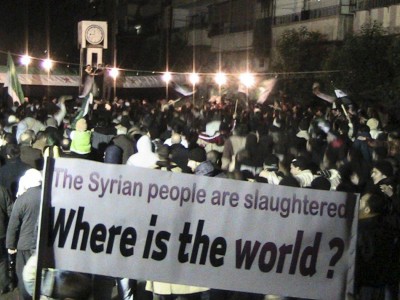
Homs per gli Alawiti, “Il Sogno di Homs”

The Syrian Sun

SCRITTO DA: Helen Dayem, Tradotto da Mary Rizzo

Homs, o Hims come è anche chiamata, è la terza città della Siria per grandezza ed è posizionata strategicamente nella fertile Vallata del Fiume Orontes  (Naher al-Aassi, – Assi significa Ribelle, siccome il fiume scorre verso il nord) della Siria centrale, tra Damasco (162 km più a sud) ed Aleppo (193 km più al nord). E’ molto vicina alla costa (Tartous, 96 km più al ovest) e geograficamente si trova nel centro della Siria.

E’ il posto ideale per una capitale per la setta Alawita!

Da quasi vent’anni ormai, Homs è diventata il luogo dove gli Alawiti emigrano a migliaia. Provengono dai loro paesini nelle montagne che circondano la città e costruiscono abusivamente aree gigantesche per le loro comunità. Quando dico “abusivamente”, intendo che  gran parte delle case, dei negozi e persino delle scuole nelle loro aree sono stati costruite senza permessi; non erano necessari naturalmente, perché il loro leader Bashar lascia fare loro ciò che vogliono, mentre il resto della comunità di Homs, composta per il 70%  circa da Musulmani sunniti e per il 10% circa da Cristiani, deve fare le domande per ottenere i permessi, persino per potere dipingere e decorare le proprie case all’interno, e ciò converranno tutti che ha dell’ incredibile!

Il problema più grande a Homs nella fattispecie è che la comunità Alawita non ha mai vissuto insieme ai Musulmani e Cristiani, preferendo restare unita nelle proprie zone, che però si spandevano a macchia d’olio lungo la via principale per  Damasco.

L’anno scorso, in occasione della mia ultima visita nella loro area, ero rimasta sbalordita da come si  fosse ingrandita l’area, con belle strade nuove di zecca, nuove strutture sportive, nuove aree commerciali: era cresciuta e si era sviluppata oltre ogni ragionevole aspettativa!

Naturalmente, erano venuti in città per lavorare, la maggior parte di loro ottenendo impieghi statali, spesso ricoprendo mansioni mai realmente svolte, addirittura senza presenziare nei posti di lavoro, ma arrivando prontamente in città ogni fine mese per riscuotere gli stipendi governativi, attendendo in file che potevano contare varie centinaia di persone fuori all’ufficio del governo.  Li vedevo ogni mese e nel mentre mi chiedevo da dove provenisse tutta questa gente.

Sì, i lavori statali erano riservati principalmente agli Alawiti, specialmente impieghi di alto livello, a prescindere dalla meritocrazia e, nei vent’anni in cui ho vissuto a Homs, ho realizzato che tenevano la città in pugno, in un pugno sempre più stretto: mentre le loro tasche si riempivano di tangenti, noi eravamo costretti a pagare per potere accedere ad un qualsiasi servizio e per svolgere qualsiasi attività, persino per fare le cose di tutti i giorni.

Anche la polizia a Homs, composta per lo più di Alawiti, poteva fermare la tua macchina, o il pulmino della scuola, senza motivo, solo per poter intascare dei soldi e noi …. pagavamo! Era più semplice che aspettare in fila per ore interminabili, ed essere trattati come cittadini di serie B per essere poi comunque costretti a pagare qualcosa di non dovuto!

Stavano cominciando a strangolare la popolazione con la loro corruzione, e stava diventando quasi impossibile per i giovani trovare un lavoro che meritavano.  Dopo aver compiuti gli studi universitari, diventava per loro chiaro che i posti migliori erano riservati ad altri.

I Professori universitari accettavano bustarelle dagli studenti affinché potessero superare gli esami. Non paghi? Allora, non superi l’esame! Il meccanismo era facile e trasparente, e so con assoluta certezza che gli studenti Alawiti durante gli esami erano informati preventivamente delle domande a cui sarebbero stati sottoposti negli esami. Era chiaro anche dal modo in cui loro finivano sempre gli esami a tempo di record, senza aver studiato neppure la notte precedente, e spesso erano proprio loro stessi che ridevano di questa situazione.

Homs sarebbe appartenuta a loro! Questo abbiamo capito quando il Sindaco, Eyad Ghazal, ideò un nuovo progetto: “Il Sogno di Homs”. E che sogno! Le proprietà che appartenevano ai Musulmani e ai Cristiani della Città Vecchia, sarebbe stata acquistata – coattamente – dal governo, e ad un prezzo che era sola una frazione del valore reale, e sarebbero state sostituite dei parcheggi. Sì, le vite delle persone sarebbero state sconvolte, e persino la zona agricola tra Homs e il quartiere Waar era compresa nel piano di esproprio, destinata a diventare giardini pubblici, e naturalmente, a meno del 10% del loro valore sul mercato immobiliare. La gente di Homs cominciava a preoccuparsi e a ragione. Il piano era evidente: la città doveva essere svenduta alla setta Alawita, dopodiché loro si sarebbero insediati lì!

Il piano era già in atto da diversi anni precedenti. Come mi era parso di notare con i miei professori nella mia scuola, molti di quali erano Alawiti, sui loro documenti d’identità  era scritto Homs, Khaldiyie o Bayada, mentre in realtà provenivano da Latakia o Tartous! Esiste una regola di ferro nella Siria: i documenti d’identità DEVONO riportare il luogo d’origine della famiglia, e dunque, il loro piano era già in azione, erano già Homsi, anche se né loro né i loro antenati erano nati lì. Il Sindaco era pronto a distruggere il patrimonio storico della Città Vecchia semplicemente per far sì che la sua gente potesse emigrare lì. Ma il popolo di Homs aveva capito questo trucco sporco e nelle prime manifestazioni aveva chiesto la rimozione del Sindaco e del suo terribile “Sogno”.

Vecchio Homs, destrutto per il Sogno Alawiti

La risposta dell’amministrazione locale furono pallottole vere, come io stessa avevo visto, e quella prima manifestazione aveva peggiorato rapidamente la situazione.

Sconvolti ed indignati dagli attacchi diretti e violenti contro di loro da parte delle forze del governo, gli abitanti di Homs cominciavano a chiedere la caduta del regime e non solo dell’amministrazione locale, e venivano strappate dai muri le foto del Presidente dall’ “Officer’s Club” sulla via Hama in Homs.

Homs aveva messo la parola “fine” al sogno del Sindaco, al sogno del Presidente. E Homs continua a lottare oggi, per fermare il progetto del governo di compiere il loro sogno folle: quello della distruzione della Vecchia Homs e la sua trasformazione in Capitale degli Alawiti. Ora, più del 53% della Città di Homs è stato distrutto, il 70% della comunità Musulmana e Cristiana è stata sfollata. Si potrebbe considerare questo come “Pulizia Etnica”? Assolutamente sì. Non posso pensare a nessun altro modo per descriverlo, ed il silenzio del mondo permette a Bashar di proseguire nell’attuazione del suo sogno Homs: Capitale Alawita della Siria!

Helen Dayem è un’attivista siriana da Homs e madre del coraggioso Danny Abdul Dayem. Tutte le opinioni espresse nell’ articolo sono quelle dell’autore.