Archive for the ‘Human Rights’ Category

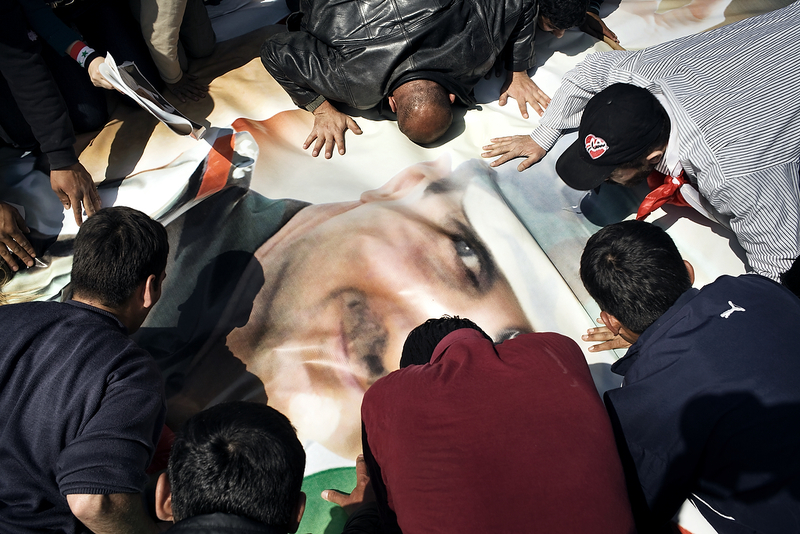
A woman showing her devotion in the Pro Assad rally in Rome

A woman showing her devotion in the Pro Assad rally in Rome

WRITTEN BY MARY RIZZO

When one has the opportunity of having two events in Rome on the same day concerning Syria, it provides an chance of seeing not only the focus of our campaigning and the current state of the “narrative” in our relationship to what everyone can agree is a debacle, but it crystallises the strengths and weaknesses that we have as activists.

Even with a war going on, with the crackdown against protests in areas that are still under control of the regime, and with the enormous dangers and risks that protesters in liberated areas face, we can’t seem to truly mobilise the European public to come anywhere close to making a mass  solidarity movement that will have any kind of echo. We have to deal with perhaps a bit of expense or inconvenience, but we pretty much can be assured there is no one that might kill us for going to protests. We have to follow a procedure to get the permits and do some work to mobilise people, but in comparison, we have nothing to hinder us, so our turnouts should reflect our effectiveness in reaching a critical mass in the public opinion. We have of course had some great marches, there have been countless events, conferences, exhibits, but we have not really engaged the general public that is not already highly politicised or directly involved  into any kind of meaningful action. There are a very few people expending a great deal of energy and in essence, singing to the choir. And this is true ON BOTH SIDES.

So we take into consideration Saturday, 15 June. Back in April, a group labelled “European Front for Syria” called for an international march in Rome, the poster reading (in screaming capital letters): DON’T TOUCH  SYRIA! EVERYBODY TO ROME / 15 JUNE RALLY. In the call to the event, they prospect that there will be thousands of lions to sustain their President and Army (and if we trust their promotional videos, their Secular Socialist State) against those they label as Rats. Yes, they actually do make a long list of who the Rats are, and of course they don’t forget who their friends are: beacons of freedom Iran, North Korea, Russia, China, Venezuela and Cuba, and naturally, a party that is anything BUT Secular or Socialist, Hezbollah. Who exactly is the European Front? I don’t know, but they “joined Facebook in January of 2013”, evidently after 2 years of war and probably combining parts of various pro Assad groups.

Given that in a free society, such as is the Italian one, the right to assemble is guaranteed by the constitution, and all opinions are constitutionally protected. However, given that in order to achieve this free society, Italy was forced to undergo the a long and painful war to overthrow two decades of Fascism (a totalitarian system with no tolerance of dissent and no guarantee of rights). Therefore, a Constitution was written by the constituent entity that had to build a democracy from the ground up, incorporating segments of provisions that place some limits on rights that would be essentially a threat to democracy. Thus, in Italy, our constitution prohibits the reorganisation of the Fascist party, and the Scelba Law (known as the law against the crime of Apology of Fascism L. 645/1952) was introduced to implement its enforcement. The text of the law punishes “whoever constitutes an association, a movement or a group having the characteristics and setting the objective as the reorganisation of the defunct Fascist party, or whoever publicly exalts the exponents, principles, facts or methods of Fascism, or its anti-democratic objectives.”

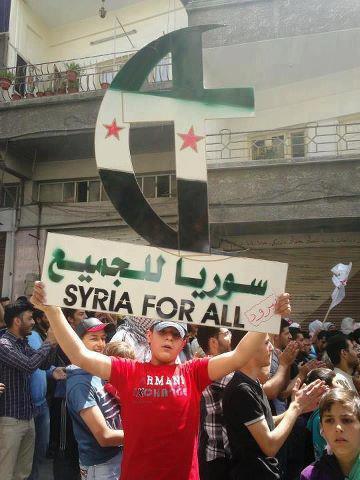
moment of the Anti-Assad rally

moment of the Anti-Assad rally

One can and should ask if this provision though present in the Constitution, and subsequent Law place limits on freedom assembly and expression, actually violating constitutional legitimacy, given that freedoms of opinion are guaranteed by the articles of the Constitution and this constriction does not regard any other ideology, since in modern times, no other ideology had been effective in undermining freedoms and pluralism in Italy. But, leaving the rhetorical question to the side, the Italian government, given that it protects our rights of assembly must however guarantee that assembly meets constitutional and legal requirements. Any assembly in a public space, a rally, a march, even the setting up of a stand to sell oranges, requires the obtaining of permits. In the case of a political rally or demonstration it requires the approval not only of the Municipality but of the State Police. Whoever has organised any event in Italy has spent time at Police Headquarters and contacted the Cabinet of the Mayor. The state provides permits and public security (in many cases escort, officers in riot gear and a motorcade). Most marches in Italy have a massive presence of police, and like it or not, they help with the traffic flow for the streets being closed off, they serve as a barrier in case there are elements that threaten the public safety; at times they are discreet and at others, they are omnipresent.

So, with all of that in mind, if a march/rally is called, with the cost and inconvenience it is going to bring to the general public, it is conditional upon being within the law.

In the call for the Pro Assad rally, the associations that supported it were the bulk of the extreme right of Europe, and this could never have surprised anyone that took even the most random of glances at any of their publications, promotional material or the sites where they held their meetings. Some Romans active for the rights of the oppressed people in Syria and Palestine came to the conclusion that the organisers are part of groups that perhaps are not reforming the Fascist party, but certainly are proud of their roots in Fascism and make no secret of it. It is time to face the fact that while not ALL those who support Assad are Fascist sympathisers, ALL Fascist sympathisers support Assad. Would there be a danger of a march turning into a Fascist rally? Indeed, the supporters of Assad sought confrontation during a pro Revolution march in April in Rome, with the police (upon their own initiative) identifying  19 of them and a pile of stones at their feet, documented by independent photographers, were what was left behind as they were asked to leave the premises. With such precedent, the activists in Rome issued a petition which was signed by hundreds of people, Italians and internationals, and presented to the authorities:

“Called for Saturday, June 15 in Rome is a gathering of European nazi-fascist movements that support the criminal regime of Syrian dictator Assad. The Italian organisations involved are the most well-known groups of the extreme right-wing, from Casa Pound to the archipelago of neo-Nazi movements and apologists of Fascism.

The support of the nazi-fascist movements towards the Syrian regime is the consequence of the shared identity of views with a repressive, murderous and corrupt system; one that has been oppressing the people of Syria for decades and has responded with unprecedented ferocity to the demand for freedom and dignity advanced two years ago with demonstrations and peaceful demonstrations. The current military drift is the result of the regime’s brutal repression against a movement that remained peaceful for many long months, despite the assaults, murders, arbitrary arrests, the widespread use of torture.

We believe that the Syrian people has the right to live in peace and freedom to determine their own future and that, to achieve these objectives, they have the right to resist oppression, just as the Palestinian people and all the peoples of the world. For this reason, we stand against the dictatorship of Assad and any imperialist military intervention, including intervention from the States of the region.

We are on the side of the Syrian people, the Palestinian and all the peoples who struggle for dignity and freedom, against the occupation, repression, torture and massacres, this is why we are anti-fascists.

A rally of rogue Nazis from across Europe in support of the dictatorship of the Assad clan is an insult to Rome, the Gold Medal in the Resistance, and an insult all freedom-loving people. Do not let this shame pass in silence, let us build solidarity with the Syrian people.”

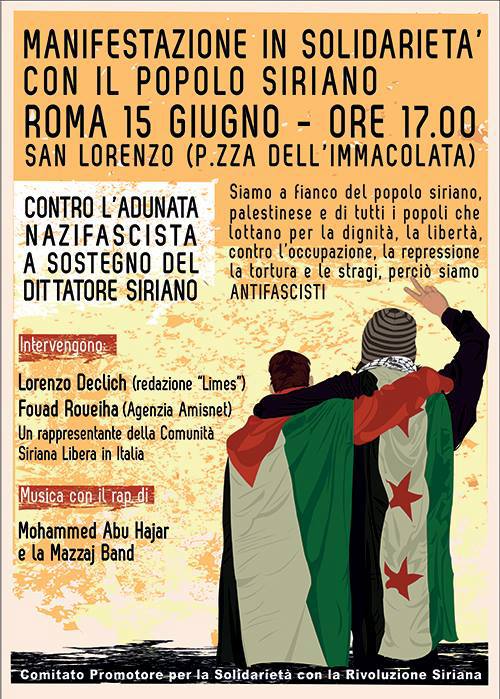
In addition to the petition, a counter-rally was organised in a public square just outside the historical centre to express dissent with the issuing of the permits and to give another voice to the Syrian struggle, that which seeks the end of the Assad Regime.  It added as a second theme the rights of Palestinian to self-determination and freedom. It certainly did not have 3 months to be planned, nor could it mobilise “thousands” from all over Europe to come, given the short notice during high season, when finding accommodation or economic transportation to Rome is nigh impossible. It had to adopt a local character, at the most people from the nearby regions could make it, and yet, calls were made through some posters and some messages on Facebook to bring activists and the general public to convene, no matter where their point of departure was.

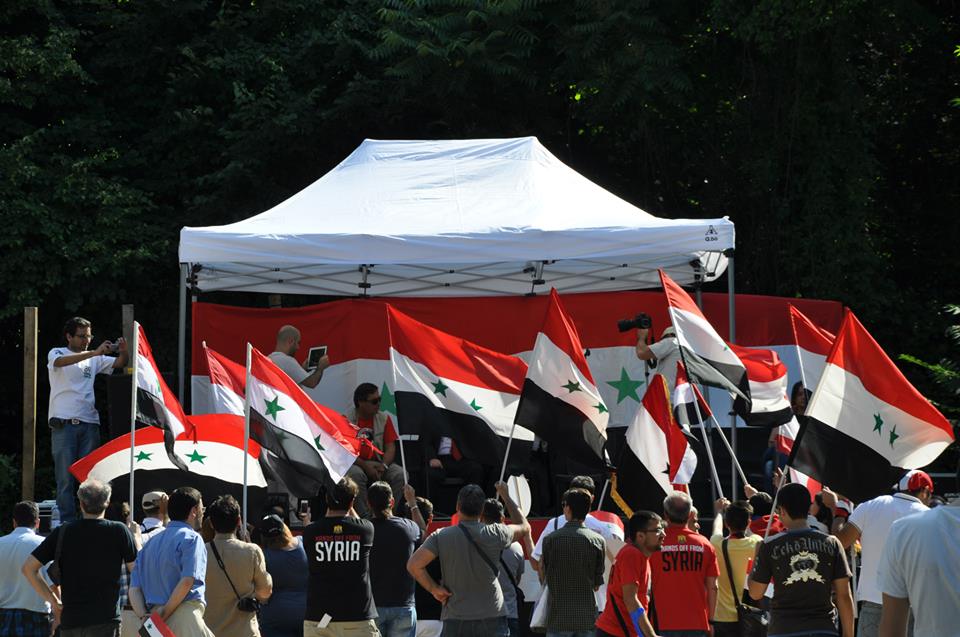
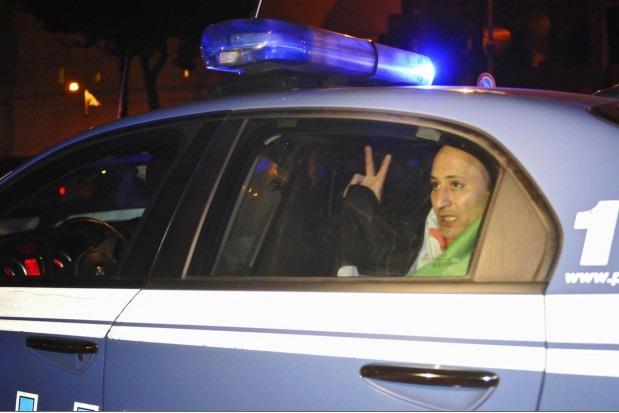
Pro Assad rally in Rome

Pro Assad rally in Rome

Then…. The unexpected happened: two days before the Pro Assad rally, both the City of Rome and the State of Italy withdrew their permits to allow this event to take place in a public square. Not defeated, the group simply moved the rally into their Clubhouse, which is the space that is occupied by Casa Pound, a well-organised group of the extreme right, certainly not neutral or apolitical terrain! Definitely that would exclude that the message would reach the general public that did not already have an opinion on the matter, and definitely would restrict its scope. Any way one looks at it, it lost its character as a Roman Rally, and the hopeful descent of thousands of lions would just have to be more folklore along the lines of the popular mandate of Assad and the “millions” of lions in the streets of every city of Syria to support his regime.

So, absolutely, efforts made by those dissenting from the public rally were fully successful. Free speech was preserved, but NOT the violation of our spaces with the blessing of the authorities.

Our rally, as scheduled, continued and the speakers would also comment upon the successful efforts, as well as explaining the situation in Syria to the general public.

One can look at both rallies and one can make some observations: the first is, both of them were successful in some ways, and unsuccessful in others. The Pro Assad rally, while not drawing thousands, and most likely not a massive presence of Europeans, in the arc of an entire day it did several hundred, they claim on their page 400, maybe half of them were hidden since they certainly don’t appear in photos or videos, yet, in spite of that, whether 200 or 400, it is not a bad number. The Anti Assad rally, while not aiming at an international presence and in concomitance with some other major events for Syria the same day, drew around 100. There were many organisations that gave their moral support and adhered to the call, though they did not bring their numbers to the square.

The Pro Assad rally was highly professional, and it should not surprise anyone! As a matter of fact, in 2 and a half years of war, it is rare (and perhaps it does not exist at all) that these people have been engaged in any efforts to support anything but the permanence of Assad. While decrying specific horrors and lamenting of massacres and destruction at the hands of the rebels, these groups NEVER organise to bring any kind of humanitarian aid in. You will never see them raise funds for ambulances, clothing, medicine, food, blankets, tents and even water. Any efforts they make are solely and exclusively to support their own propaganda. In fact, their Facebook pages included all kinds of information so that people could donate to the Roman event. That, as you see, is the extent of their work, to win the information war with private donations. And they DO invest!!! They provide themselves with a fancy set, organise entertainment, video presentations, bring in TV troupes, have an infinity of gadgets, most of them bearing the face of Assad, organise press conferences and posters… they get loads of posters and banners out there! Definitely, they have economic leeway for these things. Which is what is the problem with the Anti Assad activism. Most activists are not just doing information work, but they are constantly raising funds for humanitarian relief. They are giving sometimes all the money they have to send a bit of goods here, a bit of money there, spreading it out to many projects, so that all the projects have some level of success and serve the Syrians in the refugee camps and the internally displaced. They are building field hospitals, supplying the Syrians with the basics that their own government does not supply them with.

You can watch some of these Pro Assad people go on and on about how Assad provides all, like a good father. They must certainly believe it, because they only open their wallets to find more ways to repeat those myths. Those against Assad are aware of the reality, and not only do they not “get paid” to go to rallies, as was the case with the sixteen models suing an agency that did not pay them for their participation in a march in a public square where they were to chant slogans praising Assad in Arabic and hold his picture and a Syrian loyalist flag. No, those against Assad open their wallets again to bring themselves to marches and rallies. They open their wallets to get a sound system, the minimum things necessary for a public assembly. Things are often on a shoestring budget, and often, met with resistance by others who are in the movement for the simple reason that, “our money has to go to the people who are suffering, not in marches”.

And, this is why, on a date when there was a fundraiser, most of the Syrian community attended that. This is why, while the political paradigm for Assad is almost the property of the extreme right, for their sharing of a common worldview, it also is shared by some in the extreme left who undersign the paradigm, “the enemy of my enemy is my friend”: forgetting that whoever kills his own people is by definition an enemy of the people, whoever engages in arbitrary arrest and torture is an enemy of the people, whoever kills Arabs is an enemy of the Arabs and a danger for the entire Mediterranean.

Those misguided people probably didn’t go to the Pro Assad rally, as most of the pictures showed some families, with kiddies in strollers and grannies kissing the picture of Assad on a paper fan. The self-declared leftists perhaps would have felt more comfortable with the Revolutionary Socialists who were a large part of the Anti  Assad rally than with those dressed up in military fatigues and praising the army. They perhaps don’t even notice that while they are screaming against the “Salafis”, they are praising the theocratic State of Iran, taking the words of a Nun and a Priest with regime links as gold dripping from heaven and raising Nasrallah up as some kind of resistance icon. They probably even think he runs a secular party!

But then again: the Pro Assad folks know how to fight their information war. That is because they do not need to disperse their personal resources in aid. They apparently either do not care about the humanitarian crisis, or since the millions of victims who have lost their homes and possessions are probably persons the regime would be happy to exterminate, they can feel legitimated in claiming to be pro Syria, but ignoring the suffering of the Syrian people. They can’t teach us any lessons about humanitarianism, or even about resistance. But they can teach us how to promote themselves professionally, despite the gigantic downsizing of their event.

CONCLUSION: The Pro Assad people have a different focus, it is on “winning the information war” and to hell with the humanitarian disaster in Syria. The Anti Assad people throw most of their energy into raising funds to provide Syrians with the basics of survival. The Pro Assad people, despite all that work and economic investment that crosses borders to create a massive international event, managed to gather together a very small crowd. The Anti Assad people didn’t have the same mechanisms and certainly haven’t got a political space to fall back on. We have to work harder at convincing people that these events are ALSO important to attend, by Syrians and anyone who is a freedom lover. They present us a chance to stand in solidarity with the Syrians, to discuss among ourselves and with the general public and to in that way build the movement so that the sole beneficiaries of ALL efforts are the Syrian people seeking their rights and freedom.

the two posters of the events:

siria poster 2

don't

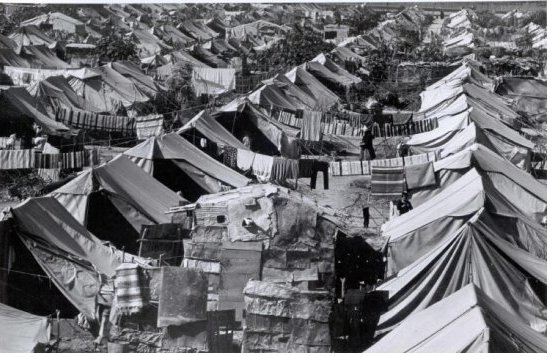
refugee camp of the Palestinian Nakba, 1948

refugee camp of the Palestinian Nakba, 1948

Commemoration Day of the Nakba is approaching. It is an important date that we must never ignore. All who know me are aware that my major interest for the past 3 decades has been to raise awareness of the Palestinian struggle and for those people to obtain their rights and justice, and for this reason, I have operated sites and written, translated, edited and shared articles on the issue, hoping to always allow the voices of the oppressed to have a venue to be heard. This Nakba day feels different from the others, though. For the first time, I feel that I am on the opposite side of the fence of many with whom I’ve campaigned for decades. I’m not talking about the Palestinians, who, by and large share the same views I do on the events of the Middle East, but I’m talking about the activism community in the West, the Left and those who consider themselves anti-imperialists.

What is the problem? The problem is that the focus in not at all about the plight of refugees and humans who are subjected to the greatest loss of all, especially in the moments of war or invasion, it is only about repeating a mantra that Israel and the West are the only enemies and anyone who is “VERBAL” about that, (it’s not required to actually DO anything to liberate occupied lands or to bring refugees back home!) has got to be backed and helped out no matter what any other policy is, particularly those internal policies that involve ethnic cleansing, oppression of part of the population, violence, arrest of any opposition, no matter if they are political or just average people on the street, extra-judicial killings and a vast list of crimes against humanity.

We have seen those who have fought for the rights of the Palestinians completely back the policy of genocide and ethnic cleansing carried out by Assad. All of this not based on his deeds, which include the active participation in the massacres and exile of Palestinians in Syria and prior to that in Lebanon.

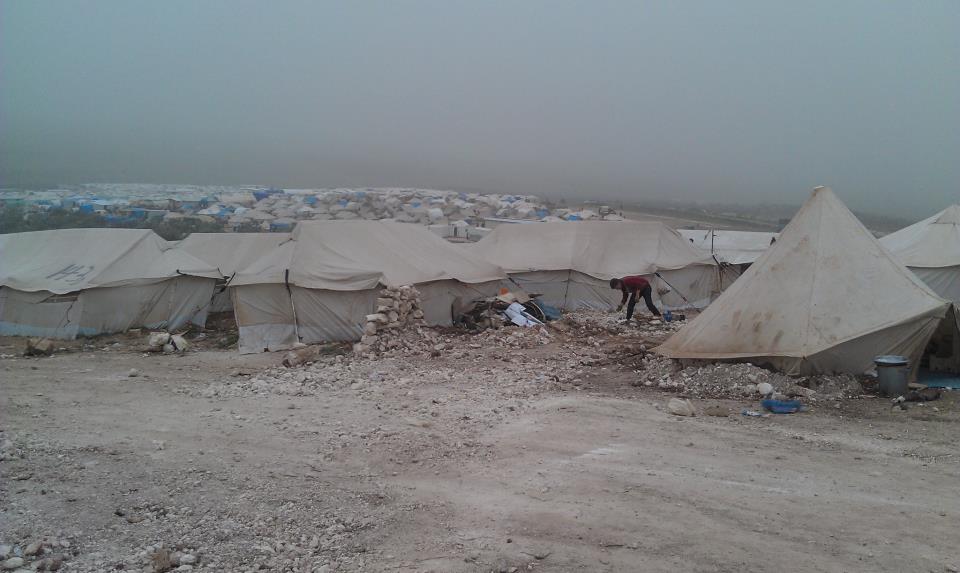
refugee camp for Syrians in Turkey, 2013. Photo by Rana Sammani

refugee camp for internally displaced Syrians, 2013. Photo by Rana Sammani

We are seeing them deny the Nakba of the Syrian people because they are more convinced by fiery speeches than by a true liberation position that vows to protect the lives of Palestinians and at the same time mows them down along with the Syrians, because they dared to not take an active role in support of the regime or if they openly support the opposition. That is enough for the Palestinian camps inside Syria to be subjected to sieges worse than those in Gaza, carpet bombing, checkpoints, massacres and starvation, along with the destruction of their homes and exile, refugees once more, but this time with the denial of the proper documents by Syria so that they can register as refugees where they escaped to, a perverse strategy the Syrian regime uses to prevent them from obtaining their rights. The same fate of collective punishment of the Syrians. This alone should alarm ANY human rights activist, and even more so, those who campaign for Palestinian rights.

Shall we compare the numbers of the victims of these two crimes of displacement and forced exile?

During the 1948 Palestine War, an estimated 700,000 Palestinians were expelled or fled, and hundreds of Palestinian villages were depopulated and destroyed. (sources agree on this, from Benny Morris to Walid Khalidi)

Palestinian refugees in 1948

These refugees and their descendants number several million people today, divided between Jordan (2 million), Lebanon (427,057), Syria (477,700), the West Bank (788,108) and the Gaza Strip (1.1 million), with at least another quarter of a million internally displaced Palestinians in Israel. The displacement, dispossession and dispersal of the Palestinian people is known to them as an-Nakba, meaning “catastrophe” or “disaster”.

Syria (since the start of the uprising in 2011)

In August 2012, the United Nations High Commissioner for Refugees (UNHCR) reported that the number of registered Syrian refugees had reached over 200,000, exceeding the UNHCR estimate of 185,000 for the entire year. Also according to the United Nations, 6 million people inside Syria needed help and about 4 million Syrians were internally displaced because of the Syrian civil war.

By the early months of 2013 the UNCHR announced that the number of refugees had topped 1 million, and by March 2013 had risen to 1,204,707 people. A spokeswoman for UNHCR, Sybilla Wilkes, also reported that the rate of flight from Syria was increasing. “In March an average of 10,000 people crossing per day. In February it was 8,000. In January it was 5,000. The numbers keep going up and up.” It has been estimated that by the summer, the number of refugees will be 4.25 MILLION, only some of them registered with the agency because they have found refuge with families living abroad or are internally displaced, which does not record them at all.

700,000 is a lot of people displaced. It is a crime against humanity.

4.25 million is an astronomical number that barely is able to be imagined. The crimes against these people are also crimes against humanity.

If supporters of Human Rights for Palestinians ignore the displacement of Arabs, it is because they are in bad faith, ill-informed, or they do not have human rights as their core agenda. They hate the West (which most of them live in quite comfortably) much much more than they love the people who are subjected to oppression, and seek that they are not denied safety and rights. Justice and dignity are not what they care about, it is something else, and the sacrifice of the Syrian people and the Palestinians inside Syria has exposed all of this.

But, to be completely fair, it is not the concern of the Syrians themselves what the activists out here think. Many of them tell me they do not care about what the activists think and they no longer are interested in their support. They have shown their suffering to the world, they do not need the approval of anyone out of Syria. Even the hypocrisy does not faze them. They basically ignore what those people think, as it has no bearing on their lives. A just cause is a just cause, and the causes of Palestinian and Syrian people are just causes, and they do not get diminished by the neglect or double standards of activists. It is the luxury of activists like me, out here, safe and comfortable, to despise the hypocrisy and hope that this vile thing would change over time, as more and more people regain their reason and reject the empty rhetoric that for decades fooled a lot of us, and still does fool some. The Syrians have the conviction that victory will come to the righteous, that God will not allow them to lose, and that it is only a matter of time, but justice will come. This is why they are so much better than I will ever be, they do not waste energy on the useless emotions, they know the battle is where they live, fought on their soil, and they strive towards their goal.

pal ymPALESTINIAN YOUTH MOVEMENT
In general, the Palestinian refugee camps in Syria, and particularly Yarmouk camp, formed as the capital of the diaspora, are among the largest groups of Palestinian refugees and have been the starting point for many resistance operations, fueling the Palestinian revolution in its various stages and sacrificing many lives for Palestine. The last demonstration of resistance to their just cause was shown with their bodies alone during the commemorations of al Nakba and al Naksa at the border of the occupied Golan heights between Syria and Palestine, with eagerness for their stolen land, carrying with them the keys of return to their homes from before the brutal Zionist occupation, which they were forced to flee. Undeterred by the threats of the enemy, fire was opened and the bullets brought down many young martyrs.

Under the tense and disastrous circumstances in Syria, the camps have shared a large portion of what is happening as a result and it has led to the displacement and dispersion of many Palestinian families as well as their fleeing to different places within Syria, to neighboring countries, and European countries, effectively repeating the tragedy of Nakba once again to the very details, and in even worse conditions than before in light of a worsening Arab climate preoccupied with their own internal affairs. Further, the PLO has ignored any responsibility it has toward our Palestinian people present in the camps, without even minor levels of communication with the stakeholders of this situation to even mildly alleviate this tragedy.

For months, the Palestinian people have suffered numerous partial sieges and blockades imposed to prevent the entrance of aid and relief, from food and medicine for the camps to preventing the wounded and injured from seeking medical treatment outside the camps, having lost medical supplied at hospitals within the camps. In these past days, a full siege has been imposed on Yarmouk camp, which positions potential for a human catastrophe and which is threatening the lives of our families and brothers and sisters trapped inside the camp.

We, in the Palestinian Youth Movement, reject and condemn the policy of collective punishment against our steadfast families, brothers and sisters in the camps and we call on all concerned international actors, and UNRWA in particular, to exercise its role and fulfill its duty of providing relief to the Palestinian refugees. Furthermore, we call upon the PLO in request for the declaration of a state of emergency and for the PLO to intensify its efforts and pressure to lift this blockade, for the claim of legitimacy and representation is not just a slogan to chant as they please, but rather it is a responsibility to its people.

As the 65th commemoration of the Nakba approaches, we recognize that the tragedy of al Nakba is carried on as part of our daily lives, and rests on the shoulders of our brothers and sisters in the camps in unparalleled ways. However, our brothers and sisters in the camps remain steadfast as always and will remain the foundation of the Palestinian experience, and the meaning and basis of representation is lost if it does not represent the nucleus of its people, especially in the worst and most difficult of conditions.

Until Return and Liberation

www.pal-youth.org
in Arabic
http://hosted-p0.vresp.com/1383031/6f86706c4a/ARCHIVE

Not looking and not seen doesn't mean that one also refrains from making judgment

Not looking and not seeing doesn’t mean that one also refrains from making judgment

WRITTEN BY MARY RIZZO AND MALAK CHABKOUN

But don’t you see that the whole trouble lies here? In words, words. Each one of us has within him a whole world of things, each man of us his own special world. And how can we ever come to an understanding if I put in the words I utter the sense and value of things as I see them; while you who listen to me must inevitably translate them according to the conception of things each one of you has within himself. We think we understand each other, but we never really do.”

― Luigi Pirandello, Six Characters In Search of an Author

Humans can be very strange creatures. Strange because we seek “the latest news” but are in practice seeking nothing more than the emotional-intellectual comfort that comes with the confirmation of our beliefs. We all “know” things, the news just confirms to us that our convictions are actually “right” or even that they are “the truth”. We humans seem to be avid consumers of a sort of passion play where the characters represented fit their roles and repeat them endlessly. We are drawn to the sources we know are going to give us answers that fit our worldview, our way of thinking, and we generally aren’t questioning their content, much less their framing of it.

This desire to fulfil this need is particularly true when we are faced with events that we have little knowledge about – events that are so far from us physically and mentally that we run to our comfort zone to explain to us how we should feel about said events. The problem is compounded as we turn to these sources again and again, sources which tell us that they are keeping us informed, lulling us into the idea that we know and are aware, when in fact we do not know and we are not aware. This creates the problem of cognitive dissonance, which is the illusion of believing that we know something when in fact we do not have the knowledge or information to process events unfamiliar to us.

So, how do we think? We often tend to think categorically. It is the way that verbal communication is taught at a primary level, so it lasts a lifetime. We all know how much time and effort can be saved once you divide the world into convenient categories of good/bad, black/white, us/them, etc. Therefore, the news source or information that one seeks already fits neatly into this paradigm, and in addition, it is one that more often than not is culturally familiar. This is not to say that there is no truth to some binary thinking. Unadulterated extremes indeed do exist, and at times we are even aware of what they are because the parameters to judge them are clear, but to attribute a value judgment to something, one has to know its true nature. One has to go beneath the surface. Subjectivity can’t be avoided because of our human nature, but it would help if we knew more facts than we think we do!

msm

Because they lie. But does that mean the “alternative” media tells the truth? No.

When thinking out of the box is just thinking in a different box

Many people will not watch TV because they are diffident about what the corporate media is telling them. It’s in fact correct and reasonable to mistrust something that tells you to buy what you don’t need with money you haven’t got and makes you feel miserable for that feeling of consumerist desire that TV implants along with its programming. Some who don’t watch TV because they are convinced it is “the idiot box” that creates conformity around falsehood at any rate have to obtain their information from someplace, and quite a few of them reject the Mainstream Media (MSM) because they attribute to it the same faults as TV, ie, that it peddles lies and that they want to “think independently” and “think out of the box”. This is why they tend to avoid newspapers or Internet sites that are connected with any corporate ownership, and most of the time that leads them to “alternative” news. Alternative news has its own pundits, its own worldview and its own pecking order of news analysis that runs the gamut from political correctness to conspiracy theory (and everything else in between). But it can be just as equally full of lies, rumour, false ideology as the corporate media. Thinking out of the box in this case isn’t happening, it’s just that the box might not be made on a production line and it looks more creative. And, as far as the alternative media goes on Syria, their box has been pretty badly distorted most of the time.

In an effort to be the alternative source on Syria, many outlets have taken to making predictions and speculations out of context. These predictions and speculations based on current events in no way offer a comprehensive view of the situation, thus leaving us with definitions of the conflict ranging from “civil war” to “Jihad” or “holy war” in Syria. Furthermore, these alternative outlets often ignore the context in which the Syrian revolution is occurring – including both historical context and regional context.  Finally, the gravest error may be that many of them then turn to an extremist explanation on either end of the spectrum, some exaggerating to the point of lying to get the attention of the MSM.

Sites that we came to know and trust for their coverage of the invasion of Iraq have for the most part, and with the stellar exception of Uruknet, been repeating as if by rote the same rhetoric (then, we didn’t call it rhetoric, because it made perfect sense with the objective facts on the ground) they used for making the public reject any intervention in Iraq, but this time they are transferring it to Syria. Virtually ignoring the fact that the situation is entirely different in almost every essential way, they dust out the anti-war slogans. The only problem is, they are not so much anti-war as they against THIS war, more specifically, against any kind of opposition to Assad, and therefore, they are anti-revolution. Reactionaries and counter-revolutionaries: being labelled by those words should chill their spines, but the consumers of these sites instead insist upon remaining virginal in their “defiance” and they repeat blatant lies such as that of there being no revolution in Syria, just a Western-based plan for take-over of Syria.

Suspending belief/suspending the moral compass

They used to say that seeing is believing, that you should always suspend your belief until you had evidence, and the best kind was physical evidence, visual proof. In the case of the Syrian revolution, first “they” (the counter-revolutionaries who read the alternative media a-critically) said, “we need proof” (that there is unhappiness in Syria). So they saw protests. Dozens of protests just like in all the other countries in the region were having and largely for the same reasons. But this was not to be trusted.

Syria, in the collective imagination of the alternative media progressive had always been “a good guy” for the mere virtue that “the West” had it on a rogue list. Now, rogue lists are ridiculous at best, especially if those paying the price are not the leaders of those nations, and if the compiler of the list has invaded nations in a serial way, but paying the price are the people who face restrictions because they are citizens of those nations, so it is criminal at worst. But to turn Syria into an “anti-Imperialist paradise” also would require evidence to demonstrate such a claim… which has not been forthcoming. Yet… there was no believing the videos making their way out, they were just not taken into consideration, no matter that there were hundreds of thousands of them and they certainly could not continue to be labelled as creations of a film studio in Doha as many “anti-Imperialist pundits” were saying, taking the cue from the regime prompts.

But, the fact that there had been even less protests over the decades than places like Egypt, Tunisia and Lebanon actually can serve to give an idea of how bad things really were in Syria before the revolution. There was a prohibition of providing evidence of the massacres, torture chambers, arbitrary detention and massive limitations on human rights. The truth and facts about life in Syria under Assad were kept well under wraps. That was because for a Syrian to even speak about all of this, inside Syria meant disappearance, torture or death and outside Syria meant the possibility of never returning home, even for a visit. It was one of those situations of “you wash the dirty laundry in the home” on a monumental scale. It is really not the fault of the consumers of alternative media if they believed the lies, all of us who rejected the “rogue state” way of thinking did that. But we weren’t entirely to blame, we didn’t have that much chance of knowing any differently. We’ve all signed petitions for the release of bloggers, but the actual EXTENT of the silencing of internal dissent was not fully understood. There was no way to understand it. The regime was so repressive that this information could NOT get out “unpunished”.

Then, things changed. It took the courageous actions of children to wake up what had been 40 years of slumber induced by severe repression and humiliation at the hands of the Assad family. People found their courage and voices and started to take to the streets in Syria, bloggers who alluded to things and kept their criticisms to complaints about the lack of liberation of occupied Golan, were taking pictures, filming events, showing visual evidence of what they had with great difficulty gotten out there “before”. Then, it wasn’t just bloggers anymore. Anyone who happened to have a cell phone was filming what was happening in every part of Syria, in a constantly growing way, and evidence of the oppression, the repression and the revolution were available free of charge and without any kind of filter, be it the MSM or the Alternative media.

But what happened? The videos were STILL not good enough, the evidence was still not convincing enough to override a fiery speech by Assad that said he was the last resistant figure to the threat of the West and Israel. And he found defenders in high places who would label him as the last great Arab leader, rhetoric not that different from the hagiography in Syrian media, as unearthed by Azmi Bishara which literally states:

“Love sprung out from Assad’s heart to water the earth of the deserving periphery of the country, reaching those who, one hopes, can still understand the language of love. He anointed his words with the tears of the bereaved orphans and widows, bowing before their sacrifices and paying homage to their selflessness. His love flowed into the mosques, where the devout were treated to a mix of the heart and the mind. …”

“Yet it was not love alone, but he his wrath erupted, burning away his enemies who do not understand the language of love … The President of Syria has made explicitly clear that the intention is no longer to chase terrorist groups from one area only for them to regroup in another. Rather, the aim now is to destroy these groups. Full stop.”

The Syrian version of The Dear Leader, one must presume.

A supporter of Syrian President Bashar al-Assad carrying his image, with words written on her face that reads in Arabic ''Bashar I love you'', takes part in a rally to commemorate the 65th anniversary of the foundation of the Baath Party, at al-Sabaa Bahrat square in Damascus April 7, 2012. Credit: Reuters/Khaled al-Hariri

A supporter of Syrian President Bashar al-Assad carrying his image, with words written on her face that reads in Arabic ”Bashar I love you”, takes part in a rally to commemorate the 65th anniversary of the foundation of the Baath Party, at al-Sabaa Bahrat square in Damascus April 7, 2012.
Credit: Reuters/Khaled al-Hariri

Yet, the true problem is not only that they see and they refuse to believe, but they have come up with reasons for why Assad has to be “backed”.  They insist that the revolution is fake, (as if they know a real one!) and that it’s simply masses (millions!) who are blindly saying the slogans that their “prompters” in (take your pick) Saudi Arabia, Qatar, the NATO, the United States, (as if they are interchangeable and have the same agendas!) have prepared for them. They forget the adage that is a truism for activism regarding Palestine/Iraq/Afghanistan:  if one is armed with a just cause, there is no need to lie, or even to exaggerate. The facts of things alone, the evidence of misery, of oppression, of suffering and struggle are sufficient and require no justification, just a moral compass that is still working.

One man’s terrorist is another man’s freedom fighter

The problem that was pointed out at the beginning of this essay is that language and culture are the crux of understanding the problem and getting to the bottom of the truth, and then acting in a consistent and morally viable way. The average person reading this will have English as his or her first language, will live in a Western country and will be familiar with the rhetoric of the dominant culture. That means that the person reading this will already know that calling one a terrorist is condemning his cause and considering its perpetrator anathema. We are all fully aware that some political parties are systematically labelled and blacklisted by the USA and Israel as “terrorist organisations”, despite the fact that they have even been victorious in elections in Palestine that were deemed legitimate by the overseeing bodies of the UN. We have rejected those labels because our “moral compass” understood that they were created in a climate of oppression, were aimed at liberating occupied lands and they restrict their operations to military ones. We activists consider them as freedom fighters and there is no need to defend them or their purposes, though we are still entitled to critically appraise their actions as serving the ends of the cause or falling into political party dormancy.

Likewise, it is easy to refer to the party that uses a car bomb in a city as a terrorist, and even to accept the (later almost always debunked) Syrian regime’s claims that it is work of the opposition (when they are being nice they call them rebels, but most of the time they are translated in even the most liberal-radical news sources as “terrorists”, when they don’t call them “rats”.) Yet, it is the armed opposition, the Free Syrian Army and then the constellation of armed forces alone who are called terrorists when they are defending a liberated town, or what remains of it after the shelling and armoured tanks finally roll back out to fill themselves with more lethal shells. Why are the alternative left and anti-imperialists information sources not referring to air strikes over Aleppo and other towns and cities as terrorism? Why do they seem to ignore bodies of women, children and men of all ages with their throats slit and their hands tied when it is clear beyond all doubt that the perpetrators of these acts (crimes) are either the “regular” army or the armed thugs known as “Shabbiha”? Does the blood of these victims cry less vendetta because the hand holding the knife works for the “president”?

Misunderstanding of these words is one of the major errors of the pundits and the media.

Misunderstanding of these words is one of the major errors of the pundits and the media.

Otherness and Understanding

Resistance is not a new concept in the Middle East. The region has had its share of both external and internal leadership imposed on the masses. Syria is no exception. In 1920, the French colonised the country of Syria and remained there until 1946, when Syria regained its full independence. In the first battle for independence in 1925, Sunnis, Druze and Christians coordinated to oppose French rule and mistreatment of segments of the population. While the revolt was eventually put down, it is often remembered with fondness for the ideals it stood for, and it paved the way for the battle for full independence.

In between independence from France and the Assad family rule, there were several coups in Syria. In 1970, a new family came to power – the Assad family. This family was to spend over 40 years controlling the lives of Syrians – their social gatherings, their speech, their religiosity, their mode of dress and their economy. The old lessons of resistance from the days of French rule had been taken to the grave but were suddenly recalled by the Syrian people when the regime arrested and tortured school boys for writing, “The people want the fall of the regime,” on their school’s wall in March 2010. Syrians in the Dar’aa Province mobilised in peaceful protests, often calling for “freedom,” “isqat annithaam” (the fall of the regime), justice, and an end to corruption. Other provinces began to follow suit, mobilising in mass protests when regime forces responded to the peaceful uprising in Dar’aa with bullets, arrests and eventually shells.

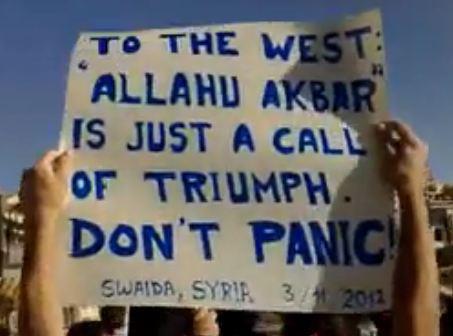
Thousands of these demonstrations, all peaceful, are documented by hours and hours of video footage on YouTube. Two years after the uprising, the footage continues to uploaded by activists on a daily basis, with most demonstrations mobilising on Fridays. Of course, because most of the signs and chants are in English, this often makes non-Arabic speakers weary, particularly if they hear the demonstrators chant the words made famous by Major Nidal Malik Hasan, the U.S. Army psychologist accused of killing 13 people in an attack on Fort Hood. These two words are Allahu Akbar – literally translated as “God is Most Great.” While Major Hasan is accused of shouting these words during the attack, many non-Arabic speakers do not realise that this phrase is actually very multi-dimensional and, more importantly, a phrase that has been in existence for thousands of years before Major Hasan came into the picture.

In the Syrian demonstrations, when Allahu Akbar is chanted, it can range from signifying that the protestors feel that God is the Most Almighty to serving as a prayer for help from God. The phrase is often very contextual – for example, in the videos where the Assad regime has perpetrated some sort of attack on civilians, the phrase signifies a plea to God – that God is greater than all of the evil happening in Syria. In demonstrations supporting freedom and justice, the phrase will often signify triumph and a vow to persevere, with God’s power, in the struggle for freedom. Yet many, from seasoned journalists to “instant book pundits” have defined this phrase as the battle cry of the “religious war” and thus have painted the entire revolution with the same brush, lacking even the most basic understanding of what is going on or what protestors mean when they use the phrase. Furthermore, they ignore the rest of the innovative words being written, created and chanted by the Syrian people and focus on this one phrase, yet another example of refusing to come to an understanding based on facts and knowledge rather than personal comfort and preconceptions.

Understanding the culture and language of “the other” is always a prerequisite for legibility of their message, in any media/medium. But if you don’t know the language, roll with the emotion and understand where the players are coming from. We are so embedded in our own cultures, that we fail to realise that we are unable to decipher what we think is obvious. An example comes to mind of a classic film. Fellini’s “8 ½” is about a filmmaker going through a terrible creativity block. He moves from scene to scene attempting to overcome it. Fellini is a poet, Marcello Mastroianni is an artist, both of them able to break through the language barrier and communicate this situation and the sentiments involved. In fact, this film is loved by many people who don’t know any Italian. However, it is a product of its culture and language and only an Italian speaker would truly understand the final, moving and amusing scene, where everyone in the film magically appears and partly under direction and partly spontaneously, simply start to go in a massive “ring around the Rosie”, eventually involving the director who up to that moment couldn’t figure out how to get back to his work. It is five or so minutes of circus music and movement.

http://www.youtube.com/watch?v=YHCIg4sQWIE

To an Italian, what everyone is doing is encouraging him to “girare” (go around in a circle), which is the Italian word for “filming”. The metaphor and its poetry and beauty doesn’t need to be explained to an Italian, but it would escape others, who see the beauty but don’t quite understand it because it is outside of their cultural reference. So, what is this example saying? That we can’t know all the cultural cues that come to us by the messages (verbal, visual and so on) during the Syrian revolution unless we are Syrians or have a deep and correct exposure to them, far removed from our OWN filters. We have to be careful, if we can’t be knowledgeable, and in all cases, we have to be SENSITIVE. We can see and on a human level sympathise with the human suffering in Syria right now. Ignoring it or replacing it with the wrong frame or with our own frame is never going to be of service of truth and justice, and isn’t that what we are into activism for in the first place?

089

WRITTEN BY ASMAE DACHAN, translated by Mary Rizzo
Hundreds of Syrians and supporters of the Syrian cause took to the streets of Rome on 13 April to say “We’ve had enough of the massacre perpetrated by the Assad regime in front of the indifference of the world”. They came in coaches, trains and cars; the young and the old, women, children, entire families who live in various cities of Italy, who in Syria have families and loved ones living in the cities under siege.

Answering the appeal of the organisers were coaches full of people from Verona to Naples: it was a presence that was important for the reasons of the march more so than for the numbers of people. The vision for those in Piazza dell’Esquilino where the march started, was an impressive one: a Syrian flag measuring 60 metres opened the march, followed by an orderly and proud stream of people who, despite the fatigue and stress of over two years of protests and activism to fight the repression their loved ones are subject to, has never betrayed its pacific nature or its ideals.

The threats and the intimidating acts coming from the supporters of the Syrian dictator in Italy that had preceded this march did not dissuade anyone. The cherrybomb that they exploded in a parallel street to the square where the marchers gathered served no purpose. It was just a loud bang that had caused the law enforcement officers to intervene immediately, but it did not shake those present, in deep empathy with their people who every day must deal with showers of real bombs.

Nor did the presence of the militants of the extreme right movement of Casa Pound, above street level and armed with stones and regime flags serve any purpose. In fact, they folded up their flags and broke up their own gathering when the officers neared them for identification. In their presence, the protesters chanted an impassioned “Assassins, assassins, keep your hands off of our children”. The march wound its way through the central streets of the capital, where hundreds of tourists and Romans applauded and were united to show their human solidarity.

Breaking the wall of silence that engulfs Syria, indeed, is one of the priorities of activism outside Syria, and the reason for which this latest protest by the Syrian community in Italy had been called. Among the participating associations were: CNS Italia, Onsur, Ossmei, Associazione 3 febbraio, Assopace SessaAurunca and others.

http://diariodisiria.wordpress.com/2013/04/15/i-siriani-ditalia-in-piazza-per-dire-stop-al-massacro-del-loro-popolo/

asm 1asm 3asm 4
asm 2

WHEN YOU AREWRITTEN BY RUTH RIEGLER

What is it that the world doesn’t ‘get’ with Syria that leads to the continuing reluctance to unequivocally condemn and speak out against Bashar Al Assad’s regime among so many otherwise intelligent people?

The Assad regime is using warplanes, helicopter warships, tanks, Scud missiles, cluster bombs, phosphorous bombs, TNT-filled barrel bombs, rocket launchers and assorted other weapons against civilians. Over 70,000 Syrian people have been officially documented killed to date, more than 5,000 of those are children. The real death toll may be twice that and it is rising by the day. Hundreds of thousands are imprisoned, ”missing,” maimed, crippled, over four million in the country need urgent humanitarian aid, over 2.6 million are displaced, over 700,000 are refugees…the horror statistics go on and on…and the world collectively shrugs, sighs and turns away.

I realise that people have the right to say this isn’t happening. They also have the right to say that the sun doesn’t rise in the east, although repeating the latter patent falsehood at least doesn’t make them tacitly complicit in genocide, as repeating the former one does.

Of course, people have the right to believe what the Assad regime and its supporters tells them – that it is a heroic and embattled state fighting heinous and possibly fanged radical Islamists and jihadists intent on its destruction, who are part of a foreign plot by the CIA to overthrow The Only True Anti-Imperialist State In The Region.

People also have the right to believe what Israel and its supporters tell them – that it is a heroic and embattled state fighting heinous and possibly fanged radical Islamists and jihadists intent on its destruction, who are part of a foreign plot by Iran to overthrow The Only True Democracy In The Region.

Both arguments, for the Assad regime and for the zionist state, have exactly the same amount of legitimacy and merit and stand up equally well to even the briefest scrutiny or analysis, which is to say none and not at all.

People have the right to say that they wish to remain neutral on Syria. In the end, however, as Desmond Tutu wisely noted, ‘If you are neutral in situations of injustice, you have chosen the side of the oppressor.’ ”Neutrality” – or simply indifference – from the outside world is what all abusive spouses, all dictators, all totalitarian regimes, all brutal and oppressive states rely on in order to continue with their brutality and oppression. Neutrality in such monstrously unjust situations is not an admirable and objective stance, but a tacit nod and wink to evil.

People have the right to suggest that maybe dictators are better for some – if they themselves are prepared to give up their own freedoms and live under dictatorship since of course they wouldn’t be hypocritical enough to wish for others what they don’t wish for themselves (perish the thought…).

People also have the right to say that Western democracy is a sham, and I would agree wholeheartedly that it could certainly be massively improved. But oddly I don’t notice the Western totalitarianism groupies actually rushing to renounce their citizenship of horrid sham democracies in favour of emigration to glorious people’s republics, or indeed campaigning for fewer rights in order to feel less oppressed by the horrors of democracy.

People have the right to say that Western leaders and governments are monstrously hypocritical, amoral and indifferent to human life, paying only lip service to the ideals of freedom and human rights while actually opposing them whenever expedient for their interests. And I would agree wholeheartedly without reservations. I’d also suggest that this is one more reason why we should not exhibit the same monstrous hypocrisy, amorality and indifference to human life – because if we pick and choose which people’s freedom and human rights to support or oppose we are no different, no less hypocritical, amoral and indifferent to human life, and certainly no better than those governments we condemn.

In the end, people have the right to say, do (or not do) and believe whatever they want, about Syria or any other issue. But that right comes with the attendant acceptance of responsibility for the results of their words, action or inaction and beliefs. The results of neutrality of indifference towards Assad’s war on Syria are tacit support for and complicity with it. The neutral and indifferent people around the world are not flying Assad’s warplanes, dropping the cluster bombs and phosphorous bombs, carrying out the rapes, torture, massacres, but their silence gives their consent for the regime to continue doing so, tipping Assad a silent nod and wink to ‘Carry On Killing.’

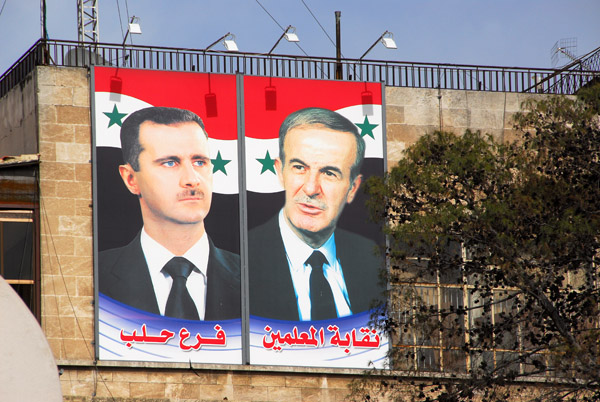
Affiches géantes, pour rappeler au peuple qui commande.

Ruth Riegler a interrogé un activiste syrien afin de mieux comprendre sa vie dans la Syrie révolutionnaire. Il apparaît sous un pseudonyme. Traduit par Eric Lamy.

R. R. : Comment décririez-vous la vie en Syrie avant la révolution, et comment définiriez-vous les causes premières de celle-ci ?

S. L. : Mon nom est Syrien Libre. Je veux que le monde sache pourquoi nous faisons la révolution contre Bashar Al Assad et son régime. Chacun sait aujourd’hui que c’est une révolution majeure, mais personne ne sait, en fait, quelles en sont les raisons profondes. Je vais vous le dire. Je veux que le monde sache comment nous vivions avant la révolution, qu’il en sache les vraies raisons. Nous vivions dans un monde où nous n’avions qu’à obéir comme des esclaves, quelque soit l’ordre du maître. Nous n’avions qu’à obéir et nous exécuter. En cas de désobéissance, nous étions punis ou exécutés.

Nous vivions dans un état de haute sécurité, ce qui signifie que nous étions gouvernés par un président unique avec ses militaires, ses services secrets, ses officiers, sa police militaire, sa police, ses indicateurs et ses shabihas [gangs armés]. Pour faire quoique ce soit, il vous fallait d’abord obtenir une autorisation et vérifier que la loi vous permettait d’agir ou non ; ce qui signifie que vous n’aviez aucun droit d’agir de vous-même et que vous auriez à affronter des obstacles si vous persistiez. Seuls les tenants du pouvoir pouvaient vivre librement et en dehors des lois. Ils pouvaient agir en toute liberté sans rien demander à personne, tout en contrôlant chaque quartier, y compris le système politique, le secteur industriel du pétrole et du gaz, l’économie du pays, les banques, le commerce, l’armée, l’agriculture et l ‘éducation. Dans les faits, ils se considéraient comme des dieux.
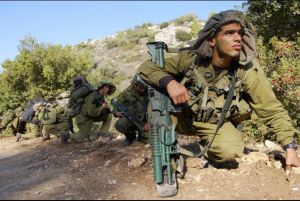
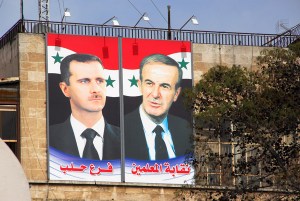
C’est Hafez (et ensuite Bashar) qui ont permis à Israël d’occuper militairement les Hauteurs du Golan.

Nous avons vécu sous ce régime qui prétend être anti-sioniste, mais c’est, en fait, un autre mensonge : il n’a jamais tiré un coup de feu contre Israël et il a maintenu la paix dans les Hauteurs du Golan, interdisant à tout syrien d’attaquer l’État Juif ou de réclamer ce territoire annexé. Tout homme qui l’aurait osé eût été jeté en prison, puni et probablement exécuté. Nous vivions comme des esclaves, sans aucun droit. Nous n’avions pas celui de choisir un candidat au poste de président ou d’organiser des élections libres, de créer des partis politiques ou de choisir des députés, d’élire un parlement. Seuls Assad et ses services secrets pouvaient choisir des députés, et leurs choix allaient invariablement vers les plus corrompus, les plus dénués de moralité ou de conscience. Si vous vous opposiez à la moindre de leurs actions, vous étiez jetés en prison. Ils faisaient de vous ce qu’ils voulaient parce que vous n’étiez rien. Les gens avaient peur de s’opposer, d’être en désaccord avec le régime ou avec quelqu’un qui fût proche des services secrets : les Syriens ont appris à courber l’échine et à se taire. Si vous osiez maudire Bashar, les hommes du régime venaient vous saisir où que vous soyiez pour vous embarquer à l’antenne locale des services secrets. Personne ne savait où vous étiez passé, personne n’osait s’en informer ou même prononcer votre nom. Si jamais vous vouliez créer un mouvement politique, ils agissaient de même : en Syrie, il n’y avait qu’un seul parti, et tous les syriens étaient obligés d’y adhérer. Au cas où vous aviez l’intention d’échapper au service militaire obligatoire, vous étiez jeté en prison pour au moins trois mois, puis forcé de servir quand même.. S’il vous arrivait de mourir pendant votre incarcération dans les geôles des services secrets, personne n’aurait cherché à savoir comment et pourquoi. Personne, évidemment, n’aurait pu être tenu responsable de votre mort car la constitution syrienne garantit au président, à ses services secrets, ses militaires et ses collaborateurs une immunité totale. Les syriens étaient traités comme des insectes qu’on écrase sous une botte. Leur vie importait peu.

On ne peut représenter l’oppression, mais on peut la ressentir.

Le système permettait au président, son armée et ses services secrets d’arrêter, de torturer et de tuer n’importe qui, de disposer de nous et personne, en dehors du pays, ne savait ce qui s’y passait. La corruption, le népotisme et les faveurs étaient la règle à tous les niveaux de l’état, et les gens ont appris à survivre et à ne s’occuper que de soi, sans poser de question, sans s’occuper des autres. Seuls Assad et les proches du régime pouvaient agir à leur guise. La Syrie était une grande ferme et les syriens en étaient le bétail.

Il faut que je vous parle de l’économie du pays. En dépit de la découverte de réserves de pétrole et de gaz dans le Nord-Est de la Syrie ainsi que d’énormes gisements en Mer Méditerranée, nous nous sommes toujours étonnés de ce que ces matières premières étaient si chères pour nous, et pourquoi devions-nous les importer d’Iran, d’Iraq et d’Égypte. Nous avons découvert que c’est parce que Bashar et sa famille volaient le gaz et le pétrole syriens pour le vendre au rabais à la Russie et à l’Europe. Ils se mettaient l’argent dans la poche, pendant que les Syriens n’ont d’autre choix que d’acheter leur carburant et leur gaz à un prix élevé dans les centres de distribution de l’état, quand on avait la chance d’en trouver un. Le gouvernement a constamment gonflé le prix du pétrole et du gaz. Conséquemment, les prix des autres denrées, pain, riz, sucre, habillement, appareils électroniques, maisons, tout, enfin, à augmenté et continué d’augmenter sans jamais diminuer. Quand on pense aux réserves de notre pays en énergies fossiles, cette situation est tout à fait grotesque.

L’économie syrienne toute entière est une farce : lorsque le gouvernement recevait une aide d’autres pays, toute question de notre part relative à la destination de ces fonds restait sans réponse. Quand nous voulûmes nous pencher sur le développement du système éducatif de notre pays, de la santé, de l’agriculture, du secteur industriel ou du réseau électrique national, le gouvernement nous répondit que cette idée entraînerait une hausse des impôts ainsi qu’un surcroît de l’aide internationale parce que la Syrie n’avait pas les moyens de telles réformes.

Les agences de services secrets et les espions : le contrôle de la vie du peuple est total. Telle est l’existence sous le règne d’Assad.

Si un Syrien, désireux de vivre dignement voulait créer une entreprise, manufacture ou import de produits finis telles des voitures, de l’habillement ou de l’équipement électrique, le régime ne l’autorisait qu’à la condition qu’il obtienne une part des bénéfices, un pot-de-vin régulier, en plus des taxes habituelles. Si vous acceptiez cela, on vous accordait votre licence. Si vous refusiez, votre demande était rejetée, et les obstacles à votre projet commençaient à se dresser devant lui. Toute personne désirant ouvrir un commerce de quelque nature que ce soit (échoppe de rue vendant de l’épicerie, stand de bouquiniste, supérette ou cybercafé) devait en premier lieu obtenir l’aval des services secrets avant de faire sa demande auprès des services d’état concernés, à qui il devait verser un pot-de-vin. Si, par exemple, vous vouliez ouvrir un cybercafé, il vous fallait obtenir l’aval des services secrets. Ensuite, après vous être rendu au siège du ministère de la communication (et acquitté un backchich pour les fonctionnaires afin que votre demande soit prise en compte) il vous fallait vous rendre au bureau du gouvernement local puis à l’organisme financier d’état et naviguer au sein de cet écheveau bureaucratique pendant des mois avant d’arriver à un résultat. Même si vous vouliez vous marier et organiser la fête de la noce, vous deviez d’abord en obtenir la permission de l’état. Pardonnez-moi d’être un peu cru, mais c’est une boutade syrienne que de dire que “si tu veux coucher avec ta femme, il te faut l’autorisation écrite du gouvernement”.

En Syrie, tout homme d’un âge donné doit se soumettre à la conscription obligatoire. Beaucoup de mes compatriotes, dès qu’ils ont 18 ans, s’envolent pour l’étranger afin d’y travailler ou faire des études. Grâce au pot-de-vin, on peut échapper à la conscription. Mais si vous n’aviez pas les moyens de prendre l’avion, de travailler ou de suivre des études à l’étranger (et pas de moyen d’échapper à la conscription), il vous restait la possibilité d’être le domestique d’un officier, ou bien chauffeur, ou garde. Si vous pouviez verser un tant par semaine à un gradé, vous pouviez être dispensé de servir et être autorisé à trouver un travail au lieu de rester au chômage. Si vous aviez les moyens d’un gros backchich (un poste TV à un gradé, le paiement de ses factures de téléphone, l’entretien de sa voiture ou tout autre service) vous pouviez éviter le service militaire pendant deux ans. Après ce délai, il vous fallait recommencer votre vie à zéro.

Les syriens veulent la liberté !

Voilà le genre de choses qui nous ont conduit à nous dresser contre le régime d’Assad. Nous voulons la liberté. Nous voulons décider de nos vies. Nous voulons organiser et affermir notre pays de nos mains. Nous voulons construire, produire nos biens de consommation nous-mêmes. Nous voulons produire de nos propres mains. Nous voulons améliorer le système éducatif, le système de santé, l’agriculture et tous les autres secteurs d’activités qu’Assad à laissé en friche. Nous voulons innover. Nous voulons être les premiers Arabes à produire des voitures, des trains. Oui, comme tous les autres peuples du monde, nous réclamons la dignité. Pour toutes ces raisons, nous continuerons de nous battre et nous ne reculerons pas. Nous vivrons dans la dignité, ou bien nous mourrons en martyr. Nous réclamons la liberté.

R. R. : Pour donner au lecteur une idée de ce que vous et vos compatriotes vivez
aujourd’hui, pouvez-vous décrire une journée habituelle en Syrie ?

S. L. : Imaginez-vous un beau matin ensoleillé… Vous vous levez, faites votre toilette, prenez votre café, en souriant à l’idée de tout ce que vous allez faire aujourd’hui, en dépit des obstacles que le gouvernement met en travers de votre chemin. Ça, c’était avant la révolution. À présent, dormir la nuit, se lever tôt le matin, c’est terminé. Tout à changé depuis le début de notre chère révolution, le 15 mai 2011 à Deraa. Bien… Voilà ce qui a changé dans mon programme et dans ma vie en général. D’abord, je ne dors plus que très tard ou très peu, sans cesse réveillé par les bombardements, les obus, les coups de feu et les manifestations, matin ou soir. Mes habitudes ont changé également.

J’avais l’habitude de fréquenter une école de langues près de chez moi pour étudier l’anglais afin d’être traducteur. Cela me permettait, en outre, de rencontrer un ami et de dénicher une meilleure place pour obtenir une maîtrise de traducteur. J’avais trouvé une place à Preston (GB), mais je n’ai pu malheureusement répondre à cette offre d’emploi car je n’ai pas de passeport, et les cours au centre linguistique américain (cycle TOEFL) ont été suspendus. Bien que j’aie contacté le Conseil Britannique pour tenter de les persuader de dispenser un cours  (cycles TOEFL ou ILTES) au Royaume-Uni, je ne pense pas pouvoir commencer ma maîtrise cette année. Je pense que l’occasion en est perdue. Mais ce n’est pas le seul problème que j’ai rencontré : après avoir cherché du travail quelques temps, j’en avais trouvé, l’an dernier, dans une société privée de communications. C’est tombé à l’eau, également, depuis que la situation, ici, n’a cessé d’empirer.

En plus, le fait de ne pas avoir fait mon service militaire signifie que je ne peux ni travailler, ni voyager pour passer ma maîtrise. Cela m’a vraiment déprimé : pas de travail, plus d’espoir de maîtrise, je perdais l’envie de vivre. Puis le régime s’est mis à tuer notre peuple. D’abord à Deraa, où les troupes d’Assad utilisèrent des balles réelles contre des manifestants désarmés, puis vinrent les chars à l’intérieur des villes. Nous autres, jeunes de Syrie, nous n’avons pas du tout aimé cela et nous avons commencé à manifester. Alors le régime à commencé à utiliser des nervis en civil et des casseurs, des brutes comme les shabihas pour nous terroriser.

Depuis lors, le régime d’Assad n’a rien épargné contre nous. Avant la révolution, je faisais trois repas par jour. Aujourd’hui, un seul. Avant la révolution, je dormais huit heures par nuit. Aujourd’hui, je me contente de cinq heures de sommeil, mais je veille bien souvent jusqu’à l’aube. Je me suis débrouillé pour aider au mieux les compatriotes qui en avaient le plus besoin, en les cachant ou en aidant quiconque avait besoin de traduire des infos ou des vidéos envoyées par d’autres activistes. Je reçois des tas d’infos : je les traduis, je les partage au mieux, je discute avec mes amis et nous échangeons nos points de vue sur ce qu’il convient de faire. Notre principal sujet de conversation tourne autour de l’idée que chaque nation au sein de la Communauté Internationale soutient le régime de Bashar parce qu’elle ne veut pas perdre le toutou docile qui protège Israël et maintient la sécurité dans la région.

À présent, le régime à dressé des checkpoints dans toutes les villes et villages, sur tous les axes principaux, et il a fermé toutes les rues qui conduisent au palais présidentiel, à Damas. Il a placé également des snipers un peu partout, surtout dans les zones contrôlées par les rebelles. Si vous voulez faire des courses ou bien vous rendre à la salle de gym, voir des amis ou aller n’importe où, les troupes du régime vous arrêteront aux checkpoints et vérifieront votre identité sur une longue liste de noms : si vous êtes recherché, convaincu d’être un activiste ou que vous n’ayez pas fait votre service militaire, ils vous arrêtent ou bien vous tuent sur place. Il nous faut passer ces checkpoints tous les jours. Récemment, je me rendais chez des amis pour travailler à notre cause. J’ai été arrêté pendant une demi-heure. Je commençais à me faire du soucis. Un soldat m’a appelé. Je me suis approché pour demander ce qui n’allait pas. Il m’a regardé puis a dit : “Voilà  tes papiers. Tu nous fais perdre notre temps avec des recherches inutiles. File.” Après cette aventure, j’ai décidé qu’à chaque fois que je sortirais, j’emprunterais des chemins de traverse pour éviter les checkpoints. Une autre fois, récemment, je me suis rendu à Barzeh pour voir les parents de Salim, un ami abattu par un sniper. Je voulais leur présenter mes condoléances. Au même moment, de violents affrontements avaient lieu dans le secteur, entre des troupes loyalistes et l’Armée Syrienne de Libération. Comme je me rendais à l’appartement des parents de Salim, un sniper à tiré et m’a manqué de peu. J’ai seulement réalisé ce qui arrivait quand un inconnu m’a tiré dans l’entrée de l’immeuble en disant : “Tu es cinglé ? Tu as donc envié de mourir ?”

Ce porc de Bashar à donné ordre aux snipers de se positionner un peu partout et de descendre qui ils veulent. J’ai beaucoup d’amis qui ont été tués par des snipers. D’autres ont survécu à leurs tirs. Anwar, un ami qui n’avait peur de rien et qui était de toutes les manifs, à pris une balle dans la tête. Après un séjour de six mois en soins intensifs et une balle qui lui a traversé le crâne, Allah n’a pas voulu qu’il meure. Certes, il a survécu, mais il est a demi-paralysé et il peut à peine se servir de sa jambe et son bras droits. J’ai d’autres amis qui ont purement et simplement disparu depuis leur arrestation par les forces du régime. Personne ne sait où ils sont et s’ils sont en vie. L’un d’entre eux, Bilal, un ami proche, avait l’habitude de ne pas manquer une seule manif pour encourager la chute du régime… Tous les jours, j’entends parler d’amis kidnappés contre rançon, d’autres sont enlevés dans la rue ou à un checkpoint. Certains d’entre eux peuvent appeler leurs parents pour demander de l’argent. Tant que la rançon n’est pas versée, les ravisseurs ne donnent aucune nouvelle aux parents.

Il est impossible de décrire notre enfer. Plus d’ordre, plus aucune stabilité, et la Communauté Internationale qui regarde faire et se tait. Des tas de jeunes gens s’envolent à l’étranger pour survivre. Les autres rejoignent les rangs de l’ASL dans laquelle on retrouve de nombreux éléments qui ont déserté l’armée régulière où ils étaient obligés de servir. Voila ma vie en Syrie aujourd’hui. J’ai décidé de rallier l’ASL. Honnêtement, j’ai souvent envié de fuir le plus vite possible. J’ai songé à m’enfuir à l’étranger mais, comme je vous l’ai dit, je n’ai pas de passeport. Bien que j’aie demandé de l’aide à des tas d’amis et de connaissances, il est quasi impossible de sortir de Syrie sans passeport.

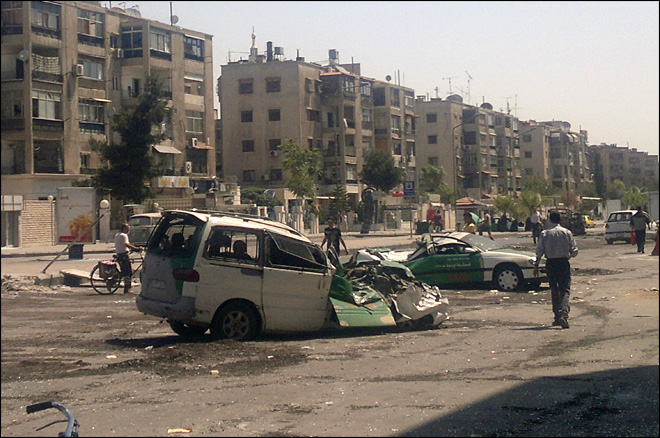
Conséquences du passage des tanks qui ont pénétré dans le camp palestinien de Yarmouk, près de Damas.

R. R. : Que répondez-vous à ceux qui continuent à prétendre qu’Assad est une figure emblématique de l’anti-sionisme ?

S. L. : Tout le monde sait que Hafez Al Assad (que Dieu le maudisse, lui et son fils !) a vendu les Hauteurs du Golan à Israël et qu’il est responsable de la mort de nombreux Palestiniens au Liban et en Syrie, et ce pour garantir la sécurité d’Israël au Liban. À présent, son fils Bashar fait la même chose mais d’une manière différente. Il a attaqué de nombreuses zones où vivent les Palestiniens établis en Syrie, surtout au camp de Yarmouk, près de Damas, et je l’ai vu de mes propres yeux. De même, il est tout à fait faux de croire que Bashar soutient le Hezbollah libanais dans sa lutte contre Israël. C’est pur mensonge. Chacun sait qu’Assad à donné le feu vert au Hezbollah pour assassiner le leader sunnite Rafiq Al Hariri au Liban. De même, le soutien syrien pour redorer le blason de Nasrallah [chef du Hezbollah libanais] afin qu’il puisse se poser en héros de guerre ; la guerre de 2007 contre Israël était pourtant un autre mensonge, un stratagème pour permettre l’expansion du Hezbollah au Liban, et donner aux chiites l’occasion d’accroître leur mainmise sur ce pays, en permettant à l’Iran de renforcer son contrôle sur la région. C’est le projet de Téhéran au Moyen-Orient : constituer un croissant chiite qui s’étendrait de l’Iran à l’Iraq en réunissant la Syrie, le Liban, l’Égypte, l’Arabie Saoudite et le Yémen. Bashar Al Assad souligne sans cesse qu’il lutte contre Israël, qu’il mène la résistance contre l’État Hébreu. Je répondrai ceci : en ce cas, pourquoi emprisonnez-vous, pourquoi torturez-vous, pourquoi tuez-vous tous mes amis ainsi que des dizaines de milliers de Syriens ? Pourquoi tuez-vous mes frères Palestiniens et Iraquiens ? Pourquoi n’avez-vous rien fait quand les avions israéliens ont violé l’espace aérien de notre pays ? N’essayez pas de mentir au peuple syrien : nous vous connaissons mieux que personne. Nous savons tous que votre boulot, c’est de nous liquider et de protéger Israël. Que Dieu vous maudisse, fils de l’adultère !

Homs, au pire de la violence.

R. R. : Comment ça se passe pour vous qui devez vivre dans une vraie zone de guerre ?

S. L. :  Il nous est très difficile de subvenir à nos besoins dans les circonstances actuelles ; on vit avec prudence, on n’achète et on ne consomme que l’essentiel. En ce qui me concerne, c’est plus dur parce que je suis sans emploi. C’est mon père qui m’aide financièrement. Je vis chez mes parents et je les aide. Aujourd’hui, en Syrie, les branches d’une même famille sont regroupées sous un même toit, ce qui fait qu’on trouve parfois de trois à dix familles vivant dans la même maison. La situation est dramatique : entre 65 et 75% de la Syrie est détruite. On se débrouille pour acheter, pour stocker la nourriture qu’on peut trouver, mais il y a des secteurs où il n’y à plus rien. À Homs, il n’y a plus ni nourriture, ni quoique ce soit pour se protéger du froid. Dans deux mois, l’hiver sera là, et nous voudrions que cela finisse le plus tôt possible. La plupart des villes syriennes n’ont plus rien : Assad à brûlé les récoltes et détruit les habitations. J’ai de quoi manger la plupart du temps mais d’autres non, et ça, ça m’inquiète. On leur envoie de l’aide mais le régime encercle ces zones, bien que l’ASL fasse de son mieux pour distribuer aide et médicaments.

Personne n’a idée de la tragédie que nous vivons, mais nous avons bon moral car nous savons tous qu’Allah est à nos côtés. Nous tuerons Bashar, inch’Allah. Nous allons continuer à nous soutenir mutuellement avec nourriture, soins médicaux et tout ce qui sera nécessaire pour remporter la
victoire. J’insiste sur le fait que que l’armée de notre pays, c’est l’Armée Libre de Syrie, l’ALS, et nous en sommes très fiers. Nous sommes tous syriens et nous resterons unis : c’est ce que nous chantions pendant les manifestations “uni, uni, uni, le Peuple Syrien est uni!”

Même après de nombreux mois, le monde se contente toujours de regarder le génocide.

R. R. : Que ressentez-vous devant l’apathie de presque toute la Communauté Internationale à l’égard de la révolution syrienne, et est-ce que votre opinion à son égard a-t-elle évolué ? Si oui, dans quelle mesure ?

S. L. : Pour quelles raisons le monde entier a-t-il béni les révolutions en Tunisie, en Égypte, en Lybie et au Yémen, pourquoi les a-t-il soutenus alors que personne ne nous a aidé, personne pour soutenir notre révolution, personne pour dire le bien-fondé de notre cause ? Pourquoi la Russie, l’Iran, la Chine et l’Iraq ont-ils été autorisés à aider Bashar et son régime en fournissant armes, argent, carburant, gaz et démarches politiques ? Pourquoi les gouvernements occidentaux n’ont-ils pas essayé de nous aider en créant une zone d’exclusion aérienne, en nous fournissant les armes nécessaires et en établissant des zones protégées pour les civils ?Peut-être que ces mêmes gouvernements sont incapables de répondre à toutes ces questions.

Nous, les syriens, nous savons pourquoi : ils veulent nous imposer une solution unilatérale, et cela, nous ne l’accepterons jamais. Je vais vous dire ce que l’on nous propose comme solution. Ils veulent que nous acceptions leurs conditions en permettant à Bashar de rester au pouvoir, nous octroyer une liberté cosmétique et procéder à des changements superficiels en réunissant un gouvernement d’unité nationale. Les gouvernements occidentaux ne veulent pas entendre parler de gens droits et nobles, d’honorables patriotes, ils ne veulent pas entendre parler de l’ALS, non. Ils veulent tuer tous ces gens-là pour mieux nous imposer leurs vues. Il y a aussi cette clause très importante : ils veulent qu’Israël soit assuré d’une paix sans nuage et que nul ne s’en approche. Pour toutes ces raisons – et l’Histoire le prouve à l’envi – Bashar est le mieux placé pour réussir. C’est pourquoi les gouvernements occidentaux laissent l’Iran, la Russie et lal’Iraq le soutenir en lui envoyant davantage d’armes et de troupes, puisqu’il n’y a plus de syriens (qui ne veulent plus de lui) à cause des défections  en masse qui dépeuplent l’armée régulière. L’Occident laisse ces pays envoyer des fonds et des soldats du Hezbollah, de l’Armée du Mahdi [milice chiite irakienne] et de la Force Al Qds [pasdarans iraniens, opérations extérieures]. L’excuse de l’Occident est que l’issue du conflit est complexe. Elle est très simple, au contraire : nous voulons la liberté. Donnez-nous des armes lourdes pour détruire les avions de chasse, des tanks, des lance-rocket et nous gagnerons. L’Occident sait que Bashar est affaibli, c’est pourquoi il prétend que s’il nous donnait des armes, l’ASL serait incapable d’en contrôler la distribution et donc Al-Qaeda en profiterait.

Mais les syriens savent bien qu’Al-Qaeda n’est pas en Syrie, ni dans aucun pays arabe. Les gouvernements occidentaux ont brandi cette nouvelle excuse : l’opposition syrienne n’est pas unie. Celle qui a défait les régimes en place dans les autres pays n’était pas plus unie. Les gouvernements occidentaux n’ont rien fait non plus pour les réfugiés syriens en Turquie, en Jordanie, au Liban et en Iraq ; ils n’ont envoyé qu’une aide insuffisante, sans leur permettre de pouvoir travailler. Ils ne les ont même pas enregistrés comme réfugiés aux Nations Unies, les laissant dans des zones désolées d’Iraq et de Jordanie, parce que l’Occident veut que les syriens, même réfugiés, obéissent à leurs directives en se soumettant à Bashar Al Assad, en retournant vivre sous sa férule. Si nous refusons cela, notre punition sera la privation de nourriture, d’eau et de denrées de première nécessité. Il ne faudra, bien sûr, pas compter sur son aide pour se débarrasser de Bashar. Personne ne nous aidera. Nous n’avons que nous pour nous aider, et Dieu, et c’est précisément ce à quoi nous sommes réduits aujourd’hui.
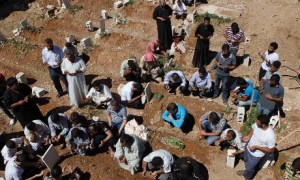
Combattants de l’ASL tombés au champ d’honneur.

R. R. : Comment voyez-vous la situation évoluer à court et moyen terme, et êtes-vous confiant dans le retour de la paix après la chute d’Assad ?

S. L. : La situation sera sanglante et bloquée si nous ne nous efforçons pas ardemment de résoudre le problème. Si l’on peut agir vite pour nous libérer, cela nous permettra d’épargner le plus de vies possibles et de sauver ce qui peut l’être de notre peuple, des propriétés, de l’infrastructure du pays, de son économie… Si on leslaisse faire ce qu’ils veulent (Bashar et les puissances occidentales) nous perdrons davantage de nos compatriotes et le carnage va empirer. Si cela devait arriver, le bain de sang se poursuivrait (ce serait un génocide) avec des milliers de morts supplémentaires, le pays pillé et mis à sac par son armée, les bâtiments et son infrastructure détruits, l’économie dévastée, des milliers de gens choisissant l’exil, les meilleurs cerveaux de Syrie, ceux qui sont essentiels pour reconstruire le pays, fuiraient une nation tout simplement abandonnée au chaos. Nous autres syriens nous ne le voulons pas. Nous ne pouvons accepter ça. C’est pourquoi nous travaillons très dur à organiser et harmoniser notre agenda pour tuer Bashar et mettre rapidement un terme à cette épouvantable situation. Nous autres syriens sommes optimistes parce qu’Allah nous accompagne et que nous sommes unis. C’est pourquoi nous pensons que la paix reviendra bientôt. Si Bashar reste au pouvoir, il n’y aura nulle paix. Juste plus de discours et de sang versé, et nous vivrons à jamais dans les ténèbres comme des esclaves. Nous ne pouvons l’accepter. C’est pourquoi nous  préférons  vivre dignement ou mourir en martyr. C’est l’option que nous avons retenue : la mort plutôt que d’être encore humiliés.

R. R. : Que pensez-vous de certaines allégations relevées dans de nombreux médias qui parlent de “guerre civile confessionnelle” ?

S. L. : Il n’y a pas de “guerre civile confessionnelle”. C’est de la propagande, distillée par le
régime et d’autres pays. Ils prétendent que si le régime tombe, une guerre civile va éclater et le massacre sera général et qu’au contraire, si Bashar reste, la société syrienne demeurera unie. C’est un mensonge éhonté ! Ce que l’Occident et Bashar projettent de faire, c’est de redessiner la carte de la Syrie en régions autonomes comme en Iraq, avec les Kurdes qui y auraient un état indépendant dans le Nord-Est, les Druzes dans le Sud et les Alaouites le long de la côte syrienne, tandis que les Sunnites obtiendraient le reste. Voilà leur projet, et Bashar se démène tant et plus pour réaliser son rêve d’un état Alaouite-Chiite. Ils oublient seulement que depuis le début de notre révolution, notre mot d’ordre a été “Uni, uni, uni : le Peuple Syrien est Uni !”

Le régime essaie d’attiser le sectarisme prétendu de la révolution ; le peuple pense différemment [la Syrie pour tous !].

Ce pays est à tous. Quelle que soit votre religion, secte ou groupe particulier, vous êtes syrien et vous appartenez à la Syrie. Les syriens de toute obédience refusent le projet de diviser notre nation et tous en appellent à l’unité. J’ai rencontré des Alaouites, des Chiites, des Chrétiens, des Druzes et des Sunnites au cours de notre révolution et tous ont rejeté ce plan pour nous diviser. Nous en appelons à l’unité : un peuple, un pays. En dépit des tentatives du pouvoir pour armer différentes sectes et les retourner les unes contre les autres. Pour nous diviser. Même si Bashar fait de son mieux pour semer la division parmi nous, nous ne permettrons pas d’être manipulés, de nous entretuer : nous sommes frères et sœurs.

Pour finir, je voudrais ajouter ceci : avant notre révolution, on vivait ensemble en parfaite harmonie. J’ai vécu, moi, dans un immeuble où mes voisins étaient chiites, juifs et chrétiens. Mes amis sont de religions différentes : on s’apprécie et on cohabite sans problème.

R. R. : Pensez-vous que cette expérience vous a changé ? Si oui, dans quelle mesure ?

S. L. :  Oui, j’ai changé. J’ai une plus grande conscience de la conspiration générale pour faire échouer notre révolution. J’ai également découvert que le monde ne se préoccupe que de ses intérêts et il se moque bien de tout le reste, sauf de lui-même. J’ai également fini de croire à la rhétorique des représentants de l’ONU ou des organisations non-gouvernementales, que ce soit les Droits de l’Homme, l’UNICEF, l’UNICO [universités & collèges en GB], la CPI [cour pénale internationale], l’IJP [institut de justice pénale] ou autre. Le monde n’a pas été capable de mettre au point le moindre programme pour aider les syriens en Syrie ou les réfugiés dans les pays voisins, ni même d’organiser une rencontre de donateurs. Même les conférences des “Amis de la
Syrie” n’a débouché sur rien. Tout ce que savent faire ces gens-là, c’est de nous regarder et laisser Bashar nous tuer avec le soutien russe et iranien.

Pour autant, la révolution m’a donné une forme d’espoir. Voulez-vous savoir ? Elle m’a appris que lorsque vous affrontez des difficultés et des obstacles dans votre vie, personne (excepté sans doute une poignée d’amis véritables ainsi que votre famille) ne se soucie de vous pour vous apporter de l’aide. Il faut tout faire soi-même et s’entraider de toutes les manières. La révolution m’a rendu très conscient de cela. Elle m’a rendu fier de mon peuple et de mon pays. Elle m’a appris ce dont nous avons besoin pour en finir avec cette situation. Nous sommes des gens pacifiques et nous ne manquons pas de ressources. On peut se reconstruire, nous et notre pays, développer nos talents et en acquérir d’autres. Je me sens plus responsable qu’avant : je veux me développer, parfaire mes capacités, acquérir de nouvelles connaissances et les partager avec mon peuple. Je veux enseigner aux générations futures que nous avons combattu et sacrifié nos vies pour gagner notre liberté, et que nous ne devons jamais plus accepter quiconque qui se prendrait pour un dieu avec un droit divin sur son peuple. Non, il nous faut désormais élire des chefs désintéressés, seulement préoccupés de la nation et du peuple syriens, et non de leur enrichissement personnel.

Je veux souligner le fait que la révolution est dans nos mains. Je pense que le monde à besoin de changement. Il doit comprendre que les peuples qui vivent sur cette terre sont égaux et qu’ils ont droit à la liberté. J’ai aussi découvert que ceux qui se posent en tant que “Leaders Arabes” ne sont que des traîtres à la solde des puissances étrangères. Au mieux, ils se moquent totalement des arabes.

R. R. : Combien de temps pensez-vous que la révolution puisse continuer, et que prévoyez-vous qu’il advienne quand elle sera achevée ?

S. L. : Lorsque nous avons commencé la révolution, nous savions qu’il n’y aurait pas de retour en arrière et nous n’avons pas changé d’avis ; après tout ce que nous avons enduré, consenti tous ces sacrifices, nous serions perdus de seulement imaginer revenir au statu quo ante. C’est notre mot de la fin : tout ce que Bashar nous a fait (et continue de nous faire, sans répit), il l’a fait avec de plus en plus d’aide d’Israël, de la Russie, de l’Iran et de la Chine. Nous avons prouvé au monde entier (qui s’obstine dans ses dénégations) que des troupes iraniennes, des hommes du Hezbollah et des soldats russes ont été capturés dans chaque ville de Syrie. Chacun de ces hommes était porteur de documents qui attestent cette évidence. Nous avons également obtenu des documents officiels en provenance du pouvoir qui prouvent que Bashar a fait venir de plus en plus d’hommes en provenance d’Iran (gardiens de la révolution), du Liban, d’Iraq, de Russie et d’autres pays qui fournissent aussi bien des armes que des troupes. Malgré cela, le régime d’Assad est en train de perdre la bataille. Ses alliés et les puissances occidentales veulent qu’il demeure, et ils le couvrent de toutes les manières possibles. Malheureusement pour lui, nous le battrons lui et ses alliés, et nous le tuerons, inch’Allah !
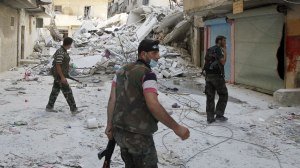
Vous me demandez combien de temps la révolution va-t-elle encore durer : jusqu’à ce que nous tuions Bachar et que nous chassions les russes, les iraniens et le Hezbollah hors de Syrie. Personne, dans notre pays, n’accepterait de s’arrêter aujourd’hui car dans chaque maison de chaque village, ville ou grande cité de Syrie on compte au moins un martyr, un prisonnier, une victime d’enlèvement par les forces du régime, à moins que ce soit un membre de la famille qui ait été contraint à l’exil. Savez-vous qu’Assad a anéanti de nombreuses familles ?

Savez-vous qu’il a détruit la plupart des villes du pays et qu’il a emprisonné plus de 250 000 personnes ? Savez-vous qu’il punit collectivement chaque syrien dans chaque secteur qui s’oppose à lui (c’est à dire presque toute la Syrie) ? Savez-vous que ses forces détiennent et retiennent des stocks de produits pharmaceutiques, qu’elles empoisonnent les réserves d’eau et de nourriture, bombardant les boulangeries pour affamer la population ? Assad fait aussi bombarder les hôpitaux, vise le personnel médical dans l’espoir que le peuple syrien sera obligé de lui obéir. Voici la réponse que nous lui adressons : “vas en enfer !”

Le monde voit tout cela et ne fait rien. Il s’excuse en disant : “c’est bien difficile. C’est compiqué”. C’est très simple, au contraire. Les syriens veulent être libérés de la dictature et la Communauté Internationale pourrait nous aider si elle le voulait. Les syriens savent tout cela. Nous allons continuer à nous soutenir les uns les autres, soutenir et combattre pour l’ALS. Quoique fasse Assad, nous ne calerons pas. Chaque homme, chaque femme, chaque enfant va combattre jusqu’à son dernier souffle. Pas question d’accepter ce que l’ Occident à décidé pour nous. Nous ne céderons pas. Nous n’accepterons pas ce que l’on veut nous imposer. Nous l’avons commencée et nous allons la finir, cette révolution. Par-dessus tout, et nous l’avons déclaré à nos débuts, Allah est avec nous, Allah et personne d’autre que Lui. Nous n’avons que Lui.

Vous voulez savoir “ce que nous ferons” après la révolution. Pour l’instant, on travaille dans la clandestinité afin que tout soit prêt, et il y a une parfaite collaboration entre nous. Nos plans sont arrêtés, mais nous ne pouvons nous dévoiler de peur que l’ennemi ne découvre ce que nous préparons. Tout ce que je peux dire, c’est que nous assurons la coordination entre l’Armée de Libération, les conseils militaires, l’opposition et les différents partis pour nous assurer que la normalité et la loi seront restaurées à la chute d’Assad, afin que le peuple syrien puisse retourner à une vie normale. Nous créerons un jour la transition qui restera en place jusqu’à ce qu’une nouvelle constitution soit adoptée et qu’un nouveau président avec un gouvernement et un parlement soient établis.

R. R. : Quels sont vos projets pour la période post-révolutionnaire, et est-ce que ce que vous avez vécu pendant la révolution les a-t-ils modifiés, et en quoi ?

S. L. : Aujourd’hui, je voudrais acquérir d’avantage d’expérience et m’impliquer activement en politique. Je veux jouer un rôle actif dans la reconstruction et le développement de mon pays et aussi participer à l’aide médicale de mes compatriotes. J’aimerais m’impliquer dans l’aide humanitaire et l’aide sociale car, comme vous le savez, un grand nombre d’adultes et d’enfants ont dû subir des amputations suite aux bombardements du régime. Ces personnes ont besoin de prothèses, tandis que d’autres ont besoin d’être opérés sans tarder. Tout cela va coûter des sommes considérables, aussi avons-nous besoin d’argent et de l’aide d’hôpitaux étrangers.

Je voudrais aussi m’investir dans l’éducation. Comme vous le savez, je suis traducteur et j’aimerais aider à enseigner aux enfants et aux jeunes gens dans les écoles, les collèges et autres établissements scolaires. Le régime a tué un grand nombre de professeurs dans toutes les disciplines, c’est pourquoi nous souffrons d’une grande pénurie dans ce domaine, et il va falloir vraiment mettre les bouchées doubles pour pallier toutes ces vacances. Il nous faudra aussi surveiller les fondations d’un projet éducatif afin de mettre en place un programme d’études accéléré. De cette façon, nous éviterons les difficultés pour des enfants qui ont manqué deux années d’études à cause des bombardements du régime et le chaos qui s’en suivit.

Nous voulons procéder à l’arrestation de tous ceux qui auront été impliqués dans des meurtres, dans la pratique de la torture, des viols et des pillages. Ces personnes seront em prisonnées et jugées. Ceux qui auront commis le pire seront exécutés. Nous ne permettrons à personne d’échapper au châtiment, quelle que soit sa religion. Nous avons tous été confrontés à la persécution, à la terreur et à l’intimidation, et beaucoup trop d’entre nous ont été torturés et/ou assassinés. C’est pourquoi nous voulons justice et dignité pour tous. De manière égale.

Pour conclure, je vous dirai que je veux participer activement au processus politique afin d’aider et représenter mon pays et mon peuple. J’ai toujours l’ambition d’obtenir ma maîtrise de traducteur et d’interprète, même si le régime m’a privé de cette chance en gâchant deux années de ma vie à cause d’une guerre brutale déchaînée contre les syriens eux-mêmes. C’est ce que ce pouvoir nous a imposé, mais nous rejetons ce régime.

https://wewritewhatwelike.com/2012/09/22/interview-with-a-free-syrian/ (original)

Soubhi Dachan

Syria has finally earned a place in the Italian news after almost a year and a half since it began. In the eyes of the Italian public it is “another war that no one can figure out” that erupts between the usual squabbles of our politicians in our news. Opposition to the regime in Italy has its own path, but in many instances, it matches that in Syria. To help us understand this war and these oppositions that are already part of history, we interviewed a Syrian opposition figure in Italy, Soubhi Dachan. His words bring us to think that even though there are now two factions that are clearly military, this cannot be called a civil war, but rather a response to genocide born of the violent response to the peaceful popular uprising. And not only is it a declared genocide, but it uses a strong propaganda to paint itself in a different way, a genocide that is “observed” by all the powers in the region and beyond, when it is not actually being fuelled by them. 

How did the revolt in Syria begin? Who is rebelling and to what?

28 Children in Daraa. 28 Children were the fuse that sparked the revolt. 28 elementary school children who returned from school, had written a phrase written on the wall that they had seen on satellite broadcasters, taken from the huge demonstrations in the Arab world: the people want the fall of the regime.

28 children have unleashed the fury of demons in power for 40 years in the Syrian state, who have used 18 different security services to repress the people.

During the night, a unit of these services led by a relative of the tyrant Assad made a house to house raid and took all 28 children.

The lifeless body of 13 year old Hamza al Khatib, tortured and killed by Assad’s security forces

The next day, the chief of the tribe (in Daraa there is a very strong concept that a tribal chief is more respected and followed than the mayor of the city or other important figure) went to the police station where he met the cousin of the president.

The tribal chief asked him to release the children and bring them back to their families, safe and sound, and he promised to severely punish their misbehaviour and their offense and promised to pay a tax for this uncouth act.

The commander literally said: “Tell their families that their children no longer exist. Tell them to make different ones. And if the women’s husbands do not know how to do it, bring them to us, we’ll take care of getting them pregnant.”

The tribal chief who wore the white veil on his head with a black band, took the black band and put it on the table. In Bedouin language this means that there is no room for dialogue, and that children will be freed by force.

And so began the revolt.

Is it part of the wave of uprisings in the Middle East and North Africa for an ideal of freedom and change, or has it got aspects that make it different from other revolts?

When we saw the satellite broadcasters with the first Arab uprisings we erupted with joy. When we saw the first movements in Syria, we immediately were concerned because only the Syrians know the criminality of this system and how it is supported by various powers for a variety of regional / international
interests

Map by Limes Rivista Geopolitica

Is it a civil war fueled by sectarianism?

In Syria, Civil War is a card that the regime is trying to use all costs, in order to show to that the minority that the regime is their only salvation. In Syria there is no sectarian problem, unlike other countries we are talking about hundreds of years of peaceful coexistence and not just tolerance. Syria was an example of civilisation where even the Christian denominations or less persecuted people in Europe found refuge.

In Syria, there is an ongoing revolt against a tyrant where all members of civil society, ethnic and religious groups are taking part. Not for nothing in Homs, the first military formation of deserters was made ​​up of Christians, Muslims and Alawites.

Does it makes sense to talk about reforms, elections, governance systems and democracies during an uprising or war?

Not only does it not make sense, but it is a way to continue to give further legitimacy to a tyrant who has no equal in recent history. Even the tyrants of past history used their cruelty in the conquest of other peoples and not to defend the interests of some other nation, massacring its own people.

To talk about all these things is to continue to justify the genocide of the Syrian people.

The revolt is armed or peaceful, given the reason for the revolt, is there a prejudice against the nature of the uprising, does it lose its value if it ceases being peaceful?

The uprising has been the most peaceful revolt in living memory. For nine months, the people responded to gunfire and bombs with flowers. They started their protest demanding reforms, the snipers are what they got in return. They then went out more numerous in street demonstrations, demanding justice, with chants, processions, prayers. In return their unarmed crowds were shelled. For nine months the Syrian people responded to torture, abuse, rapes, kidnappings, well, the people responded with the slogan “the Syrian people are one and united, the Syrian people want freedom, the Syrian people want the fall of the regime”.

Photo by Salah Methnany

The main slogan of the revolution was and remains today “Peaceful, Peaceful, Peaceful.”

The revolution has been dubbed by opponents as the “revolution of dignity and freedom”.

After nine months of massacres, deserters and not the people have decided to take up arms in defense of the people and not as a form of attack. After 12 months of bloodshed even some sections of the people had taken up arms, exclusively in defense of their dignity, their families, their people.

And despite this, even today the rebels beg the people to continue to demonstrate peacefully, even in the refugee camps, roads, cemeteries, at every march.

Is the terminology that the mass media uses “revolt, opposition, rebel” and so on correct? What are the words to properly report what is happening in Syria?

The media has behaved in a shameful manner. They still speak of the Syrian revolution of the flowers from the mouth of the Syrian regime or its affiliates. The peaceful demonstrators were called rebels. The deserters were called armed groups. The unarmed people has been called faction in the war.

The media have contributed significantly to the massacre of the Syrian people.

Syria is undergoing a mass genocide. The puppet Assad, has strict orders not to leave power until Syria will no longer have an army, it will have no more security, no more facilities, infrastructure, civil and military institutions etc. .. In Syria the cancellation of a civilisation is taking place, the destruction of churches and mosques, the systematic violation of human rights, of international conventions.

In Syria there is an ongoing genocide. Mass rapes, slashing the throats of people, women, elderly and children. Destruction of everything, cultivated fields, houses, monuments with thousands of years of history. In Syria there is the destruction of humanity.

Who is the SNC and what role does it have in the revolt?

The SNC is the Syrian National Council. It was born after about 6 months from the start of the uprising with the aim to give a voice to the Syrian people in all its facets and not be merely a show entity. This is because the word opposition in Syria has remained a taboo for 40 years, the only form of opposition that has remained for 40 years has been the Muslim Brotherhood, which is why there was a law that immediately put to death anyone suspected of belong to this organisation.

The Syrian National Council was created as a technical  and diplomatic support abroad for the revolution. It incorporated within itself the majority of members of Syrian society, secular people, Christians, Alawites, Sunnis, Shias, Druze, Kurds, members of tribal societies, secular formations, Islamic formations, etc. ..

It was chaired by Burhan Ghalioun for two terms, a secular Muslim and in third term the mandate was given to Abdulbasit Sida, a Syrian Kurd.

One of the reasons why at the international level it has not been recognised for a long time is that the Syrian National Council includes the various components of Syrian society, and the willingness of some world powers was to isolate some important components of Syrian society, in perfect dictatorial style.

In this regard a round of applause goes to the previous and current Italian government which have listened unlike the media and other institutions, very carefully the Syrian people and not the genocidal regime and has been one of the first governments in the world to send assistance and field hospitals and it has been busy at an international diplomatic level in support of the Syrian people.

Who are the Muslim Brotherhood?

The Muslim Brotherhood is a grassroots movement that is inspired by the Muslim Brotherhood movement in Egypt. It is a peaceful movement that joins together aspects of governance, education, religion, politics and diplomacy, civil status and rights of minorities. It was founded in Syria by Syrian intellectuals and religious people, and has had tremendous popular support. When Hafez al-Assad came to power he persecuted them and forced them to take up arms to defend themselves, but then given the massacre of Hama in 1982 (more than 50,000 dead) the brotherhood were deprived of their arms and were exiled (in those lucky instances in which they were able to escape,) tortured, imprisoned, killed and denied their existence in Syria. Even their relatives were persecuted, this is why they left Syria.

Free Syrian Army in Azzaz

Who is the Free Syrian Army?

The first soldier to desert was a soldier of Daraa. They ordered him to shoot shells on people demonstrating peacefully. He called his father and asked him, what should I do, my father? He said, “Never must you bear arms against your people.” He was the first soldier to be killed by the regime. Then the first unofficial faction was that of Al Rastan, Homs about 5 months after the revolt started. An entire division turned their backs on the officers. This division still today resists. Then there was the one in Lattakia, where its soldiers took refuge in the Palestinian refugee camp, only to be bombed from the sky and from the sea by the militias of Assad.

The Free Syrian Army was officially founded around the eighth month of the uprising, when several commanders who had defected decided to constitute it and give some kind of organisation to all the soldiers who had decided not to turn their weapons against their own people, their own blood. Signing a pact of honour in defense of the Syrian people and asking the Syrian people not to join the army but to continue to demonstrate peacefully. Then the situation evolved and many of the protesters have joined the army. Today the volunteers of the free Syrian army not of military origin are about 50% of the forces.

How come there is no global attention on the Syrian issue, and why even with multiple reports also being published by global organisations like the UN and Human Rights Watch, does there seem to begreat indifference?

Syria is at the crossroads of world interests. The strategic location, the proximity to Israel, the ability of the system to play with popular topics such as the Palestinian issue, defense and protection of minorities etc. .. means that the regime is still supported today by world powers, in that it is convenient for the protection of their interests in the area. The Syrian regime has never allowed a different point of view, has never allowed in Syria anything at all but the voice of the regime itself. It put all the people of the leader’s sect in key centres of power, from the institutions as simple as those of workers, up to the military.

The media willingly speaks little of Syria and when they do, it is done in a chaotic way. And this is despite the massive presence of videos, documents, photos and eyewitnesses as the UN forces or satellites. In any other part of the world headlines would have documented daily what happens. But not for the Syrian issue.

This is why journalists and their sponsors are criminals in equal measure to the tyrant and his henchmen with their shameful complicity and their disgraceful silence.

What role could the external forces, the UN, NATO, the ICC, the European Union, the Arab League, and so on undertake and what you think their objectives should be?

All these forces are bound by the opinion of the great powers. Those who say that the international community is unable to support the Syrian people are obviously liars. If the international community decided to help the Syrian people, within a week Syria would be free. It would take 100 stinger missiles and weapons to the rebels. Something that so many claim is taking place, but no one is actually doing.

Unfortunately Syria is going through a complex of international isolation. Even when countries such as Turkey, Italy and other countries still sincerely want to help the Syrian people, they find themselves blocked by the various powers from east to west. The story of the veto is a farce, everyone is in agreement to keeping the puppet in place, each for its own purposes. There are those who have the will to destabilise the entire Middle East area. This is why all these interests join together in the support of the puppet Assad. Who continues to serve his masters undaunted in order to remain in power.

Devotion to Assad

Has Assad got support in Syria?

Assad is backed by his confessional group, the Alawites but not all of them, and by the various people with whom he entertained business and other opportunists who lived the good life at the expense of the entire population. Some parts of the ethnic and religious minorities support him not for love, but for fear of being left in the cold in the future Syria. Which is clearly a result of the regime’s propaganda, because minorities were ministers and officials in the Islamic governments or any rate in the times prior to the Assads. This is part of the work of the regime, which, as has been shown now, tried to spark a civil war in Lebanon targeting the Christian patriarch who would have to visit a Muslim quarter. Thank God the plot was discovered in time.

His power is governed only by military force, Assad has no support in Syria. And the military is strong thanks to the continuous reinforcements arriving from neighbouring states in both arms in soldiers and mercenaries.

You as insurgents abroad, why you oppose the regime?

Opponents abroad fall into two categories: those who have opposed for 40 years and those who opposed during the uprising. What is certain is that both have never loved the regime. The first reason why we object to is the humanitarian cause. In Syria, there is an ongoing humanitarian disaster. And as opponents who have had the feeling of enjoying the freedom, the dignity we find in European countries and elsewhere we certainly cannot stand in this historical era, the era of the Internet, to see these abuses, the destruction of the countries of origin of our parents. Many like me, thanks to this regime have never set foot in Syria. We are free men and women and we are opposed to tyranny, whether in Syria or elsewhere.

Thanks to several million Syrians abroad some aid arrives in Syria. Businessman, university professors, employees, workers, entrepreneurs, are giving their blood and all their belongings to not abandon their Syrian brothers.

Protest in Italy “The Syrian People Ask for Protection of the Civilians”

How is the opposition in Italy organised? How was it founded?

The opposition in Italy has been present for years with people who have left Syria 40 years ago, who at the time were students and did not have a way to return as free men in a dictatorial country. During the uprising, the opposition the young and the old met one another on equal terms, they overcame the various divisions which the regime had attempted to render permanent in the Syrian people. Now with different groups and ways all are trying to support the revolution, who at the diplomatic level, some at the humanitarian level, some with the use of information through the internet, some through newspapers, others with blogs, some in their own spheres of study and work , some by means of holding public events, some in street demonstrations and protests. From Lombardy to Sicily there were demonstrations of solidarity and support to the Syrian people. Everyone contributes in their own way to support this revolution.

There are members of the regime who are trying to sneak into the opposition, but the rot will always come out into the open, and they are quickly isolated.

By whom do you feel represented?

The answer to this question is that which was given by the Syrian people in the streets: “The Syrian National Council represents me, the Free Syrian Army represents me, the local committees of the Opposition represent me.”

What can one do in Italy and Europe to support the revolution?

Work is underway to try to have united fronts of opposition, trying to do lobbying towards the political class to support the collection of humanitarian aid, attempts to act diplomatically to support the opposition and the international decisions. Certainly it would be a good omen if Europe was courageous enough to recognise the Syrian National Council, I think it then would also encourage the Arab countries to take this step.

Right now what is most urgently needed is to put an end to this humanitarian catastrophe and constitute a humanitarian corridor, especially for internally displaced Syria and the borders of neighbouring countries.

Europe could still freeze several billion of the Assad family assets and those of his cronies and it could give them to the opposition to supply aid the Syrian people. Many things could be done, but very few things are actually being done.

The establishment of a no-fly zone would mean the death of the regime within a few days.

What conclusions do you have, after a year and a half of revolt?

30,000 dead, 300,000 imprisoned, 70,000 missing. Two and a half million refugees. In Syria, the dead, imprisoned or missing are mathematically dead.

The conclusion is that the regime is simply a loose cannon, constantly humiliated by the Free Syrian Army despite the inferiority of tactical warfare and number, it destroys everything it can destroy. Since we are dealing with a cowardly regime, as are the mercenaries that follow it, they take it out on defenseless civilians, cutting their throats, cutting their bodies to pieces, putting the snipers where there is a crowd to the create the greatest number of deaths, for example where there is the bread line. The regime has now created death squads that spread death all over Syria, posing as the Free Syrian Army. This is because the people have supported and continue to support the Free Syrian Army and, despite the hunger, the lack of water, electricity, gas, medicine, and so forth, the Free Syrian Army has liberated 70% of Syria, The Syrian regime controls the air, using cluster bombs (banned by the Geneva Convention), it rounds up of civilians from house to house, rapes every human being, man, woman, child. It’s a regime that has no equal in crime in history. It castrates boys cuts children to and adults to pieces. They disconnected the incubators in hospitals, killing babies.

They destroy everything, churches, mosques, homes, culture, monuments. The important thing for them is to stay in power. To conclude: the conclusion I draw is dramatic. But the Syrian people have said and repeated: either freedom or death. There is no third way. And the Syrians sing at the funeral of their loved ones the songs of victory.

Assad will perish or escape. And the long-awaited victory will be even sweeter and Syria will be the beacon of freedom of all people in the world, as the Syrians themselves have defeated a regime supported by half the world.

The Syrians are giving everything they hold dear, family, home, friends, belongings. They are giving everything. Not to Syria. But for every free and righteous man. For every man who refuses to bow his head to the tyrant and accept his abuse and violence. This is the conclusion. Syria will be  free, and the revolution continues ..

Lebanese novelist and intellectual, Elias Khoury

Syrians, you are alone!

Written by Elias Khoury published in al Quds al arabi (Translation from Arabic by Giacomo Longhi, translation to English by Mary Rizzo)

Ghiyath Matar, the martyr in Daraya who, with a gesture that confirms the nobility of the Syrian revolution, had distributed water and flowers to the Syrian soldiers, was kidnapped by the secret service on 6 September, 2011 and returned to his family four days later as a battered corpse.

Ghiyath Matar today weeps for his city, Daraya, as he sees more than three hundred martyrs assassinated by the blind machine of the Assad army thugs and shabbiha that have devastated as the Tatars had done, eliminating anyone who they had at the range of their guns.

But the regime, not content with this inhuman massacre, ratcheted up their ferocity by sending a reporter from Addounia TV, owned by Rami Makhlouf, to traipse around with tele-cameras among the corpses still fresh with blood to interview the injured, including a woman who seemed to be at her last breath.

Two massacres: the first an expression of the drunkenness to kill anyone around with an incredible bloodlust, the second an expression of insensitivity, meanness and contempt, she wanted to record the voices and images of the event in order to terrorise Syrian men and women with the prospect of a similar fate to that of the inhabitants of Daraya, Baba Amro, Azaz and other places.

The criminal does not erase the traces of his crime, but he is actually proud in front of everyone, convinced that the support of Russia and Iran will save him from the abyss, preventing the any sort of fulfillment of his own end.

Yesterday the torturer Bashar surpassed his own father the assassin, resolving his psychological conflict with the father figure, whose effigies filled Syria of the phantom threat of a new Hama.

Last Sunday, as I watched the images of the victims of Daraya, I was reminded of a meeting in Beirut, in the house of the Arabist, Frenchman Michel Seurat, who was killed after a kidnapping. It was 1981, Beirut was experiencing devastating moments under the Israeli invasion.

That day I asked the Syrian intellectual Elias Morcos, who came from Lattakia, how the situation in Syria was, from where he received the news of the massacre in Hama. Morcos did not answer directly, but told me about Genghis Khan. When I showed surprise that Morcos, a Marxist-realist, took refuge in a metaphor, he looked at me: “What do you want me to say?”. Then he told me how the secret service men had raided a bar in Lattakia, where he was having coffee, ordering everyone to kneel.

The pain veiled his eyes with water that did not look like tears. This authoritative man, who had been a leading intellectual of our generation and whose political and moral conduct was irreproachable, found himself on his knees with others.

I was reminded of Elias Morcos not because the secret services humiliated those men like they did with the entire Syrian people, but because instead of speaking of the Assad regime, or perhaps precisely to talk about it, he had to turn to the image of the Mongols invading the Arab Levant.

They are the Mongols and with them there is no truce, nor under the oaks – as Mahmoud Darwish once wrote – or in the darkness of the tomb.

A bloodthirsty appetite dominates the machine of the regime, which has lost all legitimacy and power. The lie of its anti-imperialism became apparent. The aircraft MiG and Sukhoi never dared to stand up against the Israeli Air Force when it bombed Syria. The mission of the regime has nothing to do with anti-imperialism and resistance, its real mission is to bend his knees and humiliate the people of Syria.

The Syrians are alone in front of the machinery of death.

All verbal support of the United States and Europe is a false, misleading, cynical lie.

The deafening silence of the world in the face of the repressive machinery of Assad is not due, as is often said, to the fact that Syria lacks that oil that arouses appetites for profit and domination by the West, but it is due to Israel. The destruction that the regime has inflicted on Syria, Israel could not even dream about. When the regime will fall, and it will be inevitable, Syria and the Syrians will have ahead of them long years of reconstruction.

Do not believe the analysis that the reason for the lack of support for the Free Syrian Army is the fear of the Arab states regarding Islamic fundamentalists.

The reason is neither the lack of oil nor the fear of fundamentalists. Western countries and in particular the UN does not fear political Islam, which in fact it is building alliances with States where there are such parties in power.

The only reason is to strengthen the racist component of Israel, whose insolence and arrogance has reached the point of making accusations of racism against South Africa which has decided to apply a special label for the goods produced in the occupied West Bank.

Bashar Assad is carrying out a task that for others has so far been impossible: he is destroying Syria and its social fabric. Then what good does it do to supply arms and aid to those who want its fall?

If it remains forever, whether its Russian and Iranian allies merrily dance to the rhythm of bombs and massacres, Assad will lose power after destroying the country from north to south. His allies will be covered with shame and hated by all Syrians and Arabs.

The perpetrator of Damascus has never been so vital to Israel as he is now, so do not expect anything from those who claim to be a friend of the Syrian people.

The Syrian people are alone.

They are alone in defending the dignity of the human being in the entire Arab world. Alone, shedding their own blood, giving humanitarian and moral meaning to politics.

What can I say to you who are alone?

Your solitude, my brother, you can only compare to that of the Palestinians, who have found themselves in front of every bloody turn taken by Israeli savagery. I know well, brother, that these words do not stop the bleeding, do not dry your tears, do not console the heart of a grieving mother.

I tell you that you’re alone.

I tell you to persevere in your solitude, your insistence on taking ownership of the dignity submerged in the blood of your sons and daughters, your efforts in defending the ruins of houses destroyed by cannons and fighter planes, are the road that you have to singlehandedly defeat the torturer who would like to once again make you go down on your knees.

I know that you do will not kneel. I know that your mission, crowned by blood, is now the value of our human dignity. I have nothing but these words of mine that bow in tribute to your sacrifices and your victims.


http://www.sirialibano.com/siria-2/siriani-siete-soli.html

If a regime’s internal structure resembles that of internal colonialism, and if its actions resemble those of a foreign colonial power—bombing their own country’s cities from the air and adopting an Orientalist mindset in their dealings with their own people— then such a regime’s rule may truly be described as internal colonialism. Thus, the right of a people to resist that regime as if it were a foreign occupying power remains intact. This remains true regardless of the nature of that regime’s international foes, bad as they may be. The nature of the people’s resistance, and their rightful struggle in the face of the regime’s crimes against humanity, remains unchanged.

As for those who defend the regime, they too must shoulder some of the blame for its crimes—with all of the nonsense being peddled by some of these defenders notwithstanding. They can be said to be defending this system of internal colonialism: nothing will be powerful enough to wash their hands of this blood.

Nothing will wash away their complicity in the terrorizing of the opposition by aerial bombardment of the cities; nothing will absolve them of culpability in this harrowing moral failure. Just as was the case with those who justified colonial powers’ bombardment of cities on the grounds that terrorists were present in those cities. Keep in mind: the fascist regime we are speaking of here is bombing its own people.

To fault the people who are fighting against such an internally colonialist regime by pointing out that the regime’s decidedly evil international foes make natural allies for the opposition does not take away from the virtue and justice of the opposition’s cause; nor does pointing this out soften the blow of the regimes multiple crimes against humanity, such as the aerial bombardment of their own cities.

The resilience of the Syrian people, with such limited world support, and in the face of such aggressive bombardment—both physical and oratorical—by the regime’s proponents is without parallel in history. One would think that the regime’s supporters really were plotting and carrying out resistance operations against the Israelis when the Syrian revolution broke out. In fact, they have long become used to rhetoric: it was no different during the Israeli bombardment of Gaza. As for the regime itself, they have never managed to bomb anybody save their own people, and that with unprecedented international apathy.

The author of these words recalls well the difference between the different players here: there were some who chose to make peace with Israel, while some chose to resist. Some stood in solidarity with Gaza, while others conspired against her. Yet such stands must always be based on principle, and not subject to the whims of people who simply exploit the cause of Palestine for their own ends. Yet this same author also understands the sharp contrast between those who stand with an oppressed people as their cities are bombed from the air and those who stand by. This author will not simply abandon this very oppressed people merely because the regime’s enemies happen also to be villains.

There can be no defense for the bombing of Daryaa, and for the other towns and hamlets in the environs of Damascus. Nothing at all can wash away the crime of this months-long bombardment of Syria’s cities.

http://yallasouriya.wordpress.com/2012/08/30/azmi-bishara-official-english-page-azmi-bishara-on-3/

URGENT APPEAL:
The Jordanian authorities have handed over the activist Omar Aharir into the hands of the Syrian regime, more precisely, back to the secret services, despite the well-known fact that he has been a wanted man for his activities in favour of freedom and that, for this reason, he will be sentenced to death in Syria. Amman will hand over to the regime another 11 activists.

We are spreading this news as widely as possible so that this shameful action by the Jordanian authorities is stopped, aware as they are, of condemning these young people to certain death, people whose only crime has been that they have asked for the end of the dictatorship. The Jordanian authorities have been contacted and begged to not proceed in this act, but they have not listened. It’s not enough to undergo the abuse of the Syrian regime, now other States are chasing down and handing over for execution those who are demanding freedom for their people?

http://myfreesyria.com/2012/07/21/404/

Welcome Ramadan, Get Lost Bashar

WRITTEN BY ASMAE SIRIA DACHAN, translated by Mary Rizzo

20 July 2012, 1 Ramadan 1433. Today is the beginning, for millions of Muslims the world over, of the month of Ramadan, considered by the faithful as a moment of sincere devotion, of purification and of prayer and it is for this reason welcomed with great celebration. It is one of the acts of faith that creates the greatest amount of gathering together, with families who reunite, sharing their meals at sunset even in the places of worship. Visits to the sick, as well as to friends and relatives increase in this period precisely to reinforce the connections between people and to mend any possible fractures that may have occurred.

Ramadan has a social meaning, as well as the religious one, so much so that it is felt even among persons who are generally less observant, because it expresses that sense of sacrifice, surrender, purification and rebirth that gives one hope. It is a light that shines at the end of the tunnel… even when the tunnel is long and it takes months and months to get to the other side of it. Just like the tunnel from which we see emerging, with great human sacrifices and an unmatchable commitment, the Syrian people, who find themselves welcoming Ramadan, for the second consecutive year, under the bombardment of the regime. The picture above refers to last year: Sawret al karamah, the “Revolt of Dignity”, had been started at that time already for four months by a group of young protesters, who wrote in candles: “Welcome Ramadan, Get out Bashar”. Perhaps no one could have predicted such a lengthy repression, which has already exceeded sixteen months, causing more than 19 thousand victims, among them, at least 1,400 children. The most recent veto of China and Russia has left the Syrian people feeling indifferent, who by now know that the International Community will not give them any real support, the contrary is true: the halting character of the world only reinforces the murderous folly of the regime, which has made its offensive even more brutal, and one once again we are hearing talk of the use of chemical weapons.

I say “once again” because it has already been months that the doctors of Baba Amr, the long-suffering neighbourhood of the old city of Homs, have denounced the use of white phosphorus, documenting irreversible damage provoked by its use.

Even the “Neighbours”, the Arab nations that are considered as “Sisters”, are enacting a policy of indifference regarding the humanitarian tragedy that is striking the civilians, even going so far as rejecting the entrance of refugees, pushing them back and treating them inhumanely, as the humanitarian associations have been stating.

It is such a sad Ramadan, the one that is beginning, which only this Thursday, on the first night of the vigil, has been grieving the deaths of over 280 persons killed, slaughtered in various locations in the suburbs of Damascus and in the Homs Province. Many Syrians who live abroad, even here in Italy, were used to spending Ramadan with their loved ones, returning to Syria or perhaps inviting their parents or grandparents to come here. Today the repression prohibits Syrians from living that very “normality”, forcing them into atrocious suffering, wounded by the loss of relatives, friends and acquaintances, for the destruction of homes, entire neighbourhoods and yes… entire cities… and especially for the wounds caused by the indifference of the world. It might sound like a paradox, but giving strength to those Syrians outside the homeland, telling them to not give up, to smile and to trust God with even greater force, as well as to have more belief in themselves, are actually those Syrians who are living under the repression, who yesterday by means of internet found a way to give the world their greetings for Ramadan, expressing the prayer that the Ramadan of 2013-1434 will be a different Ramadan, in which the Syrians will be rebuilding everything that the regime has destroyed, finally finding the longed-for peace and freedom.

original in Italian on My Free Syria

Doctor SAHRAN SHALOUB, a Syrian Druse, born in Qraya, town in the Swaida district of Syria in 1964, graduate of the University of Damascus, in service at the hospital of his native town, where he resides, married and with a 17-year-old daughter and a 9-year-old son, was arrested on Sunday, 8 July 2012 in Qraya, (Swaida), taken from his home by men wearing the Syrian Army’s uniform, who did not identify themselves nor did they present any motivation for his arrest.

In the city of Swaida, during the night of Friday 6 July, a car exploded with two of its occupants, one of them, SAFUAN SHEKER, was already being sought out and his father had been arrested 30 days earlier. According to the official version, the two men were preparing a bomb for a terrorist attack, while the citizens of the city are convinced that the car had been struck by a missile or that a bomb had been placed within it and the passengers of the car entered without being aware of the explosives. There were no eyewitnesses at the moment of the explosion.

During the funeral procession, held on Saturday at Qraya, where the two men lived, the participants of the funeral had begun a protest in which hundreds of citizens participated and in which they had chanted slogans against the regime.

Together with Dr. Shaloub, other men arrested were: KARAM SHEKER, YUSSEF AL BALUSS and KAMAL RAED. A fifth man that was being sought out by the authorities in the course of the same operation, BASEL MFAREGE, was not found and is still being sought.

Dr. Shaloub’s father was a member of the Parliament until the year of his death in 1980.

Neither Dr. Shaloub, nor any of the other three men who were arrested have been involved in acts of violence and their arrest is to be attributed to their participation in the peaceful protest march that took place alongside the funerals of Safuan Sheker and his friend.

No information was however given regarding charges against them, nor was the place of their detention given. It is important to mention that Saturday’s protest was the first one held since the start of the revolts in the city of Qraya Swaida, which is an area inhabited principally by Druse.

Il Dr SAHRAN SHALOUB, di etnia drusa, nato a Qraya, località nel distretto di Swaida (Siria) nel 1964, laureato all’Università di Damasco, in servizio presso l’ospedale della sua città natale, dove risiede, sposato, con una figlia di 17 anni e un bambino di 9, è stato arrestato domenica 8 luglio 2012 nella città di Qraya, distretto di Swaida, prelevato  nella sua abitazione da uomini con l’uniforme dell’esercito, che non si sono qualificati, né hanno fornito alcuna motivazione per il suo arresto.

Nella città di  Swaida, nella notte tra venerdì 6 e sabato 7 luglio, un’auto è saltata in aria con i suoi due occupanti, uno dei quali, SAFUAN SHEKER, era già ricercato e suo padre era stato arrestato 30 giorni prima. Secondo la versione ufficiale, i due stavano preparando una bomba per un attentato, mentre i concittadini ritengono che l’auto sua stata colpita da un razzo o era stato posto, al suo interno, un ordigno all’insaputa degli occupanti. Al momento dell’esplosione non c’erano testimoni.

Durante la cerimonia funebre, tenutasi nella giornata di sabato a Qraya, dove i due risiedevano, i partecipanti alle esequie, hanno inscenato una manifestazione a cui hanno partecipato centinaia di cittadini che hanno cantato slogan contro il regime.

Insieme al Dr Shaloub, sono stati arrestati: KARAM SHEKER, YUSSEF AL BALUSS E KAMAL RAED. Un quinto ricercato, nel corso della stessa operazione, BASEL MFAREGE, non è stato trovato ed è ancora ricercato.

Il padre del Dr Shaloub è stato parlamentare fino all’anno della sua morte nel 1980.

Né il Dr Shaloub, né alcuno degli altri tre arrestati si sono resi responsabili di atti di violenza e il loro arresto è da attribuirsi alla partecipazione alla pacifica manifestazione di protesta originatasi in occasione dei funerali di Safuan Sheker e del suo amico.

Non sono state fornite comunque informazioni né sui capi di imputazione di cui sono accusati, né del luogo della detenzione. Si aggiunge che la manifestazione di Sabato è stata la prima tenutesi nella città di Qraya Swaida, in una zona abitata principalmente da drusi, dall’inizio della rivolta.

An idiotic petition is circulating, so far luckily with only 99 signatories. But read it and see how it is a textbook example of muddling issues.

“War is not the answer. Not in Iran. Not in Syria.

Intervention in Syria only makes matters worse. All sides are committing war crimes, and providing arms only results in more killing.

The US and all foreign governments should stay out of Syria and let the Syrian people resolve their own political matters in their own way. Our government must keep its arms, funding and troops out of Syria.”

Mixing issues (such as the “war” against Iran that has been announced as being around the corner for 9 years now, just confounds people and keeps reality hidden. But more sinister are the assumptions made.

1) No one does want war who is a normal person. Apparently, neither did any protesters who took to the streets as is a right of assembly free people hold dear, and the reactionary regime either forced them into death or capitulation. The more death there was, the less the people remained silent and capitulation became impossible. This is how revolutions at times begin, when a resistance occurs in the face of lack of reforms and when oppression is the answer to dissent.

2) Who says it makes matters “worse”. Apparently, someone living in California does not seem to think it is bad enough that civilians are massacred, tortured, arrested, infants are slaughtered, towns are shelled to the ground, unconventional weapons are unleashed, water is poisoned and medicine is withheld from the wounded? Refugees are not fleeing their homes and losing their possessions and loved ones? Does he or she ignore the destruction the regime carries out so that it maintains itself in power?

3) The author puts on equal footing the “war crimes”…. Is this a joke? How can the acts of the deserting soldiers ever be compared to the regular army and the Shabihha? Do they have prisons, tanks, helicopters?

4) The USA isn’t getting involved, never planned on it, unless finger-wagging and tongue-wagging is involvement. On the other hand, Russia, Iran, Lebanon and China provide material and political support including weapons and mercenaries.

5) The ultimate smack in the face against people in Syria (though this petition never claimed it cared about them) is that it believes it is possible and preferable to “let the Syrian people resolve their own political matters in their own way.” The naiveté of a statement of the sort is alarming, as if this is a political dispute that does not involve crimes against humanity and genocide. Yes, “let them” sort it out, while we put our blindfolds on, or sign some idiotic petition because peace is nice, rainbows and flowers are better than guns and severed throats of infants.

Syrian Red Crescent Volunteers, arrested, tortured, killed. And this is only part of the horror of what is going on in Homs under siege

To eliminate doctors and dissident reporters seems to be the prime objective of the Syrian army. There has been no further news on the whereabouts of Jihad Hakmi, volunteer of the Red Crescent in Homs, which since Saturday has been under heavy shelling as well as the helicopters of Damascus resuming their bombing of the city. The activists, in contact with the Italian Syrian community, have asked for the urgent intervention of organisations for human rights and have expressed the fear that the man is being held in conditions of extreme duress and may be subject to torture.

The Syrian Arab Red Crescent, in the meantime, has decided to suspend its activities in various parts of the country, affirming that it has not received protection from the Syrian government which instead is obligated to allow it to carry out all of its interventions in safety. The regime, which considers the organisation “not trustworthy” and “not neutral” has already killed, according to the activists, some of its volunteers, Alhakam Darq Sbaie and Abd-al-Razzaq Jbeiro, Mohammed Khadra, Murad Khoury and Adnan Wahbe, and is holding another volunteer doctor, Mohamad Nour Audi prisoner in an unknown place. The volunteer Ahmed Atfeh, who was imprisoned, has been freed.

The artillery of Bashar Assad continues to kill also in the world of information. The latest victim on the front of citizen journalism, referred by the Syrian community in Italy, is Khaled Ibrahim Albakr, known on the web as “Abu Suleiman”.  Ibrahim Alkbar, who the spokesman for the Homs dissidents Hadi Alabdallah has informed us, was killed yesterday at Al Qusair under the shelling “while he was recording the battle to liberate the place of death, that hated checkpoint from where day and night the snipers shoot at unarmed civilians and the regime troops have been bombing the city.”

Abu Suleiman, as affirmed by sources of the opposition, was one of the founders of the independent information network of Baba Amr, from where Ali Othman, who has been held prisoner for more than three months in the prisons of Bashar Assad, from when he helped the photojournalist Paul Conroy leave a Homs under siege after having watched Marie Colvin and Remi Ochlik, other journalists, die before his very eyes. Nothing is known of the whereabouts of Ali Othman, for whom London has asked for his immediate release, since the interview-interrogation that aired in early May.

UN “HELICOPTERS ARE SHOOTING OVER HOMS” A MISSILE EACH MINUTE

Helicopters of Syrian aviation forces are bombing the Homs area. A spokesman of the UN Observers in Syria had made known. “We report of violent battles in Rastan and Talbiseh, north of Homs, which see the heavy use of artillery and bombardment from helicopters”, said Sausan Ghosheh. It is the first time that the UN confirms what has already been reported by the Syrian rebels, that is, the use of aviation by the regime’s armed forces.

The director of the BBC’s Middle East Desk, Paul Danahar, who this morning visited the city together with a team of UN Observers, affirmed that the armed forces of the Syrian government are utilising drones to individuate the objectives they will bomb. According to the British network, falling over the city is a bomb each minute. The situation in Homs has been dramatic since Saturday, the dissidents affirm. Yesterday the spokesman Hadi Alabdallah reported, in contact with the Italian Syrian community, that “the bombing of the city is incessant. The inhabitants speak of a continuous shower of missiles and shells that fall over them. There are no shelters, women, children and the elderly are holed up in their own homes, hoping only that the missiles do not strike their houses or at least do not hit the room where there are huddled in. We have witnesses of persons who declare that at least ten missiles have fallen around their house and one entered into the next room, destroying it almost upon impact. It was a miracle that they had been at that moment in the next room. Right now, one only can count on miracles happening.”

Translated from Italian by Mary Rizzo

Original http://affaritaliani.libero.it/esteri/siria-110612.html

We Want A Free Syria / Vogliamo la Siria Libera. Syrian Italians, Syrians and Italians together in the struggle for freedom. Italo-siriani, siriani ed italiani insieme nella lotta per la libertà.

A group of Syrian Italians, joined by Syrians and by Italian sympathisers for the cause of a Syria free of the dictatorial and brutal rule of the Assad regime has been communicating (and often organising actions) together in a group that meets under “Vogliamo la Siria Libera” (We Want Syria to be Free) and other internet groups. Mirco Tau asked a simple question to everyone, “Why are you against the regime?” and the answer of some of the members follows (in English and Italian).

Why we are against the regime 

* I am against this regime for the simple fact that after 40 years it has reduced the country to their own family farm where they think they are able to do things any way that suits them, depriving everyone else of their citizenship rights. I am against this regime because it’s been able to take the smiles away from children. -FS

* I am against the regime because any regime that uses violence against dissent is a sick regime. The dimensions and the tenacity of the dissent is the proof that there is no conspiracy directed by foreign agents or secret powers. It is a revolution of the people for their most basic rights. -MR

* I am against the regime for the simple reason that it is killing children, women, young people and elderly people in a systematic way, with no regard at all for human rights, the internal or international public opinion, as it lies until the bitter end, accusing the entire world of making a coalition against it with the lie of a conspiracy… It is a regime that for over 40 years has considered Syria and the Syrians as private property to manage in a personal way, subjugating civil living to the fear and terror of the secret services that control everything in the country, even personal relationships such as marriage! It is a regime that took power with blood and for 40 years has hidden behind false elections where systematically there was a 99.9% victory of false consent. A regime that has managed to weave ambiguous relationships with the rest of the Arab world and beyond… blackmailing its allies as it wishes and managing its dirty business without anyone being able to raise their voice against it… such a Nazi-Fascist regime of the sort should not exist in this day and age!  -MGN

* In addition to the violence, rape, repression, corruption, deaths… I am against the regime because a mother has been deprived of her own son for over 35 years, because he was exiled in Italy without permission to return to his homeland, for the sole reason that it is supposed that he is against the regime, a supposition that has broken up a family, caused litres of tears to run from the eyes of my grandmother and made my father live alone, alone without his parents, brothers and sisters, relatives and friends from his childhood. Alone with no one to give him comfort or help when he was in need, because only your family truly understands you and helps you in the darkest moments. Now I listen to my father (a severe and upright man) speak on the phone with a broken and trembling voice to his mother of 95, who now no longer hears or recognises anyone, repeating in the sweetest way, “mamma, do you remember me? I am your son. O mamma, forgive me and be proud of me, mamma, don’t cry and you will see that one day we will see one another again.” And she cries saying, “in paradise, my son. We’ll see each other in paradise if God so wills it.” This breaks my heart, to hear those words, but as long as I live, I will fight against this regime. -GZ

ان تطلق النار على مسلح فهذا مبرر. ان تطلق النار على مدني، فهذه جريمة. أما أن تطلق النار على المستشفيات * فهذه نازية وفاشية

Faisal Kassem wrote: I could accept the fact that you shoot at an armed revolutionary, but to shoot at a civilian is a crime and to bomb hospitals is nothing but Nazism and Fascism. -MT

* The Syrian regime has been compared to a mafia regime, but I think it is light years away from that, the mafia avoids killing women and children while the Syrian regime uses such atrocities to bring fear to the men. THERE IS NOTHING MORE DESPICABLE THAN THIS! Not even in the history books have I ever read about a regime that is comparable to the Syrian one. -IS

* I am against the regime because I am tired of hearing promises and speeches by the corrupt authorities, while they are shamelessly talking about fighting corruption. I am against the regime because I don’t want any Syrian citizen to spend his life in prison, to die from torture or to leave prison in a state of madness only because he has expressed his opinion. I am against the regime because I don’t want to see children scrounging through trash dumpsters only to find the remains of our meals, surrounded by the atrocious odour of a country where wealth is robbed every day by those who should be governing. I am against the regime because I don’t want the dream of young Syrians become exile and not travel. How sad it makes me to read in the local papers about their success in the lands of their diaspora, with the indication (of Syrian origins) only because their country gives them no possibility of expressing their talents. I am against the regime because I don’t want the young people of my nation to spend their lives studying and then leaving their degree in a drawer to go in search of a job (labourer, builder, taxi driver), while as time goes by they forget all that they have learned. I am against the regime because I want to see the plates on the scales of justice be in balance, I want to see the sick enter in the hospitals, not in slaughterhouses, because I want to see a profound reform of the system of instruction, police, the military and all the national institutions. I am against the regime because it taught us its slogans since we were children and they remained only slogans. I am against the regime because I don’t know who represents the people; I have recently discovered that one of the men in power is Mansour and I discovered it only because those who accompany him violently attacked a child, ruining his face only for a verbal discussion the child had with is youngest son. I am against the regime because it gets its help from evil persons only to protect its interests. I am against the regime because it invokes democracy, but it sets its militia against every individual who is asking for freedom. I am against the regime because I am tired of recognising the individual errors that have caused thousands of martyrs. I am against the regime because it says it fights against armed gangs and its death squads (Shabbiha) bring arms and use them brazenly against the protesters. I am against the regime because it invokes reforms and at the same time raises the rank of its corrupt affiliates and protects those who are responsible for the massacre of so many innocents. I am against the regime because it talks about conspiracies against it, as if it were doing its duty towards its people. Lastly, I am against the regime, I am against the opposition, I am against every drop of blood that a Syrian citizen shed, whatever his opinion may be. I am with the free Syrian people. -HD

* I am against the regime because its folly is not killing only the Syrian people, but it is trampling over the rights of all of humanity, and it has no pity, no mercy for anyone… There is a document that is essential as an ideal for all people to aspire to from every nation: the Universal Declaration of Human Rights. In the preamble it is written: “Whereas recognition of the inherent dignity and of the equal and inalienable rights of all members of the human family is the foundation of freedom, justice and peace in the world,

Whereas disregard and contempt for human rights have resulted in barbarous acts which have outraged the conscience of mankind, and the advent of a world in which human beings shall enjoy freedom of speech and belief and freedom from fear and want has been proclaimed as the highest aspiration of the common people,

Whereas it is essential, if man is not to be compelled to have recourse, as a last resort, to rebellion against tyranny and oppression, that human rights should be protected by the rule of law,

Whereas it is essential to promote the development of friendly relations between nations,

Whereas the peoples of the United Nations have in the Charter reaffirmed their faith in fundamental human rights, in the dignity and worth of the human person and in the equal rights of men and women and have determined to promote social progress and better standards of life in larger freedom,

Whereas Member States have pledged themselves to achieve, in co-operation with the United Nations, the promotion of universal respect for and observance of human rights and fundamental freedoms,

Whereas a common understanding of these rights and freedoms is of the greatest importance for the full realization of this pledge… for this reason I believe that the Syrian people are struggling not only for themselves but for the whole of humanity. May Allah grant them victory. – JL

* I am against the regime because I am a TRUE ANTI-FASCIST and this regime is a NAZI regime.- PP

* I am against the regime, but I have used all the words I have to express the rage I feel for the atrocities it is committing, and I am finished with all the words to express the offence regarding a world (other regimes) that in part are looking silently at the massacre, and in part is unrepentant and unpunished while they feed the bloody regime. The words are ending, but there is still Faith, and it is Faith alone that sustains me against this regime outside every “human” logic. InshAllah the change is coming soon. -TI

* I principally am against the violence and it is clear that I also must say that to make the hostilities in Syria end, a No Fly Zone is needed. Don’t call me a warmonger because I still believe that diplomacy has to be used if there are intermediaries who are able to bring that ahead and who can at the same time assure that in the meantime, all violence ceases. -AC

* Before the March 2011 revolution.

I am an Italian journalist and I have always been against the Assad regime. I have always been against the regime because every regime wants to have total control of persons and I am a free woman, I would never renounce my independence and dignity.

I have always been against the regime because it incarnates the opposite of all the values in which I believe.

I have always been against the regime because human life is sacred, and the Assad’s for 40 years, have killed women, children, the young and the old.

I have always been against the regime because the regime whoever brings its armoured tanks into the cities and shells unarmed civilians is nothing but a criminal.

I have always been against the regime because the practice of censorship negates the freedom of the word, of thought, of opinion.

After the Revolt for Dignity

I am against the regime because it is true that I am Italian, but my blood is Syrian.

I am against the regime because I have never seen my land of origin and for thirty years, could not even talk about it.

I am against the regime because I saw the Syrian border from afar, but I could not go near it.

I am against the regime because that day I felt alone in the world, without roots, without a place to call home.

I am against the regime because it robbed me of my identity.

I am against the regime because it impeded me from living a great love story, the love of one’s homeland…

I am against the regime because every time that a new martyr falls a part of me dies.

I am against the regime because for every child that cries or who shakes in fear, my heart breaks.

I am against the regime because I never have forgotten the massacre of Hama and I will never forget the massacres of Homs.

I am against the regime because I am Syrian. I am a free Syrian and I would die to defend my country. -AD

* I am against the regime because I am the son of a dissenter, brother of a martyr, cousin of two martyrs, I am a dissenter until victory. -MT

* I am against the regime because I am against every form of dictatorship, especially if it is a dictatorship tolerated by powers that take advantage of it when they could make it go down in a week. I am against the regime because I believe in the human rights that you can recognise on the streets, not in the conventions and treaties signed during gala dinners and aperitifs by people who give to themselves from these achievements, which are often completely unknown by the true subjects. I am against the regime because one cannot allow that innocents live a life of terror or that they don’t live at all only because fate made them be born in that place. I am against (all) the dictatorial regimes because there are people who continue to negate the evidence with empty rhetoric and propaganda and because there are other superficial and a-critical people who continue, incredibly, to believe them.  -MMB
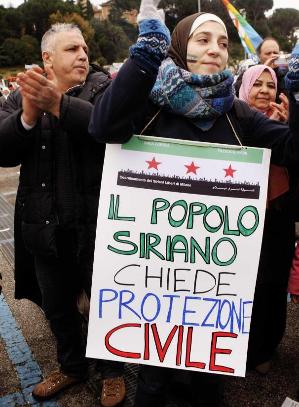
perché siamo contro il regime

* Sono contro questo regime per il semplice fatto che dopo 40 anni ha ridotto il paese ad una loro fattoria familiare dove credono di potere fare e disfare come vogliono loro privando tutti dei loro diritti di cittadinanza. Sono contro questo regime perchè è riuscito a togliere il sorriso dal volto dei bimbi. -FS

* Sono contro il regime perché qualsiasi regime che utilizza la violenza contro il dissenso è un regime malato. Le dimensioni e la tenacia del dissenso è la prova che non è un complotto da registi stranieri o poteri forti. E’ un rivoluzione del popolo per i loro più basilari diritti -MR

* Sono contro il regime per il semplice motivo che sta uccidendo bambini,donne ,giovani ed anziani in modo sistematico fregandosene dei diritti umani,dell’opinione pubblica interna ed internazionale ,mentendo fino alla fine accusando l’intero mondo di coalizzarsi contro di lui con la menzogna del complotto……un regime che da più di 40 anni considera la Siria e i siriani una sua proprietà da gestire come meglio crede soggiogando la vita civile alla paura e al terrore dei servizi segreti che nel paese controllano tutto anche i rapporti personali come il matrimonio! Un regime che ha preso il potere con il sangue e che per 40 anni si è nascosto dietro a delle false elezioni dove vinceva sistematicamente con il 99.9 % di falsi consensi, un regime che è riuscito a tessere dei rapporti ambigui con il resto del mondo arabo e non …..ricattando i suoi alleati a suo piacimento e gestendo i suoi loschi affari senza che nessuno abbia mai alzato la voce…………un regime del genere nazi-fascista,oggi non deve esistere più! –MGN

* Oltre per le violenze, stupri, repressione,corruzione, morti,… io sono contro il regime perchè una madre è stata privata di suo figlio per oltre 35 anni, pechè esiliato in Italia senza il permesso di tornare nella sua terra natia, per il solo fatto che si suppone che sia contro il regime, una supposizione che ha spezzato una famiglia, fatto versare litri di lacrime a mia nonna e fatto vivere mio padre solo, solo senza genitori, fratelli, parenti e gli amici dell’infanzia, solo senza qualcuno che potesse dargli conforto e aiuto quando ne aveva bisogno, perchè solo la tua famiglia ti capisce veramente e aiuta nei momenti più difficili. Ora sento mio padre (uomo fermo e severo) parlare a telefono con voce spezzata e tremolante con sua madre di 95 anni, che ormai non sente e riconosce più nessuno, che le ripete in modo dolce «mamma mi riconosci? sono tuo figlio, o mamma perdonami e sii orgogliosa di me, mamma non piangere vedrai che ci rivedremo» e lei piangendo gli dice «nel paradiso figliolo, nel paradiso ci rivedermo se Dio vuole» mi si spezza il cuore sentire quelle parole ma io finche vivrò lotterò contro questo regime. -GZ

ان تطلق النار على مسلح فهذا مبرر. ان تطلق النار على مدني، فهذه جريمة. أما أن تطلق النار على المستشفيات * فهذه نازية وفاشية

faisal kassem ha scritto: potrei accettare il fatto che tu spari a un rivoluzionario armato ,ma sparare a un civile e un crimine e bombardare gli ospedali non e altro che nazismo e fascismo -MT

* Si era paragonato il regima siriano ad una regime mafioso,ma invece e’ lontano anni luce ,la mafia evita di uccidere bambini e le donne mentre il regime siriano usa tale atrocita’ per spaventare gli uomini PIU’ INFAMI DI COSI’ NON ESISTE !neanche nei libri di storia non ho mai letto di un regime paragonabile a quello siriano… -IS

* Prima della rivolta

Sono contro il regime perché mi sono stancato di ascoltare promesse e discorsi da parte delle autorità corrotte, mentre parlano spudoratamente di lotta alla corruzione. Sono contro il regime perché non voglio che nessun cittadino siriano passi la vita in prigione, muoia a causa della tortura o esca di prigione ormai senza senno solo perché ha espresso una sua opinione. Sono contro il regime perché non voglio vedere bambini rovistare nei cassonetti e mangiare gli avanzi dei nostri pasti circondati da un odore atroce in un Paese dove la ricchezza viene ogni giorno rubata da chi dovrebbe governare. Sono contro il regime perché non voglio che il sogno dei giovani siriani diventi l’emigrazione e non il viaggio. Così come mi rattrista leggere sui giornali locali dei loro successi nelle terre della diaspora, con l’indicazione (siriano d’origine) solo perché nel loro Paese non trovano possibilità di esprimere le proprie capacità. Sono contro il regime perché non voglio che i giovani della mia Nazione passino la vita a studiare per poi lasciare la laurea in un cassetto e andare in giro a cercare un lavoro (operaio, muratore, tassista), mentre l’avanzare del tempo fa dimenticare loro ciò che hanno imparato. Sono contro il regime perché voglio vedere le braccia della bilancia della giustizia equipararsi, voglio vedere i malati entrare in ospedale, non in macelli, perché voglio vedere una riforma profonda del sistema d’istruzione, di polizia, dell’esercito e di tutte le istituzioni nazionali. Sono contro il regime perché il regime ci ha insegnato i suoi slogan da quando eravamo piccoli e sono rimasti solo slogan. Sono contro il regime perché non so chi rappresenta il popolo; ho scoperto di recente che uno degli uomini al potere è Mansour e l’ho scoperto solo perché i suoi accompagnatori hanno deturpato il viso di un bambino per un diverbio a scuola con il minore dei suoi figli.

Dopo la rivolta

Sono contro il regime perché si fa aiutare da persone infami per tutelare i suoi interessi.

Sono contro il regime perché invoca la democrazia, ma scatena il suo esercito contro ogni individuo che chiede libertà. Sono contro il regime perché mi sono stancato di riconoscere gli errori individuali che hanno causato migliaia di martiri. Sono contro il regime perché dice di lottare contro bande armate e i suoi squadroni della morte (shabbiha) portano e usano spudoratamente le armi contro i manifestanti. Sono contro il regime perché invoca riforme e allo stesso tempo eleva di grado i suoi affiliati corrotti e protegge i responsabili del massacro di tanti innocenti. Sono contro il regime perché parla di complotto ai suoi danni, come se intanto stesse facendo il suo dovere nei confronti del suo popolo.

Infine

Sono contro il regime

Sono contro l’opposizione

Sono contro ogni goccia di sangue che versa un cittadino siriano, qualunque sia la sua opinione

Sono con popolo siriano libero. -HD

* Sono contro il regime perchè la sua follia non uccide soltanto il popolo siriano ma calpesta i diritti dell’ intera umanità, e non si pente di nulla, non ha pietà per nessuno…… C’ è un documento che è essenziale come ideale da raggiungere da tutti i popoli e da tutte le Nazioni: La Dichiarazione Universale dei Diritti dell’Uomo. Nel preambolo c’è scritto: ” Considerato che il riconoscimento della dignità inerente a tutti i membri della famiglia umana e dei loro diritti, uguali ed inalienabili, costituisce il fondamento della libertà, della giustizia e della pace nel mondo;

Considerato che il disconoscimento e il disprezzo dei diritti dell’uomo hanno portato ad atti di barbarie che offendono la coscienza dell’umanità, e che l’avvento di un mondo in cui gli esseri umani godono della libertà di parola e di credo e della libertà dal timore e dal bisogno è stato proclamato come la più alta aspirazione dell’uomo;

Considerato che è indispensabile che i diritti dell’uomo siano protetti da norme giuridiche, se si vuole evitare che l’uomo sia costretto a ricorrere, come ultima istanza, alla ribellione contro la tirannia e l’oppressione;

Considerato che è indispensabile promuovere lo sviluppo dei rapporti amichevoli tra le Nazioni;

Considerato che i popoli delle Nazioni Unite hanno riaffermato nello Statuto la loro fede nei diritti fondamentali dell’uomo, nella dignità e nel valore della persona umana, nell’eguaglianza dei diritti dell’uomo e della donna, ed hanno deciso di promuovere il progresso sociale e un migliore tenore di vita in una maggiore libertà;

Considerato che gli Stati membri si sono impegnati a perseguire, in cooperazione con le Nazioni Unite, il rispetto e l’osservanza universale dei diritti dell’uomo e delle libertà fondamentali;

Considerato che una concezione comune di questi diritti e di queste libertà è della massima importanza per la piena realizzazione di questi impegni ……. Per questo credo che il popolo siriano stia lottando non solo per sè stesso ma per l’ intera umanità. Che Allah gli dia la vittoria.  -JL

* Sono contro il regime perchè sono un ANTIFASCISTA VERO e questo regime è NAZISTA.. -PP

* Io sono contro il regime , ma ho esaurito financo le parole per esprimere la rabbia per le atrocità che questi commette , e sto esaurendo pure le parole per esprimere lo sdegno di un mondo (altri regimi) che in parte guarda silente il massacro , e in altra parte impenitente e impunito foraggia il regime sanguinario. Le parole si stanno esaurendo , ma c’è la Fede ; ed è la Fede che mi sostiene contro questo regime fuori da ogni logica “umana”. InshAllah il cambiamento è prossimo. -TI

* Io principalmente sono contro la violenza sia chiaro pero’ devo dire che per far cessare le ostilità in Siria sarebbe necessaria una no fly zone, non datemi del guerrafondaio he pero’ credo che la diplomazia si possa usare se ci sono intermediari che riescano a portarla avanti e che si assicurino che nel frattempo cessioni le violenze. -AC

* Prima della rivolta del marzo 2011

Sono una giornalista italiana e sono contro sempre stata il regime degli Assad.
Sono sempre stata contro il regime perché ogni regime vuole avere il controllo totale delle persone e io sono una donna libera, che mai rinuncerebbe alla sua indipendenza e dignità.
Sono sempre stata contro il regime perché incarna l’opposto di tutti i valori in cui credo.
Sono sempre stata contro il regime perché la vita umana è sacra e gli assad, da 40 anni, uccidono donne, bambini, giovani, anziani.
Sono sempre stata contro il regime perché chi schiera i carro armati nelle città e spara sui civili disarmati non è che un criminale.
Sono sempre stata contro il regime perché pratica la censura e nega la libertà di parola, di espressione, di opinione.

Dopo la Rivolta della dignità

Sono contro il regime perché è vero che sono italiana, ma il mio sangue è siriano.
Sono contro il regime perché non ho mai visto la mia terra d’origine e per trent’anni non ne ho mai potuto parlare.
Sono contro il regime perché un giorno ho visto da lontano il confine siriano ma non mi sono potuta avvinare.
Sono contro il regime perché quel giorno mi sono sentita sola al mondo, senza radici, senza una casa.
Sono contro il regime perché, mi ha privato della mia identità.
Sono contro il regime perché mi ha impedito di vivere un amore grande, l’amor di patria…
Sono contro il regime perché ogni volta che cade un nuovo martire muore una parte di me.
Sono contro il regime perché per ogni bambino che piange o che trema dalla paura mi si stringe il cuore.
Sono contro il regime perché non ho mai dimenticato il massacro di Hama e mai dimenticherò il massacri di Homs.
Sono contro il regime perché sono siriana, sono una siriana libera e morirei per difendere la mia patria -AD

* sono contro il regime perché:sono figlio di un oppositore,fratello,di un martire,cugino di due martiri,sono un oppositore fino alla vittoria -MT

* Sono contro il regime perché sono contro ogni forma di dittatura,peggio se si tratta di dittature tollerate da poteri che le sfruttano quando potrebbero metterci una settimana per rovesciarle. Sono contro il regime perché credo nei diritti umani che vanno riconosciuti per le strade,non nelle convenzioni e nei trattati firmati tra convenevoli e aperitivi da gente che si bea di testi di cui i veri destinatari spesso non saranno mai neanche a conoscenza. Sono contro il regime perché non si può ammettere che innocenti vivano una vita di terrore o addirittura non vivano solo perché la sorte li ha fatti nascere in quel posto. Sono contro (tutti) i regimi dittatoriali perché c’è gente che continua a negare l’evidenza con propagande vuote e retoriche e perché c’è altra gente acritica e superficiale che continua incredibilmente a crederci. -MMB

by Julie McLaughlin

WRITTEN BY SAAD KIWAN in Beirut, translated by Mary Rizzo

The Syrians have been living for over forty years under a dictatorship of a single part and of the absolute power of a military figure, Hafez Assad, who in 1971 organised a coup d’état, against his comrades of the “Baath” political party (national-social-chauvinist) already in power since 1963 following the first coup d’ètat by the same Baath officers, overthrowing the last civil government of coalition in Syria. Assad the father had governed for the first half of his reign arm in arm with his brother Refa’at (himself a soldier, exiled then in ’84 for having tried to overthrow Hafez), arresting the “Baathist” (civil) troika in power: the leader of the party, the president of the republic and the Prime Minister, all of them having died in prison. Assad has governed practically alone, putting in act the “perfect regime” of a police state, basing it on services, eliminating political life, outlawing parties (from the Communists to the Nasserians, from the Socialists to the Liberals and even the Baathists) and eliminating the Parliament, substituting the elections with plebiscites for the sole candidate-leader. For 30 years (1971-2000) he filled the Syrian prisons with persons who opposed him, militants and activists for thought crimes, practicing every kind of torture and brutality, with the disappearance of hundreds of prisoners, Syrians and Arabs. The Syrian dictator put a gag order on the stamp and the means of information, he forbid any type of labour association or activity of a cultural or social nature. With the famous Article 8 of the Constitution that sentences: “Baath is the party that leads the state and the society”!

The first horrible crime that the Baathist dictator carried out was the aerial bombing of the city of Hama in 1982, with the massacre of over 20 thousand people, in order to silence the Muslim Brotherhood. A massacre that had passed in complete silence in the West, but also in the East, for the absolute lack of “witnesses”, that is, of the traditional means of information of the time. Also because Assad was considered as a “secular” (but an Alawite) who opposed the fanatical and reactionary Muslims, it was of little matter that he massacred entire families. And it didn’t change things that the Syrian president, after that “secular” massacre introduces in the constitution that “Islam is the religion of the Syrian president”, which has been repeated in these days by his son Bashar (a secular as well!) with his “new constitution”, going so far as to add to that article that Islam is “the principle source of legislation”.

In 1976 Hafez Assad also sent his troops (30 thousand soldiers) in Lebanon “to bring peace” between the Lebanese, with the benediction of the United States and Israel. Result? Assad’s soldiers remained 30 years in Lebanon, bringing with them the occupation militia, destroying the state and its institutions, inventing a servile political class that did not respect any rule or civil or ethical code of conduct. Moreover, the men of the Assad apparatus and its officials sacked the economic-commercial wealth of the country. The sacking was part of the “divide and conquer” strategy, pitting forces and parties against one another, and doing the same thing for communities.

Regarding Palestine, the former Syrian dictator called himself “defender of the cause of the Palestinian Arab People” using every means possible and imaginable to tame the PLO and its policies, and to put the Palestinian leader Yasser Arafat under the tutelage of the Syrian regime. For Assad, Lebanon and Palestine were “cards” to play and use in any way he wished. He did such things in the regional sphere to heat up the situation and raise the “price” of his dealings with Americans or Israelis, since the start of the 1970s. Successively, Iraq became another “card” that his heir Bashar used to deal with the USA, or to blackmail them, sending “volunteers” of fundamentalist and “Jihadist” groups there to carry out acts or terrorism or to give refuge to elements of Al-Qaeda.

In the third decade of his reign (1990-2000), Hafez Assad started to prepare his oldest son Bassel for his inheritance, passing from a despotic regime to a despotic-nepotistic regime. In 1994, the heir however died in a “road accident” that was later attributed to internal feuds within the Assad family itself. So, placed on the throne of leadership was the young ophthalmologist, “elected” with a plebiscite in 2000 upon the death of his father. There were many in Syria and in the Arab world who had hoped that the young president would be at the head of a new season of reform of the regime. The so-called “Damascus Spring” – which lasted a little over a year – turned out to be just a front. The son revealed himself to be even more merciless than the father. The campaign of arrests and ironclad repression by the regime, already since 2002, surprised everyone at some level. The prisons were filled with human rights activists and activists for freedom of speech, and they were left to rot in prison for years, without any trials.

Their doyen, the lawyer Haytham al-Maleh, today a leading figure in the opposition, was released at the start of the revolt, in March 2011, having celebrated his 80th birthday in prison, arrested several times, and never once put on trial. Among the regime prisons, the one of Mazze, in the capital city Damascus, stands out. Here Palestinian and Lebanese prisoners are detained and tortured, and they are then made to “disappear” (Lebanon still awaits to know the destiny of hundreds of Lebanese abducted by the Syrian troops in Lebanon), and that of Saidnaya, reserved for anyone opposing the regime and Syrian activists, where one of the massacres committed against the prisoners was carried out even by Maher, Bashar’s brother.

Intellectuals, writers and artists have been almost all exiled in Europe and in some Arab countries. We can’t even speak of journalists, because there are no independent or private newspapers and agencies in Syria, only the papers of the regime where the photo of the president-dictator dominates the layout. It is no different with the State TV, which opens the news with the sayings of the president-dictator. A high school student of 19 years, Tol al-Mallouhi was arrested in 2010 and sentenced to 5 years in prison for having expressed his thoughts in his blog regarding the Palestinian cause. The accusation? “Conspiracy against the regime” and “contacts with the American enemy”!

Today, Syria is governed by no less than 17 secret services agencies, under the command of the close circle of the Assad family: Bashar, his brother Maher, his mother and his brother-in-law. Then there are the Makhloufche cousins who hold the purse strings. In this “reign of terror”, the revolt erupted, which rapidly had transformed itself into a mass general uprising.

Thus was born the opposition with “three heads” inside and outside Syria: the Local Coordination Committees, the Coordination for Democratic Change and the Syrian National Council.

1 – The Local Committees are the true leaders of the revolts, rapidly organised throughout the entire territory by young volunteers who do not belong to any party; they are those of the new generation, born under the reign of the Assads and they have only known the workings and the practices of the Baath regime, but they also know the entire repertoire of the new technologies, despite the attempts of the regime to delay their access to them also by controlling their dissemination in the country, or lack thereof. These Committees are born and organised by means of Internet (Facebook, Twitter and YouTube), and they organise the protests throughout the country. In this way the revolt extended in the early months very rapidly, being able to escape from every attempt to control them or from direct intervention by the Special Forces of Bashar. But the most important and meaningful aspect is that all the young activists of the committees that lead the revolt operate clandestinely.  Those who go public are the spokespersons of the committees, who keep contact with the mass media, in that at the start of the revolt they found refuge in Beirut, Istanbul and then Cairo for logistic reasons and for coordination between the committees and the world outside Syria. And for greater safety, the committees have also created “shadow-committees”, which will substitute the “legitimate” ones in case these are discovered or arrested.

2 – The Coordination for Democratic Change. The outbreak of the revolt had practically taken also the old generation of militant politicians, writers and artists by surprise, included with them writers and artists, communists and nationalists, who already from the early 1970s fought against the Baath regime. Most of these had thus created the “Coordination for Democratic Change”, with its spokesman being Hassan Abdel-Azim, and it gathers together also parts of old political formations from ex-communists and ex-national socialists and Nasserians, as well as independent personalities such as Michel Kilo and Fayez Sara. The Coordination is a group that was born substantially within Syria, but it obviously has some of its figures abroad. It calls for the overthrow of the regime, but it also opposes any foreign intervention, the regime has winked at it, trying to get it involved in a fake dialogue that it from time to time invents, an in which some of the personalities of the Coordination have participated. The other day they refused to participate in the “meeting of the Friends of Syria” held in Tunisia to protest against the attempt to declare the National Council as the sole legitimate representative of the Syrian people.

3 – The National Council, led today by the professor of the Sorbonne Burhan Ghouliun, was instead formed abroad, in Istanbul, and it includes the majority of the foreign and internal opposition, having some renowned members such as the eighty-year-old lawyer Haytham Al-Maleh, politicians and intellectuals. The many young people who are part of the National Council in the role of representatives of the local committees guarantee the connection within Syria and make the Council the most popular among the populations of the cities in revolt. The Council also is comprised of a large number from the “Muslim Brotherhood”, backed by Erdogan’s Turkey. And it also enjoys the support of the vast majority of the Arab nations, from France and from quite a few Europeans. They insist upon “a humanitarian intervention to protect civilians” who are not victims of Bashar’s war machine which is killing them on an average of 100 persons per day.

4 – Then, there is the Free Syrian Army, formed by soldiers who had deserted the regime’s army and that despite the scarcity of arms it has available, it has been able to stand up to Bashar’s brigades, freeing some cities and guaranteeing protection to the population. And it seems that all the parts of the opposition are in agreement to support it and to consider it as the armed faction of the opposition.

The Local Committees are the true militants who move on the terrain among the people, and they are thus the structure that supports the uprising. They are for this reason not inclined to compromises, and thus they seem to guarantee solidity and continuity of the uprising despite the attempts of the regime to suffocate it and despite the failure of the Arab League to impose that the “little dictator” leaves or at least forcing him to step down. It is however obvious that with the passing of time and with the escalation of ferocity of the Assad gangs against a population that continues to peacefully protest, the danger of a militarisation of the revolt becomes greater. But it is the regime itself that pushes in the direction of a civil war that would justify a civil war and its war of extermination. It is also true that the most radical wing and those most willing to have a military response could predominate. Yet, it is likewise true that the population has reached almost a year of pacific revolts, and it is legitimate to then ask why they should be expected to resist and die? And for what reason or ideal should they have to expose themselves to the bombardments of cannons of the armoured tanks and aviation of Bashar’s regime, allowing men, when, the elderly and even children (as many as 500) to be killed?? (translator’s note: these statistics have now been overcome; children comprise around 850 of the victims to this date).

Lastly, two strong considerations: I believe that the primary and fundamental objective is that of dismantling a regime that is so totalitarian and repressive, merciless, cynical and inhuman, and to put Bashar and his close circle on trial. And regarding this point, there is no excuse in the world or justification. The “clean” and “pure” revolutionary ideals that know how to predict everything do not exist and they never have existed. But whoever it is that leads Syria after Assad could never be worse than him, his father and the Baath regime, which in addition to the Assad’s contributed to the museum of horrors also the Saddam Hussein regime in Iraq.

One cannot therefore expect that an almost clandestine opposition that has been repressed for over 40 years, which has never been able to operate in a climate of freedom, to be democratic and guarantee rights, or to not be subject to foreign pressure or influence. Yet, an opposition so diverse and politically varied is in itself a guarantee of pluralism and at the very least, is the harbinger of a future with a political life that is open to new experiences.

Original http://giulianasgrena.globalist.it/Detail_News_Display?ID=8311

This coming 15 March the group of human rights activists for Syria will be put on trial. Last 10 February these men assaulted the empty Syrian government’s embassy in the Italian capital. This act, which carries a high symbolic value, was carried out in the name of the right to life of the Syrian population and it has been dedicated to the women, children, youth and the entire Syrian population, who is paying for the choice of freedom and democracy with their lives. The Syrian embassy represents the Syrian government, therefore, those who are subjecting our people to one massacre after another, and as a consequence, does not represent those who believe in the right and sanctity of human life. The independence flag, on the other hand, represents us, it represents me, it represents the future of peace and freedom for Syria. Asmae Dachan

Il prossimo 15 marzo a Roma verrà giudicato il gruppo di attivisti per i diritti umani in Siria che il 10 febbraio scorso ha assalito l’ambasciata di Damasco nella capitale italiana. Il gesto, dall’alto valore simbolico, è stato fatto in nome del diritto alla vita del popolo siriano ed è stato dedicato alle donne, ai bambini, ai giovani, all’intero popolo, che sta pagando con la vita la scelta della libertà e della democrazia. L’ambasciata siriana rappresenta il governo siriano, quindi coloro che stanno massacrando il nostro popolo e, di conseguenza, non rappresenta chi crede nel diritto alla sacralità della vita umana. La bandiera dell’indipendenza, invece, ci rappresenta, mi rappresenta, rappresenta il futuro di pace e libertà della Siria. Asmae Dachan

the amount of marches and number of participants has grown exponentially

WRITTEN BY ENRICO DE ANGELIS, translated by Mary Rizzo

After almost a year, let’s take a look at the fundamental moments of the revolt in Syrian, running the gamut of repression, the regime’s propaganda and “hope”. From the first protests in Damascus up to the bloody episodes of recent days.

A Syrian dissident once told me that ever since the revolts in Syria started, time passes faster than in the rest of the world. If outside, a day goes by, within the borders, it is as if a week has passed. It is hard to think that only a year ago, Syria had one of the most stable regimes in the Middle East. Its president Bashar al-Assad seemed to enjoy a consensus that the other Middle Eastern dictators, starting from Hosni Mubarak, did not have. The economic difficulties hadn’t yet reached the breaking point of tolerance as they had in Egypt. And lastly, the geopolitical position of Syria put several obstacles in front of a possible revolt. For years the Syrian regime had been the only certainty in an area that is dense with ambiguity and problems: the chaos of Iraq following the American occupation, the fragility of Lebanon with its intermittent civil wars, Israel and the occupation of Palestine. No one wanted, and in many ways no one still wants, the sudden and violent fall of the Syrian regime, not even the Western powers, starting from the United States. It is impossible to think of a “calculated” regime change, it is impossible to predict what will happen if the Assad regime, which has lasted 40 years, should fall.

All of these certainties collapsed one after the other. No one expected that the Syrian revolution could have reached such proportions and developed in this way. From a year since the start of the revolts, which began in March 2011, Syria today appears to be on the brink of a civil war. The regime’s repression of the uprising in the most recent days has reached its apex. The prolonged shelling of the city of Homs, one of the strongholds of the “rebels”, is bringing about the death of hundreds. A few days earlier, there was the failure and the withdrawal of the Arab League’s observers, after having admitted their own incapacity to put a halt to the violence. Then, the lack of reaching an agreement on the UN resolution from the Arab League initiative that asked for Bashar to step down and to start the transition process towards democracy. A resolution that, though excluding a military intervention, was blocked in no uncertain terms by the double veto of Russia and China.

Never before as today are all eyes set on the armed aspect of the revolt, that Free Syrian Army (FSA) constituted prevalently of deserters of the armed forces that since July 2011 has militarily opposed the repression. The United States, though excluding a direct armed intervention, seems to think of supporting the FSA with arms and money, with the help of Turkey, Qatar and Saudi Arabia. On the other side, Russia and Iran continue to support the regime and supply Bashar al-Assad’s militia. In essence, there are all the elements for a sort of “proxy war” with dynamics that resemble those of Vietnam in the 1960s or, to stay in the region, similar to the style of the Lebanese civil wars.

The armed revolt and the regime’s propaganda – What is unfolding before our eyes can be defined as a sort of “self-fulfilling prophecy”. The regime has insisted since the beginning that the revolt was an armed on, directed by foreign elements, fruit of an international conspiracy and underscored by ethnic reasons: Sunnis against Alawites. Even when that was evidently not the case at all. In the regime’s version, the repression of the protesters has always been presented as a fight against invisible “terrorists” and against armed gangs that were not identified in any clear way. It had been Bashar al-Assad himself, in a speech held at the People’s Council at the end of last March, to set this narrative of events, deluding a good number of Syrians who hoped at least in a partial recognition of the growing dissent in the country and in the opening towards a pacific exit strategy that at the same time seemed still to be realistic. Today, some of the elements that constitute the regime’s propaganda have become reality: it is true that the armed revolt has assumed a certain importance. It is true that foreign intervention is ever more pressing, first under the form of economic and diplomatic pressure, and perhaps from now on even under the form of military aid. It is true that even the ethnic aspects of the clashes have become more evident. The Alawites, a minority group to which the al-Assad family belongs, are almost all on the side of the regime, as well as how the able propaganda of the regime has always tried to paint the revolt as directed towards the creation of an Islamic state in which the exponents of other religious groups would find themselves emarginated or worse, persecuted. Some of the lies of the regime have transformed themselves, at least in part, into truth.

The wind of the Arab Spring – But it has not always been that way. The Syrian revolt started spontaneously and it is still prevalently an authentic revolt, brought forward by the Syrian citizens without the help of anyone. The requests of the protesters are for the most part extraneous to a religious discourse: they are asking for freedom, democracy, social justice. And, despite everything, the peaceful protesters continue to build the true motor of the revolt. Everything had its start in Tunisia and Egypt. The Syrian revolt would probably never have taken place without the precedent Arab Springs. The domino effect in this case is striking. When the so-called Arab Spring began in North Africa, something in Syria had shaken. Small events, but taken all together make up a definite change in the environment. When I was in Damascus, in the winter of 2010, the transformation was evident. It was enough to look at the debates that were flooding the information sites in that period: there were discussions on the news of the uprisings against Mubarak and Ben Ali, and it is simple to pass from these arguments to the situation in Syria. One almost does not even notice it happening. In substance, the problems are and remain the same in all the Arab countries: corruption, growing gap between the rich and the poor, daily humiliation, lack of freedom, an economy that is on the decline in a way that is seemingly unstoppable. One talks of Egypt and Tunisia, and in reality, one is talking of Syria.

The phenomenon doesn’t concern only Internet. Even outside of the web, the atmosphere is visibly changing. The traditional remissive and apolitical nature that has always characterised the population seems to be crumbling. Acts of bullying and arrogance that were once tolerated by perseverance are now met with a growing impatience. In February the first marches were organised, in front of the Egyptian and Libyan embassies, to express solidarity with the Arab Spring. Then something that until only a few months before had been unthinkable: dozens of persons took to the streets of Damascus to protest against the violence of a policeman against the child of a shopkeeper. The protesters shouted, “the Syrian people will not be humiliated,” which successively became one of the most widespread slogans in the protests to follow. Damascus was thus the first city to move, something that today might seem incredible.

On 15 March, a group of youth gathered together at the suq (market) of Hamidiya: it was the first time that films that had been made using mobile phones had been put onto Internet. Al Jazeera, the pan-Arab network of Qatar, one of the Arab world’s most widespread channels, immediately began to transmit them, also allowing those who did not have an Internet connection to know what was going on. On 16 March, the relatives of some political prisoners gathered in front of the Ministry of the Interior. The security forces intervened with violence, beating the protesters and arresting dozens of them.  Small groups of protesters continued to take to the streets, but this was still a limited phenomenon. Until that moment, the only ones to make a move had been the “civil society” of Damascus: a middle-to-upper class of intellectuals and youth who were working in the cultural field, in journalism, civil organisations and human rights groups.

participation spans all ages

The dynamics of the protests had changed in those very days. In the small city of Dera’a, in southern Syria, a group of children with spray paint wrote some slogans against the regime on a wall. The emulation of the Egyptian revolt was quite clear: the writing was imitating the anti-Mubarak slogans used by the young Egyptians of the 25 January movement. The children copied them directly from the reports on Al Jazeera. The reaction of the regime was immediate: the children were arrested. The next day their parents and the families of the children took to the streets to protest, encouraged by that same atmosphere that had materialised a few days earlier in Damascus. The security forces intervened, shooting: there were the first deaths. The funerals became the occasion for even larger protests, and the repression was growing more and more ferocious. The nearby villages ran in support of Dera’a. The protesters numbered in the thousands. The Syrian revolt had begun.

The evolution of the revolt – From Damascus, the uprising moved to the provinces, and from the elite, it was substituted by the lower-middle class. This takes into consideration very often those same sectors of the population which initially constituted the pillars of the support to the regime: farmers, labourers, office workers and shopkeepers who in the last fifteen years had been abandoned and penalised by the liberalisation reforms. They were the ones who most strongly felt the effects of growing corruption in the circles of power that gravitated around the regime and of the progressive cuts in state aid. Other cities and regions progressively joined the protests: Banyas, Nawa, Homs, Latakia, Idlib, Qamishli, Hama and many others. At the start, the protests were born from various, localised needs: each region has its own requests and its own complaints regarding the regime. Especially, at the start, it was not asked for Bashar al-Assad to step down: the slogans demanded the end of corruption, reforms, more freedom.

It’s been the ferocious repression of the regime to give unity to this fragmented chain of uprisings. And, it is the repression of the regime to radicalise the requests of the protesters. As they gradually saw their death toll rise in the dozens, and then in the hundreds of protesters, the legitimacy of the president had progressively crumbled, and the marches became an open revolt against Bashar al-Assad and his regime. It has been a peaceful uprising: no one at the start thought of using arms against the army and the security forces. The control of the military by the regime is total, almost all of the officers are Alawites and their loyalty is absolute.

But even this story started to change: someone started to take weapons as a vendetta, then the first individual desertions took place as well as the formation of armed anti-regime groups. The prophecy of the regime became reality as civil war seems to get nearer, even if it is still avoidable. But looking at the current situation, one should not forget how the revolt began, and who is responsible for its degeneration.
continua su: http://www.fanpage.it/siria-ricostruire-le-origini-della-rivolta-quasi-un-anno-dopo/#ixzz1lzbH7FK4
http://www.fanpage.it


Siria: ricostruire le origini della rivolta quasi un anno dopo

A quasi un anno di distanza, ripercorriamo le tappe fondamentali della rivolta in Siria, tra repressione, propaganda di regime e “speranza”. Dalle prime manifestazioni a Damasco fino ai cruenti episodi degli ultimi giorni.

Un dissidente siriano una volta mi ha detto che da quando le rivolte sono cominciate in Siria il tempo passa più velocemente che nel resto del mondo. Se al di fuori è passato un giorno, all’interno dei confini è come se fosse passata una settimana. È difficile pensare che un anno fa quello siriano fosse uno dei regimi più stabili del Medio Oriente. Il presidente Bashar al-Assad sembrava godere di un consenso che altri dittatori mediorientali, a cominciare da Hosni Mubarak, non avevano. Il disagio economico non aveva ancora raggiunto il limite massimo di sopportazione come in Egitto. E infine, la posizione geopolitica della Siria poneva più di un ostacolo a una possibile rivolta. Per anni il regime siriano aveva costituito la sola certezza in un’area percorsa di incognite e problemi: il caos dell’Iraq dopo l’occupazione americana, la fragilità del Libano con le sue intermittenti guerre civili, Israele e l’occupazione della Palestina. Nessuno voleva, e per molti versi nessuno ancora vuole, una caduta improvvisa e violenta del regime siriano, neanche tra le potenze occidentali, a cominciare dagli Stati Uniti. Impossibile pensare a un passaggio di regime “calcolato”, impossibile prevedere cosa succederebbe se il regime quarantennale regime degli Assad dovesse crollare.

Queste certezze sono crollate una a una. Nessuno si aspettava che la rivoluzione siriana potesse raggiungere simili proporzioni e svilupparsi in questo modo. A un anno dallo scoppio delle rivolte, cominciate nel Marzo del 2011, la Siria appare oggi sull’orlo di una guerra civile. La repressione del regime nei confronti dell’insurrezione in questi ultimi giorni ha raggiunto il suo apice. Il bombardamento prolungato della città di Homs, una delle roccaforti dei “ribelli”, sta mietendo centinaia di vittime. Pochi giorni prima, l’insuccesso e il ritiro degli osservatori della Lega araba, dopo aver ammesso la propria incapacità ad arginare le violenze. Poi il mancato accordo per una risoluzione ONU su iniziativa della Lega araba che chiedeva le dimissioni di Bashar al-Assad e l’inizio di un processo di transizione verso la democrazia. Risoluzione che, pur escludendo l’intervento armato, viene bloccata senza mezzi termini dal doppio veto di Russia e Cina.

Mai come oggi gli occhi sono puntati sul lato armato della rivolta, quell’esercito siriano libero (ESL) costituito prevalentemente di disertori dell’esercito regolare che dal luglio 2011 si oppongono militarmente alla repressione. Gli Stati Uniti, pur escludendo un intervento armato diretto, pare comincino a pensare di sostenere l’ESL con armi e finanziamenti, con l’aiuto di Turchia, Qatar e Arabia Saudita. Dall’altra parte, Russia e Iran continuano a sostenere il regime e a rifornire le armate di Bashar al-Assad. Insomma si sta profilando una sorta di “guerra per procura”, con dinamiche simili a quella del Vietnam negli anni sessanta o, per restare nel Vicino Oriente, sullo stile delle guerre civili in Libano.

La rivolta armata e la propaganda del regime – Quella che oggi si dispiega sotto i nostri occhi ha l’aria di una “profezia che si autoadempie”. Il regime ha sostenuto fin dall’inizio che la rivolta fosse armata, pilotata da elementi stranieri, frutto di un complotto internazionale e mossa da ragioni etniche: sunniti contro alawiti. Anche quando evidentemente non era così. Nella versione del regime, la repressione contro i manifestanti è sempre stata presentata come una lotta a degli invisibili “terroristi” e a non ben identificate bande armate. È stato lo stesso Bashar al-Assad, in un discorso tenuto al Consiglio del Popolo alla fine del marzo scorso, a fissare questa narrazione degli eventi, deludendo non pochi siriani che speravano almeno in un parziale riconoscimento del dissenso crescente nel paese e nell’apertura verso una via d’uscita pacifica che al tempo appariva ancora realistica. Oggi alcuni degli elementi che costituiscono la propaganda del regime sono divenuti realtà: è vero che la rivolta armata ha assunto un peso importante. È vero che l’intervento straniero è sempre più pressante, prima sotto forma di pressioni economiche e diplomatiche e forse da ora in poi anche sotto forma di aiuti militari. È vero anche che gli aspetti etnici dello scontro sono divenuti più evidenti. Gli alawiti, gruppo minoritario cui appartiene la famiglia di Bashar al-Assad, si sono quasi tutti schierati dalla sua parte, anche come risultato dell’abile propaganda del regime che ha sempre dipinto la rivolta come diretta alla creazione di uno stato islamico al cui interno gli esponenti di altre confessioni religiose sarebbero marginalizzati o, peggio, perseguitati. Alcune delle bugie del regime si sono trasformate in, almeno parziali, verità.

Il vento della Primavera araba – Ma non è sempre stato così. La rivolta siriana è iniziata spontaneamente ed è ancora prevalentemente una rivolta autentica, portata avanti da cittadini siriani senza l’aiuto di nessuno. Le richieste dei manifestanti sono per lo più estranee a discorsi di tipo religioso: si chiedono libertà, democrazia, giustizia sociale. E, nonostante tutto, i manifestanti pacifici continuano a costituire il vero motore della rivolta. Tutto ha avuto in inizio in Tunisia ed Egitto. La rivolta siriana non sarebbe probabilmente mai avvenuta senza le precedenti Primavere Arabe. L’effetto domino in questo caso è lampante. Quando la cosiddetta Primavera Araba è cominciata nel Nord Africa, in Siria scatta qualcosa. Piccoli dettagli, ma che insieme disegnano un deciso cambio d’atmosfera. Quando ero a Damasco, nell’inverno del 2010, la trasformazione era evidente. È sufficiente guardare ai dibattiti che affollano i siti d’informazione in quel periodo: si commentano le notizie sulle insurrezioni contro Mubarak e Ben Ali, ed è facile passare da questi argomenti alla situazione in Siria. Quasi non te ne accorgi. In fondo i problemi sono e restano gli stessi in tutti i paesi arabi: corruzione, crescente differenza tra ricchi e poveri, umiliazioni quotidiane, mancanza di libertà, un’economia che declina apparentemente in modo inarrestabile. Si parla di Egitto e Tunisia, e in realtà si parla di Siria.

Il fenomeno non riguarda solo internet. Anche al di fuori della rete l’atmosfera sta visibilmente cambiando. La tradizionale remissività e apoliticità che ha sempre caratterizzato la popolazione sembra cominciare a sbriciolarsi. Atti di bullismo e prepotenza che prima erano tollerati a testa bassa sono ora accolti con crescente insofferenza. A febbraio vengono organizzate le prime manifestazioni, davanti alle ambasciate egiziana e libica, per esprimere solidarietà alla Primavera Araba. Poi è accaduto qualcosa che era impensabile fino a qualche mese prima: decine di persone a Damasco scendono in piazza a protestare contro la violenza di un poliziotto nei confronti del figlio di un negoziante. I manifestanti gridano “il popolo siriano non sarà umiliato”, che successivamente diverrà uno degli slogan più diffusi nelle proteste successive. Damasco è quindi la prima a muoversi, cosa che oggi può sembrare incredibile. Il 15 marzo gruppi di giovani si riuniscono al suq (mercato) Hamidiya: è la prima volta che vengono girati e sono diffusi in rete i filmati realizzati con telefoni cellulari. Al-Jazeera, la rete pan-araba del Qatar, uno dei canali più visti del mondo arabo, comincia immediatamente a trasmetterli, permettendo anche a chi non ha una connessione internet di sapere cosa sta succedendo. Il 16 marzo i parenti di alcuni prigionieri politici si riuniscono di fronte al ministero dell’interno. Le forze di sicurezza intervengono duramente, colpendo con forza i manifestanti e arrestandoli a decine. Piccoli gruppi di oppositori continuano a scendere in piazza, ma si tratta di un fenomeno ancora limitato. Finora a muoversi è stata unicamente la “società civile” damascena: una classe medio-alta di intellettuali e giovani che lavorano nel campo della cultura come giornali, organizzazioni civili, gruppi di diritti umani.

La dinamica delle proteste è cambiata in quegli stessi giorni. Nella piccola città di Deraa, nel sud del paese, un gruppo di bambini muniti di bombolette spray scrive sui muri slogan contro il regime. L’emulazione della rivolta egiziana è fin troppo chiara: le scritte sono copiate da slogan anti-Mubarak usati dai giovani egiziani del 25 gennaio. I bambini le hanno copiate direttamente dai report di Al-Jazeera. La reazione del regime è immediata: i bambini vengono arrestati. Il giorno successivo i genitori e le famiglie dei bambini scendono in piazza a protestare, incoraggiati da quella stessa atmosfera che si era materializzata qualche giorno prima a Damasco. Le forze di sicurezza intervengono, sparando: ci sono i primi morti. I funerali divengono occasione per manifestazioni ancora più ampie, e una repressione ancora più feroce. I villaggi vicini corrono a sostegno di Deraa. I manifestanti si contano a migliaia. È cominciata la rivolta siriana.

L’evoluzione della rivolta – Da Damasco l’insurrezione si sposta alla provincia, e alle elite si sostituiscono ceti medio-bassi. Si tratta molto spesso di quegli stessi settori della popolazione che prima costituivano il pilastro di sostegno del regime: contadini, operai, impiegati e piccoli commercianti che negli ultimi quindici anni sono stati abbandonati e penalizzati dalle riforme di liberalizzazione. Sono loro che hanno maggiormente risentito della crescente corruzione dei circoli di potere che gravitano intorno al regime e del taglio progressivo degli aiuti statali. Altre città e regioni si uniscono progressivamente alle proteste: Banyas, Nawa, Homs, Latakia, Idlib, Qamishli, Hama e tante altre. All’inizio le proteste nascono da esigenze diverse, localizzate: ogni regione ha le proprie richieste e le proprie lamentele contro il regime. Soprattutto, all’inizio non si chiede la caduta di Bashar al-Assad: gli slogan domandano la fine della corruzione, riforme, più libertà.

È la repressione feroce del regime a dare unitarietà a questa catena frammentata di sollevamenti. Ed è la repressione del regime a radicalizzare le richieste dei manifestanti. Man mano che i morti arrivano a decine, poi centinaia di manifestanti, la legittimità del presidente si sgretola progressivamente, e le manifestazioni divengono un’aperta rivolta contro Bashar al-Assad e il suo regime. Si tratta di un’insurrezione pacifica: nessuno all’inizio pensa di poter usare le armi contro l’esercito e le forze di sicurezza. Il controllo dell’esercito da parte del regime è totale, quasi tutti gli ufficiali sono alawiti e di fedeltà assoluta.

Ma anche questa storia comincia a cambiare: qualcuno comincia a prendere le armi per vendetta, cominciano le prime diserzioni individuali e la formazione di gruppi armati anti-regime. La profezia del regime diviene realtà e la guerra civile sembra avvicinarsi, anche se è ancora evitabile. Ma nel guardare la situazione attuale non bisogna dimenticare mai come la rivolta è cominciata e di chi è la responsabilità della sua parziale degenerazione.

Leggi anche:

continua su: http://www.fanpage.it/siria-ricostruire-le-origini-della-rivolta-quasi-un-anno-dopo/#ixzz1lzbH7FK4
http://www.fanpage.it

detainment as a way to prevent freedom of speech

Dear friends,
As you might have heard, the office in which I work at was raided by Air Force security branch on Thursday 16-2-2012. My boss, friend and mentor, Mazen Darwich, along with 8 male colleagues and friends, are still in detention since that day at air  force security branch, known to be the worst security branch in Syria.

I spent only 3 nights there along with five other female colleagues, those three nights were the longest hours of my life. You know that I was detained previously for two weeks, which was my first experience with detention, but those 3 nights at air security branch were the worst in comparison to my previous detention.

Below is SCM statement with regards to the raid and the arrest of our male colleagues, please share it with whomever you think might be helpful in getting the word out around the world.

Raid of Syrian Center for Media and Freedom of Expression office in Damascus, Arrest of its Staff and Visitors
In a new escalation against freedom of expression and media work in Syria, the Office of the Syrian Center for Media and Freedom of Expression (SCM) in Damascus was raided on Thursday 16 February at approximately one and a half PM by agents of the Air Intelligence Intelligence (Mazzeh branch). The raid, that was carried out by members of the security apparatus along with a group of armed men, who caused panic and fear among employees and visitors of the center, especially since the officer in charge did not disclose the arrest or search warrants that are supposed to be issued by a public prosecutor.

The security forces took the IDs of SCM employees and visitors in addition to their mobile phones. They were prevented from proceeding their work and were asked to gather in one room until 4 PM; they were transferred to the Air force Intelligence detention center of Mazzeh then.

Following are the names of staff and administrators who have been arrested that day:
1 – Mazen Darwish, director of the Syrian Center for Media and Freedom of expression.
2 – Yara Badr, Syrian journalist and the wife of Mazen Darwish.
3 – Hani Zitani, a graduate of the Faculty of Engineering and the Faculty of Sociology and university teacher.
4 – Sana Zitani, a graduate of the Faculty of Sociology and wife Hani Zitani.
5 – Abdel Rahman Hamada, student at the Institute of Accounting.
6 – Hussein Gharir, graduate at the Faculty of Information Engineering.
7 – Mansour Al Omari, English literature graduate from Damascus University.
8 – Joan Fersso, a graduate of the Faculty of Arabic literature.
9 – Mayada Khalil, graduate at the University of archaeology in Aleppo.
10 – Ayham Ghazoul, a dentist.
11 – Bassam Al-Ahmed, a graduate of the Faculty of Arabic literature.
12 – Razan Ghazzawi, a graduate in English literature.
13 – Rita Dayoub.
Two visitors were also arrested; Shady Yazbek (student in medicine) and Hanadi Zahlout.

Female employees working at the center were released on Saturday 18 Feb 2012 around 10 PM (Yara Badr – Sanaa Mohsen – Mayada Khalil – Razan Ghazzawi) in addition to the visitor Hanadi Zahlout on one condition that at they are to show up at Air force Security every day from 9AM to 2PM for further investigation until unspecified date. Rita Dayoub was released.

The arrest of the President of the SCM, “Mazen Darwish,” and male colleagues and visitor, however, continues: Hani Zitani – Abdel Rahman Hamada – Hussein Ghrer – Mansur Al Omari – Bassam Al-Ahmad -Ayham Ghazoul – Joan Fersso, and the visitor Shady Yazbek are still in custody.

The Syrian Center for Media and Freedom of Expression strongly condemns the raid conducted against its office as well as the ongoing arbitrary detention of the journalist Mazen Darwish and its staff. SCM expresses its deepest concern regarding the fate of persons remaining in detention, demands the Syrian authorities to release all detainees immediately and unconditionally, and holds the Syrian authorities fully responsible of the psychological and physical conditions of the detainees.

The center calls upon the Syrian authorities to put an end to arbitrary arrests and harassment of journalists, media workers and freedom of opinion and expression advocates.

Finally, the Syrian Center for Media and Freedom of Expression expresses its gratitude to all institutions and individuals who have expressed solidarity with the Syrian Center for Media and Freedom of Expression against such oppressive policies.
— Best, Razan