Archive for the ‘Somoud: Arab Voices of Resistance’ Category

WRITTEN BY MASSIMO RUSSO, translated by Mary Rizzo
What do the tears of Shirin Ebadi and Tawakkul Karman at the summit for the Peace of Rome tell us: if we don’t like the present, it is only up to us to change it

Shirin Ebadi and Tawakkul Karman on stage at the summit of Nobel Laureates The embrace between Shirin Ebadi and Tawakkul Karman on stage at the summit of the Nobel prize winners (Photo: Wired)

Shirin Ebadi and Tawakkul Karman on stage at the summit of Nobel Laureates
The embrace between Shirin Ebadi and Tawakkul Karman on stage at the summit of the Nobel prize winners (Photo: Wired)

“I ask forgiveness on behalf of the Iranian people for what the government of my country has done first in Syria, supporting a dictator – Bashar al-Assad – who kills his own citizens, and now to the Yemen of my sister Tawakkul, because it is helping the counter-revolution to stifle change. ”

Sometimes international meetings on peace are resolved in formal occasions to repeat formulas that are a  little ‘age-worn’. At the 14th World Summit of the Nobel Peace prize, which is being held these days in Rome, things were different. The abstract concept of peace and diplomacy became transformed into a hug, and into the tears of two women, the Nobel laureates Shirin Ebadi and Tawakkul Karman, divided by nationality and religion, united by belonging to the species of those who did not give up.

And if you wonder what this has to do with Wired, the answer is: because both these women are innovative. No, they are more than that, they are hackers.

Shirin Ebadi, Iranian, won the Nobel in 2003 for her fight for human rights. Magistrate, she was relieved of her duties and lives actually in exile in London. Tawakkul was the first Arab woman to receive the Nobel in 2011 for her peaceful campaign for equality, freedom and against corruption, which led to the overthrow of the regime in Yemen. A few moments before receiving the embrace of Shirin, Tawakkul had cried out passionately, asking the international community to condemn Iran for its intervention in support of the dictators of Syria and Yemen and against the Arab Spring, in order to establish itself as a regional power and obtain more favourable terms in the negotiations on nuclear disarmament.

Tawakkul in her speech emphasises a concept dear to all disruptive innovators: do not ask permission.

“No one will give you your rights if you are not willing to take them for yourselves, to take to the front lines and fight for them. And the only ones able to declare your defeat are yourselves. If you lose hope, you are already finished, everything depends on you. ”

Ebadi adds: “Democracy is alive, and it must be looked over every day, even when you’ve achieved it.”

Then there’s the idea of hacking. Because only the creative tampering of reality, even when all logic is contrary, it can lead to change in seemingly hopeless situations. All revolutionaries, rebels who are really changing the world, start by listening to themselves, to their own convictions. So they act, and change their own roads, their own community, their own country. Without any excuses.

What does this embrace between two extraordinary women in a sleepy Roman Saturday morning have to say to us? Again, the answer is a lot. To all of us. The first words that Shirin Ebadi addressed to Federica Mogherini, EU High Representative for Foreign Policy, and Italians were: “Do not accept the money of dictators. Many have brought their wealth to Italian banks. “But the real point is that people like these, with their vital example, speak to our attitude of detached cynicism, western pessimism of bored depression. The fate, the future is in our hands. From the crisis to corruption, to work, which is not created by decree. Nobody will change our destiny in our place. And the hunt for the culprit, to those who have it taken away, is simple. Just get up and look straight the first mirror.

original: http://www.wired.it/attualita/politica/2014/12/13/labbraccio-nobel-senso-dellinnovazione-nostra-pigrizia/

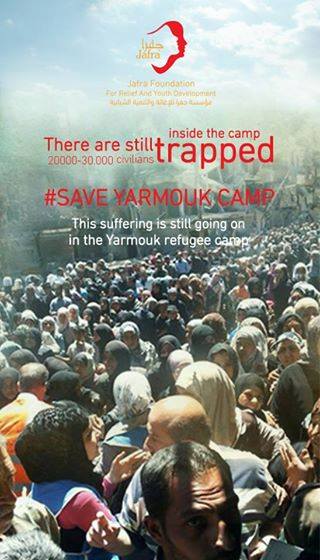
20.000 - 30.000 civils sont toujours pris au piège à l'intérieur du camp.   #SaveYarmoukCamp  Les souffrances continuent sans répit dans le camp de réfugiés de Yarmouk.

20.000 – 30.000 civils sont toujours pris au piège à l’intérieur du camp.
#SaveYarmoukCamp
Les souffrances continuent sans répit dans le camp de réfugiés de Yarmouk.

Wesam est un jeune palestinien qui milite au sein de “JAFRA”, une organisation communautaire qui aide la population de Yarmouk, en Syrie. Il a très gentillement accepté de répondre à nos questions, pour le public italien, mais pas seulement celui destiné à la Péninsule, puisqu’aussi bien Wesam aurait pu s’exprimer en anglais si son interviewer n’avait pas été arabophone. Cet entretien est la traduction anglaise de la version italienne tirée de l’arabe d’origine. (Interview & traduction italienne de Fouad Rouieha, traduction anglaise de Mary Rizzo, traduction française de Eric Lamy). 

Commençons par décrire Yarmouk.

Le camp de réfugiés de Yarmouk est situé au sud de Damas. Il s’étend sur plus de sept kilomètres carrés, juste à côté des districts du centre, tel celui de Midan Zahir. Pour faire court, le camp fait partie du tissu urbain de Damas. Avant le début de la révolte, il comptait 700.000 âmes, dont 220.000 palestiniens d’origine, le reste étant des syriens. Le camp de Yarmouk fut établi en 1957 : la majorité des palestiniens qui y vivent sont des fils de réfugiés de 48, principalement originaires du nord de la Palestine auxquels s’ajoutèrent ceux qui vinrent de Jordanie en 67 et 70. Avant la révolution en Syrie, Yarmouk était une zone économique florissante, considérée comme la capitale de la diaspora palestinienne. Il s’y tenait un marché considérable, le commerce y prospérait. Une véritable ferveur pour les questions sociales et politiques y prévalait, sans oublier ce dynamisme culturel qui faisait de Yarmouk le centre culturel de Damas, le lieu où il se passait quelque chose, où des festivals étaient organisés. Un grand nombre d’artistes célèbres sont originaires de Yarmouk. Pareil à d’autres quartiers, mais plus particulièrement animé, les rues étaient peuplées de boutiques et de restaurants que fréquentaient tous les damascènes. Le weekend, ou pendant les congés, les rues étaient si populeuses qu’on avait du mal à y circuler ; c’était un quartier très peuplé mais également réputé pour la sécurité qu’il offrait.

Vous parlez de l’existence d’un activisme politique, mais être militant, en Syrie, était complètement tabou à cause de la surveillance policière et de la répression toujours possible. Était-ce différent pour les palestiniens ?

J’ai mentionné l’activisme politique en rapport avec la Cause Palestinienne, qui n’avait pas de lien avec la situation syrienne. Yarmouk était une des bases pour les factions palestiniennes : le Front Populaire, le Hamas, le Front Populaire-Commandement Général, le Jihad Islamique, le Fatah… l’activité politique autorisée impliquait le camp de Yarmouk et la Palestine, mais rien qui pût se rapporter directement à la Syrie. Les syriens vivant à l’extérieur du camp assistaient à nos discussions, mais tant qu’il n’était question que de Palestine, tant que la politique syrienne n’était pas évoquée, il n’y avait aucun problème.

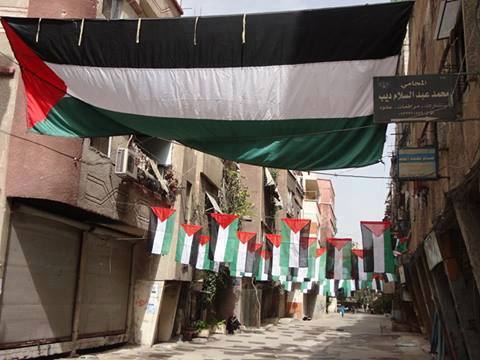
Une rue de Yarmouk.

Une rue de Yarmouk.

Parlez-nous de la cohabitation entre syriens et palestiniens-syriens. Peut-on parler d’intégration réussie ou, au contraire, a-t-on assisté à la création d’une sorte de ghetto ?

Entre nous, personne ne faisait de différence. À Yarmouk, nous avons vécu ensemble pendant 50 à 60 ans. Les mariages mixtes sont monnaie courante et nous sommes tous mélangés. Il faut dire que parfois une même famille est partagée entre les deux nations (la Palestine du Nord et la Syrie méridionale n’étant pas séparées à l’époque qui a précédé l’exil palestinien ; des familles et des clans étaient établis de chaque côté de la frontière. Il n’y a pas de différence entre syriens, palestiniens, libanais et jordaniens car des relations d’amitié et de parenté ont toujours existé.

On dit qu’au début de la révolution les palestiniens-syriens du camp ont tenté de se démarquer du conflit.

Non, nous n’avons pas tenté de nous en affranchir : il y a eu un débat considérable pour déterminer si le camp devait s’investir dans la confrontation. Une partie d’entre nous pensait que les militants de Yarmouk qui voulaient se joindre à la révolution devaient s’engager en dehors du camp, sans l’impliquer. Nous savions que si Yarmouk était visé par des représailles, elles seraient extrêmement violentes : c’est malheureusement ce qui est arrivé. Ensuite, l’idée à circulé selon laquelle Yarmouk pourrait être un lieu de repli sûr pour les syriens déplacés, pour les blessés, afin de leur permettre d’accéder aux soins médicaux et au ravitaillement. Au cours des deux premières années, Yarmouk à rempli ce rôle. Quand les affrontements ont éclaté dans les zones de Al Hajar Aswad ou de Tadamon, Yarmouk était un centre de distribution de produits médicaux et d’entraide. Nous accueillions les réfugiés. Avant eux, nous avions déjà recueilli les réfugiés de Homs : il y avait là tant de familles ! Pour eux, nous avons ouverts des refuges, profitant des écoles de l’UNRWA (agence de Nations Unies pour les Réfugiés Palestiniens, n.d.l.t.) et de celles de l’état. C’était des refuges protégés pour ces gens où ils furent accueillis, nourris et logés. Lorsque le Commandement Général à incité certains d’entre nous à prendre les armes contre l’Armée Syrienne Libre, Yarmouk a été directement impliqué dans les combats : l’ASL est entrée dans le camp et il devint, comme les autres districts de Damas, la cible du régime syrien.

On nous a rapporté des abus commis par l’ASL…

Ceux qui sont entrés dans Yarmouk n’étaient pas tous de même obédience : il y avait là des tas de gens différents et, parmi eux, des criminels de droit commun déguisés en révolutionnaires, comme cette “Brigade des Fils du Golan” qui était, en fait, un gang de kidnappeurs et de voyous. Ils ont incendié des maisons et en ont pillé d’autres. Cela a duré 6 mois, puis l’ASL, constituée de palestiniens et de syriens, les à délogés du camp.

 Concernant la révolution syrienne, qu’elle est la position des factions palestiniennes à l’intérieur du camp ?

Elle est contradictoire : d’un côté, les partisans du FPLP-GC, du Fatah Al Intifada qui combattaient aux côtés des loyalistes. Les proches du Hamas ainsi que des groupes indépendants se battaient contre le régime. La division qui existe dans la population syrienne est la même qui affecte la société syro-palestinienne.

une victime de la famine.

Une victime de la famine.

Pouvez-vous chiffrer la population vivant à l’intérieur du camp ?

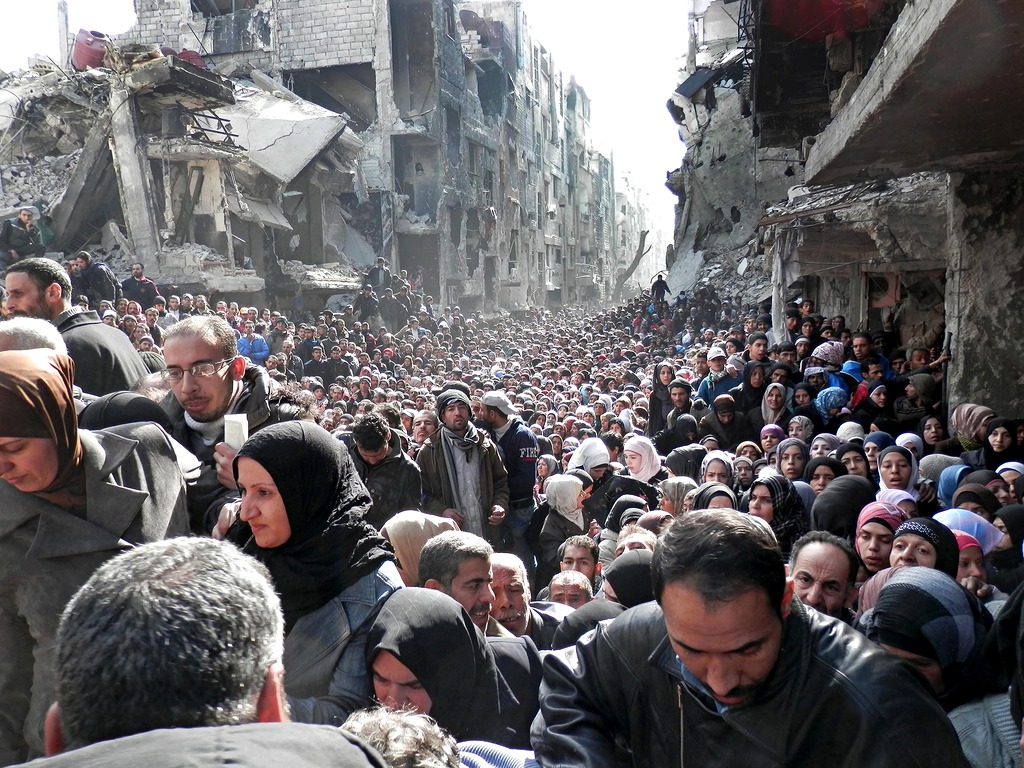
Nos données diffèrent de celles de l’UNRWA : nous sommes sur une base de 25 à 30.000 personnes, dont 5000 syriens, le reste des résidents étant palestiniens. Ceux qui sont restés n’ont nulle part où aller et il n’y a plus de place dans les refuges. Pauvres d’entre les pauvres, ces palestiniens et ces syriens n’ont pas d’argent pour louer une maison et ils n’ont pu trouver de place dans les dispensaires du camp. Certains d’entre eux ont pu, un temps, s’installer dans les différents jardins publics de Damas, mais ils en sont revenus. Il y a aussi ceux qui n’ont pu fuir de peur que leur fils soit enrôlé de force dans l’armée. Il y a là des gens qui n’ont pas de papiers, pas de carte d’identité et ne peuvent donc pas sortir du camp. Soyons un peu logiques : il y a 30.000 civils à Yarmouk. S’ils avaient vraiment été des combattants, Damas serait tombée en 2 jours ! Parmi les hommes en armes à l’intérieur du camp, on compte environ 1000 palestiniens et 500 syriens : voilà tous les combattants du camp. Ces palestiniens sont natifs de Yarmouk. Ils ont formé des comités de dėfense, pas seulement contre le régime mais pour des raisons de sécurité interne : les institutions ont volė en éclat, l’anarchie est partout. Il fallait protéger les résidents des voleurs, des kidnappeurs. Ces comités de défense remplissent, en fait, une fonction de police. Il leur arrive même de régler des problèmes familiaux.

Aujourd’hui, comment décririez-vous la situation humanitaire ?

Yarmouk vit sous siège partiel depuis décembre 2012. Cela signifie que les civils peuvent entrer et sortir avec ce qu’ils peuvent transporter. Bien sûr, les camions chargés de nourriture sont interdits. Depuis le début du siège, nous n’avons réussi qu’à faire entrer 4 camions, ce qui a entraîné l’arrestation de quelques volontaires et la mort de Khaled Bakrawi. En juin 2013, le siège à été complètement fermé : plus personne ne put entrer ou sortir, plus de nourriture, plus de produits médicaux, plus aucun bien de consommation ne furent autorisés à pénétrer à l’intérieur du camp. Au bout de 4 mois sont apparus des cas extrêmes de malnutrition et les gens ont commencé à mourir. À ce jour, nous avons répertorié 154 cas de décès dûs à la faim, sans parler des cas où la faim n’est qu’un facteur du de la mort. La nourriture continue de manquer ; il y a bien eu des tentatives diplomatiques ces deux derniers mois qui n’ont abouti qu’à la livraison de 12000 paniers-repas qui ne permettent chacun que d’assurer la subsistance d’une famille de 4 personnes pendant 10 jours. Quiconque en a reçu un n’a plus rien aujourd’hui. Plus tard, 5000 paniers contenant de la confiture, des dattes et un peu de pain furent distribués. Cette dernière livraison fut assurée par l’UNRWA, tandis que nous avons réussi à en distribuer entre 4 à 5000.

Des volontaires de JAFRA distribuent des sacs de nourriture.

Des volontaires de JAFRA distribuent des sacs de nourriture.

La situation médicale et sanitaire : il n’y avait qu’un seul hôpital en activité à Yarmouk, l’Hôpital de Palestine, qui a été fermé par suite du manque de carburant (“mazot”, une sorte de fioul utilisé pour les groupes électrogènes et les stérilisateurs, ndlt). Comme l’électricité a été coupée dans le camp il y a treize mois, l’hôpital ne peut plus compter que sur les générateurs. Il n’y a plus de produits médicaux dans le camp et le seul médecin présent à Yarmouk a été tué il y a 6 mois, comme il sortait de l’hôpital, au cours d’un bombardement. Le personnel médical ne se compose plus que d’infirmières ; leur travail est guidé par l’expérience, mais ils ne sont ni médecins, ni spécialistes. Le mois dernier, nous avons pu exfiltrer 400 cas graves hors du camp. Au cours de l’évacuation, certains ont pourtant été arrêtés par les forces de sécurité du régime. À ce jour, nous avons des cas de malades qui réclament leur évacuation, mais il est absolument impossible aux civils de quitter le camp.

Parlez-nous de la vie quotidienne d’un résident de Yarmouk. J’imagine qu’il est peu probable qu’il puisse y travailler ?

Il n’y a plus de travail à l’intérieur du camp. Les routes sont fermées : pas de déplacement, pas de commerce possible. Le problème majeur est le prix élevé de la nourriture, car la contrebande de denrées est apparue. Il y a un mois et demi, un kilo de riz coûtait environ 12.000 livres syriennes (LS), l’équivalent d’à peu près 70$. Le tarif a baissé légèrement le mois dernier, mais il faut se dire qu’il coûtait 1$ voici trois ans, qu’il coûte 1$ dans les zones qui entourent le camp, soit soixante-dix fois moins ! Un litre de fioul pour groupe électrogène revient à environ 600/700 LS et coûte seulement 100 LS dans Damas. De toutes façons, il n’en reste presque plus à l’intérieur du camp. Certaines ONG – dont notre Fondation JAFRA – ont mis en place des projets agricoles d’auto-suffisance à l’intérieur du camp. Cela n’a pas trop bien marché l’hiver dernier à causes du temps, mais cela va beaucoup mieux. Il y a ceux qui ramassent de l’herbe dans les prés, et nous avons recensé 5 morts dûs aux snipers du régime qui surveillent ces prés. Les autres se contentent d’exister à l’intérieur de Yarmouk, fouillent les maisons abandonnées à la recherche de nourriture, une poignée de riz ou de farine, quelques épices, n’importe quoi qui puisse se manger. Voilà comment vivent ces gens…

Au cours des mois écoulés, lors de tentatives d’introduire des convois d’aide humanitaire, des attaques ont eu lieu : le régime en a rejeté la responsabilité sur les rebelles.

Il ne s’agissait pas d’attaques directes, bien qu’il y ait eu des tirs dont nous n’avons pas pu établir l’origine. Les deux parties s’accusent mutuellement. La milice accuse le Commandement Général, et celui-ci dénonce les islamistes armés. En réalité, des tirs de la milice ont empêché la distribution mais, franchement, je ne pense pas que l’intention était délibérée. Ils souffrent du siège comme les autres et sont logés à la même enseigne. Je crois plutôt qu’au cours d’un engagement avec les forces loyalistes les convois ont été pris entre deux feux.

 Pour finir, avez-vous un message à faire passer à la société italienne ?

Il y a à peu près 30.000 personnes dans le camp de Yarmouk, dont 1200 enfants. Beaucoup sont nés pendant le siège. J’y étais il y a trois mois : ces enfants ne savent plus le goût de la nourriture. L’un d’entre eux rêve de déguster une simple pomme de terre, de manger quelque chose de bon, quelque chose de sucré. Des personnes âgées ont besoin de remèdes pour leur tension artérielle, leurs problèmes cardiaques, leur diabète, tous les traitements simples et basiques dont le manque total cause leur décès. Les blessés sont contraints à l’amputation par faute de simple traitement. Pas de médicament, pas de médecin ! Nous avons besoin de vaccins pour nos enfants. Les problèmes sont immenses : ils n’ont plus la moindre idée de ce qu’est une vie normale et n’imaginent même plus comment est-ce en dehors du camp. Quelle faute ont donc commis ces enfants et ces civils pour souffrir autant ? Ce qui se passe à Yarmouk est contraire à tout principe d’humanité, contraire à toute notion de patrie, contraire à toute idée de panarabisme, toutes choses pour lesquelles le régime syrien se targue d’être en première ligne !

English: http://radiofreesyria1.wordpress.com/2014/05/06/extreme-suffering-in-yarmouk-camp-interview-with-wesam-sabaaneh/

Tamim-Al-Barghoutipar Tamim Barghouti, traduit par Eric Lamy

À trois reprises, les médias furent trompés : “la gravitė de la famine était exagérée”, “les témoins oculaires mentaient” et “les victimes de la faim n’avaient faim que de célėbrité”. Dans ces trois cas précis, les forces assiégeantes mangèrent et burent devant les caméras des reporteurs, juste à côté du camp, pour mieux humilier et insulter ceux qui y vivaient.

Le camp de réfugiés de Yarmouk (à Damas) est assiégé depuis des mois, soumis à des bombardements terrestres ou aériens. De nombreux réfugiés sont morts de faim, n’ayant d’autre ressource que de se nourrir de feuilles ou de cactées ; le manque d’eau potable à également entraîné des affections intestinales et des maladies de peau.

Des nouveaux-nés ont péri de même, ainsi que leurs mères, des personnes âgées, des malades et des blessés, à cause du manque de médicaments. Toute personne qui essaie de quitter le camp est abattue, et le camp à été bombardé à de nombreuses reprises.

Même quand le régime syrien a permis l’entrée de l’aide dans le camp (grâce à la pression des médias étrangers), il a aussitôt refermé le siège quand l’attention des médias s’est relâchée.

Les tentatives des soutiens du régime syrien pour nier leur responsabilité vis-à-vis de Yarmouk sont pathétiques : le camp jouxte Damas. L’armée syrienne est seule responsable, légalement et moralement et aussi sur le plan régional, puisqu’elle contrôle entièrement la ville.

Quoique les supporteurs du régime prétendent qu’ils ont le droit pour eux, leurs actions immondes seraient moins ignobles s’ils ne prétendaient pas les accomplir au nom d’une cause prétendue.

Pour ce qui est d’affamer les Palestiniens, le régime syrien en a une longue expérience, peut-être même la plus accomplie que tout autre pays arabe. Trois des quatre pays qui entourent la Palestine ont été impliqués dans la mort de Palestiniens. Septembre, Sabra & Shatila et le blocus de Gaza… Pour autant, un seul pays sur les quatre fit couler le sang Palestinien à trois reprises : Tel Zaatar, la Guerre des Camps de réfugiés, et le camp de Yarmouk aujourd’hui.

À trois reprises, la scène se répète : le régime syrien utilise des milices alliées et leur donne l’ordre d’encercler le camp. Concernant le camp de Tel Al-Zaatar (1976), Damas a utilisé les milices chrétiennes maronites (et notamment les Phalangistes de la plus importante milice chrétienne), sans oublier les “forces Kataeb”, les “gardiens du Cèdre” et le “mouvement Marada”.

Au cours de la Guerre de Camps (1985/1988), le régime syrien à recruté la milice shiite Amal qui était, à l’époque, en conflit armé avec le Hezbollah pour le contrôle de Beyrouth et du Sud-Liban. Le Parti de Dieu ne prit pas part à la Guerre des Camps, mais Amal ouvrit le feu sur les Palestiniens et, simultanément, attaqua le Hezbollah.

Comme aujourd’hui, le régime syrien s’appuie directement sur son armée ainsi que sur des milices Palestiniennes inféodées, comme le Front Populaire pour la Libération de la Palestine – Commandement Général (FPLP – CG) et le groupe Fatah al Intifada.

Dans ces trois différents camps de réfugiés, l’eau et l’électricité furent d’abord coupés : les gens furent privés d’approvisionnement jusqu’à manquer de tout, jusqu’à mourir de faim. Dans ces trois cas, la faim à poussé les gens à manger des feuilles et à réclamer des fatwas pour être autorisés à manger des chats, des chiens et des cadavres d’animaux. Les femmes qui s’aventuraient jusqu’aux puits et autres pompes de forage à l’extérieur du camp étaient abattues par les snipers positionnés autour du camp.

Hussein Ayyad et Maysa Khatib, habitants de Tel Al-Zaatar, ont raconté que les corps des femmes tuées par les snipers tombaient dans les puits ; les gens étaient obligés de puiser l’eau dans laquelle restaient les corps des martyres. Impossible de les en retirer car les snipers continuaient de leur tirer dessus.

Dans ces trois exemples précités, les médias furent mystifiés : l’importance de la famine était exagérée, les témoins oculaires mentaient, et les victimes de la faim n’avaient faim que de célébrité. De la même manière, les forces assiégeantes mangeaient et buvaient devant les caméras, près du camp, afin d’humilier et d’insulter plus encore les habitants du camp.

Une des chaînes de télévision libanaise qui soutient le régime syrien à diffusé un reportage sur le Camp de Yarmouk montrant les soldats loyalistes en train de manger avec un des reporters de la chaîne, niant que les habitants du camp soient affamés et imitant les scènes où du lait maternisé était gâché pendant les sièges de Sabra & Shatila et de Burj El-Barajneh (dans les années 80). Le premier, imposé par le Liban et soutenu par Israël, dura trois mois, de juin à septembre 1982. Le second, mis en place par le Liban et soutenu par la Syrie, à duré 4 ans, de 1985 à 1988.

À chaque occasion, le régime syrien s’est justifié en arguant que les Palestiniens entretenaient des opinions radicales, qu’ils étaient des résistants invétérés. Mais Damas ne s’en prit jamais à Israël, même quand l’état hébreu à bombardé Damas. À chaque fois, l’humiliation des Palestiniens relayée par les médias était un élément essentiel de la guerre livrée contre eux. Non content de démoraliser les gens dans les camps et tous ceux qui les défendaient pendant le siège, il fallait aussi salir l’image de la Palestine, des symboles politiques et culturels Palestiniens. Il fallait aussi semer la confusion dans l’opinion publique syrienne et libanaise, dans leur réaction à de telles actions et, enfin, les convaincre de ne rien tenter pour s’opposer au siège des camps de réfugiés.

Refugee camp in Damascus, SyriaLe 9 janvier 2014, le porte parole de l’UNRWA, Christopher Gunness à déclaré que “la profonde souffrance des civils de Yarmouk s’aggrave. Les rapports confirment que la malnutrition est extrêmement répandue, de même que l’absence de soins médicaux, surtout pour ceux qui ont été blessés à cause du conflit, ainsi que les femmes prêtes à accoucher, avec des conséquences fatales pour certaines d’entre elles.”

Le journal britannique The Guardian relate que le même porte-parole de l’UNRWA déclaré, le 9 février 2014 (un mois après sa première déclaration) que le Dr Ibrahim Mohammed, qui travaille au sein de l’UNRWA, à sauvé un bébé de 14 mois appelé Khaled, souffrant de grave malnutrition. Depuis 2 mois, ce bébé ne vivait presqu’exclusivement d’eau. Noor, sa maman de 29 ans, avoua qu’elle n’avait, pour toute nourriture, que des décoctions d’épices. Quand il n’y en eut plus, ils se mirent à manger de l’herbe, mais celle-ci vint aussi à manquer.

Dans un message attesté du Réseau Euro-Méditerranéen pour les Droits de l’Homme (REMDH), une organisation basée à Genève qui collabore avec l’UNRWA pour apporter de la nourriture au camp, le REMDH rapporte qu’une jeune fille de 15 ans, prénommée Heba et son bébé de 5 mois, à raconté au personnel des Nations Unies qui distribuaient la nourriture qu’ils n’avaient pas mangé depuis trois jours, et qu’elle n’avait pas pu donner le sein à son bébé. Quand les infirmiers donnèrent de l’eau au bébé, il se mit à gonfler, n’ayant rien avalé depuis plusieurs jours. Les infirmiers en furent si inquiets qu’un médecin de la Croix Rouge Internationale dut le prendre en charge.

Ces exemples de famine furent accompagnés, dans le passé, par le massacre de quiconque tentait de quitter le camp. Dans le cas de celui de Tel Al-Zaatar, par exemple, après avoir affamé le camp pendant des mois, les Phalangistes, soutenus par le régime syrien [de Hafez al Assad, père de Bashar] annoncèrent qu’ils allaient autoriser les Palestiniens à quitter le camp afin d’être acheminés dans des refuges de la Croix Rouge. Quand les Palestiniens commencèrent à quitter le camp, les miliciens les massacrèrent, comme le raconte Maysa Al Khatib, une des survivantes de la tuerie, dont le témoignage fut, avec celui de Hussain Ayyad, publié dans l’appendice Palestinien du journal libanais Al-Safir du 12 août 2013 et du 15 septembre 2012.

“Tous les hommes de plus de dix ans qui tentaient de quitter le camp, comme de nombreuses jeunes filles, jeunes femmes et femmes âgées furent massacrées. Un des assassins s’approcha d’une jeune femme qui portait son nouveau-né de deux jours. Il empoigna son bébé et le projeta au loin. Celui-ci retomba dans des arbres mais la mère ne put localiser l’endroit où son bébé avait atterri.”

Une jeune femme blessée aux jambes se traînait parmi la foule. Un des meurtriers dit à un autre : “emmène-la donc sous le figuier, pour lui donner un peu de bonheur !” La femme répondit que la mort était mille fois préférable. Il la tua d’un coup de feu en disant : “crève donc !”

“Ghazi, mon cousin, portait ma grand-mère sur ses épaules, pensant que le fait de la porter lui éviterait la mort. Mais ils la tuèrent avant de l’assassiner. Une vieille femme glissa et tomba dans un fossé : comme elle tentait de s’en extraire, un des assassins lui dit : “où vas-tu ? Reste donc là où tu es ! ” Et il lui tira plusieurs balles dans la tête.

Abu Yaseen Freijah, un infirmier de l’UNRWA, vêtu de sa tenue blanche, soutenait sa femme, qui avait reçu une balle à l’épaule. Les meurtriers s’emparèrent d’elle et lièrent ses jambes à deux voitures, qui l’ont écartelée.

Mon cousin Ali, âgé de 17 ans, doux et inoffensif, fut attaché à l’arrière d’une voiture qui démarra en trombe. Abu Akram, un marchand de tissu bien connu, essaya de dissuader les assassins de s’en prendre à son fils en leur offrant tout l’argent qu’il possédait. Ils tuèrent son fils sous ses yeux avant de l’abattre, et de prendre tout son argent.

À ce jour, les coupables du massacre de Tel Al- Zaatar et de la famine organisée imposée pendant la Guerre de Camps n’ont pas été punis. Certains d’entre eux sont même devenus ministres ou responsables de conseils représentatifs, au Liban ou en Syrie. Ces tragédies se répètent dans le Camp de réfugiés de Yarmouk. Bien que le début de la tragédie à Yarmouk soit semblable à celle de Tel Al-Zaatar, nous devons agir pour que tous ces gens-là ne finissent pas de la même manière !

Tamim Al Barghouti est un poète palestinien et un scientifique engagé en politique. Il vient d’une famille lettrée. Son père est le poète palestinien Mourid Barghouti et sa mère, romancière érudite, est Radwa Ashour, d’origine égyptienne. Cet article fut publié en arabe dans le journal Shorouk, le 25 février 2014.


victims of the mosque massacre in central Yarmouk, from Syrian Air Force bomb raids

victims of the mosque massacre in central Yarmouk, from Syrian Air Force bomb raids

By Mahmoud Sarhan, translated by Jimmy Phoenix

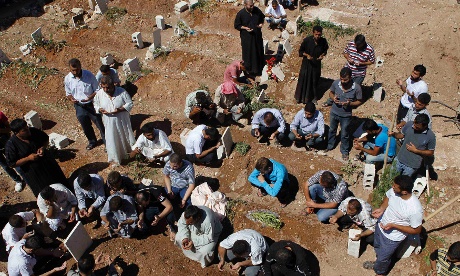
The memory of Palestinians of the Yarmouk refugee camp – south of Damascus – carries two harsh memories of two catastrophes: the first was the catastrophe of being kicked out of their land in 1948, while the second dates to 16-12-2012, which marks the Syrian opposition barging in the camp and the MIG strike which was executed by the Syrian Air Force over Falluja school and Abdul Kadir Alhusaini Mosque in the middle of the camp. And both were being used as refugee centers for those who fled from other locations, and these MIG strikes killed 170 refugees and caused many casualties as well. Afterwards, many rumors went around talking about a 24-hour warning given to the camp citizens before the regime forces would break in. As a result, thousands of citizens who were horrified by the massacre that just took place packed their bags and headed out of the camp in a scene more like the new Palestinian diaspora which was described as being worse than the first one. And many activists consider the MIG strike of the 17th December 2012 as the actual date of the catastrophe. According to Mohammed Almaqdesi – the official speaker of the Palestinian camps news association – that after the MIG strike, many Facebook pages affiliated to “Jibril” (PFLP – General Command) spread a rumor that the Syrian army commanded the people of Yarmouk camp to evacuate the camp, which is what actually was done, fearing the occurrence of another massacre just like the Mosque and School massacre.

yarmouk 2At that time, Yarmouk camp sheltered thousands of Syrian families who evacuated to it from neighboring provinces, even some came from the cities of Aleppo and Homs. Which caused schools, mosques and houses to overflow with Syrian emigrants, which seemed for a while to be a safer place from the burning hell across the country. Yet, that didn’t suit the Syrian regime, who used genocide and group punishment against civilians after exiling them from their houses and forcing them to leave, seeking refuge from the inferno scorched by the regime’s military as soon as they suspected the presence of the FSA in it. However, Yarmouk camp succeeded for 9 months to stay unbiased despite the repeating attempts to drag it to the war, which was obvious through shelling it with mortars repeatedly and accusing the opposition for bombarding the camp. One of those barrages caused the “Alja’oona” massacre in 2-8-2012, which resulted a death toll of more than 20 martyrs and tens of casualties. Though, the main attempt to drag the camp into the conflict was from the “Jibril group” (or the PFLP – General Command) and its withdrawal from the agreement of the PLO factions, forming armed popular committees supported by the regime, which eventually caused those committees to overpass their duties within the camp and engage in armed clashes with the FSA in the Alhajar AlAswad and Tadamun areas. And not just that, but some groups even overpassed Jibril to receive orders directly from the Syrian Republican Guard (aka Presidential Guard), who eventually made the regime succeed in taking control of the green zone and eliminating the sanctuary the camp represented. This eventually forced the FSA to enter the camp in order to get oust the regime forces.

According to Almaqdesi: the FSA intended upon liberating only Alhajar Alaswad and the neighborhoods interlocking with Yelda Area. But Baian Miz’il broke into the entire camp along with his forces, ignoring the plan. Here, a new name rises up “Baian Miz’il”, one of the leaders of the south region FSA, who were found to be a regime agent, and has been the cause of letting the regime regain control of some of the that area’s neighborhoods. Thus, the regime bears the responsibility of dragging the camp into that bloody conflict so that he could make a few victories. Considering the military side, the regime tightened its grasp totally on all the neighborhoods of the southern region, using only one check point consisting of a few hundred soldiers and mercenaries. Which somehow reduces the burden of spreading soldiers around the camp and costing the regime many forces that would be better deployed to other sensitive regions as it sees fitting. Add to that, the regime also cut the supply lines to the camp and the safe haven that the camp represented as well as the popular revolution’s surrogate, which is represented by thousands of Syrian refugees who fled to the camp. All that is considered to be a part of the regime’s means of punishing revolting areas and its residents wherever they are.

While from the political point of view, the regime used the “kicking the Palestinians out of the camp” strategy to support the alleged propaganda of the “universal conspiracy” against the regime, and using it to press on all Palestinian, Arab, and international bodies as well to come to its aid. The regime succeeded in involving Yarmouk Camp through “Jibril’s faction” and one of his goons, therefore, succeeded – using few a soldiers only, to impose a suffocating siege on all the areas out of his control in the southern area of Damascus for a period of one year, which allows him to stall in executing any initiative presented by the PLO or anyone else. And according to “Mamdouh” – a politician activist, the regime sees no interest in making truces, and any initiative or ceasefire is nothing but a trick which he uses in the context of a psychological warfare which he imposes upon the besieged to ruin their spirit, waiting for things to change and for the facts on the ground to get to his side. And until now, all the initiatives presented by the PLO have failed, while those presented by NGO’s in Yarmouk seem to be suspended between PLO officials’ statements, and Jibril’s people’s belief that it is bound to fail, and none of the distress calls made to help the besieged from an incoming humanitarian crisis caused by letting them stay for 6 months without food or medicine are listened to. Also, the camp’s residents’ attempts to neutralize the camp’s status and force Jibril and the regime to execute the recent initiative, which has brought about the death of four citizens in the “coffins” march, during their march to the regime forces’ check point outside the camp, returning to face the monopoly of the dealers inside. Even the kids went in the “empty vessels” march demanding the siege to be lifted. In the camp’s catastrophe anniversary, the citizens celebrated it by demanding the siege to be broken and neutralized from the entire situation and stop killing them by bombs, bullets and hunger. Yet, we haven’t received any reaction from the besiegers, and after a whole year, all the popular and formal attempts represented by the PLO failed and did not bring about any change regarding the camp’s situation, and the regime succeeded in eliminating the refugees’ green zone and cutting the supply lines by using just a paper to negotiate with. And that comfortable situation enforced the regime to bargain with all sides, considering that the Syrian regime is the puppet master from now on, and it becomes the only one to benefit from Yarmouk’s catastrophe. And according to what Mamdouh said, I guess there one significant difference between who besieges the Gazans and who does the same in Yarmouk, where Palestinians are being besieged by either the occupation or the “defiance” regime.

http://alhayat.com/Details/587914

This is a transcript of a presentation given by Palestinian anarchist Budour Hassan on 17 November 2013 at a Teach in on Syria in New York organized by the MENA Solidarity Newtork US . There is a link to the video of the presentation below.

*******

In April of 2011 a famous megastar Egyptian blogger told Syrian revolutionaries that they needed to raise Palestinian flags during the demonstrations on Friday just to prove that they support the Palestinian resistance and to deny the narrative by the regime that the regime supports the Palestinian cause.

Now I asked myself then, do Syrians have to do that? Do Syrians have to raise the Palestinian flag just to prove that they support Palestine? Do Syrians have to show their nationalist credentials so the world supports their cause? And the answer was clear to me then: No, Syrians do not have to do that. Now a Syrian friend told me at the start of the uprising that we avoided raising Palestinian flags and talking about Palestine not because we don’t support the Palestinian cause, but because this cause was exploited by the regime to a degree that turned it into just a political tool, and we love Palestine so much that we don’t agree to turn the cause into a political tool, and this is why we avoided using it. And I think that Syrians do not have to do this, Syrians do not have to wave a Palestinian flag to prove that they support us. Because Palestine is not a flag. Definitely Palestine is much more than that.

Palestine is the refugees in Yarmouk camp who supported the revolution from the first day, who aided displaced Syrians and who participated in protests, documented the uprising, and helped as much as they could. The revolution is also the Palestinian refugees in al Raml refugee camp in Latakia who took a hard beating by the regime and had to deal with a heavy crackdown starting from July 2011. And the revolution lives not in the palaces of the regime, nor in the speeches of a resistance leader who thinks that just because he leads a resistance movement this gives him the right to speak in the name of Palestinians, and to kill innocent people in Syria not just in the name of resistance but also in the name of Palestine. So this is why I think that Syrians do not have to prove anything to anyone.

Secondly, even though if we suppose that the Syrian regime does in fact support the Palestinian resistance, does it mean that this allows the Syrian regime to control Syria, to prevent people from expressing their opinions, to kill and torture hundreds of thousands of Syrians just because they dare say no to more than 40 years of oppression, to more than 40 years of injustice? Of course not. Even if Bashar al Assad was the only person capable of liberating Palestine I would not support him, and I’m sure that many Palestinians would not do so either. Because our liberation cannot be established on the enslavement of another people, particularly when this enslavement is an enslavement of our sisters and brothers in Syria.

And in fact the truth is that the Syrian regime has never truly supported Palestine; for the Syrian regime, Palestine has always been a fig leaf and always been a political tool. And it started from the 1970s when the Syrian regime helped other militias in Lebanon to crack down on the refugees in Tel al-Zaatar. The siege and massacre in Tel al-Zaatar cannot be forgotten. And the massacres that the regime helped the Amal party in Lebanon commit in the 1980s also against refugees in Lebanon and against the PLO cannot be forgotten either. And the siege the regime is imposing in Yarmouk refugee camp, preventing people from getting medical aid or baby milk, preventing people from going in and out of the refugee camp, cannot be tolerated and cannot be just ignored, as many are doing unfortunately just because they think that this regime is for resistance, and that this regime is for the human rights of Palestinians.

Now the thing is that me as a Palestinian, I don’t need to say this for many people just to convince them about the justice of the Syrian cause. Because in my opinion it is very clear that this revolution was a revolution for freedom and dignity. But unfortunately for many of us here in Palestine, because there is a polarization among Palestinians, as is the case in many other Arab countries, about the Syrian regime, we had to say it over and over again and to try to convince our comrades — or our former comrades – that they need to stop supporting the Syrian regime, that all we hear about the Syrian regime’s support of resistance is nothing but propaganda.

Now unfortunately it didn’t really help. People mostly stick to their opinions regarding the regime. If we want to talk about what the reaction of Palestinians toward the Syrian revolution is, it varies. Unfortunately the left, mostly the mainstream left, supports the Assad regime. And here lies the irony, because one of the most supportive parties of the regime is called the Israeli Communist Party, and it supports the regime because, it says, “Well, this regime is against imperialism.” But at the same time these people had absolutely no problem in participating in protests alongside Zionists in Tel Aviv, liberal Zionists for instance. So how can you say that you support the Syrian regime because it is against imperialism and on the other hand participate in protests with Zionists?

And also there are others who say that we supported the Syrian Revolution when it was nonviolent, but then after it got violent we couldn’t support it anymore, and it was hijacked. So yes, the Syrian Revolution was indeed hijacked, and we know that there are many Salafis, many jihadists and many other groups, and many pro-America and pro-imperialist groups that tried to hijack the Syrian Revolution. But that does not by any means tarnish the Syrian Revolution, and it also doesn’t mean that just because a revolutionary movement was hijacked that we should stand on the sidelines and stop supporting it.

Of course there are still so many revolutionaries working on the ground, many of them are nonviolent, and there are even many nonsectarian armed brigades that we cannot ignore. If the revolution was hijacked we don’t just go and start blaming the people for it being hijacked. We actually do everything to side with the people in order to get the revolution back on the right track. And this is what many leftists couldn’t understand.

Now on the other side of the spectrum you have the right wingers and the Islamists who support the Syrian Revolution but not truly because they believe in the right of freedom and dignity, but because they think that it is a Sunni uprising against an Alawite regime. Now this is why it was for me very hard to participate in protests organized by Islamists in support of the Revolution, because for me, although of course there are religious movements inside the Revolution, it still a Revolution for freedom, equality, social justice and dignity. And this is why I cannot agree with the line of the Islamists here in Palestine who support the Revolution just because they see it as Sunni versus Alawite.

Now there is a small section among the Palestinian left that supports the Syrian Revolution that doesn’t lecture Syrians about what they have to do, and how they failed. And we managed to organize a few protests, in Haifa for instance, in Jeruslaem, and in other places in Palestine. Although they were small protests I think it meant a lot for us to show the Syrian people that yes there are people in Palestine who stand with you, and there are people who don’t buy into the regime propaganda.

I mean it says a lot that in Syria right now there is an intelligence branch, one of the most notorious intelligence branches in Syria, it’s called “Palestine.” That means that there are people being tortured, including Palestinans, by the way, that are being tortured in the name of Palestine, in the name of our country, in the name of our cause, because we believe it is a cause for freedom.

Now to those Palestinians and to those people who believe that the Syrian regime is truly supportive of Palestine, and who do not support the Revolution, who stand on the side and say “no, we don’t want to support the Revolution, or who remain neutral: I say you have a Palestine and I have my own.

Your Palestine is an intelligence branch in Damascus that kills and tortures people, while my Palestine is Khaled Bakrawi, the martyr from the Yarmouk refugee camp, who was arrested and tortured to death. Your Palestine is a speech by Bashar al-Assad, while my Palestine is the chants of Syrian freedom fighters in Hama. Your Palestine is just empty rhetoric, while my Palestine is people in Bustan al-Qasr raising the picture of Samer Assawi, the hunger-striking prisoner.

My Palestine is people from the north to the south chanting in solidarity with Gaza during the recent war on Gaza last year and saying “Oh Gaza, we are with you ‘til death.” They did it when they were bombarded by the Assad regime and they were shelled. My Palestine is that of the Syrian Revolutionary Youth in Damascus who raised a pamphlet in solidarity with the Palestinians in the Nakab and said “Prawer shall not pass!”

So Syrian revolutionaries, even when they face the most terrible cases of torture, of persecution, and of crackdown, they still remember their sisters and brothers in Palestine, they still chant in solidarity with them and do not forget about the prisoners.

So I think it is very important to remember that, and to remember the hundreds of thousands of Syrians and Palestinian prisoners who still languish in regime jails, for example Ali Shihabi, the communist Palestinian who has been detained in Syrian regime jails for almost a year, and Maher al-Jajeh also, another youth activist from Yarmouk refugee camp, who has been detained by the Syrian regime for more than a year and no one knows what is going on with his case now.

Also we will not forget the martyr Anas Amara, who was murdered simply because he was trying to get aid into Yarmouk refugee camp and trying to break the siege. And my Palestine is that also of Jihad Asad Muhammad, the Syrian journalist who even prior to the Syrian Revolution was always writing in solidarity with Palestine, and who like many others did not believe that this Palestine is Bashar al-Assad’s Palestine, but this is a cause that interests all Arabs.

So I just ask one last thing: I ask people who think that Bashar al-Assad supports Palestine or still believe his propaganda, just go over history a little bit, read more about what he and his father did to Palestine and to the Palestinian camps. And even if you are not convinced, don’t let this fact, don’t let political gains affect your support of the Syrian revolution. Because it is obviously not about geopolitics. We do not know whether if the revolution wins in Syria how will that affect the Palestinian cause. It might indeed damage us, I do not know. But I do not care on the other hand. Because my support of the Syrian Revolution is unconditional.

And I do believe that even though it is getting more and more complicated, and despite all the terrible groups that are trying to hijack the Syrian Revolution, especially the Islamic State of Syria and Iraq, which we obviously oppose like so many Syrians, the same Syrians who started protest against the regime and are also protesting against the Islamic State, so I have faith in these people. I have faith in a woman like Souad Nofal, I have faith in those who are so resilient and steadfast in Damascus and in Daraa, birthplace of the Revolution, and in Aleppo and in Salamieh, the fantastic city that has been protesting since the first days of the uprising.

So I have faith in these people, that even though things are getting more and more complicated, that they can manage to keep the uprising going, and even if this means bad things for my cause I really do not care. What I care about is the freedom and dignity of my Syrian sisters and brothers, and to reject that my name or my country or my cause be used or coopted by the Syrian regime to kill and persecute my sisters and brothers in Syria.

agnes (1) (StWC) invited Mother Superior Agnès Mariam de la Croix to speak at its November 30 International Anti-War Conference. Fellow guests included MPs Diane Abbott and Jeremy Corbyn and journalists Owen Jones and Jeremy Scahill.

Responding to a firestorm of protest, Jones and Scahill vowed to boycott the event if the Syrian-based nun spoke alongside them. Eventually she decided to “withdraw” from the conference and StWC issued a statement without explanation. Nor did it divulge why anyone would object to a Syrian cleric’s participation in an ostensibly pro-peace event.

Here are some reasons why we consider Mother Agnès-Mariam’s inclusion in an anti-war event to be a “red line” for opponents of conflict. Despite contrary claims, she is a partisan to—rather than a neutral observer of—the war in Syria.

Mother Agnès claimed that the Syrian opposition faked films of Bashar al-Assad’s 21 August 2013 sarin-gas attack on Ghouta in the suburbs of Damascus. In her 50-page dossier on the horrible events of that fateful morning, she wrote that the dead, gassed children documented in those videos “seem mostly sleeping” and “under anaesthesia.”

According to Father Paolo Dall’Oglio, a Jesuit priest exiled by the Assad regime for speaking out against its suppression of peaceful protests and currently a prisoner of al-Qa’ida’s Syrian affiliate, ISIS, Mother Agnes “has been consistent in assuming and spreading the lies of the regime, and promoting it through the power of her religious persona. She knows how to cover up the brutality of the regime”.

Moreover, Syrian Christians for Peace have denounced Mother Agnès for claiming there had never been a single peaceful demonstration in Syria. The also accused her of failing to disburse any of the money she raised in the name of their beleaguered community. They have asked “that she be excommunicated and prevented from speaking in the name of the Order of Carmelites.”

Having a massacre denier and apologist for war criminals like Mother Agnès speak alongside respected journalists such as Jeremy Scahill and Owen Jones is not only an insult to them and their principles. It is also, more insidiously, a means of exploiting their credibility and moral authority to bolster hers, both of which are non-existent.  No journalist should be sharing a platform with Agnès when she stands accused of being complicit in the death of French journalist Gilles Jacquier by his widow and a colleague who accompanied him into Homs during the trip arranged by Mother Agnès in January 2012.

Given that her UK speaking tour is still scheduled to last from the 21st to 30th November we, the undersigned, feel compelled to express our profound and principled objections to those who give a platform to a woman condemned by Syrian pro-peace Christians for greasing the skids of the regime’s war machine.

Signatories:

  1. Prof. Gilbert Achcar, SOAS
  2. Assaad al-Achi, Local Coordination Committees in Syria
  3. Rime Allaf, Syrian writer
  4. Omar al-Assil, Syrian Non-Violence Movement
  5. Hussam Ayloush, Chairman, Syrian American Council
  6. Noor Barotchi, Bradford Syria Solidarity
  7. Mark Boothroyd, International Socialist Network
  8. Kat Burdon-Manley, International Socialist Network
  9. Clara Connolly, Human Rights lawyer
  10. Paul Conroy, photojournalist
  11. Donnacha DeLong, National Union of Journalists
  12. Hannah Elsisi, Egyptian Revolutionary Socialist
    Raed Fares, Head of Kafranabel Media Centre
  13. Naomi Foyle, writer and co-ordinator of British Writers in Support of Palestine
  14. Razan Ghazzawi, Syrian blogger and activist
  15. Christine Gilmore,  Leeds Friends of Syria
  16. Golan Haji, poet and translator
  17. Marcus Halaby, staff writer, Workers Power
  18. Sam Charles Hamad, activist
  19. Nebal Istanbouly, Office Manager of the National Coalition for Syrian Revolutionary and Opposition Forces (SOC) in the UK
  20. Tehmina Kazi, human rights activist
  21. Ghalia Kabbani, Syrian journalist and writer
  22. Khaled Khalifa, Syrian writer
  23. Malik Little, blogger
  24. Amer Scott Masri, Scotland4Syria
  25. Margaret McAdam, Unite Casa Branch NW567 (pc)
  26. Yassir Munif, sociologist and activist
  27. Tom Mycock, Unite shop steward (pc)
  28. Maryam Namazie, Spokesperson, Council of Ex-Muslims of Britain and Fitnah – Movement for Women’s Liberation
  29. Tim Nelson, Unison Shop Steward (pc)
  30. Louis Proyect, Counterpunch contributor
  31. Martin Ralph, VP Liverpool TUC (pc)
  32. Ruth Riegler, co-founder of Radio Free Syria, Syrian International Media Alliance
  33. Mary Rizzo, activist, translator and blogger
  34. Christopher Roche and Dima Albadra, Bath Solidarity
  35. Walid Saffour, Representative of the National Coalition for Syrian Revolutionary and Opposition Forces (SOC) in the UK
  36. Gita Sahgal, Centre for Secular Space
  37. David St Vincent, contributing writer and editor, National Geographic Books
  38. Reem Salahi, civil rights lawyer
  39. Salim Salamah, Palestinian blogger
  40. Yassin al-Haj Saleh, Syrian writer
  41. Richard Seymour, author
  42. Bina Shah, author and contributor to the International New York Times
  43. Leila Shrooms, founding member of Tahrir-ICN
  44. Luke Staunton, International Socialist Network
  45. KD Tait, National Secretary, Workers Power
  46. Peter Tatchell, human rights campaigner
  47. Paris Thompson, International Socialist Network
  48. Hassan Walid, Anas el-Khani and Abdulwahab Sayyed Omar, British Solidarity for Syria
  49. Robin Yassin-Kassab, author and co-editor of Critical Muslim
  50. Qusai Zakariya, activist from Moadamiyeh, Syria
  51. Nisreen al-Zaraee and Wisam al-Hamoui. Freedom Days
  52. Tasneem al-Zeer, activist
  53. Razan Zeitouneh, human rights lawyer

    originally published on: http://pulsemedia.org/2013/11/20/open-letter-to-the-stop-the-war-coalition/

sirin

WRITTEN BY Sirin Bekdash, translated by Mary Rizzo

Refugees #1

“How old are you? You look very young.”

She smiles at me in a way that it seems she has not gotten love for years, “24, 4 of these are my children. My husband has gone to a better world.”

Her eyes are green, they are not deep, but they sparkle. They say that suffering becomes light in the eyes of those who have tried it, I’ve just seen proof of that.

Refugees #2

“Take off your hood so I can fit you with this sweatshirt.”

“But my hair is a mess.”

“Well what does it matter now, it’s not important.”

“Then how should I expect to get married? I’m at the right age for it… I have to look good, I could put on my best clothes, but they fell into the sea already 3 times and the suitcase is soaking wet. I’ve been rescued each time, but the gel gets lost…”

“Don’t worry, girls like tussled hair. Tell me, is there anything else you need?”

“Yes, how many years separate us in age?”

But his was that innocent kind of questioning that is the sweetest thing that exists in the world.

Refugees #3

I learned in a week of life more than I have 3 years. You don’t learn about history by reading what’s in the newspapers, but in the eyes of the people, they have the power of incinerating paper.

Refugees #4

I stroked her fragile legs, I forced a hug, I placed a sweater over her shoulders.

I gave her a chocolate but she did not close her fist and it fell to the ground.

I asked her to choose a toy but with a chilling stare, her mouth dirty or maybe even wounded, in short, crusted, she looked beyond.

“Are you hungry little one?” She did not answer.

“Are you cold?” She did not answer.

“Are you afraid?” She lowered her gaze.

Can I die of fright in her place?

Please God

Refugees #5

This sounds terribly selfish I know, but I need those refugees more than they need me. I depend on them much more than they depend on me.

Refugees #6

There are those who wonder how you fall asleep without love, tonight I ask myself only how fall asleep in a station.

Refugees #7

Certain phrases on the walls touch my soul.

“No human being is illegal”

Refugees #8

An elderly woman with a scarred face. I do not know why, I just know that I look at you and I think that the more valuable a vase is, the more noticeable its scars will be.

Refugees #9

Slender, a back broken from 120 days of travel, 2 children in tow.

It makes me think of bamboo plants, incredibly thin trunks that are able to be tall and resilient, it leaves an impression on me.

Refugees #10

A “shukran” uttered by you has the power of reconciling myself with the world.

Refugees #11

They arrived at their destination, refugees do not put limits on Divine Providence.

Refugees #12

My mother has never had to scold me or spank me, she would tell me something was not to be done and I did not do it.

But these myopic laws…no, you cannot respect them. Mine is not an invitation to disorder but a call to demand those rights that even we one day might need.

Refugees # 13

“I’ve been travelling for two months, may daughter and I. The two of us alone.”

I prayed so that my mother would not die, she is not sick , she’s fine alhamdulillah. Then I cried silently for such a sad prayer.

Refugees #14

“What’s your name habibty?”

“Salam”

Nomen Omen, what the ancients said in Latin; your name is an omen, your destiny.

Refugees #15

I’ll reveal a work that combines mysticism and action: helping others.

Refugees #16

Probably the pages of history books will not give testimony to all the blood that Arabs have offered for free. But no matter, liber scriptus proferetur, in quo totum continetur. “A written book will be brought forth, in which everything shall be contained.”

Refugees  #17

“It’s all because of that Tunisian Bouazizi! Is it not true that it’s only his fault that all this has happened? I just wanted to live in safety and before there was safety.”

I was clamping my hands over my ears until they began to hurt. It’s a lie, an atrocious lie. But with what courage can I say that to those who have lost everything in war?

Refugees  #18

It took only a little to give me euphoria and just as little to make me sad, a goodbye. When you talk of fingerprints I seem to see you running with ankle weights. When you talk of Sweden you seem like a sunflower that stands proud and tries to get close to the sun.

Some of the hundreds of civilian victims of the Sarin Nerve Gas massacre in Ghouta. Gassed in their beds by the Syrian regime.

Some of the hundreds of civilian victims of the Sarin Nerve Gas massacre in Ghouta. Gassed in their beds by the Syrian regime.

WRITTEN BY Amr Salahi
A green light to Assad

Ever since the Syrian regime gassed its own citizens in the Damascus suburbs in a chemical attack on August 21, the issue has rarely been out of the Western news media. However, the debate has been very simplistic. Any observer would be forgiven for thinking that the only crime committed in Syria was this chemical attack, and that the Syrian people had not been subjected to a genocidal war at the hands of a ruthless sectarian dictatorship for two and a half years.

Of course, the original cause of the conflict has been largely forgotten. Outside Syria, not many people remember the peaceful protests calling for freedom and democracy that began the Syrian revolution in March 2011, and how those protests were met by the Assad regime, with unarmed protesters being slaughtered in the streets and children who wrote slogans on walls or took part in the protests tortured, on many occasions to death, in the regime’s jails. It was only after many long months of killing and oppression that defecting soldiers from the regime’s army formed the Free Syrian Army, to defend peaceful protesters as well as ordinary citizens from government attacks.

An observer of the debate would also be forgiven for thinking that the countries of the world are divided on Syria. The received wisdom on the Syrian conflict is that the United States, its allies in NATO and the Gulf States are offering support to the rebels while Russia, China, Iran and the Lebanese Hezbollah are supporting the regime. Bashar Al-Assad’s regime likes to paint itself as part of an “axis of resistance” against US and Israeli imperialism which includes Iran and Hezbollah and is supported by Russia; this is why it has gained support from the anti-imperialist left in Western countries. A closer look at the support the regime is receiving vis-a-vis the “support” the rebels are receiving from their supposed allies shows that there is in fact little difference between the major powers on the Syrian issue. Russian ships carrying weapons, including aircraft, dock regularly in Latakia and Tartus, ensuring that the regime remains armed to the teeth and able to fight on despite the military setbacks inflicted on it by the rebels. Iran has not only sent weapons to the regime but also troops and advisers. It is believed widely in Syria that these advisers are the real rulers of the country. Hezbollah was instrumental in the regime’s ruthless bombardment and capture of Qusair, and its fighters now line up alongside the regime in Deraa and Aleppo.

On the other hand, the United States and the European countries have given rhetorical support to the Syrian opposition while making sure that the Free Syrian Army remains unable to defeat the government’s forces by imposing a strict arms embargo. For example, last year the Free Syrian Army managed to acquire anti-aircraft weapons but the United States and NATO refused to allow them to be transported to Syria and they remained in storage in Turkey. In June this year, following a regime chemical attack on the town of Saraqeb, the Obama administration announced that it would arm the Syrian rebels. To-date they have not received a single bullet from the United States or from any of its European allies. The FSA’s main source of weapons remains those captured from the regime or those sold to it by corrupt regime officers. It is thought that Gulf countries have supplied weapons but not on a scale that would tip the balance of the conflict. The main factor ensuring that the conflict and genocide continue, and the Assad regime stays in power, is the continuing embargo on weapons to the Free Syrian Army, which lacks the heavy weapons needed to defeat the state’s armed forces.

In order to understand the position of the United States and its European allies, it is helpful to look at the statements of Israeli officials. While the main pro-Israel lobby group in the United States, AIPAC, publicly declared its support for strikes against the Syrian regime following the most recent chemical weapons attack, it is much more evident that Israel would in fact prefer Bashar Al-Assad to remain in power. The Wall Street Journal reported recently that Israeli Prime Minister Benjamin Netanyahu urged US Secretary of State Kerry to reach a deal with Russia that would avoid a military strike on Syria, expressing fears that a US strike would strengthen the Syrian opposition and allow it to gain control of Assad’s chemical weapons. Netanyahu’s office later issued a denial that any such exchange took place.

In November 2011, relatively early in the Syrian revolution when there was no serious talk of an Islamic extremist presence in Syria, Amos Gilad, a senior Israeli defence ministry official, said that Assad’s removal from power would be “devastating for Israel”; the Zionist state, he added, would then face an “Islamic Empire” encompassing Syria, Jordan and Egypt run by the Muslim Brotherhood and committed to its destruction. In May 2013, shortly after an Israeli strike on Damascus, Ephraim Halevy, a former director of Israel’s Mossad spy agency, went much further in an article in the American journal Foreign Affairs. Calling Assad “Israel’s Man in Damascus” he spelt out the reason why: for the past 40 years Assad has kept Israel’s “border” with Syria quiet and guaranteed its security. What Halevy means is that Assad has allowed Israel to occupy the Golan Heights, undisturbed by any resistance. Another Israeli intelligence official summed up the Israeli position towards the conflict in Syria thus: “Our ‘best-case scenario’ is that they continue to busy themselves fighting each other and don’t turn their attention to us.”

Israel’s attitude to the Syrian conflict allows us to consider the developments that have taken place since the chemical attack in a new light. After President Obama announced that the US would strike Syria, anti-war activists and left-wing “anti-imperialists” were up in arms, as were right-wing pro-Israel Republicans in the United States. There was much comment that the rebels fighting against Assad were sectarian extremists with links to Al-Qaeda, who posed a threat to Syria’s minorities, especially its Christian community, and that they were just as brutal as Assad. Conspiracy theories without any evidence which blamed the rebels for the sarin attack received mainstream coverage and were used to argue that the US and its allies were being dragged into an Iraq-style war.

Sadly for the conspiracy theorists, the evidence that the Syrian regime carried out the attack is incontrovertible. The United Nations report on the attack published on Tuesday, which does not assign blame, nevertheless concludes that it was launched from Mount Qassioun, a major government military base outside Damascus from which attacks against the Damascus suburbs are launched regularly. The report also concluded that the attack was launched using M14 rockets, which only the regime possesses, and that the sarin used was of a quality that could only be produced on an industrial scale using the resources of a government. The Assad regime’s own reaction to the attack points to its responsibility, and to its sectarian character. First, it denied that any such attack took place; then it conceded that the attack happened but blamed the rebels; then a few days later the world was treated to the bizarre spectacle of Syrian government spokeswoman Buthaina Shaaban appearing on Sky News to claim that the child victims of the attack were in fact brought to the Ghouta area from Latakia province (an Alawite-majority area 300 miles away) by “terrorists” and then killed. The government did not declare any period of mourning for the 1,429 victims of the attack and, in fact, its supporters were seen celebrating and handing out sweets on the streets of Damascus in its immediate aftermath.

The anti-war activists and their new-found allies the Assad supporters and right-wing Republicans need not have worried. Despite a great deal of emotional language from John Kerry about the use of chemical weapons and the 426 children who died as a result, Obama’s strike threat dwindled away to nothing. From being a “limited” attack to punish Assad, but not tip the balance in favour of the rebels, it became an “unbelievably small” one, as Kerry called it on his visit to London, to a non-existent one, when Kerry and Russian Foreign Minister Lavrov agreed to a deal which would allow Assad to keep his conventional weapons and continue using them to kill his own people, but oblige him to give up his chemical weapons. It is doubtful whether the deal will be backed by a binding Security Council resolution, and it is estimated that it will take until the middle of 2014 to destroy the chemical weapons. This is probably the first time in history that a criminal is to be punished simply by taking away one of his weapons.

The deal struck between Kerry and Lavrov makes almost everyone a winner. The United States can continue posing as a supporter of the Syrian people; Israel is satisfied that “their man in Damascus” is still in place; Russia can continue arming Assad and today appears to have stood up to the United States, when in reality there is little difference between the positions of these two nations on the Syrian issue; and Iran can continue to participate actively in Assad’s sectarian war while pretending that it is standing up to the United States and Israel. The anti-war campaigners are in ignorant bliss because they believe that they have stopped a war on Syria, not knowing or caring that Syrians are still enduring the most horrific war since the genocide in Rwanda. The only losers are the Syrian people.

For two and a half years, they have been pleading with the world to stop Assad’s war against them but to no avail. The chemical attack is only the latest chapter in this genocide. Constant efforts have been made in both the mainstream and alternative media to belittle the suffering in Syria, discredit the casualty figures and assign blame to the opposition for the regime’s crimes but what is happening is genocide by any standard. United Nations figures reveal that 110,000 people have been killed since the Syrian revolution broke out in March 2011. Seven million people have been displaced and the death rate is approximately 5,000 people per month. Only the regime has the capacity to kill and displace people on this scale and it has now received a green light to continue killing its own citizens, as long as it doesn’t use chemical weapons.

The suffering and the genocide of the Syrian people will be detailed in the part 2 of this article.

http://www.middleeastmonitor.com/articles/middle-east/7448-syria-genocide-by-international-consensus-

Quello che stiamo vivendo è una rivoluzione, per favore ci dovete capire

Quello che stiamo vivendo è una rivoluzione, per favore ci dovete capire

Scritto da Salwa Amor, tradotto da Mary Rizzo

Giornalista britannico – siriana Salwa Amor dice che il movimento Fermare la guerra – Stop the War ha perso il rispetto dei siriani, non sostenendo la loro rivoluzione.

Dal momento che la rivoluzione in Siria è iniziata due anni e mezzo fa ed è stato salutato da un regime oppressivo con una forza senza precedenti, il mondo sembra essere stato in silenzio sui crimini in corso che si sono verificati. A parte un paio di discussioni qua e là su i canali all-news, sembra a quelli all’interno della Siria che il mondo non si preoccupa di ciò che sta avvenendo nella loro terra e se il loro governo sta commettendo crimini contro l’umanità o no.

Prima della minaccia della guerra in Iraq gli arabi hanno ritenuto che l’Occidente (il popolo non i loro governi ) finalmente cominciavano a capire la loro lotta contro l’oppressione, l’occupazione e la dittatura. La Marcia del Milione che si è svolta per le strade di Londra è stato un punto di riferimento per le persone in Iraq e l’intero mondo arabo, era la prima volta che sono stati in grado di vedere una solidarietà visiva verso le loro continue lotte.

Fast forward al 2011 e un 26enne che lavorava come venditore ambulante in Tunisia si mise, insieme con l’intera regione araba, a fuoco in quella che sarebbe diventata la primavera araba. Egitto ha seguito l’esempio e il movimento contro la guerra hanno applaudite mentre erano testimoni ad un altro paese arabo che rovesciava il proprio dittatore tiranno.

Ispirato da Bouazizi, quello stesso gennaio un uomo in Siria anche desse fuoco a se stesso , sperando che le fiamme che hanno bruciato il suo corpo sarebbe l’ispirazione ai suoi concittadini a ribellarsi contro il loro dittatore. Il nome di quell’uomo era Hasan Ali Akleh. La sua storia non è così conosciuto, in realtà è stato appena documentato. Forse perché il Paese da cui è venuto non fa notizia, ma è stata la scintilla che ha illuminato i cuori di almeno alcuni siriani, siccome le proteste iniziarono lentamente a prendere vita in Al Raqa quello stesso mes , anche se hanno ricevuto poca o nessuna attenzione dei media.

Cospirazione occidentale?

Come le proteste avevano cominciato ad essere più frequenti, Assad ha orgogliosamente proclamato che egli è stato vittima di un complotto imperialista dell’occidente sostenuta da Israele e che avrebbe combattuto, succedesse qualunque cosa. E combattere il ciò che ha fatto, ma a differenza dei leader di Tunisia o d’Egitto, Assad ha usato i suoi armi più micidiali, principalmente realizzati in Russia che gli è stata fornita gratuitamente. Siriani feriti negli ospedali  vi racconterebbe delle bombe TNT che avrebbe letteralmente messo centinaia di buchi nei corpi delle vittime, lasciandoli ad implorare la misericordia della morte.

Eppure il movimento contro la guerra e la sinistra guardavano in silenzio mentre la furia assassina ha continuato per due anni e mezzo, con la paura che l’Occidente avrebbe usato questo per i propri interessi e di invadere un altro paese, in nome della libertà. Da un punto di vista politico che avevano ragione – l’Occidente “diffondere la democrazia e la libertà”, solamente dove i suoi interessi sono forti. Dal punto di vista umano, invece, la sinistra sì è sbagliato di grosso questa volta.

Come persone di coscienza, coloro che lottano per la pace e movimenti per la giustizia hanno una maggiore responsabilità nei confronti di quelli sotto l’oppressione, e temo che il movimento di sinistra e contro la guerra è caduto negli occhi dei siriani in tutto il mondo. E quando dico siriani, non mi riferisco agli alawiti, il 7% che hanno subito il lavaggio del cervello a lealtà verso Assad, perché ci sono alcuni di loro che si sono uniti alle proteste contro la guerra che chiedevano “nessun intervento in Siria”. Hanno il diritto di dire la loro come chiunqu , ma loro non rappressentano la maggioranza dei sirianni, come molti nella sinistra hanno suggerito.

Rivoluzione siriana

Se la sinistra c’era dalla parte dei siriani ordinari in tutto e dichiarato il loro sostegno per la loro rivoluzione come hanno fatto con la Tunisia e l’Egitto non sentirebbe come uno schiaffo in faccia alla rivoluzione, quando oggi si levano in piedi fuori dal parlamento chiedendo nessun intervento in Siria. Non è sufficiente in questa fase alla fine del gioco per chiamare semplicemente per nessun intervento. Ci deve essere il supporto per i rivoluzionari che hanno rischiato la loro vita per 30 mesi nella loro richiesta della libertà.

Se i socialisti/comunisti e sinistrorsi non supportano gli oppressi e gridare per la libertà, allora c’è qualcosa di molto sbagliato. Il movimento ha il diritto di chiedere al loro governo di non intervenire in guerre all’estero, ma per lo meno si dovrebbe tenere cartelli che raccontano siriani che hanno perso le loro case, le famiglie e la dignità che “noi, il popolo della Gran Bretagna siamo con voi”. Holding cartelli che dire “Nessun intervento e non toccare la Siria ” sembra ai siriani che siete dalla parte di Russia e la Russia è ed stava intervenendo fin dall’inizio (con le sue navi da guerra a Tartous dopo la 5° mese della rivolta e la maggior parte delle armi che hanno siriani uccisi erano un regalo di Assad da Putin).

Se la posizione dei movimenti  è “no all’intervenzione”, allora deve includere la Russia e l’Iran altrimenti è davvero unilaterale. Forse la sinistra è indulgente verso i crimini della Russia, perché non sono impegnati in nome dell’imperialismo occidentale, o forse la Russia e anche lo sfondo socialista della famiglia Assad e legami a marxismo e comunismo hanno accecato la sinistra che non riesce a vedere le loro colpe.

In qualche modo quelli che sono contro l’imperialismo occidentale sono diventati cieco da un occhio, vedono chiaramente i crimini dell’Occidente, ma la vista della loro altro occhio è bloccato da una credenza o una speranza che il mondo sarebbe un posto migliore se solo il capitalismo sarebbe rimosso insieme con i suoi ideali imperialistici.

Purtroppo, la storia ci insegna che il male esiste in molte forme e maniere, che non è definita in base al colore, religione o razza, ma risiede in tutti coloro che sono in vita, così come l’altruismo e la bontà. L’Occidente non può prendere la colpa per la Siria, non perché non è degno di biasimo per gran parte della sconvolgimenti in Medio Oriente, ma perché ci sono altri mali del mondo.

Scoraggiante

E ‘veramente scoraggiante vedere un movimento che è stato costruito per sostenere gli oppressi che è così poco solidale della rivoluzione siriana. E’ come se essi hanno completamente trascurato la rivolta. Quasi come non è mai successo, o che tutta la crisi può essere descritto come una cospirazione imperialista occidentale.

Non erano i siriani oppressi e umiliati per 40 anni? Non era la polizia segreta in Siria responsabile per avere istillato paura intollerabile nei cuori dei giovani e meno giovani o la causa di migliaia di morti sotto tortura? Per ridurre la rivoluzione siriana ad un complotto imperialista occidentale è che implica che tutto il male del mondo deriva da Ovest. Assad non era da Ovest, la sua polizia segreta che hanno torturato i bambini fino alla morte erano siriani, nati e cresciuti in Siria, lontano dall’occhio vigile del West.

Questo Sabato fermare la guerra terrà un’altra protesta contro l’intervento occidentale. Come si può discutere con la loro logica, l’Occidente infatti impone le sue idee sul mondo intero. Eppure, la prossima protesta e le sue parole d’ordine incarnano l’essenza della supremazia bianca della mente; imporre le loro credenze e le richieste sulla rivoluzione del popolo siriano. Nessun intervento , Giù le mani dalla Siria non sono slogan che sono venute dalla Siria, nemmeno lontanamente, quindi, si deve presumere che essi sono gli slogan che vengono imposte al popolo siriano.

Perché se si curava di leggere e tradurre solamente alcuni dei cartelli che quelli nelle città assediate all’interno della Siria dimostrano con orgoglio alle luci dei media  di tutto il mondo avrebbero scoperto presto che il più famoso e diffuso di tutti è SOS ! I Siriani stanno implorando aiuto, non possono prendere i bombardamenti, la fame, la mancanza di acqua e di diffusione della malattia, i corpi sotto le macerie o dei bambini che sono sepolti vivi in loro. Quindi, chi sono alla sinistra in Gran Bretagna a dichiarare giù le mani dalla Siria quando invece sono i siriani a chiedere aiuto?

Fermare la guerra è una organizzazione di base il cui lavoro è prezioso in Gran Bretagna e all’estero e la rivoluzione siriana non è diverso, è la lotta di un popolo che la sinistra ha spinto sotto il tappeto per paura dell’imperialismo occidentale. L’ironia è che i siriani stanno combattendo per la stessa cosa per cui battono i Stop the War, ma la tragedia è che la sinistra non metterà la sua paranoia del West in attesa per un tempo sufficiente per sentire le grida che esce delle macerie dalle loro controparti rivoluzionarie siriane.

5PIllarz originale http://www.5pillarz.com/2013/08/29/stop-the-war-must-support-the-syrian-revolution/

No "more" bombs...the ones from Russia and Iran dropped by Assad's army can keep coming though... there are terrorists, you know.

No “more” bombs…the ones from Russia and Iran dropped by Assad’s army can keep coming though… there are terrorists, you know.

RE: Stop the War in Syria

Hello Antiwar Activist,

How are you? It’s been 2 and half years. I’ve missed you. I hope all is well. Thank you for writing back. Yes you’re right, we have to stop this war!

I am glad you are here now. We can use your help. You are against war, right? So you must really care about the Syrian people and want to help save them from the tragedies they have endured for far too long. Let me catch you up to speed so you can join the effort to help end this war.

The media is telling us that the West is about to attack Syria. You seem concerned. Just a heads up, Israel attacked Syria a month ago. The West attacked Mali last year, Libya the year before that, and continues to use drones worldwide every day. I didn’t hear from you then so you probably just didn’t get the memo. The war isn’t just about to start. It’s actually been going on for 2 and half years. 100,000 people are dead. 1 out of every three people is displaced. 1 out of every 3 people needs humanitarian assistance. The medical system has collapsed. And third of the country is in rubble because conventional weapons are being used indiscriminately every day.

So, the West is about to attack. We don’t want foreign military intervention right? Oh but Iranian and Lebanese forces have been there for some time now fighting with The Government’s army, and along with Russia have been arming them with sophisticated weapons. I guess that doesn’t count as foreign because those are not western countries. Israel attacked Syria a few times too but they are not Western so let’s forget about that too.

What’s important now is to stop the West. They’re always looking to start wars. They are the bad guy. So that means Syria must be the good guy. Oh you don’t know much about them. Let me fill you in. There is a dictatorship there. It’s been about 40 years. It comes with all the stuff you expect from good guys, no freedom of expression, no democracy, gross human rights violations, political prisoners, and complete theft of the economy. In fact one guy owns 60% of the entire Syrian economy! Hmm, let me see what else. Oh yeah they were responsible for the killing of an entire city of Hama killing over 20,000 people in 1982 and are a designated a state sponsor of terrorism since 1979. And in case you forgot they attacked, kidnapped, tortured, and killed peaceful protesters for the first 6 months of the conflict while people asked for their basic rights and freedoms. Most recently chemical attacks were used against people while they slept killing over a thousand men, women, and children. In case you were wondering, Syria has the largest stockpile of chemical weapons in the world.

But they are not the bad guys, right? It’s more important to stop the West because they cause collateral damage. Never mind the existing collateral damage caused by The Government that has reduced a third of the country to rubble and killed tens of thousands in the process. No need to protest against the daily indiscriminate missile strikes being used by Syria’s military because the 3 days of missile strikes by the West will be much worse for the people of Syria.

I mean who does the West think its fooling? After their claims about Iraq, who can believe them? There is no proof that a war exists in Syria and that The Government is responsible for anything. Maybe we should check with someone else who we can really trust. Let’s see what AMNESTY INTERNATIONAL, HUMAN RIGHTS WATCH, UN-OCHA, INTERNATIONAL COMMITTEE OF THE RED CROSS, AND REPORTERS WITHOUT BORDERS have to say. What? You’re kidding me? There actually IS a war going on and The Government IS responsible for the vast majority of crimes against humanity. You mean they have been using tanks, airplanes, helicopters and snipers indiscriminately against the population? You know, I don’t think I have heard you mention this war. Maybe you believe that war is only bad when other countries get involved, and that it is not a war when the government attacks its own people?

Let us be clear. When you say stop the war, you don’t just mean that West should not attack? You also mean that The Government should stop indiscriminately attacking its own population? I don’t think those countless reliable sources are wrong when they have repeatedly documented that a war has been going on, that The Government is largely responsible, and that this is not acceptable? You are against war, right? Or maybe it’s okay if the war is just inside the country itself? I mean the government’s crimes against humanity are needed because their enemy is foreign jihads who eat human hearts. That’s the real bad guy. Oh didn’t you know? The foreign jihadis have always been there. They have been there for 40 years so that’s why it was okay to have a dictatorship that trampled people’s freedom for decades. They were there during the peaceful protests, that’s why The Government had to attack and kill peaceful protestors for 6 months. And they are everywhere now. No Syrian has ever picked up a gun to defend himself after seeing his wife raped, his children slaughtered, and his home razed. The 100 000 people killed and 6 million people displaced are all foreign jihadis.

Don’t you know that dictatorship, oppression, waging war, and committing crimes against humanity does not cause a local population to resist? This is all just one big conspiracy by the West. Syrians don’t have a problem from 40 years of oppression. The scenes of millions of people across the entire country protesting peacefully for the human rights were all faked. And if they weren’t, well they must have been orchestrated by the West. I mean any human rights activist can tell you how easy it is to mobilize nationwide protests in the millions for 6 months. Even in the face of torture and death, they continued to protest because the West wanted them to. It had nothing to do with any internal desire for their own basic rights. We all know how easy it is to brainwash millions of people to go in the street and protest day after day when you’re facing possible death.

I mean in the end, it’s the people you care about right? That’s why you don’t want the West to attack. Protesting against a limited Western attack will help the people much more protesting against a war that has destroyed the country for 2 and half years, calling for more help in the largest humanitarian operation in the history of the UN, or demanding our governments do something, anything REAL to stop the bloodshed. Protesting against a limited Western attack will help the people by stopping the war all together. That’s what you really care about after all, the people. It has nothing to do with protesting yet another American foreign attack. You are there to protest because you truly care about the people.

Hmmm but where have you been. I haven’t seen you protesting and lobbying your government to increase humanitarian aid to the people of Syria. You do know it’s the largest humanitarian disaster of the century? That there are over 7 million people who need humanitarian assistance? I haven’t seen you asking for more pressure on the Syrian government to stop attacking civilians indiscriminately. You do know not a single UN Security Council on Syria has been passed?

Well you are here now. Nice to have you. I hope I can count on you to help the people of Syria. We need all the help we can get. We need to stop this war. We need to help the people. Let us stand together in solidarity and call for an end to the war in Syria. Let us stand together and demand protection and aid for the people of Syria. That’s why we are here right. It’s not just about stopping a small scale limited Western military intervention. It’s about ENDING THE WAR! It’s about helping the people of Syria. We are activists for a reason, right? Stopping wars is not our end goal, it’s just a means to saving our fellow man from oppression.

I have been here for some time now. I am exhausted. It’s nice to have you next to me. This war will likely not end anytime soon. I hope you will stay for the long haul.

Thank you,
A Human rights Activist

Italian protest (No War = Pro Assad)

Italian protest (No War = Pro Assad)

by Fouad Roueiha, translated by Mary Rizzo
On the pages of Facebook, we find ourselves often reading the analysis on the situation in Syria. The writers want to appear that they have at heart freedom, justice, peace. Here a post that passes itself off as No-War but instead is something different and sinister. In this case the author is the “foreign policy” voice of Rifondazione Comunista, an Italian “armchair and cocktail party left party”. Thank goodness there are people that are able to answer in a correct manner, in this case Fouad Roueiha, an Italian-Syrian.

The Post: FA writes: “Here we go again.  Imperialism has found and presented to the world the casus belli to justify a new aggression. We are dealing with a curious case of self-fulfilling expectations.  Obama has been talking about chemical  weapons for months.  It is likely that the same were used to justify the war against Iraq. The  Syrian civil war is full of horrors, like every civil war. To feed into that there has been the contribution of many, among them, precisely the usa, gb and france, together with their allies of the oil monarchies, that fund and train the rebels, avoiding any kind of  political solution. In Syria there is a proxy war between powers, regional and international, that  are destabilising the entire area, as the recent attacks in Lebanon show.  We are opposed to any aggression by the united states, nato, gb  or france against Syria. Italy better say out of this umpteenth  neo-colonial adventure.”

The Response: Fouad Roueiha You have left us alone, in silence, when inspired by the shout of freedom of our brothers, also our voices filled the streets and our only weapons were hope, dignity and desire for democracy. Our chants for democracy, for unity and for non-violence filled the spaces of our squares that saw history be born, while the ancient pavements of our streets were coloured with our blood. For 6 months no one responded to he provocations, to the fierce repression, to the siege of entire towns deprived of water and electricity in the middle of the summer heat. Then, when the cheeks to turn simply were no more, when our freedom fighters (like yours did) ascended on the mountains risking not only their lives but also those of the their loved ones, then you have condemned us. When we were under overpowering superiority of hostile fire, fed by the men, arms and fuel of Iran, Russia, Lebanon, Iraq and even Europe, you did not lift a finger to hinder this flow of death towards our land, clearly those forces are the Empire of Good. But if crushed by lead, explosives and MiGs of The Good, our freedom fighters have accepted the (anything but disinterested) help of the antagonists of the Empire that pleases you, finally able to give substance to the defamatory accusations that since the first hour you have directed towards us. And don’t show me maps and statistics, analysis and numbers, those work well ” in society”, in your posh meeting places, but not for those who have heard the words and the chants of those who have taken to the streets… now isn’t that odd, in Syria the children do not ask themselves which international power benefits the most from their protests; they come down to the streets for their right to a future, to have the dignity of choosing their own destiny, to demand democracy, slogans that i recall having heard in many other places, even right next to yours in Piazza San Giovanni (traditional meeting place for the Italian left protests and meetings, translator’s note) or under Montecitorio (seat of the Italian Parliament), although Italy seems like a paradise of democracy compared with our land.

Syria protesters in Baba Amr (Pro-freedom = Anti-Assad)

Syria protesters in Baba Amr (Pro-freedom = Anti-Assad)

Calm down “comrades”, the States (that Italy welcomes with open arms, when the nazi-fascists raped the lands) will not come simply because is not their interest therefore without too much effort you will obtain the result wished by “peaceful” Fabio… but the 1500 dead of Ghouta, that must be added to 100,000 lives broken from Assad and companions, are not a casus belli, but a disgrace for humanity and for you particularly, you that love to pose as champions of the oppressed and of the have-nots but you are deaf if the enemy of those oppressed is not that “traditional” one, if what happens does not answer to your narrative of the world.

Dear lazy or know-it-all judges of other people’s history, do us a favour if you can: do not come to cry over our children, do not shed a tear at the funeral of our nation, you are not invited. 

p. s.

A special thanks to all those who (how it always happens in these occasions), in response to what I have written and from on high of their knowledge of my person, of my land, of the realpolitik and of the international geopolitics,  want to define me as a rat, jihadist, throat-cutter, spy on the mossad payroll… your contribution will be really precious.

No-War? Non proprio!

Ecco sulle pagine FB, ci troviamo spesso degli analisi sulla situazione in Siria. Devono sembrare che chi li scrive ha a cuore la libertà, la giustizia, la pace. Ecco un post che si spaccia per No-War ma invece è qualcosa di diverso e di sinistro. Menomale che ci sono persone che riescono a rispondere in modo corretto.

Il Post: FA “Ci risiamo. L’imperialismo ha trovato e presentato al mondo il casus belli per giustificare una nuova aggressione. Si tratta di un curioso caso di aspettative auto realizzatesi. Obama è da mesi che parla di armi chimiche. É probabile che siano le stesse usate per giustificare la guerra all’irak. La guerra civile siriana è piena di orrori, come ogni guerra civile. Ad alimentarla hanno contribuito in molti, fra cui proprio usa, gb e francia, insieme ai loro alleati delle petromonarchie, che finanziano e addestrano i ribelli, evitando qualsiasi soluzione politica. In Siria si sta combattendo una guerra per procura fra potenze, regionali e internazionali, che sta destabilizzando tutta l’area, come dimostrano i recenti attentati in Libano. Noi siamo contrari a qualsiasi aggressione da parte di usa, nato gb o francia contro la Siria. l’Italia stia fuori da questa ennesima avventura neocoloniale.”

La Risposta: Fouad Roueiha Ci avete lasciati soli, nel silenzio, quando ispirati dal grido di libertà dei nostri fratelli anche le nostre voci hanno riempito le strade e le nostre uniche armi erano speranza, dignità e voglia di democrazia. I nostri canti per la democrazia, per l’unità e la non-violenza hanno riempito l’aere delle nostre piazze che hanno visto nascere la storia, mentre i selciati antichi si tingevano del nostro sangue. Per 6 mesi nessuno ha risposto alle provocazioni, alla feroce repressione, all’assedio di intere città private d’acqua ed elettricità in piena estate. Quando poi sono finite le guance da porgere, quando i nostri partigiani (come fecero i vostri) salirono sulle montagne rischiando non solo le loro vite ma anche quelle dei loro cari, allora ci avete condannato. Quando eravamo sotto la soverchiante superiorità del fuoco nemico, alimentato dalle uomini, armi e carburanti di Iran, Russia, Libano, Iraq e persino dell’ Europa voi non avete mosso un dito per impedire il flusso di morte verso la nostra terra, evidentemente quello è l’Impero del Bene. Ma se schiacciati dal piombo, l’esplosivo ed i mig del Bene i nostri partigiani hanno accettato il (tutt’altro che disinteressato) aiuto degli antagonisti dell’Impero che piace a voi, finalmente avete potuto dar sostanza alle infamanti accuse che fin dalla prima ora ci avete rivolto. E non mostratemi cartine e statistiche, analisi e numeri, quelli van bene “in società”, nei vostri salottini, ma non per chi ha sentito le parole e le voci di chi è sceso in piazza… pensate che strano, in Siria i ragazzini non si chiedono quali potenza internazionale tragga vantaggio dal loro manifestare, scendono in piazza per il loro diritto al futuro, per aver la dignità di scegliere il proprio destino, per pretendere la democrazia, slogan che mi sembra di aver sentito da tante altre parti, anche da parte vostra in Piazza San Giovanni o sotto MOntecitorio, nonostante l’Italia appaia come un paradiso di democrazia confrontata con la nostra terra.

Tranquilli “compagni”, gli States (che l’Italia accolse a braccia aperte, quando i nazi-fascisti ne violentavano le terre) non interverranno semplicemente perchè non è loro interesse quindi senza troppi sforzi otterrete il risultato auspicato da tovarish Fabio… ma i 1500 morti di Ghouta, che si aggiungono alle 100.000 vite spezzate da Assad e compagni, non sono un casus belli ma una vergogna per l’umanità e per voi in particolare, voi che amate atteggiarvi a paladini degli oppressi e degli ultimi ma siete sordi se il nemico di quegli oppressi non è quello “tradizionale”, se quel che avviene non risponde alla vostra narrazione del mondo.

Cari ignavi o saputelli giudici dell’altrui storia, fateci un favore però: non venite a piangere i nostri bambini, non versate lascrime al funerale della nostra nazione, non siete invitati.

p.s.

Un ringraziamento particolare a tutti coloro che (come avviene sempre in queste occasioni), a seguito di quanto ho scritto e dall’alto della loro conoscenza della mia persona, della mia terra, della real politic e della geopolitica internazionale vorranno definirmi ratto, jihadista, tagliagole, spia al soldo del mossad…. il vostro contributo sarà davvero prezioso.

There will always be a Palestine, Liberated by the Palestinian Men and Women who Strive for LOVE OF PALESTINE

There will always be a Palestine, Liberated by the Palestinian Men and Women who Strive for LOVE OF PALESTINE

WRITTEN BY FIDA SHURRAB

Ever since the nation was lost, and all the efforts to gain it back were forged. Over time, they have taken the shape of a false glory.  Unfortunately, it was the “glory of selfishness”, and instead of going forward, all of this is taking the nation backwards to the land of darkness and despair. Greed, corruption, hatred and divisions are weapons that are keeping “The Lost Nation” forever lost.  Nobility is missing, honorable efforts do not exist anymore. As if it is the land of devils, and the people of the land are being handcuffed and victimized one after the other!

Those who are in control know nothing about the ethics of glory, they are very ignorant about the true meaning of nationalism, and  the only language that they are aware of  is selfishness, they lost track of their humanity, and instead of serving the nation, they are being enslaved by the enemy. The nation is being totally swallowed by the enemy, and its identity is being brutally raped! Standing still is their way of handling the enemy’s violation against their nation.

The word should not be in the hands of those who sold their nation, it is time that people must have their say and must revolt according to the following ethics:

  • Fight against the “glory of selfishness”!
  • To end the division, put aside all the factional interests!
  • To improve the status of our country, put aside your personal interest and greed and work with honesty to contribute in the developmental of your country!
  • To free the nation, resist for the sake of the nation, not for factions, parties or individuals!
  • To achieve ONENESS, act as a true human!

And seek these golden types of glory:

  • Love is a glory
  • Faith is a glory
  • Helping those in need is a glory
  • Being united is a glory
  • Launching your country towards a better status is a glory
  • Oneness is a glory
  • Resisting for the freedom of your country is the most glorious glory

PEOPLE MUST GIVE BIRTH TO THE REAL MEANING OF GLORY OF THE NATION

pal ymPALESTINIAN YOUTH MOVEMENT
In general, the Palestinian refugee camps in Syria, and particularly Yarmouk camp, formed as the capital of the diaspora, are among the largest groups of Palestinian refugees and have been the starting point for many resistance operations, fueling the Palestinian revolution in its various stages and sacrificing many lives for Palestine. The last demonstration of resistance to their just cause was shown with their bodies alone during the commemorations of al Nakba and al Naksa at the border of the occupied Golan heights between Syria and Palestine, with eagerness for their stolen land, carrying with them the keys of return to their homes from before the brutal Zionist occupation, which they were forced to flee. Undeterred by the threats of the enemy, fire was opened and the bullets brought down many young martyrs.

Under the tense and disastrous circumstances in Syria, the camps have shared a large portion of what is happening as a result and it has led to the displacement and dispersion of many Palestinian families as well as their fleeing to different places within Syria, to neighboring countries, and European countries, effectively repeating the tragedy of Nakba once again to the very details, and in even worse conditions than before in light of a worsening Arab climate preoccupied with their own internal affairs. Further, the PLO has ignored any responsibility it has toward our Palestinian people present in the camps, without even minor levels of communication with the stakeholders of this situation to even mildly alleviate this tragedy.

For months, the Palestinian people have suffered numerous partial sieges and blockades imposed to prevent the entrance of aid and relief, from food and medicine for the camps to preventing the wounded and injured from seeking medical treatment outside the camps, having lost medical supplied at hospitals within the camps. In these past days, a full siege has been imposed on Yarmouk camp, which positions potential for a human catastrophe and which is threatening the lives of our families and brothers and sisters trapped inside the camp.

We, in the Palestinian Youth Movement, reject and condemn the policy of collective punishment against our steadfast families, brothers and sisters in the camps and we call on all concerned international actors, and UNRWA in particular, to exercise its role and fulfill its duty of providing relief to the Palestinian refugees. Furthermore, we call upon the PLO in request for the declaration of a state of emergency and for the PLO to intensify its efforts and pressure to lift this blockade, for the claim of legitimacy and representation is not just a slogan to chant as they please, but rather it is a responsibility to its people.

As the 65th commemoration of the Nakba approaches, we recognize that the tragedy of al Nakba is carried on as part of our daily lives, and rests on the shoulders of our brothers and sisters in the camps in unparalleled ways. However, our brothers and sisters in the camps remain steadfast as always and will remain the foundation of the Palestinian experience, and the meaning and basis of representation is lost if it does not represent the nucleus of its people, especially in the worst and most difficult of conditions.

Until Return and Liberation

www.pal-youth.org
in Arabic
http://hosted-p0.vresp.com/1383031/6f86706c4a/ARCHIVE

089

WRITTEN BY ASMAE DACHAN, translated by Mary Rizzo
Hundreds of Syrians and supporters of the Syrian cause took to the streets of Rome on 13 April to say “We’ve had enough of the massacre perpetrated by the Assad regime in front of the indifference of the world”. They came in coaches, trains and cars; the young and the old, women, children, entire families who live in various cities of Italy, who in Syria have families and loved ones living in the cities under siege.

Answering the appeal of the organisers were coaches full of people from Verona to Naples: it was a presence that was important for the reasons of the march more so than for the numbers of people. The vision for those in Piazza dell’Esquilino where the march started, was an impressive one: a Syrian flag measuring 60 metres opened the march, followed by an orderly and proud stream of people who, despite the fatigue and stress of over two years of protests and activism to fight the repression their loved ones are subject to, has never betrayed its pacific nature or its ideals.

The threats and the intimidating acts coming from the supporters of the Syrian dictator in Italy that had preceded this march did not dissuade anyone. The cherrybomb that they exploded in a parallel street to the square where the marchers gathered served no purpose. It was just a loud bang that had caused the law enforcement officers to intervene immediately, but it did not shake those present, in deep empathy with their people who every day must deal with showers of real bombs.

Nor did the presence of the militants of the extreme right movement of Casa Pound, above street level and armed with stones and regime flags serve any purpose. In fact, they folded up their flags and broke up their own gathering when the officers neared them for identification. In their presence, the protesters chanted an impassioned “Assassins, assassins, keep your hands off of our children”. The march wound its way through the central streets of the capital, where hundreds of tourists and Romans applauded and were united to show their human solidarity.

Breaking the wall of silence that engulfs Syria, indeed, is one of the priorities of activism outside Syria, and the reason for which this latest protest by the Syrian community in Italy had been called. Among the participating associations were: CNS Italia, Onsur, Ossmei, Associazione 3 febbraio, Assopace SessaAurunca and others.

http://diariodisiria.wordpress.com/2013/04/15/i-siriani-ditalia-in-piazza-per-dire-stop-al-massacro-del-loro-popolo/

asm 1asm 3asm 4
asm 2

azmi-bsharaHow the Road to Hell was Paved (without any good intentions this time):

In the beginning, the regime refused to lead a reform process, which the protestors, and a group of people including myself had begged it to do. Instead, the regime began a forceful repression of the uprising. 

Only after it was too late does the regime finally declare that it will accede to reform—and by then, nobody believed them. Of course, the regime wanted to lead the reform single-handed, pushing the opposition aside. The forceful repression of the uprising, which by then had blossomed into a revolution, continued. 

The regime begged for dialogue, and asks the unarmed opposition to take part. Nobody accepts however, and the regime wages war on its people who are now in the throes of an armed revolution. 

The regime demands negotiations without any preconditions, yet nobody is willing to accept anything less than the regime’s departure as a condition to come to the table. So the regime adopts a scorched earth policy, bombing its own towns and cities and displacing its own people: even as they stood in queues outside of bakeries, the Syrian people were bombed by their regime. Even if left without a people and state to rule over, and even if only the ruins of towns and cities remain, this regime of destruction is committed to remaining in power. 

The Syrian people have lost count of the dead. All they have left to see is the light at the end of the tunnel.

Sheik Moaz Al Khatib, capo della nuova costituzione Coalizione nazionale siriano per l’opposizione e le forze rivoluzionarie

11 novembre 2012, Qatar

Il popolo siriano è il prodotto di 10.000 anni di civiltà. Il grande popolo della Siria si trova ad affrontare ogni giorno, una guerra di sterminio programmato e distruzione selvaggia. Si può tranquillamente dire che non c’è un cittadino che non è stato danneggiato da questo regime. Molti partiti hanno esercitato molto sforzo per tirare questo regime fuori dalla sua primitività, la sua ferocia e la sua stupidità, ma sono stati messi fuori dalla sua testardaggine e la sua arroganza.

Il regime ha distrutto tutti gli aspetti della vita normale e ha trasformato la Siria in una rovina;  ha adoperato per 50 anni per negare la volontà del popolo e di giocare sulle sue contraddizioni che li utilizzano per lacerare la nostra gente. Dopo una lunga lotta, numerosi gruppi patriottici sono ora uniti come una sola per fermare il massacro a cui il nostro popolo è stato sottoposto ogni giorno, mentre il resto del mondo ascolta passivamente e guarda.

Il nostro compito primario è quello di fornire assistenza umanitaria d’emergenza per il nostro popolo e di fermare il torrente di sangue che scorre giorno e notte, come ci uniamo i nostri ranghi per rimuovere questo regime tirannico con tutti i suoi simboli e costruire una società giusta fondata sulla giustizia e la dignità che è un dono da Dio ad ogni essere umano. Vorrei avvisarvi di determinate questioni, anche se leggermente spostato rispetto delle norme del protocollo diplomatico. Il primo problema è che la nostra rivoluzione è una rivoluzione pacifica che dal suo inizio alla sua fine ed è il solo regime che ha la responsabilità morale e legale, perché è il regime che ha costretto la nostra gente a ricorrere alla resistenza armata per difendersi, la loro famiglie, la loro cose e la loro religione.

In decine di città, fiori erano portanti durante le manifestazioni di migliaia di giovani uomini e donne. Portavano fiori e acqua fredda per dare ai membri delle forze di sicurezza per chiedere il loro diritto, semplicemente di esprimersi. Questo mostruoso regime ha risposto con arresti, carcere e la tortura e poi ha proceduto a distruggere la struttura fisica, sociale ed economica del paese, dopo aver distrutto il suo tessuto intellettuale e morale negli ultimi cinquant’anni.

Salutiamo la lotta di questo grande popolo, uomini, donne e bambini e salutiamo il loro leggendario coraggio di fronte all’oppressione e distruzione come ci troviamo con rispetto in memoria delle anime dei nostri martiri. Salutiamo anche con fedeltà tutti i combattenti dell’Esercito Siriano Libero che difendono la rivoluzione di fronte alla tirannia.

Il regime ha distrutto il nostro popolo, il nostro paese e il nostro esercito che onoriamo e proviamo il dolore alla vista di ogni bara di un soldato morto. Questo è l’esercito costruito dal lavoro duro del popolo, dal loro sudore e lacrime, per difendere il nostro paese, e lo abbiamo visto essere trasformato dal regime come una forza contro il popolo. Le richieste della gente erano molto semplici, fratelli, tutto ciò che il nostro popolo vuole è per ogni individuo di essere in grado di andare a dormire senza paura. Questa è stata la domanda del nostro popolo, fratelli, e il regime non ha risposto a questa domanda semplice, e oggi non ci sono decisioni accettabili, se non quella della partenza del regime e il completo smantellamento della sua struttura mostruosa.

La seconda questione ha a che fare con l’islamizzazione della rivoluzione e ciò che si dice, giorno e notte, per la ferocia del popolo siriano e dei suoi ribelli. O fratelli, e mi prendo la piena responsabilità di quello che dico, ogni combattente è alla ricerca di libertà, ma alcuni sono spinti agli estremi della ferocia delle forze del regime. Gli sforzi sono in corso per consigli giuridici che regolano il comportamento dei combattenti ribelli, anche quando si tratta di rapporti con i nemici. Questa rivoluzione usa “Takbir” (il canto di Allah è grande), in tutti i suoi angoli, non esclude nessuno dei nostri fratelli di tutte le fedi sono i nostri partner. Molti dei nostri fratelli cristiani sono uniti a noi come abbiamo iniziato a dimostrare dall’interno moschee e cantato “Allahu Akbar”, di fronte al tiranno. L’Islam che ci portiamo dietro è un islam che costruisce le civiltà e onora gli esseri umani, è un Islam che abbraccia il cristianesimo nella più sacra delle terre, un Islam che unisce la gente e non li divide, un islam che ritiene che la forza è nella diversità non nel isolamento. E nella scia dei primi martiri in Douma, è stato reso molto chiaro che noi chiediamo la libertà per ogni sunnita e alawita, ogni cristiano e Durzi, ogni Ismaili e Syriani. Sentiamo il dolore di ognuno di loro, dalle ingiustizie perpetrate contro il nostro arabismo alle ingiustizie perpetrate contro il grande popolo curdo e per le ingiustizie trattati ad ogni segmento della nostra società. Che cosa è presente nel nostro paese non è solo convivenza ma vero compassione e l’amore per il prossimo.

Il nostro lavoro si concluderà, e lo dico in particolare ai nostri confratelli all’interno della Siria, non appena si svolgono libere elezioni. Ogni questione giuridica e costituzionale è sospesa fino ad allora in modo che il popolo deciderà sul loro sistema giuridico e la loro costituzione con elezioni libere dopo la caduta del regime e in un clima di totale libertà e uguaglianza.

In terzo luogo, la rivoluzione le distanze dall’idea di vendetta contro chiunque e ci saranno comitati giudiziari di tenere chiunque responsabile, che commette crimini contro cittadini innocenti. Supplico anche, sapendo che molti degli ufficiali dell’esercito siriano e soldati sono persone oneste soppressi dal ferro e fuoco come noi tutti erano, mi appello a loro di prepararsi a disertare da questo corpo corrotto e di aiutarci a costruire la Siria del futuro. La maggior parte ha sofferto e le minoranze hanno sofferto e il regime ci ha trasformato uno contro l’altro, è il momento di unirsi in amore per affrontare la lunga notte.

In quarto luogo, noi come individui e comunità, non ha giurato e non giurerà mai fedeltà a qualsiasi lato o causa che è dannoso per il nostro popolo, la nostra unità e la nostra terra e il sangue è la firma del nostro impegno. Ci impegniamo davanti alla nostra gente per proteggere i loro interessi, la loro terra, la loro religione, la loro morale, la loro libertà e dello stato di diritto. La Siria del futuro sarà per tutti i suoi figli e e sue figlie. Mi impegno personalmente davanti ai miei fratelli, per essere al servizio del mio popolo, per unirli e che ogni decisione presa nel suo interesse di riconquistare la loro dignità.

In quinto luogo, chiediamo alla comunità internazionale, i suoi governi a onorare promesse di aiuto per la nostra gente. Il nostro popolo, o fratelli, non è un popolo primitivo o marginali, siamo i creatori di una grande civiltà e quando i diritti del nostro popolo vengono restituiti le risorgeremo di nuovo e creare una grande civiltà, dopo la caduta del regime. Chiediamo ogni le forme di aiuto umanitario, sostegno politico ed economico. A nome di tutti i nostri fratelli assenti in Siria, porgo i miei ringraziamenti al governo del Qatar e del suo popolo, l’Arabia Saudita e gli Emirati Arabi Uniti. Ringrazio i nostri partner di civiltà e di storia, i nostri fratelli turchi e dei nostri fratelli in Libia, Giordania ed Egitto. Spero che si possa lavorare insieme per alleviare le sofferenze del popolo siriano. Vorrei anche ringraziare tutti i nostri fratelli che hanno lavorato instancabilmente per molte notti di mettere insieme questa coalizione. Vorrei anche ringraziare il Consiglio Nazionale Siriano per aver collaborato con noi come fratelli, perché alla fine siamo fratelli.

Infine, vorrei salutare il nostro grande popolo, con riverenza e baciare la mano di ogni madre e padre. Voglio anche salutare la fermezza dei nostri giovani uomini e donne. Voglio salutare in particolare le donne siriane, esemplare della più grande donna su questa terra, che ha fatto gli esseri umani che conquistarono ferro e sangue. Vorrei anche affrontare i nostri figli, loro hanno il mio amore incondizionato e dire loro che ci verseremo il nostro sangue in modo che possano andare a letto felice, con un sorriso sulle labbra e con l’amore e la pace nei loro sogni. Voglio dire a tutti i siriani che se si trova bene in quello che faccio poi mi tengono, e altrimenti che mi chiedono di lasciare, io vi amo tutti e chiedo a dio per il successo, la lode appartiene ad Allah, Signore dei mondi.

http://levantdream.blogspot.co.uk/2012/11/translation-of-sheik-moaz-kahtibs-speech.html

(Traduzione dall’arabo: Rabi Tawil, traduzione dall’inglese Mary Rizzo)

Affiches géantes, pour rappeler au peuple qui commande.

Ruth Riegler a interrogé un activiste syrien afin de mieux comprendre sa vie dans la Syrie révolutionnaire. Il apparaît sous un pseudonyme. Traduit par Eric Lamy.

R. R. : Comment décririez-vous la vie en Syrie avant la révolution, et comment définiriez-vous les causes premières de celle-ci ?

S. L. : Mon nom est Syrien Libre. Je veux que le monde sache pourquoi nous faisons la révolution contre Bashar Al Assad et son régime. Chacun sait aujourd’hui que c’est une révolution majeure, mais personne ne sait, en fait, quelles en sont les raisons profondes. Je vais vous le dire. Je veux que le monde sache comment nous vivions avant la révolution, qu’il en sache les vraies raisons. Nous vivions dans un monde où nous n’avions qu’à obéir comme des esclaves, quelque soit l’ordre du maître. Nous n’avions qu’à obéir et nous exécuter. En cas de désobéissance, nous étions punis ou exécutés.

Nous vivions dans un état de haute sécurité, ce qui signifie que nous étions gouvernés par un président unique avec ses militaires, ses services secrets, ses officiers, sa police militaire, sa police, ses indicateurs et ses shabihas [gangs armés]. Pour faire quoique ce soit, il vous fallait d’abord obtenir une autorisation et vérifier que la loi vous permettait d’agir ou non ; ce qui signifie que vous n’aviez aucun droit d’agir de vous-même et que vous auriez à affronter des obstacles si vous persistiez. Seuls les tenants du pouvoir pouvaient vivre librement et en dehors des lois. Ils pouvaient agir en toute liberté sans rien demander à personne, tout en contrôlant chaque quartier, y compris le système politique, le secteur industriel du pétrole et du gaz, l’économie du pays, les banques, le commerce, l’armée, l’agriculture et l ‘éducation. Dans les faits, ils se considéraient comme des dieux.
C’est Hafez (et ensuite Bashar) qui ont permis à Israël d’occuper militairement les Hauteurs du Golan.

Nous avons vécu sous ce régime qui prétend être anti-sioniste, mais c’est, en fait, un autre mensonge : il n’a jamais tiré un coup de feu contre Israël et il a maintenu la paix dans les Hauteurs du Golan, interdisant à tout syrien d’attaquer l’État Juif ou de réclamer ce territoire annexé. Tout homme qui l’aurait osé eût été jeté en prison, puni et probablement exécuté. Nous vivions comme des esclaves, sans aucun droit. Nous n’avions pas celui de choisir un candidat au poste de président ou d’organiser des élections libres, de créer des partis politiques ou de choisir des députés, d’élire un parlement. Seuls Assad et ses services secrets pouvaient choisir des députés, et leurs choix allaient invariablement vers les plus corrompus, les plus dénués de moralité ou de conscience. Si vous vous opposiez à la moindre de leurs actions, vous étiez jetés en prison. Ils faisaient de vous ce qu’ils voulaient parce que vous n’étiez rien. Les gens avaient peur de s’opposer, d’être en désaccord avec le régime ou avec quelqu’un qui fût proche des services secrets : les Syriens ont appris à courber l’échine et à se taire. Si vous osiez maudire Bashar, les hommes du régime venaient vous saisir où que vous soyiez pour vous embarquer à l’antenne locale des services secrets. Personne ne savait où vous étiez passé, personne n’osait s’en informer ou même prononcer votre nom. Si jamais vous vouliez créer un mouvement politique, ils agissaient de même : en Syrie, il n’y avait qu’un seul parti, et tous les syriens étaient obligés d’y adhérer. Au cas où vous aviez l’intention d’échapper au service militaire obligatoire, vous étiez jeté en prison pour au moins trois mois, puis forcé de servir quand même.. S’il vous arrivait de mourir pendant votre incarcération dans les geôles des services secrets, personne n’aurait cherché à savoir comment et pourquoi. Personne, évidemment, n’aurait pu être tenu responsable de votre mort car la constitution syrienne garantit au président, à ses services secrets, ses militaires et ses collaborateurs une immunité totale. Les syriens étaient traités comme des insectes qu’on écrase sous une botte. Leur vie importait peu.

On ne peut représenter l’oppression, mais on peut la ressentir.

Le système permettait au président, son armée et ses services secrets d’arrêter, de torturer et de tuer n’importe qui, de disposer de nous et personne, en dehors du pays, ne savait ce qui s’y passait. La corruption, le népotisme et les faveurs étaient la règle à tous les niveaux de l’état, et les gens ont appris à survivre et à ne s’occuper que de soi, sans poser de question, sans s’occuper des autres. Seuls Assad et les proches du régime pouvaient agir à leur guise. La Syrie était une grande ferme et les syriens en étaient le bétail.

Il faut que je vous parle de l’économie du pays. En dépit de la découverte de réserves de pétrole et de gaz dans le Nord-Est de la Syrie ainsi que d’énormes gisements en Mer Méditerranée, nous nous sommes toujours étonnés de ce que ces matières premières étaient si chères pour nous, et pourquoi devions-nous les importer d’Iran, d’Iraq et d’Égypte. Nous avons découvert que c’est parce que Bashar et sa famille volaient le gaz et le pétrole syriens pour le vendre au rabais à la Russie et à l’Europe. Ils se mettaient l’argent dans la poche, pendant que les Syriens n’ont d’autre choix que d’acheter leur carburant et leur gaz à un prix élevé dans les centres de distribution de l’état, quand on avait la chance d’en trouver un. Le gouvernement a constamment gonflé le prix du pétrole et du gaz. Conséquemment, les prix des autres denrées, pain, riz, sucre, habillement, appareils électroniques, maisons, tout, enfin, à augmenté et continué d’augmenter sans jamais diminuer. Quand on pense aux réserves de notre pays en énergies fossiles, cette situation est tout à fait grotesque.

L’économie syrienne toute entière est une farce : lorsque le gouvernement recevait une aide d’autres pays, toute question de notre part relative à la destination de ces fonds restait sans réponse. Quand nous voulûmes nous pencher sur le développement du système éducatif de notre pays, de la santé, de l’agriculture, du secteur industriel ou du réseau électrique national, le gouvernement nous répondit que cette idée entraînerait une hausse des impôts ainsi qu’un surcroît de l’aide internationale parce que la Syrie n’avait pas les moyens de telles réformes.

Les agences de services secrets et les espions : le contrôle de la vie du peuple est total. Telle est l’existence sous le règne d’Assad.

Si un Syrien, désireux de vivre dignement voulait créer une entreprise, manufacture ou import de produits finis telles des voitures, de l’habillement ou de l’équipement électrique, le régime ne l’autorisait qu’à la condition qu’il obtienne une part des bénéfices, un pot-de-vin régulier, en plus des taxes habituelles. Si vous acceptiez cela, on vous accordait votre licence. Si vous refusiez, votre demande était rejetée, et les obstacles à votre projet commençaient à se dresser devant lui. Toute personne désirant ouvrir un commerce de quelque nature que ce soit (échoppe de rue vendant de l’épicerie, stand de bouquiniste, supérette ou cybercafé) devait en premier lieu obtenir l’aval des services secrets avant de faire sa demande auprès des services d’état concernés, à qui il devait verser un pot-de-vin. Si, par exemple, vous vouliez ouvrir un cybercafé, il vous fallait obtenir l’aval des services secrets. Ensuite, après vous être rendu au siège du ministère de la communication (et acquitté un backchich pour les fonctionnaires afin que votre demande soit prise en compte) il vous fallait vous rendre au bureau du gouvernement local puis à l’organisme financier d’état et naviguer au sein de cet écheveau bureaucratique pendant des mois avant d’arriver à un résultat. Même si vous vouliez vous marier et organiser la fête de la noce, vous deviez d’abord en obtenir la permission de l’état. Pardonnez-moi d’être un peu cru, mais c’est une boutade syrienne que de dire que “si tu veux coucher avec ta femme, il te faut l’autorisation écrite du gouvernement”.

En Syrie, tout homme d’un âge donné doit se soumettre à la conscription obligatoire. Beaucoup de mes compatriotes, dès qu’ils ont 18 ans, s’envolent pour l’étranger afin d’y travailler ou faire des études. Grâce au pot-de-vin, on peut échapper à la conscription. Mais si vous n’aviez pas les moyens de prendre l’avion, de travailler ou de suivre des études à l’étranger (et pas de moyen d’échapper à la conscription), il vous restait la possibilité d’être le domestique d’un officier, ou bien chauffeur, ou garde. Si vous pouviez verser un tant par semaine à un gradé, vous pouviez être dispensé de servir et être autorisé à trouver un travail au lieu de rester au chômage. Si vous aviez les moyens d’un gros backchich (un poste TV à un gradé, le paiement de ses factures de téléphone, l’entretien de sa voiture ou tout autre service) vous pouviez éviter le service militaire pendant deux ans. Après ce délai, il vous fallait recommencer votre vie à zéro.

Les syriens veulent la liberté !

Voilà le genre de choses qui nous ont conduit à nous dresser contre le régime d’Assad. Nous voulons la liberté. Nous voulons décider de nos vies. Nous voulons organiser et affermir notre pays de nos mains. Nous voulons construire, produire nos biens de consommation nous-mêmes. Nous voulons produire de nos propres mains. Nous voulons améliorer le système éducatif, le système de santé, l’agriculture et tous les autres secteurs d’activités qu’Assad à laissé en friche. Nous voulons innover. Nous voulons être les premiers Arabes à produire des voitures, des trains. Oui, comme tous les autres peuples du monde, nous réclamons la dignité. Pour toutes ces raisons, nous continuerons de nous battre et nous ne reculerons pas. Nous vivrons dans la dignité, ou bien nous mourrons en martyr. Nous réclamons la liberté.

R. R. : Pour donner au lecteur une idée de ce que vous et vos compatriotes vivez
aujourd’hui, pouvez-vous décrire une journée habituelle en Syrie ?

S. L. : Imaginez-vous un beau matin ensoleillé… Vous vous levez, faites votre toilette, prenez votre café, en souriant à l’idée de tout ce que vous allez faire aujourd’hui, en dépit des obstacles que le gouvernement met en travers de votre chemin. Ça, c’était avant la révolution. À présent, dormir la nuit, se lever tôt le matin, c’est terminé. Tout à changé depuis le début de notre chère révolution, le 15 mai 2011 à Deraa. Bien… Voilà ce qui a changé dans mon programme et dans ma vie en général. D’abord, je ne dors plus que très tard ou très peu, sans cesse réveillé par les bombardements, les obus, les coups de feu et les manifestations, matin ou soir. Mes habitudes ont changé également.

J’avais l’habitude de fréquenter une école de langues près de chez moi pour étudier l’anglais afin d’être traducteur. Cela me permettait, en outre, de rencontrer un ami et de dénicher une meilleure place pour obtenir une maîtrise de traducteur. J’avais trouvé une place à Preston (GB), mais je n’ai pu malheureusement répondre à cette offre d’emploi car je n’ai pas de passeport, et les cours au centre linguistique américain (cycle TOEFL) ont été suspendus. Bien que j’aie contacté le Conseil Britannique pour tenter de les persuader de dispenser un cours  (cycles TOEFL ou ILTES) au Royaume-Uni, je ne pense pas pouvoir commencer ma maîtrise cette année. Je pense que l’occasion en est perdue. Mais ce n’est pas le seul problème que j’ai rencontré : après avoir cherché du travail quelques temps, j’en avais trouvé, l’an dernier, dans une société privée de communications. C’est tombé à l’eau, également, depuis que la situation, ici, n’a cessé d’empirer.

En plus, le fait de ne pas avoir fait mon service militaire signifie que je ne peux ni travailler, ni voyager pour passer ma maîtrise. Cela m’a vraiment déprimé : pas de travail, plus d’espoir de maîtrise, je perdais l’envie de vivre. Puis le régime s’est mis à tuer notre peuple. D’abord à Deraa, où les troupes d’Assad utilisèrent des balles réelles contre des manifestants désarmés, puis vinrent les chars à l’intérieur des villes. Nous autres, jeunes de Syrie, nous n’avons pas du tout aimé cela et nous avons commencé à manifester. Alors le régime à commencé à utiliser des nervis en civil et des casseurs, des brutes comme les shabihas pour nous terroriser.

Depuis lors, le régime d’Assad n’a rien épargné contre nous. Avant la révolution, je faisais trois repas par jour. Aujourd’hui, un seul. Avant la révolution, je dormais huit heures par nuit. Aujourd’hui, je me contente de cinq heures de sommeil, mais je veille bien souvent jusqu’à l’aube. Je me suis débrouillé pour aider au mieux les compatriotes qui en avaient le plus besoin, en les cachant ou en aidant quiconque avait besoin de traduire des infos ou des vidéos envoyées par d’autres activistes. Je reçois des tas d’infos : je les traduis, je les partage au mieux, je discute avec mes amis et nous échangeons nos points de vue sur ce qu’il convient de faire. Notre principal sujet de conversation tourne autour de l’idée que chaque nation au sein de la Communauté Internationale soutient le régime de Bashar parce qu’elle ne veut pas perdre le toutou docile qui protège Israël et maintient la sécurité dans la région.

À présent, le régime à dressé des checkpoints dans toutes les villes et villages, sur tous les axes principaux, et il a fermé toutes les rues qui conduisent au palais présidentiel, à Damas. Il a placé également des snipers un peu partout, surtout dans les zones contrôlées par les rebelles. Si vous voulez faire des courses ou bien vous rendre à la salle de gym, voir des amis ou aller n’importe où, les troupes du régime vous arrêteront aux checkpoints et vérifieront votre identité sur une longue liste de noms : si vous êtes recherché, convaincu d’être un activiste ou que vous n’ayez pas fait votre service militaire, ils vous arrêtent ou bien vous tuent sur place. Il nous faut passer ces checkpoints tous les jours. Récemment, je me rendais chez des amis pour travailler à notre cause. J’ai été arrêté pendant une demi-heure. Je commençais à me faire du soucis. Un soldat m’a appelé. Je me suis approché pour demander ce qui n’allait pas. Il m’a regardé puis a dit : “Voilà  tes papiers. Tu nous fais perdre notre temps avec des recherches inutiles. File.” Après cette aventure, j’ai décidé qu’à chaque fois que je sortirais, j’emprunterais des chemins de traverse pour éviter les checkpoints. Une autre fois, récemment, je me suis rendu à Barzeh pour voir les parents de Salim, un ami abattu par un sniper. Je voulais leur présenter mes condoléances. Au même moment, de violents affrontements avaient lieu dans le secteur, entre des troupes loyalistes et l’Armée Syrienne de Libération. Comme je me rendais à l’appartement des parents de Salim, un sniper à tiré et m’a manqué de peu. J’ai seulement réalisé ce qui arrivait quand un inconnu m’a tiré dans l’entrée de l’immeuble en disant : “Tu es cinglé ? Tu as donc envié de mourir ?”

Ce porc de Bashar à donné ordre aux snipers de se positionner un peu partout et de descendre qui ils veulent. J’ai beaucoup d’amis qui ont été tués par des snipers. D’autres ont survécu à leurs tirs. Anwar, un ami qui n’avait peur de rien et qui était de toutes les manifs, à pris une balle dans la tête. Après un séjour de six mois en soins intensifs et une balle qui lui a traversé le crâne, Allah n’a pas voulu qu’il meure. Certes, il a survécu, mais il est a demi-paralysé et il peut à peine se servir de sa jambe et son bras droits. J’ai d’autres amis qui ont purement et simplement disparu depuis leur arrestation par les forces du régime. Personne ne sait où ils sont et s’ils sont en vie. L’un d’entre eux, Bilal, un ami proche, avait l’habitude de ne pas manquer une seule manif pour encourager la chute du régime… Tous les jours, j’entends parler d’amis kidnappés contre rançon, d’autres sont enlevés dans la rue ou à un checkpoint. Certains d’entre eux peuvent appeler leurs parents pour demander de l’argent. Tant que la rançon n’est pas versée, les ravisseurs ne donnent aucune nouvelle aux parents.

Il est impossible de décrire notre enfer. Plus d’ordre, plus aucune stabilité, et la Communauté Internationale qui regarde faire et se tait. Des tas de jeunes gens s’envolent à l’étranger pour survivre. Les autres rejoignent les rangs de l’ASL dans laquelle on retrouve de nombreux éléments qui ont déserté l’armée régulière où ils étaient obligés de servir. Voila ma vie en Syrie aujourd’hui. J’ai décidé de rallier l’ASL. Honnêtement, j’ai souvent envié de fuir le plus vite possible. J’ai songé à m’enfuir à l’étranger mais, comme je vous l’ai dit, je n’ai pas de passeport. Bien que j’aie demandé de l’aide à des tas d’amis et de connaissances, il est quasi impossible de sortir de Syrie sans passeport.

Conséquences du passage des tanks qui ont pénétré dans le camp palestinien de Yarmouk, près de Damas.

R. R. : Que répondez-vous à ceux qui continuent à prétendre qu’Assad est une figure emblématique de l’anti-sionisme ?

S. L. : Tout le monde sait que Hafez Al Assad (que Dieu le maudisse, lui et son fils !) a vendu les Hauteurs du Golan à Israël et qu’il est responsable de la mort de nombreux Palestiniens au Liban et en Syrie, et ce pour garantir la sécurité d’Israël au Liban. À présent, son fils Bashar fait la même chose mais d’une manière différente. Il a attaqué de nombreuses zones où vivent les Palestiniens établis en Syrie, surtout au camp de Yarmouk, près de Damas, et je l’ai vu de mes propres yeux. De même, il est tout à fait faux de croire que Bashar soutient le Hezbollah libanais dans sa lutte contre Israël. C’est pur mensonge. Chacun sait qu’Assad à donné le feu vert au Hezbollah pour assassiner le leader sunnite Rafiq Al Hariri au Liban. De même, le soutien syrien pour redorer le blason de Nasrallah [chef du Hezbollah libanais] afin qu’il puisse se poser en héros de guerre ; la guerre de 2007 contre Israël était pourtant un autre mensonge, un stratagème pour permettre l’expansion du Hezbollah au Liban, et donner aux chiites l’occasion d’accroître leur mainmise sur ce pays, en permettant à l’Iran de renforcer son contrôle sur la région. C’est le projet de Téhéran au Moyen-Orient : constituer un croissant chiite qui s’étendrait de l’Iran à l’Iraq en réunissant la Syrie, le Liban, l’Égypte, l’Arabie Saoudite et le Yémen. Bashar Al Assad souligne sans cesse qu’il lutte contre Israël, qu’il mène la résistance contre l’État Hébreu. Je répondrai ceci : en ce cas, pourquoi emprisonnez-vous, pourquoi torturez-vous, pourquoi tuez-vous tous mes amis ainsi que des dizaines de milliers de Syriens ? Pourquoi tuez-vous mes frères Palestiniens et Iraquiens ? Pourquoi n’avez-vous rien fait quand les avions israéliens ont violé l’espace aérien de notre pays ? N’essayez pas de mentir au peuple syrien : nous vous connaissons mieux que personne. Nous savons tous que votre boulot, c’est de nous liquider et de protéger Israël. Que Dieu vous maudisse, fils de l’adultère !

Homs, au pire de la violence.

R. R. : Comment ça se passe pour vous qui devez vivre dans une vraie zone de guerre ?

S. L. :  Il nous est très difficile de subvenir à nos besoins dans les circonstances actuelles ; on vit avec prudence, on n’achète et on ne consomme que l’essentiel. En ce qui me concerne, c’est plus dur parce que je suis sans emploi. C’est mon père qui m’aide financièrement. Je vis chez mes parents et je les aide. Aujourd’hui, en Syrie, les branches d’une même famille sont regroupées sous un même toit, ce qui fait qu’on trouve parfois de trois à dix familles vivant dans la même maison. La situation est dramatique : entre 65 et 75% de la Syrie est détruite. On se débrouille pour acheter, pour stocker la nourriture qu’on peut trouver, mais il y a des secteurs où il n’y à plus rien. À Homs, il n’y a plus ni nourriture, ni quoique ce soit pour se protéger du froid. Dans deux mois, l’hiver sera là, et nous voudrions que cela finisse le plus tôt possible. La plupart des villes syriennes n’ont plus rien : Assad à brûlé les récoltes et détruit les habitations. J’ai de quoi manger la plupart du temps mais d’autres non, et ça, ça m’inquiète. On leur envoie de l’aide mais le régime encercle ces zones, bien que l’ASL fasse de son mieux pour distribuer aide et médicaments.

Personne n’a idée de la tragédie que nous vivons, mais nous avons bon moral car nous savons tous qu’Allah est à nos côtés. Nous tuerons Bashar, inch’Allah. Nous allons continuer à nous soutenir mutuellement avec nourriture, soins médicaux et tout ce qui sera nécessaire pour remporter la
victoire. J’insiste sur le fait que que l’armée de notre pays, c’est l’Armée Libre de Syrie, l’ALS, et nous en sommes très fiers. Nous sommes tous syriens et nous resterons unis : c’est ce que nous chantions pendant les manifestations “uni, uni, uni, le Peuple Syrien est uni!”

Même après de nombreux mois, le monde se contente toujours de regarder le génocide.

R. R. : Que ressentez-vous devant l’apathie de presque toute la Communauté Internationale à l’égard de la révolution syrienne, et est-ce que votre opinion à son égard a-t-elle évolué ? Si oui, dans quelle mesure ?

S. L. : Pour quelles raisons le monde entier a-t-il béni les révolutions en Tunisie, en Égypte, en Lybie et au Yémen, pourquoi les a-t-il soutenus alors que personne ne nous a aidé, personne pour soutenir notre révolution, personne pour dire le bien-fondé de notre cause ? Pourquoi la Russie, l’Iran, la Chine et l’Iraq ont-ils été autorisés à aider Bashar et son régime en fournissant armes, argent, carburant, gaz et démarches politiques ? Pourquoi les gouvernements occidentaux n’ont-ils pas essayé de nous aider en créant une zone d’exclusion aérienne, en nous fournissant les armes nécessaires et en établissant des zones protégées pour les civils ?Peut-être que ces mêmes gouvernements sont incapables de répondre à toutes ces questions.

Nous, les syriens, nous savons pourquoi : ils veulent nous imposer une solution unilatérale, et cela, nous ne l’accepterons jamais. Je vais vous dire ce que l’on nous propose comme solution. Ils veulent que nous acceptions leurs conditions en permettant à Bashar de rester au pouvoir, nous octroyer une liberté cosmétique et procéder à des changements superficiels en réunissant un gouvernement d’unité nationale. Les gouvernements occidentaux ne veulent pas entendre parler de gens droits et nobles, d’honorables patriotes, ils ne veulent pas entendre parler de l’ALS, non. Ils veulent tuer tous ces gens-là pour mieux nous imposer leurs vues. Il y a aussi cette clause très importante : ils veulent qu’Israël soit assuré d’une paix sans nuage et que nul ne s’en approche. Pour toutes ces raisons – et l’Histoire le prouve à l’envi – Bashar est le mieux placé pour réussir. C’est pourquoi les gouvernements occidentaux laissent l’Iran, la Russie et lal’Iraq le soutenir en lui envoyant davantage d’armes et de troupes, puisqu’il n’y a plus de syriens (qui ne veulent plus de lui) à cause des défections  en masse qui dépeuplent l’armée régulière. L’Occident laisse ces pays envoyer des fonds et des soldats du Hezbollah, de l’Armée du Mahdi [milice chiite irakienne] et de la Force Al Qds [pasdarans iraniens, opérations extérieures]. L’excuse de l’Occident est que l’issue du conflit est complexe. Elle est très simple, au contraire : nous voulons la liberté. Donnez-nous des armes lourdes pour détruire les avions de chasse, des tanks, des lance-rocket et nous gagnerons. L’Occident sait que Bashar est affaibli, c’est pourquoi il prétend que s’il nous donnait des armes, l’ASL serait incapable d’en contrôler la distribution et donc Al-Qaeda en profiterait.

Mais les syriens savent bien qu’Al-Qaeda n’est pas en Syrie, ni dans aucun pays arabe. Les gouvernements occidentaux ont brandi cette nouvelle excuse : l’opposition syrienne n’est pas unie. Celle qui a défait les régimes en place dans les autres pays n’était pas plus unie. Les gouvernements occidentaux n’ont rien fait non plus pour les réfugiés syriens en Turquie, en Jordanie, au Liban et en Iraq ; ils n’ont envoyé qu’une aide insuffisante, sans leur permettre de pouvoir travailler. Ils ne les ont même pas enregistrés comme réfugiés aux Nations Unies, les laissant dans des zones désolées d’Iraq et de Jordanie, parce que l’Occident veut que les syriens, même réfugiés, obéissent à leurs directives en se soumettant à Bashar Al Assad, en retournant vivre sous sa férule. Si nous refusons cela, notre punition sera la privation de nourriture, d’eau et de denrées de première nécessité. Il ne faudra, bien sûr, pas compter sur son aide pour se débarrasser de Bashar. Personne ne nous aidera. Nous n’avons que nous pour nous aider, et Dieu, et c’est précisément ce à quoi nous sommes réduits aujourd’hui.
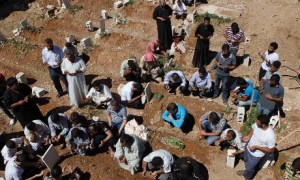
Combattants de l’ASL tombés au champ d’honneur.

R. R. : Comment voyez-vous la situation évoluer à court et moyen terme, et êtes-vous confiant dans le retour de la paix après la chute d’Assad ?

S. L. : La situation sera sanglante et bloquée si nous ne nous efforçons pas ardemment de résoudre le problème. Si l’on peut agir vite pour nous libérer, cela nous permettra d’épargner le plus de vies possibles et de sauver ce qui peut l’être de notre peuple, des propriétés, de l’infrastructure du pays, de son économie… Si on leslaisse faire ce qu’ils veulent (Bashar et les puissances occidentales) nous perdrons davantage de nos compatriotes et le carnage va empirer. Si cela devait arriver, le bain de sang se poursuivrait (ce serait un génocide) avec des milliers de morts supplémentaires, le pays pillé et mis à sac par son armée, les bâtiments et son infrastructure détruits, l’économie dévastée, des milliers de gens choisissant l’exil, les meilleurs cerveaux de Syrie, ceux qui sont essentiels pour reconstruire le pays, fuiraient une nation tout simplement abandonnée au chaos. Nous autres syriens nous ne le voulons pas. Nous ne pouvons accepter ça. C’est pourquoi nous travaillons très dur à organiser et harmoniser notre agenda pour tuer Bashar et mettre rapidement un terme à cette épouvantable situation. Nous autres syriens sommes optimistes parce qu’Allah nous accompagne et que nous sommes unis. C’est pourquoi nous pensons que la paix reviendra bientôt. Si Bashar reste au pouvoir, il n’y aura nulle paix. Juste plus de discours et de sang versé, et nous vivrons à jamais dans les ténèbres comme des esclaves. Nous ne pouvons l’accepter. C’est pourquoi nous  préférons  vivre dignement ou mourir en martyr. C’est l’option que nous avons retenue : la mort plutôt que d’être encore humiliés.

R. R. : Que pensez-vous de certaines allégations relevées dans de nombreux médias qui parlent de “guerre civile confessionnelle” ?

S. L. : Il n’y a pas de “guerre civile confessionnelle”. C’est de la propagande, distillée par le
régime et d’autres pays. Ils prétendent que si le régime tombe, une guerre civile va éclater et le massacre sera général et qu’au contraire, si Bashar reste, la société syrienne demeurera unie. C’est un mensonge éhonté ! Ce que l’Occident et Bashar projettent de faire, c’est de redessiner la carte de la Syrie en régions autonomes comme en Iraq, avec les Kurdes qui y auraient un état indépendant dans le Nord-Est, les Druzes dans le Sud et les Alaouites le long de la côte syrienne, tandis que les Sunnites obtiendraient le reste. Voilà leur projet, et Bashar se démène tant et plus pour réaliser son rêve d’un état Alaouite-Chiite. Ils oublient seulement que depuis le début de notre révolution, notre mot d’ordre a été “Uni, uni, uni : le Peuple Syrien est Uni !”

Le régime essaie d’attiser le sectarisme prétendu de la révolution ; le peuple pense différemment [la Syrie pour tous !].

Ce pays est à tous. Quelle que soit votre religion, secte ou groupe particulier, vous êtes syrien et vous appartenez à la Syrie. Les syriens de toute obédience refusent le projet de diviser notre nation et tous en appellent à l’unité. J’ai rencontré des Alaouites, des Chiites, des Chrétiens, des Druzes et des Sunnites au cours de notre révolution et tous ont rejeté ce plan pour nous diviser. Nous en appelons à l’unité : un peuple, un pays. En dépit des tentatives du pouvoir pour armer différentes sectes et les retourner les unes contre les autres. Pour nous diviser. Même si Bashar fait de son mieux pour semer la division parmi nous, nous ne permettrons pas d’être manipulés, de nous entretuer : nous sommes frères et sœurs.

Pour finir, je voudrais ajouter ceci : avant notre révolution, on vivait ensemble en parfaite harmonie. J’ai vécu, moi, dans un immeuble où mes voisins étaient chiites, juifs et chrétiens. Mes amis sont de religions différentes : on s’apprécie et on cohabite sans problème.

R. R. : Pensez-vous que cette expérience vous a changé ? Si oui, dans quelle mesure ?

S. L. :  Oui, j’ai changé. J’ai une plus grande conscience de la conspiration générale pour faire échouer notre révolution. J’ai également découvert que le monde ne se préoccupe que de ses intérêts et il se moque bien de tout le reste, sauf de lui-même. J’ai également fini de croire à la rhétorique des représentants de l’ONU ou des organisations non-gouvernementales, que ce soit les Droits de l’Homme, l’UNICEF, l’UNICO [universités & collèges en GB], la CPI [cour pénale internationale], l’IJP [institut de justice pénale] ou autre. Le monde n’a pas été capable de mettre au point le moindre programme pour aider les syriens en Syrie ou les réfugiés dans les pays voisins, ni même d’organiser une rencontre de donateurs. Même les conférences des “Amis de la
Syrie” n’a débouché sur rien. Tout ce que savent faire ces gens-là, c’est de nous regarder et laisser Bashar nous tuer avec le soutien russe et iranien.

Pour autant, la révolution m’a donné une forme d’espoir. Voulez-vous savoir ? Elle m’a appris que lorsque vous affrontez des difficultés et des obstacles dans votre vie, personne (excepté sans doute une poignée d’amis véritables ainsi que votre famille) ne se soucie de vous pour vous apporter de l’aide. Il faut tout faire soi-même et s’entraider de toutes les manières. La révolution m’a rendu très conscient de cela. Elle m’a rendu fier de mon peuple et de mon pays. Elle m’a appris ce dont nous avons besoin pour en finir avec cette situation. Nous sommes des gens pacifiques et nous ne manquons pas de ressources. On peut se reconstruire, nous et notre pays, développer nos talents et en acquérir d’autres. Je me sens plus responsable qu’avant : je veux me développer, parfaire mes capacités, acquérir de nouvelles connaissances et les partager avec mon peuple. Je veux enseigner aux générations futures que nous avons combattu et sacrifié nos vies pour gagner notre liberté, et que nous ne devons jamais plus accepter quiconque qui se prendrait pour un dieu avec un droit divin sur son peuple. Non, il nous faut désormais élire des chefs désintéressés, seulement préoccupés de la nation et du peuple syriens, et non de leur enrichissement personnel.

Je veux souligner le fait que la révolution est dans nos mains. Je pense que le monde à besoin de changement. Il doit comprendre que les peuples qui vivent sur cette terre sont égaux et qu’ils ont droit à la liberté. J’ai aussi découvert que ceux qui se posent en tant que “Leaders Arabes” ne sont que des traîtres à la solde des puissances étrangères. Au mieux, ils se moquent totalement des arabes.

R. R. : Combien de temps pensez-vous que la révolution puisse continuer, et que prévoyez-vous qu’il advienne quand elle sera achevée ?

S. L. : Lorsque nous avons commencé la révolution, nous savions qu’il n’y aurait pas de retour en arrière et nous n’avons pas changé d’avis ; après tout ce que nous avons enduré, consenti tous ces sacrifices, nous serions perdus de seulement imaginer revenir au statu quo ante. C’est notre mot de la fin : tout ce que Bashar nous a fait (et continue de nous faire, sans répit), il l’a fait avec de plus en plus d’aide d’Israël, de la Russie, de l’Iran et de la Chine. Nous avons prouvé au monde entier (qui s’obstine dans ses dénégations) que des troupes iraniennes, des hommes du Hezbollah et des soldats russes ont été capturés dans chaque ville de Syrie. Chacun de ces hommes était porteur de documents qui attestent cette évidence. Nous avons également obtenu des documents officiels en provenance du pouvoir qui prouvent que Bashar a fait venir de plus en plus d’hommes en provenance d’Iran (gardiens de la révolution), du Liban, d’Iraq, de Russie et d’autres pays qui fournissent aussi bien des armes que des troupes. Malgré cela, le régime d’Assad est en train de perdre la bataille. Ses alliés et les puissances occidentales veulent qu’il demeure, et ils le couvrent de toutes les manières possibles. Malheureusement pour lui, nous le battrons lui et ses alliés, et nous le tuerons, inch’Allah !
Vous me demandez combien de temps la révolution va-t-elle encore durer : jusqu’à ce que nous tuions Bachar et que nous chassions les russes, les iraniens et le Hezbollah hors de Syrie. Personne, dans notre pays, n’accepterait de s’arrêter aujourd’hui car dans chaque maison de chaque village, ville ou grande cité de Syrie on compte au moins un martyr, un prisonnier, une victime d’enlèvement par les forces du régime, à moins que ce soit un membre de la famille qui ait été contraint à l’exil. Savez-vous qu’Assad a anéanti de nombreuses familles ?

Savez-vous qu’il a détruit la plupart des villes du pays et qu’il a emprisonné plus de 250 000 personnes ? Savez-vous qu’il punit collectivement chaque syrien dans chaque secteur qui s’oppose à lui (c’est à dire presque toute la Syrie) ? Savez-vous que ses forces détiennent et retiennent des stocks de produits pharmaceutiques, qu’elles empoisonnent les réserves d’eau et de nourriture, bombardant les boulangeries pour affamer la population ? Assad fait aussi bombarder les hôpitaux, vise le personnel médical dans l’espoir que le peuple syrien sera obligé de lui obéir. Voici la réponse que nous lui adressons : “vas en enfer !”

Le monde voit tout cela et ne fait rien. Il s’excuse en disant : “c’est bien difficile. C’est compiqué”. C’est très simple, au contraire. Les syriens veulent être libérés de la dictature et la Communauté Internationale pourrait nous aider si elle le voulait. Les syriens savent tout cela. Nous allons continuer à nous soutenir les uns les autres, soutenir et combattre pour l’ALS. Quoique fasse Assad, nous ne calerons pas. Chaque homme, chaque femme, chaque enfant va combattre jusqu’à son dernier souffle. Pas question d’accepter ce que l’ Occident à décidé pour nous. Nous ne céderons pas. Nous n’accepterons pas ce que l’on veut nous imposer. Nous l’avons commencée et nous allons la finir, cette révolution. Par-dessus tout, et nous l’avons déclaré à nos débuts, Allah est avec nous, Allah et personne d’autre que Lui. Nous n’avons que Lui.

Vous voulez savoir “ce que nous ferons” après la révolution. Pour l’instant, on travaille dans la clandestinité afin que tout soit prêt, et il y a une parfaite collaboration entre nous. Nos plans sont arrêtés, mais nous ne pouvons nous dévoiler de peur que l’ennemi ne découvre ce que nous préparons. Tout ce que je peux dire, c’est que nous assurons la coordination entre l’Armée de Libération, les conseils militaires, l’opposition et les différents partis pour nous assurer que la normalité et la loi seront restaurées à la chute d’Assad, afin que le peuple syrien puisse retourner à une vie normale. Nous créerons un jour la transition qui restera en place jusqu’à ce qu’une nouvelle constitution soit adoptée et qu’un nouveau président avec un gouvernement et un parlement soient établis.

R. R. : Quels sont vos projets pour la période post-révolutionnaire, et est-ce que ce que vous avez vécu pendant la révolution les a-t-ils modifiés, et en quoi ?

S. L. : Aujourd’hui, je voudrais acquérir d’avantage d’expérience et m’impliquer activement en politique. Je veux jouer un rôle actif dans la reconstruction et le développement de mon pays et aussi participer à l’aide médicale de mes compatriotes. J’aimerais m’impliquer dans l’aide humanitaire et l’aide sociale car, comme vous le savez, un grand nombre d’adultes et d’enfants ont dû subir des amputations suite aux bombardements du régime. Ces personnes ont besoin de prothèses, tandis que d’autres ont besoin d’être opérés sans tarder. Tout cela va coûter des sommes considérables, aussi avons-nous besoin d’argent et de l’aide d’hôpitaux étrangers.

Je voudrais aussi m’investir dans l’éducation. Comme vous le savez, je suis traducteur et j’aimerais aider à enseigner aux enfants et aux jeunes gens dans les écoles, les collèges et autres établissements scolaires. Le régime a tué un grand nombre de professeurs dans toutes les disciplines, c’est pourquoi nous souffrons d’une grande pénurie dans ce domaine, et il va falloir vraiment mettre les bouchées doubles pour pallier toutes ces vacances. Il nous faudra aussi surveiller les fondations d’un projet éducatif afin de mettre en place un programme d’études accéléré. De cette façon, nous éviterons les difficultés pour des enfants qui ont manqué deux années d’études à cause des bombardements du régime et le chaos qui s’en suivit.

Nous voulons procéder à l’arrestation de tous ceux qui auront été impliqués dans des meurtres, dans la pratique de la torture, des viols et des pillages. Ces personnes seront em prisonnées et jugées. Ceux qui auront commis le pire seront exécutés. Nous ne permettrons à personne d’échapper au châtiment, quelle que soit sa religion. Nous avons tous été confrontés à la persécution, à la terreur et à l’intimidation, et beaucoup trop d’entre nous ont été torturés et/ou assassinés. C’est pourquoi nous voulons justice et dignité pour tous. De manière égale.

Pour conclure, je vous dirai que je veux participer activement au processus politique afin d’aider et représenter mon pays et mon peuple. J’ai toujours l’ambition d’obtenir ma maîtrise de traducteur et d’interprète, même si le régime m’a privé de cette chance en gâchant deux années de ma vie à cause d’une guerre brutale déchaînée contre les syriens eux-mêmes. C’est ce que ce pouvoir nous a imposé, mais nous rejetons ce régime.

https://wewritewhatwelike.com/2012/09/22/interview-with-a-free-syrian/ (original)

Le facce in gigantografia che vedano tutto, anche dopo la morte

Ruth Riegler ha intervistato un attivista in Siria per comprendere la vita che si conduce nella Siria rivoluzionaria. Egli usa uno pseudonomo. Traduzione a cura di Shadi Inomad

RR: Come descriveresti la vita prima della rivoluzione? E quali credi siano state le origini della rivoluzione?

FS: Il mio nome è Libero Siriano (Free Syrian). Voglio dire al mondo perché abbiamo fatto la rivoluzione contro Bashar Al Assad e il suo regime. Tutti nel mondo sanno che si tratta di una grandiosa rivoluzione, ma in realtà nessuno sa quale sia la vera ragione dietro di essa. Te lo dirò io. Voglio che il mondo intero sappia come si viveva prima della rivoluzione e quali sono le ragioni di questa. Vivevamo in un mondo in cui abbiamo dovuto dar retta e obbedire come schiavi – qualunque cosa dicesse il padrone, dovevi obbedire e farlo, e se gli disubbidivi ti puniva o ti uccideva.

Abbiamo vissuto in uno stato di sicurezza, il che significa che siamo stati governati da un presidente e dai suoi militari, dall’intelligence, dagli ufficiali dell’esercito, dalla polizia regolare e quella militare, dagli informatori e dagli shabbiha (bande armate, sono delle milizie paramilitari a base settaria, ossia composta da alawiti, che vengono pagate profumatamente e agiscono a sostegno di Assad, ndr). Quando volevi far qualcosa, dovevi prima ottenere il loro permesso e vedere se le loro regole ti permettevano di farlo o no, il che significava che non avevi il diritto di fare nessuna cosa in modo indipendente e avresti dovuto affrontare degli ostacoli se avessi tentato. Solo il personale del regime poteva vivere liberamente e senza essere governati da delle leggi; potevano fare ciò che volevano senza chiedere, comandando ogni settore, tra cui il sistema politico, il petrolio e il gas, l’economia, le banche, il commercio, i militari, l’agricoltura e l’istruzione. In effetti, si consideravano degli dei.

I siriani erano proibiti dal toccare la loro terra: l’esercito israeliano, addirittura faceva esercitazioni.

Abbiamo vissuto sotto questo regime, che rivendica di essere anti-sionista, ma in realtà questa è solo un’altra menzogna perché per 47 anni non ha mai sparato un solo proiettile contro Israele e ha mantenuto la calma nelle alture occupate del Golan, vietando a qualsiasi siriano di sparare anche un solo colpo contro Israele o di rivendicare questa terra rubata. Chiunque lo avesse fatto sarebbe stato gettato in prigione, punito ed eventualmente ucciso.

Abbiamo vissuto come schiavi, senza alcun diritto. Ci sono stati vietati la scelta di un candidato alla presidenza, lo svolgimento di elezioni libere, la costituzione di partiti politici o la selezione di nostri rappresentanti per il parlamento. Solo ad Assad e alla sua rete di intelligence era concesso scegliere i parlamentari e scelsero le persone più corrotte, senza morale o coscienza, permettendo loro di fare i propri interessi. Se ti fossi opposto a qualunque cosa facessero, saresti stati messo in prigione e ti avrebbero fatto ogni cosa avessero voluto, perché tu non sei nulla per loro.

La gente aveva paura di opporsi o dissentire con il regime o chiunque fosse vicino ai servizi segreti: i siriani impararono a tenere la testa bassa e non dire nulla. Anche se solo avessi maledetto Bashar, sarebbero venuti a prenderti ovunque tu fossi e ti avrebbero portato alla sezione locale dei servizi segreti, senza che nessuno sapesse dove tu fossi o osasse chiedere di te o anche solo nominare il tuo nome. Se volevi dare vita a un movimento politico sarebbe successo lo stesso, perché in Siria abbiamo avuto un solo partito e tutti i siriani erano costretti a farne parte. Se tu avessi evitato il servizio militare obbligatorio e non volessi servire, ti avrebbero imprigionato per tre o più mesi per poi in ogni caso costringerti a fare il servizio militare. Se si fosse morti in custodia dei servizi segreti, nessuno avrebbe chiesto come e perché eri morto e nessuno sarebbe stato ritenuto responsabile per la tua morte, perché la Costituzione conferisce l’immunità completa al presidente, ai suoi servizi di intelligence e i suoi alleati militari. Il popolo siriano è trattato come gli insetti che sono schiacciati sotto i piedi, senza attenzione per i nostri morti.

L’oppressione non si può fotografare, ma la si può sentire ovunque.

Il sistema permetteva al presidente, alle sue forze armate e ai servizi segreti, di arrestare, torturare o uccidere chiunque, di fare quello che volevano di noi, senza che nessuno nel mondo esterno sapesse cosa stava succedendo. La corruzione, il nepotismo e il favoritismo sono la norma in tutte le istituzioni statali e la gente ha imparato a esistere solo e a badare solo ai propri interessi, non chiedendo o aiutando nessuno se non sè stessi, dove solo Assad ei suoi fedelissimi del regime avevano il permesso di fare ciò che volevano; la Siria è la sua fattoria e i siriani sono gli animali.

Vorrei anche fare un accenno sull’economia siriana. Nonostante la scoperta di riserve di petrolio e di gas nel nord-est del paese e di enormi riserve di petrolio e di gas offshore, ci chiedevamo perché questi prodotti fossero così costosi per noi e perché invece compravamo gas e petrolio dall’Iran, Iraq ed Egitto. Abbiamo scoperto che questo accadeva perché Bashar e la sua famiglia rubavano il gas e il petrolio della Siria per venderlo sottocosto alla Russia e ai paesi europei, mantenendo i profitti per sè stessi, mentre noi siriani non avevamo altra scelta che comprare gas e petrolio dalle aziende statali a prezzi elevati – sempre che riuscissimo a trovarne per tutti. Il governo aumentò artificiosamente in modo costante il prezzo del petrolio e del gas e di conseguenza i prezzi di ogni altro bene – pane, riso, zucchero, vestiti, prodotti elettronici, case, tutto – aumentò e continuò a crescere senza mai diminuire. Data la grande ricchezza di petrolio e gas del nostro Paese, questa è la situazione più assurda.

La nostra economia è una farsa. Anche se il governo ha ottenuto aiuti provenienti da altri paesi, qualunque nostra domanda riguardo dove sarebbero finiti tali fondi è rimasta senza risposta. Quando volevamo sviluppare la didattica del paese, la sanità, l’agricoltura, alcuni settori industriali o la sua rete elettrica, il governo disse che avrebbe avuto bisogno di imporre più tasse per farlo, che avrebbe avuto bisogno dell’aiuto di altre nazioni, perché la Siria non aveva le risorse.

Ogni aspetto della vita dei siriani era controllato, l’intelligenza spiava sempre. Ecco la vita sotto degli Assad.

Se un siriano, cercando di vivere una vita dignitosa, avesse voluto avviare una attività produttiva per vendere i nostri propri prodotti, o di importare merci da rivendere, come automobili, vestiti o apparecchiature elettriche, il regime non ce lo avrebbe permesso, a meno che ne avesse una percentuale degli utili e fossero pagate tangenti regolari [oltre le consuete tasse]. Se eri d’accordo, ti avrebbero concesso una licenza di esercizio, ma se ti fossi rifiutato, ti avrebbero respinto la richiesta e creato ostacoli.

Chiunque avesse voluto aprire qualsiasi tipo di negozio, sia un piccolo negozio che venda generi alimentari, o una libreria, un supermercato, un internet café o qualsiasi altra cosa, avrebbe dovuto anzitutto ottenere il permesso da parte dei servizi segreti, prima di richiedere una licenza agli organi statali competenti, e pagare tangenti ai funzionari. Per esempio, se avessi voluto aprire un internet café, avrei dovuto in primis ottnere il permesso dei servizi segreti, quindi andare al ministero della comunicazione e pagare una tangente ai funzionari perché alla domanda fosse dato il suo corso, prima di andare all’ufficio locale del governatorato, poi all’ente dell’istituzione finanziaria, e proseguire con questo groviglio burocratico per mesi prima di non arrivare comunque a ottenere niente. Anche se volevi sposarti e organizzare una festa di nozze, per farlo dovevi prima ottenere il permesso ufficiale dello stato; mi dispiace usare un linguaggio grezzo, ma è una storiella ricorrente tra siriani che anche se tu volessi fare l’amore con tua moglie era prima necessario ottenere il permesso scritto del governo.

Abbiamo anche avuto il servizio militare obbligatorio per ogni uomo di una certa età. Molti fuggono all’estero per lavorare o studiare quando raggiungono i 18 anni, o pagano tangenti per evitare il servizio militare (dai 1000 dollari americani in su, cioè lo stipendio medio annuale di un siriano, ndr). Se non potevi permetterti di viaggiare e lavorare o studiare all’estero e non avessi altro modo per sfuggire alla coscrizione, avresti potuto lavorare per loro come un servo, un autista o una guardia. Se eri in grado di pagare una tangente settimanale agli ufficiali superiori, avresti potuto esser esentato dal servizio e avresti potuto ottenere il permesso di andare a cercare un posto di lavoro o piuttosto rimanere disoccupato. Se avessi potuto permetterti di pagare una tangente maggiore come l’acquisto di un televisore per un alto ufficiale, o di pagare le loro bollette telefoniche, o riparare la sua macchina o facendo un qualsiasi altro servizio utile, avresti potuto essere in grado di evitare il servizio militare per i prossimi due anni, ma dopo ciò avresti dovuti iniziare la tua vita ancora una volta da zero.

I siriani vogliano la libertà

Queste sono alcune delle cose che ci hanno spinto a insorgere contro il regime di Assad. Vogliamo la libertà. Vogliamo scegliere noi stessi la nostra vita. Vogliamo organizzare e rafforzare il nostro paese con le nostre mani. Vogliamo costruire e produrre le nostre merci nei nostri stabilimenti. Vogliamo migliorare l’istruzione della Siria, la salute, l’agricoltura e tutti gli altri settori, che Assad ha ignorato, vogliamo essere innovatori, per costruire le prime automobili e primi treni arabi. Sì, siamo persone come chiunque altro al mondo che vuole dignità. Per tutte queste ragioni noi continueremo a combattere e non torneremo indietro; vivremo la nostra vita con dignità o moriremo come martiri. Vogliamo la libertà.

RR: Puoi brevemente descrivere una giornata tipo in modo da dare ai lettori un’idea di ciò che tu e altri siriani dovete avere a che fare?

FS: Immaginati di svegliarti in una bella mattina di sole, di lavarti il viso e poi bere il tuo caffè, sorridendo al pensiero di quel che otterrai oggi, anche se devi superare degli ostacoli introdotti da parte del governo sul tuo percorso. Quella era la vita prima della rivoluzione.

Ora riusciamo a dormire in orari normali e ci svegliamo presto, sempre che riusciamo a dormire. Tutto ciò che riguarda le nostre vite è cambiato da quando è iniziata la nostra benedetta rivoluzione, il 15 Marzo 2011 a Daraa. Ad ogni modo, lascia che ti dica cosa è cambiato nel mio programma quotidiano e nella vita in generale. Anzitutto, ho comiciato a dormire tardi oppure a mala pena non dormire affatto, svegliandomi sempre per udire esplosioni di bombe, colpi di cannone, spari oppure manifestazioni, giorno e notte. Pure le mie abitudini sono cambiate. Frequentavo un istituto locale di lingua inglese per esercitarmi nella capacità di traduzione e per sviluppare le mie competenze dopo la laurea, così come mi incontravo con un amico per lavorare in modo da trovare il miglior posto per ottenere un master in traduzione. Trovai un posto in un corso a Preston, nel Regno Unito, ma sfortunatamente non sono stato in grado di accettare l’offerta poiché non in possesso di un passaporto e poiché erano stati sospeti i corsi TOEFL al Centro Linguistico Americo nella mia città. Nonostante io abbia anche contattato il British Council per cercare di convincerli ad offrire un corso TOEFL o ILTES nel Regno Unito, non penso che quest’anno riuscirò a iniziare il mio Master e comunque ho perso la mia occasione. Questo non è stato l’unico problema che ho dovuto affrontare da quando, dopo aver cercato per un certo tempo un lavoro, me ne era stato promesso uno l’anno scorso in una società privata di comunicazioni. Tuttavia anche questo è saltato dato che la situazione qui era diventata sempre peggiore. Il fatto che non avessi svolto il servizio militare significava che non potevo lavorare o viaggiare, perché non fare il servizio militare ti preclude la possibilità di fare entrambe le cose, un altro ostacolo per lasciare il paese per fare il mio Master. Questo mi ha fatto sentire senza speranza, senza lavoro e senza la speranza di un Master stavo perdendo il desiderio per la vita e tutto il resto. In seguito il regime cominciò ad uccidere la nostra gente, in un primo momento a Daraa, dove le truppe di Assad usavano proiettili veri contro manifestanti disarmati, e in seguito con carri armati dentro le città. A noi giovani siriani ciò non piacque e cominciammo a manifestare contro questo atteggiamento. Successivamente il regime cominciò ad utilizzare delinquenti e picchiatori in borghese, noti come “shabbiha”, per terrorizzarci, e da allora ha usato di tutto contro di noi.

Prima della rivoluzione ero solito avere tre pasti al giorno, ora ne ho uno solo. Prima dormivo otto ore, ora avrei potuto al massimo dormirne cinque e spesso restavo sveglio fino al mattino. Ho lavorato per far quel che potevo per aiutare i siriani che avevano bisogno di assistenza, nascondendoli e aiutando chiunque avesse bisogno di tradurre notizie o video inviati da altri attivisti. Ricevo un sacco di notizie, le traduco e le condivido ovunque posso, parlando con amici e scambiando opinioni su cosa dovremmo fare. Gran parte delle nostre conversazioni ruotano attorno a come ogni altra nazione del mondo stia sostenendo Bashar affinché rimanga al potere perché non vogliono perdere il loro maialino domestico che protegge Israele e ne preserva la sicurezza nella regione.

Il regime ora ha collocato posti di blocco sulle strade principali in ogni paesino ed in ogni città, e ha chiuso tutte le strade che portano al suo palazzo a Damasco, così come ha posizionato cecchini ovunque, specialmente nelle zone dei ribelli. Se vuoi andare a fare shopping o in palestra, vedere gli amici o andare da qualsiasi parte, le truppe del regime ti feramo ai checkpoints e verificano che il tuo nome non sia inserito nella lunga lista dei soggetti ricercati, di quelli che identificati come attivisti o di quelli che hanno evitato il servizio militare. Se il tuo nome è nella lista, ti arrestano o semplicemente ti sparano sul posto. Ogni giorno dobbiamo passare attraverso questi posti di blocco. Un giorno, di recente, sono andato a trovare degli amici per aiutarli nel lavoro connesso alla rivoluzione. Fui fermato per una mezz’ora ad un checkpoint e cominciai a preoccuparmi. Quando un soldato del regime chiamò il mio nome, andai da lui e gli chiesi quale fosse il problema: mi guardò e mi disse “Prendi la tua carta d’identità e vattene, stai sprecando il nostro tempo alla ricerca del nulla”. Dopo questo avvenimento, decisi che ovunque sarei andato, avrei utilizzato una scorciatoria per evitare i posti di blocco. Recentemente, in un’altra occasione, andai a Barzeh a visitare i genitori di un amico di nome Salim che era stato colpito a morte da un cecchino, per portar loro le mie condoglianze. In quel momento in quella zona vi erano degli scontri feroci tra le truppe del regime e l’ESL. Mentre ero in direzione dell’isolato dove si trovava l’appartamento della famiglia di Salim, un cecchino mi sparò ma mi manco per poco. Realizzai tutto ciò solo quando uno sconosciuto mi tirò verso l’entrata e mi disse “Sei matto? Vuoi morire così in malo modo?”.

La vita sotto i cecchini

Bashar il maiale ha ordinato di piazzare cecchini ovunque e ha dato loro istruzioni di sparare a chiunque essi vogliano. Molti dei miei amici sono stati uccisi dai cecchini, mentre altri sono stati nel mirino ma sono sopravvissuti. Un mio amico di nome Anwar ch era senza paura e partecipava ad ogni manifestazione anti-regime, fu colpito alla testa. Nonostante sia rimasto nel reparti di terapia intensiva per sei mesi, Allah ha evidentemente voluto che continuasse a vivere, con il proiettile che era passato attraverso il cranio. Nonostante sia sopravvissuto, tuttavia ora è parzialmente paralizzato e ha una mobilità molto limitata del suo braccio e della gamba destre. Altri amici sono tra coloro che sono scomparsi dopo esser stati arrestati dalle forze del regime; nessuno sa dove siano o se siano ancora ancora in vita. Uno di loro, un mio caro amico che si chiama Bilal, era sempre solito venire ad ogni manifestazione per sostenere la caduta del regime. Quotidianamente sento di amici che vengono rapiti per ottenere un riscatto, mentre alcuni amici vengono rapiti per strada oppure ai posti di blocco. Alcuni chiamano i loro genitori per chiedere soldi da versare ai rapitori; a meno che il riscatto non sia pagato non gli viene detto dove si trovi il loro bambino.

E’ impossibile descrivere l’interno che stiamo vivendo, senza alcun ordine o stabilità, mentre il mondo sta a guardare e non fa nulla. Molti giovani per sopravvivere fuggono all’estero: altri si uniscono all’ESL, molti dei quali dopo aver defezionato dalle forze del regime che sono sono costretti a servire. Al momento questa è la mia vita in Siria. Ho pensato di entrare nell’ESL. A dire il vero, spesso vorrei fuggire il più velocemente possibile. Già avevo pensato di fuggire e di andare all’estero, ma come ho detto non ho un passaporto e, nonostante abbia chiesto a molti amici e conoscenti di aiutarmi ad uscire, è molto difficile farlo senza passaporto.

Alla fine voglio dire che odio Bashar Al Assad e suo padre da quando sono venuti a governare la Siria. Conosciamo tutta la storia della sua famiglia e quel che hanno fatto. Sappiamo della loro distruzione assassina e sappiamo che Hafez Al Assad ebbe supporto e copertura dei suoi crimi a Hama, Aleppo e Deir El Zour (all’inizio degli anni ’80, ndr) da parte di USA, Russia, Iran e Israele e che questi stessi paesi stanno facendo lo stesso per suo figlio Bashar.

Dopo l’ennesima invasione del campo rifugiati vicino Damasco. Carri armati che hanno devastato anche le macchine.

RR: Come rispondi a quelli che continuano ad insistere sul fatto che Assad è un’icona anti-sionista?

FS: Tutti sappiamo che Hafez Al Assad (che Allah possa maledire lui e suo figlio) ha venduto le alture del Golan ad Israele e che fu responsabile dell’uccisione di molti palestinesi in Libano e Siria per preservare la sicurezza di Israele in Libano. Ora suo figlio Bashar sta facendo la stessa cosa in maniera differente. Ha attaccato molte aree palestinesi presenti in Siria, in particolare a Damasco il campo profughi di Yarmouk, che ho visto con i miei occhi. Se credi che egli sostenga Hezbollah per combattere e sconfiggere Israele, questa è una menzogna. Tutti sappiamo che (Bashar, ndr) ha dato a Hezbollah il via libera di uccidere il leader sunnita Rafiq Al Hariri in Libano, oltre ad esser d’accordo con Nasrallah per migliorare l’immagine di Nasrallah stesso e farlo sembrare un eroe di guerra, ma la guerra del 2007 contro Israele fu un’altra menzogna, semplicemente uno stratagemma per consentire l’espansione di Hezbollah in Libano e far sì che gli sciiti avessero un maggior potere nel paese per permettere all’Iran di avere lì il controllo e realizzare il piano di Teheran per un Medio Oriente sciita, dall’Iran all’Iraq, Siria, Libano, Egitto, Arabia Saudita e Yemen. Bashar Al Assad insiste sempre sul fatto che si oppone a Israele, che egli conduce la resistenza contro Israele stesso. Al che io rispondo: allora perché improgioni, torturi e uccidi i miei amici e decine di migliaia di altre persone in Siria? Perché ammazzi i miei fratelli palestinesi e iracheni? Perché non hai fatto nulla quando gli aerei militari israeliani violarono lo spazio aereo siriano? Non cercare di mentire al popolo siriano, noi ti conosciamo meglio di chiunque altro, lo sappiamo che il tuo lavoro è quello di uccidere noi e proteggere Israele; che Dio ti maledica, figlio di un adulterio.

Homs, molte famiglie cercano il reparo durante un bombardamento

RR: Come fai fronte allo stress per vivere in quella che è a tutti gli effetti una zona di guerra?

FS: E’ molto difficile per noi garantire i nostri bisogni in queste circostanze; viviamo con prudenza e mangiamo e compriamo solo lo stretto necessario. Per me, diventa più difficile sapendo che sono senza lavoro e che mio padre mi sta tuttora aiutando finanziariamente. Vivo con i miei genitori e li aiuto; nella situazione attuale, in Siria la maggior parte delle famiglie allargate è ammassata in una sola casa, con qualcosa come dalle tre alle dieci famiglie separate in ogni casa. La situazione è molto brutta, la maggior parte della Siria, tra il 65 e il 75%, è distrutta. Cerchiamo di acquistare e immagazzinare tutto il cibo che si può, ma alcune zone sono senza niente. In aree come quella di Homs non riescono a trovare alcun cibo e niente con cui proteggersi e mantenersi al caldo. L’inverno presto arriverà, fra due mesi, e vogliamo porre fine a ciò il più presto possibile. La maggior parte delle città siriana non hanno più nulla, Assad ha bruciato la maggior parte delle colture e ha distrutto le case. Io posso mangiare quasi tutti i giorni, ma altri non possono e sono preoccupato per loro. Gli inviamo aiuti ma il regime sta assediando quelle aree, nonostante l’ESL faccia del suo meglio e lavora duramente per fornire aiuti e medicine.

Nessuno ha una minima idea della tragedia che stiamo vivendo, ma i nostri spiriti rimangono forti e tutti noi sappiamo che vinceremo perché Allah è con noi e uccideremo Bashar, inshallah. Continueremo a sostenerci l’un l’altro con cibo, medicine o qualsiasi cosa necessaria per vincere. Voglio sottolineare che il vero esercito del nostro paese è l’Esercito Siriano Libero, l’ESL, e siamo molto orgogliosi di loro. Siamo tutti parte del popolo siriano e saremo tutti uniti: come gridiamo alle nostre manifestazioni, “Uno, uno, uno – il popolo siriano è uno”.

Dov’è il mondo?

RR: Come ti senti circa l’apatia di gran parte del mondo nei confronti della rivoluzione siriana e hai cambiato opinione riguardo la “comunità internazionale”? Se sì, come?

FS: Perché il mondo intero ha benedetto le rivoluzioni in Tunisia, Egitto, Libia e Yemen e le ha sostenute, mentre nessuno ha aiutato o supportato la nostra rivoluzione inSiria o ha cercato di raccontare la verità sulla giustezza della nostra causa? Perché è stato permesso a Russia, Iran, Cina e Iraq di continuare ad aiutare Bashar e il suo regime con armi, denaro, petrolio, benzina e iniziative politiche? Perché le potenze occidentali non hanno cercato di aiutarci creando una no-fly zone, fornendoci le armi necessarie o garantire zone al sicuro per i civili?

Tutte queste domande possono sembrare senza risposta, ma noi siriani sappiamo perché: le potenze occidentali vogliono imporci la loro soluzione con le loro maniere, e questo è ciò che non accetteremo mai. Ma ti dirò quali sono le opzioni o le soluzioni che ci offrono. Vogliono farci accettare le loro condizioni, consentendo a Bashar di rimanere al potere, accordandoci una libertà apparente e dei cambiamenti di facciata creando un governo di unità nazionale. Non vogliono gente nobile o veri ed autentici patrioti così come non vogliono l’ESL; vogliono ucciderli tutti e imporci a loro volontà. Quel che più conta è che vogliono che Israele sia lasciata in pace senza che nessuno possa persino portare qualsiasi pericolo, e come la storia dimostra, Bashar è il miglior candidato per questo. Per questo motivo (le potenze occidentali, ndr) lasciano che Iran, Russia e Iraq lo sostengano inviandogli più armi e truppe per aiutarlo dopo che non avrà più siriani che compiono defezioni di massa in quanto i siriani non lo vogliono. Esse permettono a questi paesi di inviargli soldi e truppe da parte di Hezbollah, dell’Esercito del Mahdy (formazione paramilitare irachena creata nel giugno 2003 dal leader sciita iracheno Moqtada Al-Sadr, ndr) e della Quds Force (letteralmente “Brigata Gerusalemme”, l’unità delle Guardie Rivoluzionarie responsabile dell’esportazione dell’ideologia khomeinista fuori dall’Iran, è guidata dal generale Qasem Suleimani, ndr). Il loro pretesto per consentire ciò è che la questione è difficile e complessa, ma in realtà è molto semplice: vogliamo la libertà. Dateci le armi pesanti necessarie a distruggere i suoi aerei da guerra, carri armati e lanciarazzi e possiamo vincere. Essi sanno che Bashar è estremamente povero così usano anche la scusa che se ci dessero le armi, l’ESL non sarebbe in grado di controllarne l’accesso e Al Qaeda acquisirebbe potere. Ma i siriani sono tutti ben consapevoli che non esiste Al Qaeda nè in Siria nè in nessun paese arabo, e così le potenze occidentali tirarono fuori un’altra scusa: che la nostra opposizione non è unita. Ma in realtà neanchè le opposizioni che rovesciarono regimi in altre nazioni erano unite.

Le potenze occidentali non hanno fatto nulla neanche per i rifugiati siriani in Turchia, Giordania, Libano e Iraq; non hanno inviato loro alcun aiuto reale e non hanno permesso loro di fare nessun lavoro. Non li hanno nemmeno registrati presso le Nazioni Unite (come rifugiati, ndr), li hanno semplicemente lassciati nei campi situati in zone morte in Iraq e Giordania, perché vogliono che i siriani obbediscano ai loro ordini, accettando Bashar Al Asssad e ritornando a vivere sotto il suo regime e se rifiuteranno, verranno puniti lasciandoli senza cibo, acqua o i servizi essenziali. Non ci aiuteranno a ucciderlo, nessuno ci aiuterà. Abbiamo solo noi stessi e facciamo affidanmento solo a Dio, e questo è quel già stiamo facendo ora.

Momento durante un funerale per gli FSA

RR: Come vedi svilupparsi la situazione in Siria nel breve e nel lungo termine, e ti senti ottimista che si possa avere la pace dopo la caduta di Assad?

FS: La situazione si svilupperà in maniera lenta e sanguinosa se non lavoreremo sodo per risolverla. Se siamo in grado di muoverci velocemente per liberar noi stessi sarà il miligior modo per non perdere altri siriani e per salvare ciò che ancora possiamo del nostro popolo, delle nostre proprietà, infrastrutture, economia e tutto il resto. Se lo lasciamo fare ciò che lui, i suoi alleati e le potenze occidentali vogliono, perderemo altre persone e ci sarà un ulteriore spargimento di sangue. Se ciò accade, il bagno di sangue continuerà, sarà un genocidio, con altre migliaia di morti, il paese sarà saccheggiato e depredato dalle sue forze, gli edifici e le infrastrutture saranno distrutti, l’economia devastata, altre migliaia di persone che vivranno in esilio e una fuga di cervelli delle persone migliori che sono essenziali per ricostruire il paese, che sarà lasciato nel caos. Noi siriani non vogliamo nè accettiamo questo, e così lavoriamo sodo tra di noi per unire le nostre forze per ucciderlo e porre al più presto fine a questa terribile situazione. Noi popolo siriano siamo ottimisti perché Allah è con noi e siamo tutti uniti, e crediamo che prestò ci sarà la pace. Se restasse non ci sarebbe nessuna pace, solo più caos e spargimenti di sangue e vivremo nelle tenebre per sempre come schiavi. Ci rifiutiamo di accetare questo per cui preferiamo vivere con dignità oppure morire come martiri. Questa è la nostre opzione preferite, la morte piuttosto che l’umiliazione.

RR: Come vedi la pretesa ripetuta da molti mezzi di informazione che si tratti di una “guerra civile settaria”?

FS: Non vi è una guerra civile settaria: questa è soltanto propaganda usata e promossa dal regime e in altri paesi. Essi sostengono che se il regime crolla ci sarà la guerra civile e la gente che si ammazza a vicenda, ma se rimane manterrà integra la società siriana. Questa è una menzogna sfacciata; quello a cui il regime e loro (le potenze straniere, ndr) stanno lavorando è dividere la Siria in regioni autonome come in Iraq, ai Curdi uno stato nel nord-est, ai drusi uno nel sud e agli alawiti uno sulla costa siriana, mentre ai sunniti rimarrebbe il resto. Questo è il loro piano e Bashar sta lavorando duramente per realizzare la sua ambizione di uno stato alawita-sciita. Si dimenticano però che fin dall’inizio della rivoluzione il nostro moto è stato “Uno, uno, uno – il popolo siriano è uno”.

Il regime spinge sul settarismo mentre il popolo siriano la pensa diversamente

Questa nazione è per tutti: qualunque sia la tua religione, setta o gruppo tu sei siriano e appartieni alla Siria. Tutte le sette del popolo siriano rifiutano questo piano di dividere la nazione e si sono appellate all’unità. Durante la rivoluzione ho incontrato e parlato con siriani alawiti, sciiti, cristiani, drusi e sunniti e tutti hanno respinto questi piani per dividerci. Tutti invochiamo l’unità – un popolo una nazione, anche se il regime ha tentato più volte di armare sette diverse e dirigerle l’una contro l’altra, per creare divisioni tra di noi. Per quanto (il regime, ndr) si sforzi, non permetteremo di essere manovrati in questo modo, e di combattere e uccidere l’un l’altro – siamo tutti fratelli e sorelle.

Infine, voglio dire una cosa in più: prima che la nostra rivoluzione cominciasse, abbiamo tutti vissuto in pace e armonia. Io vivevo personalmente in un condominio con vicini sciiti, ebrei e cristiani. I miei amici appartengono a tutte le sette, ci amiamo vicendevolmente e viviamo assieme.

RR: Pensi che questa esperienza ti ha cambiato come persona? Se sì, in che modo?

FS: Sì, mi ha cambiato e ha accresciuto la mia consapevolezza riguardo il complotto globale volto a garantire il fallimento della nostra rivoluzione. Ho anche scoperto che l’intero mondo guarda solo ai propri interessi e non si preoccupa nient’altro che di sè stesso. Non credo più nella retorica delle Nazioni Unite e delle organizzazioni non governative, che si tratti di Human Rights Watch, UNICEF, UNICO, della Corte penale internazionale, del CJI o di qualsiasi altra cosa. Il mondo intero non è riuscito ad ideare un programma per aiutare i siriani in Siria o i rifiugiati nei paesi limitrofi o addirittura tenere una riunione di donatori. Anche la conferenza “Amici della Siria” non ha ottenuto nulla; stanno solo a guardarci e a lasciarci uccidere con il sostegno russo e iraniano.

La rivoluzione mi ha comunque dato una speranza in un modo: vuoi sapere come? Mi ha insegnato che quando si incontrano problemi o ostacoli nella vita, nessun altro se non solo una manciata di veri amici si preoccuperanno o aiuteranno te e le tua famiglia, devi fare da solo e aiutare gli altri nella stessa situazione in qualunque maniera. Mi ha reso più consapevole e orgoglioso del mio popolo e del mio paese e di cosa dobbiamo fare per porre fine a ciò. Siamo gente pacifica e abbiamo delle risorse. Possiamo ricostruire noi stessi e il nostro paese, sviluppare le nostre competenze già esistenti e imparare nuove abilità. Ora sono più responsabile di quello che ero: voglio costruire me stesso, sviluppare le mie competenze, acquisire maggiori conoscenze e condividerle con la mia gente. Voglio tramandare alle generazioni future che abbiamo combattuto e sacrificato le nostre vite per ottenere la libertà e che non dovremo mai più accettare chiunque si credi un dio e ritenga di avere il diritto divino di governarci per sempre, ma dovremo eleggere solo leader altruisti che hanno a cuore il popolo siriano e la nazione piuttosto che l’auto-arricchimento.

Voglio sottolineare che la rivoluzione è nelle nostre mani. Credo che il mondo abbia bisogno di cambiare e realizzare che tutte le persone del pianeta sono uguali e gli deve essere concesso di ottenere la libertà. Ho anche scoperto che quelli che si definiscono “leader arabi” e governano paesi arabi sono in realtà infidi mandatari di poteri esterni o sempcliemente non si preoccupano affatto degli arabi.

RR: In cuor tuo, per quanto tempo ancora pensi che la rivoluzione possa continuare e cosa pensi che sia probabile che accada nel periodo successivo alla rivoluzione?

FS: Quando iniziammo questa rivoluzione, sapevamo che non saremmo mai tornati indietro e siamo ancora consci di questo: dopo tutto quello che abbiamo passato e sacrificato, saremmo condannati se soltanto considerassimo di ritornare a come stavano le cose; questa è la nostra risposta definitiva. Tutto ciò che Bashar ha commesso contro di noi e continua a farlo senza pause, lo ha fatto con il crescente supporto di Israele, Russia, Iran e China; abbiamo dimostrato al mondo che continua a negare il loro coinvolgimento, che truppe iraniane, russe e di Hezbollah sono state catturate in ogni città siriana, con ognuno di essi in possesso di documenti comprovanti ciò. Inoltre, abbiamo ottenuto dei documenti ufficiali del regime che dimostrano che Bashar ha importato sempre più soldati sciiti da Iran, Libano e Iraq, compresi dei membrei della Guardia Rivoluzionaria iraniana, con la Russia e altre nazioni che gli inviano armi così come delle truppe. Nonostante tutto questo, tuttavia, il suo regime sta perdendo la battaglia, ma i suoi alleati e le potenze occidentali vogliono che rimanga e continuare a coprirlo in qualsiasi modo possibile. Sfortunatamente per loro, noi sconfiggeremo lui e loro e lo uccideremo presto, inshallah.

Soldati del Esercito Libero Siriano entrano in una zona di Aleppo quasi raso al suolo dall’esercito del regime.

Quindi, se mi chiedete quanto tempo ancora continuerà la rivoluzione, io dico che la continueremo fino a quando non lo avremo ucciso e cacciato Russia, Iran e Hezbollah dal nostro paese. Nessuno in Siria accetterà di farla finita ora perché ogni famiglia in ogni villaggio, paesino o città siriane ha almeno un martire, un detenuto, una vittima di un rapimento da parte delle forze del regime o un membro della famiglia spinto verso l’esilio.

Lo sai che ha annientato molte famiglie intere? Lo sai che ha distrutto la maggior parte delle città e ha arrestato più di 250 mila persone? Lo sai che ora sta punendo collettivamente ogni persona in qualsiasi area che si è opposta a lui (la maggior parte della Siria) e che le sue forze stanno avvelenando le forniture di acqua e di prodotti alimentari, anche prendendo di mira i forni per fare in modo che la gente muoia di fame? Lo sai che le sue forze stanno negando le medicine e le cure mediche, bombardando ospedali e prendendo di mira il personale medico nella speranza che questo costringerà il popolo siriano ad obbedirgli? Noi gli diciamo, vai all’inferno!

Tutto il mondo lo vede e non fa nulla, scusandosi dicendo “E’ difficile e complicato” ma in realtà è molto semplice – i siriani vogliono liberarsi dalla dittatura – e potrebbero aiutare se solo lo volessero. I siriani sanno tutto questo. Continueremo e ci sosterremo a vicenda nonché sosterremo e combatteremo per l’ESL. Qualunque cosa Bashar faccia, noi non ci fermeremo; ogni uomo, ogni donna e ogni bambino si batterà fino all’ultimo respiro. Non acceteremo quel che il mondo vuole per noi, non indietreggieremo di un passo nè accetteremo quel che ci vogliono imporre. Abbiamo cominciato questo e noi lo porteremo a conclusione. E soprattutto, lo abbiamo detto fin dall’inizio, Allah è con noi e Allah e nessun al di fuori di Allah è co noi. Non abbiamo nessuno se non Allah.

Mi stai chiedendo “cosa farai dopo la rivoluzione?” Stiamo lavorando sotto copertura, per preparare tutto e cooperare tra di noi. Abbiamo progetti in atto ma il problema è che non possiamo rivelarli per timore che le persone sbagliate scoprano ciò che stiamo progettando. Tutto quello che posso dire è che stiamo coordinandoci tra l’ESL, i consigli militari, l’opposizione e i vari partiti per garantire che la normalità e lo stato di diritto siano ripristinati una volta caduto il regime, in modo che il popolo siriano possa ritornare a condurre una vita normale. Creeremo un governo di transizione che rimarrà in vigore fino a quando una nuova costituzione sarà stata creato e saranno decisi un nuovo presidente, un nuovo governo e un nuovo parlamento.

RR: Quali sono i tuoi progetti per il periodo post rivoluzionario? Le tue esperienze di vita attraverso la rivoluzione li hanno cambiati? Se sì, come?

FS: A dire il vero, mi piacerebbe far esperienza ed essere attivamente coinvolto in questioni politiche. Voglio avere un ruolo attivo nella ricostruzione e nello sviluppo del mio paese, e aiutare a fornire ciò che è necessario come il cibo e le medicine. Mi piacerebbe essere coinvolto negli aiuti e nell’assistenza umanitaria perché, come sai, ora abbiamo molti adulti e bambini amputati che hanno perso gli arti in attacchi del regime per cui hanno bisogno di arti artificiali, così come ci sono persone che necessitano di interventi chirurgici urgenti. Tutto ciò verra a costare miliardi per cui abbiamo bisogno di raccogliere fondi o di ricevere aiuto da ospedali all’estero.

Mi piacerebbe essere coinvolto nel sistema educativo. Come sai, sono uno traduttore e mi piacerebbe aiutare a insegnare ai bambini e ai giovani in scuole, università e altre istituzioni educative. Il regime ha ucciso docenti in molti settori per cui abbiamo una carenza enorme a riguardo e dobbiamo lavorare sodo per riempire questi posti vacanti e sovrintendere all’attuazione di un piano di vera educazione per introdurre un programma di apprendimento accelerato al fine di evitare problemi futuri per quei ragazzi che hanno già perso due anni di insegnamento a causa dei bombardamenti del regime e il caos ha significato che non avrebbero potuto continuare la loro educazione.

Noi vogliamo catturare tutti i soggetti coinvolti in uccisioni, torture, stupri e sacchegghi, per giudicarli, imprigionarli e giustiziare i peggiori colpevoli. Non permetteremo a nessuno di sfuggire alla pena a causa della propria setta. Siamo stati tutti esposti senza discriminazione alla persecuzione, terrore e intimidazione, e troppi sono stati torturati e/o uccisi per cui vogliamo giustizia e dignità allo stesso modo per tutti.

Infine, voglio partecipare attivamente al processo politico per aiutare e rappresentare il mio paese a la mia gente. Ho ancora l’ambizione di ottenere un Master in Traduzione e Interpretariato, anche se il regime mi ha privato di questa opportunità fino ad oggi e ha sprecato due anni della mia vita in una guerra brutale contro il popolo siriano. Questo è ciò che ci è stato imposto ma tuttora rifiutiamo il regime.

Originale in inglese https://wewritewhatwelike.com/2012/09/22/interview-with-a-free-syrian/

Soubhi Dachan

Syria has finally earned a place in the Italian news after almost a year and a half since it began. In the eyes of the Italian public it is “another war that no one can figure out” that erupts between the usual squabbles of our politicians in our news. Opposition to the regime in Italy has its own path, but in many instances, it matches that in Syria. To help us understand this war and these oppositions that are already part of history, we interviewed a Syrian opposition figure in Italy, Soubhi Dachan. His words bring us to think that even though there are now two factions that are clearly military, this cannot be called a civil war, but rather a response to genocide born of the violent response to the peaceful popular uprising. And not only is it a declared genocide, but it uses a strong propaganda to paint itself in a different way, a genocide that is “observed” by all the powers in the region and beyond, when it is not actually being fuelled by them. 

How did the revolt in Syria begin? Who is rebelling and to what?

28 Children in Daraa. 28 Children were the fuse that sparked the revolt. 28 elementary school children who returned from school, had written a phrase written on the wall that they had seen on satellite broadcasters, taken from the huge demonstrations in the Arab world: the people want the fall of the regime.

28 children have unleashed the fury of demons in power for 40 years in the Syrian state, who have used 18 different security services to repress the people.

During the night, a unit of these services led by a relative of the tyrant Assad made a house to house raid and took all 28 children.

The lifeless body of 13 year old Hamza al Khatib, tortured and killed by Assad’s security forces

The next day, the chief of the tribe (in Daraa there is a very strong concept that a tribal chief is more respected and followed than the mayor of the city or other important figure) went to the police station where he met the cousin of the president.

The tribal chief asked him to release the children and bring them back to their families, safe and sound, and he promised to severely punish their misbehaviour and their offense and promised to pay a tax for this uncouth act.

The commander literally said: “Tell their families that their children no longer exist. Tell them to make different ones. And if the women’s husbands do not know how to do it, bring them to us, we’ll take care of getting them pregnant.”

The tribal chief who wore the white veil on his head with a black band, took the black band and put it on the table. In Bedouin language this means that there is no room for dialogue, and that children will be freed by force.

And so began the revolt.

Is it part of the wave of uprisings in the Middle East and North Africa for an ideal of freedom and change, or has it got aspects that make it different from other revolts?

When we saw the satellite broadcasters with the first Arab uprisings we erupted with joy. When we saw the first movements in Syria, we immediately were concerned because only the Syrians know the criminality of this system and how it is supported by various powers for a variety of regional / international
interests

Map by Limes Rivista Geopolitica

Is it a civil war fueled by sectarianism?

In Syria, Civil War is a card that the regime is trying to use all costs, in order to show to that the minority that the regime is their only salvation. In Syria there is no sectarian problem, unlike other countries we are talking about hundreds of years of peaceful coexistence and not just tolerance. Syria was an example of civilisation where even the Christian denominations or less persecuted people in Europe found refuge.

In Syria, there is an ongoing revolt against a tyrant where all members of civil society, ethnic and religious groups are taking part. Not for nothing in Homs, the first military formation of deserters was made ​​up of Christians, Muslims and Alawites.

Does it makes sense to talk about reforms, elections, governance systems and democracies during an uprising or war?

Not only does it not make sense, but it is a way to continue to give further legitimacy to a tyrant who has no equal in recent history. Even the tyrants of past history used their cruelty in the conquest of other peoples and not to defend the interests of some other nation, massacring its own people.

To talk about all these things is to continue to justify the genocide of the Syrian people.

The revolt is armed or peaceful, given the reason for the revolt, is there a prejudice against the nature of the uprising, does it lose its value if it ceases being peaceful?

The uprising has been the most peaceful revolt in living memory. For nine months, the people responded to gunfire and bombs with flowers. They started their protest demanding reforms, the snipers are what they got in return. They then went out more numerous in street demonstrations, demanding justice, with chants, processions, prayers. In return their unarmed crowds were shelled. For nine months the Syrian people responded to torture, abuse, rapes, kidnappings, well, the people responded with the slogan “the Syrian people are one and united, the Syrian people want freedom, the Syrian people want the fall of the regime”.

Photo by Salah Methnany

The main slogan of the revolution was and remains today “Peaceful, Peaceful, Peaceful.”

The revolution has been dubbed by opponents as the “revolution of dignity and freedom”.

After nine months of massacres, deserters and not the people have decided to take up arms in defense of the people and not as a form of attack. After 12 months of bloodshed even some sections of the people had taken up arms, exclusively in defense of their dignity, their families, their people.

And despite this, even today the rebels beg the people to continue to demonstrate peacefully, even in the refugee camps, roads, cemeteries, at every march.

Is the terminology that the mass media uses “revolt, opposition, rebel” and so on correct? What are the words to properly report what is happening in Syria?

The media has behaved in a shameful manner. They still speak of the Syrian revolution of the flowers from the mouth of the Syrian regime or its affiliates. The peaceful demonstrators were called rebels. The deserters were called armed groups. The unarmed people has been called faction in the war.

The media have contributed significantly to the massacre of the Syrian people.

Syria is undergoing a mass genocide. The puppet Assad, has strict orders not to leave power until Syria will no longer have an army, it will have no more security, no more facilities, infrastructure, civil and military institutions etc. .. In Syria the cancellation of a civilisation is taking place, the destruction of churches and mosques, the systematic violation of human rights, of international conventions.

In Syria there is an ongoing genocide. Mass rapes, slashing the throats of people, women, elderly and children. Destruction of everything, cultivated fields, houses, monuments with thousands of years of history. In Syria there is the destruction of humanity.

Who is the SNC and what role does it have in the revolt?

The SNC is the Syrian National Council. It was born after about 6 months from the start of the uprising with the aim to give a voice to the Syrian people in all its facets and not be merely a show entity. This is because the word opposition in Syria has remained a taboo for 40 years, the only form of opposition that has remained for 40 years has been the Muslim Brotherhood, which is why there was a law that immediately put to death anyone suspected of belong to this organisation.

The Syrian National Council was created as a technical  and diplomatic support abroad for the revolution. It incorporated within itself the majority of members of Syrian society, secular people, Christians, Alawites, Sunnis, Shias, Druze, Kurds, members of tribal societies, secular formations, Islamic formations, etc. ..

It was chaired by Burhan Ghalioun for two terms, a secular Muslim and in third term the mandate was given to Abdulbasit Sida, a Syrian Kurd.

One of the reasons why at the international level it has not been recognised for a long time is that the Syrian National Council includes the various components of Syrian society, and the willingness of some world powers was to isolate some important components of Syrian society, in perfect dictatorial style.

In this regard a round of applause goes to the previous and current Italian government which have listened unlike the media and other institutions, very carefully the Syrian people and not the genocidal regime and has been one of the first governments in the world to send assistance and field hospitals and it has been busy at an international diplomatic level in support of the Syrian people.

Who are the Muslim Brotherhood?

The Muslim Brotherhood is a grassroots movement that is inspired by the Muslim Brotherhood movement in Egypt. It is a peaceful movement that joins together aspects of governance, education, religion, politics and diplomacy, civil status and rights of minorities. It was founded in Syria by Syrian intellectuals and religious people, and has had tremendous popular support. When Hafez al-Assad came to power he persecuted them and forced them to take up arms to defend themselves, but then given the massacre of Hama in 1982 (more than 50,000 dead) the brotherhood were deprived of their arms and were exiled (in those lucky instances in which they were able to escape,) tortured, imprisoned, killed and denied their existence in Syria. Even their relatives were persecuted, this is why they left Syria.

Free Syrian Army in Azzaz

Who is the Free Syrian Army?

The first soldier to desert was a soldier of Daraa. They ordered him to shoot shells on people demonstrating peacefully. He called his father and asked him, what should I do, my father? He said, “Never must you bear arms against your people.” He was the first soldier to be killed by the regime. Then the first unofficial faction was that of Al Rastan, Homs about 5 months after the revolt started. An entire division turned their backs on the officers. This division still today resists. Then there was the one in Lattakia, where its soldiers took refuge in the Palestinian refugee camp, only to be bombed from the sky and from the sea by the militias of Assad.

The Free Syrian Army was officially founded around the eighth month of the uprising, when several commanders who had defected decided to constitute it and give some kind of organisation to all the soldiers who had decided not to turn their weapons against their own people, their own blood. Signing a pact of honour in defense of the Syrian people and asking the Syrian people not to join the army but to continue to demonstrate peacefully. Then the situation evolved and many of the protesters have joined the army. Today the volunteers of the free Syrian army not of military origin are about 50% of the forces.

How come there is no global attention on the Syrian issue, and why even with multiple reports also being published by global organisations like the UN and Human Rights Watch, does there seem to begreat indifference?

Syria is at the crossroads of world interests. The strategic location, the proximity to Israel, the ability of the system to play with popular topics such as the Palestinian issue, defense and protection of minorities etc. .. means that the regime is still supported today by world powers, in that it is convenient for the protection of their interests in the area. The Syrian regime has never allowed a different point of view, has never allowed in Syria anything at all but the voice of the regime itself. It put all the people of the leader’s sect in key centres of power, from the institutions as simple as those of workers, up to the military.

The media willingly speaks little of Syria and when they do, it is done in a chaotic way. And this is despite the massive presence of videos, documents, photos and eyewitnesses as the UN forces or satellites. In any other part of the world headlines would have documented daily what happens. But not for the Syrian issue.

This is why journalists and their sponsors are criminals in equal measure to the tyrant and his henchmen with their shameful complicity and their disgraceful silence.

What role could the external forces, the UN, NATO, the ICC, the European Union, the Arab League, and so on undertake and what you think their objectives should be?

All these forces are bound by the opinion of the great powers. Those who say that the international community is unable to support the Syrian people are obviously liars. If the international community decided to help the Syrian people, within a week Syria would be free. It would take 100 stinger missiles and weapons to the rebels. Something that so many claim is taking place, but no one is actually doing.

Unfortunately Syria is going through a complex of international isolation. Even when countries such as Turkey, Italy and other countries still sincerely want to help the Syrian people, they find themselves blocked by the various powers from east to west. The story of the veto is a farce, everyone is in agreement to keeping the puppet in place, each for its own purposes. There are those who have the will to destabilise the entire Middle East area. This is why all these interests join together in the support of the puppet Assad. Who continues to serve his masters undaunted in order to remain in power.

Devotion to Assad

Has Assad got support in Syria?

Assad is backed by his confessional group, the Alawites but not all of them, and by the various people with whom he entertained business and other opportunists who lived the good life at the expense of the entire population. Some parts of the ethnic and religious minorities support him not for love, but for fear of being left in the cold in the future Syria. Which is clearly a result of the regime’s propaganda, because minorities were ministers and officials in the Islamic governments or any rate in the times prior to the Assads. This is part of the work of the regime, which, as has been shown now, tried to spark a civil war in Lebanon targeting the Christian patriarch who would have to visit a Muslim quarter. Thank God the plot was discovered in time.

His power is governed only by military force, Assad has no support in Syria. And the military is strong thanks to the continuous reinforcements arriving from neighbouring states in both arms in soldiers and mercenaries.

You as insurgents abroad, why you oppose the regime?

Opponents abroad fall into two categories: those who have opposed for 40 years and those who opposed during the uprising. What is certain is that both have never loved the regime. The first reason why we object to is the humanitarian cause. In Syria, there is an ongoing humanitarian disaster. And as opponents who have had the feeling of enjoying the freedom, the dignity we find in European countries and elsewhere we certainly cannot stand in this historical era, the era of the Internet, to see these abuses, the destruction of the countries of origin of our parents. Many like me, thanks to this regime have never set foot in Syria. We are free men and women and we are opposed to tyranny, whether in Syria or elsewhere.

Thanks to several million Syrians abroad some aid arrives in Syria. Businessman, university professors, employees, workers, entrepreneurs, are giving their blood and all their belongings to not abandon their Syrian brothers.

Protest in Italy “The Syrian People Ask for Protection of the Civilians”

How is the opposition in Italy organised? How was it founded?

The opposition in Italy has been present for years with people who have left Syria 40 years ago, who at the time were students and did not have a way to return as free men in a dictatorial country. During the uprising, the opposition the young and the old met one another on equal terms, they overcame the various divisions which the regime had attempted to render permanent in the Syrian people. Now with different groups and ways all are trying to support the revolution, who at the diplomatic level, some at the humanitarian level, some with the use of information through the internet, some through newspapers, others with blogs, some in their own spheres of study and work , some by means of holding public events, some in street demonstrations and protests. From Lombardy to Sicily there were demonstrations of solidarity and support to the Syrian people. Everyone contributes in their own way to support this revolution.

There are members of the regime who are trying to sneak into the opposition, but the rot will always come out into the open, and they are quickly isolated.

By whom do you feel represented?

The answer to this question is that which was given by the Syrian people in the streets: “The Syrian National Council represents me, the Free Syrian Army represents me, the local committees of the Opposition represent me.”

What can one do in Italy and Europe to support the revolution?

Work is underway to try to have united fronts of opposition, trying to do lobbying towards the political class to support the collection of humanitarian aid, attempts to act diplomatically to support the opposition and the international decisions. Certainly it would be a good omen if Europe was courageous enough to recognise the Syrian National Council, I think it then would also encourage the Arab countries to take this step.

Right now what is most urgently needed is to put an end to this humanitarian catastrophe and constitute a humanitarian corridor, especially for internally displaced Syria and the borders of neighbouring countries.

Europe could still freeze several billion of the Assad family assets and those of his cronies and it could give them to the opposition to supply aid the Syrian people. Many things could be done, but very few things are actually being done.

The establishment of a no-fly zone would mean the death of the regime within a few days.

What conclusions do you have, after a year and a half of revolt?

30,000 dead, 300,000 imprisoned, 70,000 missing. Two and a half million refugees. In Syria, the dead, imprisoned or missing are mathematically dead.

The conclusion is that the regime is simply a loose cannon, constantly humiliated by the Free Syrian Army despite the inferiority of tactical warfare and number, it destroys everything it can destroy. Since we are dealing with a cowardly regime, as are the mercenaries that follow it, they take it out on defenseless civilians, cutting their throats, cutting their bodies to pieces, putting the snipers where there is a crowd to the create the greatest number of deaths, for example where there is the bread line. The regime has now created death squads that spread death all over Syria, posing as the Free Syrian Army. This is because the people have supported and continue to support the Free Syrian Army and, despite the hunger, the lack of water, electricity, gas, medicine, and so forth, the Free Syrian Army has liberated 70% of Syria, The Syrian regime controls the air, using cluster bombs (banned by the Geneva Convention), it rounds up of civilians from house to house, rapes every human being, man, woman, child. It’s a regime that has no equal in crime in history. It castrates boys cuts children to and adults to pieces. They disconnected the incubators in hospitals, killing babies.

They destroy everything, churches, mosques, homes, culture, monuments. The important thing for them is to stay in power. To conclude: the conclusion I draw is dramatic. But the Syrian people have said and repeated: either freedom or death. There is no third way. And the Syrians sing at the funeral of their loved ones the songs of victory.

Assad will perish or escape. And the long-awaited victory will be even sweeter and Syria will be the beacon of freedom of all people in the world, as the Syrians themselves have defeated a regime supported by half the world.

The Syrians are giving everything they hold dear, family, home, friends, belongings. They are giving everything. Not to Syria. But for every free and righteous man. For every man who refuses to bow his head to the tyrant and accept his abuse and violence. This is the conclusion. Syria will be  free, and the revolution continues ..

Lebanese novelist and intellectual, Elias Khoury

Syrians, you are alone!

Written by Elias Khoury published in al Quds al arabi (Translation from Arabic by Giacomo Longhi, translation to English by Mary Rizzo)

Ghiyath Matar, the martyr in Daraya who, with a gesture that confirms the nobility of the Syrian revolution, had distributed water and flowers to the Syrian soldiers, was kidnapped by the secret service on 6 September, 2011 and returned to his family four days later as a battered corpse.

Ghiyath Matar today weeps for his city, Daraya, as he sees more than three hundred martyrs assassinated by the blind machine of the Assad army thugs and shabbiha that have devastated as the Tatars had done, eliminating anyone who they had at the range of their guns.

But the regime, not content with this inhuman massacre, ratcheted up their ferocity by sending a reporter from Addounia TV, owned by Rami Makhlouf, to traipse around with tele-cameras among the corpses still fresh with blood to interview the injured, including a woman who seemed to be at her last breath.

Two massacres: the first an expression of the drunkenness to kill anyone around with an incredible bloodlust, the second an expression of insensitivity, meanness and contempt, she wanted to record the voices and images of the event in order to terrorise Syrian men and women with the prospect of a similar fate to that of the inhabitants of Daraya, Baba Amro, Azaz and other places.

The criminal does not erase the traces of his crime, but he is actually proud in front of everyone, convinced that the support of Russia and Iran will save him from the abyss, preventing the any sort of fulfillment of his own end.

Yesterday the torturer Bashar surpassed his own father the assassin, resolving his psychological conflict with the father figure, whose effigies filled Syria of the phantom threat of a new Hama.

Last Sunday, as I watched the images of the victims of Daraya, I was reminded of a meeting in Beirut, in the house of the Arabist, Frenchman Michel Seurat, who was killed after a kidnapping. It was 1981, Beirut was experiencing devastating moments under the Israeli invasion.

That day I asked the Syrian intellectual Elias Morcos, who came from Lattakia, how the situation in Syria was, from where he received the news of the massacre in Hama. Morcos did not answer directly, but told me about Genghis Khan. When I showed surprise that Morcos, a Marxist-realist, took refuge in a metaphor, he looked at me: “What do you want me to say?”. Then he told me how the secret service men had raided a bar in Lattakia, where he was having coffee, ordering everyone to kneel.

The pain veiled his eyes with water that did not look like tears. This authoritative man, who had been a leading intellectual of our generation and whose political and moral conduct was irreproachable, found himself on his knees with others.

I was reminded of Elias Morcos not because the secret services humiliated those men like they did with the entire Syrian people, but because instead of speaking of the Assad regime, or perhaps precisely to talk about it, he had to turn to the image of the Mongols invading the Arab Levant.

They are the Mongols and with them there is no truce, nor under the oaks – as Mahmoud Darwish once wrote – or in the darkness of the tomb.

A bloodthirsty appetite dominates the machine of the regime, which has lost all legitimacy and power. The lie of its anti-imperialism became apparent. The aircraft MiG and Sukhoi never dared to stand up against the Israeli Air Force when it bombed Syria. The mission of the regime has nothing to do with anti-imperialism and resistance, its real mission is to bend his knees and humiliate the people of Syria.

The Syrians are alone in front of the machinery of death.

All verbal support of the United States and Europe is a false, misleading, cynical lie.

The deafening silence of the world in the face of the repressive machinery of Assad is not due, as is often said, to the fact that Syria lacks that oil that arouses appetites for profit and domination by the West, but it is due to Israel. The destruction that the regime has inflicted on Syria, Israel could not even dream about. When the regime will fall, and it will be inevitable, Syria and the Syrians will have ahead of them long years of reconstruction.

Do not believe the analysis that the reason for the lack of support for the Free Syrian Army is the fear of the Arab states regarding Islamic fundamentalists.

The reason is neither the lack of oil nor the fear of fundamentalists. Western countries and in particular the UN does not fear political Islam, which in fact it is building alliances with States where there are such parties in power.

The only reason is to strengthen the racist component of Israel, whose insolence and arrogance has reached the point of making accusations of racism against South Africa which has decided to apply a special label for the goods produced in the occupied West Bank.

Bashar Assad is carrying out a task that for others has so far been impossible: he is destroying Syria and its social fabric. Then what good does it do to supply arms and aid to those who want its fall?

If it remains forever, whether its Russian and Iranian allies merrily dance to the rhythm of bombs and massacres, Assad will lose power after destroying the country from north to south. His allies will be covered with shame and hated by all Syrians and Arabs.

The perpetrator of Damascus has never been so vital to Israel as he is now, so do not expect anything from those who claim to be a friend of the Syrian people.

The Syrian people are alone.

They are alone in defending the dignity of the human being in the entire Arab world. Alone, shedding their own blood, giving humanitarian and moral meaning to politics.

What can I say to you who are alone?

Your solitude, my brother, you can only compare to that of the Palestinians, who have found themselves in front of every bloody turn taken by Israeli savagery. I know well, brother, that these words do not stop the bleeding, do not dry your tears, do not console the heart of a grieving mother.

I tell you that you’re alone.

I tell you to persevere in your solitude, your insistence on taking ownership of the dignity submerged in the blood of your sons and daughters, your efforts in defending the ruins of houses destroyed by cannons and fighter planes, are the road that you have to singlehandedly defeat the torturer who would like to once again make you go down on your knees.

I know that you do will not kneel. I know that your mission, crowned by blood, is now the value of our human dignity. I have nothing but these words of mine that bow in tribute to your sacrifices and your victims.


http://www.sirialibano.com/siria-2/siriani-siete-soli.html