Archive for the ‘Somoud: Arab Voices of Resistance’ Category

During Demonstrations Demanding the Opening of Shuhada Street and Commemorating the Ibrihimi Mosque Massacre, a Number of Participants are Injured or Arrested
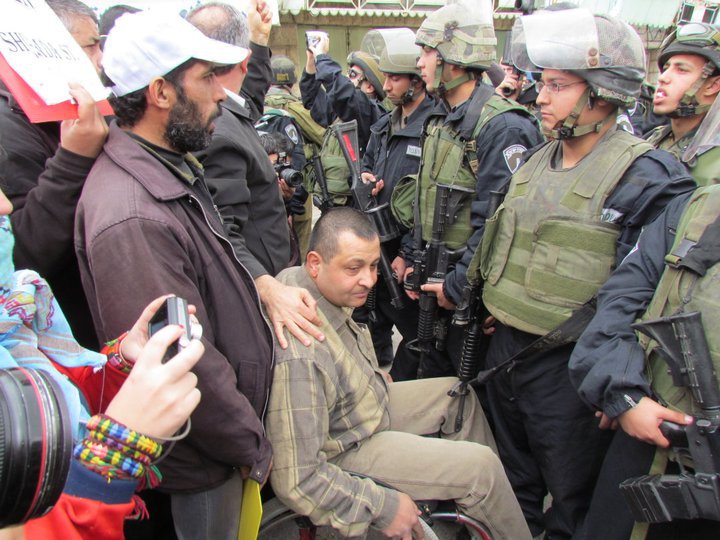
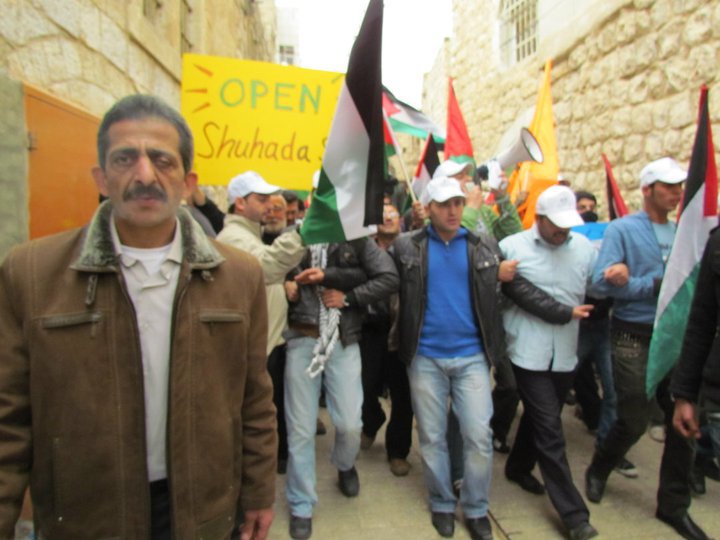
Hebron–Dozens of were injured Friday 2/25 when Israeli forces threw sound bombs and assaulted demonstrators at a large peaceful protest commemorating the Ibrihimi Mosque massacre, calling for the opening of Shuhada Street, and criticizing the American veto of the Palestinian call for UN Security Council condemnation of and a halt to settlement activity.

The protest was organized by Youth Against Settlements. Thousands of Palestinians and dozens of Israeli and foreign activists along with a number of Palestinian leaders (among them the Governor of Hebron Governorate Kamel Hamid, member of the Fatah Central Leadership Committee Jamal Mahsin, Head of the Palestinian initiative Mustafa Barghouthi,) participated in the demonstration after Friday prayers. The demonstration proceeded from the area of Sheikh Ali Al-Baka Mosque in the city toward the direction of Shuhada Street in the center of Hebron.

Occupation forces tried to prevent the demonstrators from reaching the eastern entrance to Shuhada Street, near the old municipality, by creating a large human chain of individuals from Special Forces. However, a large number of demonstrators managed to cross into Shuhada Street, where a number of demonstrators sat on the ground and in front of the tires of military jeeps. Soldiers attacked them, began to hit them with their hands and with the butts of their guns, pulled them away, and arrested a number of them, according to Youth Against Settlements Coordinator Issa Amro
.
The protesters split up to try to enter Shuhada Street through alleyways and smaller streets. They confronted occupation forces who used excessive force against them.

Occupation forces fired gas and sound bombs and rubber bullets at demonstrators, leading to injuries. About 20 demonstrators were taken to Hebron Governmental Hospital.

According to Amro, the demonstrators chanted slogans and carried signs in Arabic, English, and Hebrew demanding from the occupying authorities the opening of Shuhada Street, which has been closed for many years. Demonstrators’ slogans praised the popular revolutions in Egypt, Tunisia, and Libya, and criticized the American veto of the UN Security Council condemnation of settlement activities.

Hebron Governor Kamel Hamid spoke to those in attendance, confirming the Arab nature of the city of Hebron and the opposition to the policy of settlement and discrimination practiced by the occupation in the city. He called for supporting and strengthening popular resistance to the occupation. He condemned the US veto in the Security Council. Jamal Mahsin spoke also, praising the steadfastness of the residents of Hebron, and emphasizing the necessity of national unity and the end of internal divisions.

The Israeli occupation forces closed Shuhada Street to Palestinian vehicles in 1994, after the Ibrihimi Mosque massacre, then forbade Palestinian residents to walk there in 2000, in order to provide security for the 600 Israeli settlers occupying the center of Hebron.

More than 500 stores were closed by military order in the center of Hebron, and more than a thousand store owners were forced to close their shops due to checkpoints and closures. At the same time, illegal settlers enjoy freedom of movement in the closed streets and are protected by occupation forces.

The activities of the occupation and its settlers in the city of Hebron have turned the lives of 200,000 Palestinians in Hebron into a living hell and expelled thousands from their homes.

Unity between Palestinians is more urgent than any other need

 please sign the petion Ahewar
We have yet to be free as a people but have diverged from the path to liberty. This social contract is the basis of a new popular movement towards our liberation.

The Palestinian people and their struggle are now confronted by a disastrous situation. We are divided. Our priorities are confused, and our agenda for liberation is unclear. We have consequently fallen short of achieving our freedom. We lack justice and have yet to practice our inalienable right of self-determination.

Today, we derive our strength and legitimacy from our urge to end the suffering and aspirations of the Palestinian people in Jerusalem, the West Bank, Gaza Strip, Galilee, in the compulsory diaspora in Syria, Lebanon, Jordan, and around the world. We stand infused with the energy emanating from the Arab people’s glorious revolutions in Tunisia and Egypt, and the revolutions in Arab countries from the Atlantic Ocean to the Arabian Gulf. We say, in the name of our innocent martyrs, the wounded, prisoners, refugees, men, women and children, youth and elderly that our compass now points in one direction, and it points towards freedom. To get there we must and shall achieve the following:

Freedom, Justice, and Self-determination

The Palestinian people shall begin to build a realistic vision for their future based on a new Palestinian Social Contract. Our social contract shall be based on the inalienable rights to liberty, justice, self-determination, and the pursuit of happiness. This contract shall ensure freedom, human dignity and justice. Equality, clarity, transparency, democracy and full societal participation in the struggle shall be the guiding principles for this contract. The Palestinian citizens’ cause, concerns and aspirations cannot be reduced, in anyway, to one third of the Palestinians who are in the West Bank and the Gaza Strip. Therefore, the required Social Contract represents all the Palestinians. It addresses their rights within a formula that observes what is common among all Palestinians and recognizes the differences among the diverse components of our society.

This statement balances between the daily concerns of the Palestinian people and their aspirations. It also suggests realistic alternatives to the current status quo that results in a state of division, weakness, economic crises and the marginalization of the majority of the Palestinian people. We pose three necessary changes to the status quo that express our vision for the Palestinian people.

First: The Establishment of a New Palestinian Social Contract

The Social Contract is based on the need to establish unity amongst the Palestinian people (in Palestine within its historical borders and in the diaspora). We all have the same aspirations: Freedom, justice, return, the unhindered pursuit of happiness, and the dream that we will practice our right to self-determination. To achieve these aspirations all sectors of the Palestinian people, civil society, different political factions, the youth and trade unions are invited to:

– Rebuild the PLO as the sole representative of the Palestinian people and maintain its independence. This requires re-structuring its institutions and ensuring that it is away from the Israeli occupation control.
– Reformulate the Palestinian National Charter in accordance with the new Social Contract, in a manner that ensures the supremacy of freedom, justice and equality that light the path for our movement towards liberation, democracy and self-determination.
– Re-building of the PLO requires, first and foremost, election of a Palestinian National Council (PNC) representing all Palestinians (inside and outside the homeland). Preparations for the elections shall ensure full democracy.
– Pursuant to the PNC elections, the PLO Executive Committee shall be formed in a manner representing political forces, independent personalities and representative institutions with a special focus on ending the factional quota tradition.
– Full separation between the PLO institutions, tasks and persons and the institutions of the administrative bodies responsible for maintaining the day to day life of Palestinian people in the occupied Palestinian territories (OPT).
– End the existing status quo and begin building mechanisms that ensure the broadest democratic representation of the Palestinian people.
– Ensure that the newly formulated PLO is the sole responsible party for the political track of the Palestinian cause before the Palestinian people. Consequently, the Palestinian Authority, as an institution or personalities, does not politically represent the Palestinian people and does not identify mechanisms of our struggle and resistance.
– Struggle against the occupation and its injustices using all internationally legitimate and ethical means. Any strategies for the struggle shall be decided upon through national consensus (achieved within the PLO) and strategically formulated according to the challenges the Palestinian cause is facing to ensure that the most practical tactics are being used.
– Ensure that our inalienable rights are non-negotiable.

Second: The Struggle Against the Occupation and its Apartheid policies

Main principle: The Palestinian people shall struggle against the Israeli occupation using all morally legitimate means of resistance until they are free and establish a just society with full equality.

– The Palestinian people, through the PLO, shall identify the strategies of the struggle.
– We shall increase the momentum of nonviolent popular resistance, using the media, international law, strikes, boycotts, divestment and sanctions and shall seek international support for our struggle.
– We shall support the steadfastness our people on their land, especially in Jerusalem, areas threatened with eviction such as the Jordan Valley and areas in the Negev desert, and near the Apartheid barrier.
– We shall form popular committees to confront occupation’s measures and create daily realities to protect innocent people, their private properties and land.
– We shall launch international campaigns to combat the occupation and its racist separation. We shall use international law to assist us in ascertaining our rights and coordination with international organizations that support values such as human rights, freedom, and equality.
– We shall struggle against the Israel’s racist measures against our people inside the Green Line, support them and provide political and legal protection for their demands and struggle.

Third: Administration of the daily living affairs of the Palestinian people in the OPT

Main principle: The Palestinian administration in the Occupied Palestinian Territories is the civil entity mandated by the PLO to manage the Palestinian affairs. Hence, it does not have the authority to represent all Palestinians. It is not a political entity or authority.
– The PLO forms a representative council for the Palestinians in the OPT responsible for management of their life affairs.
– The representative council is the realistic alternative of the Palestinian Legislative Council and the Presidential institution in the OPT.
– An administrator shall be elected from the representative council. He/She shall nominate the heads of the differnet administrative directorates, which shall work according to a platform set up and approved by the representative council to ensure the fulfillment of the people’s day-to-day demands in the OPT.
– The representative council shall be constituted of experts and not politicians whose tasks are confined in taking care of administrative and legislative demands pertinent to people’s day-to-day lives. This will reduce factional competition and enhance the role of the elected representative council.

Formation of security apparatuses and their tasks, and the resistance arms
– All security apparatuses will be integrated within one police service that maintains public safety and the rule of law in the OPT.
– The police apparatus shall be fully separated from and independent of the political factions.
– Weapons shall be used for legal reasons only such as maintaining the people’s safety and defending them from mortal harm.
– Political factions do not have the right to individually select their resistance strategies.
– The police apparatus will be restructured based on new laws that shall govern its duties.

Combating corruption
– Full transparency shall be restored. Corrupt institutes and individuals shall be tried and the stolen funds returned to their rightful owners and the Palestinian people.

Requirements of national and societal reconciliation
– Banning any political platform from inciting to violence.
– The youth and academic experts shall formulate a document to end Palestinian disunity in a manner that is beneficial for the Palestinian cause.
– The youth shall use wide ranging activities to pressure all conflicting sides to come together
– Any delay in ending the division after this document is presented shall be borne by the present leaderships.
– A court shall be formed from independent persons guaranteed by the PLO to decide on all the division implications at the individual and collective levels. The court’s decisions are binding to all.

Let all people who love their people and their country now say, as we say here:
– WE SHALL STRUGGLE FOR FREEDOM, SIDE BY SIDE, THROUGHOUT OUR LIVES, UNTIL WE HAVE WON OUR LIBERTY.

please sign the petition on Ahewar

Jamila Al Habash

It has been two years since the war launched on the Gaza Strip. On 27th of December 2008 at 11:30, explosions were heard everywhere; and then the nightmare of 22 days begun. The nightmare, which resulted in 1,434 martyrs and 5,303 injured most of them were children. For most of the Gazans, the war did not end yet. Its memories bring alive the moment of the war. Everyone in Gaza has his own story to tell about the war. The war came into our houses like a thief, stole our beautiful and precious things and left for us pain and agony. Every house, every family, every person, every child and even me has a story of loss, fear and horror. I have lived the moment of fear and horror that I might wake up; and I do not find my family around me. In my dreams, I have seen my mother crying beside my dead body. The suffering did not end. Mothers still remember their children dying in front of their eyes, fathers still smell the blood of children on their hands and some children are still afraid that the war might come back again. There are many tragic and appalling stories to tell. Al Samouny family’s story, Jamila Al Habash and Om Ahmed Fawaz Saleh all suffered from the brutality of the war.

Al Samouny family’s plight began with the Israeli incursion into and firing at Al Zaytoun neighborhood. The Israeli occupying forces started bombing the area leaving no way out to the people living there. As the situation deteriorated and the shelling intensified, Al Samouny family sought refuge in Tallal Al Samouny’s house, thinking that they would be safe there, 60 members of Al Samouny family gathered at Tallal’s house. They were left without water for 24 hours. Unconcerned about the people’s lives in the area, the Israeli forces continued shelling the house. Emergency services were banned from reaching the area. Dead bodies of Palestinians lay in the house, only thirteen family members were still alive. Eight of them were children, some of them injured, who had been locked in for three days with the bodies of their dead parents and family members, with no access to food or water. Overall, 26 members of the Al Samouny family were killed, including 10 children and 7 women. Back to the children who had been locked in with the dead bodies for three days. Those children will be traumatized by the sad and mournful memory of seeing their parents dying in front of their eyes. They will be imprisoned in their painful past forever. Can any child in the world endure what those children have undergone?

Om Ahmed Fawaz Saleh has a story of loss to tell. Om Ahmed lives in Jabalia; she had four children. She lost two of them in the war, Ahmed and Fawzia. During the war, Jabalia was subjected to an intensified Israeli shelling. Most of people there left their houses to seek shelter. Om Ahmed did the same thing. She wanted to take her children to a safe place, her sister’s house. She started packing her children’s clothes, but the Israeli forces were faster than she was. As her children stepped out of the room, a missile hit the house. Ahmed and Fawzia achieved martyrdom, and the other two children were injured. Om Ahmed tried her best to save her children, but she could not. She spoke about her children with tears in her throat. She remembers her sons, Ahmed’s, dreams. She said:” Ahmed wanted to go to the kindergarten; he wanted to buy me sweets with his pocket money. But his dream will never come true.” Om Ahmed has nothing left for her except memories that will always bring the harsh moment of war.

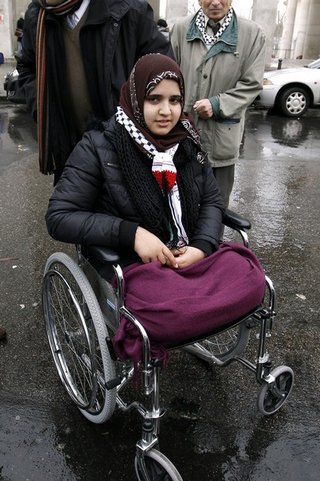
Jamila Al Habah is another evidence of the Israeli barbarity and cruelty. Jamila is a 15-year old girl who lost her legs in the war, when her house was bombed by a missile. Her sister and cousin were killed. Jamila was taken to the hospital and had several operations. When she woke up, she discovered that her legs were amputated. In spite of her ordeal, Jamila decided to be a strong girl, smile, and continue her way towards her dreams. Jamila went under physical treatment and used a wheelchair. Now she is able to walk using crutches with artificial limbs. When I met Jamila, I was impressed by her beautiful smile and her strong will. She challenged her plight. She continues going to school every day on crutches. Looking at her gave me hope. She is willing to achieve her dream and be a famous journalist. Her story is a story of faith and hope.

The Israeli war caused the Gazans so much misery; but it did not break our strong will to exist. The Israelis are to be held accountable for their crimes against humanity, and the truth will be exposed one day. Despite the war, the life in Gaza did not die. Nothing will kill the Gazans’ spirits. Finally, I would thank a friend of mine who supported and helped me in writing this article; a friend who has a story of loss; but it was so painful to talk about it.

On behalf of the Palestinian Arab people, on the blood of the martyrs, widows and bereaved, orphans and thousands of prisoners in Israeli jails and all our people in the Palestinian diaspora, we call on all the Palestinian factions to unite under the banner of Palestine, in order to reform the political system in Palestine, based on the interests and aspirations of the Palestinian people in the homeland and the diaspora.

The seriousness of the current phase of Israeli settler incursions and looting of land in our Sacred Jerusalem and the violence of the siege against the Palestinian people in Gaza require us all to stand as one against this brutal occupation.

We have heard that the Palestinian people call for legislative and presidential elections to end the state of division. Yes, we all want to end the division, but we also want a complete re-building of the Palestine Liberation Organization, to include within it all the colors of the Palestinian political spectrum, including Hamas, and to reform it in order to fight again for Palestine’s liberation, as it was initially intended.

We, Palestinian people in the homeland and abroad, have always heard that peaceful actions would achieve victory and restore the land, but 20 years of negotiations have not achieved the leatest demands. Our people remains under a brutal and oppressive occupation that steals land, violate the Holy sites and kills our children, and all of this while the world that claims democracy and human rights is watching and hearing! On the other hand, the resistance is stalling, leaving more than a million and a half Palestinians under Israeli blockade, choking them to the point that our patients, including the sons of the leaders of the resistance, are sent to be treated abroad.

We must agree; it is necessary that we unite for all Palestinians here and there and everywhere, still dreaming of six million Palestinian refugees to return to their homes stolen by the Occupation that only understands the language of force! Let us be strong, let unity be our strength and unanimously agree on a unified leadership that can lead us to freedom with all pride and dignity!

From here we call on the governments of the West Bank and Gaza to respond to the legitimate demands of the people:
1 – the release all political detainees in the prisons of the PA and Hamas
2 – the end of all forms of media campaigns against each other
3 – the resignation of the governments of Haniyeh and Fayyad to re-build a government of national unity agreed by all Palestinian factions representing the Palestinian people
4 – the restructuring of the Palestine Liberation Organization to contain all the Palestinian factions and get back to its initial aim: Palestine’s freedom
5 – the announcement of the freeze of negotiations until the full compatibility between the various Palestinian factions on a political program
6 – the end of all forms of security coordination with the Zionist enemy
7 – the organization of presidential and parliamentary elections simultaneously in the time chosen by all the factions

Events will start on Tueseday, 03/15/2011 at 11:30 pm and will continue until the achievement of all goals. We will be gathering in the following places (modifications possible):
Gaza: the Unknown Soldier Square
Ramallah: Manara Square
Tulkarm: Roundabout Gamal Abdel Nasser
Jenin: complex of garages near the old Cinema Jenin
Hebron: in front of the governor’s office
Bethlehem: Church of the Nativity Square
Nablus: Martyrs Square
Jordan and Lebanon: no location yet
All over the world: in front of the Palestinian embassies, in coordination with the Palestinian communities abroad. TO BE ANNOUNCED!!!

Please join our page.

http://www.facebook.com/Palestinians.United?sk=info

Gaza Youth Breaks Out

from PACBI -As Palestinian Students based in Gaza we are alarmed to see yet another group ‘Al Tariq’[1] presenting solutions for us Palestinians, as if two equal parties were locked in a stalemate. According to the group website “both sides” need to “learn from each other through reconciliation, forgiveness, and dialogue”. For us young people among the 1.5 million languishing in Gaza open-air prison, (800,000 children) the 4 year-long medieval blockade of land, air and sea and 2 years on from the most devastating of massacres that killed over 1400 of us and over 350 of our children, this is quite an insult.

We ask: can we forget the ongoing ethnic cleansing? How can we forget the brutal killing of 350 of our children and 1400 citizens, while more shootings of farmers and rock collectors continue along the border? How can we forget the ongoing medieval siege of the whole of the Gaza Strip which still deprives sick patients from treatment abroad and allows no concrete in for reconstruction?

The dialogue promoted is a diversion from addressing the wrongs and route to justice for a clearly racist and colonial subjugation of an entire people such as that imposed by Israel on us Palestinians languishing in besieged Gaza or in the Bantustans of the West Bank. Israeli oppression has traditionally followed the sequence of, ‘murder, steal and colonize first, then dialogue on our terms later’.

This applied to South African Apartheid, and the white Afrikaner regime and its allies and supporters steadily felt their hold was threatened only when civil resistance grew among South African blacks and the global Anti-Apartheid Movement. The right to resist illegal military occupation and racist domination is enshrined in international law, yet like us they branded the African National Congress as one of the more ‘notorious terrorist organisations’ – Nelson Mandela was on the US terror watch list until 2008.

Anti-Apartheid heroes Archbishop Desmond Tutu and Ronnie Kasrils have said that the situation here is worse than apartheid. So we ask again, would we have asked for White South African youth to discuss with Black youth under Apartheid telling them that, “the path that both parties walk only after they learn from each other through reconciliation, forgiveness, and dialogue?”

For South Africa, there was no discussion, there was no debate, the racist oppression had only one answer: BOYCOTT.

Acknowledging the one-way nature of the oppression, Al Tariq should introduce to Palestinian youth, Israeli groups that endorse the 2005 Boycott Divestment and Sanction call[2] by over 170 Palestinian civil society groups, such as Boycott! and Boycott from Within. Not as in one of al Tariq’s workshops, hearing from an Israeli youth leader who “gave the Palestinian participants the opportunity to see the Israeli liberation movement in another light and recognize the similarities between both nations in their struggle for freedom, security and peace.”

What kind of liberation movement required as a prerequisite the violent ethnic cleansing of 531 villages and 11 urban neighborhoods destroyed or emptied by force by the nascent Israeli army – all belonging to us Palestinians, the indigenous population. Over two thirds of us in Gaza are UN registered refugees, still expecting justice like any other human being would.

Dialogue groups such as Al Tariq are nothing but a cover for the status quo of Israeli domination – the illegal occupation, the forced exile of 6 million Palestinian refugees, systematic discrimination and an illegal blockade of Gaza, and the increasing number of discriminatory laws against the indigenous population of 1948. In fact, by maintaining the myth of parity between the sides, the lives of Palestinians become progressively worse due to the settler colonial nature of Israeli oppression with incremental land theft and continuous ethnic cleansing and genocide.

We say enough to equating the colonizer with the colonized, enough to the false parity between the “two sides” presented by this utterly false vision of the Middle East. We ask Al Tariq to continue the rising international isolation of Israel’s colonial enterprise instead of feeding the myth that the colonizer and colonized require dialogue, the likes of which has done nothing more than mask Israel’s increasing domination of Palestinian lives based on a racism at the core of their expansionist and apartheid policies. We call on the Palestinian participants in this project to withdraw immediately and act in accordance with Palestinian consensus by boycotting such projects of normalization.

Besieged Gaza, Palestine
Palestinian Students’ Campaign for the Academic Boycott of Israel
University Teachers’ Association

[1] http://altariq.wordpress.com
[2] http://bdsmovement.net/?q=node/52


More than 28,000 participants including head of states, ministers, parliamentary members, children and youths from different parts of the globe flocked to Istanbul to take part in the 5th World Water Forum.  As the title of the forum “Bridging Divides for Water” promised, the hope was to tackle current water crisis through open discussion and transparent dialogue, the exchange of ideas and experiences.  The forum was presumably designed to come up with new ideas and critical views, to ultimately reach a common understanding and consensus on water-related issues. However, from the sessions that I attended, I concluded that the forum outcomes fell far short of being a success. As the forum drew to a close, I could not avoid thinking repeatedly of the pressing question: Was the forum about “Bridging or Maintaining Divides”? In sessions that I attended, there was not much space to promote discussion and dialogue, let alone to challenge mainstream discourses. Hegemonic discourses of business and world politicians’ elites prevailed and went unchallenged. To better illustrate my impressions, I shall draw on a few sessions, which I attended.


In a session titled “Overcoming obstacles to serving the urban poor”, one expected the discussion to explore genuine mechanisms and approaches on how to realize universal access to water services, including the poor segments of societies.  However the session’s speakers overlooked recent experiences where privatization profoundly failed such as, Argentina, Bolivia, Brazil, Kenya, Mexico, Tanzania, and attempted to convey messages and convince the audience on how successful the privatization programs in Manila and Morocco have been to increase coverage and universal access of water supply. Experience shows that polices of privatization have been challenged by significant opposition and public protests, hostility and violence and aggregated power inequalities and socio-economic worsening. What’s more, the session speakers, in contrast to conventional knowledge on the driving forces of multinational companies, wanted us to believe that water companies are socially responsible for the poor and concerned about the Millennium Development Goals as an end but not as a means to profitable business. If this session was genuinely designed to bridge divides, as the title promises, then a wider range of participants should be invited to foster dialogue ad discussion and to conclude on constraints, openings and key factors to improve water supply services. People from case studies, such as Bolivia, where privatization of water services spawned public protest and drastic social and political consequences, would give a counter perspective. It was no surprise to learn that the stakeholders of this session are drawn from the private sector and development agencies.


More evidence for my perception came from the sessions and the side event related to the Tranboundary water issues on the Jordan River. A video presentation by one of the donors’ agencies attempted to convey a misleading and absurd message of existing cooperation and coming peace. The film wanted us to turn a blind eye to Israeli’s war crimes on Gaza that deliberately targeted civilians, homes, mosques, schools, universities and children and to have our ears deaf to the pleas of 1.5 million people besieged in Gaza. The aim of the video film, in my view, was intentionally to reduce the Palestinians cause and the Israeli occupation to sound like a normal conflict that is in way to be resolved and to normalize the sense of urgency that the international community may pick up to take action.


The Norwegian moderator, in both of the sessions: ‘Water management During and After Disasters / conflicts” and the “The UN – Water Day” did not allow for an open discussion, and constrained participants from asking questions or contributing by relevant statements. Instead he took the lead himself to address questions and sometimes he influenced the answers. While the head of Palestinian water authority was urging the participants, especially the Israeli audience, to depoliticize water issues from the political conflict, he couldn’t himself depoliticized his answers when addressing questions on how power asymmetry of the water-conflicted parties impact a real cooperation and water conflict resolutions. A few times, when one of the speakers succeeded to convey a short and clear quick message about the water crisis situation, the Norwegian moderator jumped in to normalize the message and reduce the significance of the water crisis. If this session was designed to bridge divides, the title should describe the reality as it is: ‘Water management under occupation and siege”. 


Despite of the remarkable presence of Palestinian water professionals, Palestinian speakers found themselves constrained and not able to say much about the water situation crisis and the Israeli mass destruction of water infrastructure, the thievery of water and the denial of their water rights from both surface and the ground water sources. The constrains can either because their messages has to be in harmony with what the Palestinian Authority (PA) want them to say or that they must follow instructions of the session’s chair persons or possibly because they are self-constrained. For them, it is a simple fact that if they were to convey a clear message about the crime polices on water, they would not be permitted by the Israelis, later on, to leave their occupied territories and attend the next water meeting event. Such decisions on the control of people’s movement are claimed to be for security reasons, and are not questioned or challenged. Also noteworthy are the two Palestinian children from Gaza who were supposed to participate in the children forum but were not allowed to leave Gaza. No justifications for their actions were given by the Israelis.


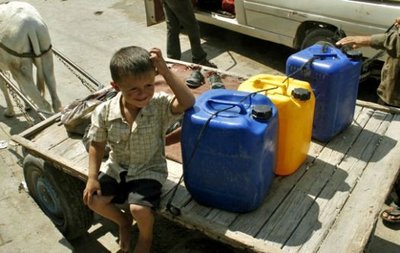
(photo at the left, a picture from one of the many pool installation companies in Israel) In a side event, a presentation dedicated to a future water scenario, was presented by a British consultant, on how to augment the water supply for Palestinians in the Jordan River Basin in 50 years. What this pragmatic proposal suggested is that riparian countries have to give up their water rights from the Jordan River and to adapt the available water quantity they have, if any. Ironically, the water consumption per capita in Israel, severe scarce country, is 320 liter per day, a figure which is far more than the water per capita consumption in a water rich country like Sweden (220 liters). The future scenario, as the consultant advocates, is based on two components. The first is to construct a desalination unit for the Gaza, with possibilities, on the Egyptian land. But what does this scenario imply? Does it imply that Gaza will be a separated geographic entity from the West Bank? That is not clear. If this unit is constructed inside, the consultant stated, there is a risk that it be destroyed by the Israelis. This is a naive speculation because if Israel wishes to destroy the unit, they can do as they have done in similar aggressive acts without any respect to the sovereignty of states or international law norms and without questioning.


Moreover, the proposal, ambiguously assumes that with the elapsing time, Palestinians will be able to develop their water infrastructure while living on a gradual and small augmentation of water supply. By time, he said, both the Israelis and Palestinians are expected to reach a positive-sum situation by developing new water sources. This assumption again is either naive or misleading. On which basis the proposal assumes that Israel will allow the Palestinians’ a free hand to develop their own infrastructure without delaying, undermining or destroying the developing water infrastructure?  What kind of signals on the ground, away from “lip service” rhetoric, has Israel given so far to base such proposals on?  More than 170 water projects, which were agreed upon between Palestinians and Israelis, have not been implemented due to imposed bureaucratic constraints by Israel. Furthermore, on which territory should the water infrastructure be built? Is this territory based on the references of United Nations resolutions? Has Israel identified its borders so far? Shouldn’t we have first and foremost identify the Palestinian lands before proposing a future scenario on water?  Land and water are inseparable issues to be resolved.


Palestinians also have to be cautious about the time issue. The time dimension has been always important for the realization of the Zionist project and the never-ending expansion of Israel’s state on the historical land of Palestine. Experience shows that the Israel governments base its strategies on creating new realties on the ground that are being realized by time. Time has been also a significant factor to discursively legitimatize the Israeli polices before the international community for more than 60 years. What was accepted by the international community including the Arabs before 1947, was different from that which was accepted in 1948, before and after 1967, now and so forth. Palestinians water professionals should be aware of the proposal implications on land, water, geographic integrity of the Palestinian territories. They also should engage as many water experts as possible, not only inside the occupied territories, but also in the exile to scrutinize proposals and challenges, to avoid losses or legitimized the illegitimatized and to safeguard water rights and shares in reference to the international norms. Palestinians should not accept less than that.


The Forum has been expected to build a platform for future settlement of divides on water. In reality, there have not been constructive discussions between parties who really need to bridge the divides.


Lina Suleiman, PhD candidate

Division of Urban and Regional Studies
Department of Urban Planning and Environment
School of Architecture and the Built Environment
KTH, Royal Institute of Technology
100 44 Stockholm

It was an ordinary morning December 2008. Children were playing and having fun. They were digging between the rocks to get some space for their childhood.

This is the story of Ahmad, a little boy without sin who was killed on that morning. Ahmad was known among his friends as lively, bustling boy.

Ahmad and his family live in Al Zahra district in the middle of the Gaza Strip, exactly next to the building of the Civil Defense. On the morning of December 27th, Ahmad took his breakfast, put on his boots and went out to go playing in his nearby garden.

“We are an extended family living in a house that comprises four floors. My family and I live in the second and my father in the first floor,” says Ahmad’s father. When he noticed that Ahmad and his sister Mariam were going to play in the garden of the house, the father tried to stop him as the family was waiting for Mohamed, the older brother to take an early lunch. But his attempt was in vain.

“It was like an earthquake hitting our house and everything was shaking,” said the father. Doors and windows were broken, too. The Father tried to find out what had happened outside and searched for the source of the terrible noise he had heard. A cloud of smoke was covering the sun. “There was nothing else to do than to assure myself about the family as another explosion shook the nearby building. I tried to make sure that everyone was inside the house, and then I convinced myself to feel safe.” Suddenly Mariam cried out: “Daddy, daddy, Ahmad, Ahmad…” The little girl Mariam broke out in tears, terribly afraid about her brother. “Her shouts froze my body,” said the father.

Ahmad was found under the rubble of stones at the entrance of the house. The father immediately took Ahmad and rushed to search a car to bring him to the Hospital Shuhad’a Al Aqsaa. “While I was holding him, I realized that Ahmad was dead,” said the father. Ahmad’s head was partially smashed; part of his brain on the ground and his back was filled with shrapnel. “I stood on the doorsteps, trying to understand the situation outside, searching for a car to drive my son to the hospital. I am a doctor myself, but now I could not help him any more,” the father said. “When I left my home, I discovered that the Headquarters of the Civil Defense had been destroyed completely.”

“The sight at the hospital was tremendously dreadful when I arrived. It was full of dozens of killed and wounded young men on the floors.” Ahmad was sent to the emergency department and although he still had some signs of life, after a while he passed away. At this moment, silence came over the father; there were no more words in him. Blood was everywhere and particularly the sight of young children who always are the symbol of innocence.

“I wondered what Ahmad and the other children might have done to be killed by this Israeli aggression. They always dreamed of safety and to live like any other child in the world,” said the father.

While the father was sitting on a chair and thinking about the situation, his mind was busy at the same time with thoughts about his family living near the targeted building of the Civil Defense. Only when he arrived home later, he saw the massive destruction at the building of the Civil Defense. As he reached the house he was devastated to find out that most of his family members had been wounded in the attack. So the father decided to go back to the hospital to get news about his family. He found out that also Mohamed, the oldest brother, who was coming home at the time of the attack, had been wounded in his head as well.

The story of Ahmad in short sentences: by his father –

Ahmad was a lovely little five-year old boy. His smiles will never be forgotten. He was the youngest brother and he was so clever. Anyone who saw Ahmad immediately liked him. He was a very active boy. His favorite pastimes were playing football, using the computer and take care of the birds. He left an empty space in our house – he was the most loved boy in our family. His sister Mariam will never forget Ahmad as she was with him in the last moments before he was killed. She said that she will stay waiting for her bother… Wait… and wait … and wait… – Waiting for the world to answer!!!

What was the sin that those young kids committed to merit the way they died? What they needed was to grow up safely and in happiness.

“We are not seeking to fight, to attack, to have weapons and all those means of death,” were words always repeated by Ahmad before he was killed.

Marya before the bombing happened!

Innocent Ahmad days before he was killed!

Ahmad, an innocent killed by Israeli Army

Pictures taken my PT,http://www.paltelegraph.com/.

http://www.peaceforgaza.blogspot.com/

Ayman Quader
Gaza Strip, Palestine
I am Ayman Talal Quader. I’m a Palestinian born and raised in Gaza. I’m 22 years old. I have a bachelor degree in English Language and Education. I have worked in several different fields’ pre and post of my university studies for almost 4 years. I have worked as volunteer in civil societies where I practiced tasks to help people and educate children. I always try to bring the suffering of Palestinians to the whole world. I am grateful to my friend Sameh A. Habeeb http://gazatoday.blogspot.com/ who always helps me. I do love Gaza and its people, its land, its breezes. I believe that justice and freedom should prevail one day.

Gaza is full of stories of brave women, under the Israeli caused rubble there are many stories of women with hopes and great expectations, pioneers in every field.

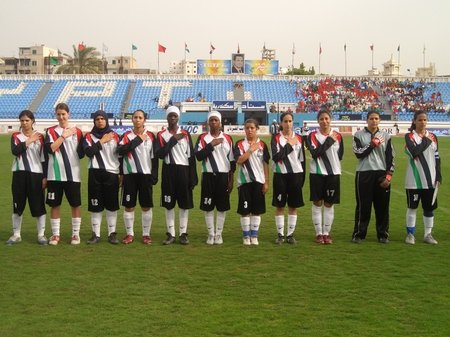
Being a Palestinian journalist in exile, there was no other way to interview my people and interact with my colleagues in Palestine but through the internet. I have started a feature by interviewing the Palestinian journalist Nelly Ismail Yassin Almasry through the net because Israel’s enforced laws made it difficult for us to meet in person. Our discussions took longer than expected because electricity blackouts happened many times in Gaza where she lives and the internet connection died with it, but I was determined to write about the other side of Gaza, the side that keeps rising from under the ashes like a bird with a thousand wings because its people refuse to surrender to defeat. Nelly is the daughter of Ismail Almasry, the Football Coach of the National Football Team in Gaza and a colleague working as a sport journalist and a member of the first women’s soccer team in Gaza.

The first Palestinian all women’s football team was established in 2003. Even though they had very limited resources, the women kept practicing and playing against other Arab women’s leagues whenever they were allowed to leave Gaza. The Gaza women’s soccer team suffered many difficulties and faced many obstacles because of the limited resources, the absence of properly built stadiums, the absence of security and the continuous closures of checkpoints by the Israeli occupation forces thus hindering them from practicing or travelling to play against other teams, even though the team wanted badly to represent Palestine on an international, level they were deprived of this dream as they were of many other dreams.

The sport movement started to come back to life in 1994, supported by the Palestinian National Authority. Some attention has been directed to develop sport facilities like maintaining sport stadiums. One of such efforts was building a stadium in the city of Jericho, which has encouraged some athletes to set up a female football team for the first time in Palestinian history, but the idea did not receive adequate attention or support because it was novel. Unfortunately that lack of interest eventually lead to freezing the idea for a while.

But again the Arab and International Federation of Football requested activating the Arab women’s football teams in their countries, and encouraged it by allocating 10% of its financial support to the union to support the Palestinian women’s football teams.

The Palestinian union adopted the idea of forming a female soccer team, and assigned this task to Mrs Haniya Albish. This decision was formally adopted by the International Football Federation who sent Mrs Haniya Albish in 2003 to attend a symposium on women’s football in the framework of the World Cup for women in America, thus starting the nucleus of the team at Bethlehem under supervision of Mrs Samar Ala’araj who was in charge of coordinating sports activities at Bethlehem University.

At the same time, Mr Hussein Shakhtour was forming another team in the Directorate of Youth and Sports, the two teams were merged into one sponsored team, supervised and trained by Bethlehem University according to their best of abilities considering the general situation in Palestine.

Then Mrs Haneyeh Albish, a member of the Palestinian union team of soccer, head of women’s football union, along with Mr. Adnan Abu Zayed attended the symposium of women’s football in “West Asia” organized by the International Federation of Football “FIFA” in March 2006 to develop the game in Palestine.

Playing abroad
The Palestinian women’s football team participated for the first time ever in a tournament held in Jordan 2004 along with 10 other Arab women’s teams; the event was organized by the Jordanian Orthodox club. The Palestinian team was formed from a number of players from the teams of Ramallah, the Evangelical Friends, Gaza, and Saryeat Ramallah group. The created team participated again in another event held in April 2005 in Jordan organized by Amman Club playing along other 10 Arab women’s teams.


The following participation was in the West Asia Championship for Women’s Football in Jordan held from 23 of September to the 1st of October 2005, during which the Palestinian team played against Jordan, Syria, Iran and Bahrain.

Then the Gaza team participated in the Arab Championship for women’s soccer in Alexandria, Egypt from 14-28 April 2006, playing against Syria, Tunisia and Egypt. Unfortunately all forms of sports in Gaza now are totally paralyzed.

Nelly grew up in a family of sportsmen who understood her passion for sport, her father was the coach of a team, and her brothers were football players who understood that football is just one of her choices.

Before getting involved in sport journalism Nelly played volleyball at AlAhli Palestinian club in Gaza. In 1996 and while she was still a university student, she joined the first football team for women in Gaza. Some families looked with suspicion at women playing football, but Nelly had no problem with that since she was brought up in a family involved with this sport, she was encouraged by her parents, besides the fact that three of her sisters joined the team as well. Her father was always keen to follow his daughter’s progress and used to go to the club to watch them training. They practiced 3 times every week for 18 months.

Nelly’s beginning with sports media goes back to the end of 2001 when she was a trainee at the Voice of Freedom Radio in Gaza, she progressed in her job to become a broadcaster of sports programs, during the same period she joined another media establishment as a supervisor of its website, but her post did not last long for economic reasons leading to the closure of the website.

Nelly confessed, ‘I have started to write sports reports in 2002 but I started playing football earlier, during 1996. Football is considered by many in Gaza as an unusual field for women, but strangely enough, most of the members of the Gaza women’s soccer team came from conservative Palestinian families, the majority of the members lived in the refugee camps, but still they have proved that they are able to commit themselves to this sport in a way that changed the society’s perception of women football players, and accept the idea to a point that the players started to receive support from the International Federation and the Arab federation, besides the FIFA and other unions.

Nelly is not involved in kicking the ball only, but she is a keen football fan as well, she talked to me about watching most matches played around the world and her support for some Arab leagues like the Saudi Arabian team Alhilal Club. She told me that and among her favourite players is Yasser Kahtani the best Arab player during the Asia championships 2007; she is also a fan of Nawwaf Altimyat, and Mohammad Shalhoob.

Many people were enraged that one Israeli player was denied a visa to Dubai to the tennis tournament held lately, claiming sport should be independent of politics, but it seems not many understood how important it is to boycott Israel’s sport to make a point, Israel bombed the Palestinian playing courts, banned Palestinian players from travel or participation, imprisoned and detained Palestinian players, attacked many of them, and these facts can be brought up and made known should Israel be boycotted. Israel’s policies are aimed at killing any hope of Palestinians participating in any sport where they can represent their country on international level.

Nelly finished her comment by saying ‘unfortunately there has been always a negative attitude towards women’s journalistic work in general, let alone working in the sports field where the journalist has to shuttle between clubs and matches. Some Gaza communities were not in favour of women practicing this sport or working in its media field, but we never gave up. All I hope for now is some peace, and to see that our stadiums will be rebuilt again after everything has been destroyed in Gaza by Israel’s attacks…the ball now is in the International court.  

Well, not much really…. Just that when you invite people who don’t consider each other to be “within the pale”, as British columnist David Aaronovitch said, then the discussion on anti-Semitism turns into character assassination.  

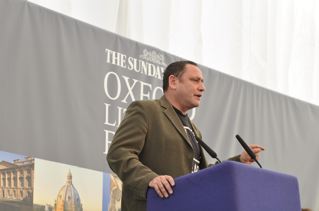
No one expected a calm discussion during the debate entitled “Anti-Semitism – Alive and Well in Europe?”, which was organised by the Sunday Times Oxford Literary Festival. Along with Aaronovitch, the panel included Gilad Atzmon and the Observer columnist Nick Cohen. 

It’s not clear why Cohen was invited to join at the very last minute when his views, to the naked eye at least, are akin to those of Aaronovitch’s. It would be fair to describe both men as supporters of Zionism who believe that anti-Semitism is on the rise and that much of it is “unfairly” blamed on Israel’s actions. 

Atzmon’s views, on the other hand, are well-known to those who follow websites on Palestinian activism. He has very strong views on “Jewishness” and “Jewish identity”, and makes a clear distinction between Jews as a people and those who commit crimes in the name of “Jewish ideology”. 

Both Aaronovitch and Cohen launched an attack on Atzmon. Aaronovich took the podium for 18 minutes (when we were told each speaker would only have 10, and indeed Atzmon had less than 10) during which he gave a  theatrical performance, reading out paragraph after paragraph of Atzmon’s articles to prove the point that the man was “fascist”. I doubt anyone in the audience managed to grasp what he was saying, but when you spit out the word “Jews” then at least it gives the impression what you’re saying about them is bad! 

Cohen, other the hand, kept wondering, over and over again, why “upper-class”, “educated”, “white” people would waste such a beautiful spring day debating anti-Semitism with a “nutter” (well, at least I could say I learned something about racial and class prejudice that day!) 

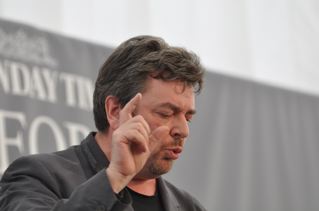
One can imagine how shocked and angry Atzmon was by the time it was his turn to take the podium. And this is why the event became a missed opportunity. He  tried to steer the debate back to its theme, but at times his emotions failed him. In between having to answer to the attacks levelled against him by Aaronovitch and Cohen, and trying to remind people of what they came to discuss, much of his ideas were lost on those who’ve never followed his writings. 

Once the floor was opened for questions, a member of the audience said the discussion, as a whole, “was a profound disappointment”. 

So why did the Oxford Literary Festival invite Atzmon? After all, he’s the “proud self-hating Jew” who wonders how America has allowed its foreign policies to be shaped by “ruthless Zionists”. He’s the one who insists that the burning of synagogues is illegitimate, yet he believes the motivations behind such actions are political rather than religious or racial.

Cohen certainly conceded that whenever Israel launches a fresh attack on Gaza or Lebanon, synagogues and Jewish cemeteries are attacked in the UK. Yet somehow he refuses to accept the correlation between Zionist policies and anti-Semitism. He wants us to believe that anti-Semitism is fuelled by pure hatred for the Jews. After all, Chinese property wasn’t attacked in the aftermath of the Tibetan clashes last year. Sudanese property wasn’t attacked when Darfur was in the media. 

Well, Mr. Cohen, maybe it’s because China and Sudan are being condemned in the international community, especially in Britain, while Israel to this day is being hailed as the West’s indispensable partner. Maybe it’s because what Israel has committed in Gaza during “Operation Cast Lead” earlier this year has created more devastation than what happened in Darfur (and this is according to the head of the International Red Cross). Maybe it’s because it is acceptable for British Jews to join the IDF, and actively take part in Israel’s wars, while British Muslims or Chinese or whatever would never dare join a non-British army. 

The response from some members of the “upper-middle class, educated, white” audience proved that these questions are not an endorsement of conspiracy theories. They are legitimate questions. 

One man raised the question of the pro-Israeli lobby in Washington. It was their pressure that led Obama to back down on his decision to appoint Mr. Freeman as an advisor, a man well-known for his criticism of Israel. “In those circumstances,” the man asked, “is a rise in anti-Semitism surprising when democracy is affected by that type of lobbying activity that prevents Obama from being able to appoint Ambassador Freeman?” 

We know what Atzmon would’ve said, but neither Aaronovitch nor Cohen answered that question. 

None of this justifies attacking synagogues or anti-Jewish graffiti. If anything, Atzmon – whom Aaronovitch and Cohen blasted as a “fascist” and a “nutter – was saying ordinary Jewish people “must be saved of the crimes imposed on them.” The crimes taking place in Palestine aren’t being committed just in the name of Israel, but in the name of the Jewish people. That’s not a conspiracy theory, that’s a fact. If you’re in doubt, go and read the Israeli government’s statements during Operation Cast Lead. 

Is it so outrageous to ask Jews in the UK to disassociate themselves from what is happening in Israel, without being labelled as an “anti-Semite”? Apparently it is. When people applauded Atzmon for making that point in the discussion, they were attacked by Aaronovitch who shouted “Shame on you! How dare you!”, even addressing one member in the audience by saying “You Sir, are an anti-Semite.”

In the aftermath of the July 7th attacks, Muslims were attacked everywhere. It became so dangerous that a fatwa had to be issued allowing women to take off the headscarf if they felt their lives were in danger. Yet at the same time, the Muslim community was under enormous pressure to disassociate itself from the terrorists who blew up those trains and busses. While they were being attacked themselves, they were still expected to make a clear statement that what happened on July 7th does not represent them and is not being committed in their name. 

Try and say that to the Jewish community today without being called an “anti-Semite”. 

Now I don’t want to ponder too much semantics but it is very ironic that anti-Semitism has been coined as a term exclusively for Jews when most of them do not belong to the Semitic race. Arabs, on the other hand, are Semitic. So if for one moment I, as an Arab, could reclaim that definition, I leave you with one point to think about. 

In the beginning of his speech, Aaronovitch wanted to illustrate just how bad Atzmon was. He quoted the Guardian’s Jon Lewis who described Atzmon’s writings as “extremely popular in the Arab world.” Aaronovitch then fixed his audience with a gaze and asked them to keep that sentence at the very front of their minds. 

On second thought, I think I did learn something about “anti-Semitism” that day. 

Dima Omar is a Palestinian journalist and filmmaker. She is based in London. 

To listen to David Aaronovitch reading Gilad Atzmon click here

To listen to David Aaronovitch’s tantrum click here

To Listen to Gilad Atzmon deconstructing antisemitism click here

To listen to Atzmon confronted with a outraged Jewish member of the audience click here
 
To listen to a disappointed member of the audience click here
 
To link to Aaronovitch confronted with a Jewish member of the audience click here
 
To listen to Aaronovitch’s closing remarks click here
 
To listen to Atzmon’s closing remarks  click here

In 1929 Ben-Gurion said: “Jerusalem is not the same thing to the Arabs as it is to the Jews”. While he meant to say that Palestinians were not part of Jerusalem and are not attached to it as the Jews are, I would say, he almost got it right: Jerusalem is not the same thing to the Palestinians as it is to the Zionists. To us, Jerusalem is a home and an integral part of each of us, to the Zionists it is but another construction site, for he who loves a city would not destroy it as the Zionists are doing right now with Jerusalem.


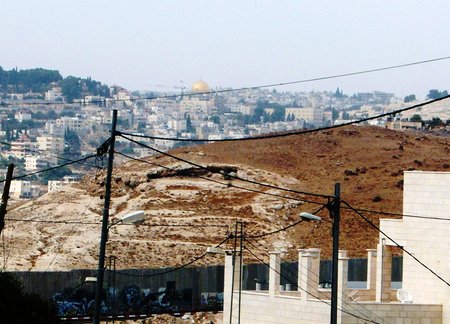
The distance between Sawahreh and Jerusalem is a relatively short one. Using a car, one would need 15 to 20 minutes, checkpoint stops excluded. Riding Sawahreh buses, which were old and rusty, it usually took us some 30 minutes, sometimes a bit more depending on the number of stops the bus made. We used to take the bus five days a week to go to school and come back home. On rainy days, the iron seats would be wet and cold, in summer they would be boiling hot. Nevertheless, my sister and I would race to find an empty seat near the window. We enjoyed the trip to Jerusalem, especially when the bus went up and down the Gethsemane Church road. To the left, facing the walls of the Old City, one would see the golden Dome of the Rock. It would get bigger or smaller as you go up and down the road. I preferred the trip up the road towards Ras Al-Amud. I would watch closely awaiting the point when the Dome would start appearing, seemingly out of nowhere. To one seeing this for the first time, it would be a nice surprise. And as the bus travels up the road, it gets bigger and bigger, till at the top of the road you have somewhat a full view of the Dome of the Rock. When I was at school, I enjoyed watching friends and relatives from Dheisheh and Bethlehem witness this miracle. A number of times, my sister and I were forced to walk all the way from Jerusalem to Sawahreh. On Saturdays there were usually fewer buses moving on the various lines, so a couple of times we had to walk back home after finishing classes. These “forced walks” were seldom, and although on foot it took us much longer to get to Sawahreh, and we would reach home completely tired and with burning feet, we enjoyed the walks. We would pass the walls of the Old City and the ancient tree which looked like something out of a horror movie. It is said that the tree is very old, and it does look it, but somehow it didn’t impress me. It looked more dead than alive, not like the green olive trees or the bloomy almond trees you find in Palestinian fields and on hilltops. From the point where the tree stood, one had a marvelous view of Mount of Olives and the Palestinian neighborhoods in the area.


Josef Weitz, the polish director of the Jewish National Fund’s Land Settlement Department in charge of illegal Zionist colonization in Palestine and the Ethnic Cleansing of Palestinians, wrote in 1940: “among ourselves it must be clear that there is no room for both people in this country. After the Arabs are transferred, the country will be wide open for us, with the Arabs staying the country will remain narrow and restricted …. There is no room for compromise on this point … land purchasing … will not bring about the state … the only way is to transfer the Arabs from here to neighboring countries, all of them, except perhaps Bethlehem, Nazareth, and Old Jerusalem. Not a single village or a single tribe must be left. And the transfer must be done through their absorption in Iraq and Syria and even in Transjordan. For that goal, money will be found – even a lot of money. And only then will the country be able to absorb millions of Jews …. There is no other solution.” In addition to calling for the transfer of Palestinians, Weitz claimed Old Jerusalem is to be “spared” the ethnic cleansing, but facts on the ground tell a completely different story. Since its establishment, the Zionist state has been implementing a systematic policy of Judaizing Jerusalem and ethnically cleansing its original Palestinian residents. Even when spreading propaganda about an empty land waiting for its long lost sons to come back, Zionist leaders admitted among themselves that the land was populated and was prosperous. English Zionist Israel Zangwill, famous for his quote: “Palestine is a country without a people; the Jews are a people without a country”, which later became the infamous Zionist slogan: A land without a people for a people without a land, said in a speech to a Zionist group in the UK in 1905: “Palestine proper has already its inhabitants. The pashalik (province) of Jerusalem is already twice as thickly populated as the United States, having 52 souls to the square mile and not 25% of them Jews”. In 1948 Israel occupied 85% of Jerusalem and forcibly expelled up to 80,000 Palestinians from their homes in West Jerusalem and 40 other surrounding villages. The villages were then destroyed to prevent their inhabitants from returning back to them, and their property was transferred to the Israeli state under the “Absentee Law” of 1950. In 1967 Israel occupied the rest of Jerusalem, and established the first illegal Jewish settlement inside the Old City. More than 700 Palestinian homes and buildings were either destroyed or expropriated. Alone in the Mughrabi Quarter of the Old City, over 6,000 Palestinians were evicted and 125 houses were destroyed in order to create a plaza in front of the Western Wall. Israel doubled the size of the Israeli municipal boundaries of the city by annexing 70 km² of lands belonging to 28 villages in the West Bank. In 1980 Israel annexed East Jerusalem officially, and in subsequent years Palestinian properties in Silwan and the Muslim Quarter of the Old City were turned over to Jewish settler organizations. Despite UN General Assembly Resolution 2253 ordering Israel “to desist forthwith from taking any action which would alter the status of Jerusalem”, the Israeli government confiscated over 60 km² of Palestinian land in East Jerusalem (i.e. 86.5% of its total land area) over the years for Jewish use.


We often used go to the Old City, either for shopping or just to enjoy the beauty of the narrow streets and alleys. Beautiful old facades would meet one all the way, with beautiful architecture that is the trademark of the Old City and a reminder of its Arabic heritage. This Old City is nothing like the Old Town Centres one would see all over Europe, from which illegal Jewish settlers come, and into which they are trying to turn Jerusalem. Two of my childhood friends, who are also sisters, live in the old city. They are originally from Sawahreh who each married a Jerusalemite and moved to Jerusalem. The first time I went to visit them I was shocked at the state of their dwelling. They had a relatively big house in Sawahreh, and although they grew up in a large family, there was enough space inside and around the house for everyone, so one didn’t feel imprisoned. Now, they both had families and each was living in a room with her family, sharing the rest of the house with other family members. There was no place for privacy there and the over-crowdedness was unbearable. One of them lived in a room built on the roof of the family house. We had to climb a ladder to enter the room, which was divided into smaller rooms in an effort to give it the shape of an apartment and provide some privacy. We went for a walk inside the Old City and every now and then my friends would point out some neighbors gathering in the narrow streets in front of their houses or children playing in the streets, and talk about how people here have little space and the children have no gardens or playgrounds. Many houses are in such a miserable state and need renovation but often the municipality doesn’t allow it, using this as yet another method to force people out of their homes. Although Palestinian Jerusalemites have to pay taxes, they receive very little municipal services in return. According to B’Tselem: “since the annexation of Jerusalem, the municipality has built almost no new school, public building, or medical clinic for Palestinians.” …. “Entire Palestinian neighborhoods are not connected to a sewage system and do not have paved roads or sidewalks”. During my last visit to Palestine, and despite their continuous invitations, I was not able to visit my friends in Jerusalem and had to be content with seeing them in Sawahreh. When their brother was preparing to leave to Mecca for the Hajj season, the whole family came to say goodbye, except one of the sisters. Although she had been married to a Jerusalemite resident and living in the Old City for more than 10 years, she only possesses a temporary permit allowing her to reside in the city. This permit has to be renewed again and again, and it happened that her permit had expired and as she was waiting for a renewal, she couldn’t come and say goodbye to her brother. She didn’t want to risk being caught at one of the checkpoints and arrested for not having the needed papers and maybe lose her right to live in the city forever and thus be disconnected from her family. According to Israeli law, Palestinian Jerusalemites, although born in Jerusalem like their ancestors before them, hold the status of “permanent resident”, giving them the same status as foreigners wishing to live in the country, while illegal settlers are given the status of citizens.
 

There is also a distinct policy of discrimination in planning and building regulations applying in Jerusalem. Outline plans for Palestinian neighborhoods prepared by the Israeli Jerusalem municipality have a common feature, i.e., about 40% of the area is designated as “open landscape area” where building is not allowed. For Palestinian building purposes, only some 11% of the lands of East Jerusalem are allocated for Palestinian use, and these are already over-crowded building areas, similar to the demarcation plans of the IOF for Zone C in the West Bank. In addition to the rarity of obtaining building licenses, Palestinians are forced to build “illegally” on their lands. While illegal constructions built by settlers are adjusted into building plans to make them retrospectively legal, Palestinians are not given permits to build on their own lands. As illegal settlements expand, Palestinian communities in Jerusalem and around it are prevented from building and expanding, thus limiting their natural expansion and strangling them. According to a report of the Society of Arab Studies published in early 2008: Israel had had demolished 8,500 Palestinian houses in East Jerusalem since 1967, and alone between January 2000 and September 2007 some 786 Palestinian houses had been demolished, leaving thousands homeless. Another 20,000 houses are threatened to be demolished under the pretext of illegal construction. B’Tselem statistics on building starts in Jerusalem for the period 2000 to 2006 show that of the 14,472 registered building starts, 11,114 were in Jewish neighborhoods, while only 3,358 were in Palestinian neighborhoods. In addition, housing density in Jewish settlements in East Jerusalem was 23.8 m²/person in 2002 in comparison to a housing density of 11.9 m²/person in Palestinian neighborhoods.


Over-crowdedness is not a feature restricted to Palestinian houses of the Old City, but applies to most Arab dwellings in Jerusalem. As far as I can remember, all of my classmates whose houses in Jerusalem I visited lived in small apartments either in old houses or in multi-apartment buildings. One friend lived in the second floor of a two-story typical Jerusalemite house, close to where religious Jews lived. Often when visiting her, we would encounter groups of these religious Jews with their typical long black clothes, back hats and long beards. The women wore head scarves, long skirts and wool stockings even in summer. The part of the house she lived in was even too crowded for the small family, but I found it brave of them to continue living there, despite their closeness to these settlers. Other friends lived in other parts of the City, all in small apartments. I always wondered why they lived in such apartments when they were attending private schools that cost much money, when their parents brought them to school in fancy cars and when they always wore beautiful expensive clothes. If they had the money to buy cars and nice clothes, they could afford bigger apartments. I had no idea about the building restrictions and all the taxes Palestinians were subjected to in Jerusalem. I think in their shoes, I would rather choke in an overcrowded room rather than leave Jerusalem of my own free will.


The Israeli Jerusalem Master Plan of 2000, serving till 2020, aims at imposing Jewish character on the city and diminishing the Palestinian population to 12%. According to the plan, the total city area is 142 km² and the boundary of the western part of the city is extended by 40%. 24.4% of East Jerusalem is zoned as “green natural” area where no building is allowed. Currently, Israel is undertaking a massive eviction and demolition process in East Jerusalem neighborhoods. In 2007 the Israelis started the construction of a Jewish settlement inside the Old City’s Muslim Quarter with more than 20 housing units and a domed synagogue. Nearby in the so-called “Holy Basin” area, Palestinians are systematically being thrown out of the area, extending from the Kidron Valley, the Mount of Olives to nearby Palestinian neighborhoods, and replaced by Jews. This March, two more houses were evicted in Sheikh Jarrah, and 88 houses in Al Bustan neighborhood in Silwan are to be evicted and demolished. Thus, over 1,500 Jerusalemites will be made homeless to make place for a national garden. Similar destiny awaits 60% of the houses in the Wad Hilwa neighborhood in Silwan.
 

Leaving the Old City, and going up the Gethsemane road, one would reach Ras Al-Amod and Silwan. To separate Jerusalem from the surrounding Palestinian environment, a ring of Jewish settlements has been created in and around the Old City, expanding from the Jewish Quarter to the illegal settlements in Ras Al-Amud and Silwan and the Jewish Cemetery on the Mount of Olives. In Ras Al-Amud Palestinian houses next to the Jewish Cemetery are separated only by a low wall. Here, dead Israelis have more rights and more place than living Palestinians. I remember the Israeli police station opposite the Jewish Cemetery. As I grew up, I watched that police station change into a “prison”. It was a simple building at the beginning, later to be surrounded with barbed wire. Then there was a checkpoint installed opposite it. No wonder these policemen don’t feel safe here, I always thought upon passing the police station, this land doesn’t belong to them and deep inside they know it. This police station was planted in the heart of Palestinian neighborhoods, with only dead Israelis in the nearby cemetery as company. They would stop Palestinian buses and cars and delay people going to work, school and hospital. After 1967, lands belonging to the Al-Ghoul family were confiscated and sold in 1990 to US Jewish millionaire Irving Moskovitz who developed a plan for the construction of an illegal settlement with 132 housing units on 14,7 Dunums of the stolen Palestinian land. The plan was frozen for some time because of its sensitive nature, only to be approved in 1999 by none other than Ehud Barak. As shameless as they are, the illegal Jewish settlers named their illegal settlement Maale Zaytim, or Olive Heights, maybe in celebration of the thousands of olive trees they uprooted from Palestinian fields to build their illegal settlements. This settlement aimed at forming continuity with the Jewish cemetery opposite it and other illegal structures on the Mount of Olives, thus contributing to the ethnic cleansing of Jerusalem. The first illegal settlers moved into the settlement in 2003. In 2005, while the Palestinians were busy “negotiating” peace with Israel, the settlers and the IOF were busy dividing Palestinian land among them. The police station in Silwan was turned over to settler committees and incorporated in Maale Zayton, in exchange for a new one that was built in the E-1 area. According to ARIJ, Palestinians in Ras Al-Amud are only allowed to build on 55-65% of the total land area whereas the settlers are allowed to build on 115% of the total area. Also, the Palestinians are allowed a maximum of two floors per housing unit, while the settlers are allowed a maximum of seven floors per housing unit.


Many Palestinians were twice ethnically cleansed from Jerusalem; first from West Jerusalem and later from East Jerusalem. Many of those who were forced out of West Jerusalem and settled in East Jerusalem are today threatened with eviction on the invented ground that the land doesn’t belong to them. At the same time, illegal Jewish settlers, coming from the United States, Europe or anywhere else in the world have a right to a city in which neither they nor their ancestors own a handful of earth. Today, Palestinians make 34% of the total population of Jerusalem, while 55% of the Jewish population of the city lives in 34 illegal settlements in and around Jerusalem. Of the total population of the Old City, only 9% are Jews. Travelling to Bethlehem through West Jerusalem, one would leave the typical Palestinian Arab landscape of East Jerusalem and enter an artificial one. Travelling this road, I used to think that this must be what Europe looks like. It was nothing like East Jerusalem, Bethlehem, Ramallah or any part of Palestine that I knew. It had nothing of the magic of East Jerusalem that attracts one and leaves everlasting memories. Although we used to travel this road frequently some 20 years ago, the only recollections I have of it are some scattered images of similar tall grey buildings that showed neither beauty nor good taste. Now, after seeing Europe, I know that the Zionists were not even able to imitate European cities. After destroying Palestinian Jerusalem, all they were able to create in its place was a shapeless town planted with building after building, their boring rhythm interrupted by more colorless side-roads and stores. The only houses worth watching were the few Palestinian houses confiscated but left undamaged. They were old, beautiful, built by Palestinian hands and now illegally occupied, and most probably shown to tourists as examples of Jewish architecture or Jewish existence in the city. They were the originals that stood like islands surrounded by seas of artificial architecture. The beauty of these houses lay in the fact that they were so in place, while their surroundings were strangers to the land.


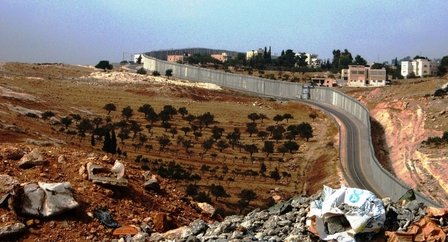
To further its policies of Judaizing Jerusalem, measures and plans have been instrumented to cut East Jerusalem from the rest of the Palestinian Territories and prevent the establishment of a contiguous Palestinian state, including land confiscation, illegal settlement activity, the Apartheid Wall, house demolition and revoking residency rights. After 1967, Israel activated the “Land Ordinance” of the British Mandate to confiscate 85% of the lands within the illegally expanded Jerusalem area. The original area of West Jerusalem tripled and the municipal boundaries of East Jerusalem were expanded from 6.5 km² to 71 km², to include large territories with minimum Palestinians. So, while densely populated Palestinian communities were excluded, the lands of these communities were included within the new illegal boundaries. At the same time, settler organizations were allowed to build settlement cores inside Palestinian communities such as Silwan and Sheikh Jarrah. This January the IOF issued orders to annex 24 Dunums from lands belonging to Husan and Nahhalin villages in Bethlehem in order to expand the illegal Jewish settlement Gush Azion. This comes as part of the “Greater Jerusalem” scheme, which aims at annexing more Palestinian land to Jerusalem and expanding settlements. So far, this plan has annexed 72,000 Dunums of Palestinian land. Further Palestinian land was confiscated for the construction of an illegal tramway that will connect illegal settlements in the West Bank with Jerusalem. This will be a Jewish-only tramway system.


An additional 19.2% of land owned by Palestinians in Jerusalem and 5.3% of Palestinian owned West Bank land were illegally confiscated by Israel for the construction of the Apartheid Wall. This Wall runs along the illegal Jerusalem municipal boundaries set by the Israel, including East Jerusalem and the annexed parts of the West Bank. By September 2007 11,100 Dunums were confiscated for the construction of the Wall and 40,985 Dunums will be disconnected from their owners. Upon completion, the Apartheid Wall around Jerusalem will be 181 km long. This wall affects the daily life of 27 Palestinian Jerusalemite communities. Dozens of Palestinian houses have been demolished because of the Wall and many more have received demolition orders.15,000 Palestinians with Jerusalem IDs living outside the Wall will be denied access to Jerusalem and 1835 families have been forced to move home. According to a report of the Civil Committee of the Rights of Palestinians in Jerusalem published in September 2007: 21.4% of the Palestinian families have been separated from relatives by the Apartheid Wall (15.5% inside and 32.6% outside the wall). 18% of the families live apart from the father and 27% of them apart from the mother. And 25% of the Palestinian-owned shops have been closed down due to the restrictions on Palestinian movement and the high taxes Palestinians living in Jerusalem have to pay.


More than 100,000 Palestinians live in towns and villages around Jerusalem. These areas have always been an integral part of Jerusalem, and depended on the city for their livelihood. Through the construction of the Wall they lost access to their businesses, schools and hospitals. Also, many residents of East Jerusalem own lands in the surrounding villages. Because of the housing shortage and the over-crowdedness in East Jerusalem, they were forced to build houses around Jerusalem, which now lie behind the Wall. Sawahreh is one of the Palestinian communities affected by the Apartheid Wall. Many families have been separated because of Wall, and others have been forced to leave their own houses and share dwelling with other family members in Jerusalem, so as not to lose their Jerusalem IDs. In my neighborhood alone, several houses stand empty, among which are 3 houses belonging to one family. The family from West Sawahreh has lands in East Sawahreh, like many others families here, both parts of Sawahreh having been one body before Israel decided to divide it and divide the community. With the family growing, and the sons getting married and establishing families of their own, the family house in West Sawahreh was getting too crowded. West Sawahreh lies within the Israeli municipal boundaries of Jerusalem, and thus building permits for Palestinians are rarely given. Each brother built a separate house for his family in East Sawahreh, and the remaining piece of land around the houses was planted with trees. Nearby stands the house of another neighbor, the eldest son of an East Sawahreh family who married a relative from West Sawahreh some twenty years ago. All these houses stand empty now. Their owners, who carry Jerusalem IDs, are forced in live in overcrowded rooms in West Sawahreh because the Jerusalem municipality gave them the choice of living on their lands behind the Wall or losing their Jerusalem IDs. The inhabitants of Sawahreh, whether East or West, have always considered themselves part of Jerusalem, and for those among them carrying a Jerusalem ID, the loss of this ID would mean losing their natural right to the city. But this is not all. Inspectors from the Israeli Jerusalem municipality often come announced and check the dwellings of these families, if they actually live there, and interrogate them about their daily life. One friend told me that she came back home one day after an appointment at a health centre to find the municipality employees waiting for her. They insisted on knowing where she was and what she was doing and this was not their only “visit”. Many Israelis have double citizenship, and spend most of the year in the United States or in Europe, where they have homes and businesses, but they are never subjected to questioning by municipality inspectors or get their residency revoked. Between 1967 and 2007 Israel revoked the residency right of 8,269 Palestinians. This “silent transfer” is one way of ethnically cleansing Palestinian Jerusalemites.


One time, travelling along the main road in Ubediyyeh with one of my uncles and a friend of his, he shouted at his friend to stop the car at a certain point. To the left side of the road we could see Jerusalem extending on the hills opposite us. My uncle said that this is the best point to see the Dome of the Rock on a clear day and both discussed what time was the best time and from which point exactly. What drew my attention wasn’t the fact that one could see the Dome of the Rock from here, because I could see the Dome from the roof of my house. It was the excitement I could hear in my uncle’s voice and that of his friend. Men, who had been often imprisoned, tortured and injured, sometimes seriously, by the IOF, filled with excitement at the prospect of seeing the Dome of the Rock “on a clear day”. This uncle had been shot in the chest by the IOF with a live bullet, in the head with a rubber bullet and his kneecap was completely crushed during the first Intifada, to mention a few of his injuries. He has a 70% handicap in his leg and is in pain most of the time, which he often tries to hide so as not to worry his wife and children. Is this what they had been imprisoned, tortured and injured for? No, it wasn’t, because I know that to them independence without the Right to Return and without Jerusalem is no independence, but a farce.


Sources:

http://www.arij.org

http://www.peacenow.org

http://www.poica.org

http://www.btselem.org

http://www.imemc.org

(From the Palestine Telegraph) To be a Palestinian in this world today is a truly unique experience. You are made to and in fact, begin to feel that you are “different” from everyone else the minute that you start to understand and comprehend what your birthright means for you. By the simple fact of being born on and living on that small piece of real estate between the Jordan River and the Mediterranean Sea , your life takes you on a path that others cannot fully comprehend.

Simple arrival in this world is looked at with suspicion and no small amount of concern. You are not just another baby: you are a statistic to be counted and watched by those who worry not about your welfare or your future, but about the fact that another Palestinian has been added to the ‘demographic equation’. Those that watch the demographics with concern would be happier if you were never born at all, and if in you had to come into “their world”, it would better elsewhere. Your arrival adds to their worry that they would lose the majority. A majority based on the “exclusivity” of a “chosen” race and religion, even though you can trace your ancestors to that piece of land for thousands of years, in the eyes of the demographers, you are not welcome there.

From the very first day that you could understand your surroundings, you begin to comprehend the burden of being a Palestinian. While other children in the world learn and play in an atmosphere of relative safety and bliss, you cannot. Your life is regulated by the ever present occupiers: settlers and their soldiers. While other kids retain the innocence that goes with childhood, yours is shattered and traumatized by the sights and sounds of the endless war of attrition surrounding you. Things that would make adults cringe with horror in other parts of the world are a part of your everyday life and in fact, become “routine”. You become as hard as your surroundings. The games of childhood are no longer innocent and lose meaning or interest to you. The games that you play reflect the desperation of your Palestinian reality. While others plan and look forward to a future, you are concerned only with surviving the present.

Your father, once the pillar of your life, the man who made you feel safe and secure, can no longer find work to support your family. He is stripped of his clothes and his honor, right there, in full view of the world: you begin to see that he cannot be the guarantor of your well being. Your heart aches to see him in such light. In your youthful anger, you want him to lash out and defy, resuming his proper place in your eyes. Yet the reality is that he cannot, and you begin to understand that it is not out of fear for his own safety, but from his fear for the well being of yourself and siblings. You begin to understand the great burden that he must shoulder in silence, suffering alone.

Your mother, the symbol of all that is good and pure in this world, is reduced to begging and pleading just to be able to move from one area to the next. You watch in horror and rage as a young Israeli soldier yells profanities and makes derogatory remarks to her. Yet she holds her ground and with the patience that only a Palestinian mother can have, she perseveres. She has been pushed to the forefront of trying to provide for and keep her family going. She undergoes the greatest humiliations at the checkpoints in order to spare your father worse treatment. She steps between you and danger, following her motherly instincts, shielding you from certain harm. You wonder what she thinks about during those sleepless nights, but you will never know, for she bears this burden in total silence.

You go to school, when allowed, and get good grades, yet you know deep down in your heart that no matter how much education you have, the best that you can hope for is a low paying menial job, even at that, a scarcity. You see the young men gather everyday on the same streets, in a ritual of boredom and futility. They either have finished their schooling or just quit out of frustration and hopelessness. Their numbers seem to grow daily, as their prospects for a hopeful future diminish. This, you begin to understand is the byproduct of the many decades of occupation, colonialism, and brazen policies to keep your people down, desperate, and broken. You begin to feel your loneliness in this world, to understand that the rest of the world doesn’t know of your plight or simply doesn’t care. You watch television images of your tormentors, living but a few kilometers away, enjoying the very life that they deny you. Your life, home, land, and history continue to be stolen, destroyed, and expropriated by others in an endless campaign to erase “Palestinian” from the land whose very soil, is mixed with the blood, sweat, and tears of your ancestors, and no amount effort will ever “cleanse” the land of the traces of its rightful owners!

While the world at large, including those that count themselves as your “brothers” in the Arab world, make yet another proclamation, statement, and preach about freedom and justice, they collude with your tormentors to imprison, starve, and oppress you in everyway possible: setting aside the very Conventions, laws, and acts of human decency that they espouse, as if those things are meant to apply to everyone, BUT those that happen to born Palestinian!

Food, a basic human need for survival, is now a “luxury” according to your oppressors, and should you happen to make too much noise about your situation, then the “dogs of war” are unleashed to kill and destroy at will, with no actual regard for your life and those around, be they young or old, as total and barbaric destruction is once again the answer to your cries for freedom, justice, and dignity, for “being Palestinian” in their eyes and the eyes that grant them unconditional support, makes you a “child of a lesser God”, thus negating your basic human rights…

You watch with envy and anger as others enjoy the freedoms forbidden to you. While others travel around the world and claim that indeed the world is a “smaller place”, you scoff at them because you cannot even travel a few kilometers to visit family, loved ones, in your own homeland. Your world grows “smaller” and more claustrophobic each day, filled only with suffocating blockades, check points, closures, and curfews.

Even though sometimes you find yourself living in another part of the world, whether close or far away from the land that is YOUR birthright, in “comfortable” and not so very comfortable surroundings, you continue to yearn for your homeland, and realize that something will always be missing in your life, that you cannot ever be “whole” or “complete” and that as Palestinians, we are different from others in that while others live in a “homeland”, our homeland will forever live in us…

“You are not very different from the canary that you keep in the cage, indeed, he might be better off than you. You take him out and set him free and watch with envy and admiration as he soars high in the sky. Free at last, A free bird in Palestine. You envy that bird and wish that you were one also…”

 Mike Odetalla


http://www.hanini.org/Beingpalestinian.html

source:

http://www.paltelegraph.com/index.php?option=com_content&view=article&id=293:to-be-a-palestinian&catid=60:palestinian-refugees&Itemid=184

Zionist massacres then and now. I have been under fire of late from two diametrically opposite quarters. First, the fanatical, self-worshipping Zionists who think that non-Jewish suffering should never ever be compared with Jewish suffering.


Needless to say, this psychotic attitude stems from deep-seated convictions that a Jew is a special creature whose life is worth more than the rest of humanity. Haven’t we noticed, for example, how Israel has made “Gilad Shalit”, the Israeli soldier imprisoned by Hamas, a household name all over the world, while next to nothing is mentioned about the estimated 10,000 Palestinian political and resistance prisoners languishing in Israeli dungeons and concentration camps?


And, second, some pro-Palestinian activists who believe that I should avoid invoking the holocaust in my writings lest this help legitimize the Zionist narrative and inadvertently justify Israeli crimes against the Palestinian people.


To our pro-Palestinian activists, I, with all due respect, would like to say the following. I sincerely believe that we would be walking in the path of immorality if we denied or belittled other people’s suffering.  Indeed, it is imperative that we retain our humanity and moral fabric in the course of this legitimate struggle against the evil state. We must never imitate or emulate their ways and tactics. This would be self-defeating, self-destructive and immensely demoralizing. 


Moreover, we must refrain from saying or doing things that would make others portray us as inherent enemies of Jews, because we are not.


We also need to be constantly vigilant and cautious about what we say and how we say it, lest we inadvertently besmirch the legitimacy of our just cause.


Israel is so manifestly criminal and ugly that we don’t need to deny anyone’s suffering to prove this plain fact.


In short, we don’t have to shoot ourselves in the foot. It is wrong and it hurts us a lot.


Obviously, the Zionists’ “arguments” are motivated, as always, by ill-will and a malicious desire to silence critics of Israeli criminality whose phantasmagoric expressions we all witnessed recently in the Gaza Strip.


The subject of contention this time has been an article I published a few days ago, entitled “Shame on us,” in which I strongly criticized efforts by some dubious “peace activists” to bamboozle some innocent Palestinian children from some impoverished localities into playing music before “holocaust survivors.”


This is what happened last week when a dozen young musicians from the Jenin Refugee Camp, in the northern West Bank,  were taken surreptitiously to Tel Aviv where they were made to play a serenade before some elderly Zionists, some of whom veterans from the many criminal wars Israel had waged on our people. And as I said in the article, the ethnic cleansing of Palestine was not carried out by UFOs but by the very people our children are now being asked to cheer up.


Understandably, the not-so-innocent event left many Palestinians infuriated by the cheap exploitation of these kids for Israeli hasbara purposes. As one who lost three uncles in one day to Zionist murderers in 1954, I felt deeply wounded and humiliated by that event.


I am actually not against reconciliation between Palestinians and Jews. I don’t and never will view Jews as our inherent enemies. Some Jews are actually among the most effective supporters of our national cause. Those we salute for their honesty and morality.


However, it is obvious that true reconciliation in this part of the world requires that the slate be made thoroughly clean. Usurped rights must be returned to rightful owners, and wrongs must be rectified. This I say to honest and conscientious Jews who are genuinely interested in justice and peace.


But to the Zionists I would like to say that the following: the latest point of contention is not about music or even peace. This is first and foremost about human dignity of which the children of the holocaust and their children and grand children and great grandchildren have been trying to rob us.


And whether you like it or not, for us, at least, you represent the real Wehrmacht, the real SS and real Gestapo. You are the Nazis of our time. This is what we see from our vantage point. This is what much of the world sees. This is what many honest and conscientious Jews see.


You stole our country, you murdered our people, you destroyed our homes, and you expelled and dispersed the bulk of our people to the four corners of the world. And after all of this, you have audacity to dupe our children to sing and play music to you? This is simply beyond, far beyond, Chutzpah.


Some of you habitually babble the word “hatred” whenever a Palestinian asserts his people’s humanity and dignity.


Well, you are really sick to the bone if you think Palestinians must sacrifice their dignity in order to become a hate-free people according to the Zionist lexicon. We will not pay tribute to the killers of our children, we will not show respect to those who murder us.


Besides, who do you think you are anyway to lecture us on hatred? After all, you represent and embody hatred in its ugliest form. The extirpation of a people from its ancestral homeland from time immemorial is a satanic act par excellence. The destruction and obliteration of hundreds of Palestinian towns and villages to fulfill Jewish nationalism is diabolical act of the highest order.


Your recent blitzkrieg in Gaza during which your Nazi-like army ganged up on a helpless, unprotected civilian population, exterminating them with bombs and missiles and incinerating their children with White Phosphorus proved once again that you are no better than the hateful Nazis you curse day and night for what they did to you sixty years ago.


Well, try to get yourselves out of this cocoon of self-denial. The Palestinian people don’t hate music nor do they teach their kids to hate Jews or non-Jews, it is your evil and murderous actions that generate hatred against you not only among Palestinians and Muslims but among many other people around the world.


Just look at your ugly faces in the mirror.

There is no doubt that the new Israeli government, led by Benyamin Netanyahu, honestly reflects the collective mindset of the Israeli Jewish Zionist society.  True, there are Israelis who are averse to racism and fascism, but these are unfortunately very few in numbers and their influence is almost negligible.


Indeed, a fleeting glance at the composition of the new Israeli cabinet reveals an extremist coalition of war criminals, pathological liars, racist thugs (both of the Hitlerian and Stalinist styles), and hateful religious maniacs who inhale and exhale hatred 24 hours per day.


For those who don’t know him, Benyamin Netanyahu is a pathological liar par excellence.  His modus operandi is based on dishonesty, mendacity, prevarication, and deception.


Despite his public relations babbling about “peace with our neighbors,” the man is firmly anti-peace, against the creation of a Palestinian state in the West Bank and against equal rights for Jews and non-Jews.


He is actually an enthusiastic advocate for Judaizing East Jerusalem by checking Arab demographic growth, demolishing Arab homes and denying Jerusalemites their natural rights to build homes to meet natural growth.


This brazenly racist policy is known as “narrowing Arab horizons” and its ultimate goal is to force the Arab inhabitants of Al-Qods, or as many of them as possible, to leave the city and emigrate for good.


Netanyahu’s venomous racism is not confined to the Palestinians of the “occupied territories” or the “Shtachem” as the West Bank and Gaza Strip are often referred to in Hebrew.


He was quoted on several occasions as demanding that “measures” be taken to prevent Israel’s Palestinian citizens from reaching the 30% threshold.


Furthermore, Netanyahu who often invokes the concepts of civility, democracy and western culture, especially when addressing naïve western audiences, actually believes that Israel should embark on a massive campaign of ethnic cleansing against the Palestinians if and when the international community, particularly the US, would tolerate such a scenario.


In 1989 Netanyahu told students at Bar-Ilan University that “Israel should have exploited the repression of the demonstrations in China, when world attention focused on that country, to carry out mass expulsions among the Arabs of the territories.”


Well, for those who take the word “transfer” lightly, they should know that “transfer” is only a euphemism for genocide.


If such is the character of the premier, one can have a clear idea about his lieutenants and ministers from Avigdor Lieberman, to the gurus of Gush Emunim (the settler movement), who are shamelessly demanding that non-Jews in Israel-Palestine be either exterminated, deported or enslaved as water carriers and wood hewers in the service of the master race!


And then there is the irredeemably opportunistic war criminal Ehud Barak who insists rather arrogantly that the army that exterminated hundreds of Gaza children with White Phosphorus just two months ago is the most moral army in the world.


Netanyahu is not stupid. He realizes that his ideological convictions are too ugly and too fascist to be accepted by the international community, including the US, Israel’s guardian-ally.


This is why he is going to mislead the world by blurring and hiding, as much as possible, his government’s fascist nature.


He will heavily resort to employing “diversionary tactics” such as “terror,” “Iran,” “anti-Semitism,” and “Hamas” to distract attention away from the fascist and criminal platform of his government.


He will shout “Auschwitz, Treblinka, Mauthauzen, Bergen Belsen” whenever Israeli crimes are exposed and criticized.


He will claim that Israel will not allow itself to be pushed to the brink Auschwitz whenever Israel is demanded to end its Nazi-like occupation of the Palestinian homeland and allow the Palestinian people the right to independence and self determination.


In short, we are talking about a man who lies as often as he breathes a dishonest politician who thinks  and smart public relations can be a more effective substitution for an honest peace process based on human rights and international law.


This is why, the capitals of the world must not allow themselves to be duped, deceived and cheated by this notorious, cardinal liar.


I am, of course, in no way suggesting that the previous Israeli government was less nefarious than the new one.  The previous government of the evil trio Olmert, Livni and Barak had all the hallmarks of a Zionist Third Reich.


What else can be said of a government that ordered its army to exterminate and incinerate thousands of civilians with White Phosphorus, and then shamelessly claimed that it didn’t really mean to do it?


However, that government was considered by many states around the world, such as the gullible Europeans, a “government of peace,” a “liberal,” even “leftist government,” which really gave a new meaning to the term “verbal fornication.”


For us Palestinians, and despite the legitimate and understandable anxiety stemming from the rise of fascism in Israel, it is still better to have in Israel a manifestly fascist government pursuing fascist policies than a deceptively “liberal” or  “leftist” government pursuing the same criminal policies.


Let the world see Israel as it really is.  

In the final analysis, an honest criminal is better than a lying saint. At least the former is predictable and consistent.

http://xpis.ps/xpisps/Uploadarticles/866articles%20Let%20the%20world%20see%20Israel%e2%80%99s%20true,%20ugly%20face.doc

Commemorating 60+ Years of the Systematic Murder of Palestinian Land. The first part of a three part series for Land Day

As I stood on the roof and watched Jerusalem stretch in front of me, with the sun reflecting on the golden Dome, I felt angry and felt how unfair the world is. I was born in Jerusalem, went to school there and practically grew up there knowing almost every corner, every street and every alley in it. I have more memories in Jerusalem than any other place in the world, all cherished ones. But now, I am not allowed into the city anymore because I am Palestinian. As I stood there, with tears in my eyes, I envied every Palestinian with an American or European passport, because they can come and visit Jerusalem. I envied every foreigner who can visit the city whenever they choose. I even envied the birds singing on the cypresses before me, because they could fly over Jerusalem and fill their eyes with its beauty and their lungs with its air. In my childhood, Jerusalem was the only major Palestinian city I knew well and loved. In the eyes and mind of a child, to me Ramallah was a cold city, Bethlehem was the “village” nearby, Nablus and Hebron were the places “to visit my uncles in Israeli prisons” and Jericho was too hot. Only Jerusalem was perfect: with its bustling Old City, the old bus station, Salah Al-Deen Street, Al Musrarah, the walk to the Notre Dame, the walk down Wadi Al-Joz and up to Al-Tur and the walk up to Ras El Amoud. I walked on the roof and saw the mountains on the Jordanian side, clearly visible during mild weather. Late afternoons, coming back home from school, one would witness a breathtaking sight going down the steep street in Sawahreh: a marvellous mixture of simple houses, some with old traditional domed roofs, barley fields or olive groves spreading against a curtain of mountains. Between the mountains and the last of the houses a strip of blue was visible. We always thought it to be the Dead Sea. Well, I personally still like to think of it as the Dead Sea. It was a combination of colours that rarely showed itself, but when it did, it was truly breathtaking.


To the south I could see Mount Herod in the distance. I have watched this artificial mountain since my childhood and always wondered at its shape. It always looked far away to be reached, but at the same time so close, an integral part of the view surrounding my home. I used to think about the impossibility of climbing that mountain, because it had steep sides, one would keep slipping and would never reach the top. I did “climb” that mountain years later, during the work on a TV documentary on Bethlehem. During the 2002 IOF invasion of the West Bank, my parents told me that Israeli fighter jets used to pass over Sawahreh on their way to Bethlehem. After a few minutes, the sound of explosions would rock the sky, as the IOF bombarded Bethlehem and the surrounding towns, villages and refugee camps. Since hearing this, every time I see Mount Herod I can’t help thinking of Israeli jets on their way to destroying yet another part of Palestine and kill innocent unarmed civilians. In Sawahreh, Israeli jets roaring in the sky were always a common thing. Some of Sawahreh’s vast lands had been confiscated for so-called “security reasons” and were used as a training area for the IOF. We would often hear sounds of explosions and the house would shake, or hear Israeli jets coming and going. One time, my sister, my brother and I thought that they were preparing for war, and since we had no army of our own, had no jets or tanks or bombs to protect ourselves, we held a meeting to decide on the best way to protect the family. The only solution we could think of was to build an underground shelter. I don’t know where we got the idea of a shelter from, since Palestinians have no shelters, but most probably from one of those WWII films the Israeli TV kept showing. We did start digging, using our hands and small pointy stones, but realized after a while what a lengthy and hard process that was, and instead decided that in case a war does break out we would use the water well as a shelter, i.e., after removing all the water.


One would think what a beautiful view, Jerusalem on one side, Bethlehem on the other with mountains and an imaginary sea in the background. Unfortunately, this scenery is interrupted by the Jewish illegal settlements Maale Adumim and Kidar, spreading themselves on Palestinian hills. Many Palestinian villages and town are surrounded by illegal Jewish settlements. Some are surrounded by settlements from one, two or three sides. Others are surrounded by illegal settlements and the Apartheid Wall. Sawahreh is surrounded by the illegal settlements of Maale Adumim from the northeast and Kidar from the east and by the Apartheid Wall from the west. Kidar settlement is the closest to us. Before the first intifada, Kidar settlers used to come and walk through our main street, among Palestinian houses. So sure they were of themselves, acting as if the land belonged to them. I remember once we were playing in the land, when a group of settlers walked up the street. We stopped playing and just watched them. I didn’t understand settlers and settlements much at the time, but I remember knowing that these people had no right to walk on our streets. We used to spend our holidays in Dheisheh refugee camp, where the IOF would shoot to kill little children, and then we would come back to Sawahreh, where settlers were walking our street. Those close to Kidar used to sell home-made white cheese and yoghurt to the settlers, who thought us too quiet and peaceful, so they called us “Kiryat Shalom” or the village of peace. It was something I always felt ashamed of, knowing that the settlers thought us too peaceful to bother with, while their army and their fellow fanatic settlers were attacking Dheisheh and killing people there. If the illegal settlers of Kidar were so very interested in peace with us, why did they steal our lands to expand their settlement, knowing that our livelihood depended on these lands? You can’t have peace with your occupier, because the only peace they will offer you is a masquerade, not a real and just peace. In Palestine, power cuts are a regular thing, and whenever we had no electricity and had to study using candle light, which often hurt our eyes, I used to look through the window and watch Sawahreh, Abu Dees and Ezariyyeh drown in complete darkness, while Kidar and Maale Adumim would be lighted like a Christmas tree. Even as a child this made me think of how unfair the situation was and that these settlers and these settlements don’t belong here.


I remember as a child how “far away” Maale Adumim seemed. But as I grew up, so did the illegal settlement. The danger of this expansion never really registered in my mind until one night I dreamt that I opened the window of my bedroom to find myself looking into the courtyard of a Jewish house. The settlement had eaten the land all the way from where it stood till our house, and our house and the land surrounding it was next. I woke up sweating and my heart beating fast. So real was the threat, I realized at the time, that I knew it was not a mere nightmare. The next day I went at the back of the house to the spot where one could get a direct view of Maale Adumim and tried to calculate how much time we had before my nightmare became reality. I thought we still had time to act, but I was mistaken. Since the 1990’s the settlements have been expanding and are eating more Palestinian land at an unprecedented pace. In this area there are several illegal Jewish settlements such as Maale Adumim, Alon, Almon, Kidar, Kefar Adumim and Mishor Adumim, with a combined population of some 40,000 settlers. The largest, Maale Adumim was established in 1975 on confiscated Palestinian land and lies 14 km to the east of Jerusalem. It has a population of 35,000 illegal Jewish settlers and a jurisdictional area of 50 km². Road networks have been also established to connect Maale Adumim and neighboring settlements with Jerusalem and with the Jordan Valley. Palestinian land would be confiscated, declared a “closed military zone” and later used for illegal settlement expansions.


On the day of my arrival to Palestine for a short visit, I watched in shock as I passed Maale Adumim at how huge it has become. Within the space of two years, since my last visit, it had doubled in size, to say the least. Standing there on the mountain top, with a wall surrounding parts of it, it reminded me of a fortress from the middle ages. Although I am a fan of fortresses, this one brought only anger and disgust. The lands opposite it, which I distinctly remember were planted with olive trees, had become bare land, the trees uprooted and the land destroyed to make way for more illegal settler houses and roads. At the entrance to Maale Adumim stood a single olive tree, as huge as life and older than any illegal settler on this land. It was clear that this tree had been uprooted from some Palestinian field, maybe even from our confiscated land, and replanted here. Macabre, I thought and could only shake my head at the sad view of that lonely olive tree. Olive trees are like Palestinians, they grow in groups, surrounded by family and friends. That tree stood there alone, a reminder to every Palestinian that this is what the so-called peace process had done to us, and that if this process is allowed to go on, every single Palestinian will end up like that tree, alone and uprooted.


The plan to expand Maale Adumim, known as the “E-1” Plan, which was initiated by Rabin in 1994 and approved in 1999, led to the confiscation of yet more Palestinian land. This Plan is an important part of the “Greater Jerusalem” scheme, which includes Maale Adumim, Beitar, H´Givat Ze’ev, Gush Etzion, the Ariel bloc, the Hashmonain bloc and the Jordan Rift, and aims at annexing large areas of the West Bank to Jerusalem. This plan expands the jurisdictional boundaries of Maale Adumim and its satellite settlements to the Israeli Jerusalem municipal boundaries, linking Jerusalem with surrounding settlement blocs and linking the Maale Adumim bloc with with other settlement blocs such as Pisgat Ze’ev, Pisgat Omer, Neve Ya’acov and the French Hill. Also, a wall is being built around Maale Adumim and its satellite settlements, which will completely encircle East Jerusalem and 61 km² of Palestinian land. The “E-1” Plan aims to completely cut off Jerusalem from the rest of the Palestinian Territories, disconnecting the geographic contiguity of Palestinian Territories by dividing the West Bank into two parts, thus ensuring that no viable Palestinian state would ever come to existence. Last year, roads were paved and a bridge, main junctions, public squares, police stations, checkpoints and side walls were built in the “E-1” area. This area will cover some 13,000 dunums confiscated from Palestinian villages around Jerusalem and is to house an additional 15,000 illegal settlers. Two Israeli-only roads will connect settler roads southeast of Bethlehem with roads to the northeast, including connecting Maale Adumim and other Jerusalem settlements with the Ramot Ashkol settlement. For the construction of these roads, tens of houses in Sawahreh, Abu Dees and Al Tour are to be demolished. To prevent Palestinians from entering Jerusalem or using Road Nr. 1 that passes through the E-1 and Road Nr. 60 that passes through East Jerusalem, an “alternative” road is being constructed for Palestinian use and is to connect the Southern West Bank with its Northern part. For the construction of this road, the IOF issued a military order in 2007 confiscating 1,128 dunums of Palestinian land from villages between Jerusalem and Maale Adumim, i.e. Sawahreh, Abu Dees, Nebi Musa and Al Khan Al Ahmar.


Blocking the southern entrance of Sawahreh is the “Container” checkpoint, which is now being expanded to become a permanent border-like crossing. Passing the checkpoint, one would not imagine what beautiful landscape lies behind the Israeli stone blocks and control tower. Locally, we call it “Barriyeh”, the wilderness or the prairies. Green meadows decorated with red poppies wherever one looks. My favourite spot there is a low area, surrounded by hills and naturally-formed stone structures. Here, running was not possible because of the tall vegetation that covered the place. We would imagine ourselves swimming and race each other or play hide and seek. Then, when we would feel hungry, we would have something to eat under the olive trees. Relics of family history decorate caves in that area and cherished memories of childhood lie behind the checkpoint, making them off-limit to us. The last time I went there was just before leaving for Germany and I had not set foot again. Our lands there, including the olive fields, which were a source of income for my family, were confiscated in 2003. Today, only those few who originally had their houses behind the checkpoint are allowed in, but no one knows how long before their houses will be demolished for some reason or other so as to close the area completely.


The “Container” checkpoint is a passage between the north and the south of the West Bank. It is one of more than 630 Israeli checkpoints and road barriers all over the West Bank, aiming to restrict Palestinian movement on Palestinian land. Travelling to the south, one would have to take the “Wadi Al-Nar” road. Wadi Al-Nar, the Valley of Fire, is most probably called so because of its steepness and the danger of driving there. It was a dirt road connecting Sawahreh with Ubediyyeh, rarely used except maybe by villagers travelling on donkeys. With the signing of the so-called peace process, Jerusalem was closed to most Palestinians and this road was used instead as a link left between the south and the north. If one is stuck behind a truck on that road, the meaning of “Valley of Fire” becomes clear, for when driving up the road, one has the continuous feeling that the truck will turn over any minute and everything behind that truck would be squeezed underneath it. As children we would follow the shepherds with their herds whenever we could. We would eat figs, search for snake nests in caves and play at the old ottoman stone circles. Every time we were there on the hills, we would go exploring a bit further. It was mostly steep hills, where we learned to slide slowly down a hill, using our left foot as a break. Here, there were no illegal settlements and no IOF soldiers, or at least they were not visible. When it was time to go home, instead of taking the direct way, we would go all around the hills, passing the “sacred river” to the old Sawahreh houses and further back home. The “sacred river” as we called it, was a small “river” running through the Wadi Al-Nar. Greenery was along both sides of this river, giving it a genuine river look, like those we used to see in cartoons. The vegetables growing around the riverbanks were double the size of the ordinary vegetables we would buy from the supermarket. Later, and to our great disappoint, we found out that the reason for the extraordinary growth of these vegetables was the waste water. This “sacred river” was actually the flow of waste water from Maale Adumim and other settlements in the area. Not only was their waste water contaminating our lands, their solid waste was being dumped and burned on our lands as well. Several studies have shown that illegal Settlements comprise a major environmental threat. Waste water and industrial waste from settlements is dumped on Palestinian lands, contaminating the soil and the water supply. Palestinian plans to treat waste water are usually rejected by Israel, and in one incident Israel insisted that a treatment facility for Tulkarem be built on the other side of the Green line, for no other reason than to use the treated water for its own interest.


During my last visit to Palestine, I wanted to see these hills again and enjoy the beauty of a Palestine that was free of illegal settlements and IOF checkpoints. It was late afternoon and as I looked around me I saw Mount Herod in the distance, with Palestinian villages decorating the hills all the way from there to Jerusalem. And opposite them, Palestinian hills extended all the way to meet the Jordanian mountains in the horizon. There was no Apartheid Wall, no IOF checkpoints and no settlements. Although I knew they were there, breaking the natural bond between Jerusalem and the rest of the West Bank, they were not visible from where I stood. I saw the old stone houses with the traditional domed roof, a herd of sheep with a shepherd who was playing the flute, the sunset adding a magical touch to the whole landscape, and there, at that moment I felt what it would feel to live in a truly free Palestine. I started taking photos and wondering how long before the Israelis would wipe out this landscape and all traces of Palestinian existence here. I went home, thinking that the Palestine I grew up in is not the Palestine of today. The Palestine of today is the rest of the so-called peace process with its illegal settlements, the Apartheid Wall, the IOF checkpoints and “Herrenstraßen” that are eating Palestine from inside, like a cancer, destroying the land piece by piece. I remembered that lonely olive tree in front of Maale Adumim and hoped that those still disillusioned by the “peace process” would wake up and act before it was too late.


Sources:

http://www.arij.org

http://www.peacenow.org

http://www.poica.org

http://www.btselem.org

http://www.imemc.org


The Jewish War on Gaza and its resultant destruction of the Gaza Strip and the horrible killings of innocent women and children in cold blood and as reported in series of articles in the Israeli newspaper Haaretz and in statements made by UN officials were not surprising since Jewish soldiers are educated and trained to do that, simply kill. And so the total silence of the Jewish community around the world and especially the US Jewish community should not come as a shocking surprise but was and is expected and so their dancing in the streets of New York City as their army was leveling Gaza, destroying homes, schools, hospitals, clinics, and UN supply depot and so their successful push for a an overwhelming resolutions in both House and Senate supporting Israel’s crimes in the name of “self defense”.

Ehud Barak, the Jewish Defense Chief in charge of the War on Gaza had the Chutzpah to declare the Jewish Army as “the most moral army in the world” as he went about justifying the killing and mayhem in Gaza. Of course Ehud Barak is right. The war on Gaza and the War on Lebanon, the many wars on the Arabs, and the crimes committed by his Jewish army are part of a culture, religious and value system that makes killing and murder of Arabs, a moral thing. For sure neither Ehud Barak nor the Jewish communities around the world and especially in the US seems to have heard of the word of the late Chaim Weizmann, the first Jewish president as he warned “ I am certain that the world will judge the Jewish State by what it will do with the Arabs”. Chaim Weizmann had good reasons to worry about how these Jewish settlers of Palestine and how they treat the indigenous inhabitants of Palestine, the Palestinians.

The Jewish State was not founded by peaceful new immigrants seeking refuge and escape from the Pogroms of Russia; it was founded by angry, racist militants committed to ethnically cleansing Palestine from its Arab inhabitants by all means, preferably by military means and cold blooded murder. That philosophy of the past continues today some 100 years later. The Jewish Occupation of 67 not only inspired the Jewish communities around the world, it was the rallying cry of Jews energized and drunk with victory giving Israel total unconditional and unquestionable support for all of its actions and the many wars initiated and engaged in by the Jewish state since 67.

The political, theological and social ideology that inspired the killings in Gaza, is the same that inspired the force expulsion of 700,000 Arabs, the total demolitions of 550 Arab villages, the killings in Deir Yassin, Qibya, Lod, Sabra and Shatilla, Qana I and Qana II, and the same that inspired the dropping of high explosive bombs over the school in Dir Albaqr in Egypt, the same that inspired the dropping of 1.5 million cluster bombs over civilian targets in Lebanon, the same that inspired the dropping of phosphorous bombs over civilian targets in Gaza and bombings of hospitals, schools, homes and mosques.  Such a theological value system also inspired the American Rabbi Baruch Goldstein to gun down dozens and injure more than a hundred Muslim worshipers as they kneeled in early Morning Prayer in the Ibrahimi Mosque (the Tomb of the Patriarchs) in Hebron. This theological philosophy was well explained in an essay titled “Ideology behind the Hebron Massacre” by the late Professor Israel Shahak.

For many Jews, secular or religious, believe that true redemptions comes about through murder and killings of Arabs, such were the views of the late American Jewish Rabbi Meir Kahane proponent of “ extermination of the Arabs as the surest way to bring about “True Redemption of the Jews”. Rabbi Kahane calls on the Jews not fear Gentile but fear God only as “they go about expelling all Arabs from the land of Israel”. This view remains the rallying cry of the Jewish Settlers movements and the Hill Top Jews.

That religious and theological philosophy is the prevailing philosophy of the Gush Emunim, the Jewish Settlers movement benefiting from the large generosity of American Jews especially philanthropic Jews engaged in gambling, prostitution, liquors and Bingo Games and Gods knows what else? According to Ian Lustic, Gush Emunim believe that “Jews are not and cannot be normal people” due the covenant made with God in Mount Sinai.  Rabbi Shlomo Aviner one of their leader believes “while God requires other normal nations to abide by abstract codes of “justice and righteousness” such laws do not apply to Jews”.  Rabbi Israel Ariel was quoted as saying “a Jew who kills a non-Jew is exempt from human judgment, and has not violated the prohibition of murder” Such religious philosophy prevails among the leaders of the Gush Emunim the likes of Rabbi Aviner, Rabbi Zvi Yehuda Kook, Rabbi Ariel all of whom are of the views that” Arabs living in Palestine are thieves because the land was once Jewish all the property to be found on that land “really” belongs to the Jews”. As such the Arab-Israeli conflict must not be seen as political conflict but a theological conflict that justifies the crimes in Gaza.

Eric H Yoffe in an article titled “Promoting Racism in Israel”  provides a very similar and frightening interpretation of the prevailing views among leading Rabbis especially the explanation of the commandment in Deuteronomy 25:17 where quoting from February 26,1980 article published in Bat Kol, the student paper of Bar-Illan University and titled “ The Mitzvah of Genocide in the Torah” written by Rabbi Israel Hess  where theological justifications for are found for  Killing of babes and sucklings, and forbid the showing of mercy”. This theological view comes from “milchment mitzvah” or war of religious obligations “Jewish Jihad”. Unlike the views held by suicide bombers that God provides them with 70 virgins for killing innocent people, the Jews believe that God Him Self comes down on the side of Jewish soldiers as they engage in cold blooded murder of non-Jews. This view was recently confirmed by Grand Rabbi Joseph Ovadia who claimed as reported in Haaretz that God interfered on the side of the Jewish soldiers during the War on Gaza and telling them where the terrorists were hiding.

In the same article Eric H. Yoffe, reports of exchange between Rabbi Shimon Wiser and one Yeshiva student who is also a member of the Jewish Army where the later (student) concludes “during wartimes I am permitted, even obligated to kill every Arab man and woman who happens across my way. I am obligated to kill them even if this leads to complications with military codes”. It seems this was the prevailing views not only of soldiers, but commanders and civilians leaders as well. It should not be so shocking for American Jews who secured congressional support for their Jewish Army to note the recent testimony of soldiers who reported in certain instances the cold blooded murder of an old Palestinian woman as she drudged alone on a lonely road, or the killings of a women and her children as she confused the orders of going left rather than right.  I am sure such acts of cold blooded murder made those who prepared and shoved the congressional resolutions down the throat of members of Congress very proud and is part of the value system prevailing among Israeli supporters.

This racist and criminal attitude goes toward the views that Palestinians Arabs do not belong and should not belong in Jerusalem, in Jewish towns and cities and certainly not in Israel. Thus the views of politicians the likes of Avigdor Lieberman who is committed to “transfer” of Arabs out of Israel/Palestine, and leading scholars such as Rabbi Elieser Waldenberg, the winner of the 1976 Israel Prize who is of the view that Palestinians, Muslims and Christians should not be allowed to live in Jerusalem and if the Jewish State to follow the covenant with God “it must expel all non Jews from  Jerusalem, in like manner, it is forbidden to us to permit non-Jews to be a majority in any cities among the cities of Israel” (Haaretz, May 9, 1967). Thus the ethnic cleansing of Arabs from Jerusalem has nothing to do with security as claimed, and the recent demolitions of Arab homes in Jerusalem has nothing to do with city regulations and housing codes, but has every thing to do with a theological and religious fatwa’s that forbid non-Jews to live in Jerusalem.

I always wondered why there is so much enmity between the Jewish State and the Arabs, between the world Jewish community, especially the American Jewish community and the Arabs, since the Arabs never committed the kind of crimes the Jews had to face for thousands of years, from the expulsion to Babylon, to the Inquision of Catholic Spain, to the Pogroms of Orthodox Czarist Russia to the Holocaust of Protestant Germany and the defamation of the Protocols of Zion. The Arabs and Muslims never did commit the kind of crimes that makes the Jews hate the Arabs so much. The golden age of Jews was during the periods of Muslims empires. However now I understand. It must be part of a religious, theological and cultural philosophy that must have been dormant for thousands of years and was dusted off and given a new life with the founding of Zionism and founding of a Jewish State to be a light among all nations.

With very few exceptions there is a defending silence among “Diaspora Jews”, as if a conspiracy of silence exists and in fact it does exist, especially in the US where very few Jews dare to speak out against the racist and criminal acts of Israel, against the Jewish Occupation, against the more than 500 “security” check points where Palestinians of all ages are subject to the most demeaning of human humiliations on daily basis. There is absolute silence against Israel Apartheid policies and practices, against the Jewish settlements on stolen Arab lands (including mine), against the Apartheid Wall, against the ethnic cleansing of Arabs from Jerusalem, against the destruction of farms and uprooting of hundreds of thousands of trees, against house demolitions, against targeted killings, against arbitrary arrests, against the use of civilians as shields for the very brave Jewish soldiers and  against the siege of Gaza and against war crimes committed by the Jewish Army in Gaza. Those brave Diaspora Jews (very few) who dare to speak out find themselves in the cold, out on the streets, dismissed from jobs and denied tenures and otherwise blackmailed by a Jewish community that prides itself to be among the first to support the Civil Rights movement, the first to stand up against the late Senator Joseph McCarthy and his “un-American inquisition”. Yes we have every right to be angry at “Diaspora Jews” and we have every right not to forgive them for turning what would and should have been a safe heaven for Jews that turned to a racist and criminal enterprise called the State of Israel. Of course no one expect Jewish leaders, commanders and soldiers to ever face war crimes, since Jews are not subject to abstract codes of justice and righteousness.

This essay was inspired by:

“The Ideology Behind Hebron Massacre” by Professor Israel Shakah.       

“Promoting Racism in Israel” by Eric H. Yoffe.

“On the eve of destruction” by Ari Shavit

IDF in Gaza: Killing civilians, vandalism and lax rules of engagement: Haaretz 19/03/2009.

ANALYSIS/ Can Israel dismiss its own troops’ stories from Gaza? Haaretz 19/03/2009.

IDF orders probe into allegations over Gaza war. Haaretz 19/03/2009.

Barak seeks legal okay to move civilians from homes. Haaretz 04/03/2008

Judges, scholars call on UN to probe war crimes by both sides in Gaza. Haaretz 20/03/2009.

Reserve IDF generals: Ethics probe necessary but difficult to carry out. Haaretz 20/03/2009.

UN envoy: Gaza op seems to be war crimes of greatest magnitude. Haaretz 19/03/2009.

Dead Palestinian babies and bombed mosques- IDF fashion 2009. Haaretz 20/03/2009.

Special Note: The Jewish State in addition to banning pasta, it also banned jam, biscuits, tomato paste, tea, sweets, and date bars, as security items from going into Gaza. 

http://www.jeffersoncorner.com/we-will-not-forgive-the-jews-for-their-silence-for-turning-israel-into-a-racist-criminal-state/

When the women came and told her to leave what she was doing and come and sit in front of the house with them, my grandmother knew what was to come. They sat outside and didn’t talk much. My uncle had been shot in the chest by the IOF that afternoon, and was at that moment being operated. He was in a critical condition, the doctors had told the men who had brought him to the hospital. Some were sent back home to prepare the family for the news and to prepare the refugee camp to welcome the hero, in case the worst happened. Although hope dies last, it was a necessity to prepare everything for a quick funeral and a quick burial. The Israeli army had been known to take bodies of Palestinian martyrs and steal their organs without the Palestinian family’s consent. The organs would then be given to Israelis who needed them. So a Palestinian killed by the IOF, mostly for no reason at all or for defending his country, would be labelled as terrorist by Israel and the biased media, while his organs would be used to save Israeli lives. In other countries, stealing the organs of dead people is considered a crime, but as usual, it doesn’t apply to Israel.


My grandmother sat quiet the whole time, no tears and no words. It was her youngest son, they said. His elder brothers had one time after another been imprisoned for everything that Israel considered “terror”, that she decided at least to spare the youngest the inside of an Israeli prison. Every day she would tell him to go to school and come back directly. “don’t go here or there”. I heard my mother say one time “she thought this way she was keeping him safe from the Israelis; everyday coming back from school after classes were over, and keeping him at her side most of the time.” Till one day, the boys came and told my grandmother that her son had been arrested. ”Arrested for what?” “he was throwing stones.” He hadn’t even bothered to go to school that day.” One of my other uncles said laughingly when the story was brought up once: but we had prepared him for this. And everyone laughed. I laughed too, because I have been though this process as well. Actually, to us kids, it was just another game. One of those bizarre refugee camp games, like the “UNRWA restaurant” game, where we would play little refugee kids standing in line and waiting for our daily portion of a slice of bread and small slice of tomato with salt, and being shouted at by the “UNRWA employee”. The other game, which was to prepare us for future imprisonment by the IOF was the “confession game”. Each one of us would be “tortured” to strengthen our resistance and prevent us from confessing anything in case we are interrogated by the IOF. There was really no “torture” in this game, because there was no real beating. We would be shouted at in a funny way, and the one among us to act the “IOF soldier” would be mimicking Israeli soldiers trying to be brave, but who are in fact afraid of us, little children. We would laugh while being “tortured”, for it was mostly fun for us. Although the game would not really prepare anyone for the barbaric Israeli interrogation and torture, in some way, the game was educational. It gave us the feeling that we are stronger than the IOF and that despite all their weapons, they feared us. So, we would just play being beaten by the IOF, and the one playing the IOF soldier would ask us continuously to confess and we would refuse. He would slash us, though not harshly, on the soles, and demand we confess. We would refuse, laughingly, because for us it was a game, a game that would prove useful one day.


That day, no funeral took place, for my uncle had made it. He had a strong will to live. But every time I think of that moment, I think about my grandmother. The 60 year old woman, who used to divide her week according to visiting days in Israeli prisons. Before one of them was released, another would be arrested, so that they rarely gathered at a dinner table. We were all used to it, not seeing all my uncles at the same time. I rarely heard my grandmother complain, but it was clear to everyone how much she loved her family and how sad she was that they weren’t all around her. She didn’t have to tell her children to go and demonstrate. It was a natural reaction to what these children themselves saw and went through, and it was the love of the land planted in their heart by my grandmother. She would often talk about Jrash, the village from which she and her family and all the residents were ethnically cleansed by the Zionist terror organizations. They were forced to move from one place to another, until they finally reached what is now Dheisheh refugee camp. There she tried to reconstruct her original home by planting some trees in the small piece of land near the UNRWA rooms they were to live in.


The life of my grandmother is typical of the lives of many Palestinian mothers. She was born in a small picturesque village in Palestine, where she grew up, got married and started a family. She would take care of her home, and help the family with the fields. She would care for her small garden and the apple trees which she loved most and would make marmalade for the winter. When the Zionist terror organizations started implementing their plan of ethnically cleansing the Palestinian population, Palestinian villages were attacked one after the other, and horrific massacres took place. The residents of Jrash were finally forced to leave, but not before they fought heroically. My grandparents often talked about these days. During my last visit to Palestine a couple of months ago, I listened to my grandfather as he talked about the fight with the Zionist groups. With sharp memory, he mentioned such details, that for a few seconds I could feel myself there, with them, 60 years ago.


A number of times my grandmother was beaten by the IOF soldiers, some of whom were younger than her own sons and who didn’t care that she was an elderly woman. When IOF soldiers would attempt to arrest someone in the refugee camp, she would hurry with the other women and try and stop them. When Zionist settlers would attack the refugee camp, she would carry the tree stem she hides behind the couch and go protect the camp alongside the men and women. And in the early mornings of the day, when everyone is still fast asleep, after finishing the morning prayer I would hear her asking God to protect her family, her relatives, her neighbours, the refugee camp, the Palestinians and the whole world. I heard her day after day asking forgiveness for the whole world.


In Palestine mothers are sacred. Every one of us has several mothers: the mother that gave birth to us, the olive tree, the land and the mother of all: Palestine. And a Palestinian mother isn’t just a mother to the children she gives birth to, she is mother to all Palestinians. When a Palestinian is being arrested by the IOF, women of all ages will be surrounding the soldiers within seconds, trying to free the prisoner. And for that, sometimes they pay a heavy price, like the 60 year old Mariam Ayyad from Abu Dees. On the night of 20th of September 2008, IOF soldiers broke into her house. After arguing with her, the old woman was repeatedly hit and thrown on the ground by the soldiers until she died in front of her children and grandchildren. During curfews, it is mostly women who would move carefully from one house corner to another and from one street to the other and distribute wheat and milk. When young masked men wanted to go from one place to another, they would be assisted by these mothers, who would check that the roads were clear of IOF soldiers. And when one of their millions of children gets killed by the IOF, they all gather and mourn as one single mother, that it becomes difficult to figure out which one of these mothers is the martyr’s mother. They are the protectors, the helpers and the witnesses of Israeli brutality, for many of them not only carry the pain of losing their children, they carry the scars of more than 60 years of Zionist terror and destruction.


During the Nakba of 1948, Zionist terrorists massacred Palestinians indiscriminately. Even women and children, who are protected during wars under all human laws, were killed in a brutal way. Accounts of the Deir Yassin massacre mention that among the 254 Palestinians victims were 25 pregnant women who were bayoneted in the abdomen while still alive. Another 52 children were maimed in front of their mothers before having their heads cut off by the Zionist terrorists. After the village of Beit Darras had been surrounded by Zionist terror groups and further Zionist mobilization was on the way to occupy the village, the Zionist terror groups called on the Palestinian residents to leave the village safely from the south side. The villagers decided that it was safer for the women and children to leave, since it was the village the Zionists wanted. Upon leaving the village, all the women and children were massacred by the Zionist terrorists. Kafr Qasim, Qibya and many other massacres carry the same pattern of killing unarmed mothers and their children. Other mothers lost their children, and many their lives, after being forced out of their homes to wander the hills of Palestine in search of a safe spot.


The suffering and pain of Palestinian mothers continues till today. Palestinian mothers, including the elderly and the sick among them, are often humiliated at checkpoints in front of their children, and pregnant women are delayed, causing many to give birth at these checkpoint. Women are not only delayed at checkpoints, they are often prevented from reaching hospitals, causing miscarriages and even the death of some of women and infants. Many unnamed children are stillborn at Israeli checkpoints after unnecessary delays or after their mothers were forced to deliver on the dirt road or inside cars at the checkpoint. A report of the Palestinian Ministry of Health published in October 2006 states that since the beginning of the second Intifada in September 2000 some 68 pregnant women gave birth at Israeli checkpoints, leading to 34 miscarriages and the death of four women. In 2002, in two consecutive days two pregnant women on their way to hospital were shot and injured by the IOF soldiers at a checkpoint in the Nablus area. One of the women lost her husband who was shot on the neck and the chest. Others are forced to give birth at home, despite fear of complications because they fear they will be stopped at checkpoints and won’t make it in time to the hospital. In Azzun Atma near Qalqilya pregnant women are even forced to take up residence outside the village until they deliver out of fear that they might not be able to get the necessary medical treatment. The village, encircled by the apartheid wall, is separated by a gate from the rest of the West Bank. This gate is not manned at night, making the village a prison to its residents. According to a B’Tselem report, alone during 2006 some 20 out of 30 pregnant women from Azzun Atma were forced to relocate outside of the village because of their pregnancy.


IOF soldiers don’t hesitate in arresting Palestinian mothers to be used as hostages to pressure wanted Palestinians to give themselves up. In its report “Behind the Bars: Palestinian Women in Israeli Prisons” published in June 2008, Addammeer, Mandela Institute and the Palestinian Counselling Centre state that “As of May 2008, over 9.080 Palestinian political prisoners remain in Israeli prisons, detention facilities and camps; of those 73 Palestinian women (including 2 girls aged 16 and 17 of a total of 327 minors, and 24 mothers with a total number of 68 children.” Many of the prisoners are held without any charges, and are subjected to torture, humiliation and intimidation. There were four cases of women giving birth inside Israeli prisons under difficult conditions. These women had their hands and feet shackled to their beds. They remain so until they enter the delivery room and are chained again after they deliver.


Palestinian mothers are not only to suffer the loss of their children, husbands and other family members, they themselves are also targeted by the IOF. According to Miftah 7141 Palestinians had been killed by the IOF during the period from 28th September 2000 till 28th February 2009, 1138 of whom were children and 581 were women. A recent report of the Palestine Centre for Human Rights on Israel’s war on Gaza confirms that “Over the course of the 22 day Israeli assault on the Gaza Strip, a total of 1,434 Palestinians were killed. Of these, 235 were combatants. The vast majority of the dead, however, were civilians and non-combatants: protected persons according to the principles of IHL. PCHR investigations confirm that, in total, 960 civilians lost their lives, including 288 children and 121 women. 239 police officers were also killed; the majority (235) in air strikes carried out on the first day of the attacks. The Ministry of Health has also confirmed that a total of 5,303 Palestinians were injured in the assault, including 1,606 children and 828 women.” Every single child killed had a mother. Human rights organization talked in their reports about mothers being killed together with their children, others witnessing the killing of their children and not able to prevent it, while others died in front of their children. Some of these mothers lost not only one child, but several. Of the many war crimes committed by Israel in Gaza, one horrific story tells the fate of a Palestinian mother of 10. While sitting with her children, the IOF soldiers entered her house and demanded she choose five of her children to “give as a gift to Israel”. After the woman screamed in horror, the IOF soldiers told her they would choose themselves and then killed five of her children in front of her.


Palestinian mothers have been actively participating in resisting the occupation. They are the first to organize sit-ins in front of international organizations and hold marches demanding the release of their children from Israeli prisons or protesting the brutality of the Israeli military occupation. They visit their sons in hospitals and in jails, despite the long wait and the humiliation they endure on the hands of the Israelis jailers. Also, many of these mothers are the supporters of their families. When the father or son is arrested or killed by the IOF, it is the mothers who take on the burden of providing for their families. Those among them who have a piece of land would plant it with vegetables and herbs, to be later sold to neighbours or at the local market. Others use their embroidery skills to stitch Palestinian tradition dresses “thob”, scarves, shawls and pillow covers. They hold their families together, particularly in difficult times.


Biased media, serving only Zionist propaganda, ignores the suffering of Palestinian  mothers under Israeli occupation and instead often portrays them as heartless women, who send these children to the streets and encourage them to throw stones so be killed and then celebrate their death. Palestinian parents encourage their children to study and get a good education and build a better future for themselves. Some parents even lock their children inside the house to prevent them from participating in demonstration or any other kind of activity against the IOF because they know the brutality of the IOF and out of fear they might be killed by Israeli soldiers or settlers. Parents work hard to spare their children the suffering they themselves endured under the Israeli occupation. But as long as the Zionists occupy Palestine, Palestinian suffering will continue, and generation after generation will seek to get themselves rid of this brutal occupation, no matter how hard the parents try to keep their children away from it. Living in Palestine, and being confronted with Zionist terror every day, one is not in need of parents or teachers to form an idea about this Zionist state and decide to demonstrate for a better future. That is why many join demonstrations or get politically active without telling their parents. In many cases it is when the children get arrested or are killed that the parents first know of their children’s involvement in resisting the occupation. Palestinian mothers who lose their children often appear composed on TV and in the news, and if asked, most of them talk about their martyred children in pride and calm and without shedding a tear. It is behind the camera that they show their sorrow and anger at the loss of their beloved ones. Palestinians know that these mothers want to send a message to Israel: despite the suffering and the pain, you won’t break us, ever. Few journalists bother to visit these mothers days after their children have been killed. Many of them visit the grave of their killed child daily, and others keep their room as it was when they still lived there. Few reporters bother asking these mothers what memoires they have kept of their children. If they did, they would be shown clothes, hair brushes, notebooks and pictures, all soaked in tears. These mothers would have freely sacrificed their lives to save their children from death on the hands of the IOF and give them a future empty of Zionist occupation.


Mothers are sacred in Palestine because they are the personification of Palestine: the homeland and the mother of all Palestinians. It is the love of this land that is handed over from one generation to the next. Whenever in Dheisheh, we often sat with grandmother as children, listening to her talking about Palestine, the Nakba, the Naksa and the life in a refugee camp. She would talk about her mother and her grandmother, about her brothers and sisters, about my grandfather, and about her children. She was strong and was always there for her family, even at times when she herself was very weak. She was the safe island everyone seeks and the cave that sheltered us from the storm. Even long after her death, I still often think of her and ask for her guidance. She passed down her strength, steadfastness and kindness to her children. My mother continued the tradition of connecting us to the Palestinian landscape. As children, she and my father used to sit with us and tell us stories about Palestine, the history that one would not find in book, the history of the real people who lived on this land and appreciated it. For me, the personal experiences of my grandmother and mother are priceless. I am thankful to my grandmother and my mother for introducing me to a Palestine that was unknown to me, to parts of our history that others work hard to delete, to a heritage that is mine forever. Through our mothers Palestine is celebrated every single day.


In his poem “My Mother”, late Palestinian poet Mahmoud Darwish said:

I must be worth my life

At the hour of my death

Worth the tears of my mother


Sources:

www.pchrgaza.org/h

www.miftah.org

www.imemc.org

http://mecaforpeace.blogspot.com/2009/01/in-gaza.html

On the 21st of March the Arab world celebrates Mother’s Day. On this day also the length of the day becomes equal to the length of the night. Nature is sending us a hint of optimism that everything is possible and as much as we feel despair, there is an equal chance of hope.

I thought of researching some photos from Google to celebrate women and their children. I started with the terms “Mother and child” in a research in Arabic and I found all kinds of mother and child pictures available from every country and animals as well, including chimps and monkeys, but not one of an Arab woman or a Palestinian woman with a child.

I thought of shifting to the English search in Google engine, again the Arab woman was not there at all. Is it possible that thousands of screaming mothers in Gaza next to their children’s corpses have been dropped from the memory of Google? Was this an intentional attempt not to include us as mothers from a general search? Mothers and children of remote areas I have never heard of were there in hundreds of pictures, but not one Arab woman with her child… not even one mother from Lebanon crying over her children during the attacks on South Lebanon, not one woman crying over her killed children in Iraq, not one photo of any Arab woman with a child in Darfur or Iraq.

Have we been condemned sterile? Are we denied the honour of being mothers by Google?

I would like to remind Google on Mother’s Day that Mary the Mother of Christ, who happens to be the most important icon of motherhood in history, is a Palestinian Mother. How come none of almost 2000 pictures of Palestinian Mothers and their killed children on the Net could not manage to find their way to Google’s engine?

Talking about conspiracy, I guess this one example shows how common it must be to manipulate the media. Imagine if every researcher of women and their children stumbled upon photos of thousands of Palestinian Mothers hugging their killed children – what that would that lead to? Yes, it will offer people an extra eye and a great chance to know that there are people oppressed and crying for help, this will move the hearts of people who have a clean conscious that they might spend some time to know why all Palestinian Mothers are stained with blood, and investigate why their children are laying there wounded or killed. People will start to wonder why there is no picture of children playing, drawing, flying a kite, enjoying a meal, smiling or studying. People might wonder why women’s pictures show mothers without homes, mothers cooking on open fires in the wild, mothers inside prisons, mothers who do harvest flowers in black so that another mother from the FIRST world can enjoy mother’s Day and get a beautiful bouquet of flowers gathered by another Mother in Palestine who could not afford to take a day off on Mother’s Day, because she is the sole supporter and provider of her family because men are either dead or in prisoners by Israeli authorities.
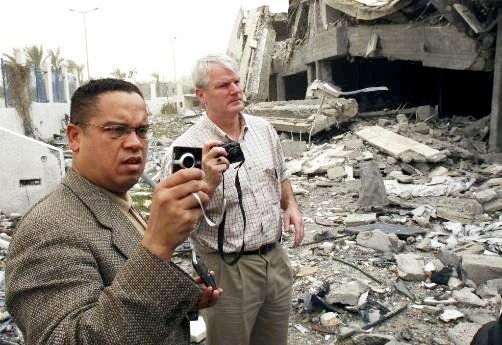
Happy Mother’s Day to all Mothers around the world, and a special Happy Mother’s Day for my heroines, the Palestinian and Arab Mothers.

On March 3rd something that is (to my knowledge) unprecedented happened in the Rayburn House Office Building on Capitol Hill. A standing room only crowd of over 130 persons heard actual Congressmen (not just outsiders given a platform by Congressmen) objectively discuss the devastation recently visited upon Gaza by the Israeli Defense Forces.

It began with an excerpt from a video about the Congressmen’s visit to Gaza that showed what was left of a day-care center. Although not much more than rubble, the center was host to an art exhibit that the staff insisted on mounting after its destruction because it was a center of life. There were also interviews with the staff of a hospital who, although their homes are only an 18-minute drive away, must go through an at least 90-minute (each way) check point every working day.

There was also a grocery store in Jaballia camp in which there were items on shelves thanks to the infamous tunnels. Congressman Keith Ellison (D-MN) argued that it would be better to open the crossings where freight would be checked.

One must understand that none of the speakers blamed Israel for what happened. Indeed, all who spoke strongly emphasized that they were not taking sides and mentioned the anxieties that militants in Gaza have imposed on Israel with their rocket attacks. Nonetheless, when most in Congress and the mainstream media are in a state of denial about the humanitarian crisis, the fact that these few stood up to show pictures of bombed schools and displaced civilians indicates that there is change in the air and that the time for the Palestinian narrative to complement the other one that has monopolized the discourse in America is timely.

Ellison insisted that his call for opening the crossings, which he said was the only message he had to offer, would enhance Israeli security as well as alleviate the humanitarian crisis. He said that at no time did they hear any anti-American talk, nor anti-Israeli or pro-Hamas comments (although that may have been due to the fact that their visit was for only one day). Ellison noted that without a dedicated constituency, Gazans can expect no action. He noted that there is well-organized Israeli lobby and a somewhat less well-organized Palestinian lobby, but no peace lobby.

Brian Baird (D-WA) said that the original intention of the Congressional visit was for him and Ellison to speak on Islam in the West. Now, he said, the challenge is to be honest about what they have seen without being accused of taking sides. He felt that what has been done in the last couple of months gives people there hope, but that money is not sufficient. Neither the rockets nor the invasion has moved things forward; neither has advanced the prosperity or security of the people there.

Congressman Rush Holt (D-NJ) says he never feared for his safety and he never met anyone looking for a fight. He said he found only friendly children and people who wanted to get on with their lives. He expressed the view that letting aid go only through tunnels has not stopped the rockets and not advanced communication between the parties to the conflict, but only enriched outlaws. Holt mentioned seeing a science book at an American school there shredded by the bombings and Baird recalled a book about baseball that mentioned Jackie Robinson’s successful struggle against racism.

The respondent was Daniel Levy, Director of the Middle East Task Force of the New America Foundation. He remarked that the Congressmen had done a service for America’s public diplomacy by restoring hope. He thanked them for resisting playing the blame game and noted that the arbitrary definition of “basic food and medicine” that is now allowed at the Rafah crossing excludes toothpaste, building materials and item arbitrarily labeled ‘luxuries.’ Banknotes are not allowed in. Even when credit is deposited to a bank it can’t be withdrawn because there is no physical currency. He said these are collective sanctions rather than targeted sanctions. He concluded that to resolve the issue there needs to be a deal on Gilad Shalit, the crossings must be opened, and a cease fire accepted. What must not happen, he said, is to continue to hold the entire population hostage. The theory that deprivation of Gaza will cause them to overthrow Hamas has been disproven.

Levy explained that in 2005 there was an agreement that the Rafah crossing would not be used for commerce, and all commerce would go through the five Israeli crossings, but those crossings are now closed. Although 200 trucks now pass through Rafah, the minimal aid requirement is 500 trucks. Baird added that the crossing best equipped to screen trucks for contraband is not open.

In response to reporter Sally Quinn’s allegations of fears by “Arab and Muslim leaders” that Hamas will steal any aid and her inquiry as to whether Gazans are angry at or supportive of Hamas, Ellison replied that Gazans are focused on their survival. Baird added that there was a lot of discussion of long-term psychological effects on children and that they had heard at the Islamic Conference that if we don’t proactively reward moderates extremism will flourish. Because of the frequency of allegations of a “hate filled curriculum,” he asked the children about their attitudes toward the U.S. and got typical kid answers. Levy added that we shouldn’t lose sight of the fact the Fatah position was that by working with the U.S. and Israel they would deliver a Palestinian state; all these years after the handshake on the White House lawn that has become a tough promise to sell. There is a recognition now that Hamas is part of the landscape like it or not.

In response to a question from a reporter from Al Jazeera as to whether the trip and program signaled a real shift in American policy, Baird replied that “you can criticize a friend and still be a friend.” He feels that many in Congress would like resolutions to be more measured and nuanced. Ellison noted that in Israel it is okay to talk about these things; it is only in Washington that politicians fear derision for stating the obvious.

Imad-ad-Dean Ahmad, Ph.D.
Minaret of Freedom Institute
http://www.minaret.org

source: http://www.theamericanmuslim.org/tam.php/features/articles/thinking_through_a_us_strategy_toward_gaza_a_congressional_view/0017209

Zionist influx into Palestine started in 1882.  There were 6 waves of Jewish immigration between 1882 and 1948.  As a result of these waves, the number of Jews living in Palestine increased to about 650,000.


During the Paris Peace Conference in 1919, the Zionists asked for the creation of a state in the territory that includes all of Mandate Palestine, Southern Lebanon up to the Litani River, the Golan Heights and part of Western Jordan along a line parallel to the Hijaz railway and ends in Aqaba.  From there, the line goes northwest to Al Arish in Egypt.  (David McDowall, Palestine and Israel: The uprising and Beyond, Berkeley, Los Angeles: University of California Press, 1989, p. 20.  See also: Simha Flappan, The Birth of Israel: Myths and Realities, New York: 1987, p. 17) 


In 1948, Ben-Gurion considered acceptance of a Jewish state in part of Palestine as a bridgehead for future expansion whenever the time was right.  His vision was spelled out in a letter to his son, Amos, stating that “A partial Jewish State is not the end, but only the beginning… We shall bring into the state all the Jews it is possible to bring… We shall organize a modern defense force, a select army…and then I am certain that we will not be prevented from settling in the other parts of the country, either by mutual agreement with our Arab neighbors or by some other means.  Our ability to penetrate the country will increase if there is a state…”  (Michael Bar-Zohar, Ben-Gurion: A Biography.  New York: Delacorte Press, 1977, pp. 91 – 92)


In a round table meeting with the French at the Sévres Conference, Ben-Gurion proposed a plan for settling all the issues in the Middle East.  The plan included eliminating Nasser in Egypt and partition of Jordan, with the West Bank going to Israel and the East Bank to Iraq.  In exchange, Iraq would sign a peace treaty with Israel and undertake to absorb the Palestinian refugees.  Moreover, Ben-Gurion requested that Israel would annex southern Lebanon up to the Litani , with a Christian state established in the rest of the country.  Ben-Gurion added that the Suez Canal would enjoy international status, that the Straits of Tiran would be under Israeli control, and that Syria should be placed under a pro-Western ruler in order to stabilize the Syrian regime.  Official confirmation of the Sévres protocol was received by Ben-Gurion on 26 October and was warmly congratulated by Menachem Begin.  (Ibid, pp. 236-244)


Golda Meir even denied the mere existence of the Palestinians by stating that there is no such thing as the Palestinians.


Within 5 decades, the Zionist dream began to evaporate.


In spite of all the Zionist atrocities aimed at Ethnic Cleansing, Palestinian Arabs living within the borders of Mandate Palestine are approximately 4.5 million.  Within ten to fifteen years, Arabs living in Palestine would become the majority even if the Palestinian Refugees living outside Palestine were not allowed to return to the homes and lands that were usurped from them. 


In spite of having a large army equipped with all the high-tech weaponry provided by the U.S., Israel failed to deter or stop Arab resistance.


In March, 1968, Israel attacked the village of Karama on the East Bank of the Jordan and faced a bloody and heroic stand by the Palestinians.  This battle gave the Palestine Liberation Organization (PLO) a psychological boost and increased its influence.


On 24 May 2000, Israel was obliged to withdraw from Southern Lebanon, which was occupied since 1978.


On 12 July 2006, Israel started an ‘open war’ against Lebanon.  The war stopped on 14 August 2006.  During this war, another massacre was committed in Kana, about 54 innocent civilians, including about 37 children, were killed in an air raid, and there was a lot of damage and destruction.  However, Israel failed in achieving its goal of ending Hizbullah.   


On 27 December 2008, Israel launched ‘Operation Cast Lead’ against the Gaza Strip and committed a massacre killing more than 1300 men, women and children and injuring more that 5500.  The war was ended on 18 January 2009 without achieving Israel’s goal of ending Hamas.

The game is over.  The Zionist lie of a ‘land without a people for a people without a land’ did not fool any one.  What we are witnessing these days is the end of the beginning and the beginning of the end, which will not take long: 5 – 20 years…

Poster courtesy Badil.


Not only have the whites been guilty of being on the offensive, but by some skilful manoeuvres, they have managed to control the responses of the blacks to the provocation. Not only have they kicked the black, but they have also told him how to react to the kick. For a long time the black has been listening with patience to the advice he has been receiving on how best to respond to the kick. With painful slowness he is now beginning to show signs that it is his right and duty to respond to the kick in the way he sees fit.   – Steve Biko


One of the most important outcomes of the Gaza massacre (2009) has been the unprecedented tremendous outpouring of popular support for the Palestinian cause; something the signatories of the Oslo accords (1993) must have not been happy with. The return of the pre-Oslo slogans of liberation, as opposed to independence, have, undoubtedly, created a new dilemma, not only for Oslo political elites, but also for the NGOized, Stalinist Left.


The process of “Osloization”, i.e, a combination of corruption, Negotization, and a selling-out of revolutionary principles and sloganeering, fused with the fiction of the two-prison solution, has been dealt a heavy blow in the 2006 elections. Judging from statements made, not only by PA officials, but also by the Left, and even the Hamas government, the ultimate goal of the current river of blood has become the establishment of a Palestinian state in any dimension, i.e. the two-state solution. The contradiction between the tremendous international support, the revival of the BDS campaign, the outpouring of demos against Apartheid Israel and its war crimes against the Palestinians of Gaza, and the reiteration, by most political orgs, of the two state mantra is a strong indication of the need for an alternative program that makes the De-Osloization of Palestine its first priority.


In order to understand the Oslo Accords and the extreme damage they have caused to the Palestinian cause, one needs a historical contextualization of the so called “peace process”, or rather what many critical thinkers have called the peace industry. This understanding is a necessary step towards a process of De-Osloization, a term I will get back to at a later stage.


The Oslo accord was claimed to be the first step towards self-determination and an independent state. But it is clear now, 16 years after the famous handshake on the White House lawn, that no state in the short run will be established because of the mere fact that Oslo simply ignored the existence of the Palestinian people as a people. In other words, these accords have offered Zionism what it has always been striving for. Golda Meir’s infamous statement that there are no Palestinians is a case in point here.


And yet, to claim that ‘Oslo’ and ‘Camp David’ were great missed opportunities and ‘breakthrough’, and that the so-called ‘peace process’ was in track until the Palestinians (i.e. colonized victims) blew it is a deliberate ideological distortion of reality claimed in order to prepare Palestinians for more concessions. Real comprehensive peace was not created in Oslo and Washington; rather what was created is an American/Israeli plan to resolve the conflict after the destruction of Iraq and the collapse of the Soviet Union and their attempt to construct a “new Middle East”—to use Condoleezza Rice’s words–a Middle East characterized by imperialist-Zionist hegemony and supported by despotic regimes. The Oslo accord was born dead because it did not guarantee the minimum national and political rights of 10 million Palestinian. As long as there are refugees, cantons, detainees, blockade, settlements, ‘legal torture’ of prisoners, dispossession, assassinations and occupation, comprehensive peace cannot be achieved. It is an illusion in the minds of those who signed the Oslo accords.


These accords have led to the creation of a limited “administrative autonomy” in the Gaza Strip and some parts of the West Bank. The local population was given “the right” to form an authority that they could call “national.” Now the question is what makes the PNA (Palestinian National Authority) beyond questioning? What is the ‘legitimate’ ground upon which it was established? Very simple: The Oslo Accords. It has now become very obvious that despite the famous hand shakes on the White house lawn and in Annapolis, and the optimistic talk of the ‘New Middle East,’ these accords, in contradistinction with UN and Security Council resolutions, have not guaranteed the establishment of a sovereign, independent Palestinian state, or the return of the refugees, nor even the demolishment of the Jewish settlements, and compensation for those Palestinians who have lost—and still losing—their homes, lands and properties; nor the release of all political prisoners, or the opening of all checkpoints, which have become daily nightmares for residents of the WB and GS; …etc. In spite of all the hand shakes, kisses, and friendly press conferences, Israel launched one of the bloodiest wars in the history of the conflict against the civilian population of Gaza, killing in 22 days more than 1400 people, including 438 children, 120 women, 95 old people, 16 medics, 5 journalists, 5 foreign women, and in which it destroyed more than 40.000 institutions and houses, leaving many families homeless. That, of course, was not mentioned as an objective of the Oslo Accords, but nothing either was mentioned in them that would prevent such bloodletting from taking place.


This is the political reality that Palestinian officials who signed the agreement do not like to be reminded of. In fact, what has been created in parts of Gaza and the West Bank is a very strange entity—an apartheid-type Bantustan endorsed by the international community. Gaza 2009, therefore, is the mirror-image of Oslo. When we bear in mind that 75-80% of Gazans are refugees, the results of 2006 elections become more comprehensible not only in its anti-colonial context, but also in socio-political terms. What Oslo has created in Gaza, and the West Bank for that matter, is literally two different worlds, both of which have been led by undemocratic institutions, many security apparatuses, a Third Worldish military court (commended by the Clinton administration), corruption, mismanagement, inefficiency and nepotism—to mention but few (neo)colonial qualities.


By winning the 1948, 1956 and 1967 wars, and by getting international, Arab and Palestinian recognition, Israel–as an Apartheid settler-colonial state—has hoped to move into a new stage; a stage  that requires the formation of ‘new consciousness’ amongst colonized Palestinians. Herein lies the danger of Oslo; Osloization, within this neo-Zionist context, means the creation of a new paradigm through which you wash out the consciousness of your supposed enemy-the ‘Other’-and replace it with a one-dimensional mentality, through the construction of a fiction (two states for two peoples) whose end is unattainable. Even the fascist Lieberman has started singing the same song.


Put differently, to aim at creating the two-state Palestinian is to aim at creating false consciousness led by assimilated intelligentsia, some of whom have a revolutionary past record. Singing the slogans of “the two state solution,” “two states for two peoples,” “return to the 1967 borders,”–or even “a long-term Hudna” (as proposed by Hamas) — is intended to guarantee the subordination and conformity of the Palestinians, especially those with revolutionary ideas. Gone are the right of return of 6 million refugees and their compensation, and the national and cultural rights of the indigenous population of Palestine 1948.


This goal, however, never sees the antithesis it creates as a result of displacement, exploitation, and oppression; it ignores the revolutionary consciousness that has been formulated throughout the different phases of the Palestinian struggle. Nor does it take into account the legacy of civil and political resistance that has become a trademark of the Palestinian struggle. Hence the necessity of the formulation of Palestinian alternative politics. To be conscious of the corruption of the Palestinian Authority, and of the huge class gape that the Oslo Accords have created has definitely been the beginning of De-Osloization represented in the Al-Aqsa uprising and the outcome of the 2006 elections. This is an oppositional consciousness that the signatories of Oslo did not take into account. Both events represent an outright rejection of the Oslo Accords and their consequences.


The Gaza Strip, however, is seen by the PA as one of three building blocks of an independent state, although it is geographically separated from the second block, i.e. the West Bank. The third block is, Jerusalem, is under total Israeli control. None of the Palestinians in the occupied territories believe that the ‘semi-autonomous’ zones in the GS and the WB -that is, the ones that fall under category A—can lay the foundation for an independent state. What Oslo has led to is, in fact, a South Africa. When black South Africans needed to move from their townships to big ‘white’ cities, they needed to get a ‘pass’. During ‘peace time,’ Palestinians, not only those who work in Israel, but also those who wanted to visit the WB form Gaza, or vice versa, needed to apply for a ‘permit’. Beside the permit, Palestinians needed a so-called ‘magnetic card,’ which is a computer card that has a password to its holder’s security file. No one could work in Israel, or visit the WB, or even go to a hospital inside the ‘green line’ without a ‘permit’ and a ‘magnetic card’. If one was granted such invaluable cards, one was still not allowed to visit any other area except the one s/he was entitled to visit. If one was ‘caught’ at another area, one’s permit and card were confiscated immediately, not to mention the torture one was exposed to. Nowadays, no one is even given such luxurious ‘permits’ and cards.  How was apartheid South Africa different?


The tribal chiefs of the South African Bantustans used to believe that they were the heads of independent states. Luckily, the ANC, despite its many compromises with the National Party, had never accepted the idea of separation and Bantustans. The official Palestinian leadership on the other hand, at the end of the millennium, boasts of having laid the foundation for a Bantustan, claiming it to be an independent state in the make. Undoubtedly, this is the ultimate prize Zionism can offer to its ‘Other’ after having denied her/his existence for a century, and after that same ‘Other’ has proved that she is human. For Zionism’s continued presence in Palestine, the ‘Other’ must be assimilated and enslaved without her/ him being conscious of her/his enslavement. Hence the granting of ‘semi-autonomous’ rule over the most crowded Palestinian cities, and hence the logic driving the Oslo Accords.


Oslo, then, brought an unprecedented level of corruption into Palestine; and security coordination with Israel, under the supervision of—irony of ironies—an American general, has become the norm. Repeating the two-state mantra, carrying the Palestinian flag, singing the national anthem and— more importantly—recognizing Israel, regardless of the rights of two thirds of the Palestinian people, are what Oslo is all about.


The lesson we learn from Gaza 2009 is to harness all effort to fight the outcome of the Oslo Accords, and to form a United Front on a platform of resistance and reforms. This cannot be achieved without dismantling the PA and realizing that ministries, premierships, and presidencies in Gaza and Ramallah are a façade not unlike the South African Independent Homelands with their tribal chiefs. The classical national program, created and adopted by the Palestinian bourgeoisie has reached its end unsuccessfully. Most political forces, including the governing party in Gaza, fail to explain how 6 million Palestinian refugees will return to the Israeli State of the Jews and an independent Palestinian state will be created at the same time.


Hence the necessity for an alternative paradigm that divorces itself from the fiction of the two-prison solution, a paradigm that takes the sacrifices of the people of Gaza as a turning point in the struggle for liberation, one that builds on the growing global anti-apartheid movement that has been given an impetus by Gaza 2009. De-Osloizing Palestine is, therefore, a precondition for the creation of peace with justice.


Associate Professor in the Department of English Literature, Al-Aqsa University, Gaza Strip, and a member of the One Democratic State Group. – haidareid@yahoo.com


Source:

http://www.amin.org/articles.php?t=ENews&id=2845