Archive for the ‘Middle East Issues’ Category

Italy's major newspaper headline claiming mass crucifixion of Christians and the tears of the Pope over this, with full size colour picture. But it's not what they claim...

Italy’s major newspaper headline claiming mass crucifixion of Christians and the tears of the Pope over this, with full size colour picture. But it’s not what they claim…

BY THE EDITORS OF SIRIALIBANO, translated and integrated with hyperlink exerpt translations by Mary Rizzo

They were not Christians, they were Muslims. They were not killed by means of crucifixion, but their already lifeless bodies were exhibited in that barbarian manner.  The crime is ghastly, no matter what religious denomination the victims belong to.  And yet it “news” of “Christians crucified in Syria” went viral in the western media, in particular in the major Italian news media.

The two major Italian newspapers Il Corriere della Sera (above) and La Repubblica (below) dedicated a great amount of space to it, bring attention to the “news” on the first page accompanied by photographs of “a man crucified in Maalula”, the small Christian small town near Damascus.

To push the directors and the heads writers towards a similar editorial choice has no doubt been the statement of Pope Francis in the official Vatican site:   “I cried when i saw the news“.

The Holy Father said, “I cried when I saw on the mass media the news of Christians being crucified in a certain non-Christian nation. Even today,” he stressed, “there are people who, in the name of God, kill and persecute. And even today we see that like the apostles they are happy to have been considered to have been worthy to undergo suffering for the name of Jesus. This is the third icon of today. The joy of the testimony.”

As you know, the assertions of the Pope are always newsworthy. And a crucified Christian in a Country infested from by al Qaida is too tasty a morsel to not take full advantage of.

The fake news did not appear only for on the pro-Assad websites, the usual Islamophobic ones or the reactionary and “anti-imperialist” (but only in one direction) sites “of the left”, but in Italy’s most important mainstream newspapers. And then it  to numerous other media outlets on radio, television and online.

Those who believe in conspiracies would even be led to think that it is a pro-Assad campaign in time to legitimise his election farce on 3 June.   It’s not quite like that.  So the question remains, “Why?”.  Is it only a matter of ignorance in good faith, then? Is it only bad journalism, incapable of verifying the information and the sources?

The facts: among the seven people killed in Raqqa there were no Christians, were all Muslims and in fact two of the crucified persons seemed to be supporters or fighters belonging to other rebel factions, the accusation against them was to have thrown some explosive devices and to have tried to kill some leaders of the al Qaeda group The Islamic State of Iraq and the Levant (ISIS).

To Raqqa, a town on the Euphrates controlled by ISIS, there is underway by the general population a resistance that is trying to oppose the imposition of what the al Qaedists call Islamic law. ISIS itself, accused by various sources to be highly infiltrated by foreign secret services as well as those of the regime of Damascus, has been active since the beginning of the year in daily clashes with the other rebel groups reunited under different names (Syrian Free Army, Islamic Front, Jabhat al Nusra, etc…), defined as takfiri and therefore, wicked.

Italy's second largest newspaper highlights the "crucifixions" and again, the tears of the Pope.

Italy’s second largest newspaper highlights the “crucifixions” and again, the tears of the Pope.

None of this matters. Any “news” that can present president Bashar al Assad to us as if he is the saviour of the nation (“it’s either him or al Qaida) is good enough and is going to be considered as authentic. In this sense, a Catholic site defined the killers of Raqqa as “anti-Assad militants”, attributing others as being engaged in disinformation: “In vain you will find in the Italian newspapers articles on the terrible event: some line or two buried in some article, nothing more. It is that in this war the needs of propaganda hinder the accounting of the crimes of the anti-Assad rebels, while emphasised, if not actually invented, are those of Assad…”

The same site citing another source goes as far as to even give a name to tone of the deceased: the Christian Antoine Hanna, a name that one sees over and over in this story.

But on the Jihadist forums of ISIS and in various tweets by ISIS fighters, it is possible to read the reply of these people to the tears of the Pope for the crucified Christians:  “Dear Pope Francis, the people of Raqqa were not crucified because they are Christians but for the application of the Koranic verse 5:33″. The sura in question recites: Indeed, the penalty for those who wage war against Allah and His Messenger and strive upon earth [to cause] corruption is none but that they be killed or crucified or that their hands and feet be cut off from opposite sides or that they be exiled from the land…”. This was done according to the strict application – according to ISIS – of the sharia, the Islamic law.

If the application of the sharia by ISIS e dell’ Isis was truly consistent with the literal Koranic text, the “infidels” must not be punished as such since in verse 2:62 it is in fact is written: “Indeed, those who believed and those who were Jews or Christians or Sabeans [before Prophet Muhammad] – those [among them] who believed in Allah and the Last Day and did righteousness – will have their reward with their Lord, and no fear will there be concerning them, nor will they grieve.” Already in the month of March, ISIS had killed and then bound a man to a wooden cross, with the accusation of having robbed and then killed another Muslim.

But let’s go back to “Antoine Hanna”. The news is that “a person was killed and then bound to a cross in the village of Meskene”, in the countryside of Aleppo. Strange: various Christian sources of Aleppo questioned in these days remember that in the countryside of the northern Syrian metropolis there have never been Christians.

None of this matters. The pro-Assad sites headline:  “A Syrian named Antoine Hanna in the rural zone of the town of Aleppo, was killed before the eyes of his children with the accusation of blasphemy. He refused to renounce his religion and they crucified him.” Or: “Young Christian named Antoine Hanna, crucified by the takfiri terrorists sponsored by the United States and the West, in the Maskana area… accused of anti-religious sentiment.”

This time the news had not yet been picked up by the Catholic sites.  We hope they don’t do it because the presumed Christian killed in Meskene has – coincidentally – the same name and surname of the presumed Christian killed in Raqqa. Evidently, this time the disinformation machine has a hitch.  See the ISIS press release on the crime committed in Meskene.

The photograph of the crucified man in Meskene appeared for the first time in a tweet by Dylan@ProSyriana, apparently a Syrian Christian supporter of President Assad, with the following wording: “one of three killed and crucified in Meskene (Aleppo) after having been accused of being an infidel by the rebels”.

There are no references to the fact that the man was Christian, perhaps what led to confusion in the Italian Assad supporters was the word “infidel”, which however is used by ISIS also towards other Muslim rebels, those they consider takfiri and infidels.

A source present in Meskene just contacted confirmed that the murder happened in the locality of Aneza, but denies that it involved a Christian. He insists that he was a native of Akraba, near Sfera; a refugee of Meskene is said to have recognised him as the person who manned the checkpoints of Khanaser, therefore he was a soldier or a person that worked for the regime. It is said that he was crucified by ISIS to frighten the rebel fighters stationed in the zone of Meskene so as to induce them to leave the area.

The story of the Christians persecuted in the Arabic East during wartime has been a constant throughout history by those who seek to maintain the control of the area  – political, economic but also cultural – serving to entrust the keys of power to the ruling regime.  It is not therefore anything new.

The perseverance of the Italian pro-Assad sites on this theme is noteworthy.  On these platforms the fake news spreads, as well as fake photographs that are passed off as the truth. One of the most clamorous ones was a photograph of a group of veiled and chained women next to a bearded man with a sword.

According to what these sites were spreading, it was about women of Aleppo sold as by the Salafiti in the markets. Those who were even more precise described them as Shi’a women sold as slaves after they had been raped.  What a pity that the photograph dates back to 2007 and showed some Shi’a women immortalised in a representation of the (Shi’a) holiday of Ashura in the village of Nabatiyeh in Lebanon.

In September of 2013 the Catholic news agency Fides had been forced to deny that the news concerned the killing of 130 Christians in Aleppo: “The news of a massacre of 130 Christians in Aleppo is entirely false, said to have been carried out by groups of the Syrian opposition, as reported in the past days by the Lebanese mass media and some websites.”

A priest questioned by Fides noted: Such kind of news only serves to spread fear, particularly, it has the objective of starting a sectarian war. They would also want to persuade Christians to arm themselves, making the conflict assume a character that is even more sectarian, taking a dangerous turn, close to the war of Lebanon. Furthermore, they seem to prepare the terrain for a division of the Syrian territory itself on a factious and sectarian basis.  This goes against the history, the culture and the real face of Syrian society, which has always been characterised by pluralism and the variety of its forms, in co-existence.”

In the net of propaganda also was captured the news of “a woman stoned to death by fundamentalists in Raqqa”. Of the victim only the surname is known: al Jasim. However, the photograph a still from the film “The Stoning of Soraya” in which the Iranian actress Mozhan Marno undergoes lapidation.

Spread on a pro-Assad Catholic news site as "a child from Kassab", whatever the true and brutal story behind this picture, the setting is not in Syria but in Yemen.

Spread on a pro-Assad Catholic news site as “a child from Kassab”, whatever the true and brutal story behind this picture, the setting is not in Syria but in Yemen, according to several Yemenites who have commented that it is a well-known picture there.

More recently and the day after the attack of the Armenian village (therefore Christian) of Kassab northeast of Latakia by fundamentalist militiamen, in the web a photograph circulated with the caption, “A Christian child executed by rebels in Kassab”.

The image showed a child just a few months old with a woolen hat surrounded by men that were pointing old guns at him.  It was an old photograph that had nothing to do with Syria, but instead was in Yemen.  On some sites the caption of the photograph was the following: “This child was captured by the terrorists because he is a child of another religion, therefore an infidel child, but above all he is a child of a Syrian Pro government family.”  As if by miracle, this passed from a pro-Assad site to a Catholic news site and it was used as an example of the damage caused by the “Western-supported fundamentalists against Syria and the Syrians.”

For more of a year, Syrian activists who support the revolution but oppose ISIS have been denouncing its violations against the population, in the almost total silence of the media, of the pro-Assad sites and the Catholic sites that are very attentive to news regarding Christians or gruesome news stories, as if the constant bombardment of the regime’s aeroplanes on the civilian population wasn’t brutal enough.

Now the ISIS that is being fought against by the other rebels, becomes the paradigm to represent the revolution, therefore guarantor of the safety of the Christians can only be the regime. But as the priest interviewed by Agenzia Fides, “Such news Fides “Such kind of news only serves to spread fear, particularly, it has the objective of starting a sectarian war.”

ORIGINAL: http://www.sirialibano.com/short-news/quando-morire-i-cristiani.html
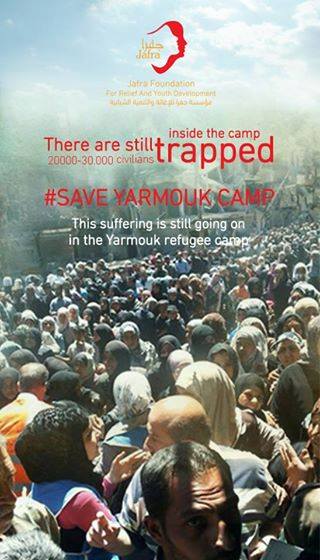
20.000 - 30.000 civils sont toujours pris au piège à l'intérieur du camp.   #SaveYarmoukCamp  Les souffrances continuent sans répit dans le camp de réfugiés de Yarmouk.

20.000 – 30.000 civils sont toujours pris au piège à l’intérieur du camp.
#SaveYarmoukCamp
Les souffrances continuent sans répit dans le camp de réfugiés de Yarmouk.

Wesam est un jeune palestinien qui milite au sein de “JAFRA”, une organisation communautaire qui aide la population de Yarmouk, en Syrie. Il a très gentillement accepté de répondre à nos questions, pour le public italien, mais pas seulement celui destiné à la Péninsule, puisqu’aussi bien Wesam aurait pu s’exprimer en anglais si son interviewer n’avait pas été arabophone. Cet entretien est la traduction anglaise de la version italienne tirée de l’arabe d’origine. (Interview & traduction italienne de Fouad Rouieha, traduction anglaise de Mary Rizzo, traduction française de Eric Lamy). 

Commençons par décrire Yarmouk.

Le camp de réfugiés de Yarmouk est situé au sud de Damas. Il s’étend sur plus de sept kilomètres carrés, juste à côté des districts du centre, tel celui de Midan Zahir. Pour faire court, le camp fait partie du tissu urbain de Damas. Avant le début de la révolte, il comptait 700.000 âmes, dont 220.000 palestiniens d’origine, le reste étant des syriens. Le camp de Yarmouk fut établi en 1957 : la majorité des palestiniens qui y vivent sont des fils de réfugiés de 48, principalement originaires du nord de la Palestine auxquels s’ajoutèrent ceux qui vinrent de Jordanie en 67 et 70. Avant la révolution en Syrie, Yarmouk était une zone économique florissante, considérée comme la capitale de la diaspora palestinienne. Il s’y tenait un marché considérable, le commerce y prospérait. Une véritable ferveur pour les questions sociales et politiques y prévalait, sans oublier ce dynamisme culturel qui faisait de Yarmouk le centre culturel de Damas, le lieu où il se passait quelque chose, où des festivals étaient organisés. Un grand nombre d’artistes célèbres sont originaires de Yarmouk. Pareil à d’autres quartiers, mais plus particulièrement animé, les rues étaient peuplées de boutiques et de restaurants que fréquentaient tous les damascènes. Le weekend, ou pendant les congés, les rues étaient si populeuses qu’on avait du mal à y circuler ; c’était un quartier très peuplé mais également réputé pour la sécurité qu’il offrait.

Vous parlez de l’existence d’un activisme politique, mais être militant, en Syrie, était complètement tabou à cause de la surveillance policière et de la répression toujours possible. Était-ce différent pour les palestiniens ?

J’ai mentionné l’activisme politique en rapport avec la Cause Palestinienne, qui n’avait pas de lien avec la situation syrienne. Yarmouk était une des bases pour les factions palestiniennes : le Front Populaire, le Hamas, le Front Populaire-Commandement Général, le Jihad Islamique, le Fatah… l’activité politique autorisée impliquait le camp de Yarmouk et la Palestine, mais rien qui pût se rapporter directement à la Syrie. Les syriens vivant à l’extérieur du camp assistaient à nos discussions, mais tant qu’il n’était question que de Palestine, tant que la politique syrienne n’était pas évoquée, il n’y avait aucun problème.

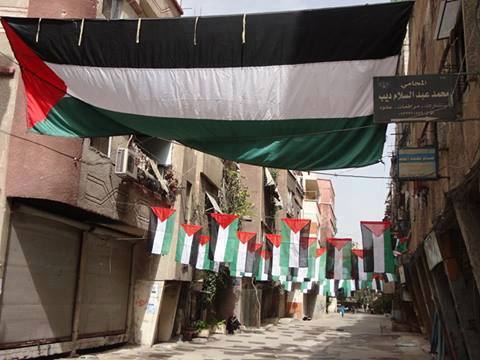
Une rue de Yarmouk.

Une rue de Yarmouk.

Parlez-nous de la cohabitation entre syriens et palestiniens-syriens. Peut-on parler d’intégration réussie ou, au contraire, a-t-on assisté à la création d’une sorte de ghetto ?

Entre nous, personne ne faisait de différence. À Yarmouk, nous avons vécu ensemble pendant 50 à 60 ans. Les mariages mixtes sont monnaie courante et nous sommes tous mélangés. Il faut dire que parfois une même famille est partagée entre les deux nations (la Palestine du Nord et la Syrie méridionale n’étant pas séparées à l’époque qui a précédé l’exil palestinien ; des familles et des clans étaient établis de chaque côté de la frontière. Il n’y a pas de différence entre syriens, palestiniens, libanais et jordaniens car des relations d’amitié et de parenté ont toujours existé.

On dit qu’au début de la révolution les palestiniens-syriens du camp ont tenté de se démarquer du conflit.

Non, nous n’avons pas tenté de nous en affranchir : il y a eu un débat considérable pour déterminer si le camp devait s’investir dans la confrontation. Une partie d’entre nous pensait que les militants de Yarmouk qui voulaient se joindre à la révolution devaient s’engager en dehors du camp, sans l’impliquer. Nous savions que si Yarmouk était visé par des représailles, elles seraient extrêmement violentes : c’est malheureusement ce qui est arrivé. Ensuite, l’idée à circulé selon laquelle Yarmouk pourrait être un lieu de repli sûr pour les syriens déplacés, pour les blessés, afin de leur permettre d’accéder aux soins médicaux et au ravitaillement. Au cours des deux premières années, Yarmouk à rempli ce rôle. Quand les affrontements ont éclaté dans les zones de Al Hajar Aswad ou de Tadamon, Yarmouk était un centre de distribution de produits médicaux et d’entraide. Nous accueillions les réfugiés. Avant eux, nous avions déjà recueilli les réfugiés de Homs : il y avait là tant de familles ! Pour eux, nous avons ouverts des refuges, profitant des écoles de l’UNRWA (agence de Nations Unies pour les Réfugiés Palestiniens, n.d.l.t.) et de celles de l’état. C’était des refuges protégés pour ces gens où ils furent accueillis, nourris et logés. Lorsque le Commandement Général à incité certains d’entre nous à prendre les armes contre l’Armée Syrienne Libre, Yarmouk a été directement impliqué dans les combats : l’ASL est entrée dans le camp et il devint, comme les autres districts de Damas, la cible du régime syrien.

On nous a rapporté des abus commis par l’ASL…

Ceux qui sont entrés dans Yarmouk n’étaient pas tous de même obédience : il y avait là des tas de gens différents et, parmi eux, des criminels de droit commun déguisés en révolutionnaires, comme cette “Brigade des Fils du Golan” qui était, en fait, un gang de kidnappeurs et de voyous. Ils ont incendié des maisons et en ont pillé d’autres. Cela a duré 6 mois, puis l’ASL, constituée de palestiniens et de syriens, les à délogés du camp.

 Concernant la révolution syrienne, qu’elle est la position des factions palestiniennes à l’intérieur du camp ?

Elle est contradictoire : d’un côté, les partisans du FPLP-GC, du Fatah Al Intifada qui combattaient aux côtés des loyalistes. Les proches du Hamas ainsi que des groupes indépendants se battaient contre le régime. La division qui existe dans la population syrienne est la même qui affecte la société syro-palestinienne.

une victime de la famine.

Une victime de la famine.

Pouvez-vous chiffrer la population vivant à l’intérieur du camp ?

Nos données diffèrent de celles de l’UNRWA : nous sommes sur une base de 25 à 30.000 personnes, dont 5000 syriens, le reste des résidents étant palestiniens. Ceux qui sont restés n’ont nulle part où aller et il n’y a plus de place dans les refuges. Pauvres d’entre les pauvres, ces palestiniens et ces syriens n’ont pas d’argent pour louer une maison et ils n’ont pu trouver de place dans les dispensaires du camp. Certains d’entre eux ont pu, un temps, s’installer dans les différents jardins publics de Damas, mais ils en sont revenus. Il y a aussi ceux qui n’ont pu fuir de peur que leur fils soit enrôlé de force dans l’armée. Il y a là des gens qui n’ont pas de papiers, pas de carte d’identité et ne peuvent donc pas sortir du camp. Soyons un peu logiques : il y a 30.000 civils à Yarmouk. S’ils avaient vraiment été des combattants, Damas serait tombée en 2 jours ! Parmi les hommes en armes à l’intérieur du camp, on compte environ 1000 palestiniens et 500 syriens : voilà tous les combattants du camp. Ces palestiniens sont natifs de Yarmouk. Ils ont formé des comités de dėfense, pas seulement contre le régime mais pour des raisons de sécurité interne : les institutions ont volė en éclat, l’anarchie est partout. Il fallait protéger les résidents des voleurs, des kidnappeurs. Ces comités de défense remplissent, en fait, une fonction de police. Il leur arrive même de régler des problèmes familiaux.

Aujourd’hui, comment décririez-vous la situation humanitaire ?

Yarmouk vit sous siège partiel depuis décembre 2012. Cela signifie que les civils peuvent entrer et sortir avec ce qu’ils peuvent transporter. Bien sûr, les camions chargés de nourriture sont interdits. Depuis le début du siège, nous n’avons réussi qu’à faire entrer 4 camions, ce qui a entraîné l’arrestation de quelques volontaires et la mort de Khaled Bakrawi. En juin 2013, le siège à été complètement fermé : plus personne ne put entrer ou sortir, plus de nourriture, plus de produits médicaux, plus aucun bien de consommation ne furent autorisés à pénétrer à l’intérieur du camp. Au bout de 4 mois sont apparus des cas extrêmes de malnutrition et les gens ont commencé à mourir. À ce jour, nous avons répertorié 154 cas de décès dûs à la faim, sans parler des cas où la faim n’est qu’un facteur du de la mort. La nourriture continue de manquer ; il y a bien eu des tentatives diplomatiques ces deux derniers mois qui n’ont abouti qu’à la livraison de 12000 paniers-repas qui ne permettent chacun que d’assurer la subsistance d’une famille de 4 personnes pendant 10 jours. Quiconque en a reçu un n’a plus rien aujourd’hui. Plus tard, 5000 paniers contenant de la confiture, des dattes et un peu de pain furent distribués. Cette dernière livraison fut assurée par l’UNRWA, tandis que nous avons réussi à en distribuer entre 4 à 5000.

Des volontaires de JAFRA distribuent des sacs de nourriture.

Des volontaires de JAFRA distribuent des sacs de nourriture.

La situation médicale et sanitaire : il n’y avait qu’un seul hôpital en activité à Yarmouk, l’Hôpital de Palestine, qui a été fermé par suite du manque de carburant (“mazot”, une sorte de fioul utilisé pour les groupes électrogènes et les stérilisateurs, ndlt). Comme l’électricité a été coupée dans le camp il y a treize mois, l’hôpital ne peut plus compter que sur les générateurs. Il n’y a plus de produits médicaux dans le camp et le seul médecin présent à Yarmouk a été tué il y a 6 mois, comme il sortait de l’hôpital, au cours d’un bombardement. Le personnel médical ne se compose plus que d’infirmières ; leur travail est guidé par l’expérience, mais ils ne sont ni médecins, ni spécialistes. Le mois dernier, nous avons pu exfiltrer 400 cas graves hors du camp. Au cours de l’évacuation, certains ont pourtant été arrêtés par les forces de sécurité du régime. À ce jour, nous avons des cas de malades qui réclament leur évacuation, mais il est absolument impossible aux civils de quitter le camp.

Parlez-nous de la vie quotidienne d’un résident de Yarmouk. J’imagine qu’il est peu probable qu’il puisse y travailler ?

Il n’y a plus de travail à l’intérieur du camp. Les routes sont fermées : pas de déplacement, pas de commerce possible. Le problème majeur est le prix élevé de la nourriture, car la contrebande de denrées est apparue. Il y a un mois et demi, un kilo de riz coûtait environ 12.000 livres syriennes (LS), l’équivalent d’à peu près 70$. Le tarif a baissé légèrement le mois dernier, mais il faut se dire qu’il coûtait 1$ voici trois ans, qu’il coûte 1$ dans les zones qui entourent le camp, soit soixante-dix fois moins ! Un litre de fioul pour groupe électrogène revient à environ 600/700 LS et coûte seulement 100 LS dans Damas. De toutes façons, il n’en reste presque plus à l’intérieur du camp. Certaines ONG – dont notre Fondation JAFRA – ont mis en place des projets agricoles d’auto-suffisance à l’intérieur du camp. Cela n’a pas trop bien marché l’hiver dernier à causes du temps, mais cela va beaucoup mieux. Il y a ceux qui ramassent de l’herbe dans les prés, et nous avons recensé 5 morts dûs aux snipers du régime qui surveillent ces prés. Les autres se contentent d’exister à l’intérieur de Yarmouk, fouillent les maisons abandonnées à la recherche de nourriture, une poignée de riz ou de farine, quelques épices, n’importe quoi qui puisse se manger. Voilà comment vivent ces gens…

Au cours des mois écoulés, lors de tentatives d’introduire des convois d’aide humanitaire, des attaques ont eu lieu : le régime en a rejeté la responsabilité sur les rebelles.

Il ne s’agissait pas d’attaques directes, bien qu’il y ait eu des tirs dont nous n’avons pas pu établir l’origine. Les deux parties s’accusent mutuellement. La milice accuse le Commandement Général, et celui-ci dénonce les islamistes armés. En réalité, des tirs de la milice ont empêché la distribution mais, franchement, je ne pense pas que l’intention était délibérée. Ils souffrent du siège comme les autres et sont logés à la même enseigne. Je crois plutôt qu’au cours d’un engagement avec les forces loyalistes les convois ont été pris entre deux feux.

 Pour finir, avez-vous un message à faire passer à la société italienne ?

Il y a à peu près 30.000 personnes dans le camp de Yarmouk, dont 1200 enfants. Beaucoup sont nés pendant le siège. J’y étais il y a trois mois : ces enfants ne savent plus le goût de la nourriture. L’un d’entre eux rêve de déguster une simple pomme de terre, de manger quelque chose de bon, quelque chose de sucré. Des personnes âgées ont besoin de remèdes pour leur tension artérielle, leurs problèmes cardiaques, leur diabète, tous les traitements simples et basiques dont le manque total cause leur décès. Les blessés sont contraints à l’amputation par faute de simple traitement. Pas de médicament, pas de médecin ! Nous avons besoin de vaccins pour nos enfants. Les problèmes sont immenses : ils n’ont plus la moindre idée de ce qu’est une vie normale et n’imaginent même plus comment est-ce en dehors du camp. Quelle faute ont donc commis ces enfants et ces civils pour souffrir autant ? Ce qui se passe à Yarmouk est contraire à tout principe d’humanité, contraire à toute notion de patrie, contraire à toute idée de panarabisme, toutes choses pour lesquelles le régime syrien se targue d’être en première ligne !

English: http://radiofreesyria1.wordpress.com/2014/05/06/extreme-suffering-in-yarmouk-camp-interview-with-wesam-sabaaneh/

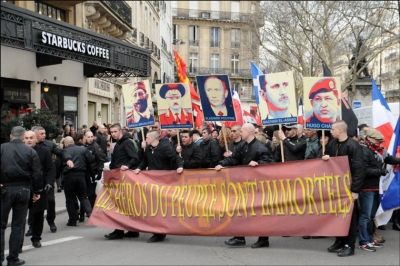
The Third Way march, with their Icons in "yes we can" Shepard Fairey style!

The Third Way march, with their Icons in “yes we can” Shepard Fairey style!

WRITTEN BY HISAM ASHKAR, translated by Laila Attar and Ubiydah Mobarak

News of the visits of fascist and far-right groups to Syria, to show solidarity with the regime, have recently started to emerge, especially with the beginning of the revolutionary process in the Arab region. It seems that the Syrian issue ranks highly on the agenda of the European far-right. So, is it axiomatic to say that the majority of the European far-right supports Assad’s regime and stands against the revolution in Syria?

Nearly two decades ago, several parties and far-right groups started to weave relations with the Syrian regime. For example, communications began between some of the French right in France and the Syrian regime, since the nineties. Many visits then followed. Most notable was that of “Frederic Chatillon“, the president of the extreme student group (Groupe Union Défense), who is very close now to “Marine Le Pen”, the current President of the French party «National Front» (Front National). During his visit in 1994, he met the Syrian Defense Minister at the time “Mustafa Tlass”.

In the first decade of this century, especially since 2006, the visits increased. Most of them took place in Lebanon, the usual place to hold meetings between visitors and the Syrian Social Nationalist Party which is an ally of the Syrian regime. Frederic Chatillon with Alain Sorel were some of the most prominent visitors. This relation was not limited to the official visits and political discussions, it extended to business. For example, the company (Riwal) which is owned by Chatillon, founded the company (Riwal-Syria) to develop economic relations between Syrian and French companies in 2009.

Chatillon, Tlass, Dieudonnè, oh those happy days!

Chatillon, Tlass, Dieudonnè, oh those happy days!

By the start of the uprising in Syria in March 2011, the far-right began to support the Syrian regime in various ways. Frederic Chatillon was the first to support Assad. Since the early days of the revolution, Chatillon accused all those who took part in the demonstrations of the opposition of being partners to the Zionist lobby, which wants to destabilize Syria. Chatillon went even further to organise a demonstration in Paris to support Assad in October of the same year. Chatillon’s company «Riwal» still perseveres to support the news website (InfoSyrie) which is campaigning for the Assad regime.

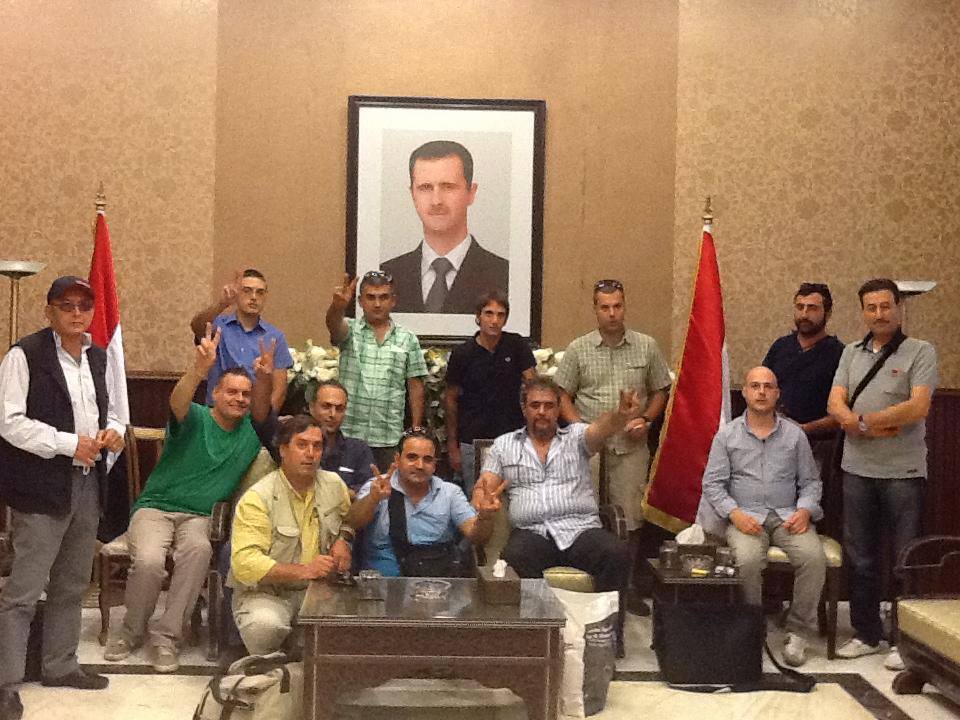
With time, far-right demonstrations supporting the regime were organised in many European cities, from Rome to Warsaw and Geneva. At the same time, several visits to show support were organized, notably the «fact-finding mission» in June 2013. Several European far-right personalities took part in this visit like Nick Griffin “MP in the House of Commons”, Philip Dewinter “deputy in the Flemish parliament in Belgium”. This extent of the support reached the level of going to Syria to fight along side Assad forces in some cases, as the New-Nazi Greek organization «black tulip» (Mavros Krinos) declared. There were also many meetings held by the far-right which aimed to discuss the Syrian situation and how to support Assad’s regime. The most notable was the Boreal Festival which was held in Kanto in Italy on the 12th of September 2013 in the presence of a large number of European fascists. Paradoxically, the Mayor of Kanto, who was hosting that event, began his speech with words by Rosa Luxemburg!

Why does the European far-right back the Syrian regime?

In her thorough article, “Who are Assad’s fascist supporters?” Leila Shrooms attributes this support to:

“Anti-imperialist/anti-globalism sentiment with a strong focus on national states (they believe the Assad regime protects the Syrian state against US imperialism), Islamophobia (they believe the Assad regime fights Islamic extremists), anti-semitism (they believe Assad’s regime acts as resistance to Israel).”

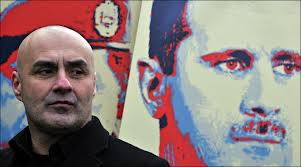
3 way

As for Serge Ayoub, leader of the far-right organization Third way, Troisieme Voie, banned since the summer of 2013, he organized on the 2nd of February 2013 a march in support of the Syrian Assad regime. The reason for his support becomes clear in his answer to the following question, “why are Syrian supporters of the Assad regime participating in this demonstration?” Ayoub replies, “Why are the Syrians with us? Of course, it is our duty to support their cause! Syria is a nation, a homeland, a socialist country with national supremacy. They are fighting for secularism, and they are subject to an attack by imperialist America, globalization and its salafist servants and Qatari and Saudi mercenaries. The purpose is to destroy the state.”

We find in Ayoub’s narrative all the reasons presented by Leila Shrooms, except for Israeli resistance. The far-right does not hide its aversion to Israel, as we have seen in Chatillon. Paradoxically, Ayoub’s supporters who describe themselves as French revolutionary nationalists, and who gained the support of many French and European Fascist organizations, brandished the photographs of five personalities in the demonstration: Bashar Al Assad’s, next to it that of the Russian president Putin, the Belarusian president Lukashenko, the Venezuelan Ex-president Chavez and the national Serb Draga Mihailovič. Many flags were also lifted, among them the Syrian, French, Russian, Venezuelan and Cuban flags.

The grounds for this support presented by all the far-right organizations on the one hand and the organizations who criticize them on the other, stir many questions such as, “Why didn’t this right ally itself with Syria against Israel before the decade of the nineties? Why did this right stand against the Syrian revolution since its beginnings before the rise of the armed extremist Islamic movements? And what is the truth of this anti-imperialist anti-globalization stance of the right?

To demonstrate the background and logic of the right’s position with regards to what is happening in Syria, we have to go back in time 25 years, to a new historical phase that started with the fall of the Berlin wall.

Redefining the enemy: from the communist threat to the threat of the American model.

In his book “The anatomy of Fascism”, Paxton says that Fascist movements are always in need of an enemy that symbolises the overwhelming crises that’s taking society by storm, and who pushes the mass to unite under the flag of the saviour leader. Towards the end of the cold war, most far-right movements in northern Europe considered The Soviet Union to be that enemy-symbol, to the extent that Jean Marie le Pen, the leader of the far-right French party, The National Front, alleged that he carried the legacies of Winston Churchill, Douglas McArthur and Ronald Regan[1], not just in the political arena, but also in the field of Economy. For until the end of the eighties, the National Front was glorifying and defending liberal Economy.[2]

In this context, the fall of communism did not just cause a crisis in the left, rather it went beyond it to reach the far-right, who lost over night its main enemy and one of the basis of its politics. The reconsideration done by some of the members of the right led to adopting ideas of ideological groups such as GRECE, which started since the sixties developing the theory of cultural difference, which opposes racial mixing because it represents a danger for the identity of nations. Hence the United States became the enemy – the new symbol, for various reasons:

1-      Cultural and political American dominance represents a threat to national identities.

2-      The American model reflects a presence and mix between various races and cultures, regardless of the racism and inequality that are rooted in this model.

Redefining the enemy has forced these right wing forces to reconsider many of their political and economic stances to fit with their new ideological position. It is worth remembering here that far-right and main fascist parties are pragmatic parties which don’t hesitate in redefining their main positions (especially concerning the economy, because they do not rely on a fixed line or position in this field, rather they fluctuate according to the political variables.)[3] In order to achieve their goal: success and power.[4] Hence this Right raised the bar of its animosity towards the USA and the new political order, such as economic neo-liberalism and globalization, and establishing relations with those they consider as enemies of this political order. For example, Jean Marie le Pen is the ally of the Lebanese far-right Phalange party since the mid-seventies, and on his visit to Beirut in 2002, he tried to no avail to meet with Ayatullah Fadlallah, who has close relations with Hezbollah. This redefinition of the enemy is what explains the rapprochement between Hizbollah and the Syrian regime, which started in a shy way in the nineties to become more solid and entrenched in the last ten years.

The new far right: “left wing in its work, right wing in its values”!?…

European delegation in support of Assad, containing members of the extreme right, Zenit, Casa Pound, Stato e Potenza, Fascisti del III Milennio,  Partito dei Comunisti Italiani. When Black and Red go to Bed together.

European delegation in support of Assad, containing members of the extreme right, Zenit, Casa Pound, Stato e Potenza, Fascisti del III Milennio, Partito dei Comunisti Italiani. When Black and Red go to Bed together.

The transformation undergone by the Right because of the redefinition of the enemy on one hand and reprioritization on the other, has led to adopting and overtaking some of the leftist ideas in order to empower this new intellectual orientation. For example, we see that the campaign of Marine le Pen in the French presidential elections of 2012 was based on social and economic issues, to the extent that it almost failed to mention some of the favourite topics of the far-right such as banning migrants. The far-right’s adoption of some of the leftist and Marxist rhetoric is not new; this was clear since the birth of fascism as Mussolini used to address the proletariat and fascists alike with his radical, nationalistic, anti-capitalist speeches. Of course, this was to a great extent a selective and manipulative manoeuvre, because the enemy was foreign capitalism and not the national one, and some of the aims of these speeches were the conciliation between the work force and the nationalistic business owners. [5]

In this context, the reliance of the new right on leftist ideas is nothing but that populist national communism, in other words, a return to the classical Fascist speech like in the twenties, and in one of the most important European capitalist crisis at the time. This return is apparent in the National Front’s adoption of the slogan “No Right and no Left” in a clear reiteration of the saying of the founder of the fascist Spanish Phalange Party (Falange Española de las JONS), Jose Antonio Primo de Rivera), that his movement was neither of the right nor the left.

National Front event, all together now! Zenith, December 2006: A. Soral, JM Dubois, B. Gollnish, D. Joly, Jany Le Pen, F. Chatillon, G. Mahé, Dieudonné and others...

National Front event, all together now! Zenith, December 2006: A. Soral, JM Dubois, B. Gollnish, D. Joly, Jany Le Pen, F. Chatillon, G. Mahé, Dieudonné and others…

However the current rhetoric and orientation of this Right differs from its 80 year old predecessor in many details. This right does not stop at adopting leftist slogans and headings, it also partially takes from its ideology to add it to its heritage.  We see Marine le Pen in her book “For France to live” (Pour que vive la France)[6], relying on sayings by many thinkers, politicians, writers and others from the Left, from George Aurel, to Bertlot Brecht and even Karl Marx himself, praising the beginnings of this Left that she considers to have later on betrayed its principles, insisting that it is now the National Front that carries these objectives. Some far-right thinkers such as Alain Soral have even gone a step further, rather than repudiating the left and the right, they try to bring them together. Soral, the ex member of the French communist party and then the National Front looks at the union of the ethical right with the economic social left against the unethical left that compliments the economic right. In form, on his online political group Egalite et Reconciliation, Soral puts together the photos of Che Guevara, Gaddafi, Mahmood Ahmadi Najad, Vladimir Putin and the far-right French icon Jeanne d’Arc. Alain Soral attacks the global political system represented by the USA and Israel and talks about social justice, and the exploitation of the social classes. He denounces imperialism and demands a real left.

In context, he does not suggest anything new apart from the reconciliation between workers and business owners, with full emphasis on the conservative principles and values which lead to the salvation of the French nation.

ayoub 3

Soral might seem like an entertainer mixing economy theology and the conspiracy theory, but his page attracts many visitors and followers, especially youth. The ideas people like Soral promote are translated in the streets, such as members from the Third Way brandishing pictures of personalities and flags as mentioned above. That could sometimes be understood as a communication and coalition between the right and some extreme nationalist left movements, such as the Polish fascist organization (Falanga) which is establishing connections with the Mauis and nationalist Bolsheviks.


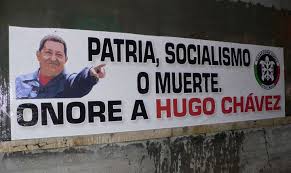
The extreme right Italian movement Casa Pound mixes Right, Left and Nationalism all in this poster, Fatherland, Socialism or Death. Honour to Hugo Chavez

The extreme right Italian movement Casa Pound mixes Right, Left and Nationalism all in this poster, Fatherland, Socialism or Death. Honour to Hugo Chavez

This ideological change, even if directed solely at the national internal interest of these parties, carries in its folds the support of this right for the Syrian regime. Theorists such as Soral, consider Bashar Al-Assad to be one of the characters standing in the face of the global system. Moreover, the Syrian regime is the example, even if not ideal, for their slogan, “left wing in terms of work, Right wing in terms of values”. Emphasising that this system is not applicable in Europe rather suitable for “the political idiosyncrasies of the Middle East, where it is important to have a strong leader to control the ethnic sectarian cohesion with a firm hand, and that is usually acceptable by all clans… As was the case in the past [in Europe]”

The limits of the hatred of the far-right for the “Foreigner”

In addition to the excuse of the “pressing foreign danger”, the far-right parties also need and internal enemy that can be a factor in the demise of the mass, and that prevents the achievement of a more comprehensive and stronger society. [7] Among the internal enemies of this Right is the “foreigner”, and in Europe the two main “foreigners” in the eyes of the far-right are the Jews and recently the Muslims. However the anti-Semitism of this Right does not always translate into animosity towards Israel. In the era of the cold war, most of the far-right considered Israel as the fortress of the west in the face of the Soviet Union. However this rapprochement was always hindered by the position of the far-right with regards to the holocaust. With the end of the cold war, and the redefining of the enemy, Israel moved from the impervious fortress in the face of the communist danger to the strongest ally of the new American enemy. This development was accompanied by a change in the perception of some of this right and their rapprochement to some of the European groups, in a step some researchers attribute to the appearance of a new danger for this Right in Europe, namely the Muslims.

This comparison remains somehow simplistic, for Islamophobia can represent an incentive for this rapprochement, however it does not explain the radical change in the perception of the far-right towards the foreigner. A few decade ago, we find that some of the prominent faces of the far-right were either Jewish or of Jewish origins, one of the most eminent examples is the vice-president of the National Front and life partner of Marine Le Pen, Louis Aliot, who has Jewish Algerian roots. Moreover, in the French parliamentary elections of 2012, the national front nominated the Jewish Michel Toris for one of the seats in Paris. Also, Far-right Jewish organizations such as the Jewish Defence League, were always close to the far-right, first to the (Bloc identitaire) then to the National Front. If we go back in time to the early nineteen twenties, we find that Mussolini’s fascist party included many Jews.[8] Hence we see that the far-right antagonizes the “foreigner” who tries to hold on to his idiosyncrasies and characteristics, while accepting the “foreigner” who adopts the values and principles of this Right – or in other words, who fuses nationally, according to the fascist expressions – then this foreigner becomes a part of that right, in that case he can assume leading positions such as Serge Ayoub who is from Lebanese origins. Therefore it will be no surprise to find Muslims among the electoral list of some of the far-right parties in Europe, and that’s in the near future.

This is with regards of the internal foreigner so what about the external one? From the unstable relationship between the Far-right and the Jews and Israel, and despite the recent antagonism with Israel, some of this right such as the National Front is trying to restore what was severed for internal electoral reasons. In this context, Marine Le Pen has declared to the Israeli newspaper Haaretz in 2011 that “The National Front was a constant supporter of the Zionist movement and a constant defender of Israel’s right to exist.”

However, we would be mistaken to think of this speech just as an electoral campaign, it has to be considered carefully and seriously. Defending Israel’s right to exist does not necessarily mean supporting it, the support is for the Zionist movement, i.e. for another far-right nationalist ideology, that decided to create an entity outside the European Nationalistic movements. The far-right parties while denying foreigners the right to be within its national and geographical borders, do not deny it the right to exist within its own geographical borders, as long as it does not clash with its own sphere. This explains the cooperation and communication between the far-right parties internationally.

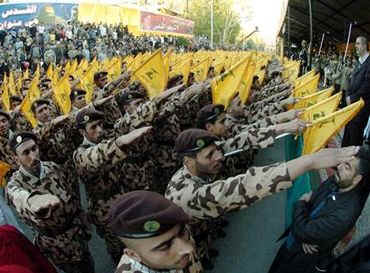
Hezbollah, what a group salute that is!

Hezbollah, what a group salute that is!

This clarifies the original seeming paradox. There is no contradiction in the support of the Far-right for the Syrian regime, and their animosity towards the Syrian refugees in their countries even if they were pro-regime. Moreover, animosity towards Islam becomes a secondary reason to back Assad. We mustn’t forget that this Right supports, even boasts about fighting side to side with an Islamic party, Hizbollah, as declared by the organization “Black Tulip”. One can also see clearly the pivotal role of the far-right parties that are Assad’s regime’s allies, in forming and strengthening this relationship and what that entails. This explains the regular visits of this European right to Beirut to meet parties such as the Syrian National Social party. The role of this party in particular and its network with the European Far-right deserves deeper consideration, to achieve a more comprehensive understanding of the topic.

Conclusion

This article has attempted to look at the Far-right in general, while in reality this right has various ideologies. This difference takes many forms according to the type and volume of these groups, from the bigger more pragmatic parties to the intellectual circles and the more radical paramilitary groups. Nonetheless, the general principles are the same, even if the difference in form seems radical, this remains particular and not essential. As we have seen in this article, any reading or analysis of the Right’s position has to take into consideration that the ideology that this right portrays is moving and constantly changing. One of the important tools for analysis and rapprochement is the basis that Paxton deduced such as to feel the crushing burden of a crisis that cannot be solved in a traditional way, priority of the group over the individual, considering the mass as victim and fearing for its demise. There is a need for a closer-knitted purer society, etc…

the Far Left sure looks like the Far Right, Good thing there is the hammer and sickle to remind us!

the Far Left sure looks like the Far Right, Good thing there is the hammer and sickle to remind us!

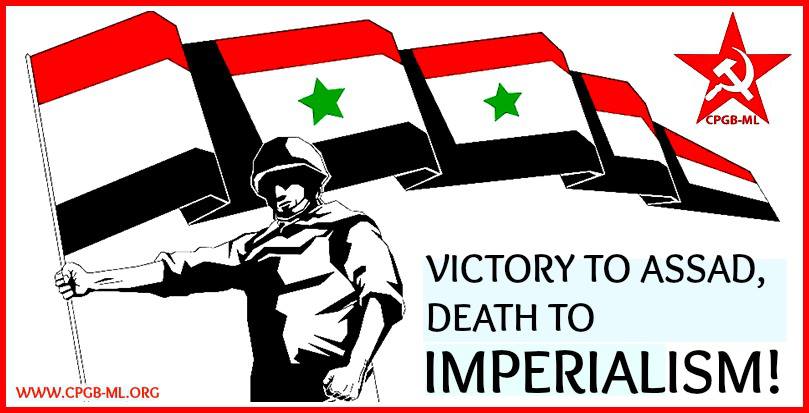
Hands off Syria, Love to Assad

Hands off Syria, Love to Assad

As for why does the far-right support the Syrian regime? The main reason is that the ideological crossing between the right and what it represents and what the Syrian regime represents has happened at this historical moment. For this Right, this represents one of the aspects of its advertising campaign with the enemy – the new symbol. This support also represents its difference from the other European political parties and movements, which he accuses of being a toy in the hand of this enemy. Although this Right knows that it is not possible to exploit this support internally, because of the bad reputation and violence of the Syrian regime, the development of events in Syria allows it to exploit European public opinion through sympathizing with the situation of the Christians in the east for example, or through the topic of European Jihadists in Syria. This matter requires further investigation to reveal the extent and ramification of these relations.

Most importantly, one of the main incentives behind these reasons is the inherent opportunism of the Far-right’s ideology that will not hesitate in taking whatever stance or doing whatever it takes to get even a little closer to power.

[1]                      Ariane Chebel d’Appolonia, L’Extrême droite en France. De Maurras à Le Pen, Bruxelles: Editions Complexe et PUF, 1987.

[2]                      Sylvain Crépon, La nouvelle extrême droite: Enquête sur les jeunes militants du front National, Paris: L’Harmattan, 2006.

[3]                      Local examples for this: the rapprochement of the National Social Syrian Party in Lebanon to the Marxist propositions in the sixties, after a failed coup on New Year’s Eve 1962.

[4]                      Robert Paxton, the Anatomy of Fascism, New York: Knopf, 2004.

[5]                      Paxton, 2004

[6]                      Marine Le Pen, Pour que vive la Farnce, Paris: Grancher, 2012

[7]                      Paxton, 2004

[8]                      Paxton, 2004

Translated by Laila Attar and Ubiydah Mobarak from Arabic ORIGINAL http://al-manshour.org/node/4904&usg=ALkJrhjqYVOhwg5JmixoJ5kn2QJQJfWlMA 


Syria: Getting out of the abyss that Assad has created, before it is too late

Father Paolo Dall'Oglio

Father Paolo Dall’Oglio

Interview with Father Paolo Dall’Oglio by Antonella Vicini, 9 January 2013 from Reset – Dialogues on Civilizations (translated by Mary Rizzo)

A discourse that in fact reaffirms the status quo and sixty thousand deaths that since 15 March 2011 (to January 2013, tr. note) have plunged Syria into a bloodbath: Bashar al-Assad and the Organisation of the United Nations have indicated the salient points of the current situation in the country. The former, speaking from the House of Culture in Damascus in front of his supporters, proposed a three-stage plan that substantially eliminates the revolutionary forces, labelled as “Western puppets” and the latter, in recent days, has published a series of disturbing numbers. From July to now, in correspondence with the increase of the military offensive, the dead are calculated at about 5 thousand per month, mostly civilians (approximately 76 percent). But this is only partial data: right from the title of the report the word is in fact of Preliminary Statistical Analysis of Documentation of Killings in Syria. “This figure is far higher than we expected. And it’s really shocking,” said the High Commissioner for Human Rights Navi Pillay. Also higher than the 45 thousand victims counted so far by groups linked to the opposition.

Torture, attacks on protected sites, the use of banned weapons and in general the human rights violations are delineating – as can be read also in the last report dated 2012 of the Independent International Commission of Investigation on Syria led by Paulo Sergio Pinheiro – a conflict with an increasingly sectarian character that is now extended also to those minorities initially “inclined to be neutral and non-hostile” and that reveal the presence of foreign fighters “with their own agenda.” A conflict that brought “immeasurable destruction and human suffering to the civilian population” and that cannot foresee “any military victory.”

“The only way to achieve an immediate cessation of violence is a negotiated political solution that responds to the legitimate aspirations of the Syrian people.” Thus was the conclusion of the updating of the Syrian situation relative to September and December, 2012, probably simplifying the complexity of the current situation on the ground.

The person who knows the Syrian context, in its areas of light and shadow, is no doubt someone like Father Paolo Dall’Oglio, who has lived in the country for over thirty years. Founder of the monastic community of Deir Mar Musa, in the desert north of Damascus, Father Paolo has always been engaged in interfaith dialogue with the Islamic world and until last June, before being forced to leave by the regime, has spoken about the tragedy that he has witnessed daily in first person accounts.

The new UN report has just been released where a denouncement is made of 60 thousand deaths since the beginning of the conflict.

I cannot make an assessment of the number of deaths on a technical basis because it’s not my task to do that, and I note that often revolutionary movements tend to drive up the numbers for propaganda purposes. But the UN, bringing together different reasonably credible sources has arrived at an even greater number (15 thousand more compared to the 45 thousand already reported, ed. note). This does not surprise me, but I am afraid that once the dust has settled, when you can make a more accurate count, the numbers will be even higher. You cannot perpetrate months and months of aerial bombardments on civilian populations imagining to get balances of victims that look like surgical operations, which are also more than questionable on moral grounds. In Syria there is no action to hit the Resistance leaders but to kill the Syrians, en masse. The moral code of the Assad regime is one is with Assad or there will be destruction of the country.

How do you explain the substantial absence and delay of the international community on Syria?

Once defined by the regime, and by its friends, the “Islamist threat” in Syria, the international community has self-legitimised its maintaining a position of stalling and waiting: there will be no democracy in Syria, then there is no reason to take steps to activate for democracy of the Syrians. We are faced with a paradox, this position of wait-and-see has created the conditions for the expansion of radical Islamism.

The revolution, as a whole, has condemned the first actions of these groups as conspiracy actions conducted by the Syrian state. I never succumbed to this temptation, but remote-controlled manipulation is nothing new in the Syrian panorama, and there have been regime manipulations of extremist cells. Without simplifying, I say that the activity of Islamic extremism was part of the regime’s postulate since the very beginning, where they claimed the revolution was terrorism paid for by foreigners, then when this area branched, complex and effective, it has been able to take the initiative and the head of the revolution in military terms, these groups have provoked in the international community a self-justification to refrain from action. There was an incredible miscalculation and these same groups have exploded in the hands of the regime.

In the report of the UN Commission of Inquiry on Syria, it is said that, given the situation on the ground, a military solution to the conflict is now impossible, and that it is instead desirable to begin negotiations. But at this moment a negotiated solution seems impractical.

The regime wants negotiations to the extent that it needs more time to continue the systematic destruction of Syria and thus enter into the third phase and try to take the country back in its own hands. I was expecting that the regime in Damascus would work to divide the country on the line of the Orontes, once acknowledged the fact of not being able to maintain control over everything. Faced with a general revolution the only thing possible would be a Syrian Kosovo, hedging their bets on Alawite solidarity and other minorities living in that area, such as, in fact, the Christians; this is a solution accepted by Iran (Shiite, ed. note) as a lesser evil. This has not happened so far and in revolutionary circles it is said that it cannot happen because the rebels have so deeply penetrated even in that area that the regime would no longer be able to have such a division.

Why had it not chosen the way of secession as long as it was possible?

I can give you two reasons. One is psychological. Bashar al-Assad has always said I am a man of Damascus and not of the Alawite mountains. His cultural and mental space is all of Syria. In this sense, paradoxically, Assad would be a “non-sectarian”. He uses his sect for his power, but a power that if it is not of the whole of Syria, it does not interest him. We see this as a disconnect between his own idea of ​​himself and reality.

The other hypothesis assumes that the regime is a complex matter, divided between Ba’ath ideology, which is obviously not for secession, and the logic of the Alawite family. These two souls have been separated in time but not enough to contemplate the geographical dislocation of the country.

You have spoken of the need to begin to govern at least the liberated zones.

I have written in Arabic just two days ago, on Facebook, asking the head of the coalition to immediately set up in the liberated territories the sole government of transition. It is an operation that should be done immediately because it would eliminate the impression that the Syrian revolution is now entirely in the hands of Muslim extremists who are subversive and clandestine and they can begin to restore the country to the Syrians. On the ground there are practical problems such as lack of water, electricity, labour, wages.

Do you believe it is still too early to talk about the future of the minorities?

It is not early, in fact you have to talk about it now, but it is very difficult to see the future because of the omission of international relief. There is hope that the revolution as a whole may have a capacity of self-discipline that allows them to form that unity of the country in the reconciliation desired by everyone in the democratic revolution in Syria. Only some extremist military groups seem to threaten the destiny of minorities, even if they have never attacked Christians as such.

In recent days, however, there was a complaint by Mother Agnes Mariam (Carmelite and superior of the Deir Mar Yocoub monastery of Qara, known to be very critical of the rebels, ed. note) in this regard.

Mother Agnes knows how to dose the words and she is only, I repeat and I emphasise, the (able) clerical expression of the deceitful manipulation action of the Syrian regime. Mother Agnes is a self-proclaimed leader of a movement that does not exist on the ground, Musalaha (Reconciliation, ed note), and it is a real problem because for her interpretation of the facts is always selective and one-sided: that the revolution is terrorism!

How do you see a possible Syria after Assad and after nearly two years of war?

I believe that the profound nature of democratic Syria will be a laboratory of civil evolution and policy making of the Islamist Arab area of great interest. Syria has a cultural dignity of Islam that is different from that of the Gulf.

This is my vow, my hope and also the space of my commitment. At the end of January I will participate in the commission of the Syrian revolution that deals with preventing the massacres in the moment of victory and I hope, in February, to be able to re-enter the country. Syria cannot win the revolution leaving a hundred thousand Alawites deaths in its wake. We must find a way, even ideological and theological, to say that there will be no revenge against the Alawites and that all criminals will be judged with fairness.

See http://www.resetdoc.org

Nun on Irish visit accused of peddling ‘regime lies’ about crisis in Syria

17/08/12

MARY FITZGERALD, Foreign Affairs Correspondent (The Irish Times)

AN ITALIAN Jesuit expelled from Syria in June due to his outspoken criticism of government violence has accused a controversial nun who visited Ireland last week of peddling “regime lies” about the crisis there.

Fr Paolo Dall’Oglio, who lived in Syria for 30 years and has been heavily involved in interfaith work in the country, described Mother Agnes Mariam as “an instrument” of President Bashar al-Assad’s regime. “She has been consistent in assuming and spreading the lies of the regime, and promoting it through the power of her religious persona,” he told The Irish Times yesterday. “She knows how to cover up the brutality of the regime.”

During her four-day visit to Ireland last week, Mother Agnes Mariam, who is superior at the Melkite Greek Catholic monastery in Syria, gave media interviews in which she claimed Christians in Syria were facing “extinction” and that rebels battling Assad were predominantly foreigners linked with al-Qaeda.

Fr Dall’Oglio, who has spent time with opposition activists in several restive parts of Syria, said these claims were “ridiculous” and constituted regime propaganda.

“I have been there, I know the people, including the youth, who are working for the revolution, and I know that what she is saying is insane. It corresponds with the regime version of the facts,” he said.

Mother Agnes Mariam, who visited Dublin and Belfast, had separate meetings with representatives of the Irish Bishops Conference justice and peace committee, Sinn Féin TD Seán Crowe, Nobel peace laureate Mairead Corrigan Maguire, and an official from the Department of Foreign Affairs.

One of her interlocutors here was taken aback when the nun claimed during their meeting that the Houla massacre, in which more than 100 civilians, more than half of them children, were killed, was an elaborate hoax concocted by rebels. This week a UN commission of inquiry concluded that Syrian government forces and the pro-Assad militia known as shabiha were responsible for the massacre.

In March, Mother Agnes Mariam was accused of running a “misinformation campaign” by a US-based Syrian opposition group called Syrian Christians for Democracy.

It said she maintains “close ties” to the Assad family and alleged she had fed selected visiting journalists “distorted facts and fake testimonies for the sole purpose of tarnishing the opposition’s image”.

The group referred to the role of a number of Christians in the Syrian uprising.

“Mother Agnes and those helping her are harming the Syrian people by disseminating negative pro-Assad propaganda and tearing at Syria’s social and religious fabrics,” it said. “The Christians in Syria, as well as the rest of the population, are in need of undivided support, backing, and funding. They do not need divisive rumours and the propagation of inaccurate information.”

Mother Agnes Mariam’s trip to Ireland was organised by Alan Lonergan, who acts as churches liaison officer with Sadaka, an Irish pro-Palestinian advocacy group, though he arranged the visit in a personal capacity.

“The impression people have of what is happening in Syria is very black and white,” he said. “We need to examine more of the grey area.”

Filed Under: Assad’s Regimedistorted factsItalian JesuitMother Agnes MariamPropaganda,Syria

http://syrianfreedom.org/nun-on-irish-visit-accused-of-peddling-regime-lies-about-crisis-in-syria

http://www.irishtimes.com/premium/loginpage?destination=http://www.irishtimes.com/news/nun-on-irish-visit-accused-of-peddling-regime-lies-about-crisis-in-syria-1.538877

thanks to Treasa

Some of the hundreds of civilian victims of the Sarin Nerve Gas massacre in Ghouta. Gassed in their beds by the Syrian regime.

Some of the hundreds of civilian victims of the Sarin Nerve Gas massacre in Ghouta. Gassed in their beds by the Syrian regime.

WRITTEN BY Amr Salahi
A green light to Assad

Ever since the Syrian regime gassed its own citizens in the Damascus suburbs in a chemical attack on August 21, the issue has rarely been out of the Western news media. However, the debate has been very simplistic. Any observer would be forgiven for thinking that the only crime committed in Syria was this chemical attack, and that the Syrian people had not been subjected to a genocidal war at the hands of a ruthless sectarian dictatorship for two and a half years.

Of course, the original cause of the conflict has been largely forgotten. Outside Syria, not many people remember the peaceful protests calling for freedom and democracy that began the Syrian revolution in March 2011, and how those protests were met by the Assad regime, with unarmed protesters being slaughtered in the streets and children who wrote slogans on walls or took part in the protests tortured, on many occasions to death, in the regime’s jails. It was only after many long months of killing and oppression that defecting soldiers from the regime’s army formed the Free Syrian Army, to defend peaceful protesters as well as ordinary citizens from government attacks.

An observer of the debate would also be forgiven for thinking that the countries of the world are divided on Syria. The received wisdom on the Syrian conflict is that the United States, its allies in NATO and the Gulf States are offering support to the rebels while Russia, China, Iran and the Lebanese Hezbollah are supporting the regime. Bashar Al-Assad’s regime likes to paint itself as part of an “axis of resistance” against US and Israeli imperialism which includes Iran and Hezbollah and is supported by Russia; this is why it has gained support from the anti-imperialist left in Western countries. A closer look at the support the regime is receiving vis-a-vis the “support” the rebels are receiving from their supposed allies shows that there is in fact little difference between the major powers on the Syrian issue. Russian ships carrying weapons, including aircraft, dock regularly in Latakia and Tartus, ensuring that the regime remains armed to the teeth and able to fight on despite the military setbacks inflicted on it by the rebels. Iran has not only sent weapons to the regime but also troops and advisers. It is believed widely in Syria that these advisers are the real rulers of the country. Hezbollah was instrumental in the regime’s ruthless bombardment and capture of Qusair, and its fighters now line up alongside the regime in Deraa and Aleppo.

On the other hand, the United States and the European countries have given rhetorical support to the Syrian opposition while making sure that the Free Syrian Army remains unable to defeat the government’s forces by imposing a strict arms embargo. For example, last year the Free Syrian Army managed to acquire anti-aircraft weapons but the United States and NATO refused to allow them to be transported to Syria and they remained in storage in Turkey. In June this year, following a regime chemical attack on the town of Saraqeb, the Obama administration announced that it would arm the Syrian rebels. To-date they have not received a single bullet from the United States or from any of its European allies. The FSA’s main source of weapons remains those captured from the regime or those sold to it by corrupt regime officers. It is thought that Gulf countries have supplied weapons but not on a scale that would tip the balance of the conflict. The main factor ensuring that the conflict and genocide continue, and the Assad regime stays in power, is the continuing embargo on weapons to the Free Syrian Army, which lacks the heavy weapons needed to defeat the state’s armed forces.

In order to understand the position of the United States and its European allies, it is helpful to look at the statements of Israeli officials. While the main pro-Israel lobby group in the United States, AIPAC, publicly declared its support for strikes against the Syrian regime following the most recent chemical weapons attack, it is much more evident that Israel would in fact prefer Bashar Al-Assad to remain in power. The Wall Street Journal reported recently that Israeli Prime Minister Benjamin Netanyahu urged US Secretary of State Kerry to reach a deal with Russia that would avoid a military strike on Syria, expressing fears that a US strike would strengthen the Syrian opposition and allow it to gain control of Assad’s chemical weapons. Netanyahu’s office later issued a denial that any such exchange took place.

In November 2011, relatively early in the Syrian revolution when there was no serious talk of an Islamic extremist presence in Syria, Amos Gilad, a senior Israeli defence ministry official, said that Assad’s removal from power would be “devastating for Israel”; the Zionist state, he added, would then face an “Islamic Empire” encompassing Syria, Jordan and Egypt run by the Muslim Brotherhood and committed to its destruction. In May 2013, shortly after an Israeli strike on Damascus, Ephraim Halevy, a former director of Israel’s Mossad spy agency, went much further in an article in the American journal Foreign Affairs. Calling Assad “Israel’s Man in Damascus” he spelt out the reason why: for the past 40 years Assad has kept Israel’s “border” with Syria quiet and guaranteed its security. What Halevy means is that Assad has allowed Israel to occupy the Golan Heights, undisturbed by any resistance. Another Israeli intelligence official summed up the Israeli position towards the conflict in Syria thus: “Our ‘best-case scenario’ is that they continue to busy themselves fighting each other and don’t turn their attention to us.”

Israel’s attitude to the Syrian conflict allows us to consider the developments that have taken place since the chemical attack in a new light. After President Obama announced that the US would strike Syria, anti-war activists and left-wing “anti-imperialists” were up in arms, as were right-wing pro-Israel Republicans in the United States. There was much comment that the rebels fighting against Assad were sectarian extremists with links to Al-Qaeda, who posed a threat to Syria’s minorities, especially its Christian community, and that they were just as brutal as Assad. Conspiracy theories without any evidence which blamed the rebels for the sarin attack received mainstream coverage and were used to argue that the US and its allies were being dragged into an Iraq-style war.

Sadly for the conspiracy theorists, the evidence that the Syrian regime carried out the attack is incontrovertible. The United Nations report on the attack published on Tuesday, which does not assign blame, nevertheless concludes that it was launched from Mount Qassioun, a major government military base outside Damascus from which attacks against the Damascus suburbs are launched regularly. The report also concluded that the attack was launched using M14 rockets, which only the regime possesses, and that the sarin used was of a quality that could only be produced on an industrial scale using the resources of a government. The Assad regime’s own reaction to the attack points to its responsibility, and to its sectarian character. First, it denied that any such attack took place; then it conceded that the attack happened but blamed the rebels; then a few days later the world was treated to the bizarre spectacle of Syrian government spokeswoman Buthaina Shaaban appearing on Sky News to claim that the child victims of the attack were in fact brought to the Ghouta area from Latakia province (an Alawite-majority area 300 miles away) by “terrorists” and then killed. The government did not declare any period of mourning for the 1,429 victims of the attack and, in fact, its supporters were seen celebrating and handing out sweets on the streets of Damascus in its immediate aftermath.

The anti-war activists and their new-found allies the Assad supporters and right-wing Republicans need not have worried. Despite a great deal of emotional language from John Kerry about the use of chemical weapons and the 426 children who died as a result, Obama’s strike threat dwindled away to nothing. From being a “limited” attack to punish Assad, but not tip the balance in favour of the rebels, it became an “unbelievably small” one, as Kerry called it on his visit to London, to a non-existent one, when Kerry and Russian Foreign Minister Lavrov agreed to a deal which would allow Assad to keep his conventional weapons and continue using them to kill his own people, but oblige him to give up his chemical weapons. It is doubtful whether the deal will be backed by a binding Security Council resolution, and it is estimated that it will take until the middle of 2014 to destroy the chemical weapons. This is probably the first time in history that a criminal is to be punished simply by taking away one of his weapons.

The deal struck between Kerry and Lavrov makes almost everyone a winner. The United States can continue posing as a supporter of the Syrian people; Israel is satisfied that “their man in Damascus” is still in place; Russia can continue arming Assad and today appears to have stood up to the United States, when in reality there is little difference between the positions of these two nations on the Syrian issue; and Iran can continue to participate actively in Assad’s sectarian war while pretending that it is standing up to the United States and Israel. The anti-war campaigners are in ignorant bliss because they believe that they have stopped a war on Syria, not knowing or caring that Syrians are still enduring the most horrific war since the genocide in Rwanda. The only losers are the Syrian people.

For two and a half years, they have been pleading with the world to stop Assad’s war against them but to no avail. The chemical attack is only the latest chapter in this genocide. Constant efforts have been made in both the mainstream and alternative media to belittle the suffering in Syria, discredit the casualty figures and assign blame to the opposition for the regime’s crimes but what is happening is genocide by any standard. United Nations figures reveal that 110,000 people have been killed since the Syrian revolution broke out in March 2011. Seven million people have been displaced and the death rate is approximately 5,000 people per month. Only the regime has the capacity to kill and displace people on this scale and it has now received a green light to continue killing its own citizens, as long as it doesn’t use chemical weapons.

The suffering and the genocide of the Syrian people will be detailed in the part 2 of this article.

http://www.middleeastmonitor.com/articles/middle-east/7448-syria-genocide-by-international-consensus-

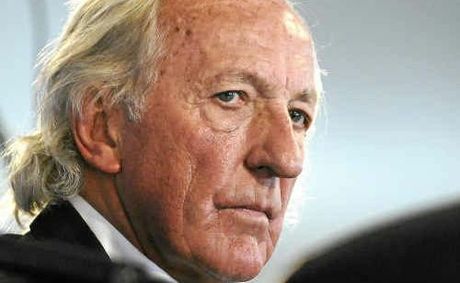
pilgerWRITTEN BY SAM CHARLES HAMAD    For people like Pilger, Arabs have absolutely no agency – they either have to be the passive masses living under an ‘anti-western’ strongman like Assad, wherein their very real suffering is even reduced by Pilger and his ilk to a ‘western conspiracy’ (or it’s just ignored), or they are these seemingly mindless ‘proxies’ being manipulated by all and sundry. 

In the recent piece by John Pilger  he writes:  “Syria is the current project. Outflanked by Russia and public opinion, Obama has now embraced the “path of diplomacy”. Has he? As Russian and US negotiators arrived in Geneva on 12 September, the US increased its support for the Al-Qaeda affiliated militias with weapons sent clandestinely through Turkey, Eastern Europe and the Gulf. The Godfather has no intention of deserting his proxies in Syria. Al Qaeda was all but created by the CIA’s Operation Cyclone that armed the mujahedin in Soviet-occupied Afghanistan. Since then, jihadists have been used to divide and Arab societies and in eliminating the threat of pan-Arab nationalism to western “interests” and Israel’s lawless colonial expansion. This is Kissinger-style “realism”.”

Let me just make something very clear: John Pilger is basically saying here that the Syrian rebels are ‘jihadists’ being used to destroy the regime of Bashar al-Assad because it somehow represents a threat to ‘western interests’. It’s not just that Pilger’s understanding of the conflict is so utterly stupid and bereft of any logic or historical fact, but it is also is in its content a very definite form of apologia for the regime’s crimes. Unlike most of the other witting and unwitting apologists for Bashar al-Assad on the left, Pilger doesn’t even bother paying lip service to Assad’s crimes (or the wider crimes of the Assad dynasty), but instead ‘treats’ us to the now familiar narrative of the conflict, wherein Assad is cast as the righteous protagonist, who was presumably just keeping on keeping on, when these vicious antagonists, the jihadist Al-Qaeda proxies, appeared from nowhere and started causing all kinds of fitna. Basically, it’s all a US plot and Assad’s ‘war on terrorism’ is very real and very righteous (unlike the west’s ‘war on terrorism’, every aspect of which Pilger was, as you might expect, dead against).

For people like Pilger, Arabs have absolutely no agency – they either have to be the passive masses living under an ‘anti-western’ strongman like Assad, wherein their very real suffering is even reduced by Pilger and his ilk to a ‘western conspiracy’ (or it’s just ignored), or they are these seemingly mindless ‘proxies’ being manipulated by all and sundry. The only time that somebody such as Pilger would ever comment on, let alone turn up with a camera to document, the suffering or resistance of the Arab peoples is if they are ‘victims’ of what he perceives to be the West, or, in other words, if they are Palestinians living under and resisting the Israeli occupation or Iraqis being ravaged by US sanctions or fighting against the imperialist occupation forces. However, if you are a Syrian who has been living under the cruel tyranny of the Assad dynasty, Pilger will not merely ignore your suffering or apologise for it, but if you resist such tyranny, he will actively essentialise you as being an ‘Al-Qaeda affiliated terrorist’ or a mere proxy for the West. His entire worldview is in essence the mirror image of the worldview of the defenders of US power and hegemony, who, for example, care only about the very few Israeli victims of rockets fired on Sderot from Gaza, while they actively deny the suffering of the Palestinian victims of Israeli state terror – or, as Pilger implies with Syria, they actually justify the death and destruction inflicted upon Gaza by Israel as being necessary in a ‘war on terror’.

To various different degrees (some more subtle than others), events in Syria have allowed this kind of facile ‘anti-imperialism’ to come to the fore among significant sections and individuals of the left, and you’ll notice that there has been – over the past two-and-a-half years – a gradual coalescence of not just the type of language used by some on the ‘anti-imperialist left’ and that of the pro-imperialists, but the actual substance of the arguments are basically the same, albeit with different ‘sides’ corresponding to the similar content and form of the arguments. This is not a type of leftism that I could ever accept or be a part of.

Quello che stiamo vivendo è una rivoluzione, per favore ci dovete capire

Quello che stiamo vivendo è una rivoluzione, per favore ci dovete capire

Scritto da Salwa Amor, tradotto da Mary Rizzo

Giornalista britannico – siriana Salwa Amor dice che il movimento Fermare la guerra – Stop the War ha perso il rispetto dei siriani, non sostenendo la loro rivoluzione.

Dal momento che la rivoluzione in Siria è iniziata due anni e mezzo fa ed è stato salutato da un regime oppressivo con una forza senza precedenti, il mondo sembra essere stato in silenzio sui crimini in corso che si sono verificati. A parte un paio di discussioni qua e là su i canali all-news, sembra a quelli all’interno della Siria che il mondo non si preoccupa di ciò che sta avvenendo nella loro terra e se il loro governo sta commettendo crimini contro l’umanità o no.

Prima della minaccia della guerra in Iraq gli arabi hanno ritenuto che l’Occidente (il popolo non i loro governi ) finalmente cominciavano a capire la loro lotta contro l’oppressione, l’occupazione e la dittatura. La Marcia del Milione che si è svolta per le strade di Londra è stato un punto di riferimento per le persone in Iraq e l’intero mondo arabo, era la prima volta che sono stati in grado di vedere una solidarietà visiva verso le loro continue lotte.

Fast forward al 2011 e un 26enne che lavorava come venditore ambulante in Tunisia si mise, insieme con l’intera regione araba, a fuoco in quella che sarebbe diventata la primavera araba. Egitto ha seguito l’esempio e il movimento contro la guerra hanno applaudite mentre erano testimoni ad un altro paese arabo che rovesciava il proprio dittatore tiranno.

Ispirato da Bouazizi, quello stesso gennaio un uomo in Siria anche desse fuoco a se stesso , sperando che le fiamme che hanno bruciato il suo corpo sarebbe l’ispirazione ai suoi concittadini a ribellarsi contro il loro dittatore. Il nome di quell’uomo era Hasan Ali Akleh. La sua storia non è così conosciuto, in realtà è stato appena documentato. Forse perché il Paese da cui è venuto non fa notizia, ma è stata la scintilla che ha illuminato i cuori di almeno alcuni siriani, siccome le proteste iniziarono lentamente a prendere vita in Al Raqa quello stesso mes , anche se hanno ricevuto poca o nessuna attenzione dei media.

Cospirazione occidentale?

Come le proteste avevano cominciato ad essere più frequenti, Assad ha orgogliosamente proclamato che egli è stato vittima di un complotto imperialista dell’occidente sostenuta da Israele e che avrebbe combattuto, succedesse qualunque cosa. E combattere il ciò che ha fatto, ma a differenza dei leader di Tunisia o d’Egitto, Assad ha usato i suoi armi più micidiali, principalmente realizzati in Russia che gli è stata fornita gratuitamente. Siriani feriti negli ospedali  vi racconterebbe delle bombe TNT che avrebbe letteralmente messo centinaia di buchi nei corpi delle vittime, lasciandoli ad implorare la misericordia della morte.

Eppure il movimento contro la guerra e la sinistra guardavano in silenzio mentre la furia assassina ha continuato per due anni e mezzo, con la paura che l’Occidente avrebbe usato questo per i propri interessi e di invadere un altro paese, in nome della libertà. Da un punto di vista politico che avevano ragione – l’Occidente “diffondere la democrazia e la libertà”, solamente dove i suoi interessi sono forti. Dal punto di vista umano, invece, la sinistra sì è sbagliato di grosso questa volta.

Come persone di coscienza, coloro che lottano per la pace e movimenti per la giustizia hanno una maggiore responsabilità nei confronti di quelli sotto l’oppressione, e temo che il movimento di sinistra e contro la guerra è caduto negli occhi dei siriani in tutto il mondo. E quando dico siriani, non mi riferisco agli alawiti, il 7% che hanno subito il lavaggio del cervello a lealtà verso Assad, perché ci sono alcuni di loro che si sono uniti alle proteste contro la guerra che chiedevano “nessun intervento in Siria”. Hanno il diritto di dire la loro come chiunqu , ma loro non rappressentano la maggioranza dei sirianni, come molti nella sinistra hanno suggerito.

Rivoluzione siriana

Se la sinistra c’era dalla parte dei siriani ordinari in tutto e dichiarato il loro sostegno per la loro rivoluzione come hanno fatto con la Tunisia e l’Egitto non sentirebbe come uno schiaffo in faccia alla rivoluzione, quando oggi si levano in piedi fuori dal parlamento chiedendo nessun intervento in Siria. Non è sufficiente in questa fase alla fine del gioco per chiamare semplicemente per nessun intervento. Ci deve essere il supporto per i rivoluzionari che hanno rischiato la loro vita per 30 mesi nella loro richiesta della libertà.

Se i socialisti/comunisti e sinistrorsi non supportano gli oppressi e gridare per la libertà, allora c’è qualcosa di molto sbagliato. Il movimento ha il diritto di chiedere al loro governo di non intervenire in guerre all’estero, ma per lo meno si dovrebbe tenere cartelli che raccontano siriani che hanno perso le loro case, le famiglie e la dignità che “noi, il popolo della Gran Bretagna siamo con voi”. Holding cartelli che dire “Nessun intervento e non toccare la Siria ” sembra ai siriani che siete dalla parte di Russia e la Russia è ed stava intervenendo fin dall’inizio (con le sue navi da guerra a Tartous dopo la 5° mese della rivolta e la maggior parte delle armi che hanno siriani uccisi erano un regalo di Assad da Putin).

Se la posizione dei movimenti  è “no all’intervenzione”, allora deve includere la Russia e l’Iran altrimenti è davvero unilaterale. Forse la sinistra è indulgente verso i crimini della Russia, perché non sono impegnati in nome dell’imperialismo occidentale, o forse la Russia e anche lo sfondo socialista della famiglia Assad e legami a marxismo e comunismo hanno accecato la sinistra che non riesce a vedere le loro colpe.

In qualche modo quelli che sono contro l’imperialismo occidentale sono diventati cieco da un occhio, vedono chiaramente i crimini dell’Occidente, ma la vista della loro altro occhio è bloccato da una credenza o una speranza che il mondo sarebbe un posto migliore se solo il capitalismo sarebbe rimosso insieme con i suoi ideali imperialistici.

Purtroppo, la storia ci insegna che il male esiste in molte forme e maniere, che non è definita in base al colore, religione o razza, ma risiede in tutti coloro che sono in vita, così come l’altruismo e la bontà. L’Occidente non può prendere la colpa per la Siria, non perché non è degno di biasimo per gran parte della sconvolgimenti in Medio Oriente, ma perché ci sono altri mali del mondo.

Scoraggiante

E ‘veramente scoraggiante vedere un movimento che è stato costruito per sostenere gli oppressi che è così poco solidale della rivoluzione siriana. E’ come se essi hanno completamente trascurato la rivolta. Quasi come non è mai successo, o che tutta la crisi può essere descritto come una cospirazione imperialista occidentale.

Non erano i siriani oppressi e umiliati per 40 anni? Non era la polizia segreta in Siria responsabile per avere istillato paura intollerabile nei cuori dei giovani e meno giovani o la causa di migliaia di morti sotto tortura? Per ridurre la rivoluzione siriana ad un complotto imperialista occidentale è che implica che tutto il male del mondo deriva da Ovest. Assad non era da Ovest, la sua polizia segreta che hanno torturato i bambini fino alla morte erano siriani, nati e cresciuti in Siria, lontano dall’occhio vigile del West.

Questo Sabato fermare la guerra terrà un’altra protesta contro l’intervento occidentale. Come si può discutere con la loro logica, l’Occidente infatti impone le sue idee sul mondo intero. Eppure, la prossima protesta e le sue parole d’ordine incarnano l’essenza della supremazia bianca della mente; imporre le loro credenze e le richieste sulla rivoluzione del popolo siriano. Nessun intervento , Giù le mani dalla Siria non sono slogan che sono venute dalla Siria, nemmeno lontanamente, quindi, si deve presumere che essi sono gli slogan che vengono imposte al popolo siriano.

Perché se si curava di leggere e tradurre solamente alcuni dei cartelli che quelli nelle città assediate all’interno della Siria dimostrano con orgoglio alle luci dei media  di tutto il mondo avrebbero scoperto presto che il più famoso e diffuso di tutti è SOS ! I Siriani stanno implorando aiuto, non possono prendere i bombardamenti, la fame, la mancanza di acqua e di diffusione della malattia, i corpi sotto le macerie o dei bambini che sono sepolti vivi in loro. Quindi, chi sono alla sinistra in Gran Bretagna a dichiarare giù le mani dalla Siria quando invece sono i siriani a chiedere aiuto?

Fermare la guerra è una organizzazione di base il cui lavoro è prezioso in Gran Bretagna e all’estero e la rivoluzione siriana non è diverso, è la lotta di un popolo che la sinistra ha spinto sotto il tappeto per paura dell’imperialismo occidentale. L’ironia è che i siriani stanno combattendo per la stessa cosa per cui battono i Stop the War, ma la tragedia è che la sinistra non metterà la sua paranoia del West in attesa per un tempo sufficiente per sentire le grida che esce delle macerie dalle loro controparti rivoluzionarie siriane.

5PIllarz originale http://www.5pillarz.com/2013/08/29/stop-the-war-must-support-the-syrian-revolution/

Italian protest (No War = Pro Assad)

Italian protest (No War = Pro Assad)

by Fouad Roueiha, translated by Mary Rizzo
On the pages of Facebook, we find ourselves often reading the analysis on the situation in Syria. The writers want to appear that they have at heart freedom, justice, peace. Here a post that passes itself off as No-War but instead is something different and sinister. In this case the author is the “foreign policy” voice of Rifondazione Comunista, an Italian “armchair and cocktail party left party”. Thank goodness there are people that are able to answer in a correct manner, in this case Fouad Roueiha, an Italian-Syrian.

The Post: FA writes: “Here we go again.  Imperialism has found and presented to the world the casus belli to justify a new aggression. We are dealing with a curious case of self-fulfilling expectations.  Obama has been talking about chemical  weapons for months.  It is likely that the same were used to justify the war against Iraq. The  Syrian civil war is full of horrors, like every civil war. To feed into that there has been the contribution of many, among them, precisely the usa, gb and france, together with their allies of the oil monarchies, that fund and train the rebels, avoiding any kind of  political solution. In Syria there is a proxy war between powers, regional and international, that  are destabilising the entire area, as the recent attacks in Lebanon show.  We are opposed to any aggression by the united states, nato, gb  or france against Syria. Italy better say out of this umpteenth  neo-colonial adventure.”

The Response: Fouad Roueiha You have left us alone, in silence, when inspired by the shout of freedom of our brothers, also our voices filled the streets and our only weapons were hope, dignity and desire for democracy. Our chants for democracy, for unity and for non-violence filled the spaces of our squares that saw history be born, while the ancient pavements of our streets were coloured with our blood. For 6 months no one responded to he provocations, to the fierce repression, to the siege of entire towns deprived of water and electricity in the middle of the summer heat. Then, when the cheeks to turn simply were no more, when our freedom fighters (like yours did) ascended on the mountains risking not only their lives but also those of the their loved ones, then you have condemned us. When we were under overpowering superiority of hostile fire, fed by the men, arms and fuel of Iran, Russia, Lebanon, Iraq and even Europe, you did not lift a finger to hinder this flow of death towards our land, clearly those forces are the Empire of Good. But if crushed by lead, explosives and MiGs of The Good, our freedom fighters have accepted the (anything but disinterested) help of the antagonists of the Empire that pleases you, finally able to give substance to the defamatory accusations that since the first hour you have directed towards us. And don’t show me maps and statistics, analysis and numbers, those work well ” in society”, in your posh meeting places, but not for those who have heard the words and the chants of those who have taken to the streets… now isn’t that odd, in Syria the children do not ask themselves which international power benefits the most from their protests; they come down to the streets for their right to a future, to have the dignity of choosing their own destiny, to demand democracy, slogans that i recall having heard in many other places, even right next to yours in Piazza San Giovanni (traditional meeting place for the Italian left protests and meetings, translator’s note) or under Montecitorio (seat of the Italian Parliament), although Italy seems like a paradise of democracy compared with our land.

Syria protesters in Baba Amr (Pro-freedom = Anti-Assad)

Syria protesters in Baba Amr (Pro-freedom = Anti-Assad)

Calm down “comrades”, the States (that Italy welcomes with open arms, when the nazi-fascists raped the lands) will not come simply because is not their interest therefore without too much effort you will obtain the result wished by “peaceful” Fabio… but the 1500 dead of Ghouta, that must be added to 100,000 lives broken from Assad and companions, are not a casus belli, but a disgrace for humanity and for you particularly, you that love to pose as champions of the oppressed and of the have-nots but you are deaf if the enemy of those oppressed is not that “traditional” one, if what happens does not answer to your narrative of the world.

Dear lazy or know-it-all judges of other people’s history, do us a favour if you can: do not come to cry over our children, do not shed a tear at the funeral of our nation, you are not invited. 

p. s.

A special thanks to all those who (how it always happens in these occasions), in response to what I have written and from on high of their knowledge of my person, of my land, of the realpolitik and of the international geopolitics,  want to define me as a rat, jihadist, throat-cutter, spy on the mossad payroll… your contribution will be really precious.

No-War? Non proprio!

Ecco sulle pagine FB, ci troviamo spesso degli analisi sulla situazione in Siria. Devono sembrare che chi li scrive ha a cuore la libertà, la giustizia, la pace. Ecco un post che si spaccia per No-War ma invece è qualcosa di diverso e di sinistro. Menomale che ci sono persone che riescono a rispondere in modo corretto.

Il Post: FA “Ci risiamo. L’imperialismo ha trovato e presentato al mondo il casus belli per giustificare una nuova aggressione. Si tratta di un curioso caso di aspettative auto realizzatesi. Obama è da mesi che parla di armi chimiche. É probabile che siano le stesse usate per giustificare la guerra all’irak. La guerra civile siriana è piena di orrori, come ogni guerra civile. Ad alimentarla hanno contribuito in molti, fra cui proprio usa, gb e francia, insieme ai loro alleati delle petromonarchie, che finanziano e addestrano i ribelli, evitando qualsiasi soluzione politica. In Siria si sta combattendo una guerra per procura fra potenze, regionali e internazionali, che sta destabilizzando tutta l’area, come dimostrano i recenti attentati in Libano. Noi siamo contrari a qualsiasi aggressione da parte di usa, nato gb o francia contro la Siria. l’Italia stia fuori da questa ennesima avventura neocoloniale.”

La Risposta: Fouad Roueiha Ci avete lasciati soli, nel silenzio, quando ispirati dal grido di libertà dei nostri fratelli anche le nostre voci hanno riempito le strade e le nostre uniche armi erano speranza, dignità e voglia di democrazia. I nostri canti per la democrazia, per l’unità e la non-violenza hanno riempito l’aere delle nostre piazze che hanno visto nascere la storia, mentre i selciati antichi si tingevano del nostro sangue. Per 6 mesi nessuno ha risposto alle provocazioni, alla feroce repressione, all’assedio di intere città private d’acqua ed elettricità in piena estate. Quando poi sono finite le guance da porgere, quando i nostri partigiani (come fecero i vostri) salirono sulle montagne rischiando non solo le loro vite ma anche quelle dei loro cari, allora ci avete condannato. Quando eravamo sotto la soverchiante superiorità del fuoco nemico, alimentato dalle uomini, armi e carburanti di Iran, Russia, Libano, Iraq e persino dell’ Europa voi non avete mosso un dito per impedire il flusso di morte verso la nostra terra, evidentemente quello è l’Impero del Bene. Ma se schiacciati dal piombo, l’esplosivo ed i mig del Bene i nostri partigiani hanno accettato il (tutt’altro che disinteressato) aiuto degli antagonisti dell’Impero che piace a voi, finalmente avete potuto dar sostanza alle infamanti accuse che fin dalla prima ora ci avete rivolto. E non mostratemi cartine e statistiche, analisi e numeri, quelli van bene “in società”, nei vostri salottini, ma non per chi ha sentito le parole e le voci di chi è sceso in piazza… pensate che strano, in Siria i ragazzini non si chiedono quali potenza internazionale tragga vantaggio dal loro manifestare, scendono in piazza per il loro diritto al futuro, per aver la dignità di scegliere il proprio destino, per pretendere la democrazia, slogan che mi sembra di aver sentito da tante altre parti, anche da parte vostra in Piazza San Giovanni o sotto MOntecitorio, nonostante l’Italia appaia come un paradiso di democrazia confrontata con la nostra terra.

Tranquilli “compagni”, gli States (che l’Italia accolse a braccia aperte, quando i nazi-fascisti ne violentavano le terre) non interverranno semplicemente perchè non è loro interesse quindi senza troppi sforzi otterrete il risultato auspicato da tovarish Fabio… ma i 1500 morti di Ghouta, che si aggiungono alle 100.000 vite spezzate da Assad e compagni, non sono un casus belli ma una vergogna per l’umanità e per voi in particolare, voi che amate atteggiarvi a paladini degli oppressi e degli ultimi ma siete sordi se il nemico di quegli oppressi non è quello “tradizionale”, se quel che avviene non risponde alla vostra narrazione del mondo.

Cari ignavi o saputelli giudici dell’altrui storia, fateci un favore però: non venite a piangere i nostri bambini, non versate lascrime al funerale della nostra nazione, non siete invitati.

p.s.

Un ringraziamento particolare a tutti coloro che (come avviene sempre in queste occasioni), a seguito di quanto ho scritto e dall’alto della loro conoscenza della mia persona, della mia terra, della real politic e della geopolitica internazionale vorranno definirmi ratto, jihadista, tagliagole, spia al soldo del mossad…. il vostro contributo sarà davvero prezioso.

Still from the beheading video... Released by SyriaTruth, a proRegime "information" site, wonder how they got it, don't you?

Still from the beheading video… Released by SyriaTruth, a proRegime “information” site, wonder how they got it, don’t you?

By Lorenzo Trombetta, for Europa – Translated by Mary Rizzo

With a terrifying growl and a nasty sneer the self-styled “judge” of a group of fundamentalist Islamic criminals pronounce the sentence: condemned to death by beheading – indeed, having their throats slit – for having cooperated with the regime. One of the three condemned men, which, as we are shown in the amateur film, is slaughtered by a butcher with a beret like those used in Afghanistan, is according to the caption, Father François Murad, a Franciscan. But his killing, in north-eastern Syria, had been reported three days earlier by another Franciscan, who had said they had recovered the body of Murad but had not reported that the body was headless.

This is one of the first and most obvious inconsistencies of a news that has been shrieked by Radio France Internationale and immediately broadcast, in a more or less uncritical manner, by most of the Western media: “Three Franciscans were beheaded in Syria by armed militiamen.” The gruesome video had been released by the network SyriaTruth, which for at least two years has been working as a megaphone in the West to defend the cause of Bashar al Assad’s regime.

According to a Syrian source in the region of Idlib, heard by Europa, the three were not priests but instead are “collaborators” of the regime. About an hour after the publication of the video, even the denial of Father Pierbattista Pizzaballa, Franciscan Custodian of the Holy Land arrived: “None of this is true as far as we know. The monks in the region are all alive.” And it is again Pizzaballa on 24 June who did not hesitate to confirm, however, the news of the killing of the ‘”hermit” François Murad in Ghassaniye. This is a place near Jisr ash Shughur, in the north-western region of Idlib and inhabited until 2012 by a Christian majority. About a year ago Ghassaniye was conquered by Syrian insurgent fringes, which were replaced shortly after by militiamen of the Jabhat an Nusra Front, labelled as Al Qaeda – and considered by the U.S. as well as by Assad a “terrorist group” – more and more composed of mujahidin foreigners.

By their own admission, the militia of the Nusra Front are fighting for a cause unrelated to that of the rebels and anti-Syrian regime activists: the removal of the regime is only the first step in a much more challenging path towards the creation of a state entity dominated their interpretation of Islamic law. The link between the alleged beheading of the Franciscans and the Nusra Front is immediately established by many media, including Italian ones, based on the caption – where the agency Fides is cites – and on the fact that the crime in the film took place in Ghassaniye.

The video shows a group of people, many of them with Central Asian, South-east Asian and North African somatic features, around at least three people kneeling on the ground, blindfolded and with their hands tied behind their backs. One can see two shady characters standing: the Executioner, wearing an Afghan paqul and speaking Arabic with a strong foreign accent (there are those who say he is a Chechen), and the “judge”, an older man who, for all appearances, seems to have just taken part, as the ogre, in the last film in the saga of the Lord of the Rings.

In the film there is no reference to the condemned parties as belonging to religious orders or as Christians. Neither does it state that they are executed as unbelievers – kuffar – but because they are “collaborators of the regime.” One of the reasons cited by the Executioner is that “in their mobile phones numbers of officers of the security services (of the regime) of Aleppo were found.” After the chanting of the classic Allahu Akbar (God is great) the execution begins.

There are many reasons to doubt the authenticity of the caption of the video, where a connection is made between the killing of Father Murad with the beheading of the three individuals who are as yet unidentified. And it is true that the denial of Pizzaballa, in itself, closes the discussion. But there are some confusing elements that recur – and that will continue to recur – in the context of a practice of disinformation aimed particularly at identifying these criminals as the rebels Syrians, with the all too evident  aim of pushing the news consumer to conclude that things were better when things were worse. That the regime of Bashar al-Assad, in the end, is the best guarantee for avoiding descent into this hell.

The first issue concerns the origin of these criminals: they are not Syrians. They do not speak as Syrians, do not dress as Syrians and do not follow accepted practices in Syria. The second point – as pointed out to Europa by Alberto Savioli, a scholar of tribes in Syria, granted some authority due to his many years in Syria – it is unlikely that these militants belong to the Nusra Front. “In the film you cannot see their militia insignia. While in all their videos their flags and their logo always are present.” Savioli also points out that “no one of the Nusra Front or some other similar group has claimed responsibility for the killing of father Murad or the beheadings of these three individuals. But the Nusra Front always claims its actions.”

Even Lorenzo Declich, a scholar of radical Islam, insists that “those of the Nusra Front do not have problems with Christians. At least at the rhetorical level, they have always claimed that their struggle is not directed against the Christians. These persons – continues Declich – seem more like Chechens.”

Amedeo Ricucci, Italian journalist who months ago, together with other colleagues, spent several days precisely in Ghassaniye as prisoner of members of the Nusra Front, expressed strong doubts about the fact that the authors of the crime recorded in the video the others present are “people present at Ghassaniye, which is a place presided over by Nusra Front and garrisoned by a brigade of the Free Syrian Army. In the Nusra Front nobody is dressed as those included in the clip,” Ricucci says, who well remembers Father Murad because he met him in person right in the village when it had a Christian majority: “I do not recognise absolutely that he is Father Murad – he says – and I would tend to exclude the possibility that he might be one of the two with their throats cut.”

For Father Paolo dall’Oglio, a Jesuit who has spent more than thirty years in Syria and who was expelled a year ago by the regime in Damascus, “it is clear that there are criminal groups that operate in Syria and that they are anti-Christian. But remember that these are the same groups that the Syrian regime has previously used in Iraq in a subversive sense.” Father Paolo, however, accuses some Italian and European media platforms for their activities in support of the Assad rhetoric: “There is an objective convergence between the work of disinformation of the regime and the receptors of information of Catholic identity that are always ready to take the bait of the hooks of the regime ,” says the Jesuit, who now lives in northern Iraq.

“The regime wants to show that the revolution is terrorism and persecution of Christians in order to obtain the paralysis of European democracies and the support of the Islamophobic Catholic identity areas.” Father Paolo calls for the creation of an “international court of justice for all these crimes. Because we cannot use these sectarian crimes committed by radical Islamist criminals to justify the crimes of the regime.”

And from Kfar Nabl, a town in central Syria known for the creativity of its activists who draw cartoons and invent slogans, came an answer – this one yes, entirely Syrian – to the “shock video” of the ” beheaded Franciscans”: “Those who help Assad to survive – reads the banner photographed and reproduced on the Facebook profile of the local coordination committee – produce slaughter videos that demonise our legitimate revolution, which denounces all brutal actions.”  (Europa Quotidiano, 28 June 2013)
1000992_213110702170091_1722486322_n

Original: http://www.sirialibano.com/siria-2/lorco-e-luomo-nero-imperversano-in-siria.html

what is in store in the coming hours for Egypt?

what is in store in the coming hours for Egypt?

By Afro-Middle East Centre (www.amec.org.za)

In a move reminiscent of the ouster of former president, Husni Mubarak, the Egyptian military on Tuesday issued a communiqué ordering protesters demands be met within 48 hours. That period ends this afternoon. Failure to do so, said the statement, would result in the enforcement of a ‘roadmap’ ‘under military supervision’. Despite the army’s assertion that coups are not part of its ethos, this is certainly threat of a coup. Ironically, the army’s message was well received by large parts of the crowds in Tahrir square, which a year ago were calling for the same military to relinquish power. The government under Muhammad Mursi subsequently expressed its opposition to the communiqué, saying that it risks deepening divisions between Egyptians, and, even if well intentioned, ‘may threaten the social peace’. Further, the administration reiterated its call for dialogue and reconciliation, and re-emphasised democratic legitimacy.

The protests and subsequent actions were largely instigated by a protest movement called ‘Tamarrud’ (rebel), founded in April by disillusioned Egyptians seeking Mursi’s ouster. It claims to have gathered twenty-two million signatures calling for Mursi to be replaced by its constitutional court president Adli Mansour. Initially, Tamarrud was ignored by Egypt’s main opposition groups. However, as the campaign grew in strength, political opposition figures began aligning with the campaign, and organising meetings to chart a postMorsi transition. Even Mubarak supporter Ahmed Shafiq signed the petition. Opposition leader Hamdeen Sabahi publicly said that if Mursi refused to resign, the military should oust him. Mursi’s Freedom and Justice Party (FJP) and its supporters launched a counter campaign called ‘Tagarrud’ (impartiality), emphasising that the president was democratically elected, arguing that he be allowed time to implement his policies, and that remnants from the Mubarak era were involved in Tamarrud.

These events are a symptom of the existing and increasing political polarisation Egypt is experiencing, pitting ‘secularists’ against ‘Islamists’. To this end, the Mubarak-supporting judiciary has been utilised for political goals, and both sides have made charges against the other of ‘secularisation’ and ‘brotherhoodification’ respectively. This has filtered to the population, and has seen the hardening of these stances, increasing the chances of large scale violence.

The culmination was the massive (still continuing) 30 June anti- and proMursi protests, which brought the country to a halt. FJP offices have been burned down – an indication of Mursi’s tenuous control over the interior ministry; around twenty people have been killed and over 700 injured, and the prime minister and ministers of foreign affairs, communication, legal affairs, water utilities and tourism have resigned.

Tamarrud’s appeal is largely a result of two factors. First, its call for Mursi’s resignation has meant that disparate opposition figures have coalesced around the campaign, using it to regain ground lost over the past five electoral and voting processes which saw the FJP and other Islamists win a referendum; capture over seventy per cent of parliamentary seats; Mursi elected president; and winning a referendum to pass the new constitution with over sixty per cent of the votes. Second, the postMubarak Egyptian economy has weakened as a result of Mubarak’s ouster and lack of investor confidence. Tourism has decreased, the Egyptian pound has depreciated against the dollar, and the country’s foreign reserves have dropped by over half. This has meant that the Mursi administration has had to fight off ‘bread protests’, ensure wheat security, and sustain fuel purchases and subsidies. It has failed at the last, leading to fuel shortages and a virtual economic standstill. This has caused many in the ‘middle class’ to resent the administration, believing that its ousting will miraculously alleviate the problems.

The big questions are: what will the military announce this afternoon, and what scenarios are possible thereafter.

The army may force the administration and opposition into negotiations, but this now seems unlikely. It is more likely that the army brass will suspend the constitution, parliament and the president – effectively engineering a coup – and setting up a new leadership council to which a new prime minister – likely to be army head Abdel-Fattah Sisi – will report. Is it an accident that this ‘roadmap’ and the proposals of the new 30 June Front, led by Mohammed Elbaradei, are similar? This will result in fierce opposition from various Islamist groups and could result in violent clashes, possibly paving the way for a full military take over. A civil war, as suggested by many commentators, is, however, unlikely. Already the High Command has asserted that it will protect the country from ‘terrorists, radicals…and fools’ – words that echo many of Husni Mubarak’s previous speeches.

Not looking and not seen doesn't mean that one also refrains from making judgment

Not looking and not seeing doesn’t mean that one also refrains from making judgment

WRITTEN BY MARY RIZZO AND MALAK CHABKOUN

But don’t you see that the whole trouble lies here? In words, words. Each one of us has within him a whole world of things, each man of us his own special world. And how can we ever come to an understanding if I put in the words I utter the sense and value of things as I see them; while you who listen to me must inevitably translate them according to the conception of things each one of you has within himself. We think we understand each other, but we never really do.”

― Luigi Pirandello, Six Characters In Search of an Author

Humans can be very strange creatures. Strange because we seek “the latest news” but are in practice seeking nothing more than the emotional-intellectual comfort that comes with the confirmation of our beliefs. We all “know” things, the news just confirms to us that our convictions are actually “right” or even that they are “the truth”. We humans seem to be avid consumers of a sort of passion play where the characters represented fit their roles and repeat them endlessly. We are drawn to the sources we know are going to give us answers that fit our worldview, our way of thinking, and we generally aren’t questioning their content, much less their framing of it.

This desire to fulfil this need is particularly true when we are faced with events that we have little knowledge about – events that are so far from us physically and mentally that we run to our comfort zone to explain to us how we should feel about said events. The problem is compounded as we turn to these sources again and again, sources which tell us that they are keeping us informed, lulling us into the idea that we know and are aware, when in fact we do not know and we are not aware. This creates the problem of cognitive dissonance, which is the illusion of believing that we know something when in fact we do not have the knowledge or information to process events unfamiliar to us.

So, how do we think? We often tend to think categorically. It is the way that verbal communication is taught at a primary level, so it lasts a lifetime. We all know how much time and effort can be saved once you divide the world into convenient categories of good/bad, black/white, us/them, etc. Therefore, the news source or information that one seeks already fits neatly into this paradigm, and in addition, it is one that more often than not is culturally familiar. This is not to say that there is no truth to some binary thinking. Unadulterated extremes indeed do exist, and at times we are even aware of what they are because the parameters to judge them are clear, but to attribute a value judgment to something, one has to know its true nature. One has to go beneath the surface. Subjectivity can’t be avoided because of our human nature, but it would help if we knew more facts than we think we do!

msm

Because they lie. But does that mean the “alternative” media tells the truth? No.

When thinking out of the box is just thinking in a different box

Many people will not watch TV because they are diffident about what the corporate media is telling them. It’s in fact correct and reasonable to mistrust something that tells you to buy what you don’t need with money you haven’t got and makes you feel miserable for that feeling of consumerist desire that TV implants along with its programming. Some who don’t watch TV because they are convinced it is “the idiot box” that creates conformity around falsehood at any rate have to obtain their information from someplace, and quite a few of them reject the Mainstream Media (MSM) because they attribute to it the same faults as TV, ie, that it peddles lies and that they want to “think independently” and “think out of the box”. This is why they tend to avoid newspapers or Internet sites that are connected with any corporate ownership, and most of the time that leads them to “alternative” news. Alternative news has its own pundits, its own worldview and its own pecking order of news analysis that runs the gamut from political correctness to conspiracy theory (and everything else in between). But it can be just as equally full of lies, rumour, false ideology as the corporate media. Thinking out of the box in this case isn’t happening, it’s just that the box might not be made on a production line and it looks more creative. And, as far as the alternative media goes on Syria, their box has been pretty badly distorted most of the time.

In an effort to be the alternative source on Syria, many outlets have taken to making predictions and speculations out of context. These predictions and speculations based on current events in no way offer a comprehensive view of the situation, thus leaving us with definitions of the conflict ranging from “civil war” to “Jihad” or “holy war” in Syria. Furthermore, these alternative outlets often ignore the context in which the Syrian revolution is occurring – including both historical context and regional context.  Finally, the gravest error may be that many of them then turn to an extremist explanation on either end of the spectrum, some exaggerating to the point of lying to get the attention of the MSM.

Sites that we came to know and trust for their coverage of the invasion of Iraq have for the most part, and with the stellar exception of Uruknet, been repeating as if by rote the same rhetoric (then, we didn’t call it rhetoric, because it made perfect sense with the objective facts on the ground) they used for making the public reject any intervention in Iraq, but this time they are transferring it to Syria. Virtually ignoring the fact that the situation is entirely different in almost every essential way, they dust out the anti-war slogans. The only problem is, they are not so much anti-war as they against THIS war, more specifically, against any kind of opposition to Assad, and therefore, they are anti-revolution. Reactionaries and counter-revolutionaries: being labelled by those words should chill their spines, but the consumers of these sites instead insist upon remaining virginal in their “defiance” and they repeat blatant lies such as that of there being no revolution in Syria, just a Western-based plan for take-over of Syria.

Suspending belief/suspending the moral compass

They used to say that seeing is believing, that you should always suspend your belief until you had evidence, and the best kind was physical evidence, visual proof. In the case of the Syrian revolution, first “they” (the counter-revolutionaries who read the alternative media a-critically) said, “we need proof” (that there is unhappiness in Syria). So they saw protests. Dozens of protests just like in all the other countries in the region were having and largely for the same reasons. But this was not to be trusted.

Syria, in the collective imagination of the alternative media progressive had always been “a good guy” for the mere virtue that “the West” had it on a rogue list. Now, rogue lists are ridiculous at best, especially if those paying the price are not the leaders of those nations, and if the compiler of the list has invaded nations in a serial way, but paying the price are the people who face restrictions because they are citizens of those nations, so it is criminal at worst. But to turn Syria into an “anti-Imperialist paradise” also would require evidence to demonstrate such a claim… which has not been forthcoming. Yet… there was no believing the videos making their way out, they were just not taken into consideration, no matter that there were hundreds of thousands of them and they certainly could not continue to be labelled as creations of a film studio in Doha as many “anti-Imperialist pundits” were saying, taking the cue from the regime prompts.

But, the fact that there had been even less protests over the decades than places like Egypt, Tunisia and Lebanon actually can serve to give an idea of how bad things really were in Syria before the revolution. There was a prohibition of providing evidence of the massacres, torture chambers, arbitrary detention and massive limitations on human rights. The truth and facts about life in Syria under Assad were kept well under wraps. That was because for a Syrian to even speak about all of this, inside Syria meant disappearance, torture or death and outside Syria meant the possibility of never returning home, even for a visit. It was one of those situations of “you wash the dirty laundry in the home” on a monumental scale. It is really not the fault of the consumers of alternative media if they believed the lies, all of us who rejected the “rogue state” way of thinking did that. But we weren’t entirely to blame, we didn’t have that much chance of knowing any differently. We’ve all signed petitions for the release of bloggers, but the actual EXTENT of the silencing of internal dissent was not fully understood. There was no way to understand it. The regime was so repressive that this information could NOT get out “unpunished”.

Then, things changed. It took the courageous actions of children to wake up what had been 40 years of slumber induced by severe repression and humiliation at the hands of the Assad family. People found their courage and voices and started to take to the streets in Syria, bloggers who alluded to things and kept their criticisms to complaints about the lack of liberation of occupied Golan, were taking pictures, filming events, showing visual evidence of what they had with great difficulty gotten out there “before”. Then, it wasn’t just bloggers anymore. Anyone who happened to have a cell phone was filming what was happening in every part of Syria, in a constantly growing way, and evidence of the oppression, the repression and the revolution were available free of charge and without any kind of filter, be it the MSM or the Alternative media.

But what happened? The videos were STILL not good enough, the evidence was still not convincing enough to override a fiery speech by Assad that said he was the last resistant figure to the threat of the West and Israel. And he found defenders in high places who would label him as the last great Arab leader, rhetoric not that different from the hagiography in Syrian media, as unearthed by Azmi Bishara which literally states:

“Love sprung out from Assad’s heart to water the earth of the deserving periphery of the country, reaching those who, one hopes, can still understand the language of love. He anointed his words with the tears of the bereaved orphans and widows, bowing before their sacrifices and paying homage to their selflessness. His love flowed into the mosques, where the devout were treated to a mix of the heart and the mind. …”

“Yet it was not love alone, but he his wrath erupted, burning away his enemies who do not understand the language of love … The President of Syria has made explicitly clear that the intention is no longer to chase terrorist groups from one area only for them to regroup in another. Rather, the aim now is to destroy these groups. Full stop.”

The Syrian version of The Dear Leader, one must presume.

A supporter of Syrian President Bashar al-Assad carrying his image, with words written on her face that reads in Arabic ''Bashar I love you'', takes part in a rally to commemorate the 65th anniversary of the foundation of the Baath Party, at al-Sabaa Bahrat square in Damascus April 7, 2012. Credit: Reuters/Khaled al-Hariri

A supporter of Syrian President Bashar al-Assad carrying his image, with words written on her face that reads in Arabic ”Bashar I love you”, takes part in a rally to commemorate the 65th anniversary of the foundation of the Baath Party, at al-Sabaa Bahrat square in Damascus April 7, 2012.
Credit: Reuters/Khaled al-Hariri

Yet, the true problem is not only that they see and they refuse to believe, but they have come up with reasons for why Assad has to be “backed”.  They insist that the revolution is fake, (as if they know a real one!) and that it’s simply masses (millions!) who are blindly saying the slogans that their “prompters” in (take your pick) Saudi Arabia, Qatar, the NATO, the United States, (as if they are interchangeable and have the same agendas!) have prepared for them. They forget the adage that is a truism for activism regarding Palestine/Iraq/Afghanistan:  if one is armed with a just cause, there is no need to lie, or even to exaggerate. The facts of things alone, the evidence of misery, of oppression, of suffering and struggle are sufficient and require no justification, just a moral compass that is still working.

One man’s terrorist is another man’s freedom fighter

The problem that was pointed out at the beginning of this essay is that language and culture are the crux of understanding the problem and getting to the bottom of the truth, and then acting in a consistent and morally viable way. The average person reading this will have English as his or her first language, will live in a Western country and will be familiar with the rhetoric of the dominant culture. That means that the person reading this will already know that calling one a terrorist is condemning his cause and considering its perpetrator anathema. We are all fully aware that some political parties are systematically labelled and blacklisted by the USA and Israel as “terrorist organisations”, despite the fact that they have even been victorious in elections in Palestine that were deemed legitimate by the overseeing bodies of the UN. We have rejected those labels because our “moral compass” understood that they were created in a climate of oppression, were aimed at liberating occupied lands and they restrict their operations to military ones. We activists consider them as freedom fighters and there is no need to defend them or their purposes, though we are still entitled to critically appraise their actions as serving the ends of the cause or falling into political party dormancy.

Likewise, it is easy to refer to the party that uses a car bomb in a city as a terrorist, and even to accept the (later almost always debunked) Syrian regime’s claims that it is work of the opposition (when they are being nice they call them rebels, but most of the time they are translated in even the most liberal-radical news sources as “terrorists”, when they don’t call them “rats”.) Yet, it is the armed opposition, the Free Syrian Army and then the constellation of armed forces alone who are called terrorists when they are defending a liberated town, or what remains of it after the shelling and armoured tanks finally roll back out to fill themselves with more lethal shells. Why are the alternative left and anti-imperialists information sources not referring to air strikes over Aleppo and other towns and cities as terrorism? Why do they seem to ignore bodies of women, children and men of all ages with their throats slit and their hands tied when it is clear beyond all doubt that the perpetrators of these acts (crimes) are either the “regular” army or the armed thugs known as “Shabbiha”? Does the blood of these victims cry less vendetta because the hand holding the knife works for the “president”?

Misunderstanding of these words is one of the major errors of the pundits and the media.

Misunderstanding of these words is one of the major errors of the pundits and the media.

Otherness and Understanding

Resistance is not a new concept in the Middle East. The region has had its share of both external and internal leadership imposed on the masses. Syria is no exception. In 1920, the French colonised the country of Syria and remained there until 1946, when Syria regained its full independence. In the first battle for independence in 1925, Sunnis, Druze and Christians coordinated to oppose French rule and mistreatment of segments of the population. While the revolt was eventually put down, it is often remembered with fondness for the ideals it stood for, and it paved the way for the battle for full independence.

In between independence from France and the Assad family rule, there were several coups in Syria. In 1970, a new family came to power – the Assad family. This family was to spend over 40 years controlling the lives of Syrians – their social gatherings, their speech, their religiosity, their mode of dress and their economy. The old lessons of resistance from the days of French rule had been taken to the grave but were suddenly recalled by the Syrian people when the regime arrested and tortured school boys for writing, “The people want the fall of the regime,” on their school’s wall in March 2010. Syrians in the Dar’aa Province mobilised in peaceful protests, often calling for “freedom,” “isqat annithaam” (the fall of the regime), justice, and an end to corruption. Other provinces began to follow suit, mobilising in mass protests when regime forces responded to the peaceful uprising in Dar’aa with bullets, arrests and eventually shells.

Thousands of these demonstrations, all peaceful, are documented by hours and hours of video footage on YouTube. Two years after the uprising, the footage continues to uploaded by activists on a daily basis, with most demonstrations mobilising on Fridays. Of course, because most of the signs and chants are in English, this often makes non-Arabic speakers weary, particularly if they hear the demonstrators chant the words made famous by Major Nidal Malik Hasan, the U.S. Army psychologist accused of killing 13 people in an attack on Fort Hood. These two words are Allahu Akbar – literally translated as “God is Most Great.” While Major Hasan is accused of shouting these words during the attack, many non-Arabic speakers do not realise that this phrase is actually very multi-dimensional and, more importantly, a phrase that has been in existence for thousands of years before Major Hasan came into the picture.

In the Syrian demonstrations, when Allahu Akbar is chanted, it can range from signifying that the protestors feel that God is the Most Almighty to serving as a prayer for help from God. The phrase is often very contextual – for example, in the videos where the Assad regime has perpetrated some sort of attack on civilians, the phrase signifies a plea to God – that God is greater than all of the evil happening in Syria. In demonstrations supporting freedom and justice, the phrase will often signify triumph and a vow to persevere, with God’s power, in the struggle for freedom. Yet many, from seasoned journalists to “instant book pundits” have defined this phrase as the battle cry of the “religious war” and thus have painted the entire revolution with the same brush, lacking even the most basic understanding of what is going on or what protestors mean when they use the phrase. Furthermore, they ignore the rest of the innovative words being written, created and chanted by the Syrian people and focus on this one phrase, yet another example of refusing to come to an understanding based on facts and knowledge rather than personal comfort and preconceptions.

Understanding the culture and language of “the other” is always a prerequisite for legibility of their message, in any media/medium. But if you don’t know the language, roll with the emotion and understand where the players are coming from. We are so embedded in our own cultures, that we fail to realise that we are unable to decipher what we think is obvious. An example comes to mind of a classic film. Fellini’s “8 ½” is about a filmmaker going through a terrible creativity block. He moves from scene to scene attempting to overcome it. Fellini is a poet, Marcello Mastroianni is an artist, both of them able to break through the language barrier and communicate this situation and the sentiments involved. In fact, this film is loved by many people who don’t know any Italian. However, it is a product of its culture and language and only an Italian speaker would truly understand the final, moving and amusing scene, where everyone in the film magically appears and partly under direction and partly spontaneously, simply start to go in a massive “ring around the Rosie”, eventually involving the director who up to that moment couldn’t figure out how to get back to his work. It is five or so minutes of circus music and movement.

http://www.youtube.com/watch?v=YHCIg4sQWIE

To an Italian, what everyone is doing is encouraging him to “girare” (go around in a circle), which is the Italian word for “filming”. The metaphor and its poetry and beauty doesn’t need to be explained to an Italian, but it would escape others, who see the beauty but don’t quite understand it because it is outside of their cultural reference. So, what is this example saying? That we can’t know all the cultural cues that come to us by the messages (verbal, visual and so on) during the Syrian revolution unless we are Syrians or have a deep and correct exposure to them, far removed from our OWN filters. We have to be careful, if we can’t be knowledgeable, and in all cases, we have to be SENSITIVE. We can see and on a human level sympathise with the human suffering in Syria right now. Ignoring it or replacing it with the wrong frame or with our own frame is never going to be of service of truth and justice, and isn’t that what we are into activism for in the first place?

An idiotic petition is circulating, so far luckily with only 99 signatories. But read it and see how it is a textbook example of muddling issues.

“War is not the answer. Not in Iran. Not in Syria.

Intervention in Syria only makes matters worse. All sides are committing war crimes, and providing arms only results in more killing.

The US and all foreign governments should stay out of Syria and let the Syrian people resolve their own political matters in their own way. Our government must keep its arms, funding and troops out of Syria.”

Mixing issues (such as the “war” against Iran that has been announced as being around the corner for 9 years now, just confounds people and keeps reality hidden. But more sinister are the assumptions made.

1) No one does want war who is a normal person. Apparently, neither did any protesters who took to the streets as is a right of assembly free people hold dear, and the reactionary regime either forced them into death or capitulation. The more death there was, the less the people remained silent and capitulation became impossible. This is how revolutions at times begin, when a resistance occurs in the face of lack of reforms and when oppression is the answer to dissent.

2) Who says it makes matters “worse”. Apparently, someone living in California does not seem to think it is bad enough that civilians are massacred, tortured, arrested, infants are slaughtered, towns are shelled to the ground, unconventional weapons are unleashed, water is poisoned and medicine is withheld from the wounded? Refugees are not fleeing their homes and losing their possessions and loved ones? Does he or she ignore the destruction the regime carries out so that it maintains itself in power?

3) The author puts on equal footing the “war crimes”…. Is this a joke? How can the acts of the deserting soldiers ever be compared to the regular army and the Shabihha? Do they have prisons, tanks, helicopters?

4) The USA isn’t getting involved, never planned on it, unless finger-wagging and tongue-wagging is involvement. On the other hand, Russia, Iran, Lebanon and China provide material and political support including weapons and mercenaries.

5) The ultimate smack in the face against people in Syria (though this petition never claimed it cared about them) is that it believes it is possible and preferable to “let the Syrian people resolve their own political matters in their own way.” The naiveté of a statement of the sort is alarming, as if this is a political dispute that does not involve crimes against humanity and genocide. Yes, “let them” sort it out, while we put our blindfolds on, or sign some idiotic petition because peace is nice, rainbows and flowers are better than guns and severed throats of infants.

A Syrian protester

WRITTEN BY ENRICO DE ANGELIS – translated by Mary Rizzo

The Syrian revolution is a conspiracy devised by the United States: thus goes the discourse of many leftists activists and their newspapers. But behind this vision is a distorted reading of reality and an increasing difficulty in interpreting the complexity of the contemporary world. Which risks making them lose credibility even in the future struggles. 

Since the revolt in Syria started, many have been convinced that it has been an American-Zionist conspiracy that has been behind the scenes, directing the uprising. They say that the majority of Syrians still support Bashar al-Assad.  They say that the living is still good in Syria and that the life conditions were better than in the other Arab states where the revolts broke out. They say that the activists of the opposition and the mainstream media that support them exaggerate the number of victims. They say that right from the start it was an insurrection armed by the United States and Gulf countries. They say that Syria is the last secular State and especially that it is the last bastion, together with Iran, against the policies of the United States and their allies in the region. Expressing this vision of what is happening in Syria since last March are persons who see themselves as belonging to the so-called Anti-imperialist camp. It is difficult to identify with precision those who belong to it: more than anything else, it is with a way of thinking, which emerges when one finds himself in discussion with human rights activists, those who sympathise with the Palestinian cause, anarchists, exponents of social centres (translator’s note, leftist student groups) and many others. In general, those who are against the world order that has the stamp of the United States. But it is a reading that at times also finds its expression in more official ways. In Italy, an example is il manifesto, which since the start had an attitude regarding Syria that can be called ambiguous at best. Any argument seems valid as long as it deviates the attention from the repression of the regime regarding the protests: the geo-political interests at play, the lack of precision in the count of the victims, the armed character of the revolt, the infiltration by al Qaeda and Iraqi Jihadists.

And, on the other hand, il manifesto is in good company – in a recent article entitles “The United States should stay out of Syria”, the American magazine The Nation  begins immediately with a geo-political analysis of the question, stressing who is against whom in the international panorama. Then it follows saying that “the Syrian opposition is, at least in its most external form, obscure” and concludes that the revolt could end in a massacre of the Alawites. Joseph Massad, the champion of the conspiracy theory writes in al-Jazeera English that the Syrian revolt has been “taken hostage” by the imperialist forces within (???) and outside Syria, and that certainly the outcome cannot be a true democracy. And in that vein still others. In these months I often found myself encountering persons who have these opinions. An example is an Italian activist I met in Tahrir Square in Cairo, on the occasion of 25 January, anniversay of the Egyptian revolt. He also came to celebrate with the victory against the Mubarak regime with the Egyptians. But when it comes to Syria, the position is striking, “the situation is completely different. The Egyptian regime was supported by the United States, the Syrian one is on the other hand against them.”

When Che Guevara talks like Kissinger – This is the first point that I’d like to discuss: the cold realpolitik that comprises this way of thinking. Suddenly the discourse of human rights, the defence of freedom at all costs, the opposition to State violence against citizens slip into the background. What counts now are only geo-political types of concerns. Though hidden behind other arguments, the discourse is essentially: the enemy of my enemy is my friend, no matter what he does. Syria and its regime is the enemy of the United States, thus it has to be protected. The Syrian people can be sacrificed on the altar of the global struggle of anti-imperialism, because, too bad for them, they happen to be fighting from the wrong side. What is important is to be against the United States, and anything that goes against the, is fine with me. This passage from a discourse based on ethics to a discourse based exclusively on political concerns seems to be experienced by those who use it without contradictions. Che Guevara all of a sudden starts to talk like Kissinger or Metternich, yet, everything seems normal. What happens on a local level counts for nothing, the struggle of a people for their freedom: the only thing that counts is geo-political equilibrium.

Protesters waving the revolutionary flag (pre-Assad era flag)

An erroneous reconstruction of reality – The second consideration goes under the name of ignorance. Because the contradiction referred to above is often overcome by claiming that it’s not truly a spontaneous revolt, but it is an armed insurrection orchestrated by the United States with the intention to intervene militarily. This is the same script that is used regarding the Iraq war of 2003 or, more recently, that in Libya. If the revolt is authentic, then the humanitarian case does not exist. There is no place here for challenging in detail all the pieces that make up this invented mosaic. And I don’t want to deny that there are foreign interests at play: there always are some. In fact, the longer the revolt lasts and the more that the clampdown of it is bloody, the more that an external intervention becomes pressing and influential, conditioning the future of the country. As a Syrian activist has said: when you don’t know who to turn to, you would even deal with the Devil.

But to think that the insurrection in Syria is fruit of a pre-ordained plan from outside is simply false. And for those who know the situation well, for those who have followed every single development since the beginning, there is no shadow of a doubt. No regional or international power wanted a revolt in Syria. It is sufficient to analyse the declarations of the American administration since last March. After less than a month Hillary Clinto declares that “Assad is a reformer”, dismissing the repression as “disproportionate use of force” and reassures Assad, excluding armed intervention in Syria. On 20 May Obama states that “Assad should lead the transition towards democracy”. On 20 May, Obama repeats that “Assad has to step down in the interest of the Syrian people”. And lastly, 6 February he excludes once more any military intervention. Clearly, it is not what one can call a defamation campaign as the one against Saddam Hussein prior to the invasion of 2003. On the contrary, the doors have always remained open for Bashar al-Assad, even when the brutality of the repression had become clear to all. The Syrian National Council, the main opposition organ abroad, has been recognised only one month ago and by very few countries. And the Free Syria Army, despite all the widespread rumours this year, judging by the rudimentary arms it possesses, has not yet received any help from foreign countries.

A revolution against the entire world – The Syrian revolution, as some activists have written, seems to be a revolution against the entire world. Not in the sense that there is any kind of conspiracy against it, but in the sense that the struggle for independence is evidently a solitary struggle. No external actor has the force to intervene, or the intention to place their bets on this revolution. Yet everyone follows it closely, anxious to understand how it will end and to know which horse to bet on so that they can cash in when all is over and done. There are many interests that must be safeguarded, except for the Syrian ones. The truth is that the Bashar al-Assad regime is convenient for everyone, the West and Israel included. Syria and the Assads have always barked tremendously and bitten very little, and they offered stability to the entire area. Fundamentally, Israel needs to have a threat to exhibit in order to continue reciting the role of victim under siege. And the Assad regime constitutes a threat only on paper. On the contrary, a truly independent Syria is a certain loss for someone and the terrible unknown for the others. It is precisely for this reason that the lack of solidarity in those movements and those persons who instead are always ready to participate in protests for Palestine or against the wars of NATO stands out even more as incomprehensible behaviour.

It is a world, that of the “anti-imperialists”, which shows that it not only has remained behind in its own incapacity to understand contemporary reality and its transformations, but also to be imprisoned within ideological prisons that impede them from reading the nature of local phenomena in their specificity. They say: one always must read events in a global key. But even if that were true, one first of all needs to read them well, and second, they need to do so without forgetting the persons who live in places where the events take place and who are undergoing more often than not local forces. As the Syrians know well, at times local powers can be more violent and ferocious than global ones. What does it matter to a Syrian if in the end the United States should make gains in geopolitical interests, if this of course is true, if the day before a follower of Assad has killed his brother? The Syrian regime perhaps is not a friend of the West, but it is an oppressive regime that has in recent years started a process of free market policies and policies of centralisation of economic power that resemble unrestrained capitalism, limited only to the need to ensure that the distribution of wealth is compatible with the interests of the authorities.

The loss of credibility of international solidarity movements – It is a paradox and disquieting that the insurrection brought forward in the first place in the name of freedom, democracy and social justice, and which is brought ahead by the less advantaged social classes of the country, is perceived as a revolt in favour of global imperialism. Why can’t one simply be on the side of the people and against the forces that limit their freedoms, wherever they may be? But this would already be an operation that is far too complex within the rigid framework of imperialism vs the free world. One is either against Iran or against the United States. These persons in general exhibit a presumptuous scepticism that often translates into a hasty conclusion: the mainstream media lies, therefore, reality is the opposite of what they affirm. In other words, if CNN affirms that there is a massacre in Syria, it means that the revolt has been organised by the Americans. They know how the world works, the others are poor lobotomised idiots who drink down anything that the mass media decides to force their way.

But unfortunately, or perhaps fortunately, the world (and also that of the media) is much more complex than that. If it is true that the mainstream media are often subordinated by the agendas of governments, it is also true that one cannot so easily dismiss them and thing that there is a permanent international conspiracy woven by the United States. But all of this, for those pseudo-intellectuals who are sitting comfortably in their own armchairs while people die, is if no importance at all. They should however remember one thing, and that is when they take to the streets again to march for a just cause, against the occupation of Palestine or against another NATO intervention, they will have very much less credibility from now on.

continua su: http://www.fanpage.it/la-realpolitik-dell-anti-imperialista-da-salotto/#ixzz1nZvtmQWG
http://www.fanpage.it

grazie Mobin Safi    نحن مواطنون وناشطون سياسيون ومثقفون من منبت علوي وخصوصا من حمص وريف الساحل، ندين بقوة

The Assad System: To Kill More

جرائم بشار الأسد وندين بالخصوص القصف الذي تعرضت له مدينتنا الباسلة مدينة حمص الذي راح ضحيته اكثر من ثلاثمئة وخمسون شهيداً، بينهم شبان وأطفال ونساء، كلهم أ…برياء وكلهم سوريون وكلهم مظلومون وندين كل أنواع القتل والإجتياح التي يمارسها …النظام في ريف دمشق وحماه وإدلب وكل مكان من سورية، نحن ومن منطلق حرصنا على وطننا السوري المعذّب ندعو بشدة أهلنا السوريين من كل الطوائف والإثنيات للبقاء صفاً واحداً لتفويت الفتنة التي يحاول النظام الأسدي المجرم زرعها لجرالبلاد إلى حرب أهلية لا يعرف أحد كيف أوأين تنتهي، نحن السوريون العلويون في كل مكان من سورية ننبّه أخواننا إلى أن الجيش الأسدي يستخدم أحياء العلويين في حمص ليمارس إعتداءه على بقية الأحياء محاولاً بهذه الوسيلة إثارة الإقتتال الطائفي، لذلك فنحن نحمّل افراد النظام ا…لأسدي وكل المتعاملين معه من اشخاص وقوى واحزاب في الداخل والخارج مسؤولية ما يجري في البلاد ونحملهم بالأخص مسؤولية أيقاد الفتنة الطائفية التي قد تؤدي إلى تقسيم سورية، كما ندعو كل العسكريين الشرفاء من ضباط وصف ضباط ورجال أمن الإنشقاق عن آلة نظام العصابة القاتلة، هذه الآلة المدمّرة لبنيان الوطن السوري الحبيب، كما ندعوهم الوقوف في وجه هذا النظام اللاوطني في محاولته لزرع الفتنة الطائفية والمناطقية والقومية ومحاولة تقسيم سورية كي يبقى على أشلائها، كما إننا ندين الموقف الروسي اللامسؤول ونحمّل النظام الروسي القاتل مسؤولية كل طفل وامرأة ورجل يقتل برصاصه وأسلحته ونعلن ما يلي : 1- وقوفنا العلني واللا مشروط إلى جانب الثوار في سوريا 2- وقوفنا العلني واللا مشروط ضد العصابات الحاكمة لسوريا وضد من يساندها أو يدعمها مهما اختلفت التسميات والحجج 3- وقوفنا العلني واللا مشروط ضد الذين يراهنون على قتل الشعب فهؤلاء هم أعداء سوريا المستقبل مهما اختلفت انتماءاتهم عاشت سورية حرة واحدة مستقلة من الموقعين: د. تماضر عبدالله د.توفيق دنيا -د.رامي حسين- رشا عمران- نزار حمود كفاح علي ديب- المحامي عُباب رياض خليل- عادل محفوظ -الفنانة لويز عبدالكريم -الفنانة ريم علي- يامن حسين- عبدالكريم علي- فايق المير فراس سعد- عُلا رمضان- ماهر إبراهيم- مرح وسّوف- نينار حسن -علي بدرية- علي عبود- ربا حسن- غياث الجندي- راغدة حسين- ميلاد أمين علي نزير -علي سهير- أسمر خلدون الإبراهيم- محمود سلمان محمود عبدالله أسماء- عمار سوزان- سلوم تميم- أحمد أحمد- م أحمد شعبان وسّوف -سليمان علي- حسام وقّاف- حبيب محمد- نضال سعيد ماهر اسماعيل جميلة بركات- نضال س سلامه -ربى حداد- عادل سعود- عبير محمد نهلة -عباس ماهر اسبر- نور الهدى -عودة علي -سعد بيسان الفقيه- صبا خضور هشام- شوكت احمد -اياد الكردي- سميرة قابقلي عبير سليمان -سلاف صبح -همام حداد- وسيم حسن- علي سعد -علي علي- نوار قاسم

The Assad System: To Kill More

VERSIONE ITALIANA SEGUE!

by لجان التنسيق المحلية في سوريا on Sunday, 5 February 2012 at 23:30

A Statement of Condemnation from Homs the Coastal Cities (Alawites)

We the citizens, political activists, and intellectuals from the Alawite sect in Homs and the surrounding suburbs of the coastal cities, strongly condemn the massacres committed by Bashar al-Assad. In particular, we condemn the bombardment of our city, the brave city of Homs, where hundreds were martyred and hundreds more wounded, including women and children. These people are oppressed innocent Syrians that have been affected. We condemn the massacres and raids committed by the regime in Damascus, Hama, Idlib, and all the Syrian cities and towns. Out of fear for our beloved Syria, we are committed to alleviate the suffering of the Syrian people. We call upon all sects and ethnic minority groups to unite as one and to halt all efforts put forth by the Assad regime to drag the country into a never-ending civil war. We, the Syrian Alawites, warn all of our brothers and sisters in Syria that Assad’s Army has been using Alawite dominated neighborhoods in Homs, to launch its assaults on the remaining neighborhoods and surrounding areas. It has been doing so to spark a sectarian revenge among the people of Homs. We hold Assad’s regime and forces along with Ba’ath Party members at home and abroad, completely responsible for the massacres in the country. In particular, we hold them responsible for igniting sectarian strife to divide Syria.

Moreover, we call upon all honorable military soldiers, officers, aides and security members to defect from the regime’s destructive army; a killing machine that is destroying our beloved Syrian nation. We also call upon them, to stand united against this unpatriotic regime that promotes sectarian and regional strife in its attempt to divide Syria.

In addition, we condemn the irresponsible stance of the killer Russian regime and hold them entirely responsible for each child, woman and man murdered by their bullets and weapons.

We announce the following:

– Our public and unconditional support of the Syrian revolutionaries

– Our public and unconditional denouncement of the Syrian thugs ruling the country and everyone supporting it despite of his/her motivations and excuses.

– Our public and unconditional support against those who encourage the killing of the unarmed civilians; for they are the true enemies of the new Syria regardless of their sect.

Long Live Syria: One Independent, Free and Democratic Country

Una Dichiarazione da alcuni membri della comunità Alawita siriana condannando le atrocità del regime

Una Dichiarazione di Condanna da Homs le Città Costiere (Alawite) Tradotto in italiano da Luca Urbinati

Noi i cittadini, attivisti politici ed intellettuali della comunità Alawita ad Homs e dei circostanti sobborghi delle città costiere, condanniamo duramente i massacri commessi da Bashar al-Assad.

In particolare, condanniamo il bombardamento nella nostra città, la coraggiosa città di Homs, dove centinaia sono stati martirizzati ed altri centinaia feriti, compresi donne e bambini. Queste persone sono innocenti Siriani oppressi che sono stati colpiti. Noi condanniamo i massacri ed i raid commessi dal regime a Damasco, Hama, Idlib e tutte le città e cittadine Siriane. Per paura della nostra amata Siria, noi siamo impegnati di alleviare la sofferenza del popolo Siriano. Noi invochiamo tutti i credi religiosi e  gruppi di minoranza etnica ad unirsi come uno a fermare tutti gli sforzi tesi dal regime di Assad per portare il Paese ad un’infinita guerra civile. Noi, i Siriani Alawiti, mettiamo in guardia tutti i nostri fratelli e sorelle in Siria che l’Esercito di Assad ha utilizzato quartieri dominati Alawiti ad Homs, per lanciare i suoi assalti nei rimanenti quartieri ed aree circostanti. E’ stato fatto così, per accendere una settaria vendetta in mezzo al popolo di Homs. Noi riteniamo il regime di Assad e forze, insieme con i membri del Partito di Ba’ath in Patria ed all’estero, completamente responsabili dei massacri nel Paese. In particolare, li riteniamo responsabili di accendere un settario conflitto per dividere la Syria.

Inoltre, invochiamo tutti gli onorevoli militari soldati, ufficiali, aiutanti e membri della sicurezza a disertare dall’esercito distruttivo del regime; una macchina per uccidere che sta distruggendo la nostra amata nazione Siriana.

Invochiamo anche loro, ad unirsi contro l’antipatriottico regime che promuove un conflitto settario e regionale, con il suo intento di dividere la Siria.

In aggiunta, noi condanniamo l’iriresponsabile posizione del killer-regime Russo e lo riteniamo interamente responsabile per ogni bambino, donna e uomo ucciso dalle loro pallottole ed armi.

Annunciamo il seguente:
– il Nostro pubblico ed incondizionato supporto ai Siriani rivoluzionari.
– la Nostra pubblica ed incondizionata denuncia del teppismo sparso nel Paese ed ogniuno che lo supporta nonostante le sue motivazioni e scuse.
– il Nostro pubblico ed incondizionato supporto contro quelli che incoraggiano l’uccisione dei civili disarmati; per loro sono i veri nemici della nuova Syria senza riguardo del loro settore.

Lunga vita alla Siria: Un Indipendente, Libero e Democratico Paese

Dr. Tamador Abdallah

Dr. Taofic Dunia

Dr. Rami Hussein

Rasha Omran

Nizar Hammoud

Kifah Ali Deeb

Obab Riad Kalil, JD

Adel Mahfouth

Artist Louise AbdelKareem

Artist Reem Ali

Yamen Hussein

Fouad Malla

Abdelkareem Ali

Fayek Almeir

Firas Saad

Oula Ramadan

Maher Ibrahim

Marah Wassouf

Ninar Hasan

Sarah Saleh

Ali Badrieh

Ali Aboud

Rami Kousa

Rouba Hasan

Ghayath Aljundi

Raghida Hussein

Rawan Masoud

Milad Amin

Ali Nazir Ali

Suheir Asmar

Khaldoun Ibrahim

Mahmoud Salman

Mahmoud Abdallah

Asma’ Ammar

Susanne Salloum

Tamim Ahmad

Ahmad M. Ahmad

Shaban Wassouf

Suleiman Ali

Hussam Wakkaf

Habib Mohammad

Nidal Sa’id

Maher Ismail

Jamileh Barakat

Nidal S. Salamah

Rouba Haddad

Adel Masoud

Abeer Mohammad

Nahla Abbas

Our Children in Syria
WRITTEN BY Asmae Dachan, translated by Mary Rizzo

Syrian children carry the photo of Hamza Al Khatib, before and after his torture and death

Every parent would like to buy their own children toys so that they can play, books so that they can get an education, clothes and shoes to wear, food and drink for their nourishment. They would like to smile while they get out of bed during the night to check on their children as they sleep in their room, tucking them in well under their covers; wake them up in the morning, help them get ready, bring them to school, kiss them goodbye and then embrace them again when they return from work, sit beside them on the sofa, listen to them tell about their day, watch their eyes light up when they are excited, look through their notebooks with them to see what they are learning, hugging them tightly, watch a film with them…

These are scenes from daily life: you may be asking yourself why I have used a conditional mode for this text. Because in Syria, for 11 months, none of these things exist any longer. In Syria, it has been exactly the love of freedom of a group of children from the city of Dar’à who wrote on a wall of their school “The people want the fall of the regime” to cause the repression and wicked violence of the bloody regime, which has been in power for over 40 years. In Syria, for 11 months, unarmed civilians are suffering unspeakable violence, they are under the guns of snipers and their homes shelled by armoured tanks. To this day, there are over 7,000 dead, among them, 400 children! Children who have been torn away from life, from the love of their families, their relatives, their friends. Children who have been deprived of the right to play, dream, grow.

More than 400 flowers cut by the criminal hands of the dictator Assad and his militia. More than 400 little voices who filled the lives and homes of their mothers and fathers, the classes of their schools, the streets of their towns, the gardens and playgrounds and now have been silenced forever. More than 400 innocent victims full of love and curious to discover life, who today sleep eternally. More than 400 tiny souls who will always remain in the hearts and the memories of those who loved them, including the other children with whom they shared the days in school or the afternoons of play. 400 times “goodbye” to these pure angels.

Their stories burn in our souls as if we are being branded. Our children in Syria know what it means to be tortured, they know what it means to die on account of an infection, from a bullet that penetrates their bodies, from a grenade launched against the homes they live in. Our children in Syria have learned what it means to spend days without eating and drinking, they know what it means to die from the cold, since the regime with determination cut the electricity and the gas, and they prohibited the inhabited centres in the zones of the protests from being supplied with these basic necessities. In Syria our children know what it means to see their own mother or father die before their eyes, they know what it means to look fear in the eyes…

Today in Syria parents are forced to buy shrouds for their children, and when it is not possible, they give them the final farewell wrapping them in their own blankets.

What kind of humanity can accept all of this?

In Syria our children die twice: The first time at the hands of the regime, the second time on account of the world’s indifference!

Do not be accomplices in this slaughter of innocents!
The Martyrdom of Syrian Children WITH VIDEO

WRITTEN BY SHADY HAMADI, translated by Mary Rizzo

victims of a massacre, women and children included

The week that has just ended has been the bloodiest since the start of the Syrian uprising. At least 66 killed yesterday alone, as reported by activists in Syria. The regime of Damascus has started a violent offensive against the Free Syrian Army (FSA) and the protesters: the deaths come from each one of these groups. The Syrian Foreign Minister Mohammed Ibrahim al Chaar has declared, by means of the official SANA news agency that, “the regime is determined to re-establish order and security and to clean the territory of its criminals.”

In the suburbs of Saqba and Zabadani, which are now under the control of the FSA, there are equally heavy attacks from the regime underway, which aim at regaining control, not only of these two zones, but of the entire band of suburbs surrounding the capital. The Arab League, due to the escalation of the violence, has ended their observers mission. Nabil al Arabi, secretary of the Arab League, has flown to New York in order to United Nations’ support for a plan of peaceful transition of power.

What is now in Syria becoming a true war of liberation encloses one tragedy in another: it is that of the Syrian children who have become involuntary protagonists in a revolution that is robbing their innocence from them. More than 400 children have died from violence since the beginning of the protests.

Hamza al-Khatib, born in October 1997 in Jiza, in the Daraa province, was arrested on 29 April in a checkpoint, while he was going to Daraa with other persons to bring aid to the citizens under siege by the Syrian regular militia. The body of the child was brought to his family completely mutilated, his penis was cut off, and bearing many other signs of torture, he had gunshot wounds on his limbs and chest.

Tamer Mohammad al-Sharey, 15 years old, he was arrested together with Hamza al-Khatib and like him, he died under torture; his teeth were pulled out of his mouth while he was alive, they gouged out his eyes and shot him in the legs, stomach and face. Signs of cigarette burns were found on every part of his body.

And several days ago was the terrible massacre of children in the village of Hasal al Wuard. Eleven components of the Bahado family were executed by the regime’s “security forces” and among the victims, five children. How long will mankind be attracted to evil, How long will be keep accepting that all of this happens?

Original http://www.ilfattoquotidiano.it/2012/01/30/martirio-bambini-siriani/187597/

WRITTEN BY SHADY HAMADI, translated by Mary Rizzo

Fadwa Soliman

Since the start of the Syrian revolution, approximately eleven months ago, women have played a role that is equal to that of men. Young Syrian women have been leading the protest, they are at the head of human rights organisations and they are leading protagonists in the political opposition. But who are these women?

Fadwa Soliman was one of Syria’s most famous actresses. When the revolution began, she decided to actively participate. Her parents, upon discovering their daughter’s choice, disowned her, because they were dedicated supporters of the president Assad as well as belonging to the same religious group as the Assad family, the Alawite sect. Being a public figure whose face was known to all, Fadwa, wanted by the police, decided to cut her long black hair so as to render herself less recognisable. Her activity, in this moment, is concentrated especially in leading protests and sending video messages by means of You Tube. She has been living in hiding for months, and every day she is forced to change where she is living so as to avoid capture.

Razan Zaithouni, born in 1977, she manages a network of local coordination committees for human rights in Syria. She is wanted because she is accused by the Syrian regime of being a foreign spy. Razan Zaithouni was awarded the Sakharov Prize in October and also in 2011 won the Anna Politkovskaya Award. Her husband is currently detained in the Syrian prisons.

Bassma Kodmani, spokesperson of the Syrian National Council – the principle opposition group to the regime – in 1968 left Syria with his parents who abandoned their country due to political problems, transferring themselves to Paris. Prior to the start of the revolution, she had published various books in France and has managed, for the Ford Foundation, the programme of government and cooperation in the Middle East. She is the most influential Syrian woman on a political level at this moment, and she is the second in command of the Syrian National Council.

Suhair Atassi, human rights activits, member of the Atassi family, which has a lengthy political history behind it, manages the Jamal Atassi Forum. In this moment the form is only online because it was outlawed by the government. She was arrested at the start of the protests and released several months later. Her identity card has been taken by the security forces so as to prevent her from escaping. She lives under the constant threat of being arrested again.

The list of the women who are changing Syria is long. Christian, Muslim, Alawite women, as well as women from all the other religions are participating, collaborating actively in this spring that is late in blooming. I believe that the saying “behind every great man there is a great woman” isn’t sufficient for the Syrian situation, because men and women are walking side by side, hand in hand.

PLEASE WATCH THIS IMPORTANT VIDEO MESSAGE

Original: http://www.ilfattoquotidiano.it/2012/01/23/donne-della-primavera-siriana/185771/

Global day of rage

21 January 2012 Global Day of Rage in Solidarity with the Syrian People

Why?

  • Because the Syrian people have been undergoing the atrocities of the dictatorship of the Assad dynasty for more than 40 years. First, the father Hafez, then his son Bashar, with the complicity of the entire family and the mercenaries of the Ba’ath party.
  • Because the Syrian people, for 11 months, have taken to the streets to demand the end of this regime, to demand the respect of their human rights, invoking freedom and democracy and for this reason, and no other, are killed by an inhumane repression.
  • Because in Syria innocents are dying, children are killed in cold blood, as well as adolescents, women and men of every age, unarmed and defenceless civilians. The centres of their towns and villages are bombarded and shelled and their places of worship are broken into. Universities are raided in order to arrest and kill those who oppose the regime.
  • Because in Syria there is a strike to demand the protection and safeguarding of human dignity, paid for in blood.
  • Because in Syria thousands of people are imprisoned for thought crimes: even children!!
  • Because in Syria women are abducted and raped, including minors, in order to dissuade people from the desire to demand their freedom.
  • Because in Syria funeral processions are shot upon and the bodies of the martyrs are subject to every kind of vilification.
  • Because in Syria the regime controls information, instruction, economy and every aspect of the people’s lives.
  • Because there are entire cities in Syria that are subject to constant shelling by armoured tanks of the regime, with snipers positioned on the roofs and in the streets who are there to kill passers-by and protesters.
  • Because the world is standing by and only watching, from the UN to the Arab League, no one has moved a finger decisively and effectively to make this massacre cease!!
  • Because 6,700 martyrs, many of them children, thousands of wounded and mutilated people, prisoners and desaparicidos ask that this massacre ENDS and that justice be done!!

These are only some of the reasons for which, the 21st of January 2012, the World Day of Rage in Solidarity with the Syrian People has been declared. We can no longer stand by in silence! Silence and indifference are accomplices in this massacre! We make an appeal to the consciences of everyone, citizens, administrations, workers, political and religious leaders, academics and students, for mobilisation towards the respect of human rights in Syria.

SYRIA ASKS FOR FREEDOM: LET US SUPPORT HER!!

Giornata Mondiale della Collera per la Siria

21 gennaio 2012 Giornata Mondiale della collera in Solidarietà con il Popolo Siriano
Sabato, 21 gennaio 2012 sarà celebrata dalle donne e dagli uomini liberi di tutto il mondo la Giornata Mondiale della collera in Solidarietà con il Popolo… Siriano.
Perché?

• Perché il popolo siriano subisce le atrocità della dittatura della dinastia Assad da oltre 40 anni. Prima il padre, Hafez, poi il figlio, Bashar, con la complicità di tutta la famiglia e dei mercenari del partito Ba’ath.

• Perché il popolo siriano da 11 mesi è sceso in piazza per chiedere la fine di questo regime, per domandare il rispetto dei diritti umani, invocando libertà e democrazia e per questo viene colpito a morte da una repressione disumana.

• Perché in Siria muoiono innocenti, vengono uccisi a sangue freddo bambini, adolescenti, donne e uomini di ogni età, civili inermi e disarmati. Si bombardano i centri abitati e si fa irruzione dei luoghi di culto e nelle università per arrestare e uccidere chi si oppone al regime.

• Perché in Siria chi sciopera per chiedere la tutela e la salvaguardia della propria dignità paga con il sangue.

• Perché in Siria migliaia di persone si trovano in carcere per reati d’opinione: anche bambini!

• Perché in Siria vengono sequestrate e stuprate le donne, comprese le minorenni, per dissuadere il popolo dalla volontà di chiedere libertà.

• Perché in Siria sparano sui cortei funebri e vilipendiano i corpi dei martiri.

• Perché in Siria il regime controlla l’informazione, l’istruzione, l’economia e tutti gli aspetti della vita del popolo.

• Perché ci sono intere città in Siria che vengono bombardare dai carro armati del regime, con i cecchini appostati sui tetti e nelle strade per uccidere i passanti e i dimostranti.

• Perché il mondo sta a guardare, dall’ONU alla Lega Araba, nessuno si è mosso con decisione ed efficacia per dire stop al massacro!

• Perché 6700 martiri, tra cui molti bambini, migliaia di feriti e mutilati, di prigionieri e di desaparecidos chiedono che venga fermato il massacro e sia fatta giustizia!!!

Queste sono alcune della cause per cui il 21 gennaio 2012 è stata proclamata la Giornata Mondiale della collera in solidarietà con il Popolo Siriano! Non possiamo più sopportare in silenzio! Il silenzio e l’indifferenza sono complici di questo massacro! Ci appelliamo alle coscienze di tutti, cittadini, amministrazioni, lavoratori, esponenti politici e religiosi, accademici e studenti, per una mobilitazione generale per il rispetto dei diritti umani in Siria.

LA SIRIA CHIEDE LIBERTA’: SOSTENIAMOLA!

Ho dovuto sacrificare la nazione siriana per salvare il regime

Written by ASMAE DACHAN, translated by Mary Rizzo

It’s been ten long months since the start of the Syrian revolution against the regime of Bashar Assad. Ten months that have cost the lives of more than 6,000 martyrs, with thousands of people wounded, thousands tortured and thousands who have disappeared. There have been people forced from their homes and have become refugees. And, there is constant abuse against women and ferocious brutality against children. The regime in Syria has lasted for more than 40 years, since the father of the current dictator-president, Hafez Assad, rose to power by a coup d’état. Upon his death, power passed “by inheritance” to Bashar, and this dynasty has brought about an ever-growing discontent, while the regime continues to impose a curfew, which for over 40 years has served to impede and prohibit any kind of demonstration or right for the people to assemble.

Watching the images of the protests on TV, a group of children from the city of Dar’à wrote on a wall of their school, “The people want the fall of the regime”. The children were identified and abducted, then they were tortured and their bodies thrown in the streets. Their parents went into the squares to protest, in a pacific manner, but as a response to this, the regime opened fire on them and they are remembered as the first fallen martyrs.

Thus began the Syrian revolution: with slogans, chants, songs, protests, the voices of young Syrians who came from every part of the country: in particular, the people of Homs, Hama and Dar’à. The regime deployed its army in the cities, it started a policy of extreme and violent repression, using the instruments of abductions, rape and terrible torture. In many parts of these cities, there has been no supply of gas or electricity for months, they are running out of medicine and even food, including milk for their children. There are thousands of refugees, both internal and those who seek refuge abroad.

But nothing can bend the will of the people, not even the lining up of the so-called Shabbiha, that is, the infiltrate squadrons, those shadow-like figures who clandestinely join in the protests to stab the youth, even the children, then to indicate them to the secret services, who will arrest them and kill them. But the voice of the revolution cannot be silenced. Not even the deployment of the army, from which each day dozens of soldiers who no longer want to shoot into the crowds are defecting from, giving life to the Free Syrian Army. To distinguish the spontaneous protests of the Syrian revolution from those ordered by the regime to its supporters, the new Syria has chosen a new flag. The old flag with the colours black, white and red has been abandoned in order to adopt the new won, green, white and black, with 3 red stars.

One of the particularities of this revolution is its horizontal character: everything is organised, spread and transmitted by means of the network, with messages, videos, slogans and documents transmitted from one part of the world to another. In this way, for the first time, Syrians of the diaspora are involved, that is, those Syrians who had emigrated, some of whom had never been allowed to return home due to the regime. So has been born the first free and actual Syrian opposition, the SNC Syrian National Council, which is now working with international diplomacy in order to bring the country towards freedom. At this moment, the international community is doing very little, the Arab League is worse. The mission of the observers has proved itself to be useless.

The Syrian people are alone, but they are not surrendering. We will continue until Freedom comes!   Asmae Dachan

I am against the regime

I am against the regime because it is helped by wicked people who know it will protect their interests.

I am against the regime because it invokes democracy, but it unleashes its own army against every individual who asks for freedom. I am against the regime because I am tired of recognising the individual errors that have caused thousands of martyrs. I am against the regime because it says it is fighting against armed gangs, yet its death squadrons (Shabbiha) brazenly bring and use weapons against protesters. I am against the regime because it invokes reforms, but at the same time raises the rank and degree of its corrupt affiliates, while protecting those who are responsible for the massacre of so many innocents. I am against the regime because it talks about conspiracies against it, as if it was were itself doing its duty towards its own people.

Hani Dalati from Aleppo

La rivolta siriana contro il regime di assad

Ho dovuto sacrificare la nazione siriana per salvare il regime

Sono ormai dieci lunghi mesi che è iniziata la rivolta siriana contro il regime di bashar assad. Dieci mesi che sono costati la vita ad oltre 6000 martiri, con migliaia di feriti, di persone torturate, scomparse, con sfollati e profughi, abusi su donne e ferocia contro i bambini. Il regime in Siria dura da oltre 40 anni, da quando il padre del dittatore-presidente attuale, hafez assad, salì al potere con un colpo di stato. Alla sua morte il potere è passato “per eredità” a bashar, con un malcontento popolare sempre più diffuso, mentre continua a perdurare il regime di coprifuoco, che di fatto impedisce ogni manifestazione o riunione popolare, da oltre 40 anni.

Guardando in tv le immagini delle manifestazioni, un gruppo di bambini della città di Dar’à ha scritto sul muro della scuola “Il popolo vuole la caduta del regime”. Individuati e sequestrati, i bambini sono stati torturati e poi gettati in strada. I loro genitori sono scesi in piazza a manifestare, in modo pacifico, ma per tutta risposta il regime ha aperto su di loro il fuoco e sono caduti i primi martiri.  Ha preso così il via la rivolta siriana: cori, canti, manifestazioni, le voci dei giovani siriani si sono rincorse da una parte all’altra del paese: in particolare, a Homs, Hama, Dar’à. Il regime ha schierato l’esercito nelle città, ha avviato politiche di repressione feroce, mettendo in atto sequestri, stupri e torture terribili. In molti quartieri manca la corrente e il gas da mesi, mancano i medicinali e persino i viveri, il latte per bambini. Si contano migliaia di sfollati e profughi.

Ma nulla può piegare la volontà del popolo, nemmeno lo schieramento dei cosiddetti shabbiha, cioè gli infiltrati, i fantasmi che si intrufolano nelle manifestazioni per accoltellare i giovani, persino i bambini, segnalarli ai servizi segreti, farli arrestare e uccider, ma la voce della rivolta è inarrestabile. Nemmeno lo schieramento dell’esercito, da cui ogni giorno si defezionano decine di soldati che non vogliono sparare sulla folla e hanno dato vita al Free Syrian Army. Per distinguere le manifestazioni spontanee della rivolta siriana da quelle ordinate dal regime ai suoi sostenitori, la nuova Siria ha scelto una nuova bandiera. È stata lasciata quella nera bianca e rossa per adottare quella nuova, verde, bianca e nera, con 3 stelle rosse.

Una delle peculiarità e di questa rivolta è il suo carattere orizzontale: tutto si organizza, si diffonde e si trasmette tramite la rete, con messaggi, video, slogan e documenti trasmessi da una parte all’altra del mondo. Vengono così coinvolti, per la prima volta, anche i siriani della diaspora, i siriani cioè, emigrati all’estero, alcuni dei quali non hanno mai potuto fare ritorno a casa per via del regime. Nasce così la prima opposizione siriana libera e reale, il SNC Syrian National Council, che sta ora lavorando con le diplomazie internazionali per portare il Paese verso la libertà. Ad oggi la comunità internazionale tentenna, la Lega Araba peggio. La missione degli osservatori non è servita a nulla.

Il popolo siriano è solo, ma non si arrende. Andremo avanti fino alla Libertà!

Asmae Dachan


Sono contro il regime perché si fa aiutare da persone infami per tutelare i suoi interessi.

Sono contro il regime perché invoca la democrazia, ma scatena il suo esercito contro ogni individuo che chiede libertà. Sono contro il regime perché mi sono stancato di riconoscere gli errori individuali che hanno causato migliaia di martiri. Sono contro il regime perché dice di lottare contro bande armate e i suoi squadroni della morte (Shabbiha) portano e usano spudoratamente le armi contro i manifestanti. Sono contro il regime perché invoca riforme e allo stesso tempo eleva di grado i suoi affiliati corrotti e protegge i responsabili del massacro di tanti innocenti. Sono contro il regime perché parla di complotto ai suoi danni, come se intanto stesse facendo il suo dovere nei confronti del suo popolo.

Hani Dalati, Aleppo

Declaration of Dignity
by لجان التنسيق المحلية في سوريا on Monday, 19 December 2011 at 18:47

Symbol of the Syrian Struggle for Dignity

The humiliation our Syrian nation faces is incomparable to any other of its kind. Women and men, fathers and mothers, and sons and daughters of all ethnic and religious backgrounds have faced enormous abuses. Our nation’s people have been forced, through decades of dictatorship and tyranny, to accept regular offenses as part of their daily lives. The disregard and contempt for human dignity have resulted in barbarous acts that have hurt both the national unity and the human conscience throughout the country.

Syrians have struggled bravely for their freedom and their dignity, and have paid a very high price during their struggle: the lives of many, as well as dignity of many others.

From our participation in this glorious uprising, the uprising of dignity, and from our perspective, we hereby announce that:

·         Syrians are precious and their lives are valuable.

·         No public authority has the right to deprive any Syrian of life, or expose any Syrian to risk without legitimate authority.

·         No one is allowed to torture Syrians, or harm their physical or psychological integrity.

·         Syrian citizens are their own masters, and no government authority may arrest Syrians or deny them their right to self-determination, unless there is a legal reason issued by a fair, impartial, independent, and legitimate judicial authority.

·         No one, whether a public figure or private individual, has the right to curse or ridicule the Syrian citizen, or abuse him or her with obscenities, nor to treat him or her harshly or brutally, in a manner that affects his or dignity or self-respect.

·         Every Syrian citizen shall be secure in his or her home, property, and life. No public authority shall interfere with these rights unless they have a legal reason to do so, as determined by a fair, impartial, independent, and legitimate judicial authority.

·         No public authority may stop any Syrian from enjoying the fruits of his or her labor; the Syrian worker will not be taken advantage of.

·         No public authority may undermine any Syrian’s religious belief, or lack thereof, nor force anyone to accept any belief that goes against his or her conscience.

·         All Syrian citizens are equal in dignity and honor.

·         The diverse religious and ethnic groups that make up the Syrian community are all equal in Syria in their dignity and honor. The state may not favor one group over another.

·         The commitment to people’s dignity serves as the basis for freedom, justice, and civil peace in the country.

·         Syria’s strength is measured by the dignity of its weakest citizens.

·         Syrians cannot and should not accept any dealings that would adversely impact their dignity or honor.

Local Coordination Committees in Syria 19-11-2011

Dichiarazione della Dignità 

by لجان التنسيق المحلية في سوريا

lunedì, 19 dicembre 2011

Comitato dei Coordinamenti locali in Siria

il simbolo per la lotta siriana per la libertà e la dignità

L’umiliazione che la nostra nazione, la Siria, deve affrontare, non può essere confrontata con nessun’ altra umiliazione. Donne e uomini, padri, madri, figli e figlie di ogni provenienza etnica e religiosa sono testimoni di abusi terrificanti. La gente della nostra nazione è stata costretto, attraverso decenni di dittatura e tirannia, ad accettare le offese costanti come se, semplicemente, facessero parte delle loro vita quotidiana. Il disdegno ed il disprezzo della dignità umana si è manifestato in atti barbarici che hanno ferito non solo l’unità nazionale, ma anche la coscienza umana in ogni parte del Paese.

I siriani hanno lottato con coraggio per la loro libertà e la loro dignità e hanno pagato un prezzo altissimo durante la loro lotta: le vite di molti ed anche la dignità di molti altri.

Dalla nostra partecipazione in questo intifada gloriosa, l’intifada della dignità e dalla nostra prospettiva, annunciamo che:

·          I siriani sono preziosi e le loro vite hanno grande valore.

·          Nessuna autorità pubblica ha il diritto di togliere la vita ai siriani, o di esporli a rischi senza l’autorità legittima di farlo.

·          Nessuno ha il diritto di torturare i siriani, o di recare loro dolore o danno nella loro integrità fisica o psicologica.

·          I cittadini siriani sono gli artefici del proprio destino e nessuna autorità governativa ha il diritto di arrestarli oppure di negare il loro diritto all’autodeterminazione, se non esiste un motivo legale che è stato emanato da una legittima autorità che è obiettiva, imparziale e indipendente.

·          Nessuno, neanche se è una figura pubblica o un individuo privato, ha il diritto di maledire o ridicolizzare un cittadino siriano, né abusare di lui o di lei con parole oscene, né di trattare lui o lei con durezza o brutalità, in una maniera che mina alla sua dignità o auto-stima.

·          Ogni cittadino siriano deve essere sicuro nella propria casa, come deve essere sicura la propria proprietà e la propria vita. Nessun autorità pubblica ha il diritto di interferire con questi diritti se non con un motivo legale di farlo, motivo determinato sempre da un legittima autorità che deve essere obiettiva, imparziale ed indipendente.

·          Nessuna autorità pubblica ha il diritto di proibire a qualsiasi siriano di godere dei frutti del proprio lavoro; i lavoratori siriani non devono essere soggetti allo sfruttamento.

·          Nessuna  autorità pubblica ha il diritto di penalizzare o di punire alcun siriano per la sua fede religiosa, o per la mancanza di fede religiosa, né può costringere alcuna persona ad accettare qualsiasi credo che vada contro la propria coscienza.

·          Tutti i cittadini siriani sono uguali in dignità ed in onore.

·          I diversi gruppi religiosi ed etnici che compongono la comunità siriani sono tutti uguali in Siria nella loro dignità ed onore. Lo Stato non deve favorire un gruppo a discapito degli altri.

·          L’impegno verso la dignità delle persone serve come  base per la libertà, la giustizia e la pace civile nel Paese.

·          La forza della Siria è misurata a secondo la dignità dei suoi cittadini più deboli.

·          I siriani non possono e non dovrebbero accettare alcun patto che possa avere un impatto negativo sulla loro dignità.