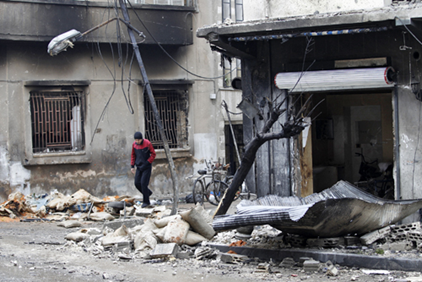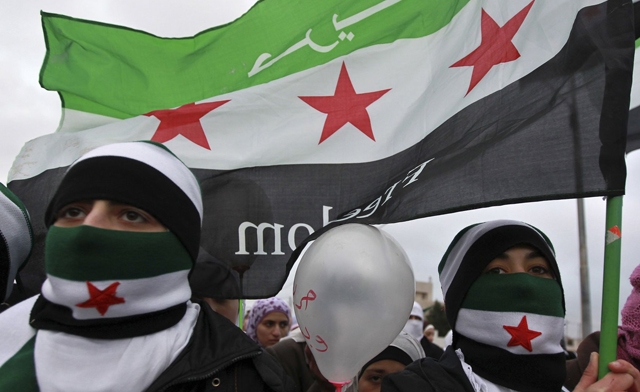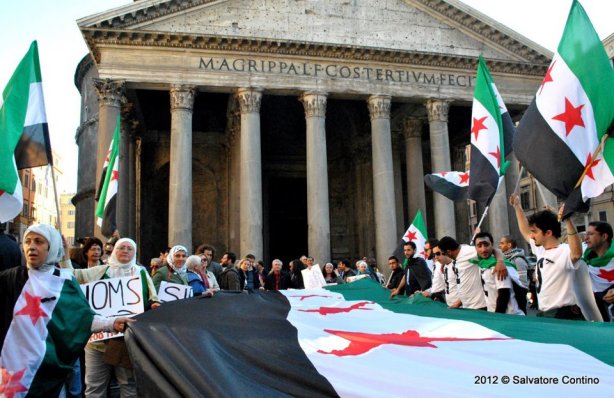
If a regime’s internal structure resembles that of internal colonialism, and if its actions resemble those of a foreign colonial power—bombing their own country’s cities from the air and adopting an Orientalist mindset in their dealings with their own people— then such a regime’s rule may truly be described as internal colonialism. Thus, the right of a people to resist that regime as if it were a foreign occupying power remains intact. This remains true regardless of the nature of that regime’s international foes, bad as they may be. The nature of the people’s resistance, and their rightful struggle in the face of the regime’s crimes against humanity, remains unchanged.

As for those who defend the regime, they too must shoulder some of the blame for its crimes—with all of the nonsense being peddled by some of these defenders notwithstanding. They can be said to be defending this system of internal colonialism: nothing will be powerful enough to wash their hands of this blood.

Nothing will wash away their complicity in the terrorizing of the opposition by aerial bombardment of the cities; nothing will absolve them of culpability in this harrowing moral failure. Just as was the case with those who justified colonial powers’ bombardment of cities on the grounds that terrorists were present in those cities. Keep in mind: the fascist regime we are speaking of here is bombing its own people.

To fault the people who are fighting against such an internally colonialist regime by pointing out that the regime’s decidedly evil international foes make natural allies for the opposition does not take away from the virtue and justice of the opposition’s cause; nor does pointing this out soften the blow of the regimes multiple crimes against humanity, such as the aerial bombardment of their own cities.

The resilience of the Syrian people, with such limited world support, and in the face of such aggressive bombardment—both physical and oratorical—by the regime’s proponents is without parallel in history. One would think that the regime’s supporters really were plotting and carrying out resistance operations against the Israelis when the Syrian revolution broke out. In fact, they have long become used to rhetoric: it was no different during the Israeli bombardment of Gaza. As for the regime itself, they have never managed to bomb anybody save their own people, and that with unprecedented international apathy.

The author of these words recalls well the difference between the different players here: there were some who chose to make peace with Israel, while some chose to resist. Some stood in solidarity with Gaza, while others conspired against her. Yet such stands must always be based on principle, and not subject to the whims of people who simply exploit the cause of Palestine for their own ends. Yet this same author also understands the sharp contrast between those who stand with an oppressed people as their cities are bombed from the air and those who stand by. This author will not simply abandon this very oppressed people merely because the regime’s enemies happen also to be villains.

There can be no defense for the bombing of Daryaa, and for the other towns and hamlets in the environs of Damascus. Nothing at all can wash away the crime of this months-long bombardment of Syria’s cities.

http://yallasouriya.wordpress.com/2012/08/30/azmi-bishara-official-english-page-azmi-bishara-on-3/

The majestic independence flags wave

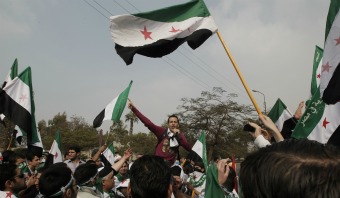
If I had to sum up in only one sentence the most emotional moment of my voyage, it certainly was when they brought us to the border between Turkey and Syria, and I saw, from the Syrian side, two gigantic independence flags waving majestically against the sky. I can’t describe it in words, but reading “Welcome to Free Syria” and recognising the colours of the flag that for more than a year has represented for us, Syrians, hope and the dream of freedom, as well as the end of the regime, was a marvellous feeling. I almost hesitated to set foot in Syrian territory, it seemed too good to be true: a dream that I’ve held in my heart for my entire life was, even if only marginally, becoming reality. Of Syria, the real Syria, I didn’t see anything. No, houses, no cities, no monuments, because I was in a border area, but the sensation of breathing in, finally, the air of my beloved and longed-for land, it was almost a rebirth for me. I bent down, picked up a stone, cradled it in my hand, I kept it with me… a small piece of Syria, a small part of me that has been suffocated by the injustice of the tyrannical regime.

I looked at Syria in the eyes

What struck me so very much during the encounters with our fellow Syrians, was the light in their eyes and faces… Despite the suffering that each one of them carries inside, despite the pain, the precariousness of their situation as refugees, people who had to abandon their homes and their people in order to save themselves from the air strikes, on their faces I saw no signs of hardness, but so much dignity, so much light; in the children and in the adults as well, men and women alike. The children adopted me as an aunt straight away, overcoming any shyness they might have had and they came to me to tell me about their experiences; the horrors of the war have forced them to grow up before their time and their words revolved only around this argument, and this was the case whether they were boys or girls. Even when they played, they repeated the scenes of their escape, the interventions of protection that the youth of the FSA carried out, escorting them until the refugee camp… The last day, before leaving, I tried to get a promise out of them, though knowing that what I was asking of them was impossible: “Try to play other kinds of games, don’t think about war all the time.” They lowered their eyes, they know I am asking too much of them. The war hasn’t physically killed them, but it has stripped them of their childhood, their feelings that they can be carefree, the drive to dream about life. The one, sole dream that they now have is to return home, to their schools, to the gardens where they used to play, to a home where they no longer expect to see the assassins of the regime with their bombs, their armoured tanks.

The immense heart of the women

In the various refugee camps we visited (Kilys, Islahiye, Altinoz, Bohsin, Yayladagi), after the necessary checks at the entrance, we were always presented by those running the camps and then welcomed warmly by everyone, with children taking part with enthusiasm, followed by many young men and women. The welcoming of the women, in particular, was very touching: each one of them wanted us to come visit them in their container or tent; there they tried to do everything possible so as to make me feel at home, then they tried to offer me something, a cup of tea, a sweet from the packets that the Turkish authorities gave them on occasion of the celebration of the end of Ramadan. I watched them move, putting in order those few objects that they had, which now represented their daily lives, with so much care and delicacy that it seemed that they were still the queens of their respective homes. Instead, today all of them are refugees, huddled together in conditions of poverty, with difficult living conditions, but this does not allow them to renounce their dignity, their values, their traditions.

Huda Dachan, Italian-Syrian social worker in the refugee camps in Turkey.

URGENT APPEAL:
The Jordanian authorities have handed over the activist Omar Aharir into the hands of the Syrian regime, more precisely, back to the secret services, despite the well-known fact that he has been a wanted man for his activities in favour of freedom and that, for this reason, he will be sentenced to death in Syria. Amman will hand over to the regime another 11 activists.

We are spreading this news as widely as possible so that this shameful action by the Jordanian authorities is stopped, aware as they are, of condemning these young people to certain death, people whose only crime has been that they have asked for the end of the dictatorship. The Jordanian authorities have been contacted and begged to not proceed in this act, but they have not listened. It’s not enough to undergo the abuse of the Syrian regime, now other States are chasing down and handing over for execution those who are demanding freedom for their people?

http://myfreesyria.com/2012/07/21/404/

Welcome Ramadan, Get Lost Bashar

WRITTEN BY ASMAE SIRIA DACHAN, translated by Mary Rizzo

20 July 2012, 1 Ramadan 1433. Today is the beginning, for millions of Muslims the world over, of the month of Ramadan, considered by the faithful as a moment of sincere devotion, of purification and of prayer and it is for this reason welcomed with great celebration. It is one of the acts of faith that creates the greatest amount of gathering together, with families who reunite, sharing their meals at sunset even in the places of worship. Visits to the sick, as well as to friends and relatives increase in this period precisely to reinforce the connections between people and to mend any possible fractures that may have occurred.

Ramadan has a social meaning, as well as the religious one, so much so that it is felt even among persons who are generally less observant, because it expresses that sense of sacrifice, surrender, purification and rebirth that gives one hope. It is a light that shines at the end of the tunnel… even when the tunnel is long and it takes months and months to get to the other side of it. Just like the tunnel from which we see emerging, with great human sacrifices and an unmatchable commitment, the Syrian people, who find themselves welcoming Ramadan, for the second consecutive year, under the bombardment of the regime. The picture above refers to last year: Sawret al karamah, the “Revolt of Dignity”, had been started at that time already for four months by a group of young protesters, who wrote in candles: “Welcome Ramadan, Get out Bashar”. Perhaps no one could have predicted such a lengthy repression, which has already exceeded sixteen months, causing more than 19 thousand victims, among them, at least 1,400 children. The most recent veto of China and Russia has left the Syrian people feeling indifferent, who by now know that the International Community will not give them any real support, the contrary is true: the halting character of the world only reinforces the murderous folly of the regime, which has made its offensive even more brutal, and one once again we are hearing talk of the use of chemical weapons.

I say “once again” because it has already been months that the doctors of Baba Amr, the long-suffering neighbourhood of the old city of Homs, have denounced the use of white phosphorus, documenting irreversible damage provoked by its use.

Even the “Neighbours”, the Arab nations that are considered as “Sisters”, are enacting a policy of indifference regarding the humanitarian tragedy that is striking the civilians, even going so far as rejecting the entrance of refugees, pushing them back and treating them inhumanely, as the humanitarian associations have been stating.

It is such a sad Ramadan, the one that is beginning, which only this Thursday, on the first night of the vigil, has been grieving the deaths of over 280 persons killed, slaughtered in various locations in the suburbs of Damascus and in the Homs Province. Many Syrians who live abroad, even here in Italy, were used to spending Ramadan with their loved ones, returning to Syria or perhaps inviting their parents or grandparents to come here. Today the repression prohibits Syrians from living that very “normality”, forcing them into atrocious suffering, wounded by the loss of relatives, friends and acquaintances, for the destruction of homes, entire neighbourhoods and yes… entire cities… and especially for the wounds caused by the indifference of the world. It might sound like a paradox, but giving strength to those Syrians outside the homeland, telling them to not give up, to smile and to trust God with even greater force, as well as to have more belief in themselves, are actually those Syrians who are living under the repression, who yesterday by means of internet found a way to give the world their greetings for Ramadan, expressing the prayer that the Ramadan of 2013-1434 will be a different Ramadan, in which the Syrians will be rebuilding everything that the regime has destroyed, finally finding the longed-for peace and freedom.

original in Italian on My Free Syria

Doctor SAHRAN SHALOUB, a Syrian Druse, born in Qraya, town in the Swaida district of Syria in 1964, graduate of the University of Damascus, in service at the hospital of his native town, where he resides, married and with a 17-year-old daughter and a 9-year-old son, was arrested on Sunday, 8 July 2012 in Qraya, (Swaida), taken from his home by men wearing the Syrian Army’s uniform, who did not identify themselves nor did they present any motivation for his arrest.

In the city of Swaida, during the night of Friday 6 July, a car exploded with two of its occupants, one of them, SAFUAN SHEKER, was already being sought out and his father had been arrested 30 days earlier. According to the official version, the two men were preparing a bomb for a terrorist attack, while the citizens of the city are convinced that the car had been struck by a missile or that a bomb had been placed within it and the passengers of the car entered without being aware of the explosives. There were no eyewitnesses at the moment of the explosion.

During the funeral procession, held on Saturday at Qraya, where the two men lived, the participants of the funeral had begun a protest in which hundreds of citizens participated and in which they had chanted slogans against the regime.

Together with Dr. Shaloub, other men arrested were: KARAM SHEKER, YUSSEF AL BALUSS and KAMAL RAED. A fifth man that was being sought out by the authorities in the course of the same operation, BASEL MFAREGE, was not found and is still being sought.

Dr. Shaloub’s father was a member of the Parliament until the year of his death in 1980.

Neither Dr. Shaloub, nor any of the other three men who were arrested have been involved in acts of violence and their arrest is to be attributed to their participation in the peaceful protest march that took place alongside the funerals of Safuan Sheker and his friend.

No information was however given regarding charges against them, nor was the place of their detention given. It is important to mention that Saturday’s protest was the first one held since the start of the revolts in the city of Qraya Swaida, which is an area inhabited principally by Druse.

Il Dr SAHRAN SHALOUB, di etnia drusa, nato a Qraya, località nel distretto di Swaida (Siria) nel 1964, laureato all’Università di Damasco, in servizio presso l’ospedale della sua città natale, dove risiede, sposato, con una figlia di 17 anni e un bambino di 9, è stato arrestato domenica 8 luglio 2012 nella città di Qraya, distretto di Swaida, prelevato  nella sua abitazione da uomini con l’uniforme dell’esercito, che non si sono qualificati, né hanno fornito alcuna motivazione per il suo arresto.

Nella città di  Swaida, nella notte tra venerdì 6 e sabato 7 luglio, un’auto è saltata in aria con i suoi due occupanti, uno dei quali, SAFUAN SHEKER, era già ricercato e suo padre era stato arrestato 30 giorni prima. Secondo la versione ufficiale, i due stavano preparando una bomba per un attentato, mentre i concittadini ritengono che l’auto sua stata colpita da un razzo o era stato posto, al suo interno, un ordigno all’insaputa degli occupanti. Al momento dell’esplosione non c’erano testimoni.

Durante la cerimonia funebre, tenutasi nella giornata di sabato a Qraya, dove i due risiedevano, i partecipanti alle esequie, hanno inscenato una manifestazione a cui hanno partecipato centinaia di cittadini che hanno cantato slogan contro il regime.

Insieme al Dr Shaloub, sono stati arrestati: KARAM SHEKER, YUSSEF AL BALUSS E KAMAL RAED. Un quinto ricercato, nel corso della stessa operazione, BASEL MFAREGE, non è stato trovato ed è ancora ricercato.

Il padre del Dr Shaloub è stato parlamentare fino all’anno della sua morte nel 1980.

Né il Dr Shaloub, né alcuno degli altri tre arrestati si sono resi responsabili di atti di violenza e il loro arresto è da attribuirsi alla partecipazione alla pacifica manifestazione di protesta originatasi in occasione dei funerali di Safuan Sheker e del suo amico.

Non sono state fornite comunque informazioni né sui capi di imputazione di cui sono accusati, né del luogo della detenzione. Si aggiunge che la manifestazione di Sabato è stata la prima tenutesi nella città di Qraya Swaida, in una zona abitata principalmente da drusi, dall’inizio della rivolta.

Beware the Gatekeepers! They want to control all discourse, especially since open discourse might reveal the facts and the ugly truth!

WRITTEN BY CHRISTINA BASEOS

+++
I left the below comment under this piece (http://www.salem-ews.com/articles/july102012/rizzo-lies-sd.php).

QUOTE
Christina Baseos July 11, 2012 7:01 am (Pacific time)

Mr. Davis, In regards to the few paragraphs mentioning my name and making reference to the R2H’s convoy and the shipping incident that took place in Libya, please note that I can prove your claims false. In light of this, the admins of this page are kindly requested to advise how I can upload a couple of pictures in the comments section. If uploading pics is not possible, please let me know and I will give you the link to an external page where you can redirect yourselves in order to see them. Thank you.
UNQUOTE

Given that I haven’t received an answer from SN’s admins, I post here my response to Mr. Davis, who, given that he’s a a ‘fan’ of this blog, will read it.
+++

Mr. Davis,

First of all, let’s make clear that we do not know each other. We have never met and none of us have the slightest idea on each other’s existence. Just as I know nothing about you, you know nothing about me as well. For the purposes of this comment and just for the sake of good order, please note that I’m a shipping professional (and not a lawyer as falsely claimed by Ms. Merton in one of the below pictures). Moreover, please note that, unlike the hundreds of people who posted & commented back in 2010 about the R2H shipping incident in Libya, I was the only one (except for the infamous “Gaza 10” of course) who was there, on board the vessel, together with Ken O’ Keefe and the rest of the 9 members of the convoy and their Greek lawyers and all involved authorities. I was also there when the “Gaza 10” were arrested on the ship, brought to the port authorities and then to the court house.

Ken O’ Keefe and myself talked while they were all on the ship and I also talked to other members of the convoy, as well as to their lawyers. I believe Ken O’ Keefe will have no objection whatsoever to confirming the above, should you feel the need to cross-check this.

The reason I’m stating that I was there is in order to clarify that I don’t talk on behalf of anyone else, except for myself, and I certainly do not rely on third parties’ words, in order to take a position on this issue.

Having said this, let me cut to the chase, but before I do, note that I will not respond para by para to your ‘analysis’ of the alleged kidnapping incident in relation to Mary Rizzo’s article. I will though make an effort to explain some things, for the umpteenth time, which they should make you reconsider your stance on this, if you are indeed objective as you say and if you indeed base your thesis on facts & proof.

1) You claim that I was rightfully blocked by the R2H Facebook page due to my “repeated comments”, which as per your own admittance you only “assume” that they were “repeated” and that it would have been better if I had just left a post and left. Moreover, you claim that you “would have travelled half-way across the world to sue if not strangle someone who would have eased my concern only to find my loved one dead from a shipping incident”.

Since you “assume” that I repeated the same comments over & over and that they were annoying or misleading or false or whatever it is you’re insinuating, I refer you to the below 2 screenshots. One is a PM exchanged between the sister of one of the convoy’s members on board the ship, and myself. As you can see yourself, according to a FAMILY MEMBER, the info I left on R2H’s FB page was indeed relieving to the families and most importantly accurate, since according to that family member the info I posted were confirmed to her by the Foreign Affairs. Just for the record, I’m telling you that this family member did indeed call me the day she sent me the PM and I indeed handed my phone to her brother in order for them to speak.
(N.B. The last name of this lady, as well as the tel numbers shown in this PM, have been erased on purpose and substituted with “xxx” for privacy reasons).

private exchange between CB and sister of one of the persons on ship with Ken O’Keefe

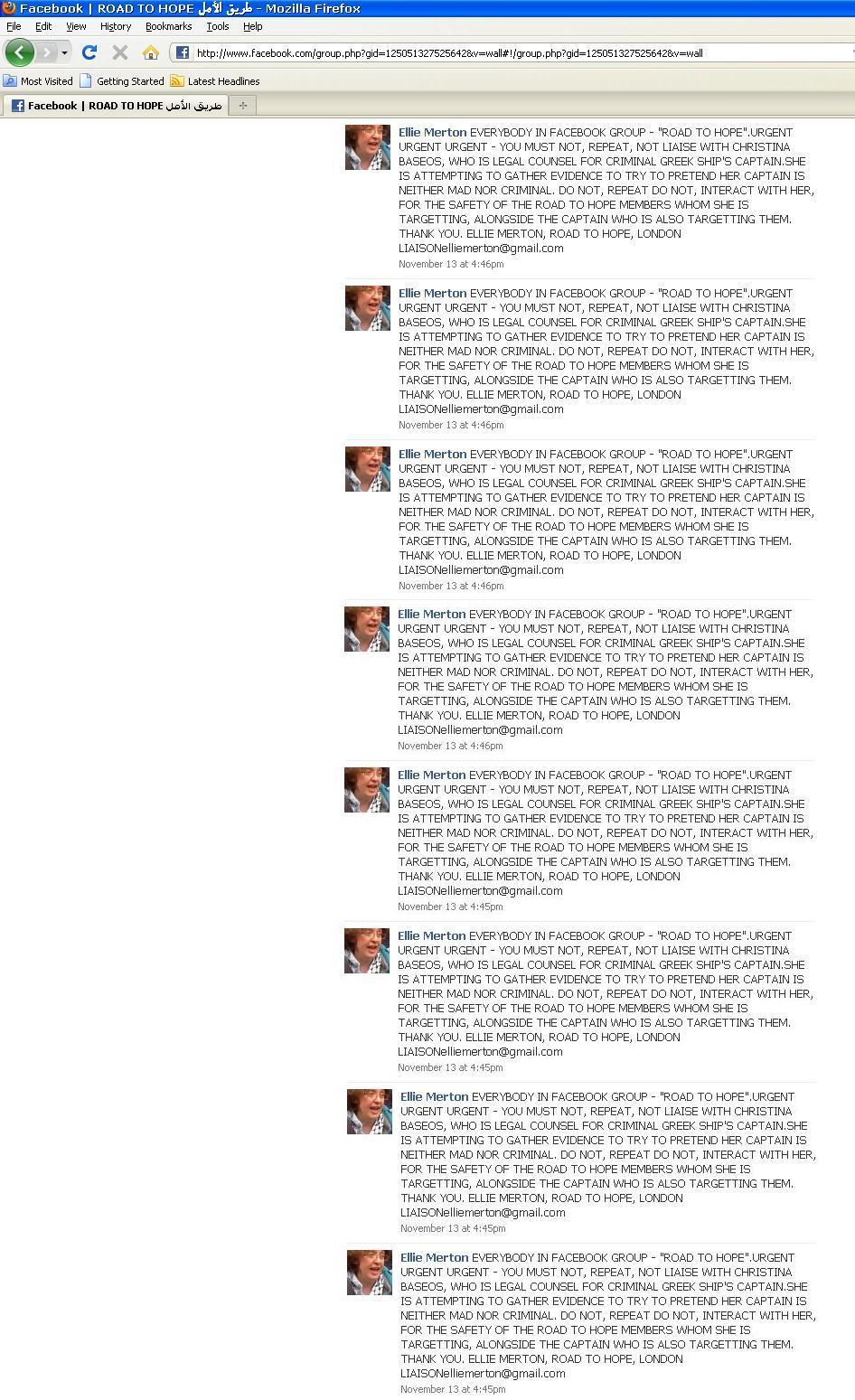
In regards to repeating comments over & over again and that being somehow an abuse of ‘freedom of speech’, I will only ask you to have a look at the screenshot concerning Ms. Ellie Merton (R2H’s official liaison at that time), where she posted 10 times in less than 2 minutes the same comment (simply by copy/pasting it), falsely claiming that I am a “legal counsel”, which is not true as I have no relation to the legal profession whatsoever and this can be verified by anyone on this planet, and asking people not to liaise with me as I am ‘dangerous’. I will not comment on the second part of her post and if I’m dangerous or not, as Ken O’ Keefe and the rest of the convoy members can tell you directly if any of them were directly or indirectly endangered by me. As far as it concerns the first part of Ms. Merton’s repetitive post, please tell me Mr. Davis, given that you are a man of facts and proof, since I am not a legal counsel, how would you call Ms. Merton’s claim? Does it fall within the defamatory/libel category according to your criteria?

Ellie Merton posting repeat “warnings” containing untrue information

2) The so called “pre-contract” saga: What Mary Rizzo calls “pre-contract” is what is officially called in shipping a “firm offer”, which just for your guidance is an offer a shipowner makes to the potential charterer of the vessel (charterer in shipping = client in commercial business), which basically includes the freight the shipowner is asking for in order to execute a voyage, i.e. the carriage of a cargo between two destinations. A firm offer, except for the freight, includes a number of other terms & conditions, which are negotiated between the shipowner and the charterer and IF the two parties come to an agreement, then the fixture (as it’s called in shipping) is deemed concluded and a Charter Party (charter party in shipping = contract in commercial business) is then drafted and signed by both parties. In a few words, the ‘pre-offer’ was the shipowner’s firm offer. Note above that I said that a C/P (stands for Charter Party) is signed after the negotiating parties have reached an agreement. In the case of R2H, the charterer and the shipowner never reached an agreement, therefore all negotiations were dropped and eventually there was no fixture.

There are trails of exchanged messages between the shipowner, the charterer and their broker, which clearly show that the negotiations failed and that there was no agreement. Ken O’Keefe (and Ellie Merton) have a copy of these exchanged messages and it is THIS copy Ken O’Keefe sent to Mary Rizzo and he falsely named it as “contract”. Note, that it can only be the exact same copy of messages that was sent to Mary Rizzo by myself, as there were no other existing documents concerning the charter that could be sent, only it was named correctly by myself as “exchanged messages” and not “contract”, since it was not a contract.

At some point in your text, you write:

“…without giving any notice of if the agreement that Ken and his crew believed they had would be honored”.

Note the word you used: “BELIEVED”, i.e. the agreement Ken O’ Keefe thought he had. If he was so sure that there was an agreement and moreover if there was a breach of this agreement from the shipowner’s side, why do you insert the word “believed”? Mr. Davis, have you seen any of the proof you claim that Mary Rizzo doesn’t have in her hands, not to mention that according to you they are totally non-existent? Have you seen any document, whatever that is, with your own eyes? If you haven’t, then I suggest you check your facts first before you make any comments and if you have, then I suggest you read carefully the contents of these documents and make sure to consult a shipping professional to explain to you the process of a shipping negotiation, the meaning of a firm offer and a C/P.

3) A few words on your comments about the NATO’s involvement (or to be more specific, the non–involvement), your example of a taxi driver (although, thankfully, you admit yourself that this analogy is different by a few standards), the “international incident” and your comments about my ‘credentials’.

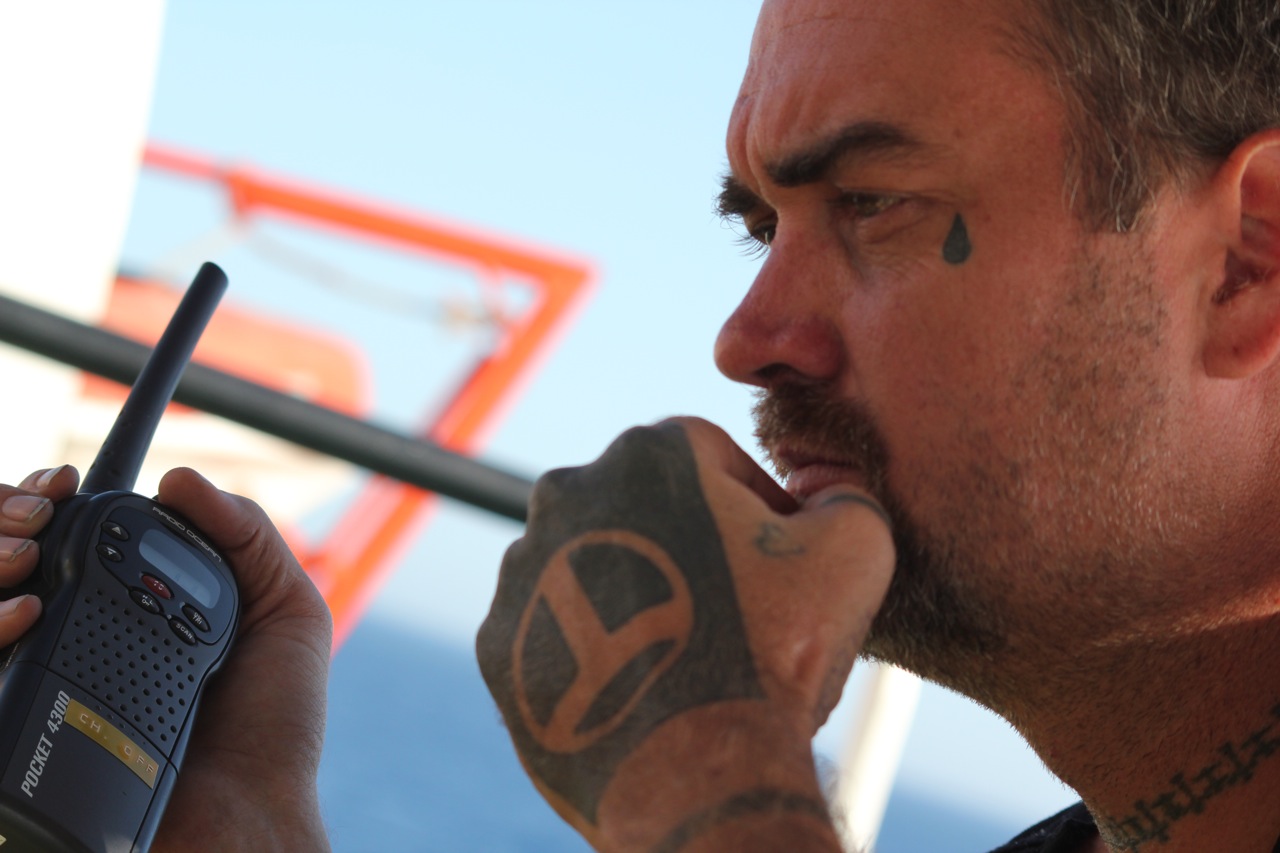
Ken O’Keefe admitted that he commandeered a ship’s radio and contacted a neighboring vessel seeking for help/intervention. For the sake of clarity, the vessel he contacted was a commercial one (a ship belonging to OOCL’s fleet) and not a NATO vessel. He also admitted that he made a distress call. I suggest you find out yourself the meaning & essence of a “distress call” in shipping. Anyhow, as we all saw from O’ Keefe’s own video, he sought help from a neighboring vessel claiming that he and another 9 persons were being kidnapped. FYI and because I suspect you once again have no proof of what you are claiming, all communications between the commercial ship of OCCL, which was the recipient of the distress call, with all relevant port authorities as well as the SRCC of the Greek Ministry of Maritime Affairs are recorded. Copies of the recordings are available upon request made to the relevant authorities. I presume, and I emphasize on the word presume, as I do not have firm knowledge on this, that the ‘Gaza 10’ lawyer has already obtained a copy of those recordings for the purposes of supporting their case in court. Since Ken O’ Keefe inadvertently (NOT), left out from his video the response he got from the OOCL ship, maybe you should check for yourself what it was and rest assured all your questions on why NATO wasn’t involved will be answered.

Nice try with your taxi-driver example although when you attempt to make an analogy, you should first make sure that the standards are the same. Your example is wrong by default and I will not explain why here, in the comments section of a webpage, as this would require speedy lessons on shipping and I’m not willing to give such lessons in the internet and especially not for free! I would advise you, if I’m allowed, to learn some basic shipping principles first, as well as shipping law, in depth instead of copying/pasting articles of the penal code from sources irrelevant to shipping and more importantly from irrelevant jurisdictions.

With regards to whether this incident was an “international” one and whether it almost lead to a diplomatic fallout between the involved countries, please note that Mary Rizzo, myself and I presume (again….I presume) the ‘Gaza 10’ lawyer have in our hands a document addressed to the Ministry of Foreign Affairs, marked as “Confidential and Urgent” and issued by the Maltese authorities (you might ask why the Maltese? Because the ship’s flies the Maltese flag, ergo it falls under the Maltese jurisdiction…please feel free do your research on the relationship between a ship’s flag and her jurisdiction or alternatively ask Ken O’ Keefe, who according to him is a Captain himself, therefore he should have knowledge on this), where it clearly describes all efforts made by the authorities of the Maltese, Libyan and Greek Authorities in order for a diplomatic fallout between the governments of those countries not to occur. Just for the sake of good order, Mary Rizzo was requested by me to not publish this document, as it is a confidential one, however just as the shipowner’s lawyers have it in their hands, I assume the lawyer of the ‘Gaza 10’ has it as well.

Lastly, as far as it concerns my ‘credentials’, to the best of my knowledge you Mr. Davis never asked me for them, however they are not secret. And since you wonder if Mary Rizzo sought my credentials before she,as you claim, almost entirely based her whole article on my report, I hereby inform you that she did ask for them and she did cross-check them well in advance. As far as I’m concerned, Mary Rizzo did show due diligence with regards to my credentials, in stark contrast with you, which you never did.

To conclude this long comment, I kindly request you Mr. Davis to check your facts first and have proof of your claims before you start analyzing cases, at least when they are related to shipping. Actions speak louder than words, therefore I would expect from someone who claims that he’s all about facts, proof and objectiveness to practice what he preaches.

As I said in the beginning of this comment, you Mr. Davis do not know me, just as I don’t know you; therefore you have no right to question my credibility, credentials and whatever else you question, without having firm knowledge of the actual facts and evidence of your claims. It is a paradox for someone who accuses a journalist for not having checked her facts or gathered evidence to support her writings, to question the credibility of another person, without having showed his own due diligence first.

There are numerous other inaccuracies in your statements above, with regards to R2H fiasco, but as I said, I will not respond to each & every one of them as it is of no merit and since all of them have already been addressed in the past and are posted in public fora. With regards to the rest of your piece, I have not read it as I’m in no way the right person to comment on any part of it, as I don’t have knowledge of the actual facts. The impression I have is that all this is an orchestrated attempt (if not a campaign) to discredit Mary Rizzo, in every way, on behalf of Ken O’ Keefe. I can’t help but wonder why you Mr. Davis are discrediting one person with such passion? I wonder if this orchestrated attempt is an effort to form a negative public opinion about Mary Rizzo a priori to some “big event”? Perhaps, Mr. O’ Keefe is planning his big come back to Gaza and deems necessary to prepare the ground in case Mary Rizzo dares to criticize again any of his future actions? But as I said, this is just an impression I have, in no way am I claiming that I’m right in my assumption…….

You wrote that Mary Rizzo deserves any character assassination results and you also advise her to learn what ‘character’ is.

Ken O Keefe is a great guy in my opinion. You and Kim were wrong to believe anyone is blindly following him. Thus you martyred him and now the truth is out and you all deserve whatever character assassination results. It is called responsibility.

Well, according to the Collins English Dictionary, ‘character assassination is the act of deliberately attempting to destroy a person’s reputation by defamatory remarks” and at when it comes to the R2H fiasco, your claims, comments, statements, etc are not only false but also defamatory as you don’t provide proof of your claims. I must admit though that it must have taken you some courage to admit publicly that you indeed exercise character assassination. Remember, Mr Davis, ‘Verba volant, scripta manent’.


And if that applies for Mary Rizzo, then it applies for you as well. Elbert Hubbard said that
Character is the result of two things: mental attitude and the way we spend our time”. Judging from the length of your piece, it’s crystal clear how you spend your time…as for the mental attitude, I’ll refrain myself from saying more in an attempt to keep things civilized.

An idiotic petition is circulating, so far luckily with only 99 signatories. But read it and see how it is a textbook example of muddling issues.

“War is not the answer. Not in Iran. Not in Syria.

Intervention in Syria only makes matters worse. All sides are committing war crimes, and providing arms only results in more killing.

The US and all foreign governments should stay out of Syria and let the Syrian people resolve their own political matters in their own way. Our government must keep its arms, funding and troops out of Syria.”

Mixing issues (such as the “war” against Iran that has been announced as being around the corner for 9 years now, just confounds people and keeps reality hidden. But more sinister are the assumptions made.

1) No one does want war who is a normal person. Apparently, neither did any protesters who took to the streets as is a right of assembly free people hold dear, and the reactionary regime either forced them into death or capitulation. The more death there was, the less the people remained silent and capitulation became impossible. This is how revolutions at times begin, when a resistance occurs in the face of lack of reforms and when oppression is the answer to dissent.

2) Who says it makes matters “worse”. Apparently, someone living in California does not seem to think it is bad enough that civilians are massacred, tortured, arrested, infants are slaughtered, towns are shelled to the ground, unconventional weapons are unleashed, water is poisoned and medicine is withheld from the wounded? Refugees are not fleeing their homes and losing their possessions and loved ones? Does he or she ignore the destruction the regime carries out so that it maintains itself in power?

3) The author puts on equal footing the “war crimes”…. Is this a joke? How can the acts of the deserting soldiers ever be compared to the regular army and the Shabihha? Do they have prisons, tanks, helicopters?

4) The USA isn’t getting involved, never planned on it, unless finger-wagging and tongue-wagging is involvement. On the other hand, Russia, Iran, Lebanon and China provide material and political support including weapons and mercenaries.

5) The ultimate smack in the face against people in Syria (though this petition never claimed it cared about them) is that it believes it is possible and preferable to “let the Syrian people resolve their own political matters in their own way.” The naiveté of a statement of the sort is alarming, as if this is a political dispute that does not involve crimes against humanity and genocide. Yes, “let them” sort it out, while we put our blindfolds on, or sign some idiotic petition because peace is nice, rainbows and flowers are better than guns and severed throats of infants.

Not only on FB, but FB makes it easy to avoid facts and hype rhetorical good and bad deeds

Here we go again, just when one thinks that the insanity of the personalisation of the PALESTINIAN CAUSE is finally running its course, long, long overdue, I add… I find that a blog called Shoah.org that purports to be very popular and pro-Palestinian, though featuring almost no Palestinians at all among those it publishes, has decided that acceptable content is bizarre personal vendettas becoming “our business and thus THEIR business”. The blog looks actually scarily similar to the National Inquirer. I have not had much opportunity to see the site in the past, but having seen the recent “popular” post I do worry about the state of activism and mostly, for what concerns this site, wonder if it is competing in the stakes of activism tabloids.

Happily being able to ignore the big flame wars between activists has been a wonderful luxury. I feel that most of these activists and campaigners are strictly relevant to themselves and basically just bringing grist to their own publicity mills, since they turn out to be little more than a few men glorifying their egos and repeating ad nauseam in public articles and posts their own self-worth and assuming the baton will be carried by others repeating the mantra that “if you are not with this (or that) “known” activist, you are a Zionist! You are a proven AGENT!”  But it’s easy and desirable to disengage with this lot, since when asked over and over to prove the claims made against those who dare criticise them, they never do provide any proof of it besides comical ones that they invent themselves. Agents certainly DO exist, but to call anyone an agent is dangerous and no intelligent person will accept that without evidence. It certainly does speak volumes that this claim is made so very often and at the flip of a hat, but rarely is there anything to support it, thus it is empty of meaning. It is quite clear by now that it’s more productive to ignore this lot, because it serves no purpose to engage in time-wasting battles that no one but the men involved and their “followers” (yes, their own way of referring to those who engage in battles on behalf of them or even anyone who they are “friends” with) care about.

Yet, again, I find my name brought up in one of these smear campaigns, and despite my reticence to waste more time on issues that do not interest me because they are so far removed from Palestine, this time I will respond, because the level of smearing (not only of me, but of a plethora of people, in fact ANYONE who points out a criticism of the “author” of a piece vying for the most insane bit of using the Palestinian cause to settle a personal vendetta to date) simply calls for it being exposed for what it is. The rhetoric used in these endless smear campaigns waged by a specific faction most definitely falls into what has been defined by as “Extremist Traits” by an analyst of the rhetoric and propaganda of several hundred militant “fringe” political and social groups across the political spectrum. Militant and “fringe” are not derogatory terms, they present the positioning of a cause as to how it fits into the mainstream or dominant framework of political or social opinion.  As such, I will address the issue and in those very terms. Extremist, however, is the style of the behaviour, and it certainly can be considered as being derogatory as it depends upon manipulation.

Following even a bad example is the way that social pressure groups work when thinking for oneself is not encouraged

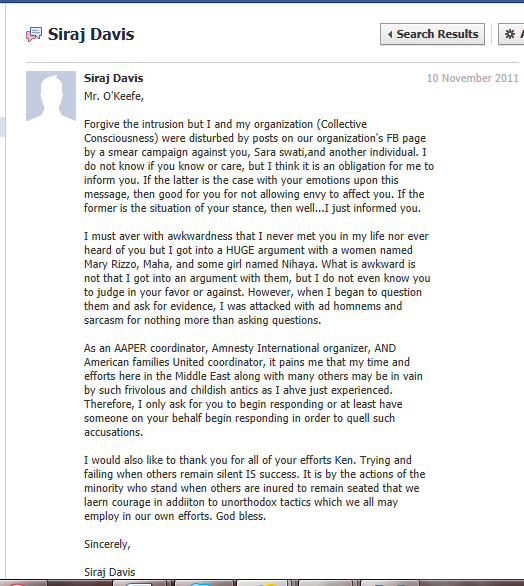
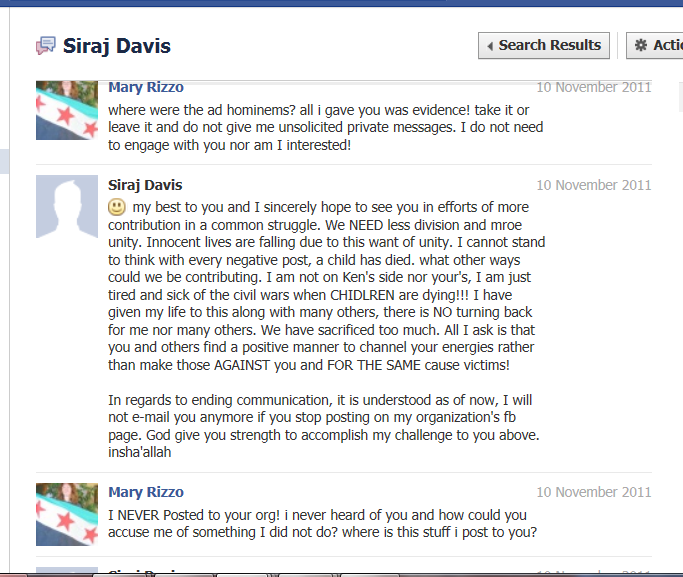
I am being referred to in comments on the “popular” post, which is very little else but a character assassination based on the personal feud someone has with the subject, I have seen probably the worst displays by “activists” available, even vying with some of the most absurd smear posts on Facebook, attempting to create a sort of mobbing and consensus as to the character of a person who shares one thing in common with me, and that is that she does not think Ken O’Keefe is such hot shit as he claims, but who actually has a big difference with me in that she once actually supported him and then changed her mind, without any solicitation from me, but independently and of her own freewill (and this shared view regarding Ken O’Keefe creates in the minds of the Ken O’Keefe Fans the automatism that this person and I are affiliated.) Besides the point being that this entire thing is nonsensical, especially as Siraj Davis (the author of the piece) is a legend in his mind alone, having claimed that I was posting things to him, totally debunked and with MY screenshots to demonstrate it, the issue of Ken O’Keefe being the pillar of activism is entirely outdated and misleading. (At the bottom of this post, 4 screenshots concerning Siraj Davis, his unsolicited harassment of me and my response to it, as well as evidence of some bizarre stalking-like behaviour in my regards and his own uncontrollable addiction to pornography, which he also has used the Shoah org blog to promote these screenshots he himself made showing his “particular tastes in that regard).

It is clear and acceptable that there are many, particularly from the ranks of O’Keefe’s former “most dedicated followers” who no longer see him as relevant enough to form the dividing line between supporters of the struggle and its opponents. Indeed, the moment they so much as voice a criticism of him, they are accused of being paid agents or somesuch. His former “spokesperson” who had publicly stated that he had hijacked a vessel, despite having claimed the opposite a few months earlier, also quite publicly, was accused by him of being an MI6 agent, and those who had most vocally defended him (by attacking those who criticise him) have been dragged over the coals, one by one and there are dozens of such examples, should anyone care to look.

For a site to facilitate this and allow the use of a space ostensibly for the Palestinian struggle to attack someone to settle a personal issue he has with someone – and without a real argument or substantial proof to boot – is the blog’s own business, but it has damaged any reputation the blog might have had as being about the Palestinian issue. Again the Palestinians are caught in the middle of some activists who are NOT Palestinian to settle their own disputes. They are used as an excuse to create a consensus surrounding someone that is not natural. Actually, Palestinians stay out of the discourse for the most part, seeing it as a distraction and an abuse of their cause. But then again, what a blog puts up is its own business. I really don’t care that much what these blogs and sites say when they are either hagiography or smears. They truly cease to hold any interest for me, and I would not be surprised if I were not alone in this assessment. Yet, again I am dragged into the smear campaigns because I have not bent to the mobbing. It would not be appropriate for me to feed this campaign, and yet, since I will be accused of not being able to support my point of view, I for the last time will refer those interested to the factual events, and they can be their own best judge of the righteousness of certain persons and of the wrongfulness of the smear campaigns, especially when they are jumping the back of the Palestinian cause to justify their wrongdoing.

I am addressing something I would prefer to ignore given my lack of interest in the persons involved, as it is clear that I do not really care about the lies and the capacity to engage in such character assassination and abuse of the cause by these subjects whose ethics and integrity (as well as mere accountability) are filled with quite a large number of gaping holes. It is generally preferable to allow those engaging in these attacks to their own devices, since it will become clear over time that they are lacking in accountability and that they invent things as they see fitting, avoiding truthfulness when they feel it suits their ends. It is evident that I have taken my position based on facts and evidence, and it is likewise evident that people are free to judge as they see fit based on the available facts. I have not attempted to influence or win over anyone. Like all I have written, it stands on its own and people are free to judge with their own minds. I do not live on internet as many of the other activists seem to do, and I do not need to convince anyone at all of the logic of my argument. If people are convinced, they have reached this awareness not by my insistence, but upon their own judgement.

As I have written, The Truth Sunk during the Road to Hope Fiasco (https://wewritewhatwelike.com/2011/06/14/truth-justice-and-peace-nearly-sunk-as-rth-convoy-facts-emerge-and-as-usual-gazans-get-the-worst-part-of-the-deal/), and caused a big mess in the meantime. No one was obligated to “follow me” as I have no followers, nor do I want them. If people are going to take a position, however, they are advised to be informed of the facts, as objectively as possible, this is itself a bare essential for TRUTH.  As Ken had refused to even be interviewed once it was clear that the article was not going to become his personal Tazibao, but all parties were going to be interviewed and all of their statements both in a public domain and those they had made in interactions with me (as declared openly and correctly that I was going to examine the evidence and write up an assessment of it) and all documents were going to be taken into consideration, not only his personal testimony and the information given by those who got it from him. Upon learning that other parties, including those who both at the time and subsequently, would be listened to and that he would not be given a list of the questions prior to the agreement to be interviewed (a condition no other parties had placed before me, all of them willing to subject themselves to “the investigation” without demanding any particular benefits or any right to view the material during its assembly and prior to publication). Ken demanded special treatment, and he wanted to control an independent observer. If he was unable to control her, he changed his tactic that she was an enemy to the cause since he believes he alone represents the cause! When the outcome did not please him, he conveniently forgot that he had the same exact opportunity to reply to questions and to express himself as all the other involved parties. Instead, he decided that it was in his best interests to “ignore” what was written, advising his “followers” to not read the (admittedly) long article complete with photos, documents, communications between the authorities and others, direct quotes taken from press releases and from communications in the public domain. His “followers” were advised to engage instead in smear campaigns against me and to use almost all of the techniques that have been pointed out so well by Laird Wilcox in his seminal study of “Extremist Traits” https://wewritewhatwelike.com/2012/06/25/laird-wilcox-on-extremist-traits/ reprinted here with definitions that come painfully close to the entire modus operandi of this faction. Most glaring was the tendency to engage in Inadequate Proof For Assertions. I was labelled as a CIA or Mossad Agent, as being a paid infiltrate, as being an Israeli and much more besides with some at times hilarious “proof” by the Ken O’Keefe minions.

However, the one thing lacking was even ONE serious attempt to provide evidence to confute the thesis of the failed Road To Hope convoy, that it was managed in a bizarre way at least from the “leadership change” and the outcome of this were false claims of being kidnapped in order to attempt to create confusion, consensus and mostly to elicit donations and support from those who were already fully determined to support Palestine – allowing the cause to morph into Supporting Ken O’Keefe.

None of them were able to confute, and Ken in primis, the lack of a contract, which was the crucial circumstance upon which all else depends in that most bizarre of events! In fact, what is most clear throughout the entire debacle is that Ken was indeed somehow convinced of the veracity of a fact that was patently false, so convinced that he himself sent me what he labelled as “The Contract”, when it was clear as the light of day that this was not a contract at all, and it was merely a pre-Contract negotiation, which by its very nature is non-binding until the stipulation of what instead IS a contract! When I pointed out that I was aware it was not a contract, it dawned upon him that he had to turn me into the adversary since his entire story had no backbone to sustain it.

That a contract was broken and the counter-party scooted off with the loot to his Israeli masters is the first of the bizarre stretching of truth, this accessory big fish story of the captain being really on the Mossad payroll and jumping off his own ship with the wad of money itself was quite hilarious and indeed worrying when spread as if it were fact the same way old gossips do, when the facts are brought to the fore instead of just one extremely false claim. I was already watching the playing out of the events, called as I was by other concerned activists to ensure the safe passage of the chartered convoy when trouble first started, in an ad hoc group I was invited to, and kicked out of when I asked that we seek confirmation of any claim being made prior to disseminating what could later be demonstrated as dangerous false rumours and nothing more.

It was when I was invited by persons whose loved ones were on the convoy and who found them stranded in Libya without any more resources that I began collecting evidence in earnest from all parties involved, deciding to not further participate in the public debate, but to merely collect the evidence. Why did these people ask me? Because for a long time I have been involved in the activism for Palestine camp and it was and still is clear that my only loyalties are to Palestinians. I am not, nor have I ever been beholden to anyone. I have been and remain thoroughly independent and am influenced merely by facts. It was this objectivity that was considered as being the best guarantee of a faithful assessment of the reality, as there was all of a sudden a complete shift from the convoy being about the entire convoy and instead being about Ken O’Keefe and those who were most loyal to him. It was indeed logical that others who had different priorities, and for this reason did they agree to sacrifice their own time, money and effort in order to participate in a long and trouble-ridden land convoy, would seek to know the truth and would be asking that a third party that had nothing but a solid record of support of the Palestinian cause to attempt to clarify all the hazy and contradictory points.

Ken O’Keefe making “distress calls” to the NATO for a kidnapping that never was, but you weren’t supposed to challenge that or wonder what good that does the Palestinians

It was the research that convinced me of the correctness of the thesis that things were NOT as they were being presented to the activists, and that the conflicting reports coming from Libya were proof enough that there was indeed a serious conflict between “factions”. Why did Ken O’Keefe claim there was going to be a “confrontation on the Egyptian border” when there had not been any arrangements for a land transit anyway and this would be detrimental in the extremely precarious situation of those in Libya without the proper paperwork and without adequate economic support? Why would he claim that he and 9 others were being kidnapped and some people spread this without it being verified? Why would it be taken as fact that this vessel had taken people against their will off the coast of Libya? Why would Ken O’Keefe engage in actions with the intent of involving NATO and the Libyan armed forces as well? Would this not endanger any future convoys to Palestine and would it not cast a very dark shadow over the efforts made to break the siege which did not resort to such reckless measures? Would not the abuse of trust that ensued be disastrous for further (more well planned and feasible) interventions? Since I presented the evidence that Ken O’Keefe did not get “kidnapped” off the Libyan coast and instead had unlawfully boarded a vessel he had no right to board and analysing as well the knee-jerk response to his “appeals” that were not backed up by facts and were instead abusing the trust of many sincerely caring individuals who were involved both in the convoy itself and those following it at a distance, I became the target of a huge smear campaign.

But I was the first of many. It seems that instead of presenting a stitch of evidence to dispute the claims, the issue has become that I am an “irrational Ken Hater, fuelled by my jealousy of him”. I could not even bother to engage with this level of discourse, though the great number of comments on this blog (https://wewritewhatwelike.com/2011/08/05/the-171-comments-to-the-ken-okeefe-rth-fiasco-reprinted-from-ptt/) attest to the fact that there was indeed some discussion of the facts, but never by the minions of the “Ken Followers”. It was instead just one smear campaign after another waged by them, and at a certain point, valuing my time more than needlessly “debating” people who do not know how to debate and would not be interested in it anyway, I simply began ignoring whatever it is they do or say, and focussing on the Arab and Palestinian freedom causes, which has always been my priority. I find the whole “cult” quite comical and at some level am certain that sooner or later they will self-destruct because their major enemies are those who had turned on Ken after having felt that they had been taken advantage of by him and who have opinions of him that do not match the “godlike” one that he and his cult have built around him.

It is very interesting that the way to address any human being who dares to have decided that Ken is not worth their support and they will not only not “follow” him, but they will avoid him, are subject to a more or less organised smear campaign. It is quite alarming that this has got to do with the issue of Palestine, because each and every one of these “tendencies” have been utilised in the “war” Ken has with anyone who does not think he is so “godlike”
1. CHARACTER ASSASSINATION.

Extremists often attack the character of an opponent rather than deal with the facts or issues raised. They will question motives, qualifications, past associations, alleged values, personality, looks, mental health, and so on as a diversion from the issues under consideration. Some of these matters are not entirely irrelevant, but they should not serve to avoid the real issues.

Extremists object strenuously when this is done to them, of course!

2. NAME-CALLING AND LABELING.

3. IRRESPONSIBLE SWEEPING GENERALIZATIONS.

4. INADEQUATE PROOF FOR ASSERTIONS.

5. ADVOCACY OF DOUBLE STANDARDS.

6. TENDENCY TO VIEW THEIR OPPONENTS AND CRITICS AS ESSENTIALLY EVIL.

7. MANICHAEAN WORLDVIEW.

8. ADVOCACY OF SOME DEGREE OF CENSORSHIP OR REPRESSION OF THEIR OPPONENTS AND/OR CRITICS.

9. TEND TO IDENTIFY THEMSELVES IN TERMS OF WHO THEIR ENEMIES ARE: WHOM THEY

HATE AND WHO HATES THEM.

10. TENDENCY TOWARD ARGUMENT BY INTIMIDATION.

11. USE OF SLOGANS, BUZZWORDS, AND THOUGHT-STOPPING CLICHES.

12. ASSUMPTION OF MORAL OR OTHER SUPERIORITY OVER OTHERS.

13. DOOMSDAY THINKING.

14. BELIEF THAT IT’S OKAY TO DO BAD THINGS IN THE SERVICE OF A “GOOD” CAUSE.

15. EMPHASIS ON EMOTIONAL RESPONSES AND, CORRESPONDINGLY, LESS IMPORTANCE ATTACHED TO REASONING AND LOGICAL ANALYSIS.

16. HYPERSENSITIVITY AND VIGILANCE.

17. USE OF SUPERNATURAL RATIONALE FOR BELIEFS AND ACTIONS.

18. PROBLEMS TOLERATING AMBIGUITY AND UNCERTAINTY.

19. INCLINATION TOWARD “GROUPTHINK.”

20. TENDENCY TO PERSONALIZE HOSTILITY.

21. EXTREMISTS OFTEN FEEL THAT THE SYSTEM IS NO GOOD UNLESS THEY WIN.

Since my name has been brought up countless times by a specific group of persons who do very little else but engage in their facebook wars and online smearfests, rather than debate and discuss pertinent issues, I feel it is simply par for the course to consider the “source” of this new and most ridiculous round of the eternal war of Ken Supporters against the world as being a tabloid.

I do not feel I need to be “bullied” into participating in this juvenile “debate”, as it is clear that the editor of said site uses zero responsibility in allowing the same author to participate using at least a dozen screen names in order to be abusive to any commenter that bothered to criticise both the form and the content of said article and further commentary by Siraj Davis, and while doing it is unable to even remotely respond to the major questions about the ethical qualities of the author, as evidenced in his own screenshots which are a catalogue of his weird porno fetishes in addition to being simply too ridiculous to take into consideration by any serious person that this issue of his private war with two persons (extended to include others not even related to them, myself included). I certainly do not need to “debate” about Ken O’Keefe, as all are free to read whatever is available for reading and make up their own minds regarding the issue.

I consider my time too valuable to engage further with a group of persons I, in a moment of generosity, consider to be nothing more than clowns and self-deluded extremists.

my first contact with Siraj Davis pt 1

part 2 Siraj Davis

siraj 3

Note well the name in the search, the tab including a Tony Greenstein smear piece on me and mostly, the many open tabs of pornography, which he published far and wide on his FB page and a public site for maximum dissemination.

They tend to be motivated by feelings more than facts, by what they want to exist rather than what actually does exist. Extremists do a lot of wishful and fearful thinking.

Activists are bound to be involved (both because they wish to be or because they are dragged into it) in what are most commonly known as “flame wars” between persons who claim to be advocates of the same cause. The flame war is generally within the same “movement” and unfortunately, it sucks up huge amounts of energy from the causes itself. Yet, choosing to participate in these flame wars or choosing to characterise them instead as mechanisms of “Extremist Traits” used in militant political or social groups is essential in order to be able to devote the proper time and energy to what matters, the cause. Here is an outstanding summary by Laird Wilcox that describes the Extremist Traits so that they be identified as what they are and that those who seek truth and justice are never diverted from that course by what instead is the enemy of both of those things.

Robert F. Kennedy wrote:

“What is objectionable, what is dangerous about extremists is not that they are extreme, but that they are intolerant. The evil is not what they say about their cause, but what they say about their opponents.”

In analyzing the rhetoric and propaganda of several hundred militant “fringe” political and social groups across the political spectrum, I have identified a number of specific traits or behaviors that tend to represent the extremist “style”…

1. CHARACTER ASSASSINATION.

Extremists often attack the character of an opponent rather than deal with the facts or issues raised. They will question motives, qualifications, past associations, alleged values, personality, looks, mental health, and so on as a diversion from the issues under consideration. Some of these matters are not entirely irrelevant , but they should not serve to avoid the real issues.

Extremists object strenuously when this is done to them, of course!

2. NAME-CALLING AND LABELING.

Extremists are quick to resort to epithets (racist, subversive, pervert, hate monger, nut, crackpot, degenerate, un-American, anti-semite, red, commie, nazi, kook, fink, liar, bigot, and so on) to label and condemn opponents in order to divert attention from their arguments and to discourage others from hearing them out. These epithets don’t have to be proved to be effective; the mere fact that they have been said is often enough.

3. IRRESPONSIBLE SWEEPING GENERALIZATIONS.

Extremists tend to make sweeping claims or judgments on little or no evidence, and they have a tendency to confuse similarity with sameness. That is, they assume that because two (or more) things, events, or persons are alike in some respects, they must be alike in most respects. The sloppy use of analogy is a treacherous form of logic and has a high potential for false conclusions.

4. INADEQUATE PROOF FOR ASSERTIONS.

Extremists tend to be very fuzzy about what constitutes proof, and they also tend to get caught up in logical fallacies, such as post hoc ergo propter hoc  (assuming that a prior event explains a subsequent occurrence simply because of their before and after relationship). They tend to project wished-for conclusions and to exaggerate the significance of information that confirms their beliefs while derogating or ignoring information that contradicts them. They tend to be motivated by feelings more than facts, by what they want to exist rather than what actually does exist. Extremists do a lot of wishful and fearful thinking.

5. ADVOCACY OF DOUBLE STANDARDS.

Extremists generally tend to judge themselves or their interest group in terms of their intentions, which they tend to view very generously, and others by their acts, which they tend to view very critically. They would like you to accept their assertions on faith, but they demand proof for yours. They tend to engage in special pleading on behalf of themselves or their interests, usually because of some alleged special status, past circumstances, or present disadvantage.

6. TENDENCY TO VIEW THEIR OPPONENTS AND CRITICS AS ESSENTIALLY EVIL.

To the extremist, opponents hold opposing positions because they are bad people, immoral, dishonest, unscrupulous, mean-spirited, hateful, cruel, or whatever, not merely because they simply disagree, see the matter differently, have competing interests, or are perhaps even mistaken.

7. MANICHAEAN WORLDVIEW.

Extremists have a tendency to see the world in terms of absolutes of good and evil, for them or against them, with no middle ground or intermediate positions. All issues are ultimately moral issues of right and wrong, with the “right” position coinciding with their interests. Their slogan is often “those who are not with me are against me.”

8. ADVOCACY OF SOME DEGREE OF CENSORSHIP OR REPRESSION OF THEIR OPPONENTS AND/OR CRITICS.

This may include a very active campaign to keep opponents from media access and a public hearing, as in the case of blacklisting, banning or “quarantining” dissident spokespersons. They may actually lobby for legislation against speaking, writing, teaching, or instructing “subversive” or forbidden information or opinions. They may even attempt to keep offending books out of stores or off of library shelves, discourage advertising with threats of reprisals, and keep spokespersons for “offensive” views off the airwaves or certain columnists out of newspapers. In each case the goal is some kind of information control. Extremists would prefer that you listen only to them. They feel threatened when someone talks back or challenges their views.

9. TEND TO IDENTIFY THEMSELVES IN TERMS OF WHO THEIR ENEMIES ARE: WHOM THEY HATE AND WHO HATES THEM.

Accordingly, extremists may become emotionally bound to their opponents, who are often competing extremists themselves. Because they tend to view their enemies as evil and powerful, they tend, perhaps subconsciously, to emulate them, adopting the same tactics to a certain degree. For example, anti-Communist and anti-Nazi groups often behave surprisingly like their opponents. Anti-Klan rallies often take on much of the character of the stereotype of Klan rallies themselves, including the orgy of emotion, bullying, screaming epithets, and even acts of violence. To behave the opposite of someone is to actually surrender your will to them, and “opposites” are often more like mirror images that, although they have “left” and “right” reversed, look and behave amazingly alike.

10. TENDENCY TOWARD ARGUMENT BY INTIMIDATION.

Extremists tend to frame their arguments in such a way as to intimidate others into accepting their premises and conclusions. To disagree with them is to “ally oneself with the devil,” or to give aid and comfort to the enemy. They use a lot of moralizing and pontificating, and tend to be very judgmental. This shrill, harsh rhetorical style allows them to keep their opponents and critics on the defensive, cuts off troublesome lines of argument, and allows them to define the perimeters of debate.

11. USE OF SLOGANS, BUZZWORDS, AND THOUGHT-STOPPING CLICHES.

For many extremists shortcuts in thinking and in reasoning matters out seem to be necessary in order to avoid or evade awareness of troublesome facts and compelling counter-arguments. Extremists generally behave in ways that reinforce their prejudices and alter their own consciousness in a manner that bolsters their false confidence and sense of self-righteousness.

12. ASSUMPTION OF MORAL OR OTHER SUPERIORITY OVER OTHERS.

Most obvious would be claims of general racial or ethnic superiority–a master race, for example. Less obvious are claims of ennoblement because of alleged victimhood, a special relationship with God, membership in a special “elite” or “class,” and a kind of aloof “highminded” snobbishness that accrues because of the weightiness of their preoccupations, their altruism, and their willingness to sacrifice themselves (and others) to their cause. After all, who can bear to deal with common people when one is trying to save the world! Extremists can show great indignation when one is “insensitive” enough to challenge these claims.

13. DOOMSDAY THINKING.

Extremists often predict dire or catastrophic consequences from a situation or from failure to follow a specific course, and they tend to exhibit a kind of “crisis-mindedness.” It can be a Communist takeover, a Nazi revival, nuclear war, earthquakes, floods, or the wrath of God. Whatever it is, it’s just around the corner unless we follow their program and listen to the special insight and wisdom, to which only the truly enlightened have access. For extremists, any setback or defeat is the “beginning of the end!”

14. BELIEF THAT IT’S OKAY TO DO BAD THINGS IN THE SERVICE OF A “GOOD” CAUSE.

Extremists may deliberately lie, distort, misquote, slander, defame, or libel their opponents and/or critics, engage in censorship or repression , or undertake violence in “special cases.” This is done with little or no remorse as long as it’s in the service of defeating the Communists or Fascists or whomever. Defeating an “enemy” becomes an all-encompassing goal to which other values are subordinate. With extremists, the end justifies the means.

15. EMPHASIS ON EMOTIONAL RESPONSES AND, CORRESPONDINGLY, LESS IMPORTANCE ATTACHED TO REASONING AND LOGICAL ANALYSIS.

Extremists have an unspoken reverence for propaganda, which they may call “education” or “consciousness-raising.” Symbolism plays an exaggerated role in their thinking, and they tend to think imprecisely and metamorphically. Harold D. Lasswell, in his book, *Psychopathology and Politics*, says, “The essential mark of the agitator is the high value he places on the emotional response of the public.” Effective extremists tend to be effective propagandists. Propaganda differs from education in that the former teaches one what to think, and the latter teaches one how to think.

16. HYPERSENSITIVITY AND VIGILANCE.

Extremists perceive hostile innuendo in even casual comments; imagine rejection and antagonism concealed in honest disagreement and dissent; see “latent” subversion, anti-semitism, perversion, racism, disloyalty, and so on in innocent gestures and ambiguous behaviors. Although few extremists are clinically paranoid, many of them adopt a paranoid style with its attendant hostility and distrust.

17. USE OF SUPERNATURAL RATIONALE FOR BELIEFS AND ACTIONS.

Some extremists, particularly those involved in “cults” or extreme religious movements, such as fundamentalist Christians, militant Zionist extremists, and members of mystical and metaphysical organizations, claim some kind of supernatural rationale for their beliefs and actions, and that their movement or cause is ordained by God. In this case, stark extremism may become reframed in a “religious” context, which can have a legitimizing effect for some people. It’s surprising how many people are reluctant to challenge religiously motivated extremism because it represents “religious belief” or because of the sacred-cow status of some religions in our culture.

18. PROBLEMS TOLERATING AMBIGUITY AND UNCERTAINTY.

Indeed, the ideologies and belief systems to which extremists tend to attach themselves often represent grasping for certainty in an uncertain world, or an attempt to achieve absolute security in an environment that is naturally unpredictable or perhaps populated by people with interests opposed to their own. Extremists exhibit a kind of risk-aversiveness that compels them to engage in controlling and manipulative behavior, both on a personal level and in a political context, to protect themselves from the unforeseen and unknown. The more laws or “rules” there are that regulate the behavior of others–particular their “enemies”–the more secure extremists feel.

19. INCLINATION TOWARD “GROUPTHINK.”

Extremists, their organizations , and their subcultures are prone to a kind of inward-looking group cohesiveness that leads to what Irving Janis discussed in his excellent book Victims of Groupthink. “Groupthink” involves a tendency to conform to group norms and to preserve solidarity and concurrence at the expense of distorting members’ observations of facts, conflicting evidence, and disquieting observations that would call into question the shared assumptions and beliefs of the group.

Right-wingers (or left-wingers), for example, talk only with one another, read material that reflects their own views, and can be almost phobic about the “propaganda” of the “other side.” The result is a deterioration of reality-testing, rationality, and moral judgment. With groupthink, shared illusions of righteousness, superior morality, persecution, and so on remain intact, and those who challenge them are viewed with skepticism and hostility.

20. TENDENCY TO PERSONALIZE HOSTILITY.

Extremists often wish for the personal bad fortune of their “enemies,” and celebrate when it occurs. When a critic or an adversary dies or has a serious illness, a bad accident, or personal legal problems, extremists often rejoice and chortle about how they “deserved” it. I recall seeing right-wing extremists celebrate the assassination of Martin Luther King and leftists agonizing because George Wallace survived an assassination attempt. In each instance their hatred was not only directed against ideas, but also against individual human beings.

21. EXTREMISTS OFTEN FEEL THAT THE SYSTEM IS NO GOOD UNLESS THEY WIN.

For example, if they lose an election, then it was “rigged.” If public opinion turns against them, it was because of “brainwashing.” If their followers become disillusioned, it’s because of “sabotage.” The test of the rightness or wrongness of the system is how it impacts upon them…

[The Hoaxer Project Report, pp. 39-41]http://www.lairdwilcox.com/news/hoaxerproject.html

Syrian Red Crescent Volunteers, arrested, tortured, killed. And this is only part of the horror of what is going on in Homs under siege

To eliminate doctors and dissident reporters seems to be the prime objective of the Syrian army. There has been no further news on the whereabouts of Jihad Hakmi, volunteer of the Red Crescent in Homs, which since Saturday has been under heavy shelling as well as the helicopters of Damascus resuming their bombing of the city. The activists, in contact with the Italian Syrian community, have asked for the urgent intervention of organisations for human rights and have expressed the fear that the man is being held in conditions of extreme duress and may be subject to torture.

The Syrian Arab Red Crescent, in the meantime, has decided to suspend its activities in various parts of the country, affirming that it has not received protection from the Syrian government which instead is obligated to allow it to carry out all of its interventions in safety. The regime, which considers the organisation “not trustworthy” and “not neutral” has already killed, according to the activists, some of its volunteers, Alhakam Darq Sbaie and Abd-al-Razzaq Jbeiro, Mohammed Khadra, Murad Khoury and Adnan Wahbe, and is holding another volunteer doctor, Mohamad Nour Audi prisoner in an unknown place. The volunteer Ahmed Atfeh, who was imprisoned, has been freed.

The artillery of Bashar Assad continues to kill also in the world of information. The latest victim on the front of citizen journalism, referred by the Syrian community in Italy, is Khaled Ibrahim Albakr, known on the web as “Abu Suleiman”.  Ibrahim Alkbar, who the spokesman for the Homs dissidents Hadi Alabdallah has informed us, was killed yesterday at Al Qusair under the shelling “while he was recording the battle to liberate the place of death, that hated checkpoint from where day and night the snipers shoot at unarmed civilians and the regime troops have been bombing the city.”

Abu Suleiman, as affirmed by sources of the opposition, was one of the founders of the independent information network of Baba Amr, from where Ali Othman, who has been held prisoner for more than three months in the prisons of Bashar Assad, from when he helped the photojournalist Paul Conroy leave a Homs under siege after having watched Marie Colvin and Remi Ochlik, other journalists, die before his very eyes. Nothing is known of the whereabouts of Ali Othman, for whom London has asked for his immediate release, since the interview-interrogation that aired in early May.

UN “HELICOPTERS ARE SHOOTING OVER HOMS” A MISSILE EACH MINUTE

Helicopters of Syrian aviation forces are bombing the Homs area. A spokesman of the UN Observers in Syria had made known. “We report of violent battles in Rastan and Talbiseh, north of Homs, which see the heavy use of artillery and bombardment from helicopters”, said Sausan Ghosheh. It is the first time that the UN confirms what has already been reported by the Syrian rebels, that is, the use of aviation by the regime’s armed forces.

The director of the BBC’s Middle East Desk, Paul Danahar, who this morning visited the city together with a team of UN Observers, affirmed that the armed forces of the Syrian government are utilising drones to individuate the objectives they will bomb. According to the British network, falling over the city is a bomb each minute. The situation in Homs has been dramatic since Saturday, the dissidents affirm. Yesterday the spokesman Hadi Alabdallah reported, in contact with the Italian Syrian community, that “the bombing of the city is incessant. The inhabitants speak of a continuous shower of missiles and shells that fall over them. There are no shelters, women, children and the elderly are holed up in their own homes, hoping only that the missiles do not strike their houses or at least do not hit the room where there are huddled in. We have witnesses of persons who declare that at least ten missiles have fallen around their house and one entered into the next room, destroying it almost upon impact. It was a miracle that they had been at that moment in the next room. Right now, one only can count on miracles happening.”

Translated from Italian by Mary Rizzo

Original http://affaritaliani.libero.it/esteri/siria-110612.html

So, what’s the situation in Libya today?

Posted: 06/05/2012 by editormary in Libya, Middle East

We hear a lot of talk about what goes on in Libya, mostly about “thousands of NATO deaths”, when actually, seeking the numbers, we realise that this is another one of those innacuracies and fallacies that wish to dupe people who are not paying attention. We hear about NATO boots on the ground. Another fallacy. However, unless you are involved closely with Libyans, after the war that took place on their land and the ousting of the Gaddafi regime, there has been a sort of silence, which leaves room for those who aren’t closely involved with Libya or who actually never even thought of it before the revolution to dominate the discourse.

In a Facebook group, the question was asked regarding the truthfulness of the things being said by the Westerners who ar nostalgic of the Gaddafi regime. This was one of the replies:

Zuran Zolowski

In Libya today, some dissatisfied militia occupied the airport and interrupted flight traffic. After negotiations they seem to have left in peace, or so Twitter said this evening. There is no foreign military presence in Libya that amounts to anything; oil companies are not protected by the Libyan troops at the moment. Generally, the mood seems to be OK; there were not many problems with the election preparations that could not be fixed, and the people protest vigorously and freely when something is not to their mind. Tens of thousands of Berbers came to Tripoli to protest for increased cultural rights some months ago, perhaps the first time this has ever been possible. There have been some armed clashes, but generally they are resolved by negotiation. Two more serious incidents had a tribal, not political background though.

Tolerance for incompetent politicians is low to nonexisting. Open militia presence on the streets is not commonplace anymore at least in the major cities. After some problems around March 1, connectivity and Web traffic has fully resumed its pre-revolution pattern. Public services are generally working, except in Sirte, where reconstruction is progressing but much is still damaged. The number of political prisoners is still too high and prison conditions are bad, but 80-85% of the political prisoners have been released since the fall of the regime. There are cultural and educational festivals and meetings on things like womens’ rights, sustainable development, digital democracy, human rights etc.

There is much discussion about increased regional autonomy, but I have yet to come across any marked sentiment of factionalism or tribal independence. The Berbers are outspoken, but even there outright separatism is muted. There are still problems with getting the embezzled Gaddafi funds. The legal system is a mess. A working noncorrupt social-security system is urgently needed.

There may be future problems with foreign mercenaries – presently the oil companies only use bodyguards for the specialist technicians and engineers (Gaddafi was not an anticolonialist – he merely elevated exploitation of the natives to a higher level: Libya has not nearly sufficient trained personnel for the high-tech jobs in oil/gas drilling. Libyan people were good enough to do the ork work for foreign oil companies – the well-paid jobs were WASPs and are still WASPs.)

Altogether more Libyans than not seem to think that NATO did a good or at least not a bad job. There is much discussion and criticism on Twitter, but very very little pro-Gaddafi sentiment. I have yet to see as much as 1 Libyan in 10 on Twitter who cries for him. Russian and English and German tweets OTOH… you wouldn’t believe they are talking about the same country. According to the info we get in Western “underground sources”, Libya has been flattened and depopulated by NATO but the Green Army marches victorious. Really makes you wonder what these guys smoke.

All in all I’d give Libya 7.5 points out of 10 for its revolution. It is still too much in the balance to ask “was it worth the killed? – as if it ever really were, but the “check what Bush did in Iraq and do the exact opposite” rule seems to work. But considering what *might* have happened, the state of affairs in Libya is surprisingly good. The news often seem harsh to Western ears – like with the guys at the airport today -, but Libyans were always more Beduin than anyone else, and are somewhat blunt and have a rough and ready “cowboy” mentality. The caveat is that we will see more tribal and even cross-border violence. But it might not amount to much all in all if it’s played cool. Borders are porous down there, and tribal feuds have always been around. Under Gaddafi, the military made short work of any tribals who raised hell; this is not gonna happen anymore anytime soon.

Pierre Piccinin when he believed Assad had a lot of sunny days ahead of him

Frequently quoted by alternative news sources, a guest on RT where he predicted many sunny days for Assad and falsity in the “narrative” of the opposition and the media attention in the west, Pierre Piccinin had a dramatic change of heart when he finally was able to experience the full-immersion into Syrian reality, the arbitrary arrests on false accusations and physical abuse. He now states

“faced with the horror that I discovered and for each of these men I’ve seen horribly mutilated by barbarians in the service of a dictatorship which I never imagined the daring and the degree of ferocity, I agree with them, I call for military intervention in Syria, which can reverse the abomination of the Baathist regime, even if the country is sinking into civil war if this difficult passage is necessary, it must be attempted, so to put an end to forty-two years of organized terror in proportions which I had no idea.”

His own site was a treasure trove for the anti-imperialist and particularly pro-Assad websites to use as a source. Take for instance this excerpt (a bit of fact checking to find out his nationality would have been a nice touch if we are talking about accuracy, but anyway)

In his latest interview with the known Turkish newspaper Hurriyet, Pierre Piccinin said, that he was able to witness firsthand, how armed men attacked Syrian government authorities in the Syrian cities of Hama, Homs and Damascus. He also mentioned that he saw the weakness of the so-called opposition and that the amount of pro-government demonstrations has never been broadcasted by international media.

The French academic also mentioned in these statements to the Turkish newspaper Hurriyet, that the real image of the situation in Syria was not reflected accurately by Arab and international media and news agencies. He also stated that these media agencies use false information for their reports. This false information is in contrast to the real situation within this country of the Middle East. In line with other known people as e.g. Lizzie Phelan, Webster Tarpley and Thierry Meyssan,

Pierre Piccinin reports about his own experiences in Syria and these reports are really in a huge contrast to the coverage by international and Arab media. This is also in contrast to the false propaganda of some Western governments. Pierre Piccinin visited Syria twice in recent months and wasn`t too afraid to visit also the Syrian cities of Hama and Homs.

On his Facebook page, which has a large number of Assad supporters as “friends”, he issued his first post upon his return to Belgium. In rough translation, this is the content:

Well back to Brussels. A little battered, but alright. I thank all those who, on Face Book or by mail, have supported me in these complicated moments that I now find messages of friendship, after six hard days spent in four different Syrian prisons. I also thank my fellow prisoners who are still there.

What really happened …

Because I read a lot of nonsense about me, since I got home, late afternoon: This article from the newspaper Le Soir, in particular, is a stupidity of wickedness and filth, not only because that it is filled with mistakes and nonsense-the photo to begin with, was taken in Lebanon, along with anti-Assad Sunni militiamen, but also because it is well known for some unhealthy mudslinging, and I said that, contrary to other media who had traveled to greet me at the airport this afternoon, Le Soir published the dispatches of anything without contacting me for checking, I also wonder how many Le Soir journalists had the balls to go on the ground twice in Libya, Yemen, Syria three times, etc.., as I did, I in fact I know the answer: no

I come home exhausted and injured, and I have to read this shit.

The facts: While trying to map the rebellion in Syria (I had already visited the region of Zabadani, Homs, in Tal-Biset, where I had met the rebel military command, and to Rastan Hama), I was arrested May 17 by the Syrian intelligence services, before the rebel city of Tal-Calah, on the border with northern Lebanon, where I was also trying to get into Qouseir before going to Idlib.

After several hours of a dungeon, I was transferred to the center of the intelligence services of Homs, where I was “severely questioned” the Syrian secret services were convinced that I was spying on behalf of the French government and attending the logistics and coordination of the Free Syrian Army. I was then transferred to the center of the intelligence services of Palestine Branch in Damascus (which was the subject of a bomb attack a few days earlier). I was questioned again, but more politely this time.

When the Syrian authorities have understood that I was presenting no danger to them, I was thrown into a basement, to be expelled. With some accomplices, I was able to get a message out, the Belgian Foreign Ministry was notified and immediately made every effort to locate me and get me out of the country and I thank him for his extraordinary effectiveness .

I just got home, in Brussels. The six days of hell I experienced the night during which I was questioned, Homs, and, especially, during which I saw my fellow prisoners being tortured, so much more violently than I have been myself, were moments of intense physical and psychological suffering. Nevertheless, I thank God for bringing me into this place of pain, so now I can testify on behalf of all those I left behind me.

So far, about Syria, I have always defended the Westphalian principles of law and of national sovereignty and noninterference. But, faced with the horror that I discovered and for each of these men I’ve seen horribly mutilated by barbarians in the service of a dictatorship which I never imagined the daring and the degree of ferocity, I agree with them, I call for military intervention in Syria, which can reverse the abomination of the Baathist regime, even if the country is sinking into civil war if this difficult passage is necessary, it must be attempted, so to put an end to forty-two years of organized terror in proportions which I had no idea.

In any case, the system Assad son is not reformed and different from that of the father, contrary to how superficial analysis gave hope. Some will say that my reversal on this point the Syrian dossier shall certainly part of the trauma I experienced, but, beyond that, the fact of an objective reflection based on the reality on the ground that I have apprehended this time than before.

Fuck this bloody bastard regime! (English in original) [end]

You can imagine how his friends reacted. From once being the pinnacle of objectivity when he was stating:

I am saying that several dozens were killed in the armed conflict. But journalists are talking about reprisals by the regime. If the government attacks peaceful protesters, we can call it reprisals, but if the Syrian authorities are dealing with an army based in refugee camps in Lebanon and Turkey, financed from Qatar, and trained by the French army – it’s not repression. The regime is defending its territory from foreign aggression!

Much quoted in the alternative media, but not this blurb from the same interview:

Israel is also very concerned now. Should the Syrian regime collapse, the country could sink into chaos, and then Israel will have significant problems with it, whereas now, despite the prevailing anti-Israeli rhetoric in Damascus, Israel is in fact quite comfortable with the current regime. In reality, they are getting along pretty well.

An interesting figure, and now, a real head-scratcher for his followers. Was he lying then? Is he lying now? Some are accusing him of faking the story, including here where he was previously their darling for his opinions that were considered as expert, as they whitewashed most of what almost all Syrians know to be the truth of the crimes, repression and censure of thought:

He has been detained for two and a half days at the prison in Damascus, but not six, and never in the prison of Homs, nor at the seat of intelligence. It was therefore not able to attend to the horrific scenes he describes. He requested consular assistance, which he was immediately granted. Considered a pathological liar and not a spy, he was immediately expelled. Without comment on what Mr. Piccinin, the Belgian Ministry of Foreign Affairs confirmed the excellent cooperation from the Syrian authorities to resolve this deplorable affaire.

And the Italian media after our tips (thanks to Wassy, Tahar, Suzi, Angelo, Eleonora who had worked to get this story out), has picked up the story, which for the first time is appearing in English in this translation:

Belgian historian mistaken for a spy recounts the inferno of the prison cells of the Syrian regime

He wanted to see for himself the situation in Syria, but was suspected of being an agent for the French Secret Services. Pierre Piccinin was imprisoned and beaten. His is the eyewitness account of the terror established by Bashar Assad.

BRUXELLES – He wanted to see with his own eyes what takes place in Syria and assess how the regime was operating. But a week in a Syrian prison cell was all it took for him to understand that what the Syrians say about Bashar Assad is not fruit of their imagination.

Pierre Piccinin is one of those intellectuals who wants to experience the reality first hand, and like Jonathan Little, he travelled into the hell of Syria, like the author of Benevole, a travel diary that is shocking in its description of the repression. Belgian, History professor at the European School of Bruxelles, Piccinin was able to obtain a visa thanks to which he entered the country from Lebanon last 15 May. In Damascus, he rented a car, which he used to go to Homs, stronghold of the rebels and therefore also prime objective of the military machine of the regime. From there he went to Talbisseh, under the control of the armed opposition. “They are well organised,” he told the newspaper La Libre Belgique “much more than you can imagine”.

The moral point of no return was reached by Piccinin when he reached Tall Kalakh on 17 May, at the Lebanese border: “I wanted to go to the city in a legal way, I asked for authorisation at the checkpoint, they let me go through. Two hours later, wandering through the city I was met by men from the secret services: I could only go around in their car, they told me. Once I boarded, they handcuffed me and brought me to a building.” Piccinin was identified by them as a member of the French secret services.

The Belgian intellectual had then seen hell: his personal effects taken from him, he was transferred to Homs: interrogated, he saw being passed before his eyes prisoners who were now cadavers. In the office where he was interrogated he noted “needles, blood, fingernails everywhere”.

The agents beat him. Then they transferred him to Damascus, during the day there was a terror attack that caused 55 deaths. In the cells of the security headquarters, at Qazzaz, “people wailed and screamed all night long”. The day after, in the prison of Bab al Musalla, thanks to the “wonderful” solidarity of the prisoners, he managed to get enough money to bribe a guard into letting him use a mobile phone. Thus Piccinin called a friend, who had alerted Belgian diplomatic authorities. On 22 May the historian was released from prison. Fascinated by the Arab world, his view on Syria today is this: “Nothing will change there if there is no intervention. A regime of terror is governing”.

(translated by Mary Rizzo) HTTP://WWW.REPUBBLICA.IT/ESTERI/2012/05/26/NEWS/STORICO_BELGA_SCAMBIATO_PER_SPIA_RACCONTA_L_INFERNO_NELLE_CELLE_DEL_REGIME-35978701/

Homs per gli Alawiti, “Il Sogno di Homs”

The Syrian Sun

SCRITTO DA: Helen Dayem, Tradotto da Mary Rizzo

Homs, o Hims come è anche chiamata, è la terza città della Siria per grandezza ed è posizionata strategicamente nella fertile Vallata del Fiume Orontes  (Naher al-Aassi, – Assi significa Ribelle, siccome il fiume scorre verso il nord) della Siria centrale, tra Damasco (162 km più a sud) ed Aleppo (193 km più al nord). E’ molto vicina alla costa (Tartous, 96 km più al ovest) e geograficamente si trova nel centro della Siria.

E’ il posto ideale per una capitale per la setta Alawita!

Da quasi vent’anni ormai, Homs è diventata il luogo dove gli Alawiti emigrano a migliaia. Provengono dai loro paesini nelle montagne che circondano la città e costruiscono abusivamente aree gigantesche per le loro comunità. Quando dico “abusivamente”, intendo che  gran parte delle case, dei negozi e persino delle scuole nelle loro aree sono stati costruite senza permessi; non erano necessari naturalmente, perché il loro leader Bashar lascia fare loro ciò che vogliono, mentre il resto della comunità di Homs, composta per il 70%  circa da Musulmani sunniti e per il 10% circa da Cristiani, deve fare le domande per ottenere i permessi, persino per potere dipingere e decorare le proprie case all’interno, e ciò converranno tutti che ha dell’ incredibile!

Il problema più grande a Homs nella fattispecie è che la comunità Alawita non ha mai vissuto insieme ai Musulmani e Cristiani, preferendo restare unita nelle proprie zone, che però si spandevano a macchia d’olio lungo la via principale per  Damasco.

L’anno scorso, in occasione della mia ultima visita nella loro area, ero rimasta sbalordita da come si  fosse ingrandita l’area, con belle strade nuove di zecca, nuove strutture sportive, nuove aree commerciali: era cresciuta e si era sviluppata oltre ogni ragionevole aspettativa!

Naturalmente, erano venuti in città per lavorare, la maggior parte di loro ottenendo impieghi statali, spesso ricoprendo mansioni mai realmente svolte, addirittura senza presenziare nei posti di lavoro, ma arrivando prontamente in città ogni fine mese per riscuotere gli stipendi governativi, attendendo in file che potevano contare varie centinaia di persone fuori all’ufficio del governo.  Li vedevo ogni mese e nel mentre mi chiedevo da dove provenisse tutta questa gente.

Sì, i lavori statali erano riservati principalmente agli Alawiti, specialmente impieghi di alto livello, a prescindere dalla meritocrazia e, nei vent’anni in cui ho vissuto a Homs, ho realizzato che tenevano la città in pugno, in un pugno sempre più stretto: mentre le loro tasche si riempivano di tangenti, noi eravamo costretti a pagare per potere accedere ad un qualsiasi servizio e per svolgere qualsiasi attività, persino per fare le cose di tutti i giorni.

Anche la polizia a Homs, composta per lo più di Alawiti, poteva fermare la tua macchina, o il pulmino della scuola, senza motivo, solo per poter intascare dei soldi e noi …. pagavamo! Era più semplice che aspettare in fila per ore interminabili, ed essere trattati come cittadini di serie B per essere poi comunque costretti a pagare qualcosa di non dovuto!

Stavano cominciando a strangolare la popolazione con la loro corruzione, e stava diventando quasi impossibile per i giovani trovare un lavoro che meritavano.  Dopo aver compiuti gli studi universitari, diventava per loro chiaro che i posti migliori erano riservati ad altri.

I Professori universitari accettavano bustarelle dagli studenti affinché potessero superare gli esami. Non paghi? Allora, non superi l’esame! Il meccanismo era facile e trasparente, e so con assoluta certezza che gli studenti Alawiti durante gli esami erano informati preventivamente delle domande a cui sarebbero stati sottoposti negli esami. Era chiaro anche dal modo in cui loro finivano sempre gli esami a tempo di record, senza aver studiato neppure la notte precedente, e spesso erano proprio loro stessi che ridevano di questa situazione.

Homs sarebbe appartenuta a loro! Questo abbiamo capito quando il Sindaco, Eyad Ghazal, ideò un nuovo progetto: “Il Sogno di Homs”. E che sogno! Le proprietà che appartenevano ai Musulmani e ai Cristiani della Città Vecchia, sarebbe stata acquistata – coattamente – dal governo, e ad un prezzo che era sola una frazione del valore reale, e sarebbero state sostituite dei parcheggi. Sì, le vite delle persone sarebbero state sconvolte, e persino la zona agricola tra Homs e il quartiere Waar era compresa nel piano di esproprio, destinata a diventare giardini pubblici, e naturalmente, a meno del 10% del loro valore sul mercato immobiliare. La gente di Homs cominciava a preoccuparsi e a ragione. Il piano era evidente: la città doveva essere svenduta alla setta Alawita, dopodiché loro si sarebbero insediati lì!

Il piano era già in atto da diversi anni precedenti. Come mi era parso di notare con i miei professori nella mia scuola, molti di quali erano Alawiti, sui loro documenti d’identità  era scritto Homs, Khaldiyie o Bayada, mentre in realtà provenivano da Latakia o Tartous! Esiste una regola di ferro nella Siria: i documenti d’identità DEVONO riportare il luogo d’origine della famiglia, e dunque, il loro piano era già in azione, erano già Homsi, anche se né loro né i loro antenati erano nati lì. Il Sindaco era pronto a distruggere il patrimonio storico della Città Vecchia semplicemente per far sì che la sua gente potesse emigrare lì. Ma il popolo di Homs aveva capito questo trucco sporco e nelle prime manifestazioni aveva chiesto la rimozione del Sindaco e del suo terribile “Sogno”.

Vecchio Homs, destrutto per il Sogno Alawiti

La risposta dell’amministrazione locale furono pallottole vere, come io stessa avevo visto, e quella prima manifestazione aveva peggiorato rapidamente la situazione.

Sconvolti ed indignati dagli attacchi diretti e violenti contro di loro da parte delle forze del governo, gli abitanti di Homs cominciavano a chiedere la caduta del regime e non solo dell’amministrazione locale, e venivano strappate dai muri le foto del Presidente dall’ “Officer’s Club” sulla via Hama in Homs.

Homs aveva messo la parola “fine” al sogno del Sindaco, al sogno del Presidente. E Homs continua a lottare oggi, per fermare il progetto del governo di compiere il loro sogno folle: quello della distruzione della Vecchia Homs e la sua trasformazione in Capitale degli Alawiti. Ora, più del 53% della Città di Homs è stato distrutto, il 70% della comunità Musulmana e Cristiana è stata sfollata. Si potrebbe considerare questo come “Pulizia Etnica”? Assolutamente sì. Non posso pensare a nessun altro modo per descriverlo, ed il silenzio del mondo permette a Bashar di proseguire nell’attuazione del suo sogno Homs: Capitale Alawita della Siria!

Helen Dayem è un’attivista siriana da Homs e madre del coraggioso Danny Abdul Dayem. Tutte le opinioni espresse nell’ articolo sono quelle dell’autore.

Editorial staff of ilmediterraneo  Translated by Mary Rizzo

ROME – The Syrian regime has no intention of enacting the United Nations and Arab League plan. It is instead adopting a strategy of “buying time”. Having been advised by its inner circle, the regime is clearly betting on the future potential modifications that in the end will influence the structure of the events. It goes without saying, the regime has approved the mission of the United Nations due to pressure exerted by the international community. As it stands, the time margin of three months set out by the mission is considered as being opportune to allow the international community to accept the imminent modifications as facts on the ground (while both the French and American administrations are currently preoccupied with their own elections).

At the same time, the local scene within Syria is in a restructuring phase with constant killings, arrests of revolutionary activists and the continual displacement of the civilian population, especially in Homs. A clear signal of the success of the dismantling of the uprising as carried out by the government.

Based on the following facts, it seems like the regime has approved the United Nations mission on the basis of the evaluation of the Russian position on Syria, especially after the constitution of the “Friends of Syria” that has proposed a “group to monitor the follow-up on the crisis”.

THE RUSSIAN STRATEGY FOR SYRIA

It is clear that the Russian strategy has the purpose of softening the position of the international community, limiting it to concentration exclusively on the urgent humanitarian crisis in Syria and shifting the attention away from the strategic plan. Moreover, Moscow is attempting to drag the world in a controversial discussion regarding the presence of organised terrorism in Syria lead by “armed gangs”.

With the Russian strategy and the dilated time frame of the Annan “peace plan” the Syrian regime could try to stop the uprising with more solid arrests and more killings. It is furthermore trying to limit the defections within the armed forces, which are very dangerous for a regime that no longer can predict the defections and the possible consequences. Based on the above elements, it is correct to say that the regime is not willing to enact the Kofi Annan initiative regarding a pacific transfer of power. The Syrian government knows that the international community is considering a similar solution in Yemen, while the Syrian protesters are determined to continue in their struggle without compromising.

It is indeed impossible for the Syrian population, after the massacres and the destruction of the cities, to accept any agreement or conciliation. The choices of the regime are thus narrowing. It has to drastically silence the revolution and it needs to find the way to rebuild the regime in the international and regional scene, or it will push the country towards a civil war where the author remains unpunished, leaving all the parties to bear responsibility.

Original http://www.ilmediterraneo.it/it/cronaca/7803

BFF

Did you doubt that there is actually a handy DIY for all the tyrants, with a few variations? This useful manual has been circulating, and some additions have been made to bring it up to date for the President  Duck Supreme of Syria, Bashar al-Assad.

Rami Kamal – Arab Tyrant Manual
-I remember the time Mugabe cracked down on protests against Gadaffi.

-Chapter One: The Tyrant is always right. Chapter Two: If He is wrong, refer to Chapter One.

-Blame your wife’s excessive shopping for the country’s political turmoil.

-When accused of atrocities, dig up instances of other countries doing the same. If others do it, it means it’s OK.

-Be sure you have a tyrant-friendly country backing you up. Bonus points if it has veto power in the UNSC.

-When in doubt, refer to the Arab Tyrant Manual.

-Blame it on a conspiracy. Our country is so awesome that everyone is trying to bring us down.

-Blame feminism for the increased presence of women in protests, and moral decay during protests.

-Tell everyone you’re the only Arab leader who supports Palestine and that Palestinians would be screwed without you.

-If world opinion is against you, state that #CNN and soccer teams are part of evil Islamist-Zionist conspiracy.

-Got grey hair? Dye your hair & moustache/beard black, it’ll make countrymen forget you are almost 100 years old!

-Hang on to power tooth & nail. If anyone comes along to challenge your legitimacy, accuse him of seeking power.

-As your regime crumbles while you massacre entire communities, do some quick online shopping. iTunes is always good.

-If any images or videos leak showing civilian casualties, call it propaganda from the opposition.

-Certainly, offer to step down if the majority of your people so desire. Then make sure they are dead.

-Kill a mother’s children then have your wife come on State TV appealing to mothers of killed children.

-Accuse media of using fake footage to fabricate, then be caught using fake footage to prove armed terrorists in your country.

-When things get really bad, address the nation in front of your Cabinet. Make sure they clap after every 3 words.

-Your favorite words are “reform” and “conspiracy”.

– You can always find a Lebanese politician supporting you.

-When sh*t hits the fan, you can always blame Barcelona FC and Messi for it.

-Tip 2: Lead your people as if they were sheep

– Claim refugees who are fleeing your violence are just visiting their families/are tourists in neighbouring countries.

-Look, if necessary you can always call on foreign governments to assist you while decrying foreign intervention.

-Some people call it mass murder. We just call it efficiency.

-Forge relations with the great republic of Venezuela & the free democratic Russia, they’ll come in handy in time of need.

-Cry during a press conference about mom’s kids who were martyred but continue to allow other moms’ children to be killed.

-Run your country like you run your mob.

Rami Kamal – Il Manuale del Tiranno Arabo

(tradotto da Mary Rizzo)

Mi ricordo quando Mugabe ha fatto la repressione delle manifestazioni contro Gheddafi.

Primo Capitolo: Il Tiranno Ha Sempre Ragione.

Secondo Capitolo: Se Non Ha Ragione, Vedi il Primo Capitolo.

– Dare la colpa del disordine nel Paese allo shopping eccessivo della tua consorte.

– Quando accusato di atrocità, trovo esempi di altri Paese che fanno la stessa cosa. Se gli altri lo fanno, non hai nulla cui preoccuparti.

– Assicurati che hai un Paese che piace avere i tiranni per amici. Punti extra se ha il potere del Veto nel Consiglio di Sicurezza del ONU.

– Quando ci sono dubbi, vedi il Manuale del Tiranno Arabo.

– Dare la colpa ad un complotto. Il nostro Paese è talmente stupendo che tutti, ma proprio tutti, hanno l’interesse di farci fallire.

– Dare la colpa al femminismo per la presenza massiccia delle donne nelle manifestazioni, che conduce al degrado morale durante le stesse.

-Die a tutti che sei l’unico leader arabo che sostiene la Palestine e che senza di te, i palestinesi saranno nella m……

– Se l’opinione mondiale è contro di te, devi dire che CNN e squadre di calcio fanno parte di un malvagio complotto islamista-sionista.

– Hai i capelli grigi? Allora, tingi i capelli ed i baffi/barba neri. Questo servirebbe a fare i tuoi soggetti dimenticare che hai quasi 100 anni e sei in potere da sempre.

– Aggrappati al potere fino al ultimo respiro. Se qualcuno arriva a dubitare della tua legittimità, devi accusarlo di cercare solo il potere.

– Mentre sbricciola il tuo regime sotto il massacro che stai facendo di interi comunità, fai un po’ di shopping online. iTunes fa proprio per te!

– Se dovesse filtrare accidentalmente video che mostrano morti civili, devi chiamarlo propaganda dall’opposizione.

– Certamente, dichiarati pronto a lasciare il potere se la maggioranza del tuo popolo lo vuole. Poi assicurati che sono morti.

– Uccidi i bambini di una madre, poi fare che la tua moglie va nella TV di Stato con un appello alle madri di bambini uccisi.

– Accusare i media di usare filmati falsi per fabbricare evidenza, poi tu stessi usi filmati falsi (non importa se si sono dimostrati falsi) per dimostrare che i guai sono causati da terroristi armati nel tuo Paese.

– Quando le cose si mettono male, parla alla nazione davanti al tuo Gabinetto. Assicurati che ti applaudono dopo ogni tre parole.

– Le tue parole preferite sono “riforma” e “complotto”.

– Puoi sempre trovare un politico libano per sostenerti.

– Quando le cose si mettono VERAMENTE male, dare sempre la colpa a Barcelona FC e Messi.

– Un consiglio: guidare il popolo come se fossero le pecore.

– Devi dichiarare che i rifugiati che scappano dalla violenza sono soltanto in visita alle loro famiglie/sono turisti in Paesi confinanti.

– Dai! Se è necessario, puoi sempre chiedere che governi stranieri ti assistono nello stesso momento che tu denuncia l’intervento straniero.

– Alcuni possono chiamare quello che fai “massacre”. Noi usiamo il termine “efficienza”.

– Consolidare il rapporto con il grande repubblica di Venezuela e la libera e democratica Russia, saranno di grande aiuto nei momenti di bisogno.

– Piangi durante una conferenza stampa quando parli di bambini e di madri che sono stati uccisi, ma lascia che i bambini di altre madri continuino ad essere uccisi

– Guida il tuo Paese come guidi la tua mafia.

We Want A Free Syria / Vogliamo la Siria Libera. Syrian Italians, Syrians and Italians together in the struggle for freedom. Italo-siriani, siriani ed italiani insieme nella lotta per la libertà.

A group of Syrian Italians, joined by Syrians and by Italian sympathisers for the cause of a Syria free of the dictatorial and brutal rule of the Assad regime has been communicating (and often organising actions) together in a group that meets under “Vogliamo la Siria Libera” (We Want Syria to be Free) and other internet groups. Mirco Tau asked a simple question to everyone, “Why are you against the regime?” and the answer of some of the members follows (in English and Italian).

Why we are against the regime 

* I am against this regime for the simple fact that after 40 years it has reduced the country to their own family farm where they think they are able to do things any way that suits them, depriving everyone else of their citizenship rights. I am against this regime because it’s been able to take the smiles away from children. -FS

* I am against the regime because any regime that uses violence against dissent is a sick regime. The dimensions and the tenacity of the dissent is the proof that there is no conspiracy directed by foreign agents or secret powers. It is a revolution of the people for their most basic rights. -MR

* I am against the regime for the simple reason that it is killing children, women, young people and elderly people in a systematic way, with no regard at all for human rights, the internal or international public opinion, as it lies until the bitter end, accusing the entire world of making a coalition against it with the lie of a conspiracy… It is a regime that for over 40 years has considered Syria and the Syrians as private property to manage in a personal way, subjugating civil living to the fear and terror of the secret services that control everything in the country, even personal relationships such as marriage! It is a regime that took power with blood and for 40 years has hidden behind false elections where systematically there was a 99.9% victory of false consent. A regime that has managed to weave ambiguous relationships with the rest of the Arab world and beyond… blackmailing its allies as it wishes and managing its dirty business without anyone being able to raise their voice against it… such a Nazi-Fascist regime of the sort should not exist in this day and age!  -MGN

* In addition to the violence, rape, repression, corruption, deaths… I am against the regime because a mother has been deprived of her own son for over 35 years, because he was exiled in Italy without permission to return to his homeland, for the sole reason that it is supposed that he is against the regime, a supposition that has broken up a family, caused litres of tears to run from the eyes of my grandmother and made my father live alone, alone without his parents, brothers and sisters, relatives and friends from his childhood. Alone with no one to give him comfort or help when he was in need, because only your family truly understands you and helps you in the darkest moments. Now I listen to my father (a severe and upright man) speak on the phone with a broken and trembling voice to his mother of 95, who now no longer hears or recognises anyone, repeating in the sweetest way, “mamma, do you remember me? I am your son. O mamma, forgive me and be proud of me, mamma, don’t cry and you will see that one day we will see one another again.” And she cries saying, “in paradise, my son. We’ll see each other in paradise if God so wills it.” This breaks my heart, to hear those words, but as long as I live, I will fight against this regime. -GZ

ان تطلق النار على مسلح فهذا مبرر. ان تطلق النار على مدني، فهذه جريمة. أما أن تطلق النار على المستشفيات * فهذه نازية وفاشية

Faisal Kassem wrote: I could accept the fact that you shoot at an armed revolutionary, but to shoot at a civilian is a crime and to bomb hospitals is nothing but Nazism and Fascism. -MT

* The Syrian regime has been compared to a mafia regime, but I think it is light years away from that, the mafia avoids killing women and children while the Syrian regime uses such atrocities to bring fear to the men. THERE IS NOTHING MORE DESPICABLE THAN THIS! Not even in the history books have I ever read about a regime that is comparable to the Syrian one. -IS

* I am against the regime because I am tired of hearing promises and speeches by the corrupt authorities, while they are shamelessly talking about fighting corruption. I am against the regime because I don’t want any Syrian citizen to spend his life in prison, to die from torture or to leave prison in a state of madness only because he has expressed his opinion. I am against the regime because I don’t want to see children scrounging through trash dumpsters only to find the remains of our meals, surrounded by the atrocious odour of a country where wealth is robbed every day by those who should be governing. I am against the regime because I don’t want the dream of young Syrians become exile and not travel. How sad it makes me to read in the local papers about their success in the lands of their diaspora, with the indication (of Syrian origins) only because their country gives them no possibility of expressing their talents. I am against the regime because I don’t want the young people of my nation to spend their lives studying and then leaving their degree in a drawer to go in search of a job (labourer, builder, taxi driver), while as time goes by they forget all that they have learned. I am against the regime because I want to see the plates on the scales of justice be in balance, I want to see the sick enter in the hospitals, not in slaughterhouses, because I want to see a profound reform of the system of instruction, police, the military and all the national institutions. I am against the regime because it taught us its slogans since we were children and they remained only slogans. I am against the regime because I don’t know who represents the people; I have recently discovered that one of the men in power is Mansour and I discovered it only because those who accompany him violently attacked a child, ruining his face only for a verbal discussion the child had with is youngest son. I am against the regime because it gets its help from evil persons only to protect its interests. I am against the regime because it invokes democracy, but it sets its militia against every individual who is asking for freedom. I am against the regime because I am tired of recognising the individual errors that have caused thousands of martyrs. I am against the regime because it says it fights against armed gangs and its death squads (Shabbiha) bring arms and use them brazenly against the protesters. I am against the regime because it invokes reforms and at the same time raises the rank of its corrupt affiliates and protects those who are responsible for the massacre of so many innocents. I am against the regime because it talks about conspiracies against it, as if it were doing its duty towards its people. Lastly, I am against the regime, I am against the opposition, I am against every drop of blood that a Syrian citizen shed, whatever his opinion may be. I am with the free Syrian people. -HD

* I am against the regime because its folly is not killing only the Syrian people, but it is trampling over the rights of all of humanity, and it has no pity, no mercy for anyone… There is a document that is essential as an ideal for all people to aspire to from every nation: the Universal Declaration of Human Rights. In the preamble it is written: “Whereas recognition of the inherent dignity and of the equal and inalienable rights of all members of the human family is the foundation of freedom, justice and peace in the world,

Whereas disregard and contempt for human rights have resulted in barbarous acts which have outraged the conscience of mankind, and the advent of a world in which human beings shall enjoy freedom of speech and belief and freedom from fear and want has been proclaimed as the highest aspiration of the common people,

Whereas it is essential, if man is not to be compelled to have recourse, as a last resort, to rebellion against tyranny and oppression, that human rights should be protected by the rule of law,

Whereas it is essential to promote the development of friendly relations between nations,

Whereas the peoples of the United Nations have in the Charter reaffirmed their faith in fundamental human rights, in the dignity and worth of the human person and in the equal rights of men and women and have determined to promote social progress and better standards of life in larger freedom,

Whereas Member States have pledged themselves to achieve, in co-operation with the United Nations, the promotion of universal respect for and observance of human rights and fundamental freedoms,

Whereas a common understanding of these rights and freedoms is of the greatest importance for the full realization of this pledge… for this reason I believe that the Syrian people are struggling not only for themselves but for the whole of humanity. May Allah grant them victory. – JL

* I am against the regime because I am a TRUE ANTI-FASCIST and this regime is a NAZI regime.- PP

* I am against the regime, but I have used all the words I have to express the rage I feel for the atrocities it is committing, and I am finished with all the words to express the offence regarding a world (other regimes) that in part are looking silently at the massacre, and in part is unrepentant and unpunished while they feed the bloody regime. The words are ending, but there is still Faith, and it is Faith alone that sustains me against this regime outside every “human” logic. InshAllah the change is coming soon. -TI

* I principally am against the violence and it is clear that I also must say that to make the hostilities in Syria end, a No Fly Zone is needed. Don’t call me a warmonger because I still believe that diplomacy has to be used if there are intermediaries who are able to bring that ahead and who can at the same time assure that in the meantime, all violence ceases. -AC

* Before the March 2011 revolution.

I am an Italian journalist and I have always been against the Assad regime. I have always been against the regime because every regime wants to have total control of persons and I am a free woman, I would never renounce my independence and dignity.

I have always been against the regime because it incarnates the opposite of all the values in which I believe.

I have always been against the regime because human life is sacred, and the Assad’s for 40 years, have killed women, children, the young and the old.

I have always been against the regime because the regime whoever brings its armoured tanks into the cities and shells unarmed civilians is nothing but a criminal.

I have always been against the regime because the practice of censorship negates the freedom of the word, of thought, of opinion.

After the Revolt for Dignity

I am against the regime because it is true that I am Italian, but my blood is Syrian.

I am against the regime because I have never seen my land of origin and for thirty years, could not even talk about it.

I am against the regime because I saw the Syrian border from afar, but I could not go near it.

I am against the regime because that day I felt alone in the world, without roots, without a place to call home.

I am against the regime because it robbed me of my identity.

I am against the regime because it impeded me from living a great love story, the love of one’s homeland…

I am against the regime because every time that a new martyr falls a part of me dies.

I am against the regime because for every child that cries or who shakes in fear, my heart breaks.

I am against the regime because I never have forgotten the massacre of Hama and I will never forget the massacres of Homs.

I am against the regime because I am Syrian. I am a free Syrian and I would die to defend my country. -AD

* I am against the regime because I am the son of a dissenter, brother of a martyr, cousin of two martyrs, I am a dissenter until victory. -MT

* I am against the regime because I am against every form of dictatorship, especially if it is a dictatorship tolerated by powers that take advantage of it when they could make it go down in a week. I am against the regime because I believe in the human rights that you can recognise on the streets, not in the conventions and treaties signed during gala dinners and aperitifs by people who give to themselves from these achievements, which are often completely unknown by the true subjects. I am against the regime because one cannot allow that innocents live a life of terror or that they don’t live at all only because fate made them be born in that place. I am against (all) the dictatorial regimes because there are people who continue to negate the evidence with empty rhetoric and propaganda and because there are other superficial and a-critical people who continue, incredibly, to believe them.  -MMB

perché siamo contro il regime

* Sono contro questo regime per il semplice fatto che dopo 40 anni ha ridotto il paese ad una loro fattoria familiare dove credono di potere fare e disfare come vogliono loro privando tutti dei loro diritti di cittadinanza. Sono contro questo regime perchè è riuscito a togliere il sorriso dal volto dei bimbi. -FS

* Sono contro il regime perché qualsiasi regime che utilizza la violenza contro il dissenso è un regime malato. Le dimensioni e la tenacia del dissenso è la prova che non è un complotto da registi stranieri o poteri forti. E’ un rivoluzione del popolo per i loro più basilari diritti -MR

* Sono contro il regime per il semplice motivo che sta uccidendo bambini,donne ,giovani ed anziani in modo sistematico fregandosene dei diritti umani,dell’opinione pubblica interna ed internazionale ,mentendo fino alla fine accusando l’intero mondo di coalizzarsi contro di lui con la menzogna del complotto……un regime che da più di 40 anni considera la Siria e i siriani una sua proprietà da gestire come meglio crede soggiogando la vita civile alla paura e al terrore dei servizi segreti che nel paese controllano tutto anche i rapporti personali come il matrimonio! Un regime che ha preso il potere con il sangue e che per 40 anni si è nascosto dietro a delle false elezioni dove vinceva sistematicamente con il 99.9 % di falsi consensi, un regime che è riuscito a tessere dei rapporti ambigui con il resto del mondo arabo e non …..ricattando i suoi alleati a suo piacimento e gestendo i suoi loschi affari senza che nessuno abbia mai alzato la voce…………un regime del genere nazi-fascista,oggi non deve esistere più! –MGN

* Oltre per le violenze, stupri, repressione,corruzione, morti,… io sono contro il regime perchè una madre è stata privata di suo figlio per oltre 35 anni, pechè esiliato in Italia senza il permesso di tornare nella sua terra natia, per il solo fatto che si suppone che sia contro il regime, una supposizione che ha spezzato una famiglia, fatto versare litri di lacrime a mia nonna e fatto vivere mio padre solo, solo senza genitori, fratelli, parenti e gli amici dell’infanzia, solo senza qualcuno che potesse dargli conforto e aiuto quando ne aveva bisogno, perchè solo la tua famiglia ti capisce veramente e aiuta nei momenti più difficili. Ora sento mio padre (uomo fermo e severo) parlare a telefono con voce spezzata e tremolante con sua madre di 95 anni, che ormai non sente e riconosce più nessuno, che le ripete in modo dolce «mamma mi riconosci? sono tuo figlio, o mamma perdonami e sii orgogliosa di me, mamma non piangere vedrai che ci rivedremo» e lei piangendo gli dice «nel paradiso figliolo, nel paradiso ci rivedermo se Dio vuole» mi si spezza il cuore sentire quelle parole ma io finche vivrò lotterò contro questo regime. -GZ

ان تطلق النار على مسلح فهذا مبرر. ان تطلق النار على مدني، فهذه جريمة. أما أن تطلق النار على المستشفيات * فهذه نازية وفاشية

faisal kassem ha scritto: potrei accettare il fatto che tu spari a un rivoluzionario armato ,ma sparare a un civile e un crimine e bombardare gli ospedali non e altro che nazismo e fascismo -MT

* Si era paragonato il regima siriano ad una regime mafioso,ma invece e’ lontano anni luce ,la mafia evita di uccidere bambini e le donne mentre il regime siriano usa tale atrocita’ per spaventare gli uomini PIU’ INFAMI DI COSI’ NON ESISTE !neanche nei libri di storia non ho mai letto di un regime paragonabile a quello siriano… -IS

* Prima della rivolta

Sono contro il regime perché mi sono stancato di ascoltare promesse e discorsi da parte delle autorità corrotte, mentre parlano spudoratamente di lotta alla corruzione. Sono contro il regime perché non voglio che nessun cittadino siriano passi la vita in prigione, muoia a causa della tortura o esca di prigione ormai senza senno solo perché ha espresso una sua opinione. Sono contro il regime perché non voglio vedere bambini rovistare nei cassonetti e mangiare gli avanzi dei nostri pasti circondati da un odore atroce in un Paese dove la ricchezza viene ogni giorno rubata da chi dovrebbe governare. Sono contro il regime perché non voglio che il sogno dei giovani siriani diventi l’emigrazione e non il viaggio. Così come mi rattrista leggere sui giornali locali dei loro successi nelle terre della diaspora, con l’indicazione (siriano d’origine) solo perché nel loro Paese non trovano possibilità di esprimere le proprie capacità. Sono contro il regime perché non voglio che i giovani della mia Nazione passino la vita a studiare per poi lasciare la laurea in un cassetto e andare in giro a cercare un lavoro (operaio, muratore, tassista), mentre l’avanzare del tempo fa dimenticare loro ciò che hanno imparato. Sono contro il regime perché voglio vedere le braccia della bilancia della giustizia equipararsi, voglio vedere i malati entrare in ospedale, non in macelli, perché voglio vedere una riforma profonda del sistema d’istruzione, di polizia, dell’esercito e di tutte le istituzioni nazionali. Sono contro il regime perché il regime ci ha insegnato i suoi slogan da quando eravamo piccoli e sono rimasti solo slogan. Sono contro il regime perché non so chi rappresenta il popolo; ho scoperto di recente che uno degli uomini al potere è Mansour e l’ho scoperto solo perché i suoi accompagnatori hanno deturpato il viso di un bambino per un diverbio a scuola con il minore dei suoi figli.

Dopo la rivolta

Sono contro il regime perché si fa aiutare da persone infami per tutelare i suoi interessi.

Sono contro il regime perché invoca la democrazia, ma scatena il suo esercito contro ogni individuo che chiede libertà. Sono contro il regime perché mi sono stancato di riconoscere gli errori individuali che hanno causato migliaia di martiri. Sono contro il regime perché dice di lottare contro bande armate e i suoi squadroni della morte (shabbiha) portano e usano spudoratamente le armi contro i manifestanti. Sono contro il regime perché invoca riforme e allo stesso tempo eleva di grado i suoi affiliati corrotti e protegge i responsabili del massacro di tanti innocenti. Sono contro il regime perché parla di complotto ai suoi danni, come se intanto stesse facendo il suo dovere nei confronti del suo popolo.

Infine

Sono contro il regime

Sono contro l’opposizione

Sono contro ogni goccia di sangue che versa un cittadino siriano, qualunque sia la sua opinione

Sono con popolo siriano libero. -HD

* Sono contro il regime perchè la sua follia non uccide soltanto il popolo siriano ma calpesta i diritti dell’ intera umanità, e non si pente di nulla, non ha pietà per nessuno…… C’ è un documento che è essenziale come ideale da raggiungere da tutti i popoli e da tutte le Nazioni: La Dichiarazione Universale dei Diritti dell’Uomo. Nel preambolo c’è scritto: ” Considerato che il riconoscimento della dignità inerente a tutti i membri della famiglia umana e dei loro diritti, uguali ed inalienabili, costituisce il fondamento della libertà, della giustizia e della pace nel mondo;

Considerato che il disconoscimento e il disprezzo dei diritti dell’uomo hanno portato ad atti di barbarie che offendono la coscienza dell’umanità, e che l’avvento di un mondo in cui gli esseri umani godono della libertà di parola e di credo e della libertà dal timore e dal bisogno è stato proclamato come la più alta aspirazione dell’uomo;

Considerato che è indispensabile che i diritti dell’uomo siano protetti da norme giuridiche, se si vuole evitare che l’uomo sia costretto a ricorrere, come ultima istanza, alla ribellione contro la tirannia e l’oppressione;

Considerato che è indispensabile promuovere lo sviluppo dei rapporti amichevoli tra le Nazioni;

Considerato che i popoli delle Nazioni Unite hanno riaffermato nello Statuto la loro fede nei diritti fondamentali dell’uomo, nella dignità e nel valore della persona umana, nell’eguaglianza dei diritti dell’uomo e della donna, ed hanno deciso di promuovere il progresso sociale e un migliore tenore di vita in una maggiore libertà;

Considerato che gli Stati membri si sono impegnati a perseguire, in cooperazione con le Nazioni Unite, il rispetto e l’osservanza universale dei diritti dell’uomo e delle libertà fondamentali;

Considerato che una concezione comune di questi diritti e di queste libertà è della massima importanza per la piena realizzazione di questi impegni ……. Per questo credo che il popolo siriano stia lottando non solo per sè stesso ma per l’ intera umanità. Che Allah gli dia la vittoria.  -JL

* Sono contro il regime perchè sono un ANTIFASCISTA VERO e questo regime è NAZISTA.. -PP

* Io sono contro il regime , ma ho esaurito financo le parole per esprimere la rabbia per le atrocità che questi commette , e sto esaurendo pure le parole per esprimere lo sdegno di un mondo (altri regimi) che in parte guarda silente il massacro , e in altra parte impenitente e impunito foraggia il regime sanguinario. Le parole si stanno esaurendo , ma c’è la Fede ; ed è la Fede che mi sostiene contro questo regime fuori da ogni logica “umana”. InshAllah il cambiamento è prossimo. -TI

* Io principalmente sono contro la violenza sia chiaro pero’ devo dire che per far cessare le ostilità in Siria sarebbe necessaria una no fly zone, non datemi del guerrafondaio he pero’ credo che la diplomazia si possa usare se ci sono intermediari che riescano a portarla avanti e che si assicurino che nel frattempo cessioni le violenze. -AC

* Prima della rivolta del marzo 2011

Sono una giornalista italiana e sono contro sempre stata il regime degli Assad.
Sono sempre stata contro il regime perché ogni regime vuole avere il controllo totale delle persone e io sono una donna libera, che mai rinuncerebbe alla sua indipendenza e dignità.
Sono sempre stata contro il regime perché incarna l’opposto di tutti i valori in cui credo.
Sono sempre stata contro il regime perché la vita umana è sacra e gli assad, da 40 anni, uccidono donne, bambini, giovani, anziani.
Sono sempre stata contro il regime perché chi schiera i carro armati nelle città e spara sui civili disarmati non è che un criminale.
Sono sempre stata contro il regime perché pratica la censura e nega la libertà di parola, di espressione, di opinione.

Dopo la Rivolta della dignità

Sono contro il regime perché è vero che sono italiana, ma il mio sangue è siriano.
Sono contro il regime perché non ho mai visto la mia terra d’origine e per trent’anni non ne ho mai potuto parlare.
Sono contro il regime perché un giorno ho visto da lontano il confine siriano ma non mi sono potuta avvinare.
Sono contro il regime perché quel giorno mi sono sentita sola al mondo, senza radici, senza una casa.
Sono contro il regime perché, mi ha privato della mia identità.
Sono contro il regime perché mi ha impedito di vivere un amore grande, l’amor di patria…
Sono contro il regime perché ogni volta che cade un nuovo martire muore una parte di me.
Sono contro il regime perché per ogni bambino che piange o che trema dalla paura mi si stringe il cuore.
Sono contro il regime perché non ho mai dimenticato il massacro di Hama e mai dimenticherò il massacri di Homs.
Sono contro il regime perché sono siriana, sono una siriana libera e morirei per difendere la mia patria -AD

* sono contro il regime perché:sono figlio di un oppositore,fratello,di un martire,cugino di due martiri,sono un oppositore fino alla vittoria -MT

* Sono contro il regime perché sono contro ogni forma di dittatura,peggio se si tratta di dittature tollerate da poteri che le sfruttano quando potrebbero metterci una settimana per rovesciarle. Sono contro il regime perché credo nei diritti umani che vanno riconosciuti per le strade,non nelle convenzioni e nei trattati firmati tra convenevoli e aperitivi da gente che si bea di testi di cui i veri destinatari spesso non saranno mai neanche a conoscenza. Sono contro il regime perché non si può ammettere che innocenti vivano una vita di terrore o addirittura non vivano solo perché la sorte li ha fatti nascere in quel posto. Sono contro (tutti) i regimi dittatoriali perché c’è gente che continua a negare l’evidenza con propagande vuote e retoriche e perché c’è altra gente acritica e superficiale che continua incredibilmente a crederci. -MMB
by Julie McLaughlin

WRITTEN BY SAAD KIWAN in Beirut, translated by Mary Rizzo

The Syrians have been living for over forty years under a dictatorship of a single part and of the absolute power of a military figure, Hafez Assad, who in 1971 organised a coup d’état, against his comrades of the “Baath” political party (national-social-chauvinist) already in power since 1963 following the first coup d’ètat by the same Baath officers, overthrowing the last civil government of coalition in Syria. Assad the father had governed for the first half of his reign arm in arm with his brother Refa’at (himself a soldier, exiled then in ’84 for having tried to overthrow Hafez), arresting the “Baathist” (civil) troika in power: the leader of the party, the president of the republic and the Prime Minister, all of them having died in prison. Assad has governed practically alone, putting in act the “perfect regime” of a police state, basing it on services, eliminating political life, outlawing parties (from the Communists to the Nasserians, from the Socialists to the Liberals and even the Baathists) and eliminating the Parliament, substituting the elections with plebiscites for the sole candidate-leader. For 30 years (1971-2000) he filled the Syrian prisons with persons who opposed him, militants and activists for thought crimes, practicing every kind of torture and brutality, with the disappearance of hundreds of prisoners, Syrians and Arabs. The Syrian dictator put a gag order on the stamp and the means of information, he forbid any type of labour association or activity of a cultural or social nature. With the famous Article 8 of the Constitution that sentences: “Baath is the party that leads the state and the society”!

The first horrible crime that the Baathist dictator carried out was the aerial bombing of the city of Hama in 1982, with the massacre of over 20 thousand people, in order to silence the Muslim Brotherhood. A massacre that had passed in complete silence in the West, but also in the East, for the absolute lack of “witnesses”, that is, of the traditional means of information of the time. Also because Assad was considered as a “secular” (but an Alawite) who opposed the fanatical and reactionary Muslims, it was of little matter that he massacred entire families. And it didn’t change things that the Syrian president, after that “secular” massacre introduces in the constitution that “Islam is the religion of the Syrian president”, which has been repeated in these days by his son Bashar (a secular as well!) with his “new constitution”, going so far as to add to that article that Islam is “the principle source of legislation”.

In 1976 Hafez Assad also sent his troops (30 thousand soldiers) in Lebanon “to bring peace” between the Lebanese, with the benediction of the United States and Israel. Result? Assad’s soldiers remained 30 years in Lebanon, bringing with them the occupation militia, destroying the state and its institutions, inventing a servile political class that did not respect any rule or civil or ethical code of conduct. Moreover, the men of the Assad apparatus and its officials sacked the economic-commercial wealth of the country. The sacking was part of the “divide and conquer” strategy, pitting forces and parties against one another, and doing the same thing for communities.

Regarding Palestine, the former Syrian dictator called himself “defender of the cause of the Palestinian Arab People” using every means possible and imaginable to tame the PLO and its policies, and to put the Palestinian leader Yasser Arafat under the tutelage of the Syrian regime. For Assad, Lebanon and Palestine were “cards” to play and use in any way he wished. He did such things in the regional sphere to heat up the situation and raise the “price” of his dealings with Americans or Israelis, since the start of the 1970s. Successively, Iraq became another “card” that his heir Bashar used to deal with the USA, or to blackmail them, sending “volunteers” of fundamentalist and “Jihadist” groups there to carry out acts or terrorism or to give refuge to elements of Al-Qaeda.

In the third decade of his reign (1990-2000), Hafez Assad started to prepare his oldest son Bassel for his inheritance, passing from a despotic regime to a despotic-nepotistic regime. In 1994, the heir however died in a “road accident” that was later attributed to internal feuds within the Assad family itself. So, placed on the throne of leadership was the young ophthalmologist, “elected” with a plebiscite in 2000 upon the death of his father. There were many in Syria and in the Arab world who had hoped that the young president would be at the head of a new season of reform of the regime. The so-called “Damascus Spring” – which lasted a little over a year – turned out to be just a front. The son revealed himself to be even more merciless than the father. The campaign of arrests and ironclad repression by the regime, already since 2002, surprised everyone at some level. The prisons were filled with human rights activists and activists for freedom of speech, and they were left to rot in prison for years, without any trials.

Their doyen, the lawyer Haytham al-Maleh, today a leading figure in the opposition, was released at the start of the revolt, in March 2011, having celebrated his 80th birthday in prison, arrested several times, and never once put on trial. Among the regime prisons, the one of Mazze, in the capital city Damascus, stands out. Here Palestinian and Lebanese prisoners are detained and tortured, and they are then made to “disappear” (Lebanon still awaits to know the destiny of hundreds of Lebanese abducted by the Syrian troops in Lebanon), and that of Saidnaya, reserved for anyone opposing the regime and Syrian activists, where one of the massacres committed against the prisoners was carried out even by Maher, Bashar’s brother.

Intellectuals, writers and artists have been almost all exiled in Europe and in some Arab countries. We can’t even speak of journalists, because there are no independent or private newspapers and agencies in Syria, only the papers of the regime where the photo of the president-dictator dominates the layout. It is no different with the State TV, which opens the news with the sayings of the president-dictator. A high school student of 19 years, Tol al-Mallouhi was arrested in 2010 and sentenced to 5 years in prison for having expressed his thoughts in his blog regarding the Palestinian cause. The accusation? “Conspiracy against the regime” and “contacts with the American enemy”!

Today, Syria is governed by no less than 17 secret services agencies, under the command of the close circle of the Assad family: Bashar, his brother Maher, his mother and his brother-in-law. Then there are the Makhloufche cousins who hold the purse strings. In this “reign of terror”, the revolt erupted, which rapidly had transformed itself into a mass general uprising.

Thus was born the opposition with “three heads” inside and outside Syria: the Local Coordination Committees, the Coordination for Democratic Change and the Syrian National Council.

1 – The Local Committees are the true leaders of the revolts, rapidly organised throughout the entire territory by young volunteers who do not belong to any party; they are those of the new generation, born under the reign of the Assads and they have only known the workings and the practices of the Baath regime, but they also know the entire repertoire of the new technologies, despite the attempts of the regime to delay their access to them also by controlling their dissemination in the country, or lack thereof. These Committees are born and organised by means of Internet (Facebook, Twitter and YouTube), and they organise the protests throughout the country. In this way the revolt extended in the early months very rapidly, being able to escape from every attempt to control them or from direct intervention by the Special Forces of Bashar. But the most important and meaningful aspect is that all the young activists of the committees that lead the revolt operate clandestinely.  Those who go public are the spokespersons of the committees, who keep contact with the mass media, in that at the start of the revolt they found refuge in Beirut, Istanbul and then Cairo for logistic reasons and for coordination between the committees and the world outside Syria. And for greater safety, the committees have also created “shadow-committees”, which will substitute the “legitimate” ones in case these are discovered or arrested.

2 – The Coordination for Democratic Change. The outbreak of the revolt had practically taken also the old generation of militant politicians, writers and artists by surprise, included with them writers and artists, communists and nationalists, who already from the early 1970s fought against the Baath regime. Most of these had thus created the “Coordination for Democratic Change”, with its spokesman being Hassan Abdel-Azim, and it gathers together also parts of old political formations from ex-communists and ex-national socialists and Nasserians, as well as independent personalities such as Michel Kilo and Fayez Sara. The Coordination is a group that was born substantially within Syria, but it obviously has some of its figures abroad. It calls for the overthrow of the regime, but it also opposes any foreign intervention, the regime has winked at it, trying to get it involved in a fake dialogue that it from time to time invents, an in which some of the personalities of the Coordination have participated. The other day they refused to participate in the “meeting of the Friends of Syria” held in Tunisia to protest against the attempt to declare the National Council as the sole legitimate representative of the Syrian people.

3 – The National Council, led today by the professor of the Sorbonne Burhan Ghouliun, was instead formed abroad, in Istanbul, and it includes the majority of the foreign and internal opposition, having some renowned members such as the eighty-year-old lawyer Haytham Al-Maleh, politicians and intellectuals. The many young people who are part of the National Council in the role of representatives of the local committees guarantee the connection within Syria and make the Council the most popular among the populations of the cities in revolt. The Council also is comprised of a large number from the “Muslim Brotherhood”, backed by Erdogan’s Turkey. And it also enjoys the support of the vast majority of the Arab nations, from France and from quite a few Europeans. They insist upon “a humanitarian intervention to protect civilians” who are not victims of Bashar’s war machine which is killing them on an average of 100 persons per day.

4 – Then, there is the Free Syrian Army, formed by soldiers who had deserted the regime’s army and that despite the scarcity of arms it has available, it has been able to stand up to Bashar’s brigades, freeing some cities and guaranteeing protection to the population. And it seems that all the parts of the opposition are in agreement to support it and to consider it as the armed faction of the opposition.

The Local Committees are the true militants who move on the terrain among the people, and they are thus the structure that supports the uprising. They are for this reason not inclined to compromises, and thus they seem to guarantee solidity and continuity of the uprising despite the attempts of the regime to suffocate it and despite the failure of the Arab League to impose that the “little dictator” leaves or at least forcing him to step down. It is however obvious that with the passing of time and with the escalation of ferocity of the Assad gangs against a population that continues to peacefully protest, the danger of a militarisation of the revolt becomes greater. But it is the regime itself that pushes in the direction of a civil war that would justify a civil war and its war of extermination. It is also true that the most radical wing and those most willing to have a military response could predominate. Yet, it is likewise true that the population has reached almost a year of pacific revolts, and it is legitimate to then ask why they should be expected to resist and die? And for what reason or ideal should they have to expose themselves to the bombardments of cannons of the armoured tanks and aviation of Bashar’s regime, allowing men, when, the elderly and even children (as many as 500) to be killed?? (translator’s note: these statistics have now been overcome; children comprise around 850 of the victims to this date).

Lastly, two strong considerations: I believe that the primary and fundamental objective is that of dismantling a regime that is so totalitarian and repressive, merciless, cynical and inhuman, and to put Bashar and his close circle on trial. And regarding this point, there is no excuse in the world or justification. The “clean” and “pure” revolutionary ideals that know how to predict everything do not exist and they never have existed. But whoever it is that leads Syria after Assad could never be worse than him, his father and the Baath regime, which in addition to the Assad’s contributed to the museum of horrors also the Saddam Hussein regime in Iraq.

One cannot therefore expect that an almost clandestine opposition that has been repressed for over 40 years, which has never been able to operate in a climate of freedom, to be democratic and guarantee rights, or to not be subject to foreign pressure or influence. Yet, an opposition so diverse and politically varied is in itself a guarantee of pluralism and at the very least, is the harbinger of a future with a political life that is open to new experiences.

Original http://giulianasgrena.globalist.it/Detail_News_Display?ID=8311

This coming 15 March the group of human rights activists for Syria will be put on trial. Last 10 February these men assaulted the empty Syrian government’s embassy in the Italian capital. This act, which carries a high symbolic value, was carried out in the name of the right to life of the Syrian population and it has been dedicated to the women, children, youth and the entire Syrian population, who is paying for the choice of freedom and democracy with their lives. The Syrian embassy represents the Syrian government, therefore, those who are subjecting our people to one massacre after another, and as a consequence, does not represent those who believe in the right and sanctity of human life. The independence flag, on the other hand, represents us, it represents me, it represents the future of peace and freedom for Syria. Asmae Dachan

Il prossimo 15 marzo a Roma verrà giudicato il gruppo di attivisti per i diritti umani in Siria che il 10 febbraio scorso ha assalito l’ambasciata di Damasco nella capitale italiana. Il gesto, dall’alto valore simbolico, è stato fatto in nome del diritto alla vita del popolo siriano ed è stato dedicato alle donne, ai bambini, ai giovani, all’intero popolo, che sta pagando con la vita la scelta della libertà e della democrazia. L’ambasciata siriana rappresenta il governo siriano, quindi coloro che stanno massacrando il nostro popolo e, di conseguenza, non rappresenta chi crede nel diritto alla sacralità della vita umana. La bandiera dell’indipendenza, invece, ci rappresenta, mi rappresenta, rappresenta il futuro di pace e libertà della Siria. Asmae Dachan

WRITTEN BY ANGELA ZURZOLO, translated by Mary Rizzo

ROME – Shady Hamadi is a young Italian-Syrian who was among the first to have openly spoken on the repression that the Bashar al-Assad regime is enacting against the Syrian people. Despite the intimidations, he continued to take to the streets in  protests and to address the mass media in order to raise awareness in the general public. Now, he is asking Italians to not cling to indifference and to join in the “Black Ribbon for Syria” campaign, by wearing a symbol of solidarity to the Syrian people each day.

Q: It has been almost a year of repression and death in the country of your origins, when the drama directly affected your loved ones as well. What happens when history bursts into the life of a family? How has the history of your family changed in two   generations, through the Assad governments?

A: My family’s history is interwoven with the fate of an entire people. The drama of the sudden deaths, of arrests and exile has touched my family as it has the families of millions of other persons. When this happens, the drama begins to be part of daily life, so one simply needs to move forward and never go back, avoiding regrets and second thoughts.

Q: Your family members in Syria have been intimidated due to your activism in Italy. You have decided to continue to speak and put yourself in the public eye, defending the cause of the Syrian opposition even in the Italian and European Parliaments.  What resistance and difficulties have you met since then?

A: I didn’t have any real difficulties myself. At times I felt very much alone, abandoned, but during those moments I thought of my family in Syria and about my father’s example  so that I could carry on.

Q: Tell us about your first travels to Syria. What was happening those years in the capital? Did the Damascus Spring leave any traces of cultural life in the country? What are the “Voices of the Spirits” that you would write about today?

A: In 2009, Damascus was a sleepy city, the times of the Damascus Manifesto were by then far away and certainly no one imagined to be able to muster up so much courage. I remember having met many persons who were literally famished for knowledge, they wanted to know what people from other countries thought on any cultural argument or even wanting to know their simple conception of daily reality.  The Syrian people are not stupid, and they never have been. There are so many voices to talk about today, but one comes to mind in particular, a friend who recited poetry in English in the basement of a hotel on Monday evenings, and we would meet to listen to him.

Q: You have started a campaign called “Black Ribbon for Syria” why did you think of this kind of initiative to involve the Italian public?

A: A symbol is able to raise awareness more than a thousand words. Unfortunately the Italian public is not very aware of the Syrian tragedy, since its beginnings. This initiative, present also in other countries where small committees have been formed, seeks to create a common awareness on what is happening in Syria, bringing people into the street and squares. It is not possible that in Syria even children are executed and the world is not outraged.

Q: What are the greatest fears of those Syrians who live in the cities these days? With the shelling of the cities, the Syrian repression seems to have entered into a new and more terrible phase.

A: There are many kinds of fears: that of ending up in prison, that women in one’s family will be raped, and so forth. The situation is terrible, we are not even able to send medicine from Lebanon to Syria because the Lebanese government collaborates closely with the Damascus regime.

Q:The price that journalists have paid with their blood in Syria has been high. What has been the contribution of journalists to the coverage of information? Some say that they had been silent for too long, others challenge the information that comes out of Syria.

A: I think that more could have been done. Today we celebrate, rightly so, the two western journalists killed but together with them was Rami al Sayd and the hundreds of young people who continue to die for the reasons of uploading their videos on Youtube. Western journalism has to give more credit to the Syrian activist journalists who are in Syria and live there. If a journalist is treated like a hero because he entered into Syria for four days wouldn’t it be right to publicly recognise that there are Syrians who have done this work for eleven months, right in Syrian, in such a risky situation and they have died for this?

Q: During the rebellion of the Muslim Brotherhood, between 1976 nd 1982, one of the accusations raised against Assad and his loyalists was that of belonging to a sect of non-believers, and those most harshly struck by the armed actions of those doing the revolt were not only the government representatives and the Alawite officials of the military, but also ordinary citizens whose only fault was belonging to the same religious group as that of those in the regime. How do you interpret the relationship between Alawits and Sunnis in recent years?

A: There is the false believe that all the Alawites are with the regime and that all of them gain from it. This is untrue. In Syria, coexistence between religions is rooted in the society and has been for millenia, not only since 1963, as the government tries to suggest. Killing persons only because they are Alawites, has had happened in 1982 is wrong, just as it is wrong to kill anyone, if it it might sound merely rhetorical. The Syria of tomorrow will also have Alawites and for this reason work must be done to destroy the culture of the vendetta.

Q: Do you think that the new Constitution could open a margin for reaction to the opposition or do you think that it has definitively handed the keys of the nation over to Bashar?

A: I think that it is a farce. Assad has never recognised that an opposition exists, he has always said they are only a band of salafist terrorists who want to kill the minorities. When he recognises that there is dissent, then maybe one can start thinking about it.

Original:  http://www.ilmediterraneo.it/it/interviste/7570

A Syrian protester

WRITTEN BY ENRICO DE ANGELIS – translated by Mary Rizzo

The Syrian revolution is a conspiracy devised by the United States: thus goes the discourse of many leftists activists and their newspapers. But behind this vision is a distorted reading of reality and an increasing difficulty in interpreting the complexity of the contemporary world. Which risks making them lose credibility even in the future struggles. 

Since the revolt in Syria started, many have been convinced that it has been an American-Zionist conspiracy that has been behind the scenes, directing the uprising. They say that the majority of Syrians still support Bashar al-Assad.  They say that the living is still good in Syria and that the life conditions were better than in the other Arab states where the revolts broke out. They say that the activists of the opposition and the mainstream media that support them exaggerate the number of victims. They say that right from the start it was an insurrection armed by the United States and Gulf countries. They say that Syria is the last secular State and especially that it is the last bastion, together with Iran, against the policies of the United States and their allies in the region. Expressing this vision of what is happening in Syria since last March are persons who see themselves as belonging to the so-called Anti-imperialist camp. It is difficult to identify with precision those who belong to it: more than anything else, it is with a way of thinking, which emerges when one finds himself in discussion with human rights activists, those who sympathise with the Palestinian cause, anarchists, exponents of social centres (translator’s note, leftist student groups) and many others. In general, those who are against the world order that has the stamp of the United States. But it is a reading that at times also finds its expression in more official ways. In Italy, an example is il manifesto, which since the start had an attitude regarding Syria that can be called ambiguous at best. Any argument seems valid as long as it deviates the attention from the repression of the regime regarding the protests: the geo-political interests at play, the lack of precision in the count of the victims, the armed character of the revolt, the infiltration by al Qaeda and Iraqi Jihadists.

And, on the other hand, il manifesto is in good company – in a recent article entitles “The United States should stay out of Syria”, the American magazine The Nation  begins immediately with a geo-political analysis of the question, stressing who is against whom in the international panorama. Then it follows saying that “the Syrian opposition is, at least in its most external form, obscure” and concludes that the revolt could end in a massacre of the Alawites. Joseph Massad, the champion of the conspiracy theory writes in al-Jazeera English that the Syrian revolt has been “taken hostage” by the imperialist forces within (???) and outside Syria, and that certainly the outcome cannot be a true democracy. And in that vein still others. In these months I often found myself encountering persons who have these opinions. An example is an Italian activist I met in Tahrir Square in Cairo, on the occasion of 25 January, anniversay of the Egyptian revolt. He also came to celebrate with the victory against the Mubarak regime with the Egyptians. But when it comes to Syria, the position is striking, “the situation is completely different. The Egyptian regime was supported by the United States, the Syrian one is on the other hand against them.”

When Che Guevara talks like Kissinger – This is the first point that I’d like to discuss: the cold realpolitik that comprises this way of thinking. Suddenly the discourse of human rights, the defence of freedom at all costs, the opposition to State violence against citizens slip into the background. What counts now are only geo-political types of concerns. Though hidden behind other arguments, the discourse is essentially: the enemy of my enemy is my friend, no matter what he does. Syria and its regime is the enemy of the United States, thus it has to be protected. The Syrian people can be sacrificed on the altar of the global struggle of anti-imperialism, because, too bad for them, they happen to be fighting from the wrong side. What is important is to be against the United States, and anything that goes against the, is fine with me. This passage from a discourse based on ethics to a discourse based exclusively on political concerns seems to be experienced by those who use it without contradictions. Che Guevara all of a sudden starts to talk like Kissinger or Metternich, yet, everything seems normal. What happens on a local level counts for nothing, the struggle of a people for their freedom: the only thing that counts is geo-political equilibrium.

Protesters waving the revolutionary flag (pre-Assad era flag)

An erroneous reconstruction of reality – The second consideration goes under the name of ignorance. Because the contradiction referred to above is often overcome by claiming that it’s not truly a spontaneous revolt, but it is an armed insurrection orchestrated by the United States with the intention to intervene militarily. This is the same script that is used regarding the Iraq war of 2003 or, more recently, that in Libya. If the revolt is authentic, then the humanitarian case does not exist. There is no place here for challenging in detail all the pieces that make up this invented mosaic. And I don’t want to deny that there are foreign interests at play: there always are some. In fact, the longer the revolt lasts and the more that the clampdown of it is bloody, the more that an external intervention becomes pressing and influential, conditioning the future of the country. As a Syrian activist has said: when you don’t know who to turn to, you would even deal with the Devil.

But to think that the insurrection in Syria is fruit of a pre-ordained plan from outside is simply false. And for those who know the situation well, for those who have followed every single development since the beginning, there is no shadow of a doubt. No regional or international power wanted a revolt in Syria. It is sufficient to analyse the declarations of the American administration since last March. After less than a month Hillary Clinto declares that “Assad is a reformer”, dismissing the repression as “disproportionate use of force” and reassures Assad, excluding armed intervention in Syria. On 20 May Obama states that “Assad should lead the transition towards democracy”. On 20 May, Obama repeats that “Assad has to step down in the interest of the Syrian people”. And lastly, 6 February he excludes once more any military intervention. Clearly, it is not what one can call a defamation campaign as the one against Saddam Hussein prior to the invasion of 2003. On the contrary, the doors have always remained open for Bashar al-Assad, even when the brutality of the repression had become clear to all. The Syrian National Council, the main opposition organ abroad, has been recognised only one month ago and by very few countries. And the Free Syria Army, despite all the widespread rumours this year, judging by the rudimentary arms it possesses, has not yet received any help from foreign countries.

A revolution against the entire world – The Syrian revolution, as some activists have written, seems to be a revolution against the entire world. Not in the sense that there is any kind of conspiracy against it, but in the sense that the struggle for independence is evidently a solitary struggle. No external actor has the force to intervene, or the intention to place their bets on this revolution. Yet everyone follows it closely, anxious to understand how it will end and to know which horse to bet on so that they can cash in when all is over and done. There are many interests that must be safeguarded, except for the Syrian ones. The truth is that the Bashar al-Assad regime is convenient for everyone, the West and Israel included. Syria and the Assads have always barked tremendously and bitten very little, and they offered stability to the entire area. Fundamentally, Israel needs to have a threat to exhibit in order to continue reciting the role of victim under siege. And the Assad regime constitutes a threat only on paper. On the contrary, a truly independent Syria is a certain loss for someone and the terrible unknown for the others. It is precisely for this reason that the lack of solidarity in those movements and those persons who instead are always ready to participate in protests for Palestine or against the wars of NATO stands out even more as incomprehensible behaviour.

It is a world, that of the “anti-imperialists”, which shows that it not only has remained behind in its own incapacity to understand contemporary reality and its transformations, but also to be imprisoned within ideological prisons that impede them from reading the nature of local phenomena in their specificity. They say: one always must read events in a global key. But even if that were true, one first of all needs to read them well, and second, they need to do so without forgetting the persons who live in places where the events take place and who are undergoing more often than not local forces. As the Syrians know well, at times local powers can be more violent and ferocious than global ones. What does it matter to a Syrian if in the end the United States should make gains in geopolitical interests, if this of course is true, if the day before a follower of Assad has killed his brother? The Syrian regime perhaps is not a friend of the West, but it is an oppressive regime that has in recent years started a process of free market policies and policies of centralisation of economic power that resemble unrestrained capitalism, limited only to the need to ensure that the distribution of wealth is compatible with the interests of the authorities.

The loss of credibility of international solidarity movements – It is a paradox and disquieting that the insurrection brought forward in the first place in the name of freedom, democracy and social justice, and which is brought ahead by the less advantaged social classes of the country, is perceived as a revolt in favour of global imperialism. Why can’t one simply be on the side of the people and against the forces that limit their freedoms, wherever they may be? But this would already be an operation that is far too complex within the rigid framework of imperialism vs the free world. One is either against Iran or against the United States. These persons in general exhibit a presumptuous scepticism that often translates into a hasty conclusion: the mainstream media lies, therefore, reality is the opposite of what they affirm. In other words, if CNN affirms that there is a massacre in Syria, it means that the revolt has been organised by the Americans. They know how the world works, the others are poor lobotomised idiots who drink down anything that the mass media decides to force their way.

But unfortunately, or perhaps fortunately, the world (and also that of the media) is much more complex than that. If it is true that the mainstream media are often subordinated by the agendas of governments, it is also true that one cannot so easily dismiss them and thing that there is a permanent international conspiracy woven by the United States. But all of this, for those pseudo-intellectuals who are sitting comfortably in their own armchairs while people die, is if no importance at all. They should however remember one thing, and that is when they take to the streets again to march for a just cause, against the occupation of Palestine or against another NATO intervention, they will have very much less credibility from now on.

continua su: http://www.fanpage.it/la-realpolitik-dell-anti-imperialista-da-salotto/#ixzz1nZvtmQWG
http://www.fanpage.it