Archive for the ‘Resistance’ Category

Lebanese novelist and intellectual, Elias Khoury

Syrians, you are alone!

Written by Elias Khoury published in al Quds al arabi (Translation from Arabic by Giacomo Longhi, translation to English by Mary Rizzo)

Ghiyath Matar, the martyr in Daraya who, with a gesture that confirms the nobility of the Syrian revolution, had distributed water and flowers to the Syrian soldiers, was kidnapped by the secret service on 6 September, 2011 and returned to his family four days later as a battered corpse.

Ghiyath Matar today weeps for his city, Daraya, as he sees more than three hundred martyrs assassinated by the blind machine of the Assad army thugs and shabbiha that have devastated as the Tatars had done, eliminating anyone who they had at the range of their guns.

But the regime, not content with this inhuman massacre, ratcheted up their ferocity by sending a reporter from Addounia TV, owned by Rami Makhlouf, to traipse around with tele-cameras among the corpses still fresh with blood to interview the injured, including a woman who seemed to be at her last breath.

Two massacres: the first an expression of the drunkenness to kill anyone around with an incredible bloodlust, the second an expression of insensitivity, meanness and contempt, she wanted to record the voices and images of the event in order to terrorise Syrian men and women with the prospect of a similar fate to that of the inhabitants of Daraya, Baba Amro, Azaz and other places.

The criminal does not erase the traces of his crime, but he is actually proud in front of everyone, convinced that the support of Russia and Iran will save him from the abyss, preventing the any sort of fulfillment of his own end.

Yesterday the torturer Bashar surpassed his own father the assassin, resolving his psychological conflict with the father figure, whose effigies filled Syria of the phantom threat of a new Hama.

Last Sunday, as I watched the images of the victims of Daraya, I was reminded of a meeting in Beirut, in the house of the Arabist, Frenchman Michel Seurat, who was killed after a kidnapping. It was 1981, Beirut was experiencing devastating moments under the Israeli invasion.

That day I asked the Syrian intellectual Elias Morcos, who came from Lattakia, how the situation in Syria was, from where he received the news of the massacre in Hama. Morcos did not answer directly, but told me about Genghis Khan. When I showed surprise that Morcos, a Marxist-realist, took refuge in a metaphor, he looked at me: “What do you want me to say?”. Then he told me how the secret service men had raided a bar in Lattakia, where he was having coffee, ordering everyone to kneel.

The pain veiled his eyes with water that did not look like tears. This authoritative man, who had been a leading intellectual of our generation and whose political and moral conduct was irreproachable, found himself on his knees with others.

I was reminded of Elias Morcos not because the secret services humiliated those men like they did with the entire Syrian people, but because instead of speaking of the Assad regime, or perhaps precisely to talk about it, he had to turn to the image of the Mongols invading the Arab Levant.

They are the Mongols and with them there is no truce, nor under the oaks – as Mahmoud Darwish once wrote – or in the darkness of the tomb.

A bloodthirsty appetite dominates the machine of the regime, which has lost all legitimacy and power. The lie of its anti-imperialism became apparent. The aircraft MiG and Sukhoi never dared to stand up against the Israeli Air Force when it bombed Syria. The mission of the regime has nothing to do with anti-imperialism and resistance, its real mission is to bend his knees and humiliate the people of Syria.

The Syrians are alone in front of the machinery of death.

All verbal support of the United States and Europe is a false, misleading, cynical lie.

The deafening silence of the world in the face of the repressive machinery of Assad is not due, as is often said, to the fact that Syria lacks that oil that arouses appetites for profit and domination by the West, but it is due to Israel. The destruction that the regime has inflicted on Syria, Israel could not even dream about. When the regime will fall, and it will be inevitable, Syria and the Syrians will have ahead of them long years of reconstruction.

Do not believe the analysis that the reason for the lack of support for the Free Syrian Army is the fear of the Arab states regarding Islamic fundamentalists.

The reason is neither the lack of oil nor the fear of fundamentalists. Western countries and in particular the UN does not fear political Islam, which in fact it is building alliances with States where there are such parties in power.

The only reason is to strengthen the racist component of Israel, whose insolence and arrogance has reached the point of making accusations of racism against South Africa which has decided to apply a special label for the goods produced in the occupied West Bank.

Bashar Assad is carrying out a task that for others has so far been impossible: he is destroying Syria and its social fabric. Then what good does it do to supply arms and aid to those who want its fall?

If it remains forever, whether its Russian and Iranian allies merrily dance to the rhythm of bombs and massacres, Assad will lose power after destroying the country from north to south. His allies will be covered with shame and hated by all Syrians and Arabs.

The perpetrator of Damascus has never been so vital to Israel as he is now, so do not expect anything from those who claim to be a friend of the Syrian people.

The Syrian people are alone.

They are alone in defending the dignity of the human being in the entire Arab world. Alone, shedding their own blood, giving humanitarian and moral meaning to politics.

What can I say to you who are alone?

Your solitude, my brother, you can only compare to that of the Palestinians, who have found themselves in front of every bloody turn taken by Israeli savagery. I know well, brother, that these words do not stop the bleeding, do not dry your tears, do not console the heart of a grieving mother.

I tell you that you’re alone.

I tell you to persevere in your solitude, your insistence on taking ownership of the dignity submerged in the blood of your sons and daughters, your efforts in defending the ruins of houses destroyed by cannons and fighter planes, are the road that you have to singlehandedly defeat the torturer who would like to once again make you go down on your knees.

I know that you do will not kneel. I know that your mission, crowned by blood, is now the value of our human dignity. I have nothing but these words of mine that bow in tribute to your sacrifices and your victims.


http://www.sirialibano.com/siria-2/siriani-siete-soli.html

If a regime’s internal structure resembles that of internal colonialism, and if its actions resemble those of a foreign colonial power—bombing their own country’s cities from the air and adopting an Orientalist mindset in their dealings with their own people— then such a regime’s rule may truly be described as internal colonialism. Thus, the right of a people to resist that regime as if it were a foreign occupying power remains intact. This remains true regardless of the nature of that regime’s international foes, bad as they may be. The nature of the people’s resistance, and their rightful struggle in the face of the regime’s crimes against humanity, remains unchanged.

As for those who defend the regime, they too must shoulder some of the blame for its crimes—with all of the nonsense being peddled by some of these defenders notwithstanding. They can be said to be defending this system of internal colonialism: nothing will be powerful enough to wash their hands of this blood.

Nothing will wash away their complicity in the terrorizing of the opposition by aerial bombardment of the cities; nothing will absolve them of culpability in this harrowing moral failure. Just as was the case with those who justified colonial powers’ bombardment of cities on the grounds that terrorists were present in those cities. Keep in mind: the fascist regime we are speaking of here is bombing its own people.

To fault the people who are fighting against such an internally colonialist regime by pointing out that the regime’s decidedly evil international foes make natural allies for the opposition does not take away from the virtue and justice of the opposition’s cause; nor does pointing this out soften the blow of the regimes multiple crimes against humanity, such as the aerial bombardment of their own cities.

The resilience of the Syrian people, with such limited world support, and in the face of such aggressive bombardment—both physical and oratorical—by the regime’s proponents is without parallel in history. One would think that the regime’s supporters really were plotting and carrying out resistance operations against the Israelis when the Syrian revolution broke out. In fact, they have long become used to rhetoric: it was no different during the Israeli bombardment of Gaza. As for the regime itself, they have never managed to bomb anybody save their own people, and that with unprecedented international apathy.

The author of these words recalls well the difference between the different players here: there were some who chose to make peace with Israel, while some chose to resist. Some stood in solidarity with Gaza, while others conspired against her. Yet such stands must always be based on principle, and not subject to the whims of people who simply exploit the cause of Palestine for their own ends. Yet this same author also understands the sharp contrast between those who stand with an oppressed people as their cities are bombed from the air and those who stand by. This author will not simply abandon this very oppressed people merely because the regime’s enemies happen also to be villains.

There can be no defense for the bombing of Daryaa, and for the other towns and hamlets in the environs of Damascus. Nothing at all can wash away the crime of this months-long bombardment of Syria’s cities.

http://yallasouriya.wordpress.com/2012/08/30/azmi-bishara-official-english-page-azmi-bishara-on-3/

URGENT APPEAL:
The Jordanian authorities have handed over the activist Omar Aharir into the hands of the Syrian regime, more precisely, back to the secret services, despite the well-known fact that he has been a wanted man for his activities in favour of freedom and that, for this reason, he will be sentenced to death in Syria. Amman will hand over to the regime another 11 activists.

We are spreading this news as widely as possible so that this shameful action by the Jordanian authorities is stopped, aware as they are, of condemning these young people to certain death, people whose only crime has been that they have asked for the end of the dictatorship. The Jordanian authorities have been contacted and begged to not proceed in this act, but they have not listened. It’s not enough to undergo the abuse of the Syrian regime, now other States are chasing down and handing over for execution those who are demanding freedom for their people?

http://myfreesyria.com/2012/07/21/404/

Welcome Ramadan, Get Lost Bashar

WRITTEN BY ASMAE SIRIA DACHAN, translated by Mary Rizzo

20 July 2012, 1 Ramadan 1433. Today is the beginning, for millions of Muslims the world over, of the month of Ramadan, considered by the faithful as a moment of sincere devotion, of purification and of prayer and it is for this reason welcomed with great celebration. It is one of the acts of faith that creates the greatest amount of gathering together, with families who reunite, sharing their meals at sunset even in the places of worship. Visits to the sick, as well as to friends and relatives increase in this period precisely to reinforce the connections between people and to mend any possible fractures that may have occurred.

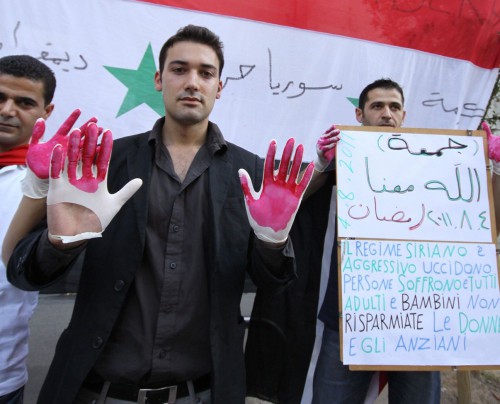
Ramadan has a social meaning, as well as the religious one, so much so that it is felt even among persons who are generally less observant, because it expresses that sense of sacrifice, surrender, purification and rebirth that gives one hope. It is a light that shines at the end of the tunnel… even when the tunnel is long and it takes months and months to get to the other side of it. Just like the tunnel from which we see emerging, with great human sacrifices and an unmatchable commitment, the Syrian people, who find themselves welcoming Ramadan, for the second consecutive year, under the bombardment of the regime. The picture above refers to last year: Sawret al karamah, the “Revolt of Dignity”, had been started at that time already for four months by a group of young protesters, who wrote in candles: “Welcome Ramadan, Get out Bashar”. Perhaps no one could have predicted such a lengthy repression, which has already exceeded sixteen months, causing more than 19 thousand victims, among them, at least 1,400 children. The most recent veto of China and Russia has left the Syrian people feeling indifferent, who by now know that the International Community will not give them any real support, the contrary is true: the halting character of the world only reinforces the murderous folly of the regime, which has made its offensive even more brutal, and one once again we are hearing talk of the use of chemical weapons.

I say “once again” because it has already been months that the doctors of Baba Amr, the long-suffering neighbourhood of the old city of Homs, have denounced the use of white phosphorus, documenting irreversible damage provoked by its use.

Even the “Neighbours”, the Arab nations that are considered as “Sisters”, are enacting a policy of indifference regarding the humanitarian tragedy that is striking the civilians, even going so far as rejecting the entrance of refugees, pushing them back and treating them inhumanely, as the humanitarian associations have been stating.

It is such a sad Ramadan, the one that is beginning, which only this Thursday, on the first night of the vigil, has been grieving the deaths of over 280 persons killed, slaughtered in various locations in the suburbs of Damascus and in the Homs Province. Many Syrians who live abroad, even here in Italy, were used to spending Ramadan with their loved ones, returning to Syria or perhaps inviting their parents or grandparents to come here. Today the repression prohibits Syrians from living that very “normality”, forcing them into atrocious suffering, wounded by the loss of relatives, friends and acquaintances, for the destruction of homes, entire neighbourhoods and yes… entire cities… and especially for the wounds caused by the indifference of the world. It might sound like a paradox, but giving strength to those Syrians outside the homeland, telling them to not give up, to smile and to trust God with even greater force, as well as to have more belief in themselves, are actually those Syrians who are living under the repression, who yesterday by means of internet found a way to give the world their greetings for Ramadan, expressing the prayer that the Ramadan of 2013-1434 will be a different Ramadan, in which the Syrians will be rebuilding everything that the regime has destroyed, finally finding the longed-for peace and freedom.

original in Italian on My Free Syria

We Want A Free Syria / Vogliamo la Siria Libera. Syrian Italians, Syrians and Italians together in the struggle for freedom. Italo-siriani, siriani ed italiani insieme nella lotta per la libertà.

A group of Syrian Italians, joined by Syrians and by Italian sympathisers for the cause of a Syria free of the dictatorial and brutal rule of the Assad regime has been communicating (and often organising actions) together in a group that meets under “Vogliamo la Siria Libera” (We Want Syria to be Free) and other internet groups. Mirco Tau asked a simple question to everyone, “Why are you against the regime?” and the answer of some of the members follows (in English and Italian).

Why we are against the regime 

* I am against this regime for the simple fact that after 40 years it has reduced the country to their own family farm where they think they are able to do things any way that suits them, depriving everyone else of their citizenship rights. I am against this regime because it’s been able to take the smiles away from children. -FS

* I am against the regime because any regime that uses violence against dissent is a sick regime. The dimensions and the tenacity of the dissent is the proof that there is no conspiracy directed by foreign agents or secret powers. It is a revolution of the people for their most basic rights. -MR

* I am against the regime for the simple reason that it is killing children, women, young people and elderly people in a systematic way, with no regard at all for human rights, the internal or international public opinion, as it lies until the bitter end, accusing the entire world of making a coalition against it with the lie of a conspiracy… It is a regime that for over 40 years has considered Syria and the Syrians as private property to manage in a personal way, subjugating civil living to the fear and terror of the secret services that control everything in the country, even personal relationships such as marriage! It is a regime that took power with blood and for 40 years has hidden behind false elections where systematically there was a 99.9% victory of false consent. A regime that has managed to weave ambiguous relationships with the rest of the Arab world and beyond… blackmailing its allies as it wishes and managing its dirty business without anyone being able to raise their voice against it… such a Nazi-Fascist regime of the sort should not exist in this day and age!  -MGN

* In addition to the violence, rape, repression, corruption, deaths… I am against the regime because a mother has been deprived of her own son for over 35 years, because he was exiled in Italy without permission to return to his homeland, for the sole reason that it is supposed that he is against the regime, a supposition that has broken up a family, caused litres of tears to run from the eyes of my grandmother and made my father live alone, alone without his parents, brothers and sisters, relatives and friends from his childhood. Alone with no one to give him comfort or help when he was in need, because only your family truly understands you and helps you in the darkest moments. Now I listen to my father (a severe and upright man) speak on the phone with a broken and trembling voice to his mother of 95, who now no longer hears or recognises anyone, repeating in the sweetest way, “mamma, do you remember me? I am your son. O mamma, forgive me and be proud of me, mamma, don’t cry and you will see that one day we will see one another again.” And she cries saying, “in paradise, my son. We’ll see each other in paradise if God so wills it.” This breaks my heart, to hear those words, but as long as I live, I will fight against this regime. -GZ

ان تطلق النار على مسلح فهذا مبرر. ان تطلق النار على مدني، فهذه جريمة. أما أن تطلق النار على المستشفيات * فهذه نازية وفاشية

Faisal Kassem wrote: I could accept the fact that you shoot at an armed revolutionary, but to shoot at a civilian is a crime and to bomb hospitals is nothing but Nazism and Fascism. -MT

* The Syrian regime has been compared to a mafia regime, but I think it is light years away from that, the mafia avoids killing women and children while the Syrian regime uses such atrocities to bring fear to the men. THERE IS NOTHING MORE DESPICABLE THAN THIS! Not even in the history books have I ever read about a regime that is comparable to the Syrian one. -IS

* I am against the regime because I am tired of hearing promises and speeches by the corrupt authorities, while they are shamelessly talking about fighting corruption. I am against the regime because I don’t want any Syrian citizen to spend his life in prison, to die from torture or to leave prison in a state of madness only because he has expressed his opinion. I am against the regime because I don’t want to see children scrounging through trash dumpsters only to find the remains of our meals, surrounded by the atrocious odour of a country where wealth is robbed every day by those who should be governing. I am against the regime because I don’t want the dream of young Syrians become exile and not travel. How sad it makes me to read in the local papers about their success in the lands of their diaspora, with the indication (of Syrian origins) only because their country gives them no possibility of expressing their talents. I am against the regime because I don’t want the young people of my nation to spend their lives studying and then leaving their degree in a drawer to go in search of a job (labourer, builder, taxi driver), while as time goes by they forget all that they have learned. I am against the regime because I want to see the plates on the scales of justice be in balance, I want to see the sick enter in the hospitals, not in slaughterhouses, because I want to see a profound reform of the system of instruction, police, the military and all the national institutions. I am against the regime because it taught us its slogans since we were children and they remained only slogans. I am against the regime because I don’t know who represents the people; I have recently discovered that one of the men in power is Mansour and I discovered it only because those who accompany him violently attacked a child, ruining his face only for a verbal discussion the child had with is youngest son. I am against the regime because it gets its help from evil persons only to protect its interests. I am against the regime because it invokes democracy, but it sets its militia against every individual who is asking for freedom. I am against the regime because I am tired of recognising the individual errors that have caused thousands of martyrs. I am against the regime because it says it fights against armed gangs and its death squads (Shabbiha) bring arms and use them brazenly against the protesters. I am against the regime because it invokes reforms and at the same time raises the rank of its corrupt affiliates and protects those who are responsible for the massacre of so many innocents. I am against the regime because it talks about conspiracies against it, as if it were doing its duty towards its people. Lastly, I am against the regime, I am against the opposition, I am against every drop of blood that a Syrian citizen shed, whatever his opinion may be. I am with the free Syrian people. -HD

* I am against the regime because its folly is not killing only the Syrian people, but it is trampling over the rights of all of humanity, and it has no pity, no mercy for anyone… There is a document that is essential as an ideal for all people to aspire to from every nation: the Universal Declaration of Human Rights. In the preamble it is written: “Whereas recognition of the inherent dignity and of the equal and inalienable rights of all members of the human family is the foundation of freedom, justice and peace in the world,

Whereas disregard and contempt for human rights have resulted in barbarous acts which have outraged the conscience of mankind, and the advent of a world in which human beings shall enjoy freedom of speech and belief and freedom from fear and want has been proclaimed as the highest aspiration of the common people,

Whereas it is essential, if man is not to be compelled to have recourse, as a last resort, to rebellion against tyranny and oppression, that human rights should be protected by the rule of law,

Whereas it is essential to promote the development of friendly relations between nations,

Whereas the peoples of the United Nations have in the Charter reaffirmed their faith in fundamental human rights, in the dignity and worth of the human person and in the equal rights of men and women and have determined to promote social progress and better standards of life in larger freedom,

Whereas Member States have pledged themselves to achieve, in co-operation with the United Nations, the promotion of universal respect for and observance of human rights and fundamental freedoms,

Whereas a common understanding of these rights and freedoms is of the greatest importance for the full realization of this pledge… for this reason I believe that the Syrian people are struggling not only for themselves but for the whole of humanity. May Allah grant them victory. – JL

* I am against the regime because I am a TRUE ANTI-FASCIST and this regime is a NAZI regime.- PP

* I am against the regime, but I have used all the words I have to express the rage I feel for the atrocities it is committing, and I am finished with all the words to express the offence regarding a world (other regimes) that in part are looking silently at the massacre, and in part is unrepentant and unpunished while they feed the bloody regime. The words are ending, but there is still Faith, and it is Faith alone that sustains me against this regime outside every “human” logic. InshAllah the change is coming soon. -TI

* I principally am against the violence and it is clear that I also must say that to make the hostilities in Syria end, a No Fly Zone is needed. Don’t call me a warmonger because I still believe that diplomacy has to be used if there are intermediaries who are able to bring that ahead and who can at the same time assure that in the meantime, all violence ceases. -AC

* Before the March 2011 revolution.

I am an Italian journalist and I have always been against the Assad regime. I have always been against the regime because every regime wants to have total control of persons and I am a free woman, I would never renounce my independence and dignity.

I have always been against the regime because it incarnates the opposite of all the values in which I believe.

I have always been against the regime because human life is sacred, and the Assad’s for 40 years, have killed women, children, the young and the old.

I have always been against the regime because the regime whoever brings its armoured tanks into the cities and shells unarmed civilians is nothing but a criminal.

I have always been against the regime because the practice of censorship negates the freedom of the word, of thought, of opinion.

After the Revolt for Dignity

I am against the regime because it is true that I am Italian, but my blood is Syrian.

I am against the regime because I have never seen my land of origin and for thirty years, could not even talk about it.

I am against the regime because I saw the Syrian border from afar, but I could not go near it.

I am against the regime because that day I felt alone in the world, without roots, without a place to call home.

I am against the regime because it robbed me of my identity.

I am against the regime because it impeded me from living a great love story, the love of one’s homeland…

I am against the regime because every time that a new martyr falls a part of me dies.

I am against the regime because for every child that cries or who shakes in fear, my heart breaks.

I am against the regime because I never have forgotten the massacre of Hama and I will never forget the massacres of Homs.

I am against the regime because I am Syrian. I am a free Syrian and I would die to defend my country. -AD

* I am against the regime because I am the son of a dissenter, brother of a martyr, cousin of two martyrs, I am a dissenter until victory. -MT

* I am against the regime because I am against every form of dictatorship, especially if it is a dictatorship tolerated by powers that take advantage of it when they could make it go down in a week. I am against the regime because I believe in the human rights that you can recognise on the streets, not in the conventions and treaties signed during gala dinners and aperitifs by people who give to themselves from these achievements, which are often completely unknown by the true subjects. I am against the regime because one cannot allow that innocents live a life of terror or that they don’t live at all only because fate made them be born in that place. I am against (all) the dictatorial regimes because there are people who continue to negate the evidence with empty rhetoric and propaganda and because there are other superficial and a-critical people who continue, incredibly, to believe them.  -MMB

perché siamo contro il regime

* Sono contro questo regime per il semplice fatto che dopo 40 anni ha ridotto il paese ad una loro fattoria familiare dove credono di potere fare e disfare come vogliono loro privando tutti dei loro diritti di cittadinanza. Sono contro questo regime perchè è riuscito a togliere il sorriso dal volto dei bimbi. -FS

* Sono contro il regime perché qualsiasi regime che utilizza la violenza contro il dissenso è un regime malato. Le dimensioni e la tenacia del dissenso è la prova che non è un complotto da registi stranieri o poteri forti. E’ un rivoluzione del popolo per i loro più basilari diritti -MR

* Sono contro il regime per il semplice motivo che sta uccidendo bambini,donne ,giovani ed anziani in modo sistematico fregandosene dei diritti umani,dell’opinione pubblica interna ed internazionale ,mentendo fino alla fine accusando l’intero mondo di coalizzarsi contro di lui con la menzogna del complotto……un regime che da più di 40 anni considera la Siria e i siriani una sua proprietà da gestire come meglio crede soggiogando la vita civile alla paura e al terrore dei servizi segreti che nel paese controllano tutto anche i rapporti personali come il matrimonio! Un regime che ha preso il potere con il sangue e che per 40 anni si è nascosto dietro a delle false elezioni dove vinceva sistematicamente con il 99.9 % di falsi consensi, un regime che è riuscito a tessere dei rapporti ambigui con il resto del mondo arabo e non …..ricattando i suoi alleati a suo piacimento e gestendo i suoi loschi affari senza che nessuno abbia mai alzato la voce…………un regime del genere nazi-fascista,oggi non deve esistere più! –MGN

* Oltre per le violenze, stupri, repressione,corruzione, morti,… io sono contro il regime perchè una madre è stata privata di suo figlio per oltre 35 anni, pechè esiliato in Italia senza il permesso di tornare nella sua terra natia, per il solo fatto che si suppone che sia contro il regime, una supposizione che ha spezzato una famiglia, fatto versare litri di lacrime a mia nonna e fatto vivere mio padre solo, solo senza genitori, fratelli, parenti e gli amici dell’infanzia, solo senza qualcuno che potesse dargli conforto e aiuto quando ne aveva bisogno, perchè solo la tua famiglia ti capisce veramente e aiuta nei momenti più difficili. Ora sento mio padre (uomo fermo e severo) parlare a telefono con voce spezzata e tremolante con sua madre di 95 anni, che ormai non sente e riconosce più nessuno, che le ripete in modo dolce «mamma mi riconosci? sono tuo figlio, o mamma perdonami e sii orgogliosa di me, mamma non piangere vedrai che ci rivedremo» e lei piangendo gli dice «nel paradiso figliolo, nel paradiso ci rivedermo se Dio vuole» mi si spezza il cuore sentire quelle parole ma io finche vivrò lotterò contro questo regime. -GZ

ان تطلق النار على مسلح فهذا مبرر. ان تطلق النار على مدني، فهذه جريمة. أما أن تطلق النار على المستشفيات * فهذه نازية وفاشية

faisal kassem ha scritto: potrei accettare il fatto che tu spari a un rivoluzionario armato ,ma sparare a un civile e un crimine e bombardare gli ospedali non e altro che nazismo e fascismo -MT

* Si era paragonato il regima siriano ad una regime mafioso,ma invece e’ lontano anni luce ,la mafia evita di uccidere bambini e le donne mentre il regime siriano usa tale atrocita’ per spaventare gli uomini PIU’ INFAMI DI COSI’ NON ESISTE !neanche nei libri di storia non ho mai letto di un regime paragonabile a quello siriano… -IS

* Prima della rivolta

Sono contro il regime perché mi sono stancato di ascoltare promesse e discorsi da parte delle autorità corrotte, mentre parlano spudoratamente di lotta alla corruzione. Sono contro il regime perché non voglio che nessun cittadino siriano passi la vita in prigione, muoia a causa della tortura o esca di prigione ormai senza senno solo perché ha espresso una sua opinione. Sono contro il regime perché non voglio vedere bambini rovistare nei cassonetti e mangiare gli avanzi dei nostri pasti circondati da un odore atroce in un Paese dove la ricchezza viene ogni giorno rubata da chi dovrebbe governare. Sono contro il regime perché non voglio che il sogno dei giovani siriani diventi l’emigrazione e non il viaggio. Così come mi rattrista leggere sui giornali locali dei loro successi nelle terre della diaspora, con l’indicazione (siriano d’origine) solo perché nel loro Paese non trovano possibilità di esprimere le proprie capacità. Sono contro il regime perché non voglio che i giovani della mia Nazione passino la vita a studiare per poi lasciare la laurea in un cassetto e andare in giro a cercare un lavoro (operaio, muratore, tassista), mentre l’avanzare del tempo fa dimenticare loro ciò che hanno imparato. Sono contro il regime perché voglio vedere le braccia della bilancia della giustizia equipararsi, voglio vedere i malati entrare in ospedale, non in macelli, perché voglio vedere una riforma profonda del sistema d’istruzione, di polizia, dell’esercito e di tutte le istituzioni nazionali. Sono contro il regime perché il regime ci ha insegnato i suoi slogan da quando eravamo piccoli e sono rimasti solo slogan. Sono contro il regime perché non so chi rappresenta il popolo; ho scoperto di recente che uno degli uomini al potere è Mansour e l’ho scoperto solo perché i suoi accompagnatori hanno deturpato il viso di un bambino per un diverbio a scuola con il minore dei suoi figli.

Dopo la rivolta

Sono contro il regime perché si fa aiutare da persone infami per tutelare i suoi interessi.

Sono contro il regime perché invoca la democrazia, ma scatena il suo esercito contro ogni individuo che chiede libertà. Sono contro il regime perché mi sono stancato di riconoscere gli errori individuali che hanno causato migliaia di martiri. Sono contro il regime perché dice di lottare contro bande armate e i suoi squadroni della morte (shabbiha) portano e usano spudoratamente le armi contro i manifestanti. Sono contro il regime perché invoca riforme e allo stesso tempo eleva di grado i suoi affiliati corrotti e protegge i responsabili del massacro di tanti innocenti. Sono contro il regime perché parla di complotto ai suoi danni, come se intanto stesse facendo il suo dovere nei confronti del suo popolo.

Infine

Sono contro il regime

Sono contro l’opposizione

Sono contro ogni goccia di sangue che versa un cittadino siriano, qualunque sia la sua opinione

Sono con popolo siriano libero. -HD

* Sono contro il regime perchè la sua follia non uccide soltanto il popolo siriano ma calpesta i diritti dell’ intera umanità, e non si pente di nulla, non ha pietà per nessuno…… C’ è un documento che è essenziale come ideale da raggiungere da tutti i popoli e da tutte le Nazioni: La Dichiarazione Universale dei Diritti dell’Uomo. Nel preambolo c’è scritto: ” Considerato che il riconoscimento della dignità inerente a tutti i membri della famiglia umana e dei loro diritti, uguali ed inalienabili, costituisce il fondamento della libertà, della giustizia e della pace nel mondo;

Considerato che il disconoscimento e il disprezzo dei diritti dell’uomo hanno portato ad atti di barbarie che offendono la coscienza dell’umanità, e che l’avvento di un mondo in cui gli esseri umani godono della libertà di parola e di credo e della libertà dal timore e dal bisogno è stato proclamato come la più alta aspirazione dell’uomo;

Considerato che è indispensabile che i diritti dell’uomo siano protetti da norme giuridiche, se si vuole evitare che l’uomo sia costretto a ricorrere, come ultima istanza, alla ribellione contro la tirannia e l’oppressione;

Considerato che è indispensabile promuovere lo sviluppo dei rapporti amichevoli tra le Nazioni;

Considerato che i popoli delle Nazioni Unite hanno riaffermato nello Statuto la loro fede nei diritti fondamentali dell’uomo, nella dignità e nel valore della persona umana, nell’eguaglianza dei diritti dell’uomo e della donna, ed hanno deciso di promuovere il progresso sociale e un migliore tenore di vita in una maggiore libertà;

Considerato che gli Stati membri si sono impegnati a perseguire, in cooperazione con le Nazioni Unite, il rispetto e l’osservanza universale dei diritti dell’uomo e delle libertà fondamentali;

Considerato che una concezione comune di questi diritti e di queste libertà è della massima importanza per la piena realizzazione di questi impegni ……. Per questo credo che il popolo siriano stia lottando non solo per sè stesso ma per l’ intera umanità. Che Allah gli dia la vittoria.  -JL

* Sono contro il regime perchè sono un ANTIFASCISTA VERO e questo regime è NAZISTA.. -PP

* Io sono contro il regime , ma ho esaurito financo le parole per esprimere la rabbia per le atrocità che questi commette , e sto esaurendo pure le parole per esprimere lo sdegno di un mondo (altri regimi) che in parte guarda silente il massacro , e in altra parte impenitente e impunito foraggia il regime sanguinario. Le parole si stanno esaurendo , ma c’è la Fede ; ed è la Fede che mi sostiene contro questo regime fuori da ogni logica “umana”. InshAllah il cambiamento è prossimo. -TI

* Io principalmente sono contro la violenza sia chiaro pero’ devo dire che per far cessare le ostilità in Siria sarebbe necessaria una no fly zone, non datemi del guerrafondaio he pero’ credo che la diplomazia si possa usare se ci sono intermediari che riescano a portarla avanti e che si assicurino che nel frattempo cessioni le violenze. -AC

* Prima della rivolta del marzo 2011

Sono una giornalista italiana e sono contro sempre stata il regime degli Assad.
Sono sempre stata contro il regime perché ogni regime vuole avere il controllo totale delle persone e io sono una donna libera, che mai rinuncerebbe alla sua indipendenza e dignità.
Sono sempre stata contro il regime perché incarna l’opposto di tutti i valori in cui credo.
Sono sempre stata contro il regime perché la vita umana è sacra e gli assad, da 40 anni, uccidono donne, bambini, giovani, anziani.
Sono sempre stata contro il regime perché chi schiera i carro armati nelle città e spara sui civili disarmati non è che un criminale.
Sono sempre stata contro il regime perché pratica la censura e nega la libertà di parola, di espressione, di opinione.

Dopo la Rivolta della dignità

Sono contro il regime perché è vero che sono italiana, ma il mio sangue è siriano.
Sono contro il regime perché non ho mai visto la mia terra d’origine e per trent’anni non ne ho mai potuto parlare.
Sono contro il regime perché un giorno ho visto da lontano il confine siriano ma non mi sono potuta avvinare.
Sono contro il regime perché quel giorno mi sono sentita sola al mondo, senza radici, senza una casa.
Sono contro il regime perché, mi ha privato della mia identità.
Sono contro il regime perché mi ha impedito di vivere un amore grande, l’amor di patria…
Sono contro il regime perché ogni volta che cade un nuovo martire muore una parte di me.
Sono contro il regime perché per ogni bambino che piange o che trema dalla paura mi si stringe il cuore.
Sono contro il regime perché non ho mai dimenticato il massacro di Hama e mai dimenticherò il massacri di Homs.
Sono contro il regime perché sono siriana, sono una siriana libera e morirei per difendere la mia patria -AD

* sono contro il regime perché:sono figlio di un oppositore,fratello,di un martire,cugino di due martiri,sono un oppositore fino alla vittoria -MT

* Sono contro il regime perché sono contro ogni forma di dittatura,peggio se si tratta di dittature tollerate da poteri che le sfruttano quando potrebbero metterci una settimana per rovesciarle. Sono contro il regime perché credo nei diritti umani che vanno riconosciuti per le strade,non nelle convenzioni e nei trattati firmati tra convenevoli e aperitivi da gente che si bea di testi di cui i veri destinatari spesso non saranno mai neanche a conoscenza. Sono contro il regime perché non si può ammettere che innocenti vivano una vita di terrore o addirittura non vivano solo perché la sorte li ha fatti nascere in quel posto. Sono contro (tutti) i regimi dittatoriali perché c’è gente che continua a negare l’evidenza con propagande vuote e retoriche e perché c’è altra gente acritica e superficiale che continua incredibilmente a crederci. -MMB

by Julie McLaughlin

WRITTEN BY SAAD KIWAN in Beirut, translated by Mary Rizzo

The Syrians have been living for over forty years under a dictatorship of a single part and of the absolute power of a military figure, Hafez Assad, who in 1971 organised a coup d’état, against his comrades of the “Baath” political party (national-social-chauvinist) already in power since 1963 following the first coup d’ètat by the same Baath officers, overthrowing the last civil government of coalition in Syria. Assad the father had governed for the first half of his reign arm in arm with his brother Refa’at (himself a soldier, exiled then in ’84 for having tried to overthrow Hafez), arresting the “Baathist” (civil) troika in power: the leader of the party, the president of the republic and the Prime Minister, all of them having died in prison. Assad has governed practically alone, putting in act the “perfect regime” of a police state, basing it on services, eliminating political life, outlawing parties (from the Communists to the Nasserians, from the Socialists to the Liberals and even the Baathists) and eliminating the Parliament, substituting the elections with plebiscites for the sole candidate-leader. For 30 years (1971-2000) he filled the Syrian prisons with persons who opposed him, militants and activists for thought crimes, practicing every kind of torture and brutality, with the disappearance of hundreds of prisoners, Syrians and Arabs. The Syrian dictator put a gag order on the stamp and the means of information, he forbid any type of labour association or activity of a cultural or social nature. With the famous Article 8 of the Constitution that sentences: “Baath is the party that leads the state and the society”!

The first horrible crime that the Baathist dictator carried out was the aerial bombing of the city of Hama in 1982, with the massacre of over 20 thousand people, in order to silence the Muslim Brotherhood. A massacre that had passed in complete silence in the West, but also in the East, for the absolute lack of “witnesses”, that is, of the traditional means of information of the time. Also because Assad was considered as a “secular” (but an Alawite) who opposed the fanatical and reactionary Muslims, it was of little matter that he massacred entire families. And it didn’t change things that the Syrian president, after that “secular” massacre introduces in the constitution that “Islam is the religion of the Syrian president”, which has been repeated in these days by his son Bashar (a secular as well!) with his “new constitution”, going so far as to add to that article that Islam is “the principle source of legislation”.

In 1976 Hafez Assad also sent his troops (30 thousand soldiers) in Lebanon “to bring peace” between the Lebanese, with the benediction of the United States and Israel. Result? Assad’s soldiers remained 30 years in Lebanon, bringing with them the occupation militia, destroying the state and its institutions, inventing a servile political class that did not respect any rule or civil or ethical code of conduct. Moreover, the men of the Assad apparatus and its officials sacked the economic-commercial wealth of the country. The sacking was part of the “divide and conquer” strategy, pitting forces and parties against one another, and doing the same thing for communities.

Regarding Palestine, the former Syrian dictator called himself “defender of the cause of the Palestinian Arab People” using every means possible and imaginable to tame the PLO and its policies, and to put the Palestinian leader Yasser Arafat under the tutelage of the Syrian regime. For Assad, Lebanon and Palestine were “cards” to play and use in any way he wished. He did such things in the regional sphere to heat up the situation and raise the “price” of his dealings with Americans or Israelis, since the start of the 1970s. Successively, Iraq became another “card” that his heir Bashar used to deal with the USA, or to blackmail them, sending “volunteers” of fundamentalist and “Jihadist” groups there to carry out acts or terrorism or to give refuge to elements of Al-Qaeda.

In the third decade of his reign (1990-2000), Hafez Assad started to prepare his oldest son Bassel for his inheritance, passing from a despotic regime to a despotic-nepotistic regime. In 1994, the heir however died in a “road accident” that was later attributed to internal feuds within the Assad family itself. So, placed on the throne of leadership was the young ophthalmologist, “elected” with a plebiscite in 2000 upon the death of his father. There were many in Syria and in the Arab world who had hoped that the young president would be at the head of a new season of reform of the regime. The so-called “Damascus Spring” – which lasted a little over a year – turned out to be just a front. The son revealed himself to be even more merciless than the father. The campaign of arrests and ironclad repression by the regime, already since 2002, surprised everyone at some level. The prisons were filled with human rights activists and activists for freedom of speech, and they were left to rot in prison for years, without any trials.

Their doyen, the lawyer Haytham al-Maleh, today a leading figure in the opposition, was released at the start of the revolt, in March 2011, having celebrated his 80th birthday in prison, arrested several times, and never once put on trial. Among the regime prisons, the one of Mazze, in the capital city Damascus, stands out. Here Palestinian and Lebanese prisoners are detained and tortured, and they are then made to “disappear” (Lebanon still awaits to know the destiny of hundreds of Lebanese abducted by the Syrian troops in Lebanon), and that of Saidnaya, reserved for anyone opposing the regime and Syrian activists, where one of the massacres committed against the prisoners was carried out even by Maher, Bashar’s brother.

Intellectuals, writers and artists have been almost all exiled in Europe and in some Arab countries. We can’t even speak of journalists, because there are no independent or private newspapers and agencies in Syria, only the papers of the regime where the photo of the president-dictator dominates the layout. It is no different with the State TV, which opens the news with the sayings of the president-dictator. A high school student of 19 years, Tol al-Mallouhi was arrested in 2010 and sentenced to 5 years in prison for having expressed his thoughts in his blog regarding the Palestinian cause. The accusation? “Conspiracy against the regime” and “contacts with the American enemy”!

Today, Syria is governed by no less than 17 secret services agencies, under the command of the close circle of the Assad family: Bashar, his brother Maher, his mother and his brother-in-law. Then there are the Makhloufche cousins who hold the purse strings. In this “reign of terror”, the revolt erupted, which rapidly had transformed itself into a mass general uprising.

Thus was born the opposition with “three heads” inside and outside Syria: the Local Coordination Committees, the Coordination for Democratic Change and the Syrian National Council.

1 – The Local Committees are the true leaders of the revolts, rapidly organised throughout the entire territory by young volunteers who do not belong to any party; they are those of the new generation, born under the reign of the Assads and they have only known the workings and the practices of the Baath regime, but they also know the entire repertoire of the new technologies, despite the attempts of the regime to delay their access to them also by controlling their dissemination in the country, or lack thereof. These Committees are born and organised by means of Internet (Facebook, Twitter and YouTube), and they organise the protests throughout the country. In this way the revolt extended in the early months very rapidly, being able to escape from every attempt to control them or from direct intervention by the Special Forces of Bashar. But the most important and meaningful aspect is that all the young activists of the committees that lead the revolt operate clandestinely.  Those who go public are the spokespersons of the committees, who keep contact with the mass media, in that at the start of the revolt they found refuge in Beirut, Istanbul and then Cairo for logistic reasons and for coordination between the committees and the world outside Syria. And for greater safety, the committees have also created “shadow-committees”, which will substitute the “legitimate” ones in case these are discovered or arrested.

2 – The Coordination for Democratic Change. The outbreak of the revolt had practically taken also the old generation of militant politicians, writers and artists by surprise, included with them writers and artists, communists and nationalists, who already from the early 1970s fought against the Baath regime. Most of these had thus created the “Coordination for Democratic Change”, with its spokesman being Hassan Abdel-Azim, and it gathers together also parts of old political formations from ex-communists and ex-national socialists and Nasserians, as well as independent personalities such as Michel Kilo and Fayez Sara. The Coordination is a group that was born substantially within Syria, but it obviously has some of its figures abroad. It calls for the overthrow of the regime, but it also opposes any foreign intervention, the regime has winked at it, trying to get it involved in a fake dialogue that it from time to time invents, an in which some of the personalities of the Coordination have participated. The other day they refused to participate in the “meeting of the Friends of Syria” held in Tunisia to protest against the attempt to declare the National Council as the sole legitimate representative of the Syrian people.

3 – The National Council, led today by the professor of the Sorbonne Burhan Ghouliun, was instead formed abroad, in Istanbul, and it includes the majority of the foreign and internal opposition, having some renowned members such as the eighty-year-old lawyer Haytham Al-Maleh, politicians and intellectuals. The many young people who are part of the National Council in the role of representatives of the local committees guarantee the connection within Syria and make the Council the most popular among the populations of the cities in revolt. The Council also is comprised of a large number from the “Muslim Brotherhood”, backed by Erdogan’s Turkey. And it also enjoys the support of the vast majority of the Arab nations, from France and from quite a few Europeans. They insist upon “a humanitarian intervention to protect civilians” who are not victims of Bashar’s war machine which is killing them on an average of 100 persons per day.

4 – Then, there is the Free Syrian Army, formed by soldiers who had deserted the regime’s army and that despite the scarcity of arms it has available, it has been able to stand up to Bashar’s brigades, freeing some cities and guaranteeing protection to the population. And it seems that all the parts of the opposition are in agreement to support it and to consider it as the armed faction of the opposition.

The Local Committees are the true militants who move on the terrain among the people, and they are thus the structure that supports the uprising. They are for this reason not inclined to compromises, and thus they seem to guarantee solidity and continuity of the uprising despite the attempts of the regime to suffocate it and despite the failure of the Arab League to impose that the “little dictator” leaves or at least forcing him to step down. It is however obvious that with the passing of time and with the escalation of ferocity of the Assad gangs against a population that continues to peacefully protest, the danger of a militarisation of the revolt becomes greater. But it is the regime itself that pushes in the direction of a civil war that would justify a civil war and its war of extermination. It is also true that the most radical wing and those most willing to have a military response could predominate. Yet, it is likewise true that the population has reached almost a year of pacific revolts, and it is legitimate to then ask why they should be expected to resist and die? And for what reason or ideal should they have to expose themselves to the bombardments of cannons of the armoured tanks and aviation of Bashar’s regime, allowing men, when, the elderly and even children (as many as 500) to be killed?? (translator’s note: these statistics have now been overcome; children comprise around 850 of the victims to this date).

Lastly, two strong considerations: I believe that the primary and fundamental objective is that of dismantling a regime that is so totalitarian and repressive, merciless, cynical and inhuman, and to put Bashar and his close circle on trial. And regarding this point, there is no excuse in the world or justification. The “clean” and “pure” revolutionary ideals that know how to predict everything do not exist and they never have existed. But whoever it is that leads Syria after Assad could never be worse than him, his father and the Baath regime, which in addition to the Assad’s contributed to the museum of horrors also the Saddam Hussein regime in Iraq.

One cannot therefore expect that an almost clandestine opposition that has been repressed for over 40 years, which has never been able to operate in a climate of freedom, to be democratic and guarantee rights, or to not be subject to foreign pressure or influence. Yet, an opposition so diverse and politically varied is in itself a guarantee of pluralism and at the very least, is the harbinger of a future with a political life that is open to new experiences.

Original http://giulianasgrena.globalist.it/Detail_News_Display?ID=8311

Shady Hamadi and other Italian Syrians protest against the Assad Regime

WRITTEN BY Monica Ricci Sargentini, translated by Mary Rizzo

In the days in which the city of Homs is under massive shelling by the Assad Regime and there has been a call for the evacuation of Americans from Syria, the writer and activist Shady Hamadi, born in Milan in 1988 from an Italian mother and Syrian father, writes an appeal to the Italian and International Community so that they forcefully condemn the massacre of unarmed people that is happening in his country of origin. His appeal seems to me to be a cry of anguish which we should not ignore. Shady Hamadi (photo) is a son of a leader of the Arab Nationalist Party in the region of Homs who underwent the torture of electrical cattle prods in the regime’s cells and at the end of the 1960s, was able to flee to Italy. A student of Political Sciences, Shady has already exposed himself on many occasions. He has given interviews on TV and web networks (“We can break the wall of fear”), and he is among the members of a Facebook community “Comunità siriana in Italia”. He is in contact with opposition figures in Paris and last year his book Voci di anime was published. It is a spiritual voyage in the search of one’s identity that is divided between two cultures. In the letter that we publish below, he invites us to “not remain in silence” and to set upon the task of “raising awareness” to inform others of the reality of the situation.

“My request of you all,” says Hamadi, “is that of putting a black ribbon around your bags, cases, backpacks, coats, wherever you can. This simple act will allow us, the Syrians who pass by you in public places, to recognise those who have chosen to not abandon the Syrian people, because they believe in the values of freedom and respect for human life.”

A simple act that, for the Syrians, means “solidarity”.

Here is the full letter:  

“I hope that my words will be a shout that comes from the whole of Syria and a kind request to all of you.

For eleven months, the land that has been the cradle of civilisation, is experiencing one of the darkest moments of its history that spans the millennia. Syria is bleeding. There is not a single city that has been able to spare itself from burying the young and old, women and children.

This revolution – different from others by the means and macabre repression it is using – is costing the city of Homs the highest price in human lives.

Hart Safsafi, Bab Sba, Bab Amr, are only some of the neighbourhoods of this audacious city, which have continued to pay a constant price in human lives. In these streets, my family has its origins and its memories, while today, those who live there, are facing a daily challenge against death.

Only in the last week more than 500 persons have lost their lives, due to the constant shelling that is striking their homes. This massacre of human beings must no longer be tolerated by the whole of humanity. There are no excuses, nor can there be any excuses for these actions carried out by the militia of the Syrian regime, with the goal of bending the city of Homs, given its strenuous and indomitable resistance. The people of Syria – Alawites, Sunnis, Shi’as, Christians, the entire enormous puzzle of ethnic and religious groups – has chosen to no longer accept the silence, striving for the breath of freedom that is common to human nature.

The task entrusted to the Syrians abroad and to any person at all, disregarding any differences in faith, nationality, ethnicity, is that of witnessing and being aware of what is happening in Syria.  No one should be silent or observe with indifference the continuation of this drama.

I invite all of you to begin a campaign to raise awareness, with the aim of informing others of what is going on in this nation that is suffering. Talk with your neighbours, your friends, write, protest and learn – from the Syrian tragedy – to love your neighbour, to not forget about his needs.

My request of you all is that of putting a black ribbon around your bags, cases, backpacks, coats, wherever you can. This simple act will allow us, the Syrians who pass by you in public places, to recognise those who have chosen to not abandon the Syrian people, because they believe in the values of freedom and respect for human life.”
Shady Hamadi

Original: http://lepersoneeladignita.corriere.it/2012/02/07/lappello-dello-scrittore-hamadi-un-fiocco-nero-per-salvare-la-siria/

EN FRANCAIS – Traduit par Wassyla Hayat

* Fr. L’écrivain et militant Shady Hamadi, né à Milan en 19…88 d’une mère italienne et d’un père syrien, lance un appel à la communauté italienne et internationale afin que soit énergiquement condamné  le massacre de gens désarmés dans son pays d’origine. Il est le fils d’un chef de file du parti nationaliste arabe de la région de Homs qui a subi la torture des aiguillons électriques pour bovins dans les cellules du régime et à la fin des années 1960, et a réussi à s’enfuir en Italie. Etudiant en Sciences Politiques, Shady a déjà pris position à de nombreuses reprises.

Voici son appel. “J’espère que mes paroles seront un cri qui s’élèvera de la Syrie toute entière et une demande à vous tous. Depuis onze mois, la terre qui a été le berceau de la civilisation, connaît l’un des moments les plus sombres de son histoire qui s’étend sur des millénaires. La Syrie saigne. Pas une seule ville n’a été exempte d’enterrements de jeunes et d’anciens, de femmes et d’enfants. Cette révolution – différente des autres par les moyens et la macabre répression macabre mis en œuvre – coûte à la ville de Homs le prix le plus élevé en vies humaines.

Hart Safsafi, Bab Sba, Bab Amr, ce ne sont que quelques-uns des quartiers de cette ville audacieuse, qui ont continué à payer un prix constant en vies humaines. Dans ces rues, ma famille a ses origines et ses souvenirs, alors qu’aujourd’hui ceux qui y vivent, sont confrontés à un défi quotidien contre la mort.

La semaine dernière seulement plus de 500 personnes ont perdu la vie, en raison du bombardement constant qui  s’abat sur leurs maisons. Ce massacre d’êtres humains ne doit plus être toléré par l’ensemble de l’humanité. Il n’y a pas d’excuses, il ne peut y avoir aucune excuse pour ces actions menées par la milice du régime syrien, dans le but de faire plier la ville de Homs en raison de son énergique et indomptable résistance. Le peuple de Syrie -, sunnites, alaouites chiites,  chrétiens, l’ensemble de l’immense puzzle de groupes ethniques et religieux – a choisi de ne plus accepter le silence, en luttant pour la liberté, aspiration commune à la nature humaine.

La tâche qui incombe aux Syriens vivant à l’étranger et à tous, sans tenir compte des différences de  foi, nationalité, ethnicité, est d’être témoin et conscient de ce qui se passe en Syrie. Personne ne doit se taire ou observer avec indifférence la poursuite de ce drame.

Je vous invite tous à commencer une campagne de sensibilisation, dans le but d’informer de ce qui se passe dans ce pays meurtri. Parlez à vos voisins, vos amis, écrivez, manifestez,  et apprenez – de la tragédie syrienne – à aimer votre voisin, à ne pas oublier ses besoins. Ce que je vous demande, c’est de mettre un ruban noir à vos sacs, mallettes, sacs à dos, manteaux, partout où vous le pouvez. Cet acte simple nous permettra, nous Syriens qui passons parmi vous dans les lieux publics, de reconnaître ceux qui ont choisi de ne pas abandonner le peuple syrien, parce qu’ils croient dans les valeurs de liberté et de respect de la vie humaine.”

Vous pouvez bien sûr rejoindre la page (en anglais pour le moment) “Un ruban noir pour la Syrie, éveiller les consciences” ( le lien figure en haut) et, si vous êtes anglophone, lire l’article https://wewritewhatwelike.com/2012/02/07/an-appeal-by-the-writer-hamadi-a-black-ribbon-for-syria/

grazie Mobin Safi    نحن مواطنون وناشطون سياسيون ومثقفون من منبت علوي وخصوصا من حمص وريف الساحل، ندين بقوة

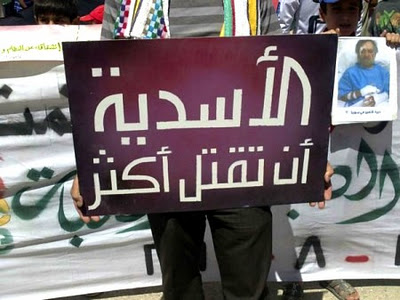
The Assad System: To Kill More

جرائم بشار الأسد وندين بالخصوص القصف الذي تعرضت له مدينتنا الباسلة مدينة حمص الذي راح ضحيته اكثر من ثلاثمئة وخمسون شهيداً، بينهم شبان وأطفال ونساء، كلهم أ…برياء وكلهم سوريون وكلهم مظلومون وندين كل أنواع القتل والإجتياح التي يمارسها …النظام في ريف دمشق وحماه وإدلب وكل مكان من سورية، نحن ومن منطلق حرصنا على وطننا السوري المعذّب ندعو بشدة أهلنا السوريين من كل الطوائف والإثنيات للبقاء صفاً واحداً لتفويت الفتنة التي يحاول النظام الأسدي المجرم زرعها لجرالبلاد إلى حرب أهلية لا يعرف أحد كيف أوأين تنتهي، نحن السوريون العلويون في كل مكان من سورية ننبّه أخواننا إلى أن الجيش الأسدي يستخدم أحياء العلويين في حمص ليمارس إعتداءه على بقية الأحياء محاولاً بهذه الوسيلة إثارة الإقتتال الطائفي، لذلك فنحن نحمّل افراد النظام ا…لأسدي وكل المتعاملين معه من اشخاص وقوى واحزاب في الداخل والخارج مسؤولية ما يجري في البلاد ونحملهم بالأخص مسؤولية أيقاد الفتنة الطائفية التي قد تؤدي إلى تقسيم سورية، كما ندعو كل العسكريين الشرفاء من ضباط وصف ضباط ورجال أمن الإنشقاق عن آلة نظام العصابة القاتلة، هذه الآلة المدمّرة لبنيان الوطن السوري الحبيب، كما ندعوهم الوقوف في وجه هذا النظام اللاوطني في محاولته لزرع الفتنة الطائفية والمناطقية والقومية ومحاولة تقسيم سورية كي يبقى على أشلائها، كما إننا ندين الموقف الروسي اللامسؤول ونحمّل النظام الروسي القاتل مسؤولية كل طفل وامرأة ورجل يقتل برصاصه وأسلحته ونعلن ما يلي : 1- وقوفنا العلني واللا مشروط إلى جانب الثوار في سوريا 2- وقوفنا العلني واللا مشروط ضد العصابات الحاكمة لسوريا وضد من يساندها أو يدعمها مهما اختلفت التسميات والحجج 3- وقوفنا العلني واللا مشروط ضد الذين يراهنون على قتل الشعب فهؤلاء هم أعداء سوريا المستقبل مهما اختلفت انتماءاتهم عاشت سورية حرة واحدة مستقلة من الموقعين: د. تماضر عبدالله د.توفيق دنيا -د.رامي حسين- رشا عمران- نزار حمود كفاح علي ديب- المحامي عُباب رياض خليل- عادل محفوظ -الفنانة لويز عبدالكريم -الفنانة ريم علي- يامن حسين- عبدالكريم علي- فايق المير فراس سعد- عُلا رمضان- ماهر إبراهيم- مرح وسّوف- نينار حسن -علي بدرية- علي عبود- ربا حسن- غياث الجندي- راغدة حسين- ميلاد أمين علي نزير -علي سهير- أسمر خلدون الإبراهيم- محمود سلمان محمود عبدالله أسماء- عمار سوزان- سلوم تميم- أحمد أحمد- م أحمد شعبان وسّوف -سليمان علي- حسام وقّاف- حبيب محمد- نضال سعيد ماهر اسماعيل جميلة بركات- نضال س سلامه -ربى حداد- عادل سعود- عبير محمد نهلة -عباس ماهر اسبر- نور الهدى -عودة علي -سعد بيسان الفقيه- صبا خضور هشام- شوكت احمد -اياد الكردي- سميرة قابقلي عبير سليمان -سلاف صبح -همام حداد- وسيم حسن- علي سعد -علي علي- نوار قاسم

100 Syrian civilian vicitims in 2 days of attacks against them

WRITTEN BY MARY RIZZO

“You may as well be born an animal rather than a Syrian. You would have been given more protection.”

I have been wondering to myself and at times aloud, “What the hell has happened to the empathy and humanity of the activism movement? When did they start deciding whose blood was expendable? Where did their compassion, empathy and sense of justice go?”

There are a few qualities that an activist should have as a mandatory part of their baggage.  Not all of them are required to have a solution to the problems that are afflicting the victims or the weak in the causes that they are advocating. Nor are they even required to dedicate a lot of time or money to the cause. One can be an activist nowadays locally or even if they are disabled and unable to leave their homes, as they can express their views, share information and engage in solidarity by means of internet. The qualities however that should be part of every activists’ tool kit include empathy, a bit of courage and a strong desire for “good” to overpower and defeat “bad”.  And, that this vital and obligatory baggage has become so selective, has got to be the most fatal blow to the activism universe. It makes it reek of hypocrisy and plays directly into the hands of the oppressors.

Empathy is a social and emotional response to the conditions that other sentient beings are in. Since we all can agree that pain and suffering (including being a victim of abuse, starvation, deprivation) are negative things, it is not difficult to feel bad, “as if” what is happening could be happening to us or to the people or animals we love. If we are able to unplug the empathy because we have an ideology that we buy into, accompanied by a kind of strange peer pressure, something has gone wrong very seriously. If we are selective in such a subject as human pain and our acceptance of it, we need a major time out to rethink what we are doing in activism. We should remember that empathy can be a tool towards change, we should put it to use and understand that suffering people (and to some extent animals) are aware of our involvement or our detachment, and they tap into the capacity of (especially) activists, to make the feelings of empathy manifest and bring about an end to the suffering, which is the primary and immediate goal.

By understanding, witnessing and realising the extreme suffering that some are subject to, an activist has the ability to concretely help to change the condition of pain and suffering through the recognition of the condition followed by acts that aim at intervening in favour of the victims. On the other hand, their indifference can empower the abuser and oppressor, who believes that there is justification for his violence.

There has been no lack of evidence for many many months coming from Syria that the situation in Syria is a humanitarian crisis of an extremely severe nature. To cite some statistics, much of them from international organs that are considered to be highly authoritative such as the UN, Human Rights Watch, Amnesty International and others, in eleven months since the first protests against the regime in power took to the streets, there have been a confirmed 6000 civilians killed, by snipers, shelling, bombs and beatings, though other sources claim that the actual number is much higher, since discovery of mass graves and bodies of “disappeared” protesters is a constant occurrence. 70,000 persons have been arrested, most of them charged with nothing or charged with crimes that would not stand up in any normal court of law, including thought crimes and crimes of intention. There have been constant and documented abuses and torture, with corpses bearing the signs of brutality one can hardly imagine. The scenes are so horrible and devastating, in years and years of activism for human rights and especially Palestinian rights, I have never witnessed this level of depravity, this level of gore.

Last week, the town of Idlib had a most gruesome event: a group of people were victims of the explosion of a nail bomb, sending tiny projectiles into the flesh, damaging internal organs and causing internal bleeding until painful death comes. They were brought to the civil hospital for holding before their funerals, but 60 other bodies were discovered in the refrigerator cells, all of them bearing signs of gruesome torture. The hospital was occupied by the regime’s militia who also prohibited any wounded from receiving treatment. Hospitals were now simply for serving the regime’s fight to stay in power at all costs. What came to mind to an activist I know who had seen the still shots of the bodies face down in pools of their own blood was scenes of Sabra and Shatilla. But these are Syrians, and for some strange reason, most activists for Palestine are ignoring this. Are they wearing blinders or are they unable to empathise with the Syrians?

That there are over 20,000 refugees who have sought refuge in Turkey in a tent facility is another number that should cause any activists to tremble. We know the fate of refugees, the way they often never come back and mostly, the dire living conditions they are faced with. An activist should be concerned about this problem. How many Syrians have fled to Lebanon or even farther? No one knows the numbers because often these people continue to be threatened and hunted even in exile.

Why do the activists fail to understand the severity of the situation? Why do they denounce the protesters in the same exact terms used by the regime with mountains of evidence against it being a humane government? Why have they tweeted, blogged, shouted for weeks about pepper spray in the eyes of American demonstrators, yet the mortal assaults on civilians (including 300 children who have had a violent death at the hands of the regime, many of them subjected to arrest and death at the hands of their torturers) are all but ignored? Are Syrians children of a lesser God? Are they less worthy of protection and concern? Is it possible that American university students who later in the day can go to their dorms and realise their lives are not in danger get more sympathy and empathy from activists than innocent Arab children who have lost their lives under the cruelty of a repressive militia?

Some will say, “Why do you say that it’s worse if someone is killing their own people?” as a kind of excuse to then talk about a different geographical place, a different situation. Others will say that the Assad regime is the last bastion against imperialism, which is the sole argument they seem to be able to muster. They are certain there is an imperialist plot behind all of this, something they were reluctant to say with the same protests in Tunisia, Egypt and to some extent, to the Palestinian Intifadas. Many of these people who are proclaiming it can’t be a sincere popular revolt or revolution live in affluent societies in Europe and North America, where they have the right to say what they want to without being arrested and yet, have never taken part in a revolution or revolt. Others will say that there should be no outside intervention, but they root for Russia, Lebanon and Iran continuing to arm the regime and give it economic solvency for as long as possible. Others will say that the Free Syria Army is an imperialist militia (???!!!) and that it is fomenting war and is not a true resistance militia. Yet others are claiming that both sides are to blame, putting them on equal footing, something they would never dare do if this were Palestine. How can an armed power that controls government, the economy, can turn off water, electricity and gas at a whim, arbitrarily arrest people in the thousands, close down hospitals and invade cities with tanks, bombarding people as they are within their own homes and placing snipers on the roof should they dare seek to escape be equated with the civilians?

A Syrian friend of mine said to me a few months ago, “If only we were animals, then I think that more people would feel for us and care.” After a few weeks, he noticed even the total abandonment of the Activists for Palestine, who are touting the Assad line without a practical reason to do so unless they are inhumane or blind. He said, “We should just tell everyone we are Palestinian, perhaps they will then be upset about how we are dying”. I would take it further: several years ago Vittorio Arrigoni wrote a piece that was very poignant. I ask especially the activists for Palestine to read it and reflect upon it.

“Take some kittens, tiny little cats and put them in a box” said the surgeon at Gaza’s main hospital called Al Shifa, while the nurse placed a couple of big boxes on the floor right in front of us, covered in splashes of blood. “Seal up the box, then with all your might jump on top of it until you hear the little bones crunching, and the last suffocated “meow”. I’m astounded and I stare at the boxes. The doctor goes on “Now try to imagine what would happen straight after the broadcast of a scene like that, the justifiably indignant reaction of the world-wide public, the denunciations of the organisations protecting animals…” The doctor goes on with his account and I can’t take my eyes off those boxes placed by my feet. “Israel has enclosed hundreds of civilians in a school as though in a box, dozens of children, and then it squeezed it with all its might using its bombs. And what were the reactions of the world? Almost nothing. You may as well be born an animal rather than Palestinian. We would have been given more protection.” At this point the doctor leans towards the box and takes the lid off in front of my eyes. Inside there are mutilated limbs, arms, legs, from the knee down or whole femurs, amputated from the people injured inside the Al Fakhura United Nations school in Jabalia. Up until now there are more than 50 victims. I pretended I had an urgent telephone call, I told Jamal I had to go, but actually I ran for the toilet, I bent over and threw up.

http://groups.yahoo.com/group/NewWorldOrderWhistleBlowers3/message/32547

Right now those victims are Syrians. At this moment, the average of 40 victims each day, at times close to 100, belongs to Syria.  “You may as well be born an animal rather than a Syrian. You would have been given more protection.”

Ho dovuto sacrificare la nazione siriana per salvare il regime

Written by ASMAE DACHAN, translated by Mary Rizzo

It’s been ten long months since the start of the Syrian revolution against the regime of Bashar Assad. Ten months that have cost the lives of more than 6,000 martyrs, with thousands of people wounded, thousands tortured and thousands who have disappeared. There have been people forced from their homes and have become refugees. And, there is constant abuse against women and ferocious brutality against children. The regime in Syria has lasted for more than 40 years, since the father of the current dictator-president, Hafez Assad, rose to power by a coup d’état. Upon his death, power passed “by inheritance” to Bashar, and this dynasty has brought about an ever-growing discontent, while the regime continues to impose a curfew, which for over 40 years has served to impede and prohibit any kind of demonstration or right for the people to assemble.

Watching the images of the protests on TV, a group of children from the city of Dar’à wrote on a wall of their school, “The people want the fall of the regime”. The children were identified and abducted, then they were tortured and their bodies thrown in the streets. Their parents went into the squares to protest, in a pacific manner, but as a response to this, the regime opened fire on them and they are remembered as the first fallen martyrs.

Thus began the Syrian revolution: with slogans, chants, songs, protests, the voices of young Syrians who came from every part of the country: in particular, the people of Homs, Hama and Dar’à. The regime deployed its army in the cities, it started a policy of extreme and violent repression, using the instruments of abductions, rape and terrible torture. In many parts of these cities, there has been no supply of gas or electricity for months, they are running out of medicine and even food, including milk for their children. There are thousands of refugees, both internal and those who seek refuge abroad.

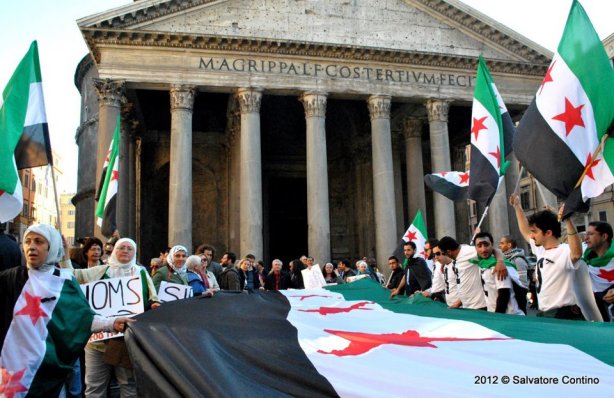
But nothing can bend the will of the people, not even the lining up of the so-called Shabbiha, that is, the infiltrate squadrons, those shadow-like figures who clandestinely join in the protests to stab the youth, even the children, then to indicate them to the secret services, who will arrest them and kill them. But the voice of the revolution cannot be silenced. Not even the deployment of the army, from which each day dozens of soldiers who no longer want to shoot into the crowds are defecting from, giving life to the Free Syrian Army. To distinguish the spontaneous protests of the Syrian revolution from those ordered by the regime to its supporters, the new Syria has chosen a new flag. The old flag with the colours black, white and red has been abandoned in order to adopt the new won, green, white and black, with 3 red stars.

One of the particularities of this revolution is its horizontal character: everything is organised, spread and transmitted by means of the network, with messages, videos, slogans and documents transmitted from one part of the world to another. In this way, for the first time, Syrians of the diaspora are involved, that is, those Syrians who had emigrated, some of whom had never been allowed to return home due to the regime. So has been born the first free and actual Syrian opposition, the SNC Syrian National Council, which is now working with international diplomacy in order to bring the country towards freedom. At this moment, the international community is doing very little, the Arab League is worse. The mission of the observers has proved itself to be useless.

The Syrian people are alone, but they are not surrendering. We will continue until Freedom comes!   Asmae Dachan

I am against the regime

I am against the regime because it is helped by wicked people who know it will protect their interests.

I am against the regime because it invokes democracy, but it unleashes its own army against every individual who asks for freedom. I am against the regime because I am tired of recognising the individual errors that have caused thousands of martyrs. I am against the regime because it says it is fighting against armed gangs, yet its death squadrons (Shabbiha) brazenly bring and use weapons against protesters. I am against the regime because it invokes reforms, but at the same time raises the rank and degree of its corrupt affiliates, while protecting those who are responsible for the massacre of so many innocents. I am against the regime because it talks about conspiracies against it, as if it was were itself doing its duty towards its own people.

Hani Dalati from Aleppo

La rivolta siriana contro il regime di assad

Ho dovuto sacrificare la nazione siriana per salvare il regime

Sono ormai dieci lunghi mesi che è iniziata la rivolta siriana contro il regime di bashar assad. Dieci mesi che sono costati la vita ad oltre 6000 martiri, con migliaia di feriti, di persone torturate, scomparse, con sfollati e profughi, abusi su donne e ferocia contro i bambini. Il regime in Siria dura da oltre 40 anni, da quando il padre del dittatore-presidente attuale, hafez assad, salì al potere con un colpo di stato. Alla sua morte il potere è passato “per eredità” a bashar, con un malcontento popolare sempre più diffuso, mentre continua a perdurare il regime di coprifuoco, che di fatto impedisce ogni manifestazione o riunione popolare, da oltre 40 anni.

Guardando in tv le immagini delle manifestazioni, un gruppo di bambini della città di Dar’à ha scritto sul muro della scuola “Il popolo vuole la caduta del regime”. Individuati e sequestrati, i bambini sono stati torturati e poi gettati in strada. I loro genitori sono scesi in piazza a manifestare, in modo pacifico, ma per tutta risposta il regime ha aperto su di loro il fuoco e sono caduti i primi martiri.  Ha preso così il via la rivolta siriana: cori, canti, manifestazioni, le voci dei giovani siriani si sono rincorse da una parte all’altra del paese: in particolare, a Homs, Hama, Dar’à. Il regime ha schierato l’esercito nelle città, ha avviato politiche di repressione feroce, mettendo in atto sequestri, stupri e torture terribili. In molti quartieri manca la corrente e il gas da mesi, mancano i medicinali e persino i viveri, il latte per bambini. Si contano migliaia di sfollati e profughi.

Ma nulla può piegare la volontà del popolo, nemmeno lo schieramento dei cosiddetti shabbiha, cioè gli infiltrati, i fantasmi che si intrufolano nelle manifestazioni per accoltellare i giovani, persino i bambini, segnalarli ai servizi segreti, farli arrestare e uccider, ma la voce della rivolta è inarrestabile. Nemmeno lo schieramento dell’esercito, da cui ogni giorno si defezionano decine di soldati che non vogliono sparare sulla folla e hanno dato vita al Free Syrian Army. Per distinguere le manifestazioni spontanee della rivolta siriana da quelle ordinate dal regime ai suoi sostenitori, la nuova Siria ha scelto una nuova bandiera. È stata lasciata quella nera bianca e rossa per adottare quella nuova, verde, bianca e nera, con 3 stelle rosse.

Una delle peculiarità e di questa rivolta è il suo carattere orizzontale: tutto si organizza, si diffonde e si trasmette tramite la rete, con messaggi, video, slogan e documenti trasmessi da una parte all’altra del mondo. Vengono così coinvolti, per la prima volta, anche i siriani della diaspora, i siriani cioè, emigrati all’estero, alcuni dei quali non hanno mai potuto fare ritorno a casa per via del regime. Nasce così la prima opposizione siriana libera e reale, il SNC Syrian National Council, che sta ora lavorando con le diplomazie internazionali per portare il Paese verso la libertà. Ad oggi la comunità internazionale tentenna, la Lega Araba peggio. La missione degli osservatori non è servita a nulla.

Il popolo siriano è solo, ma non si arrende. Andremo avanti fino alla Libertà!

Asmae Dachan


Sono contro il regime perché si fa aiutare da persone infami per tutelare i suoi interessi.

Sono contro il regime perché invoca la democrazia, ma scatena il suo esercito contro ogni individuo che chiede libertà. Sono contro il regime perché mi sono stancato di riconoscere gli errori individuali che hanno causato migliaia di martiri. Sono contro il regime perché dice di lottare contro bande armate e i suoi squadroni della morte (Shabbiha) portano e usano spudoratamente le armi contro i manifestanti. Sono contro il regime perché invoca riforme e allo stesso tempo eleva di grado i suoi affiliati corrotti e protegge i responsabili del massacro di tanti innocenti. Sono contro il regime perché parla di complotto ai suoi danni, come se intanto stesse facendo il suo dovere nei confronti del suo popolo.

Hani Dalati, Aleppo

Razan Ghazzawi (photo by Gillian York)

Following the arrest of Syrian-American blogger Razan Ghazzawi on December 4 by Syrian authorities, Razan subsequently faces various anti-state charges that carry up to 15 years of imprisonment. Today, a group of Palestinian bloggers and activists issued the following statement of support, which appeared on a range of internet outlets and blogs and follows weeks of campaigns for her release. The statement read:

We, a group of Palestinian bloggers and activists raise our voices loud and clear in solidarity with all the prisoners of the Great Syrian Revolution. We stand with all the prisoners, activists, artists, bloggers and others, all who are shouting in the streets or on various platforms demanding freedom and justice, while decrying the huge amount of injustice and oppression practiced by the Syrian regime for more than four decades.

We issue this statement in solidarity with all those Syrian activists, and with the blogger Razan Ghazzawi who was arrested on December 4th, on the Jordanian-Syrian crossing border. Razan was adamant in her support for the Palestinian cause. She was the first to stand in solidarity with the Palestinian bloggers who were not granted a visa to enter Tunisia in order to participate in the Arab Bloggers Conference. Razan posted a blog in 2008 during the massacre on Gaza titled, “The Idea of Solidarity with Gaza.” She wrote, “I understand when Cubans, Brazilians, and Pakistanies stand in solidarity with Gaza. But what I do not understand is when Syrians, Lebanese, Jordanians, and also Palestinians in exile stand in solidarity. What is the meaning of solidarity in this context?”

Not only do we stand in solidarity with Razan and the other prisoners, but we also affirm that our destiny is one, our concerns are one, and our struggle is one. Palestine can never be free while the Arab people live under repressive and reactionary regimes. The road to a free Palestine comes with a free Syria, in which Syrians live in dignity.

Freedom to all of the prisoners in the Syrian regime’s cells. Long live the Syrian Revolution, free from dictatorship, sectarianism, and foreign intervention.

If you wish to help #FreeRazan, repost this on your own blog and spread the call.

Signatories:

Abir Kopty

Abrar Agil

Ahmed Fahoum

Ahmed Nimer

Alaa Abu Diab

Ali Abunimah

Ali AlMasri

Ali Bari

Amal Murtaja

Amani Ighbaria

Amra Amra

Anas Hamra

Asmaa AlGhoul

Bashar Lubbad

Budour Hasan

Dalia Ghorab

Dalia Othman

Deema AlSaafin

Diana Al-Zeer

Doa Ali

Fidaa Abu Assi

Hala AlSafadi

Hamza Elbuhaisi

Hanaa Mahameed

Huwaida Arraf

Ebaa Rezeq

Irene Nasser

Jalal AbuKhater

Khaled AlShihabi

Linah AlSaafin

Maath Musleh

Maha Rezeq

Majd Kayyal

Mariam Al-Barghouti

Meera AlBaba

Mira Nabulsi

Nader Al-Khuzundar

Nadine Darwish

Nalan Al Sarraj

Nihal ElAlami

Nisreen Mazzawi

Ola Anan

Osama Ghorab

Osama Shomar

Rasha Hilwi

Rowan Abu-Shahla

Saed Karzoun

Saleh Dawabsheh

Thameena Husary

Yusra Jamous

by Shepard Fairey

by Aya Homsi (translated by Mary Rizzo) graphics by Shepard Fairey, quote by Frederick Douglass

* Reassure yourself that your country is not country X (X is the country that had undergone revolution right before yours). Throw the blame on Al Jazeera, then close its offices in your country.

* Say that you “support the young protesters” (as long as your security forces are ready to beat those same youth to death).

* Denounce the Islamists. Start at the lowest levels (the Muslim Brotherhood) prior to climbing straight towards the biggest nightmare of all, Al Qaeda.

* (At the start) Act as if nothing is happening. Then you will become aware of the severity of the situation once it is too late, addressing the nation at around midnight. * Warn people about the menace of Communism, Sectarianism, Tribalism and the other “isms” that frighten them to death.

* Make an explosion in a Church and then accuse the Islamists. Say that your permanence in power is synonym of stability and protection of the minorities. * Make some changes in government then… make some more.

* Burn the police stations and then accuse the protesters.

* Insist upon the fact that everything is going just fine.

* Once the situation has degenerated totally, cut off all the telephone lines and block access to the social networks. When things get REALLY bad, just block Internet.

* Make statements that the protesters represent merely an infinitesimal percentage of the population. The majority supports you. Cite the results of the last “elections”.

* Say that “change is necessary” and promise a lot of fun things if the youth accept to stay at home.

* Order the Ministry of the Interior to kill protesters, but then fire them for “excessive use of force”.

* Say that the youth have been pushed to protest under the influence of X (X can be KFC, Nescafè or other hallucinogens).

* Organise huge assemblies in favour of your regime. But instead of providing banners and flags to those present, offer them 50 dollars each and some AK47s (Kalashnikovs).

* Accept to be interviewed by a very famous journalist. (Christiane) Amanpour will do it. * Prohibit funerals.

* If people in the West criticise you, denounce their interference in your affairs and affirm that “they understand nothing of the culture of this country”. “In our culture, I am the leader and the people obey.”

* Evoke the spectre of the economic situation. Youth are about to destroy the country. But especially mention the state of the economy of your nation before (prior to the start of the revolts).

* If the evidence of billions in your accounts, declare that you are only saving so that you can make a big gift to the people.

* Book a suite in Jeddah (where Ben Ali took refuge), in case of…

The lifeless body of 14 year old Mohmmed Abdul Salam Al Mlaessa

The 14 year old shot dead by a soldier in front of his classmates

He was a model student, just like the rest of his classmates. Mohammed was a student at one of the institutes for gifted youth in Eastern Syria, near the Iraqi border. The other morning, together with his classmates, Mohammed was taken from his classroom: brought to the street, he was forced to join in a pro-regime march in the city of Deir ez Zor, a hotbed of dissent. Mohammed dared to give voice to those who like him did not want to go and protest against the decision of the Arab League to suspend Syria for the brutality of Assad’s repression of dissenters. He dared to ask to simply go home. The response was a bullet in his chest, in front of his classmates as they witnessed in
shock.

The teen had fallen to the ground, but Assad’s military security forces continued to shoot: first they kicked him and clubbed him with sticks and then they ended by firing one more shot into his side. “Make sure he is dead,” was the order given by the commander of the Military Security Forces, in the account given of the incident before the Syrian Observatory for Human Rights, an NGO with a London base that has access to a large number of voluntary informers who life in Syria.

Mohammed Abdul Salam Al Mlaessa was only 14 years old. How he was beaten and brought to such pitiful condition at the end of this brutal execution can be seen in the videos on You Tube (it is not possible to verify the authenticity, Western journalists are forbidden to report by the regime): a bullet hole in the left side, his face plummeted and in a pool of blood. An “exemplary” lesson for the other youth present.

That Damascus is afraid of students was something that was clear from the start:  at the beginning of the protests, last March, repression against a group of youth that had made anti-Assad graffiti on the walls of their school. “From primary school to high school, the youth of Syria are in the front line in the protests,” Mousab Azzawi, from the Syrian Observatory for Human Rights states. “No regime can resist when students protest and for this reason, they fear them, they kill them, they take them as hostages. And they make their families hear their voice over the phone as they are torturing them.”

The funeral of Mohammed was attended by at least 45 thousand people, according to estimates. “To disperse the crowd, agents used electrical sticks that provoked temporary paralysis,” Azzawi states. At the ceremony there was an evening sit-in with 8 thousand youths in what has been renamed “Liberty Square”. The gathering was dispersed by firing from the security forces: here there were two of the day’s thirty victims, the majority of which in the city of Homs, the capital of the protesters, where the deserters have taken refuge. But also in the streets of Hama, Deraa, Idleb, people continue to be killed. The activists report that yesterday forty protesters had been killed by soldiers near the Jordan border.

The repression has not stopped, despite the agreement made by Damascus on 2 November to follow the Arab League’s peace plan which calls for the end of the violence and the withdrawal of the tanks from the cities. And after the assaults on the Embassies of the Arab countries that had announced the suspension of Syria from the pan-Arab organisation, the regime has used the iron fist to fill the squares with pro-Assad marches and demonstrations. The case of Mohammed is not an isolated one. Similar incidents have been reported in other parts of the country. Azzawi states: “This same Sunday at Hama, the security forces shot against a group of students who had refused to participate in a loyalist march: five of them never again opened their eyes.”

Alessandra Muglia for Corriere della Sera (translated by Mary Rizzo)

http://www.corriere.it/esteri/11_novembre_15/20111115NAZ19_22_97cf31c6-0f59-11e1-a19b-d568c0d63dd6.shtmlv


 STATEMENT FROM THE SYRIAN OBSERVATORY FOR HUMAN RIGHTS, Sunday, 13 November 2011 19:41
On November the
13th , 2011, 09.15 local time in Dir Zour, the elements of military security took out the students of the pioneer students school in the city by force to the street and compelled them to participate in a march organized by Syrian security forces to condemn the decisions of Arab League concerning the  suspending of Syrian membership in the League.When first-graders of high school refused to participate in the march, and asked to be allowed to go back homes, security forces arrested the student Mohamed Abdul Salam Al-Mlaessa (14 years) who spoke on behalf of his classmates who do not want to participate in the march supporting Syrian Regime, and shot him directly in his chest just under the right wishbone in front of his friends. Then, they started beating him with batons while he bleeds in front of all students crowded for few minutes. When they were not sure about his Death, several minutes after the first shot in his chest, and the awful beating he was subjected to, the commander of the present elements of military security recommended the elements to shoot him again to ensure that he dies (this is literally what the commander said), and this is exactly what happened through the second shot in the flank of the child Mohamed Abdul Salam Al-Mlaessa, which led to his death.Syrian Observatory for Human Rights calls on all Arab and International organizations concerned with protecting civilians and child rights, to urgently intervene to protect civilians in Syria and refer all those responsible for committing such crimes against civilians in Syria to International Criminal Court to consider what might be a typical example of the crimes against humanity that are taking place daily in Syria.To see the documenting videos, you can click on the links below:

www.youtube.com/watch?v=68_uLBMKs0o

www.youtube.com/watch?v=5-QdqGQ5Auc

www.youtube.com/watch?v=zT6nrDpSrVQ

Syrian Observatory for Human Rights

London, November
13th , 2011


(Italian subtitles by Diego Traversa, French by Mirielle Rumeau)
To reply to the Gaza youth Manifesto, and with no additional words to the ones spoken with true heart on this video, we give you, The Manifesto. A simple, true, self-explanatory, expression of what we’re sick of.

As these days mark the 63rd memory of the Nakba, our people all around the world, revolt, and object to the injustice and hatred we are met with on a day to day basis, just because we’re Palestinians and just because we exist.

I urge your humanity and your conscience, to spread on this video, so the 15th of May 1948, wouldn’t ever be forgot, and so Palestinians would once more have their freedom and rights back; especially the right of return.

Salamat,
Two anonymous from Palestine.

كرد على بيان شباب غزة، وبدون أي كلمات إضافية للكلمات الصادقة من القلب التي قيلت في هذا الفيديو، نقدم نحن لكم “البيان” والذي هو تعبيرنا البسيط والصريح والغاني عن الشرح، الذي يعبر عن كل الأشياء “اللي احنا زهقنا منها”.

في هذه الأيام التي تمثل الذكرى الثالثة والستين للنكبة، شعبنا في مختلف أنحاء العالم ينتفض ويحتج على الظلم والكراهية التي نعامل بها على أساس يومي، فقط “علشان احنا فلسطينية”.

أنا أحث إنسانيتكم وضمائركم لتنشروا بياننا، لكي يبقى 15-5-1948 يوما لا ينسى في تاريخ الشعوب، ولكي يستعيد الفلسطينيون حريتهم وحقوقهم، وخاصة حقهم في العودة.

سلامات،
عشوائيان من فلسطين.

63 ans de Nakba

Par Deux anonymes de Gaza

Pour répondre au Manifeste de la Jeunesse de Gaza, et sans ajouter un mot à ceux qui sont dits du fond du cœur sur cette vidéo, nous vous donnons Le Manifeste. L’expression simple, qui se passe d’explications, de tout ce dont nous avons marre. En ces jours qui marquent le 63ème souvenir de la Nakba, notre peuple, dans le monde entier, se révolte et proteste contre l’injustice et la haine que nous rencontrons chaque jour, simplement parce que nous sommes Palestiniens et simplement parce que nous existons. (cliquer pour la suite du post et la traduction des sous-titres)
Nous en appelons à votre humanité et à votre conscience pour diffuser cette vidéo, pour que le 15 mai 1948 ne soit jamais oublié, et pour que les Palestiniens recouvrent leur liberté et leurs droits, en particulier le droit au retour.

Salamat,
Deux anonymes de Palestine

http://www.ism-france.org/temoignages/63-ans-de-Nakba-article-15565

63 ans de Nakba

J’en ai marre du mur
J’en ai marre des checkpoints entre les villes palestiniennes
J’en ai marre des colons israéliens illégaux et de leurs colonies
J’en ai marre que ma carte d’identité soit en hébreu
J’en ai marre que des gens ne connaissent rien de notre histoire mais qu’ils sachent tout de l’histoire juive
J’en ai marre que des gens ignorent le droit palestinien au retour et accepte le droit au retour des juifs
J’en ai marre de l’Accord d’Oslo que personne ici n’a d’abord voulu
J’en ai marre de l’Autorité palestinienne sans aucune autorité
J’en ai marre de voir mon père être humilié aux checkpoints par des gens de mon âge et plus jeunes
J’en ai marre que mes amis internationaux soient obligés de mentir quand ils viennent me voir, qu’ils soient interrogés, fouillés à corps et quelquefois expulsés
J’en ai marre que des gens ne comprennent pas ce qu’est “l’occupation”
J’en ai marre d’avoir tout le temps peur
J’en ai marre du syndrome de stress post-traumatique, un état normal ici en Palestine
J’en ai marre du Droit humanitaire international qui ne s’applique pas à l’État d’Israël
J’en ai marre de voir que combattre pour les droits humains de base des Palestiniens, ou critiquer la politique israélienne, est si souvent traité d'”antisémitisme”
J’en ai marre que tout le monde oublie que je suis une Sémite
J’en ai marre d’entendre les Israéliens se plaindre de discrimination quand l’État d’Israël a été fondé sur un principe de pureté ethnique
J’en ai marre de vivre à une époque où la discrimination raciale est devenue acceptable
J’en ai marre d’être constamment traité comme un suspect
J’en ai marre de la manière dont les médias nous décrivent, nous et notre situation
J’en ai marre que le monde entier se préoccupe de Gilad Shalit alors qu’il y a plus de 7000 Palestiniens dans les prisons israéliennes
J’en ai marre d’essayer de me défendre, moi-même, mes amis ou mes compatriotes et de me faire traiter de terroriste
J’en ai marre de voir, où je j’aille, le mur, une colonie ou une soldat israélien

J’en ai marre de 63 ans d’occupation israélienne

Traduction : MR pour ISM

Tradotto in italiano da Daniela Filippin (Questo omaggio a Vittorio di Jeff Halper è così bello, che non potevo sopportare che non venisse tradotto in italiano):

Dopo aver perso un altro amico e compagno meno di due settimane fa, Juliano Mer-Khamis, mi tocca piangere e ricordare il mio compagno di viaggio di nave Free Gaza, Vittorio (Vik) Arrigoni, brutalmente assassinato ieri notte da estremisti religiosi a Gaza. In realtà; Vik ricordava fisicamente Juliano, per la personalità esuberante e la sua insistenza nell’”esserci” quando gli oppressi avevano bisogno di lui.

Vik era davvero una persona che non potevi non notare. Era così pieno di energia, un misto di gioia, goliardia e impazienza entro i confini di barche e prigioni come Gaza, che all’improvviso ti avrebbe sollevato in aria, o si sarebbe messo a fare la lotta con te – era un ragazzo grosso, forte, bello, vivace e sorridente anche nelle situazioni più pericolose e oppressive, come a dirti: Yaala! A noi e ai pescatori palestinesi, queste navi israeliane che ci sparano, non possono prevalere sulla solidarietà, indignazione e la giustizia della nostra causa! (Vik fu ferito in uno di questi scontri). Ti arrivava da dietro dicendoti: L’occupazione cadrà esattamente così! (lottando con te fino a gettarti a terra, ridendo e giocando con te mentre lo faceva).

Vik, che come me ha ricevuto la cittadinanza palestinese e un passaporto quando abbiamo rotto l’assedio di Gaza salpando nel porto di Gaza nell’agosto 2008, era un esempio supremo di portatore di pace. Nonostante avesse una famiglia in Italia, si è dedicato ai palestinesi col cuore intero, come era solito fare. Sulla sua pagina facebook ha scritto: “Vive a Gaza”. Era conosciuto soprattutto perché accompagnava i pescatori che cercavano di fare il loro lavoro, nonostante gli spari quasi quotidiane della marina israeliana, che li confina alle acque già pescate fino all’esaurimento e sporche di fogna delle cose di Gaza. Almeno diciotto pescatori sono stati uccisi nell’ultimo decennio e circa 200 feriti, molte barche sono state distrutte e molto equipaggiamento danneggiato. Ma era intimamente coinvolto ovunque ci fosse bisogno di lui a Gaza, fra i contadini come fra i bambini traumatizzati, in tempi difficili – il suo libro, Gaza Stay Human, documenta le due esperienze fra la gente durante l’offensiva israeliana di tre settimane nel 2008-09 – e anche essendo semplicemente a contatto con la gente nelle caffetterie e nelle loro case.

Quando è stato appreso che era stato rapito sono spontaneamente sorti centinaia di appelli non solo dalla comunità pacifista internazionale, ma soprattutto dalla popolazione palestinese affranta di Gaza. Un memoriale sarà tenuto oggi a Gaza City e altre parti dei territori occupati.

Vik lavorava nella West Bank come a Gaza, ed è stato imprigionato tre volte prima di essere stato espulso da Israele. Ma il suo lavoro di pace non era solo sotto forma di attivismo. Vik era un maestro della comunicazione – fisica, verbale, scritta (il suo blog, Guerrilla Radio, era uno dei più seguiti in Italia), mischiando con naturalezza esperienze personali, reportage e analisi.

Vik era quello che chiamiamo un “testimone”, qualcuno che fisicamente si mette dalla parte degli oppressi e condivide con loro trionfi, tragedie, sofferenze e speranze. Eppure era uno che attraverso l’azione sperava di influenzare dei veri cambiamenti. Lui, come Juliano, Rachel e molti altri che si sono sacrificati per la pace e la giustizia in Palestina e in tutto il mondo, lasciano un grande vuoto nei nostri cuori, le nostre vite e nella lotta.

Mi mancherai, ragazzo mio. Ma ogni volta che mi sento stanco o scoraggiato, ti sentirò sollevarmi su in alto e sopra la tua testa e, col tuo enorme sorriso e la tua risata, minacciare di gettarmi fuori bordo se solo esito a coinvolgermi in una lotta. Tu eri e sei la forza terrena della lotta contro l’ingiustizia. Ci solleverai sempre su e ci ispirerai. Come i pescatori palestinesi che amavi tanto, noi e tutti gli altri che lottano per le fondamenta della vita in tutto il mondo ci impegneremo per realizzare la tua visione.

Ciao, amico.

freedom fighters in BenghaziThe author of the article I post below, Robert Grenier, rightly asked: “Where are the Arabs?” but in our opinion, we Arab Nationalists, also believe that he had also rightly volunteered to reply to his own question which is in his own words:

“…the primary motivating principles of the rebels have been clear: A desire for personal liberty, dignity and collective social empowerment.” 

Once an Egyptian Arab intellectual lady, Huda Hanum Shaarawi, replied after the 1948 Palestinian Arab Nakbah to the question: “How is it possible that seven Arab states and their armies were defeated by one state “Israel”? Her reply was simple and clear: “Because they were seven states with seven armies and seven ‘leaderships’ each quarrelling with the rest, while the enemy was one with one leadership, one army for one state.”, which the author has described below:

Robert Grenier was the CIA’s chief of station in Islamabad, Pakistan, from 1999 to 2002. He was also the director of the CIA’s counter-terrorism centre.” As a high CIA officer he should have known why did the British  Mr. Sykes and the French M. Picot come together to plan to divide the east Mediterranean Arab territories even before the defeat and  expulsion of the Ottoman Turks from it. They met and agreed to conclude on what is known as “The Sykes Picot Agreement”, that is, to  apply the principle of “divide and rule”, of course to create small weak Arab states that cannot defend themselves in the face of the colonialist powers and their colonialist ambitions, who were at the time in the first place Great Britain and France.

And lately why the old Zionist fox Shimon Peres to be joined at a later time by Condoleezza Rice, U.S Secretary of State under George W. Bush, further try to divide the present Arab states into a smaller states based on religious and ethnic minorities, which Zionists and other colonialist powers shall try to create between them feuds and enmities so as to resort to these colonialist powers for protection against their other Arab brothers… then Zionists and other colonialists shall be able to control them all, but fortunately enough what is known as the New Middle East colonialist conspiracy did not see the light, and with the domino theory of Arab revolutions presently taking place shall never be realized, and hopefully an Arab unity shall instead be realized to counteract these Zionist and western colonialist conspiracies.

Now the aim of young Arab revolutionaries is to get rid of these rulers who want to keep their control on what they consider as their subjects in collaboration with their colonialist protectors, but the young Arab citizens who want to be no more subjects of their corrupt ruers, but real citizens and be able to decide their own fate are struggling to overthrow all these rotten, corrupt and isolationist rulers. That is why those particular rulers shall not volunteer to come to give assistance to Libyan Arabs or any revolutionary Arabs citizens revolting against their rotten rulers… because as we said and saw that by the domino theory, revolutions shall pass from one Arab state to another. They, Arab rulers, want to keep their chairs under the seat of their pants and keep on riding on the backs of what they consider their obedient subjects. The young revolutionaries want their freedom and liberty from their internal and external rulers.

In a big and rich Arab state, an official and a member of the ruling family commented on the simple and rightful demands of their young citizens whom they consider “subjects” who gathered peacefully. As is the case with all Arab rulers, the official said after denying that there were gatherings and demands: “The cooperation of citizens with security men to confront those who call for anarchy was a good proof and spontaneous response against those calling for evil in a peaceful country.” He added that, “driving people to overstep matters to what doesn’t achieve demands or reform, calls for dialogue,and that is exactly what those in command in the state call for”!!!!

Another highly posted official said: “Some of those calling for evil gathered in front of the ministry of internal affairs,” he claimed that, “they want to make of the state a place of chaos, they are organizing purposeless demonstrations that have no high aims, but they proved that they don’t know the people of their state”!!!

From Libya, correspondent Ogharit Dandaash wrote the story of the engineer Almahdi Zeo:

“Before February 14th there was not a single exceptional matter or incident that makes it to informational mass media, nor was there a political stance, be it pro or con, regarding the regime that was in the activities of this Benghazi engineer who was in his forties. Engineer Almahdi Zeo was living a quiet life in Benghazi, his financial status was as described by those who knew him well as “better than good (kwaiseh)”. Zeo was the head of a family, and the father of two daughters studying at university, who never heard or noticed him fidgeting when Gaddafi and his men ruling from their stronghold of terror in Benghazi were mentioned.

On February 15th 2011 the young people of Benghazi didn’t expect the official birth for the February 17th revolution, to mount the winds of change that blew from their neighborhood. They demonstrated and were confronted from the Benghazi battalion of terror with fire in front of the court house… many of the revolutionary fell down martyrs…

While the young revolutionaries were marching in the funeral of their martyred comrades, Zeo was passing an ordinary day during his monotonous life. He passed in front of the headquarters of the battalion on his way to practice his ordinary daily routine work, it was inevitable that some incident should happen to attract his attention. Young people returning from the funeral of their beloved comrades, were, without notice, confronted with live fire, the source of which was from the battalion of Al-Fadel Omar, the headquarters of the soldiers of the regime, where any activists with political opposition to the regime, or with any ideas that contradict those of the Gaddafi Green holy Book. Zeo stopped to see the young people confronting the heavily armed soldiers with their naked chests, He returned home to tell his two daughters about 18 years olds fighting without help.

The following morning he returned to practice his ordinary work, believing that the zeal of the young couldn’t but be aborted with the regime’s brutality, but just in front of the same battalion tens of young people returned for another sit down with other supporters… Zeo realized after a long life of submission and looking aside shall not end with the feeling at ease required by other human beings, those youngsters realized, before it was too late, that there is a difference between living as ordinary human beings and a life full with a humanitarian meaning.

That night he hugged his beloved ones like he had never done before, he talked to them about small heroic incidents that history books didn’t mention, and about which no poems were written, but they leave their effect in people’s souls that had submitted to accepting life at ease, and as an ordinary matter… and left his house.

The place is the headquarters of the Benghazi battalion, date before the new Libyan history, attendants, the young persons seated on the ground, the occasion: drawing a new road map for the revolution.

The engineer said: “Success depends on the element of surprise: Clearly, we need to act quickly.

One of youth there understood: the moment the road opens, we attack.

Another youth pointed out to another group of young people, the brothers coming here are from Baida, they came to help us.

The engineer said, “I am going ahead”.

The engineer mounts his car that was loaded with gas containers for home use, and drives towards the wall of the two storey building housing the battalion’s headquarters, which is impossible to enter to or to break into. He steps on the accelerator to maximum speed, hits the wall, the car explodes, the wall crumbles creating an opening, the youngsters rush into the headquarters.

The element of surprise dispersed the soldiers who ran away, the revolutionaries took control and they obtained their first quantity of arms, they took control of the helm of the battle and thus the battle turned in their favor. After some confrontations, the Abu Al-Fadel Omar battalion fell and its leader fled to Tripoli along with Assaadi Al-Gaddafi (One of Muamar Gaddafi’s sons) who took refuge at the battalion’s headquarters after the outbreak of revolution. Then the weapons and ammunitions stores are now in the service of the revolution born on February 17th.

The fall of the battalion contributed to the liberation of Benghazi, and the revolutionaries gave credit in that to Engineer Almahdi Zeo for the morale and military help he gave to them, and encouraging many officers and soldiers to defect from Gaddafi’s forces and join the revolutionaries, and opening the door wide open for victories, which made the east of Libya fall from the hands of Gaddafi into the hands of the revolution within four days.

Martyr Al-Mahdi Zeo did not live to reap the fruits of the trees he planted, but those Libyan young men and women who had never heard of Engineer Zeo know now that the engineer of the realized revolution shall be the name who they shall tell to their children and grandchildren when their hair shall turn grey about a revolution executed by dreamers who didn’t wait enjoy its fruits.

So we should not expect from these decaying, rotten and dictatorial regimes to step in to help other revolutions against their equally decaying, rotten and dictatorial Arab regimes… they are equally bad and should be overthrown by young Arab revolutionaries.

“Where are the Arabs?” The other Arabs, are the young revolutionary Arabs, who are each cleaning the dirt the old Arab dictatorial and rotten Arab regimes left over by colonialism behind. Good things are coming with Arab liberty and unity. 

So we cannot but agree with Robert Grenier saying: A new day is dawning in the Arab world. The revolutions underway have only just begun, and there is much to be sorted out in the countries where the democratic wave has taken hold. The response of other regional regimes, under less acute and immediate pressure, but still grappling with the challenge of socio-political changes now set perhaps inexorably in motion, remains very much to be seen. For all that its common outlook is rapidly evolving, the Arab world has a long way to go in coming to a firm consensus about what forms of rule will meet its minimum standards of acceptability.”

 ORIGINAL PIECE

Opinion
‘Where are the Arabs?’ By: Robert Grenier 

If Arab states are serious about ending Gaddafi’s menace to his people, they must take the lead in helping the rebels.

Robert Grenier Last Modified: 13 Mar 2011 08:35 GMT
If Arab states do not act now, when the last Libyan rebel lies bleeding in the desert, his final words
may well be: ‘Where are the Arabs?’

It was August of 1982. For seven weeks, Beirut had been sealed off, under attack by Israel from land, sea and air. Water and electricity supplies were cut. The Israelis had secured the airport and much of the southern suburbs. The Syrians had been defeated, their air force wiped from the Lebanese skies. Chairman Arafat and the PLO were seemingly at the mercy of their enemies, utterly dependent upon the international community to arrange an evacuation of their fighters which would bring an end to the carnage. Isolated and alone, all the leader of the Palestinian movement could do was look into the cameras and plead: “Where are the Arabs?”

In January of 1991, a nominally extensive international coalition of armed forces, led by the US but including many of the Arab countries, stood poised in northern Saudi Arabia to drive Saddam Hussein from Kuwait. It might have seemed that much of the Arab world was unified, and had engaged the United States and the international community in their cause to liberate a brutally occupied Arab country.

But in many of the Arab capitals, and to a seeming majority in the Arab street, the armies massed in the Saudi desert were anything but a sign of Arab strength and unity. For in point of fact, the Arab countries had had comparatively little to do with organizing this un-authorized, largely Western coalition. Many Arab nationalists from across the region asserted strenuously that the Arabs should not rely upon the Americans to sort out their difficulties, arguing in favor of an “Arab solution” to the crisis. In fact, however, this was mere posturing: An Arab solution to the crisis would have amounted to meek acquiescence in Saddam Hussein’s intra-Arab aggression. Those Arab countries most threatened by Saddam were not about to entrust their fate to regional Arab councils. They did not wish one day to be left, alone, to make the entreaty: “Where are the Arabs?”

Today, in the deserts along the coast of Libya, patriots are fighting to liberate themselves and their country from over 40 years of brutal, arbitrary misrule. Although tribal and other social divisions are no doubt playing a role in determining the fault lines of the civil war progressively settling over Libya, the primary motivating principles of the rebels have been clear: A desire for personal liberty, dignity and collective social empowerment. In this they have been transparently inspired by the courage of their brothers and sisters in Tunisia, in Egypt, and in many other parts of the Arab world. But as they attempt to withstand the onslaught of Muammar Gaddafi’s better-armed loyalists, and as those rebels most hard-pressed repeatedly plead for at least limited outside assistance, well they might ask: “Where are the Arabs?”

Passivity and diffidence

A new day is dawning in the Arab world. The revolutions underway have only just begun, and there is much to be sorted out in the countries where the democratic wave has taken hold. The response of other regional regimes, under less acute and immediate pressure, but still grappling with the challenge of socio-political changes now set perhaps inexorably in motion, remains very much to be seen. For all that its common outlook is rapidly evolving, the Arab world has a long way to go in coming to a firm consensus about what forms of rule will meet its minimum standards of acceptability.

Nonetheless, the latest indications of Arab intent in the context of Libya are positive, if as yet insufficient. A clear message has been sent by both the GCC and the Arab League that Gaddafi’s brutality toward his people is not acceptable, and has effectively delegitimised his government. The Arab nations have taken a clear stand in favour of a UN Security Council-imposed no-fly zone, and for urgent outreach to the National Transitional Council in Benghazi.

So far, perhaps, so good. Still, troubling signs of traditional passivity and diffidence remain. The Arabs are deferring action to the international community without suggestions as to how that action should be implemented, and with no firm commitment for their own direct involvement. The Arab League ministers aver that a no-fly zone should only be for the purpose of protecting Libyan civilians, and should end as quickly as possible. They continue to express concern over foreign intervention, while requesting precisely that. Their ambivalence is palpable.

At the same time, evidence is mounting that the international fixation on a no-fly zone may be a distraction from more urgently-needed action, and may in fact be counter-productive. First of all, it is not at all clear how great a threat is posed by Gaddafi’s air strikes, per se. While the military situation remains confused, it seems more likely that Gaddafi’s armour and artillery pose the more lethal danger to both rebel and civilian targets.

Moreover, imposition of a no-fly zone would be no simple task. Security Council agreement is far from assured: The Council is divided, and the Chinese, in particular, will do what they can to avoid approving international interference in internal Libyan affairs, out of fear of the negative precedent it might set for themselves. While others might well participate, the US, clearly, would have to take the lead. (As far we Arabs are concerned, we have no trust with the United States and other western powers, their policies are equally colonialist, and we suffered enough on their hands and their rogue adopted and nursed our Zionist entity- A.S.K.)

Following its doctrine, the US would need to attack Libyan air defences first; the potential for significant collateral damage is considerable. The Americans would also require a helicopter-borne “combat search and rescue (CSAR)” capability to be in place for downed pilots before they would willingly act. And there are not nearly enough aircraft in theatre, yet, for an effective no-fly effort. Finally, it may simply be too much to suppose that the Americans, already engaged militarily in two Muslim countries, should now intervene in a third, when the risk to their already weak regional standing from those who may advocate international action now, but will no doubt quickly criticise any missteps, is so great.

Taking the lead
If the Arab League is serious about ending Gaddafi’s menace to his people, they should focus on providing the National Transitional Council with the means to defeat him and his loyalist forces. The US, the EU and NATO have all made clear that they will only act with a clear legal mandate and with regional support. Therefore, it is up to the Arab nations to take the initiative.

It is very likely that the softness in the Arab League stance is a reflection of the divisions between those members on either side of the “democratic revolutionary” divide. Hobbled by the need for consensus, the League as a whole has gone about as far as it is capable; it is unlikely to take the tough decisions and hard actions necessary to counter Gaddafi’s resurgence. Those whose commitment to support of the rebellion is notably strong – Egypt and the GCC countries in particular – must be prepared to take the lead from here.

First, they should move quickly to recognise the Council in Benghazi as the legitimate government of Libya, and immediately request modification of the current UN arms embargo to exclude its forces. Meanwhile, a rapid assessment of the rebels’ military requirements is needed; these would likely include ammunition, anti-armour weapons, and perhaps rockets or artillery. It is clearly within the capabilities of at least some of the Arab countries to provide these rapidly by air, most likely with logistical assistance from the US or NATO. In this context, it would become far easier, and more palatable, for the US and NATO to provide overhead intelligence, perhaps off-shore jamming of Libyan military communications, and other forms of assistance to the transitional government.

We can begin to imagine that such an Arab-led initiative on behalf of the Libyans could help to build a new, cooperative relationship with America and the West – one which flows from Arab empowerment and collective resolve, and not, as in the past, from Arab weakness.

The time has come, in short, for the Arab regimes to demonstrate regionally and internationally the will and courage to act demonstrated by many of their own citizens domestically. Otherwise, they run the risk, in what is supposed to be a transforming Middle East, that when the last Libyan rebel lies bleeding in the desert, the boot of a pro-Gaddafi thug upon his neck, his last gasp will be: “Where are the Arabs?”

Robert Grenier was the CIA’s chief of station in Islamabad, Pakistan, from 1999 to 2002. He was also the director of the CIA’s counter-terrorism centre.

The views expressed in this article are the author’s own and do not necessarily reflect Al Jazeera’s editorial policy.Source:

Al Jazeera

The arms of the Resistance, it has been suggested, should be abandoned as a matter of principle.  ‘From now on’, explains Caretaker Prime Minister Saad Hariri, ‘the possession of weapons, decision of war and peace, and defending the country should only be under the state’s control’.  Political principles, it would seem, can be slippery.  ‘From now on’?  Perhaps this disclaimer is meant to ease the turnabout from the Hariri-Ministerial Cabinet Statement issued just over a year ago:

‘Based on the Cabinet’s responsibility to preserve Leba­non’s sovereignty, its independence, unity and the safety of its land, the government underscores Lebanon’s right through its people, army and resistance to liberate or regain authority of Shebaa Farms, Kfarshouba hills and the occupied part of Ghajar village and defend the country against any aggression’.

For the sake of argument, however, let us set aside the dictates of political expediency.  Let us look at the reality of what this stance entails. 

The crux of the grievance being voiced these days is that the Lebanese Army should have exclusive domain over national defence.  The grievance asserts that the Islamic Resistance of Hezbollah has usurped this privilege for its own advancement.  The puzzling bit of this accusation, however, is that it is being raised not by the Army—but by various politicians.

In contrast to the opinions of the 14th of March personalities, the Lebanese Army has for over twenty-five years maintained an efficient working relationship with the Resistance.  The developments in Lebanon over the past six years have left this harmony stronger than ever.  Building on the firm, longstanding commitment exhibited by Generals Michel Aoun and Emile Lahoud, the Lebanese Army remains a proud partner of the Resistance. 

When Lebanese Army General Michel Sleiman took on the role of President in 2008, he carried with him the experience to judge the elements required for an adequate national defence.  He stated that the success of the Resistance in defeating the occupier was ‘achieved by virtue of the support granted by the Lebanese people, the State, and the Lebanese Army’.  Such success notwithstanding, he continued,

‘the enemy’s persistence in threatening to violate our sovereignty imposes upon us to elaborate a defensive strategy that will safeguard the country concomitantly with a calm dialogue to benefit from the capacities of the Resistance in order to better serve this strategy.  Accordingly, we will manage to avoid depreciating the achievements of the Resistance in internal conflicts and subsequently we will safeguard its values and national position’.

President Sleiman reiterated his conviction just weeks ago in response to Israeli Defence Minister Ehud Barak’s warning that Israeli military may invade Lebanon yet again.  Barak ‘knows full well’, said Sleiman, ‘ that entering Lebanon is no longer a walk in the park.  The defence minister’s threat to send his forces into Lebanon again shows premeditated intentions of aggression.  The Lebanese people, army and resistance are ready to respond to any such aggression.’

President Sleiman’s confidence in the existing defence framework is shared by the head of the Lebanese Army, General Jean Kahwagi.  Addressing his troops last year, he advised them to ‘cling to the will of steadfastness and confrontation and to benefit from all the Lebanese capabilities residing in the capacities of the Army, the people and the Resistance as well as from the presence of the United Nations Interim Force in Lebanon and its support’. 

Whereas the stance currently adopted by the 14th of March campaigners clearly resents the ability of the Resistance, General Kahwagi  openly describes all contributions toward the national defence as honourable:

‘Let us look with veneration and respect at the souls of our pious martyrs, whether soldiers, citizens or resistance fighters, who fell while defending their country. . . and drew with their innocent blood the path of dignity and liberation for a country that we can be proud of in front of the whole world since we are its true and loyal protectors’.

As the Israeli media grins at the banners being  waved in Beirut that read ‘We want only the arms of the Lebanese army’, again it becomes imperative to look at the reality of what this stance entails.  

The Lebanese Army remains committed to a cooperative national defence, to a formula of the Army, the people and the Resistance.  Just days ago, General Kahwagi reiterated:

‘The Lebanese Army abides by this formula since it is part of the decisions and guidance of the political authority represented by the Cabinet and it is totally convinced by this formula since experience has proved its primary role in liberating the greater part of south Lebanon and western Bekaa from Israeli enemy occupation in addition to its role in defeating this enemy in the war of July 2006 and in safeguarding Lebanon in these days’.

A system of mutual support has evolved.  To disallow the arms of the Resistance would be to arbitrarily disregard the consistent evaluation of the Army’s top leaders.  This is nonsensical.  Such a suggestion would leave Lebanon vulnerable; of this there is no doubt.  The only conclusion, then, is that such a suggestion is either gross negligence or wilfull acceptance of Lebanon’s being engulfed.   We have to wonder whether the current swirl of rhetoric over who gets to be commander-of-the-day has more to do with protection or politics.  If both the acting Army General and the President, a former Army General, embrace the contributions of the Resistance, then the state of Lebanon is already well in control of its defence. 

 By Brenda Heard For www.english.moqawama.org

Originally posted at http://www.english.moqawama.org/essaydetails.php?eid=13640&cid=269 


Gaza – PNN – Crowds packed Gaza City’s streets today, chanting “The people want an end to division.” The demonstrators are demanding both Palestinian governments in Gaza and the West Bank end the four year old division and restore national unity.

Although Hamas security forces in Gaza didn’t attempt to break up the protests for most of the day, after night fell they surrounded demonstrators and used force to disperse them, beating some with batons, as many as five were reported injured.

Mahmoud Srour is a university student. He left class today demanding national unity.

“Yes for the unity of the Palestinian people in order to encounter an aggressive occupation that grabs our lands day by day, while each of the dividing parties are just taking care to their own political interests and ignore Palestine’s”

As part of the call for unity, some Palestinians have been on hunger strike and many demonstrators say say they are committed to continue demonstrating until they see results. Rewan Abu Shahla is one of the March 15 organizers in Gaza.

“We are staying here, whatever happens, we are staying because what we are calling for is noble and higher than anything. We are calling for unity for the sake of Palestine and we are raising this flag, the Palestinian flag, so we will never give this up”.

Despite mediation from Arab countries including Egypt, Qatar, Saudi Arabia and Yemen, both Fatah and Hamas have been unable to agree on a path toward reconciliation.

Rami Al Meghari from Gaza contributed to this article. http://english.pnn.ps/index.php?option=com_content&task=view&id=9713

During Demonstrations Demanding the Opening of Shuhada Street and Commemorating the Ibrihimi Mosque Massacre, a Number of Participants are Injured or Arrested
Hebron–Dozens of were injured Friday 2/25 when Israeli forces threw sound bombs and assaulted demonstrators at a large peaceful protest commemorating the Ibrihimi Mosque massacre, calling for the opening of Shuhada Street, and criticizing the American veto of the Palestinian call for UN Security Council condemnation of and a halt to settlement activity.

The protest was organized by Youth Against Settlements. Thousands of Palestinians and dozens of Israeli and foreign activists along with a number of Palestinian leaders (among them the Governor of Hebron Governorate Kamel Hamid, member of the Fatah Central Leadership Committee Jamal Mahsin, Head of the Palestinian initiative Mustafa Barghouthi,) participated in the demonstration after Friday prayers. The demonstration proceeded from the area of Sheikh Ali Al-Baka Mosque in the city toward the direction of Shuhada Street in the center of Hebron.

Occupation forces tried to prevent the demonstrators from reaching the eastern entrance to Shuhada Street, near the old municipality, by creating a large human chain of individuals from Special Forces. However, a large number of demonstrators managed to cross into Shuhada Street, where a number of demonstrators sat on the ground and in front of the tires of military jeeps. Soldiers attacked them, began to hit them with their hands and with the butts of their guns, pulled them away, and arrested a number of them, according to Youth Against Settlements Coordinator Issa Amro
.
The protesters split up to try to enter Shuhada Street through alleyways and smaller streets. They confronted occupation forces who used excessive force against them.

Occupation forces fired gas and sound bombs and rubber bullets at demonstrators, leading to injuries. About 20 demonstrators were taken to Hebron Governmental Hospital.

According to Amro, the demonstrators chanted slogans and carried signs in Arabic, English, and Hebrew demanding from the occupying authorities the opening of Shuhada Street, which has been closed for many years. Demonstrators’ slogans praised the popular revolutions in Egypt, Tunisia, and Libya, and criticized the American veto of the UN Security Council condemnation of settlement activities.

Hebron Governor Kamel Hamid spoke to those in attendance, confirming the Arab nature of the city of Hebron and the opposition to the policy of settlement and discrimination practiced by the occupation in the city. He called for supporting and strengthening popular resistance to the occupation. He condemned the US veto in the Security Council. Jamal Mahsin spoke also, praising the steadfastness of the residents of Hebron, and emphasizing the necessity of national unity and the end of internal divisions.

The Israeli occupation forces closed Shuhada Street to Palestinian vehicles in 1994, after the Ibrihimi Mosque massacre, then forbade Palestinian residents to walk there in 2000, in order to provide security for the 600 Israeli settlers occupying the center of Hebron.

More than 500 stores were closed by military order in the center of Hebron, and more than a thousand store owners were forced to close their shops due to checkpoints and closures. At the same time, illegal settlers enjoy freedom of movement in the closed streets and are protected by occupation forces.

The activities of the occupation and its settlers in the city of Hebron have turned the lives of 200,000 Palestinians in Hebron into a living hell and expelled thousands from their homes.