Archive for the ‘Resistance’ Category

Once upon an alleged democracy, the Egyptian government decided a couple of days ago to try the journalist Majdi Hussein, the secretary-general of the Egyptian Labour party in a military court – even though he is a civilian – because he broke the law when he tried to “illegally enter the Gaza Strip”.


One wonders what is legal and what is not when it comes to Gaza.  It seems the law in Egypt is extremely elastic and can accommodate all manipulations and tailoring of the law to fit different sizes of growing plots. The good old Egyptian system is abiding by the law to the letter, and that’s why it wants to try a journalist in a military court for entering Gaza ‘illegally’ while the good old authority was providing the Israeli military ‘legally’ with tons of foods through the Gaza crossings while blocking any food sent to the starved to death children of Gaza who were burned to the bone by white phosphorus by that same Israeli army Egypt was feeding.


Last month the opposition Egyptian newspaper Alosbooa ‘The Week’ revealed in one of its reports a controversial story that was not refuted by the authorities about the Egyptian company ‘International Union of Food Industries’ which was providing the Israeli army with large quantities of homegrown Egyptian vegetables during the aggression on Gaza, since the very first day of the aggression. 


The report revealed that the Egyptian trucks were loaded with tons of frozen local grown vegetables from the company stores in the city of Sadat to the Israeli company “Food Channel”, through Al Awja crossing between Egypt and Israel. One of the drivers said that he has made these deliveries many times to Israel but he was hiding this fact from his relatives and neighbours in Albadry neighbourhood at Assalam city, and that he used to tell them that he was delivering goods to other Arab countries, or the delivery is heading towards far ports like Savaja because he was embarrassed to tell them the truth. Other drivers said they no more feel embarrassed or ashamed of doing so because their government itself has normalized relations with Israel years ago. The workers in the company said that the food was repackaged with Hebrew writing, showing the expiry date and the contents, and that the food has been prepared according to Jewish religious rules.  Thus indicating that it complied with the traditional religious Jewish parameters, and that’s why the company imposed a cordon around the place, keeping stored bags, boxes, posters and empty cartons away from the sight of intruders, not allowing any of the workers or the staff to approach the packaging area, and searching every worker at the end of his shift before leaving.


Contrary to what was expected, trade exchange between Egypt and Israel because of Israeli policies towards the Palestinians has increased notably to 4 billion dollars in addition to exports of oil and gas.


Regarding the journalist Majdi Husse, this was not his first encounter with the Egyptian authorities. He was Chief Editor of an Egyptian Islamic bi-weekly when he was imprisoned for 4 months along with the journalist Muhammad Hilal in 1998 with charges of defaming former Minister of the Interior in Egypt, Lt. Gen. Hussein al-Alfi.

Hussein said he was prevented twice by the Egyptian authorities from entering the Gaza Strip through the Rafah crossing point, forcing him to take an alternative route to get into the Palestinian territories.

The Egyptian prosecutor in Al-Arish city said the decision to put Hussein on military trial (even though he is a civilian) came after three days of investigations with him, and that he was arrested upon his arrival to the Egyptian side of the border with Gaza. The trial of Hussein is expected to be held on Thursday.

The Labour party in Egypt considered subjecting one of its top officials to a military trial as a grave violation of human rights, since he is a civilian, and commented that Majdi’s decision to get into Gaza Strip was driven by his “nationalist, Islamic, and popular considerations, and that Majdi’s determination to enter the Strip reflects the general feeling in the Egyptian street to lift the siege on Gaza and to open the Rafah crossing point before the Palestinian people.”

Majidi is not the only Arab journalist Egyptian authorities prevented from entering Gaza, the Al-Jazeera team was denied entry into Gaza too. The Egyptian authorities denied two of Al-Jazeera’s top journalists Ahmed Mansour and Ghassan Bin Jiddo entry into the Gaza Strip without explaining the reasons. Especially since Egypt had granted entry into the Gaza Strip to foreign and European journalists.

In a telephone call with his satellite channel, Mansour confirmed that the Egyptian authorities told them that they (he and bin Jiddo) were denied entry, at a time it granted many journalists of different nationalities the right to enter the Strip.

“We presented our identification documents to the Egyptian authorities and requested permission to enter the Gaza Strip as other journalists did, but we were denied entry,” added Mansour.

Mansour also said that the Egyptian officials stopped answering their telephone calls, but he stressed that the Al-Jazeera team will remain at the borders till a rational reason by the Egyptian authorities is given to justify such action.

Hence, according to the law-abiding Egyptian authorities, it is illegal to open the crossing to allow food and aid to the starved Gaza children, but it is legal to feed the Zionist army who were barbecuing Gaza children. It is legal to allow foreign journalists to cross to the Gaza haven, but it is against the law to allow Arab journalists to cross the borders to investigate or offer emotional support. It seems it is legal to stand on the borders and watch a full nation being killed and not only to stand idly doing nothing, but also to punish those who intend to help.

Translated into English by Manuel Talens and revised by Mary Rizzo


During the current Israeli aggression to Gaza both the Spanish Left and Right have built linguistic fences to position themselves around the problem. The case of the Spanish institutional Left is without any doubt paradigmatic: on one side there a party now in office – the Spanish Socialist Workers Party, PSOE – whose Minister of Foreign Affairs pretends to be a personal friend of Palestinians [1], whose Prime Minister Zapatero condemned the Israeli attacks during a PSOE meeting and whose militants (some of them) demonstrated in solidarity with Palestine. But on the other side, the government issued from this same party is among the ten main exporters of weapons to Israel, its secret services cooperates with their Israeli counterparts, it maintains preferential agreements with Tel Aviv, it supports the creation of the Sepharad-Israel House in Spain and it insists that what the party does is irrelevant to both the government’s performance and its State policies, which of course are to maintain very good diplomatic relations with “the great Israeli democracy” (so defined by the current UN President, Nicolas Sarkozy).


If this schizophrenic performance characterizes the party in office, the case of other Spanish organizations – labour unions and other left-wing groups with institutional vocation – is no less disturbing. While they have condemned Israel for its attacks, they also have emphasized their condemnation of Hamas as responsible for what happened to the Palestinians – although without mimicking Simon’s Peres accusations, – essentially sustaining the same justificatory arguments held by the Israeli government. They all have looked for a common denominator, a common language of consent – the same one that the Minister of Foreign Affairs Moratinos requests of the Palestinians when he says that “we don’t want unity but consent” – which would allow them to simultaneously show solidarity with Palestinians and be politically correct.


This consent has been built upon two taboos: never to use the word genocide and never question the Israeli democracy.


The objective result of building consent upon the negation of genocide and accepting the farce of Israeli democracy is a continuous complicity and the blockade of any fair option for the Palestinian people.


The imposition of consent betrays a far-reaching political objective in Spain. Either consciously or unconsciously it has intercepted the explosions of rage and pain by both Arab and Spaniards in the country, which have been systematically excluded, reprehended and silenced by the organized groups that led the manifestations of solidarity with the Palestinian people [2]. The Arabs of Spain went massively to all demonstrations in the country but were forced to accept the conditions imposed by these groups which organized the events, wrote the manifestos and chose “what actions were authorized and what not.” The fear that the immigrant Arab population – fully identified with the Palestinian cause – could explode and that this explosion could be considered as shared by the government has forced both the government and the Socialist party to a strategy to channel and control what the Left could carry out. [3]


The PSOE has managed to be part of all groups that organized actions and its interest in it was clear: to “normalize” them, to “control” them and to avoid any “radicalism,” as it risked to get out of hand considering what had happened in past demonstrations during the Iraq war. Clearly the PSOE wanted to avoid being forced to call the Israeli ambassador for consultations, to officially condemn the Israeli government or to interrupt the preferential relations with it.


As for other groups – unions, parties, some ONGs – a “minimum of consent” was essential to sustain the image of a not-radicalized-Left (so profitable from the institutional stand) while at the same time preserving the image of solidarity and the prestige of the slogan “another world is possible.” 


The Israeli genocide of Palestinians


The task of both PSOE militants and all other groups whose priorities are institutional was clear from the start: to provide all kinds of media, legal and economic support to demonstrations of solidarity with Gaza while intercepting all initiatives susceptible to friction with the Israeli government. That’s why the use of the word genocide was rejected in banners, manifestos, etc. under the threat of breaking the coalition of forces.


But why has it been so important to banish the word genocide from the vocabulary on any denunciation of Israel and of any act of solidarity with the Palestinian population? Why was the consented word massacre? Instead of looking into laws or international legislations, let’s see the definition of the word genocide in the Spanish Royal Academy Dictionary (DRAE): “extermination or systematic elimination of a social group for reasons of race, religion or politics.”


Historian Ilan Pappe carried out an exhaustive research on Jewish sources – unclassified documents from Israeli security services, Zionist files, Department of State reports, Ben Gurion’s files, military statements – and he reached the irrefutable conclusion that from the very moment of the foundation of the State of Israel the Jews planned the ethnic cleansing of Palestine. [4] In a recent piece he refers to different researchers who “call attention on the distinction between massacres that are part of a genocide, i.e., that are planned, and the unplanned massacres that directly happen out of hate and vengeance in the general context of an ethnic cleansing.” [5] All the indications and certainties of Israel’s “new historians” point to the fact that in the case of Israel’s acts against Palestinians they were massacres that happened in the context of the ethnic cleansing designed by the Israeli State, but at the same time, the original planning, systematization and political objectives made most of these massacres an integral part of the genocide against Palestinians. So if the ethnic cleansing – the genocide of Palestinians – is implicit to the foundational act of the Israeli nation, then the very existence of this State is delegitimized.


According to the DRAE the word massacre implies “slaughter of generally defenceless people produced by an armed attack or a similar cause.” If we substitute the word genocide for massacre we end up with a unplanned, not even intentional act against two, three or a hundred people but not against a people as a whole; a massacre is the result of “an armed attack or similar cause”, that is to say that it can be either the result of a war or that its causal relationship is directly related to an armed conflict so that the objective cannot be neither political – intended to eliminate people for racial, ethnic or political questions – nor its objective is to exterminate the civil population but rather it can be a unwanted consequence, uncontrolled hate by soldiers, a disproportion justified by technical questions… Finally, the people killed are – according to the DRAE – “generally defenceless” but maybe not. All of this means that a single word can be paramount to characterize and politically position people whether they use it or not. Words are neither neuter nor objective. In this case they characterize a conflict and place their users in one position or another.


From the point of view of the political costs, most of the organizations present in demonstrations did not risk anything before the mobilized masses as these did not perceive the difference between the words genocide and massacre; so organizers opted for the most acceptable term in order to safeguard all of their institutional contacts.


Beyond juridical considerations and the well-known pragmatism of law professionals, the definition of the attacks on Gaza as a massacre has contributed to halt any further analysis, considering it just as a regrettable but punctual fact similar to the destruction of Jenin in 2002. Calling it a “disproportionate attack” permits the filing of the case as a new example of the wrongdoings of certain leaders who maybe one day could be prosecuted for war crimes for their “errors” and their “disproportions.” Seen from a distance, the Spaniards’ image will be that of supportive human beings moved by the deaths of innocent people who after the “massacre” will return to mend their daily business after having done all that they could. By refusing to recognize the logic of manipulating words and scrutinizing the essence of the conflict and by adapting its speech to official requirements, the good-hearted and harmless Spanish “Left” has sided again – even without realizing it – with the wrong camp. 


Boycotting Israel


Neither Spanish institutions nor certain groups either favoured or compensated by their “efforts for peace” like to speak of boycotting Israel. A boycott implies to “deprive a person or an entity of all social or commercial exchanges in order to harm it and to force it to give in.” If all solidarity groups with Palestine ask – either politely or less so – that is it necessary to request Israel to abide by the United Nations resolutions, why do they give up an instrument as effective as the boycott as happened in South Africa?


In the case of Israel, requesting it to abide by the resolutions is like sending a letter to Santa Claus, even more considering the zero possibility of the UN either to force sanctions to Israel by the Security Council or to force it to abide by its resolutions. On top of that let’s not forget that the origin of the problem was the UN.


To deprive Israel of commercial exchanges could strangle its economy; its economy is not self-sufficient and its exchanges with Middle East countries would not allow Israel to commercially survive. On the other hand, its economy is strongly militarized, it depends on the US war industry and on the plundering of Palestinian resources. Israel would have a real problem if a boycott impacted on its commercial exchanges. In Spain there are groups which don’t refuse this kind of boycott because it can be carried out on an individual basis, it depends on the will of consumers and it permits justification of the resources spent on the necessary campaigns to increase sensitivity; a boycott would not jeopardize their institutional relations either. Other Spanish groups, it is true, defend this type of boycott with total sincerity.


The true problem arises when we think about an institutional boycott. From a political point of view a boycott of institutional relations with Israel has unacceptable implications to the Spanish State because the target of such a boycott is the democratic legitimacy of Israel. The aim of such a boycott would not have anything to do with the modification of a particular policy, or with the recognition of Palestinians, or with certain concession to the other part in conflict but with the very essence of the “Israeli democracy” in which there are discriminatory laws that mimic the South African apartheid system and create second class Arab Israeli citizens, i.e., the Law of Nationality that establishes differences in acquiring citizenship for Jews and non-Jews; the Law of Citizenship which forbids Israeli citizens to marry a resident of the occupied Palestinian territories [6]; the Law of Return which establishes that any Jew of the world can obtain citizenship and many privileges if he/she moves to Israel; as well, there are more than 11.000 Palestinian political prisoners in Israel to whom they apply military justice and the practice of torture is accepted by Israel based upon the British Command laws, etc.


The boycott entertains the possibility that both citizens and institutions could carry out actions that they depend entirely on them, not on the will of Israel nor of their own governments. This would suppose the breaking, even partial, of Israeli impunity. The impotence and the discouragement that generates an International Community unable to force Israel to abide by the UN resolutions and the message of a powerful Israel against whom nothing can be done would crumble with actions controlled by citizens and institutions (universities, sport organizations, foundations, unions, parties).


The blockade of the words genocide and boycott by the Spanish institutionalized “Left” neutralizes and deactivates the struggle against Israeli Zionism and reduces almost all the country’s political spectrum to the role of mere spectators who watch it with “indignation” and then scratch their pockets obeying Moratinos’ order to concentrate themselves on the humanitarian aid, so politically profitable. Meanwhile Palestinians will continue being bad victims because they will prefer, even at the cost of being murdered either slowly or quickly, to continue resisting and fighting for their territory. 


Notes


[1] Today Moratinos is one of the Israeli government’s main champions in Spain up to the point of having apologized to  Minister Tizpi Livni. He says he will try to reform the Spanish legislation so that it won’t permit again the prosecution of military Israelis on the charges of war crimes, as it has just happened at the Spanish National Audience on January 29th, 2009.


[2] The Arabs showed up massively at the first meeting before the Ministry of Foreign Affairs in Madrid (January 3rd, 2009), responding to the call of mosques. They overflowed the organizers, generating a spontaneous demonstration that walked toward the Israeli embassy and blocked important Madrid avenues. From that moment on it was clear to the PSOE that the danger of overflow had to be avoided.


[3] In fact, this channelling and control strategy was implemented by the PSOE just after the March 11 Madrid’s Atocha bombing in 2004: it created a federal group of “socialist Arabs” inside the secretary of social “Movements and relations with NGOs”. At the Ministry of Justice it also created the Pluralism and Coexistence Foundation to offer courses on both Islam and democratic principles, sponsor seminars on the integration of Muslims and follow-up the congresses of the Islamic communities in Spain, etc.

[4] Ilan Pappe, The Ethnic Cleansing of Palestine, Oneworld, 2006.

[5] Ibidem, “Demons of the Nakba”, Al-Ahram, May 17, 2002.


[6] If this happens the Jew loses all his/her rights as an Israeli citizen.


Source in Spanish: Los límites de la “izquierda” en su defensa del pueblo palestino


Ángeles Diez is professor of Political Sciences at the Madrid Complutense University. She has a PhD on Contemporary Latin America. She has done research work on collective action, social movements and NGOs.


The Spanish writer and translator Manuel Talens is a member of Tlaxcala, the Translators’ Network for Linguistic Diversity.

The rebuilding of Gaza has become the latest siege weapon. The Israeli occupation, the US that had backed its offensive, and the EU which did nothing to stop it are conspiring to turn the reconstruction process into a means to produce a suitable “peace partner” while the Arab summit in Kuwait hopes to use it to bring about Palestinian reconciliation. Meanwhile, the Palestinian Authority (PA) government is urging all parties and others to look to it as the sole channel for administering the construction process on the grounds that it is the government formed by the Palestine Liberation Organisation that is recognised as the sole legitimate representative of the Palestinian people. Soon we will see that freezing reconstruction will become the tool of all those parties for extracting from the resistance what they have been unable to gain from three weeks of warfare and the long blockade that preceded it.

Israel, the occupying power, is determined to keep a tight grip on the reconstruction process, which is why it sustained its closure of the border crossing following its “unilateral” ceasefire. Indeed, this is why it declared the ceasefire unilaterally: it did not want to be bound by any agreement — the Egyptian initiative or any other framework — that would oblige it to lift the embargo, if only partially, in order to facilitate reconstruction. Tel Aviv has also been seeking to obtain “guarantees” from international agencies such as UNWRA. On 19 January Reuters reported that Western diplomats revealed that Israel had asked the UN and other agencies to submit itemised lists of the goods, equipment and staff that they intend to send into Gaza, whether for urgent relief or for the more long-term reconstruction process. According to these sources, Israel plans to keep close tabs on these processes by insisting that the various agencies obtain its approval in advance for every project. One of the conditions for that approval will be that the project will not benefit Hamas or its government in Gaza. Prime Minister Ehud Olmert has appointed Social Affairs Minister Isaac Herzog as coordinator of the Gaza reconstruction drive.

The US not only fully supports Israel on this; it is open about using the reconstruction process to help the PA reassert its authority and influence in Gaza. The EU is equally frank in its approval. EU External Relations Commissioner Ferrero-Waldner made clear that the EU would not contribute to reconstruction unless Gaza produced a viable peace partner and that it would not make aid available to a government led by Hamas. A high-level European diplomat was reported by Reuters as saying that this was “a recipe for failure”. “Let’s be realistic. If the PA is going to be responsible, its leadership and institutions have to exist on the ground. Right now none of that does,” he said.

It is patently clear that to Tel Aviv, Washington and Brussels the assertion of PA rule over Gaza is the strongest argument for holding off reconstruction as a Damocles sword over Gaza, and for the occupying power this condition is its strongest “guarantee” for sustaining its grip on that sword. The fear now is that Israel and the international powers that have helped it to perpetuate its occupation since 1967 will use a Palestinian façade buttressed by official Arab support to stage a repeat in Gaza of the Iraq experience in the wake of the 1991 war when reconstruction and development were perpetually deferred in order to further weaken the country preparatory to toppling the regime through the invasion that took place in 2003. It may or may not be a coincidence that the Israeli invasion of Gaza ended almost on the same date that the war against Iraq started 18 years ago. Nor does it bode well for the aftermath of a “regime change” scenario in Gaza that Iraq’s infrastructure today, six days after the Saddam regime was toppled, is worse than it was beforehand.

The attempt to engineer such a scenario can be seen in PA President Mahmoud Abbas’s appeal to the Arab summit last week to channel the reconstruction process through the PA and its institutions, an appeal echoed by World Bank President Robert Zoellick who met with Abbas on the fringes of the summit in Kuwait. UN Secretary-General Ban Ki-Moon and other Western leaders had proposed creating a temporary international committee to oversee the funding and organisation of the reconstruction effort. However, Abbas and his supporters rejected such a mechanism on the grounds that “it presumes that the separation between Gaza and the West Bank will continue,” as acting PA Prime Minister Salam Fayyad put it, adding that international donors who are eager to reconstruct Gaza “will risk deepening the Palestinian division by ignoring the role of the PA”.

The PA’s stance, if followed, would condemn Arab pledges made in Kuwait — as well as any pledges made in a possible international conference on the reconstruction of Gaza called for by Egypt, the PA and the EU president — to remain pending until such time as a “viable peace partner” secures a steady seat in Gaza.

Although the participants at the Kuwaiti summit stressed the need for the reconstruction of Gaza in principle, they failed to reach an agreement over the mechanism. Differences between leaders obstructed a proposal to create a reconstruction fund and the most participants managed to agree upon was to make reconstruction contingent upon Palestinian reconciliation, a task they designated to Arab foreign ministers without setting a date or place for a ministerial meeting for this purpose, leaving us with the question as to when and how Arab ministers are to succeed where their heads of state failed.

Of course this procrastination through delegating makes the pledge to reconstruct Gaza barely worth the paper it was written on and will probably consign it to the same oblivion fated for so many other Arab summit resolutions. One of those forgotten resolutions was that adopted by the emergency Arab summit in Cairo in October 2000 calling for the creation of an Al-Aqsa and Jerusalem Fund for the purpose of reconstructing Palestinian infrastructure, especially in the sectors of healthcare, education, agriculture and housing. Apparently Arab leaders in Kuwait did not wish to recall that that resolution did not restrict the distribution of funds through the channel of the PA but also provided for other channels such as UNWRA, the Egyptian and Qatari Red Crescents, the Jordanian Royal Philanthropic Organisation, the UN Arab Gulf Programme and other such regional and international humanitarian agencies. Perhaps, too, they did not want to remind anyone that when that earlier resolution was passed there was no “Hamas problem” behind which are hiding those who do not really want to reconstruct the occupied territories, whether in Gaza or in the West Bank.

The underlying reason why the Al-Aqsa and Jerusalem Fund was not adopted by the Kuwaiti summit as a mechanism for the reconstruction of Gaza is that the urgent humanitarian mission has been politicised whereas it should remain above the political fray between Palestinians, Arabs, foreign powers and everyone else whose voices are loud enough to drown out the appeals of those in need. There is nothing to debate about humanitarian relief. The Israeli offensive destroyed all the civil infrastructure of the government in Gaza on the grounds that it served as bases for Hamas whereas in fact it was PA infrastructure paid for by taxpayers in donor countries. Whole residential quarters were flattened, totally destroying 4,000 homes and severely damaging around 16,000 more. There are now some 100,000 civilians in urgent need of shelter, temporarily accommodated in some 12 refuges opened by UNWRA in schools that were also targeted by Israeli guns and therefore need to be repaired as well. In addition, agricultural land ruined by bombardment has to be reclaimed, potable water needs to be supplied to half a million Palestinians, electricity has to be restored to about the same number of people, and about 80 per cent of the inhabitants of Gaza are in urgent need of food relief (these are all UN estimates). Any political argument for postponing such urgent aid is morally outrageous.

The Israeli list of “prohibited materials” even before its offensive includes such items as iron, steel and cement, which are now absolutely vital to reconstruction. UN Commissioner for Humanitarian Affairs John Holmes pointed out this self-evident truth in a statement last Tuesday saying that if Israel refuses to allow in construction materials reconstruction cannot begin.

It is equally obvious that to adopt the PA as the sole channel for reconstruction financing is to effectively allow the occupying power, which destroyed Gaza, to supervise reconstruction. It is hardly possible to expect the PA, which is at Israel’s every beck and call, to independently and effectively manage the reconstruction process by remote control from Ramallah, let alone release funding for projects without Israel’s prior approval. Remember that President Abbas, himself, pleaded the difficulty of obtaining an Israeli exit permit on short notice as the reason he did not appear at the Doha summit on Gaza, according to Qatari Prime Minister and Minister for Foreign Affairs Sheikh Hamed Ben Jasem Al Thani. Also, only two months ago, Abbas’s government in Ramallah could not disburse salaries to some 70,000 PA government employees who are believed paid to stay home because of the internal Palestinian rift. If, as acting Prime Minister Fayyad repeats on every occasion, the PA is unable to deliver the budgetary allocation to Gaza, which is about half of its total budget, how can that government be relied upon to deliver the funds that have been pledged — or will be pledged — for reconstruction?

Kuwait, for one, acted correctly when instead of waiting for the Arab summit to reach an agreement it donated $34 million directly to UNRWA. Similarly, Norway donated 20 million kroner to organisations capable of reaching civilians directly in Gaza, such as the International Red Cross. Such noble examples confirm the existence of practical, serious channels for meeting urgent humanitarian needs. These should not be made pawn to the demand for the arrival of a Palestinian “peace partner” to Gaza, contrary to the insistence of PA Foreign Minister Riyad Al-Maliki in Kuwait that everything had to be coordinated with the PA “in all fields” before beginning the relief and reconstruction process. If that demand is met, nothing could be more guaranteed to subject the reconstruction process to the whims of the occupying power and turn it into another way to besiege Gaza in order to bring it to its knees.

* The writer is a veteran Arab journalist based in Bir Zeit on the West Bank of the Israeli-occupied Palestinian territories. This article was translated from Arabic and published by Al-Ahram Weekly, Issue No. 932, 29 January – 4 February 2009.

Source: http://en.timeturk.com/nicola-nasser-gaza-new-siege-mechanism–377-yazisi.html TimeTurk


The latest of Al Arabiya TV series of betrayals to the ethics of journalism and another move of manipulations of the media came today with a report it has published on its news website.


Al Arabiya claims that Palestinian Mothers are requesting NOT to broadcast images of children killed in Gaza because it causes fear and panic amongst the children in Gaza.


What A heap of Bull media Sh-t.


Before going to disintegrate Al Arabiya’s method of handling the coverage of Current Affairs, I would like to mention that the Foreign Ministry of Israel hailed on its website by Israel’s Foreign Minister Tzipi Livni a number of Arab journalists and recommend reading their articles regularly, and have their list of names available on the official website of the Ministry as a reference because she considers them as Israel’s ambassadors in the Arab world, for they follow exactly the Israeli line and defend its point of view to the letter. She recommended not only publishing their present articles during the last war, but all their old ones – especially the ones they wrote against Hamas, and guess what? Abdul Rahman al-Rashed, General Manager, Al Arabiya Channel and the former editor-in-chief of Asharq Al- Awsat who happens to hold a US post-graduate degree in mass communications from USA, is on this so-called Honour list.


Regarding Al Arabiya’s report claiming that the women of Gaza complained that what their children see on TV screens of bodies or parts of bodies of Gaza children became a worrying concern and that it should be stopped.


I would like to borrow an old saying of my Palestinian culture book of sarcastic quotes that can be applied in this case, we were told since we were young, ‘if you want to find if a certain claim is a lie, just look how big it is’ and sure enough this lie is extra large, for everybody around the world knows that Gaza still does not have electricity to connect TV sets to, and almost the majority of the homes in Gaza have no living room or TV sets left to watch TV, let alone the fact that most of the families are left with no mothers to complain, and the mothers who were lucky to escape death are preoccupied by other concerns like finding some clean water to drink, or finding a way to visit a half burned child at hospitals, and what piece of furniture to burn next to boil some roots to eat after 19 months of siege and after Israel forces have blown up all the UN buildings that used to have some stored food. All the pictures we received are still excellent evidence that all the dishes that used to capture the signals from TV stations are on the ground half buried under the rubble with the dead bodies. What kind of false media message is Al Arabiya trying to send the world?


This is clearly a desperate attempt to dilute the pain and misery of the people of Gaza for they have committed the sin of choosing Hamas as their political representative which is considered as an anti-USA.


The mothers and children of Gaza are claimed to complain of airing their need and despair and the injustice fallen upon them, but it seems that no Palestinian mother is complaining about the collaboration of the Arab states against them and siding with the Israel and USA.


Since when Al Arabiya has worried about the emotions of women in Gaza or been concerned that the children can’t sleep? How else would the people around the world would know the scale of cruelty and destruction caused by the Israeli state, and how ugly the war was? Is Al Arabiya advising us to create an entertainment program backed with animation and soft music when we scream about such a huge scale of massacres? 60 years of occupation and massacres had no effect on the international conscience because of the media manipulations Al Arabiya and other media adopting Western agenda means of reporting, by considering the dead are no longer important, and only worrying about the preferences of the fragile sensitive emotions of the living. I bet Al Arabiya would prefer a little entertainment instead to wash away the blood of hundreds of children killed without any crime committed but being born Palestinians. Al Arabiya has been reporting about the handmade rockets that fell on Sderot killing nobody but injuring a worktop of a kitchen, but not once it has mentioned that Sderot was the original home for those who were desperately firing homemade rockets more like fireworks because they were desperate after 19 months of siege and being forced to live packed like sardines and pickled in their own sweat together in the most populated area in the world.


Al Arabiya claimed that Palestinian women (generalising as usual) do not want any pictures of the massacred, let’s see who they have claimed they were representing the Palestinian mothers in Gaza and how did they came up with such report, and who were there references….?


They mention two persons, this was not the Gaza mothers point of view, but one person (a male) not a mother as claimed by the article, and one journalist.


So… how can Al Arabiya lie and claim something the mothers of Gaza never said? The manipulations of the media seem to underestimate the intelligence of the viewer and insult Palestinian women who are still mourning their lost ones in the shadows of their wrecked homes, holding tight to bits and pieces of their lost ones, sniffing the scent of their children’s bodies mixed with the smell of white phosphorus.

 the article in question: http://www.alarabiya.net/articles/2009/02/02/65521.html

WRITTEN BY Michelle J. Kinnucan

An Israeli apartheid dance troupe started its North America tour in Houston on Wednesday, January 28, 2009. Between then and March 1, 2009 it will go to fourteen more American and Canadian cities. That troupe, the Batsheva Dance Company, is currently scheduled to perform in Purchase, NY on January 30-31 and then it’s on to (in order): Princeton, NJ; Philadelphia, PA; Pittsburgh, PA; Chicago, IL; Columbus, OH; Ottawa, ON; Ann Arbor, MI; Minneapolis, MN; Vancouver, BC; Santa Barbara, CA; San Diego, CA; Los Angeles, CA; and New York, NY.

As I wrote in The Electronic Intifada last November, the Batsheva Dance Company has been a recipient of Israeli public financing since the 1990s. According to a report in The Independent of London, the dance company has no Arab performers and is “proud to be considered Israel’s leading ambassador.” As I also wrote, “Ohad Naharin, the dance company’s current Director, served in the Israeli army. In a 2005 interview with a Canadian newspaper, Naharin stated that ‘I continue to do my work, while 20 km from me people are participating in war crimes … the ability to detach oneself from the situation — that is what allows one to go on.’ Needless to say, the victims of Israeli ‘war crimes’ cannot avail themselves of the luxury of detachment.” It is particularly egregious that the Batsheva Dance Company is scheduled to perform in Vancouver, British Columbia as part of the 2009 Cultural Olympiad in the run up to the 2010 Olympic Games. Since when is polishing the image of a violent, racist state part of the Olympic spirit?

As Omar Barghouti, a Jerusalem-based freelance choreographer, cultural analyst, and founding member of the Palestinian Campaign for the Academic and Cultural Boycott of Israel (www.PACBI.org) said last month in The Dance Insider: No Israeli dance company “has ever taken a position calling for an end to the occupation, not to mention recognizing UN-sanctioned rights of the refugees or ending racial discrimination against the state’s ‘non-Jewish’ citizens … none of [the dance companies] has ever challenged reserve service in the occupation army, despite the fact that punishment for doing so is minimal in Israel (unlike Germany in the ’30s, say). … Those same dancers are part-time occupation soldiers, manning roadblocks, protecting colonies, evacuating homes and demolishing them, killing children and letting pregnant women die at checkpoints by preventing ambulances [from passing through], letting young bleeding youth bleed to death without medical aid, etcetera. What a bunch of liberal dancers! And what do their institutions do? Nothing.”

I urge American and Canadian Palestinian solidarity activists to use letters, petitions, leaflets, demonstrations, signs, and other nonviolent means to encourage cultural organizations and their patrons to boycott the Batsheva Dance Company and to raise awareness of Israel’s crimes and the BDS campaign to liberate the Palestinian people. Local campaigns are already well underway in Ann Arbor, Pittsburgh, Chicago, and other cities, plus the newly formed U.S. Campaign for the Academic & Cultural Boycott of Israel is spreading the word, too. As Desmond Tutu used to say during the struggle against South African apartheid–which also employed BDS, including cultural boycotts–it’s time join the winning side, the side of justice. Today, that side is the side of the Palestinian people.

For more details on the dance company’s performance schedule please go here or check the web site of their North American booking agent, H-Art Management, at www.h-artmanagement.com/calendar.html.

Michelle J. Kinnucan is a member of Middle East Task Force of Ann Arbor. Click here to contact her. Her writing has previously appeared in CommonDreams.org, Critical Moment, Palestine Chronicle, Arab American News, and elsewhere. Her 2004 investigative report on the Global Intelligence Working Group was featured in Censored 2005: The Top 25 Censored Stories (Seven Stories Pr., 2004) and she contributed a chapter to Finding the Force of the Star Wars Franchise (Peter Lang, 2006).

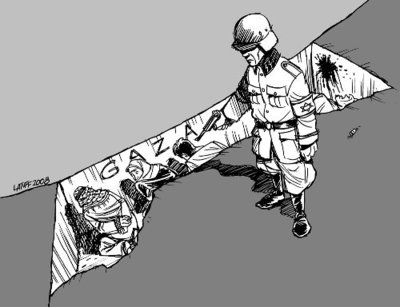
By Carlos Latuff

By Carlos Latuff

There are only two powers in the world…the sword of the oppressor and the spirit of the oppressed. In the long run, the sword is always defeated by the spirit.”
– Napoleon Bonaparte

It is the duty of Israeli leaders to explain to public opinion, clearly and courageously, a certain number of facts that are forgotten with time. The first of these is that there is no Zionism, colonization or Jewish State without the eviction of the Arabs and the expropriation of their lands.”
–Yoram Bar Porath, Yediot Aahronot, of 14 July 1972.

May the Holy Name visit retribution on the Arabs’ heads, and cause their seed to be lost, and annihilate them, and cause them to be vanquished and cause them to be cast from the world. It is forbidden to be merciful to them, you must give them missiles, with relish – annihilate them. Evil ones, damnable ones.”
— Ultra-Orthodox Shas Party spiritual leader Rabbi Ovadia Yosef, in a sermon discussing Passover and God’s wrath at Israel’s enemies, 8 April 2001. Some months ago he distinguished himself by describing Arabs as “snakes” whom “God regrets having created“.
(more…)

Rule #1: In the Middle East, it is always the Palestinians that attack first, and it’s always Israel who defends itself. The name of this is “retaliation”.


Rule #2: The Palestinians are not allowed to kill Israelis. The name of this is “terrorism”.


Rule #3: Israel has the right to kill Palestinian civilians; the name of this is “self-defense” or “collateral damage”.


Rule #4: When Israel kills too many Palestinian civilians, the Western world calls for restraint. This is called the “reaction of the international community”.


Rule #5: Palestinians do not have the right to capture Israeli military, not even 1 or 2.


Rule #6: Israel has the right to capture as many Palestinians as they want (around 10,000 to date being held without trial). There is no limit; there is no need for proof of guilt or a trial. All that is needed is the magic word: “terrorism”.


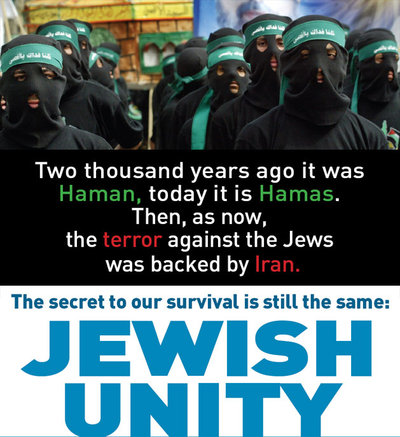
Rule #7: When you say “Hamas”, always be sure to add “supported by Hezbollah, Syria and Iran”.


Rule #8: When you say “Israel”, never say “supported by the USA, the UK, European countries and even some Arab regimes”, for people (God forbid) might believe this is not an equal conflict.


Rule #9: When it comes to Israel, don’t mention the words “occupied territories”, “UN resolutions”, “Geneva Conventions”. This could distress the audience of Fox, CNN, etc.


Rule # 10: The Palestinians are always “cowards” who hide behind a civilian population that “they don’t care about”. If they (militants) sleep in houses with their families, the name of this is: “cowardice”. Israel has the right to annihilate the towns where they sleep using bombs and missiles. The name of this is “high precision surgical action”.


Rule #11: Israelis speak better English than Arabs. This is why we let them speak out as much as possible, so that they can explain rules 1 through 9. The name of this is “neutral journalism”.


Rule #12: If you don’t agree with these rules or if you favor the Palestinian side over the Israeli side, you must be a very dangerous anti-Semite. You may even have to make a public apology if you express your honest opinion.


THIS NAME OF THIS IS: DEMOCRACY!!

(Isn’t democracy wonderful?)


Now that you have read the rules (a Spanish language version of them says the author was God, and I’ve translated an Italian version you can read tomorrow on www.tlaxcala.es), see what the Ministry of Foreign Affairs Lies and Deception has issued in today’s briefing. It’s their denouncement of War Crimes and Death of civilians, of thievery and use of weaponry. Obviously, they project all evil onto their enemies, and here is a classic example of the Hasbara of Israel’s “Good War in a Nutshell”. If you read it, you will see that they are accusing Hamas of all and sundry, War Crimes, even! See how well they apply these rules, going beyond the beyond! They tout about words such as “Truth”, the use of exaggeration and hyperbole alone is staggering, “Eight years of constant rocket barrages”, “I don’t think there’s ever been a time in the history of warfare when any army has made more efforts to reduce civilian casualties and deaths of innocent people than the IDF is doing today in Gaza.”,  and the whopper, “…I was struck by how cosmetically unchanged Gaza appeared to be.”


Count how many times they use each rule and share your results with the rest of us! Find a few rules that were hidden… in essence, for lovers of science fiction or fairy tales, this genre will be right up your alley.

Behind the Headlines: The truth about Hamas crimes in Gaza

The evidence of Hamas’ war crimes, its exaggeration of civilian casualties and damage to property, its abuse of humanitarian aid and its intimidation of Gaza’s residents are finally coming to light.

Despite Hamas’ best efforts to hide the truth about events in the Gaza Strip, the evidence of Hamas’ war crimes, its exaggeration of civilian casualties and damage to property, its abuse of humanitarian aid and its intimidation of Gaza’s residents are finally coming to light.

Israel knows better than most countries the horrors of war. Eight years of constant rocket barrages targeting Israeli civilians, eight years of trying tactic after tactic to stop these war crimes left Israel with little choice but to invoke its legitimate right of self-defense.

When Israel did strike back against Hamas terror in Gaza, it took unprecedented and innovative steps to try to encourage civilians to avoid Hamas positions, even placing tens of thousands of phone calls warning residents in hazardous areas. As British Colonel (ret.) Richard Kemp commented on the BBC, “I don’t think there’s ever been a time in the history of warfare when any army has made more efforts to reduce civilian casualties and deaths of innocent people than the IDF is doing today in Gaza.”

To Israel’s great sorrow, innocent civilians in Gaza have been harmed. However, the figures of civilian casualties have been greatly exaggerated. Most of these figures come from Hamas sources, amplifying the number of civilians killed by including as “children” teenage Hamas fighters and as “women,” female terrorists. According to an Israeli investigation, of the 1,100-1,200 reported casualties, 250 were civilians. The rest are believed to be terrorists or have yet to be identified, but given that most of them are young men in their 20s, it is not unreasonable to assume that they are also members of Hamas or other terrorist organizations.

Hamas is responsible, both morally and under international law, for many of the dead and injured civilians. This terrorist organization deliberately used the local population as human shields, a war crime. Civilian structures were used as launching pads for rockets, a tactic that is extremely hazardous to residents. Civilians were prevented, at gunpoint, from fleeing the sites of battles and even children have been grabbed to be used as living bulletproof vests. Even ambulances were not safe from hijacking attempts by terrorists, who would lure the ambulances into the heart of battle to transport Hamas terrorists to safety.

Property damage, while sizeable, has also been exaggerated. As Tim Butcher, a journalist intimately familiar with the Gaza Strip reported (Telegraph, Jan 20): “There had been no carpet bombing of large areas, no firebombing of complete suburbs. Targets had been selected and then hit, often several times, but almost always with precision munitions. Buildings nearby had been damaged and there had been some clear mistakes… But, in most the cases, I saw the primary target had borne the brunt… For the most part, I was struck by how cosmetically unchanged Gaza appeared to be.”

Hamas’ rocket attacks, which continued throughout the operation, constituted a double war crime. Not only were they aimed at about 15% of Israel’s civilian population, they were cynically carried out from locations immediately adjacent to homes, schools, hospitals, relief agency warehouses, mosques, public buildings – as well as from the office building that housed foreign media studios. These reprehensible acts were documented not only in Israeli aerial films, but by the international media.

As Rod Nordland (Newsweek, Jan 20) described one event, “Suddenly there was a terrific whoosh, louder even than a bomb explosion. It was another of Hamas’s homemade Qassam rockets being launched into Israel – and the mobile launchpad was smack in the middle of the four [apartment] buildings, where every apartment was full…”

Lorenzo Cremonesi (Corriere della Sera, Jan 21) relates the testimony of “Um Abdallah”:  “Practically all of the tallest buildings in Gaza that were hit by Israeli bombs … had rocket launching pads on their roofs, or were observation decks for the Hamas. They had also put them near the big UN warehouse, which went up in flames.”

Many of Gaza’s residents are now returning home. Some have found weapons left behind by Hamas terrorists who turned their homes into forward positions against the IDF, or worse, bodies of terrorists killed during the fighting. Many blame Hamas for the loss of life and property damage caused by Hamas’ practice of hiding among the civilian population. However, critical as they are of the Hamas regime in private, few, if any, residents of Gaza will accuse Hamas publically, a move that is tantamount to suicide.

An official Fatah spokesman in Ramallah (Jerusalem Post, Jan 19) reported that 100 of his men in Gaza have been killed or wounded, some brutally tortured, by Hamas. A Fatah leader in Gaza City claimed that members of his faction were being held in school buildings and hospitals that Hamas had turned into make-shift interrogation centers, and as many as 80 were either shot in the legs or had their hands broken for allegedly defying Hamas’ orders (see also video of Fatah testimonials about Hamas).

Ulrike Putz (Der Spiegel, Jan 23) managed to interview Palestinians who were not too intimidated by Hamas to speak (as long as their full names were not used): “Hail found out after the cease-fire that the militants had used his house as a base for their operations. The door to his house stood open and there were electric cables lying in the hallway. When Hail followed them they led to his neighbor’s house which it seems Hamas had mined. As Hail, in his mid-30s, sat on his porch and thought about what to do a man came by: He was from Hamas and had left something in Hail’s home. He let him in and the man then emerged with a bullet proof vest, a rocket launcher and an ammunitions belt. An hour later a fighter with Islamic Jihad called to the door, then disappeared onto the roof and reappeared with a box of ammunition.” 

Israel has a strong interest in the rehabilitation of the Gaza Strip and will work together with the international community and moderate Arab regimes to improve the lives of Gaza’s residents. However, caution most be exercised to ensure that the aid does not end up in Hamas’ pockets.

This is not unwarranted wariness – Hamas has a long history of stealing humanitarian aid for its own use, even while the operation was ongoing. As Yaacov Katz reported (Jerusalem Post, Jan 12), “Hamas raided some 100 aid trucks that Israel had allowed into Gaza, stole their contents and sold them to the highest bidders.”     Earlier (Jerusalem Post, Jan 6) Mr. Katz related that “Hamas has set up an independent hospital in the Gaza Strip to treat its operatives wounded in fighting with the IDF – and, according to Israeli estimates, it is pilfering a significant portion of the medicine allowed into the Strip…”  

These reports are not only coming in from Israeli sources. Jordan’s News Agency (Petra, Jan 20) reported on the hijacking of humanitarian aid on its way to UNWRA warehouses in Gaza for distribution to the civilian population: “A number of armed men have seized on Tuesday a Jordanian aid convoy after entering the Gaza Strip… The armed men opened fire at drivers after crossing Karem Abu Salem [Kerem Shalom] crossing point and forced them to head to their own warehouses.”

Hamas’ hijacking of humanitarian aid is not only ethically repulsive, it is extraordinary given that Hamas is attempting to claim that the motive for its  rocket attacks is to force the opening of the crossings. This assertion is, of course, preposterous given that the rocket fire started eight years ago, when there was free trade with Gaza and continued after Israel completely withdrew from the Gaza Strip. Moreover, Hamas’ constant and deadly rocket, mortar, truck-bomb and shooting attacks on the crossings are one of the prime reasons for their closing.

The complexities of fighting terrorist organizations are becoming more familiar to democratic states, including NATO forces in Afghanistan. A British soldier who served there analyzed the IDF’s activities in light of his experience and noted (The Spectator, Jan 24) that “I believe that I and other soldiers understand the stress, friction and confusion that combat brings in a way that media commentators and UN bureaucrats never can.”

However, one principle is clear to any unbiased analyst – as long as Israel, and not Hamas, is blamed for civilian casualties and property damage, Hamas will continue to use civilians as human shields and violate every basic rule of international humanitarian law.

As Nir Boms, vice president of the Center for Freedom in the Middle East, and Shayan Arya an Iranian activist, wrote (Jerusalem Post, Jan 28), “War, even when justified, brings much injustice with it. But there is also an important lesson to be learned, and a hope that this time it will not be completely missed by the rioting Arab street… The Palestinian discourse often fails to address the question of responsibility and accountability for Palestinian choices, decisions and leadership.” The Palestinians in Gaza must accept and take responsibility for the consequences of the Hamas leaders they chose.

Fortunately, the truth is starting to come to light. Even a senior European Union official – Louis Michel, European Commissioner for Development and Humanitarian Aid – denounced Hamas, not only stating (AFP, Jan 26) during his visit to Gaza: “I intentionally say this here – Hamas is a terrorist movement and it has to be denounced as such,” but also concluding that: “At this time we have to also recall the overwhelming responsibility of Hamas” for the conflict in Gaza.

Soon after we had seen a unilateral ceasefire from Israel followed by the withdrawal of the Israeli Defense Forces (IDF) after a 22-day assault on the Gaza Strip, we hear the usual two sides of the story, from both Israel and Hamas, each one claiming that Victory was on its Side and all goals were achieved. Either by “Eliminating Hamas Infrastructures and putting an end to the weapon smuggling through underground tunnels” or by “Showing that Hamas Militants stood still facing the state-of-the-Art destructive ‘American-made’ technology by the hands of the Zionists” and how it was able with it’s humble capabilities to push IDF back with bare hands renewing the memory of Israel Defeat in the minds of those who witnessed the Lebanon War in 2006.

Whether Hamas or Israel won, it would matter no more. After all, thousands of Civilians have paid the price in this war, fed their innocent blood to the barrels of the Israeli machine guns and the Zionist bloodthirsty grenades and missiles.

While War Crimes were committed in Gaza, Countries were silently watching it on the media screens and when they decided to act positively towards this horrible situation, they decided to watch some more. Each country (whether, Arab or non-Arab) carrying its hidden agenda, shutting every spokesmen’s mouth from speaking out the truth supporting the weak Gazans.

It was not a surprise for us to see former President Bush behaving gloatingly, invoking the mendacious mantra that “Israel has the right to defend itself.” No wonder his era was the bloodiest since Roman times. Neither are we expecting Obama to change the unjust statements that come from the White House. Unfortunately, as Khaled Amayreh said, “the American political environment is too morally barren, Zionist soaked to produce truly moral politicians who would be willing, let alone able, to call the spade a spade, especially when the Zio-Nazi state is concerned.”
Neither was it a surprise to see Egypt has, to some extent, used this conflict, certainly seen it, as a means of weakening Hamas and bringing Mahmud Abbas [the Palestinian President, also known as Abu Mazen] back to a ruling position in Gaza. Since he always played the “good boy” role regarding so-called peace talks with the Zionist state. Not to mention on 06/20/07, Hamas gunmen stormed the Fatah security compounds in Gaza discovering something far more valuable than some American-made weapons and grenades — CIA files which purportedly contain “information about the collaboration between Fatah and the Israeli and American security organizations; CIA methods on how to prevent attacks, chase and follow after cells of Hamas and their Committees; plans about Fatah assassinations of members of Hamas and other organizations; and American studies on the security situation in Gaza.” So eventually Israel had created a pretty good doll to play with to eliminate all the pockets of resistance.

On the controversy, Israel with this attack failed to weaken the ties of loyalty between the Palestinian citizens and Hamas; One of its unfulfilled primary goals was to weaken Hamas’ reputation in Gaza, starting with an absolute Siege preventing any basic supplies from entering to the civilians. Then after the siege was met with complete failure and Gazans bravely stood strong and showed the Zionists they are ready to take more for the sake of free Palestine, the military attack started adding more cuts to the unhealed wounds and more Death to the terminally ill.

We saw many Palestinian demonstrations in the West Bank and even inside Jerusalem supporting the Palestinian Resistance. With no doubt Gazans are more loyal to Hamas than before.

And this only shows that Israel kept on ignoring THE FACT, that there is a big difference between trying to eliminate a group of rebellious militiamen that could be thrown in the cages of surrender by military force and a movement based on a Religious Ideology which had been planted in Palestinian soil for decades, its roots reach deep inside the hearts of Palestinians. Every time trials are made to remove it, it even grows more strong, blossoming it’s Fruits sweeter than ever. And what Israel also learned is the more it presses on the so-called Moderate Arabic leaders, the more the Gap between them and their streets increase. This street rage in the Arabic world will swallow them before their own leaders like “Youssry Fouda” has mentioned in his recent article.

After this Crisis we have witnessed two major outcomes.

(1) If there is a bright spot of hope for Palestinians in the horrific aggressiveness of the last few weeks, it is that Israel’s deployment of disproportionate and blind, indiscriminate violence in Gaza has revealed the abnormality, brutality and pro-Terrorist nature of the occupation for millions of people, especially in the western world, who previously had been unable to perceive it due to the pro-Zionist Media washing the blood from the faces of the Israeli spokesmen before appearing on the news channels.

(2) It was a reckoning day for the Arab and Western Leaders, Arab and International states where all masks were removed and true faces were revealed regarding their devotion/deception, truthfulness/treason, hatred/hope towards a free Palestine for Palestinians.


WRITTEN BY KHALID AMAYREH – The meeting in Cairo on Monday 26 January, between a Hamas representative and Fatah leader Azzam al Ahmed is a glimmer of hope for millions of Palestinians and their allies who are hoping and praying for a speedy end of the enduring rift between the two biggest political camps in the Palestinian arena.


Though symbolic and procedural in nature, the meeting shows that the problems between the two sides can be overcome if both sides display good-will and especially if the Ramallah regime ends its ignominious subservience to Israel and the United States.


Needless to say, the rift has wreaked havoc on the reputation of the just Palestinian cause and caused many bleeding wounds to our people, the scars of which will take a long time to heal.


However, we are still one people, feeling the same pain, languishing under the same hateful occupation, and harboring the same hopes for freedom and justice.


But in order to reach a lasting national harmony, we need to be honest and frank, and refrain from trying to negate the other side.  This is so because neither Hamas nor Fatah will go away or evaporate into nonexistence.


There is no doubt that a great calamity has hit our people in the Gaza Strip. But by no means was that evil aggression  a victory for Israel unless the Zio-Nazi entity views the mass killing of innocent civilians and the mass destruction of residential homes and public buildings as an act of heroism.


Well, if so, then we would have to view Adolf Hitler as the greatest hero of all times.


Nonetheless, we should refrain from whipping ourselves too much or trying to score propaganda points one against the other.


Israel did try to decapitate Hamas, destroy its legitimate government (legitimate because Hamas was elected by the Palestinian people) and give the Gaza Strip back to PA leader Mahmoud Abbas on a sliver platter.


The fact that Israel couldn’t achieve the criminal goal was not due to Israeli magnanimity. Zionists are too thuggish and too criminal minded to know the meaning of magnanimity. After all, magnanimity requires at least a modicum of humanity and Zionism has none of that.


In truth, Hamas and other Palestinian resistance factions earned this spectacular steadfastness, this legendary resoluteness, in the face of overwhelming criminality, hideousness and firepower.


Hence, one can only view with utter contempt the cheap canards and calumnies coming out of Ramallah and accusing the resistance of responsibility for the widespread death and destruction in Gaza, as if the murderous pilots who were raining bombs and missiles and white phosphorous on the heads of our children and civilians were members of Hamas, not Israeli war criminals.


To be sure, such cheap accusations are made by two categories of people, ignoramuses who don’t know the facts, and bona fide traitors who are doing Israel’s work.


The former can be somehow forgiven by virtue of their ignorance or stupidity. However, the latter are willful Judases who ought to be silenced and punished. And if the time is not conducive to dealing with them the proper way, they should be isolated in disgrace.


This should be one of Hamas’s key tasks in the coming weeks and months. Otherwise, the Fifth columnists within Fatah and the PA, the very people who committed national adultery in broad daylight by collaborating with the Shin Beth and the CIA for the purpose of raping the Palestinian people’s will and achieving America’s morbid goals in this tortured part of the world, will continue to create mischief and try to rock the collective Palestinian boat.


These must be ejected, isolated, exposed, disgraced, and made to pay for their treachery and perfidy.


But Fatah is not a movement of traitors, and it is not in the Palestinian people’s interests to see Fatah catapulted into the laps of the likes of Muhammed Dahlan, Nimr Hammad and al-Tayeb Abdul Rahim who probably were dreaming, even loudly, of an Israeli victory in Gaza.


Hence, it is both right and wise for Hamas to get closer to true patriots within Fatah. And the time to do that is now.


There is no doubt that despite the enormity of the genocidal Zionist blitzkrieg against our people in Gaza, Hamas has not only managed to remain intact, but has also earned overwhelming respect and admiration from around the world.


Hamas shouldn’t treat lightly this earned outpouring of support which many movements, parties and governments even dream of receiving a fraction of.


In this light, Hamas should show enlightened flexibility toward re-establishing national unity.


It is this national unity that will eventually dump the government of Fayadh into the dustbin of history and do away with the whoring practice known as “security coordination.”


The restoration of national unity will also impose an early retirement on people like Keith Dayton and other CIA officers who have taught hundreds, if not thousands, of our beguiled and naïve young sons that the enemy is Hamas, not the Zionist thugs who have just murdered and maimed thousands of our children and civilians in the Gaza Strip and who have been stealing our land and narrowing our horizons.


In the Quran, God orders Muslims to refrain from falling into disunity and internal conflicts.


In Surat al Anfal, God says: “ And obey God and His Messenger and fall not into disputes, lest you lose heart and your power depart; and be patient and persevering: For God stands with those who patiently persevere.” Of all Palestinian factions, Hamas should understand this best.


Amen!

To support Peoples’ Anti-Imperialistic Resistance and the building of Alternatives to Globalisation 

On the initiative of several research centres, associations and socio-political movements, The Beirut International Forum was held on 16, 17 and 18 January 2009, attended by Arab and international delegations and authorities from five continents (66 countries).


This Forum, in which South America, Asia and Near East were massively represented, embodied the spirit of the Tricontinental centre.


Two major topics characterised the Forum. On one hand, the heroic resistance by the Palestinian people of Gaza and their ability to confront an intense violence and unprecedented barbarity. On the other, capitalism’s global crisis, which is not only financial but also on economic, social, cultural and moral fronts, thus posing a threat to the survival of humanity itself.
Principles and rights

The Forum declares that:

– All Peoples have the right to resist. This right must be inalienable, supported by the entire international community and recognised as such within international law;

– The resistance’s fight against colonialism can’t be detached from the struggle carried out by world revolutionaries and free individuals when facing global capitalism, imperialism, militarisation and destruction of social achievements. These have been the product of the working classes’ tenacious struggles for two hundred years;

– Peoples have the right to sovereignty over their own natural resources. Rights to nourishment, health and education prevail over all commercial stakes;

– Every culture has to be able to help build humanity’s common good with respect for nature, the supremacy of human needs and a democratic management of societies;

– The right to democratic participation must be exerted not only on a political level but also on an economic one and it applies to men and women alike;

– The right to cultural differentiation and freedom of worship without any cultural or racial stigmatisation.


Campaigns and resolutions
Concerning Gaza:

The Forum’s attendees declare their support of the Palestinian people’s resistance of Gaza. They condemn the terrorism, crimes, violations of the rule of law and disregard for human value, which Israel has inflicted on these populations.

Moreover, they call for:
1-     Applying severe sanctions against Israel, such as: calling off relations and covenants and forbidding any sale of weapons to this country;
2-     Legal proceedings against states and companies selling weapons to Israel;
3-     Urging the EU to put an end to all economic, political and cultural relations with Israel and to cancel all the covenants and agreements linking it with this country;
4-     Holding an international conference in order to judge war crimes and crimes against humanity inflicted upon Gaza’ s population, as well as economic and environmental crimes, and to bring to court the persons accountable for these actions, as well as for those committed in Lebanon in 2006;
5-     Restoring UN Resolution 3379 which classifies Zionism as racism, and ousting Israel from the UN;
6-     Launching an international campaign for rebuilding Gaza, lifting the blockade and having political prisoners released

Concerning the anti-imperialistic and anti-colonialist struggle
1-     The Forum participants expressed their support for both the Palestinian and Lebanese resistances against Israeli occupation, as well as to the Iraqis’ fight against American occupation. In addition, they back the Iraqi people’s endeavours to preserve their territorial unity.
2-     The participants declare their support for self-determination for the Afghan people and to their struggle against the American and Atlantic occupation.
3-     The participants salute Venezuelan President Hugo Chavez and Bolivian President Evo Morales for their support to the peoples’ resistance. They express total endorsement of their fight against US’s interference in South America.
4-     They call for lifting the embargo on Cuba and the release of Cuban prisoners detained in US’ prisons.
5-     They demand the establishment of an international league of Parliamentary members in order to uphold the peoples’ right to resistance and self-determination, in order to restore accords relevant to the defence of civilian populations.
6-     They urge the creation of an international media network that may expose the mendacious propaganda concerning Israel’s character and crimes.
7-     Carrying on the moral imperative to judge war crimes, namely bringing to court the people responsible for the war crimes committed in Lebanon in 2006.
8-     Launching a campaign to enforce the consultative advice by the International Court of Justice concerning the wall’s ethnic segregation in Palestine.
9-     Setting up an international network with the aim of coordination between local delegations during crises and wars.
10-          Refusing threats and provocations by the US against Iran with regard to its right to develop its nuclear program for civil purposes within the context of international laws. Refusing, likewise, the threats of war by the US towards Syria and Sudan.
11-          Opposing American attempts to make international and humanitarian laws ineffective under the pretext of the war on terror.

The participants suggest the following as alternatives to the market’s blackmail:
1-     Excluding agriculture and feeding-related sectors from the international negotiations contemplating the privitisation of markets (GATT, OMC…)
2-     Turning down accords and international policies that allow corporations to control living organisms thus jeopardizing biodiversity.
3-     Setting up a Mediterranean Common Market based on fair trade between customers and producers, from the north and the south of the basin as well as within each country. All this is to be performed within a process for building an area linking Mediterranean basin with Mesopotamia (leaving out Israel until the colonial question in Palestine is settled), in opposition to Sarkozy’s neo-liberal project.
4-     Fighting the excessive exploitation carried out by industrial fishing in favour of artisan fishery.
5-     Preserving the common asset of humanity and the fundamental resources for living. Developing organic agriculture and using renewable energy sources.


The Center for Studies and Documentation in Beirut, International Campaign against American and Zionist Occupation (the Cairo Conference), the National Gathering to Support the Choice of Resistance (Lebanon), The International Anti-Imperialist and Peoples’ Solidarity Forum (the Calcutta- India Conference), Stop The War Campaign (London), L’union de la jeunesse démocratique (Liban), Réseau des organisations de la jeunesse Palestinienne, The Party of Dignity (Egypt), The Popular Campaign to Break the Siege on Gaza, KIFAYA (le mouvement egyptien pour le changement), Union of Democratic Youth (Lebanon), Egyptian Women Issues Association, Palestinian Youth Organizations Network (Palestine), Fédération des Syndicats marocains, AMCI (The Mediterranean Agency for International Cooperation (Morocco), Arab Youth Council- and the wWalk to the aArab pParliament (Morocco), Data and Strategic Studies Center (Syria), El Badil Regroupement Anti Globalisation (Syria), Campaign Genoa 2001 Greece, l’altra Lambardia-Sulatesta, Anti- Imperialist Camp (Grèce),  Socialist Thinking Forum (Jordan), Organisation des socialistes révolutionnaires (Egypt), To be continued…

TRANSLATED BY DIEGO TRAVERSA AND REVISED BY SAJA RAOOF, MEMBERS OF TLAXCALA. www.tlaxcala.es

UPDATE! FURTHER INFORMATION ABOUT THE ARREST WRITTEN BY KHALID AT THE BOTTOM OF THIS POST! With friends like these – WRITTEN BY SHERINE BAHAA

KHALED AMAYREH, the Al-Ahram Weekly correspondent in the West Bank was arrested Sunday evening by the Preventive Security Forces (PSF) in Hebron. He was released after two days. Amayreh, 52, lives in Dura, 12 miles southwest of Hebron and has worked as the Weekly correspondent since 1997, as well as for a number of other media outlets.


He has a BA in journalism from the University of Oklahoma and an MA in journalism from the University of Southern Illinois. For a long time, he suffered, as do all Palestinians in the occupied territories, being confined by the occupation to his home village.


Not long ago, he was prohibited by Israeli forces from leaving Hebron at an Israeli checkpoint, detained and released only after being threatened for his courageous articles documenting Israeli crimes in the Weekly.


Surprisingly though, this time, Amayreh was not arrested by the Israelis, he was detained by the PSF; the PA police apparatus. This was the fourth time that Amayreh was arrested by the PSF. But this time why was he arrested? He was not in a demonstration, nor was he smuggling weapons to his fellow Palestinians being killed by Israelis on a daily basis.


His crime was explaining, during an interview with the Beirut based Al-Quds satellite TV, why there are only a few demonstrations in the West Bank in support of the people of Gaza. Amayreh frankly said that the PA did not allow such demonstrations. Amayreh did not mean to undermine the PA but he said, “the PA has certain commitments towards Israel and they (PA) do not want things to get out of their hands.” Amayreh also said the Israelis do not respect the PA and view the PA as a kind of “servant” to Israeli interests.


For the PSF, this was defamation. Amayreh speaking to the Weekly immediately after his release, explained that he only spoke of how Palestinian officials were prevented from moving freely and how Israel added more checkpoints to try to cordon Palestinians in closed areas. In short, they did not like the tone of the interview.


“They interrogated me for six hours, then they locked me in a dark cell for two days, where I could not tell day from night.”


“I think they released me because of the media and public pressure,” Amayreh said. According to Amayreh, around 15 journalists have been arrested over the past few months and some of them are still in jail.


Amayreh, father of nine, was taken from his family home to the headquarters of the PSF in Hebron. His family were denied any access to him.


The International Society for Translators and Linguists issued a statement condemning his arrest and asking for his immediate release. “These police units do not represent anything for Palestine except murder, destruction, corruption and chaos,” the statement said. “This apparatus is a disgrace to the history of the Palestinian Authority. Khaled Amayreh has helped the Palestinian cause much more than those people have,” the statement added.


In the past three weeks, dozens of Hamas supporters have either been detained or summoned for investigation by the PA’s much-feared Preventive Security Forces and General Intelligence Service. Coordination between the PA police forces and the Israeli occupation forces and Shin Beth has continued even as Gaza is being destroyed, in pursuit of their common goal of uprooting Hamas in the West Bank.


Five months ago, Amayreh was invited to attend a media conference in Germany and was granted a visa from the German representative office in Ramallah, the main stipulation being that he had never been arrested or detained by Israeli authorities. In spite of this, the Israeli military authorities refused to give him a permit to leave the West Bank and he was unable to travel. But be it the Israelis or the PA Security apparatus, it is evidently clear that Palestinians are continuously having their civil rights violated.


KHALID AMAYREH’S ACCOUNT OF HIS ORDEAL

Source: Islamonline 
http://www.islamonline.net:80/servlet/Satellite?c=Article_C&cid=1232976490385&pagename=Zone-English-Muslim_Affairs%2FMAELayout 

“Five Minutes” With the PA Interrogators
Muzzling Freedom of Expression in Palestine

By  Khalid Amayreh : Journalist – Occupied Palestine

When the Beirut-based Al-Quds satellite television interviewed me last week on the recent genocidal Israeli onslaught on the Gaza Strip, it never occurred to me that the few sound bites I uttered would land me in a slimy prison cell at the headquarters of the Palestinian Authority (PA) Preventive Security Apparatus (PSA) in Hebron.

During that interview, I was asked why the American-backed regime in Ramallah was not allowing large protests in solidarity with the Gaza Strip. I answered that the PA didn’t want things to get out of control and that it didn’t wish to antagonize Israel.

Interestingly, Israel itself had allowed a massive demonstration against the war on Gaza to take place in the Israeli Arab town of Sakhnin where as many as 150,000 people, including some Jewish peace activists, took to the streets to protest the nauseating killings and bombings of civilian targets all over the coastal enclave.

I further pointed out that Israel didn’t really respect the PA and was effectively treating it as a subservient entity serving  Israeli interests.
I  did think, and I still, that I was stating the obvious. However, the PA security establishment had a different idea.

Proverbial Cup of Coffee 
 
I was immediately locked up inside a small room and my mobile phone was confiscated.On Jan. 18, shortly afternoon, someone from the local PSA center invited me to drink a cup of coffee with the head of office for five minutes. Eventually, the “five minutes” were stretched into 55 hours of nightmarish experience.  

I knew they wanted to arrest me since most Palestinians have come to associate the onerous telephone call with imminent arrest by any of the security agencies.

When I arrived there, I was neither asked to meet with the local security chief nor offered the proverbial cup of coffee. Instead, I was immediately locked up inside a small room and my mobile phone was confiscated.

My watch and shoe laces were also taken from me. They must have been awfully worried about my safety!

Half an hour later, I was taken to the PSA headquarters in Hebron, 14 kilometers away. There, I was scolded for “besmirching and distorting the PA image,” “sowing discontent,” and “indulging in incitement.”

I was subjected to four sessions of interrogation which covered a whole set of issues and subjects from the Iranian strategy in the Middle East to the receding chances for the creation of a Palestinian state.

I told my interrogators that what they were doing was against the law, since the Palestinian law stated that “the security apparatus has no right to question, interrogate or detain a journalist in connection to his or her work.”
When I uttered these words, one operative scoffed at me, saying that “we are in Palestine, not in Sweden.”

Small, Semi-dark, Rancid-smelling Room

The interrogators didn’t really abuse me neither physically nor verbally. However, I was thrown into a small, semi-dark, rancid-smelling room with two other inmates, one a political prisoner and the other a common-law prisoner. That in itself was a humiliating form of mistreatment.

Getting dumped inside a slimy cell, with an exposed water circuit, was not exactly the right way to treat a journalist who has spent a lifetime defending the just Palestinian cause in face of Israeli propaganda and lies. But, then, they were probably right in a certain sense. The West Bank is not Sweden, and the PA regime is not the government of Sweden.

On Monday evening, Jan. 20, I was asked to meet with the PSA Chief, Abu Al-Fateh, who explained to me that the overall situation facing the PA was sensitive and delicate and that journalists had to be careful and cautious about what they say and write.

I generally concurred with him. However, I did forcefully argue that suppressing freedom of expression, especially press freedom, was a very harmful idea. I further  explained that when people are made to fear the government, it means that that the government is undemocratic and had a lot of things to hid from the people.

At the end of the conversation, I was told I could go home.

My latest encounter with the PSA is not the first time I am hounded by the PA security establishment. Last year I was subjected to intensive interrogation by the PA Mukhabarat (or general intelligence), also in connection with my professional work.

In 1998, I was arrested and briefly imprisoned for reporting on the prevalence of torture in some PA interrogation centers. I was also interrogated by both the Palestinian and Israeli security apparatuses over an article I had written on the  centrality of the right of return for Palestinian refugees uprooted from their ancestral homeland in what is now Israel.
These days, most Palestinians arrested by either Israel or the PA are rearrested by the other side after their release.

Self-censorship

Self-censorship is the ultimate enemy of healthy journalism.I knew that the main aim behind my brief but unjustified incarceration was to make me exercise “self-censorship” and refrain from calling things by their real names.

However, for journalists, “self-censorship” is not an innocuous word. It actually represents the ultimate enemy of healthy journalism. After all, a journalist ought to be responsible first and foremost to his or her conscience within the frame of the law.

Unfortunately, very few people within the Palestinian security establishment understand the language of human rights and civil liberties.

This condition is made even worse by the persistent power struggle between Hamas and Fateh, which is often used as a pretext and justification for the police-state atmosphere prevailing in the West Bank now.

Hence, one would exaggerate very little by saying that the situation of human rights and civil liberties is the West Bank is probably worse today than it ever has been since the establishment of the PA more than 15 years ago.

Rampant Violations

My latest experience pales in comparison to the more serious persecution haunting non-conformist journalists throughout the West Bank.In truth, my latest experience pales in comparison to the more serious persecution haunting non-conformist journalists throughout the West Bank.

Last week, PA security personnel assaulted and severely beat AP correspondent Majdee Ishtayyeh while filming an “unlicensed” demonstration in Ramallah. Ishtayya reportedly was taken to a nearby building where he was badly beaten, causing a severe hemorrhage from his nose.

The 44-year-journalist had to undergo a surgical operation to fix his battered nose at a Nablus hospital.

Some other journalists, photojournalists, and cameramen were violently assaulted and had their equipment broken or confiscated. 

Last year, as many as 20 Palestinian journalists were imprisoned for relatively lengthy periods for reporting news or views the PA regime considers detrimental to their interests or image. Many of these journalists were beaten and even tortured for refusing to abide by the “official line.”
And in nearly all cases, concocted charges were leveled against them, such as  “sowing division, incitement, and endangering national unity.”

Last year, Awad Rajoub, an Al-Jazeera.net correspondent was detained in a PSA prison cell in Hebron in what he described “harsh and humiliating conditions” for 32 days. Rajoub was forced to sleep inside a bare room, without mattresses or blankets, and had to use his own shoes as a pillow.
Rajoub was accused of interviewing critics of the PA.

Carte Blanch for Law Violation

In fact, there is a widespread impression that the security agencies are granted  a virtual carte blanch to violate the law for the sake of punishing and savaging political opponents of the PA regime, particularly people affiliated with the Islamic camp.

During my brief stint at the Hebron jail, I saw several inmates being subjected to the Shabah (hooding) technique where a prisoner is made to sit down in a small room with his hands tied to his back.

At one point, I heard an inmate crying “why are you beating me, why are you beating me.”

The PA government in Ramallah claims that it is doing its utmost to uphold the rule of law. This is its usual response to criticisms voiced by local and international human rights organizations.

However, it is obvious that the status of human rights and civil liberties under the PA   continues to deteriorate, especially with the virtual paralysis of the Palestinian justice system and especially in light of the conspicuous hegemony the security agencies exercises over civil society. This is why Palestinians do hope that the PA government, which many people view as both illegal and illegitimate, will issue clear and unmistakable orders to the security agencies to stop arresting and mistreating journalists and to respect the basic human and civil rights of Palestinian citizens.

Such a step is crucial for the creation of a healthy society based on the rule of law and respect for human dignity. It is also a sine-qua-non for the success of the Palestinian  national struggle for justice and freedom from the shackles of the colonialist Israeli occupation.

Khalid Amayreh is a journalist living in Palestine. He obtained his MA in journalism from the University of Southern Illinois in 1983. Since the 1990s, Mr. Amayreh has been working and writing for several news outlets among which is Aljazeera.net, Al-Ahram Weekly, Islamic Republic News Agency (IRNA), and Middle East International.


Song by The Dark Bob:


With George Bush now dumped into the dustbin of history, millions of people around the world are hoping that the new American president Barak H. Obama will make a genuine departure from the conspicuously criminal policies that characterized his predecessor’s gloomy era.


Undoubtedly, Bush excelled in the perpetration of evil. He murdered, killed, deceived and lied, thinking he was doing a great service to America and the world.


His era was drenched with blood, mostly the blood of hundreds of thousands of innocent civilians, killed unjustly under the misleading rubric of “the war on terror.”


In Palestine, and only three weeks before his unmissed departure, Bush gave the Zio-Nazi state of Israel carte blanche to commit a real genocide in Gaza in which thousands of helpless civilians were brutally massacred and maimed while thousands of homes and other buildings were utterly destroyed.


And instead of urging Israel to stop the pornographic bloodletting against the captive and virtually defenseless people of Gaza, Bush behaved gleefully and gloatingly, invoking the mendacious mantra that “Israel has the right to defend itself.”


We in the Middle East realize quite well that Obama is not going to be the paragon of freedom and justice many naïve people had thought he would be.


Unfortunately, the American political environment is too morally barren to produce truly moral politicians who would be willing, let alone able,  to call the spade a spade, especially when the Zio-Nazi state is concerned.


Doing so would most likely be tantamount to committing political suicide in a country where Congress, the media, Show business as well as the bulk of the vital financial industry are tightly controlled by Israel’s American gents.


Nonetheless, Obama should strive to be more than just a sort of a Bush-lite president. Otherwise, he would be repeating the same mistakes, indulging in the same follies and committing the same crimes, knowingly or unknowingly.


I know it is premature to judge the man since he has been only a few days in the White House.  However, the signs are not very encouraging.


Obama has refrained from denouncing the recent Nazi-like crimes committed by the Zio-Nazi state in the Gaza Strip. Obama spoke elaborately about Israel’s right to defend itself, but said absolutely nothing about the Palestinian people’s right to defend themselves.


He cited the “thousands of rockets” that Hamas fired on Israel, but completely ignored the cruel and deadly aggressions Israel has been carrying out against an imprisoned people languishing under a manifestly criminal siege that has striking similarities with the German siege of Ghetto Warsaw during the Second World War.


Obama said the Palestinians needed food, clean water and basic medical care. However, he carefully refrained from uttering the word “freedom.”  That was really mind-boggling, even shocking.


Well, Mr. Obama, are you betraying your own history? Your own Afro-American people’s struggle for freedom and justice? Besides, what happened to “give me freedom or give me death”?  Indeed, have you come to think that certain classes of people, the Untermenschen, don’t deserve freedom or can live without it?


Obama should understand that the enduring Palestinian cause is not about food, clean water and basic medical care, although these are basic necessities for all human beings. It is also not about border crossings or even terror.


What the Palestinians need most, Mr. Obama, is freedom, freedom from the Nazi-like Israeli occupation, oppression and persecution.


We want to be free from the evils wrought upon us by the Zionist occupation of our country. This evil occupation is a collective act of rape that robs us of our human dignity, human rights, even our very survival.


As human beings, we will not accept trading our God-given freedom for food, clean water and medical care.


The White slave masters once viewed your not-too-distant ancestors as only deserving food and water and probably some sort of medical care, but no freedom.


So, are you Mr. President trying now to reproduce ancient racism and apply it to our people, long haunted by foreign occupation and oppression?


Obama said Hamas would have to recognize Israel in order to qualify for his administration’s recognition.

Well, Hamas doesn’t need your recognition, Mr. Obama. It won’t do it any good. The US did recognize the PLO nearly two decades ago, after the latter recognized Israel.


But since then, and instead of pressuring Israel to end its criminal occupation and colonization of our homeland, successive American administrations (under Reagan, George Bush, Sr., Clinton, Bush, Jr.), gave Israel tens of billions of dollars to expand Jewish-only colonies, effectively enabling the criminal state to kill the prospect of any genuine peace settlement of the conflict.


So, what would your conditional recognition of Hamas do in real terms? Moreover, why do you think Hamas should repeat the same stupid blunders of the PLO?


Luckily, Hamas will not recognize the evil Zio-Nazi entity under any circumstances. Evil and its ramifications and implications must never be granted legitimacy, especially by its victims.


A state that commits genocide and exterminates thousands of innocent children and women and old men, by raining on their homes missiles and bombs from high altitudes, using the state-of-the-art of the American technology of death, cannot be a legitimate state. It is rather a criminal state that ought to be destroyed and eradicated.


More to the point, is not a state that uses White Phosphorous bombs against school children, worshippers praying to their God in peaceable mosques, and civilians seeking shelter in UN-run schools is a murderous genocidal state not unlike the Third Reich?


After all, there is not really a qualitative difference between exterminating people by way of gas chambers as the Nazis did several decades ago and incinerating them by White Phosphorous bombs and F-16 fighters as the great grandchildren of the holocaust survivors have just done in Gaza.


In short, Israel is a murderous criminal state which has no legitimacy. This is not a matter of a few rotten people at the helm of Israeli politics. The entire Zionist infrastructure is intrinsically and hopelessly evil.


Hence, no Palestinian with a modicum of national dignity and self-respect should lend legitimacy to this satanic entity.


One more message to Obama. It has been reported that one of the foreign policy priorities of your administration is to mend relations with the Muslim world.


Well, this is certainly a good idea. After all, one of the main causes of Muslim hostility to the US is America’s scandalous and enduring embrace of tyrannical Arab regimes that treat their own peoples as animals or sub-humans.


So, Mr. Obama, if you would like to see America respected, not just feared, by Muslims, you hasten to withdraw your country’s support from these rotten and self-worshipping tyrants who torment and savage their own masses on America’s behalf.


You certainly did the right thing by terminating some of the ugly practices initiated by Bush, e.g. the renditions and the ghoulish torture techniques such as “waterboarding,” that some of our Arab governments have been involved in obviously in collusion with the Bush administration.


Nonetheless, you still have a long way to go. These governments, which the US routinely calls “our allies,” are really tyrannical police states whose political and moral modus operandi represents the exact antithesis of every sublime value and ideal America holds dear.


So, please, Mr. Obama, withdraw your support from governments and regimes that don’t allow free and fair elections as well as freedom of expression; don’t court governments that arrest, persecute, torture, and kill political opponents and non-conformist journalists.  Don’t sanction police state practices in the Muslim world under the rubric of such outworn concepts as “the war on terror” or “fighting fundamentalism” or even “preserving America’s interests.”


Mr. President, the most effective means of safeguarding America’s interests in the Muslim world is attained by adopting a foreign policy based on justice, morality and respect for our people’s right to freedom and sovereignty.


Yes, embracing tyrannical police states in the Muslim world might look expedient in the short term. But in the long term, America will only reap the hostility of hundreds of millions of people in the Muslim world.


Finally, I would like to point out that Muslims don’t really hate America. I myself received my college and graduate education in the US, and I harbor no hatred or hostility to the American people.


Muslims only hate the often pornographic oppression meted to us as a result of America’s unjust policies.


And, as always, Palestine remains the most scandalous example.


INTERVIEWED BY Kourosh Ziabari


Adam Shapiro, the symbol of a courageous, pure peace advocate, has long been under fire for his unconditional and categorical criticism of Israeli occupying state.

Born in 1972, the perseverant and steadfast anti-Zionist campaigner and co-founder of International Solidarity Movement vigorously makes efforts to broadcast the voice of subjugated and downtrodden nation of Palestine.

Following his meeting with Yasser Arafat in his Mukataa (government center) in Ramallah while it was besieged during the March 2002 Israeli military operation in the West Bank and Gaza, Adam Shapiro attained an international popularity and was put under the spotlight of Zionist media thereafter.

Despite enduring a stack of insults and invectives from the side of Zionist campaign in the past years, Adam Shapiro neither has relinquished nor alleviated his stance so far; rather intensified his anti-Zionist statements in the particular situations such as the horrendous 22 days of Israeli incursion into Gaza.

This interview has been done in the midst of Israeli genocide in Gaza as it’s apparent in some points of the conversation; nevertheless, it contains some informative and revealing information which are prone to be read and reflected thoughtfully.


Would you please elucidate about the salient and prominent activities which you usually carry out in the International Solidarity Movement? What are your agenda, modus operandi and plans to help the survivors of recent offensive in Gaza?


The International Solidarity Movement (ISM) started off in 2001 as an effort to join international solidarity to the Palestinian resistance to Israeli occupation and oppression. This was through the joining of foreign activists with Palestinian activists in civilian-based non-violent active resistance in the west bank and Gaza. this kind of popular resistance has always been part of the Palestinian movement, and we felt that adding the international component would force the world to recognize that the conflict was not about Jew vs. Arab or Jew vs. Muslim, but rather a situation of oppression and discrimination based on ethnicity and religion in a sense similar to the anti-apartheid movement in south Africa.

Nowadays, the ISM role continues in this way, but is also more and more involved with being an eyewitness and reporting on the atrocities of what is happening to the Palestinian people. ISM volunteers spend longer periods of time in the territories and get to know the situation in depth.  

Currently ISM has 5 volunteers in the Gaza Strip, who are responding during this assault on the people of Gaza – they are escorting ambulances and medical personnel who are responding to emergency calls; they are documenting what is happening and reporting out to the world, even as the Zionist government bars foreign journalists; they are assisting in the distribution of food and water as they can and to areas that are under major threat; and they are documenting evidence of war crimes, such as the use of white phosphorous artillery shells.

According to what you said, one effective and impressive choice that could help the progressive flow of Palestinians’ extrication and release from the harsh situation is to promote the notion of imposing sanctions, embargo on Israel. How is it possible to boycott and isolate the terrorist regime in the international stage?


There is a call from Palestinian civil society to boycott Israel, and it is for this reason that we are compelled to adhere to this call. That said, sanctions will most likely be symbolic at best, given the penetration of businesses in Israel and the difficulty to render such an impact.  Symbolically, however the boycott, sanctions and divestment (BDS) campaign is very useful, particularly in the west, where it enables us to alter the debate away from spurious charges of anti-Semitism towards pointing out specifically why such measures are necessary.  Additionally, the academic and cultural boycott can have tangible results, forcing Israeli academics, artists and intellectuals to confront the reality of their own position and force them to take a stand.  There are very credible and valuable efforts in this regard, including a recent determination by a UK-based teachers union.  However, in a sense, we need to remember that far more dramatic action is required, given that this situation for the Palestinians has been going on for 60 years, and the scale of the devastation and oppression of the entire Palestinian people is at such a level that symbolic actions – while good – do not meet the urgency of the situation.


Nevertheless, US and its European allies flagrantly veto any anti-Israeli resolution which comes on the top of UNSC agenda and don’t allow the international community to express its unequivocal and clear condemnation of Israeli massacre freely. What’s the reason, in your view, and how can that be opposed?


The reason has to do with domestic factors for the US more than anything else.  I think for the European nations it is connected to the lingering guilt over the holocaust, a situation that is exploited by Israel and some of the Jewish organizations in those countries to maintain a code of silence when it comes to clearly calling out Israel for what has been a 60-year effort of crimes against humanity and ethnic cleansing.  For the US, there really is no organized constituency willing to vote or donate to politicians campaigns based on this issue. Those who would are small in number and largely ineffective.  the pro-Israel lobby in the US  is not only among the organized Jewish community, but includes Christian Zionists, the military-industrial complex in the US, the information technology industry, the biotech industry, the medical community and others, all of which have significant relationships with Israel from a business perspective. This all has repercussions in the US political system and set the parameters of the debate in the US around us support for Israel. 
 

That said, I also think the Palestinian leadership has missed opportunities over the years, but most importantly it accepted the framework of peace as a means of addressing the conflict, which helped set up a false sense of parity between the two parties. Instead of maintaining a position of national liberation, or creating a movement based on equal rights or ending oppression/discrimination, the choice for 2 states in the framework of peacemaking has helped allow the us and others to ‘blame both sides’.

All of these inconsistencies aside, neither the American double standards about the Israel’s nuclear case are bearable. They are folding their arms and sitting back relaxed while everybody, even ex-President Carter has confessed that Israel deposits 200 nuclear warheads!


Indeed, on this point in particular the hypocrisy reaches the level of absurd. Add to the points you raise in the question to the fact that Israel has been at war more than any other state in the region and almost always as the initiator and aggressor; not only in the formal wars, but also in the cross-border skirmishes, as occurred with Egypt and Lebanon in the past. If any regime in the region was volatile and prone to use military force it is Israel. A s such, there should be great world concern about its weapons of mass destruction, also since we have seen that Israel is willing to use dubious weapons and disproportionate force such as we witnessed in Lebanon in 2006 (cluster bombs) and Gaza today (white phosphorous artillery).


Accordingly, it seems that the mainstream media are pusillanimously afraid of the Israeli tyrannical lobby which rules the global corporate media. They censor any kind of news reflecting demonstrations, condemnations and anti-Israeli remarks by the world’s statesmen. How can they justify this unilateral and hostile approach in conveying the information? 


I think many of the same factors that influence how the US and European governments act also influence the media’s role. But there is also an element of having a media strategy that requires examination. Israel and its allies around the world have a clear, organized and effective media strategy to promote the messaging and images that they want. Sure, there is media bias, but it would be false to think that that bias is the beginning and the end. After all, I know many journalists who cover the conflict and who seek to promote different perspectives in their newspapers and broadcasts. On the Palestinian side, there really is not an effective media strategy, and certainly not one that is organized. Some of these very practical details can make a very big difference in the coverage of the issue.  While I don’t think this can fully overcome the bias that does exist, it can start making changes in the overall system.

I also think with the advent of new media, including Al-Jazeera and Press TV in particular, mainstream western media outlets are being challenged and being forced to change. Even the BBC’s own Arabic service has forced a certain change in BBC’s English service, which while subtle, nonetheless has important consequences.

Finally, I think it is also somewhat easy to overcount the media, in that worldwide, the Palestinian position of justice and ending occupation and oppression is the majority opinion, despite the media coverage.  It is not world opinion that necessarily needs to change; it is the actions of governments.

So what actions are needed to administer justice about Israel? How could the world’s countries prevent it from committing further, predictable atrocities and seeking adventurous war-games in the region?


There needs to be unequivocal action in the international community to force Israel to end is aggression in Gaza.  This should entail full suspension of diplomatic relations (as we have seen in Venezuela and Bolivia); full arms embargo on Israel; and the establishment of a criminal court under the ICC (mandated by the Security Council) to bring forward war crimes charges.  while these maybe long-shots, we have to remember that the Palestinian people, unlike virtually any other people in the world, are wholly dependent on the international community to act to help, both because it is the international community that is responsible for the original partitioning and displacement of the Palestinians and because Palestinians do not have a state, an army or any means of self-defense.  The UN General Assembly can also act and take dramatic action, and it should – and this would be a way to overcome a us veto.


And what about an international investigation on the illegal employment of unconventional weapons, mass killing of women and children, beleaguering the densely-populated strip for a long time and killing journalists, media correspondents and representatives of international communities? 

There needs to be a tribunal established to try these crimes committed in Gaza.  But this is truly not sufficient. The crimes of 60 years need to be addressed.  Because of the impunity Israel has enjoyed since 1948, the lesson it learned is that there are no consequences for its actions and no limits. The Palestinians have borne the brunt of that ‘freedom to act’ for 60 years. It is not enough to say what Israel is doing in Gaza today is too much. What was done in Deir Yassin, in Tantoura, in Lid, in the Jenin refugee camp, in Israeli prisons, and hundreds of other places and over the course of years, has been beyond the limit of international law and human rights. Of course, I would welcome justice for the crimes committed in Gaza, but this should just be the beginning.  

WRITTEN BY Henry Siegman


Western governments and most of the Western media have accepted a number of Israeli claims justifying the military assault on Gaza: that Hamas consistently violated the six-month truce that Israel observed and then refused to extend it; that Israel therefore had no choice but to destroy Hamas’s capacity to launch missiles into Israeli towns; that Hamas is a terrorist organisation, part of a global jihadi network; and that Israel has acted not only in its own defence but on behalf of an international struggle by Western democracies against this network.


I am not aware of a single major American newspaper, radio station or TV channel whose coverage of the assault on Gaza questions this version of events. Criticism of Israel’s actions, if any (and there has been none from the Bush administration), has focused instead on whether the IDF’s carnage is proportional to the threat it sought to counter, and whether it is taking adequate measures to prevent civilian casualties.


Middle East peacemaking has been smothered in deceptive euphemisms, so let me state bluntly that each of these claims is a lie. Israel, not Hamas, violated the truce: Hamas undertook to stop firing rockets into Israel; in return, Israel was to ease its throttlehold on Gaza. In fact, during the truce, it tightened it further. This was confirmed not only by every neutral international observer and NGO on the scene but by Brigadier General (Res.) Shmuel Zakai, a former commander of the IDF’s Gaza Division. In an interview in Ha’aretz on 22 December, he accused Israel’s government of having made a ‘central error’ during the tahdiyeh, the six-month period of relative truce, by failing ‘to take advantage of the calm to improve, rather than markedly worsen, the economic plight of the Palestinians of the Strip . . . When you create a tahdiyeh, and the economic pressure on the Strip continues,’ General Zakai said, ‘it is obvious that Hamas will try to reach an improved tahdiyeh, and that their way to achieve this is resumed Qassam fire . . . You cannot just land blows, leave the Palestinians in Gaza in the economic distress they’re in, and expect that Hamas will just sit around and do nothing.’


The truce, which began in June last year and was due for renewal in December, required both parties to refrain from violent action against the other. Hamas had to cease its rocket assaults and prevent the firing of rockets by other groups such as Islamic Jihad (even Israel’s intelligence agencies acknowledged this had been implemented with surprising effectiveness), and Israel had to put a stop to its targeted assassinations and military incursions. This understanding was seriously violated on 4 November, when the IDF entered Gaza and killed six members of Hamas. Hamas responded by launching Qassam rockets and Grad missiles. Even so, it offered to extend the truce, but only on condition that Israel ended its blockade. Israel refused. It could have met its obligation to protect its citizens by agreeing to ease the blockade, but it didn’t even try. It cannot be said that Israel launched its assault to protect its citizens from rockets. It did so to protect its right to continue the strangulation of Gaza’s population.


Everyone seems to have forgotten that Hamas declared an end to suicide bombings and rocket fire when it decided to join the Palestinian political process, and largely stuck to it for more than a year. Bush publicly welcomed that decision, citing it as an example of the success of his campaign for democracy in the Middle East. (He had no other success to point to.) When Hamas unexpectedly won the election, Israel and the US immediately sought to delegitimise the result and embraced Mahmoud Abbas, the head of Fatah, who until then had been dismissed by Israel’s leaders as a ‘plucked chicken’. They armed and trained his security forces to overthrow Hamas; and when Hamas ­ brutally, to be sure ­pre-empted this violent attempt to reverse the result of the first honest democratic election in the modern Middle East, Israel and the Bush administration imposed the blockade.


Israel seeks to counter these indisputable facts by maintaining that in withdrawing Israeli settlements from Gaza in 2005, Ariel Sharon gave Hamas the chance to set out on the path to statehood, a chance it refused to take; instead, it transformed Gaza into a launching-pad for firing missiles at Israel’s civilian population. The charge is a lie twice over. First, for all its failings, Hamas brought to Gaza a level of law and order unknown in recent years, and did so without the large sums of money that donors showered on the Fatah-led Palestinian Authority. It eliminated the violent gangs and warlords who terrorised Gaza under Fatah’s rule. Non-observant Muslims, Christians and other minorities have more religious freedom under Hamas rule than they would have in Saudi Arabia, for example, or under many other Arab regimes.


The greater lie is that Sharon’s withdrawal from Gaza was intended as a prelude to further withdrawals and a peace agreement. This is how Sharon’s senior adviser Dov Weisglass, who was also his chief negotiator with the Americans, described the withdrawal from Gaza, in an interview with Ha’aretz in August 2004:


What I effectively agreed to with the Americans was that part of the settlements [i.e. the major settlement blocks on the West Bank] would not be dealt with at all, and the rest will not be dealt with until the Palestinians turn into Finns . . . The significance [of the agreement with the US] is the freezing of the political process. And when you freeze that process, you prevent the establishment of a Palestinian state and you prevent a discussion about the refugees, the borders and Jerusalem. Effectively, this whole package that is called the Palestinian state, with all that it entails, has been removed from our agenda indefinitely. And all this with [President Bush’s] authority and permission . . . and the ratification of both houses of Congress.


Do the Israelis and Americans think that Palestinians don’t read the Israeli papers, or that when they saw what was happening on the West Bank they couldn’t figure out for themselves what Sharon was up to?


Israel’s government would like the world to believe that Hamas launched its Qassam rockets because that is what terrorists do and Hamas is a generic terrorist group. In fact, Hamas is no more a ‘terror organisation’ (Israel’s preferred term) than the Zionist movement was during its struggle for a Jewish homeland. In the late 1930s and 1940s, parties within the Zionist movement resorted to terrorist activities for strategic reasons. According to Benny Morris, it was the Irgun that first targeted civilians. He writes in Righteous Victims that an upsurge of Arab terrorism in 1937 ‘triggered a wave of Irgun bombings against Arab crowds and buses, introducing a new dimension to the conflict’. He also documents atrocities committed during the 1948-49 war by the IDF, admitting in a 2004 interview, published in Ha’aretz, that material released by Israel’s Ministry of Defence showed that ‘there were far more Israeli acts of massacre than I had previously thought . . . In the months of April-May 1948, units of the Haganah were given operational orders that stated explicitly that they were to uproot the villagers, expel them, and destroy the villages themselves.’ In a number of Palestinian villages and towns the IDF carried out organised executions of civilians. Asked by Ha’aretz whether he condemned the ethnic cleansing, Morris replied that he did not:


A Jewish state would not have come into being without the uprooting of 700,000 Palestinians. Therefore it was necessary to uproot them. There was no choice but to expel that population. It was necessary to cleanse the hinterland and cleanse the border areas and cleanse the main roads. It was necessary to cleanse the villages from which our convoys and our settlements were fired on.


In other words, when Jews target and kill innocent civilians to advance their national struggle, they are patriots. When their adversaries do so, they are terrorists.


It is too easy to describe Hamas simply as a ‘terror organisation’. It is a religious nationalist movement that resorts to terrorism, as the Zionist movement did during its struggle for statehood, in the mistaken belief that it is the only way to end an oppressive occupation and bring about a Palestinian state. While Hamas’s ideology formally calls for that state to be established on the ruins of the state of Israel, this doesn’t determine Hamas’s actual policies today any more than the same declaration in the PLO charter determined Fatah’s actions.


These are not the conclusions of an apologist for Hamas but the opinions of the former head of Mossad and Sharon’s national security adviser, Ephraim Halevy. The Hamas leadership has undergone a change ‘right under our very noses’, Halevy wrote recently in Yedioth Ahronoth, by recognising that ‘its ideological goal is not attainable and will not be in the foreseeable future.’ It is now ready and willing to see the establishment of a Palestinian state within the temporary borders of 1967. Halevy noted that while Hamas has not said how ‘temporary’ those borders would be, ‘they know that the moment a Palestinian state is established with their co-operation, they will be obligated to change the rules of the game: they will have to adopt a path that could lead them far from their original ideological goals.’ In an earlier article, Halevy also pointed out the absurdity of linking Hamas to al-Qaida.


In the eyes of al-Qaida, the members of Hamas are perceived as heretics due to their stated desire to participate, even indirectly, in processes of any understandings or agreements with Israel. [The Hamas political bureau chief, Khaled] Mashal’s declaration diametrically contradicts al-Qaida’s approach, and provides Israel with an opportunity, perhaps a historic one, to leverage it for the better.


Why then are Israel’s leaders so determined to destroy Hamas? Because they believe that its leadership, unlike that of Fatah, cannot be intimidated into accepting a peace accord that establishes a Palestinian ‘state’ made up of territorially disconnected entities over which Israel would be able to retain permanent control. Control of the West Bank has been the unwavering objective of Israel’s military, intelligence and political elites since the end of the Six-Day War.[*] They believe that Hamas would not permit such a cantonisation of Palestinian territory, no matter how long the occupation continues. They may be wrong about Abbas and his superannuated cohorts, but they are entirely right about Hamas.


Middle East observers wonder whether Israel’s assault on Hamas will succeed in destroying the organisation or expelling it from Gaza. This is an irrelevant question. If Israel plans to keep control over any future Palestinian entity, it will never find a Palestinian partner, and even if it succeeds in dismantling Hamas, the movement will in time be replaced by a far more radical Palestinian opposition.


If Barack Obama picks a seasoned Middle East envoy who clings to the idea that outsiders should not present their own proposals for a just and sustainable peace agreement, much less press the parties to accept it, but instead leave them to work out their differences, he will assure a future Palestinian resistance far more extreme than Hamas ­ one likely to be allied with al-Qaida. For the US, Europe and most of the rest of the world, this would be the worst possible outcome. Perhaps some Israelis, including the settler leadership, believe it would serve their purposes, since it would provide the government with a compelling pretext to hold on to all of Palestine. But this is a delusion that would bring about the end of Israel as a Jewish and democratic state.


Anthony Cordesman, one of the most reliable military analysts of the Middle East, and a friend of Israel, argued in a 9 January report for the Center for Strategic and International Studies that the tactical advantages of continuing the operation in Gaza were outweighed by the strategic cost ­ and were probably no greater than any gains Israel may have made early in the war in selective strikes on key Hamas facilities. ‘Has Israel somehow blundered into a steadily escalating war without a clear strategic goal, or at least one it can credibly achieve?’ he asks. ‘Will Israel end in empowering an enemy in political terms that it defeated in tactical terms? Will Israel’s actions seriously damage the US position in the region, any hope of peace, as well as moderate Arab regimes and voices in the process? To be blunt, the answer so far seems to be yes.’ Cordesman concludes that ‘any leader can take a tough stand and claim that tactical gains are a meaningful victory. If this is all that Olmert, Livni and Barak have for an answer, then they have disgraced themselves and damaged their country and their friends.’


15 January


Note


[*] See my piece in the LRB, 16 August 2007.


Henry Siegman, director of the US Middle East Project in New York, is a visiting research professor at SOAS, University of London. He is a former national director of the American Jewish Congress and of the Synagogue Council of America.


http://www.lrb.co.uk/v31/n02/sieg01_.html


LRB contributors react to events in Gaza


Tariq Ali, David Bromwich, Alastair Crooke, Conor Gearty, R.W. Johnson, Rashid Khalidi, Yitzhak Laor, Yonatan Mendel, John Mearsheimer, Gabriel Piterberg, Jacqueline Rose (certainly to be published elsewhere), Eliot Weinberger, Michael Wood.


January 15, 2009


http://www.lrb.co.uk/web/15/01/2009/mult04_.html#tariqali


Tariq Ali


A few weeks before the assault on Gaza, the Strategic Studies Institute of the US Army published a levelheaded document on ‘Hamas and Israel’, which argued that ‘Israel’s stance towards the democratically-elected Palestinian government headed by Hamas in 2006, and towards Palestinian national coherence – ­legal, territorial, political and economic – has been a major obstacle to substantive peacemaking.’ Whatever their reservations about the organisation, the authors of the paper detected signs that Hamas was considering a shift of position even before the blockade:


It is frequently stated that Israel or the United States cannot ‘meet’ with Hamas (although meeting is not illegal; materially aiding terrorism is, if proven) because the latter will not ‘recognise Israel’. In contrast, the PLO has ‘recognised’ Israel’s right to exist and agreed in principle to bargain for significantly less land than the entire West Bank and Gaza Strip, and it is not clear that Israel has ever agreed to accept a Palestinian state. The recognition of Israel did not bring an end to violence, as wings of various factions of the PLO did fight Israelis, especially at the height of the Second (al- Aqsa) Intifada. Recognition of Israel by Hamas, in the way that it is described in the Western media, cannot serve as a formula for peace. Hamas moderates have, however, signaled that it implicitly recognises Israel, and that even a tahdiya (calming, minor truce) or a hudna, a longer-term truce, obviously implies recognition. Khalid Mish’al states: ‘We are realists,’ and there is ‘an entity called Israel,’ but ‘realism does not mean that you have to recognise the legitimacy of the occupation.’


The war on Gaza has killed the two-state solution by making it clear to Palestinians that the only acceptable Palestine would have fewer rights than the Bantustans created by apartheid South Africa. The only acceptable alternative is a single state for Jews and Palestinians with equal rights for all. Certainly it seems utopian at the moment with the two Palestinian parties in Israel ­Balad and the United Arab List – both barred from contesting the February elections. Avigdor Lieberman, the chairman of Yisrael Beitenu, has breathed a sigh of satisfaction: ‘Now that it has been decided that the Balad terrorist organisation will not be able to run, the first battle is over.’ But even victory has its drawbacks. After the Six-Day War in 1967, Isaac Deutscher warned his one-time friend Ben Gurion: ‘The Germans have summed up their own experience in the bitter phrase “Mann kann sich totseigen!” — you can triumph yourself to death. This is what the Israelis have been doing. They have bitten off much more than they can swallow.’


Five hundred courageous Israelis have sent a letter to Western embassies calling for sanctions and other measures to be applied against their country, echoing the 2005 call by numerous Palestinian organisations for Boycott, Divestment and Sanctions (BDS) on the South African model. This will not happen overnight but it is the only non-violent way to help the struggle for freedom and equality in Israel-Palestine.


Tariq Ali’s latest book is The Duel: Pakistan on the Flight Path of American Power.


David Bromwich


Like the suicide bombings of the Second Intifada, the rockets from Gaza were a choice of tactics of a spectacular vengefulness. The spectacle was greater than the damage: no Israeli had been killed by a rocket before the IDF launched their assault. Yet the idea of rockets falling induces terror, whereas the idea of an army invading a neighbouring territory has an official sound. The numbers of the dead ­ as of 15 January, more than 1000 Palestinians and fewer than 20 Israelis tell a different story. Many people remain unmoved by the tremendous disproportion because they cannot get the image of rockets out of their heads.


In the United States, since this one-sided war began on 27 December, facts are not suppressed but fiction pervades the commentary. We are offered an analogy: what would Americans do if rockets were fired from Canada or Cuba? The question has been repeated with docility by congressional leaders of both parties; but the rockets are assumed to come suddenly without cause. The choking of the Gaza Strip by land, sea and air, the rejection by the US of the Palestinian Unity Government, the coup launched by Fatah and bankrolled by the US, which ended in the seizure of power by Hamas ­ all of this happened before the rockets fell from thee sky. It is as if it belonged to a prehistoric time.


American politicians exhibit an identification with Israel that is now in excess of the measurable effects of the Israel lobby. The blindness of the identification has led the US to respond with keen sensitivity to Israeli requests for assistance and moral support, and to underestimate the suffering caused by the Gaza blockade and by the settlements and checkpoints and the wall on the West Bank. Yet grant the potency of the lobby and the identification ­ even so, the arrogance with which Israel dictates policy is hard to comprehend on the usual index of motives. Ehud Olmert boasted to a crowd in Ashkelon on 12 January that with one phone call to Bush, he forced Condoleezza Rice to abstain from voting for the UN ceasefire resolution she herself had prepared. The depth, the efficacy and the immediacy of the influence are treated by Olmert as an open secret.


To judge by the nomination of Hillary Clinton as secretary of state and the likely nomination of Dennis Ross as Middle East envoy, Obama wants to be seen as someone who intends no major change of course. In a televised interview on 11 January, he said he would deal with Israel and Palestine in the manner of the Clinton and Bush administrations. The unhappy message of his recent utterances has been reconciliation without truth; and reconciliation, above all, for Americans. This preference for bringing-together over bringing-to-light is a trait of Obama’s political character we are only now coming to see the extent of. It is an element  -until lately an unperceived element- ­ of a certain native moderation of temper that is likely to mark his presidency. Yet his silence on Gaza has been startling, even immoderate. The ascent of Barack Obama was connected in the world as well as in the US with peculiar and passionate hopes, and his chances of emerging as a leader of the world are diminished with every passing day of silence.


David Bromwich teaches English at Yale.


Alastair Crooke


‘We have to ask the West a question: when the Israelis bombed the house of Sheikh Nizar Rayan, a Hamas leader, killing him, his wives, his nine children, and killing 19 others who happened to live in adjoining houses ­because they saw him as a target, ­was this terrorism? If the West’s answer is that this was not terrorism, it was self-defence ­then we must think to adopt this definition too.’


This was said to me by a leading Islamist in Beirut a few days ago. He was making a point, but behind his rhetorical question plainly lies the deeper issue of what the Gaza violence will signify for mainstream Islamists in the future.


Take Egypt. Mubarak has made no secret of his wish to see Israel teach Hamas a ‘lesson’. Hamas are sure that his officials urged Israel to proceed, assuring Amos Yadlin, Israel’s Head of Military Intelligence, at a meeting in Cairo that Hamas would collapse within three days of the Israeli onslaught.


Islamists in Egypt and other pro-Western ‘moderate’ alliance states such as Saudi Arabia and Jordan have noted Israel’s wanton disregard for the deaths of civilians in its desire to crush Hamas. They have seen the barely concealed pleasure of the regimes that run those states. The message is clear: the struggle for the future of this region is going to be uncompromising and bloody.


For all Islamists, the events in Gaza will be definitive: they will tell the story of a heroic stand in the name of justice against overwhelming odds. This archetype was already in place on the day of Ashura which fell this year on 7 January — when Shi’ites everywhere commemorate the martyrdom of Hussein, the Prophet’s grandson, killed by an overwhelming military force at Kerbala. The speeches given by Hassan Nasrallah, Hizbullah’s secretary general, were avidly followed; the ceremony of Ashura drove home the message of martyrdom and sacrifice.


Islamists are likely to conclude from Gaza that Arab regimes backed by the US and some European states will go to any lengths in their struggle against Islamism. Many Sunni Muslims will turn to the salafi-jihadists, al-Qaida included, who warned Hamas and others about the kind of punishment being visited on them now. Mainstream movements such as the Muslim Brotherhood, Hamas and Hizbullah will find it hard to resist the radical trend. The middle ground is eroding fast.


At one level Gaza will be seen as a repeat of Algeria. At another, it will speak to wider struggles in the Arab world, where elites favoured by the West soldier on with no real legitimacy, while the weight of support for change builds up. The overhang may persist for a while yet, but a small event could trip the avalanche.


Alastair Crooke is co-director of Conflicts Forum and has been an EU mediator with Hamas and other Islamist movements. Resistance: The Essence of the Islamist Revolution will come out next month.


Conor Gearty


It is just possible the killings in Gaza may mark the end of Israel’s disastrous plunge into militant Zionism. The key is Obama: will he collapse under pressure like most of his predecessors, or is there more to him? Let us assume he knows how senseless it is for the US to collude in a crime of the kind going on in Gaza. There are ways of marking this without unleashing the pro-Israeli forces against him at too early a stage.


Clearly the new administration desires to re-engage with the global community and revive its commitment to international law: the ‘war on terror’ will be reconfigured and Guantanamo closed. A rededication of the US to law should also involve a more consensual approach to the UN ­“Security Council business in particular ­ including (for example) support for UN investigative missions to regions where egregious violations of human rights and breaches of the UN charter have occurred. It should entail the US signing up to the International Criminal Court” and urging its closest allies to do likewise. Framed in this way, a US engagement in the international human rights agenda would quickly lead to a crucial re-empowerment of the rapporteurs, special representatives, committees of experts and so on who have languished on the margins for so long.


This reformist energy would then need to be backed by mechanisms along the lines of the MacBride principles or the Comprehensive Anti-Apartheid Act linking US financial and military aid to the newly emerging international legal order. The worst offenders against the new dispensation would run the risk of economic and intellectual boycotts. Since its application would be general, Obama could do all this without any mention of Israel, leaving the consequences to be worked through by various bureaucracies, while the phone calls and special pleas are politely fended off with an easy ‘it is out of my hands’. Were pressure from the lobbies to reach dangerous levels, the president might choose to take the issue to the American people, to discuss openly whether Israel should have an exemption from the system of values to which every other genuine ally and the US itself will by then have signed up. That is not likely to be a debate which the Israeli leadership will want.


Conor Gearty, Rausing Director of the Centre for the Study of Human Rights and professor of human rights law at the LSE, has written a number of books on terrorism and human rights.


R.W. Johnson


The current crisis has probably not changed anything fundamental. As even the more pessimistic Israeli analysts have been noting for some time, the pressure of the crisis has turned many, perhaps most Palestinians into irreconcilable foes of Israel. To that extent the two-state solution, however much the great and good may wish it, gradually becomes less and less of a real solution. The present crisis was probably unavoidable given (a) Iran’s position, (b) the coming Israeli election and (c) the failure of Israel to achieve full-scale victory over Hizbullah last year. That last factor has weighed on all minds, showing Iran how much leverage it had, threatening to turn all Arab-occupied land into rocket-launching grounds and increasing Israeli determination to show that this is a prohibitively expensive option for anyone who opts to host such an exercise. The stalemate seems complete.


I doubt whether Obama will make much difference. His chief of staff is an ex-Israeli soldier and his administration will be heavily in hock to the Israel lobby from day one. Israel may be unhappy that he will talk to Hamas but this unhappiness is quite unnecessary. He is not going to soft-talk them into accepting Israel’s existence and laying down their rockets, so what will such talks really change?


The real key remains US-Iran relations. This was a period in which many expected an Israeli strike against Iranian nuclear facilities. The fact that it has not happened is promising and suggests that the CIA is right to say Iran is not close to having nuclear weapons. As it is the US has hugely strengthened Iran by handing Iraq over to Shi’ites and an Obama administration might try to capitalise on that by making a US-Iranian deal the cornerstone of Middle East politics, thus reducing Syrian, Saudi and Egyptian leverage. Iran would obviously be greatly tempted by such a deal. But if Obama and Ahmadinejad really could reach a deal it would probably be very bad news for both Hizbullah and Hamas, who might get cut off from Iranian aid. If that happens, I can’t see much joy for Palestinian militancy. But if it doesn’t and the US under Obama is left to face an unchanged position, he is bound to end up taking Israel’s side as much as Bush did. Which also doesn’t bode well for militant Palestinians. So whatever happens I’d expect the Palestinians to emerge worse off from this conflict and Israel stronger, though probably less popular.


R.W. Johnson lives in Cape Town.


Rashid Khalidi


It is commonplace to talk about the ‘fog of war’, but war can also clarify things. The war in Gaza has pointed up the Israeli security establishment’s belief in force as a means of imposing ‘solutions’ which result in massive Arab civilian suffering and solve nothing. It has also laid bare the feebleness of the Arab states, and their inability to protect Palestinian civilians from the Israeli military, to the despair and fury of their citizens. Almost from the moment the war began, America’s Arab allies ­ above all Egypt ­ found themselves on the defensive, facing accusations of impotence and even treason in some of the largest demonstrations the region has seen in years. Hassan Nasrallah, the secretary general of Hizbullah in Lebanon, reserved some of his harshest criticism for the Mubarak regime; at Hizbullah rallies, protesters chanted ‘Where are you, Nasser?’ ­ a question that is also being asked by Egyptians.


The Egyptian government and its Arab allies ­ Saudi Arabia, Jordan, Morocco ­ responded to the war much as they responded to thee 2006 invasion of Lebanon: by tacitly supporting Israel’s offensive in the hope of weakening a resistance movement which they see as a proxy for Iran and Syria. When the bombing began, Egypt criticised Hamas over the breakdown of the reconciliation talks with Fatah that Cairo had brokered, and for firing rockets at Israel. The implication was that Hamas was responsible for the war. Refusing to open the Rafah crossing, the Mubarak government pointed out that Israel, the occupying power, not Egypt, was responsibile for the humanitarian situation in Gaza under the Fourth Geneva Convention. Egypt’s concern is understandable: ever since it recovered the Sinai in 1979, it has worried that Israel might attempt to dump responsibility onto it for the Strip’s 1.5 million impoverished residents, a fear that has grown as the prospects of ending the occupation have receded. But its initial refusal to open the crossing to relief supplies, medical personnel and reporters made it difficult for Cairo to deny charges that it was indifferent to Palestinian suffering, and that it valued relations with Israel and the US (its main patron) more highly than the welfare of Gaza’s people.


Since Hamas came to power in Gaza in 2006, Egypt’s press has been rife with lurid warnings ­ echoed in conservative Lebanese and Saudi newspapers, as well as Israeli ones ­about the establishment in Gaza of an Islamic emirate backed by Iran. Cairo’s distrust of Hamas is closely connected with internal politics: Hamas is an offshoot of the Muslim Brothers, the country’s largest opposition movement; and it came to power in Gaza in the kind of democratic elections that Mubarak has done everything to prevent. (He is likely to be succeeded by his son, Gamal, after sham elections.) When there still seemed hope of a Palestinian Authority (PA) coalition government between Fatah and Hamas (which would have diluted the latter’s power), Egypt was careful to appear balanced. But after the deep split in Palestinian politics that followed the Hamas takeover of Gaza in 2007, Egypt tilted increasingly against Hamas. The division of occupied Palestine into two PAs ­ a Fatah-ruled West  Bank and a Hamas-ruled Gaza Strip, both without sovereignty, jurisdiction or much in the way of authority ­ was seen in Cairo as a threat to domestic security: it promised greater instability on Egypt’s borders, jeopardised the negotiated two-state solution with Israel to which Egypt was committed, and emboldened allies of the Muslim Brothers.


Egypt has also been alarmed by Hamas’s deepening relationship with its fiercest adversaries: Iran, Syria and Hizbullah. ‘Moderate’ Arab regimes like the one in Egypt ­ deeply authoritarian, at best, but friendly with the US ­ have favoured peaceful negotiations with Israel, but negotiations have not led to Palestinian independence, or even translated into diplomatic leverage. Resistance movements such as Hizbullah and Hamas, by contrast, can plausibly claim that they forced Israel to withdraw from occupied Arab land while scoring impressive gains at the ballot box; they have also been reasonably free of corruption. As if determined to increase the influence of these radical movements, Israel has undermined Abbas and the PA at every turn: settlements, bypass roads and ‘security barriers’ continue to encroach on Palestinian land; none of the 600 checkpoints and barriers in the West Bank has been removed; and more than 10,000 Palestinian political prisoners languish in Israeli jails. The result has been the erosion of support for the PA, and for the conciliatory approach pursued by the PA and Arab states such as Egypt and Saudi Arabia, which reacted by moving even closer to the Bush administration in its waning days. Mubarak, according to Ha’aretz, urged Olmert to continue the Gaza offensive until Hamas was severely weakened – though Egypt has, of course, denied these reports.


But Hamas will not be so easily defeated, even if Israel’s merciless assault and Hamas’s own obduracy have brought untold suffering on the people of Gaza and much of the Strip lies in ruins: like Hizbullah in Lebanon in 2006, all it has to do in order to proclaim victory is remain standing. The movement continued to fire rockets into Israel under devastating bombardment, and it looks likely to emerge politically stronger when the war is over, although as with Hizbullah, it may have provoked popular resentment for bringing Israeli fire down on the heads of the civilian population: there was little Palestinian popular support for the firing of rockets at Israel in the months before the Israeli offensive. It is doubtful, moreover, whether any Hamas leader will be as shrewd as Hassan Nasrallah after the 2006 Lebanon war, when he admitted that had he known the damage Israel would do, he would not have offered the pretext that triggered its onslaught.


Israel began a propaganda campaign several months ago, when it closed Gaza to journalists in what appears to have been an effort to remove witnesses from the scene before the crime took place. Cell phone transmission was interrupted to prevent the circulation of photos and videos. The result, in Israel and the US, has been an astonishingly sanitised war, in which, in a bizarre attempt at ‘balance’, the highly inaccurate rocket attacks against Israel and their three civilian victims since the fighting began on 27 December have received as much attention as the levelling of Gaza and the killing of more than 1000 Palestinians and the wounding of nearly 5000, most of them civilians. But Arabs and Muslims (and indeed most people not living in the US and Israel) have seen a very different war, with vivid images of those trapped in the Gaza Strip, thanks in large part to Arab journalists on the ground.


During the large demonstrations that erupted in Egypt, Saudi Arabia, Morocco, Jordan and Yemen, condemnation was directed not only at the usual targets, Israel and the US, but also at the passivity, even complicity, of Arab governments. Stung by the protests and fearing popular unrest, several Arab states sent their foreign ministers to New York, led by Prince Sa’ud al-Faisal, the Saudi foreign minister, and forced through a Security Council resolution in the face of American resistance. Jordan withdrew its ambassador from Tel Aviv; Qatar broke off ties with Israel and offered $250 million for the rebuilding of Gaza. At the same time, Egypt made limited concessions, taking some wounded Gazans to hospitals in Egypt, providing medical supplies, and belatedly allowing a few medical personnel into the Strip through the Rafah crossing. Yet the Mubarak regime has otherwise continued to play the role of even-handed mediator.


As I write, its proposals for a ceasefire have met with a positive response from both Hamas (which has significantly modulated its criticism of Egypt) and Israel. It is still unclear how Egypt will respond to Israel’s demands that it halt arms smuggling through tunnels into Gaza; when and if the crossings will be fully opened; under what arrangements, and how reconstruction aid will be channelled to the devastated area; and indeed how an Egyptian-brokered arrangement, should it come into force and endure, will be regarded by Egyptian and Arab public opinion.


For the moment, the shaky legitimacy of Abbas’s government in Ramallah, and of the authoritarian Arab governments that have cast their lot with Israel and the United States in the regional contest with Iran, appears to have grown shakier still. Should Iran and Syria succeed in rapidly establishing new relationships with Washington under the Obama administration, these governments will be further weakened. Moreover, their inability (or their unwillingness) to do more to resolve the Palestine question, or even to alleviate Palestinian suffering, has been exposed once again. It contrasts starkly with democratic and non-Arab Turkey’s robust support for the Palestinians. Palestine has been a rallying cry for opposition movements in the Arab world since 1948, and in the decade after the first Arab-Israeli war a series of domestic upheavals, revolutions and coups took place in several Arab countries, including Egypt, where veterans of the Palestine war led by Nasser came to power in the 1952 coup against King Farouk. The repressive capacities of a government such as Egypt’s, whose secret police is said to employ more than a million people, should not be underestimated. But several unpopular regimes may face serious consequences at home for having aligned themselves with Israel.


Rashid Khalidi is Edward Said Professor of Arab Studies at Columbia.


Yitzhak Laor


We’ve been here before. It’s a ritual. Every two or three years, our military mounts another bloody expedition. The enemy is always smaller, weaker; our military is always larger, technologically more sophisticated, prepared for full-scale war against a full-scale army. But Iran is too scary, and even the relatively small Hizbullah gave us a hard time. That leaves the Palestinians.


Israel is engaged in a long war of annihilation against Palestinian society. The objective is to destroy the Palestinian nation and drive it back into pre-modern groupings based on the tribe, the clan and the enclave. This is the last phase of the Zionist colonial mission, culminating in inaccessible townships, camps, villages, districts, all of them to be walled or fenced off, and patrolled by a powerful army which, in the absence of a proper military objective, is really an over-equipped police force, with F16s, Apaches, tanks, artillery, commando units and hi-tech surveillance at its disposal.


The extent of the cruelty, the lack of shame and the refusal of self-restraint are striking, both in anthropological terms and historically. The worldwide Jewish support for this vandal offensive makes one wonder if this isn’t the moment Zionism is taking over the Jewish people.


But the real issue is that since 1991, and even more since the Oslo agreements in 1993, Israel has played on the idea that it really is trading land for peace, while the truth is very different. Israel has not given up the territories, but cantonised and blockaded them. The new strategy is to confine the Palestinians: they do not belong in our space, they are to remain out of sight, packed into their townships and camps, or swelling our prisons. This project now has the support of most of the Israeli press and academics.


We are the masters. We work and travel. They can make their living by policing their own people. We drive on the highways. They must live across the hills. The hills are ours. So are the fences. We control the roads, and the checkpoints and the borders. We control their electricity, their water, their milk, their oil, their wheat and their gasoline. If they protest peacefully we fire tear gas at them. If they throw stones, we fire bullets. If they launch a rocket, we destroy a house and its inhabitants. If they launch a missile, we destroy families, neighbourhoods, streets, towns.


Israel doesn’t want a Palestinian state alongside it. It is willing to prove this with hundreds of dead and thousands of disabled, in a single ‘operation’. The message is always the same: leave or remain in subjugation, under our military dictatorship. We are a democracy. We have decided democratically that you will live like dogs.


On 27 December just before the bombs started falling on Gaza, the Zionist parties, from Meretz to Yisrael Betenu, were unanimously in favour of the attack. As usual ­ it’s the ritual again ­ differences emerged only over the dispatch of blankets and medication to Gaza. Our most fervent pro-war columnist, Ari Shavit, has suggested that Israel should go on with the assault and build a hospital for the victims. The enemy is wounded, bleeding, dying, desperate for help. Nobody is coming unless Obama moves ­ yes, we are all waiting for Godot. Maybe this time he shows up.


Yitzhak Laor lives in Tel Aviv. He is the editor of Mita’am.


John Mearsheimer


The Gaza war is not going to change relations between Israel and the Palestinians in any meaningful way. Instead, the conflict is likely to get worse in the years ahead. Israel will build more settlements and roads in the West Bank and the Palestinians will remain locked up in a handful of impoverished enclaves in Gaza and the West Bank. The two-state solution is probably dead.


‘Greater Israel’ will be an apartheid state. Ehud Olmert has sounded a warning note on this score, but he has done nothing to stop the settlements and by starting the Gaza war he doomed what little hope there was for creating a viable Palestinian state.


The Palestinians will continue to resist the occupation, and Hamas will still be able to strike Israel with rockets and mortars, whose range and effectiveness are likely to improve. Palestinians will increasingly make the case that Greater Israel should become a democratic binational state in which Palestinians and Jews enjoy equal political rights. They know that they will eventually outnumber the Jews, which would mean the end of Israel as a Jewish state. This proposal is already gaining ground among Israel’s Palestinian citizens, striking fear into the hearts of many Israelis, who see them as a dangerous fifth column. This fear accounts in part for the recent Israeli decision to ban the major Arab political parties from participating in next month’s parliamentary elections.


There is no reason to think that Israel’s Jewish citizens would accept a binational state, and it’s safe to assume that Israel’s supporters in the Diaspora would have no interest in it. Apartheid is not a solution either, because it is repugnant and because the Palestinians will continue to resist, forcing Israel to escalate the repressive policies that have already cost it significant blood and treasure, encouraged political corruption, and badly tarnished its global image.


Israel may try to avoid the apartheid problem by expelling or ‘transferring’ the Palestinians. A substantial number of Israeli Jews ­ 400 per cent or more ­ think that the government should ‘encourage” their fellow Palestinian citizens to leave. Indeed, Tzipi Livni recently said that if there is a two-state solution, she expects the Palestinians inside Israel to move to the new Palestinian state.


Why would American and European leaders intervene? The Bush administration, after all, backed Israel’s creation of a major humanitarian crisis in Gaza, first with a devastating blockade and then with a brutal war. European leaders reacted to this collective punishment, which violates international law, not to mention basic decency, by upgrading Israel’s relationship with the European Union.


Many in the West expect Barack Obama to ride into town and fix the situation. Don’t bet on it. As his campaign showed, Obama is no match for the Israel lobby. His silence during the Gaza war speaks volumes about how tough he is likely to be with the Israelis. His chief Middle East adviser is likely to be Dennis Ross, whose deep attachment to Israel helped squander opportunities for peace during the Clinton administration.


In a recent op-ed about the Gaza war, Benny Morris said that ‘it would not be surprising if more powerful explosions were to follow.’ I rarely agree with Morris these days, but I think he has it right in this case. Even bigger trouble is in the offing for Israel ­ and above all ffor the Palestinians.


John Mearsheimer is a professor of political science at the University of Chicago and co-author of The Israel Lobby and US Foreign Policy.


Yonatan Mendel


It’s very frustrating to see Israeli society recruited so calmly and easily to war. Hardly anyone has dared to mention the connection between the decision to go to war and the fact that we are only a few weeks away from an election. Kadima (Tzipi Livni’s party) and Labour (Ehud Barak’s) were doing very badly in the polls. Now that they have killed more than 1000 Palestinians (250 on the first day ­ the highest number in 41 years of occupation) they are both doing very well. Barak was expected to win eight seats in the Knesset; now it is around 15. Netanyahu is the one sweating.


I am terribly sad about all this, and frustrated. On the first day of the operation I wrote an article for the Walla News website and within four hours I had received 1600 comments, most calling for my deportation (at best) or immediate execution (at worst). It showed me again how sensitive Israeli society is to any opposition to war. It is shocking how easily this society unites behind yet another military solution, after it has failed so many times. Hizbullah was created in response to Israel’s occupation of Lebanon in 1982. Hamas was created in 1987 in response to two decades of military occupation. What do we think we’ll achieve this time?


The state called up more than 10,000 reservists, and even people who had not been called also travelled to military bases and asked to be sent to Gaza. This shows once again how efficient the Israeli propaganda and justification machine is, and how naturally people here believe in myths that have been disproved again and again. If people were saying, ‘We killed 1000 people, but the army is not perfect, and this is war,’ I would say it was a stupid statement. But Israelis are saying: ‘We killed 1000 people, and our army is the most moral army in the world.’ This says a lot about the psychology of the conflict: people are not being told what to think or say; they reach these insights ‘naturally’.


Since I was a soldier myself ten years ago, I worry I might be called up as a reservist. If I were to refuse now, when Israel is at war, I would be sent to prison. But still, I tell myself, that would be so much easier than being part of what my country is doing. Apparently, every single Jewish member of the Knesset, except one from the Jewish-Arab list, believes that killing more Palestinians, keeping the Gazan population under siege, destroying their police stations, ministerial offices and headquarters will weaken Hamas, strengthen Israel, demonstrate to the Palestinians that next time they should vote for Fatah, and bring stability to the region. I have no words. Only one Jewish member of the Knesset, out of 107, went to the demonstration that followed the deliberate bombing by the Israelis of an UNRWA school being used to house refugees, resulting in the deaths of 45 civilians. Once again, the Israeli slogan is ‘Let the IDF win’ and once again everybody agrees. People have short memories. By 2008, two years after the Second Lebanon War ended, Hizbullah had more soldiers than before, three times more weapons, and had dramatically improved its political position. It now even has a right of veto in parliament. The same could happen to Hamas, but once again military magic enchants Israeli society.


I have a friend whose brother is a pilot in the IDF. I asked to speak to him. I told him what I thought about Israel’s behaviour and he seemed to agree with my general conclusions. He said, however, that a soldier should not ask himself such questions, which should be kept to the political sphere. I can’t agree. But the second thing he told me was more important. He told me that for pilots, a day like the first day of the war, when so many attacks are being made simultaneously, is a day full of excitement, a day you look forward to. If you take these words into account, and bear in mind that in Israel every man is a soldier, either in uniform or in reserve, there is no avoiding the conclusion that there are great pressures for it to act as a military society. Not acting is damaging to the IDF’s status, budget, masculinity, power and happiness, and not only to the IDF’s. This could explain why in Israel the military option is almost never considered second best. It is always the first choice.


Ha’aretz too is a source of unhappiness for me, since in wartime the paper is part of this militaristic discourse, shares its values and lack of vision. Ha’aretz did not criticise Israel when its troops deployed to Lebanon in 2006. Nor did it have anything to say when the same soldiers bombed Gaza’s police, schools and people. Even when there was a demonstration against the war, with more than 10,000 people taking part, both Jews and Palestinian citizens of Israel, the Ha’aretz website chose to publish a picture of a counter-demonstration, in which a few hundred participated, waving Israeli flags and shouting: ‘Let the IDF win.’


I have problems speaking to my closest friends and family these days, because I can no longer bear to hear the security establishment’s propaganda coming from their mouths. I cannot bear to hear people justifying the deaths of more than 200 children killed by Israeli soldiers. There is no justification for that, and it’s wrong to try to find one. Usually I feel part of society in Israel. I feel that I am on one side of the political map and other people are on the opposite side. But over the last few days, I feel that I am not part of this society any more. I do not call friends who support the war, and they do not call me. The same with my family. It is a hard thing for me to write, but this is how it is.


Yonatan Mendel was a correspondent for the Israeli news agency Walla. He is currently at Queens’ College, Cambridge working on a PhD that studies the connection between the Arabic language and security in Israel.


Gabriel Piterberg


Israel’s onslaught on Gaza may well do permanent damage to one of the most effective tools in its propaganda kit: the image of the morally handsome, ‘shooting and crying’ Israeli soldier.


Three weeks after the 1967 War, Avraham Shapira and Amos Oz, then a rising young author, were summoned to Labour Party headquarters. They were asked to make the demobilised soldiers from the kibbutzim break the wall of silence and discuss their war experience. Soldiers’ Talk (Siah Lohamim), the collection of interviews they edited, was a national and international success. The book, which forged the image of the handsome, dilemma-ridden, existentially soul-searching Israeli soldier, was a hymn to that frightening oxymoron, ‘purity of arms’ and the ideal of an exalted Jewish morality.


It was also a kind of ‘central casting’ from which Oz drew many of his fictional protagonists. Rabin (when he was ambassador to Washington) and Elie Wiesel read extracts in the US ‘in order to present the Israeli soldier’s profile’; and Golda Meir called it ‘a sacred book’: ‘we are fortunate to have been blessed with such sons.’ The latest version of Soldiers’ Talk, in terms of register and success, is Ari Folman’s Waltz with Bashir.


Given the might of Israel’s warriors and the vulnerability of their targets, now that the country no longer engages in wars against other state armies, the image is hard to keep alive. At the same time it no longer matters in the way it once did: for political and military elites in Israel, and the War on Terror constituency in the US, the killing of Arabs and Muslims no longer requires any weeping or soul-searching. It’s just what freedom-loving people do. The war adulation of the recent pro-Israel demonstrations in Los Angeles is chastening but you couldn’t call it hypocritical.


Perhaps with the benefit of hindsight, the attack on Gaza will be seen as the action of a colonial power that is running out of ideas; not unlike France in the final stage of the Algerian war.


Gabriel Piterberg teaches history at UCLA. The Returns of Zionism was published last year. 


Eliot Weinberger


1. Who remembers the original dream of Israel? A place where the observant could practice their religion in peace and the secular would be invisible as Jews ­ where being Jewish only mattered if you wanted it to matter. That dream was realised, not in Israel, but in New York City.


2. The second dream of Israel was of a place where socialist collectives could flourish in a secular nation with democratic freedoms. Who remembers that now?


3. ‘Never again’ should international Jews invoke the Holocaust as justification for Israeli acts of barbarism.


4. As in India-Pakistan, blaming the Brits is true enough, but useless.


5. A few days ago, to illustrate the Gaza invasion, the front page of the New York Times had a large pastoral photograph of handsome Israeli soldiers lounging on a hill above verdant fields. Unquestioning faith in the ‘milk and honey’ Utopia of Israel is the bedrock of American Judaism, and reality does not intrude on faith.


6. Any hope for some sort of peace will not come from the US, even without Bush. It must come from within an Israel where the same petrified leaders are elected time and again, where masses of the rational have emigrated to saner shores and have been replaced by Russians and the American cultists who become settlers. It is hard to believe that this will be anytime soon.


7. It is hard to believe that two states will ever be possible. So why not a new dream of Israel? A single nation, a single citizenry with equal rights, three languages­ English as a neutral third­ €“ and three religions, separate from the state. Give it a new name– say, Semitia, land of the Semites.


Eliot Weinberger’s recent books include What Happened Here: Bush Chronicles.


Michael Wood


A New York Times reporter describes the ‘lethal tricks’ of Hamas in Gaza. I don’t doubt the existence of the tricks, but the implication is that the far more lethal directness of the Israeli attack is not only justified but morally superior to the enemy’s underhand modes of action. This is an adaptation of an old paradigm, in which Israel gets to play the role of the rational modern state. The straightforward, civilised West meets the endlessly devious, backward Orient, and takes care of things in its up-to-date efficient way. What’s wrong with that? They are always ‘they’; their deaths don’t count as ours do.


When does an invasion become a massacre? How many Palestinians have to die just because they are Palestinians before we recognise another old paradigm? Herzl thought the native population of what was to become Israel would have to be ‘spirited’ across the border; now the very deaths of that population are being spirited off into arguments about the right to self-defence. If self-defence includes the bombing of ambulances and feeling no qualms at killing such an astonishing number of children, then we have entered a moral territory from which there may be no return. Unless of course we have merely returned to the imperial 19th century, a world of brutal and unapologetic conquest, where force was the only argument that mattered and our only choice was whether to be hypocritical about it or not.


Michael Wood teaches at Princeton. His most recent book is Literature and the Taste of Knowledge.

 www.lrb.co.uk/v31/n02/sieg01_.html

WRITTEN BY Noah Cohen

As news came out recently that the United States would be sending a new shipment of bombs to “Israel” from the Greek port of Astakos at some point between the middle and end of January, Palestinians sent out an urgent call to organizers in Greece to stop the shipment. Within a day, several organizations and individuals in Greece responded to the call. Perhaps most significant in the current context was that of the Greek Anti-authoritarian Movement, centrally involved in weeks of rebellion against the repressive forces of their own government:

“The Anti-authoritarian Movement calls for a Pan-hellenic gathering on Thursday, Jan. 15th at Astakos at 1:00 p.m. to block the departure of boats with American weapons which are destined for Israel.
DON’T LET THE CARGO OF AMERICAN WEAPONS LEAVE THE PORT
SOLIDARITY WITH THE PALESTINIAN PEOPLE
RESISTANCE TO GLOBALIZED STATE TERRORISM…”
As pressure began from below, even members of the parliamentary left began to raise questions. On January 12th, the “US” announced that it had canceled the shipment of arms through Astakos because of “concerns” expressed by the Greek government.

The prefect of Aitoloakarnania (where the port lies) announced that they would be sending instead a ship with material aid to Palestinians and expressed the sentiments of the local people:

“The people of Aitoloakarnania do not accept that Greek ports, and especially this port of Platygiali, constitute places for the transfer of weapons and ammunition which are used in belligerent circumstances and in the slaughter of the peoples of our region. … we are sending medicines and medical material to the beseiged people of Gaza instead of weapons [to Israel]…”

Resistance to Globalized State Terrorism

“Resistance to globalized state terrorism” is a call that relates the rebellion of youth and anti-authoritarians in Greece over the last several weeks to the slaughter of people in Gaza. Their opposition moves beyond the usual limits of “solidarity:” stopping a “US” arms shipment to “Israel” becomes a part of their own struggle.

State terrorism is globalized. The “US,” Greece and “Israel” collaborate not just against Palestinians, but against Greeks. It was the “US” that set up Greece’s repressive police structures: the MAT (Monades Apokatastasis Taxis)–“riot” police–are a special branch of political police that have their origins in “US” police training programs. Through the “Public Safety Program” in the 1960s and 1970s, the “US” supplied Greece with weapons and trained police in methods of repression–including torture–as part of the global “war against communism.” Just before Christmas, it was revealed that “Israel” was supplying Greece with a new harsher form of tear-gas to use against demonstrators. Protestors have described it as “asphyxiating.”

People in rebellion find their solidarity in a struggle against injustice which they know directly. It is solidarity in resistance. One can see this reading the statement of high-school students from the Coordinated Struggle of High-Schools in Athens, who chose to re-organize their national mobilization on education rights in Greece on January 9 into a mobilization for solidarity with Gaza:

“…Everyone must take a position:

–either with the victim or the executioner
–either with the Palestinians or with their murderers
–either with the peoples who fight or with the imperialists

…We are on the side of our student comrades in Palestine who have been murdered over these last days by Israeli fire.
Victory to the Palestinian people!”
Fighting zionism

The ties are concrete that link the police murder of Alexis Grigoropulos in Greece, the murder of Oscar Grant in Oakland, and the genocidal zionist assault on Gaza. The central role of the “US” and “Israel” in developing a global system of police repression has everything to do with their common history as colonial settler-states. As Aime Cesaire, Franz Fanon and others have written, it’s in the colonies that the methods, apparatus, and ideology of fascism developed. Concentration camps, special laws that expropriate whole populations based on “race,” and the systematic annihilation of peoples: Europe did this to Africa, the Arab world, and the Americas before turning to the interior. It’s in the settler colonies that whole new classes emerge whose livelihood depends on repression: the various military and paramilitary formations of the settler garrison become the police, mercenaries and prison guards of the totalitarian state. Germany, Italy and Spain recruited their own repressive forces from the colonies. The Algerian settlers became the most fascistic bloc of political power within France and threatened to seize control of the country and impose a military dictatorship as France began to back away from its colony.

Wherever the “pioneering frontier” is most active so also is the development of genocidal repressive power. The “US” contracts zionist mercenaries and companies to develop its own domestic security state. Elbit Systems–the “Israeli” company that designed and built the wall that is intended to starve communities in Palestine–was contracted to develop the “US” border wall with Mexico and flight security systems in airlines. Instinctive Shooting International–now renamed Security Systems International–provided “Israeli” mercenaries for “security” in New Orleans in the aftermath of Katrina, and now regularly organizes trainings in “Israel” for “US” police and Homeland Security. Repression is now “Israel’s” most important global industry–all it really has to export.

The failure to confront zionism as ideology and as material power is a failure to confront a bloc of repressive, white-supremacist power within our own society. This has been a major weak point of social justice, anti-racist and anti-war organizing. To take the most obvious example, the strength of zionism within labor unions has been a major force for turning them into pro-imperialist institutions.

Solidarity

The Greeks have understood that solidarity means recognizing the concrete points of intersection where the fight becomes serious.

The US is dead center of the system of genocide and global repression. The physical apparatus is here in every major city and across the country in small towns: munitions factories, military bases, recruiting centers. Virtually every major university has its research institutions to develop instruments of mass murder, and its theoretical institutes to develop strategies of repressive power.

But this extensiveness is also its weakness. The main strategy of security is depoliticization: there is simply no way to defend so many nodes of violence from a movement that is serious about intefering with them.

The Greeks have given a small example of what such a movement might look like. Let’s stop the flow of weapons at the source.

Source: La Repubblica http://ricerca.repubblica.it/repubblica/archivio/repubblica/2009/01/20/la-barbarie-strategica.html


Translated from Italian by Diego Traversa and revised by Mary Rizzo, members of Tlaxcala www.tlaxcala.es

UPDATE FROM JULIANO MER KHAMIS
Hi, we were informed by Achinoam’s Nini manager that she and Mira Awad won’t be performing tomorrow at the Solidarity event with the children of Gaza.
Call to Kill the Parents and Volunteer to Sing for the Children
We, the undersigned, demand that Achinoam Nini be barred from participating in the Gaza charity event scheduled for Friday, January 23, 2009  at “Levontin 7” in Tel Aviv


In an open letter to the Palestinian people, Israeli singer Ahinoam Nini wrote:
“I can only wish for you that Israel will do the job we all know needs to be done, and finally RID YOU of this cancer, this virus, this monster called fanaticism, today, called Hamas.”
 
Hebrew
 
English
 
Today, after her wish has been fulfilled, and the Israeli army “GOT RID” of over 1300 Palestinians, over 400 of them children, over 100 of them women, and injured more than 5000, Ahinoam Nini wants to share the stage at a charity performance for the sake of Gaza’s children?


There is no limit to your hypocrisy, Noa. You supported the war which orphaned these children, and now you want to play “Mama Theresa” and help them out? How cynical can you be? Thousands of children were crippled physically and emotionally for the rest of their lives in a war that not only did you not protest, you vocally justified. Maybe you can increase your popularity and try to wash your bloody hands by making headlines on the backs of these children, but you will not be able to clear your dirty conscience.

Not unless you recognize that an occupier has no moral right to tell an occupied people what to do, including what leadership it can or cannot democratically elect. Not before you recognize that the real “virus” or “cancer,” to use your ill-willed words, the “monster” is the ongoing occupation and the oppression that comes with it. anything it spawns, is its own doing. The real fanatics around here, Noa, are the people who think that they have the right to inflict so much harm and damage and pain to a besieged and beleaguered and disenfranchised people.

send adhesions to Juliano Mer Khamis children.gaza3@gmail.com