Archive for the ‘War’ Category

It is said that Assad sold the GPS coordinates to France for a promise.
Assad aurait vendu les coordonnées GPS de Kadhafi en échange d’une contrepartie.

Il y a de fortes probabilités pour que la capture de Kadhafi soit l’œuvre des services secrets français. Le Colonel aurait été “vendu” à l’Ouest par Al Assad.

De notre correspondant au Corriere della Sera, Lorenzo Cremonesi, traduit par Eric Lamy

TRIPOLI.    Ce ne serait donc pas un membre des Brigades Révolutionnaires mais un “agent étranger” qui a tiré le coup de feu mortel ayant atteint Muammar Kadhafi à la tête le 20 octobre de l’année dernière, dans les faubourgs de Syrte. Ce n’est pas la première fois que la version officielle communément admise concernant la fin du colonel est remise en cause en Lybie. Mais aujourd’hui, c’est Mahmoud Jibril en personne qui s’exprime : Jibril est l’ancien premier ministre du Gouvernement de Transition, et actuellement en concurrence pour diriger les affaires lybiennes après les législatives du 7 juillet. Il pointe à nouveau l’hypothèse d’un plan conçu par
des services secrets étrangers. “C’est un agent étranger infiltré au sein des Brigades Révolutionnaires qui a tué Kadhafi” a-t-il précisé il y a deux jours, au cours d’un interview avec la chaîne de télévision cairote Dream TV, où il participait à un débat sur le printemps arabe.

La French Connection
S’il y a bien un secret de Polichinelle dont on parle abondamment dans les milieux diplomatiques de la capitale lybienne, c’est bien que l’assassin de Kadhafi n’était pas seulement un étranger : il était français. Et voici pourquoi. Depuis le début du soutien de l’OTAN à la révolution lybienne, fortement encouragée par le gouvernement de Nicolas Sarkozy, Kadhafi avait ouvertement menacé de révéler la teneur de sa relation avec le président français, et d’évoquer les millions de dollars versés au candidat Sarkozy pendant la campagne électorale de 2007. Selon des sources diplomatiques européennes, Sarkozy aurait eu toutes les raisons de réduire Kadhafi au silence
le plus rapidement possible. Ce point de vue est confirmé par les informations recueillies par le “Corriere della Sera” il y a trois jours, à Benghazi. Rami El Obeidi, ancien chargé de mission auprès des agences de renseignements étrangers pour le compte du Conseil National de Transition (la première entité politique de la Lybie révolutionnaire) jusqu’au milieu de l’année 2011, nous a révélé qu’il connaissait les procédures qui ont permis à l ‘OTAN d’identifier l’endroit où se cachait le colonel Kadhafi , après la libération de Tripoli par les forces révolutionnaires, entre le 20 et le 23 août 2011. “On croyait, à cette époque, que Kadhafi s’était réfugié dans le désert avec une poignée de partisans, vers la frontière méridionale du pays, avec l’intention d’organiser la résistance” déclare El Obeidi. Ces informations étaient sans cesse relayées par les révolutionnaires eux-mêmes, qui avaient lancé des attaques jusqu’au secteur de Bani Walid et des oasis du sud.

En réalité, Kadhafi avait trouvé refuge au sein de Syrte, qui lui était restée fidèle. El Obeidi précise que “le raïs a utilisé son téléphone Irridium pour joindre ses fidèles réfugiés en Syrie et protégés par Assad”. Parmi ces loyalistes se trouvait le fidèle Yusuf Shakir, chargé de la propagande à la TV
lybienne, qui vit actuellement incognito à Prague. C’est, en fait, le président syrien qui aurait donné le numéro de téléphone de Kadhafi aux services secrets français ; en échange, Assad obtiendrait l’assurance que Paris limiterait sa pression sur régime syrien responsable de réprimer son peuple révolté. Dès lors, la localisation du téléphone Irridium du dictateur grâce au système de GPS était un jeu d’enfant pour les spécialistes de l’Alliance Atlantique… Si la chose était confirmée, on peut raisonnablement affirmer que ce fut le faux pas qui conduisit Kadhafi à sa perte quelques semaines plus tard.

It is said that Assad sold the GPS coordinates to France for a promise.

The credit for the capture of Gaddafi would have been the Intelligence Services of France. The Colonel “sold” to the West by Assad

From our reporter LORENZO CREMONESI / Corriere della Sera

TRIPOLI – It is said to have been a “foreign agent” and not the Libyan Revolutionary Brigades, to fire the gunshot wound to the head that would have killed Muammar Gaddafi on October 20 last year on the outskirts of Sirte. This is not the first time the official and more widespread version concerning the end of the Colonel is doubted in Libya. But now it is Mahmoud Jibril himself, former Prime Minister of the transitional government and currently vying for the leadership of the country after the parliamentary elections of July 7, to again mention the version of the plot devised by a foreign intelligence service. “It was a foreign agent who had mixed with the revolutionary brigades to kill Gaddafi,” he said two days ago during an interview with the Egyptian network “Dream TV” in Cairo, where he is to participate in a debate on the Arab Spring.

THE FRENCH CONNECTION – Among the Western diplomatic circles in the Libyan capital, the most widespread unofficial comment is that, if indeed there was the hand of an assassin in the service of foreign intelligence, he “almost certainly was French.” The reasoning is known. Since the beginning of NATO’s support to the revolution, strongly backed by the government of Nicolas Sarkozy, Gaddafi openly threatened to reveal details of his relationship with the former president of France, including the millions of dollars he paid to finance his candidacy and the 2007 election campaign. “Sarkozy had every reason to try to silence the Colonel and as quickly as possible,” European diplomatic sources in Tripoli told us yesterday.

REVELATIONS – This view is reinforced by the revelations collected by the “Corriere della Sera” three days ago, in Benghazi. Here Rami El Obeidi, former responsible for relations with foreign intelligence agencies on behalf of the National Transitional Council (the former self-governing body of Libyan revolutionaries) up to mid-2011, told us his knowledge on procedures that allowed the NATO to identify the place where the Colonel had hidden after the liberation of Tripoli at the hands of the revolutionaries between 20 and 23 August 2011. “At the time it was believed that Gaddafi had fled to the desert and to the southern border of Libya along with a handful of followers with the intention of reorganising the resistance,” says El Obeidi. The news was repeated continuously by the revolutionaries themselves, who had stepped up their attacks on the region south of Bani Walid and towards the southern oases. In reality, Gaddafi had found refuge in the loyalist city of Sirte. El Obeidi adds: “Here the Rais tried to communicate via his Iridium satellite with a number of loyalists who fled to Syria under the protection of Bashar Assad. Among them was his heir for television propaganda, Yusuf Shakir (today he is safe and sound incognito in Prague). And it was in fact the Syrian president to pass the satellite number belonging to Gaddafi to French intelligence. In return, Assad would get a promise from Paris that they would limit international pressure on Syria to stop the repression against the people in revolt.” Locating the Iridium of the dictator with GPS would then be child’s play for the NATO experts. If it is confirmed, that was the first step that led to the tragic end of Gaddafi several weeks later.

September 29, 2012 | Translated by Mary Rizzo Original: http://www.corriere.it/esteri/12_settembre_29/gheddafi-morte-servizi-segreti-francesi-libia_155ed6f2-0a07-11e2-a442-48fbd27c0e44.shtml

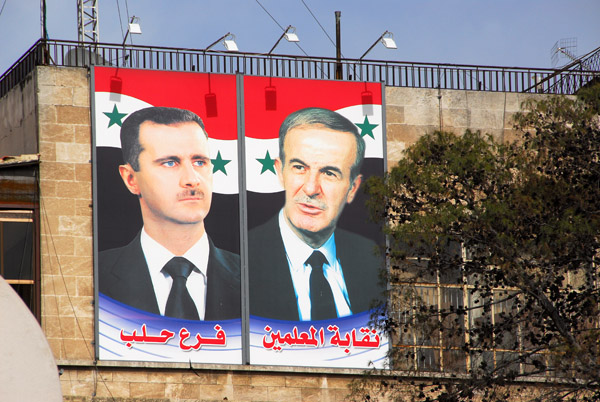
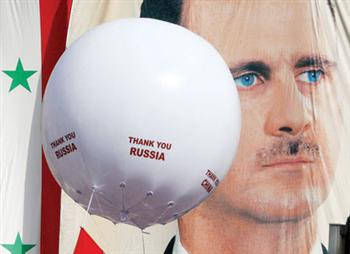
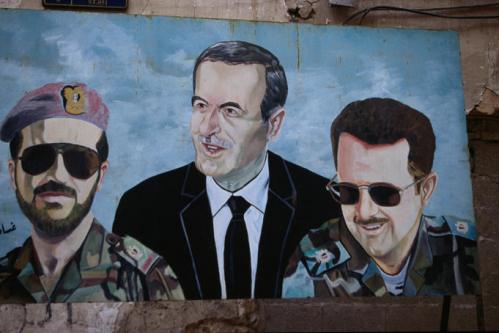
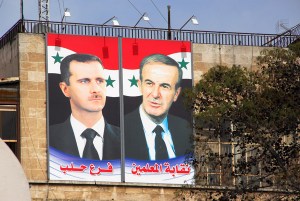
Affiches géantes, pour rappeler au peuple qui commande.

Ruth Riegler a interrogé un activiste syrien afin de mieux comprendre sa vie dans la Syrie révolutionnaire. Il apparaît sous un pseudonyme. Traduit par Eric Lamy.

R. R. : Comment décririez-vous la vie en Syrie avant la révolution, et comment définiriez-vous les causes premières de celle-ci ?

S. L. : Mon nom est Syrien Libre. Je veux que le monde sache pourquoi nous faisons la révolution contre Bashar Al Assad et son régime. Chacun sait aujourd’hui que c’est une révolution majeure, mais personne ne sait, en fait, quelles en sont les raisons profondes. Je vais vous le dire. Je veux que le monde sache comment nous vivions avant la révolution, qu’il en sache les vraies raisons. Nous vivions dans un monde où nous n’avions qu’à obéir comme des esclaves, quelque soit l’ordre du maître. Nous n’avions qu’à obéir et nous exécuter. En cas de désobéissance, nous étions punis ou exécutés.

Nous vivions dans un état de haute sécurité, ce qui signifie que nous étions gouvernés par un président unique avec ses militaires, ses services secrets, ses officiers, sa police militaire, sa police, ses indicateurs et ses shabihas [gangs armés]. Pour faire quoique ce soit, il vous fallait d’abord obtenir une autorisation et vérifier que la loi vous permettait d’agir ou non ; ce qui signifie que vous n’aviez aucun droit d’agir de vous-même et que vous auriez à affronter des obstacles si vous persistiez. Seuls les tenants du pouvoir pouvaient vivre librement et en dehors des lois. Ils pouvaient agir en toute liberté sans rien demander à personne, tout en contrôlant chaque quartier, y compris le système politique, le secteur industriel du pétrole et du gaz, l’économie du pays, les banques, le commerce, l’armée, l’agriculture et l ‘éducation. Dans les faits, ils se considéraient comme des dieux.
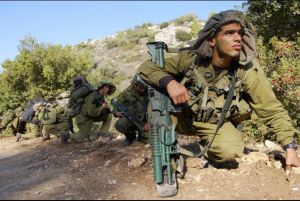
C’est Hafez (et ensuite Bashar) qui ont permis à Israël d’occuper militairement les Hauteurs du Golan.

Nous avons vécu sous ce régime qui prétend être anti-sioniste, mais c’est, en fait, un autre mensonge : il n’a jamais tiré un coup de feu contre Israël et il a maintenu la paix dans les Hauteurs du Golan, interdisant à tout syrien d’attaquer l’État Juif ou de réclamer ce territoire annexé. Tout homme qui l’aurait osé eût été jeté en prison, puni et probablement exécuté. Nous vivions comme des esclaves, sans aucun droit. Nous n’avions pas celui de choisir un candidat au poste de président ou d’organiser des élections libres, de créer des partis politiques ou de choisir des députés, d’élire un parlement. Seuls Assad et ses services secrets pouvaient choisir des députés, et leurs choix allaient invariablement vers les plus corrompus, les plus dénués de moralité ou de conscience. Si vous vous opposiez à la moindre de leurs actions, vous étiez jetés en prison. Ils faisaient de vous ce qu’ils voulaient parce que vous n’étiez rien. Les gens avaient peur de s’opposer, d’être en désaccord avec le régime ou avec quelqu’un qui fût proche des services secrets : les Syriens ont appris à courber l’échine et à se taire. Si vous osiez maudire Bashar, les hommes du régime venaient vous saisir où que vous soyiez pour vous embarquer à l’antenne locale des services secrets. Personne ne savait où vous étiez passé, personne n’osait s’en informer ou même prononcer votre nom. Si jamais vous vouliez créer un mouvement politique, ils agissaient de même : en Syrie, il n’y avait qu’un seul parti, et tous les syriens étaient obligés d’y adhérer. Au cas où vous aviez l’intention d’échapper au service militaire obligatoire, vous étiez jeté en prison pour au moins trois mois, puis forcé de servir quand même.. S’il vous arrivait de mourir pendant votre incarcération dans les geôles des services secrets, personne n’aurait cherché à savoir comment et pourquoi. Personne, évidemment, n’aurait pu être tenu responsable de votre mort car la constitution syrienne garantit au président, à ses services secrets, ses militaires et ses collaborateurs une immunité totale. Les syriens étaient traités comme des insectes qu’on écrase sous une botte. Leur vie importait peu.

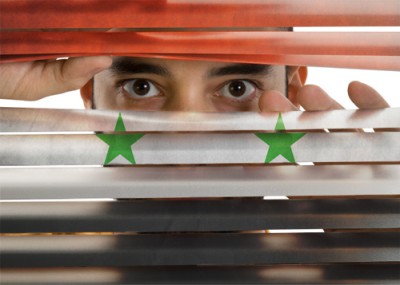
On ne peut représenter l’oppression, mais on peut la ressentir.

Le système permettait au président, son armée et ses services secrets d’arrêter, de torturer et de tuer n’importe qui, de disposer de nous et personne, en dehors du pays, ne savait ce qui s’y passait. La corruption, le népotisme et les faveurs étaient la règle à tous les niveaux de l’état, et les gens ont appris à survivre et à ne s’occuper que de soi, sans poser de question, sans s’occuper des autres. Seuls Assad et les proches du régime pouvaient agir à leur guise. La Syrie était une grande ferme et les syriens en étaient le bétail.

Il faut que je vous parle de l’économie du pays. En dépit de la découverte de réserves de pétrole et de gaz dans le Nord-Est de la Syrie ainsi que d’énormes gisements en Mer Méditerranée, nous nous sommes toujours étonnés de ce que ces matières premières étaient si chères pour nous, et pourquoi devions-nous les importer d’Iran, d’Iraq et d’Égypte. Nous avons découvert que c’est parce que Bashar et sa famille volaient le gaz et le pétrole syriens pour le vendre au rabais à la Russie et à l’Europe. Ils se mettaient l’argent dans la poche, pendant que les Syriens n’ont d’autre choix que d’acheter leur carburant et leur gaz à un prix élevé dans les centres de distribution de l’état, quand on avait la chance d’en trouver un. Le gouvernement a constamment gonflé le prix du pétrole et du gaz. Conséquemment, les prix des autres denrées, pain, riz, sucre, habillement, appareils électroniques, maisons, tout, enfin, à augmenté et continué d’augmenter sans jamais diminuer. Quand on pense aux réserves de notre pays en énergies fossiles, cette situation est tout à fait grotesque.

L’économie syrienne toute entière est une farce : lorsque le gouvernement recevait une aide d’autres pays, toute question de notre part relative à la destination de ces fonds restait sans réponse. Quand nous voulûmes nous pencher sur le développement du système éducatif de notre pays, de la santé, de l’agriculture, du secteur industriel ou du réseau électrique national, le gouvernement nous répondit que cette idée entraînerait une hausse des impôts ainsi qu’un surcroît de l’aide internationale parce que la Syrie n’avait pas les moyens de telles réformes.

Les agences de services secrets et les espions : le contrôle de la vie du peuple est total. Telle est l’existence sous le règne d’Assad.

Si un Syrien, désireux de vivre dignement voulait créer une entreprise, manufacture ou import de produits finis telles des voitures, de l’habillement ou de l’équipement électrique, le régime ne l’autorisait qu’à la condition qu’il obtienne une part des bénéfices, un pot-de-vin régulier, en plus des taxes habituelles. Si vous acceptiez cela, on vous accordait votre licence. Si vous refusiez, votre demande était rejetée, et les obstacles à votre projet commençaient à se dresser devant lui. Toute personne désirant ouvrir un commerce de quelque nature que ce soit (échoppe de rue vendant de l’épicerie, stand de bouquiniste, supérette ou cybercafé) devait en premier lieu obtenir l’aval des services secrets avant de faire sa demande auprès des services d’état concernés, à qui il devait verser un pot-de-vin. Si, par exemple, vous vouliez ouvrir un cybercafé, il vous fallait obtenir l’aval des services secrets. Ensuite, après vous être rendu au siège du ministère de la communication (et acquitté un backchich pour les fonctionnaires afin que votre demande soit prise en compte) il vous fallait vous rendre au bureau du gouvernement local puis à l’organisme financier d’état et naviguer au sein de cet écheveau bureaucratique pendant des mois avant d’arriver à un résultat. Même si vous vouliez vous marier et organiser la fête de la noce, vous deviez d’abord en obtenir la permission de l’état. Pardonnez-moi d’être un peu cru, mais c’est une boutade syrienne que de dire que “si tu veux coucher avec ta femme, il te faut l’autorisation écrite du gouvernement”.

En Syrie, tout homme d’un âge donné doit se soumettre à la conscription obligatoire. Beaucoup de mes compatriotes, dès qu’ils ont 18 ans, s’envolent pour l’étranger afin d’y travailler ou faire des études. Grâce au pot-de-vin, on peut échapper à la conscription. Mais si vous n’aviez pas les moyens de prendre l’avion, de travailler ou de suivre des études à l’étranger (et pas de moyen d’échapper à la conscription), il vous restait la possibilité d’être le domestique d’un officier, ou bien chauffeur, ou garde. Si vous pouviez verser un tant par semaine à un gradé, vous pouviez être dispensé de servir et être autorisé à trouver un travail au lieu de rester au chômage. Si vous aviez les moyens d’un gros backchich (un poste TV à un gradé, le paiement de ses factures de téléphone, l’entretien de sa voiture ou tout autre service) vous pouviez éviter le service militaire pendant deux ans. Après ce délai, il vous fallait recommencer votre vie à zéro.

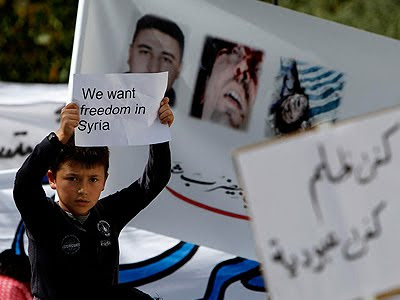
Les syriens veulent la liberté !

Voilà le genre de choses qui nous ont conduit à nous dresser contre le régime d’Assad. Nous voulons la liberté. Nous voulons décider de nos vies. Nous voulons organiser et affermir notre pays de nos mains. Nous voulons construire, produire nos biens de consommation nous-mêmes. Nous voulons produire de nos propres mains. Nous voulons améliorer le système éducatif, le système de santé, l’agriculture et tous les autres secteurs d’activités qu’Assad à laissé en friche. Nous voulons innover. Nous voulons être les premiers Arabes à produire des voitures, des trains. Oui, comme tous les autres peuples du monde, nous réclamons la dignité. Pour toutes ces raisons, nous continuerons de nous battre et nous ne reculerons pas. Nous vivrons dans la dignité, ou bien nous mourrons en martyr. Nous réclamons la liberté.

R. R. : Pour donner au lecteur une idée de ce que vous et vos compatriotes vivez
aujourd’hui, pouvez-vous décrire une journée habituelle en Syrie ?

S. L. : Imaginez-vous un beau matin ensoleillé… Vous vous levez, faites votre toilette, prenez votre café, en souriant à l’idée de tout ce que vous allez faire aujourd’hui, en dépit des obstacles que le gouvernement met en travers de votre chemin. Ça, c’était avant la révolution. À présent, dormir la nuit, se lever tôt le matin, c’est terminé. Tout à changé depuis le début de notre chère révolution, le 15 mai 2011 à Deraa. Bien… Voilà ce qui a changé dans mon programme et dans ma vie en général. D’abord, je ne dors plus que très tard ou très peu, sans cesse réveillé par les bombardements, les obus, les coups de feu et les manifestations, matin ou soir. Mes habitudes ont changé également.

J’avais l’habitude de fréquenter une école de langues près de chez moi pour étudier l’anglais afin d’être traducteur. Cela me permettait, en outre, de rencontrer un ami et de dénicher une meilleure place pour obtenir une maîtrise de traducteur. J’avais trouvé une place à Preston (GB), mais je n’ai pu malheureusement répondre à cette offre d’emploi car je n’ai pas de passeport, et les cours au centre linguistique américain (cycle TOEFL) ont été suspendus. Bien que j’aie contacté le Conseil Britannique pour tenter de les persuader de dispenser un cours  (cycles TOEFL ou ILTES) au Royaume-Uni, je ne pense pas pouvoir commencer ma maîtrise cette année. Je pense que l’occasion en est perdue. Mais ce n’est pas le seul problème que j’ai rencontré : après avoir cherché du travail quelques temps, j’en avais trouvé, l’an dernier, dans une société privée de communications. C’est tombé à l’eau, également, depuis que la situation, ici, n’a cessé d’empirer.

En plus, le fait de ne pas avoir fait mon service militaire signifie que je ne peux ni travailler, ni voyager pour passer ma maîtrise. Cela m’a vraiment déprimé : pas de travail, plus d’espoir de maîtrise, je perdais l’envie de vivre. Puis le régime s’est mis à tuer notre peuple. D’abord à Deraa, où les troupes d’Assad utilisèrent des balles réelles contre des manifestants désarmés, puis vinrent les chars à l’intérieur des villes. Nous autres, jeunes de Syrie, nous n’avons pas du tout aimé cela et nous avons commencé à manifester. Alors le régime à commencé à utiliser des nervis en civil et des casseurs, des brutes comme les shabihas pour nous terroriser.

Depuis lors, le régime d’Assad n’a rien épargné contre nous. Avant la révolution, je faisais trois repas par jour. Aujourd’hui, un seul. Avant la révolution, je dormais huit heures par nuit. Aujourd’hui, je me contente de cinq heures de sommeil, mais je veille bien souvent jusqu’à l’aube. Je me suis débrouillé pour aider au mieux les compatriotes qui en avaient le plus besoin, en les cachant ou en aidant quiconque avait besoin de traduire des infos ou des vidéos envoyées par d’autres activistes. Je reçois des tas d’infos : je les traduis, je les partage au mieux, je discute avec mes amis et nous échangeons nos points de vue sur ce qu’il convient de faire. Notre principal sujet de conversation tourne autour de l’idée que chaque nation au sein de la Communauté Internationale soutient le régime de Bashar parce qu’elle ne veut pas perdre le toutou docile qui protège Israël et maintient la sécurité dans la région.

À présent, le régime à dressé des checkpoints dans toutes les villes et villages, sur tous les axes principaux, et il a fermé toutes les rues qui conduisent au palais présidentiel, à Damas. Il a placé également des snipers un peu partout, surtout dans les zones contrôlées par les rebelles. Si vous voulez faire des courses ou bien vous rendre à la salle de gym, voir des amis ou aller n’importe où, les troupes du régime vous arrêteront aux checkpoints et vérifieront votre identité sur une longue liste de noms : si vous êtes recherché, convaincu d’être un activiste ou que vous n’ayez pas fait votre service militaire, ils vous arrêtent ou bien vous tuent sur place. Il nous faut passer ces checkpoints tous les jours. Récemment, je me rendais chez des amis pour travailler à notre cause. J’ai été arrêté pendant une demi-heure. Je commençais à me faire du soucis. Un soldat m’a appelé. Je me suis approché pour demander ce qui n’allait pas. Il m’a regardé puis a dit : “Voilà  tes papiers. Tu nous fais perdre notre temps avec des recherches inutiles. File.” Après cette aventure, j’ai décidé qu’à chaque fois que je sortirais, j’emprunterais des chemins de traverse pour éviter les checkpoints. Une autre fois, récemment, je me suis rendu à Barzeh pour voir les parents de Salim, un ami abattu par un sniper. Je voulais leur présenter mes condoléances. Au même moment, de violents affrontements avaient lieu dans le secteur, entre des troupes loyalistes et l’Armée Syrienne de Libération. Comme je me rendais à l’appartement des parents de Salim, un sniper à tiré et m’a manqué de peu. J’ai seulement réalisé ce qui arrivait quand un inconnu m’a tiré dans l’entrée de l’immeuble en disant : “Tu es cinglé ? Tu as donc envié de mourir ?”

Ce porc de Bashar à donné ordre aux snipers de se positionner un peu partout et de descendre qui ils veulent. J’ai beaucoup d’amis qui ont été tués par des snipers. D’autres ont survécu à leurs tirs. Anwar, un ami qui n’avait peur de rien et qui était de toutes les manifs, à pris une balle dans la tête. Après un séjour de six mois en soins intensifs et une balle qui lui a traversé le crâne, Allah n’a pas voulu qu’il meure. Certes, il a survécu, mais il est a demi-paralysé et il peut à peine se servir de sa jambe et son bras droits. J’ai d’autres amis qui ont purement et simplement disparu depuis leur arrestation par les forces du régime. Personne ne sait où ils sont et s’ils sont en vie. L’un d’entre eux, Bilal, un ami proche, avait l’habitude de ne pas manquer une seule manif pour encourager la chute du régime… Tous les jours, j’entends parler d’amis kidnappés contre rançon, d’autres sont enlevés dans la rue ou à un checkpoint. Certains d’entre eux peuvent appeler leurs parents pour demander de l’argent. Tant que la rançon n’est pas versée, les ravisseurs ne donnent aucune nouvelle aux parents.

Il est impossible de décrire notre enfer. Plus d’ordre, plus aucune stabilité, et la Communauté Internationale qui regarde faire et se tait. Des tas de jeunes gens s’envolent à l’étranger pour survivre. Les autres rejoignent les rangs de l’ASL dans laquelle on retrouve de nombreux éléments qui ont déserté l’armée régulière où ils étaient obligés de servir. Voila ma vie en Syrie aujourd’hui. J’ai décidé de rallier l’ASL. Honnêtement, j’ai souvent envié de fuir le plus vite possible. J’ai songé à m’enfuir à l’étranger mais, comme je vous l’ai dit, je n’ai pas de passeport. Bien que j’aie demandé de l’aide à des tas d’amis et de connaissances, il est quasi impossible de sortir de Syrie sans passeport.

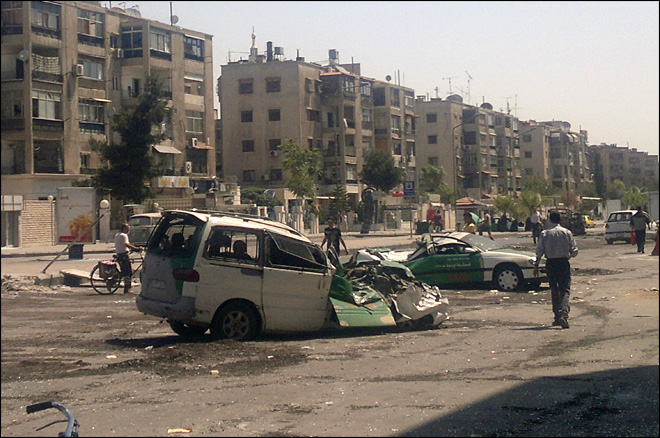
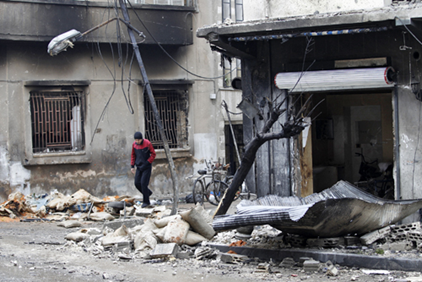
Conséquences du passage des tanks qui ont pénétré dans le camp palestinien de Yarmouk, près de Damas.

R. R. : Que répondez-vous à ceux qui continuent à prétendre qu’Assad est une figure emblématique de l’anti-sionisme ?

S. L. : Tout le monde sait que Hafez Al Assad (que Dieu le maudisse, lui et son fils !) a vendu les Hauteurs du Golan à Israël et qu’il est responsable de la mort de nombreux Palestiniens au Liban et en Syrie, et ce pour garantir la sécurité d’Israël au Liban. À présent, son fils Bashar fait la même chose mais d’une manière différente. Il a attaqué de nombreuses zones où vivent les Palestiniens établis en Syrie, surtout au camp de Yarmouk, près de Damas, et je l’ai vu de mes propres yeux. De même, il est tout à fait faux de croire que Bashar soutient le Hezbollah libanais dans sa lutte contre Israël. C’est pur mensonge. Chacun sait qu’Assad à donné le feu vert au Hezbollah pour assassiner le leader sunnite Rafiq Al Hariri au Liban. De même, le soutien syrien pour redorer le blason de Nasrallah [chef du Hezbollah libanais] afin qu’il puisse se poser en héros de guerre ; la guerre de 2007 contre Israël était pourtant un autre mensonge, un stratagème pour permettre l’expansion du Hezbollah au Liban, et donner aux chiites l’occasion d’accroître leur mainmise sur ce pays, en permettant à l’Iran de renforcer son contrôle sur la région. C’est le projet de Téhéran au Moyen-Orient : constituer un croissant chiite qui s’étendrait de l’Iran à l’Iraq en réunissant la Syrie, le Liban, l’Égypte, l’Arabie Saoudite et le Yémen. Bashar Al Assad souligne sans cesse qu’il lutte contre Israël, qu’il mène la résistance contre l’État Hébreu. Je répondrai ceci : en ce cas, pourquoi emprisonnez-vous, pourquoi torturez-vous, pourquoi tuez-vous tous mes amis ainsi que des dizaines de milliers de Syriens ? Pourquoi tuez-vous mes frères Palestiniens et Iraquiens ? Pourquoi n’avez-vous rien fait quand les avions israéliens ont violé l’espace aérien de notre pays ? N’essayez pas de mentir au peuple syrien : nous vous connaissons mieux que personne. Nous savons tous que votre boulot, c’est de nous liquider et de protéger Israël. Que Dieu vous maudisse, fils de l’adultère !

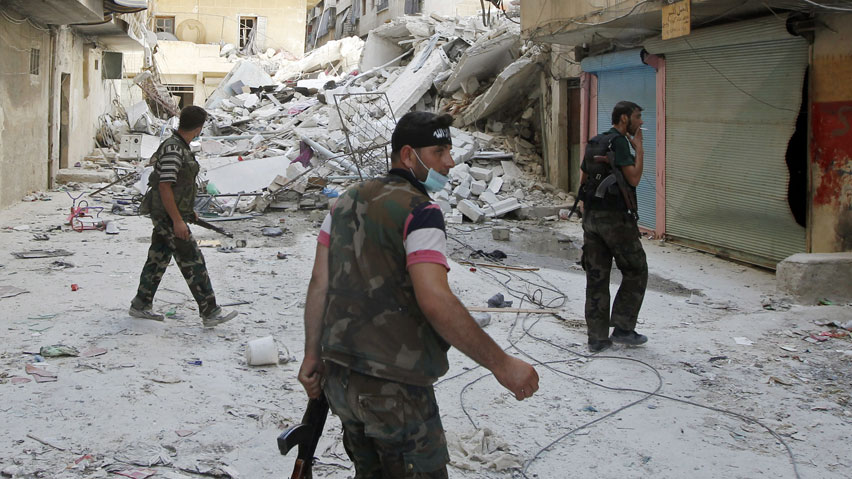
Homs, au pire de la violence.

R. R. : Comment ça se passe pour vous qui devez vivre dans une vraie zone de guerre ?

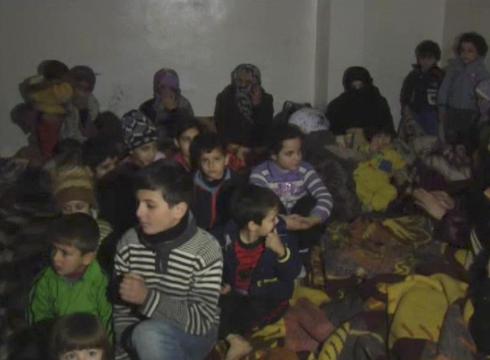
S. L. :  Il nous est très difficile de subvenir à nos besoins dans les circonstances actuelles ; on vit avec prudence, on n’achète et on ne consomme que l’essentiel. En ce qui me concerne, c’est plus dur parce que je suis sans emploi. C’est mon père qui m’aide financièrement. Je vis chez mes parents et je les aide. Aujourd’hui, en Syrie, les branches d’une même famille sont regroupées sous un même toit, ce qui fait qu’on trouve parfois de trois à dix familles vivant dans la même maison. La situation est dramatique : entre 65 et 75% de la Syrie est détruite. On se débrouille pour acheter, pour stocker la nourriture qu’on peut trouver, mais il y a des secteurs où il n’y à plus rien. À Homs, il n’y a plus ni nourriture, ni quoique ce soit pour se protéger du froid. Dans deux mois, l’hiver sera là, et nous voudrions que cela finisse le plus tôt possible. La plupart des villes syriennes n’ont plus rien : Assad à brûlé les récoltes et détruit les habitations. J’ai de quoi manger la plupart du temps mais d’autres non, et ça, ça m’inquiète. On leur envoie de l’aide mais le régime encercle ces zones, bien que l’ASL fasse de son mieux pour distribuer aide et médicaments.

Personne n’a idée de la tragédie que nous vivons, mais nous avons bon moral car nous savons tous qu’Allah est à nos côtés. Nous tuerons Bashar, inch’Allah. Nous allons continuer à nous soutenir mutuellement avec nourriture, soins médicaux et tout ce qui sera nécessaire pour remporter la
victoire. J’insiste sur le fait que que l’armée de notre pays, c’est l’Armée Libre de Syrie, l’ALS, et nous en sommes très fiers. Nous sommes tous syriens et nous resterons unis : c’est ce que nous chantions pendant les manifestations “uni, uni, uni, le Peuple Syrien est uni!”

Même après de nombreux mois, le monde se contente toujours de regarder le génocide.

R. R. : Que ressentez-vous devant l’apathie de presque toute la Communauté Internationale à l’égard de la révolution syrienne, et est-ce que votre opinion à son égard a-t-elle évolué ? Si oui, dans quelle mesure ?

S. L. : Pour quelles raisons le monde entier a-t-il béni les révolutions en Tunisie, en Égypte, en Lybie et au Yémen, pourquoi les a-t-il soutenus alors que personne ne nous a aidé, personne pour soutenir notre révolution, personne pour dire le bien-fondé de notre cause ? Pourquoi la Russie, l’Iran, la Chine et l’Iraq ont-ils été autorisés à aider Bashar et son régime en fournissant armes, argent, carburant, gaz et démarches politiques ? Pourquoi les gouvernements occidentaux n’ont-ils pas essayé de nous aider en créant une zone d’exclusion aérienne, en nous fournissant les armes nécessaires et en établissant des zones protégées pour les civils ?Peut-être que ces mêmes gouvernements sont incapables de répondre à toutes ces questions.

Nous, les syriens, nous savons pourquoi : ils veulent nous imposer une solution unilatérale, et cela, nous ne l’accepterons jamais. Je vais vous dire ce que l’on nous propose comme solution. Ils veulent que nous acceptions leurs conditions en permettant à Bashar de rester au pouvoir, nous octroyer une liberté cosmétique et procéder à des changements superficiels en réunissant un gouvernement d’unité nationale. Les gouvernements occidentaux ne veulent pas entendre parler de gens droits et nobles, d’honorables patriotes, ils ne veulent pas entendre parler de l’ALS, non. Ils veulent tuer tous ces gens-là pour mieux nous imposer leurs vues. Il y a aussi cette clause très importante : ils veulent qu’Israël soit assuré d’une paix sans nuage et que nul ne s’en approche. Pour toutes ces raisons – et l’Histoire le prouve à l’envi – Bashar est le mieux placé pour réussir. C’est pourquoi les gouvernements occidentaux laissent l’Iran, la Russie et lal’Iraq le soutenir en lui envoyant davantage d’armes et de troupes, puisqu’il n’y a plus de syriens (qui ne veulent plus de lui) à cause des défections  en masse qui dépeuplent l’armée régulière. L’Occident laisse ces pays envoyer des fonds et des soldats du Hezbollah, de l’Armée du Mahdi [milice chiite irakienne] et de la Force Al Qds [pasdarans iraniens, opérations extérieures]. L’excuse de l’Occident est que l’issue du conflit est complexe. Elle est très simple, au contraire : nous voulons la liberté. Donnez-nous des armes lourdes pour détruire les avions de chasse, des tanks, des lance-rocket et nous gagnerons. L’Occident sait que Bashar est affaibli, c’est pourquoi il prétend que s’il nous donnait des armes, l’ASL serait incapable d’en contrôler la distribution et donc Al-Qaeda en profiterait.

Mais les syriens savent bien qu’Al-Qaeda n’est pas en Syrie, ni dans aucun pays arabe. Les gouvernements occidentaux ont brandi cette nouvelle excuse : l’opposition syrienne n’est pas unie. Celle qui a défait les régimes en place dans les autres pays n’était pas plus unie. Les gouvernements occidentaux n’ont rien fait non plus pour les réfugiés syriens en Turquie, en Jordanie, au Liban et en Iraq ; ils n’ont envoyé qu’une aide insuffisante, sans leur permettre de pouvoir travailler. Ils ne les ont même pas enregistrés comme réfugiés aux Nations Unies, les laissant dans des zones désolées d’Iraq et de Jordanie, parce que l’Occident veut que les syriens, même réfugiés, obéissent à leurs directives en se soumettant à Bashar Al Assad, en retournant vivre sous sa férule. Si nous refusons cela, notre punition sera la privation de nourriture, d’eau et de denrées de première nécessité. Il ne faudra, bien sûr, pas compter sur son aide pour se débarrasser de Bashar. Personne ne nous aidera. Nous n’avons que nous pour nous aider, et Dieu, et c’est précisément ce à quoi nous sommes réduits aujourd’hui.
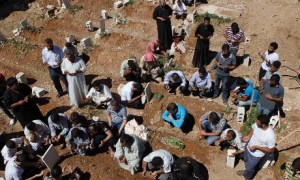
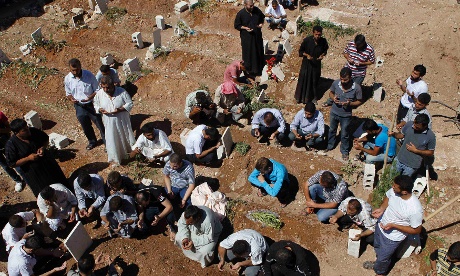
Combattants de l’ASL tombés au champ d’honneur.

R. R. : Comment voyez-vous la situation évoluer à court et moyen terme, et êtes-vous confiant dans le retour de la paix après la chute d’Assad ?

S. L. : La situation sera sanglante et bloquée si nous ne nous efforçons pas ardemment de résoudre le problème. Si l’on peut agir vite pour nous libérer, cela nous permettra d’épargner le plus de vies possibles et de sauver ce qui peut l’être de notre peuple, des propriétés, de l’infrastructure du pays, de son économie… Si on leslaisse faire ce qu’ils veulent (Bashar et les puissances occidentales) nous perdrons davantage de nos compatriotes et le carnage va empirer. Si cela devait arriver, le bain de sang se poursuivrait (ce serait un génocide) avec des milliers de morts supplémentaires, le pays pillé et mis à sac par son armée, les bâtiments et son infrastructure détruits, l’économie dévastée, des milliers de gens choisissant l’exil, les meilleurs cerveaux de Syrie, ceux qui sont essentiels pour reconstruire le pays, fuiraient une nation tout simplement abandonnée au chaos. Nous autres syriens nous ne le voulons pas. Nous ne pouvons accepter ça. C’est pourquoi nous travaillons très dur à organiser et harmoniser notre agenda pour tuer Bashar et mettre rapidement un terme à cette épouvantable situation. Nous autres syriens sommes optimistes parce qu’Allah nous accompagne et que nous sommes unis. C’est pourquoi nous pensons que la paix reviendra bientôt. Si Bashar reste au pouvoir, il n’y aura nulle paix. Juste plus de discours et de sang versé, et nous vivrons à jamais dans les ténèbres comme des esclaves. Nous ne pouvons l’accepter. C’est pourquoi nous  préférons  vivre dignement ou mourir en martyr. C’est l’option que nous avons retenue : la mort plutôt que d’être encore humiliés.

R. R. : Que pensez-vous de certaines allégations relevées dans de nombreux médias qui parlent de “guerre civile confessionnelle” ?

S. L. : Il n’y a pas de “guerre civile confessionnelle”. C’est de la propagande, distillée par le
régime et d’autres pays. Ils prétendent que si le régime tombe, une guerre civile va éclater et le massacre sera général et qu’au contraire, si Bashar reste, la société syrienne demeurera unie. C’est un mensonge éhonté ! Ce que l’Occident et Bashar projettent de faire, c’est de redessiner la carte de la Syrie en régions autonomes comme en Iraq, avec les Kurdes qui y auraient un état indépendant dans le Nord-Est, les Druzes dans le Sud et les Alaouites le long de la côte syrienne, tandis que les Sunnites obtiendraient le reste. Voilà leur projet, et Bashar se démène tant et plus pour réaliser son rêve d’un état Alaouite-Chiite. Ils oublient seulement que depuis le début de notre révolution, notre mot d’ordre a été “Uni, uni, uni : le Peuple Syrien est Uni !”

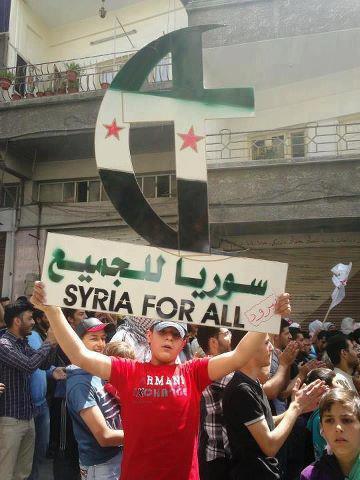
Le régime essaie d’attiser le sectarisme prétendu de la révolution ; le peuple pense différemment [la Syrie pour tous !].

Ce pays est à tous. Quelle que soit votre religion, secte ou groupe particulier, vous êtes syrien et vous appartenez à la Syrie. Les syriens de toute obédience refusent le projet de diviser notre nation et tous en appellent à l’unité. J’ai rencontré des Alaouites, des Chiites, des Chrétiens, des Druzes et des Sunnites au cours de notre révolution et tous ont rejeté ce plan pour nous diviser. Nous en appelons à l’unité : un peuple, un pays. En dépit des tentatives du pouvoir pour armer différentes sectes et les retourner les unes contre les autres. Pour nous diviser. Même si Bashar fait de son mieux pour semer la division parmi nous, nous ne permettrons pas d’être manipulés, de nous entretuer : nous sommes frères et sœurs.

Pour finir, je voudrais ajouter ceci : avant notre révolution, on vivait ensemble en parfaite harmonie. J’ai vécu, moi, dans un immeuble où mes voisins étaient chiites, juifs et chrétiens. Mes amis sont de religions différentes : on s’apprécie et on cohabite sans problème.

R. R. : Pensez-vous que cette expérience vous a changé ? Si oui, dans quelle mesure ?

S. L. :  Oui, j’ai changé. J’ai une plus grande conscience de la conspiration générale pour faire échouer notre révolution. J’ai également découvert que le monde ne se préoccupe que de ses intérêts et il se moque bien de tout le reste, sauf de lui-même. J’ai également fini de croire à la rhétorique des représentants de l’ONU ou des organisations non-gouvernementales, que ce soit les Droits de l’Homme, l’UNICEF, l’UNICO [universités & collèges en GB], la CPI [cour pénale internationale], l’IJP [institut de justice pénale] ou autre. Le monde n’a pas été capable de mettre au point le moindre programme pour aider les syriens en Syrie ou les réfugiés dans les pays voisins, ni même d’organiser une rencontre de donateurs. Même les conférences des “Amis de la
Syrie” n’a débouché sur rien. Tout ce que savent faire ces gens-là, c’est de nous regarder et laisser Bashar nous tuer avec le soutien russe et iranien.

Pour autant, la révolution m’a donné une forme d’espoir. Voulez-vous savoir ? Elle m’a appris que lorsque vous affrontez des difficultés et des obstacles dans votre vie, personne (excepté sans doute une poignée d’amis véritables ainsi que votre famille) ne se soucie de vous pour vous apporter de l’aide. Il faut tout faire soi-même et s’entraider de toutes les manières. La révolution m’a rendu très conscient de cela. Elle m’a rendu fier de mon peuple et de mon pays. Elle m’a appris ce dont nous avons besoin pour en finir avec cette situation. Nous sommes des gens pacifiques et nous ne manquons pas de ressources. On peut se reconstruire, nous et notre pays, développer nos talents et en acquérir d’autres. Je me sens plus responsable qu’avant : je veux me développer, parfaire mes capacités, acquérir de nouvelles connaissances et les partager avec mon peuple. Je veux enseigner aux générations futures que nous avons combattu et sacrifié nos vies pour gagner notre liberté, et que nous ne devons jamais plus accepter quiconque qui se prendrait pour un dieu avec un droit divin sur son peuple. Non, il nous faut désormais élire des chefs désintéressés, seulement préoccupés de la nation et du peuple syriens, et non de leur enrichissement personnel.

Je veux souligner le fait que la révolution est dans nos mains. Je pense que le monde à besoin de changement. Il doit comprendre que les peuples qui vivent sur cette terre sont égaux et qu’ils ont droit à la liberté. J’ai aussi découvert que ceux qui se posent en tant que “Leaders Arabes” ne sont que des traîtres à la solde des puissances étrangères. Au mieux, ils se moquent totalement des arabes.

R. R. : Combien de temps pensez-vous que la révolution puisse continuer, et que prévoyez-vous qu’il advienne quand elle sera achevée ?

S. L. : Lorsque nous avons commencé la révolution, nous savions qu’il n’y aurait pas de retour en arrière et nous n’avons pas changé d’avis ; après tout ce que nous avons enduré, consenti tous ces sacrifices, nous serions perdus de seulement imaginer revenir au statu quo ante. C’est notre mot de la fin : tout ce que Bashar nous a fait (et continue de nous faire, sans répit), il l’a fait avec de plus en plus d’aide d’Israël, de la Russie, de l’Iran et de la Chine. Nous avons prouvé au monde entier (qui s’obstine dans ses dénégations) que des troupes iraniennes, des hommes du Hezbollah et des soldats russes ont été capturés dans chaque ville de Syrie. Chacun de ces hommes était porteur de documents qui attestent cette évidence. Nous avons également obtenu des documents officiels en provenance du pouvoir qui prouvent que Bashar a fait venir de plus en plus d’hommes en provenance d’Iran (gardiens de la révolution), du Liban, d’Iraq, de Russie et d’autres pays qui fournissent aussi bien des armes que des troupes. Malgré cela, le régime d’Assad est en train de perdre la bataille. Ses alliés et les puissances occidentales veulent qu’il demeure, et ils le couvrent de toutes les manières possibles. Malheureusement pour lui, nous le battrons lui et ses alliés, et nous le tuerons, inch’Allah !
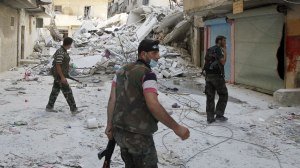
Vous me demandez combien de temps la révolution va-t-elle encore durer : jusqu’à ce que nous tuions Bachar et que nous chassions les russes, les iraniens et le Hezbollah hors de Syrie. Personne, dans notre pays, n’accepterait de s’arrêter aujourd’hui car dans chaque maison de chaque village, ville ou grande cité de Syrie on compte au moins un martyr, un prisonnier, une victime d’enlèvement par les forces du régime, à moins que ce soit un membre de la famille qui ait été contraint à l’exil. Savez-vous qu’Assad a anéanti de nombreuses familles ?

Savez-vous qu’il a détruit la plupart des villes du pays et qu’il a emprisonné plus de 250 000 personnes ? Savez-vous qu’il punit collectivement chaque syrien dans chaque secteur qui s’oppose à lui (c’est à dire presque toute la Syrie) ? Savez-vous que ses forces détiennent et retiennent des stocks de produits pharmaceutiques, qu’elles empoisonnent les réserves d’eau et de nourriture, bombardant les boulangeries pour affamer la population ? Assad fait aussi bombarder les hôpitaux, vise le personnel médical dans l’espoir que le peuple syrien sera obligé de lui obéir. Voici la réponse que nous lui adressons : “vas en enfer !”

Le monde voit tout cela et ne fait rien. Il s’excuse en disant : “c’est bien difficile. C’est compiqué”. C’est très simple, au contraire. Les syriens veulent être libérés de la dictature et la Communauté Internationale pourrait nous aider si elle le voulait. Les syriens savent tout cela. Nous allons continuer à nous soutenir les uns les autres, soutenir et combattre pour l’ALS. Quoique fasse Assad, nous ne calerons pas. Chaque homme, chaque femme, chaque enfant va combattre jusqu’à son dernier souffle. Pas question d’accepter ce que l’ Occident à décidé pour nous. Nous ne céderons pas. Nous n’accepterons pas ce que l’on veut nous imposer. Nous l’avons commencée et nous allons la finir, cette révolution. Par-dessus tout, et nous l’avons déclaré à nos débuts, Allah est avec nous, Allah et personne d’autre que Lui. Nous n’avons que Lui.

Vous voulez savoir “ce que nous ferons” après la révolution. Pour l’instant, on travaille dans la clandestinité afin que tout soit prêt, et il y a une parfaite collaboration entre nous. Nos plans sont arrêtés, mais nous ne pouvons nous dévoiler de peur que l’ennemi ne découvre ce que nous préparons. Tout ce que je peux dire, c’est que nous assurons la coordination entre l’Armée de Libération, les conseils militaires, l’opposition et les différents partis pour nous assurer que la normalité et la loi seront restaurées à la chute d’Assad, afin que le peuple syrien puisse retourner à une vie normale. Nous créerons un jour la transition qui restera en place jusqu’à ce qu’une nouvelle constitution soit adoptée et qu’un nouveau président avec un gouvernement et un parlement soient établis.

R. R. : Quels sont vos projets pour la période post-révolutionnaire, et est-ce que ce que vous avez vécu pendant la révolution les a-t-ils modifiés, et en quoi ?

S. L. : Aujourd’hui, je voudrais acquérir d’avantage d’expérience et m’impliquer activement en politique. Je veux jouer un rôle actif dans la reconstruction et le développement de mon pays et aussi participer à l’aide médicale de mes compatriotes. J’aimerais m’impliquer dans l’aide humanitaire et l’aide sociale car, comme vous le savez, un grand nombre d’adultes et d’enfants ont dû subir des amputations suite aux bombardements du régime. Ces personnes ont besoin de prothèses, tandis que d’autres ont besoin d’être opérés sans tarder. Tout cela va coûter des sommes considérables, aussi avons-nous besoin d’argent et de l’aide d’hôpitaux étrangers.

Je voudrais aussi m’investir dans l’éducation. Comme vous le savez, je suis traducteur et j’aimerais aider à enseigner aux enfants et aux jeunes gens dans les écoles, les collèges et autres établissements scolaires. Le régime a tué un grand nombre de professeurs dans toutes les disciplines, c’est pourquoi nous souffrons d’une grande pénurie dans ce domaine, et il va falloir vraiment mettre les bouchées doubles pour pallier toutes ces vacances. Il nous faudra aussi surveiller les fondations d’un projet éducatif afin de mettre en place un programme d’études accéléré. De cette façon, nous éviterons les difficultés pour des enfants qui ont manqué deux années d’études à cause des bombardements du régime et le chaos qui s’en suivit.

Nous voulons procéder à l’arrestation de tous ceux qui auront été impliqués dans des meurtres, dans la pratique de la torture, des viols et des pillages. Ces personnes seront em prisonnées et jugées. Ceux qui auront commis le pire seront exécutés. Nous ne permettrons à personne d’échapper au châtiment, quelle que soit sa religion. Nous avons tous été confrontés à la persécution, à la terreur et à l’intimidation, et beaucoup trop d’entre nous ont été torturés et/ou assassinés. C’est pourquoi nous voulons justice et dignité pour tous. De manière égale.

Pour conclure, je vous dirai que je veux participer activement au processus politique afin d’aider et représenter mon pays et mon peuple. J’ai toujours l’ambition d’obtenir ma maîtrise de traducteur et d’interprète, même si le régime m’a privé de cette chance en gâchant deux années de ma vie à cause d’une guerre brutale déchaînée contre les syriens eux-mêmes. C’est ce que ce pouvoir nous a imposé, mais nous rejetons ce régime.

https://wewritewhatwelike.com/2012/09/22/interview-with-a-free-syrian/ (original)

Le facce in gigantografia che vedano tutto, anche dopo la morte

Ruth Riegler ha intervistato un attivista in Siria per comprendere la vita che si conduce nella Siria rivoluzionaria. Egli usa uno pseudonomo. Traduzione a cura di Shadi Inomad

RR: Come descriveresti la vita prima della rivoluzione? E quali credi siano state le origini della rivoluzione?

FS: Il mio nome è Libero Siriano (Free Syrian). Voglio dire al mondo perché abbiamo fatto la rivoluzione contro Bashar Al Assad e il suo regime. Tutti nel mondo sanno che si tratta di una grandiosa rivoluzione, ma in realtà nessuno sa quale sia la vera ragione dietro di essa. Te lo dirò io. Voglio che il mondo intero sappia come si viveva prima della rivoluzione e quali sono le ragioni di questa. Vivevamo in un mondo in cui abbiamo dovuto dar retta e obbedire come schiavi – qualunque cosa dicesse il padrone, dovevi obbedire e farlo, e se gli disubbidivi ti puniva o ti uccideva.

Abbiamo vissuto in uno stato di sicurezza, il che significa che siamo stati governati da un presidente e dai suoi militari, dall’intelligence, dagli ufficiali dell’esercito, dalla polizia regolare e quella militare, dagli informatori e dagli shabbiha (bande armate, sono delle milizie paramilitari a base settaria, ossia composta da alawiti, che vengono pagate profumatamente e agiscono a sostegno di Assad, ndr). Quando volevi far qualcosa, dovevi prima ottenere il loro permesso e vedere se le loro regole ti permettevano di farlo o no, il che significava che non avevi il diritto di fare nessuna cosa in modo indipendente e avresti dovuto affrontare degli ostacoli se avessi tentato. Solo il personale del regime poteva vivere liberamente e senza essere governati da delle leggi; potevano fare ciò che volevano senza chiedere, comandando ogni settore, tra cui il sistema politico, il petrolio e il gas, l’economia, le banche, il commercio, i militari, l’agricoltura e l’istruzione. In effetti, si consideravano degli dei.

I siriani erano proibiti dal toccare la loro terra: l’esercito israeliano, addirittura faceva esercitazioni.

Abbiamo vissuto sotto questo regime, che rivendica di essere anti-sionista, ma in realtà questa è solo un’altra menzogna perché per 47 anni non ha mai sparato un solo proiettile contro Israele e ha mantenuto la calma nelle alture occupate del Golan, vietando a qualsiasi siriano di sparare anche un solo colpo contro Israele o di rivendicare questa terra rubata. Chiunque lo avesse fatto sarebbe stato gettato in prigione, punito ed eventualmente ucciso.

Abbiamo vissuto come schiavi, senza alcun diritto. Ci sono stati vietati la scelta di un candidato alla presidenza, lo svolgimento di elezioni libere, la costituzione di partiti politici o la selezione di nostri rappresentanti per il parlamento. Solo ad Assad e alla sua rete di intelligence era concesso scegliere i parlamentari e scelsero le persone più corrotte, senza morale o coscienza, permettendo loro di fare i propri interessi. Se ti fossi opposto a qualunque cosa facessero, saresti stati messo in prigione e ti avrebbero fatto ogni cosa avessero voluto, perché tu non sei nulla per loro.

La gente aveva paura di opporsi o dissentire con il regime o chiunque fosse vicino ai servizi segreti: i siriani impararono a tenere la testa bassa e non dire nulla. Anche se solo avessi maledetto Bashar, sarebbero venuti a prenderti ovunque tu fossi e ti avrebbero portato alla sezione locale dei servizi segreti, senza che nessuno sapesse dove tu fossi o osasse chiedere di te o anche solo nominare il tuo nome. Se volevi dare vita a un movimento politico sarebbe successo lo stesso, perché in Siria abbiamo avuto un solo partito e tutti i siriani erano costretti a farne parte. Se tu avessi evitato il servizio militare obbligatorio e non volessi servire, ti avrebbero imprigionato per tre o più mesi per poi in ogni caso costringerti a fare il servizio militare. Se si fosse morti in custodia dei servizi segreti, nessuno avrebbe chiesto come e perché eri morto e nessuno sarebbe stato ritenuto responsabile per la tua morte, perché la Costituzione conferisce l’immunità completa al presidente, ai suoi servizi di intelligence e i suoi alleati militari. Il popolo siriano è trattato come gli insetti che sono schiacciati sotto i piedi, senza attenzione per i nostri morti.

L’oppressione non si può fotografare, ma la si può sentire ovunque.

Il sistema permetteva al presidente, alle sue forze armate e ai servizi segreti, di arrestare, torturare o uccidere chiunque, di fare quello che volevano di noi, senza che nessuno nel mondo esterno sapesse cosa stava succedendo. La corruzione, il nepotismo e il favoritismo sono la norma in tutte le istituzioni statali e la gente ha imparato a esistere solo e a badare solo ai propri interessi, non chiedendo o aiutando nessuno se non sè stessi, dove solo Assad ei suoi fedelissimi del regime avevano il permesso di fare ciò che volevano; la Siria è la sua fattoria e i siriani sono gli animali.

Vorrei anche fare un accenno sull’economia siriana. Nonostante la scoperta di riserve di petrolio e di gas nel nord-est del paese e di enormi riserve di petrolio e di gas offshore, ci chiedevamo perché questi prodotti fossero così costosi per noi e perché invece compravamo gas e petrolio dall’Iran, Iraq ed Egitto. Abbiamo scoperto che questo accadeva perché Bashar e la sua famiglia rubavano il gas e il petrolio della Siria per venderlo sottocosto alla Russia e ai paesi europei, mantenendo i profitti per sè stessi, mentre noi siriani non avevamo altra scelta che comprare gas e petrolio dalle aziende statali a prezzi elevati – sempre che riuscissimo a trovarne per tutti. Il governo aumentò artificiosamente in modo costante il prezzo del petrolio e del gas e di conseguenza i prezzi di ogni altro bene – pane, riso, zucchero, vestiti, prodotti elettronici, case, tutto – aumentò e continuò a crescere senza mai diminuire. Data la grande ricchezza di petrolio e gas del nostro Paese, questa è la situazione più assurda.

La nostra economia è una farsa. Anche se il governo ha ottenuto aiuti provenienti da altri paesi, qualunque nostra domanda riguardo dove sarebbero finiti tali fondi è rimasta senza risposta. Quando volevamo sviluppare la didattica del paese, la sanità, l’agricoltura, alcuni settori industriali o la sua rete elettrica, il governo disse che avrebbe avuto bisogno di imporre più tasse per farlo, che avrebbe avuto bisogno dell’aiuto di altre nazioni, perché la Siria non aveva le risorse.

Ogni aspetto della vita dei siriani era controllato, l’intelligenza spiava sempre. Ecco la vita sotto degli Assad.

Se un siriano, cercando di vivere una vita dignitosa, avesse voluto avviare una attività produttiva per vendere i nostri propri prodotti, o di importare merci da rivendere, come automobili, vestiti o apparecchiature elettriche, il regime non ce lo avrebbe permesso, a meno che ne avesse una percentuale degli utili e fossero pagate tangenti regolari [oltre le consuete tasse]. Se eri d’accordo, ti avrebbero concesso una licenza di esercizio, ma se ti fossi rifiutato, ti avrebbero respinto la richiesta e creato ostacoli.

Chiunque avesse voluto aprire qualsiasi tipo di negozio, sia un piccolo negozio che venda generi alimentari, o una libreria, un supermercato, un internet café o qualsiasi altra cosa, avrebbe dovuto anzitutto ottenere il permesso da parte dei servizi segreti, prima di richiedere una licenza agli organi statali competenti, e pagare tangenti ai funzionari. Per esempio, se avessi voluto aprire un internet café, avrei dovuto in primis ottnere il permesso dei servizi segreti, quindi andare al ministero della comunicazione e pagare una tangente ai funzionari perché alla domanda fosse dato il suo corso, prima di andare all’ufficio locale del governatorato, poi all’ente dell’istituzione finanziaria, e proseguire con questo groviglio burocratico per mesi prima di non arrivare comunque a ottenere niente. Anche se volevi sposarti e organizzare una festa di nozze, per farlo dovevi prima ottenere il permesso ufficiale dello stato; mi dispiace usare un linguaggio grezzo, ma è una storiella ricorrente tra siriani che anche se tu volessi fare l’amore con tua moglie era prima necessario ottenere il permesso scritto del governo.

Abbiamo anche avuto il servizio militare obbligatorio per ogni uomo di una certa età. Molti fuggono all’estero per lavorare o studiare quando raggiungono i 18 anni, o pagano tangenti per evitare il servizio militare (dai 1000 dollari americani in su, cioè lo stipendio medio annuale di un siriano, ndr). Se non potevi permetterti di viaggiare e lavorare o studiare all’estero e non avessi altro modo per sfuggire alla coscrizione, avresti potuto lavorare per loro come un servo, un autista o una guardia. Se eri in grado di pagare una tangente settimanale agli ufficiali superiori, avresti potuto esser esentato dal servizio e avresti potuto ottenere il permesso di andare a cercare un posto di lavoro o piuttosto rimanere disoccupato. Se avessi potuto permetterti di pagare una tangente maggiore come l’acquisto di un televisore per un alto ufficiale, o di pagare le loro bollette telefoniche, o riparare la sua macchina o facendo un qualsiasi altro servizio utile, avresti potuto essere in grado di evitare il servizio militare per i prossimi due anni, ma dopo ciò avresti dovuti iniziare la tua vita ancora una volta da zero.

I siriani vogliano la libertà

Queste sono alcune delle cose che ci hanno spinto a insorgere contro il regime di Assad. Vogliamo la libertà. Vogliamo scegliere noi stessi la nostra vita. Vogliamo organizzare e rafforzare il nostro paese con le nostre mani. Vogliamo costruire e produrre le nostre merci nei nostri stabilimenti. Vogliamo migliorare l’istruzione della Siria, la salute, l’agricoltura e tutti gli altri settori, che Assad ha ignorato, vogliamo essere innovatori, per costruire le prime automobili e primi treni arabi. Sì, siamo persone come chiunque altro al mondo che vuole dignità. Per tutte queste ragioni noi continueremo a combattere e non torneremo indietro; vivremo la nostra vita con dignità o moriremo come martiri. Vogliamo la libertà.

RR: Puoi brevemente descrivere una giornata tipo in modo da dare ai lettori un’idea di ciò che tu e altri siriani dovete avere a che fare?

FS: Immaginati di svegliarti in una bella mattina di sole, di lavarti il viso e poi bere il tuo caffè, sorridendo al pensiero di quel che otterrai oggi, anche se devi superare degli ostacoli introdotti da parte del governo sul tuo percorso. Quella era la vita prima della rivoluzione.

Ora riusciamo a dormire in orari normali e ci svegliamo presto, sempre che riusciamo a dormire. Tutto ciò che riguarda le nostre vite è cambiato da quando è iniziata la nostra benedetta rivoluzione, il 15 Marzo 2011 a Daraa. Ad ogni modo, lascia che ti dica cosa è cambiato nel mio programma quotidiano e nella vita in generale. Anzitutto, ho comiciato a dormire tardi oppure a mala pena non dormire affatto, svegliandomi sempre per udire esplosioni di bombe, colpi di cannone, spari oppure manifestazioni, giorno e notte. Pure le mie abitudini sono cambiate. Frequentavo un istituto locale di lingua inglese per esercitarmi nella capacità di traduzione e per sviluppare le mie competenze dopo la laurea, così come mi incontravo con un amico per lavorare in modo da trovare il miglior posto per ottenere un master in traduzione. Trovai un posto in un corso a Preston, nel Regno Unito, ma sfortunatamente non sono stato in grado di accettare l’offerta poiché non in possesso di un passaporto e poiché erano stati sospeti i corsi TOEFL al Centro Linguistico Americo nella mia città. Nonostante io abbia anche contattato il British Council per cercare di convincerli ad offrire un corso TOEFL o ILTES nel Regno Unito, non penso che quest’anno riuscirò a iniziare il mio Master e comunque ho perso la mia occasione. Questo non è stato l’unico problema che ho dovuto affrontare da quando, dopo aver cercato per un certo tempo un lavoro, me ne era stato promesso uno l’anno scorso in una società privata di comunicazioni. Tuttavia anche questo è saltato dato che la situazione qui era diventata sempre peggiore. Il fatto che non avessi svolto il servizio militare significava che non potevo lavorare o viaggiare, perché non fare il servizio militare ti preclude la possibilità di fare entrambe le cose, un altro ostacolo per lasciare il paese per fare il mio Master. Questo mi ha fatto sentire senza speranza, senza lavoro e senza la speranza di un Master stavo perdendo il desiderio per la vita e tutto il resto. In seguito il regime cominciò ad uccidere la nostra gente, in un primo momento a Daraa, dove le truppe di Assad usavano proiettili veri contro manifestanti disarmati, e in seguito con carri armati dentro le città. A noi giovani siriani ciò non piacque e cominciammo a manifestare contro questo atteggiamento. Successivamente il regime cominciò ad utilizzare delinquenti e picchiatori in borghese, noti come “shabbiha”, per terrorizzarci, e da allora ha usato di tutto contro di noi.

Prima della rivoluzione ero solito avere tre pasti al giorno, ora ne ho uno solo. Prima dormivo otto ore, ora avrei potuto al massimo dormirne cinque e spesso restavo sveglio fino al mattino. Ho lavorato per far quel che potevo per aiutare i siriani che avevano bisogno di assistenza, nascondendoli e aiutando chiunque avesse bisogno di tradurre notizie o video inviati da altri attivisti. Ricevo un sacco di notizie, le traduco e le condivido ovunque posso, parlando con amici e scambiando opinioni su cosa dovremmo fare. Gran parte delle nostre conversazioni ruotano attorno a come ogni altra nazione del mondo stia sostenendo Bashar affinché rimanga al potere perché non vogliono perdere il loro maialino domestico che protegge Israele e ne preserva la sicurezza nella regione.

Il regime ora ha collocato posti di blocco sulle strade principali in ogni paesino ed in ogni città, e ha chiuso tutte le strade che portano al suo palazzo a Damasco, così come ha posizionato cecchini ovunque, specialmente nelle zone dei ribelli. Se vuoi andare a fare shopping o in palestra, vedere gli amici o andare da qualsiasi parte, le truppe del regime ti feramo ai checkpoints e verificano che il tuo nome non sia inserito nella lunga lista dei soggetti ricercati, di quelli che identificati come attivisti o di quelli che hanno evitato il servizio militare. Se il tuo nome è nella lista, ti arrestano o semplicemente ti sparano sul posto. Ogni giorno dobbiamo passare attraverso questi posti di blocco. Un giorno, di recente, sono andato a trovare degli amici per aiutarli nel lavoro connesso alla rivoluzione. Fui fermato per una mezz’ora ad un checkpoint e cominciai a preoccuparmi. Quando un soldato del regime chiamò il mio nome, andai da lui e gli chiesi quale fosse il problema: mi guardò e mi disse “Prendi la tua carta d’identità e vattene, stai sprecando il nostro tempo alla ricerca del nulla”. Dopo questo avvenimento, decisi che ovunque sarei andato, avrei utilizzato una scorciatoria per evitare i posti di blocco. Recentemente, in un’altra occasione, andai a Barzeh a visitare i genitori di un amico di nome Salim che era stato colpito a morte da un cecchino, per portar loro le mie condoglianze. In quel momento in quella zona vi erano degli scontri feroci tra le truppe del regime e l’ESL. Mentre ero in direzione dell’isolato dove si trovava l’appartamento della famiglia di Salim, un cecchino mi sparò ma mi manco per poco. Realizzai tutto ciò solo quando uno sconosciuto mi tirò verso l’entrata e mi disse “Sei matto? Vuoi morire così in malo modo?”.

La vita sotto i cecchini

Bashar il maiale ha ordinato di piazzare cecchini ovunque e ha dato loro istruzioni di sparare a chiunque essi vogliano. Molti dei miei amici sono stati uccisi dai cecchini, mentre altri sono stati nel mirino ma sono sopravvissuti. Un mio amico di nome Anwar ch era senza paura e partecipava ad ogni manifestazione anti-regime, fu colpito alla testa. Nonostante sia rimasto nel reparti di terapia intensiva per sei mesi, Allah ha evidentemente voluto che continuasse a vivere, con il proiettile che era passato attraverso il cranio. Nonostante sia sopravvissuto, tuttavia ora è parzialmente paralizzato e ha una mobilità molto limitata del suo braccio e della gamba destre. Altri amici sono tra coloro che sono scomparsi dopo esser stati arrestati dalle forze del regime; nessuno sa dove siano o se siano ancora ancora in vita. Uno di loro, un mio caro amico che si chiama Bilal, era sempre solito venire ad ogni manifestazione per sostenere la caduta del regime. Quotidianamente sento di amici che vengono rapiti per ottenere un riscatto, mentre alcuni amici vengono rapiti per strada oppure ai posti di blocco. Alcuni chiamano i loro genitori per chiedere soldi da versare ai rapitori; a meno che il riscatto non sia pagato non gli viene detto dove si trovi il loro bambino.

E’ impossibile descrivere l’interno che stiamo vivendo, senza alcun ordine o stabilità, mentre il mondo sta a guardare e non fa nulla. Molti giovani per sopravvivere fuggono all’estero: altri si uniscono all’ESL, molti dei quali dopo aver defezionato dalle forze del regime che sono sono costretti a servire. Al momento questa è la mia vita in Siria. Ho pensato di entrare nell’ESL. A dire il vero, spesso vorrei fuggire il più velocemente possibile. Già avevo pensato di fuggire e di andare all’estero, ma come ho detto non ho un passaporto e, nonostante abbia chiesto a molti amici e conoscenti di aiutarmi ad uscire, è molto difficile farlo senza passaporto.

Alla fine voglio dire che odio Bashar Al Assad e suo padre da quando sono venuti a governare la Siria. Conosciamo tutta la storia della sua famiglia e quel che hanno fatto. Sappiamo della loro distruzione assassina e sappiamo che Hafez Al Assad ebbe supporto e copertura dei suoi crimi a Hama, Aleppo e Deir El Zour (all’inizio degli anni ’80, ndr) da parte di USA, Russia, Iran e Israele e che questi stessi paesi stanno facendo lo stesso per suo figlio Bashar.

Dopo l’ennesima invasione del campo rifugiati vicino Damasco. Carri armati che hanno devastato anche le macchine.

RR: Come rispondi a quelli che continuano ad insistere sul fatto che Assad è un’icona anti-sionista?

FS: Tutti sappiamo che Hafez Al Assad (che Allah possa maledire lui e suo figlio) ha venduto le alture del Golan ad Israele e che fu responsabile dell’uccisione di molti palestinesi in Libano e Siria per preservare la sicurezza di Israele in Libano. Ora suo figlio Bashar sta facendo la stessa cosa in maniera differente. Ha attaccato molte aree palestinesi presenti in Siria, in particolare a Damasco il campo profughi di Yarmouk, che ho visto con i miei occhi. Se credi che egli sostenga Hezbollah per combattere e sconfiggere Israele, questa è una menzogna. Tutti sappiamo che (Bashar, ndr) ha dato a Hezbollah il via libera di uccidere il leader sunnita Rafiq Al Hariri in Libano, oltre ad esser d’accordo con Nasrallah per migliorare l’immagine di Nasrallah stesso e farlo sembrare un eroe di guerra, ma la guerra del 2007 contro Israele fu un’altra menzogna, semplicemente uno stratagemma per consentire l’espansione di Hezbollah in Libano e far sì che gli sciiti avessero un maggior potere nel paese per permettere all’Iran di avere lì il controllo e realizzare il piano di Teheran per un Medio Oriente sciita, dall’Iran all’Iraq, Siria, Libano, Egitto, Arabia Saudita e Yemen. Bashar Al Assad insiste sempre sul fatto che si oppone a Israele, che egli conduce la resistenza contro Israele stesso. Al che io rispondo: allora perché improgioni, torturi e uccidi i miei amici e decine di migliaia di altre persone in Siria? Perché ammazzi i miei fratelli palestinesi e iracheni? Perché non hai fatto nulla quando gli aerei militari israeliani violarono lo spazio aereo siriano? Non cercare di mentire al popolo siriano, noi ti conosciamo meglio di chiunque altro, lo sappiamo che il tuo lavoro è quello di uccidere noi e proteggere Israele; che Dio ti maledica, figlio di un adulterio.

Homs, molte famiglie cercano il reparo durante un bombardamento

RR: Come fai fronte allo stress per vivere in quella che è a tutti gli effetti una zona di guerra?

FS: E’ molto difficile per noi garantire i nostri bisogni in queste circostanze; viviamo con prudenza e mangiamo e compriamo solo lo stretto necessario. Per me, diventa più difficile sapendo che sono senza lavoro e che mio padre mi sta tuttora aiutando finanziariamente. Vivo con i miei genitori e li aiuto; nella situazione attuale, in Siria la maggior parte delle famiglie allargate è ammassata in una sola casa, con qualcosa come dalle tre alle dieci famiglie separate in ogni casa. La situazione è molto brutta, la maggior parte della Siria, tra il 65 e il 75%, è distrutta. Cerchiamo di acquistare e immagazzinare tutto il cibo che si può, ma alcune zone sono senza niente. In aree come quella di Homs non riescono a trovare alcun cibo e niente con cui proteggersi e mantenersi al caldo. L’inverno presto arriverà, fra due mesi, e vogliamo porre fine a ciò il più presto possibile. La maggior parte delle città siriana non hanno più nulla, Assad ha bruciato la maggior parte delle colture e ha distrutto le case. Io posso mangiare quasi tutti i giorni, ma altri non possono e sono preoccupato per loro. Gli inviamo aiuti ma il regime sta assediando quelle aree, nonostante l’ESL faccia del suo meglio e lavora duramente per fornire aiuti e medicine.

Nessuno ha una minima idea della tragedia che stiamo vivendo, ma i nostri spiriti rimangono forti e tutti noi sappiamo che vinceremo perché Allah è con noi e uccideremo Bashar, inshallah. Continueremo a sostenerci l’un l’altro con cibo, medicine o qualsiasi cosa necessaria per vincere. Voglio sottolineare che il vero esercito del nostro paese è l’Esercito Siriano Libero, l’ESL, e siamo molto orgogliosi di loro. Siamo tutti parte del popolo siriano e saremo tutti uniti: come gridiamo alle nostre manifestazioni, “Uno, uno, uno – il popolo siriano è uno”.

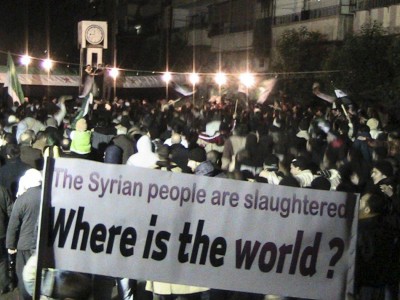
Dov’è il mondo?

RR: Come ti senti circa l’apatia di gran parte del mondo nei confronti della rivoluzione siriana e hai cambiato opinione riguardo la “comunità internazionale”? Se sì, come?

FS: Perché il mondo intero ha benedetto le rivoluzioni in Tunisia, Egitto, Libia e Yemen e le ha sostenute, mentre nessuno ha aiutato o supportato la nostra rivoluzione inSiria o ha cercato di raccontare la verità sulla giustezza della nostra causa? Perché è stato permesso a Russia, Iran, Cina e Iraq di continuare ad aiutare Bashar e il suo regime con armi, denaro, petrolio, benzina e iniziative politiche? Perché le potenze occidentali non hanno cercato di aiutarci creando una no-fly zone, fornendoci le armi necessarie o garantire zone al sicuro per i civili?

Tutte queste domande possono sembrare senza risposta, ma noi siriani sappiamo perché: le potenze occidentali vogliono imporci la loro soluzione con le loro maniere, e questo è ciò che non accetteremo mai. Ma ti dirò quali sono le opzioni o le soluzioni che ci offrono. Vogliono farci accettare le loro condizioni, consentendo a Bashar di rimanere al potere, accordandoci una libertà apparente e dei cambiamenti di facciata creando un governo di unità nazionale. Non vogliono gente nobile o veri ed autentici patrioti così come non vogliono l’ESL; vogliono ucciderli tutti e imporci a loro volontà. Quel che più conta è che vogliono che Israele sia lasciata in pace senza che nessuno possa persino portare qualsiasi pericolo, e come la storia dimostra, Bashar è il miglior candidato per questo. Per questo motivo (le potenze occidentali, ndr) lasciano che Iran, Russia e Iraq lo sostengano inviandogli più armi e truppe per aiutarlo dopo che non avrà più siriani che compiono defezioni di massa in quanto i siriani non lo vogliono. Esse permettono a questi paesi di inviargli soldi e truppe da parte di Hezbollah, dell’Esercito del Mahdy (formazione paramilitare irachena creata nel giugno 2003 dal leader sciita iracheno Moqtada Al-Sadr, ndr) e della Quds Force (letteralmente “Brigata Gerusalemme”, l’unità delle Guardie Rivoluzionarie responsabile dell’esportazione dell’ideologia khomeinista fuori dall’Iran, è guidata dal generale Qasem Suleimani, ndr). Il loro pretesto per consentire ciò è che la questione è difficile e complessa, ma in realtà è molto semplice: vogliamo la libertà. Dateci le armi pesanti necessarie a distruggere i suoi aerei da guerra, carri armati e lanciarazzi e possiamo vincere. Essi sanno che Bashar è estremamente povero così usano anche la scusa che se ci dessero le armi, l’ESL non sarebbe in grado di controllarne l’accesso e Al Qaeda acquisirebbe potere. Ma i siriani sono tutti ben consapevoli che non esiste Al Qaeda nè in Siria nè in nessun paese arabo, e così le potenze occidentali tirarono fuori un’altra scusa: che la nostra opposizione non è unita. Ma in realtà neanchè le opposizioni che rovesciarono regimi in altre nazioni erano unite.

Le potenze occidentali non hanno fatto nulla neanche per i rifugiati siriani in Turchia, Giordania, Libano e Iraq; non hanno inviato loro alcun aiuto reale e non hanno permesso loro di fare nessun lavoro. Non li hanno nemmeno registrati presso le Nazioni Unite (come rifugiati, ndr), li hanno semplicemente lassciati nei campi situati in zone morte in Iraq e Giordania, perché vogliono che i siriani obbediscano ai loro ordini, accettando Bashar Al Asssad e ritornando a vivere sotto il suo regime e se rifiuteranno, verranno puniti lasciandoli senza cibo, acqua o i servizi essenziali. Non ci aiuteranno a ucciderlo, nessuno ci aiuterà. Abbiamo solo noi stessi e facciamo affidanmento solo a Dio, e questo è quel già stiamo facendo ora.

Momento durante un funerale per gli FSA

RR: Come vedi svilupparsi la situazione in Siria nel breve e nel lungo termine, e ti senti ottimista che si possa avere la pace dopo la caduta di Assad?

FS: La situazione si svilupperà in maniera lenta e sanguinosa se non lavoreremo sodo per risolverla. Se siamo in grado di muoverci velocemente per liberar noi stessi sarà il miligior modo per non perdere altri siriani e per salvare ciò che ancora possiamo del nostro popolo, delle nostre proprietà, infrastrutture, economia e tutto il resto. Se lo lasciamo fare ciò che lui, i suoi alleati e le potenze occidentali vogliono, perderemo altre persone e ci sarà un ulteriore spargimento di sangue. Se ciò accade, il bagno di sangue continuerà, sarà un genocidio, con altre migliaia di morti, il paese sarà saccheggiato e depredato dalle sue forze, gli edifici e le infrastrutture saranno distrutti, l’economia devastata, altre migliaia di persone che vivranno in esilio e una fuga di cervelli delle persone migliori che sono essenziali per ricostruire il paese, che sarà lasciato nel caos. Noi siriani non vogliamo nè accettiamo questo, e così lavoriamo sodo tra di noi per unire le nostre forze per ucciderlo e porre al più presto fine a questa terribile situazione. Noi popolo siriano siamo ottimisti perché Allah è con noi e siamo tutti uniti, e crediamo che prestò ci sarà la pace. Se restasse non ci sarebbe nessuna pace, solo più caos e spargimenti di sangue e vivremo nelle tenebre per sempre come schiavi. Ci rifiutiamo di accetare questo per cui preferiamo vivere con dignità oppure morire come martiri. Questa è la nostre opzione preferite, la morte piuttosto che l’umiliazione.

RR: Come vedi la pretesa ripetuta da molti mezzi di informazione che si tratti di una “guerra civile settaria”?

FS: Non vi è una guerra civile settaria: questa è soltanto propaganda usata e promossa dal regime e in altri paesi. Essi sostengono che se il regime crolla ci sarà la guerra civile e la gente che si ammazza a vicenda, ma se rimane manterrà integra la società siriana. Questa è una menzogna sfacciata; quello a cui il regime e loro (le potenze straniere, ndr) stanno lavorando è dividere la Siria in regioni autonome come in Iraq, ai Curdi uno stato nel nord-est, ai drusi uno nel sud e agli alawiti uno sulla costa siriana, mentre ai sunniti rimarrebbe il resto. Questo è il loro piano e Bashar sta lavorando duramente per realizzare la sua ambizione di uno stato alawita-sciita. Si dimenticano però che fin dall’inizio della rivoluzione il nostro moto è stato “Uno, uno, uno – il popolo siriano è uno”.

Il regime spinge sul settarismo mentre il popolo siriano la pensa diversamente

Questa nazione è per tutti: qualunque sia la tua religione, setta o gruppo tu sei siriano e appartieni alla Siria. Tutte le sette del popolo siriano rifiutano questo piano di dividere la nazione e si sono appellate all’unità. Durante la rivoluzione ho incontrato e parlato con siriani alawiti, sciiti, cristiani, drusi e sunniti e tutti hanno respinto questi piani per dividerci. Tutti invochiamo l’unità – un popolo una nazione, anche se il regime ha tentato più volte di armare sette diverse e dirigerle l’una contro l’altra, per creare divisioni tra di noi. Per quanto (il regime, ndr) si sforzi, non permetteremo di essere manovrati in questo modo, e di combattere e uccidere l’un l’altro – siamo tutti fratelli e sorelle.

Infine, voglio dire una cosa in più: prima che la nostra rivoluzione cominciasse, abbiamo tutti vissuto in pace e armonia. Io vivevo personalmente in un condominio con vicini sciiti, ebrei e cristiani. I miei amici appartengono a tutte le sette, ci amiamo vicendevolmente e viviamo assieme.

RR: Pensi che questa esperienza ti ha cambiato come persona? Se sì, in che modo?

FS: Sì, mi ha cambiato e ha accresciuto la mia consapevolezza riguardo il complotto globale volto a garantire il fallimento della nostra rivoluzione. Ho anche scoperto che l’intero mondo guarda solo ai propri interessi e non si preoccupa nient’altro che di sè stesso. Non credo più nella retorica delle Nazioni Unite e delle organizzazioni non governative, che si tratti di Human Rights Watch, UNICEF, UNICO, della Corte penale internazionale, del CJI o di qualsiasi altra cosa. Il mondo intero non è riuscito ad ideare un programma per aiutare i siriani in Siria o i rifiugiati nei paesi limitrofi o addirittura tenere una riunione di donatori. Anche la conferenza “Amici della Siria” non ha ottenuto nulla; stanno solo a guardarci e a lasciarci uccidere con il sostegno russo e iraniano.

La rivoluzione mi ha comunque dato una speranza in un modo: vuoi sapere come? Mi ha insegnato che quando si incontrano problemi o ostacoli nella vita, nessun altro se non solo una manciata di veri amici si preoccuperanno o aiuteranno te e le tua famiglia, devi fare da solo e aiutare gli altri nella stessa situazione in qualunque maniera. Mi ha reso più consapevole e orgoglioso del mio popolo e del mio paese e di cosa dobbiamo fare per porre fine a ciò. Siamo gente pacifica e abbiamo delle risorse. Possiamo ricostruire noi stessi e il nostro paese, sviluppare le nostre competenze già esistenti e imparare nuove abilità. Ora sono più responsabile di quello che ero: voglio costruire me stesso, sviluppare le mie competenze, acquisire maggiori conoscenze e condividerle con la mia gente. Voglio tramandare alle generazioni future che abbiamo combattuto e sacrificato le nostre vite per ottenere la libertà e che non dovremo mai più accettare chiunque si credi un dio e ritenga di avere il diritto divino di governarci per sempre, ma dovremo eleggere solo leader altruisti che hanno a cuore il popolo siriano e la nazione piuttosto che l’auto-arricchimento.

Voglio sottolineare che la rivoluzione è nelle nostre mani. Credo che il mondo abbia bisogno di cambiare e realizzare che tutte le persone del pianeta sono uguali e gli deve essere concesso di ottenere la libertà. Ho anche scoperto che quelli che si definiscono “leader arabi” e governano paesi arabi sono in realtà infidi mandatari di poteri esterni o sempcliemente non si preoccupano affatto degli arabi.

RR: In cuor tuo, per quanto tempo ancora pensi che la rivoluzione possa continuare e cosa pensi che sia probabile che accada nel periodo successivo alla rivoluzione?

FS: Quando iniziammo questa rivoluzione, sapevamo che non saremmo mai tornati indietro e siamo ancora consci di questo: dopo tutto quello che abbiamo passato e sacrificato, saremmo condannati se soltanto considerassimo di ritornare a come stavano le cose; questa è la nostra risposta definitiva. Tutto ciò che Bashar ha commesso contro di noi e continua a farlo senza pause, lo ha fatto con il crescente supporto di Israele, Russia, Iran e China; abbiamo dimostrato al mondo che continua a negare il loro coinvolgimento, che truppe iraniane, russe e di Hezbollah sono state catturate in ogni città siriana, con ognuno di essi in possesso di documenti comprovanti ciò. Inoltre, abbiamo ottenuto dei documenti ufficiali del regime che dimostrano che Bashar ha importato sempre più soldati sciiti da Iran, Libano e Iraq, compresi dei membrei della Guardia Rivoluzionaria iraniana, con la Russia e altre nazioni che gli inviano armi così come delle truppe. Nonostante tutto questo, tuttavia, il suo regime sta perdendo la battaglia, ma i suoi alleati e le potenze occidentali vogliono che rimanga e continuare a coprirlo in qualsiasi modo possibile. Sfortunatamente per loro, noi sconfiggeremo lui e loro e lo uccideremo presto, inshallah.

Soldati del Esercito Libero Siriano entrano in una zona di Aleppo quasi raso al suolo dall’esercito del regime.

Quindi, se mi chiedete quanto tempo ancora continuerà la rivoluzione, io dico che la continueremo fino a quando non lo avremo ucciso e cacciato Russia, Iran e Hezbollah dal nostro paese. Nessuno in Siria accetterà di farla finita ora perché ogni famiglia in ogni villaggio, paesino o città siriane ha almeno un martire, un detenuto, una vittima di un rapimento da parte delle forze del regime o un membro della famiglia spinto verso l’esilio.

Lo sai che ha annientato molte famiglie intere? Lo sai che ha distrutto la maggior parte delle città e ha arrestato più di 250 mila persone? Lo sai che ora sta punendo collettivamente ogni persona in qualsiasi area che si è opposta a lui (la maggior parte della Siria) e che le sue forze stanno avvelenando le forniture di acqua e di prodotti alimentari, anche prendendo di mira i forni per fare in modo che la gente muoia di fame? Lo sai che le sue forze stanno negando le medicine e le cure mediche, bombardando ospedali e prendendo di mira il personale medico nella speranza che questo costringerà il popolo siriano ad obbedirgli? Noi gli diciamo, vai all’inferno!

Tutto il mondo lo vede e non fa nulla, scusandosi dicendo “E’ difficile e complicato” ma in realtà è molto semplice – i siriani vogliono liberarsi dalla dittatura – e potrebbero aiutare se solo lo volessero. I siriani sanno tutto questo. Continueremo e ci sosterremo a vicenda nonché sosterremo e combatteremo per l’ESL. Qualunque cosa Bashar faccia, noi non ci fermeremo; ogni uomo, ogni donna e ogni bambino si batterà fino all’ultimo respiro. Non acceteremo quel che il mondo vuole per noi, non indietreggieremo di un passo nè accetteremo quel che ci vogliono imporre. Abbiamo cominciato questo e noi lo porteremo a conclusione. E soprattutto, lo abbiamo detto fin dall’inizio, Allah è con noi e Allah e nessun al di fuori di Allah è co noi. Non abbiamo nessuno se non Allah.

Mi stai chiedendo “cosa farai dopo la rivoluzione?” Stiamo lavorando sotto copertura, per preparare tutto e cooperare tra di noi. Abbiamo progetti in atto ma il problema è che non possiamo rivelarli per timore che le persone sbagliate scoprano ciò che stiamo progettando. Tutto quello che posso dire è che stiamo coordinandoci tra l’ESL, i consigli militari, l’opposizione e i vari partiti per garantire che la normalità e lo stato di diritto siano ripristinati una volta caduto il regime, in modo che il popolo siriano possa ritornare a condurre una vita normale. Creeremo un governo di transizione che rimarrà in vigore fino a quando una nuova costituzione sarà stata creato e saranno decisi un nuovo presidente, un nuovo governo e un nuovo parlamento.

RR: Quali sono i tuoi progetti per il periodo post rivoluzionario? Le tue esperienze di vita attraverso la rivoluzione li hanno cambiati? Se sì, come?

FS: A dire il vero, mi piacerebbe far esperienza ed essere attivamente coinvolto in questioni politiche. Voglio avere un ruolo attivo nella ricostruzione e nello sviluppo del mio paese, e aiutare a fornire ciò che è necessario come il cibo e le medicine. Mi piacerebbe essere coinvolto negli aiuti e nell’assistenza umanitaria perché, come sai, ora abbiamo molti adulti e bambini amputati che hanno perso gli arti in attacchi del regime per cui hanno bisogno di arti artificiali, così come ci sono persone che necessitano di interventi chirurgici urgenti. Tutto ciò verra a costare miliardi per cui abbiamo bisogno di raccogliere fondi o di ricevere aiuto da ospedali all’estero.

Mi piacerebbe essere coinvolto nel sistema educativo. Come sai, sono uno traduttore e mi piacerebbe aiutare a insegnare ai bambini e ai giovani in scuole, università e altre istituzioni educative. Il regime ha ucciso docenti in molti settori per cui abbiamo una carenza enorme a riguardo e dobbiamo lavorare sodo per riempire questi posti vacanti e sovrintendere all’attuazione di un piano di vera educazione per introdurre un programma di apprendimento accelerato al fine di evitare problemi futuri per quei ragazzi che hanno già perso due anni di insegnamento a causa dei bombardamenti del regime e il caos ha significato che non avrebbero potuto continuare la loro educazione.

Noi vogliamo catturare tutti i soggetti coinvolti in uccisioni, torture, stupri e sacchegghi, per giudicarli, imprigionarli e giustiziare i peggiori colpevoli. Non permetteremo a nessuno di sfuggire alla pena a causa della propria setta. Siamo stati tutti esposti senza discriminazione alla persecuzione, terrore e intimidazione, e troppi sono stati torturati e/o uccisi per cui vogliamo giustizia e dignità allo stesso modo per tutti.

Infine, voglio partecipare attivamente al processo politico per aiutare e rappresentare il mio paese a la mia gente. Ho ancora l’ambizione di ottenere un Master in Traduzione e Interpretariato, anche se il regime mi ha privato di questa opportunità fino ad oggi e ha sprecato due anni della mia vita in una guerra brutale contro il popolo siriano. Questo è ciò che ci è stato imposto ma tuttora rifiutiamo il regime.

Originale in inglese https://wewritewhatwelike.com/2012/09/22/interview-with-a-free-syrian/

By Wissam Al Jazairy

There are two ways of experiencing a social upheaval of epic proportions: directly or indirectly. Naturally, if one is directly affected by restrictions, uprisings, detention, revolution, attacks, blockades, shortages of utilities, medicine and food, migration and so forth, they are going to be connected to the event in a visceral way and this of course helps to define the nature of the event as being positive or negative.  There is a DIRECT relationship between what is happening and an improvement or a worsening in their lives. It is a relationship that is dependent upon reality and the “timeline” of their narrative is going to be “before” the event and “after” it. There is little abstraction going on, as, for example, you simply know that “before” you lived in your home and “after”, you were marching towards a refugee camp because not only your home, but your entire town no longer exists, and you know who did that to you as well!  No one has to inform you that this is a bad situation. No ideology could ever be more meaningful to you than the fact that your life has been totally changed (for the worse) from what it was before.

It’s obvious that those who live outside areas of upheaval are not going to have these experiences in order to judge the events, and judging them is what we tend to do naturally if we are “activists”. We tend to see them in a bigger picture and part of a greater struggle. Therefore, as indirectly involved, we have a few choices at our disposal. We can view events (and people) in a prism that comforts us or at least fits into what we think we already know (our ideology or beliefs), we can take the road of empathy and identify with the persons directly involved, we can remain indifferent, uninvolved and choose to ignore any information until it DOES directly involve us, if it ever would have that destiny. We can even attempt to tightrope walk in a combination of all of them, depending upon our mood, our social interactions, our interests.

Then there are degrees of indirect involvement. It often relates to the concept of “identity politics”: where a person relates to an event according to a perceived degree of identification with those directly involved in any event. Taking the Syrian uprising into consideration in this paper, it is clear that all Syrians around the world have a connection to Syria and have its interests at heart. I doubt that there is even one Syrian who washes his or her hands of the entire situation, even if they may find themselves on diametrically opposed sides. However, one important matter must be acknowledged: that there are indeed persons who are directly affected and whose lives have been shattered, and that the facts supporting the amount of destruction, the number of deaths and refugees and even the dynamics of the various massacres can in no way be denied. It is beyond ridiculous to imagine that we can turn back the clock to a time when we were not connected in real time, when news of massacres only reached a small public in whispered tones, knowing that the details were too horrible to even be believed. Any town in the world that has some sort of access to communication is fully able to see documents such as photographs and films of the real events happening in Syria at this very minute. They can judge if there are protests, battles, massacres by what they see.

Dealing with cognitive dissonance

There is actually a tricky part of this whole thing though: if we AREN’T directly involved, whatever decision we make will turn out to be an ethical choice. Unless we are completely alienated and detached from the suffering of others, not to mention living in a vacuum, the suffering going on in Syria smacks us in the face day after day and hour after hour. If the sight of torture, destruction and death makes us feel bad, chances are we are normal and we will experience some level of cognitive dissonance. We know that things we are witnessing (or being shown) are “bad” or even “unacceptable” or “evil”, depending on our linguistic habits, but since we are not in the habit of outspokenly endorsing evident ethnic cleansing and carpet bombing of Arab cities and villages, we may find ourselves taking refuge in the cosy world of “punditry” and “analysis”, where the idea and intention (real or imagined) bears more weight than isolated events (even if they are repeated thousands and hundreds of thousands of times). It is clear that punditry is the easiest road for the self-identifying human rights activist, because we all have a body of literature that slips all events into a meta-narrative (in the case of punditry that calls itself “anti-imperialist”, but is actually the sum equivalent of counter-revolutionary thought, where the leader is preferred and supported over the rebelling masses for perceived value he has in an ideological framework) and we can selectively analyse specific events in order to prove our points and especially settle our painful cognitive dissonance.

It’s a bit of a disaster though, because it assumes that the indirect experience, nay, the ANALYSIS is actually more relevant than the direct experience. It puts us in the even MORE uncomfortable position of being the “great white hope”, the one who “knows better than “the other” what’s Best for the Other”, though we attempt to not let that fact bother us, as we are cognisant that most of us are unwilling and unable to leave the comfort of the West and its trappings such as banks, iPads and all the pluggable things we adore more than humans. We have the opportunity of justifying what we normally would not be able to justify by means of adopting a “more important” ideological stance, and we assume others will be able to understand that we are not any kind of privileged person, but instead we benefit of our years of activism and awareness and just plain “intelligence”, seeing things ordinary folk can’t see!

A few anti-interventionists in London are selective about what intervention they reject

In addition to our ability to be physically far from war, we are even lucky enough to have the assistance of critical distance, the only thing that allows analysis and lets us paint over the grey areas (we can decide even which meta-narrative we can focus on, tailoring our interventions to our public. If the consumers of punditry are Westerners like us, (as 90% of them are) we can assume they do not want to be involved in interventionist wars (Western intervention, that is) and they will respond to a group of code words, they will take on and utilise in discourse new ones such as “sectarian” without requiring mental strain of figuring out if this is truly the case in point. We can vary the theme a bit by going for the generic pacifism/no war framework if the complexities of historical events in mass movements in the Arab world is beyond our grasp. And there is a beauty to all of this: we can still consider ourselves as superior ethical beings, because we are not ignoring (and we would never admit we are facilitating something negative!) the situation, but instead we can remain great humanitarian activists who are looking out for the best interests in those populations who do not have the dialectical positions we have. We resolve our painful cognitive dissonance and at the same time give ourselves hefty pats on the backs for being so very clever and anti-imperialist.

I believe I am like most of the others reading this: not directly involved, but not able to avoid the empathic response of shock and disgust at the violence, yet also deeply entrenched in my “activist identity” that seeks to analyse what is seen within a larger framework. This means that I am a consumer of punditry, and for better or worse, the vast majority of it is done by those who might move onto the next “hot spot”, and that means that whatever the outcome, it’s not going to affect them personally, because it’s someone else’s lives, someone else’s country. So, the logical assumption is that if you are not personally involved, your stakes in the situation are completely different than those who are involved, and your “personal” stakes may not at all be lofty ideals such as “saving the Arab people from the evil empire”, since the evidence that imperial interests are the driving force in the uprising of the Syrian people is nil. The personal stakes may quite simply be learning to live with yourself after seeing what is objectively “unacceptable” violence committed by the regime with very little excuse for this except that they CAN.

How is that done? Simple! Claim that the justification of the violence is a greater cause or that “both sides” commit unacceptable deeds. The fact that you will always find a bit of evidence to justify that thesis comes in handy, and it avoids the need to actually ANALYSE, but to stick selected evidence into a pre-conceived analysis. You can use even contradict yourself, no one is keeping score! If in January there was NO such thing as Al Qaeda, in August they can be the driving force of the “rebels”.  If you spent years stressing the absolute right of the Palestinians to select for themselves parties that are overtly Islamic, no one will spend too much effort to point out the hypocrisy of determining that Assad “needs” to stay in power to guarantee a Secular Syria. No one will point out the vaguely Islamophobic comments that you might make as you lump all the freedom fighters into the “Salafist” bag. And do not worry that people are going to argue that the concept of a wider “homeland” has always been a part of uprisings in the Arab world, that the Umma should at least theoretically participate in the struggles and armed conflicts where called upon.

The kitsch aesthetic reigns supreme in self-styled pundits

If you are like me, you have read dozens of articles that bear lots of information but almost no factual data. Much of this information is by self-styled pundits, quite kitschy most of the time, who have no direct access to information, and what they actually do is pass off regime dispatches as being their independent analysis. RT, Press TV and Global Research are going to tell you about hundreds (and at times thousands) of troops of Libyan soldiers fighting in Syria, but that is pretty much all you will ever find out about them, though meaningless and fact-deprived mega titles like this will float from article to article:

The “Free Syrian Army” is Al Qaeda, led, armed, funded by Western-backed LIFG (Libyan Islamic Fighting Group) terrorists.

No need to prove any of that! Just saying it is enough, and throw in the word “terrorist” referred to Arab fighters and you can actually take almost any analysis by the Neocon Think Tanks and arrange it to suit your needs.

And this is the problem: Those who are closer to the revolution / uprising because they identify with the persons actually undergoing these events are reacting empathically, humanely and emotionally. They believe that it is sufficient to show the world what is going on and human decency will do the rest, will stop saying “this is unacceptable” and will MAKE it unaccepted. Those who are farthest away, whose involvement with it is fickle, transitory and laden with the cognitive dissonance that forces them to justify atrocities are the ones analysing the situation. They are not presenting all that is seen, but are clipping out those things that support the effort they are making in order to continue to back a regime that is objectively engaged in violence against a civilian population that is obscene. They will point to the Palestinian cause, repeating the regime’s slogans that have no support in truth! It is clear that if the regime has shelled the Palestinian refugee camps (bringing about destruction and also the death of over 400 Palestinians) because these places are considered as supportive of the revolution, there is something in that argument that is enormously flawed!

Russian Veto serves Assad

If they are using the “no intervention” argument, they simply ignore the fact that there is heavy intervention and actual material support of the regime from Iran, Russia and Hezbollah. It is not a theory, it is actual fact. If they claim that the UN veto serves the interest of imperialism and the West and has been a grotesque miscarriage of Justice regarding Palestine, the veto of Russia and China to sanctions is seen in a completely different light. If the No Fly Zone was slammed for Libya, is labelled as a NATO device when applied to Syria we have to simply ignore that, “I Support a No Fly Zone Over Palestine” was a campaign that was adhered to particularly by these same pundits. Or, could it be that there are some humans who are more human than others and whose rights are worth stopping at nothing to protect?

The range of arguments that these people use is often contradictory, almost always lacks research and most of the time is detached from the will and reality of the persons who are directly involved. Even the idea borrowed from the pro-Assad people outside Syria who do not see the pro-regime intervention but are obsessed with that of the uprising, whether that intervention is real or imagined which states: “let Syrians settle it among themselves”. This is a way to avoid the internal conflict of being an “activist” in someone else’s struggle and urging that all issues are resolved without others butting in. Non-intervention is selective, and it follows the trends.

I would like to close this paper by making two points. The first is that since we have shifted much of this war into the “social sphere” where communication happens, we are aware of the weight of conformance to social conventions in our interactions. We are horrified at the prospect of clashing with those who in the past have had such accurate insights or at least who along general lines followed the same ideas we did, those of the revolutionary struggle for freedom from oppression and a people’s rights to self-determination. This means that many of us, accepting these paradigms of justification of human rights violations have removed our critical abilities in a lazy manner. We simply fail to recognise the hypocrisy that exists where Pro-Palestine activists are posting up hateful pictures of icons of the resistance, Shiehk Raed Salah, Azmi Bishara, or journalists and writers such as Khalid Amayreh or Elias Khoury only because they have insisted that the Syrian liberation struggle is a struggle of an oppressed people against a tyrant and that this tyrant has continually put the “rights” of Israel before the rights of the Palestinians and Syrians.

One of the more intricate “proxy war” maps, though it ignores Israel, unlike some of the simpler ones circulating

It is ironic that these pundits specialised in revolutionary slogans are busy labelling the uprising and revolution, brought ahead heroically by the brave Syrian people almost single-handedly, as a “Proxy War against Iran”, which is not only a meaningless phrase but it takes away any agency that the Arab and Syrian people have in determining their own fate and making their own history. They will also tie into this concept all the regional and international powers, as if they are the point and Syria is not an issue. And it’s not only the anti-imperialists who have a problem, there is something really wrong in pacifists who are busy equating the massacre of almost 700 people in a day to the throwing off the roof of two snipers who had been killed in combat. It simply defies a sense of measure, a sense of perspective and reality!

The second point I want to make is that while the pro-revolution faction outside Syria is very busy in the noble task of disseminating the information that leaks out of Syria, at times with enormous difficulty, informing the entire world of the situation there, and honouring the martyrs with the testimony of their suffering, it is missing out on the “analysis” aspect. It is a shame that of the thousands of analytical items to read, half of them are reprints of the same 3 or 4 articles by faraway pundits (often without experience or credentials) in London, Chicago, Naples or Florida. If some of them are nearer, they have a specific dog in the fight, and they themselves are “obsessed” about sectarianism, so they see it in everyone else, whether it is there or not. I believe that we activists who are both empathic and who support the people of Syria in their struggle for freedom have to make an extra effort to fight the propaganda, to debunk the fallacy of the information presented as argument (lacking the evidence, the big words such as Imperialist fly!) The truth is on our side, but the Assad-supporting activists are beating us in the information game only because they are required to play it so that they can look at their faces in the mirror and not hate who they see.

Soubhi Dachan

Syria has finally earned a place in the Italian news after almost a year and a half since it began. In the eyes of the Italian public it is “another war that no one can figure out” that erupts between the usual squabbles of our politicians in our news. Opposition to the regime in Italy has its own path, but in many instances, it matches that in Syria. To help us understand this war and these oppositions that are already part of history, we interviewed a Syrian opposition figure in Italy, Soubhi Dachan. His words bring us to think that even though there are now two factions that are clearly military, this cannot be called a civil war, but rather a response to genocide born of the violent response to the peaceful popular uprising. And not only is it a declared genocide, but it uses a strong propaganda to paint itself in a different way, a genocide that is “observed” by all the powers in the region and beyond, when it is not actually being fuelled by them. 

How did the revolt in Syria begin? Who is rebelling and to what?

28 Children in Daraa. 28 Children were the fuse that sparked the revolt. 28 elementary school children who returned from school, had written a phrase written on the wall that they had seen on satellite broadcasters, taken from the huge demonstrations in the Arab world: the people want the fall of the regime.

28 children have unleashed the fury of demons in power for 40 years in the Syrian state, who have used 18 different security services to repress the people.

During the night, a unit of these services led by a relative of the tyrant Assad made a house to house raid and took all 28 children.

The lifeless body of 13 year old Hamza al Khatib, tortured and killed by Assad’s security forces

The next day, the chief of the tribe (in Daraa there is a very strong concept that a tribal chief is more respected and followed than the mayor of the city or other important figure) went to the police station where he met the cousin of the president.

The tribal chief asked him to release the children and bring them back to their families, safe and sound, and he promised to severely punish their misbehaviour and their offense and promised to pay a tax for this uncouth act.

The commander literally said: “Tell their families that their children no longer exist. Tell them to make different ones. And if the women’s husbands do not know how to do it, bring them to us, we’ll take care of getting them pregnant.”

The tribal chief who wore the white veil on his head with a black band, took the black band and put it on the table. In Bedouin language this means that there is no room for dialogue, and that children will be freed by force.

And so began the revolt.

Is it part of the wave of uprisings in the Middle East and North Africa for an ideal of freedom and change, or has it got aspects that make it different from other revolts?

When we saw the satellite broadcasters with the first Arab uprisings we erupted with joy. When we saw the first movements in Syria, we immediately were concerned because only the Syrians know the criminality of this system and how it is supported by various powers for a variety of regional / international
interests

Map by Limes Rivista Geopolitica

Is it a civil war fueled by sectarianism?

In Syria, Civil War is a card that the regime is trying to use all costs, in order to show to that the minority that the regime is their only salvation. In Syria there is no sectarian problem, unlike other countries we are talking about hundreds of years of peaceful coexistence and not just tolerance. Syria was an example of civilisation where even the Christian denominations or less persecuted people in Europe found refuge.

In Syria, there is an ongoing revolt against a tyrant where all members of civil society, ethnic and religious groups are taking part. Not for nothing in Homs, the first military formation of deserters was made ​​up of Christians, Muslims and Alawites.

Does it makes sense to talk about reforms, elections, governance systems and democracies during an uprising or war?

Not only does it not make sense, but it is a way to continue to give further legitimacy to a tyrant who has no equal in recent history. Even the tyrants of past history used their cruelty in the conquest of other peoples and not to defend the interests of some other nation, massacring its own people.

To talk about all these things is to continue to justify the genocide of the Syrian people.

The revolt is armed or peaceful, given the reason for the revolt, is there a prejudice against the nature of the uprising, does it lose its value if it ceases being peaceful?

The uprising has been the most peaceful revolt in living memory. For nine months, the people responded to gunfire and bombs with flowers. They started their protest demanding reforms, the snipers are what they got in return. They then went out more numerous in street demonstrations, demanding justice, with chants, processions, prayers. In return their unarmed crowds were shelled. For nine months the Syrian people responded to torture, abuse, rapes, kidnappings, well, the people responded with the slogan “the Syrian people are one and united, the Syrian people want freedom, the Syrian people want the fall of the regime”.

Photo by Salah Methnany

The main slogan of the revolution was and remains today “Peaceful, Peaceful, Peaceful.”

The revolution has been dubbed by opponents as the “revolution of dignity and freedom”.

After nine months of massacres, deserters and not the people have decided to take up arms in defense of the people and not as a form of attack. After 12 months of bloodshed even some sections of the people had taken up arms, exclusively in defense of their dignity, their families, their people.

And despite this, even today the rebels beg the people to continue to demonstrate peacefully, even in the refugee camps, roads, cemeteries, at every march.

Is the terminology that the mass media uses “revolt, opposition, rebel” and so on correct? What are the words to properly report what is happening in Syria?

The media has behaved in a shameful manner. They still speak of the Syrian revolution of the flowers from the mouth of the Syrian regime or its affiliates. The peaceful demonstrators were called rebels. The deserters were called armed groups. The unarmed people has been called faction in the war.

The media have contributed significantly to the massacre of the Syrian people.

Syria is undergoing a mass genocide. The puppet Assad, has strict orders not to leave power until Syria will no longer have an army, it will have no more security, no more facilities, infrastructure, civil and military institutions etc. .. In Syria the cancellation of a civilisation is taking place, the destruction of churches and mosques, the systematic violation of human rights, of international conventions.

In Syria there is an ongoing genocide. Mass rapes, slashing the throats of people, women, elderly and children. Destruction of everything, cultivated fields, houses, monuments with thousands of years of history. In Syria there is the destruction of humanity.

Who is the SNC and what role does it have in the revolt?

The SNC is the Syrian National Council. It was born after about 6 months from the start of the uprising with the aim to give a voice to the Syrian people in all its facets and not be merely a show entity. This is because the word opposition in Syria has remained a taboo for 40 years, the only form of opposition that has remained for 40 years has been the Muslim Brotherhood, which is why there was a law that immediately put to death anyone suspected of belong to this organisation.

The Syrian National Council was created as a technical  and diplomatic support abroad for the revolution. It incorporated within itself the majority of members of Syrian society, secular people, Christians, Alawites, Sunnis, Shias, Druze, Kurds, members of tribal societies, secular formations, Islamic formations, etc. ..

It was chaired by Burhan Ghalioun for two terms, a secular Muslim and in third term the mandate was given to Abdulbasit Sida, a Syrian Kurd.

One of the reasons why at the international level it has not been recognised for a long time is that the Syrian National Council includes the various components of Syrian society, and the willingness of some world powers was to isolate some important components of Syrian society, in perfect dictatorial style.

In this regard a round of applause goes to the previous and current Italian government which have listened unlike the media and other institutions, very carefully the Syrian people and not the genocidal regime and has been one of the first governments in the world to send assistance and field hospitals and it has been busy at an international diplomatic level in support of the Syrian people.

Who are the Muslim Brotherhood?

The Muslim Brotherhood is a grassroots movement that is inspired by the Muslim Brotherhood movement in Egypt. It is a peaceful movement that joins together aspects of governance, education, religion, politics and diplomacy, civil status and rights of minorities. It was founded in Syria by Syrian intellectuals and religious people, and has had tremendous popular support. When Hafez al-Assad came to power he persecuted them and forced them to take up arms to defend themselves, but then given the massacre of Hama in 1982 (more than 50,000 dead) the brotherhood were deprived of their arms and were exiled (in those lucky instances in which they were able to escape,) tortured, imprisoned, killed and denied their existence in Syria. Even their relatives were persecuted, this is why they left Syria.

Free Syrian Army in Azzaz

Who is the Free Syrian Army?

The first soldier to desert was a soldier of Daraa. They ordered him to shoot shells on people demonstrating peacefully. He called his father and asked him, what should I do, my father? He said, “Never must you bear arms against your people.” He was the first soldier to be killed by the regime. Then the first unofficial faction was that of Al Rastan, Homs about 5 months after the revolt started. An entire division turned their backs on the officers. This division still today resists. Then there was the one in Lattakia, where its soldiers took refuge in the Palestinian refugee camp, only to be bombed from the sky and from the sea by the militias of Assad.

The Free Syrian Army was officially founded around the eighth month of the uprising, when several commanders who had defected decided to constitute it and give some kind of organisation to all the soldiers who had decided not to turn their weapons against their own people, their own blood. Signing a pact of honour in defense of the Syrian people and asking the Syrian people not to join the army but to continue to demonstrate peacefully. Then the situation evolved and many of the protesters have joined the army. Today the volunteers of the free Syrian army not of military origin are about 50% of the forces.

How come there is no global attention on the Syrian issue, and why even with multiple reports also being published by global organisations like the UN and Human Rights Watch, does there seem to begreat indifference?

Syria is at the crossroads of world interests. The strategic location, the proximity to Israel, the ability of the system to play with popular topics such as the Palestinian issue, defense and protection of minorities etc. .. means that the regime is still supported today by world powers, in that it is convenient for the protection of their interests in the area. The Syrian regime has never allowed a different point of view, has never allowed in Syria anything at all but the voice of the regime itself. It put all the people of the leader’s sect in key centres of power, from the institutions as simple as those of workers, up to the military.

The media willingly speaks little of Syria and when they do, it is done in a chaotic way. And this is despite the massive presence of videos, documents, photos and eyewitnesses as the UN forces or satellites. In any other part of the world headlines would have documented daily what happens. But not for the Syrian issue.

This is why journalists and their sponsors are criminals in equal measure to the tyrant and his henchmen with their shameful complicity and their disgraceful silence.

What role could the external forces, the UN, NATO, the ICC, the European Union, the Arab League, and so on undertake and what you think their objectives should be?

All these forces are bound by the opinion of the great powers. Those who say that the international community is unable to support the Syrian people are obviously liars. If the international community decided to help the Syrian people, within a week Syria would be free. It would take 100 stinger missiles and weapons to the rebels. Something that so many claim is taking place, but no one is actually doing.

Unfortunately Syria is going through a complex of international isolation. Even when countries such as Turkey, Italy and other countries still sincerely want to help the Syrian people, they find themselves blocked by the various powers from east to west. The story of the veto is a farce, everyone is in agreement to keeping the puppet in place, each for its own purposes. There are those who have the will to destabilise the entire Middle East area. This is why all these interests join together in the support of the puppet Assad. Who continues to serve his masters undaunted in order to remain in power.

Devotion to Assad

Has Assad got support in Syria?

Assad is backed by his confessional group, the Alawites but not all of them, and by the various people with whom he entertained business and other opportunists who lived the good life at the expense of the entire population. Some parts of the ethnic and religious minorities support him not for love, but for fear of being left in the cold in the future Syria. Which is clearly a result of the regime’s propaganda, because minorities were ministers and officials in the Islamic governments or any rate in the times prior to the Assads. This is part of the work of the regime, which, as has been shown now, tried to spark a civil war in Lebanon targeting the Christian patriarch who would have to visit a Muslim quarter. Thank God the plot was discovered in time.

His power is governed only by military force, Assad has no support in Syria. And the military is strong thanks to the continuous reinforcements arriving from neighbouring states in both arms in soldiers and mercenaries.

You as insurgents abroad, why you oppose the regime?

Opponents abroad fall into two categories: those who have opposed for 40 years and those who opposed during the uprising. What is certain is that both have never loved the regime. The first reason why we object to is the humanitarian cause. In Syria, there is an ongoing humanitarian disaster. And as opponents who have had the feeling of enjoying the freedom, the dignity we find in European countries and elsewhere we certainly cannot stand in this historical era, the era of the Internet, to see these abuses, the destruction of the countries of origin of our parents. Many like me, thanks to this regime have never set foot in Syria. We are free men and women and we are opposed to tyranny, whether in Syria or elsewhere.

Thanks to several million Syrians abroad some aid arrives in Syria. Businessman, university professors, employees, workers, entrepreneurs, are giving their blood and all their belongings to not abandon their Syrian brothers.

Protest in Italy “The Syrian People Ask for Protection of the Civilians”

How is the opposition in Italy organised? How was it founded?

The opposition in Italy has been present for years with people who have left Syria 40 years ago, who at the time were students and did not have a way to return as free men in a dictatorial country. During the uprising, the opposition the young and the old met one another on equal terms, they overcame the various divisions which the regime had attempted to render permanent in the Syrian people. Now with different groups and ways all are trying to support the revolution, who at the diplomatic level, some at the humanitarian level, some with the use of information through the internet, some through newspapers, others with blogs, some in their own spheres of study and work , some by means of holding public events, some in street demonstrations and protests. From Lombardy to Sicily there were demonstrations of solidarity and support to the Syrian people. Everyone contributes in their own way to support this revolution.

There are members of the regime who are trying to sneak into the opposition, but the rot will always come out into the open, and they are quickly isolated.

By whom do you feel represented?

The answer to this question is that which was given by the Syrian people in the streets: “The Syrian National Council represents me, the Free Syrian Army represents me, the local committees of the Opposition represent me.”

What can one do in Italy and Europe to support the revolution?

Work is underway to try to have united fronts of opposition, trying to do lobbying towards the political class to support the collection of humanitarian aid, attempts to act diplomatically to support the opposition and the international decisions. Certainly it would be a good omen if Europe was courageous enough to recognise the Syrian National Council, I think it then would also encourage the Arab countries to take this step.

Right now what is most urgently needed is to put an end to this humanitarian catastrophe and constitute a humanitarian corridor, especially for internally displaced Syria and the borders of neighbouring countries.

Europe could still freeze several billion of the Assad family assets and those of his cronies and it could give them to the opposition to supply aid the Syrian people. Many things could be done, but very few things are actually being done.

The establishment of a no-fly zone would mean the death of the regime within a few days.

What conclusions do you have, after a year and a half of revolt?

30,000 dead, 300,000 imprisoned, 70,000 missing. Two and a half million refugees. In Syria, the dead, imprisoned or missing are mathematically dead.

The conclusion is that the regime is simply a loose cannon, constantly humiliated by the Free Syrian Army despite the inferiority of tactical warfare and number, it destroys everything it can destroy. Since we are dealing with a cowardly regime, as are the mercenaries that follow it, they take it out on defenseless civilians, cutting their throats, cutting their bodies to pieces, putting the snipers where there is a crowd to the create the greatest number of deaths, for example where there is the bread line. The regime has now created death squads that spread death all over Syria, posing as the Free Syrian Army. This is because the people have supported and continue to support the Free Syrian Army and, despite the hunger, the lack of water, electricity, gas, medicine, and so forth, the Free Syrian Army has liberated 70% of Syria, The Syrian regime controls the air, using cluster bombs (banned by the Geneva Convention), it rounds up of civilians from house to house, rapes every human being, man, woman, child. It’s a regime that has no equal in crime in history. It castrates boys cuts children to and adults to pieces. They disconnected the incubators in hospitals, killing babies.

They destroy everything, churches, mosques, homes, culture, monuments. The important thing for them is to stay in power. To conclude: the conclusion I draw is dramatic. But the Syrian people have said and repeated: either freedom or death. There is no third way. And the Syrians sing at the funeral of their loved ones the songs of victory.

Assad will perish or escape. And the long-awaited victory will be even sweeter and Syria will be the beacon of freedom of all people in the world, as the Syrians themselves have defeated a regime supported by half the world.

The Syrians are giving everything they hold dear, family, home, friends, belongings. They are giving everything. Not to Syria. But for every free and righteous man. For every man who refuses to bow his head to the tyrant and accept his abuse and violence. This is the conclusion. Syria will be  free, and the revolution continues ..

Lebanese novelist and intellectual, Elias Khoury

Syrians, you are alone!

Written by Elias Khoury published in al Quds al arabi (Translation from Arabic by Giacomo Longhi, translation to English by Mary Rizzo)

Ghiyath Matar, the martyr in Daraya who, with a gesture that confirms the nobility of the Syrian revolution, had distributed water and flowers to the Syrian soldiers, was kidnapped by the secret service on 6 September, 2011 and returned to his family four days later as a battered corpse.

Ghiyath Matar today weeps for his city, Daraya, as he sees more than three hundred martyrs assassinated by the blind machine of the Assad army thugs and shabbiha that have devastated as the Tatars had done, eliminating anyone who they had at the range of their guns.

But the regime, not content with this inhuman massacre, ratcheted up their ferocity by sending a reporter from Addounia TV, owned by Rami Makhlouf, to traipse around with tele-cameras among the corpses still fresh with blood to interview the injured, including a woman who seemed to be at her last breath.

Two massacres: the first an expression of the drunkenness to kill anyone around with an incredible bloodlust, the second an expression of insensitivity, meanness and contempt, she wanted to record the voices and images of the event in order to terrorise Syrian men and women with the prospect of a similar fate to that of the inhabitants of Daraya, Baba Amro, Azaz and other places.

The criminal does not erase the traces of his crime, but he is actually proud in front of everyone, convinced that the support of Russia and Iran will save him from the abyss, preventing the any sort of fulfillment of his own end.

Yesterday the torturer Bashar surpassed his own father the assassin, resolving his psychological conflict with the father figure, whose effigies filled Syria of the phantom threat of a new Hama.

Last Sunday, as I watched the images of the victims of Daraya, I was reminded of a meeting in Beirut, in the house of the Arabist, Frenchman Michel Seurat, who was killed after a kidnapping. It was 1981, Beirut was experiencing devastating moments under the Israeli invasion.

That day I asked the Syrian intellectual Elias Morcos, who came from Lattakia, how the situation in Syria was, from where he received the news of the massacre in Hama. Morcos did not answer directly, but told me about Genghis Khan. When I showed surprise that Morcos, a Marxist-realist, took refuge in a metaphor, he looked at me: “What do you want me to say?”. Then he told me how the secret service men had raided a bar in Lattakia, where he was having coffee, ordering everyone to kneel.

The pain veiled his eyes with water that did not look like tears. This authoritative man, who had been a leading intellectual of our generation and whose political and moral conduct was irreproachable, found himself on his knees with others.

I was reminded of Elias Morcos not because the secret services humiliated those men like they did with the entire Syrian people, but because instead of speaking of the Assad regime, or perhaps precisely to talk about it, he had to turn to the image of the Mongols invading the Arab Levant.

They are the Mongols and with them there is no truce, nor under the oaks – as Mahmoud Darwish once wrote – or in the darkness of the tomb.

A bloodthirsty appetite dominates the machine of the regime, which has lost all legitimacy and power. The lie of its anti-imperialism became apparent. The aircraft MiG and Sukhoi never dared to stand up against the Israeli Air Force when it bombed Syria. The mission of the regime has nothing to do with anti-imperialism and resistance, its real mission is to bend his knees and humiliate the people of Syria.

The Syrians are alone in front of the machinery of death.

All verbal support of the United States and Europe is a false, misleading, cynical lie.

The deafening silence of the world in the face of the repressive machinery of Assad is not due, as is often said, to the fact that Syria lacks that oil that arouses appetites for profit and domination by the West, but it is due to Israel. The destruction that the regime has inflicted on Syria, Israel could not even dream about. When the regime will fall, and it will be inevitable, Syria and the Syrians will have ahead of them long years of reconstruction.

Do not believe the analysis that the reason for the lack of support for the Free Syrian Army is the fear of the Arab states regarding Islamic fundamentalists.

The reason is neither the lack of oil nor the fear of fundamentalists. Western countries and in particular the UN does not fear political Islam, which in fact it is building alliances with States where there are such parties in power.

The only reason is to strengthen the racist component of Israel, whose insolence and arrogance has reached the point of making accusations of racism against South Africa which has decided to apply a special label for the goods produced in the occupied West Bank.

Bashar Assad is carrying out a task that for others has so far been impossible: he is destroying Syria and its social fabric. Then what good does it do to supply arms and aid to those who want its fall?

If it remains forever, whether its Russian and Iranian allies merrily dance to the rhythm of bombs and massacres, Assad will lose power after destroying the country from north to south. His allies will be covered with shame and hated by all Syrians and Arabs.

The perpetrator of Damascus has never been so vital to Israel as he is now, so do not expect anything from those who claim to be a friend of the Syrian people.

The Syrian people are alone.

They are alone in defending the dignity of the human being in the entire Arab world. Alone, shedding their own blood, giving humanitarian and moral meaning to politics.

What can I say to you who are alone?

Your solitude, my brother, you can only compare to that of the Palestinians, who have found themselves in front of every bloody turn taken by Israeli savagery. I know well, brother, that these words do not stop the bleeding, do not dry your tears, do not console the heart of a grieving mother.

I tell you that you’re alone.

I tell you to persevere in your solitude, your insistence on taking ownership of the dignity submerged in the blood of your sons and daughters, your efforts in defending the ruins of houses destroyed by cannons and fighter planes, are the road that you have to singlehandedly defeat the torturer who would like to once again make you go down on your knees.

I know that you do will not kneel. I know that your mission, crowned by blood, is now the value of our human dignity. I have nothing but these words of mine that bow in tribute to your sacrifices and your victims.


http://www.sirialibano.com/siria-2/siriani-siete-soli.html

If a regime’s internal structure resembles that of internal colonialism, and if its actions resemble those of a foreign colonial power—bombing their own country’s cities from the air and adopting an Orientalist mindset in their dealings with their own people— then such a regime’s rule may truly be described as internal colonialism. Thus, the right of a people to resist that regime as if it were a foreign occupying power remains intact. This remains true regardless of the nature of that regime’s international foes, bad as they may be. The nature of the people’s resistance, and their rightful struggle in the face of the regime’s crimes against humanity, remains unchanged.

As for those who defend the regime, they too must shoulder some of the blame for its crimes—with all of the nonsense being peddled by some of these defenders notwithstanding. They can be said to be defending this system of internal colonialism: nothing will be powerful enough to wash their hands of this blood.

Nothing will wash away their complicity in the terrorizing of the opposition by aerial bombardment of the cities; nothing will absolve them of culpability in this harrowing moral failure. Just as was the case with those who justified colonial powers’ bombardment of cities on the grounds that terrorists were present in those cities. Keep in mind: the fascist regime we are speaking of here is bombing its own people.

To fault the people who are fighting against such an internally colonialist regime by pointing out that the regime’s decidedly evil international foes make natural allies for the opposition does not take away from the virtue and justice of the opposition’s cause; nor does pointing this out soften the blow of the regimes multiple crimes against humanity, such as the aerial bombardment of their own cities.

The resilience of the Syrian people, with such limited world support, and in the face of such aggressive bombardment—both physical and oratorical—by the regime’s proponents is without parallel in history. One would think that the regime’s supporters really were plotting and carrying out resistance operations against the Israelis when the Syrian revolution broke out. In fact, they have long become used to rhetoric: it was no different during the Israeli bombardment of Gaza. As for the regime itself, they have never managed to bomb anybody save their own people, and that with unprecedented international apathy.

The author of these words recalls well the difference between the different players here: there were some who chose to make peace with Israel, while some chose to resist. Some stood in solidarity with Gaza, while others conspired against her. Yet such stands must always be based on principle, and not subject to the whims of people who simply exploit the cause of Palestine for their own ends. Yet this same author also understands the sharp contrast between those who stand with an oppressed people as their cities are bombed from the air and those who stand by. This author will not simply abandon this very oppressed people merely because the regime’s enemies happen also to be villains.

There can be no defense for the bombing of Daryaa, and for the other towns and hamlets in the environs of Damascus. Nothing at all can wash away the crime of this months-long bombardment of Syria’s cities.

http://yallasouriya.wordpress.com/2012/08/30/azmi-bishara-official-english-page-azmi-bishara-on-3/

Syrian Red Crescent Volunteers, arrested, tortured, killed. And this is only part of the horror of what is going on in Homs under siege

To eliminate doctors and dissident reporters seems to be the prime objective of the Syrian army. There has been no further news on the whereabouts of Jihad Hakmi, volunteer of the Red Crescent in Homs, which since Saturday has been under heavy shelling as well as the helicopters of Damascus resuming their bombing of the city. The activists, in contact with the Italian Syrian community, have asked for the urgent intervention of organisations for human rights and have expressed the fear that the man is being held in conditions of extreme duress and may be subject to torture.

The Syrian Arab Red Crescent, in the meantime, has decided to suspend its activities in various parts of the country, affirming that it has not received protection from the Syrian government which instead is obligated to allow it to carry out all of its interventions in safety. The regime, which considers the organisation “not trustworthy” and “not neutral” has already killed, according to the activists, some of its volunteers, Alhakam Darq Sbaie and Abd-al-Razzaq Jbeiro, Mohammed Khadra, Murad Khoury and Adnan Wahbe, and is holding another volunteer doctor, Mohamad Nour Audi prisoner in an unknown place. The volunteer Ahmed Atfeh, who was imprisoned, has been freed.

The artillery of Bashar Assad continues to kill also in the world of information. The latest victim on the front of citizen journalism, referred by the Syrian community in Italy, is Khaled Ibrahim Albakr, known on the web as “Abu Suleiman”.  Ibrahim Alkbar, who the spokesman for the Homs dissidents Hadi Alabdallah has informed us, was killed yesterday at Al Qusair under the shelling “while he was recording the battle to liberate the place of death, that hated checkpoint from where day and night the snipers shoot at unarmed civilians and the regime troops have been bombing the city.”

Abu Suleiman, as affirmed by sources of the opposition, was one of the founders of the independent information network of Baba Amr, from where Ali Othman, who has been held prisoner for more than three months in the prisons of Bashar Assad, from when he helped the photojournalist Paul Conroy leave a Homs under siege after having watched Marie Colvin and Remi Ochlik, other journalists, die before his very eyes. Nothing is known of the whereabouts of Ali Othman, for whom London has asked for his immediate release, since the interview-interrogation that aired in early May.

UN “HELICOPTERS ARE SHOOTING OVER HOMS” A MISSILE EACH MINUTE

Helicopters of Syrian aviation forces are bombing the Homs area. A spokesman of the UN Observers in Syria had made known. “We report of violent battles in Rastan and Talbiseh, north of Homs, which see the heavy use of artillery and bombardment from helicopters”, said Sausan Ghosheh. It is the first time that the UN confirms what has already been reported by the Syrian rebels, that is, the use of aviation by the regime’s armed forces.

The director of the BBC’s Middle East Desk, Paul Danahar, who this morning visited the city together with a team of UN Observers, affirmed that the armed forces of the Syrian government are utilising drones to individuate the objectives they will bomb. According to the British network, falling over the city is a bomb each minute. The situation in Homs has been dramatic since Saturday, the dissidents affirm. Yesterday the spokesman Hadi Alabdallah reported, in contact with the Italian Syrian community, that “the bombing of the city is incessant. The inhabitants speak of a continuous shower of missiles and shells that fall over them. There are no shelters, women, children and the elderly are holed up in their own homes, hoping only that the missiles do not strike their houses or at least do not hit the room where there are huddled in. We have witnesses of persons who declare that at least ten missiles have fallen around their house and one entered into the next room, destroying it almost upon impact. It was a miracle that they had been at that moment in the next room. Right now, one only can count on miracles happening.”

Translated from Italian by Mary Rizzo

Original http://affaritaliani.libero.it/esteri/siria-110612.html

Homs per gli Alawiti, “Il Sogno di Homs”

The Syrian Sun

SCRITTO DA: Helen Dayem, Tradotto da Mary Rizzo

Homs, o Hims come è anche chiamata, è la terza città della Siria per grandezza ed è posizionata strategicamente nella fertile Vallata del Fiume Orontes  (Naher al-Aassi, – Assi significa Ribelle, siccome il fiume scorre verso il nord) della Siria centrale, tra Damasco (162 km più a sud) ed Aleppo (193 km più al nord). E’ molto vicina alla costa (Tartous, 96 km più al ovest) e geograficamente si trova nel centro della Siria.

E’ il posto ideale per una capitale per la setta Alawita!

Da quasi vent’anni ormai, Homs è diventata il luogo dove gli Alawiti emigrano a migliaia. Provengono dai loro paesini nelle montagne che circondano la città e costruiscono abusivamente aree gigantesche per le loro comunità. Quando dico “abusivamente”, intendo che  gran parte delle case, dei negozi e persino delle scuole nelle loro aree sono stati costruite senza permessi; non erano necessari naturalmente, perché il loro leader Bashar lascia fare loro ciò che vogliono, mentre il resto della comunità di Homs, composta per il 70%  circa da Musulmani sunniti e per il 10% circa da Cristiani, deve fare le domande per ottenere i permessi, persino per potere dipingere e decorare le proprie case all’interno, e ciò converranno tutti che ha dell’ incredibile!

Il problema più grande a Homs nella fattispecie è che la comunità Alawita non ha mai vissuto insieme ai Musulmani e Cristiani, preferendo restare unita nelle proprie zone, che però si spandevano a macchia d’olio lungo la via principale per  Damasco.

L’anno scorso, in occasione della mia ultima visita nella loro area, ero rimasta sbalordita da come si  fosse ingrandita l’area, con belle strade nuove di zecca, nuove strutture sportive, nuove aree commerciali: era cresciuta e si era sviluppata oltre ogni ragionevole aspettativa!

Naturalmente, erano venuti in città per lavorare, la maggior parte di loro ottenendo impieghi statali, spesso ricoprendo mansioni mai realmente svolte, addirittura senza presenziare nei posti di lavoro, ma arrivando prontamente in città ogni fine mese per riscuotere gli stipendi governativi, attendendo in file che potevano contare varie centinaia di persone fuori all’ufficio del governo.  Li vedevo ogni mese e nel mentre mi chiedevo da dove provenisse tutta questa gente.

Sì, i lavori statali erano riservati principalmente agli Alawiti, specialmente impieghi di alto livello, a prescindere dalla meritocrazia e, nei vent’anni in cui ho vissuto a Homs, ho realizzato che tenevano la città in pugno, in un pugno sempre più stretto: mentre le loro tasche si riempivano di tangenti, noi eravamo costretti a pagare per potere accedere ad un qualsiasi servizio e per svolgere qualsiasi attività, persino per fare le cose di tutti i giorni.

Anche la polizia a Homs, composta per lo più di Alawiti, poteva fermare la tua macchina, o il pulmino della scuola, senza motivo, solo per poter intascare dei soldi e noi …. pagavamo! Era più semplice che aspettare in fila per ore interminabili, ed essere trattati come cittadini di serie B per essere poi comunque costretti a pagare qualcosa di non dovuto!

Stavano cominciando a strangolare la popolazione con la loro corruzione, e stava diventando quasi impossibile per i giovani trovare un lavoro che meritavano.  Dopo aver compiuti gli studi universitari, diventava per loro chiaro che i posti migliori erano riservati ad altri.

I Professori universitari accettavano bustarelle dagli studenti affinché potessero superare gli esami. Non paghi? Allora, non superi l’esame! Il meccanismo era facile e trasparente, e so con assoluta certezza che gli studenti Alawiti durante gli esami erano informati preventivamente delle domande a cui sarebbero stati sottoposti negli esami. Era chiaro anche dal modo in cui loro finivano sempre gli esami a tempo di record, senza aver studiato neppure la notte precedente, e spesso erano proprio loro stessi che ridevano di questa situazione.

Homs sarebbe appartenuta a loro! Questo abbiamo capito quando il Sindaco, Eyad Ghazal, ideò un nuovo progetto: “Il Sogno di Homs”. E che sogno! Le proprietà che appartenevano ai Musulmani e ai Cristiani della Città Vecchia, sarebbe stata acquistata – coattamente – dal governo, e ad un prezzo che era sola una frazione del valore reale, e sarebbero state sostituite dei parcheggi. Sì, le vite delle persone sarebbero state sconvolte, e persino la zona agricola tra Homs e il quartiere Waar era compresa nel piano di esproprio, destinata a diventare giardini pubblici, e naturalmente, a meno del 10% del loro valore sul mercato immobiliare. La gente di Homs cominciava a preoccuparsi e a ragione. Il piano era evidente: la città doveva essere svenduta alla setta Alawita, dopodiché loro si sarebbero insediati lì!

Il piano era già in atto da diversi anni precedenti. Come mi era parso di notare con i miei professori nella mia scuola, molti di quali erano Alawiti, sui loro documenti d’identità  era scritto Homs, Khaldiyie o Bayada, mentre in realtà provenivano da Latakia o Tartous! Esiste una regola di ferro nella Siria: i documenti d’identità DEVONO riportare il luogo d’origine della famiglia, e dunque, il loro piano era già in azione, erano già Homsi, anche se né loro né i loro antenati erano nati lì. Il Sindaco era pronto a distruggere il patrimonio storico della Città Vecchia semplicemente per far sì che la sua gente potesse emigrare lì. Ma il popolo di Homs aveva capito questo trucco sporco e nelle prime manifestazioni aveva chiesto la rimozione del Sindaco e del suo terribile “Sogno”.

Vecchio Homs, destrutto per il Sogno Alawiti

La risposta dell’amministrazione locale furono pallottole vere, come io stessa avevo visto, e quella prima manifestazione aveva peggiorato rapidamente la situazione.

Sconvolti ed indignati dagli attacchi diretti e violenti contro di loro da parte delle forze del governo, gli abitanti di Homs cominciavano a chiedere la caduta del regime e non solo dell’amministrazione locale, e venivano strappate dai muri le foto del Presidente dall’ “Officer’s Club” sulla via Hama in Homs.

Homs aveva messo la parola “fine” al sogno del Sindaco, al sogno del Presidente. E Homs continua a lottare oggi, per fermare il progetto del governo di compiere il loro sogno folle: quello della distruzione della Vecchia Homs e la sua trasformazione in Capitale degli Alawiti. Ora, più del 53% della Città di Homs è stato distrutto, il 70% della comunità Musulmana e Cristiana è stata sfollata. Si potrebbe considerare questo come “Pulizia Etnica”? Assolutamente sì. Non posso pensare a nessun altro modo per descriverlo, ed il silenzio del mondo permette a Bashar di proseguire nell’attuazione del suo sogno Homs: Capitale Alawita della Siria!

Helen Dayem è un’attivista siriana da Homs e madre del coraggioso Danny Abdul Dayem. Tutte le opinioni espresse nell’ articolo sono quelle dell’autore.

100 civili siriani, vittime di 2 soli giorni di attachi

SCRITTO DA MARY RIZZO

“Sarebbe stato meglio nascere animali piuttosto che siriani. Avresti ricevuto maggiore protezione.”

Stavo riflettendo tra me e me, ed a volte a voce alta, “Che cavolo è successo all’empatia e all’umanità del movimento degli attivisti? Quando hanno deciso quale sangue non valeva molto? Dove sono andate la loro compassione, empatia e senso della giustizia?”

Ci sono alcune qualità che un’attivista dovrebbe possedere come parte obligatoria del proprio bagaglio. Non tutti devono avere una soluzione ai problemi che affligono le vittime o i deboli nelle cause che sostengono. Nemmeno devono dedicare molto tempo o soldi alla causa. Si potrebbe fare l’attivista oggigiorno localmente o anche se si è disabili o si  hanno difficoltà a lasciare le proprie case. Ci si può esprimere, condividere informazioni, e fare azioni di solidarietà attraverso internet. Le qualità, però, che dovrebbero essere a disposizione di ogni attivista includono l’empatia, un po’ di coraggio ed un forte desiderio che “il bene” abbia il sopravento e sconfigga “il male”. Che questo bagaglio così cruciale e obligatorio sia diventato così selettivo deve essere il colpo più fatale all’universo dell’attivisimo. Lo fa puzzare di ipocrisia e serve principalmente la causa degli oppressori.

L’empatia è una risposta sociale ed emotiva alle condizioni in cui vivono altri essere senzienti. Siccome tutti noi possiamo concordare che dolore e sofferenza (compresso quello d’essere vittima di abusi, fame e privazioni) sono cose negative, non dovrebbe essere difficile sentirsi male, “come se” quello che succede potesse succedere a noi o alle persone che amiamo. Se siamo capaci di sconnettere l’empatia perché abbiamo un’ideologia cui fare fede, accompagnata da una sorta di strana pressione sociale, qualcosa è andato storto. Se siamo selettivi per un concetto quale il dolore umano e la per nostra capacità di accettarlo (per gli altri), abbiamo bisogno di una lunga pausa di riflessione per pensare ex novo che cosa stiamo facendo nel mondo dell’attivismo. Dobbiamo ricordare che l’empatia potrebbe essere uno strumento per il cambiamento, dobbiamo metterlo al nostro servizio e capire che la gente che soffre (e in alcuni casi gli animali) percepisce il nostro coinvolgimento oppure la nostra indifferenza, e possono servire delle capacità tipiche degli (soprattutto) attivisti per far sì che i sentimenti di empatia si manifestino e vadano verso la fine della sofferenza, che rimane l’oggetto primario ed immediato.

Per poter capire, testimoniare ed identificarsi con la sofferenza estrema che è la realtà di alcuni, un attivista deve possedere la capacità di aiutare in una maniera concreta il cambiamento della condizione di dolore e di sofferenza attraverso il riconoscimento della condizione, seguito da azioni atte a    intervenire a favore delle vittime. Dall’altra parte, la loro indifferenza potrebbe dare sostegno al violento, all’ oppressore, che crede che la sua violenza sia giustificata.

Non c’è stata mancanza di prove per moltissimi mesi che in Siria la situazione attuale è una crisi umanitaria di gravità estrema. A citare alcune statistiche, molte delle quali provenienti dagli organi internazionali considerati come altamente autorevoli come l’ONU, Human Rights Watch, Amnesty International e altri ancora, in undici mesi dalle prime manifestazioni contro il regime, ci sono stati 6.000 civili uccisi, da cecchini, da  bombardamenti con mortai, bombe e pestaggi, anche se altre fonti dichiarano che il numero vero è molto più alto, visto che la scoperta di fosse comuni e la “sparizione” di manifestanti è un evento frequente. 70.000 persone sono state arrestate, la stragrande maggioranza senza accuse specifiche oppure accusate di crimini che nessun tribunale normale potrebbe sostenere, compresi crimini di pensiero e di intento. Ci sono stati casi documentati in modo costante di abusi e tortura, con i corpi segnati dalla brutalità che è difficile immaginare. Le scene sono così orribili e devastanti, che in anni ed anni di attivismo per i diritti umani e soprattutto per quelli palestinesi, non ho mai visto questo livello di depravazione, questo livello di crudezza.

La settimana scorsca, la città di Idleb ha subito un attacco molto sanguinoso: un gruppo di persone sono state vittime dello scoppio di una bomba di chiodi, che ha conficcato piccolissimi pezzi di metallo nella loro carne, daneggiando gli organi interni e causando emorragia interna fino ad arrivare ad una morte dolorosa. Sono stati trasportati all’ospedale civile per il loro funerale, ma lì, altri 60 corpi erano scoperti nelle celle frigorifere, tutti con segni di tortura estrema. L’ospedale è occupato dalla militia del regime che ha sparato alla gente e proibito a qualsiasi ferito le cure. Gli ospedali ora servono soltanto al regime per rimanere al potere a tutti i costi. L’immagine che è venuta alla mente di un’amica attivista che ha visto le foto erano le immagini  di persone faccia in giù nel proprio sangue a Sabra e Shatilla. Ma, questi sono siriani, e per un motivo che non riesco a capire, la maggioranza degli attivisti per la Palestina preferiscono ignorare il tutto. Stano portando gli paraocchi oppure sono incapaci di provare empatia con i siriani?

Che ci sono più di 20.000 rifugiati che hanno cercato la salvezza in Turchia nelle tende è un altro numero che dovrebbe essere un dato insopportabile per un attivista. Sappiamo bene quello che è il destino dei rifugiati, il fatto che spesso non possono mai tornare e soprattutto, le condizioni atroci in cui sono costretti a vivere. Un attivista dovrebbe essere preoccupato per tutto questo. Quanti siriani sono fuggiti in Libano o anche più lontano? Nessuno conosce i numeri perché spesso questa gente continua ad essere minacciata e ricercata anche in esilio.

Come mai gli attivisti non riescono a capire la severità della situazione? Perché denunciano i manifestanti negli stessi termini che sono usati dal regime, nonostante montagne di prove che dimonstrano che non è un governo umano? Come mai hanno fatto uso di Twitter, Facebook ed i blog per settimane contro lo spray al pepperoncino negli occhi dei manifestanti americani, ma gli assalti mortali contro civili (compreso più di 300 bambini che sono morti per mano del regime, molti di loro soggetti alla detenzione e alla morte per torture) sono ignorati? Sono i Siriani figli di un dio minore?  Sono meno degni di protezione e di interesse? E’ mai possibile che studenti universitari americani che dopo la manifestazione possono tornare nei loro dormitori e sanno che le loro vite non sono in pericolo ottengono più comprensione e empatia dagli attivisti che bambini arabi innocenti che hanno perso le loro vite sotto la crudeltà di una milizia repressiva?

Alcuni diranno, “Perché dici che è peggio se qualcuno uccide la propria gente?” come una scusa per poi parlare di un altro luogo geografico, un’altra situazione. Altri diranno che il regime di Assad è l’ultimo baluardo contro l’imperialismo, che è l’unico argomento che riescono a trovare. Sono sicuri che dietro tutte le proteste c’è un complotto imperialista, qualcosa che non dicevano  per le stesse proteste in Tunisia, Egitto ed a volte, verso l’Intifada palestinese. Molte di queste persone che dichariano che non può  essere una rivolta sincera e popolare oppure una rivoluzione vivono in società ricche in Europa e Nord America, dove hanno il diritto di dire qualsiasi cosa vogliono senza avere paura di essere arrestati. Però, non hanno mai fatto parte di una rivoluzione o di una rivolta contro il governo al  potere. Altri dicono che non ci deve essere l’intervento esterno, ma fanno il tifo per la Russia, il Libano e l’Iran perchè continuino ad armare il regime perché lo sostengano per il più lungo tempo possibile. Altri diranno che l’Esercito della Siria Libera è una milizia imperialista (???!!!) e che sta fomentando la guerra, non essendo una vera milizia di resistenza. Ancora altri dicono che entrambi i lati hanno la colpa, mettendoli sullo stesso piano, una cosa che non si azzardarebbero a fare se fosse la Palestina. Come è possible mettere a pari merito civili con un potere armato che controlla il governo, l’economia, che potrebbe togliere l’acqua, la corrente e il gas per proprio sfizio, arrestare persone in modo arbitrario a migliaia, chiudere ospedali, invadere città con carri armati, bombardare le persone mentre stanno nelle loro case e mettere cecchini sui tetti,  dovesse mai qualcuno provare a scappare?

Un mio amico siriano mi ha detto qualche mese fa, “Se solo fossimo degli animali, credo che ci sarebbero più persone a provare la compassione per noi.” Dopo alcune settimane, ha preso atto anche dell’abbandono totale degli Attivisti per la Palestina, che ripetono le posizioni retoriche di Assad senza nemmeno un motivo pratico per farlo se non la loro mancanza di umanità oppure la loro mancanza di occhi per vedere. Mi ha detto, “Dovremmo dire a tutti semplicemente che siamo palestinesi, forse solo allora si sentiranno male per come stiamo morendo.” Io lo porterei ancora avanti il pensiero: alcuni anni fa Vittorio Arrigoni ha scritto un pezzo molto toccante. Io chiedo agli attivisti per la Palestina in modo particolare di leggerlo e rifletterci sopra.

“Prendi dei gattini, dei teneri micetti e mettili dentro una scatola” mi dice Jamal, chirurgo dell’ospedale Al Shifa, il principale di Gaza, mentre un infermiere pone per terra dinnanzi a noi proprio un paio di scatoloni di cartone, coperti di chiazze di sangue. “Sigilla la scatola, quindi con tutto il tuo peso e la tua forza saltaci sopra sino a quando senti scricchiolare gli ossicini, e l’ultimo miagolio soffocato.” Fisso gli scatoloni attonito, il dottore continua “Cerca ora di immaginare cosa accadrebbe subito dopo la diffusione di una scena del genere, la reazione giustamente sdegnata dell’opinione pubblica mondiale, le denunce delle organizzazioni animaliste…” il dottore continua il suo racconto e io non riesco a spostare un attimo gli occhi da quelle scatole poggiate dinnanzi ai miei piedi. “Israele ha rinchiuso centinaia di civili in una scuola come in una scatola, decine di bambini, e poi la schiacciata con tutto il peso delle sue bombe. E quale sono state le reazioni nel mondo? Quasi nulla. Tanto valeva nascere animali, piuttosto che palestinesi, saremmo stati più tutelati.”A questo punto il dottore si china verso una scatola, e me la scoperchia dinnanzi. Dentro ci sono contenuti gli arti mutilati, braccia e gambe, dal ginocchio in giù o interi femori, amputati ai feriti provenienti dalla scuola delle Nazioni Unite Al Fakhura di Jabalia, più di cinquanta finora le vittime. Fingo una telefonata urgente, mi congedo da Jamal, in realtà mi dirigo verso i servizi igienici, mi piego in due e vomito.”

In questo momento, queste vittime sono siriani. In questo momento, la media di 40 vittime al giorno (ma cresce negli ultimi giorni), a volte 100 vittime ogni giorno, è ciò che accade in Siria.

(grazie a Eugenio Dacrema per l’aiuto)

the amount of marches and number of participants has grown exponentially

WRITTEN BY ENRICO DE ANGELIS, translated by Mary Rizzo

After almost a year, let’s take a look at the fundamental moments of the revolt in Syrian, running the gamut of repression, the regime’s propaganda and “hope”. From the first protests in Damascus up to the bloody episodes of recent days.

A Syrian dissident once told me that ever since the revolts in Syria started, time passes faster than in the rest of the world. If outside, a day goes by, within the borders, it is as if a week has passed. It is hard to think that only a year ago, Syria had one of the most stable regimes in the Middle East. Its president Bashar al-Assad seemed to enjoy a consensus that the other Middle Eastern dictators, starting from Hosni Mubarak, did not have. The economic difficulties hadn’t yet reached the breaking point of tolerance as they had in Egypt. And lastly, the geopolitical position of Syria put several obstacles in front of a possible revolt. For years the Syrian regime had been the only certainty in an area that is dense with ambiguity and problems: the chaos of Iraq following the American occupation, the fragility of Lebanon with its intermittent civil wars, Israel and the occupation of Palestine. No one wanted, and in many ways no one still wants, the sudden and violent fall of the Syrian regime, not even the Western powers, starting from the United States. It is impossible to think of a “calculated” regime change, it is impossible to predict what will happen if the Assad regime, which has lasted 40 years, should fall.

All of these certainties collapsed one after the other. No one expected that the Syrian revolution could have reached such proportions and developed in this way. From a year since the start of the revolts, which began in March 2011, Syria today appears to be on the brink of a civil war. The regime’s repression of the uprising in the most recent days has reached its apex. The prolonged shelling of the city of Homs, one of the strongholds of the “rebels”, is bringing about the death of hundreds. A few days earlier, there was the failure and the withdrawal of the Arab League’s observers, after having admitted their own incapacity to put a halt to the violence. Then, the lack of reaching an agreement on the UN resolution from the Arab League initiative that asked for Bashar to step down and to start the transition process towards democracy. A resolution that, though excluding a military intervention, was blocked in no uncertain terms by the double veto of Russia and China.

Never before as today are all eyes set on the armed aspect of the revolt, that Free Syrian Army (FSA) constituted prevalently of deserters of the armed forces that since July 2011 has militarily opposed the repression. The United States, though excluding a direct armed intervention, seems to think of supporting the FSA with arms and money, with the help of Turkey, Qatar and Saudi Arabia. On the other side, Russia and Iran continue to support the regime and supply Bashar al-Assad’s militia. In essence, there are all the elements for a sort of “proxy war” with dynamics that resemble those of Vietnam in the 1960s or, to stay in the region, similar to the style of the Lebanese civil wars.

The armed revolt and the regime’s propaganda – What is unfolding before our eyes can be defined as a sort of “self-fulfilling prophecy”. The regime has insisted since the beginning that the revolt was an armed on, directed by foreign elements, fruit of an international conspiracy and underscored by ethnic reasons: Sunnis against Alawites. Even when that was evidently not the case at all. In the regime’s version, the repression of the protesters has always been presented as a fight against invisible “terrorists” and against armed gangs that were not identified in any clear way. It had been Bashar al-Assad himself, in a speech held at the People’s Council at the end of last March, to set this narrative of events, deluding a good number of Syrians who hoped at least in a partial recognition of the growing dissent in the country and in the opening towards a pacific exit strategy that at the same time seemed still to be realistic. Today, some of the elements that constitute the regime’s propaganda have become reality: it is true that the armed revolt has assumed a certain importance. It is true that foreign intervention is ever more pressing, first under the form of economic and diplomatic pressure, and perhaps from now on even under the form of military aid. It is true that even the ethnic aspects of the clashes have become more evident. The Alawites, a minority group to which the al-Assad family belongs, are almost all on the side of the regime, as well as how the able propaganda of the regime has always tried to paint the revolt as directed towards the creation of an Islamic state in which the exponents of other religious groups would find themselves emarginated or worse, persecuted. Some of the lies of the regime have transformed themselves, at least in part, into truth.

The wind of the Arab Spring – But it has not always been that way. The Syrian revolt started spontaneously and it is still prevalently an authentic revolt, brought forward by the Syrian citizens without the help of anyone. The requests of the protesters are for the most part extraneous to a religious discourse: they are asking for freedom, democracy, social justice. And, despite everything, the peaceful protesters continue to build the true motor of the revolt. Everything had its start in Tunisia and Egypt. The Syrian revolt would probably never have taken place without the precedent Arab Springs. The domino effect in this case is striking. When the so-called Arab Spring began in North Africa, something in Syria had shaken. Small events, but taken all together make up a definite change in the environment. When I was in Damascus, in the winter of 2010, the transformation was evident. It was enough to look at the debates that were flooding the information sites in that period: there were discussions on the news of the uprisings against Mubarak and Ben Ali, and it is simple to pass from these arguments to the situation in Syria. One almost does not even notice it happening. In substance, the problems are and remain the same in all the Arab countries: corruption, growing gap between the rich and the poor, daily humiliation, lack of freedom, an economy that is on the decline in a way that is seemingly unstoppable. One talks of Egypt and Tunisia, and in reality, one is talking of Syria.

The phenomenon doesn’t concern only Internet. Even outside of the web, the atmosphere is visibly changing. The traditional remissive and apolitical nature that has always characterised the population seems to be crumbling. Acts of bullying and arrogance that were once tolerated by perseverance are now met with a growing impatience. In February the first marches were organised, in front of the Egyptian and Libyan embassies, to express solidarity with the Arab Spring. Then something that until only a few months before had been unthinkable: dozens of persons took to the streets of Damascus to protest against the violence of a policeman against the child of a shopkeeper. The protesters shouted, “the Syrian people will not be humiliated,” which successively became one of the most widespread slogans in the protests to follow. Damascus was thus the first city to move, something that today might seem incredible.

On 15 March, a group of youth gathered together at the suq (market) of Hamidiya: it was the first time that films that had been made using mobile phones had been put onto Internet. Al Jazeera, the pan-Arab network of Qatar, one of the Arab world’s most widespread channels, immediately began to transmit them, also allowing those who did not have an Internet connection to know what was going on. On 16 March, the relatives of some political prisoners gathered in front of the Ministry of the Interior. The security forces intervened with violence, beating the protesters and arresting dozens of them.  Small groups of protesters continued to take to the streets, but this was still a limited phenomenon. Until that moment, the only ones to make a move had been the “civil society” of Damascus: a middle-to-upper class of intellectuals and youth who were working in the cultural field, in journalism, civil organisations and human rights groups.

participation spans all ages

The dynamics of the protests had changed in those very days. In the small city of Dera’a, in southern Syria, a group of children with spray paint wrote some slogans against the regime on a wall. The emulation of the Egyptian revolt was quite clear: the writing was imitating the anti-Mubarak slogans used by the young Egyptians of the 25 January movement. The children copied them directly from the reports on Al Jazeera. The reaction of the regime was immediate: the children were arrested. The next day their parents and the families of the children took to the streets to protest, encouraged by that same atmosphere that had materialised a few days earlier in Damascus. The security forces intervened, shooting: there were the first deaths. The funerals became the occasion for even larger protests, and the repression was growing more and more ferocious. The nearby villages ran in support of Dera’a. The protesters numbered in the thousands. The Syrian revolt had begun.

The evolution of the revolt – From Damascus, the uprising moved to the provinces, and from the elite, it was substituted by the lower-middle class. This takes into consideration very often those same sectors of the population which initially constituted the pillars of the support to the regime: farmers, labourers, office workers and shopkeepers who in the last fifteen years had been abandoned and penalised by the liberalisation reforms. They were the ones who most strongly felt the effects of growing corruption in the circles of power that gravitated around the regime and of the progressive cuts in state aid. Other cities and regions progressively joined the protests: Banyas, Nawa, Homs, Latakia, Idlib, Qamishli, Hama and many others. At the start, the protests were born from various, localised needs: each region has its own requests and its own complaints regarding the regime. Especially, at the start, it was not asked for Bashar al-Assad to step down: the slogans demanded the end of corruption, reforms, more freedom.

It’s been the ferocious repression of the regime to give unity to this fragmented chain of uprisings. And, it is the repression of the regime to radicalise the requests of the protesters. As they gradually saw their death toll rise in the dozens, and then in the hundreds of protesters, the legitimacy of the president had progressively crumbled, and the marches became an open revolt against Bashar al-Assad and his regime. It has been a peaceful uprising: no one at the start thought of using arms against the army and the security forces. The control of the military by the regime is total, almost all of the officers are Alawites and their loyalty is absolute.

But even this story started to change: someone started to take weapons as a vendetta, then the first individual desertions took place as well as the formation of armed anti-regime groups. The prophecy of the regime became reality as civil war seems to get nearer, even if it is still avoidable. But looking at the current situation, one should not forget how the revolt began, and who is responsible for its degeneration.
continua su: http://www.fanpage.it/siria-ricostruire-le-origini-della-rivolta-quasi-un-anno-dopo/#ixzz1lzbH7FK4
http://www.fanpage.it


Siria: ricostruire le origini della rivolta quasi un anno dopo

A quasi un anno di distanza, ripercorriamo le tappe fondamentali della rivolta in Siria, tra repressione, propaganda di regime e “speranza”. Dalle prime manifestazioni a Damasco fino ai cruenti episodi degli ultimi giorni.

Un dissidente siriano una volta mi ha detto che da quando le rivolte sono cominciate in Siria il tempo passa più velocemente che nel resto del mondo. Se al di fuori è passato un giorno, all’interno dei confini è come se fosse passata una settimana. È difficile pensare che un anno fa quello siriano fosse uno dei regimi più stabili del Medio Oriente. Il presidente Bashar al-Assad sembrava godere di un consenso che altri dittatori mediorientali, a cominciare da Hosni Mubarak, non avevano. Il disagio economico non aveva ancora raggiunto il limite massimo di sopportazione come in Egitto. E infine, la posizione geopolitica della Siria poneva più di un ostacolo a una possibile rivolta. Per anni il regime siriano aveva costituito la sola certezza in un’area percorsa di incognite e problemi: il caos dell’Iraq dopo l’occupazione americana, la fragilità del Libano con le sue intermittenti guerre civili, Israele e l’occupazione della Palestina. Nessuno voleva, e per molti versi nessuno ancora vuole, una caduta improvvisa e violenta del regime siriano, neanche tra le potenze occidentali, a cominciare dagli Stati Uniti. Impossibile pensare a un passaggio di regime “calcolato”, impossibile prevedere cosa succederebbe se il regime quarantennale regime degli Assad dovesse crollare.

Queste certezze sono crollate una a una. Nessuno si aspettava che la rivoluzione siriana potesse raggiungere simili proporzioni e svilupparsi in questo modo. A un anno dallo scoppio delle rivolte, cominciate nel Marzo del 2011, la Siria appare oggi sull’orlo di una guerra civile. La repressione del regime nei confronti dell’insurrezione in questi ultimi giorni ha raggiunto il suo apice. Il bombardamento prolungato della città di Homs, una delle roccaforti dei “ribelli”, sta mietendo centinaia di vittime. Pochi giorni prima, l’insuccesso e il ritiro degli osservatori della Lega araba, dopo aver ammesso la propria incapacità ad arginare le violenze. Poi il mancato accordo per una risoluzione ONU su iniziativa della Lega araba che chiedeva le dimissioni di Bashar al-Assad e l’inizio di un processo di transizione verso la democrazia. Risoluzione che, pur escludendo l’intervento armato, viene bloccata senza mezzi termini dal doppio veto di Russia e Cina.

Mai come oggi gli occhi sono puntati sul lato armato della rivolta, quell’esercito siriano libero (ESL) costituito prevalentemente di disertori dell’esercito regolare che dal luglio 2011 si oppongono militarmente alla repressione. Gli Stati Uniti, pur escludendo un intervento armato diretto, pare comincino a pensare di sostenere l’ESL con armi e finanziamenti, con l’aiuto di Turchia, Qatar e Arabia Saudita. Dall’altra parte, Russia e Iran continuano a sostenere il regime e a rifornire le armate di Bashar al-Assad. Insomma si sta profilando una sorta di “guerra per procura”, con dinamiche simili a quella del Vietnam negli anni sessanta o, per restare nel Vicino Oriente, sullo stile delle guerre civili in Libano.

La rivolta armata e la propaganda del regime – Quella che oggi si dispiega sotto i nostri occhi ha l’aria di una “profezia che si autoadempie”. Il regime ha sostenuto fin dall’inizio che la rivolta fosse armata, pilotata da elementi stranieri, frutto di un complotto internazionale e mossa da ragioni etniche: sunniti contro alawiti. Anche quando evidentemente non era così. Nella versione del regime, la repressione contro i manifestanti è sempre stata presentata come una lotta a degli invisibili “terroristi” e a non ben identificate bande armate. È stato lo stesso Bashar al-Assad, in un discorso tenuto al Consiglio del Popolo alla fine del marzo scorso, a fissare questa narrazione degli eventi, deludendo non pochi siriani che speravano almeno in un parziale riconoscimento del dissenso crescente nel paese e nell’apertura verso una via d’uscita pacifica che al tempo appariva ancora realistica. Oggi alcuni degli elementi che costituiscono la propaganda del regime sono divenuti realtà: è vero che la rivolta armata ha assunto un peso importante. È vero che l’intervento straniero è sempre più pressante, prima sotto forma di pressioni economiche e diplomatiche e forse da ora in poi anche sotto forma di aiuti militari. È vero anche che gli aspetti etnici dello scontro sono divenuti più evidenti. Gli alawiti, gruppo minoritario cui appartiene la famiglia di Bashar al-Assad, si sono quasi tutti schierati dalla sua parte, anche come risultato dell’abile propaganda del regime che ha sempre dipinto la rivolta come diretta alla creazione di uno stato islamico al cui interno gli esponenti di altre confessioni religiose sarebbero marginalizzati o, peggio, perseguitati. Alcune delle bugie del regime si sono trasformate in, almeno parziali, verità.

Il vento della Primavera araba – Ma non è sempre stato così. La rivolta siriana è iniziata spontaneamente ed è ancora prevalentemente una rivolta autentica, portata avanti da cittadini siriani senza l’aiuto di nessuno. Le richieste dei manifestanti sono per lo più estranee a discorsi di tipo religioso: si chiedono libertà, democrazia, giustizia sociale. E, nonostante tutto, i manifestanti pacifici continuano a costituire il vero motore della rivolta. Tutto ha avuto in inizio in Tunisia ed Egitto. La rivolta siriana non sarebbe probabilmente mai avvenuta senza le precedenti Primavere Arabe. L’effetto domino in questo caso è lampante. Quando la cosiddetta Primavera Araba è cominciata nel Nord Africa, in Siria scatta qualcosa. Piccoli dettagli, ma che insieme disegnano un deciso cambio d’atmosfera. Quando ero a Damasco, nell’inverno del 2010, la trasformazione era evidente. È sufficiente guardare ai dibattiti che affollano i siti d’informazione in quel periodo: si commentano le notizie sulle insurrezioni contro Mubarak e Ben Ali, ed è facile passare da questi argomenti alla situazione in Siria. Quasi non te ne accorgi. In fondo i problemi sono e restano gli stessi in tutti i paesi arabi: corruzione, crescente differenza tra ricchi e poveri, umiliazioni quotidiane, mancanza di libertà, un’economia che declina apparentemente in modo inarrestabile. Si parla di Egitto e Tunisia, e in realtà si parla di Siria.

Il fenomeno non riguarda solo internet. Anche al di fuori della rete l’atmosfera sta visibilmente cambiando. La tradizionale remissività e apoliticità che ha sempre caratterizzato la popolazione sembra cominciare a sbriciolarsi. Atti di bullismo e prepotenza che prima erano tollerati a testa bassa sono ora accolti con crescente insofferenza. A febbraio vengono organizzate le prime manifestazioni, davanti alle ambasciate egiziana e libica, per esprimere solidarietà alla Primavera Araba. Poi è accaduto qualcosa che era impensabile fino a qualche mese prima: decine di persone a Damasco scendono in piazza a protestare contro la violenza di un poliziotto nei confronti del figlio di un negoziante. I manifestanti gridano “il popolo siriano non sarà umiliato”, che successivamente diverrà uno degli slogan più diffusi nelle proteste successive. Damasco è quindi la prima a muoversi, cosa che oggi può sembrare incredibile. Il 15 marzo gruppi di giovani si riuniscono al suq (mercato) Hamidiya: è la prima volta che vengono girati e sono diffusi in rete i filmati realizzati con telefoni cellulari. Al-Jazeera, la rete pan-araba del Qatar, uno dei canali più visti del mondo arabo, comincia immediatamente a trasmetterli, permettendo anche a chi non ha una connessione internet di sapere cosa sta succedendo. Il 16 marzo i parenti di alcuni prigionieri politici si riuniscono di fronte al ministero dell’interno. Le forze di sicurezza intervengono duramente, colpendo con forza i manifestanti e arrestandoli a decine. Piccoli gruppi di oppositori continuano a scendere in piazza, ma si tratta di un fenomeno ancora limitato. Finora a muoversi è stata unicamente la “società civile” damascena: una classe medio-alta di intellettuali e giovani che lavorano nel campo della cultura come giornali, organizzazioni civili, gruppi di diritti umani.

La dinamica delle proteste è cambiata in quegli stessi giorni. Nella piccola città di Deraa, nel sud del paese, un gruppo di bambini muniti di bombolette spray scrive sui muri slogan contro il regime. L’emulazione della rivolta egiziana è fin troppo chiara: le scritte sono copiate da slogan anti-Mubarak usati dai giovani egiziani del 25 gennaio. I bambini le hanno copiate direttamente dai report di Al-Jazeera. La reazione del regime è immediata: i bambini vengono arrestati. Il giorno successivo i genitori e le famiglie dei bambini scendono in piazza a protestare, incoraggiati da quella stessa atmosfera che si era materializzata qualche giorno prima a Damasco. Le forze di sicurezza intervengono, sparando: ci sono i primi morti. I funerali divengono occasione per manifestazioni ancora più ampie, e una repressione ancora più feroce. I villaggi vicini corrono a sostegno di Deraa. I manifestanti si contano a migliaia. È cominciata la rivolta siriana.

L’evoluzione della rivolta – Da Damasco l’insurrezione si sposta alla provincia, e alle elite si sostituiscono ceti medio-bassi. Si tratta molto spesso di quegli stessi settori della popolazione che prima costituivano il pilastro di sostegno del regime: contadini, operai, impiegati e piccoli commercianti che negli ultimi quindici anni sono stati abbandonati e penalizzati dalle riforme di liberalizzazione. Sono loro che hanno maggiormente risentito della crescente corruzione dei circoli di potere che gravitano intorno al regime e del taglio progressivo degli aiuti statali. Altre città e regioni si uniscono progressivamente alle proteste: Banyas, Nawa, Homs, Latakia, Idlib, Qamishli, Hama e tante altre. All’inizio le proteste nascono da esigenze diverse, localizzate: ogni regione ha le proprie richieste e le proprie lamentele contro il regime. Soprattutto, all’inizio non si chiede la caduta di Bashar al-Assad: gli slogan domandano la fine della corruzione, riforme, più libertà.

È la repressione feroce del regime a dare unitarietà a questa catena frammentata di sollevamenti. Ed è la repressione del regime a radicalizzare le richieste dei manifestanti. Man mano che i morti arrivano a decine, poi centinaia di manifestanti, la legittimità del presidente si sgretola progressivamente, e le manifestazioni divengono un’aperta rivolta contro Bashar al-Assad e il suo regime. Si tratta di un’insurrezione pacifica: nessuno all’inizio pensa di poter usare le armi contro l’esercito e le forze di sicurezza. Il controllo dell’esercito da parte del regime è totale, quasi tutti gli ufficiali sono alawiti e di fedeltà assoluta.

Ma anche questa storia comincia a cambiare: qualcuno comincia a prendere le armi per vendetta, cominciano le prime diserzioni individuali e la formazione di gruppi armati anti-regime. La profezia del regime diviene realtà e la guerra civile sembra avvicinarsi, anche se è ancora evitabile. Ma nel guardare la situazione attuale non bisogna dimenticare mai come la rivolta è cominciata e di chi è la responsabilità della sua parziale degenerazione.

Leggi anche:

continua su: http://www.fanpage.it/siria-ricostruire-le-origini-della-rivolta-quasi-un-anno-dopo/#ixzz1lzbH7FK4
http://www.fanpage.it

SCRITTO DA Iyad Abou-Rabii
Tradotto da Mary Rizzo
Torniamo indietro fino al 1967 quando Hafez Al-Assad era il Ministro della Difesa siriana. Era considerato come direttamente responsabile per la sconfitta nella Guerra di Sei Giorni nel 1967.

Il 15 settembre 1970, King Hussein dichierò la legge marziale. Il giorno seguente, carri armati giordani (La Brigata 60° dell’Esercito Giordano) attaccarono la sede delle organizzazioni palestinesi ad Amman; l’esercito ha anche attaccato campi in Irbid, Salt, Sweileh, Baq’aa, Wehdat e Zarqa. Quando una parte dell’esercito siriano sotto il commando della divione siriana dell’Esercito per la Liberazione della Palestina (PLA), decise di assistere i loro fratelli palestinesi, trovarono con loro la 40° Brigata dell’Esercito Giordano. L’Aeronautica Militare Siriana, sotto gli ordini di Assad, non entrò mai nella battaglia. C’erano tra i tremila e i cinquemila soldati palestinesi uccisi.

Dopo il danno d’immagine causato dal totale fallimento dell’Esercito siriano di prendere parte nella Guerra dei Sei Giorni nel 1967, e iracondo dopo l’abortito intervento nella guerra Giordana-Palestinese di settembre, all’interno del governo iniziò un conflitto tra le varie posizioni. Quando il Presidente Nureddin al-Atassi ed il leader de facto, il Vice Segretario Generale del partito Ba’ath Jadid, si resero conto della situazione, ordinarono che Assad e Tlass fossero privati di ogni potere di partito e di governo; ma era troppo tardi. Assad iniziò velocemente un golpe intra-partito senza spargimento di sangue, la Rivoluzione Correttiva di 1970. Il partito fu epurato, Atassi e Jadid imprigionati ed i lealisti di Assad si istaurarono nelle posizioni chiave in ogni settore del governo.

La guerra con Israele nel ottobre 1973 (per me è la “Recita d’ottobre” e non la Guerra d’ottobre) che era stata presentata dal governo siriano come una vittoria, fu in realtà un disastro, poichè alla fine della guerra l’esercito israeliano aveva invaso grandi porzioni della Siria, con posizioni fino a 40 km da Damasco. Dopo questa data, fino ad oggi, il confine siriana con Israele è stato il più sicuro, calmo e silenzioso di tutti.

Il 12 agosto, 1976, l’esercito di Assad con alcune fazioni libanesi (Phalange, Guardiani dei Cedri e Tigre forze di milizia) attaccò il più grande assembramento di soldati palestinesi nel campo di Tel al-Zaatar. Fu un massacro; il campo ospitava oltre 60.000 rifugiati palestinesi, più 2.500 soldati del OLP. Furono uccisi 1.500 palestinesi, (1.200 di essi civili), tra i leader della fazione armata libanese (Michel Aoun), l’attuale amico del regime siriano.

Un’altro colpo duro inferto ai palestinesi dopo il suo ruolo nel Settembre Nero fu il 19 maggio, 1985 quando scontri pesanti si sviluparono tra Amal e la milizia del campo rifugiati palestinese per il controllo dei campi di Sabra, Shatila e Burj el-Barajneh a Beirut. Amal, era sostenuta prevalentamente dagli sciiti della 6° Brigata dell’Esercito Libanese. Essa a sua volta si trovava sotto il comando di alcune divisioni dell’ 8° Brigata, prevalentemente cristiana, fedele al Generale Michel Aoum (di nuovo), il quale era stazionato a Beirut est. Praticamente tutte le case nei campi furono ridotto a macerie.

Amal fu supportato fortemente dalla Siria e sostenuto indirettamente da Israele (Sì, Israele), mentre l’OLP non ha goduto di molto sostegno dall’estero. Amal ebbe anche il vantaggio sull’OLP per quanto riguardava equipaggiamento, soprattuto veicoli corazzati (forniti direttamente dall’Esercito siriano); Amal fu inoltre sostenuto dall’Aeronautica Militare dell’Israele (IAF) che lanciò alcuni raid aerei contro postazioni palestinesi (Saidon 1986).

Questa guerra (La Guerra dei Campi) finì con l’espulsione di ogni militante palestinese dal Libano (un’altro ruolo sporco giocato da Assad contro la resistenza palestinese).

Ecco il sostegno che il regime degli Al-Assad ha dato alla resistenza palestinese! E ancora volete considerarlo un’eroe che sostiene la resistenza contro i sionisti?!

Ecco suo figlio

In 2000, quando Bashar andrò al potere, tutta la popolazione siriana lo sostenne, anche se non fu eletto democraticamente, ma per il popolo – che a questo punto pensò con un po’ d’amnesia –cambiamenti radicali avrebbero potuto portare il Paese al caos, e preferì accettare Bashar, che promisse loro cambiamenti politici ed economici di grande portata. Fu quindi creduto da tutti, me compreso.

Infatti, moltissime persone avevano creduto in lui, come Aref Dalila che nel 2001 fu tra gli attivisti incoraggiati dal senso di ottimismo mentre Bashar al-Assad, il giovane nuovo presidente stava facendo i suoi primi passi come capo dello Stato. Ecco quale fu lo spirito del periodo che fu chiamato la “Primavera di Damasco”.

Ma una dura presa di coscienza con la realtà fu necessaria nel settembre di quell’anno, quando Sig. Dalila e nove altri furono rastrellati ed arrestati in una repressione governativa. Il suo crimine? Promuovere l’idea di riforme e di parlare contro la corruzione ad ogni livello – una questione in cui senza dubbio poteva dire di avere possedere autorevolezza, essendo stato uno dei principali economisti del Paese che servì come professore alle Università di Aleppo e Damasco. Alcuni fanno menzione di come lui fu un caso davvero particolare, essendo una rara voce critica dalla setta Alawita, la minoranza cui appartiene il presidente e quello che ha sempre dominato il potere dal momento che Hafez al-Assad prese il potere in 1970.

E mentre il governo siriano ebbe goduto di una considerevole rivalutazione diplomatica, gli attivisti per i diritti umani sostennero sempre che pochissimo cambiò in questo campo dal momento che Sig. Dalili fu sequestrato dalla sua casa dagli agenti della sicurezza in borghese. Un numero di attivisti molto conosciuti furono arrestati con Sig. Dalila e poi rilasciati e ora sono di nuovo sono dietro le sbarre, insieme con decine di altre persone che sono detenuti per motivi politici.

Pochissimi attivisti pensano che la situazione potrebbe migliorare, a dispetto del miglioramento dei rapporti internazionali.

14 rami dei servizi segreti erano attivi, mentre solo 5 università funzionavano, facendo si che fosse molto più facile per i cittadini siriani di essere arrestati o cominciare a lavorare per uno di questi servizi piuttosto che fare gli studi universitari.

In 11 anni, nulla è cambiato, se non in peggio. La corruzione è il pane quotidianno di ogni siriano, la disoccupazione è al 20%, il capitalismo si è lentamente istaurato in Siria, e non esiste più nulla del socialismo, se non un nome senza significato sui testi ufficiali.

Perché scrivo questo?

Perché vedo che ci sono persone che non conoscono affatto la faccia vera del regime degli Al-Assad, e il loro scopo nella vita è di andare dove nessun imperialista o politico americana mette piede, quindi, vedono nel (non esistente) sostegno degli USA alla siriani che protestano un’indicazione che la loro rivolta non è niente altro che una aspirazione occidentale.

Questo è assolutamente e totalmente sbagliato….

Sbagliato perché gli Usa e i sue alleati non stanno sostenendo il popolo siriano, regalando a Bashar tutto il tempo necessario di mettere la parola “fine” alla loro rivolta (ma loro mantengono nelle dichiarazioni pubbliche parole di sostengo verso il popolo siriano, per il motivo di continuare di tenere il bastone al centro.)

Abbiamo visto gli USA che invadono Afghanistan, Nicaragua, Iraq, Groenlandia e altri Paesi senza ascoltare l’opinione russa o cinese o cercando di ottenere il loro consenso, perché proprio ora stiamo talmente interessati in quello che pensano e di quello che faranno con la risoluzione all’ONU?

Stiamo ora vivendo questa repressione brutale in Siria. Che cosa è la risposta adeguata quando l’impulso democratico di un qualsiasi Paese è calpestato dall’ecessivo e disumano uso di forza dello Stato?

Alcuni parlano ancora di una transizione pacifica e democratica! Non è crudele di occupare la mente con fantasie di trasformazioni democratiche di fronte a uccisioni di massa? Quando la gente mette la sua vita in pericolo ogni giorno per gli ideali rivoluzionari, non è quello dei critici solamente un gioco intelletuali irrilevante? Noi, progressisti o gente di sinistra, non dobbiamo comunque dubitare la paradigma di una trasformazione in ogni caso?

Poi, ci sono i fatti. Uno di questi fatti è che il regime siriano ha da molto tempo posseduto uno dei più brutali meccanismi di controllo nella regione. E mentre i massacri indiscriminati piovano sulle teste dei civili, gli studiosi della storia non possono non vedere gli echi del massacro sanguinoso in 1982 a Hama.

Quello che serve al popolo siriano è solamente l’umanità con la sua coscienza.

Io continuo a credere, come è stato detto da Martin Luther King Jr, che “l’arco della storia va verso la direzione della giustizia.”

Originale: http://iyadabourabii.wordpress.com/2012/02/07/al-assad-story/
GRAZIE Eugenio Dacrema per l’aiuto.

a father mourns his slaughtered son in Homs

WRITTEN By Soubhi Dachan, translated by Mary Rizzo

In a world in which communication has become a duty, the silence that reigns over the Syrian tragedy is even more shameful.

Only yesterday, Tuesday 21/02/2012 in the city of Homs there were 400 rounds of shells launched upon the defenceless city for the 18th consecutive day.

In this slaughter which is being consumed before our very eyes, no one is spared, not even journalists, killed under the cannon mortar.

In a country in which all foreign press is prohibited and in which every foreign observer is now forbidden entry, it is natural to ask some questions to those who still today sustain that there is no truth to the news that reaches us from Syria:

– Why are outside journalists now allowed to report from Syria?

– Why are the International Red Cross and the Red Crescent forbidden from operating in Syria?

– Why are all the Syrian cities under siege?

– Why are non-government agencies not allowed entry into cities such as Hama or Baba Amr and other Syrian cities?

The protesters have reported widespread use of chemical weapons against civilians, carpet-bombing, bombing of hospitals and mosques, shortages or absence of food, water and medicine, lack of gas and electricity. For over a month, there has not even been oxygen for the sick who need it.

Four hundred victims in only a few days. Among them women, children, the elderly.

What is going to have to happen so that this genocide will stop? What other excuses do people need to fabricate in order to maintain their shameful silence? And thus, to remain accomplices of this state terrorism adopted by the criminal dictatorship of the Syrian regime?

 ITALIANO

In un mondo in cui la comunicazione è diventata dovere è quanto più vergognoso il silenzio che si cela sulla tragedia Siriana.
Solo ieri martedì 21.02.2012 nella città di Homs sono stati lanciate 400 cannonate sulla città inerme per il 18° giorno consecutivo
In questa mattanza che si sta consumando nessuno è risparmiato, nemmeno i giornalisti, uccisi sotto i colpi di mortaio.
In un paese in cui …ogni stampa estera è vietata e in cui ogni osservatore estero è bandito, viene naturale chiedere a coloro che ancora oggi sostengono la non veridicità delle notizie che giungono dalla Siria:

– Come mai non sono ammessi altri giornalisti?
– Come mai non è permesso alla croce rossa internazionale o alla mezza luna rossa operare in loco?
– Come mai le città di tutta la siria sotto assedio?
– Come mai non si permette alle organizzazioni non governative di entrare nelle città come HOMOS e BABA AMR e nelle altre città Siriane?

I rivoltosi denunciano l’uso di armi chimiche, bombardamenti a tappeto, bombardamento di ospedali e moschee, la mancanza di viveri, acqua e medicinali, gas e corrente. Nemmeo l’ossigeno per i malati è presente oramai da più di un mese.

Quattrocento morti in meno di pochi giorni, donne, bambini e anziani.
Cosa bisogna aspettare ancora per fermare questo genocidio? Quali altre scuse bisogna fabbricare per rimanere ancora in questo vergognoso silenzio, e dunque, complice di questo terrorismo di stato adottato dalla dittatura criminale del regime Siriano?

Shady Hamadi

“Just like a poet, I will try to escape, to make a breakout from prison, to make the road on which I take flight become your road and to take you with me to safety” (Voices from the Spirit – S.H.). Shady Hamadi was born on 23 May 1988 in Milan, of a Syrian father and Italian mother. A very young writer, he is the son of a political dissident who had been tortured and sent into exile.

by Angela Zurzolo, translated by Mary Rizzo

“For a certain period we even tried to go back to Syria. Then, in 1997 we received amnesty from President Assad. Despite that, my father was always stopped at the airport and he was only able to enter Syria twice in his 35 – almost 40 – years of exile.”

Shady Hamadi instead has seen Syria three times, in 2001, in 2006 and then in 2009, “the first time that I can say I had really been there.”

He recounts: “Syria enchants you, it is for this reason that many Italians who have been there are unable to accept and to understand that behind the ‘beautiful’ Damascus, there is a population who for 40 years has been downtrodden and oppressed. If one said anything at all against the President, he would be intercepted by the omnipresent Syrian Secret Services and then they would drag him away in the dead of the night.”

This is one Damascus. Then there is another, the one hidden behind the poetry clubs, the one that is found under Hotel Fardus, where the intellectuals of the “Damascus Declaration” met in 2001: “Directors, actors and poets who wrote verses against the regime. Kurds and Syrians together.”

Since the start of the protests in Syria, Shady Hamadi has stepped forward to encourage the Syrians who live in Italy to publicly air their dissent. A ‘moral obligation2, inherited, he says, even from history and from the example of his father, who had been arrested and tortured various times during the 1960s.

“This revolution is the moment for those whose fathers had been tortured and forced into exile to put themselves on the line, as I have been trying to do since this May.”

Of his father he mentions that “he was a young leader of the Arab Nationalist Party that was ‘thrown’ in prison numerous times, as well as tortured with electrical wires and beaten with clubs. They would kill people right before his eyes in order to try to get him to talk.”

Concerning the Syrian situation, Hamadi insists that Hezbollah are controlling the border between Syria and Lebanon, while the Iranians are alongside Assad’s army at the checkpoints. “Some NGO reports denounce cases of persons kidnapped in Lebanon and then brought to Syria.”

Regarding Turkey, the other key player in the Syrian events, he stresses: “Now they are playing an important role for our people, but we must not forget that Ankara is responsible for the kidnapping of Colonel Harmoush who came from the city of Deraa – one of the first to have founded the ‘free officials’, and who ended up in Syrian hands thanks precisely to the help of Turkish intelligence. The colonel was then executed before dozens of officials. His sacrifice has awakened the conscience of many in the army.”

On the shabbiha, commonly defined as “armed forces that get their orders directly from Assad”, Shady explains that “they are not actually armed forces in the normal sense of the term,” but instead “mafia bands that belong to some important families who deeply believe in the ideology of the regime.”

“The shabbiha are dressed in plainclothes, they ride in pickups, armed with Kalashnikovs, and they are the reason why in Aleppo and Damascus there have not yet been the large protests as we see in all the rest of Syria.”

The regime, Shady affirms, resists because the armed forces number “almost 400 thousand men, 100 thousand of them are loyalists to Maher al Assad.”

And regarding the Arab League proposal, Hamadi comments: “It has been an excellent move, I only hope that the League will keep the same consistency in the future as well, with the other countries that are violating human rights and personal dignity. Because the revolutions of this Arab Spring have been done in the name of dignity.” Indeed, “Assad should have been able to easily have saved himself right from the start, if he had granted freedom of thought, dignity and free elections.”

Then, when asked about the French proposal to open a humanitarian corridor, he observes: “We need to see what clauses this is going to bring with it. The Syrian people have already expressed their will to not want military intervention from the French or from the Americans. No one should be entering into our country. We can save ourselves by ourselves. But we need consistency in foreign diplomacy, which has never happened. Just think about this: Bashar was decorated on the 11th of March of 2010 with honours from the Italian Republic. Is that not scandalous?”

For Shady, consistency has never been a strong point of the Italian government: “Look at the optimal relationship between Berlusconi and Gaddafi or the fact that after having granted honours to Assad, the Italian parliamentary and ministerial authorities welcomed Burhan Ghaioun, leader of the SNC, to Rome.”

“The meeting with the Vatican was instead organised to clarify that there will not be a Christian diaspora from Syria as well, as has happened in Iraq and how it is presumed will happen in Egypt.”

It is precisely the fear of sectarian clashes that dominates, while Hamadi stresses that among the revolutionaries there are both Sunnis and Alawis, many of whom are renowned intellectuals.

“The solution that we are hoping for,” he concludes, “is that of the no fly zone, a buffer zone. Then the defections of the army will reach 85%.”

10 December 2011

http://www.osservatorioiraq.it/siria-intervista-allo-scrittore-siriano-shady-hamadi Italian original

Protesters for Libyan freedom in London

It seems like years ago, but only a few months have gone by. The anti-imperialist world raised their virtual glasses in a united toast to the people’s revolutions. When I say this phrase, it seems I need to define every term, so bear with me. I will try to not take any concepts for granted.

The anti-imperialist world as I have come to know it is generally comprised of generally well-to-do intellectual-type folks who engage more time in discourse and social networking than they actually do in developing strategies or training individuals for a radical change in society where local (indigenous) people are their own leaders and determine for their exclusive benefit the policies and economic organisation of their own territory. They however are generally very passionate about the need to seek justice against tyrants and they believe that the people themselves want the same thing, so they do what they can (far from the places themselves) ninety-nine times out of one hundred by raising awareness through their articles, videos, comments, social network activities and fundraisers for more public events to raise awareness (and this cycle continues until it exhausts itself into the next fashionable group of unfortunate others).

With all that awareness-raising, you would be sure that by now, this formidable band of selfless virtual warriors would have convinced all of the world that there is no way on earth that the will of the people should be trampled on and that sooner rather than later, each people will achieve its own autonomy and self-reliance. These people who have concretely moved towards self-liberation might even be so inclined as to bite the hands that looks like it feeds them, if this has to happen for them to truly be free, but an anti-imperialist should never look at his or her own interests as a member of the empire who enjoys the privileges of that status, and should even tolerate great levels of aggression against the empire he calls home.

That said, when first Tunisia, then Egypt, began staging independent demos to demand change in their government systems, inspired by their sheer numbers, they seemed to be fully successful. There was bloodshed among civilians, but it ended, and this was a revolution that was almost like a dream, almost too easy and certainly so full of promise and hope. It even adopted the name that will remain with it for all time, “Arab Spring”, the long-awaited renewal of Arabhood connected to the idea of development of a new society that was going to put people before anything else. That it gained support at a global level probably was intrinsic to its success.

Protesters in Gaza

How did that happen? Well, we all know it was through mass communications, some of it entirely spontaneous between those directly involved, and some of it presented to a wider community to enlist their sympathies and support. It was the fact that the world was watching that perhaps hastened the demise of Ben Ali and Mubarak, and it could also be the fact that a barrier of fear had been broken. Make no mistake, I have been  documenting Egyptian uprisings for at least 3 years, and there are others who like me were not under the impression that Egyptians were passively accepting a lack of political expression and a worsening social crisis. Several of us had commented that it was necessary to break through the impression that Egyptians were incapable of rebellion and to show that there was the emergence of a protest movement that was non-confessional, and was tying together the idea of the rebirth of Arabhood as well as an Egyptian national identity that was as vibrant as the Egyptian people. We could have been some of the few who were not surprised by the revolution, but what did surprise us was the enablement that  this gave to nearby peoples.

Living in the European country closest to Libya and with a colonial past which as recently as 1972 has seen mass expulsions of Libyans of Italian descent, whatever happens in Libya is going to be felt directly. In the past years, hundreds of boats full of refugees have headed toward our shores,  and as has been documented thoroughly, the Libyan regime had utilised the African migrants as a playing card to obtain many things from Italy. The Africans who were brought to Libyan Migrant Detention Centres were actually imprisoned there, and the thought of dying at sea on unsafe and overcrowded ships was a risk almost all of them were desirous to take after months of torment from the military and police branches of the Libyan government. There were truckloads of them driven to the confines of the desert and left there to die, documented by Italian film crews, who were concerned about lives in the face of the “Bilateral Agreements” so that Gaddafi could keep a foothold in Italy’s economy and obtain “aid” worth billions of Euros for infrastructure (some of it I can personally testify was for bunkers), weaponry and telecommunications in exchange for a policy of limiting African immigration from Libyan shores.

Gaddafi’s racism thought it found another foothold in the sensitivities of the Italian government, and his words were carefully used to obtain what he  wanted, a combination of greed and rank racism that I witnessed few anti-imperialists getting upset about.  It deserves being read word by word:

“Europe runs the risk of turning black from illegal immigration, it could turn into Africa. We need support from the European Union to stop this army trying to get across from Libya, which is their entry point. At the moment there is a dangerous level of immigration from Africa into Europe and we don’t know what will happen. What will be the reaction of the white Christian Europeans to this mass of hungry, uneducated Africans? We don’t know if Europe will remain an advanced and cohesive continent or if it will be destroyed by this barbarian invasion. We have to imagine that this could happen but before it does we need to work together.”

Gaddafi's recent "Rome By Night" outing

Gaddafi would come to Italy, honoured by Silvio Berlusconi and the best that the Italian government had to offer by way of hospitality, in order to seal more deals and to re-establish that these two neighbours had the same interests at heart: especially a thirst for petroleum and a provider who would make sure there would be preferential treatment under certain conditions, including keeping Europe white. Berlusconi was also an honoured guest in Libya, promising billions of Euros for schools, retirement homes, infrastructure and other things. It is curious that those continually claiming Libya was fulfilling all of its people’s needs on its own seem to not question why they would need so very much Italian money to do what they claim has already been done. During these visits, our news shows were almost suffering an embarrassment at how to represent it. The feelings run deep, and we had known of the abuses that were going on in Libya. Many of us know Libyans, some of them in exile, “You mean  you can’t go back? What do you mean you can’t go back?” Others who come on scholarships and seem to never want to talk about politics either. I would joke with two friends (one in each category) and call it the Libyan black hole. However, both would easily admit that Libya could be much more than it is, if only it could have the chance for that.

So, I watched the revolutions with other anti-imperialists, and the Libyan revolution had quite a few of us excited at the first moments because  Libya is not a Middle Eastern country and it also has ambiguous and collaborative relations with the empire, and with my nation in particular. I  was naively convinced that true anti-imperialists would welcome the will of the people as sovereign and that the information constantly withheld from us regarding many human rights violations would cause one of those powerful moments of decision: supporting an action that really was going to mean conflict and risk for my own nation. As February 17th approached, (with its planned march in Benghazi of the family members of the 1,200 political prisoners of Abu Salim who had been executed by Gaddafi ) I noticed that a few would start to say it was not a real revolution because a) it was against a leader who claimed to be anti-imperialist, b) it was a tribal conflict that we should not take part in, as it would lead to division of Libya (as if they actually knew or cared!), c)the protesters had some problems that did not make them revolutionary, with the sub-groups of 1) they are seeking the restoration of the monarchy, 2) they are religious fanatics that will turn back the clock on progressive revolutions and make Libya a theocratic state. I asked them if they had the right to determine when a revolution was valid and when it was not, and I was surprised to hear that they were putting conditions on the support of a people, and didn’t they notice the people were demanding their freedom?

I started to check into all my favourite anti-imperialist sites, most of the relevant articles indicated to me by friends on Facebook, and lo and behold, most of these were articles by Westerners. If I had kept count, and I should have, I would have the evidence in front of me that out of 100 articles perhaps 3 were actually penned by Libyans. I got to wondering what was happening when I had been reading and hearing the reports from Benghazi by Mohamed Nabbous, killed by Gaddafi’s squadrons and in the many comments surrounding these interventions, and noticed the enormous gulf in what the Pundits were saying, and what Libyans were saying. It was as if there were two worlds colliding. All of these people claimed to love freedom and to want to do anything necessary to obtain it, but there was that nasty issue of Gaddafi actually threatening to exterminate those who tried. At this point, one would think that this would be enough for one to firmly side with the Libyan people and wonder what the pundits were going on about.

And, at this time, many things entered the scene, such as NATO, which all of us detest, and transitional governments and Libyan officials abandoning their leader and an upsurge in refugees flooding into Tunisia and war and death in the land that only a few weeks before was the next domino with a tyrant’s face that had to be knocked down.

We read of infiltrations of Al Qaeda, (this was what Gaddafi claimed the Thuwar (“rebels” to those who hate them and “freedom fighters” to those who love them), of deals with Empire, of CIA infiltrates and anything else that you can imagine by way of establishing that those who were commemorating the massacre of their loved ones and who were massacred while doing so were SO BAD and if we supported them, we were dupes. I guess it would take a very self-assured person to still want to see the Thuwar and indeed the people opposing Gaddafi in a decent light.

Already involved in a few discussion groups regarding the events in the region, I was invited by friends to join a few private mostly-Libyan discussion groups. I wanted to observe the discourse, and since my sympathies and antipathies were known to me, but not backed up by enough concrete information, I took it as my “personal fact finding mission” to learn as much as I could about the situation from Libyans. Indeed, the discussions in these groups are lively, and shockingly, almost everyone in the groups (which are by no means small either) has a martyr for the cause and has family living in conditions of siege. It is quite a shocker to log in and see someone receiving condolences for his father, his uncle, her brother, a daily litany of suffering and loss… And even more shocking was the coming into contact with a world I should have been more aware of, that of the acceptance of the will and wisdom of God.

Yes, religion plays a big part in many of these struggles, and while this is not a religious war, (and all Libyans practice the same religion for the most part), the element of faith and perseverance that these people surely learned from over four decades of negation of their political freedom is omnipresent. I would also peek into Pro-Gaddafi boards and oddly, there was a sort of violence and lack of humanity that were not even hidden very well. It became almost apparent to me that there was a lot more to this situation than meets the eye.

I got into discussions with American Communists (self-proclaimed, naturally) and leftists in general and when they started to stress that they didn’t like the religious symbolism that they were seeing (as if their taste was going to matter) I had to ask them why they thought they knew better than the Libyans what was best for Libyans. I was told that the Libyans would put the monarchy in. I stated that the TNC issued a statement and it was supported by those I was discussing things with, that there were to be elections and there was going to be an establishment of democracy. These AC + Leftists told me that the Libyans were dupes for the empire and religious fanatics and that if they were not working for a world revolution but for a repressive and authoritative patriarchal set-up, and thus, as AC + Leftists, the Libyans would not be worthy of obtaining their support. I thought that was some cheek. So what I decided to do was to serve as a filter, I invited Libyans to use my board to engage with these anti-imperialists, and many willingly did so. They presented the Libyan point of view, they were kind, patient and tried to explain what the situation was so that it could be understood.

I admit I was shocked at the violent verbal reactions they got. I admit it was the classic Western Pundit thing of orientalism and ignoring the voice of the common man if that common man was not “politically advanced”. It was the thing I see time and again in Palestine activism: the great Western hero (usually white, male, often Christian or Jewish) determines that he or she knows what is best and becomes the spokesman and mouthpiece for Palestinians. It is denial of Palestinian agency, but it is so common and so normal that we tend to not notice it as the alarming trend it is.

McKinney not looking too objective there.

Working for the Man

So, when Cynthia McKinney stepped onto the scene, it is as if the secret prayers of the Gaddafi supporters who also are against the Libyan people’s revolution (they want to deny it’s what it is, but they are unable to turn off our memory cells that far back) had been answered. Black, female, present in the past in brave gestures for Palestine, outspoken against the robbery of the Democratic vote in the Bush elections, pacifist and they can plug their noses on the fact that she actually might represent empire by being involved in the presidential elections as a candidate and as a Roman Catholic. She does fine to complain against NATO abuses and even their involvement, but to become the mouthpiece of Gaddafi went above and beyond the call of duty, even going so far as to follow the game plan he provided while establishing the proper narrative to put forth. She did this as well on Libyan State TV, yes, the same state TV that has been accused by Libyans as sending out calls for ethnic cleansing of the Amazigh people (a linguistic minority in Libya) and those living in cities where protesting became resistance and then revolution.

And it seems, once again, we have thousands of eyewitnesses who the anti- imperialists, Leftists, American Communists refuse to listen to or when they are given the opportunity censor them or hurl insults their way, but when an American “eyewitness” (who has been shown where the Gaddafi cronies have taken her and nowhere else) speaks, she is the one who must be listened to, because she will not change anything, because she has no loved ones there, so whatever happens is politics, because she will have her hardcore followers and for all the ones she loses, she will pick up more, sensing where the anti-imperialist (banter) winds blow, feeding the fundraising machine for awareness-raising in an endless cycle. Those who actually are Libyans are treated to the usual “shut up” that is reserved for “counter-revolutionaries”. All from the comfort of these Western Anti-Imperialist homes far away from where the blood is being shed.

So what is my final remark to anti-imperialists, that group which I had felt I had proudly belonged to for decades? Quit lecturing with such an attitude of cultural colonialism and start listening to those who are actually the directly interested party. Answer them at least once when they ask  what alternative you would have offered when it was clear that their people were being violently crushed. Realise they are not interested in anything but their own freedom, and that includes freedom from you and your ideology and platitudes that contain nothing concrete for them to use towards obtainment of their freedom. If the anti-imperialists can’t understand that, then Khalas, because shutting up is golden.

Jamila Al Habash

It has been two years since the war launched on the Gaza Strip. On 27th of December 2008 at 11:30, explosions were heard everywhere; and then the nightmare of 22 days begun. The nightmare, which resulted in 1,434 martyrs and 5,303 injured most of them were children. For most of the Gazans, the war did not end yet. Its memories bring alive the moment of the war. Everyone in Gaza has his own story to tell about the war. The war came into our houses like a thief, stole our beautiful and precious things and left for us pain and agony. Every house, every family, every person, every child and even me has a story of loss, fear and horror. I have lived the moment of fear and horror that I might wake up; and I do not find my family around me. In my dreams, I have seen my mother crying beside my dead body. The suffering did not end. Mothers still remember their children dying in front of their eyes, fathers still smell the blood of children on their hands and some children are still afraid that the war might come back again. There are many tragic and appalling stories to tell. Al Samouny family’s story, Jamila Al Habash and Om Ahmed Fawaz Saleh all suffered from the brutality of the war.

Al Samouny family’s plight began with the Israeli incursion into and firing at Al Zaytoun neighborhood. The Israeli occupying forces started bombing the area leaving no way out to the people living there. As the situation deteriorated and the shelling intensified, Al Samouny family sought refuge in Tallal Al Samouny’s house, thinking that they would be safe there, 60 members of Al Samouny family gathered at Tallal’s house. They were left without water for 24 hours. Unconcerned about the people’s lives in the area, the Israeli forces continued shelling the house. Emergency services were banned from reaching the area. Dead bodies of Palestinians lay in the house, only thirteen family members were still alive. Eight of them were children, some of them injured, who had been locked in for three days with the bodies of their dead parents and family members, with no access to food or water. Overall, 26 members of the Al Samouny family were killed, including 10 children and 7 women. Back to the children who had been locked in with the dead bodies for three days. Those children will be traumatized by the sad and mournful memory of seeing their parents dying in front of their eyes. They will be imprisoned in their painful past forever. Can any child in the world endure what those children have undergone?

Om Ahmed Fawaz Saleh has a story of loss to tell. Om Ahmed lives in Jabalia; she had four children. She lost two of them in the war, Ahmed and Fawzia. During the war, Jabalia was subjected to an intensified Israeli shelling. Most of people there left their houses to seek shelter. Om Ahmed did the same thing. She wanted to take her children to a safe place, her sister’s house. She started packing her children’s clothes, but the Israeli forces were faster than she was. As her children stepped out of the room, a missile hit the house. Ahmed and Fawzia achieved martyrdom, and the other two children were injured. Om Ahmed tried her best to save her children, but she could not. She spoke about her children with tears in her throat. She remembers her sons, Ahmed’s, dreams. She said:” Ahmed wanted to go to the kindergarten; he wanted to buy me sweets with his pocket money. But his dream will never come true.” Om Ahmed has nothing left for her except memories that will always bring the harsh moment of war.

Jamila Al Habah is another evidence of the Israeli barbarity and cruelty. Jamila is a 15-year old girl who lost her legs in the war, when her house was bombed by a missile. Her sister and cousin were killed. Jamila was taken to the hospital and had several operations. When she woke up, she discovered that her legs were amputated. In spite of her ordeal, Jamila decided to be a strong girl, smile, and continue her way towards her dreams. Jamila went under physical treatment and used a wheelchair. Now she is able to walk using crutches with artificial limbs. When I met Jamila, I was impressed by her beautiful smile and her strong will. She challenged her plight. She continues going to school every day on crutches. Looking at her gave me hope. She is willing to achieve her dream and be a famous journalist. Her story is a story of faith and hope.

The Israeli war caused the Gazans so much misery; but it did not break our strong will to exist. The Israelis are to be held accountable for their crimes against humanity, and the truth will be exposed one day. Despite the war, the life in Gaza did not die. Nothing will kill the Gazans’ spirits. Finally, I would thank a friend of mine who supported and helped me in writing this article; a friend who has a story of loss; but it was so painful to talk about it.

The Rotten Orchard


(there are many important hyperlinks, the colour of which is very close to the text colour.) On March 19th, two months after the 22-day devastation of Gaza and the slaughtering of over 1,400 Palestinians, the Israeli daily newspaper Ha’aretz published harrowing testimonies by numerous Israeli soldiers who had participated in “Operation Cast Lead.” The soldiers, all recent graduates of the Yitzhak Rabin pre-military preparatory program, were speaking at an open academic forum about their recent military experiences and, as Sarah Anne Minkin of Jewish Peace News reports, “confessed that they’d knowingly shot civilians to death in Gaza, that they’d intentionally vandalized Palestinian homes, and that the rules of engagement in the war – rules handed down from above – were exceptionally permissive.”

In response to these testimonies, the Israeli military denied the claims made by their own personnel, stating that even if some of the allegations and anecdotes were true (since the troops had “no reason to lie”), they were isolated incidents and did not represent the IDF as a whole. Nonetheless, the IDF promised to conduct “intensive and comprehensive inquiries” and an investigation was launched.

Eleven days later, on March 30th – half the time it took the Israeli air force, navy, and army to murder 313 children, 116 women, 497 civilian men, and 255 non-combatant police officers, wound over 6,000 more, and leave tens of thousands homeless – the Israeli military concluded that the soldiers’ stories of gross misconduct and war crimes were baseless, that they were “based in hearsay” and “rumors,” and declared an end to the probe. Even though the pre-military program’s own founder and leader, Danny Zamir, who is himself a deputy battalion commander in the IDF, described the soldiers’ testimonies as “dismaying and depressing” and concluded that the stories reveal the truth about “an army with very low norms of value,” the IDF investigators disagreed. Luckily for the IDF, the “investigation” by the IDF found that the IDF was still, in fact, according to the IDF, “the most moral army in the world.” What a relief that must have been.

Apparently, the claims of intentionally targeting Palestinian civilians, of shooting women and children, of the wanton destruction of civilian infrastructure and personal property, even if they are true, are only, we are told, the misguided actions of a few bad apples.

In fact, we are told that, in Israel, any evidence of military or political misconduct, human rights or international law violations, or racism and oppression are mere aberrations from normality, simple – however troubling – deviations from the peace-loving, ethnically tolerant, democratically representative mainstream. We are told not to judge an entire society by the misdeeds of some bad apples. These bad apples don’t represent the whole Israeli orchard, which, we are told, thrives on justice and equality. (The fact that the Israeli orchard was planted atop a bulldozed Palestinian orchard is, we are told, irrelevant. Even broaching such a topic is anti-Semitic…we are told.)

We are told that the Jewish Rabbinate distributed books and pamphlets, indoctrinating Israeli troops headed for Gaza with claims that they are holy warriors fighting to expel the Palestinians (collectively called “murderers”) who are “interfering with our conquest of this holy land.” The rabbis preach that there is a “a biblical ban on surrendering a single millimeter” of Israel to non-Jews and the literature they hand out states that “when you show mercy to a cruel enemy, you are being cruel to pure and honest soldiers. This is terribly immoral.” We are told that these rabid rabbis are just a handful of overzealous, extremist apples.

Even though in the first nine hours of the recent Gaza assault the Israeli Air Force dropped over 100 tons of bombs on one of the most densely populated areas on Earth – an area blockaded to ensure that no one penned up inside could escape Israeli missiles, shells, and bullets, we are told that the atrocities that occurred in Gaza must have been perpetrated by a few bad apples.

In three weeks of devastating bombings and ground assaults, the Israeli military destroyed over 4,100 homes, 25 schools and hospitals, two bridges, 1500 factories and shops, and numerous government offices and buildings in Gaza. Ten water and sewage arteries, ten electricity-generating stations, and 80% of all agricultural properties, including all farms and crops, were also destroyed. Damages to Palestinian infrastructure exceed $2 billion. Who is being held responsible for this destruction? Is it the Israeli government that authorized the operation, the military brass that planned and ordered the attacks, or the pilots, sailors, and soldiers that carried them out? We are told that the bad apples of Hamas are to blame.

We are told that “for the most part, someone who belongs to Hamas’ civilian welfare organizations is treated the same way as a member of its military wing” and is a legitimate target as dictated by Shin Bet, Israel’s internal security force. We are told that many of the Israeli attacks on Gaza were carried out via remote control. An Israeli reservist is quoted as saying, “It feels like hunting season has begun…Sometimes it reminds me of a Play Station game. You hear cheers in the war room after you see on the screens that the missile hit a target, as if it were a soccer game.” Have we lost count of bad apples yet?

We are told that Parash Hill, near Sderot, with views across lush green fields to Gaza City with the Mediterranean Sea beyond, was full of Israeli sightseers during the Gaza assault. They came with their families, binoculars, cameras with zoom lenses, and picnic baskets to watch Israeli F-16s, Apache helicopters, and unmanned drones fire missiles into residential neighborhoods, destroying buildings and slaughtering their terrified inhabitants. They gather on this “Hill of Shame” to view the carnage in the distance, celebrating the death and destruction, justifying the killing of children by saying, “When they grow up they’ll also probably be terrorists.” These Israelis, for whom watching genocidal air raids is a spectator sport, must be bad apples.

The Israeli military used banned and experimental weaponry such as white phosphorous and Dense Inert Metal Explosives (DIME) in heavily-populated civilian neighborhoods of Gaza. These weapons cause severe burns, dismemberment and mutilation to their victims. Numerous other atrocities have been well documented by Israeli and international organizations, such as Human Rights Watch, Amnesty International, the National Lawyers Guild, and B’Tselem. We are told that the perpetrators of such blatant war crimes must surely be bad apples, but for some reason the International Criminal Court has yet to charge anyone for misconduct.

The Israeli army used flechettes, which are “anti-personnel weapons designed to penetrate dense vegetation…4cm long metal darts that are sharply pointed at the front, with four fins at the rear. Between 5,000 and 8,000 are packed into 120mm shells which are generally fired from tanks.” Wafa’ Nabil Abu Jarad, a 21-year-old pregnant mother of two, was killed by flechettes in Gaza. Who would fire such heavy weaponry at a civilian? Probably just another bad apple.


Testimonies from Israeli soldiers reveal that it was common practice to storm an apartment building in Gaza and open fire upon anything that moved. Women and children waving white flags were gunned down. Soldiers “break down doors of houses for no reason other than it’s cool,” take over homes, write “Death to Arabs” on the walls, spit on family pictures, urinate on piles of the residents’ clothing, smear shit on the walls, and receive orders to “clean out the whole house. We threw everything, everything, out of the windows to make room. The entire contents of the house went flying out the windows.” Palestinians who try to run away must be terrorists, just as those who stay where they are must be terrorists. The pilot who makes a minor mistake like bombing a school and killing 40 Palestinian children is forgiven while the Israeli squad commander who says, “That’s what is so nice, supposedly, about Gaza: You see a person on a road, walking along a path. He doesn’t have to be with a weapon, you don’t have to identify him with anything and you can just shoot him. With us it was an old woman, on whom I didn’t see any weapon. The order was to take the person out, that woman, the moment you see her…I simply felt it was murder in cold blood” is yet another bad apple.

The sharpshooter who shot and killed a mother and her two children because they misunderstood orders (to turn right instead of left), given to them by Israeli soldiers who had invaded and occupied their home for days, holding them captive in one room before releasing them, was just a bad apple who made a mistake. According to the sniper’s squad leader:

“I don’t think he felt too bad about it, because after all, as far as he was concerned, he did his job according to the orders he was given. And the atmosphere in general, from what I understood from most of my men who I talked to … I don’t know how to describe it…The lives of Palestinians, let’s say, is something very, very less important than the lives of our soldiers. So as far as they are concerned they can justify it that way.”

Maybe he wasn’t such a bad apple, actually. After all, he was just following orders.

The non-commissioned officer who revealed that when the Israeli army “entered a house, we were supposed to bust down the door and start shooting inside and just go up storey by storey…I call that murder. Each storey, if we identify a person, we shoot them,” must just be talking about orders given by a bad apple or two and carried out by some more bad apples.

We are told that the Israeli soldiers who have custom t-shirts designed and printed for their units at end of training or field duty that bear such images as dead Palestinian babies, mothers weeping on their children’s graves, a gun aimed at a child and bombed-out mosques are just bad apples.

The snipers who wear shirts depicting a dead Palestinian baby with a teddy bear and his weeping mother beside him, accompanied by the inscription “Better use Durex,” the soldiers wearing shirts with a drawing of a Palestinian boy and the words, “Don’t bother running because you’ll die tired,” those who wear shirts depicting an Israeli soldier raping a Palestinian girl and the inscription “No virgins, no terror attacks,” the sharpshooters from the Givati Brigade’s Shaked battalion who wear T-shirts showing a pregnant Palestinian woman with a bull’s-eye superimposed on her belly, and the slogan, “1 shot, 2 kills,” these, we are told again and again, are just some more bad apples.

We are told that troops in Gaza engaged in a military practice called the “Neighborhood Procedure,” wherein Palestinian civilians are forced, often at gunpoint, to enter homes and ask the inhabitants to come out. This practice has been rejected by Israel’s own Supreme Court due to the ruling that using civilians in military operations violates not only IDF protocol but also international law, such as the Geneva Conventions that guarantee immunity to all civilians. So what is happening to the bad apples in the IDF who are using Palestinian civilians as human shields?

We are told that the IDF commanders who ordered their troops to shoot at Palestinian and Red Cross paramedics, rescuers, and ambulances in Gaza, preventing evacuation and treatment of the wounded, resulting in the deaths of an unknown number of Palestinians, in another unequivocal breach of international law, are most likely just some bad apples.

The rules of engagement in Gaza, as defined by the Israeli military, state that a Palestinian need only be in a “problematic” location for him to be “incriminated” and thereby automatically be “sentenced to death. Often, there is no need for him to be identified as carrying a weapon. Three people in the home of a known Hamas operative, someone out on a roof at 2 A.M. about a kilometer away from an Israeli post, a person walking down the wrong street before dawn – all are legitimate targets for attack.” According to the IDF, the bad apples here are the “suspicious” Palestinians, stupidly living their lives without seeking permission from Israel, and not the soldiers shooting unarmed civilians.


In Gaza, Israeli soldiers entered the home of a woman and her ten children and told her she had to choose five of her children to “give as a gift to Israel.” After ignoring the screams and pleas for mercy and repeating their demands, the soldiers said they would choose for her and murdered five of the children before her eyes. These soldiers are apparently bad apples.

A senior Israeli reserve officer, after hearing about some of the barbarity of the Israeli troops in Gaza, said it was important to “bear in mind what sort of values inductees have when they come to us these days. Every year, the education system produces a significant number of little racists.” That sounds like a significant number of bad little apples.

Israel’s new Foreign Minister, Avigdor Lieberman, is one such bad apple. Lieberman, leader of the openly fascist Israel Beteynu party, ran for Prime Minister in Israel’s recent elections under the banner of “No loyalty, no citizenship” with the hopes of implementing oaths of allegiance to a Jewish state in order for Arab citizens of Israel and Jewish critics of Israeli policies toward Palestinians to maintain their citizenship. Lieberman even led a call to ban two Arab parties from Knesset elections – a move that was approved by the Central Elections Committee but subsequentally overturned by the Supreme Court. Undeterred, Lieberman said, “We will not give up. In the next Knesset we will pass the Citizenship Law, which will put a border on the disloyalty of some of the Israeli Arabs.” He is also a confessed and convicted child abuser, is under investigation for money-laundering and fraud, was a proud member of Meir Kahane’s Kach political party, which was outlawed due to its overt racism, and lives in an illegal Israeli settlement in the Palestinian West Bank.

As Minister of Transport in 2003, Lieberman, in response to the news that 350 Palestinian prisoners were to be given amnesty by Israel, declared that he would be happy to provide buses to take the prisoners to the Dead Sea and drown them there.

Of the thirty-three parties running for the Knesset in the recent elections, Israel Beteynu came in third. In mock elections held in 10 high schools prior to the official vote, the party came in first, followed by the hard-right Likud. The left-wing Meretz party came in dead last. Lieberman’s rabid teenage supporters wave Israeli flags and shout “Death to the Arabs” outside Israel Beteynu conferences, openly call for a fascist dictatorship in Israel, and explain their support for such beliefs by drawing connections to their mandatory military service this way:

“It gives us motivation against the Arabs. You want to enlist in the army so you can stick it to them. The preparation gives you the motivation to stick it to the Arabs and we want to elect someone who’ll do that. I like Lieberman’s thinking about the Arabs. Bibi doesn’t want to go as far.”

So, how many bad apples does it take for Israel Beteynu to finish third in parliamentary elections?

Lieberman’s predecessor, Tzipi Livni, is seen as being more of a centrist in Israeli politics. As leader of the Kadima party, founded in 2005 by war criminal Ariel Sharon, Livni supports the establishment of a Palestinian state in order to transfer Arab citizens out of Israel. Speaking at a Tel Aviv high school a week before the Gaza attacks, she said, “My solution for maintaining a Jewish and democratic State of Israel is to have two nation-states with certain concessions and with clear red lines…And among other things, I will also be able to approach the Palestinian residents of Israel, those whom we call Israeli Arabs, and tell them, ‘your national solution lies elsewhere.'” Is someone who limits national identity and the full spectrum of rights to only Jewish citizens of Israel, thereby excluding nearly one fifth of the population, a good apple or a bad apple?

Benyamin Netanyahu is Israel’s new Prime Minister and head of the Likud party. The 1999 party platform, more than a decade newer than the constantly-pointed-to Hamas Charter, confirms Likud’s unabashed support for illegal Jewish settlements in Palestine:

“The Jewish communities in Judea, Samaria and Gaza are the realization of Zionist values. Settlement of the land is a clear expression of the unassailable right of the Jewish people to the Land of Israel and constitutes an important asset in the defense of the vital interests of the State of Israel. The Likud will continue to strengthen and develop these communities and will prevent their uprooting.”

The document also states that “Jerusalem is the eternal, united capital of the State of Israel and only of Israel. The government will flatly reject Palestinian proposals to divide Jerusalem” and wholly rejects any semblance of a sovereign Palestinian state:

“The Government of Israel flatly rejects the establishment of a Palestinian Arab state west of the Jordan river. The Palestinians can run their lives freely in the framework of self-rule, but not as an independent and sovereign state. Thus, for example, in matters of foreign affairs, security, immigration and ecology, their activity shall be limited in accordance with imperatives of Israel’s existence, security and national needs.”

If we are told that Hamas leaders Khalid Meshal and Ismail Haniyeh are bad apples for consistently offering 30-year-long truces and accepting (and recognizing) Israel as a legitimate political entity within its 1967 borders, then what exactly are Bibi and his Likudniks?

We are told that the Israeli government has banned Palestinian political activity in Jerusalem. At one recent event, celebrating the Arab League’s designation of Jerusalem as the capital of Arab culture for 2009, Israeli authorities broke up a children’s march at an East Jerusalem Catholic school and when the teenage girls present at the gathering “released a few dozen balloons in the red, white, green and black colors of the Palestinian flag over the walled Old City…Israeli military police and soldiers quickly moved into the schoolyard and popped the remaining balloons.” Obviously, these balloon-poppers and party-poopers are just some local bad apples enforcing the law.

A recent poll by Israel’s Jaffee Center for Strategic Studies shows that 46% of Israel’s Jewish citizens favor the “transfer” of Palestinians out of the West Bank and Gaza, 31% favor the “transfer” of Israeli-Arabs out of the country altogether. Moreover, 55% say that the state should encourage Arab emigration, only 49% support the establishment of a Palestinian state, 61% believe Israeli-Arabs pose a threat to Israel’s security, and around 80% are opposed to Israeli-Arabs being involved in important decisions, such as delineating the country’s borders. Another poll, conducted by the Israeli Association for Civil Rights, found that 78% of Jewish Israelis are opposed to Arab parties being part of a coalition government, 56% believe that “Arabs cannot attain the Jewish level of cultural development,” 75% agree that Arabs are inclined to be violent (54% of Arab Israelis feel the same way about Jews), and 75% of Israeli Jews say they would not live in the same building as Arabs.

By contrast, the United Nations Development Program reports that nearly 70% of Palestinian young adults over the age of 17 oppose the use of violence to resolve the conflict with Israel and only 8% believe that violence is an important tool. The study also found that 42% were depressed by their current conditions and 39% were “extremely” depressed (55% in Gaza).

We are told that the barbaric destruction of Gaza had the support of 90% (if not 94%) of Israelis. Assuming this percentage excludes all Palestinian citizens of Israel, we’re only talking about 5 million or so bad apples.

When the seeds of a society are cultivated on a steady diet of historical falsehoods, bogus founding mythologies, unabated colonization and rampant militarism, some bad apples, infested with hatred, racism, and convictions of divine right, ethnic supremacy, and perpetual victimization, will surely grow.

But with so many bad apples, it is clear: the entire orchard is rotten.

Nima Shirazi is a writer and a musician. He was born and raised in Manhattan. Now living in Brooklyn, he writes the weblog Wide Asleep In America under the moniker “Lord Baltimore.” He can be reached at wideasleepinamerica (at) gmail (dot) com.


صلح با عدالت
Peace with justice

Lord Baltimore
Wide Asleep In America
Brooklyn, NY
http://www.wideasleepinamerica.com

The people of the Middle East could learn more about modern democracy from the anti-war camp, and not from former president Bush and his ‘coalition of the willing’, the very anti-Christ of democracy, writes Mamoon Alabbasi.

 
– “Those dirty A-rabs don’t deserve democracy. We give them freedom and they kill our troops. We should nuke them all in their shit-hole.”

-“Bring our troops home. What are they doing dying in some far away land trying to bring democracy to people who don’t want it?”

-“We Arabs are not yet ready for democracy. We need strong authoritarian governments to keep the peace and ensure economic growth.”

-“We should be grateful to the Americans. They got rid of our dictator and brought us democracy.”

-“Is this democracy? Is this freedom? The Americans killed all my family and destroyed my house. If this democracy, I tell you my brother, we don’t want it!”

Such comments and their likes are unfortunately not uncommon among some Americans and Iraqis regarding the US-led invasion of Iraq. Whether American or Iraqi, pro-war or anti-war, one fallacy lies at the bottom of their reasoning: that somehow ‘democracy’ had anything to do with the Iraq war.

Not that possessing WMDs was ever – objectively – enough reason to subject the whole of Iraq to so much senseless destruction; but since it became clear that the only real threat Iraq posed was to itself, the rhetoric had shifted into saving Iraqis from themselves by bringing onto them good old (well, in human history it isn’t actually that old) democracy.

But the fact is, that was never the case. Not in Iraq and certainly not in the region. Not in 2003 and most definitely not before that. After the fall of Baghdad, there were no serious moves to install democracy. Instead, US policies were channelled to inflame the sectarian divide.

After 12 years of merciless US-backed sanctions, all Iraq needed was one small push to descend into total chaos. Yet many Iraqis still waited to see what the US would offer. What they got was complete absence of security, hundreds of thousands of jobs losses, and death and torture at the hands of US forces with the help of some ‘favoured’ Iraqis.

That’s where the seeds of sectarianism had been sown. Instead of promoting reconciliation and unity, the US played a classic ‘divide and rule’ game in Iraq and drew the new Iraq – politically – along sectarian lines.

Militarily, Iraqis who had friends or family members killed or tortured by US forces in the presence (or under the advice) of other Iraqis weren’t always strong enough to punish the Americans so they took vengeance on their fellow Iraqis. The result? A cycle of vengeance that could have been averted.

Meanwhile, on the ‘democracy’ front, we had one segment of the population relatively prepared for campaigning whilst the other barely struggling to stay alive let alone take part in elections. Who would they vote for? How can you have fair elections when all your potential candidates are in hiding for fear of being killed or detained and tortured? Voting may (or may not) have been free, but who would one vote for if his/her choice is not on the list that is approved by the powers that be?

Adding to the confusion, Iraqis were requested to approve a constitution that most of whom have not even had the chance to read, let alone contemplate. ‘Imported’ from the US and released only five days before its referendum date, the new constitution caused further divisions in Iraq. In the meantime, new laws continued to be passed despite strong objection from a large segment of the population that was never properly represented in parliament because there never had been free elections in the first place.

All this was taking place with direct US involvement, with a mainly favourable outcome for the war architects. Big money was being made by the invasion’s supporters while ordinary Iraqis were being killed by many unexplainable attacks. Some of a sectarian nature, others just for money; ones blamed on Iran or Israel, while others blamed on Al-Qaeda (which only came to Iraq post-2003 invasion) or on the US military (frequently accused of secretly targeting civilians to discredit the insurgency).

The absolute truth may never be known, but one thing is certain: the US, as an occupying power, was under obligation, according to international law, to protect Iraqis. We all know how well that went. If it can’t – or is unwilling to – assume such responsibility it should have not been there in the first place, and trigger a ‘sectarian domino effect’, in addition to its own acts of murder and torture.

Washington and its allies in right-wing think thanks and mainstream media experts cannot talk of ‘mistakes’ happening when the average person in the street predicted that total chaos (at least) would befall Iraq in the event of an invasion. How can pro-invasion so called ‘experts’, ‘analysts’, and ‘intelligence’ fail to foresee what an average bricklayer in Tunisia predicted?


Charity begins at home

In fact, how can the invading countries ‘export’ democracy to Iraq while they were fighting democratic value at home? Why would an Iraqi believe that the US is bringing him/her democracy when he/she sees American citizens gradually being deprived of their rights and freedoms by the Bush administration? They also ignored the loud voices of their own people protesting against the Iraq war.

Saddam Hussein was accused of torture, detaining suspects indefinitely, spying on his own people, silencing journalist critical of his policies, and inciting fear in the hearts of his opponents. And how does that differ – relatively – from the actions of Bush, the ‘decider in chief’? Can anyone say – with a straight face – that Saddam was more of a threat to the American people than Bush himself?

Yet US and European right-wingers, and their ‘political pawns’ in the Middle East continue to speak favourably of so called ‘democracy and freedom interventions’ in the region. Yes, democracy should be vigorously sought in the Middle East (by the people of the region) and yes Americans and Europeans have every reason to be proud of their democracies (despite many shortfalls). But the pro-war establishment has no right to boast of democracy because whatever rights and freedoms ‘western’ societies enjoy today, they were the direct result of people fighting or challenging a similar-natured establishment in former eras. Today’s anti-war camp is the legitimate inheritor of the women’s-rights and the civil-rights movements. They are the rightful heirs of the anti-slavery and later the anti-empire heroes.

The people of the Middle East could learn more about modern democracy from the anti-war camp, and not from former president Bush and his ‘coalition of the willing’, the very anti-Christ of democracy.

What has the Bush administration really done to support democracy in the region?


US-backed dictatorships

Despite few lip services to democracy in the Middle East now and then, American foreign policy has always backed Arab dictators to remain in power and oppress their own people. These ‘puppet presidents’ or ‘drag-queen kings’ are kept in power – with US weapons and intelligence – for as long as they continue to serve American interests, not those of their own peoples.

Although mainstream media is not equally kind to them, the truth is often grossly distorted. These leaders are always much more ‘liberal’ than their predominantly conservative societies on social and religious issues. They would only draw a red line when their hold to power is shaken or challenged. But as Bush does with democracy, they often pay lip service to ‘moral values’. And if you believe Bush then you might as well believe them too.


War on words

As is the case with all wars, truth was the first causality too in the Iraq war. But as more details emerge regarding the lead up to the invasion, one could say, to a small degree, that the truth is making a slow but sustainable recovery. I wish I could say the same for the English language which was among the early victims of the Bush administration.

Many may laugh at the clumsy language mistakes Bush made during his speeches or when answering questions from the press, but few know that it is really the former US president who had the last laugh. The truth maybe recovering, but the English language is not. The Bush administration may have gone, but twisted right-wing rhetoric still lingers on in most mainstream media outlets.

From that perspective, killing ‘our’ soldiers is ‘terrorism’ yet killing ‘their’ civilians is not. Their actions are ‘barbaric’ but ours are ‘controversial’, etc.

But my concern here is on terms related to governments and politicians. How come Middle Easterners don’t get to have ‘hawks’ and ‘doves’ like their US (and sometime Israeli) counterparts? And why don’t Americans have ‘moderates’, ‘hardliners’ and ‘radicals’ at the Oval office?

More importantly, why are some US-backed Arab dictators who are extremely repressive of their own populations referred to as ‘moderates’? Is it just because they serve the interests of Washington (or Tel Aviv) instead of their own countries? At the same time, those who are brought to power through the ballot box or enjoy extremely wide support among their populations are termed ‘hardliners’ or ‘radicals’ just because they are not in good terms with foreign invading (or occupying) powers.

Who will defend the English language from ‘radical democracies’ and ‘moderate dictatorships’?


Iron Iran

Far from being a perfect democracy, Iran today is much closer to realising the wishes of its people than during the era of the ruthless US-backed dictator, the Shah, toppled by the 1979 revolution. Most Iranians today, despite their young age, are also familiar with the role of the US CIA-backed coup against their democratically elected PM in the fifties, Mohammed Mosadaq.

Iranians are in an uphill struggle to have a modern democracy and more freedoms, but the last thing their reformers or rights activists need is foreign interference that would directly discredit them in the eyes of the majority of their people.

The people of Iran, generally fond of ‘western’ societies, remain suspicious of US foreign policy. And amid rumours that neo-conservatives and Christian Zionists seek to nuke their 70- million population, accompanied with serious threats from the Bush administration, their reformist camp took a heavy blow. You have to remember that during World War II even rooted democracies like Britain suspended all democratic activities, and to Iranians the US is still perceived as an enemy that poses an existential threat.


Hands off Hamas

I don’t know of any people who have defended their electoral choice with so much blood and sweat (plus hunger and disease) as the people of Palestine following their election of Hamas.

They faced a superpower (US), an occupation power (Israel), propaganda war by pro-Israelis, Islamaphopbes, anti-Arab racists, Arab dictators, self-loathing Muslims, and tag-along opportunists, while being besieged in a tiny overpopulated strip.

They were punished for their votes and yet at the same time were prevented somehow from being represented. It is OK, according to some Rabbis, to kill them because they voted for Hamas, but Hamas, so Israel wishes, must not be seen as representing them. It wasn’t enough to take away their liberty, health and lives; their political and social voices had to be taken away too. And thus Hamas leaders had to be silenced – but should they speak, then the mainstream media is there to distort their views.

So called ‘experts’ and ‘analysts’ would indulge in debates on why Hamas was elected, fruitlessly seeking to undermine their legitimacy, forgetting that in democracies, reasons of voting for one party instead of another does not affect the power that comes from the ballot box.

They often speak of corruption in Fatah or by some members of the Palestinian Authority, without even giving much thought to what that implies. To Palestinians, corruption is not just breaking the law for some financial benefits; it is deeper than that. Many see corruption as selling Palestinian rights to Israel for personal gains; i.e. treason of the first degree.

The people of Palestine had faced many atrocities before; land theft, ethnic cleansing, occupation, bone breaking, imprisonment, tight sieges, and mass murder, among other injustices. But it was only under Bush’s watch that their first ever democracy and electoral choice came under such ruthless attack.


Jews-only democracy

No doubt that in many senses of the word, Israel is a democracy. It could be because the whole system was planted there by the ‘west’, like many of its American and European immigrants who settled there during and after the creation of the Jewish state. It also could be the people there reached that wise decision on their own. Nevertheless, whatever the causes and reasons are, the positive aspects of its democracy must be acknowledged.

But it should not pass as something comparable to ‘western’ democracies (not that they make those like they used to anymore). You have to remember a democracy is usually elected by a majority. Yet the majority of the people of that particular land are forced to live in exile.

Imagine if you’d expel the majority of blacks in the US and then when Election Day comes, you’d say to the few that remained that they have a right to vote and they should count their blessings for living in a democracy. You might even want to consider demanding that they’d show their loyalty to you. You didn’t ban anyone from voting, you just prevented them from returning to their rightful homes, making them unable to cast their ballots.

Until the Palestinian refugees’ problem is solved on a just basis, the Jewish state cannot claim to be a true democracy. But what has the Bush administration done to the plight of those estimated six million Palestinian refugees?

Plus, as the US should know, being a democracy at home does not give you the right to be a dictator abroad.

So why was Iraq invaded? Was it for money (oil)? For love (of Israel)? Or just for fame (keeping superpower reputation means teaching others a lesson every now and then)? I am not completely sure, but you can bet your sorry soul it was never about democracy.

Mamoon Alabbasi is an editor for Middle East Online and can be reached via: alabbasi@middle-east-online.com

http://www.middle-east-online.com/english/?id=31257

art by Jorge Arrieta: http://www.popsiclesandgrenades.com/archives/2009/03/beware-peace-democracy-is-coming/

Israel has once more sent out a message to the Islamic and Arab world with its onslaught on Gaza that the struggle for the Middle East will be uncompromisingly bloody and violent. It was the same message in the summer of 2006 with the invasion of the Lebanon, with the Qana massacre of 1996, with the invasion and the 18 year occupation of the Lebanon in 1982 to 2000, and all the way back to 1948. For those who abjure violence in their personal lives, and for those, like me, who have never carried or used a gun, the boycott campaign is an important tool of nonviolent struggle against the Occupation of the West Bank, and the racist polity within the ever shifting borders of Israel, the borderless state in Occupied Palestine.


I admire Hamas’ and Hezbollah’s armed resistance against overwhelming force, but it should be by now clear after sixty one years that by itself armed resistance to Zionism will not lead to its overthrow. The most these organisations can do to Israel is harass, with as much impact as a wasp stinging a human being. This in itself is not negligible. The main effect of the missiles launched over Israel’s border is psychological terror, and occasional fatalities, against which the fourth most powerful military machine in the world is powerless. Psychological terror may discourage new Jewish immigrants from arriving in Israel, and that is to the good. 


However such tactics do not even elicit a pause from Israel’s political leadership, Right and Left, in the ongoing war on the Palestinians, the Zionist project of clearing the land of Arabs, and the continued illegal settlement by Jews of the Palestine’s West Bank. Clearly Hamas and other resistance organizations are quite powerless by themselves to stop Zionism in its tracks. In a defensive struggle the Shi’ite organization Hezbollah did succeed in throwing the IDF out of Lebanon in the year 2000, and successfully frustrated Israel’s attempt to reoccupy the Southern Lebanon in 2006. Israeli expansionism was thus contained.


At no point in the last sixty-one years have Arab armies succeeded in crossing Israel’s 1967 borders, or even in invading the annexed West Bank. Israel’s wars, including that of 1948, have been fought on the territory of other countries. The Yom Kippur War of 1973, although a partial defeat for the Arabs, did eventually lead to the return of the Sinai to Egypt (under American pressure) during the Carter administration. The regional military balance has been shifting in Israel’s favour for the last sixty years (Ref. “Plowshares Into Swords: From Zionism to Israel” by Arno J Mayer, Verso, 2008). Talk of Hamas’ “victory” in Gaza in 2009 (http://news.antiwar.com/2009/01/18/hamas-leader-declares-victory-in-gaza-war) is in my view self-deluding and misplaced. An unopposed massacre of over 1,400 civilians is not a victory. 


I do not want to see the Palestinian resistance reduced to the equivalent of the Native American “ghost dances” of the 1880s, as the last resistance of the aboriginal inhabitants of Palestine is vanquished. I do not think for a moment that this will happen, because the Palestinian Diaspora now numbers more than 7 million, but the weakness of the opposition to the Zionist colonisation of Palestine within Israel is very concerning, and a helping hand from an international citizens’ boycott of Israeli goods and services is its chief, but not its only hope. Arab resistance and Arab demography are other reasons for hope.


Resistance as enshrined in the UN charter is legal; Israel is not, as the renowned Irgun terrorist Menachem Begin and future Israeli Prime Minister remarked the day after the UN vote on the partition of Palestine in November 1947: “The Partition of Palestine is illegal. It will never be recognized …. Jerusalem was and will forever be our capital. Eretz Israel will be restored to the people of Israel. All of it. And forever.” In order to be accepted as a member state in the United Nations, in 1949, Israel was required to endorse General Assembly Resolution 194, which recognizes the right of return of the Palestinian refugees and commits itself to the return of all “the refugees wishing to return to their homes and live at peace with their neighbours” (700,000 in total at the time), to its sovereign territory. Israel accepted, was made a member state and immediately after announced it had no intention of implementing the UN resolution. Israel thus announced its illegitimacy as a member state of the UN. The Security Council, dominated by the imperialist states of the West, who helped to implant Israel in the Middle East in the first place, went along for the ride.


Israel’s key vulnerability lies in its being a trading state with a highly skilled workforce but few natural resources. The boycott of Israeli products, coupled with divestment in Israeli companies and a cultural embargo has to be a key way of supporting the Islamic and secular Palestinian resistance (PFLP), as well as a way of applying pressure to the Zionist establishment to moderate its penchant for atrocities, encouraging dissent within Israel and the deepening of existing fissures within Israeli society. If an international boycott can be linked to the issue of the Right of Return for the Palestinians and the cancellation of the Jewish Right of Return, an uncontroversial strategic goal in support of the Palestinians can be flagged up for the movement.


In January 2009 479 Israeli citizens signed a document called “A Call From Israeli Citizens” (at www.kibush.co.il) calling for the boycott of Israeli products, divestment from and sanctions against Israel as the only way forward to begin the Civil-ization (in both senses – demilitarisation as well – Occupied Palestine to become a civilian society once again rather than a garrison state) of the Zionist military machine and stop the ongoing war on the Palestinian population.
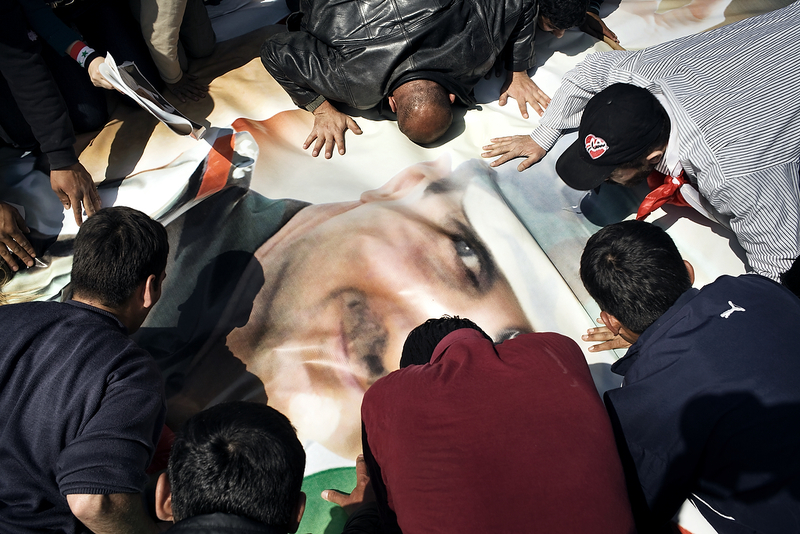
 

In the 1980s Meron Benvenisti, an Israeli writer and the ex-deputy mayor of Jerusalem, ran the West Bank Data Project, which analyzed the interaction of the Israeli and Palestinian economies in the Occupation. The resulting study concluded that the West Bank had effectively been annexed by Israel, not merely occupied (Ref: Intimate Enemies, Jews and Arabs in a Shared Land, 1995). As pre-1967 Israel was also an annexation by military force, accompanied by some strong arming of Truman and the infant United Nations by Zionist elements in the American Jewish community, the term “Occupied Palestine” correctly refers to the whole of the land between the river Jordan and the sea.  Any other designation fudges the evidence, which suggests that the military occupation of the West Bank will remain until the post-1948 colonial regime itself is either brought down or collapses under the weight of its own internal contradictions, to be replaced by a non-colonial political order and the re-establishment of political and economic equality between Arab and Jew. 


Before 1967, Palestinian civilians of Israel also lived under a military occupation, and were in a similar position politically to those of the West Bank and Gaza now. The Palestinian American writer Rashid Khalidi uses the term “helot” (a term from the Greek of Ancient Greece to designate an indeterminate status between that of a slave and that of a citizen) to designate the position of Palestinian civilians who have neither civil rights nor any political opportunity to influence the behaviour of the state that dominates and controls their lives in endlessly demeaning and demoralising ways. 


Those who do not like equality before the law and citizenship for all will leave, just as the Algerian French did together with some of the pieds noirs in 1962, helping to solve the problem of housing some of the Palestinian refugees from Occupied Palestine at a stroke. Frantz Fanon’s two most important books, Black Skin, White Masks, and The Wretched of the Earth, have now been translated into Hebrew (2004). I am sure that they have been available in Arabic for a long time, but the political culture of the Hebrews is backward and inward looking, which is to be expected in a colonial state. Were the champion of the Algerian liberation struggle Fanon alive today (he would be 82 years old) he would certainly support the Palestinians. It is our privilege and duty as free citizens of the international community to do the same.


Paul Grenville 1st April 2009.