Archive for the ‘Resistance’ Category

Unity between Palestinians is more urgent than any other need

 please sign the petion Ahewar
We have yet to be free as a people but have diverged from the path to liberty. This social contract is the basis of a new popular movement towards our liberation.

The Palestinian people and their struggle are now confronted by a disastrous situation. We are divided. Our priorities are confused, and our agenda for liberation is unclear. We have consequently fallen short of achieving our freedom. We lack justice and have yet to practice our inalienable right of self-determination.

Today, we derive our strength and legitimacy from our urge to end the suffering and aspirations of the Palestinian people in Jerusalem, the West Bank, Gaza Strip, Galilee, in the compulsory diaspora in Syria, Lebanon, Jordan, and around the world. We stand infused with the energy emanating from the Arab people’s glorious revolutions in Tunisia and Egypt, and the revolutions in Arab countries from the Atlantic Ocean to the Arabian Gulf. We say, in the name of our innocent martyrs, the wounded, prisoners, refugees, men, women and children, youth and elderly that our compass now points in one direction, and it points towards freedom. To get there we must and shall achieve the following:

Freedom, Justice, and Self-determination

The Palestinian people shall begin to build a realistic vision for their future based on a new Palestinian Social Contract. Our social contract shall be based on the inalienable rights to liberty, justice, self-determination, and the pursuit of happiness. This contract shall ensure freedom, human dignity and justice. Equality, clarity, transparency, democracy and full societal participation in the struggle shall be the guiding principles for this contract. The Palestinian citizens’ cause, concerns and aspirations cannot be reduced, in anyway, to one third of the Palestinians who are in the West Bank and the Gaza Strip. Therefore, the required Social Contract represents all the Palestinians. It addresses their rights within a formula that observes what is common among all Palestinians and recognizes the differences among the diverse components of our society.

This statement balances between the daily concerns of the Palestinian people and their aspirations. It also suggests realistic alternatives to the current status quo that results in a state of division, weakness, economic crises and the marginalization of the majority of the Palestinian people. We pose three necessary changes to the status quo that express our vision for the Palestinian people.

First: The Establishment of a New Palestinian Social Contract

The Social Contract is based on the need to establish unity amongst the Palestinian people (in Palestine within its historical borders and in the diaspora). We all have the same aspirations: Freedom, justice, return, the unhindered pursuit of happiness, and the dream that we will practice our right to self-determination. To achieve these aspirations all sectors of the Palestinian people, civil society, different political factions, the youth and trade unions are invited to:

– Rebuild the PLO as the sole representative of the Palestinian people and maintain its independence. This requires re-structuring its institutions and ensuring that it is away from the Israeli occupation control.
– Reformulate the Palestinian National Charter in accordance with the new Social Contract, in a manner that ensures the supremacy of freedom, justice and equality that light the path for our movement towards liberation, democracy and self-determination.
– Re-building of the PLO requires, first and foremost, election of a Palestinian National Council (PNC) representing all Palestinians (inside and outside the homeland). Preparations for the elections shall ensure full democracy.
– Pursuant to the PNC elections, the PLO Executive Committee shall be formed in a manner representing political forces, independent personalities and representative institutions with a special focus on ending the factional quota tradition.
– Full separation between the PLO institutions, tasks and persons and the institutions of the administrative bodies responsible for maintaining the day to day life of Palestinian people in the occupied Palestinian territories (OPT).
– End the existing status quo and begin building mechanisms that ensure the broadest democratic representation of the Palestinian people.
– Ensure that the newly formulated PLO is the sole responsible party for the political track of the Palestinian cause before the Palestinian people. Consequently, the Palestinian Authority, as an institution or personalities, does not politically represent the Palestinian people and does not identify mechanisms of our struggle and resistance.
– Struggle against the occupation and its injustices using all internationally legitimate and ethical means. Any strategies for the struggle shall be decided upon through national consensus (achieved within the PLO) and strategically formulated according to the challenges the Palestinian cause is facing to ensure that the most practical tactics are being used.
– Ensure that our inalienable rights are non-negotiable.

Second: The Struggle Against the Occupation and its Apartheid policies

Main principle: The Palestinian people shall struggle against the Israeli occupation using all morally legitimate means of resistance until they are free and establish a just society with full equality.

– The Palestinian people, through the PLO, shall identify the strategies of the struggle.
– We shall increase the momentum of nonviolent popular resistance, using the media, international law, strikes, boycotts, divestment and sanctions and shall seek international support for our struggle.
– We shall support the steadfastness our people on their land, especially in Jerusalem, areas threatened with eviction such as the Jordan Valley and areas in the Negev desert, and near the Apartheid barrier.
– We shall form popular committees to confront occupation’s measures and create daily realities to protect innocent people, their private properties and land.
– We shall launch international campaigns to combat the occupation and its racist separation. We shall use international law to assist us in ascertaining our rights and coordination with international organizations that support values such as human rights, freedom, and equality.
– We shall struggle against the Israel’s racist measures against our people inside the Green Line, support them and provide political and legal protection for their demands and struggle.

Third: Administration of the daily living affairs of the Palestinian people in the OPT

Main principle: The Palestinian administration in the Occupied Palestinian Territories is the civil entity mandated by the PLO to manage the Palestinian affairs. Hence, it does not have the authority to represent all Palestinians. It is not a political entity or authority.
– The PLO forms a representative council for the Palestinians in the OPT responsible for management of their life affairs.
– The representative council is the realistic alternative of the Palestinian Legislative Council and the Presidential institution in the OPT.
– An administrator shall be elected from the representative council. He/She shall nominate the heads of the differnet administrative directorates, which shall work according to a platform set up and approved by the representative council to ensure the fulfillment of the people’s day-to-day demands in the OPT.
– The representative council shall be constituted of experts and not politicians whose tasks are confined in taking care of administrative and legislative demands pertinent to people’s day-to-day lives. This will reduce factional competition and enhance the role of the elected representative council.

Formation of security apparatuses and their tasks, and the resistance arms
– All security apparatuses will be integrated within one police service that maintains public safety and the rule of law in the OPT.
– The police apparatus shall be fully separated from and independent of the political factions.
– Weapons shall be used for legal reasons only such as maintaining the people’s safety and defending them from mortal harm.
– Political factions do not have the right to individually select their resistance strategies.
– The police apparatus will be restructured based on new laws that shall govern its duties.

Combating corruption
– Full transparency shall be restored. Corrupt institutes and individuals shall be tried and the stolen funds returned to their rightful owners and the Palestinian people.

Requirements of national and societal reconciliation
– Banning any political platform from inciting to violence.
– The youth and academic experts shall formulate a document to end Palestinian disunity in a manner that is beneficial for the Palestinian cause.
– The youth shall use wide ranging activities to pressure all conflicting sides to come together
– Any delay in ending the division after this document is presented shall be borne by the present leaderships.
– A court shall be formed from independent persons guaranteed by the PLO to decide on all the division implications at the individual and collective levels. The court’s decisions are binding to all.

Let all people who love their people and their country now say, as we say here:
– WE SHALL STRUGGLE FOR FREEDOM, SIDE BY SIDE, THROUGHOUT OUR LIVES, UNTIL WE HAVE WON OUR LIBERTY.

please sign the petition on Ahewar

On 25 February 2011 activists and organizations from around the world will join together in solidarity with the Palestinian residents of Hebron/ al Khaleel, through local protests that demand for the opening of Shuhada Street to Palestinians and an End to the Occupation! For more info or to organize a protest in your city please contact openshuhadastreet@gmail.com

Want to get involved? Click here for more information

Open Shuhada Street Pamphlet 2011

Open Shuhada Street – 25 Feb 2011 – Global Day of Action from Joseph Dana on Vimeo.

Shuhada Street used to be the principal street for Palestinians residents, businesses and a very active market place in the Palestinian city of Hebron/ al Khaleel. Today, because Shuhada Street runs through the Jewish settlement of Hebron, the street is closed to Palestinian movement and looks like a virtual ghost street which only Israelis and tourists are allowed to access. Hate graffiti has been sprayed across the closed Palestinian shops and Palestinians living on the street have to enter and exit their houses through their back doors or, even sometimes by climbing over neighbor’s roofs.

International Supporter Being Arrested During a Recent Protest in Hebron. Photo: Activestills.org

In 1994, following the massacre of 29 Muslims at prayer by America-Israeli settler Dr Baruch Goldstein, shops on Shuhada Street were closed and vehicular traffic prohibited on the street. Despite a court case and an admission by the Israeli government that it is illegal, the street is still closed to Palestinians 16 years later. We are focusing on Shuhada Street as a symbol of the settlement issue, the policy of separation in Hebron/al Khaleel and the entire West Bank, the lack of freedom of movement, and the occupation at large. Check back to this page for more updates regarding how you can get involved. For more background information and FAQ’s click here.


Στο όνομα του Αραβικού Παλαιστινιακού λαού, του αίματος των μαρτύρων, των χηρών και των υστερημένων, των ορφανών και των χιλιάδων φυλακισμένων στις Ισραηλινές φυλακές και όλων των απόδημων Παλαιστινίων, καλούμε όλες τις Παλαιστινιακές παρατάξεις να ενωθούν υπό το λάβαρο της Παλαιστίνης, προκειμένου να μεταρρυθμιστεί το πολιτικό σύστημα στην Παλαιστίνη στη βάση των συμφερόντων και των φιλοδοξιών (οραμάτων) των Παλαιστινίων στην πατρίδα και τη διασπορά.

Η σοβαρότητα της Ισραηλινής αποικιακής εισβολής στην παρούσα φάση, η αρπαγή των εδαφών της ιερής μας Ιερουσαλήμ και η βίαιη πολιορκία εναντίον του λαού της Γάζας, απαιτεί από όλους μας να αντισταθούμε σε αυτή την βάναυση κατοχή.

Έχουμε ακούσει πως ο Παλαιστινιακός λαός ζητά νομοθετικές και προεδρικές εκλογές προκειμένου να λήξει το καθεστώς διάσπασης. Ναι, όλοι θέλουμε να βάλουμε ένα τέλος στη διάσπαση, αλλά θέλουμε επίσης την πλήρη αναδόμηση και μεταρρύθμιση της Οργάνωσης για την Απελευθέρωση της Παλαιστίνης (PLO), ώστε να περιλαμβάνει όλες τις αποχρώσεις του παλαιστινιακού πολιτικού φάσματος, της Hamas συμπεριλαμβανομένης, προκειμένου να παλέψουμε πάλι για την απελευθέρωση της Παλαιστίνης όπως προορίστηκε αρχικά.

Εμείς, οι Παλαιστίνιοι στην πατρίδα και στο εξωτερικό, πάντα ακούγαμε ότι οι ειρηνικές ενέργειες θα επετύγχαναν τη νίκη και θα αποκαθιστούσαν τα εδάφη μας αλλά 20 χρόνια διαπραγματεύσεων δεν έχουν επιτύχει ούτε τις ελάχιστες απαιτήσεις. Οι συνάνθρωποι μας παραμένουν υπό τη βάναυση και καταπιεστική κατοχή που υφαρπάζει τα εδάφη μας, παραβιάζει τους ιερούς τόπους και σκοτώνει τα παιδιά μας, και όλα αυτά ενώ η οικουμένη, που απαιτεί δημοκρατία και σεβασμό των ανθρωπίνων δικαιωμάτων, απλά παρατηρεί και ακούει! Ενώ παράλληλα, η αντίσταση χρονοτριβεί, αφήνοντας περισσότερο από ενάμιση εκατομμύριο Παλαιστίνιους υπό τον ισραηλινό αποκλεισμό που τους πνίγει σε τέτοιο βαθμό που παραπέμπει ακόμα και ασθενείς στο εξωτερικό προκειμένου να τους παραχθεί θεραπεία, την ίδια στιγμή που αυτό είναι πρακτικά αδύνατο να γίνει, ακόμα και για τους ίδιους τους ηγέτες της αντίστασης και των οικογενειών τους, πόσο μάλλον για τον υπόλοιπο Παλεστινιακό λαό.

Πρέπει να συμφωνήσουμε πως είναι απαραίτητο όλοι μας να ενωθούμε για τους απανταχού Παλαιστίνιους, που ακόμη ονειρεύονται την επιστροφή έξι εκατομμύριων Παλαιστίνιων προσφύγων στις κατοικίες τους που καταπατήθηκαν κατά την κατοχή, μια κατοχή που αντιλαμβάνεται μόνο τη γλώσσα της βίας!

Ας γίνουμε δυνατοί, ας είναι η ενότητα η δύναμή μας, και ας συμφωνήσουμε ομόφωνα σε μια ενοποιημένη ηγεσία που θα μας οδηγήσει στην ελευθερία με υπερηφάνεια και αξιοπρέπεια!

Από αυτή τη θέση, καλούμε τις κυβερνήσεις της Δυτικής Όχθης και της Γάζας να ανταποκριθούν στα νόμιμα αιτήματα των ανθρώπων:
1. Την απελευθέρωση όλων των πολιτικών κρατουμένων από τις φυλακές της Παλαιστινιακής Αρχής και της Hamas.
2. Το τέλος της μεταξύ τους δημόσιας αντιπαράθεσης.
3. Την παραίτηση των κυβερνήσεων του Haniyeh και του Fayyad και τον σχηματισμό μίας κυβέρνησης εθνικής ενότητας που θα συμφωνηθεί από όλες τις παλαιστινιακές παρατάξεις και θα είναι αντιπροσωπευτική του Παλαιστινιακού λαού.
4. Την αναδιάρθρωση της Οργάνωσης για την Απελευθέρωση της Παλαιστίνης, που θα περιέχει όλες τις παλαιστινιακές παρατάξεις και την επιστροφή της στον αρχικό στόχο: την Ελευθερία της Παλαιστίνης
5. Την ανακοίνωση περί αναστολής όλων των διαπραγματεύσεων μέχρι την πλήρη συμφωνία ενός πολιτικού προγράμματος από τις διάφορες παλαιστινιακές παρατάξεις
6. Το τέλος κάθε μορφής συντονισμού σε θέματα ασφάλειας με το σιωνιστή εχθρό
7. Την οργάνωση προεδρικών και κοινοβουλευτικών εκλογών ταυτόχρονα, σε χρόνο που θα συμφωνηθεί από όλες τις παρατάξεις

Οι εκδηλώσεις θα ξεκινήσουν την Τρίτη, 15 Μαρτίου 2011, στις 11:30 π.μ. και θα συνεχιστούν μέχρι την επίτευξη όλων των στόχων.
Θα μαζευτούμε στις ακόλουθες τοποθεσίες (αλλαγές είναι πιθανόν να υπάρξουν):
Γάζα: Πλατεία Αγνώστου Στρατιώτη (Gaza: the Unknown Soldier Square)
Ραμάλλα: Πλατεία Manara (Ramallah: Manara Square)
Τουλκάρμ: Κυκλική Πλατεία Gamal Abdel Nasser (Tulkarm: Roundabout Gamal Abdel Nasser)
Τζενίν: στο συγκρότημα των χώρων στάθμευσης κοντά στον παλαιό κινηματογράφο Jenin (Jenin: complex of garages near the old Cinema Jenin)
Χεβρώνα: μπροστά στο κυβερνείο (Hebron: in front of the governor’s office)
Βηθλεέμ: Εκκλησία της πλατείας Nativity (Bethlehem: Church of the Nativity Square)
Nablus: Πλατεία Μαρτύρων (Nablus: Martyrs Square)
Ιορδανία και Λίβανος: η τοποθεσία δεν έχει οριστεί ακόμα
Στον υπόλοιπο κόσμο: μπροστά από τις Παλαιστινιακές πρεσβείες, σε συνεννόηση με τις παλαιστινιακές κοινότητες στο εξωτερικό. ΘΑ ΑΚΟΛΟΥΘΗΣΕΙ ΑΝΑΚΟΙΝΩΣΗ !!!

Παρακαλούμε επισκεφτείτε μας στην σελίδα:
http://www.facebook.com/Palestinians.United?sk=info

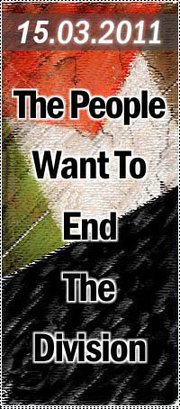
15 marzo, Azione internazionale per l’unità del Popolo Palestinese.
Un solo popolo contro il Sionismo.

In nome del popolo arabo palestinese, per il rispetto del sangue dei martiri, delle vedove, degli orfani e dei loro lutti, per le migliaia di prigionieri nelle carceri israeliane e per tutta la nostra gente della diaspora palestinese, chiediamo a tutte le fazioni di unirsi sotto la bandiera della Palestina per potere riformare e basare il sistema politico in Palestina sugli interessi ed aspirazioni del popolo palestinese, in patria e in esilio.

La gravità dell’attuale fase di incursioni da parte dei coloni israeliani, dell’appropriazione della terra nella nostra Sacra Gerusalemme e della violenza dell’assedio contro il popolo palestinese di Gaza obbliga tutti noi ad unirci saldamente contro quest’occupazione brutale.

Noi abbiamo sentito il popolo palestinese chiedere le elezioni legislative e presidenziali per porre fine alla divisione. Sì, tutti noi vogliamo la fine della divisione, ma vogliamo anche una totale ricostruzione dell’ Organizzazione per la Liberazione della Palestina, che comprenda tutti i colori dello spettro politico palestinese, incluso Hamas, e di riformarla con lo scopo di lottare di nuovo per la liberazione della Palestina, così come era stato inteso dalla sua fondazione.

Noi, il popolo palestinese, in patria ed in esilio, abbiamo sempre sentito che le azioni pacifiche sarebbero bastate per ottenere la vittoria e ci avrebbero restituito la nostra terra, ma 20 anni di negoziati non ci hanno fatto ottenere la benché minima richiesta. La nostra gente vive sotto una brutale ed oppressiva occupazione che saccheggia la nostra terra, viola i nostri luoghi sacri, uccide i nostri figli. Fa tutto questo mentre il mondo dichiara che la democrazia è assicurata e i diritti umani vengono rispettati! D’altro canto la resistenza è in stallo, mentre più di un milione e mezzo di palestinesi restano sotto l’assedio israeliano che strangola fino al punto che i nostri malati, compresi i figli dei leader della resistenza, possono essere curati solo altrove.

Dobbiamo essere d’accordo: è necessario che noi ci uniamo per tutti i palestinesi qui e per i sei milioni di rifugiati palestinesi in ogni parte del mondo che ancora sognano il loro ritorno alle loro case sottratte dall’Occupazione, che comprende soltanto il linguaggio della forza! Dobbiamo essere forti, dobbiamo fare sì che l’unità sia la nostra forza e che siamo unanimemente concordi su una dirigenza che ci potrebbe guidare fino alla libertà, con orgoglio e dignità!

Con questo appello chiediamo a tutti coloro che governano in Cisgiordania e Gaza di rispondere alle richieste legittime del popolo:
1 – il rilascio di tutti i detenuti politici nelle prigioni dell’ Autorità Palestinese e di Hamas
2 – la fine di ogni tipo di campagna stampa contro le altre fazioni
3 – le dimissioni dei governi di Haniyeh e Fayyad per poter ricostruire un governo di unità nazionale che riscuota l’approvazione di ogni fazione palestinese e che avrebbe il compito di rappresentare il popolo palestinese
4 – la ristrutturazione dell’Organizzazione per la Liberazione della Palestinna che includa tutte le fazioni palestinesi e che ritorni al suo scopo originario: la liberazione della Palestina
5 – l’annuncio del congelamento dei negoziati finchè non ci sarà totale compatabilità tra le vari fazioni su un programma politico
6 – la fine di ogni forma di coordinamento con il nemico sionista sulla questione della sicurezza
7 – l’organizzazione di elezioni presidenziali e parlamentari simultanee nei tempi scelti da tutte le fazioni

Gli eventi avranno inizio il martedì, 15/03/2011 alle 11:30 e andranno avanti finchè non saranno accolte tutte le nostre richieste. Ci raduneremo nei seguenti posti (salvo modifiche):
Gaza: Piazza del Milite Ignoto
Ramallah: Piazza Manara
Tulkarm: Piazzale Gamal Abdel Nasser
Jenin: complesso dei garagi vicino al vecchio Cinema Jenin
Hebron: davanti all’ufficio del Governatore (Al Khalil)
Bethlehem: Piazza della Natività
Nablus: Piazza dei Martiri
Giordania e Libano: da definire
Nel mondo: davanti alle sedi diplomatici palestinesi, in coordinamento con le comunità palestinesi in esilio.

http://www.facebook.com/Palestinians.United?sk=info

Gaza Youth Breaks Out

Translated into Greek by Christina Baseos, translated into Italian by Mary Rizzo

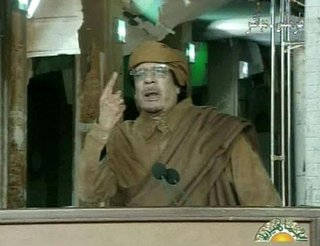
A classic postion for a dictator's speech... from the window of the symbolic building

I have just finished listening to Colonel Qaddafi
I did not get wiser, nor did my opinion change.

40 years is enough even if the ruler is Mother Tereza
or Nelson Mandela…………

One thing I must agree with Qaddafi:
If and when Qadafi shall leave Libya,
it will no more be ruled by “a Libyan”
.
Raja Chemayel

Raja, I am surprised.  How did you get the strength to listen to Gheddafi’s speech all the way to the end?  I tried but couldn’t do it.  I got too sick.  I did even vomit. 

I met the man several times.  I prayed behind him on the sand outside his tent.  I visited his home and sat with his ordinary and humble wife and lovely daughter, Aashea.  I was impressed.  I loved what I saw.  Aaesha told me that she will soon be studying law to defend the oppressed.  I must say that my home is better than theirs.  I am not rich.  I saw no servants.  It was Aaesha and her mom who brought lemonade, pistachio nuts and baclawa.  The living room was tiny and had simple furniture.  Only the home of President Omar al-Bashir of the Sudan impressed me more.  It was even tinier and simpler.  The couch I sat on was an old iron bed.

Nasser was a dictator, but we loved him.  He was our champion. As a matter of fact, we almost “worshipped” him.  He built Egypt.  The Arab people realized that we are one nation.  Despite our defeats, we felt proud. He was one of the pillars of the non-aligned nations’ movement.  He continued to live in his house that he owned as an officer.  The home had only one bathroom.  Nasser was surprised when his children complained and told him that they knew some families who had two bathrooms.  The Nasser family members had to stand in line to wash, bathe and do the other thing; you know what I mean.  After he was poisoned, he left behind less than 100 dollars for his family.

Gheddafi was a dictator too.  But we tolerated him.  He financed several liberation movements around the world.  He didn’t succumb to Zionism.  He didn’t open an Israeli embassy at this bad time when the majority of Arab leaders are caving in.  We also thought that he didn’t deposit billions of dollars in foreign banks.  Of course, it is too early to find the truth.

I personally dropped Gheddafi from my “book” when he paid over two and a half billion dollars to the Lockerbie Pan American crash victims.  Libya has nothing to do with this horrendous crime.  It was a false flag.  It was a CIA operation.  The White Prime Minister of South Africa was warned in advance to not take that plane. Gheddafi also paid for the attack on a night club in Berlin.  Two American soldiers died.  This crime was carried out by the German Red Brigade that worked for the CIA.

My “respect” for Gheddafi ended when he capitulated to Bush the son on nukes and sent all material and equipment to Washington.  The guy even demanded that Iran should do the same to avoid destruction by America.

hand in hand

I was delivering a speech titled “Africa’s Brain Drain” in Tripoli, Libya when the Tunisian President fled to Saudi Arabia.  Almost 500 people from Europe, North and South America, Australia and New Zealand attended a conference on African Immigration to Europe.  I was shocked to discover that the organizers were not interested in the papers we delivered.  They packed us as cattle and drove us to listen to Gheddafi and his puppets.  The great “revolutionary leader” delivered another speech telling the Tunisians that they should have kept Ben Ali for life as a president.  I couldn’t believe my ears.  He repeated the same nonsense later when the Egyptian youth revolution erupted.  He wanted Mubarak to stay.

The only thing that I loved about my trip to Tripoli is the fact that I met some good people.  Abdel Hakim Jamal Abdel an-Nasser was one.  Fortunately, he didn’t speak.  I felt that he was disgusted.  We embraced.  I saw Nasser in him.  But I also wept.  I am “weak”.

I do apologize to the Arab people of Libya.  I thought that they would never rise up.  I thought that they are not prepared to face the enormous firepower of Gheddafi’s army. Fortunately, I was wrong. To my greatest surprise, they did.  The price was too high.  My Libyan brothers and sisters continue to pay.

Today, Gheddafi accused the Libyan youth who demand his ouster of being on drugs.  Now I am convinced that the man himself is hallucinating.  He should check what his Ukrainian “nurse” is giving him.  He should leave now.  He must not forget to take his sons.  Libyans want to be free.  The Gheddafi “kingdom” must come to an end.

Ali Baghdadi

Video describing the modern history of  Palestine by Mustapha Barghouti

The people of the Middle East could learn more about modern democracy from the anti-war camp, and not from former president Bush and his ‘coalition of the willing’, the very anti-Christ of democracy, writes Mamoon Alabbasi.

 
– “Those dirty A-rabs don’t deserve democracy. We give them freedom and they kill our troops. We should nuke them all in their shit-hole.”

-“Bring our troops home. What are they doing dying in some far away land trying to bring democracy to people who don’t want it?”

-“We Arabs are not yet ready for democracy. We need strong authoritarian governments to keep the peace and ensure economic growth.”

-“We should be grateful to the Americans. They got rid of our dictator and brought us democracy.”

-“Is this democracy? Is this freedom? The Americans killed all my family and destroyed my house. If this democracy, I tell you my brother, we don’t want it!”

Such comments and their likes are unfortunately not uncommon among some Americans and Iraqis regarding the US-led invasion of Iraq. Whether American or Iraqi, pro-war or anti-war, one fallacy lies at the bottom of their reasoning: that somehow ‘democracy’ had anything to do with the Iraq war.

Not that possessing WMDs was ever – objectively – enough reason to subject the whole of Iraq to so much senseless destruction; but since it became clear that the only real threat Iraq posed was to itself, the rhetoric had shifted into saving Iraqis from themselves by bringing onto them good old (well, in human history it isn’t actually that old) democracy.

But the fact is, that was never the case. Not in Iraq and certainly not in the region. Not in 2003 and most definitely not before that. After the fall of Baghdad, there were no serious moves to install democracy. Instead, US policies were channelled to inflame the sectarian divide.

After 12 years of merciless US-backed sanctions, all Iraq needed was one small push to descend into total chaos. Yet many Iraqis still waited to see what the US would offer. What they got was complete absence of security, hundreds of thousands of jobs losses, and death and torture at the hands of US forces with the help of some ‘favoured’ Iraqis.

That’s where the seeds of sectarianism had been sown. Instead of promoting reconciliation and unity, the US played a classic ‘divide and rule’ game in Iraq and drew the new Iraq – politically – along sectarian lines.

Militarily, Iraqis who had friends or family members killed or tortured by US forces in the presence (or under the advice) of other Iraqis weren’t always strong enough to punish the Americans so they took vengeance on their fellow Iraqis. The result? A cycle of vengeance that could have been averted.

Meanwhile, on the ‘democracy’ front, we had one segment of the population relatively prepared for campaigning whilst the other barely struggling to stay alive let alone take part in elections. Who would they vote for? How can you have fair elections when all your potential candidates are in hiding for fear of being killed or detained and tortured? Voting may (or may not) have been free, but who would one vote for if his/her choice is not on the list that is approved by the powers that be?

Adding to the confusion, Iraqis were requested to approve a constitution that most of whom have not even had the chance to read, let alone contemplate. ‘Imported’ from the US and released only five days before its referendum date, the new constitution caused further divisions in Iraq. In the meantime, new laws continued to be passed despite strong objection from a large segment of the population that was never properly represented in parliament because there never had been free elections in the first place.

All this was taking place with direct US involvement, with a mainly favourable outcome for the war architects. Big money was being made by the invasion’s supporters while ordinary Iraqis were being killed by many unexplainable attacks. Some of a sectarian nature, others just for money; ones blamed on Iran or Israel, while others blamed on Al-Qaeda (which only came to Iraq post-2003 invasion) or on the US military (frequently accused of secretly targeting civilians to discredit the insurgency).

The absolute truth may never be known, but one thing is certain: the US, as an occupying power, was under obligation, according to international law, to protect Iraqis. We all know how well that went. If it can’t – or is unwilling to – assume such responsibility it should have not been there in the first place, and trigger a ‘sectarian domino effect’, in addition to its own acts of murder and torture.

Washington and its allies in right-wing think thanks and mainstream media experts cannot talk of ‘mistakes’ happening when the average person in the street predicted that total chaos (at least) would befall Iraq in the event of an invasion. How can pro-invasion so called ‘experts’, ‘analysts’, and ‘intelligence’ fail to foresee what an average bricklayer in Tunisia predicted?


Charity begins at home

In fact, how can the invading countries ‘export’ democracy to Iraq while they were fighting democratic value at home? Why would an Iraqi believe that the US is bringing him/her democracy when he/she sees American citizens gradually being deprived of their rights and freedoms by the Bush administration? They also ignored the loud voices of their own people protesting against the Iraq war.

Saddam Hussein was accused of torture, detaining suspects indefinitely, spying on his own people, silencing journalist critical of his policies, and inciting fear in the hearts of his opponents. And how does that differ – relatively – from the actions of Bush, the ‘decider in chief’? Can anyone say – with a straight face – that Saddam was more of a threat to the American people than Bush himself?

Yet US and European right-wingers, and their ‘political pawns’ in the Middle East continue to speak favourably of so called ‘democracy and freedom interventions’ in the region. Yes, democracy should be vigorously sought in the Middle East (by the people of the region) and yes Americans and Europeans have every reason to be proud of their democracies (despite many shortfalls). But the pro-war establishment has no right to boast of democracy because whatever rights and freedoms ‘western’ societies enjoy today, they were the direct result of people fighting or challenging a similar-natured establishment in former eras. Today’s anti-war camp is the legitimate inheritor of the women’s-rights and the civil-rights movements. They are the rightful heirs of the anti-slavery and later the anti-empire heroes.

The people of the Middle East could learn more about modern democracy from the anti-war camp, and not from former president Bush and his ‘coalition of the willing’, the very anti-Christ of democracy.

What has the Bush administration really done to support democracy in the region?


US-backed dictatorships

Despite few lip services to democracy in the Middle East now and then, American foreign policy has always backed Arab dictators to remain in power and oppress their own people. These ‘puppet presidents’ or ‘drag-queen kings’ are kept in power – with US weapons and intelligence – for as long as they continue to serve American interests, not those of their own peoples.

Although mainstream media is not equally kind to them, the truth is often grossly distorted. These leaders are always much more ‘liberal’ than their predominantly conservative societies on social and religious issues. They would only draw a red line when their hold to power is shaken or challenged. But as Bush does with democracy, they often pay lip service to ‘moral values’. And if you believe Bush then you might as well believe them too.


War on words

As is the case with all wars, truth was the first causality too in the Iraq war. But as more details emerge regarding the lead up to the invasion, one could say, to a small degree, that the truth is making a slow but sustainable recovery. I wish I could say the same for the English language which was among the early victims of the Bush administration.

Many may laugh at the clumsy language mistakes Bush made during his speeches or when answering questions from the press, but few know that it is really the former US president who had the last laugh. The truth maybe recovering, but the English language is not. The Bush administration may have gone, but twisted right-wing rhetoric still lingers on in most mainstream media outlets.

From that perspective, killing ‘our’ soldiers is ‘terrorism’ yet killing ‘their’ civilians is not. Their actions are ‘barbaric’ but ours are ‘controversial’, etc.

But my concern here is on terms related to governments and politicians. How come Middle Easterners don’t get to have ‘hawks’ and ‘doves’ like their US (and sometime Israeli) counterparts? And why don’t Americans have ‘moderates’, ‘hardliners’ and ‘radicals’ at the Oval office?

More importantly, why are some US-backed Arab dictators who are extremely repressive of their own populations referred to as ‘moderates’? Is it just because they serve the interests of Washington (or Tel Aviv) instead of their own countries? At the same time, those who are brought to power through the ballot box or enjoy extremely wide support among their populations are termed ‘hardliners’ or ‘radicals’ just because they are not in good terms with foreign invading (or occupying) powers.

Who will defend the English language from ‘radical democracies’ and ‘moderate dictatorships’?


Iron Iran

Far from being a perfect democracy, Iran today is much closer to realising the wishes of its people than during the era of the ruthless US-backed dictator, the Shah, toppled by the 1979 revolution. Most Iranians today, despite their young age, are also familiar with the role of the US CIA-backed coup against their democratically elected PM in the fifties, Mohammed Mosadaq.

Iranians are in an uphill struggle to have a modern democracy and more freedoms, but the last thing their reformers or rights activists need is foreign interference that would directly discredit them in the eyes of the majority of their people.

The people of Iran, generally fond of ‘western’ societies, remain suspicious of US foreign policy. And amid rumours that neo-conservatives and Christian Zionists seek to nuke their 70- million population, accompanied with serious threats from the Bush administration, their reformist camp took a heavy blow. You have to remember that during World War II even rooted democracies like Britain suspended all democratic activities, and to Iranians the US is still perceived as an enemy that poses an existential threat.


Hands off Hamas

I don’t know of any people who have defended their electoral choice with so much blood and sweat (plus hunger and disease) as the people of Palestine following their election of Hamas.

They faced a superpower (US), an occupation power (Israel), propaganda war by pro-Israelis, Islamaphopbes, anti-Arab racists, Arab dictators, self-loathing Muslims, and tag-along opportunists, while being besieged in a tiny overpopulated strip.

They were punished for their votes and yet at the same time were prevented somehow from being represented. It is OK, according to some Rabbis, to kill them because they voted for Hamas, but Hamas, so Israel wishes, must not be seen as representing them. It wasn’t enough to take away their liberty, health and lives; their political and social voices had to be taken away too. And thus Hamas leaders had to be silenced – but should they speak, then the mainstream media is there to distort their views.

So called ‘experts’ and ‘analysts’ would indulge in debates on why Hamas was elected, fruitlessly seeking to undermine their legitimacy, forgetting that in democracies, reasons of voting for one party instead of another does not affect the power that comes from the ballot box.

They often speak of corruption in Fatah or by some members of the Palestinian Authority, without even giving much thought to what that implies. To Palestinians, corruption is not just breaking the law for some financial benefits; it is deeper than that. Many see corruption as selling Palestinian rights to Israel for personal gains; i.e. treason of the first degree.

The people of Palestine had faced many atrocities before; land theft, ethnic cleansing, occupation, bone breaking, imprisonment, tight sieges, and mass murder, among other injustices. But it was only under Bush’s watch that their first ever democracy and electoral choice came under such ruthless attack.


Jews-only democracy

No doubt that in many senses of the word, Israel is a democracy. It could be because the whole system was planted there by the ‘west’, like many of its American and European immigrants who settled there during and after the creation of the Jewish state. It also could be the people there reached that wise decision on their own. Nevertheless, whatever the causes and reasons are, the positive aspects of its democracy must be acknowledged.

But it should not pass as something comparable to ‘western’ democracies (not that they make those like they used to anymore). You have to remember a democracy is usually elected by a majority. Yet the majority of the people of that particular land are forced to live in exile.

Imagine if you’d expel the majority of blacks in the US and then when Election Day comes, you’d say to the few that remained that they have a right to vote and they should count their blessings for living in a democracy. You might even want to consider demanding that they’d show their loyalty to you. You didn’t ban anyone from voting, you just prevented them from returning to their rightful homes, making them unable to cast their ballots.

Until the Palestinian refugees’ problem is solved on a just basis, the Jewish state cannot claim to be a true democracy. But what has the Bush administration done to the plight of those estimated six million Palestinian refugees?

Plus, as the US should know, being a democracy at home does not give you the right to be a dictator abroad.

So why was Iraq invaded? Was it for money (oil)? For love (of Israel)? Or just for fame (keeping superpower reputation means teaching others a lesson every now and then)? I am not completely sure, but you can bet your sorry soul it was never about democracy.

Mamoon Alabbasi is an editor for Middle East Online and can be reached via: alabbasi@middle-east-online.com

http://www.middle-east-online.com/english/?id=31257

art by Jorge Arrieta: http://www.popsiclesandgrenades.com/archives/2009/03/beware-peace-democracy-is-coming/

Israel has once more sent out a message to the Islamic and Arab world with its onslaught on Gaza that the struggle for the Middle East will be uncompromisingly bloody and violent. It was the same message in the summer of 2006 with the invasion of the Lebanon, with the Qana massacre of 1996, with the invasion and the 18 year occupation of the Lebanon in 1982 to 2000, and all the way back to 1948. For those who abjure violence in their personal lives, and for those, like me, who have never carried or used a gun, the boycott campaign is an important tool of nonviolent struggle against the Occupation of the West Bank, and the racist polity within the ever shifting borders of Israel, the borderless state in Occupied Palestine.


I admire Hamas’ and Hezbollah’s armed resistance against overwhelming force, but it should be by now clear after sixty one years that by itself armed resistance to Zionism will not lead to its overthrow. The most these organisations can do to Israel is harass, with as much impact as a wasp stinging a human being. This in itself is not negligible. The main effect of the missiles launched over Israel’s border is psychological terror, and occasional fatalities, against which the fourth most powerful military machine in the world is powerless. Psychological terror may discourage new Jewish immigrants from arriving in Israel, and that is to the good. 


However such tactics do not even elicit a pause from Israel’s political leadership, Right and Left, in the ongoing war on the Palestinians, the Zionist project of clearing the land of Arabs, and the continued illegal settlement by Jews of the Palestine’s West Bank. Clearly Hamas and other resistance organizations are quite powerless by themselves to stop Zionism in its tracks. In a defensive struggle the Shi’ite organization Hezbollah did succeed in throwing the IDF out of Lebanon in the year 2000, and successfully frustrated Israel’s attempt to reoccupy the Southern Lebanon in 2006. Israeli expansionism was thus contained.


At no point in the last sixty-one years have Arab armies succeeded in crossing Israel’s 1967 borders, or even in invading the annexed West Bank. Israel’s wars, including that of 1948, have been fought on the territory of other countries. The Yom Kippur War of 1973, although a partial defeat for the Arabs, did eventually lead to the return of the Sinai to Egypt (under American pressure) during the Carter administration. The regional military balance has been shifting in Israel’s favour for the last sixty years (Ref. “Plowshares Into Swords: From Zionism to Israel” by Arno J Mayer, Verso, 2008). Talk of Hamas’ “victory” in Gaza in 2009 (http://news.antiwar.com/2009/01/18/hamas-leader-declares-victory-in-gaza-war) is in my view self-deluding and misplaced. An unopposed massacre of over 1,400 civilians is not a victory. 


I do not want to see the Palestinian resistance reduced to the equivalent of the Native American “ghost dances” of the 1880s, as the last resistance of the aboriginal inhabitants of Palestine is vanquished. I do not think for a moment that this will happen, because the Palestinian Diaspora now numbers more than 7 million, but the weakness of the opposition to the Zionist colonisation of Palestine within Israel is very concerning, and a helping hand from an international citizens’ boycott of Israeli goods and services is its chief, but not its only hope. Arab resistance and Arab demography are other reasons for hope.


Resistance as enshrined in the UN charter is legal; Israel is not, as the renowned Irgun terrorist Menachem Begin and future Israeli Prime Minister remarked the day after the UN vote on the partition of Palestine in November 1947: “The Partition of Palestine is illegal. It will never be recognized …. Jerusalem was and will forever be our capital. Eretz Israel will be restored to the people of Israel. All of it. And forever.” In order to be accepted as a member state in the United Nations, in 1949, Israel was required to endorse General Assembly Resolution 194, which recognizes the right of return of the Palestinian refugees and commits itself to the return of all “the refugees wishing to return to their homes and live at peace with their neighbours” (700,000 in total at the time), to its sovereign territory. Israel accepted, was made a member state and immediately after announced it had no intention of implementing the UN resolution. Israel thus announced its illegitimacy as a member state of the UN. The Security Council, dominated by the imperialist states of the West, who helped to implant Israel in the Middle East in the first place, went along for the ride.


Israel’s key vulnerability lies in its being a trading state with a highly skilled workforce but few natural resources. The boycott of Israeli products, coupled with divestment in Israeli companies and a cultural embargo has to be a key way of supporting the Islamic and secular Palestinian resistance (PFLP), as well as a way of applying pressure to the Zionist establishment to moderate its penchant for atrocities, encouraging dissent within Israel and the deepening of existing fissures within Israeli society. If an international boycott can be linked to the issue of the Right of Return for the Palestinians and the cancellation of the Jewish Right of Return, an uncontroversial strategic goal in support of the Palestinians can be flagged up for the movement.


In January 2009 479 Israeli citizens signed a document called “A Call From Israeli Citizens” (at www.kibush.co.il) calling for the boycott of Israeli products, divestment from and sanctions against Israel as the only way forward to begin the Civil-ization (in both senses – demilitarisation as well – Occupied Palestine to become a civilian society once again rather than a garrison state) of the Zionist military machine and stop the ongoing war on the Palestinian population.


In the 1980s Meron Benvenisti, an Israeli writer and the ex-deputy mayor of Jerusalem, ran the West Bank Data Project, which analyzed the interaction of the Israeli and Palestinian economies in the Occupation. The resulting study concluded that the West Bank had effectively been annexed by Israel, not merely occupied (Ref: Intimate Enemies, Jews and Arabs in a Shared Land, 1995). As pre-1967 Israel was also an annexation by military force, accompanied by some strong arming of Truman and the infant United Nations by Zionist elements in the American Jewish community, the term “Occupied Palestine” correctly refers to the whole of the land between the river Jordan and the sea.  Any other designation fudges the evidence, which suggests that the military occupation of the West Bank will remain until the post-1948 colonial regime itself is either brought down or collapses under the weight of its own internal contradictions, to be replaced by a non-colonial political order and the re-establishment of political and economic equality between Arab and Jew. 


Before 1967, Palestinian civilians of Israel also lived under a military occupation, and were in a similar position politically to those of the West Bank and Gaza now. The Palestinian American writer Rashid Khalidi uses the term “helot” (a term from the Greek of Ancient Greece to designate an indeterminate status between that of a slave and that of a citizen) to designate the position of Palestinian civilians who have neither civil rights nor any political opportunity to influence the behaviour of the state that dominates and controls their lives in endlessly demeaning and demoralising ways. 


Those who do not like equality before the law and citizenship for all will leave, just as the Algerian French did together with some of the pieds noirs in 1962, helping to solve the problem of housing some of the Palestinian refugees from Occupied Palestine at a stroke. Frantz Fanon’s two most important books, Black Skin, White Masks, and The Wretched of the Earth, have now been translated into Hebrew (2004). I am sure that they have been available in Arabic for a long time, but the political culture of the Hebrews is backward and inward looking, which is to be expected in a colonial state. Were the champion of the Algerian liberation struggle Fanon alive today (he would be 82 years old) he would certainly support the Palestinians. It is our privilege and duty as free citizens of the international community to do the same.


Paul Grenville 1st April 2009.

It was an ordinary morning December 2008. Children were playing and having fun. They were digging between the rocks to get some space for their childhood.

This is the story of Ahmad, a little boy without sin who was killed on that morning. Ahmad was known among his friends as lively, bustling boy.

Ahmad and his family live in Al Zahra district in the middle of the Gaza Strip, exactly next to the building of the Civil Defense. On the morning of December 27th, Ahmad took his breakfast, put on his boots and went out to go playing in his nearby garden.

“We are an extended family living in a house that comprises four floors. My family and I live in the second and my father in the first floor,” says Ahmad’s father. When he noticed that Ahmad and his sister Mariam were going to play in the garden of the house, the father tried to stop him as the family was waiting for Mohamed, the older brother to take an early lunch. But his attempt was in vain.

“It was like an earthquake hitting our house and everything was shaking,” said the father. Doors and windows were broken, too. The Father tried to find out what had happened outside and searched for the source of the terrible noise he had heard. A cloud of smoke was covering the sun. “There was nothing else to do than to assure myself about the family as another explosion shook the nearby building. I tried to make sure that everyone was inside the house, and then I convinced myself to feel safe.” Suddenly Mariam cried out: “Daddy, daddy, Ahmad, Ahmad…” The little girl Mariam broke out in tears, terribly afraid about her brother. “Her shouts froze my body,” said the father.

Ahmad was found under the rubble of stones at the entrance of the house. The father immediately took Ahmad and rushed to search a car to bring him to the Hospital Shuhad’a Al Aqsaa. “While I was holding him, I realized that Ahmad was dead,” said the father. Ahmad’s head was partially smashed; part of his brain on the ground and his back was filled with shrapnel. “I stood on the doorsteps, trying to understand the situation outside, searching for a car to drive my son to the hospital. I am a doctor myself, but now I could not help him any more,” the father said. “When I left my home, I discovered that the Headquarters of the Civil Defense had been destroyed completely.”

“The sight at the hospital was tremendously dreadful when I arrived. It was full of dozens of killed and wounded young men on the floors.” Ahmad was sent to the emergency department and although he still had some signs of life, after a while he passed away. At this moment, silence came over the father; there were no more words in him. Blood was everywhere and particularly the sight of young children who always are the symbol of innocence.

“I wondered what Ahmad and the other children might have done to be killed by this Israeli aggression. They always dreamed of safety and to live like any other child in the world,” said the father.

While the father was sitting on a chair and thinking about the situation, his mind was busy at the same time with thoughts about his family living near the targeted building of the Civil Defense. Only when he arrived home later, he saw the massive destruction at the building of the Civil Defense. As he reached the house he was devastated to find out that most of his family members had been wounded in the attack. So the father decided to go back to the hospital to get news about his family. He found out that also Mohamed, the oldest brother, who was coming home at the time of the attack, had been wounded in his head as well.

The story of Ahmad in short sentences: by his father –

Ahmad was a lovely little five-year old boy. His smiles will never be forgotten. He was the youngest brother and he was so clever. Anyone who saw Ahmad immediately liked him. He was a very active boy. His favorite pastimes were playing football, using the computer and take care of the birds. He left an empty space in our house – he was the most loved boy in our family. His sister Mariam will never forget Ahmad as she was with him in the last moments before he was killed. She said that she will stay waiting for her bother… Wait… and wait … and wait… – Waiting for the world to answer!!!

What was the sin that those young kids committed to merit the way they died? What they needed was to grow up safely and in happiness.

“We are not seeking to fight, to attack, to have weapons and all those means of death,” were words always repeated by Ahmad before he was killed.

Marya before the bombing happened!

Innocent Ahmad days before he was killed!

Ahmad, an innocent killed by Israeli Army

Pictures taken my PT,http://www.paltelegraph.com/.

http://www.peaceforgaza.blogspot.com/

Ayman Quader
Gaza Strip, Palestine
I am Ayman Talal Quader. I’m a Palestinian born and raised in Gaza. I’m 22 years old. I have a bachelor degree in English Language and Education. I have worked in several different fields’ pre and post of my university studies for almost 4 years. I have worked as volunteer in civil societies where I practiced tasks to help people and educate children. I always try to bring the suffering of Palestinians to the whole world. I am grateful to my friend Sameh A. Habeeb http://gazatoday.blogspot.com/ who always helps me. I do love Gaza and its people, its land, its breezes. I believe that justice and freedom should prevail one day.

Gaza is full of stories of brave women, under the Israeli caused rubble there are many stories of women with hopes and great expectations, pioneers in every field.

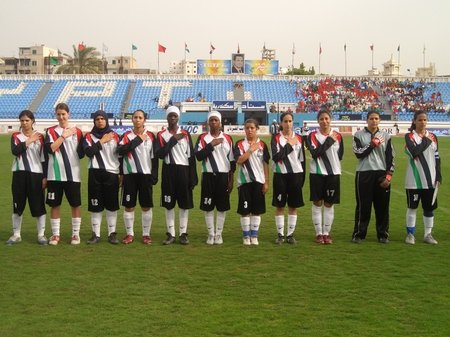
Being a Palestinian journalist in exile, there was no other way to interview my people and interact with my colleagues in Palestine but through the internet. I have started a feature by interviewing the Palestinian journalist Nelly Ismail Yassin Almasry through the net because Israel’s enforced laws made it difficult for us to meet in person. Our discussions took longer than expected because electricity blackouts happened many times in Gaza where she lives and the internet connection died with it, but I was determined to write about the other side of Gaza, the side that keeps rising from under the ashes like a bird with a thousand wings because its people refuse to surrender to defeat. Nelly is the daughter of Ismail Almasry, the Football Coach of the National Football Team in Gaza and a colleague working as a sport journalist and a member of the first women’s soccer team in Gaza.

The first Palestinian all women’s football team was established in 2003. Even though they had very limited resources, the women kept practicing and playing against other Arab women’s leagues whenever they were allowed to leave Gaza. The Gaza women’s soccer team suffered many difficulties and faced many obstacles because of the limited resources, the absence of properly built stadiums, the absence of security and the continuous closures of checkpoints by the Israeli occupation forces thus hindering them from practicing or travelling to play against other teams, even though the team wanted badly to represent Palestine on an international, level they were deprived of this dream as they were of many other dreams.

The sport movement started to come back to life in 1994, supported by the Palestinian National Authority. Some attention has been directed to develop sport facilities like maintaining sport stadiums. One of such efforts was building a stadium in the city of Jericho, which has encouraged some athletes to set up a female football team for the first time in Palestinian history, but the idea did not receive adequate attention or support because it was novel. Unfortunately that lack of interest eventually lead to freezing the idea for a while.

But again the Arab and International Federation of Football requested activating the Arab women’s football teams in their countries, and encouraged it by allocating 10% of its financial support to the union to support the Palestinian women’s football teams.

The Palestinian union adopted the idea of forming a female soccer team, and assigned this task to Mrs Haniya Albish. This decision was formally adopted by the International Football Federation who sent Mrs Haniya Albish in 2003 to attend a symposium on women’s football in the framework of the World Cup for women in America, thus starting the nucleus of the team at Bethlehem under supervision of Mrs Samar Ala’araj who was in charge of coordinating sports activities at Bethlehem University.

At the same time, Mr Hussein Shakhtour was forming another team in the Directorate of Youth and Sports, the two teams were merged into one sponsored team, supervised and trained by Bethlehem University according to their best of abilities considering the general situation in Palestine.

Then Mrs Haneyeh Albish, a member of the Palestinian union team of soccer, head of women’s football union, along with Mr. Adnan Abu Zayed attended the symposium of women’s football in “West Asia” organized by the International Federation of Football “FIFA” in March 2006 to develop the game in Palestine.

Playing abroad
The Palestinian women’s football team participated for the first time ever in a tournament held in Jordan 2004 along with 10 other Arab women’s teams; the event was organized by the Jordanian Orthodox club. The Palestinian team was formed from a number of players from the teams of Ramallah, the Evangelical Friends, Gaza, and Saryeat Ramallah group. The created team participated again in another event held in April 2005 in Jordan organized by Amman Club playing along other 10 Arab women’s teams.


The following participation was in the West Asia Championship for Women’s Football in Jordan held from 23 of September to the 1st of October 2005, during which the Palestinian team played against Jordan, Syria, Iran and Bahrain.

Then the Gaza team participated in the Arab Championship for women’s soccer in Alexandria, Egypt from 14-28 April 2006, playing against Syria, Tunisia and Egypt. Unfortunately all forms of sports in Gaza now are totally paralyzed.

Nelly grew up in a family of sportsmen who understood her passion for sport, her father was the coach of a team, and her brothers were football players who understood that football is just one of her choices.

Before getting involved in sport journalism Nelly played volleyball at AlAhli Palestinian club in Gaza. In 1996 and while she was still a university student, she joined the first football team for women in Gaza. Some families looked with suspicion at women playing football, but Nelly had no problem with that since she was brought up in a family involved with this sport, she was encouraged by her parents, besides the fact that three of her sisters joined the team as well. Her father was always keen to follow his daughter’s progress and used to go to the club to watch them training. They practiced 3 times every week for 18 months.

Nelly’s beginning with sports media goes back to the end of 2001 when she was a trainee at the Voice of Freedom Radio in Gaza, she progressed in her job to become a broadcaster of sports programs, during the same period she joined another media establishment as a supervisor of its website, but her post did not last long for economic reasons leading to the closure of the website.

Nelly confessed, ‘I have started to write sports reports in 2002 but I started playing football earlier, during 1996. Football is considered by many in Gaza as an unusual field for women, but strangely enough, most of the members of the Gaza women’s soccer team came from conservative Palestinian families, the majority of the members lived in the refugee camps, but still they have proved that they are able to commit themselves to this sport in a way that changed the society’s perception of women football players, and accept the idea to a point that the players started to receive support from the International Federation and the Arab federation, besides the FIFA and other unions.

Nelly is not involved in kicking the ball only, but she is a keen football fan as well, she talked to me about watching most matches played around the world and her support for some Arab leagues like the Saudi Arabian team Alhilal Club. She told me that and among her favourite players is Yasser Kahtani the best Arab player during the Asia championships 2007; she is also a fan of Nawwaf Altimyat, and Mohammad Shalhoob.

Many people were enraged that one Israeli player was denied a visa to Dubai to the tennis tournament held lately, claiming sport should be independent of politics, but it seems not many understood how important it is to boycott Israel’s sport to make a point, Israel bombed the Palestinian playing courts, banned Palestinian players from travel or participation, imprisoned and detained Palestinian players, attacked many of them, and these facts can be brought up and made known should Israel be boycotted. Israel’s policies are aimed at killing any hope of Palestinians participating in any sport where they can represent their country on international level.

Nelly finished her comment by saying ‘unfortunately there has been always a negative attitude towards women’s journalistic work in general, let alone working in the sports field where the journalist has to shuttle between clubs and matches. Some Gaza communities were not in favour of women practicing this sport or working in its media field, but we never gave up. All I hope for now is some peace, and to see that our stadiums will be rebuilt again after everything has been destroyed in Gaza by Israel’s attacks…the ball now is in the International court.  

Well, not much really…. Just that when you invite people who don’t consider each other to be “within the pale”, as British columnist David Aaronovitch said, then the discussion on anti-Semitism turns into character assassination.  

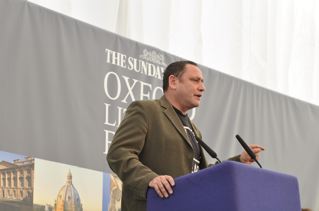
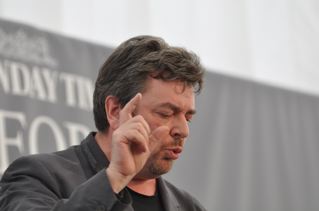
No one expected a calm discussion during the debate entitled “Anti-Semitism – Alive and Well in Europe?”, which was organised by the Sunday Times Oxford Literary Festival. Along with Aaronovitch, the panel included Gilad Atzmon and the Observer columnist Nick Cohen. 

It’s not clear why Cohen was invited to join at the very last minute when his views, to the naked eye at least, are akin to those of Aaronovitch’s. It would be fair to describe both men as supporters of Zionism who believe that anti-Semitism is on the rise and that much of it is “unfairly” blamed on Israel’s actions. 

Atzmon’s views, on the other hand, are well-known to those who follow websites on Palestinian activism. He has very strong views on “Jewishness” and “Jewish identity”, and makes a clear distinction between Jews as a people and those who commit crimes in the name of “Jewish ideology”. 

Both Aaronovitch and Cohen launched an attack on Atzmon. Aaronovich took the podium for 18 minutes (when we were told each speaker would only have 10, and indeed Atzmon had less than 10) during which he gave a  theatrical performance, reading out paragraph after paragraph of Atzmon’s articles to prove the point that the man was “fascist”. I doubt anyone in the audience managed to grasp what he was saying, but when you spit out the word “Jews” then at least it gives the impression what you’re saying about them is bad! 

Cohen, other the hand, kept wondering, over and over again, why “upper-class”, “educated”, “white” people would waste such a beautiful spring day debating anti-Semitism with a “nutter” (well, at least I could say I learned something about racial and class prejudice that day!) 

One can imagine how shocked and angry Atzmon was by the time it was his turn to take the podium. And this is why the event became a missed opportunity. He  tried to steer the debate back to its theme, but at times his emotions failed him. In between having to answer to the attacks levelled against him by Aaronovitch and Cohen, and trying to remind people of what they came to discuss, much of his ideas were lost on those who’ve never followed his writings. 

Once the floor was opened for questions, a member of the audience said the discussion, as a whole, “was a profound disappointment”. 

So why did the Oxford Literary Festival invite Atzmon? After all, he’s the “proud self-hating Jew” who wonders how America has allowed its foreign policies to be shaped by “ruthless Zionists”. He’s the one who insists that the burning of synagogues is illegitimate, yet he believes the motivations behind such actions are political rather than religious or racial.

Cohen certainly conceded that whenever Israel launches a fresh attack on Gaza or Lebanon, synagogues and Jewish cemeteries are attacked in the UK. Yet somehow he refuses to accept the correlation between Zionist policies and anti-Semitism. He wants us to believe that anti-Semitism is fuelled by pure hatred for the Jews. After all, Chinese property wasn’t attacked in the aftermath of the Tibetan clashes last year. Sudanese property wasn’t attacked when Darfur was in the media. 

Well, Mr. Cohen, maybe it’s because China and Sudan are being condemned in the international community, especially in Britain, while Israel to this day is being hailed as the West’s indispensable partner. Maybe it’s because what Israel has committed in Gaza during “Operation Cast Lead” earlier this year has created more devastation than what happened in Darfur (and this is according to the head of the International Red Cross). Maybe it’s because it is acceptable for British Jews to join the IDF, and actively take part in Israel’s wars, while British Muslims or Chinese or whatever would never dare join a non-British army. 

The response from some members of the “upper-middle class, educated, white” audience proved that these questions are not an endorsement of conspiracy theories. They are legitimate questions. 

One man raised the question of the pro-Israeli lobby in Washington. It was their pressure that led Obama to back down on his decision to appoint Mr. Freeman as an advisor, a man well-known for his criticism of Israel. “In those circumstances,” the man asked, “is a rise in anti-Semitism surprising when democracy is affected by that type of lobbying activity that prevents Obama from being able to appoint Ambassador Freeman?” 

We know what Atzmon would’ve said, but neither Aaronovitch nor Cohen answered that question. 

None of this justifies attacking synagogues or anti-Jewish graffiti. If anything, Atzmon – whom Aaronovitch and Cohen blasted as a “fascist” and a “nutter – was saying ordinary Jewish people “must be saved of the crimes imposed on them.” The crimes taking place in Palestine aren’t being committed just in the name of Israel, but in the name of the Jewish people. That’s not a conspiracy theory, that’s a fact. If you’re in doubt, go and read the Israeli government’s statements during Operation Cast Lead. 

Is it so outrageous to ask Jews in the UK to disassociate themselves from what is happening in Israel, without being labelled as an “anti-Semite”? Apparently it is. When people applauded Atzmon for making that point in the discussion, they were attacked by Aaronovitch who shouted “Shame on you! How dare you!”, even addressing one member in the audience by saying “You Sir, are an anti-Semite.”

In the aftermath of the July 7th attacks, Muslims were attacked everywhere. It became so dangerous that a fatwa had to be issued allowing women to take off the headscarf if they felt their lives were in danger. Yet at the same time, the Muslim community was under enormous pressure to disassociate itself from the terrorists who blew up those trains and busses. While they were being attacked themselves, they were still expected to make a clear statement that what happened on July 7th does not represent them and is not being committed in their name. 

Try and say that to the Jewish community today without being called an “anti-Semite”. 

Now I don’t want to ponder too much semantics but it is very ironic that anti-Semitism has been coined as a term exclusively for Jews when most of them do not belong to the Semitic race. Arabs, on the other hand, are Semitic. So if for one moment I, as an Arab, could reclaim that definition, I leave you with one point to think about. 

In the beginning of his speech, Aaronovitch wanted to illustrate just how bad Atzmon was. He quoted the Guardian’s Jon Lewis who described Atzmon’s writings as “extremely popular in the Arab world.” Aaronovitch then fixed his audience with a gaze and asked them to keep that sentence at the very front of their minds. 

On second thought, I think I did learn something about “anti-Semitism” that day. 

Dima Omar is a Palestinian journalist and filmmaker. She is based in London. 

To listen to David Aaronovitch reading Gilad Atzmon click here

To listen to David Aaronovitch’s tantrum click here

To Listen to Gilad Atzmon deconstructing antisemitism click here

To listen to Atzmon confronted with a outraged Jewish member of the audience click here
 
To listen to a disappointed member of the audience click here
 
To link to Aaronovitch confronted with a Jewish member of the audience click here
 
To listen to Aaronovitch’s closing remarks click here
 
To listen to Atzmon’s closing remarks  click here

WRITTEN BY Anis Hamadeh


With amazement the world public has noticed in recent weeks that war crimes had apparently been committed in Gaza. (1) Even Israeli soldiers and military staff now report about their own cruelties against the Palestinian population, cruelties that we do not even know from movies. (2) The stylish T-shirts, that promote the shooting of pregnant Palestinian women by indicating that in this way you can kill two human beings with one bullet, appeared strange to people abroad, too. (3) Moreover, the appointment of Avigdor Lieberman as Israeli foreign minister horrifies the public. (4) There would be further reasons to be disgusted, like the ongoing ethnic cleansing in Jerusalem, the plans for expanding the illegal settlements, some killings, the abduction of Gazan fishermen and so on, but these details do not enter the global discourse, because, well, because they never did. The question is: how genuine is the amazement about what happened in Gaza?


Did anything change in Israeli politics? Are those really completely new phenomena, suddenly coming up in the discourse, out of thin air? Or do we only witness the consequences of a continuing strategy that had begun more than sixty years ago? There are good arguments for the latter alternative, especially when you look at the facts. Let us, for example, revisit the year 1948 …


Deir Yassin and the Human Rights


1948 was a special year. It was marked by Plan D, the Israeli plan to ethnically cleanse Palestine. (5) Jewish troops expelled about 700,000 people from the indigenous population of the country and killed many of the men in combat age. Even in 1936, after the Palestinian revolt, the Palestinian elite had been persecuted. This was shortly after the first Palestinian party was founded which was to represent the interests of the native population in the two fronts struggle against the British occupation and the Zionist conquerers. “Punishments” like the demolition of residence houses were firstly used by the British and were adopted later by the Zionists. In 1948, several Jewish terror groups were known, like the Haganah, Irgun, the Stern Gang, Lechi and others. They killed, took the land away from the local people and later contributed several prime ministers who were accepted by the world public without any difficulty – very similar to today.


Don’t think that the pogroms against the population of Palestine during the execution of Plan D were secret. When the future Prime Minister Menachem Begin had the Arab village of Deir Yassin attacked on April 9 and many of its inhabitants killed (certainly including children and women) in order to terrorize and horrify the people, this was covered in the world press. Begin defended his deed with a typical Israeli bonmot: “The massacre of Deir Yassin not only had its justification – without the ‘victory’ of Deir Yassin there had never been a State of Israel.” (6) Four years later, the same Begin attempted to kill the German chancellor Adenauer (7) and in 1978 he received the Nobel Peace Prize.


When Deir Yassin went through the press, the horror about this deed was huge, very similar to today after Gaza. Everybody was surprised and disgusted, even perpetrators like Haganah and the Jewish Agency. A pattern came into being, the pattern of shooting and crying, i.e. killing with subsequent lament. This has worked: there have never been any consequences for Israel. The killings, the expropriations and the humiliation of the local population until today belong to the salient characteristics of Israeli politics. Nothing has changed.


At the end of 1948, large portions of Palestine were “Palestinian-free”, much more than the designated part of the land that the international community and the UN had granted to the Jews (with the explicit demand that the local people be treated well). We remember that the international community decided to give some land to the victims of the European genocide against the Jews and everybody was happy with the Palestine decision … except, of course, the people who lived in the region, because it was their land according to all international and logical standards. Weapons and myths (8) silenced them.


1948 was also the year of the Universal Declaration of Human Rights. In December, when Israel was established on the blood of the Palestinians, the world celebrated the Human Rights and did not care about Palestinians. The world wanted human rights with exceptions, but this did not work. Now, sixty years later, we begin to understand that.


The Aryan state did not work, let’s try a Jewish state …


During its history, Israel has continued the Deir Yassin policy, and today there is less than 10 or 5 percent of the land left to the Palestinians. On global refugee days people do not talk about Palestinians, although they are the biggest group of refugees in the world with far over 5 million people. This works because Palestinians (and Arabs and Muslims in general) are needed to fill the role of the anti-Semite which is substantial to the Zionist ideology.


It is, as if the world said: the Aryan state did not work, let’s try a Jewish state … Is it really surprising that we witness stunning similarities between the two today? (9) The Israeli population today is exactly confronted with the “final solution” subject now, because Israel cannot make peace on the one hand (this would imply justice for Palestinians, an unthinkable idea in Israel’s decision-making) and needs to end the conflict, on the other. With extremely violent politicians like Netanyahu and Lieberman the “transfer” plan comes closer, an idea to just expel Palestinians en masse like in the old days. Of course, if this happens, it will not mean peace, but more violence and even stronger resistance. So let your imagination fly and think about what a final solution could look like.


It is not known how many Palestinians must die before the world recognizes that they are human beings and not anti-Semites. Right now the killing goes on, the Gaza peak did not evoke a real criticism yet. Israel is encouraged to go on to see how far it can go. Do not think that this was it, do not think that Israel will now see that it cannot go on like this. The Zionists have learned that they can do anything with impunity. On March 22, 2009, a total of 14,000 tons of new US weapons arrived in Ashdod on the German cargo ship “MS Wehr Elbe” (owner: Oskar Wehr KG, Hamburg). (10) With these weapons alone, tens of thousands of people can be killed.


The Jewish state will collapse, like the Aryan state has collapsed, because both have the seed of self-destruction in them. Both are clearly racist, violent and expansionist in nature. This time it hits Arabs and Muslims instead of Jews. For over sixty years the international community has been blind to this fact, although it is so obvious that ordinary people know it and talk about it – not politicians or journalists or others who need the public.


Countries like Germany even have a “reason of state” to secure the persecution of Palestinians, Arabs and Muslims, calling it a “historical responsibility”. There is no other possible reason to introduce a reason of state if it was not for something highly illegal that needs to be hushed up.


We may still save the rest


The repressive tolerance of Western countries like Germany and the USA makes it possible to write all this down, because it usually has no “harmful” effects towards change. A lot of people think that – unlike the Nazi state – the Zionist state cannot be overcome by violence and thus will prevail. This is an error. Racist regimes of this ilk end up in self-destruction if they are not overcome from the outside. What is important now: we can still save lives. We cannot save the about 1,500 dead in Gaza anymore. But we may still save the rest.


At the end of May, the Free Gaza Movement will organize a flotilla of boats, the Hope Fleet, to break the siege of Gaza. You can support them. (11) The International Solidarity Movement (ISM) is present in Palestine to shield Palestinians from the Zionist killers (12). You can support them and save lives. This is a critical phase and every hand is needed, every tongue and every cent. Boycott Zionists now! Take it seriously now! Boycott non-Israeli journalists and politicians who support the killing! Argue with them! Support those Jews who are committed against violence and for peace in Palestine. For the sake of humanity and of yourself: do not take part in this murder.


NOTES:
1. E.g. in the German “Spiegel”, “Israelische Armee: Gaza-Veteranen schockieren mit Aussagen über wahllose Morde.” by Ulrike Putz, Beirut,
http://www.spiegel.de/politik/ausland/0,1518,614286,00.html
2.
See e.g. ‘Shooting and crying’, von Amos Harel, http://www.haaretz.com/hasen/spages/1072475.html
3. See e.g. http://news.sky.com 20 March 2009, “Israeli Army T-Shirts Mock Gaza Killings”, by Dominic Waghorn (URL too long)
4. Guardian 25 March 2009, “Avigdor Lieberman, Israel’s shame”, by Neve Gordon, http://www.redress.cc/palestine/ngordon20090327
5. Ilan Pappe, “The Ethnic Cleansing of Palestine”, 2006
6.
Markus A. Weingardt (2002): Deutsche Israel- und Nahostpolitik. p. 33
7. See e.g. Frankfurter Allgemeine Zeitung, 12 June 2006 “‘Im Auftrag des Gewissens’. Begin war Drahtzieher des Adenauer-Attentats”, www.faz.net/s/RubFC06D389EE76479E9E76425072B196C3/Doc~E35BBCD5A37DA47809AD4F6A865C6332B~ATpl~Ecommon~Scontent.html
8. Myths like “A land without a people for a people without land”, “Arab aggressions/ David vs. Goliath”, “anti-Semitic Arabs/Muslims”, Palestinian Nazi cooperation (it was far less effective than Zionist Nazi cooperation), Arab military superiority (Jordan was the only country with a decent army then, and the Jordanian king was successfully promised a part of the prey, namely the West Bank); also see John Rose (2004), “Myths of Zionism”
9. This comparison is still forbidden in the mainstream, “for the security of Israel”, but it is as obvious as it is founded and necessary. See my essay “The Second Case”, Feb. 5, 2009, http://www.anis-online.de/1/essays/23.htm
10. Amnesty International, Press Release, April 1, 2009, United States Delivers Massive New Weapons Shipment to Israel, Confirmed by Pentagon, Says Amnesty International, http://www.amnestyusa.org/document.php?id=ENGUSA20090402002&lang=e (NB: The German government is co-guilty, cf. (in German): http://www.radio-utopie.de/2009/01/23/Bundesregierung-dementiert-Wissen-ueber-Waffentransport-nach-Israel-Chronologie-der-Wehr-Elbe-Affaere)
11. See press release and updates at www.freegaza.org
12. http://palsolidarity.org


SOURCE: http://www.freegaza.org/en/home/804-shooting-and-crying-nothing-new-since-1948–or-is-it


On the occasion of the June 2009 European elections, we are launching an urgent appeal to all candidates for the 736 seats in the European parliament.
We ask that they actively pursue the immediate and unconditional removal of Hamas and all other Palestinian liberation organizations from the European list of proscribed terrorist organizations. We further ask that they acknowledge the right of the Palestinian people to self-determination and, by so doing, recognise, Hamas as a legitimate voice for the Palestinian people’s aspirations for national liberation.
http://www.recogniseresistance.net/

http://www.recogniseresistance.net/index.php

Initial Signatories:

275 personalities on March 30th 2009

ABICHT Ludo Belgique-ABOUDAN F, Dr. Stellvertret Vorsitzender des Deutsch Syrischen e.V. Allemagne-ABOU JAHJAH Dyab, activiste, Belgique-Liban Belgique-ABUALROB Mohammad, coordinator of the Palestinian People society Afrique du Sud-AHIDAR Fouad, parlementaire bruxellois Belgique-ALEGRE Greta, cinéaste, Artistes contre le Mur Belgique – ALI Tariq, writer, film-maker and editor of New Left Review Royaume-Uni-ALLEG Henri France-ALLEG-SALEM Gilberte France-AL-ZOEBI Mohammed, prof. Dr., ex-Minister in Syria Allemagne-AMADOR Irene, anthropologue Espagne-AMARA Jean-Claude, porte-parole de Droits devant !!, France-ANDREEVA Nina, Secretary general of Central Comity A-UCPB Russie-ANWAR Aamer, Human Rights Lawyer, Ecosse Royaume-Uni-AOURAGH Miriyam, co-organizer Dutch antiwar and antiracism campaign, Pays-Bas-ARSALAN Fathallah, porte-parole du mouvement Justice et Spiritualité Maroc-ARTLIEB Marion, Dpl.Ing. computer scientist Autriche-ATZMON Gilad, artiste de jazz et écrivain Royaume-Uni-AYALA SOSA Rosa (Dr.ssa), CIEP  Italie-BADER Wilfried, local counsellor Angerberg, Tirol Autriche-BARBEAU-LAVALETTE Anaïs, Réalisatrice Québec Canada-BARGHOUTHY Hani, Writer, editor-in-chief of arabianawareness.com Canada-Baroud Ramzy, Author, Journalist USA-BARRETT Mark, civil liberties campaigner, London Royaume Uni-BARTOLIK Pawel Michal, Journalist of Trybuna Robotnicza (Workers Tribune) Pologne-BEAUGIER Catherine, Poète – Ecrivain Belgique-BELAHRACHE Radouane, Nîmes France-BELAL Aabdelhai, PHD student Chypre-BENGHABRIT Hassan, écrivain/poète France-BENMERAD Djamal, Ecrivain Bruxelles Belgique-BENZAKOUR Mohammed, écrivain et journaliste Pays-Bas-BERLIN Greta, co-fondatrice Free Gaza Movment USA-BIBEAU Robert, expert en éducation au Ministère de l’Éducation du Québec Canada-BLEITRACH Danielle, sociologue et écrivain France-BOAL Augusto, homme de théâtre Brésil-BONALI Giulio Italie-BONAZZI Giuseppe, Professore emerito Fac. Scienze Politiche Università di Torino Italie-BORREMAN Hadassah, publiciste Belgique-BORREMAN Shmiel Mordche, Yechouroun Judaïsme contre Sionisme Belgique-BOUAMAMA Saïd, sociologue France-BOUKMAN Daniel, écrivain Martinique-BOUMEDIENE-THIERY Alima, sénatrice France-BOUSSOUMAH Youssef, Mouvement des Indigènes de la République France-BOUTELDJA Houria, Mouvement des Indigènes de la République France-BOUTELDJA Naima, Journalist, Royaume-Uni-BOUZERDA Abdou, président Arab European League Pays-Bas-BRACKE Maud, lecturer, University of Glasgow Royaume-Uni-BRACKE Sarah, féministe & professor KULeuven Belgique-BRICMONT Jean, physicien Belgique-BROWN Brenda, Chair, Brighton & Hove Palestine Solidarity Campaign  Royaume-Uni-BRUGUIER Alain, vice-président de l’AFPS de Nîmes (Gard) France-BUSTANI Hisham, Writer and Secretary of the Socialist Thought Forum Jordanie-CAPORALE Alessandra, social anthropologist, university lecturer, Barcelona Espagne-CATALINOTTO John, managing editor, Workers World Newspaper USA-CAVALLI Franco, Immediate Past President of UICC, Direktor IOSI in Bellinzona, Initiator Medicuba, Nationalrat der SP Schweiz von 1995 – 2007 Suisse-CERRI Giovanni, Professore di Letteratura greca antica Università di Roma Tre Italie-CHAAMBI Abdelaziz, militant associatif France-CHANDAN Sukant, Chair, English branch of the IUPFP Royaume-Uni-CHASSEUR Tony, musicien Martinique-CHIAROTTO Francesca, dottoranda in Studi Politici, Torino Italie-CHICHAH Souhail, chercheur ULB Belgique-CHIESA Giulietto, parlamentare europeo e giornalista Italie-CHRISTISON Bill, writer, Palestinian rights activist USA-CHRISTISON Kathleen, writer, Palestinian rights activist USA-COLLON Michel, écrivain et journaliste Belgique-COLONNA Eric, citoyen engagé, Lyon France-CONFIANT Raphaël, écrivain Martinique-CONSTANTINOU Petros, Campain Genoa 2001 Grèce-COOPER Alan, Senior Lecturer, European College of Business and Management, Royaume-Uni-COSSELLU Mario Gabrielli, Segretario Circolo PRC/SE “Enrico Berlinguer” Bruxelles Belgique-CRETAUX Sophie, ex-chercheur au CNRS, agrégée d’histoire France-CROOKE Alistair, Conflicts Forum Director and Founder Royaume-Uni-DALTON Des, Vize-Präsident von Republican Sinn Féin, Betriebsrat der Gewerkschaft SIPTU Irlande-DAWOOD Fakeer, Dr., Prof. Telecommunication, Montreal, Qc Canada-DE BRABANDER Ludo, Stafmedewerker vzw Vrede Belgique-DE HERT Robbe, cinéaste Belgique-DE LEY Herman, emeritus professor.Universiteit Gent Belgique-DE SANTI Massimo (Prof.), Presidente Comitato Internazionale di Educazione per la Pace Italie-DE WITTE Ludo, auteur Belgique-DE WITTE Paul, Woordvoerder Basisbewehging voor democratie in samenlevving en kerken, Belgique-DEDAJ Viktor, cyberjournaliaste France-DEKKERS Daniel, Ingénieur retraité Belgique-DELMOTTE Paul, professeur IHECS Belgique-DELORCA Frédéric, Sociologue, coordinateur du blog de l’Atlas alternatif, France-DELPHY Christine, Fondatrice et directrice de la revue NQF, France-DEQUEECKER Ida, féministe Belgique-DERMAGNE Jean-Marie, Avocat, Enseignant à l’Université Belgique-DERONNE Thierry, vice-président télévision publique Vive TV République bolivarienne du Venezuela Venezuela-DERRICHE Ouardia, membre de l’Association Belgique-Palestine Belgique-DIAGNE Roland, enseignant en France, militant communiste marxiste-léniniste France-D’ORSI Angelo (Prof.),  Cattedra di Storia del Pensiero politico Dipartimento di Studi Politici, Università di -Torino Italie-DOUGLAS Emory, Former Minister of Culture of The Black Panther Party USA-DRURY Ivan, member of Vancouver Socialist Forum, contributing editor of Socialist Voice Canada-DUISENBERG Gretta, Chair Foundation Stop the Occupation Pays-Bas-DUMAS F. LAFONTANT Doumafis, Organizer, African Liberation Day USA-DURAND Benjamin, professeur de cinéma et télévision, Caracas Venezuela-DUTHU Françoise, ancienne députée au Parlement Européen (Les Verts) France-DWORCZAK Hermann, social scientist, trade unionist Autriche-EDDE Dominique, écrivain franco-libanaise France-EL KADI Mohamed, Président de l’Agence Méditerranée pour la Coopération Internationale, Journaliste /Directeur du Journal “La Méditerranée”, Fès Maroc-EL-ABED Chairman Fathi, Danish Palestinian Friendship Association and Candidate to the EU-Parliament (The -Socialist People Party) Danemark-EL-SALAHI Zaki, Masters student, Edinburgh, Scotland Royaume-Uni-ELSÄSSER Jürgen, journalist, Berlin Allemagne-FADIL Nadia, sociologue Belgique-FANON-MENDES-FRANCE Mireille France-FELLER Jonas, Anti-imperialist activist and high school student, Rostock Allemagne-FIGUEIREDO Jorge, Webmaster resistir.info Portugal-FINKELSTEIN Norman G., enseignant, auteur USA-FISCHER Franz, Sekretariat Partei der Arbeit der Schweiz – Sektion Basel, Trade Union UNIA Suisse-FLINKER Jean,  enseignant, membre d’Attac-Bruxelles, Belgique-FLOUNDERS Sara, co-director, International Action Center USA-FRABETTI Carlo, écrivain Espagne-GABRIEL Leo, journalist and social anthropologist, member of the council of the World Social Forum Autriche-GARREAU Micheline, militante ISM  France-GEYS Herman, Kunstenaar Belgique-GHARBI Anouar, Président de « Droit pout tous » et porte parole de la « Campagne Européenne pour mettre -fin au siège de Gaza » Suisse-GHARBI Anouar, Président de « Droit pout tous » et porte parole de la « Campagne Européenne pour mettre fin au siège de Gaza », Suisse-GIRARD Youssef, étudiant France-GOEMAN Eric, woordvoerder Attac Vlaanderen Belgique-GOOSSENS Pol, journaliste Belgique-GRAZIANI Tiberio, directeur Eurasia. Rivista di studi geopolitici Roma Italie-HABERKORN Amir Belgique-HACK Margherita, Astrofisica Italie-HADDAD Georges, Writer, Bulgaria/Liban-HAIDER Ahmad, Dr. med. Urologe und Androloge Allemagne-HALPIN David, FRCS Standing in solidarity with the Palestinian people Royaume-Uni-HAMAD Nidal, Writer and Joournalist, Palestine/Norway Norvège-HAMIDI Malika, doctorante EHESS à Paris Belgique-HARTMANN Klaus, Offenbach am Main, Bundesvorsitzender des Deutschen Freidenker-Verbandes Allemagne-HASSOUN Karim, Voorzitter AEL Belgique-HAYDEN Josephine, ehem. politische Gefangene in Irland, Sekretärin von Republican Sinn Féin Irlande-HAYEEM A
be, Chair, Architects & Planners for Justice in Palestine Royaume-Uni-HAZAN Eric, éditeur France-HEARD Brenda, Founder Friends of Lebanon London Royaume-Uni-HECHT-GALINSKI Evelyn, Publizistin Allemagne-HELMUT Franz, Oberstleutnant der Deutschen Bundeswehr i. R. Allemagne-HOFBAUER Hannes, publisher and publicist  Autriche-HÖRSTEL Christoph, Regierungs-/Unternehmensberater, Buchautor, Vors. Friedenskreis Deutschland e.V. i.G., Nehls, Gertrud, AK Asyl Allemagne-HOUSE James, maitre de conférences à l’Université de Leeds Royaume-Uni-HOUTART François, professeur émérite de l’Université catholique de Louvain Belgique-HUI Matthias, Fachstelle OeME, Ref. Kirchen Bern-Jura-Solothurn, Suisse-HUTNYK John, Professor of Cultural Studies, Academic Director of CCS Goldsmiths University of London -Royaume-Uni-ITANI Zouhair, Prof.Dr.med. Dermatologist, Düsseldorf Allemagne-JENART Nathalie, psychologue, directrice d’un centre PMS, Bruxelles Belgique-JENNAR Raoul Marc, consultant en relations internationales France-KAREL Arnaut, antropoloog, UGent  Belgique-KARSLI Jamal, FAKT-Party Allemagne-KASRILS Ronnie, former South African government minister, writer Afrique du Sud-KEHOE Jon, artist, London Royaume-Uni-KHIARI Sadri, Mouvement des indigènes de la république France-KHRESHE Hassan Dr., Vice President Palestinian legislative council Palestine-KOUCHAKJI George A., Palestine Solidarity Basel Suisse-KOWALEWSKI Zbigniew Marcin, researcher and editor Pologne-KREBS Djamila, membre d’Europalestine Allemagne-KRZYŻANIAK Piotr, trade-unionist of All-Polish Trade Union “Workers’ Initiative” (Ogólnopolski Związek —Zawodowy “Inicjatywa Pracownicza”) Pologne-LACROIX-RIZ Annie, professeur d’histoire contemporaine, université Paris 7 France-LAHAYE Laure, Chargée de collections en arabe à la Bibliothèque nationale de France, Conseillère de quartier, -Paris, France-LAMB Franklin P. , PhD, Director Americans Concerned for Middle East Peace, Washington DC – Beirut Acting –Chair, the Sabra-Shatila Memorial Scholarship Program Laptop Initiative, Shatila Palestinian Refugee Camp-LAMP Paul, board member of Stop the Occupation Pays-Bas-LAMRABET Asma, Médecin et Essayiste Maroc-LANGTHALER Wilhelm, Anti-imperialist Camp Autriche-LANOYE Tom, auteur Belgique-LAROSIERE Jean-François, responsable syndical et associatif France-LAWLOR Zoe, Ireland-Palestine Solidarity Campaign Membership Officer Irlande-LEGRAND Michel, Président du Comité pour une Paix Juste au Proche-Orient Luxembourg-LEUENBERGER Peter, Historiker, Vorstandsmitglied Gesellschaft Schweiz- Palästina, Suisse-LEVY Laurent, essayiste France-LOPE (de) Monique, professeur émérite à l’Université de Provence France-LOS René, bestuurder Belgique-LOSURDO Domenico, Direttore Istituto Scienze filosofiche, università di Urbino Italie-LOUCKX Fred, Sociologue,  Vrije Universiteit Brussel Belgique-LOUIS Tim, Former Vancouver City Councillor Canada-MAC MANUS Patrick, author Danemark-MAESTRO MARTIN Ángeles, mèdica especialista en salud pública Espagne-MAGUIRE Mairead, prix Nobel de la Paix Irlande-MAHI Yacob, Enseignant, Théologien, Dr. en Histoire et Sciences des Religions, Belgique-MAIRA Antonio, Politólogo, redactor Diario digital inSurGente Espagne-MANAMELA Buti, National Secretary Young Communist League of South Africa-MANDUCA Paola, geneticist Italie-MANISCO Lucio, giornalista ed ex parlamentare europeo Italie-MARTINEZ Miguel, website kelebekler.com Italie-MASSARRAT Mohssen, Professor Dr. Osnabrück Allemagne-MAUERSBERGER Günter, Botschafter a.D., Vize- Vorsitzender des Nahostforum e.V. Allemagne-MELVYN Peter, Jewish voices for a just peace in the Middle East Autriche-MEYER HAJO G., Bestuurslid “Een Ander Joods Geluid” Pays-Bas-MOFFA Claudio, Professor University of Teramo Italie-MOMMAERTS Omer, militant vakbond ACV-CSC Belgique-MORRISON Danny, writer Irlande-MORTIER Erwin, schrijver Belgique-MOUEDDEN Mohsin, éducateur Belgique-MOUSSET Renée, Association Belgique-Palestine, Liège Belgique-MUKUNA Olivier, journaliste Belgique-MYRDAL Jan, écrivain Suède-NOUR DACHAN Mohamed (Dr.), Unione delle Comunità ed organizzazioni Islamiche in Italia Italie-Ó BRÁDAIGH Ruairí, President Sinn Féin Poblachtach since 1969, IRA Chief of Staff 1956-62 Irlande-OBERKOFLER Gerhard, University professor, Vice president of the Association Alfred Klahr, Innsbruck Autriche-OBID Milan, chairman of the Slovene Students Club Vienna Autriche-OLFF-RASTEGAR Perrine, Porte-parole du Collectif Judéo Arabe et Citoyen pour la Paix – Strasbourg France-PAGANI Giovanna (Prof.ssa), Presidente On. Wilpf Italia -Lega Internazionale delle Donne per la Pace e la Libertà Italie-PEIRCE Gareth, solicitor, Londres Royaume-Uni-PELLEGRIN-RESCIA Marie L., Présidente, Séminaire d’anthropologie et psychologie sociale J S, Paris V—Sorbonne France-PEREZ BERROCAL Gloria, programmatrice de télévision Espagne-PETRAS James, Bartle professor emeritus Binghamton University USA-PIERART Pierre, Professeur Honoraire Université Mons Hainaut Belgique-PINO Julio (Dr.), professor of history USA-PIRKER Werner, journalist Autriche-PLOUVIER Liliane, Professeur de droit international Bruxelles Belgique-POLGAR Alexandru, philosophe, éditeur de la revue Idea Roumanie-POSMAN André, eredocent actualiteit Sint Lucasinstituut Gent, lic. Geschiedenis. Dir Concertreeksen DE Rode -Pomp Gent Belgique-RAHWANJI Maha, Member of the Executive Committee, Palestine Solidarity Campaign Royaume-Uni-RAMADAN Tariq, professor, Oxford/Erasmus Universities Royaume-Uni-RAMIREZ Ronnie, cinéaste Belgique-RAVENTÓS BARANGÉ Anna, PhD Senior Lecturer Faculty of Arts and Letters University of Seville Espagne-REVELLI  Philippe, journaliste France-RICHA Raymond, Ingénieur France-RICHET Mathis, Musician Royaume-Uni-RIDLEY Yvonne, journaliste Royaume-Uni-RIZZO Mary, co-Editor of Palestine Think Tank and co-founders of Tlaxcala, Dr. Art Historian and Art Restorer Italie-ROELS Frank, MD, emeritus professor Ugent Belgique-ROMANO Vicente, professeur d’université Espagne-ROSA-ROSSO Nadine, enseignante et auteur Belgique-ROSSEEL Eric, gepensioneerd docent psychologie VUB Belgique-RUMEAU Mireille, militante ISM France-SAÏDI Nordine, Mouvement Citoyen Palestine Belgique-SALEM Jean, philosophe, professeur à la Sorbonne, Paris France-SANDBAEK Ulla, Former Member of the European Parliament Danemark-SARAMAGO Jose, écrivain, Portugal-SCHAUER Waltraud, former human shield in Iraq Autriche-SCHLERETH Einar, Journalist Suède-SCHMID Estella, Kurdistan Solidarity Committee & CAMPACC Royaume-Uni-SCHÖGLER Johann, Styrian Peace Platform Autriche-SCHOMBLOND Christiane, chargée de cours honoraire de l’ULB Belgique-SCHYDLO Krystyna, Deutsch-Palästinensische Gesellschaft, Ruhrgebiet Allemagne-SEBOGO BERNARD NKUMAH, Chairperson of Boston Branch, All African People’s Revolutionary Party USA-SEIFERT Arne C. (Dr.), Botschafter a.D., Sprecher der Initiativer “Diplomaten für Frieden mit der Islamischen Welt” Allemagne-SENOUCI Brahim, maître de conférences France-SHEIKH KHALIL Nabil, Association to Support Palestinians in Need Suisse-SIFAKAKIS Yiannis, Stop the war Coalition Grèce-SOETERIK Robert, antropoloog, Middle East Research Associates Pays-Bas-STASZEWSKI Michel, enseignant, Bruxelles Belgique-STERN Catherine, enseignante d’Histoire à la retraite, ancienne chargée de cours à Paris France-STUDEN-KIRCHNER Aleks, author and interpreter Autriche-SWYNGEDOUW Erik, Professor of Geography School of Environment and Development Manchester University Royaume-Uni-TALENS Manuel, écrivain Espagne-TAWFIK AL-MANSOURI Mohamed, Ph.D., Writer and Researcher, Afnan Magazine Canada-TENA Carlos, periodista Espagne-THARANI Marishka, Actress Royaume-Uni-TIBON-CORNILLOT Michel, Universitaire, écrivain France-TILLEY Virginia, political scientist Afrique du Sud-TURINE Jean-Marc, écrivain Belgique-URBANO Miguel, écrivain Portugal-VAN DEN BERGHE Gie, professor Universiteit Gent, ethicus en historicus Belgique-VAN HOORNE Michel, coordinateur du mouvement ‘Links Ecologisch Forum (LEF)’Belgique-VANDEN BAVIERE Paul, journaliste et historien Belgique-VANDEPERRE Elke, coördinator v
zw Motief Belgique-VANHOVE Daniel, Observateur civil, auteur, membre de l’ABP et du MCP Belgique-VARNAVA-SKOURA Gella, professeur en sciences de l’éducation à l’Université d’Athènes Grèce-VATTIMO Gianni, Filosofo ed ex parlamentare europeo Italie-VERCHEVAL Véronique, Photographe Belgique-VERCRUYSSEN Frank, acteur Belgique-VERGAELEN Eva, writer Belgique-VERLICCHI Elsa, Anthropologist, Rome Italie-VERVAET Luk, président section belge IUPFP Belgique-VERWIMP Remi, coördinator Werkplaats voor Theologie en Maatschappiij Belgique-VIRGIN Robin, Pluto Press, England Royaume-Uni-VISCHER Daniel, MP of the Green Party Suisse-VON RAUSSENDORFF Klaus, Referent für internationale Fragen beim Bundesvorstand des Deutschen Freidenker-Verbands  Allemagne-WALSH Richard, Pressesprecher von Republican Sinn Féin und Vorsitzender der Republican Prisoners Action Group Irlande-WILHELMSON Lasse, teacher Suède-WINTER Heinz-Dieter (Dr.), Botschafter a.D. Allemagne-YAFOUT Merieme, Responsable de la section féminine du mouvement Justice et Spiritualité Maroc-ZAAF Mohamed, chirurgien et conseiller municipal France-ZAAIMAN Andre, Researcher Afrique du Sud-ZEMOR Olivia, présidente de CAPJPO-EuroPalestine et responsable europalestine.com France-ZOLO Danilo, Docente di Filosofia del Diritto internazionale, università di Firenze Italie

WRITTEN BY IQBAL TAMIMI Yesterday evening the Centre for Islamic Studies in Oxford hosted Turkish Prime Minister Recep Tayyip Erdogan, accompanied by his wife Amina, whom I consider as an icon of a Muslim woman that deserves all the respect and admiration for her continuous support for the Palestinian women and her courage and dedication to human rights. A number of diplomatic personalities and statesmen accompanied the PM to Oxford after the last G20 summit meeting.

Erdogan was welcomed with a very long, warm applause, he spoke to the masses after some delay by the traffic in London which he apologized for, commenting in his usual humorous way that his counterpart Gordon Brown should do something to solve the traffic problem. ‘I used to think that the traffic jams in Turkey were the worst, but I discovered that London’s traffic is even worse,’ he said.  

The Turkish Bristolian group who I have accompanied included Sakir Yildirim who drove an eight thousand mile round trip delivering an ambulance loaded with practical aid to Gaza. Business man Talip Topuz waited a long time until he got Prime Minster Erdogan’s autograph and danced happily with it for quite a while. The Bristol PSC group were lucky to secure a place, while almost a thousand people had to return back home, for the crowds were much more than the expectations of the lecture organizers, but still some preferred to wait outside the hall. 

Most amazing was the relaxed atmosphere and the very friendly local police and security personnel, amongst whom were a British Muslim policewoman wearing a Hijab as part of her uniform.

Erdogan who had just arrived from the last meeting of the G20 summit held in London, during which he proposed solutions for the global economic crisis were discussed as well as another equally important issue of the mutual understanding and respect between people of different faiths and communities. 

“It is important that the Western community understands that Turkey is a country that identifies with the European region and is part of it, but at the same time the majority of our nation are Muslims,” he said.

His call for others to understand the importance of mutual respect of faith choice was clear, ‘I respect Jesus and Moses and the message they came with, and I expect others to have similar understanding and respect for my faith,“ he said.

One of the guests requested a comment from the Prime Minister regarding the incident when he stormed out of a conference held in Davos, which was attended by Israeli President Shimon Peres after Israel’s bombing of Gaza. Erdogan said, “I had to do the same in Georgia as well, because I saw a fierce barbaric attack on women, children, the elderly and the vulnerable who do not have the means to defend themselves, they were killed while no one from the international community intervened to stop this aggression, this I could not tolerate. I saw with my own eyes young Palestinian children being killed in Gaza. The situation is still bad, for Israel is still refusing to open this big prison of Gaza to allow for humanitarian aid and food to reach families in desperate need of help, the people of Gaza are still living in tents and in need of help. I spoke with Quartet envoy Tony Blair on this subject, and told him there is an urgent need to open the borders to allow the necessary building materials enter Gaza for rebuilding the badly damaged infrastructure.”

In response to a question about the expected timing of Turkey’s joining the European Union, Turkish Prime Minister said, “Until now, there is no set time. The UK had struggled for 11 years before joining the EU, and perhaps we should expect to wait as long. There is a routine procedure of examining two files at a time, and I always asked why only two, why not three.”

Erdogan also talked about Turkey’s organic farming plans: “There is a large extended border area between Turkey and Syria full of land mines; we plan to clean up the minefields and cultivate the area organically,” he commented on a question asked about farming in Turkey.

He also spoke about the upcoming visit of U.S. President Obama, expected to take place in Turkey next week and said, “I spoke with Quartet envoy Tony Blair as well, and discussed this issue with USA President Obama and we will discuss it again when he arrives in Turkey that there is an urgent need to find a solution for the Israeli-Palestinian conflict, and such discussions should involve all Palestinian parties involved, including the Hamas.” (photo by Iqbal Tamimi)

Visit Palestinian Mothers

In 1929 Ben-Gurion said: “Jerusalem is not the same thing to the Arabs as it is to the Jews”. While he meant to say that Palestinians were not part of Jerusalem and are not attached to it as the Jews are, I would say, he almost got it right: Jerusalem is not the same thing to the Palestinians as it is to the Zionists. To us, Jerusalem is a home and an integral part of each of us, to the Zionists it is but another construction site, for he who loves a city would not destroy it as the Zionists are doing right now with Jerusalem.


The distance between Sawahreh and Jerusalem is a relatively short one. Using a car, one would need 15 to 20 minutes, checkpoint stops excluded. Riding Sawahreh buses, which were old and rusty, it usually took us some 30 minutes, sometimes a bit more depending on the number of stops the bus made. We used to take the bus five days a week to go to school and come back home. On rainy days, the iron seats would be wet and cold, in summer they would be boiling hot. Nevertheless, my sister and I would race to find an empty seat near the window. We enjoyed the trip to Jerusalem, especially when the bus went up and down the Gethsemane Church road. To the left, facing the walls of the Old City, one would see the golden Dome of the Rock. It would get bigger or smaller as you go up and down the road. I preferred the trip up the road towards Ras Al-Amud. I would watch closely awaiting the point when the Dome would start appearing, seemingly out of nowhere. To one seeing this for the first time, it would be a nice surprise. And as the bus travels up the road, it gets bigger and bigger, till at the top of the road you have somewhat a full view of the Dome of the Rock. When I was at school, I enjoyed watching friends and relatives from Dheisheh and Bethlehem witness this miracle. A number of times, my sister and I were forced to walk all the way from Jerusalem to Sawahreh. On Saturdays there were usually fewer buses moving on the various lines, so a couple of times we had to walk back home after finishing classes. These “forced walks” were seldom, and although on foot it took us much longer to get to Sawahreh, and we would reach home completely tired and with burning feet, we enjoyed the walks. We would pass the walls of the Old City and the ancient tree which looked like something out of a horror movie. It is said that the tree is very old, and it does look it, but somehow it didn’t impress me. It looked more dead than alive, not like the green olive trees or the bloomy almond trees you find in Palestinian fields and on hilltops. From the point where the tree stood, one had a marvelous view of Mount of Olives and the Palestinian neighborhoods in the area.


Josef Weitz, the polish director of the Jewish National Fund’s Land Settlement Department in charge of illegal Zionist colonization in Palestine and the Ethnic Cleansing of Palestinians, wrote in 1940: “among ourselves it must be clear that there is no room for both people in this country. After the Arabs are transferred, the country will be wide open for us, with the Arabs staying the country will remain narrow and restricted …. There is no room for compromise on this point … land purchasing … will not bring about the state … the only way is to transfer the Arabs from here to neighboring countries, all of them, except perhaps Bethlehem, Nazareth, and Old Jerusalem. Not a single village or a single tribe must be left. And the transfer must be done through their absorption in Iraq and Syria and even in Transjordan. For that goal, money will be found – even a lot of money. And only then will the country be able to absorb millions of Jews …. There is no other solution.” In addition to calling for the transfer of Palestinians, Weitz claimed Old Jerusalem is to be “spared” the ethnic cleansing, but facts on the ground tell a completely different story. Since its establishment, the Zionist state has been implementing a systematic policy of Judaizing Jerusalem and ethnically cleansing its original Palestinian residents. Even when spreading propaganda about an empty land waiting for its long lost sons to come back, Zionist leaders admitted among themselves that the land was populated and was prosperous. English Zionist Israel Zangwill, famous for his quote: “Palestine is a country without a people; the Jews are a people without a country”, which later became the infamous Zionist slogan: A land without a people for a people without a land, said in a speech to a Zionist group in the UK in 1905: “Palestine proper has already its inhabitants. The pashalik (province) of Jerusalem is already twice as thickly populated as the United States, having 52 souls to the square mile and not 25% of them Jews”. In 1948 Israel occupied 85% of Jerusalem and forcibly expelled up to 80,000 Palestinians from their homes in West Jerusalem and 40 other surrounding villages. The villages were then destroyed to prevent their inhabitants from returning back to them, and their property was transferred to the Israeli state under the “Absentee Law” of 1950. In 1967 Israel occupied the rest of Jerusalem, and established the first illegal Jewish settlement inside the Old City. More than 700 Palestinian homes and buildings were either destroyed or expropriated. Alone in the Mughrabi Quarter of the Old City, over 6,000 Palestinians were evicted and 125 houses were destroyed in order to create a plaza in front of the Western Wall. Israel doubled the size of the Israeli municipal boundaries of the city by annexing 70 km² of lands belonging to 28 villages in the West Bank. In 1980 Israel annexed East Jerusalem officially, and in subsequent years Palestinian properties in Silwan and the Muslim Quarter of the Old City were turned over to Jewish settler organizations. Despite UN General Assembly Resolution 2253 ordering Israel “to desist forthwith from taking any action which would alter the status of Jerusalem”, the Israeli government confiscated over 60 km² of Palestinian land in East Jerusalem (i.e. 86.5% of its total land area) over the years for Jewish use.


We often used go to the Old City, either for shopping or just to enjoy the beauty of the narrow streets and alleys. Beautiful old facades would meet one all the way, with beautiful architecture that is the trademark of the Old City and a reminder of its Arabic heritage. This Old City is nothing like the Old Town Centres one would see all over Europe, from which illegal Jewish settlers come, and into which they are trying to turn Jerusalem. Two of my childhood friends, who are also sisters, live in the old city. They are originally from Sawahreh who each married a Jerusalemite and moved to Jerusalem. The first time I went to visit them I was shocked at the state of their dwelling. They had a relatively big house in Sawahreh, and although they grew up in a large family, there was enough space inside and around the house for everyone, so one didn’t feel imprisoned. Now, they both had families and each was living in a room with her family, sharing the rest of the house with other family members. There was no place for privacy there and the over-crowdedness was unbearable. One of them lived in a room built on the roof of the family house. We had to climb a ladder to enter the room, which was divided into smaller rooms in an effort to give it the shape of an apartment and provide some privacy. We went for a walk inside the Old City and every now and then my friends would point out some neighbors gathering in the narrow streets in front of their houses or children playing in the streets, and talk about how people here have little space and the children have no gardens or playgrounds. Many houses are in such a miserable state and need renovation but often the municipality doesn’t allow it, using this as yet another method to force people out of their homes. Although Palestinian Jerusalemites have to pay taxes, they receive very little municipal services in return. According to B’Tselem: “since the annexation of Jerusalem, the municipality has built almost no new school, public building, or medical clinic for Palestinians.” …. “Entire Palestinian neighborhoods are not connected to a sewage system and do not have paved roads or sidewalks”. During my last visit to Palestine, and despite their continuous invitations, I was not able to visit my friends in Jerusalem and had to be content with seeing them in Sawahreh. When their brother was preparing to leave to Mecca for the Hajj season, the whole family came to say goodbye, except one of the sisters. Although she had been married to a Jerusalemite resident and living in the Old City for more than 10 years, she only possesses a temporary permit allowing her to reside in the city. This permit has to be renewed again and again, and it happened that her permit had expired and as she was waiting for a renewal, she couldn’t come and say goodbye to her brother. She didn’t want to risk being caught at one of the checkpoints and arrested for not having the needed papers and maybe lose her right to live in the city forever and thus be disconnected from her family. According to Israeli law, Palestinian Jerusalemites, although born in Jerusalem like their ancestors before them, hold the status of “permanent resident”, giving them the same status as foreigners wishing to live in the country, while illegal settlers are given the status of citizens.


There is also a distinct policy of discrimination in planning and building regulations applying in Jerusalem. Outline plans for Palestinian neighborhoods prepared by the Israeli Jerusalem municipality have a common feature, i.e., about 40% of the area is designated as “open landscape area” where building is not allowed. For Palestinian building purposes, only some 11% of the lands of East Jerusalem are allocated for Palestinian use, and these are already over-crowded building areas, similar to the demarcation plans of the IOF for Zone C in the West Bank. In addition to the rarity of obtaining building licenses, Palestinians are forced to build “illegally” on their lands. While illegal constructions built by settlers are adjusted into building plans to make them retrospectively legal, Palestinians are not given permits to build on their own lands. As illegal settlements expand, Palestinian communities in Jerusalem and around it are prevented from building and expanding, thus limiting their natural expansion and strangling them. According to a report of the Society of Arab Studies published in early 2008: Israel had had demolished 8,500 Palestinian houses in East Jerusalem since 1967, and alone between January 2000 and September 2007 some 786 Palestinian houses had been demolished, leaving thousands homeless. Another 20,000 houses are threatened to be demolished under the pretext of illegal construction. B’Tselem statistics on building starts in Jerusalem for the period 2000 to 2006 show that of the 14,472 registered building starts, 11,114 were in Jewish neighborhoods, while only 3,358 were in Palestinian neighborhoods. In addition, housing density in Jewish settlements in East Jerusalem was 23.8 m²/person in 2002 in comparison to a housing density of 11.9 m²/person in Palestinian neighborhoods.


Over-crowdedness is not a feature restricted to Palestinian houses of the Old City, but applies to most Arab dwellings in Jerusalem. As far as I can remember, all of my classmates whose houses in Jerusalem I visited lived in small apartments either in old houses or in multi-apartment buildings. One friend lived in the second floor of a two-story typical Jerusalemite house, close to where religious Jews lived. Often when visiting her, we would encounter groups of these religious Jews with their typical long black clothes, back hats and long beards. The women wore head scarves, long skirts and wool stockings even in summer. The part of the house she lived in was even too crowded for the small family, but I found it brave of them to continue living there, despite their closeness to these settlers. Other friends lived in other parts of the City, all in small apartments. I always wondered why they lived in such apartments when they were attending private schools that cost much money, when their parents brought them to school in fancy cars and when they always wore beautiful expensive clothes. If they had the money to buy cars and nice clothes, they could afford bigger apartments. I had no idea about the building restrictions and all the taxes Palestinians were subjected to in Jerusalem. I think in their shoes, I would rather choke in an overcrowded room rather than leave Jerusalem of my own free will.


The Israeli Jerusalem Master Plan of 2000, serving till 2020, aims at imposing Jewish character on the city and diminishing the Palestinian population to 12%. According to the plan, the total city area is 142 km² and the boundary of the western part of the city is extended by 40%. 24.4% of East Jerusalem is zoned as “green natural” area where no building is allowed. Currently, Israel is undertaking a massive eviction and demolition process in East Jerusalem neighborhoods. In 2007 the Israelis started the construction of a Jewish settlement inside the Old City’s Muslim Quarter with more than 20 housing units and a domed synagogue. Nearby in the so-called “Holy Basin” area, Palestinians are systematically being thrown out of the area, extending from the Kidron Valley, the Mount of Olives to nearby Palestinian neighborhoods, and replaced by Jews. This March, two more houses were evicted in Sheikh Jarrah, and 88 houses in Al Bustan neighborhood in Silwan are to be evicted and demolished. Thus, over 1,500 Jerusalemites will be made homeless to make place for a national garden. Similar destiny awaits 60% of the houses in the Wad Hilwa neighborhood in Silwan.


Leaving the Old City, and going up the Gethsemane road, one would reach Ras Al-Amod and Silwan. To separate Jerusalem from the surrounding Palestinian environment, a ring of Jewish settlements has been created in and around the Old City, expanding from the Jewish Quarter to the illegal settlements in Ras Al-Amud and Silwan and the Jewish Cemetery on the Mount of Olives. In Ras Al-Amud Palestinian houses next to the Jewish Cemetery are separated only by a low wall. Here, dead Israelis have more rights and more place than living Palestinians. I remember the Israeli police station opposite the Jewish Cemetery. As I grew up, I watched that police station change into a “prison”. It was a simple building at the beginning, later to be surrounded with barbed wire. Then there was a checkpoint installed opposite it. No wonder these policemen don’t feel safe here, I always thought upon passing the police station, this land doesn’t belong to them and deep inside they know it. This police station was planted in the heart of Palestinian neighborhoods, with only dead Israelis in the nearby cemetery as company. They would stop Palestinian buses and cars and delay people going to work, school and hospital. After 1967, lands belonging to the Al-Ghoul family were confiscated and sold in 1990 to US Jewish millionaire Irving Moskovitz who developed a plan for the construction of an illegal settlement with 132 housing units on 14,7 Dunums of the stolen Palestinian land. The plan was frozen for some time because of its sensitive nature, only to be approved in 1999 by none other than Ehud Barak. As shameless as they are, the illegal Jewish settlers named their illegal settlement Maale Zaytim, or Olive Heights, maybe in celebration of the thousands of olive trees they uprooted from Palestinian fields to build their illegal settlements. This settlement aimed at forming continuity with the Jewish cemetery opposite it and other illegal structures on the Mount of Olives, thus contributing to the ethnic cleansing of Jerusalem. The first illegal settlers moved into the settlement in 2003. In 2005, while the Palestinians were busy “negotiating” peace with Israel, the settlers and the IOF were busy dividing Palestinian land among them. The police station in Silwan was turned over to settler committees and incorporated in Maale Zayton, in exchange for a new one that was built in the E-1 area. According to ARIJ, Palestinians in Ras Al-Amud are only allowed to build on 55-65% of the total land area whereas the settlers are allowed to build on 115% of the total area. Also, the Palestinians are allowed a maximum of two floors per housing unit, while the settlers are allowed a maximum of seven floors per housing unit.


Many Palestinians were twice ethnically cleansed from Jerusalem; first from West Jerusalem and later from East Jerusalem. Many of those who were forced out of West Jerusalem and settled in East Jerusalem are today threatened with eviction on the invented ground that the land doesn’t belong to them. At the same time, illegal Jewish settlers, coming from the United States, Europe or anywhere else in the world have a right to a city in which neither they nor their ancestors own a handful of earth. Today, Palestinians make 34% of the total population of Jerusalem, while 55% of the Jewish population of the city lives in 34 illegal settlements in and around Jerusalem. Of the total population of the Old City, only 9% are Jews. Travelling to Bethlehem through West Jerusalem, one would leave the typical Palestinian Arab landscape of East Jerusalem and enter an artificial one. Travelling this road, I used to think that this must be what Europe looks like. It was nothing like East Jerusalem, Bethlehem, Ramallah or any part of Palestine that I knew. It had nothing of the magic of East Jerusalem that attracts one and leaves everlasting memories. Although we used to travel this road frequently some 20 years ago, the only recollections I have of it are some scattered images of similar tall grey buildings that showed neither beauty nor good taste. Now, after seeing Europe, I know that the Zionists were not even able to imitate European cities. After destroying Palestinian Jerusalem, all they were able to create in its place was a shapeless town planted with building after building, their boring rhythm interrupted by more colorless side-roads and stores. The only houses worth watching were the few Palestinian houses confiscated but left undamaged. They were old, beautiful, built by Palestinian hands and now illegally occupied, and most probably shown to tourists as examples of Jewish architecture or Jewish existence in the city. They were the originals that stood like islands surrounded by seas of artificial architecture. The beauty of these houses lay in the fact that they were so in place, while their surroundings were strangers to the land.


To further its policies of Judaizing Jerusalem, measures and plans have been instrumented to cut East Jerusalem from the rest of the Palestinian Territories and prevent the establishment of a contiguous Palestinian state, including land confiscation, illegal settlement activity, the Apartheid Wall, house demolition and revoking residency rights. After 1967, Israel activated the “Land Ordinance” of the British Mandate to confiscate 85% of the lands within the illegally expanded Jerusalem area. The original area of West Jerusalem tripled and the municipal boundaries of East Jerusalem were expanded from 6.5 km² to 71 km², to include large territories with minimum Palestinians. So, while densely populated Palestinian communities were excluded, the lands of these communities were included within the new illegal boundaries. At the same time, settler organizations were allowed to build settlement cores inside Palestinian communities such as Silwan and Sheikh Jarrah. This January the IOF issued orders to annex 24 Dunums from lands belonging to Husan and Nahhalin villages in Bethlehem in order to expand the illegal Jewish settlement Gush Azion. This comes as part of the “Greater Jerusalem” scheme, which aims at annexing more Palestinian land to Jerusalem and expanding settlements. So far, this plan has annexed 72,000 Dunums of Palestinian land. Further Palestinian land was confiscated for the construction of an illegal tramway that will connect illegal settlements in the West Bank with Jerusalem. This will be a Jewish-only tramway system.


An additional 19.2% of land owned by Palestinians in Jerusalem and 5.3% of Palestinian owned West Bank land were illegally confiscated by Israel for the construction of the Apartheid Wall. This Wall runs along the illegal Jerusalem municipal boundaries set by the Israel, including East Jerusalem and the annexed parts of the West Bank. By September 2007 11,100 Dunums were confiscated for the construction of the Wall and 40,985 Dunums will be disconnected from their owners. Upon completion, the Apartheid Wall around Jerusalem will be 181 km long. This wall affects the daily life of 27 Palestinian Jerusalemite communities. Dozens of Palestinian houses have been demolished because of the Wall and many more have received demolition orders.15,000 Palestinians with Jerusalem IDs living outside the Wall will be denied access to Jerusalem and 1835 families have been forced to move home. According to a report of the Civil Committee of the Rights of Palestinians in Jerusalem published in September 2007: 21.4% of the Palestinian families have been separated from relatives by the Apartheid Wall (15.5% inside and 32.6% outside the wall). 18% of the families live apart from the father and 27% of them apart from the mother. And 25% of the Palestinian-owned shops have been closed down due to the restrictions on Palestinian movement and the high taxes Palestinians living in Jerusalem have to pay.


More than 100,000 Palestinians live in towns and villages around Jerusalem. These areas have always been an integral part of Jerusalem, and depended on the city for their livelihood. Through the construction of the Wall they lost access to their businesses, schools and hospitals. Also, many residents of East Jerusalem own lands in the surrounding villages. Because of the housing shortage and the over-crowdedness in East Jerusalem, they were forced to build houses around Jerusalem, which now lie behind the Wall. Sawahreh is one of the Palestinian communities affected by the Apartheid Wall. Many families have been separated because of Wall, and others have been forced to leave their own houses and share dwelling with other family members in Jerusalem, so as not to lose their Jerusalem IDs. In my neighborhood alone, several houses stand empty, among which are 3 houses belonging to one family. The family from West Sawahreh has lands in East Sawahreh, like many others families here, both parts of Sawahreh having been one body before Israel decided to divide it and divide the community. With the family growing, and the sons getting married and establishing families of their own, the family house in West Sawahreh was getting too crowded. West Sawahreh lies within the Israeli municipal boundaries of Jerusalem, and thus building permits for Palestinians are rarely given. Each brother built a separate house for his family in East Sawahreh, and the remaining piece of land around the houses was planted with trees. Nearby stands the house of another neighbor, the eldest son of an East Sawahreh family who married a relative from West Sawahreh some twenty years ago. All these houses stand empty now. Their owners, who carry Jerusalem IDs, are forced in live in overcrowded rooms in West Sawahreh because the Jerusalem municipality gave them the choice of living on their lands behind the Wall or losing their Jerusalem IDs. The inhabitants of Sawahreh, whether East or West, have always considered themselves part of Jerusalem, and for those among them carrying a Jerusalem ID, the loss of this ID would mean losing their natural right to the city. But this is not all. Inspectors from the Israeli Jerusalem municipality often come announced and check the dwellings of these families, if they actually live there, and interrogate them about their daily life. One friend told me that she came back home one day after an appointment at a health centre to find the municipality employees waiting for her. They insisted on knowing where she was and what she was doing and this was not their only “visit”. Many Israelis have double citizenship, and spend most of the year in the United States or in Europe, where they have homes and businesses, but they are never subjected to questioning by municipality inspectors or get their residency revoked. Between 1967 and 2007 Israel revoked the residency right of 8,269 Palestinians. This “silent transfer” is one way of ethnically cleansing Palestinian Jerusalemites.


One time, travelling along the main road in Ubediyyeh with one of my uncles and a friend of his, he shouted at his friend to stop the car at a certain point. To the left side of the road we could see Jerusalem extending on the hills opposite us. My uncle said that this is the best point to see the Dome of the Rock on a clear day and both discussed what time was the best time and from which point exactly. What drew my attention wasn’t the fact that one could see the Dome of the Rock from here, because I could see the Dome from the roof of my house. It was the excitement I could hear in my uncle’s voice and that of his friend. Men, who had been often imprisoned, tortured and injured, sometimes seriously, by the IOF, filled with excitement at the prospect of seeing the Dome of the Rock “on a clear day”. This uncle had been shot in the chest by the IOF with a live bullet, in the head with a rubber bullet and his kneecap was completely crushed during the first Intifada, to mention a few of his injuries. He has a 70% handicap in his leg and is in pain most of the time, which he often tries to hide so as not to worry his wife and children. Is this what they had been imprisoned, tortured and injured for? No, it wasn’t, because I know that to them independence without the Right to Return and without Jerusalem is no independence, but a farce.


Sources:

http://www.arij.org

http://www.peacenow.org

http://www.poica.org

http://www.btselem.org

http://www.imemc.org

(From the Palestine Telegraph) To be a Palestinian in this world today is a truly unique experience. You are made to and in fact, begin to feel that you are “different” from everyone else the minute that you start to understand and comprehend what your birthright means for you. By the simple fact of being born on and living on that small piece of real estate between the Jordan River and the Mediterranean Sea , your life takes you on a path that others cannot fully comprehend.

Simple arrival in this world is looked at with suspicion and no small amount of concern. You are not just another baby: you are a statistic to be counted and watched by those who worry not about your welfare or your future, but about the fact that another Palestinian has been added to the ‘demographic equation’. Those that watch the demographics with concern would be happier if you were never born at all, and if in you had to come into “their world”, it would better elsewhere. Your arrival adds to their worry that they would lose the majority. A majority based on the “exclusivity” of a “chosen” race and religion, even though you can trace your ancestors to that piece of land for thousands of years, in the eyes of the demographers, you are not welcome there.

From the very first day that you could understand your surroundings, you begin to comprehend the burden of being a Palestinian. While other children in the world learn and play in an atmosphere of relative safety and bliss, you cannot. Your life is regulated by the ever present occupiers: settlers and their soldiers. While other kids retain the innocence that goes with childhood, yours is shattered and traumatized by the sights and sounds of the endless war of attrition surrounding you. Things that would make adults cringe with horror in other parts of the world are a part of your everyday life and in fact, become “routine”. You become as hard as your surroundings. The games of childhood are no longer innocent and lose meaning or interest to you. The games that you play reflect the desperation of your Palestinian reality. While others plan and look forward to a future, you are concerned only with surviving the present.

Your father, once the pillar of your life, the man who made you feel safe and secure, can no longer find work to support your family. He is stripped of his clothes and his honor, right there, in full view of the world: you begin to see that he cannot be the guarantor of your well being. Your heart aches to see him in such light. In your youthful anger, you want him to lash out and defy, resuming his proper place in your eyes. Yet the reality is that he cannot, and you begin to understand that it is not out of fear for his own safety, but from his fear for the well being of yourself and siblings. You begin to understand the great burden that he must shoulder in silence, suffering alone.

Your mother, the symbol of all that is good and pure in this world, is reduced to begging and pleading just to be able to move from one area to the next. You watch in horror and rage as a young Israeli soldier yells profanities and makes derogatory remarks to her. Yet she holds her ground and with the patience that only a Palestinian mother can have, she perseveres. She has been pushed to the forefront of trying to provide for and keep her family going. She undergoes the greatest humiliations at the checkpoints in order to spare your father worse treatment. She steps between you and danger, following her motherly instincts, shielding you from certain harm. You wonder what she thinks about during those sleepless nights, but you will never know, for she bears this burden in total silence.

You go to school, when allowed, and get good grades, yet you know deep down in your heart that no matter how much education you have, the best that you can hope for is a low paying menial job, even at that, a scarcity. You see the young men gather everyday on the same streets, in a ritual of boredom and futility. They either have finished their schooling or just quit out of frustration and hopelessness. Their numbers seem to grow daily, as their prospects for a hopeful future diminish. This, you begin to understand is the byproduct of the many decades of occupation, colonialism, and brazen policies to keep your people down, desperate, and broken. You begin to feel your loneliness in this world, to understand that the rest of the world doesn’t know of your plight or simply doesn’t care. You watch television images of your tormentors, living but a few kilometers away, enjoying the very life that they deny you. Your life, home, land, and history continue to be stolen, destroyed, and expropriated by others in an endless campaign to erase “Palestinian” from the land whose very soil, is mixed with the blood, sweat, and tears of your ancestors, and no amount effort will ever “cleanse” the land of the traces of its rightful owners!

While the world at large, including those that count themselves as your “brothers” in the Arab world, make yet another proclamation, statement, and preach about freedom and justice, they collude with your tormentors to imprison, starve, and oppress you in everyway possible: setting aside the very Conventions, laws, and acts of human decency that they espouse, as if those things are meant to apply to everyone, BUT those that happen to born Palestinian!

Food, a basic human need for survival, is now a “luxury” according to your oppressors, and should you happen to make too much noise about your situation, then the “dogs of war” are unleashed to kill and destroy at will, with no actual regard for your life and those around, be they young or old, as total and barbaric destruction is once again the answer to your cries for freedom, justice, and dignity, for “being Palestinian” in their eyes and the eyes that grant them unconditional support, makes you a “child of a lesser God”, thus negating your basic human rights…

You watch with envy and anger as others enjoy the freedoms forbidden to you. While others travel around the world and claim that indeed the world is a “smaller place”, you scoff at them because you cannot even travel a few kilometers to visit family, loved ones, in your own homeland. Your world grows “smaller” and more claustrophobic each day, filled only with suffocating blockades, check points, closures, and curfews.

Even though sometimes you find yourself living in another part of the world, whether close or far away from the land that is YOUR birthright, in “comfortable” and not so very comfortable surroundings, you continue to yearn for your homeland, and realize that something will always be missing in your life, that you cannot ever be “whole” or “complete” and that as Palestinians, we are different from others in that while others live in a “homeland”, our homeland will forever live in us…

“You are not very different from the canary that you keep in the cage, indeed, he might be better off than you. You take him out and set him free and watch with envy and admiration as he soars high in the sky. Free at last, A free bird in Palestine. You envy that bird and wish that you were one also…”

 Mike Odetalla


http://www.hanini.org/Beingpalestinian.html

source:

http://www.paltelegraph.com/index.php?option=com_content&view=article&id=293:to-be-a-palestinian&catid=60:palestinian-refugees&Itemid=184

Zionist massacres then and now. I have been under fire of late from two diametrically opposite quarters. First, the fanatical, self-worshipping Zionists who think that non-Jewish suffering should never ever be compared with Jewish suffering.


Needless to say, this psychotic attitude stems from deep-seated convictions that a Jew is a special creature whose life is worth more than the rest of humanity. Haven’t we noticed, for example, how Israel has made “Gilad Shalit”, the Israeli soldier imprisoned by Hamas, a household name all over the world, while next to nothing is mentioned about the estimated 10,000 Palestinian political and resistance prisoners languishing in Israeli dungeons and concentration camps?


And, second, some pro-Palestinian activists who believe that I should avoid invoking the holocaust in my writings lest this help legitimize the Zionist narrative and inadvertently justify Israeli crimes against the Palestinian people.


To our pro-Palestinian activists, I, with all due respect, would like to say the following. I sincerely believe that we would be walking in the path of immorality if we denied or belittled other people’s suffering.  Indeed, it is imperative that we retain our humanity and moral fabric in the course of this legitimate struggle against the evil state. We must never imitate or emulate their ways and tactics. This would be self-defeating, self-destructive and immensely demoralizing. 


Moreover, we must refrain from saying or doing things that would make others portray us as inherent enemies of Jews, because we are not.


We also need to be constantly vigilant and cautious about what we say and how we say it, lest we inadvertently besmirch the legitimacy of our just cause.


Israel is so manifestly criminal and ugly that we don’t need to deny anyone’s suffering to prove this plain fact.


In short, we don’t have to shoot ourselves in the foot. It is wrong and it hurts us a lot.


Obviously, the Zionists’ “arguments” are motivated, as always, by ill-will and a malicious desire to silence critics of Israeli criminality whose phantasmagoric expressions we all witnessed recently in the Gaza Strip.


The subject of contention this time has been an article I published a few days ago, entitled “Shame on us,” in which I strongly criticized efforts by some dubious “peace activists” to bamboozle some innocent Palestinian children from some impoverished localities into playing music before “holocaust survivors.”


This is what happened last week when a dozen young musicians from the Jenin Refugee Camp, in the northern West Bank,  were taken surreptitiously to Tel Aviv where they were made to play a serenade before some elderly Zionists, some of whom veterans from the many criminal wars Israel had waged on our people. And as I said in the article, the ethnic cleansing of Palestine was not carried out by UFOs but by the very people our children are now being asked to cheer up.


Understandably, the not-so-innocent event left many Palestinians infuriated by the cheap exploitation of these kids for Israeli hasbara purposes. As one who lost three uncles in one day to Zionist murderers in 1954, I felt deeply wounded and humiliated by that event.


I am actually not against reconciliation between Palestinians and Jews. I don’t and never will view Jews as our inherent enemies. Some Jews are actually among the most effective supporters of our national cause. Those we salute for their honesty and morality.


However, it is obvious that true reconciliation in this part of the world requires that the slate be made thoroughly clean. Usurped rights must be returned to rightful owners, and wrongs must be rectified. This I say to honest and conscientious Jews who are genuinely interested in justice and peace.


But to the Zionists I would like to say that the following: the latest point of contention is not about music or even peace. This is first and foremost about human dignity of which the children of the holocaust and their children and grand children and great grandchildren have been trying to rob us.


And whether you like it or not, for us, at least, you represent the real Wehrmacht, the real SS and real Gestapo. You are the Nazis of our time. This is what we see from our vantage point. This is what much of the world sees. This is what many honest and conscientious Jews see.


You stole our country, you murdered our people, you destroyed our homes, and you expelled and dispersed the bulk of our people to the four corners of the world. And after all of this, you have audacity to dupe our children to sing and play music to you? This is simply beyond, far beyond, Chutzpah.


Some of you habitually babble the word “hatred” whenever a Palestinian asserts his people’s humanity and dignity.


Well, you are really sick to the bone if you think Palestinians must sacrifice their dignity in order to become a hate-free people according to the Zionist lexicon. We will not pay tribute to the killers of our children, we will not show respect to those who murder us.


Besides, who do you think you are anyway to lecture us on hatred? After all, you represent and embody hatred in its ugliest form. The extirpation of a people from its ancestral homeland from time immemorial is a satanic act par excellence. The destruction and obliteration of hundreds of Palestinian towns and villages to fulfill Jewish nationalism is diabolical act of the highest order.


Your recent blitzkrieg in Gaza during which your Nazi-like army ganged up on a helpless, unprotected civilian population, exterminating them with bombs and missiles and incinerating their children with White Phosphorus proved once again that you are no better than the hateful Nazis you curse day and night for what they did to you sixty years ago.


Well, try to get yourselves out of this cocoon of self-denial. The Palestinian people don’t hate music nor do they teach their kids to hate Jews or non-Jews, it is your evil and murderous actions that generate hatred against you not only among Palestinians and Muslims but among many other people around the world.


Just look at your ugly faces in the mirror.

My friends at the Italian-Palestinian youth group “Wael Zuaiter” shared this incredible new creative initiative that was partly organised by the Italian NGO “Vento di Terra” (http://www.ventoditerra.org/). It’s the first Web TV program from the refugee camp of Qalandia and these kids ready to share pieces of their daily experiences with us. Armed with one camera (and they need more, so anyone who can help, please do!) we’ll get a child’s view of things, which is just as important a view as an adult’s if not more important! It just went on line two days ago, a few bugs need to be worked out before it is up and running to full capacity but it looks promising!

http://nuke.kalandiachildren.com/PressKit/tabid/487/Default.aspx


http://nuke.kalandiachildren.com/