Archive for the ‘Somoud: Arab Voices of Resistance’ Category

If a regime’s internal structure resembles that of internal colonialism, and if its actions resemble those of a foreign colonial power—bombing their own country’s cities from the air and adopting an Orientalist mindset in their dealings with their own people— then such a regime’s rule may truly be described as internal colonialism. Thus, the right of a people to resist that regime as if it were a foreign occupying power remains intact. This remains true regardless of the nature of that regime’s international foes, bad as they may be. The nature of the people’s resistance, and their rightful struggle in the face of the regime’s crimes against humanity, remains unchanged.

As for those who defend the regime, they too must shoulder some of the blame for its crimes—with all of the nonsense being peddled by some of these defenders notwithstanding. They can be said to be defending this system of internal colonialism: nothing will be powerful enough to wash their hands of this blood.

Nothing will wash away their complicity in the terrorizing of the opposition by aerial bombardment of the cities; nothing will absolve them of culpability in this harrowing moral failure. Just as was the case with those who justified colonial powers’ bombardment of cities on the grounds that terrorists were present in those cities. Keep in mind: the fascist regime we are speaking of here is bombing its own people.

To fault the people who are fighting against such an internally colonialist regime by pointing out that the regime’s decidedly evil international foes make natural allies for the opposition does not take away from the virtue and justice of the opposition’s cause; nor does pointing this out soften the blow of the regimes multiple crimes against humanity, such as the aerial bombardment of their own cities.

The resilience of the Syrian people, with such limited world support, and in the face of such aggressive bombardment—both physical and oratorical—by the regime’s proponents is without parallel in history. One would think that the regime’s supporters really were plotting and carrying out resistance operations against the Israelis when the Syrian revolution broke out. In fact, they have long become used to rhetoric: it was no different during the Israeli bombardment of Gaza. As for the regime itself, they have never managed to bomb anybody save their own people, and that with unprecedented international apathy.

The author of these words recalls well the difference between the different players here: there were some who chose to make peace with Israel, while some chose to resist. Some stood in solidarity with Gaza, while others conspired against her. Yet such stands must always be based on principle, and not subject to the whims of people who simply exploit the cause of Palestine for their own ends. Yet this same author also understands the sharp contrast between those who stand with an oppressed people as their cities are bombed from the air and those who stand by. This author will not simply abandon this very oppressed people merely because the regime’s enemies happen also to be villains.

There can be no defense for the bombing of Daryaa, and for the other towns and hamlets in the environs of Damascus. Nothing at all can wash away the crime of this months-long bombardment of Syria’s cities.

http://yallasouriya.wordpress.com/2012/08/30/azmi-bishara-official-english-page-azmi-bishara-on-3/

Welcome Ramadan, Get Lost Bashar

WRITTEN BY ASMAE SIRIA DACHAN, translated by Mary Rizzo

20 July 2012, 1 Ramadan 1433. Today is the beginning, for millions of Muslims the world over, of the month of Ramadan, considered by the faithful as a moment of sincere devotion, of purification and of prayer and it is for this reason welcomed with great celebration. It is one of the acts of faith that creates the greatest amount of gathering together, with families who reunite, sharing their meals at sunset even in the places of worship. Visits to the sick, as well as to friends and relatives increase in this period precisely to reinforce the connections between people and to mend any possible fractures that may have occurred.

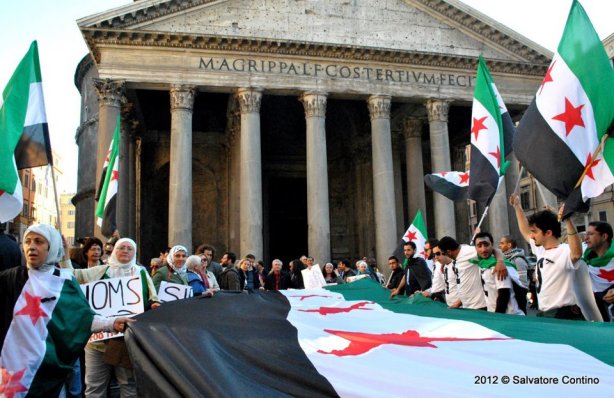
Ramadan has a social meaning, as well as the religious one, so much so that it is felt even among persons who are generally less observant, because it expresses that sense of sacrifice, surrender, purification and rebirth that gives one hope. It is a light that shines at the end of the tunnel… even when the tunnel is long and it takes months and months to get to the other side of it. Just like the tunnel from which we see emerging, with great human sacrifices and an unmatchable commitment, the Syrian people, who find themselves welcoming Ramadan, for the second consecutive year, under the bombardment of the regime. The picture above refers to last year: Sawret al karamah, the “Revolt of Dignity”, had been started at that time already for four months by a group of young protesters, who wrote in candles: “Welcome Ramadan, Get out Bashar”. Perhaps no one could have predicted such a lengthy repression, which has already exceeded sixteen months, causing more than 19 thousand victims, among them, at least 1,400 children. The most recent veto of China and Russia has left the Syrian people feeling indifferent, who by now know that the International Community will not give them any real support, the contrary is true: the halting character of the world only reinforces the murderous folly of the regime, which has made its offensive even more brutal, and one once again we are hearing talk of the use of chemical weapons.

I say “once again” because it has already been months that the doctors of Baba Amr, the long-suffering neighbourhood of the old city of Homs, have denounced the use of white phosphorus, documenting irreversible damage provoked by its use.

Even the “Neighbours”, the Arab nations that are considered as “Sisters”, are enacting a policy of indifference regarding the humanitarian tragedy that is striking the civilians, even going so far as rejecting the entrance of refugees, pushing them back and treating them inhumanely, as the humanitarian associations have been stating.

It is such a sad Ramadan, the one that is beginning, which only this Thursday, on the first night of the vigil, has been grieving the deaths of over 280 persons killed, slaughtered in various locations in the suburbs of Damascus and in the Homs Province. Many Syrians who live abroad, even here in Italy, were used to spending Ramadan with their loved ones, returning to Syria or perhaps inviting their parents or grandparents to come here. Today the repression prohibits Syrians from living that very “normality”, forcing them into atrocious suffering, wounded by the loss of relatives, friends and acquaintances, for the destruction of homes, entire neighbourhoods and yes… entire cities… and especially for the wounds caused by the indifference of the world. It might sound like a paradox, but giving strength to those Syrians outside the homeland, telling them to not give up, to smile and to trust God with even greater force, as well as to have more belief in themselves, are actually those Syrians who are living under the repression, who yesterday by means of internet found a way to give the world their greetings for Ramadan, expressing the prayer that the Ramadan of 2013-1434 will be a different Ramadan, in which the Syrians will be rebuilding everything that the regime has destroyed, finally finding the longed-for peace and freedom.

original in Italian on My Free Syria

We Want A Free Syria / Vogliamo la Siria Libera. Syrian Italians, Syrians and Italians together in the struggle for freedom. Italo-siriani, siriani ed italiani insieme nella lotta per la libertà.

A group of Syrian Italians, joined by Syrians and by Italian sympathisers for the cause of a Syria free of the dictatorial and brutal rule of the Assad regime has been communicating (and often organising actions) together in a group that meets under “Vogliamo la Siria Libera” (We Want Syria to be Free) and other internet groups. Mirco Tau asked a simple question to everyone, “Why are you against the regime?” and the answer of some of the members follows (in English and Italian).

Why we are against the regime 

* I am against this regime for the simple fact that after 40 years it has reduced the country to their own family farm where they think they are able to do things any way that suits them, depriving everyone else of their citizenship rights. I am against this regime because it’s been able to take the smiles away from children. -FS

* I am against the regime because any regime that uses violence against dissent is a sick regime. The dimensions and the tenacity of the dissent is the proof that there is no conspiracy directed by foreign agents or secret powers. It is a revolution of the people for their most basic rights. -MR

* I am against the regime for the simple reason that it is killing children, women, young people and elderly people in a systematic way, with no regard at all for human rights, the internal or international public opinion, as it lies until the bitter end, accusing the entire world of making a coalition against it with the lie of a conspiracy… It is a regime that for over 40 years has considered Syria and the Syrians as private property to manage in a personal way, subjugating civil living to the fear and terror of the secret services that control everything in the country, even personal relationships such as marriage! It is a regime that took power with blood and for 40 years has hidden behind false elections where systematically there was a 99.9% victory of false consent. A regime that has managed to weave ambiguous relationships with the rest of the Arab world and beyond… blackmailing its allies as it wishes and managing its dirty business without anyone being able to raise their voice against it… such a Nazi-Fascist regime of the sort should not exist in this day and age!  -MGN

* In addition to the violence, rape, repression, corruption, deaths… I am against the regime because a mother has been deprived of her own son for over 35 years, because he was exiled in Italy without permission to return to his homeland, for the sole reason that it is supposed that he is against the regime, a supposition that has broken up a family, caused litres of tears to run from the eyes of my grandmother and made my father live alone, alone without his parents, brothers and sisters, relatives and friends from his childhood. Alone with no one to give him comfort or help when he was in need, because only your family truly understands you and helps you in the darkest moments. Now I listen to my father (a severe and upright man) speak on the phone with a broken and trembling voice to his mother of 95, who now no longer hears or recognises anyone, repeating in the sweetest way, “mamma, do you remember me? I am your son. O mamma, forgive me and be proud of me, mamma, don’t cry and you will see that one day we will see one another again.” And she cries saying, “in paradise, my son. We’ll see each other in paradise if God so wills it.” This breaks my heart, to hear those words, but as long as I live, I will fight against this regime. -GZ

ان تطلق النار على مسلح فهذا مبرر. ان تطلق النار على مدني، فهذه جريمة. أما أن تطلق النار على المستشفيات * فهذه نازية وفاشية

Faisal Kassem wrote: I could accept the fact that you shoot at an armed revolutionary, but to shoot at a civilian is a crime and to bomb hospitals is nothing but Nazism and Fascism. -MT

* The Syrian regime has been compared to a mafia regime, but I think it is light years away from that, the mafia avoids killing women and children while the Syrian regime uses such atrocities to bring fear to the men. THERE IS NOTHING MORE DESPICABLE THAN THIS! Not even in the history books have I ever read about a regime that is comparable to the Syrian one. -IS

* I am against the regime because I am tired of hearing promises and speeches by the corrupt authorities, while they are shamelessly talking about fighting corruption. I am against the regime because I don’t want any Syrian citizen to spend his life in prison, to die from torture or to leave prison in a state of madness only because he has expressed his opinion. I am against the regime because I don’t want to see children scrounging through trash dumpsters only to find the remains of our meals, surrounded by the atrocious odour of a country where wealth is robbed every day by those who should be governing. I am against the regime because I don’t want the dream of young Syrians become exile and not travel. How sad it makes me to read in the local papers about their success in the lands of their diaspora, with the indication (of Syrian origins) only because their country gives them no possibility of expressing their talents. I am against the regime because I don’t want the young people of my nation to spend their lives studying and then leaving their degree in a drawer to go in search of a job (labourer, builder, taxi driver), while as time goes by they forget all that they have learned. I am against the regime because I want to see the plates on the scales of justice be in balance, I want to see the sick enter in the hospitals, not in slaughterhouses, because I want to see a profound reform of the system of instruction, police, the military and all the national institutions. I am against the regime because it taught us its slogans since we were children and they remained only slogans. I am against the regime because I don’t know who represents the people; I have recently discovered that one of the men in power is Mansour and I discovered it only because those who accompany him violently attacked a child, ruining his face only for a verbal discussion the child had with is youngest son. I am against the regime because it gets its help from evil persons only to protect its interests. I am against the regime because it invokes democracy, but it sets its militia against every individual who is asking for freedom. I am against the regime because I am tired of recognising the individual errors that have caused thousands of martyrs. I am against the regime because it says it fights against armed gangs and its death squads (Shabbiha) bring arms and use them brazenly against the protesters. I am against the regime because it invokes reforms and at the same time raises the rank of its corrupt affiliates and protects those who are responsible for the massacre of so many innocents. I am against the regime because it talks about conspiracies against it, as if it were doing its duty towards its people. Lastly, I am against the regime, I am against the opposition, I am against every drop of blood that a Syrian citizen shed, whatever his opinion may be. I am with the free Syrian people. -HD

* I am against the regime because its folly is not killing only the Syrian people, but it is trampling over the rights of all of humanity, and it has no pity, no mercy for anyone… There is a document that is essential as an ideal for all people to aspire to from every nation: the Universal Declaration of Human Rights. In the preamble it is written: “Whereas recognition of the inherent dignity and of the equal and inalienable rights of all members of the human family is the foundation of freedom, justice and peace in the world,

Whereas disregard and contempt for human rights have resulted in barbarous acts which have outraged the conscience of mankind, and the advent of a world in which human beings shall enjoy freedom of speech and belief and freedom from fear and want has been proclaimed as the highest aspiration of the common people,

Whereas it is essential, if man is not to be compelled to have recourse, as a last resort, to rebellion against tyranny and oppression, that human rights should be protected by the rule of law,

Whereas it is essential to promote the development of friendly relations between nations,

Whereas the peoples of the United Nations have in the Charter reaffirmed their faith in fundamental human rights, in the dignity and worth of the human person and in the equal rights of men and women and have determined to promote social progress and better standards of life in larger freedom,

Whereas Member States have pledged themselves to achieve, in co-operation with the United Nations, the promotion of universal respect for and observance of human rights and fundamental freedoms,

Whereas a common understanding of these rights and freedoms is of the greatest importance for the full realization of this pledge… for this reason I believe that the Syrian people are struggling not only for themselves but for the whole of humanity. May Allah grant them victory. – JL

* I am against the regime because I am a TRUE ANTI-FASCIST and this regime is a NAZI regime.- PP

* I am against the regime, but I have used all the words I have to express the rage I feel for the atrocities it is committing, and I am finished with all the words to express the offence regarding a world (other regimes) that in part are looking silently at the massacre, and in part is unrepentant and unpunished while they feed the bloody regime. The words are ending, but there is still Faith, and it is Faith alone that sustains me against this regime outside every “human” logic. InshAllah the change is coming soon. -TI

* I principally am against the violence and it is clear that I also must say that to make the hostilities in Syria end, a No Fly Zone is needed. Don’t call me a warmonger because I still believe that diplomacy has to be used if there are intermediaries who are able to bring that ahead and who can at the same time assure that in the meantime, all violence ceases. -AC

* Before the March 2011 revolution.

I am an Italian journalist and I have always been against the Assad regime. I have always been against the regime because every regime wants to have total control of persons and I am a free woman, I would never renounce my independence and dignity.

I have always been against the regime because it incarnates the opposite of all the values in which I believe.

I have always been against the regime because human life is sacred, and the Assad’s for 40 years, have killed women, children, the young and the old.

I have always been against the regime because the regime whoever brings its armoured tanks into the cities and shells unarmed civilians is nothing but a criminal.

I have always been against the regime because the practice of censorship negates the freedom of the word, of thought, of opinion.

After the Revolt for Dignity

I am against the regime because it is true that I am Italian, but my blood is Syrian.

I am against the regime because I have never seen my land of origin and for thirty years, could not even talk about it.

I am against the regime because I saw the Syrian border from afar, but I could not go near it.

I am against the regime because that day I felt alone in the world, without roots, without a place to call home.

I am against the regime because it robbed me of my identity.

I am against the regime because it impeded me from living a great love story, the love of one’s homeland…

I am against the regime because every time that a new martyr falls a part of me dies.

I am against the regime because for every child that cries or who shakes in fear, my heart breaks.

I am against the regime because I never have forgotten the massacre of Hama and I will never forget the massacres of Homs.

I am against the regime because I am Syrian. I am a free Syrian and I would die to defend my country. -AD

* I am against the regime because I am the son of a dissenter, brother of a martyr, cousin of two martyrs, I am a dissenter until victory. -MT

* I am against the regime because I am against every form of dictatorship, especially if it is a dictatorship tolerated by powers that take advantage of it when they could make it go down in a week. I am against the regime because I believe in the human rights that you can recognise on the streets, not in the conventions and treaties signed during gala dinners and aperitifs by people who give to themselves from these achievements, which are often completely unknown by the true subjects. I am against the regime because one cannot allow that innocents live a life of terror or that they don’t live at all only because fate made them be born in that place. I am against (all) the dictatorial regimes because there are people who continue to negate the evidence with empty rhetoric and propaganda and because there are other superficial and a-critical people who continue, incredibly, to believe them.  -MMB

perché siamo contro il regime

* Sono contro questo regime per il semplice fatto che dopo 40 anni ha ridotto il paese ad una loro fattoria familiare dove credono di potere fare e disfare come vogliono loro privando tutti dei loro diritti di cittadinanza. Sono contro questo regime perchè è riuscito a togliere il sorriso dal volto dei bimbi. -FS

* Sono contro il regime perché qualsiasi regime che utilizza la violenza contro il dissenso è un regime malato. Le dimensioni e la tenacia del dissenso è la prova che non è un complotto da registi stranieri o poteri forti. E’ un rivoluzione del popolo per i loro più basilari diritti -MR

* Sono contro il regime per il semplice motivo che sta uccidendo bambini,donne ,giovani ed anziani in modo sistematico fregandosene dei diritti umani,dell’opinione pubblica interna ed internazionale ,mentendo fino alla fine accusando l’intero mondo di coalizzarsi contro di lui con la menzogna del complotto……un regime che da più di 40 anni considera la Siria e i siriani una sua proprietà da gestire come meglio crede soggiogando la vita civile alla paura e al terrore dei servizi segreti che nel paese controllano tutto anche i rapporti personali come il matrimonio! Un regime che ha preso il potere con il sangue e che per 40 anni si è nascosto dietro a delle false elezioni dove vinceva sistematicamente con il 99.9 % di falsi consensi, un regime che è riuscito a tessere dei rapporti ambigui con il resto del mondo arabo e non …..ricattando i suoi alleati a suo piacimento e gestendo i suoi loschi affari senza che nessuno abbia mai alzato la voce…………un regime del genere nazi-fascista,oggi non deve esistere più! –MGN

* Oltre per le violenze, stupri, repressione,corruzione, morti,… io sono contro il regime perchè una madre è stata privata di suo figlio per oltre 35 anni, pechè esiliato in Italia senza il permesso di tornare nella sua terra natia, per il solo fatto che si suppone che sia contro il regime, una supposizione che ha spezzato una famiglia, fatto versare litri di lacrime a mia nonna e fatto vivere mio padre solo, solo senza genitori, fratelli, parenti e gli amici dell’infanzia, solo senza qualcuno che potesse dargli conforto e aiuto quando ne aveva bisogno, perchè solo la tua famiglia ti capisce veramente e aiuta nei momenti più difficili. Ora sento mio padre (uomo fermo e severo) parlare a telefono con voce spezzata e tremolante con sua madre di 95 anni, che ormai non sente e riconosce più nessuno, che le ripete in modo dolce «mamma mi riconosci? sono tuo figlio, o mamma perdonami e sii orgogliosa di me, mamma non piangere vedrai che ci rivedremo» e lei piangendo gli dice «nel paradiso figliolo, nel paradiso ci rivedermo se Dio vuole» mi si spezza il cuore sentire quelle parole ma io finche vivrò lotterò contro questo regime. -GZ

ان تطلق النار على مسلح فهذا مبرر. ان تطلق النار على مدني، فهذه جريمة. أما أن تطلق النار على المستشفيات * فهذه نازية وفاشية

faisal kassem ha scritto: potrei accettare il fatto che tu spari a un rivoluzionario armato ,ma sparare a un civile e un crimine e bombardare gli ospedali non e altro che nazismo e fascismo -MT

* Si era paragonato il regima siriano ad una regime mafioso,ma invece e’ lontano anni luce ,la mafia evita di uccidere bambini e le donne mentre il regime siriano usa tale atrocita’ per spaventare gli uomini PIU’ INFAMI DI COSI’ NON ESISTE !neanche nei libri di storia non ho mai letto di un regime paragonabile a quello siriano… -IS

* Prima della rivolta

Sono contro il regime perché mi sono stancato di ascoltare promesse e discorsi da parte delle autorità corrotte, mentre parlano spudoratamente di lotta alla corruzione. Sono contro il regime perché non voglio che nessun cittadino siriano passi la vita in prigione, muoia a causa della tortura o esca di prigione ormai senza senno solo perché ha espresso una sua opinione. Sono contro il regime perché non voglio vedere bambini rovistare nei cassonetti e mangiare gli avanzi dei nostri pasti circondati da un odore atroce in un Paese dove la ricchezza viene ogni giorno rubata da chi dovrebbe governare. Sono contro il regime perché non voglio che il sogno dei giovani siriani diventi l’emigrazione e non il viaggio. Così come mi rattrista leggere sui giornali locali dei loro successi nelle terre della diaspora, con l’indicazione (siriano d’origine) solo perché nel loro Paese non trovano possibilità di esprimere le proprie capacità. Sono contro il regime perché non voglio che i giovani della mia Nazione passino la vita a studiare per poi lasciare la laurea in un cassetto e andare in giro a cercare un lavoro (operaio, muratore, tassista), mentre l’avanzare del tempo fa dimenticare loro ciò che hanno imparato. Sono contro il regime perché voglio vedere le braccia della bilancia della giustizia equipararsi, voglio vedere i malati entrare in ospedale, non in macelli, perché voglio vedere una riforma profonda del sistema d’istruzione, di polizia, dell’esercito e di tutte le istituzioni nazionali. Sono contro il regime perché il regime ci ha insegnato i suoi slogan da quando eravamo piccoli e sono rimasti solo slogan. Sono contro il regime perché non so chi rappresenta il popolo; ho scoperto di recente che uno degli uomini al potere è Mansour e l’ho scoperto solo perché i suoi accompagnatori hanno deturpato il viso di un bambino per un diverbio a scuola con il minore dei suoi figli.

Dopo la rivolta

Sono contro il regime perché si fa aiutare da persone infami per tutelare i suoi interessi.

Sono contro il regime perché invoca la democrazia, ma scatena il suo esercito contro ogni individuo che chiede libertà. Sono contro il regime perché mi sono stancato di riconoscere gli errori individuali che hanno causato migliaia di martiri. Sono contro il regime perché dice di lottare contro bande armate e i suoi squadroni della morte (shabbiha) portano e usano spudoratamente le armi contro i manifestanti. Sono contro il regime perché invoca riforme e allo stesso tempo eleva di grado i suoi affiliati corrotti e protegge i responsabili del massacro di tanti innocenti. Sono contro il regime perché parla di complotto ai suoi danni, come se intanto stesse facendo il suo dovere nei confronti del suo popolo.

Infine

Sono contro il regime

Sono contro l’opposizione

Sono contro ogni goccia di sangue che versa un cittadino siriano, qualunque sia la sua opinione

Sono con popolo siriano libero. -HD

* Sono contro il regime perchè la sua follia non uccide soltanto il popolo siriano ma calpesta i diritti dell’ intera umanità, e non si pente di nulla, non ha pietà per nessuno…… C’ è un documento che è essenziale come ideale da raggiungere da tutti i popoli e da tutte le Nazioni: La Dichiarazione Universale dei Diritti dell’Uomo. Nel preambolo c’è scritto: ” Considerato che il riconoscimento della dignità inerente a tutti i membri della famiglia umana e dei loro diritti, uguali ed inalienabili, costituisce il fondamento della libertà, della giustizia e della pace nel mondo;

Considerato che il disconoscimento e il disprezzo dei diritti dell’uomo hanno portato ad atti di barbarie che offendono la coscienza dell’umanità, e che l’avvento di un mondo in cui gli esseri umani godono della libertà di parola e di credo e della libertà dal timore e dal bisogno è stato proclamato come la più alta aspirazione dell’uomo;

Considerato che è indispensabile che i diritti dell’uomo siano protetti da norme giuridiche, se si vuole evitare che l’uomo sia costretto a ricorrere, come ultima istanza, alla ribellione contro la tirannia e l’oppressione;

Considerato che è indispensabile promuovere lo sviluppo dei rapporti amichevoli tra le Nazioni;

Considerato che i popoli delle Nazioni Unite hanno riaffermato nello Statuto la loro fede nei diritti fondamentali dell’uomo, nella dignità e nel valore della persona umana, nell’eguaglianza dei diritti dell’uomo e della donna, ed hanno deciso di promuovere il progresso sociale e un migliore tenore di vita in una maggiore libertà;

Considerato che gli Stati membri si sono impegnati a perseguire, in cooperazione con le Nazioni Unite, il rispetto e l’osservanza universale dei diritti dell’uomo e delle libertà fondamentali;

Considerato che una concezione comune di questi diritti e di queste libertà è della massima importanza per la piena realizzazione di questi impegni ……. Per questo credo che il popolo siriano stia lottando non solo per sè stesso ma per l’ intera umanità. Che Allah gli dia la vittoria.  -JL

* Sono contro il regime perchè sono un ANTIFASCISTA VERO e questo regime è NAZISTA.. -PP

* Io sono contro il regime , ma ho esaurito financo le parole per esprimere la rabbia per le atrocità che questi commette , e sto esaurendo pure le parole per esprimere lo sdegno di un mondo (altri regimi) che in parte guarda silente il massacro , e in altra parte impenitente e impunito foraggia il regime sanguinario. Le parole si stanno esaurendo , ma c’è la Fede ; ed è la Fede che mi sostiene contro questo regime fuori da ogni logica “umana”. InshAllah il cambiamento è prossimo. -TI

* Io principalmente sono contro la violenza sia chiaro pero’ devo dire che per far cessare le ostilità in Siria sarebbe necessaria una no fly zone, non datemi del guerrafondaio he pero’ credo che la diplomazia si possa usare se ci sono intermediari che riescano a portarla avanti e che si assicurino che nel frattempo cessioni le violenze. -AC

* Prima della rivolta del marzo 2011

Sono una giornalista italiana e sono contro sempre stata il regime degli Assad.
Sono sempre stata contro il regime perché ogni regime vuole avere il controllo totale delle persone e io sono una donna libera, che mai rinuncerebbe alla sua indipendenza e dignità.
Sono sempre stata contro il regime perché incarna l’opposto di tutti i valori in cui credo.
Sono sempre stata contro il regime perché la vita umana è sacra e gli assad, da 40 anni, uccidono donne, bambini, giovani, anziani.
Sono sempre stata contro il regime perché chi schiera i carro armati nelle città e spara sui civili disarmati non è che un criminale.
Sono sempre stata contro il regime perché pratica la censura e nega la libertà di parola, di espressione, di opinione.

Dopo la Rivolta della dignità

Sono contro il regime perché è vero che sono italiana, ma il mio sangue è siriano.
Sono contro il regime perché non ho mai visto la mia terra d’origine e per trent’anni non ne ho mai potuto parlare.
Sono contro il regime perché un giorno ho visto da lontano il confine siriano ma non mi sono potuta avvinare.
Sono contro il regime perché quel giorno mi sono sentita sola al mondo, senza radici, senza una casa.
Sono contro il regime perché, mi ha privato della mia identità.
Sono contro il regime perché mi ha impedito di vivere un amore grande, l’amor di patria…
Sono contro il regime perché ogni volta che cade un nuovo martire muore una parte di me.
Sono contro il regime perché per ogni bambino che piange o che trema dalla paura mi si stringe il cuore.
Sono contro il regime perché non ho mai dimenticato il massacro di Hama e mai dimenticherò il massacri di Homs.
Sono contro il regime perché sono siriana, sono una siriana libera e morirei per difendere la mia patria -AD

* sono contro il regime perché:sono figlio di un oppositore,fratello,di un martire,cugino di due martiri,sono un oppositore fino alla vittoria -MT

* Sono contro il regime perché sono contro ogni forma di dittatura,peggio se si tratta di dittature tollerate da poteri che le sfruttano quando potrebbero metterci una settimana per rovesciarle. Sono contro il regime perché credo nei diritti umani che vanno riconosciuti per le strade,non nelle convenzioni e nei trattati firmati tra convenevoli e aperitivi da gente che si bea di testi di cui i veri destinatari spesso non saranno mai neanche a conoscenza. Sono contro il regime perché non si può ammettere che innocenti vivano una vita di terrore o addirittura non vivano solo perché la sorte li ha fatti nascere in quel posto. Sono contro (tutti) i regimi dittatoriali perché c’è gente che continua a negare l’evidenza con propagande vuote e retoriche e perché c’è altra gente acritica e superficiale che continua incredibilmente a crederci. -MMB
the amount of marches and number of participants has grown exponentially

WRITTEN BY ENRICO DE ANGELIS, translated by Mary Rizzo

After almost a year, let’s take a look at the fundamental moments of the revolt in Syrian, running the gamut of repression, the regime’s propaganda and “hope”. From the first protests in Damascus up to the bloody episodes of recent days.

A Syrian dissident once told me that ever since the revolts in Syria started, time passes faster than in the rest of the world. If outside, a day goes by, within the borders, it is as if a week has passed. It is hard to think that only a year ago, Syria had one of the most stable regimes in the Middle East. Its president Bashar al-Assad seemed to enjoy a consensus that the other Middle Eastern dictators, starting from Hosni Mubarak, did not have. The economic difficulties hadn’t yet reached the breaking point of tolerance as they had in Egypt. And lastly, the geopolitical position of Syria put several obstacles in front of a possible revolt. For years the Syrian regime had been the only certainty in an area that is dense with ambiguity and problems: the chaos of Iraq following the American occupation, the fragility of Lebanon with its intermittent civil wars, Israel and the occupation of Palestine. No one wanted, and in many ways no one still wants, the sudden and violent fall of the Syrian regime, not even the Western powers, starting from the United States. It is impossible to think of a “calculated” regime change, it is impossible to predict what will happen if the Assad regime, which has lasted 40 years, should fall.

All of these certainties collapsed one after the other. No one expected that the Syrian revolution could have reached such proportions and developed in this way. From a year since the start of the revolts, which began in March 2011, Syria today appears to be on the brink of a civil war. The regime’s repression of the uprising in the most recent days has reached its apex. The prolonged shelling of the city of Homs, one of the strongholds of the “rebels”, is bringing about the death of hundreds. A few days earlier, there was the failure and the withdrawal of the Arab League’s observers, after having admitted their own incapacity to put a halt to the violence. Then, the lack of reaching an agreement on the UN resolution from the Arab League initiative that asked for Bashar to step down and to start the transition process towards democracy. A resolution that, though excluding a military intervention, was blocked in no uncertain terms by the double veto of Russia and China.

Never before as today are all eyes set on the armed aspect of the revolt, that Free Syrian Army (FSA) constituted prevalently of deserters of the armed forces that since July 2011 has militarily opposed the repression. The United States, though excluding a direct armed intervention, seems to think of supporting the FSA with arms and money, with the help of Turkey, Qatar and Saudi Arabia. On the other side, Russia and Iran continue to support the regime and supply Bashar al-Assad’s militia. In essence, there are all the elements for a sort of “proxy war” with dynamics that resemble those of Vietnam in the 1960s or, to stay in the region, similar to the style of the Lebanese civil wars.

The armed revolt and the regime’s propaganda – What is unfolding before our eyes can be defined as a sort of “self-fulfilling prophecy”. The regime has insisted since the beginning that the revolt was an armed on, directed by foreign elements, fruit of an international conspiracy and underscored by ethnic reasons: Sunnis against Alawites. Even when that was evidently not the case at all. In the regime’s version, the repression of the protesters has always been presented as a fight against invisible “terrorists” and against armed gangs that were not identified in any clear way. It had been Bashar al-Assad himself, in a speech held at the People’s Council at the end of last March, to set this narrative of events, deluding a good number of Syrians who hoped at least in a partial recognition of the growing dissent in the country and in the opening towards a pacific exit strategy that at the same time seemed still to be realistic. Today, some of the elements that constitute the regime’s propaganda have become reality: it is true that the armed revolt has assumed a certain importance. It is true that foreign intervention is ever more pressing, first under the form of economic and diplomatic pressure, and perhaps from now on even under the form of military aid. It is true that even the ethnic aspects of the clashes have become more evident. The Alawites, a minority group to which the al-Assad family belongs, are almost all on the side of the regime, as well as how the able propaganda of the regime has always tried to paint the revolt as directed towards the creation of an Islamic state in which the exponents of other religious groups would find themselves emarginated or worse, persecuted. Some of the lies of the regime have transformed themselves, at least in part, into truth.

The wind of the Arab Spring – But it has not always been that way. The Syrian revolt started spontaneously and it is still prevalently an authentic revolt, brought forward by the Syrian citizens without the help of anyone. The requests of the protesters are for the most part extraneous to a religious discourse: they are asking for freedom, democracy, social justice. And, despite everything, the peaceful protesters continue to build the true motor of the revolt. Everything had its start in Tunisia and Egypt. The Syrian revolt would probably never have taken place without the precedent Arab Springs. The domino effect in this case is striking. When the so-called Arab Spring began in North Africa, something in Syria had shaken. Small events, but taken all together make up a definite change in the environment. When I was in Damascus, in the winter of 2010, the transformation was evident. It was enough to look at the debates that were flooding the information sites in that period: there were discussions on the news of the uprisings against Mubarak and Ben Ali, and it is simple to pass from these arguments to the situation in Syria. One almost does not even notice it happening. In substance, the problems are and remain the same in all the Arab countries: corruption, growing gap between the rich and the poor, daily humiliation, lack of freedom, an economy that is on the decline in a way that is seemingly unstoppable. One talks of Egypt and Tunisia, and in reality, one is talking of Syria.

The phenomenon doesn’t concern only Internet. Even outside of the web, the atmosphere is visibly changing. The traditional remissive and apolitical nature that has always characterised the population seems to be crumbling. Acts of bullying and arrogance that were once tolerated by perseverance are now met with a growing impatience. In February the first marches were organised, in front of the Egyptian and Libyan embassies, to express solidarity with the Arab Spring. Then something that until only a few months before had been unthinkable: dozens of persons took to the streets of Damascus to protest against the violence of a policeman against the child of a shopkeeper. The protesters shouted, “the Syrian people will not be humiliated,” which successively became one of the most widespread slogans in the protests to follow. Damascus was thus the first city to move, something that today might seem incredible.

On 15 March, a group of youth gathered together at the suq (market) of Hamidiya: it was the first time that films that had been made using mobile phones had been put onto Internet. Al Jazeera, the pan-Arab network of Qatar, one of the Arab world’s most widespread channels, immediately began to transmit them, also allowing those who did not have an Internet connection to know what was going on. On 16 March, the relatives of some political prisoners gathered in front of the Ministry of the Interior. The security forces intervened with violence, beating the protesters and arresting dozens of them.  Small groups of protesters continued to take to the streets, but this was still a limited phenomenon. Until that moment, the only ones to make a move had been the “civil society” of Damascus: a middle-to-upper class of intellectuals and youth who were working in the cultural field, in journalism, civil organisations and human rights groups.

participation spans all ages

The dynamics of the protests had changed in those very days. In the small city of Dera’a, in southern Syria, a group of children with spray paint wrote some slogans against the regime on a wall. The emulation of the Egyptian revolt was quite clear: the writing was imitating the anti-Mubarak slogans used by the young Egyptians of the 25 January movement. The children copied them directly from the reports on Al Jazeera. The reaction of the regime was immediate: the children were arrested. The next day their parents and the families of the children took to the streets to protest, encouraged by that same atmosphere that had materialised a few days earlier in Damascus. The security forces intervened, shooting: there were the first deaths. The funerals became the occasion for even larger protests, and the repression was growing more and more ferocious. The nearby villages ran in support of Dera’a. The protesters numbered in the thousands. The Syrian revolt had begun.

The evolution of the revolt – From Damascus, the uprising moved to the provinces, and from the elite, it was substituted by the lower-middle class. This takes into consideration very often those same sectors of the population which initially constituted the pillars of the support to the regime: farmers, labourers, office workers and shopkeepers who in the last fifteen years had been abandoned and penalised by the liberalisation reforms. They were the ones who most strongly felt the effects of growing corruption in the circles of power that gravitated around the regime and of the progressive cuts in state aid. Other cities and regions progressively joined the protests: Banyas, Nawa, Homs, Latakia, Idlib, Qamishli, Hama and many others. At the start, the protests were born from various, localised needs: each region has its own requests and its own complaints regarding the regime. Especially, at the start, it was not asked for Bashar al-Assad to step down: the slogans demanded the end of corruption, reforms, more freedom.

It’s been the ferocious repression of the regime to give unity to this fragmented chain of uprisings. And, it is the repression of the regime to radicalise the requests of the protesters. As they gradually saw their death toll rise in the dozens, and then in the hundreds of protesters, the legitimacy of the president had progressively crumbled, and the marches became an open revolt against Bashar al-Assad and his regime. It has been a peaceful uprising: no one at the start thought of using arms against the army and the security forces. The control of the military by the regime is total, almost all of the officers are Alawites and their loyalty is absolute.

But even this story started to change: someone started to take weapons as a vendetta, then the first individual desertions took place as well as the formation of armed anti-regime groups. The prophecy of the regime became reality as civil war seems to get nearer, even if it is still avoidable. But looking at the current situation, one should not forget how the revolt began, and who is responsible for its degeneration.
continua su: http://www.fanpage.it/siria-ricostruire-le-origini-della-rivolta-quasi-un-anno-dopo/#ixzz1lzbH7FK4
http://www.fanpage.it


Siria: ricostruire le origini della rivolta quasi un anno dopo

A quasi un anno di distanza, ripercorriamo le tappe fondamentali della rivolta in Siria, tra repressione, propaganda di regime e “speranza”. Dalle prime manifestazioni a Damasco fino ai cruenti episodi degli ultimi giorni.

Un dissidente siriano una volta mi ha detto che da quando le rivolte sono cominciate in Siria il tempo passa più velocemente che nel resto del mondo. Se al di fuori è passato un giorno, all’interno dei confini è come se fosse passata una settimana. È difficile pensare che un anno fa quello siriano fosse uno dei regimi più stabili del Medio Oriente. Il presidente Bashar al-Assad sembrava godere di un consenso che altri dittatori mediorientali, a cominciare da Hosni Mubarak, non avevano. Il disagio economico non aveva ancora raggiunto il limite massimo di sopportazione come in Egitto. E infine, la posizione geopolitica della Siria poneva più di un ostacolo a una possibile rivolta. Per anni il regime siriano aveva costituito la sola certezza in un’area percorsa di incognite e problemi: il caos dell’Iraq dopo l’occupazione americana, la fragilità del Libano con le sue intermittenti guerre civili, Israele e l’occupazione della Palestina. Nessuno voleva, e per molti versi nessuno ancora vuole, una caduta improvvisa e violenta del regime siriano, neanche tra le potenze occidentali, a cominciare dagli Stati Uniti. Impossibile pensare a un passaggio di regime “calcolato”, impossibile prevedere cosa succederebbe se il regime quarantennale regime degli Assad dovesse crollare.

Queste certezze sono crollate una a una. Nessuno si aspettava che la rivoluzione siriana potesse raggiungere simili proporzioni e svilupparsi in questo modo. A un anno dallo scoppio delle rivolte, cominciate nel Marzo del 2011, la Siria appare oggi sull’orlo di una guerra civile. La repressione del regime nei confronti dell’insurrezione in questi ultimi giorni ha raggiunto il suo apice. Il bombardamento prolungato della città di Homs, una delle roccaforti dei “ribelli”, sta mietendo centinaia di vittime. Pochi giorni prima, l’insuccesso e il ritiro degli osservatori della Lega araba, dopo aver ammesso la propria incapacità ad arginare le violenze. Poi il mancato accordo per una risoluzione ONU su iniziativa della Lega araba che chiedeva le dimissioni di Bashar al-Assad e l’inizio di un processo di transizione verso la democrazia. Risoluzione che, pur escludendo l’intervento armato, viene bloccata senza mezzi termini dal doppio veto di Russia e Cina.

Mai come oggi gli occhi sono puntati sul lato armato della rivolta, quell’esercito siriano libero (ESL) costituito prevalentemente di disertori dell’esercito regolare che dal luglio 2011 si oppongono militarmente alla repressione. Gli Stati Uniti, pur escludendo un intervento armato diretto, pare comincino a pensare di sostenere l’ESL con armi e finanziamenti, con l’aiuto di Turchia, Qatar e Arabia Saudita. Dall’altra parte, Russia e Iran continuano a sostenere il regime e a rifornire le armate di Bashar al-Assad. Insomma si sta profilando una sorta di “guerra per procura”, con dinamiche simili a quella del Vietnam negli anni sessanta o, per restare nel Vicino Oriente, sullo stile delle guerre civili in Libano.

La rivolta armata e la propaganda del regime – Quella che oggi si dispiega sotto i nostri occhi ha l’aria di una “profezia che si autoadempie”. Il regime ha sostenuto fin dall’inizio che la rivolta fosse armata, pilotata da elementi stranieri, frutto di un complotto internazionale e mossa da ragioni etniche: sunniti contro alawiti. Anche quando evidentemente non era così. Nella versione del regime, la repressione contro i manifestanti è sempre stata presentata come una lotta a degli invisibili “terroristi” e a non ben identificate bande armate. È stato lo stesso Bashar al-Assad, in un discorso tenuto al Consiglio del Popolo alla fine del marzo scorso, a fissare questa narrazione degli eventi, deludendo non pochi siriani che speravano almeno in un parziale riconoscimento del dissenso crescente nel paese e nell’apertura verso una via d’uscita pacifica che al tempo appariva ancora realistica. Oggi alcuni degli elementi che costituiscono la propaganda del regime sono divenuti realtà: è vero che la rivolta armata ha assunto un peso importante. È vero che l’intervento straniero è sempre più pressante, prima sotto forma di pressioni economiche e diplomatiche e forse da ora in poi anche sotto forma di aiuti militari. È vero anche che gli aspetti etnici dello scontro sono divenuti più evidenti. Gli alawiti, gruppo minoritario cui appartiene la famiglia di Bashar al-Assad, si sono quasi tutti schierati dalla sua parte, anche come risultato dell’abile propaganda del regime che ha sempre dipinto la rivolta come diretta alla creazione di uno stato islamico al cui interno gli esponenti di altre confessioni religiose sarebbero marginalizzati o, peggio, perseguitati. Alcune delle bugie del regime si sono trasformate in, almeno parziali, verità.

Il vento della Primavera araba – Ma non è sempre stato così. La rivolta siriana è iniziata spontaneamente ed è ancora prevalentemente una rivolta autentica, portata avanti da cittadini siriani senza l’aiuto di nessuno. Le richieste dei manifestanti sono per lo più estranee a discorsi di tipo religioso: si chiedono libertà, democrazia, giustizia sociale. E, nonostante tutto, i manifestanti pacifici continuano a costituire il vero motore della rivolta. Tutto ha avuto in inizio in Tunisia ed Egitto. La rivolta siriana non sarebbe probabilmente mai avvenuta senza le precedenti Primavere Arabe. L’effetto domino in questo caso è lampante. Quando la cosiddetta Primavera Araba è cominciata nel Nord Africa, in Siria scatta qualcosa. Piccoli dettagli, ma che insieme disegnano un deciso cambio d’atmosfera. Quando ero a Damasco, nell’inverno del 2010, la trasformazione era evidente. È sufficiente guardare ai dibattiti che affollano i siti d’informazione in quel periodo: si commentano le notizie sulle insurrezioni contro Mubarak e Ben Ali, ed è facile passare da questi argomenti alla situazione in Siria. Quasi non te ne accorgi. In fondo i problemi sono e restano gli stessi in tutti i paesi arabi: corruzione, crescente differenza tra ricchi e poveri, umiliazioni quotidiane, mancanza di libertà, un’economia che declina apparentemente in modo inarrestabile. Si parla di Egitto e Tunisia, e in realtà si parla di Siria.

Il fenomeno non riguarda solo internet. Anche al di fuori della rete l’atmosfera sta visibilmente cambiando. La tradizionale remissività e apoliticità che ha sempre caratterizzato la popolazione sembra cominciare a sbriciolarsi. Atti di bullismo e prepotenza che prima erano tollerati a testa bassa sono ora accolti con crescente insofferenza. A febbraio vengono organizzate le prime manifestazioni, davanti alle ambasciate egiziana e libica, per esprimere solidarietà alla Primavera Araba. Poi è accaduto qualcosa che era impensabile fino a qualche mese prima: decine di persone a Damasco scendono in piazza a protestare contro la violenza di un poliziotto nei confronti del figlio di un negoziante. I manifestanti gridano “il popolo siriano non sarà umiliato”, che successivamente diverrà uno degli slogan più diffusi nelle proteste successive. Damasco è quindi la prima a muoversi, cosa che oggi può sembrare incredibile. Il 15 marzo gruppi di giovani si riuniscono al suq (mercato) Hamidiya: è la prima volta che vengono girati e sono diffusi in rete i filmati realizzati con telefoni cellulari. Al-Jazeera, la rete pan-araba del Qatar, uno dei canali più visti del mondo arabo, comincia immediatamente a trasmetterli, permettendo anche a chi non ha una connessione internet di sapere cosa sta succedendo. Il 16 marzo i parenti di alcuni prigionieri politici si riuniscono di fronte al ministero dell’interno. Le forze di sicurezza intervengono duramente, colpendo con forza i manifestanti e arrestandoli a decine. Piccoli gruppi di oppositori continuano a scendere in piazza, ma si tratta di un fenomeno ancora limitato. Finora a muoversi è stata unicamente la “società civile” damascena: una classe medio-alta di intellettuali e giovani che lavorano nel campo della cultura come giornali, organizzazioni civili, gruppi di diritti umani.

La dinamica delle proteste è cambiata in quegli stessi giorni. Nella piccola città di Deraa, nel sud del paese, un gruppo di bambini muniti di bombolette spray scrive sui muri slogan contro il regime. L’emulazione della rivolta egiziana è fin troppo chiara: le scritte sono copiate da slogan anti-Mubarak usati dai giovani egiziani del 25 gennaio. I bambini le hanno copiate direttamente dai report di Al-Jazeera. La reazione del regime è immediata: i bambini vengono arrestati. Il giorno successivo i genitori e le famiglie dei bambini scendono in piazza a protestare, incoraggiati da quella stessa atmosfera che si era materializzata qualche giorno prima a Damasco. Le forze di sicurezza intervengono, sparando: ci sono i primi morti. I funerali divengono occasione per manifestazioni ancora più ampie, e una repressione ancora più feroce. I villaggi vicini corrono a sostegno di Deraa. I manifestanti si contano a migliaia. È cominciata la rivolta siriana.

L’evoluzione della rivolta – Da Damasco l’insurrezione si sposta alla provincia, e alle elite si sostituiscono ceti medio-bassi. Si tratta molto spesso di quegli stessi settori della popolazione che prima costituivano il pilastro di sostegno del regime: contadini, operai, impiegati e piccoli commercianti che negli ultimi quindici anni sono stati abbandonati e penalizzati dalle riforme di liberalizzazione. Sono loro che hanno maggiormente risentito della crescente corruzione dei circoli di potere che gravitano intorno al regime e del taglio progressivo degli aiuti statali. Altre città e regioni si uniscono progressivamente alle proteste: Banyas, Nawa, Homs, Latakia, Idlib, Qamishli, Hama e tante altre. All’inizio le proteste nascono da esigenze diverse, localizzate: ogni regione ha le proprie richieste e le proprie lamentele contro il regime. Soprattutto, all’inizio non si chiede la caduta di Bashar al-Assad: gli slogan domandano la fine della corruzione, riforme, più libertà.

È la repressione feroce del regime a dare unitarietà a questa catena frammentata di sollevamenti. Ed è la repressione del regime a radicalizzare le richieste dei manifestanti. Man mano che i morti arrivano a decine, poi centinaia di manifestanti, la legittimità del presidente si sgretola progressivamente, e le manifestazioni divengono un’aperta rivolta contro Bashar al-Assad e il suo regime. Si tratta di un’insurrezione pacifica: nessuno all’inizio pensa di poter usare le armi contro l’esercito e le forze di sicurezza. Il controllo dell’esercito da parte del regime è totale, quasi tutti gli ufficiali sono alawiti e di fedeltà assoluta.

Ma anche questa storia comincia a cambiare: qualcuno comincia a prendere le armi per vendetta, cominciano le prime diserzioni individuali e la formazione di gruppi armati anti-regime. La profezia del regime diviene realtà e la guerra civile sembra avvicinarsi, anche se è ancora evitabile. Ma nel guardare la situazione attuale non bisogna dimenticare mai come la rivolta è cominciata e di chi è la responsabilità della sua parziale degenerazione.

Leggi anche:

continua su: http://www.fanpage.it/siria-ricostruire-le-origini-della-rivolta-quasi-un-anno-dopo/#ixzz1lzbH7FK4
http://www.fanpage.it

Fahmi Huwaidi

TRADOTTO dall’inglese da Luca Urbinati

Dobbiamo delle scuse al popolo Siriano per ogni giorno che furono macellati prima che i nostri occhi (potessero vedere) durante i passati undici mesi. I popoli Arabi li hanno delusi ed hanno guardato dai bordi come se “il cuore dell’Arabismo” è divenuto circondato da Arabi senza cuori.

Da Venerdì 3 a Venerdì 10 Febbraio, 755 Siriani furono uccisi, e dall’inizio della leggendaria Intifada a metà Marzo lo scorso anno, il regime di Assad ha ucciso 8.000 persone. Altri 10.000 sono scomparsi e le prigioni Siriane sono riempite da numeri incalcolabili. L’unico crimine che queste persone hanno commesso è di domandare dignità e libertà per il loro Paese, dopo quasi 45 anni di tirannide ed oppressione.

Durante i mesi scorsi, non abbiamo visto nulla della Syria ma un Paese macerato dal sangue del proprio popolo. Le sue strade traboccano di precessione funerarie delle vittime, e le sue città sono minacciate di devastazione e distruzione al suono delle voci che chiedono libertà. L’unica cosa ad essere udita è il ronzio dei missili e bombardieri; l’angoscia di coloro intrappolati che chiedono la fine dei massacri, le urla di coloro che insistono a rovesciare il regime, ed i sostenitori per ogni Arabo od intervento internazionale che possa frenare i nuovi attacchi Tartari (Huns).

Questo crimine, che è stato in corso per gli undici mesi passati, ha mosso duramente ognuno nel mondo Arabo dove la maggioranza pensa che sia sufficiente seguire gli eventi in televisione, come fanno con ogni soap opera Turca!

Ironicamente, il mondo Arabo e Musulmano si scosse con rabbia quando Salman Rushdie ha pubblicato i “Versi Satanici”, ed ugualmente quando un quotidiano Danese ha pubblicato dei cartoni del Profeta Muhammad (Maometto) (pace su di Lui), ma poco importa riguardo il massacro in corso contro il popolo Siriano.

E mentre capisco la legittimità nell’esprime rabbia quando una violazione viene commessa contro le sacre scritture, io sono sorpreso al caso contrario in difesa della dignità dei Musulmani. Questo, in parte, mostra l’estensione dello squilibrio nei prevalenti concetti che separano fra la dotrrina e la dignità di una persona. Questo confina gelosia e protezione al primo ma non si estende al secondo. Questo, mentre si conosce che le dottrine sono protette da Dio, mentre la violazione della santità del popolo e la loro dignità rappresentano un attacco ad uno dei diritti di Dio che richiede vigilanza, condanna e chiama a stringersi intorno e punire l’oppressore.

Se qualcuno dovesse dire che la Lega Araba ha intrapreso iniziative, ha iniviato controllori ed è andata al Concilio di Sicurezza allo scopo di guadagnare un po’ di influenza nei confronti del regime di Damasco, io non sarei in disaccordo. Tuttavia, la Lega Araba rappresenta i governi e non il popolo. Gli osservatori sono andati in Siria, e sono tornati indietro non avendo fatto nulla che possa cambiare l’equazione. Invece, il regime di Assad ha capitalizzato nella loro missione per guadagnare tempo allo scopo di terminare la soppressione delle manifestazioni.

Con riguardo al Concilio di Sicurezza, questo approccio è stato abortito dai Russi e Cinesi usando il loro veto. Non ci sono più iniziative capaci di risolvere questo problema internazionalmente eccetto per la conferenza di Amici della Siria sollecitata dalla Francia, ed una conferenza parallela sollecitata della Turchia. I più importanti sviluppi ufficiali che hanno preso posto nel livello Arabo sono stati il ritiro della Missione dell’Osservatore, l’espulsione degli ambasciatori Siriani dalla Tunisia e dai Paesi del Concilio di Cooperazione del Golfo (GCC), e la ricognizione della Libia da parte dei Concilio Nazionale rappresentante la rivoluzione Siriana.

Nel caso della Libia, era chiaro che la caduta di Gheddafi si è verificata per l’intervento della NATO. Questo è stato ripetuto nello Yemen dal lancio dell’Iniziativa del Golfo con chiaro supporto Occidentale, e dove il Presidente Ali Abdullah Saleh non ha avuto scelta se non lasciare alla fine. Nel caso della Siria, le cose sono più complesse alla luce dell’impossibilità dell’intervento internazionale, l’impossibilità della riconciliazione fra il popolo ed il regime dopo tutto il sangue che è stato versato, l’intrattabilità dell’azione militare interna, e la fragilità della pressione Araba. Ciò significa tre cose: in primo luogo, che il regime Siriano è ancora relativamente coerente e può andare avanti a meno che ci sia una sorpresa inaspettata. In secondo luogo, che nell’attuale clima Arabo ed internazionale, sembra che il popolo Siriano sia destinato a combattere la propria battaglia da solo. Ed in terzo luogo, che questa battaglia sarà estesa, che la sofferenza del popolo continuerà e con questa, il pedaggio dei sacrifici ed il dolore aumenteranno.

Raccogliendo forza attraverso i fattori interni così come attraverso il supporto regionale ed internazionale, il regime Siriano è a suo agio nel trattare con il popolo Siriano nel modo in cui vuole, ed è riluttante nel fare un passo indietro. Quindi, tutti i suoi slogans di cambiamento e parlare di dialogo nazionale e riforma politica sono senza senso, e non vengono più prese seriamente. E’ divenuto chiaro a tutti che sono scuse per guadagnare tempo.

Internamente, il regime Siriano dipende dalla sua forte presa di sicurezza, e dal supporto di gran parte del segmento della minorità Alawita che il regime utilizza come spaventapasseri non solo per spaventare il popolo con la probabilità di una guerra civile, ma anche per spaventare il vicino della Siria, la Turchia, che ha più di dieci milioni di cittadini Alawiti. Il regime Siriano utilizza la carta della minoranza etnica e religiosa non soltanto per spaventare gli altri delle sue alternative, ma anche per sfidare ed intimidire i suoi vicini.

Nella faccia della pressione Turca, ad esempio, si agitano entrambe le carte gli Alawiti ed i Kurdi. Sebbene i Kurdi della Siria sono 200.000, maggiormente nella provincia di Qamishli, nel nord della Turchia, ci sono più di 12 milioni di Kurdi ed il loro conflitto con Ankara ha una lunga storia.

Il regime ottiene forza anche attraverso l’esteso supporto Iraniano che è accompagnato dal supporto Iracheno e dal supporto degli Hezbollah in Libano.

E’ risaputo che c’è un’alleanza strategica fra Siria ed Iran ove Teheran fa affidamento sul regime di Assad, e non sul popolo Siriano, e che la coalizione protegge i due Paesi, da un grado od un altro, di fronte alla minaccia Israeliana. Comunque, anche l’Iran ha i suoi motivi religiosi. Esso rafforzerebbe la posizione della setta Alawita più vicina agli Sciiti in Siria, e rafforza la posizione degli Hezbollah in Libano. Il cambio del regime a Damasco non soltanto pone questa equazione a favore dei Sunniti in Siria, minaccia anche il cambio della situazione in Iraq, in quanto rafforza i Sunniti là di fronte ai dominanti partiti Sciiti fedeli all’Iran.

La conclusione è che il regime Siriano, nella sua resistenza ad ogni cambio politico, deriva forza da diverse carte che tiene in mano e si riscalda contro l’alterare l’equilibrio delle forze regionali. Il messaggio che il regime di Assad desidera inviare ad ognuno è che se è cattivo, ciò che comunque può venire dopo la sua morte sarebbe molto peggio.

Come per l’arena internazionale, il regime Siriano sta contando sul supporto di Russia e Cina, come è stato visto nel veto utilizzato dai due Paesi nel Conciglio di Sicurezza. Ciò che spinge i due Paesi ad attuare questa presa di posizione è che essi sono contro l’incremento dell’influenza Americana nella Regione. Essi hanno detto esplicitamente che i Paesi Occidentali li hanno “ingannati” quando hanno deciso di non opporsi all’imposizione dell’embargo aereo in Libia. Là, la NATO divenne impegnata nelle operazioni militari, e Russia e Cina furono ignorate – uno scenario che loro non vogliono veder ripetersi. In aggiunta, la Russia ha relazioni speciali con Damasco in quanto ha una base di servizio militare al porto di Tartus, e tutte le armi Siriane vengono acquistate da Mosca. Come per la Cina, è delicato appoggiare ogni cambiamento democratico attraverso il Concilio di Sicurezza e non vuole che il Concilio di Sicurezza inferferisca negli affari interni di ogni Paese in quanto ciò potrebbe ritorcersi contro Pechino ed aprire un numero di files interni, causando imbarazzo.

Ciò che è così rimasto lontanamente assente dalla scena è la pressione dei popoli Arabi, specialmente da un Paese come l’Egitto, il quale si supponeva avrebbe preso l’iniziativa e che ognuno tratta come una “grande sorella”. La domanda è, perché tutto questo sangue versato  in Siria non ha causato reazioni nelle strade Arabe in generale, e particolarmente in Egitto? Ci sono vari fattori che hanno contribuito a questa assenza, inclusi i seguenti:

Da quando l’Egitto ha firmato il suo trattato di Pace con Istraele nel 1979, praticamente ha abdicato il suo ruolo di comando, ed è caduto in un coma a lungo termine che continua a persistere. Durante questo trance, non lo ha tenuto solo per lui, ma ha pure aderito alla campagna dei cosiddetti “moderati” che praticamente si risolvono nell’orbita delle politiche Americane. Uno può soltanto immaginare la eco in tutto il mondo Arabo che hanno portato le azioni della “grande sorella”.

L’atmosfera della Primavera Araba ha sopraffatto vari Paesi e li ha resi occupati dai loro affari interni. Il ribaltamento dei regimi richiede un grande sforzo dato che altri nuovi devono essere stabiliti il che, distoglie l’attenzione da altri eventi importanti che prendono posto nell’arena Araba.

Alcune delle élites ricordano ancora la posizione del regime Siriano a supporto della resistenza palestinese. Loro considerano questa posizione positiva come uno che assolve l’errore, e sono sospettosi dei membri dell’opposizione Siriana.

Il file Siriano è molto più complicato di quanto molti percepiscono che sia. Non c’è disaccordo che il regime a Damasco è dominato da una manciata di cattivi ragazzi, ma che le forze esterne che cercano di rovesciarlo sono anch’esse guidate da una lunga linea di cattivi ragazzi anche – una materia che sgretola parecchi che stanno ora pesando preferenze fra il male che conoscono e quello che non conoscono.

L’internazionalizzazione del problema è divenuta sospetta dopo l’esperienza della NATO in Libia. La situazione che stiamo trattando ora è più difficile, perché la Libia ha solamente ricchezza di petrolio, mentre la Siria è unita ad una nuova mappa dell’Est, e forse tutto il Medio Oriente se teniamo conto dell’impatto della caduta del regime Siriano in Iran e Turchia.

Cosa fare poi? La mia risposta è che dovremmo gridare pazzamente dicendo NO al continuo dei massacri, e NO all’intervento della NATO. Considerato questo, non abbiamo scelta se non renderci conto che il collasso del regime di Assad si frappone fra di noi ed aspettando una soluzione Araba che può applicare pressione per fermare i massacri e spedire l’autorità al popolo Siriano.

Sembra che non ci sia altra scelta prima di noi se non affidarsi ai popoli Arabi, che si sono finalmente svegliati ed hanno aumentato le loro voci che furono per così tanto tempo oscurate dai regimi autoritari. Abbiamo recentemente sentito le voci di quei popoli nelle manifestazioni in Tunisia, Libia e Mauritania. Fin quando non si sente la voce del resto dei popoli Arabi, particolarmente del popolo dell’Egitto, dobbiamo offrire le scuse al popolo Siriano per averli delusi ed aver omesso di dichiarargli solidarietà. Se loro non ci perdonano o non accettano le nostre scuse, allora sono scusati. Io non sono autorizzato ad offrire delle scuse, ma io la offro a nome mio sentendo un alto grado di tristezza e vergogna.

*L’autore è uno scrittore Egiziano. Questo articolo è una traduzione dall’Arabo che è apparso su al Jazeera net  il 14/02/2012

Originale su http://www.middleeastmonitor.org.uk/articles/middle-east/3441-an-apology-to-the-syrian-people

detainment as a way to prevent freedom of speech

Dear friends,
As you might have heard, the office in which I work at was raided by Air Force security branch on Thursday 16-2-2012. My boss, friend and mentor, Mazen Darwich, along with 8 male colleagues and friends, are still in detention since that day at air  force security branch, known to be the worst security branch in Syria.

I spent only 3 nights there along with five other female colleagues, those three nights were the longest hours of my life. You know that I was detained previously for two weeks, which was my first experience with detention, but those 3 nights at air security branch were the worst in comparison to my previous detention.

Below is SCM statement with regards to the raid and the arrest of our male colleagues, please share it with whomever you think might be helpful in getting the word out around the world.

Raid of Syrian Center for Media and Freedom of Expression office in Damascus, Arrest of its Staff and Visitors
In a new escalation against freedom of expression and media work in Syria, the Office of the Syrian Center for Media and Freedom of Expression (SCM) in Damascus was raided on Thursday 16 February at approximately one and a half PM by agents of the Air Intelligence Intelligence (Mazzeh branch). The raid, that was carried out by members of the security apparatus along with a group of armed men, who caused panic and fear among employees and visitors of the center, especially since the officer in charge did not disclose the arrest or search warrants that are supposed to be issued by a public prosecutor.

The security forces took the IDs of SCM employees and visitors in addition to their mobile phones. They were prevented from proceeding their work and were asked to gather in one room until 4 PM; they were transferred to the Air force Intelligence detention center of Mazzeh then.

Following are the names of staff and administrators who have been arrested that day:
1 – Mazen Darwish, director of the Syrian Center for Media and Freedom of expression.
2 – Yara Badr, Syrian journalist and the wife of Mazen Darwish.
3 – Hani Zitani, a graduate of the Faculty of Engineering and the Faculty of Sociology and university teacher.
4 – Sana Zitani, a graduate of the Faculty of Sociology and wife Hani Zitani.
5 – Abdel Rahman Hamada, student at the Institute of Accounting.
6 – Hussein Gharir, graduate at the Faculty of Information Engineering.
7 – Mansour Al Omari, English literature graduate from Damascus University.
8 – Joan Fersso, a graduate of the Faculty of Arabic literature.
9 – Mayada Khalil, graduate at the University of archaeology in Aleppo.
10 – Ayham Ghazoul, a dentist.
11 – Bassam Al-Ahmed, a graduate of the Faculty of Arabic literature.
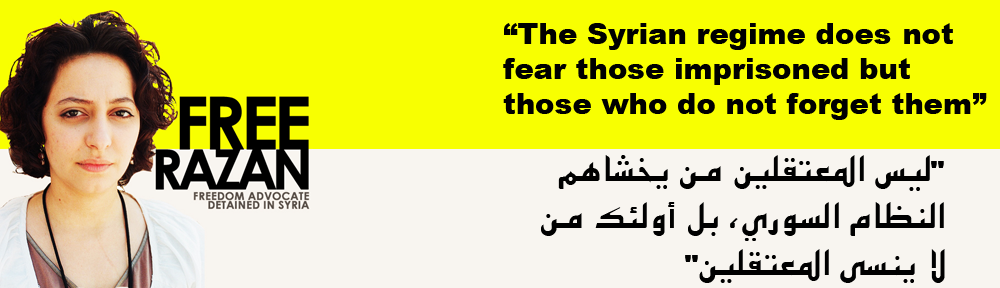
12 – Razan Ghazzawi, a graduate in English literature.
13 – Rita Dayoub.
Two visitors were also arrested; Shady Yazbek (student in medicine) and Hanadi Zahlout.

Female employees working at the center were released on Saturday 18 Feb 2012 around 10 PM (Yara Badr – Sanaa Mohsen – Mayada Khalil – Razan Ghazzawi) in addition to the visitor Hanadi Zahlout on one condition that at they are to show up at Air force Security every day from 9AM to 2PM for further investigation until unspecified date. Rita Dayoub was released.

The arrest of the President of the SCM, “Mazen Darwish,” and male colleagues and visitor, however, continues: Hani Zitani – Abdel Rahman Hamada – Hussein Ghrer – Mansur Al Omari – Bassam Al-Ahmad -Ayham Ghazoul – Joan Fersso, and the visitor Shady Yazbek are still in custody.

The Syrian Center for Media and Freedom of Expression strongly condemns the raid conducted against its office as well as the ongoing arbitrary detention of the journalist Mazen Darwish and its staff. SCM expresses its deepest concern regarding the fate of persons remaining in detention, demands the Syrian authorities to release all detainees immediately and unconditionally, and holds the Syrian authorities fully responsible of the psychological and physical conditions of the detainees.

The center calls upon the Syrian authorities to put an end to arbitrary arrests and harassment of journalists, media workers and freedom of opinion and expression advocates.

Finally, the Syrian Center for Media and Freedom of Expression expresses its gratitude to all institutions and individuals who have expressed solidarity with the Syrian Center for Media and Freedom of Expression against such oppressive policies.
— Best, Razan

Dr. Mohamed Nour Dachan

Interview with Doctor Mohamed Nour Dachan, Italian delegate of the Syrian Coalition of Support to the Syrian Revolution

 by Giovanni Sarubbi, translated by Mary Rizzo

Doctor Mohamed Nour Dachan is the Italian delegate of the Syrian Coalition of Support to the Syrian Revolution. Born in Aleppo, Syria 65 years ago, he has been living in Italy for 45 years. Doctor of Medicine and Surgery, he has various specialisations and works as a family doctor. Currently he is the President Emeritus of the Union of Islamic Communities of Italy (UCOII) of which he is among the founders, and of which he was the acting President until two years ago. Recently he participated in the meeting of the Syrian National Council with the Italian Foreign Affairs Minister Giulio Maria Terzi di Sant’Agata. The Syrian National Council has promoted a national protest in Rome to be held on the date of 19 February, which has as its slogan “Let us stop the massacre of the innocents”. He has accepted to answer our questions regarding the Syrian situation, and for this, we are grateful. In his words, one can feel the suffering of who, still very young, was forced to leave his own country, bringing him to firmly oppose the Assad government. But, and this should be stressed, it is also an appeal to not leave anything untried for a peaceful solution, without arms or war, to the Syrian crisis. It is a hypothesis on which he works intensively. Following is the text of the interview.

Giovanni Sarubbi (GS): Doctor Dachan, you have been living for many years in Italy, and you have become a member of the Syrian National Council. Can you kindly explain to us the reasons for your choice and describe what forces comprise such Council?

Dr. Mohamed Nour Dachan (MND): To become a member of the SNC is not a novelty for me, seeing that for many years I have chosen freedom and democracy and that during these years I have fought against dictatorships and injustice and for this reason, I could not hesitate to give my contribution to my country of origin.

The SNC joins together very many components of the Syrian opposition, an opposition that has a wide variety of elements, given that there has been over 40 years of dictatorship which has slowly but surely allowed the birth of one opposition group after the other. The advantage of the SNC is that it has the largest opposition groups taking part in it: religious, secular and liberal ones.

GS: What do you propose to do, what is your programme and by the means of what initiatives and instruments do you plan on realising your goals?

MND: The programme is to support the peaceful revolution of the Syrian people, to work and raise awareness to all the world’s countries so that they help us to obtain the fall of the Syrian regime.

GS: What relationship do you have with the Free Syrian Army?

MND: There has to be some clarification regarding the name: it is called Free Syrian Army, which means that they are soldiers, officers and non-commissioned officers who have chosen to refuse shooting at unarmed civilians and it is not an offensive army that is at war, but it has exclusively the task of defending the protests.

It is constituted of a bilateral commission which has started its collaboration between the SNC and the Free Army.

GS: The Syrian National Council has been recognised at an international level by some countries such as France and the USA. What relationships have you got with these countries? Don’t you believe that this support could harm your cause and the liberation of your people from oppression?

MND: The SNC has not yet been recognised by any country, but there have been meetings with several countries, both Arab-Islamic and not. For the time being, the only country that has expelled the Syrian Ambassador has been Tunisia, and Libya is preparing to give the SNC official local offices, in addition to other countries such as Turkey where the SNC has its actual headquarters.

GS: You have recently had a meeting with the Foreign Affairs Minister of the Italian government. What have you asked of the Italian government and what response did you receive?

MND: We have already had a meeting with the previous government’s Foreign Affairs Minister Frattini, and successively with Minister Terzi: our first requests have been to obtain support for the Syrian revolution with all possible means and to remove the support and collaboration they have with the Syrian regime. The relationship has begun very well and we hope that the collaboration is continuous and fruitful.

GS: In your communiqué you have written that: “Today everyone is pointing their finger against Russia and China, but in reality, behind their positions are hidden other diplomatic entities who are complicit in this slaughter.” Who are you referring to? From your point of view, who are the forces in play in Syria and what are the objectives they have set for themselves?”

MND: We don’t have any particular nation in mind, but in the time that has passed, eleven months with massacres each and every day – (and this is only my personal point of view) much more could have been done and perhaps much more can be done, if the positions of China and Russia had been different.

The forces in play by the regime are the army and the forces of the security services. Certainly, the Assad family and those dependent upon it have a sole objective: to continue to rule.

GS: In point 28 of the Report of the International Observers in Syria it is written: “The Mission had made note that various parties reported that there had been explosions of violence in many areas. When the observers had gone to these areas, they found that this information was unfounded.” Just as in all wars, the first victim is the truth and correct information. What can you say, from your point of observation, on what is truly going on in Syria? Do you have direct sources of information on all the things that are taking place?

MND: The mission of the Observers in Syria was dead before it had a chance to be born. There were three objectives to that mission:

1. Withdrawal of all the military vehicles from the streets, an objective that was neither applied nor taken into consideration,

2. The liberation of all the prisoners of thought who have been arrested from the beginning of the revolution to this very date: of the 150,000 person arrested, the government has liberated only a few hundred, only to arrest others from other places,

3. The number of observers was supposed to be 5,000, and instead those who had actually arrived were only 150, some of whom could not even be able to observe a high school graduation test in any high school at all!

The Syrian government, with its excuse of protecting them, first sent in the police forces and then they themselves made these very observers be accompanied by the security forces, in this way, they ensured that the people were terrified and they did not speak with anyone.

Of course, we have direct sources, and we are able to communicate with them now in every way that is possible, including those that are widespread communication instruments: Facebook, emails, cell phones and so forth.

GS: What is your point of view on the various proposals of solution to the Syrian crisis that have been set forth by different international organisations?

MND: We are favourable to any proposal at all which is peaceful but protects civilians, and most importantly, immediately stops this barbarity.

GS: There are about ninety associations, unions and parties, among them FIOM-CGIL, which have taken the position against any hypothesis of a new war in Syria, similar to what has recently been fought in Libya. From your point of view, is a pacific solution possible for the Syrian crisis, without wars or the intervention of foreign powers in your country?

MND: I thank you for this question and allow me to express an appeal, because some forces and some friends with which we have already shared in some activities and sit ins, when faced with the massacres of the Syrian people, are not evaluating the human question, but the political question, as if we were in the Cold War. The revolution started with the actions of children, and still today, each day its characteristic feature is the peaceful protesting in the street and squares. To allow a dictator to keep on assassinating his own people or to join in a war as the one in Libya? Between the two things there are actually many solutions, and for this I invite all the free and democratic men and women to take the side of the people: one simply cannot say, “we are against the war” in words, and then support the government that is using its own army against defenceless people. We ask our brothers and sisters who are against the war to join us with other solutions, but with a sole objective: to immediately put an end to the massacres.

Thus ends the interview. Obviously, whoever is against the war in Syria does not support any regime or any assassin, whoever it is committing these acts, but believes that one must to all that is necessary to find peaceful solutions to the crisis.

By Giovanni Sarubbi – Director of the site www.ildialogo.org (Italian)

Original in Italian: http://www.ildialogo.org/cEv.php?f=http://www.ildialogo.org/noguerra/NotizieCommenti_1328690852.htm

WRITTEN BY SHADY HAMADI, translated by Mary Rizzo

Fadwa Soliman

Since the start of the Syrian revolution, approximately eleven months ago, women have played a role that is equal to that of men. Young Syrian women have been leading the protest, they are at the head of human rights organisations and they are leading protagonists in the political opposition. But who are these women?

Fadwa Soliman was one of Syria’s most famous actresses. When the revolution began, she decided to actively participate. Her parents, upon discovering their daughter’s choice, disowned her, because they were dedicated supporters of the president Assad as well as belonging to the same religious group as the Assad family, the Alawite sect. Being a public figure whose face was known to all, Fadwa, wanted by the police, decided to cut her long black hair so as to render herself less recognisable. Her activity, in this moment, is concentrated especially in leading protests and sending video messages by means of You Tube. She has been living in hiding for months, and every day she is forced to change where she is living so as to avoid capture.

Razan Zaithouni, born in 1977, she manages a network of local coordination committees for human rights in Syria. She is wanted because she is accused by the Syrian regime of being a foreign spy. Razan Zaithouni was awarded the Sakharov Prize in October and also in 2011 won the Anna Politkovskaya Award. Her husband is currently detained in the Syrian prisons.

Bassma Kodmani, spokesperson of the Syrian National Council – the principle opposition group to the regime – in 1968 left Syria with his parents who abandoned their country due to political problems, transferring themselves to Paris. Prior to the start of the revolution, she had published various books in France and has managed, for the Ford Foundation, the programme of government and cooperation in the Middle East. She is the most influential Syrian woman on a political level at this moment, and she is the second in command of the Syrian National Council.

Suhair Atassi, human rights activits, member of the Atassi family, which has a lengthy political history behind it, manages the Jamal Atassi Forum. In this moment the form is only online because it was outlawed by the government. She was arrested at the start of the protests and released several months later. Her identity card has been taken by the security forces so as to prevent her from escaping. She lives under the constant threat of being arrested again.

The list of the women who are changing Syria is long. Christian, Muslim, Alawite women, as well as women from all the other religions are participating, collaborating actively in this spring that is late in blooming. I believe that the saying “behind every great man there is a great woman” isn’t sufficient for the Syrian situation, because men and women are walking side by side, hand in hand.

PLEASE WATCH THIS IMPORTANT VIDEO MESSAGE

Original: http://www.ilfattoquotidiano.it/2012/01/23/donne-della-primavera-siriana/185771/

Razan Ghazzawi (photo by Gillian York)

Following the arrest of Syrian-American blogger Razan Ghazzawi on December 4 by Syrian authorities, Razan subsequently faces various anti-state charges that carry up to 15 years of imprisonment. Today, a group of Palestinian bloggers and activists issued the following statement of support, which appeared on a range of internet outlets and blogs and follows weeks of campaigns for her release. The statement read:

We, a group of Palestinian bloggers and activists raise our voices loud and clear in solidarity with all the prisoners of the Great Syrian Revolution. We stand with all the prisoners, activists, artists, bloggers and others, all who are shouting in the streets or on various platforms demanding freedom and justice, while decrying the huge amount of injustice and oppression practiced by the Syrian regime for more than four decades.

We issue this statement in solidarity with all those Syrian activists, and with the blogger Razan Ghazzawi who was arrested on December 4th, on the Jordanian-Syrian crossing border. Razan was adamant in her support for the Palestinian cause. She was the first to stand in solidarity with the Palestinian bloggers who were not granted a visa to enter Tunisia in order to participate in the Arab Bloggers Conference. Razan posted a blog in 2008 during the massacre on Gaza titled, “The Idea of Solidarity with Gaza.” She wrote, “I understand when Cubans, Brazilians, and Pakistanies stand in solidarity with Gaza. But what I do not understand is when Syrians, Lebanese, Jordanians, and also Palestinians in exile stand in solidarity. What is the meaning of solidarity in this context?”

Not only do we stand in solidarity with Razan and the other prisoners, but we also affirm that our destiny is one, our concerns are one, and our struggle is one. Palestine can never be free while the Arab people live under repressive and reactionary regimes. The road to a free Palestine comes with a free Syria, in which Syrians live in dignity.

Freedom to all of the prisoners in the Syrian regime’s cells. Long live the Syrian Revolution, free from dictatorship, sectarianism, and foreign intervention.

If you wish to help #FreeRazan, repost this on your own blog and spread the call.

Signatories:

Abir Kopty

Abrar Agil

Ahmed Fahoum

Ahmed Nimer

Alaa Abu Diab

Ali Abunimah

Ali AlMasri

Ali Bari

Amal Murtaja

Amani Ighbaria

Amra Amra

Anas Hamra

Asmaa AlGhoul

Bashar Lubbad

Budour Hasan

Dalia Ghorab

Dalia Othman

Deema AlSaafin

Diana Al-Zeer

Doa Ali

Fidaa Abu Assi

Hala AlSafadi

Hamza Elbuhaisi

Hanaa Mahameed

Huwaida Arraf

Ebaa Rezeq

Irene Nasser

Jalal AbuKhater

Khaled AlShihabi

Linah AlSaafin

Maath Musleh

Maha Rezeq

Majd Kayyal

Mariam Al-Barghouti

Meera AlBaba

Mira Nabulsi

Nader Al-Khuzundar

Nadine Darwish

Nalan Al Sarraj

Nihal ElAlami

Nisreen Mazzawi

Ola Anan

Osama Ghorab

Osama Shomar

Rasha Hilwi

Rowan Abu-Shahla

Saed Karzoun

Saleh Dawabsheh

Thameena Husary

Yusra Jamous

by Shepard Fairey

by Aya Homsi (translated by Mary Rizzo) graphics by Shepard Fairey, quote by Frederick Douglass

* Reassure yourself that your country is not country X (X is the country that had undergone revolution right before yours). Throw the blame on Al Jazeera, then close its offices in your country.

* Say that you “support the young protesters” (as long as your security forces are ready to beat those same youth to death).

* Denounce the Islamists. Start at the lowest levels (the Muslim Brotherhood) prior to climbing straight towards the biggest nightmare of all, Al Qaeda.

* (At the start) Act as if nothing is happening. Then you will become aware of the severity of the situation once it is too late, addressing the nation at around midnight. * Warn people about the menace of Communism, Sectarianism, Tribalism and the other “isms” that frighten them to death.

* Make an explosion in a Church and then accuse the Islamists. Say that your permanence in power is synonym of stability and protection of the minorities. * Make some changes in government then… make some more.

* Burn the police stations and then accuse the protesters.

* Insist upon the fact that everything is going just fine.

* Once the situation has degenerated totally, cut off all the telephone lines and block access to the social networks. When things get REALLY bad, just block Internet.

* Make statements that the protesters represent merely an infinitesimal percentage of the population. The majority supports you. Cite the results of the last “elections”.

* Say that “change is necessary” and promise a lot of fun things if the youth accept to stay at home.

* Order the Ministry of the Interior to kill protesters, but then fire them for “excessive use of force”.

* Say that the youth have been pushed to protest under the influence of X (X can be KFC, Nescafè or other hallucinogens).

* Organise huge assemblies in favour of your regime. But instead of providing banners and flags to those present, offer them 50 dollars each and some AK47s (Kalashnikovs).

* Accept to be interviewed by a very famous journalist. (Christiane) Amanpour will do it. * Prohibit funerals.

* If people in the West criticise you, denounce their interference in your affairs and affirm that “they understand nothing of the culture of this country”. “In our culture, I am the leader and the people obey.”

* Evoke the spectre of the economic situation. Youth are about to destroy the country. But especially mention the state of the economy of your nation before (prior to the start of the revolts).

* If the evidence of billions in your accounts, declare that you are only saving so that you can make a big gift to the people.

* Book a suite in Jeddah (where Ben Ali took refuge), in case of…

Shady Hamadi

“Just like a poet, I will try to escape, to make a breakout from prison, to make the road on which I take flight become your road and to take you with me to safety” (Voices from the Spirit – S.H.). Shady Hamadi was born on 23 May 1988 in Milan, of a Syrian father and Italian mother. A very young writer, he is the son of a political dissident who had been tortured and sent into exile.

by Angela Zurzolo, translated by Mary Rizzo

“For a certain period we even tried to go back to Syria. Then, in 1997 we received amnesty from President Assad. Despite that, my father was always stopped at the airport and he was only able to enter Syria twice in his 35 – almost 40 – years of exile.”

Shady Hamadi instead has seen Syria three times, in 2001, in 2006 and then in 2009, “the first time that I can say I had really been there.”

He recounts: “Syria enchants you, it is for this reason that many Italians who have been there are unable to accept and to understand that behind the ‘beautiful’ Damascus, there is a population who for 40 years has been downtrodden and oppressed. If one said anything at all against the President, he would be intercepted by the omnipresent Syrian Secret Services and then they would drag him away in the dead of the night.”

This is one Damascus. Then there is another, the one hidden behind the poetry clubs, the one that is found under Hotel Fardus, where the intellectuals of the “Damascus Declaration” met in 2001: “Directors, actors and poets who wrote verses against the regime. Kurds and Syrians together.”

Since the start of the protests in Syria, Shady Hamadi has stepped forward to encourage the Syrians who live in Italy to publicly air their dissent. A ‘moral obligation2, inherited, he says, even from history and from the example of his father, who had been arrested and tortured various times during the 1960s.

“This revolution is the moment for those whose fathers had been tortured and forced into exile to put themselves on the line, as I have been trying to do since this May.”

Of his father he mentions that “he was a young leader of the Arab Nationalist Party that was ‘thrown’ in prison numerous times, as well as tortured with electrical wires and beaten with clubs. They would kill people right before his eyes in order to try to get him to talk.”

Concerning the Syrian situation, Hamadi insists that Hezbollah are controlling the border between Syria and Lebanon, while the Iranians are alongside Assad’s army at the checkpoints. “Some NGO reports denounce cases of persons kidnapped in Lebanon and then brought to Syria.”

Regarding Turkey, the other key player in the Syrian events, he stresses: “Now they are playing an important role for our people, but we must not forget that Ankara is responsible for the kidnapping of Colonel Harmoush who came from the city of Deraa – one of the first to have founded the ‘free officials’, and who ended up in Syrian hands thanks precisely to the help of Turkish intelligence. The colonel was then executed before dozens of officials. His sacrifice has awakened the conscience of many in the army.”

On the shabbiha, commonly defined as “armed forces that get their orders directly from Assad”, Shady explains that “they are not actually armed forces in the normal sense of the term,” but instead “mafia bands that belong to some important families who deeply believe in the ideology of the regime.”

“The shabbiha are dressed in plainclothes, they ride in pickups, armed with Kalashnikovs, and they are the reason why in Aleppo and Damascus there have not yet been the large protests as we see in all the rest of Syria.”

The regime, Shady affirms, resists because the armed forces number “almost 400 thousand men, 100 thousand of them are loyalists to Maher al Assad.”

And regarding the Arab League proposal, Hamadi comments: “It has been an excellent move, I only hope that the League will keep the same consistency in the future as well, with the other countries that are violating human rights and personal dignity. Because the revolutions of this Arab Spring have been done in the name of dignity.” Indeed, “Assad should have been able to easily have saved himself right from the start, if he had granted freedom of thought, dignity and free elections.”

Then, when asked about the French proposal to open a humanitarian corridor, he observes: “We need to see what clauses this is going to bring with it. The Syrian people have already expressed their will to not want military intervention from the French or from the Americans. No one should be entering into our country. We can save ourselves by ourselves. But we need consistency in foreign diplomacy, which has never happened. Just think about this: Bashar was decorated on the 11th of March of 2010 with honours from the Italian Republic. Is that not scandalous?”

For Shady, consistency has never been a strong point of the Italian government: “Look at the optimal relationship between Berlusconi and Gaddafi or the fact that after having granted honours to Assad, the Italian parliamentary and ministerial authorities welcomed Burhan Ghaioun, leader of the SNC, to Rome.”

“The meeting with the Vatican was instead organised to clarify that there will not be a Christian diaspora from Syria as well, as has happened in Iraq and how it is presumed will happen in Egypt.”

It is precisely the fear of sectarian clashes that dominates, while Hamadi stresses that among the revolutionaries there are both Sunnis and Alawis, many of whom are renowned intellectuals.

“The solution that we are hoping for,” he concludes, “is that of the no fly zone, a buffer zone. Then the defections of the army will reach 85%.”

10 December 2011

http://www.osservatorioiraq.it/siria-intervista-allo-scrittore-siriano-shady-hamadi Italian original

After years of watching human rights abuses, censorship and detention of civilians in Syria for no other reason than them writing or even commenting on Syria in a negative way, the latest arrest hits me very personally. Razan Ghazzawi is a personal friend, and as others have said much better than I ever could, a heroic individual, and I will add, a true Syrian.

Like many others, I “virtually met” Razan in her role as a blogger. I admired her attention to all kinds of issues, especially Palestine and the fate of the Palestinian refugees in Lebanon, but also her dedication to other issues such as animal rights and women’s rights. I admired her bravery to personally campaign for each and every man or woman detained for expressing their views, and there are probably 20 or so campaigns she sent to me, which I circulated in my own network. I asked her to join the anti-imperialist translations collective I founded, Tlaxcala, and she was enthusiastic, though, never had much time to for it, which was understandable, given her intense writing and research activities as well as her very extensive on-the-ground activities. Our friendship grew, as well as my awareness that she was an outstanding communicator, so I invited her to be one of the speakers at a convention I was organising (not about blogging, but about the concept of living under occupation and attempts to make an Italian public become familiar with the idea of Palestinian right of return and the refugee situation). Unfortunately, she was unable to make it.

It was due to Razan’s older blogs, Decentering Damascus, especially (which contains some of the best writing I’ve ever encountered), but also Free Occupied Syrian Golan and Damascus Spring, which introduced me to the Damascus Spring movement and the repression they underwent, which prior to then, I had not been remotely aware of. She had an archive of Asmi Bishara writing in a blog as well. She gave me permission to use many of her photos on posts for my blog and site and quite often, I would republish her articles on them as well. Later, I got to know her even better, as her posts became more personal, though always strong and focused, on the blog everyone knows well, Razaniyyat. In an interview for Maktoob, when asked who my favourite writers were, it was easy to come up with a list, and topping the list was Razan. Her writing is simply intense, and it could only be because of her very powerful sense of justice, her keen perception and her amazing humanity and compassion for people and animals.

But I wonder if the “authorities” who stole her liberty and are detaining her realise that they do not have an enemy at all. This is the huge mistake that the regime makes, by pointing the finger at various outside entities or a perversion of the idea of patriotic spirit in their repression of dissent and in their will to quelch all who are perceived as their enemy. They fail to realise in the desperate clinging to power, that they are killing off those who love Syria. So, after reading once again the blog of hers that meant the most to me, tears running down my face worrying about her well-being, I invite you to read just one passage and to ask yourselves: is Syria’s regime so afraid of Syrians who THINK about Syria and question it and seek to belong to it as much as their hearts want them to?

“With a country and our belonging to it, the process becomes rather complex. Each Syrian loves her Syria, and each fights or not, to maintain the Syria she sees or wants to see growing. I think most of our belonging to Syria is either fictionist if not imagined. For some, Syria lies in Syrian food, for others it lies in old cafes in Old Damascus. Some belongings to Syria lie in the longing for her. I think some belongings are “touristy” when it comes to Syria’s traditional atmosphere.

Syrian becomes its “ornamentation”.

I believe racism, sexism, sectarianism, human rights’ abuse, are unconsciously celebrated in the Syrian daily life. Just like the Syrians are now the prime reason for everything wrong happens in Lebanon, the Iraqi refugees are the prime reason of everything wrong happens in Syria, if one caught AIDS, it’s an Iraqi girl, if one cannot find a job, it’s the Iraqis’ fault, if a family are sleeping in the streets, it’s the Iraqis fault. Syrians now, and away from the regime’s tyranny, are constructing the “Syrianism” within this binary opposition “Syrians/Iraqis”, as a continuous process that started with the “Syrians/Lebanon”. Syrians are formulating a belonging to Syrian in opposition to the “new comers” of Syria.

I am not here trying to unfold the current Syrianism in order to come up with another, I don’t like fixed entities, I like chaos, I trust chaotic identities. My Arabism is like no other Arabist, neither is my Syrianism. To be a Syrian is not a question to be answered or to look for, it shouldn’t be there or obvious, it should be a repeatedly questioned question.”

Also, in 2007, her article about the censoring of Facebook is definitely worth a read.

Now, all I can add after this is: please participate in all the campaigns to free Razan. A petition: http://www.avaaz.org/en/free_razan/  a Facebook page with many useful campaigns: https://www.facebook.com/freerazan and a site with many useful links: http://freerazan.pen.io/

Please write, call, share information, use the #FreeRazan hashtag on Twitter and don’t stop until Razan is safe at home with her family, friends and loved ones. ALL Syrian detainees MUST be freed immediately.


(Italian subtitles by Diego Traversa, French by Mirielle Rumeau)
To reply to the Gaza youth Manifesto, and with no additional words to the ones spoken with true heart on this video, we give you, The Manifesto. A simple, true, self-explanatory, expression of what we’re sick of.

As these days mark the 63rd memory of the Nakba, our people all around the world, revolt, and object to the injustice and hatred we are met with on a day to day basis, just because we’re Palestinians and just because we exist.

I urge your humanity and your conscience, to spread on this video, so the 15th of May 1948, wouldn’t ever be forgot, and so Palestinians would once more have their freedom and rights back; especially the right of return.

Salamat,
Two anonymous from Palestine.

كرد على بيان شباب غزة، وبدون أي كلمات إضافية للكلمات الصادقة من القلب التي قيلت في هذا الفيديو، نقدم نحن لكم “البيان” والذي هو تعبيرنا البسيط والصريح والغاني عن الشرح، الذي يعبر عن كل الأشياء “اللي احنا زهقنا منها”.

في هذه الأيام التي تمثل الذكرى الثالثة والستين للنكبة، شعبنا في مختلف أنحاء العالم ينتفض ويحتج على الظلم والكراهية التي نعامل بها على أساس يومي، فقط “علشان احنا فلسطينية”.

أنا أحث إنسانيتكم وضمائركم لتنشروا بياننا، لكي يبقى 15-5-1948 يوما لا ينسى في تاريخ الشعوب، ولكي يستعيد الفلسطينيون حريتهم وحقوقهم، وخاصة حقهم في العودة.

سلامات،
عشوائيان من فلسطين.

63 ans de Nakba

Par Deux anonymes de Gaza

Pour répondre au Manifeste de la Jeunesse de Gaza, et sans ajouter un mot à ceux qui sont dits du fond du cœur sur cette vidéo, nous vous donnons Le Manifeste. L’expression simple, qui se passe d’explications, de tout ce dont nous avons marre. En ces jours qui marquent le 63ème souvenir de la Nakba, notre peuple, dans le monde entier, se révolte et proteste contre l’injustice et la haine que nous rencontrons chaque jour, simplement parce que nous sommes Palestiniens et simplement parce que nous existons. (cliquer pour la suite du post et la traduction des sous-titres)
Nous en appelons à votre humanité et à votre conscience pour diffuser cette vidéo, pour que le 15 mai 1948 ne soit jamais oublié, et pour que les Palestiniens recouvrent leur liberté et leurs droits, en particulier le droit au retour.

Salamat,
Deux anonymes de Palestine

http://www.ism-france.org/temoignages/63-ans-de-Nakba-article-15565

63 ans de Nakba

J’en ai marre du mur
J’en ai marre des checkpoints entre les villes palestiniennes
J’en ai marre des colons israéliens illégaux et de leurs colonies
J’en ai marre que ma carte d’identité soit en hébreu
J’en ai marre que des gens ne connaissent rien de notre histoire mais qu’ils sachent tout de l’histoire juive
J’en ai marre que des gens ignorent le droit palestinien au retour et accepte le droit au retour des juifs
J’en ai marre de l’Accord d’Oslo que personne ici n’a d’abord voulu
J’en ai marre de l’Autorité palestinienne sans aucune autorité
J’en ai marre de voir mon père être humilié aux checkpoints par des gens de mon âge et plus jeunes
J’en ai marre que mes amis internationaux soient obligés de mentir quand ils viennent me voir, qu’ils soient interrogés, fouillés à corps et quelquefois expulsés
J’en ai marre que des gens ne comprennent pas ce qu’est “l’occupation”
J’en ai marre d’avoir tout le temps peur
J’en ai marre du syndrome de stress post-traumatique, un état normal ici en Palestine
J’en ai marre du Droit humanitaire international qui ne s’applique pas à l’État d’Israël
J’en ai marre de voir que combattre pour les droits humains de base des Palestiniens, ou critiquer la politique israélienne, est si souvent traité d'”antisémitisme”
J’en ai marre que tout le monde oublie que je suis une Sémite
J’en ai marre d’entendre les Israéliens se plaindre de discrimination quand l’État d’Israël a été fondé sur un principe de pureté ethnique
J’en ai marre de vivre à une époque où la discrimination raciale est devenue acceptable
J’en ai marre d’être constamment traité comme un suspect
J’en ai marre de la manière dont les médias nous décrivent, nous et notre situation
J’en ai marre que le monde entier se préoccupe de Gilad Shalit alors qu’il y a plus de 7000 Palestiniens dans les prisons israéliennes
J’en ai marre d’essayer de me défendre, moi-même, mes amis ou mes compatriotes et de me faire traiter de terroriste
J’en ai marre de voir, où je j’aille, le mur, une colonie ou une soldat israélien

J’en ai marre de 63 ans d’occupation israélienne

Traduction : MR pour ISM

Blasting. Shouts. Screams. Sirens. 

Someone told me to run, I should.

I try to keep my eyes open; I would, if I could.

Wait,

Nobody told me it would feel this good.

I look at the sky and breathe in one last time,

That’s it; I think it has reached my time.

I close my eyes and as I let go, I smile,

I haven’t felt this happy in a very long while.

Don’t get carried away with me,

Going, Going, I’m gone away…

To my mother, father, son, daughter and anyone that has cried;

It would be an insult to say I have died,

Instead be blissful and speak my name in pride,

Or release those tears of joy you are trying to hide,

For I am waiting for you on the better side.

Sorry about the call you received at 4 o’clock in the morning,

I don’t want you upset and I don’t want you mourning.

I am sorry to anyone I have left behind,

I hope one day peace and tranquillity you will find.

Don’t worry about me I am wide awake,

For I have lost my earthly life for the almighty’s sake.

If you have lost me or any family member,

Stay with the thought that we will meet again in Jannah.

They say what doesn’t kill you only makes you stronger,

So try and hold on a little while longer.

With you I will always remain, in your heart and your soul;

As you try to find freedom and accomplish this goal.

Be strong, and remain standing tall,

Don’t give up hope or lose patience as you fight for evil’s downfall,

Everything helps no matter how small,

Each one of us can build freedom like each brick builds a wall.

Pray, Pray, Pray and Pray.

Try not to lose patience and carry on day after day,

As you fight for freedom in every way.

My death wasn’t my end, it’s not over,

The sadness of my loss you will Inshallah get over,

Remember that paradise is what I fly over,

The Dunya’s hurt that I suffered I don’t think over,

Agony and Pain I will never again fret over,

Just carry on praying for the day that this is all over.

freedom fighters in BenghaziThe author of the article I post below, Robert Grenier, rightly asked: “Where are the Arabs?” but in our opinion, we Arab Nationalists, also believe that he had also rightly volunteered to reply to his own question which is in his own words:

“…the primary motivating principles of the rebels have been clear: A desire for personal liberty, dignity and collective social empowerment.” 

Once an Egyptian Arab intellectual lady, Huda Hanum Shaarawi, replied after the 1948 Palestinian Arab Nakbah to the question: “How is it possible that seven Arab states and their armies were defeated by one state “Israel”? Her reply was simple and clear: “Because they were seven states with seven armies and seven ‘leaderships’ each quarrelling with the rest, while the enemy was one with one leadership, one army for one state.”, which the author has described below:

Robert Grenier was the CIA’s chief of station in Islamabad, Pakistan, from 1999 to 2002. He was also the director of the CIA’s counter-terrorism centre.” As a high CIA officer he should have known why did the British  Mr. Sykes and the French M. Picot come together to plan to divide the east Mediterranean Arab territories even before the defeat and  expulsion of the Ottoman Turks from it. They met and agreed to conclude on what is known as “The Sykes Picot Agreement”, that is, to  apply the principle of “divide and rule”, of course to create small weak Arab states that cannot defend themselves in the face of the colonialist powers and their colonialist ambitions, who were at the time in the first place Great Britain and France.

And lately why the old Zionist fox Shimon Peres to be joined at a later time by Condoleezza Rice, U.S Secretary of State under George W. Bush, further try to divide the present Arab states into a smaller states based on religious and ethnic minorities, which Zionists and other colonialist powers shall try to create between them feuds and enmities so as to resort to these colonialist powers for protection against their other Arab brothers… then Zionists and other colonialists shall be able to control them all, but fortunately enough what is known as the New Middle East colonialist conspiracy did not see the light, and with the domino theory of Arab revolutions presently taking place shall never be realized, and hopefully an Arab unity shall instead be realized to counteract these Zionist and western colonialist conspiracies.

Now the aim of young Arab revolutionaries is to get rid of these rulers who want to keep their control on what they consider as their subjects in collaboration with their colonialist protectors, but the young Arab citizens who want to be no more subjects of their corrupt ruers, but real citizens and be able to decide their own fate are struggling to overthrow all these rotten, corrupt and isolationist rulers. That is why those particular rulers shall not volunteer to come to give assistance to Libyan Arabs or any revolutionary Arabs citizens revolting against their rotten rulers… because as we said and saw that by the domino theory, revolutions shall pass from one Arab state to another. They, Arab rulers, want to keep their chairs under the seat of their pants and keep on riding on the backs of what they consider their obedient subjects. The young revolutionaries want their freedom and liberty from their internal and external rulers.

In a big and rich Arab state, an official and a member of the ruling family commented on the simple and rightful demands of their young citizens whom they consider “subjects” who gathered peacefully. As is the case with all Arab rulers, the official said after denying that there were gatherings and demands: “The cooperation of citizens with security men to confront those who call for anarchy was a good proof and spontaneous response against those calling for evil in a peaceful country.” He added that, “driving people to overstep matters to what doesn’t achieve demands or reform, calls for dialogue,and that is exactly what those in command in the state call for”!!!!

Another highly posted official said: “Some of those calling for evil gathered in front of the ministry of internal affairs,” he claimed that, “they want to make of the state a place of chaos, they are organizing purposeless demonstrations that have no high aims, but they proved that they don’t know the people of their state”!!!

From Libya, correspondent Ogharit Dandaash wrote the story of the engineer Almahdi Zeo:

“Before February 14th there was not a single exceptional matter or incident that makes it to informational mass media, nor was there a political stance, be it pro or con, regarding the regime that was in the activities of this Benghazi engineer who was in his forties. Engineer Almahdi Zeo was living a quiet life in Benghazi, his financial status was as described by those who knew him well as “better than good (kwaiseh)”. Zeo was the head of a family, and the father of two daughters studying at university, who never heard or noticed him fidgeting when Gaddafi and his men ruling from their stronghold of terror in Benghazi were mentioned.

On February 15th 2011 the young people of Benghazi didn’t expect the official birth for the February 17th revolution, to mount the winds of change that blew from their neighborhood. They demonstrated and were confronted from the Benghazi battalion of terror with fire in front of the court house… many of the revolutionary fell down martyrs…

While the young revolutionaries were marching in the funeral of their martyred comrades, Zeo was passing an ordinary day during his monotonous life. He passed in front of the headquarters of the battalion on his way to practice his ordinary daily routine work, it was inevitable that some incident should happen to attract his attention. Young people returning from the funeral of their beloved comrades, were, without notice, confronted with live fire, the source of which was from the battalion of Al-Fadel Omar, the headquarters of the soldiers of the regime, where any activists with political opposition to the regime, or with any ideas that contradict those of the Gaddafi Green holy Book. Zeo stopped to see the young people confronting the heavily armed soldiers with their naked chests, He returned home to tell his two daughters about 18 years olds fighting without help.

The following morning he returned to practice his ordinary work, believing that the zeal of the young couldn’t but be aborted with the regime’s brutality, but just in front of the same battalion tens of young people returned for another sit down with other supporters… Zeo realized after a long life of submission and looking aside shall not end with the feeling at ease required by other human beings, those youngsters realized, before it was too late, that there is a difference between living as ordinary human beings and a life full with a humanitarian meaning.

That night he hugged his beloved ones like he had never done before, he talked to them about small heroic incidents that history books didn’t mention, and about which no poems were written, but they leave their effect in people’s souls that had submitted to accepting life at ease, and as an ordinary matter… and left his house.

The place is the headquarters of the Benghazi battalion, date before the new Libyan history, attendants, the young persons seated on the ground, the occasion: drawing a new road map for the revolution.

The engineer said: “Success depends on the element of surprise: Clearly, we need to act quickly.

One of youth there understood: the moment the road opens, we attack.

Another youth pointed out to another group of young people, the brothers coming here are from Baida, they came to help us.

The engineer said, “I am going ahead”.

The engineer mounts his car that was loaded with gas containers for home use, and drives towards the wall of the two storey building housing the battalion’s headquarters, which is impossible to enter to or to break into. He steps on the accelerator to maximum speed, hits the wall, the car explodes, the wall crumbles creating an opening, the youngsters rush into the headquarters.

The element of surprise dispersed the soldiers who ran away, the revolutionaries took control and they obtained their first quantity of arms, they took control of the helm of the battle and thus the battle turned in their favor. After some confrontations, the Abu Al-Fadel Omar battalion fell and its leader fled to Tripoli along with Assaadi Al-Gaddafi (One of Muamar Gaddafi’s sons) who took refuge at the battalion’s headquarters after the outbreak of revolution. Then the weapons and ammunitions stores are now in the service of the revolution born on February 17th.

The fall of the battalion contributed to the liberation of Benghazi, and the revolutionaries gave credit in that to Engineer Almahdi Zeo for the morale and military help he gave to them, and encouraging many officers and soldiers to defect from Gaddafi’s forces and join the revolutionaries, and opening the door wide open for victories, which made the east of Libya fall from the hands of Gaddafi into the hands of the revolution within four days.

Martyr Al-Mahdi Zeo did not live to reap the fruits of the trees he planted, but those Libyan young men and women who had never heard of Engineer Zeo know now that the engineer of the realized revolution shall be the name who they shall tell to their children and grandchildren when their hair shall turn grey about a revolution executed by dreamers who didn’t wait enjoy its fruits.

So we should not expect from these decaying, rotten and dictatorial regimes to step in to help other revolutions against their equally decaying, rotten and dictatorial Arab regimes… they are equally bad and should be overthrown by young Arab revolutionaries.

“Where are the Arabs?” The other Arabs, are the young revolutionary Arabs, who are each cleaning the dirt the old Arab dictatorial and rotten Arab regimes left over by colonialism behind. Good things are coming with Arab liberty and unity. 

So we cannot but agree with Robert Grenier saying: A new day is dawning in the Arab world. The revolutions underway have only just begun, and there is much to be sorted out in the countries where the democratic wave has taken hold. The response of other regional regimes, under less acute and immediate pressure, but still grappling with the challenge of socio-political changes now set perhaps inexorably in motion, remains very much to be seen. For all that its common outlook is rapidly evolving, the Arab world has a long way to go in coming to a firm consensus about what forms of rule will meet its minimum standards of acceptability.”

 ORIGINAL PIECE

Opinion
‘Where are the Arabs?’ By: Robert Grenier 

If Arab states are serious about ending Gaddafi’s menace to his people, they must take the lead in helping the rebels.

Robert Grenier Last Modified: 13 Mar 2011 08:35 GMT
If Arab states do not act now, when the last Libyan rebel lies bleeding in the desert, his final words
may well be: ‘Where are the Arabs?’

It was August of 1982. For seven weeks, Beirut had been sealed off, under attack by Israel from land, sea and air. Water and electricity supplies were cut. The Israelis had secured the airport and much of the southern suburbs. The Syrians had been defeated, their air force wiped from the Lebanese skies. Chairman Arafat and the PLO were seemingly at the mercy of their enemies, utterly dependent upon the international community to arrange an evacuation of their fighters which would bring an end to the carnage. Isolated and alone, all the leader of the Palestinian movement could do was look into the cameras and plead: “Where are the Arabs?”

In January of 1991, a nominally extensive international coalition of armed forces, led by the US but including many of the Arab countries, stood poised in northern Saudi Arabia to drive Saddam Hussein from Kuwait. It might have seemed that much of the Arab world was unified, and had engaged the United States and the international community in their cause to liberate a brutally occupied Arab country.

But in many of the Arab capitals, and to a seeming majority in the Arab street, the armies massed in the Saudi desert were anything but a sign of Arab strength and unity. For in point of fact, the Arab countries had had comparatively little to do with organizing this un-authorized, largely Western coalition. Many Arab nationalists from across the region asserted strenuously that the Arabs should not rely upon the Americans to sort out their difficulties, arguing in favor of an “Arab solution” to the crisis. In fact, however, this was mere posturing: An Arab solution to the crisis would have amounted to meek acquiescence in Saddam Hussein’s intra-Arab aggression. Those Arab countries most threatened by Saddam were not about to entrust their fate to regional Arab councils. They did not wish one day to be left, alone, to make the entreaty: “Where are the Arabs?”

Today, in the deserts along the coast of Libya, patriots are fighting to liberate themselves and their country from over 40 years of brutal, arbitrary misrule. Although tribal and other social divisions are no doubt playing a role in determining the fault lines of the civil war progressively settling over Libya, the primary motivating principles of the rebels have been clear: A desire for personal liberty, dignity and collective social empowerment. In this they have been transparently inspired by the courage of their brothers and sisters in Tunisia, in Egypt, and in many other parts of the Arab world. But as they attempt to withstand the onslaught of Muammar Gaddafi’s better-armed loyalists, and as those rebels most hard-pressed repeatedly plead for at least limited outside assistance, well they might ask: “Where are the Arabs?”

Passivity and diffidence

A new day is dawning in the Arab world. The revolutions underway have only just begun, and there is much to be sorted out in the countries where the democratic wave has taken hold. The response of other regional regimes, under less acute and immediate pressure, but still grappling with the challenge of socio-political changes now set perhaps inexorably in motion, remains very much to be seen. For all that its common outlook is rapidly evolving, the Arab world has a long way to go in coming to a firm consensus about what forms of rule will meet its minimum standards of acceptability.

Nonetheless, the latest indications of Arab intent in the context of Libya are positive, if as yet insufficient. A clear message has been sent by both the GCC and the Arab League that Gaddafi’s brutality toward his people is not acceptable, and has effectively delegitimised his government. The Arab nations have taken a clear stand in favour of a UN Security Council-imposed no-fly zone, and for urgent outreach to the National Transitional Council in Benghazi.

So far, perhaps, so good. Still, troubling signs of traditional passivity and diffidence remain. The Arabs are deferring action to the international community without suggestions as to how that action should be implemented, and with no firm commitment for their own direct involvement. The Arab League ministers aver that a no-fly zone should only be for the purpose of protecting Libyan civilians, and should end as quickly as possible. They continue to express concern over foreign intervention, while requesting precisely that. Their ambivalence is palpable.

At the same time, evidence is mounting that the international fixation on a no-fly zone may be a distraction from more urgently-needed action, and may in fact be counter-productive. First of all, it is not at all clear how great a threat is posed by Gaddafi’s air strikes, per se. While the military situation remains confused, it seems more likely that Gaddafi’s armour and artillery pose the more lethal danger to both rebel and civilian targets.

Moreover, imposition of a no-fly zone would be no simple task. Security Council agreement is far from assured: The Council is divided, and the Chinese, in particular, will do what they can to avoid approving international interference in internal Libyan affairs, out of fear of the negative precedent it might set for themselves. While others might well participate, the US, clearly, would have to take the lead. (As far we Arabs are concerned, we have no trust with the United States and other western powers, their policies are equally colonialist, and we suffered enough on their hands and their rogue adopted and nursed our Zionist entity- A.S.K.)

Following its doctrine, the US would need to attack Libyan air defences first; the potential for significant collateral damage is considerable. The Americans would also require a helicopter-borne “combat search and rescue (CSAR)” capability to be in place for downed pilots before they would willingly act. And there are not nearly enough aircraft in theatre, yet, for an effective no-fly effort. Finally, it may simply be too much to suppose that the Americans, already engaged militarily in two Muslim countries, should now intervene in a third, when the risk to their already weak regional standing from those who may advocate international action now, but will no doubt quickly criticise any missteps, is so great.

Taking the lead
If the Arab League is serious about ending Gaddafi’s menace to his people, they should focus on providing the National Transitional Council with the means to defeat him and his loyalist forces. The US, the EU and NATO have all made clear that they will only act with a clear legal mandate and with regional support. Therefore, it is up to the Arab nations to take the initiative.

It is very likely that the softness in the Arab League stance is a reflection of the divisions between those members on either side of the “democratic revolutionary” divide. Hobbled by the need for consensus, the League as a whole has gone about as far as it is capable; it is unlikely to take the tough decisions and hard actions necessary to counter Gaddafi’s resurgence. Those whose commitment to support of the rebellion is notably strong – Egypt and the GCC countries in particular – must be prepared to take the lead from here.

First, they should move quickly to recognise the Council in Benghazi as the legitimate government of Libya, and immediately request modification of the current UN arms embargo to exclude its forces. Meanwhile, a rapid assessment of the rebels’ military requirements is needed; these would likely include ammunition, anti-armour weapons, and perhaps rockets or artillery. It is clearly within the capabilities of at least some of the Arab countries to provide these rapidly by air, most likely with logistical assistance from the US or NATO. In this context, it would become far easier, and more palatable, for the US and NATO to provide overhead intelligence, perhaps off-shore jamming of Libyan military communications, and other forms of assistance to the transitional government.

We can begin to imagine that such an Arab-led initiative on behalf of the Libyans could help to build a new, cooperative relationship with America and the West – one which flows from Arab empowerment and collective resolve, and not, as in the past, from Arab weakness.

The time has come, in short, for the Arab regimes to demonstrate regionally and internationally the will and courage to act demonstrated by many of their own citizens domestically. Otherwise, they run the risk, in what is supposed to be a transforming Middle East, that when the last Libyan rebel lies bleeding in the desert, the boot of a pro-Gaddafi thug upon his neck, his last gasp will be: “Where are the Arabs?”

Robert Grenier was the CIA’s chief of station in Islamabad, Pakistan, from 1999 to 2002. He was also the director of the CIA’s counter-terrorism centre.

The views expressed in this article are the author’s own and do not necessarily reflect Al Jazeera’s editorial policy.Source:

Al Jazeera


Gaza – PNN – Crowds packed Gaza City’s streets today, chanting “The people want an end to division.” The demonstrators are demanding both Palestinian governments in Gaza and the West Bank end the four year old division and restore national unity.

Although Hamas security forces in Gaza didn’t attempt to break up the protests for most of the day, after night fell they surrounded demonstrators and used force to disperse them, beating some with batons, as many as five were reported injured.

Mahmoud Srour is a university student. He left class today demanding national unity.

“Yes for the unity of the Palestinian people in order to encounter an aggressive occupation that grabs our lands day by day, while each of the dividing parties are just taking care to their own political interests and ignore Palestine’s”

As part of the call for unity, some Palestinians have been on hunger strike and many demonstrators say say they are committed to continue demonstrating until they see results. Rewan Abu Shahla is one of the March 15 organizers in Gaza.

“We are staying here, whatever happens, we are staying because what we are calling for is noble and higher than anything. We are calling for unity for the sake of Palestine and we are raising this flag, the Palestinian flag, so we will never give this up”.

Despite mediation from Arab countries including Egypt, Qatar, Saudi Arabia and Yemen, both Fatah and Hamas have been unable to agree on a path toward reconciliation.

Rami Al Meghari from Gaza contributed to this article. http://english.pnn.ps/index.php?option=com_content&task=view&id=9713


Saeed Amireh, unlike me, does not live in freedom. Saeed, 18, lives in Palestine, in a village named Ni’lin. His home is under Occupation by Israel. I have chosen to write my third piece on Palestine about Saeed and his family. Their treatment by the Israeli army has been shockingly brutal.

The erection of the illegal apartheid wall has stolen one third of Ni’lin’s land. In 2004 the Israel Supreme court and the international court of justice sided with the villagers of Ni’lin and ruled the wall illegal. However, this did not deter the Israeli government and in 2008 the construction of the wall continued again. It is a disgrace that this wall steals much of Ni’lin’s land. Saeed and his family are an inspiration.

They continually protest against the annexation wall. Saeed’s father is Ibrahim Amireh, one of the leaders of “The Ni’lin Popular Committee against the Wall.’ The Popular Committee non-violently resists the construction. On the 12th January 2010, Ibrahim was arrested by the Israeli army and sentenced to 11 months and 15 days in prison and fined 9,000 shekels ($2,330) with a prohibition from joining future protests. His family were given two months to pay the fine but they had no means to pay it. Two other members of the Popular Committee, Hassan Mousa and Zaydoon Srour, each received the same sentence. Ibrahim’s treatment during his arrest and incarceration was inhumane.

Photo: Saeed Arpatheid
wallcredit to Saeed Amireh.

I sit and watch the news and listen to the radio and hear the commentators speak of the conflict in the Middle East. This is not a conflict; it is an occupation, pure and simple. It saddens me that so many seem to close their eyes to the horror of the situation. In highlighting Saeed’s story and that of his family I am sharing only one of many such accounts that tell of Israel’s brutal military and their unfair and unjust treatment of Palestinians.

Writing about Palestine evokes many emotions no matter how detached one tries to be. The previous articles I wrote in this series on life in the West Bank gave a feel for what life is like in Palestine as an activist, fighting for a cause while often feeling nobody is hearing you. I followed this with an opposite view point of a Jewish settler living in the west bank and what it feels like to live with the constant threat of terrorism. But who really is the terrorist? Can a home that has been built on occupied territory really be named a settlement when it has no right to be there? I would argue as Saeed does, that these are colonies, not settlements. Is the media portrayal of the Palestinian terrorist just another propagation of the Israeli government? Palestinians live under a constant state of occupation. Their dignity has been stolen as well as their land. They fight every day for freedom. Is Israel not terrorising the Palestinians, who now no longer have a country? Without a country they do not have an army, so how can this be defined a conflict?

During my interviews and correspondence with many people living in Palestine and the occupied areas, I found it very difficult not to sympathise with the Palestinians. At all times I found them to be very obliging, sincere and not at all bitter, although their sadness and feelings of loss is evident in their every word. It has become quite apparent to me that the media coverage of the Israel-Palestine situation is unbalanced. The American activist Alison Weir who is neither Jewish or a Muslim uncovered this for herself and continually addresses the balance on her web page ‘If Americans knew’ . Since September 29th 2000, 124 Israeli children have been killed by Palestinians and 1,452 Palestinian children have been killed by Israelis. I think it is reasonable to state that this is by far an occupation and not a conflict. This article focuses on the village Ni’lin and of an occupation but most of all an inspiring family.

Ni’lin, in the words of Saeed

Ni’lin, a village located to the west of Ramallah City in the West Bank, and just a few kilometres east of the Green line has been particularly affected by the construction of the Separation Barrier, the expansion of illegal settlements, the construction of a settler-only road and a tunnel that will inherently run through the village. In the near future, the village will be closed off from all sides, controlling the movement of Ni’lin’s citizens through one tunnel. We are suffering in the village since 1948. Once we had 57,000 dunam (A unit of land measurement) of fertile land. Israel has left us 7,000 dunam, they have stolen 50,000 dunam in order to build settlements and road number 446, which is an apartheid road since it can be used only by settlers, we are prohibited to enter it. Five illegal settlements have been built on our land; they surround our village from all sides. Additionally, Israel started building the separation wall on our remaining olive orchards in May 2008, annexing additional dunams of our land. With the support of surrounding villages, as well as international and Israeli peace activists, we have been protesting against the confiscation of the land and the construction of the apartheid wall. The army regularly invades our village and beats and arrests men and children, often in the middle of the night. We have been on curfew for four consecutive days. The authorities continue to deny us access to our land as well as working permits. There is no doubt that Israel wants us to disappear and annex all that remains. How are we to survive these measures?”

Ni’lin, (Photo of Saeeds mother at one of the first all women protests and where she was shot)
credit Activestills.

Demonstrations

In May 2008 nonviolent demonstrations began taking place in an effort to block the construction of the wall. By July the Israeli army had imposed a total curfew on Ni’lin. Did they have the right? After three days, villagers from the surrounding areas join the residents of Ni’lin in a demonstration to break the curfew. The Israeli military shoot two demonstrators who survive. A month later, on July 29, 2008, Ahmed Mousa, is shot and killed during a nonviolent demonstration. Ahmed was ten years old. Was he really a serious threat to Israel’s security? Yousef Amira (17) is shot and killed during a nonviolent demonstration two days later. In December Saeed is arrested during a night raid. Later, that same month Arafat Rateb Khawaje (22) and Mohammed Khawaje (20) are shot and killed during a demonstration. By 2009 Israel had established checkpoints around Ni’lin in an effort to prevent Israeli and international activists from participating in the non-violent demonstrations. Of course it must be remembered that Israel does not own this land but are occupying it illegally, one cannot say this enough. Saeed’s was in his final year at school when he was arrested. It was December 2008. Saeed was not released until the following April. Since then he has not studied. Israel tried to destroy his future but they cannot destroy his spirit. He was top in his grades but since his release he has worked tirelessly for the cause of Palestine. He cannot now afford to go to university.

The Amireh family

On the 12th January 2010, Ibrahim Amireh was arrested by the Israeli army and sentenced to 11 months and 15 days in prison. During his time in Prison there were 15 court hearings. The offences he was charged with were: Being present in a declared military zone: The “military zone” is actually his olive groves, which Israel declared a military zone, once they began building the wall. Organizing illegal and violent demonstrations: Ibrahim has always been a strong opponent to violence and has discouraged others from reacting violently whenever they have been attacked by the Israeli military. Saeed decided to fight for his father’s release and set up a web page. Using borrowed computers he began to raise awareness, as well as funds, to get his father and other members of ‘The Popular Committee against the Wall,’ out of prison. Saeed has seen things that an 18-year-old should never have to see.

Perseverance, strength, and determination

“Sometimes the Israeli soldiers just come to harass, mock and threaten us. Other times they come with dogs, unleash them inside the house, rummage through the house and cause a great deal of damage.

Due to the repeated abuse we have endured, both of my five-year-old twin brothers are terrified and suffer from nightmares. My 12- year-old sister Sammer, has been shot in her hand with live ammunition simply for participating in the protests. My 10-year-old sister Rajaa, was hit in her leg by a sound bomb when she tried to prevent snipers from climbing on our rooftop to shoot at other villagers.

Since the building of the apartheid wall on our lands, which started on the 27th May 2008, Israel has prevented us from reaching our lands. A few months ago Israel issued 50 permits for the first time for people to go on the other side of the wall to harvest the olive trees. More than 2000 people who are in need of permits in order to harvest their land were denied access to their land. My family and I are among those 2000 people.

When the people went to harvest their olive trees on the other side of the wall they had to wait for the soldiers for two hours until they came and opened the gate and the farmers were allowed in. It is an insult to our lives because before the wall was built we easily reached our land any time we wanted to.

Since the Israeli occupation constructed this wall we need to apply for permits which are very difficult to get. Those few who did get them received them only for a limited time of five days. After the farmers reached their lands, which are full of weeds and waste, they were surprised to see that the settlers and the soldiers had put Israeli flags on the olive trees and also burned many others.” –  Saeed Amireh

Saeed worked hard to try and get his father released by appealing through his web page, and facebook account, using limited internet access. Mostly he would use internet cafes. I have corresponded a great deal with him and was in awe of his dedicated perseverance.

His continuing determination eventually did get his father released. Early in December Ibrahim was freed after his plight was highlighted in newspapers and on websites. Many people emailed kind words of support and staged fundraising events. The Facebook page now has more than 1,134 members, many who contributed to help release Ibrahim Amirah.

I spoke to Ibrahim and his wife following his release.

Tell us about the day you were arrested?

Ibrahim: “It was the 12th January 2010, around 1.30 in the morning. We heard loud knocking on the door. I woke up and went to answer it. I was surprised to see 10 Israeli soldier’s pointing their M16 guns at me and shouting, ‘Are you Ibrahim Amerih?” I told them yes, and then one of them started screaming in my face and telling me to go out of the house. I told him I needed to get my shoes and my jacket but they didn’t allow me to.

Violently, they took me out of the house where it was very cold. They then raided the house and started to destroy the furniture and scream at my sons, trying to make them scared. I looked around me and saw that more than fifty soldiers were surrounding my house. Why so many I thought? They handcuffed and blindfolded me and took me to the military jeep. Once at the gate of the military Jail I met with my friends Hassan Mousa and Zaydoon Srour.

We waited from 1.00 am to 7.00am. It was very cold and I was without any shoes or warm clothes. I was freezing at that time and I also sick in my heart. Just after 7.00 am they took us to be interrogated. I stayed there until 11 pm in the evening without water or food or being allowed to use the bathroom. It was very hard for me.

For more than three hours they interrogated me and then started to threaten me to force me to admit things that I hadn’t done. I refused to say things, which were not true. I know that we are under occupation, and the real face of this occupation is so bad and unjust.

They treat us as if we are animals and they look at us like we are less than the animals. In these closed places where there is no media you see their reality. They do horrible things but when in front of the media they show themselves as a democratic people. The reality is that they are very brutal criminals.

I fight the occupation with values and ethics and with all the peaceful ways I know. I fight to get justice and have it in our lives. I fight for the justice and freedom of my people and to be independent and to get back our stolen land.”

Photo: Saeed with his parents, credit to Saeed Amireh

What was it like when you were released?

“I cannot describe my happiness. I was so happy. You cannot imagine how it feels to be away from your wife, children and responsibilities and not know how they are or how they are coping while you are not with them.

I was worried about my family so when I was released I was so pleased to be back in my home and land and with my people, who welcomed me back with a very big party.

Freedom is a very nice and beautiful thing. I wish to taste the flavour of freedom and peace for Palestine one day.”

Do you think there can ever be peace?

“Yes, and I am confident about that. We hope to have the right to live on our land in freedom and peace like all other people in the world.

Our peaceful and non-violent struggle we hope will prove to the whole world that we are a peaceful people. If we can show the whole world our true cause then they will know the truth about Palestine.

If we have international support we can break the borders and make a very big popular peace army to put pressure on America to stop Israel from committing such crimes against us and end the Occupation. We can then talk about peace.”

Living with a husband in Jail

For Bassma Amireh, life was very hard after her husband’s arrest. It was difficult to cope without him and even visiting him was quite arduous. Bassma would rise at four in the morning to visit her husband, as she knew there would be long waits at checkpoints before she would arrive at Negev Jail. The trip would take her many hours and when she finally arrived she could only spend forty-five minutes with him. Most of her time was spent travelling, waiting for buses, waiting at checkpoints and then waiting at the jail. It would be 11 at night before she returned home, exhausted and hungry. I asked how she had coped.

“It is really so hard to describe how we all were while my husband was in the jail and how we coped. I realized that this was a big thing imposed on us and we must accept it and continue our life and face all its difficulties. Even so, it is very hard because our situation is bad and our house was raided more than twenty-five times.

We became closer as a family and stronger in order to face all the difficulties. I became the only responsible parent to my children because now I have to cover the place of the father too. My oldest son Sadat who is twenty-one started looking for work and my other son Saeed did also. There are eight in the family so we needed to survive.  Every member of the family started taking responsibility for something. We were a united family. But before I visited him we were so worried as we didn’t know what had happened to him because they took him in a very brutal way.  After two months we were allowed to see him, just my two little twins Mahmood and Mostafa aged five and me and even then only for forty-five minutes.

It was a so hard, those days that I don’t want to remember it anymore.”

You must be very proud of your son Saeed and all he has done to raise awareness?

“Yes I am. Always he fights and never accepts that we lose. Saeed will not be broken and he has much dignity. One day, we were very disappointed and started to lose hope because the fine that was set to free my husband was so high.

Saeed came to me and told me that there is a friend ((an international friend)) who wants to help us with our situation and continue our struggle. I didn’t believe him in the beginning but later I saw everything that they did to raise money. I am so proud of my son and also grateful to all the people that helped raise the money for us.

I realized that we are not alone anymore and that the whole world is starting to know about what really goes on here now.

I don’t know how Saeed organised all this or how it all started but I saw Saeed was always busy, day and night. I know he worked so hard to achieve this great success. This is my son, as I know him and his spirit cannot be broken.”

Can you tell us a little about your everyday life and what it is like living under an occupied territory?

“It is a hard life and an unbearable life, but we have to deal with it and try to be normal. Here there is no security and most of the time I am so worried about my children because of the occupation forces. It is frightening when they come and go to the village often in the day.

At night there are the night raids. Our house was raided more than 25 times and when they don’t come to the house they annoy the whole village by throwing sound bombs and tear gas and live bullets at our homes. We need to feel more secure and also to feel we have some rights.

I joined the protest against the building of the annexation wall and I got shot several times. There is no way else than to accept to live under this situation, but we still do have hope for a better future full of peace and love and security and freedom one day. My daily life is-full of stress, we try to smile but it’s so hard when we have pain in our hearts hurting us. But we will never go down and we will be free one day.

It seems the Israeli army have total unchecked freedom to threaten, detain, imprison, torture and arrest Palestinians often without any charge. They openly practice violation of human rights.

These acts are carried out in the name of Jews everywhere. As a Jew this makes me responsible. I cannot condone their acts.”

* Palestinian, loss of land:
http://lawrenceofcyberia.blogs.com/photos/maps/landloss.html
* To read more about Ni’lin and to show your support, please go to
http://www.nilin-village.org/

AUTHOR: Lynda Renham-Cook
URL: http://www.lyndarenham.org.uk
E-MAIL: lynda@renham.co.uk

http://www.nl-aid.org/continent/middle-east/palestine-the-theft-of-ni’lin/

Mohammed BakriTo: Israeli court system
Stop The Political Persecution Of The Director And Actor Mohammed Bakri

There is mounting racism in Israel against the Arabs who form more than 20% of the state’s citizens. Indeed, the state itself is contributing to this climate of racism. Government agencies are trying to intimidate the political representatives of the Arab citizens. A series of increasingly racist bills are being introduced to the Knesset by members of parties in the governing coalition. The government does nothing to counter the widely-distributed racist proclamation which was issued by dozens of prominent rabbis who are actually paid by the government itself – a racist call for expelling Arab citizens from neighbourhoods in the cities of Safed, Tel Aviv, Bat Yam and elsewhere.

In line with all this, the courts are being used for a concerted attack on the director and actor, Muhammad Bakri. He is being persecuted for using his art to document the crimes of the Israeli state and its army.

Bakri was right when he commented on this persecution as follows: “Nobody sued me when, in addition to movies about the victims of the Jewish Holocaust, I attended movies on the Armenian Genocide and the crimes against the Kurds. Why, then, am I being pursued because I made the film “Jenin, Jenin”, about the attack of the Israeli army on the refugee camp in that city in Spring 2002?”

We know what stands behind the Israeli soldiers who are suing Bakri. The individual soldiers who are suing him were neither shown, nor mentioned, in the film. It is clear that the suit against Bakri is simply an attempt to silence a prominent voice that has dared to reveal the truth about the Israeli occupation. Bakri has dared to challenge the monopoly of the occupiers’ narrative. He is being persecuted in order to send a message to all others who might be tempted to reveal truths that are embarrassing to the racist hegemony in Israel.

The suit against Bakri is simply one ploy in a campaign of intimidation, a campaign which aims to silence all those who dare tell the truth about the injustices which the Israeli state, its settlers and its army are inflicting on the Palestinians.
All artists and progressive intellectuals around the world should lend their support to those in Israel who are trying to resist this vile campaign of intimidation. By doing so, they will help save whatever still remains in that country of the right to freedom of thought, to freedom of expression, to freedom of artistic creativity.
We, the undersigned, warn all Israelis: today they are abusing the courts to intimidate Mohammed Bakri; one day it will be you.

To the Israeli court system, we say: throw out this frivolous suit against Mohammed Bakri. Otherwise, you will drag the State of Israel and its institutions further into disrepute.

Sincerely,

The Undersigned

please sign it here: http://www.petitiononline.com/bakri11/petition.html

also send your letters of solidarity to jenin.jenin48@gmail.com